Etsy Growth Strategy: Complete Guide to Marketplace Success

Turn this article into takeaways for your work.


Each assistant summarizes the article only for you and suggests best practices for your work.
Ecommerce growth on Etsy comes from compounding five levers: search-optimized listings, conversion-grade photography, value-based pricing, disciplined ads, and a steady review engine. Master Etsy SEO and product photos first, then layer in Etsy Ads and review follow-ups once your fundamentals convert. This guide walks through each lever in order so your sales build month over month instead of spiking and fading.
Etsy isn't just another marketplace. While Amazon focuses on convenience and eBay on deals, Etsy built its reputation on something different: the story behind what you're buying. Understanding this distinction is the foundation of every successful Etsy growth strategy.
If you're treating Etsy like Amazon with better margins, you're missing the point. Etsy buyers aren't just looking for products, they're looking for handmade authenticity, unique craftsmanship, and a connection to the creator. Your growth strategy needs to reflect that.
Why Etsy is Unique Among Marketplaces
Etsy operates in a category of one. The platform's positioning around handmade, vintage, and craft supplies creates a buyer mindset that's distinctly different from other marketplaces.
The Etsy buyer psychology:
- They expect to pay more for quality and uniqueness
- They value the story and craftsmanship behind products
- They're browsing for inspiration as much as shopping
- They're willing to wait longer for shipping if the item is special
- They care about supporting small businesses and individual creators
This means your growth strategy can't just copy what works on Amazon. You need to lean into what makes handmade special, tell your story authentically, and build a brand that resonates with this specific buyer mindset.
The marketplace has over 96 million active buyers and 7.5 million active sellers. Competition is real, but so is the opportunity if you understand how to position yourself correctly.
Understanding the Etsy Ecosystem
Etsy's marketplace mechanics reward sellers who understand both the algorithm and the buyer journey.
How Etsy makes money (and what that means for you):
- 6.5% transaction fee on sale price
- $0.20 listing fee per item
- 3% + $0.25 payment processing fee
- Optional advertising fees (if you use Etsy Ads)
Your pricing needs to account for these fees while remaining competitive. The listing fee structure encourages sellers to create quality listings rather than spam the platform, but it also means you need to be strategic about what you list.
The Etsy buyer journey:
- Discovery through search or browsing categories
- Exploring individual listings with multiple photos
- Reading reviews and shop policies
- Checking seller reputation and response time
- Making purchase decision
- Post-purchase experience and potential review
Each stage presents optimization opportunities. Most sellers focus only on search ranking, but conversion optimization at every stage is where sustainable growth happens.
Etsy SEO Fundamentals
Etsy search is its own ecosystem. The algorithm weighs multiple factors to determine which listings appear for specific searches.
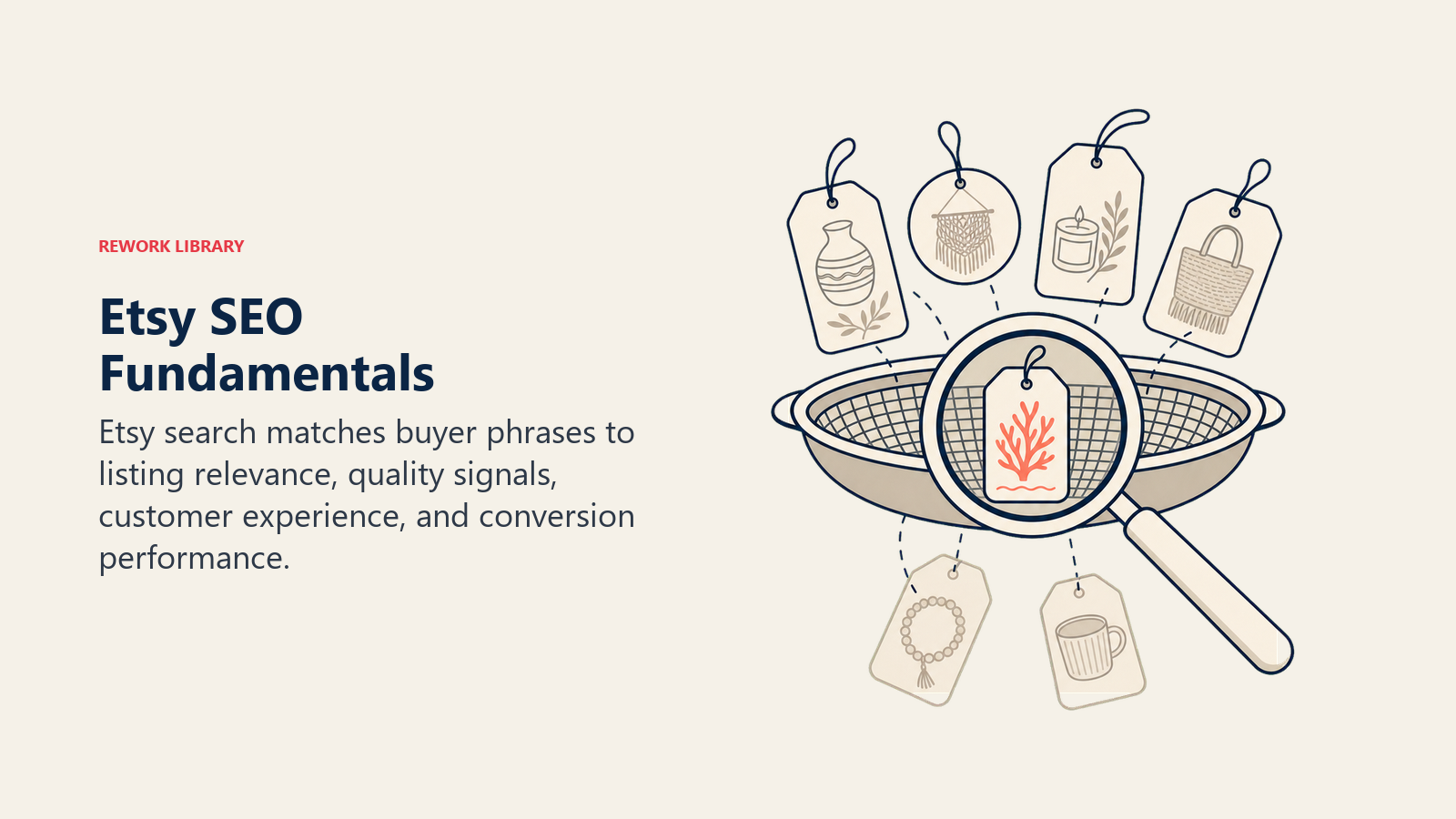
Etsy's ranking algorithm considers:
- Query matching: How well your titles, tags, and attributes match the search
- Listing quality score: Click-through rate, favorites, and conversions
- Customer and marketplace experience score: Reviews, shipping time, customer service
- Recency: Newly listed or recently renewed items get temporary boosts
- Shop quality: Overall shop reputation and performance
Title optimization strategy:
Your title has 140 characters to work with. Use them strategically.
Front-load the most important keywords first. Etsy weighs the beginning of your title more heavily than the end.
Effective pattern:
[Primary Keyword] | [Secondary Keyword] | [Differentiator] | [Material/Style]
Example:
Personalized Leather Wallet | Mens Minimalist Wallet | Custom Engraved Gift | Genuine Leather
This title hits multiple search intents while maintaining readability. Avoid keyword stuffing that makes your title sound robotic. Buyers need to read it, not just the algorithm.
Tag strategy:
You get 13 tags per listing. Each tag can be up to 20 characters and can include multiple words.
Use all 13 tags. Wasted tag slots are wasted visibility.
Tag selection framework:
- Exact match tags (2-3 tags): Your primary keywords exactly as buyers search
- Long-tail variations (4-5 tags): More specific combinations with lower competition
- Attribute tags (2-3 tags): Materials, colors, styles
- Occasion tags (2-3 tags): Gift occasions, seasonal relevance
Don't repeat words across tags unless necessary for phrase matching. "leather wallet" and "mens wallet" covers both terms without redundancy.
Attributes matter:
Fill out every single product attribute Etsy offers. These feed into structured search filters and help buyers narrow results.
Attributes include:
- Primary color
- Secondary color
- Materials
- Occasion
- Style
- Pattern
- Size options
- Personalization options
Incomplete attributes mean you won't show up when buyers filter search results. This is low-hanging optimization fruit that many sellers ignore.
Product Photography & Presentation
On Etsy, your photos do more than show the product. They tell the story of handmade quality and help buyers imagine owning it.
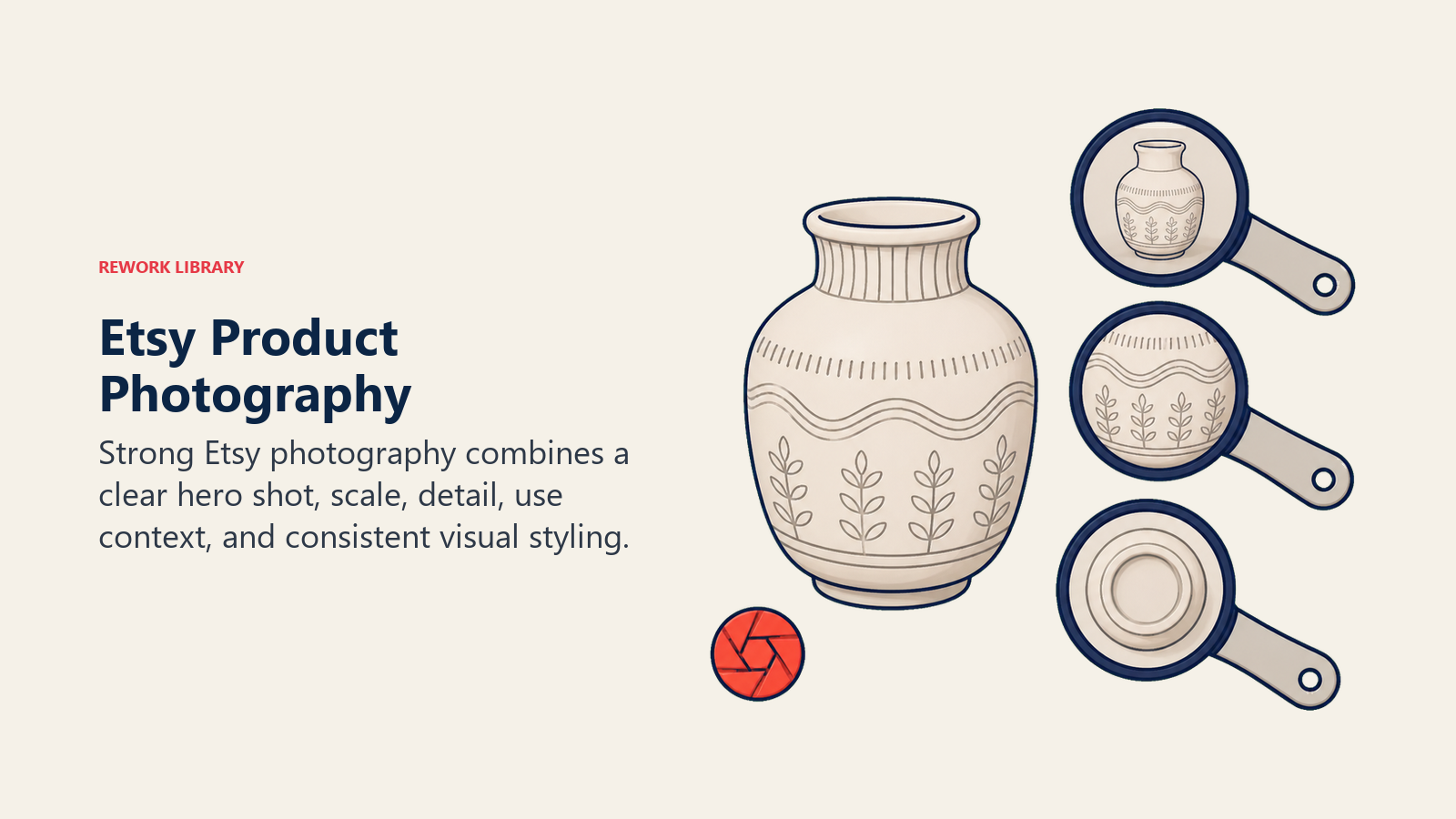
Etsy-specific photography requirements:
- Minimum 2000px on shortest side for best quality
- Square format (1:1 ratio) displays best in search results
- First photo is your search result thumbnail, make it count
- You can upload up to 10 photos per listing
The Etsy photography framework:
Photo 1 - The Hero Shot: Clean, well-lit product on a neutral background. This is your search result thumbnail. It needs to stand out in a grid of competing listings while clearly showing what you're selling.
Photo 2 - Scale and Context: Show the product in use or with size reference. Buyers need to understand dimensions, especially for handmade items where sizing can vary.
Photo 3 - Detail Shot: Close-up of craftsmanship, materials, or texture. This is where you showcase the handmade quality that justifies your price point.
Photo 4 - Lifestyle Shot: Product in a real-world setting. Help buyers visualize it in their life, not just as an object.
Photos 5-7 - Variations: Show different angles, color options, or use cases. Reduce pre-purchase questions by anticipating what buyers need to see.
Photo 8-10 - Story and Process: Consider showing your workspace, materials, or creation process. Etsy buyers appreciate the "made by hand" narrative.
Mobile optimization is critical:
Over 60% of Etsy traffic comes from mobile devices. Your photos need to look great on small screens.
Test your listings on your phone. If details are hard to see or text overlays are unreadable, adjust. Many sellers optimize for desktop and wonder why mobile conversions lag.
For more comprehensive photography strategies, see our guide on Product Photography & Video.
Shop Optimization & Branding
Your Etsy shop is your brand home on the platform. Treat it like a storefront, not just a collection of listings.
Essential shop elements:
Shop banner and logo: Your banner (3360 x 840px) and logo (500 x 500px) create first impressions. They should communicate your brand aesthetic immediately.
Avoid generic stock photos. Use branded graphics, product photography, or workspace shots that tell your story.
Shop announcement: The first thing buyers see when they visit your shop. Use this space to:
- Welcome visitors with your brand voice
- Highlight current promotions or bestsellers
- Set expectations for processing times
- Share your unique value proposition
Keep it concise. Three to four sentences maximum.
About section: This is where you tell your story. Etsy buyers care about the person behind the products.
Effective About section structure:
- Who you are and why you create
- Your process or materials
- What makes your products special
- Your commitment to quality or customer service
Include a photo of yourself or your workspace. It humanizes your brand and builds trust.
Shop policies:
Clear, comprehensive policies reduce customer service issues and build confidence.
Cover these areas:
- Processing times (be realistic, not optimistic)
- Shipping methods and timeframes
- Return and exchange policies
- Customization options and timelines
- How to contact you with questions
Buyers read policies before purchasing. Vague or missing policies create purchase hesitation.
Brand consistency across listings:
Your shop should feel cohesive. Consistent photography style, similar descriptions structure, and unified branding signal professionalism.
Inconsistent listings suggest you're reselling rather than creating, which undermines the handmade positioning that makes Etsy special.
Pricing Strategy on Etsy
Etsy pricing requires a different approach than cost-plus formulas. You're selling craftsmanship and uniqueness, not commodities.
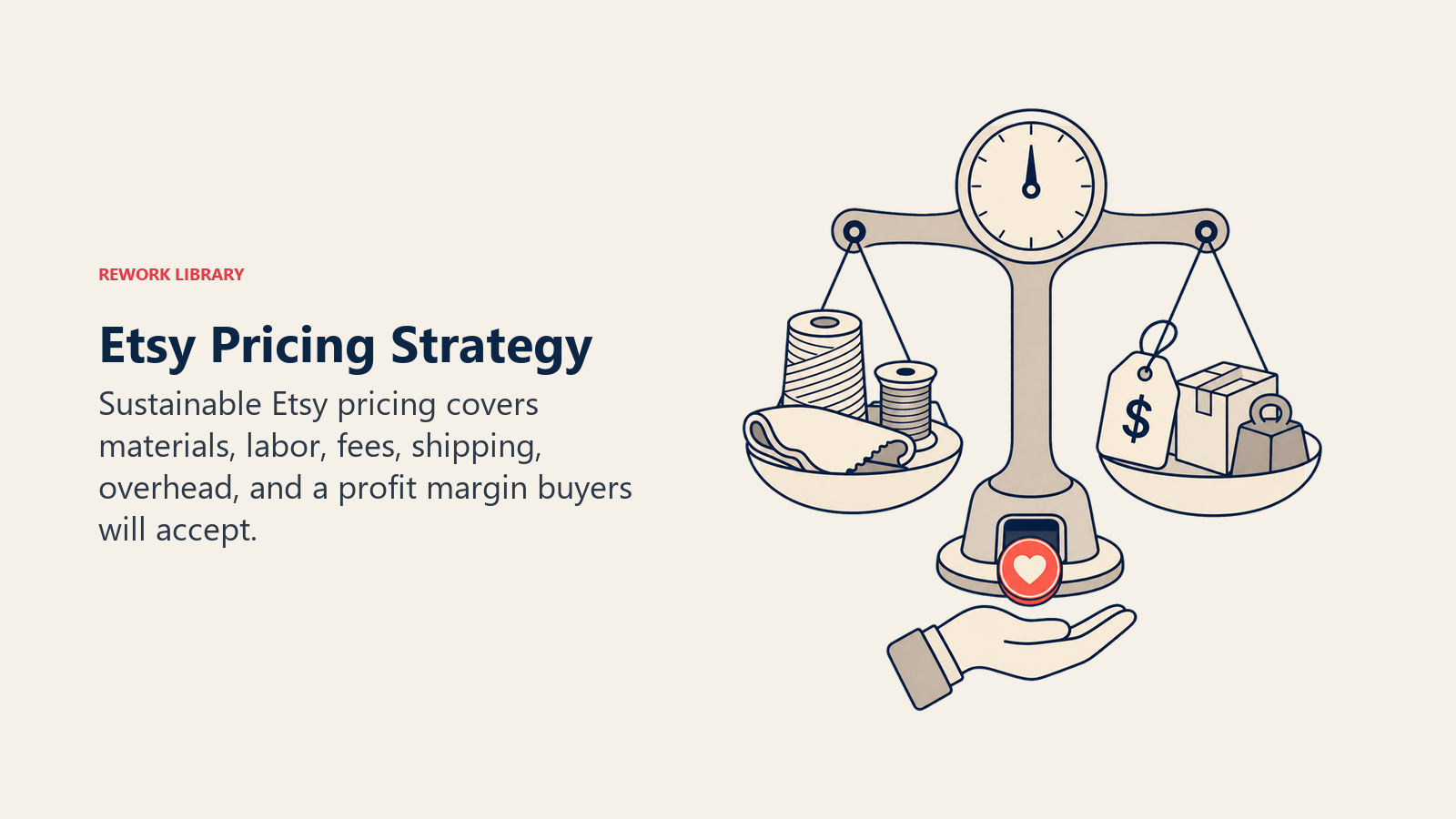
The full cost breakdown:
Materials cost: Track every component, down to packaging materials. Don't estimate, calculate.
Labor cost: Time your production process. Multiply by your target hourly rate. Don't shortchange your time just because you work from home.
Overhead cost: Tools, equipment depreciation, workspace, utilities. Allocate a percentage to each product.
Etsy fees:
- 6.5% transaction fee
- $0.20 listing fee (amortized across expected sales)
- 3% + $0.25 payment processing
- Advertising cost if using Etsy Ads (typically 12-15% of attributed sales)
Formula:
(Materials + Labor + Overhead) ÷ (1 - 0.095 - Ad percentage) = Minimum Price
Then add your profit margin on top.
Competitive analysis:
Search for comparable products on Etsy. Sort by bestsellers and note pricing patterns.
You don't need to be the cheapest. On Etsy, mid-to-premium pricing often outperforms budget pricing because it signals quality.
If your pricing is higher than competitors, make sure your photography, descriptions, and reviews justify the premium. If it's lower, you might be leaving money on the table or signaling lower quality.
Psychological pricing on Etsy:
Round numbers ($50, $75, $100) work better than precise numbers ($47.99) for handmade products. The .99 pricing trick feels commercial and undermines the artisan positioning.
For related marketplace pricing strategies, see Shopify vs Marketplace to understand when to expand beyond Etsy.
Etsy Ads & Paid Promotion
Etsy Ads (formerly Promoted Listings) can accelerate growth, but only if your fundamentals are solid first.
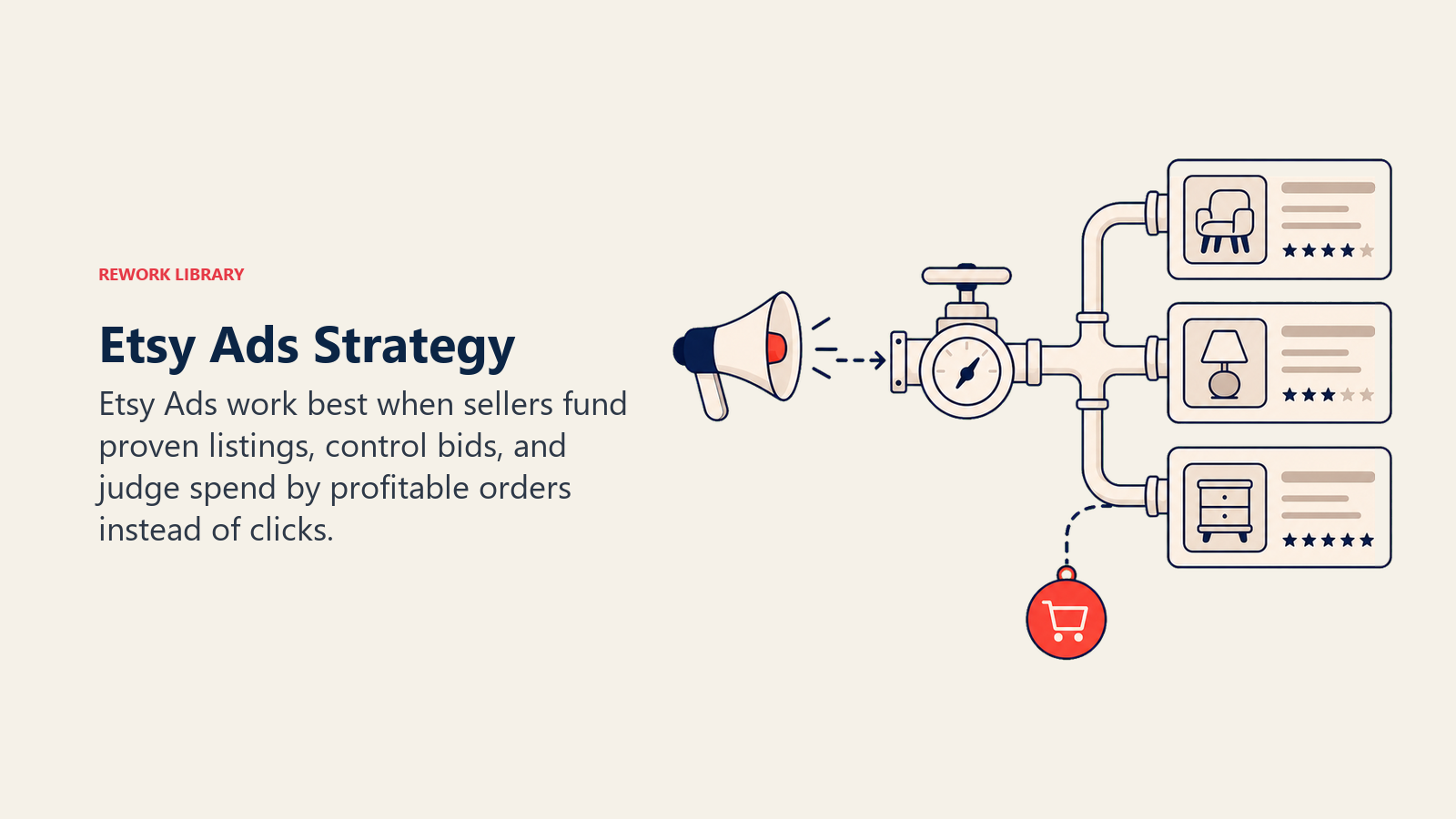
How Etsy Ads work:
You set a daily budget and Etsy promotes your listings in search results and category pages. You only pay when someone clicks your ad.
Etsy automatically optimizes which listings to promote based on their likelihood to convert. You can't manually select specific keywords or placements like Google Ads.
When to use Etsy Ads:
Don't run ads if:
- Your listings have less than 5 sales and reviews
- Your photos are weak or unprofessional
- Your pricing isn't validated through organic sales
- You haven't optimized titles, tags, and descriptions
Ads amplify what's already working. They don't fix fundamental listing problems.
Do run ads when:
- You have proven bestsellers with good conversion rates
- Your organic ranking is strong and you want to scale
- You're launching seasonal products and need quick visibility
- You have new products and want to accelerate the initial traction phase
Budget allocation strategy:
Start with $5-10 per day. Monitor for at least two weeks before making adjustments. Etsy's algorithm needs time to optimize.
Track these metrics:
- ROAS (Return on Ad Spend): Revenue from ads ÷ ad spend
- ACoS (Advertising Cost of Sale): Ad spend ÷ revenue from ads
- Target ACoS around 15-20% for profitability on most products
If your ACoS exceeds 30%, pause ads and fix your listings first. The problem isn't the ads, it's conversion rate or pricing.
Optimization approach:
Etsy shows you which listings are getting ad impressions and clicks. Double down on listings with good ad performance by ensuring they're always in stock and have competitive processing times.
Pause ads on listings with high ad spend but low conversions. Sometimes products that work organically don't work as well for paid traffic.
For broader advertising strategies, check out Amazon Advertising to see how marketplace ads compare across platforms.
Handmade Positioning & Differentiation
Etsy's handmade promise is both your biggest opportunity and your biggest constraint. Lean into it.
Authenticity beats perfection:
Buyers expect slight variations in handmade products. Small imperfections can actually reinforce authenticity if you position them correctly.
Mention in your descriptions: "Each piece is individually handcrafted, so slight variations make your item unique."
This sets expectations while highlighting the made-by-hand appeal.
Tell your creation story:
Your product didn't materialize in a factory. Share the process:
- Where you source materials
- How long each piece takes to create
- What techniques you use
- Why you chose this craft
Example from a successful ceramics shop: "Each mug is wheel-thrown in my home studio using locally sourced clay. I hand-paint the designs with food-safe glazes and fire them in my kiln. The entire process takes about a week from clay to finished mug."
This positions the product as worth the price and the wait.
Brand differentiation strategies:
Specialization: Don't try to be everything. Focus on becoming known for one thing done exceptionally well. "Personalized leather goods" beats "custom gifts and accessories."
Signature style: Develop visual or functional elements that make your products instantly recognizable. Maybe it's a particular color palette, a signature closure, or a distinctive packaging style.
Material quality: Source premium materials and talk about them. "Genuine Italian vegetable-tanned leather" tells a different story than just "leather."
Customization: Offering personalization increases perceived value and reduces direct price comparison with competitors.
For more on crafting compelling product narratives, see Product Description Writing.
Product Listing Optimization
Your listing description needs to accomplish multiple goals: provide information, tell your story, address concerns, and inspire purchase.
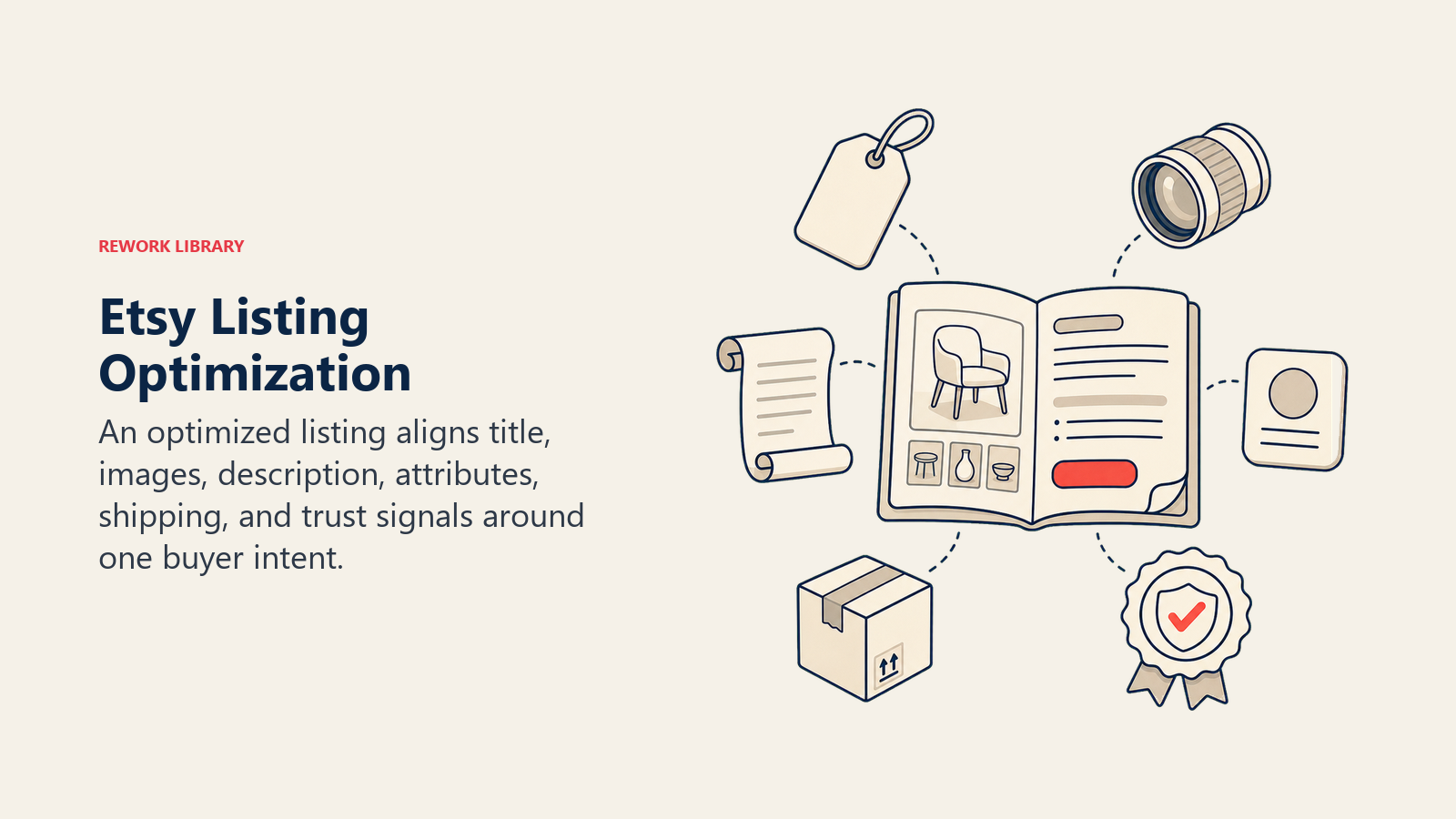
Description structure that converts:
Opening paragraph - The hook: Lead with the benefit or feeling, not the features. "Imagine starting each morning with coffee from a handmade mug that fits perfectly in your hands" beats "This is a ceramic mug."
Section 2 - Key features and specifications: Bullet points work well here. Include:
- Dimensions
- Materials
- Colors/variations available
- Care instructions
- Customization options
Make it scannable. Buyers skim.
Section 3 - The story: Why you make this product, what makes it special, how it's made. This is where handmade positioning happens.
Section 4 - Policies and expectations: Processing time, shipping info, return policy recap. Addressing these in the description reduces pre-purchase anxiety.
SEO in descriptions:
Etsy's algorithm reads your description, but it's weighted less than titles and tags. Write for humans first, then incorporate keywords naturally.
Front-load important keywords in the first 160 characters. This text shows in search results as your preview.
Conversion-focused elements:
Scarcity and urgency (when authentic): "Only 3 available" or "Processing time increases to 2 weeks after December 10th" create purchase motivation.
Don't manufacture false scarcity. Etsy buyers see through it, and it damages trust.
Social proof: Reference bestseller status or review highlights: "Our most popular wallet design" or "Customers love the soft leather and compact size."
Clear calls to action: "Click 'Add to Cart' to customize your order" or "Message me with questions before ordering."
For deeper optimization techniques, review Product Page Optimization.
Building Customer Reviews
Reviews are the currency of trust on Etsy. The algorithm favors shops with strong review profiles, and buyers heavily weight reviews in purchase decisions.
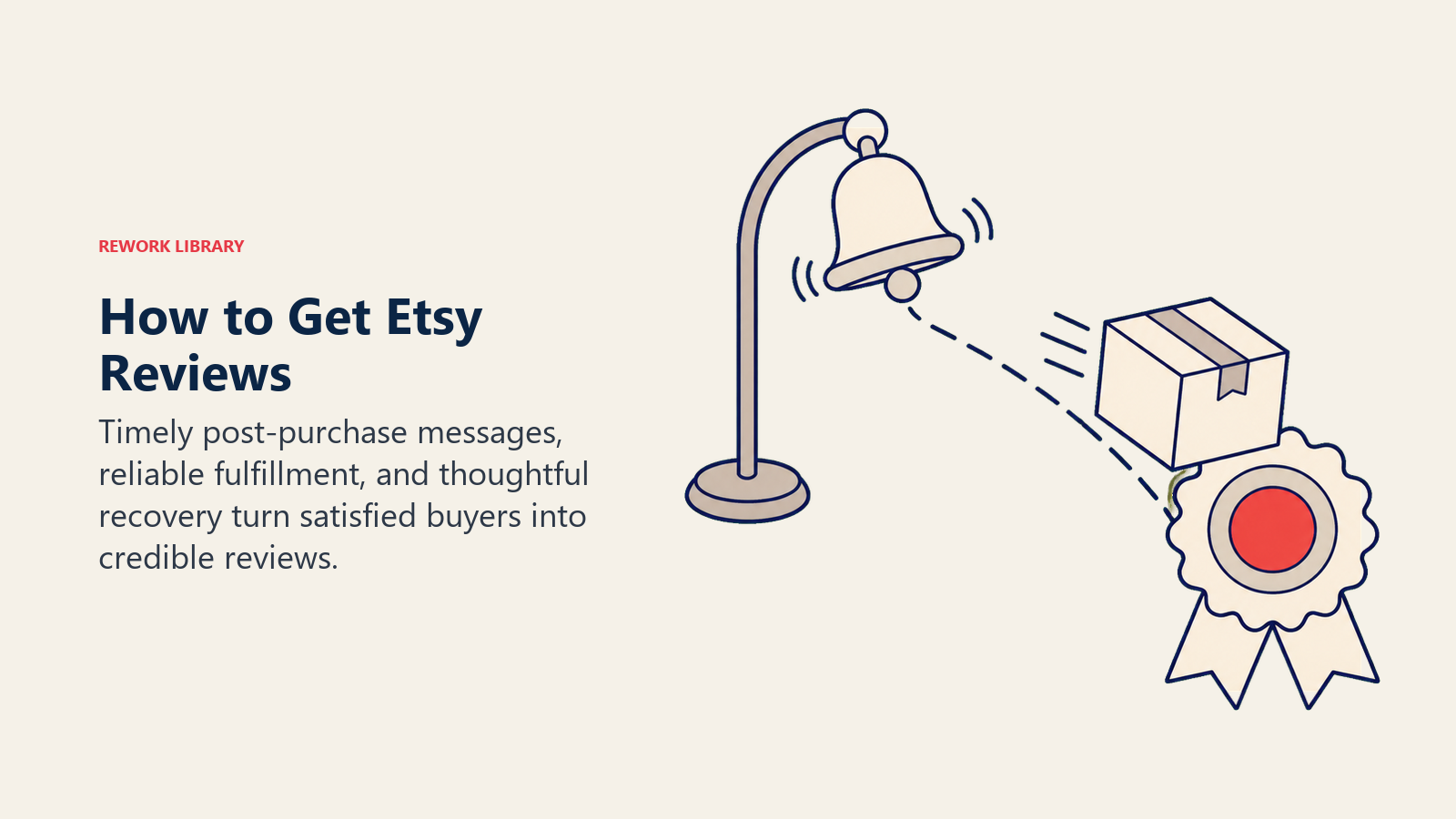
The review generation system:
Etsy automatically requests reviews from buyers a few days after estimated delivery. But you can increase review rates through strategic follow-up.
Post-purchase sequence:
- Shipment notification: Thank them for the purchase, provide tracking
- Delivery follow-up: Message 2-3 days after delivery asking if everything arrived safely
- Review request: A week after delivery, politely ask for a review if they're happy with the product
Keep messages brief and genuine. Over-aggressive review requests backfire.
The message template that works:
"Hi [Name], I hope your [product] arrived safely! I'd love to hear what you think. If you're happy with your purchase, I'd really appreciate it if you could leave a review. It helps other buyers find my shop. Thanks so much for supporting my small business!"
Personal, appreciative, and clear about why you're asking.
Handling negative reviews:
Respond quickly and professionally to every review, especially negative ones.
Response framework:
- Thank them for feedback
- Apologize for their experience (even if you disagree)
- Offer a solution
- Take conversation private if needed
Public responses show potential buyers how you handle issues. Professional, solution-oriented responses can actually increase trust.
Review recovery:
If a buyer leaves a negative review, you can message them to resolve the issue. If you fix it to their satisfaction, they can update their review.
Offer refunds, replacements, or partial refunds depending on the situation. One negative review can cost you many future sales. The math usually favors resolution.
Shop Statistics & Analytics
Etsy provides robust stats tools. Use them.
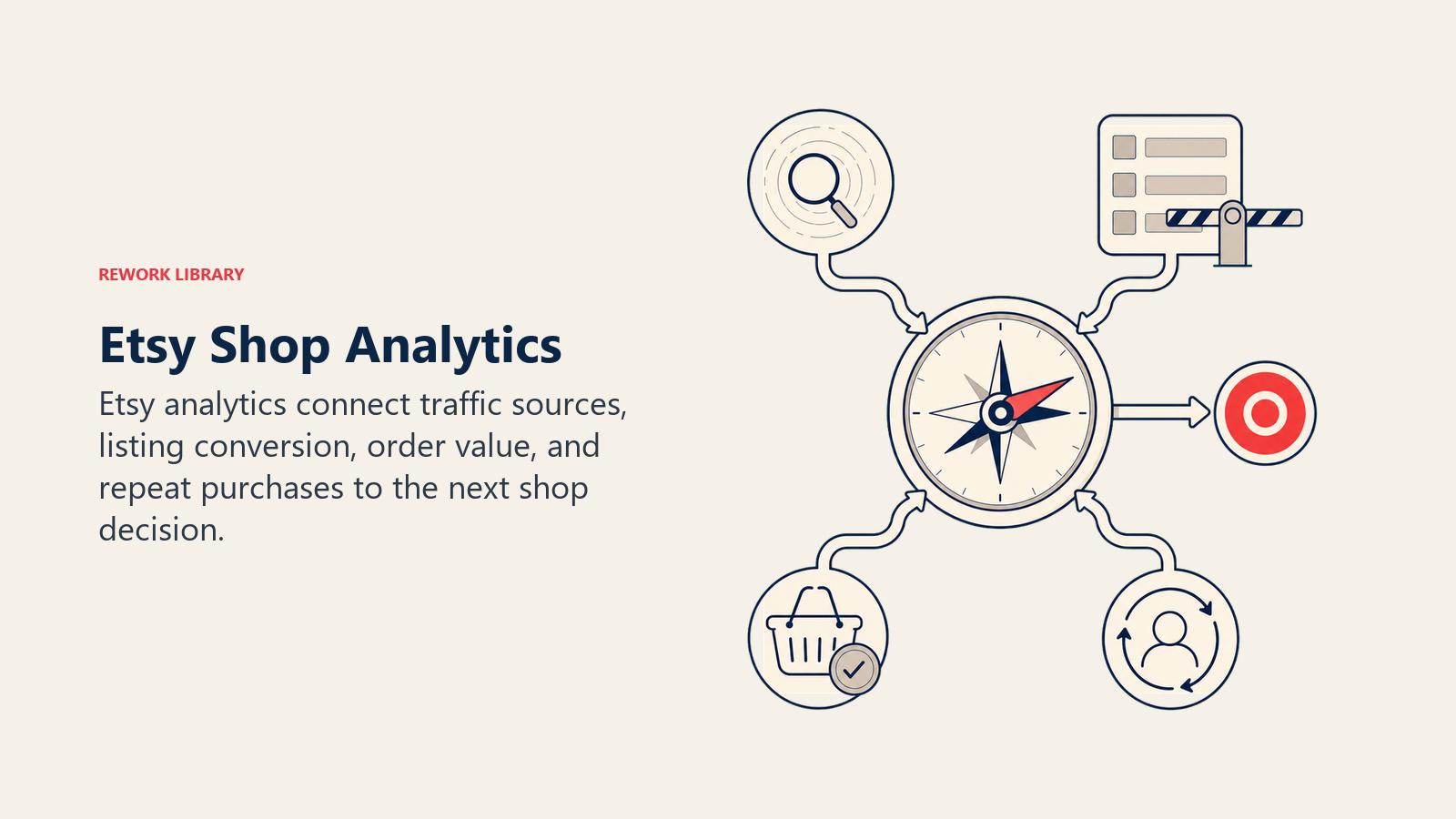
Key metrics to track weekly:
Visits: Total traffic to your shop. Track the trend, not day-to-day fluctuations.
Views: Individual listing views. Which products are getting traffic? If visits are high but views are low, your shop homepage needs work.
Favorites: Products added to wishlists. High favorites with low sales suggests pricing or listing optimization issues.
Orders: Sales volume and revenue. Track against marketing activities to identify what's working.
Conversion rate: Orders ÷ visits. Etsy average is around 1-3%. If you're below 1%, focus on conversion optimization before traffic acquisition.
Traffic sources:
Etsy shows where your traffic comes from:
- Etsy search and browse
- Direct and other Etsy pages
- Social media
- Etsy Ads
- External sources
If Etsy search is low, improve SEO. If social is high but conversion is low, you might be attracting the wrong audience.
Best performing listings:
Double down on what's working. Your top 20% of listings likely drive 80% of sales.
Strategies to amplify winners:
- Renew them more frequently for ranking boosts
- Create variations or complementary products
- Allocate more ad budget to them
- Feature them prominently in your shop
Search terms report:
Etsy shows which searches led to your listings being viewed. This data is gold.
Find high-performing search terms and incorporate them into other relevant listings. Identify search terms where you're getting impressions but no clicks, and adjust your main photos or titles.
For broader e-commerce SEO strategies, see E-commerce SEO Strategy.
Scaling Beyond Etsy
Etsy is a powerful platform, but platform dependency is risky. As you grow, diversification becomes critical.
Multi-channel expansion strategy:
Phase 1 - Etsy dominance: Master Etsy first. Build reviews, refine product-market fit, optimize operations.
Phase 2 - Owned channel: Launch a Shopify store or standalone e-commerce site. This gives you customer data and eliminates marketplace fees for direct traffic.
Use Etsy to acquire customers, then build an email list and drive repeat purchases through your owned channel.
Phase 3 - Additional marketplaces: Consider Amazon Handmade or other specialized marketplaces. Each platform has different buyer psychology and economics.
Phase 4 - Wholesale or licensing: Once you've validated products at scale, explore wholesale partnerships or licensing your designs.
The customer data strategy:
Etsy owns the customer relationship, not you. You can't export customer emails or retarget buyers directly.
Workarounds:
- Include business cards or postcards in packages with your website
- Offer discounts for joining your email list
- Create social media presence and drive Etsy buyers there
- Use package inserts to build your owned audience
When to prioritize your own site:
If you're spending heavily on Etsy Ads, calculate what those costs could do for your own site traffic. At some point, owning the customer relationship and eliminating transaction fees becomes more profitable.
Break-even analysis: If Etsy fees + ad costs exceed 25% of revenue, and you're getting meaningful traffic from sources you control (social, email, content), your own site becomes financially attractive.
For comprehensive marketplace strategy considerations, read Multi-Channel Marketplace Strategy.
Etsy Photography Checklist
Use this checklist for every product listing:
Technical requirements:
- Minimum 2000px on shortest side
- Square aspect ratio (1:1) for search optimization
- Good lighting (natural light or softbox setup)
- Neutral background for primary photo
- Sharp focus with no blurring
Photo sequence:
- Photo 1: Hero shot on neutral background
- Photo 2: Scale reference or product in use
- Photo 3: Close-up of craftsmanship/texture
- Photo 4: Lifestyle context shot
- Photos 5-7: Multiple angles and variations
- Photos 8-10: Story elements (workspace, process, materials)
Mobile optimization:
- Tested on mobile device
- Details visible on small screens
- Text overlays readable (if used)
- Color accurate across devices
Branding consistency:
- Matches overall shop aesthetic
- Similar editing style across all listings
- Consistent props or backgrounds
Etsy Algorithm Breakdown
Understanding what Etsy's search algorithm prioritizes helps you optimize strategically.
Ranking factors by importance:
1. Query matching (40% weight estimated):
- Title relevance to search query
- Tag exact and partial matches
- Attribute alignment with filters
- Category selection
2. Listing quality score (30% weight estimated):
- Click-through rate from search
- Conversion rate (views to purchases)
- Favorites and cart adds
- Time on listing page
3. Customer experience score (20% weight estimated):
- Shop review average and count
- Review recency and response rate
- Case/dispute history
- On-time shipping rate
- Message response time
4. Recency (10% weight estimated):
- New listings get temporary boost
- Renewed listings get smaller boost
- Seasonal relevance
What this means for optimization:
You can't game the algorithm, but you can align with what it rewards:
- Perfect your query matching through titles, tags, and attributes
- Improve CTR with better thumbnails and titles
- Increase conversion through better photos, descriptions, and pricing
- Build review volume and maintain excellent customer service
- Maintain consistent inventory and shipping performance
The shops that succeed on Etsy aren't gaming the system. They're creating genuinely great listings that serve buyers well. The algorithm rewards that.
Frequently Asked Questions
How fast can you grow an Etsy shop? Most sellers see meaningful movement within 60 to 90 days once listings are SEO-optimized and photography is strong. Growth compounds: early reviews and sales feed the algorithm, which raises ranking, which drives more sales. Expect a slow first month while the algorithm gathers signals, then steeper gains as your quality score climbs.
What is the single biggest driver of Etsy growth? Listing quality score, which Etsy builds from click-through rate, favorites, and conversion. That means your first photo and your title do most of the work, because they decide whether buyers click and buy. Fix those before spending on ads.
Should new Etsy sellers run Etsy Ads right away? No. Ads amplify listings that already convert, so run them only after you have proven bestsellers with solid photos, validated pricing, and at least a handful of reviews. Starting ads too early just pays to send traffic to pages that don't convert.
How is growing on Etsy different from Amazon or Shopify? Etsy buyers reward story, craftsmanship, and authenticity over pure price and convenience, so your growth strategy leans on brand and narrative. For when to diversify beyond Etsy, see Multi-Channel Marketplace Strategy and Shopify vs Marketplace.
What metrics should Etsy sellers track to grow? Watch conversion rate (orders divided by visits, with 1 to 3% as the Etsy norm), favorites-to-sales ratio, and traffic source mix. For the broader framework, review E-commerce Metrics and KPIs and E-commerce SEO Strategy.
Etsy success isn't about tricks or hacks. It's about understanding a platform built for handmade authenticity, then delivering on that promise better than your competitors.
Optimize your SEO, perfect your photography, tell your story authentically, and treat every customer interaction as an opportunity to build your reputation. The algorithm will reward you, and more importantly, buyers will choose you.
Start with your best-performing products, implement the frameworks in this guide, and scale what works. Your Etsy shop can become a meaningful revenue stream, a launchpad for your brand, or both.
The makers who win on Etsy don't just sell products. They sell craftsmanship, story, and the feeling of supporting something real. Make sure your growth strategy reflects that.

Sales Operations Practice Lead
On this page
- Why Etsy is Unique Among Marketplaces
- Understanding the Etsy Ecosystem
- Etsy SEO Fundamentals
- Product Photography & Presentation
- Shop Optimization & Branding
- Pricing Strategy on Etsy
- Etsy Ads & Paid Promotion
- Handmade Positioning & Differentiation
- Product Listing Optimization
- Building Customer Reviews
- Shop Statistics & Analytics
- Scaling Beyond Etsy
- Etsy Photography Checklist
- Etsy Algorithm Breakdown
- Frequently Asked Questions