Subscribe & Save Programs: Building Recurring Revenue Through Subscription Discounts
Turn this article into takeaways for your work.


Each assistant summarizes the article only for you and suggests best practices for your work.
Subscribe & save programs are one of the most effective ways to build predictable recurring revenue in e-commerce. Offer customers a discount in exchange for regular, automated purchases. It's a win-win: customers save money and eliminate the hassle of reordering, while businesses gain predictable revenue streams and better inventory planning.
The model is simple, offer 5-20% off in exchange for subscription enrollment, but the business impact can be massive. Companies with successful subscribe & save programs typically see 3-5x higher customer lifetime value (LTV) compared to one-time purchasers, much lower customer acquisition costs when spread over time, and better gross margins through improved inventory forecasting and less waste.
This guide covers everything you need to design, launch, and optimize a subscribe & save program that drives meaningful business results.
The Business Case for Subscribe & Save
Subscribe & save programs deliver three business advantages for nearly any e-commerce business selling consumable or regularly repurchased products. Recurring revenue and cash flow predictability. When customers enroll in subscribe & save, you gain visibility into future revenue that traditional one-time purchases can't provide. A business with 30% of customers on subscriptions can forecast that revenue with high confidence 3-6 months out, enabling better financial planning, more aggressive growth investments, and improved valuations for companies seeking funding. Monthly recurring revenue (MRR) becomes a trackable, improvable metric that transforms business operations.
Inventory planning and working capital efficiency. Knowing that 1,000 customers will receive deliveries next month allows you to optimize inventory levels, negotiate better terms with suppliers through volume commitments, and reduce both stockouts and overstock situations. Companies often see 20-30% improvements in inventory turnover after implementing successful subscribe & save programs. This working capital efficiency alone can justify the discount you're offering customers. For more on managing stock levels effectively, see our guide on inventory management.
Margin improvement through operational efficiency. While you're offering a discount, the economics often work out favorably. Subscription orders have lower customer service costs (fewer "where's my order" inquiries since delivery is expected), reduced payment processing fees through saved payment methods, lower marketing costs per order, and often higher average order values when customers bundle multiple products. The net margin on subscription orders frequently exceeds one-time purchases even with the discount applied.
The key is understanding that you're not just discounting, you're exchanging a discount for guaranteed future purchases and dramatically reduced friction in the customer journey.
Subscribe & Save Program Fundamentals
Subscribe & save programs differ from traditional subscription model design in several important ways that affect how you structure your program.
Flexible vs. committed subscriptions. Traditional subscriptions often involve fixed product sets delivered at predetermined intervals (think meal kits or beauty boxes). Subscribe & save gives customers significantly more control, they choose which specific products to subscribe to, can mix and match different delivery frequencies for different items, and maintain the ability to skip, pause, or cancel without penalties. This flexibility reduces perceived risk and increases enrollment rates, but requires more sophisticated management systems.
Discount as the primary value proposition. While traditional subscription services emphasize discovery, curation, or exclusive access, subscribe & save leads with savings and convenience. The value proposition is straightforward: same products you already buy, delivered automatically, for less money. This clarity makes subscribe & save easier to market but means your discount structure needs to be genuinely attractive.
Individual product subscriptions vs. bundled offerings. Customers subscribe to individual products rather than predetermined bundles. Someone might subscribe to coffee and dog food but buy other products one-time. This à la carte approach increases program accessibility but requires clear systems for managing multiple subscription frequencies across a single customer account.
The most successful programs balance flexibility with encouraging long-term commitment. You want customers to feel in control while still building habitual purchasing patterns that drive retention.
Discount Strategy & Economics
The discount you offer is the central economic lever in your subscribe & save program. Get it right, and you create a sustainable competitive advantage. Get it wrong, and you erode margins without driving meaningful behavioral change. Standard discount structures typically range from 5% to 25%, with most successful programs landing in the 10-15% range: | Discount Tier | Best For | Customer Psychology | Margin Impact | |--------------|----------|---------------------|---------------| | 5-10% | Premium brands, low-margin categories | Signals value without cheapening brand | Minimal margin erosion, often offset by operational savings | | 10-15% | Mainstream categories, moderate margins | Sweet spot for perceived value vs. commitment | Manageable margin impact, recovered through LTV increase | | 15-20% | High-margin products, competitive markets | Strong motivator for switching from competitors | Significant margin trade-off, requires high retention to justify | | 20-25% | Market disruption, customer acquisition focus | Aggressive value proposition | Substantial margin pressure, works only with very high LTV multiples |
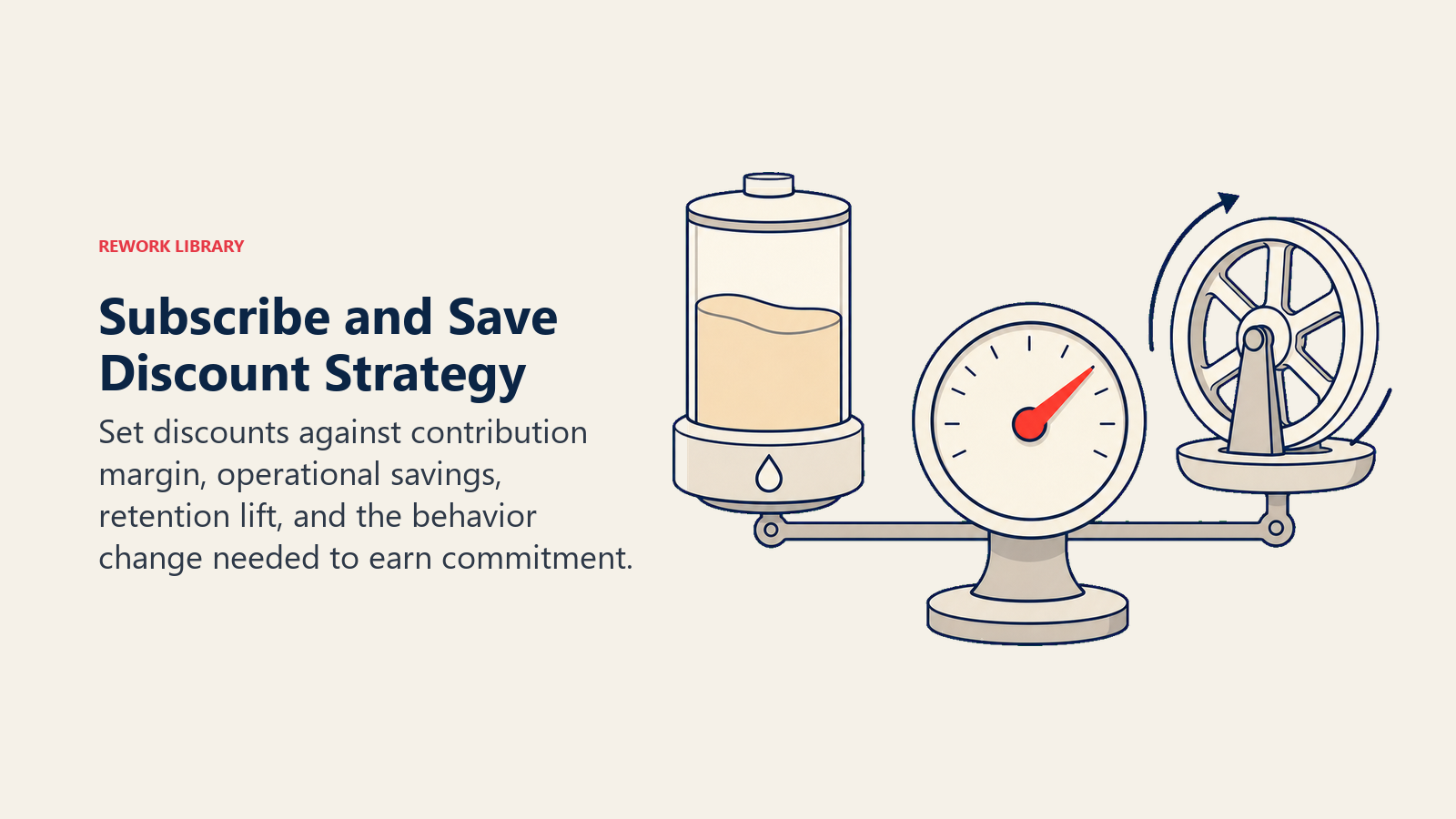
Flat vs. tiered discount structures. The simplest approach is a flat discount (e.g. "Save 15% on all subscriptions"). This is easy to communicate and requires minimal system complexity. However, tiered structures can drive more strategic behavior: 5% off for one subscribed item, 10% off for 2-3 items, 15% off for 4+ items. This encourages customers to subscribe to more products, increasing their commitment and your recurring revenue base.
Frequency-based discounts. Some programs offer better discounts for more frequent deliveries (e.g. 10% off monthly, 15% off bi-weekly). This works well for fast-consuming products where you want to encourage higher consumption rates, but can backfire if customers feel pressured into unnecessarily frequent deliveries that lead to product accumulation and eventual cancellation.
The margin math that matters. When evaluating discount sustainability, calculate the contribution margin on subscription vs. one-time orders:
- One-time order: 100% price × 40% gross margin - 15% marketing/acquisition cost = 25% contribution margin
- Subscription order: 85% price (15% discount) × 40% gross margin - 3% marketing cost (amortized) = 31% contribution margin
In this example, the subscription order is actually more profitable per order, even with the discount, because marketing costs are spread across multiple future orders. The key is achieving retention that justifies the math, generally 3+ orders before cancellation makes the economics work. Understanding these unit economics for e-commerce is important for setting sustainable discount levels.
Frequency & Delivery Options
The delivery frequency options you offer dramatically impact both enrollment rates and long-term retention. Too rigid, and customers won't enroll; too flexible, and you lose the planning benefits that make subscriptions valuable. Standard frequency options for most subscribe & save programs include:
- Weekly: Rarely used, primarily for perishables or very fast-consuming products (fresh flowers, produce)
- Bi-weekly (every 2 weeks): Growing in popularity, works well for household essentials consumed quickly
- Monthly (every 30 days): The most common default, strikes a balance for most product categories
- Every 6 weeks: Popular middle-ground for moderate consumption products
- Every 2 months (60 days): Common for products that last longer but are regularly repurchased
- Quarterly (every 90 days): Works for slower-consuming products or bulk purchases
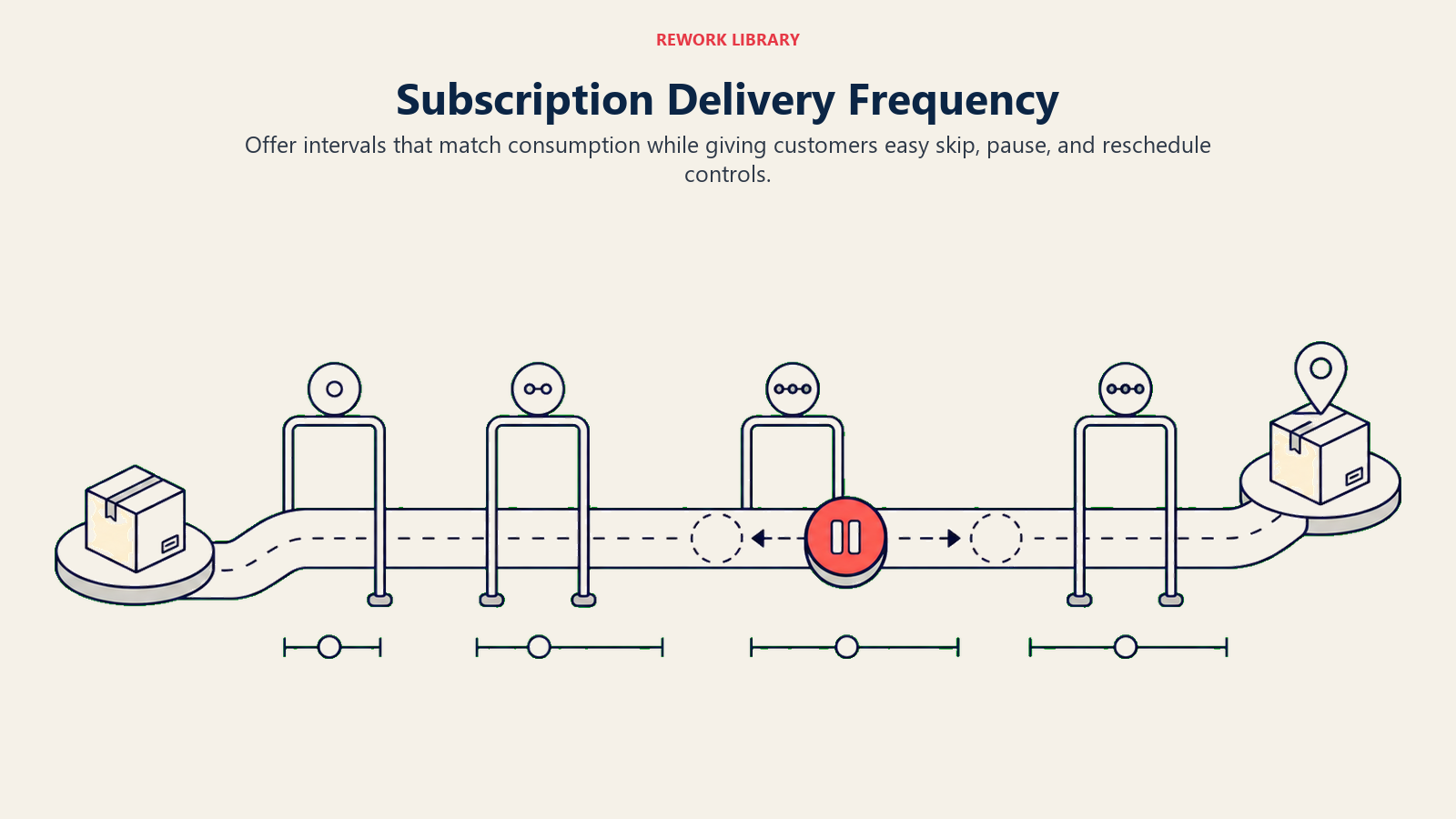
The key is offering enough options that customers can match their actual consumption patterns (reducing waste and cancellations) without overwhelming them with choices.
Skip and pause functionality. This is non-negotiable for modern subscribe & save programs. Customers must be able to easily skip an upcoming delivery or pause their subscription temporarily. Companies that make this difficult see dramatically higher cancellation rates, customers who can't skip will cancel entirely rather than receive unwanted products. Make skip/pause options prominent in your customer portal and send reminder emails 3-5 days before each scheduled delivery with clear skip options.
Delivery date control vs. interval control. Some systems let customers choose specific delivery dates ("deliver every month on the 15th"), while others work on intervals from the previous order ("deliver every 30 days"). Interval systems are simpler to manage but can lead to delivery dates drifting over time. Date-based systems give customers more control but require more sophisticated scheduling systems. Most successful programs use interval-based systems with the ability to modify the next specific delivery date.
The convenience factor. Convenience is part of your value proposition. Customers shouldn't have to think about reordering. Here's what works: send reminder emails 5 days before each subscription delivery that say "Your [product] will arrive on [date]. No action needed, we've got you covered. [Skip this delivery]." This reinforces the convenience while giving customers an easy escape valve that actually reduces cancellations and improves customer retention strategies.
Product Selection & Bundling
Not all products are equally suited for subscribe & save programs. Choosing the right products and creating smart bundles can dramatically impact enrollment and retention. Ideal subscription products share several characteristics:
- Consumable and replenishable: Products that run out and need replacement (coffee, supplements, pet food, toiletries)
- Predictable consumption rates: Customers use products at relatively consistent intervals
- Frequent repurchase cycles: Ideally monthly or faster for maximum engagement
- Sufficient margin: Can support the discount while maintaining profitability
- Low variability desire: Products where customers want the same thing repeatedly, not constant variety
Poor subscription candidates include:
- Highly seasonal products where demand fluctuates dramatically
- Products with extremely variable consumption rates
- Items customers like to switch between frequently
- Very slow-moving products where subscriptions would be annual or less
- Products where "getting the wrong timing" creates significant waste
Bundle strategies for subscriptions. While subscribe & save emphasizes individual product choice, smart bundling can increase program value:
- Starter bundles: Pre-configured sets for new subscribers ("Essential Morning Routine") that customers can then customize
- Complementary product suggestions: "Customers who subscribe to X often add Y" prompts that increase cart size
- Themed collections: Curated sets around use cases (pet care, workout recovery) offered as optional subscription bundles
- Subscribe & save stacks: Volume tiers where subscribing to multiple products unlocks better discounts, similar to loyalty programs
The goal is making it easy for customers to subscribe to everything they need regularly without overwhelming them with too many individual decisions upfront.
Subscription Management & UX
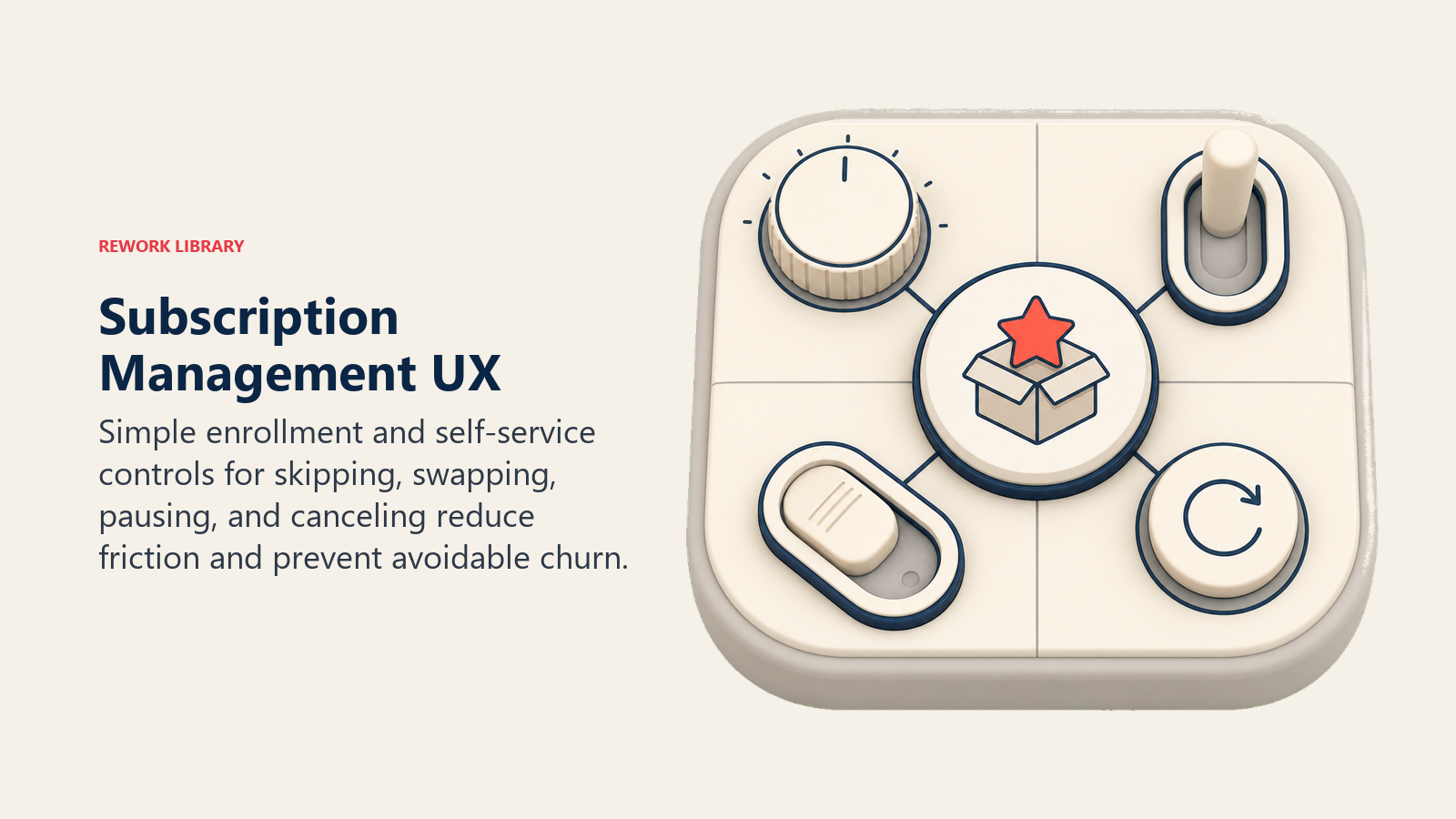
The user experience of managing subscriptions often determines whether customers enroll and stay enrolled. Friction here drives cancellations; simplicity drives retention. Enrollment flow optimization. The point of subscription enrollment is critical. Best practices include:
- Product page enrollment: Clear "Subscribe & Save" option on every eligible product page with the discount prominently displayed
- Cart page prompts: Reminder at checkout that eligible items can be converted to subscriptions
- First-purchase incentives: Extra discount on first subscription order to overcome enrollment hesitation
- One-click enrollment: Minimize form fields, use existing customer information wherever possible
Amazon's approach is instructive: the subscribe & save option is a simple toggle on the product page with the discount immediately visible in the price. No separate flow, no extra steps.
Subscription dashboard design. Once enrolled, customers need a clear dashboard to manage all subscriptions. Essential features:
- Overview of all active subscriptions: Products, frequencies, next delivery dates at a glance
- One-click skip/pause: No confirmation screens or friction for these actions
- Easy frequency changes: Dropdown to adjust delivery interval without contacting support
- Quantity adjustments: Ability to change from 1 to 2 bags of coffee, for example
- Add products: Direct ability to add new products to subscription from the dashboard
- Billing information management: Update payment methods without re-enrolling
- Delivery history: Clear record of past deliveries and upcoming schedule
Modification permissions and guidance. A common pain point: customers want to modify their upcoming delivery but don't know the deadline. Clearly communicate modification windows ("Changes to your July 15 delivery must be made by July 12") and send reminder emails before this window closes. The easier you make modifications, the less likely customers are to simply cancel out of frustration.
Mobile optimization. The majority of subscription management happens on mobile devices, often in micro-moments ("I need to skip next week's delivery"). Your dashboard must be fully responsive and fast-loading, with large, easily tappable buttons for common actions.
Retention & Churn Management
Even the best-designed subscribe & save programs face churn. Understanding why customers cancel and implementing smart interventions is key to program success. Typical churn patterns for subscribe & save programs:
- Early churn (orders 1-3): 20-35% of subscribers cancel after 1-2 deliveries, usually due to poor frequency fit or buyer's remorse
- Mid-term churn (orders 4-8): 10-15% cancel due to product accumulation, changing needs, or competitive offers
- Long-term churn (orders 9+): 5-8% annual churn from life changes, dissatisfaction, or natural attrition
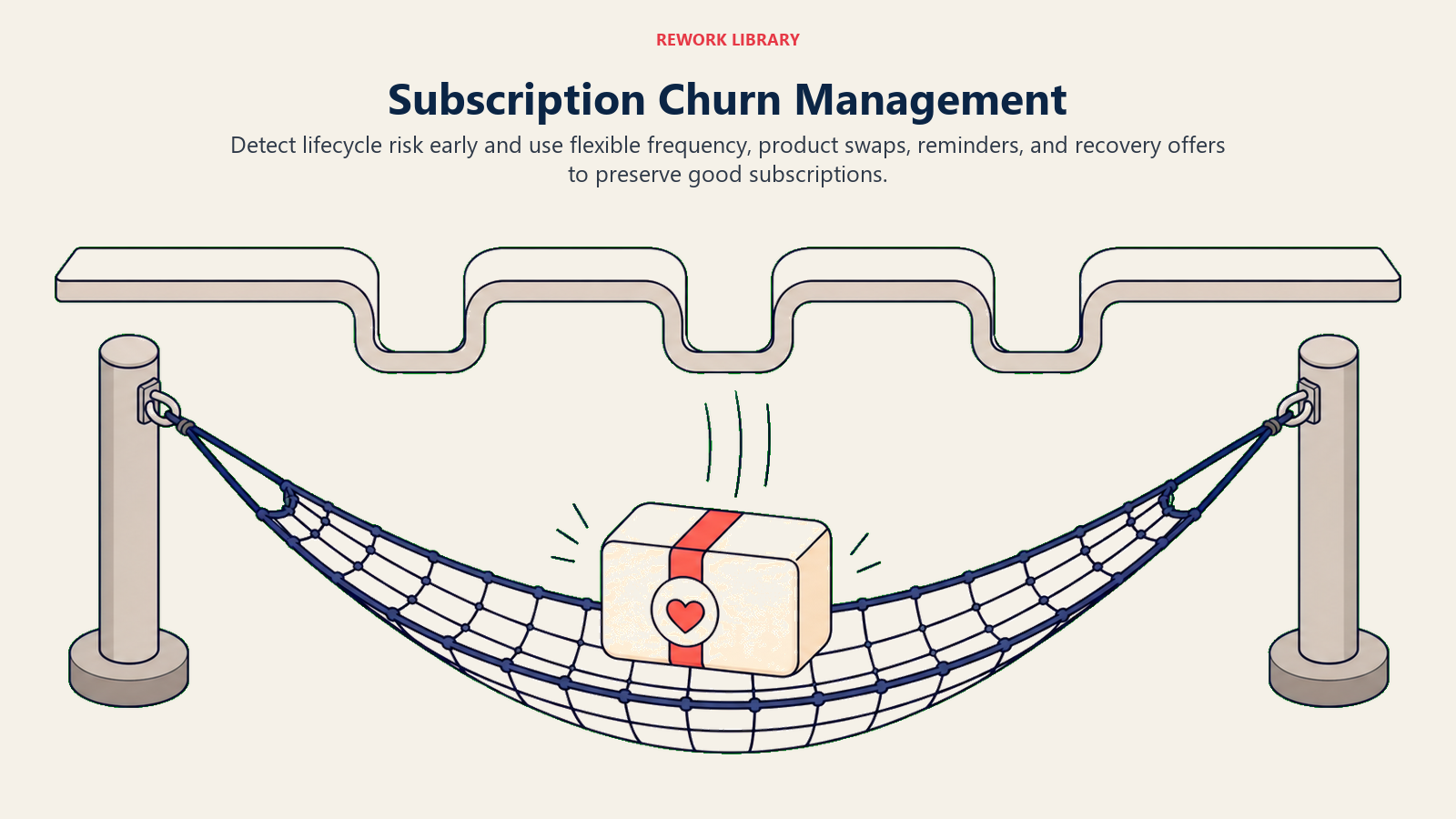
Your retention efforts should target each phase differently.
Common cancellation reasons and solutions:
| Cancellation Reason | Frequency | Solution |
|---|---|---|
| "I have too much product" | 35-40% | Proactive frequency adjustment offers, easier skip functionality |
| "I want to try something else" | 15-20% | Product swap options, variety bundles, "pause & explore" programs |
| "It's too expensive" | 10-15% | Loyalty rewards, increased discounts for long-term subscribers |
| "I found it cheaper elsewhere" | 8-12% | Price match guarantees, emphasize total value including free shipping |
| "I forgot I was subscribed" | 8-10% | Better reminder emails, improve delivery visibility |
| "The product quality declined" | 5-8% | Quality assurance, direct customer feedback loops |
Retention intervention strategy. Implement these touchpoints to reduce churn:
- Pre-delivery reminders (5 days before): Confirm upcoming delivery with easy skip option, reduces unwanted deliveries
- Post-delivery engagement (2 days after): "How was your delivery?" email that solves problems before they lead to cancellation
- Consumption check-ins (mid-cycle): "How's your supply?" messages that offer frequency adjustments before product accumulates
- Cancellation deflection (at point of cancel): When customers attempt to cancel, offer alternatives: pause for 30 days, skip next 2 deliveries, reduce frequency, or switch products
- Win-back campaigns (30-60 days post-cancellation): Special offers to re-enroll lapsed subscribers with improved terms
The importance of flexibility. Data consistently shows that customers who use skip or pause features have higher long-term retention than those who never modify their subscriptions. This seems counterintuitive but makes sense: engaged customers who actively manage their subscriptions are more invested in the program than those who passively receive deliveries until accumulation forces cancellation. Implementing effective email marketing for e-commerce helps keep subscribers engaged throughout their journey.
Pricing & Financial Modeling
Understanding the full financial model of your subscribe & save program is essential for setting sustainable discounts and making smart growth investments. The CAC vs. LTV equation. Subscribe & save programs work when the lifetime value of a subscription customer significantly exceeds acquisition cost:
- Target ratio: 3:1 LTV to CAC (a $150 LTV justifies $50 acquisition cost)
- Subscription advantage: One-time customers might have $80 LTV with $40 CAC (2:1 ratio), while subscribers achieve $240 LTV with $50 CAC (4.8:1 ratio)
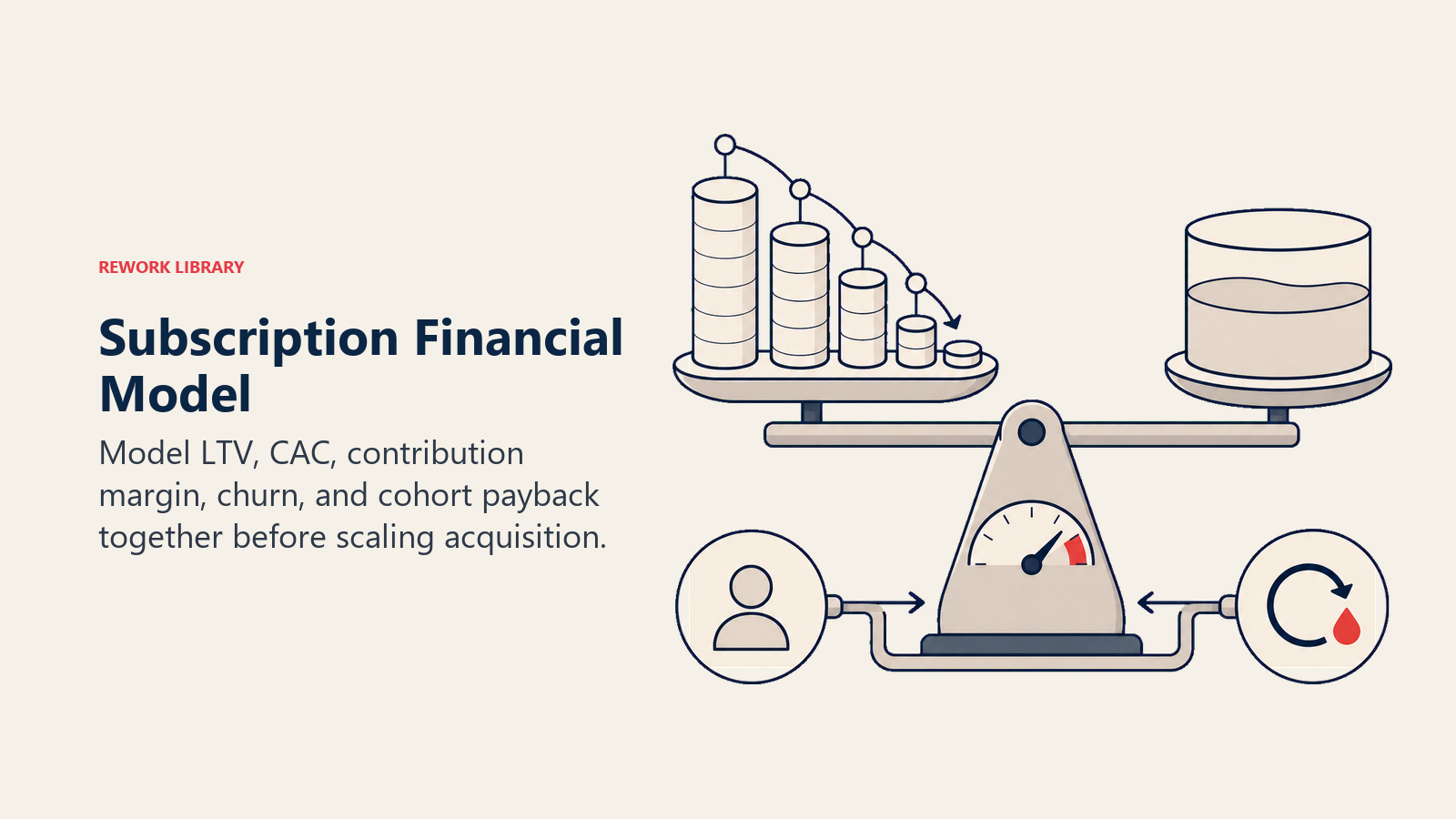
The higher ratio for subscribers means you can afford to spend more on acquisition, access more expensive marketing channels, and outbid competitors for customer attention.
Contribution margin analysis. Calculate the true profitability of subscription orders:
Subscription Order Contribution Margin:
Revenue: $100 (product price)
- Discount: -$15 (15% subscribe & save discount)
= Net revenue: $85
- COGS: -$40 (cost of goods sold)
= Gross profit: $45
- Fulfillment: -$8 (picking, packing, shipping)
- Payment processing: -$2.55 (3% of $85)
- Overhead allocation: -$5
= Contribution margin: $29.45 (34.6% of net revenue)
Compare this to your one-time order contribution margin (which includes full acquisition cost) to determine your break-even point, typically 2-4 orders for most programs.
Break-even timeline. If your subscription acquisition cost is $50 and your contribution margin per order is $30, you break even after 2 orders. By order 4, you've generated $70 in pure profit. This math explains why aggressive initial acquisition spending often makes sense for subscription programs.
Revenue forecasting model. Build a cohort-based revenue projection:
- Month 1: 100 new subscribers × $100 average order = $10,000 revenue
- Month 2: 85 retained subscribers (15% churned) × $100 + 100 new = $18,500 revenue
- Month 3: (85 × 0.90 + 85 × 0.90) retained + 100 new = $24,350 revenue
- Continue forward with monthly churn rate and new subscriber additions
This model helps you understand when subscription revenue becomes meaningful relative to total revenue and how different churn rates impact long-term outcomes.
Sensitivity analysis. Test how changes in key variables affect program profitability:
- What happens if discount increases from 10% to 15%?
- How does 20% churn vs. 25% churn impact 12-month LTV?
- If average order value increases by 15%, how does that affect break-even?
This analysis identifies which levers have the most impact on program success and where to focus optimization efforts.
Marketing & Customer Acquisition
Getting customers to enroll in subscribe & save requires clear messaging, strategic incentives, and targeted promotion.
Core messaging framework. Effective subscribe & save marketing emphasizes three value pillars:
- Savings: Lead with the discount, "Save 15% on every delivery"
- Convenience: "Never run out of [product], automatic delivery"
- Control: "Skip, pause, or cancel anytime, you're in control"
The third element matters. Customers fear getting locked into something they can't escape. Prominent "cancel anytime" messaging actually increases enrollment by reducing perceived risk.
Promotion strategy. Where and how you promote subscribe & save affects enrollment quality:
- Product pages: Primary conversion point, A/B test placement, design, and copy
- Cart and checkout: "Subscribe to these items and save $12" prompts
- Post-purchase emails: First-time buyers receive offer to convert to subscription for future orders
- Dedicated landing pages: Deep-dive content explaining program benefits with customer testimonials
- Email campaigns: Regular reminders to non-subscribed customers highlighting savings
- Packaging inserts: Physical cards in shipments promoting subscription enrollment
First-order incentives. Offering enhanced discounts on the first subscription order (e.g. "20% off your first Subscribe & Save order, then 10% off every order after") can boost enrollment rates significantly. The key is making the ongoing discount attractive enough that customers don't enroll, enjoy the first discount, then immediately cancel.
Target audience identification. Not all customers are equally likely to subscribe. High-potential targets include:
- Customers who've made 2-3 purchases of the same product (demonstrated repurchase intent)
- High-frequency purchasers (monthly or more often)
- Customers who buy multiple units at once (stocking behavior indicates steady consumption)
- Cart abandoners for eligible products (retarget with subscription option)
Targeting these segments with personalized subscribe & save messaging generates higher conversion rates than broad campaigns. Effective customer segmentation helps you identify and prioritize these high-value subscription candidates.
Referral programs. Subscription customers are ideal referral sources, they're highly engaged and regularly interact with your brand. Offering both the referrer and referee subscription discounts or account credits creates a powerful growth loop. "Give friends 20% off their first subscription, get a $10 credit when they subscribe" structures work particularly well.
Program Integration & Operations
The operational infrastructure supporting your subscribe & save program needs to handle complexity that one-time purchases don't require. Technology stack requirements. A functional subscribe & save program needs:
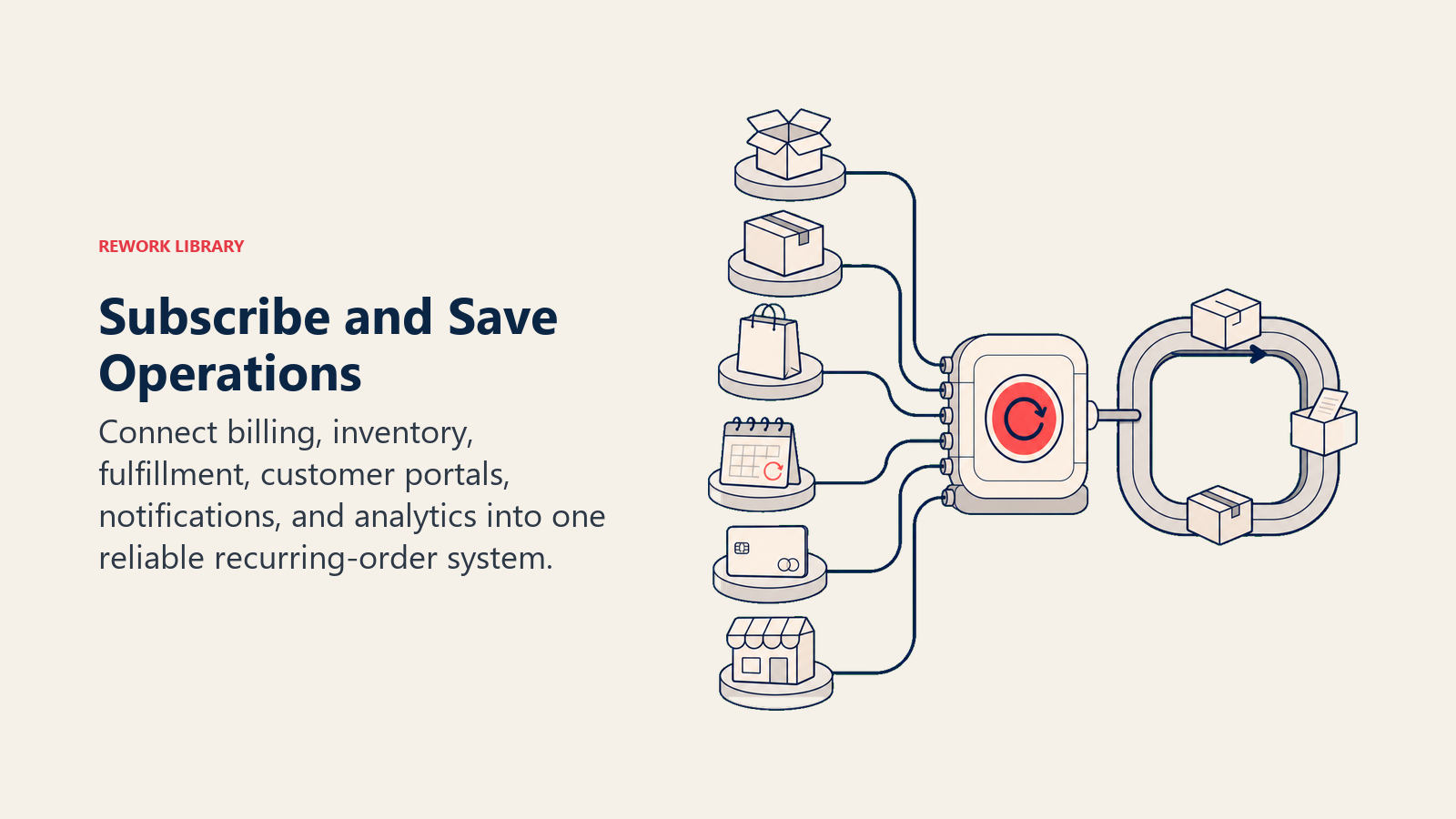
- Subscription management platform: Recharge, Bold Subscriptions, or Recurly for Shopify; custom solutions for other platforms
- Billing automation: Recurring payment processing with automatic retry logic for failed payments
- Inventory system integration: Real-time stock visibility to prevent subscription overselling
- Customer portal: Self-service dashboard for subscription management
- Notification system: Automated emails for upcoming deliveries, payment issues, shipping confirmations
- Analytics platform: Subscription-specific metrics (MRR, churn rate, LTV cohorts)
Most e-commerce platforms don't natively support sophisticated subscription features, expect to integrate specialized tools.
Fulfillment workflow modifications. Subscription orders require different handling:
- Automated order creation: System generates orders based on schedule without customer action
- Batch processing: Processing all subscriptions scheduled for a particular day efficiently
- Priority handling: Some programs prioritize subscription orders to ensure on-time delivery
- Special packaging: Branded boxes or inserts for subscription deliveries (reinforces program value)
- Delivery timing windows: Managing expectations around when "monthly" deliveries actually ship
Payment management and failed payment recovery. Failed payments are a major operational challenge. Effective dunning processes:
- Automatic retry on different days (not immediately, which often fails again)
- Email notifications that payments failed with easy update links
- Multiple retry attempts over 7-14 days before cancellation
- SMS notifications for high-value subscriptions
- Saved backup payment methods that automatically attempt after primary fails
Industry data shows that 30-40% of "failed payment" cancellations can be recovered with good dunning processes.
Customer service training. Support teams need specific training for subscription inquiries:
- How to modify frequencies, skip deliveries, and update payment methods
- Understanding the financial impact of different retention offers
- Authority to offer discounts or credits to prevent cancellation
- Clear escalation paths for technical issues with subscription systems
Empowering support teams to solve problems without engineering intervention is critical for customer satisfaction.
Measurement & Optimization
What gets measured gets improved. Subscribe & save programs generate unique metrics that require dedicated tracking. Essential subscription metrics:
- Monthly Recurring Revenue (MRR): Total value of all active subscriptions on a monthly basis
- Subscriber count: Total active subscribers (track growth rate month over month)
- Churn rate: Percentage of subscribers who cancel each month (target: under 8-10%)
- Average revenue per subscriber (ARPS): MRR divided by subscriber count
- Subscription penetration rate: Percentage of total customers who have active subscriptions
- Orders per subscriber: How many deliveries average subscriber receives before canceling
- Subscription LTV: Average total revenue generated per subscriber over their lifetime
- New subscriber acquisition cost: Marketing spend divided by new subscribers acquired
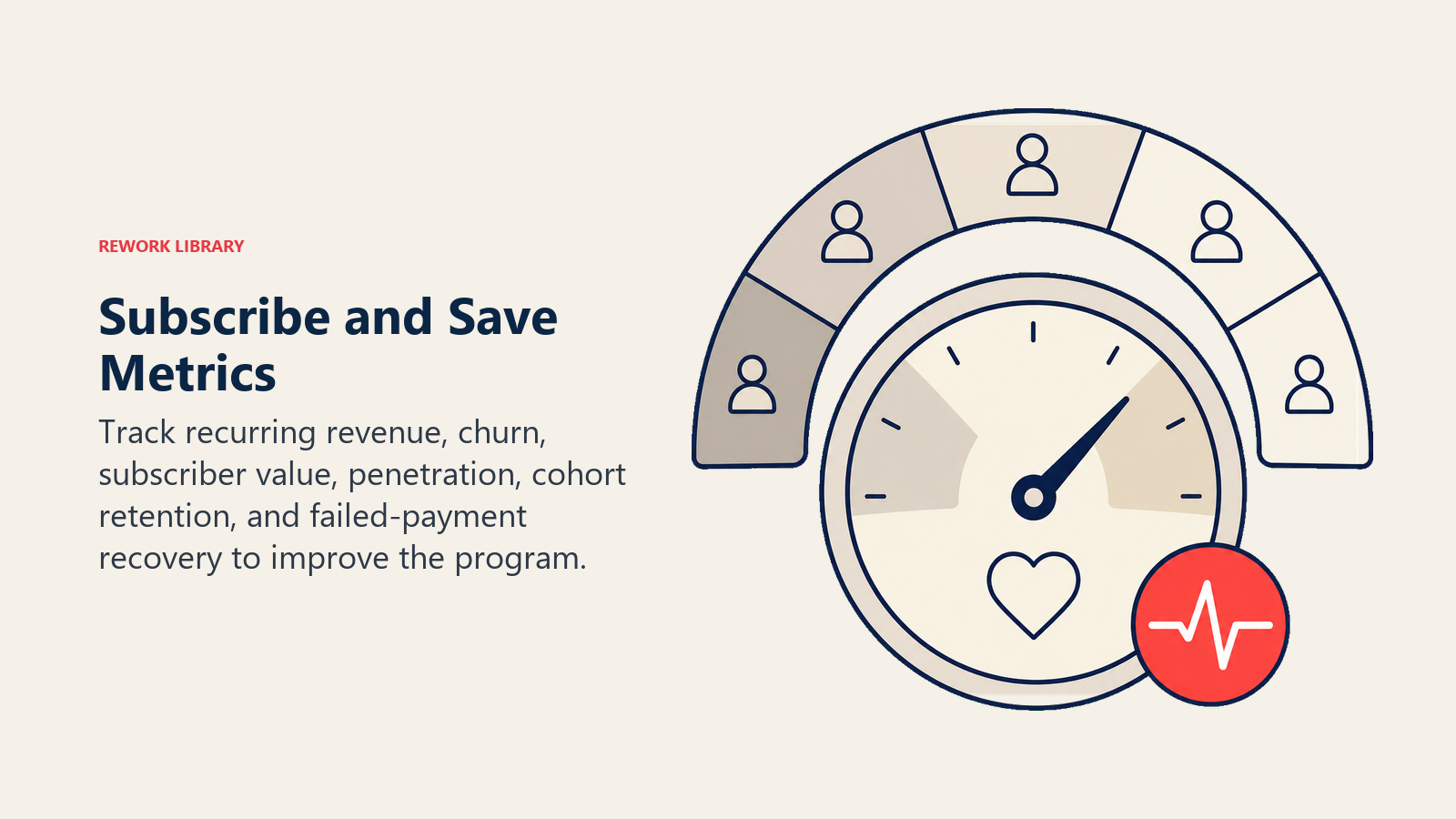
For comprehensive tracking of these and other performance indicators, see our guide on e-commerce metrics and KPIs.
Cohort analysis framework. Track each monthly subscriber cohort separately to understand retention patterns:
January 2026 Cohort: 100 subscribers
- Month 1: 100 subscribers, $10,000 revenue
- Month 2: 85 subscribers, $8,500 revenue (15% churn)
- Month 3: 74 subscribers, $7,400 revenue (13% churn)
- Month 4: 66 subscribers, $6,600 revenue (11% churn)
This shows you not just overall churn rate but how retention evolves over time and whether newer cohorts perform better than older ones (indicating program improvements are working).
A/B testing priorities. Systematically test variables that impact enrollment and retention:
- Discount levels (10% vs. 15% vs. 20%)
- Frequency options (more choices vs. fewer choices)
- Reminder email timing (3 days vs. 5 days before delivery)
- Cancellation flow interventions (immediate cancel vs. offer alternatives)
- Dashboard design (ease of skip/pause functionality)
- First-order incentives (enhanced first discount vs. standard discount)
Run tests for at least full billing cycles to capture true behavior, weekly results don't reflect monthly subscription dynamics.
Churn reduction focus. Small improvements in retention create massive value:
- Reducing monthly churn from 10% to 8% increases average subscriber lifetime from 10 months to 12.5 months (25% increase)
- This translates directly to 25% higher LTV with no increase in acquisition cost
- The LTV:CAC ratio improves from 3:1 to 3.75:1, enabling more aggressive growth spending
This math explains why subscription businesses obsess over churn, it's the highest-leverage optimization area.
For more on subscription retention, see subscription churn management.
Competitive Positioning & Launch Strategy
Successfully launching a subscribe & save program requires strategic positioning and phased rollout. Competitive differentiation. If competitors already offer subscribe & save, you need clear differentiation:
- Better discount: If competitors offer 10%, you offer 15%
- More flexibility: Easier skip/pause, more frequency options, better customer portal
- Superior products: Higher quality or unique formulations justify subscription commitment
- Enhanced benefits: Free gifts, exclusive products, or loyalty rewards for subscribers
- Bundling advantages: Better multi-product subscription offers than competitors
Don't just copy competitor programs, offer something demonstrably better.
Phased launch approach. Rather than launching subscribe & save across your entire catalog simultaneously, consider a phased approach:
Phase 1: Beta with best products (Month 1-2)
- Launch on 5-10 highest-repurchase-rate products
- Offer enhanced "founding subscriber" discount to drive enrollment
- Gather feedback, identify technical issues, refine processes
- Goal: 100-500 subscribers to validate systems
Phase 2: Category expansion (Month 3-4)
- Add full categories of eligible products
- Begin marketing to broader customer base
- Implement learnings from beta phase
- Goal: 1,000+ subscribers, refined operations
Phase 3: Full catalog rollout (Month 5-6)
- Make all eligible products available for subscription
- Launch major marketing campaigns
- Optimize for scale and efficiency
- Goal: 10-20% of customers subscribed within 6 months
This approach reduces risk, allows learning before scaling, and creates early success stories to promote in later phases.
Internal stakeholder alignment. Subscribe & save programs affect multiple departments:
- Finance: Needs revenue recognition processes for subscriptions
- Operations: Requires fulfillment workflow changes
- Customer service: Needs training and updated scripts
- Marketing: Shifts focus to retention alongside acquisition
- Product: May need to adjust packaging or formulations for subscription suitability
Get buy-in and involvement from all stakeholders before launch to ensure smooth execution.
Success metrics and iteration. Define clear success criteria for each phase:
- Phase 1: Technical functionality works, churn under 15%, customer feedback positive
- Phase 2: 5%+ customer subscription rate, LTV:CAC ratio above 3:1
- Phase 3: 15%+ subscription penetration, subscriptions represent 20%+ of revenue
If metrics fall short, pause expansion and fix issues before scaling further.
Making Subscribe & Save Work for Your Business
Subscribe & save programs work best when they're designed around your specific customers, products, and business model. The companies seeing the greatest success follow several principles:
Start with product-market fit. Don't force subscriptions on products that don't naturally fit. Focus on consumables with predictable repurchase cycles where customers already come back regularly. If customers naturally reorder monthly, subscriptions remove friction from existing behavior rather than creating new behavior.
Optimize for flexibility over lock-in. Modern consumers won't tolerate restrictive subscriptions. The easier you make skip, pause, and cancellation, the more customers will enroll and the longer they'll stay subscribed. Counter-intuitively, reducing friction to leave actually increases retention.
Invest in the management experience. Your subscription dashboard is as important as your product pages. If managing subscriptions is frustrating, customers will cancel. If it's effortless, they'll stay subscribed and add more products over time.
Focus relentlessly on churn reduction. Small improvements in retention compound dramatically over time. A 2% reduction in monthly churn increases LTV by 25-30%, transforming program economics and enabling more aggressive growth.
Let data drive discount levels. Don't guess at the right discount, test different levels and measure impact on enrollment, retention, and profitability. The optimal discount is the one that maximizes lifetime profit per subscriber, not the one that maximizes enrollment.
When executed well, subscribe & save programs create sustainable competitive advantages. They lock in customer relationships, improve unit economics, and generate the predictable revenue streams that make businesses valuable and fundable. The discount you offer is an investment in customer lifetime value, make sure you're getting a return worth the cost.
Learn More
Deepen your understanding of subscription commerce and customer retention with these related resources:
- Subscription Model Design - Explore different subscription business models and choose the right structure for your products
- Subscription Churn Management - Advanced strategies for reducing cancellations and improving subscriber retention
- Customer Lifetime Value - Calculate and optimize LTV to justify your subscription discount strategy
- Customer Retention Strategies - Comprehensive tactics for keeping customers engaged beyond subscriptions

On this page
- The Business Case for Subscribe & Save
- Subscribe & Save Program Fundamentals
- Discount Strategy & Economics
- Frequency & Delivery Options
- Product Selection & Bundling
- Subscription Management & UX
- Retention & Churn Management
- Pricing & Financial Modeling
- Marketing & Customer Acquisition
- Program Integration & Operations
- Measurement & Optimization
- Competitive Positioning & Launch Strategy
- Making Subscribe & Save Work for Your Business
- Learn More