Win-Back Campaigns: Reactivating Lapsed Customers
 Your customer made a purchase six months ago. They loved the product, left a positive review, and seemed like a perfect fit for your brand. Then they disappeared. No opens, no clicks, no purchases. They've gone silent.
Turn this article into takeaways for your work.


Each assistant summarizes the article only for you and suggests best practices for your work.
This isn't unusual. Most e-commerce brands lose 60-80% of their customers after the first purchase. But here's what most brands miss: these lapsed customers are significantly cheaper to reactivate than acquiring new ones, and they convert at 2-3x the rate of cold prospects.
Win-back campaigns are your systematic approach to recovering these dormant customers before they're lost forever. When done right, you can reactivate 15-30% of lapsed customers and generate serious revenue at a fraction of your customer acquisition cost.
Let's build a win-back system that recovers lost revenue and prevents customer churn before it becomes permanent.
The Win-Back Opportunity
Before investing in win-back campaigns, understand the business case. The numbers prove this is one of the highest-ROI activities in e-commerce growth. Revenue potential from lapsed customers:
A typical e-commerce brand has 30-50% of their customer base in "lapsed" status at any given time. If you have 10,000 customers and 40% are lapsed, that's 4,000 customers who've stopped buying.
If your average order value is $75 and you reactivate just 20% of those lapsed customers, you've generated $60,000 in recovered revenue. These customers already know your brand, trust your products, and have proven purchase intent.
Cost comparison:
Acquiring a new customer costs $30-$100 depending on your industry and channels. Reactivating a lapsed customer typically costs $5-$15 through email and retargeting. You're spending 70-85% less to recover customers who already have purchase history with your brand.
Conversion rates:
Cold traffic converts at 1-3%. Warm leads convert at 5-10%. Lapsed customers convert at 15-30% in well-executed win-back campaigns. They've already purchased once, so the friction is lower and the trust is higher.
Customer lifetime value impact:
Customers who return after a win-back campaign often have higher lifetime value than customers who never lapse. They've experienced both the product and the recovery effort, creating stronger brand loyalty.
The opportunity is huge, but timing matters. The longer a customer remains dormant, the harder they are to reactivate. Your win-back system needs to intervene before the relationship becomes unrecoverable.
Defining Lapsed Customer Segments
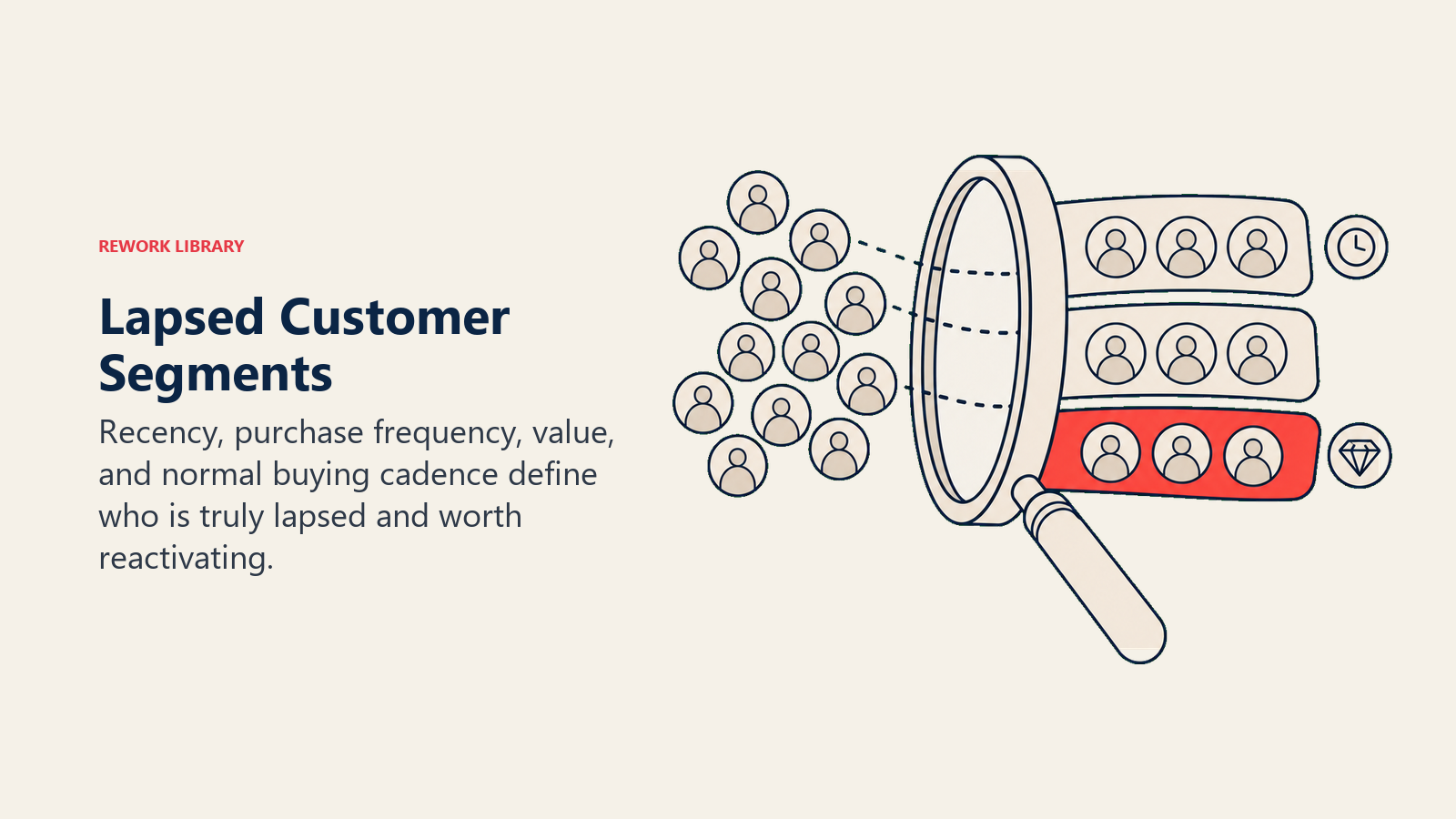
Not all lapsed customers are the same. A customer who purchased 35 days ago is in a very different state than someone who hasn't bought in 180 days. Your win-back strategy needs to recognize these differences. Standard dormancy windows:
30-60 days: Early lapse. These customers are at risk but still highly engaged with your brand. They remember their purchase experience and are likely still consuming or using their products. Win-back efforts here focus on gentle reminders and relevance.
60-90 days: Mid-stage lapse. These customers have clearly moved out of their natural repurchase cycle. They may have found alternatives or simply forgotten about your brand. Win-back campaigns need to create urgency and offer value.
90-180 days: Late-stage lapse. These customers are at serious risk of permanent churn. They've likely purchased from competitors or simply don't need your product category anymore. Win-back efforts require aggressive offers and multiple touchpoints.
180+ days: Deep lapse. Recovery rates drop significantly after six months. These customers require your most aggressive win-back tactics and may not be worth the effort depending on their original purchase value.
RFM segmentation for win-back:
Apply RFM analysis (Recency, Frequency, Monetary) to prioritize your win-back efforts. A customer who made three high-value purchases before lapsing deserves more aggressive recovery efforts than a one-time $20 buyer.
High-value lapsed (3+ purchases, $500+ lifetime value): Deserves personalized outreach, phone calls, dedicated account management, and premium offers.
Medium-value lapsed (2 purchases, $100-$500 lifetime value): Gets standard win-back sequence with moderate discounts and multi-channel approach.
Low-value lapsed (1 purchase, under $100): Receives automated email sequence with broader offers and lower investment.
Behavioral segmentation:
Beyond purchase history, segment based on engagement signals. A customer who hasn't purchased in 90 days but still opens your emails is very different from someone who hasn't engaged at all.
Engaged but not buying: High open rates, clicks, but no purchases. These customers need conversion optimization, not win-back tactics. They're interested but something is blocking the purchase.
Partially engaged: Occasional opens, low clicks. These customers need re-engagement before win-back. Remind them why they loved your brand initially.
Completely disengaged: No opens, no clicks, no website visits. These customers need the most aggressive win-back tactics including retargeting and potentially direct mail.
Understanding these segments prevents you from treating all lapsed customers the same and allows you to allocate budget where it will have the highest return.
Lapsed Customer Identification
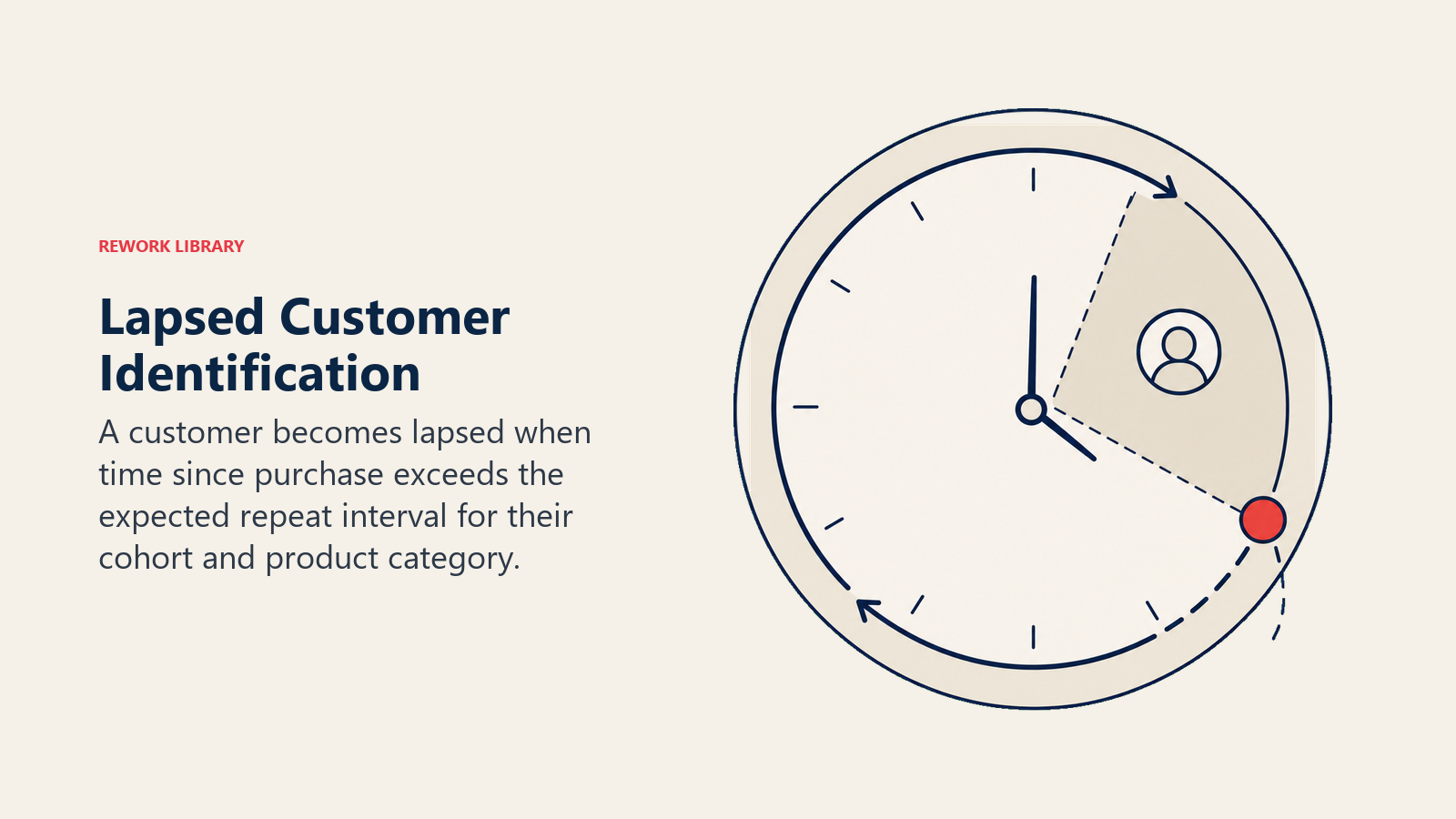
You can't recover customers if you don't know they're lapsing. Build automated systems to identify and flag customers entering dormancy before they become unrecoverable.
Purchase history analysis:
Calculate your average repurchase cycle by product category. If customers buying skincare typically reorder every 60 days, anyone at day 75 should be flagged for win-back intervention.
Create automated triggers based on these timelines. A customer who bought supplements 45 days ago and typically reorders at 40 days should receive an automated reminder before they consider alternatives.
Track cohort retention curves to understand when customers typically churn. If 40% of customers never make a second purchase and the drop-off happens between days 30-45, that's your critical intervention window.
Engagement scoring:
Don't wait until purchase behavior lapses. Track engagement signals as leading indicators of churn risk:
Email engagement declining over 30 days? Flag for re-engagement before they fully lapse.
Website visits dropping? They're losing interest before they stop buying.
Average time between purchases increasing? They're transitioning to a competitor.
Build a simple engagement score: 3 points for purchase, 2 points for email click, 1 point for email open. When a customer's 30-day engagement score drops below a threshold, trigger intervention.
Predictive churn models:
If you have sufficient data, build predictive models that identify customers likely to churn before they do. These models analyze:
Purchase frequency trends, product category mix, discount usage patterns, email engagement trajectory, support ticket history, return rate.
A customer showing multiple churn indicators (decreasing engagement, longer time between purchases, recent support issues) gets proactive outreach before they fully lapse.
Automated flagging systems:
Build automated workflows that move customers into win-back segments based on your defined criteria. When a customer hits day 45 without a purchase and has high lifetime value, they automatically enter your win-back sequence.
This prevents customers from slipping through the cracks and ensures timely intervention when recovery rates are highest.
For more on using data to understand customer behavior, see our guide on Customer Lifetime Value (LTV).
Win-Back Campaign Strategy
Effective win-back campaigns follow a structured approach that escalates urgency and value over time. You're not sending a single "we miss you" email; you're executing a multi-touch sequence designed to recover customers at different stages of consideration. Phased sequence approach:
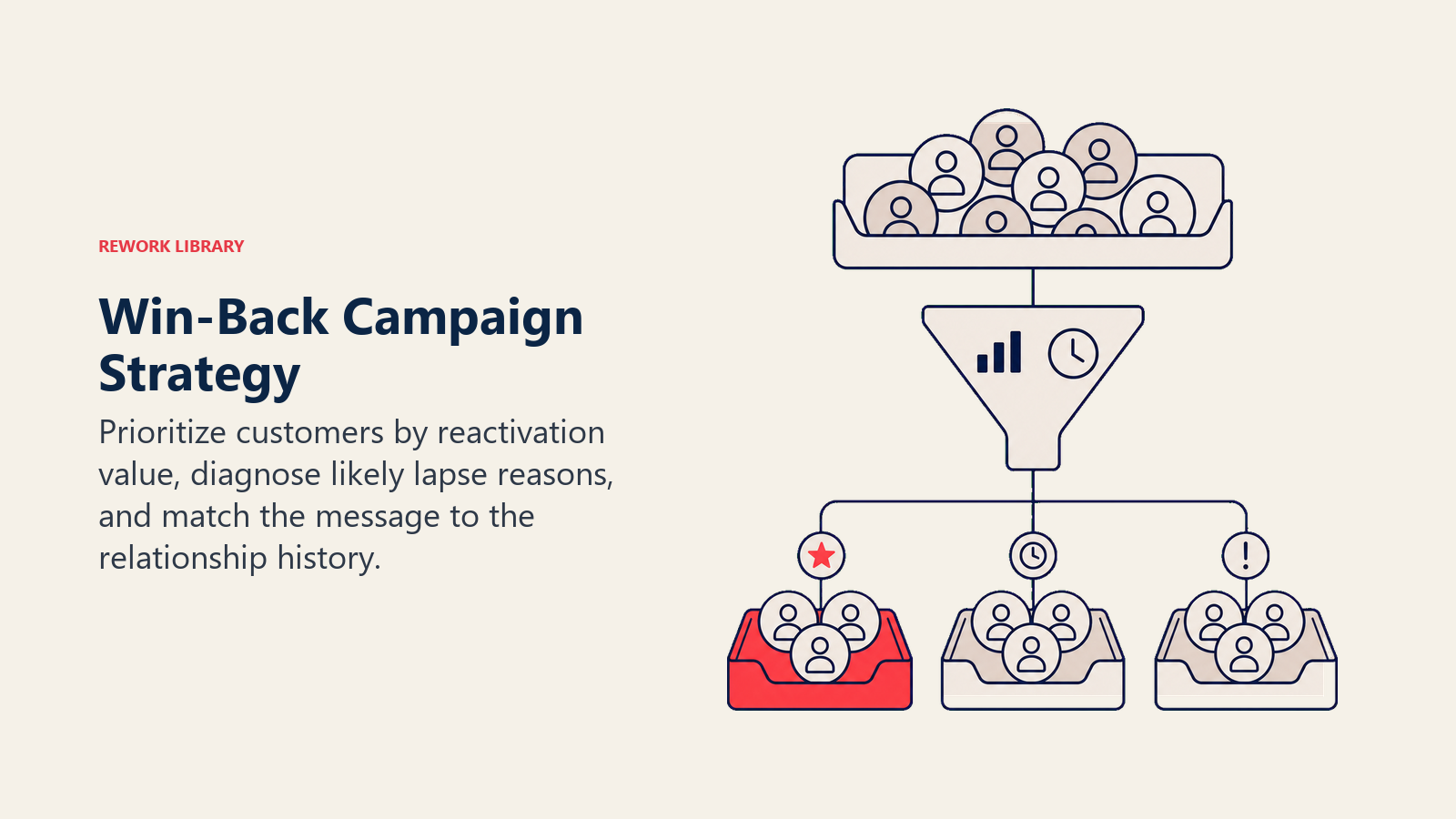
Phase 1 - Gentle reminder (day 30-45): No discounts, just value reinforcement. Remind customers what they loved about your brand and showcase new arrivals or content. Keep it soft and non-transactional.
Phase 2 - Value proposition (day 60-75): Introduce moderate incentives. Free shipping, loyalty points, or small discounts. You're creating a reason to return without training customers to expect deep discounts.
Phase 3 - Aggressive recovery (day 90-120): Significant offers, urgency, and scarcity. This is your final attempt before the customer becomes unrecoverable. Make it compelling.
Channel selection:
Email remains the primary win-back channel with the highest ROI, but multi-channel approaches increase recovery rates by 30-50%.
Email: Your foundation. Lowest cost, highest scalability, easy to test and optimize. Use for all lapsed segments.
SMS: Add for high-value customers in later phases. SMS has 98% open rates and creates urgency. Save it for your most aggressive offers.
Retargeting ads: Display and social retargeting keeps your brand visible as customers browse elsewhere. Particularly effective for completely disengaged customers who don't open emails.
Direct mail: For your highest-value lapsed customers, physical mail cuts through digital noise and demonstrates commitment to the relationship.
Time-sensitive windows:
Win-back campaigns have narrow windows of effectiveness. Too early and customers feel pressured. Too late and they've already replaced you with a competitor.
Map your win-back sequence to your natural repurchase cycle. A subscription business with 30-day cycles needs faster intervention than a furniture retailer with 2-year cycles.
Test day-of-week and time-of-day sends. Win-back emails sent Tuesday-Thursday mornings typically outperform weekend sends by 15-25%.
Personalization depth:
Basic personalization: Name, last product purchased, time since purchase.
Advanced personalization: Product recommendations based on purchase history, category preferences, browse behavior.
Sophisticated personalization: Dynamic offers based on RFM segment, predicted next purchase, lifetime value tier.
The more valuable the customer, the deeper your personalization should go. High-value customers deserve hand-crafted recovery campaigns, not generic "we miss you" templates.
For foundational email strategy principles, see our guide on Email Marketing for E-commerce.
Crafting Win-Back Offers
The offer is the heart of your win-back campaign. Too aggressive and you train customers to wait for discounts. Too weak and you fail to overcome the inertia keeping them away. Discount structures that work:
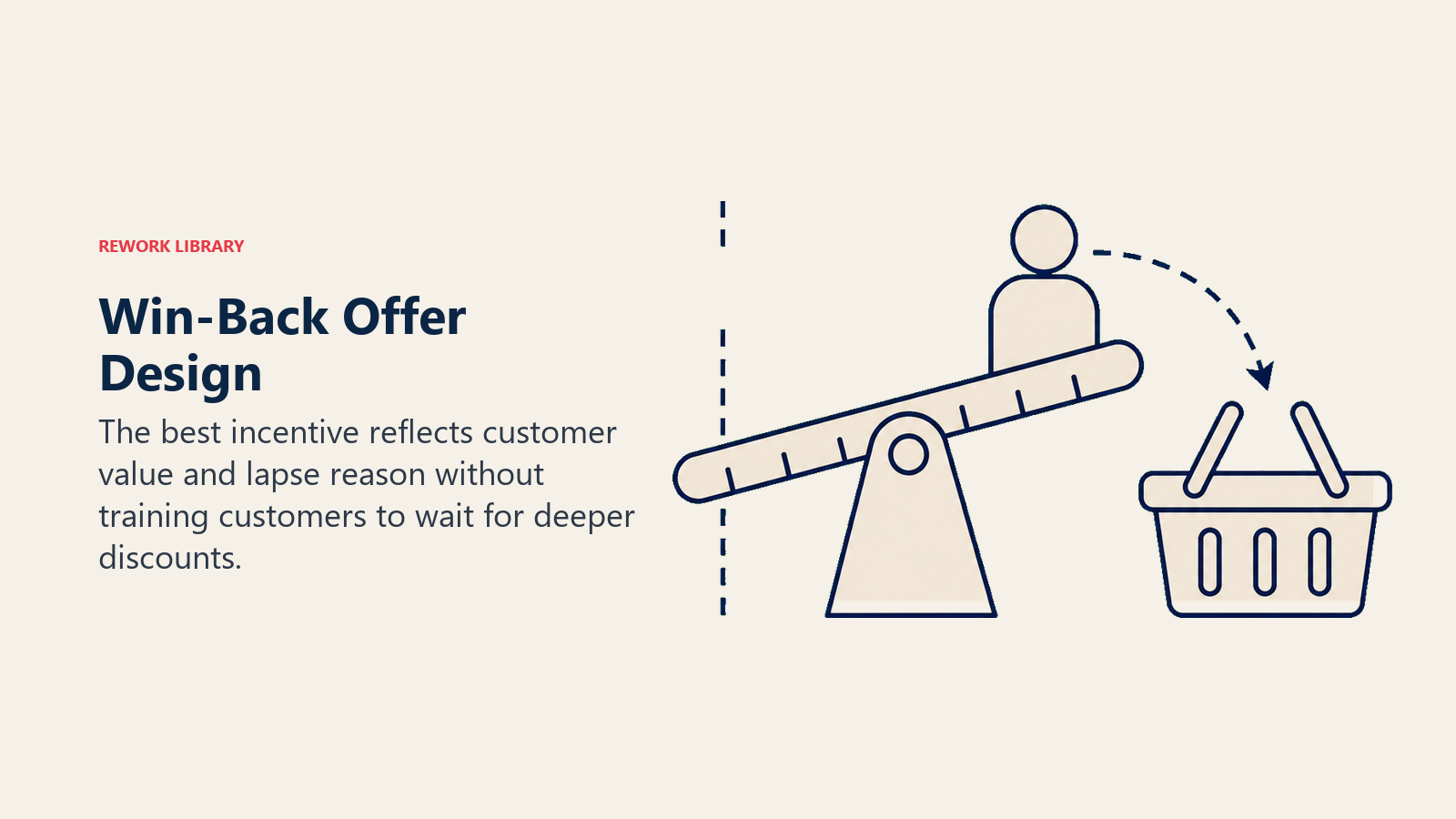
Percentage discounts: 15-25% works for most mid-value customers. Higher percentages (30-40%) reserved for high-value customers in late-stage lapse. Avoid going below 15% as it rarely moves the needle.
Dollar discounts: $10-$25 off creates clear value perception and works well for higher AOV products. "$20 off your next purchase" is more tangible than "15% off."
Tiered discounts: "15% off $50+, 20% off $100+, 25% off $150+" encourages larger purchases and increases recovered AOV.
Non-discount incentives:
Free shipping: Incredibly effective for customers who abandoned due to shipping costs. Often as effective as 10-15% discounts without eroding margins.
Loyalty points: Double or triple points for comeback purchases. Appeals to customers who value ongoing benefits over one-time discounts.
Free gifts: "Free gift with purchase" creates perceived value without discounting your products. Works well for beauty, food, and lifestyle brands.
Early access: VIP access to new launches or sales. Makes customers feel valued without traditional discounts.
Creating urgency:
Time-limited offers: "72-hour exclusive offer" or "This weekend only" creates urgency without feeling manipulative. Be specific with deadlines.
Scarcity elements: "Limited quantities available" or "While supplies last" for specific products or offers.
Expiring incentives: "Your $25 welcome back credit expires in 5 days" creates a clear call-to-action.
Countdown timers: Visual timers in emails reinforce urgency and increase conversion rates by 20-40%.
Offer testing framework:
Test different offer levels by RFM segment. Your one-time buyers don't need the same aggressive offers as your previously high-value customers.
Test discount vs. non-discount incentives. Many brands find free shipping or free gifts perform equally well with better margin protection.
Test urgency elements. Some audiences respond to tight deadlines, others need more time to consider.
Track not just reactivation rates but also recovered CLV. A lower discount that attracts higher-quality returning customers may outperform aggressive discounts that attract discount chasers.
For strategic approaches to discounting without eroding brand value, see our guide on Discount Strategy.
Timing and Sequencing
The timing of your win-back messages significantly impacts recovery rates. Too frequent and you annoy customers. Too sparse and they forget about your brand before the next touchpoint.
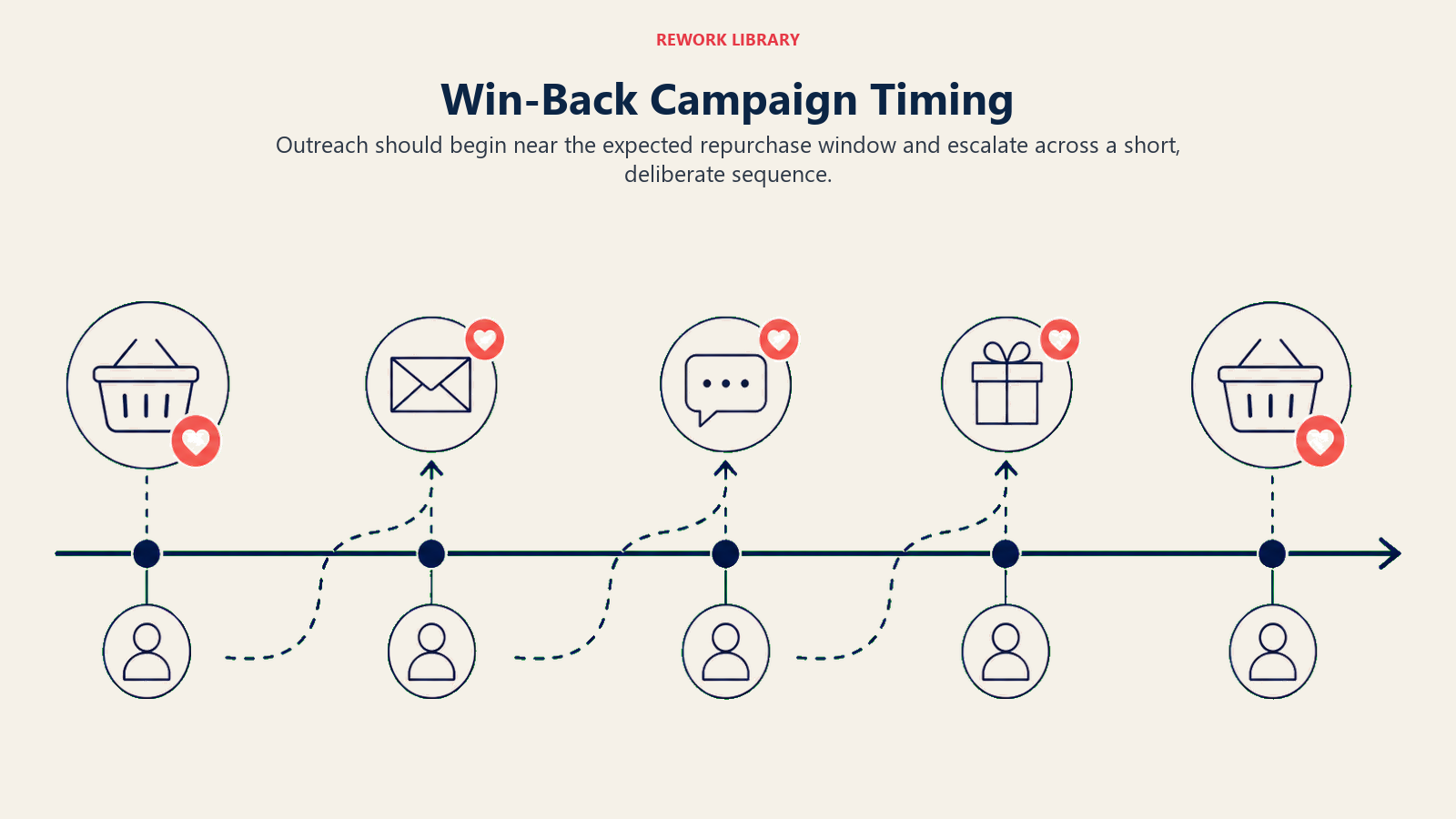
Optimal cadence:
3-email sequence for standard win-back:
- Email 1: Day 45 (gentle reminder)
- Email 2: Day 60 (moderate offer)
- Email 3: Day 90 (aggressive final offer)
5-email sequence for high-value customers:
- Email 1: Day 30 (soft engagement)
- Email 2: Day 45 (reminder + value)
- Email 3: Day 60 (first offer)
- Email 4: Day 80 (stronger offer)
- Email 5: Day 100 (final aggressive offer)
Days between messages:
Maintain 10-15 days between win-back emails in the same sequence. This provides enough time for customers to act without feeling harassed.
Increase intervals for later messages in the sequence. The gap between email 1 and 2 can be 10 days, but the gap between email 2 and 3 should be 15-20 days.
Seasonal triggers:
Leverage natural shopping seasons to boost win-back effectiveness. A lapsed customer from January is more likely to return during holiday shopping in November.
Back-to-school (July-August), Holiday shopping (November-December), New Year motivation (January), Spring refresh (March-April).
Time your final win-back push to align with these high-intent shopping periods. A customer who ignored your summer win-back email may respond during Black Friday.
Reactivation windows:
Track when reactivation happens in your sequence. If 70% of recoveries happen after email 2, your email 1 might need optimization or your timing might be off.
Analyze time-to-conversion after win-back sends. If customers typically convert 3-7 days after receiving a win-back email, that's your natural consideration window.
Adjust your urgency and deadline messaging based on these windows. A 48-hour deadline works if customers convert quickly. A 7-day deadline works if they need time to consider.
Win-Back Email Sequences
Let's look at the specific emails in an effective win-back sequence, including subject lines, messaging, and calls-to-action. Email 1: The re-engagement message (day 45-60)
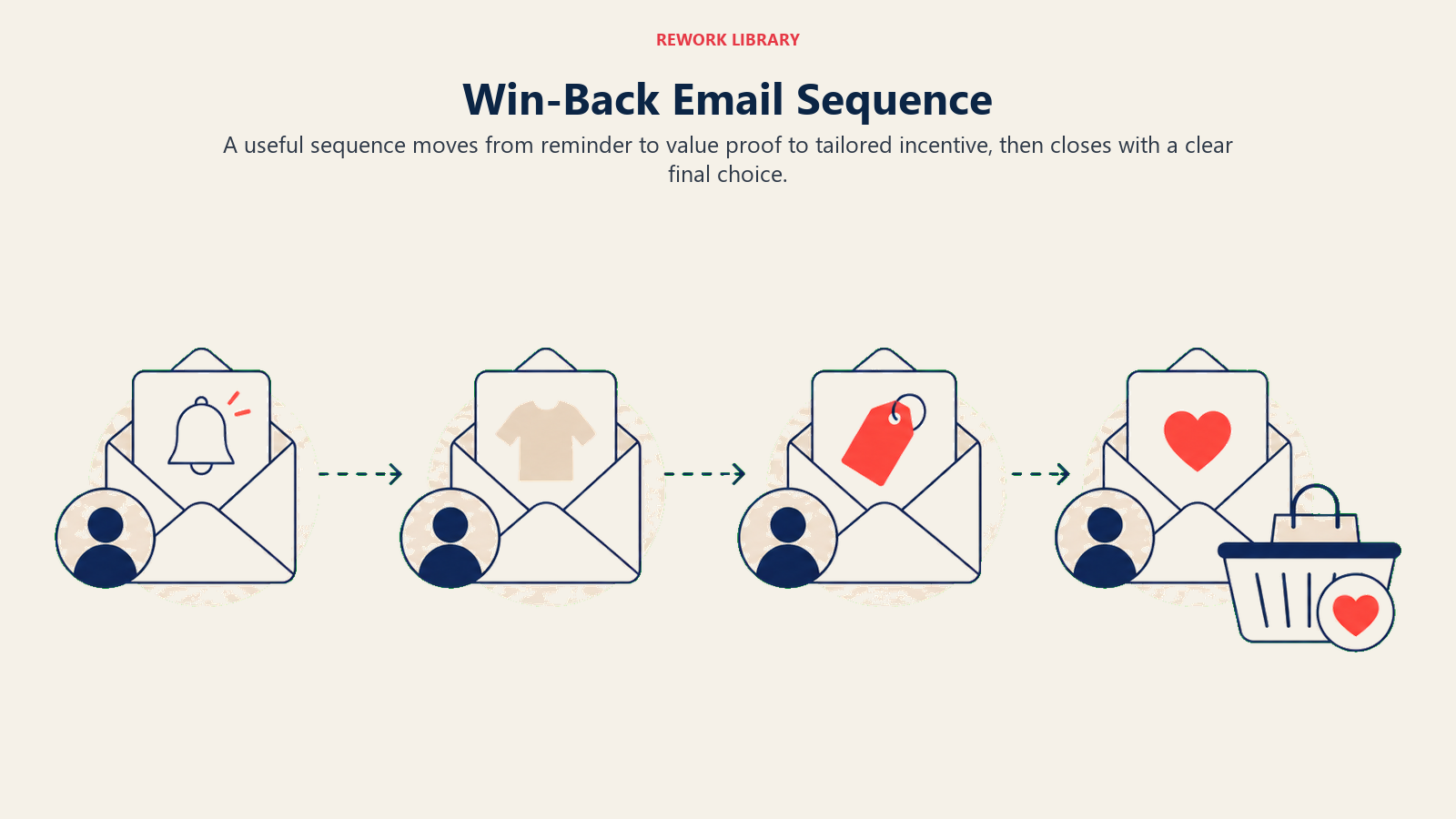
Subject line: "We noticed you've been away" or "[Name], we miss you"
Body: Warm, personal, non-transactional. Remind customers what makes your brand special. Showcase new arrivals, bestsellers, or content they might have missed. No discount yet.
Example: "Hi [Name], It's been a while since your last order and we wanted to check in. We've added some exciting new products you might love based on your previous purchase of [product]. [Browse new arrivals] We're here if you need anything. - The [Brand] Team"
Goal: Gentle reminder without pressure. Re-establish connection.
Email 2: The value offer (day 60-90)
Subject line: "Here's 20% off to welcome you back" or "Your exclusive comeback offer"
Body: Acknowledge the time gap, present a moderate offer, create soft urgency. Show how easy it is to come back and shop.
Example: "Hi [Name], We've been thinking about you! It's been [X] weeks since you last shopped with us, and we'd love to see you again. To make your return special, here's 20% off your next order (valid for 7 days). Plus, we've set aside some recommendations based on your love of [category]. [Shop now with 20% off] This offer expires [specific date]. - The [Brand] Team"
Goal: Convert fence-sitters with moderate incentive.
Email 3: The final call (day 90-120)
Subject line: "Last chance: 30% off before we say goodbye" or "Your final welcome-back offer"
Body: Strong urgency, aggressive offer, make it clear this is the last outreach. Use FOMO and scarcity.
Example: "Hi [Name], This is our final email. We've tried to bring you back, and this is your last chance to take advantage of our best offer: 30% off everything + free shipping. This offer expires in 48 hours, and after that, we won't be reaching out again. If you're ready to come back, now is the time. [Claim 30% off now] Expires: [specific date and time] - The [Brand] Team"
Goal: Create urgency and capture last recoverable customers.
Email design considerations:
Keep design clean and focused. Win-back emails aren't the place for complex layouts. Clear headline, simple offer, obvious CTA.
Use images of products the customer previously purchased or similar items. Visual reminders of what they loved.
Make the CTA button prominent and action-oriented. "Claim my 20% off" outperforms generic "Shop now."
Include a feedback mechanism. "Not interested? Tell us why" link to a quick survey. You'll learn why customers lapse and improve retention.
For broader email strategy and best practices, see our guide on Email Marketing for E-commerce.
Retargeting and Paid Acquisition
Email alone won't recover all lapsed customers, especially those who've completely disengaged. Retargeting creates multiple brand touchpoints and recovers customers who don't open emails. Pixel-based retargeting setup:
Install retargeting pixels on your confirmation page so you can build audiences of past purchasers. These customers are cookied and can be reached through display and social ads even if they don't open emails.
Create custom audiences of lapsed customers by time windows: 30-60 days since purchase, 60-90 days, 90-180 days. Each segment gets different creative and offers matching your email strategy.
Dynamic retargeting ads:
Show customers products they previously purchased or similar items. "Remember the [product] you loved? It's back in stock" or "Customers who bought [product] also love [related product]."
Use dynamic creative that pulls from your product catalog based on purchase history. Facebook and Google both support this for e-commerce brands.
Include your win-back offer in ad creative. If email 2 offers 20% off, your retargeting ads should show the same offer for consistency.
Platform strategy:
Facebook/Instagram: Best for lifestyle brands with visual products. Use carousel ads showing multiple products from their preferred category.
Google Display: Broader reach across the web. Good for keeping brand visible as customers browse news sites, blogs, and other retail sites.
Google Search: Bid on branded terms to recapture customers searching for you by name. If they're searching for your brand name, they're showing interest.
YouTube: For brands with video content, YouTube pre-roll ads can re-engage lapsed customers with brand storytelling.
Budget allocation:
Allocate 60-70% of win-back budget to email (lowest cost, highest ROI). Allocate 20-30% to retargeting (increases recovery by reaching non-openers). Allocate 10% to testing new channels (SMS, direct mail, etc.).
Increase retargeting budget for high-value lapsed customers. A customer with $1,000 lifetime value justifies higher acquisition costs than a $50 one-time buyer.
Attribution and measurement:
Use multi-touch attribution to understand how channels work together. A customer might see a retargeting ad, then open a win-back email, then convert. Both channels contributed.
Track view-through conversions for display ads. Customers who see your ad but don't click may still convert later through direct traffic or email.
For comprehensive retargeting strategies, see our guide on Retargeting & Remarketing.
Measurement and Analytics
You can't optimize what you don't measure. Track these metrics to understand win-back performance and identify opportunities. Core reactivation metrics:
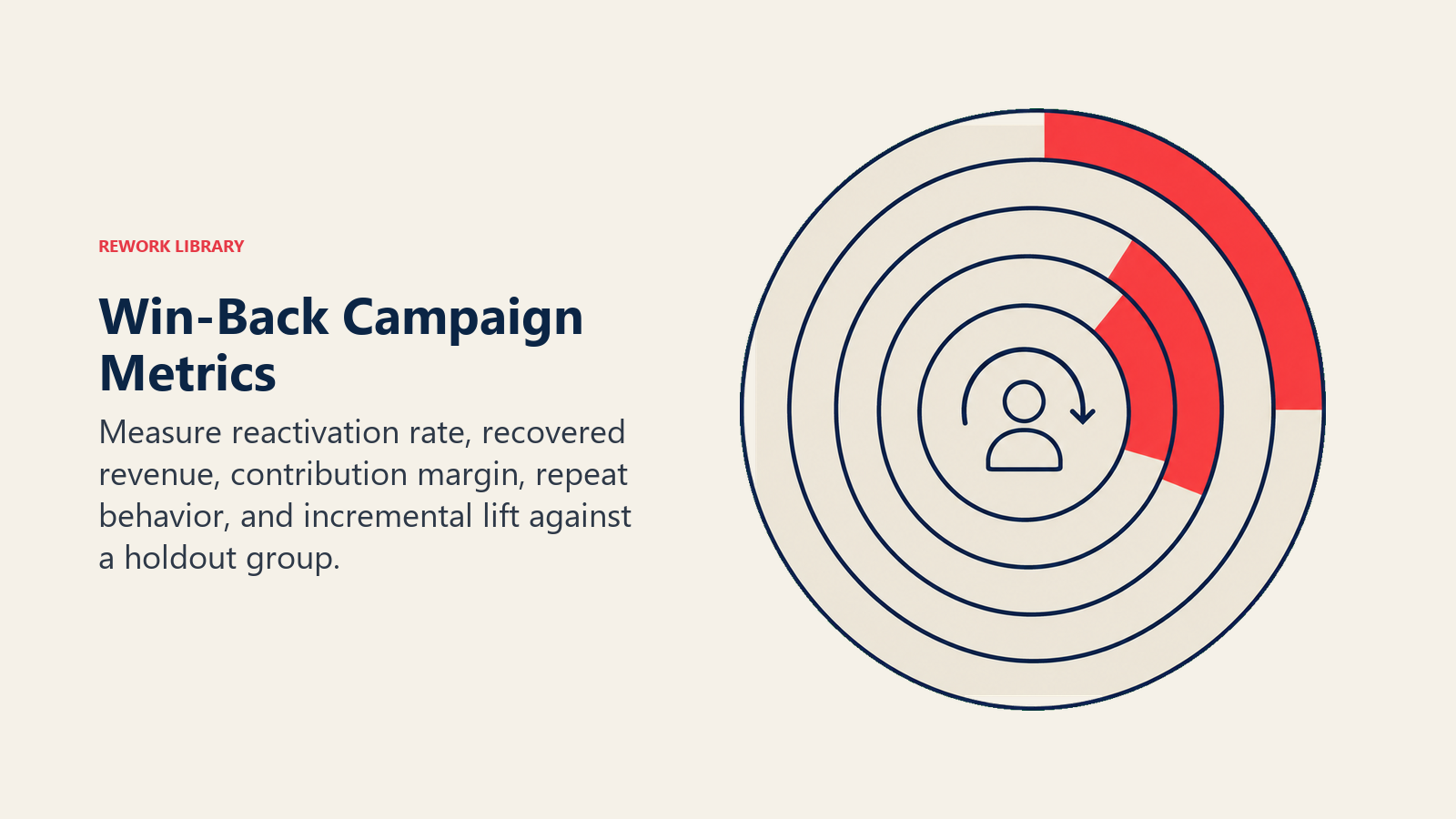
Reactivation rate: Percentage of lapsed customers who make a purchase after entering win-back sequence. Benchmark: 15-30% depending on industry and sequence quality.
Email-specific reactivation rate: Customers who converted directly from a win-back email. Typically 8-15% of lapsed segment.
Multi-touch reactivation rate: Customers who converted after multiple win-back touchpoints. This is where email + retargeting shines.
Time to reactivation: How long between entering win-back sequence and conversion. Helps optimize your cadence and urgency messaging.
Financial metrics:
Revenue recovered: Total revenue generated from reactivated customers. This is your primary success metric.
Cost per reactivation: Total campaign spend divided by number of reactivated customers. Benchmark against your CAC for new customers.
ROI: Revenue recovered minus campaign costs, divided by campaign costs. Win-back ROI should be 300-500% or higher.
Recovered CLV: Lifetime value of reactivated customers after their win-back purchase. This shows whether you're recovering high-quality customers or discount chasers.
Segment performance:
Compare reactivation rates across RFM segments. Your high-value customers should reactivate at 30-40%, mid-value at 20-30%, low-value at 10-20%.
Track offer performance by segment. Did your aggressive discount work better for low-value or high-value customers? Adjust future campaigns accordingly.
Analyze channel effectiveness by segment. High-value customers may respond better to SMS and direct mail. Low-value customers may be email-only for ROI reasons.
Behavioral indicators:
Open rates on win-back emails: Should be 20-35% for first email, declining for subsequent emails.
Click-through rates: Should be 3-8% for offer emails, higher for aggressive final offers.
Website visits post-send: Track if customers visit your site after win-back emails even if they don't immediately purchase.
Browse behavior: Do they look at the same categories they previously purchased? This indicates intent even without immediate conversion.
Dashboard setup:
Create a weekly win-back dashboard showing: Number of customers entering win-back sequences, reactivation rate by cohort, revenue recovered this week, cumulative campaign ROI.
Review monthly for strategic adjustments: Which segments have highest ROI? Which offers work best? What's the optimal sequence length?
For frameworks on measuring and improving campaign performance, see our guide on A/B Testing Framework.
Retention After Reactivation
Winning back a customer is only half the battle. Preventing them from lapsing again is equally important.
The second-purchase window:
Reactivated customers are at extremely high risk of re-lapsing. They left once; they'll leave again if you don't change the experience.
Your first 30 days after reactivation are critical. This is when you establish new purchase patterns and demonstrate that coming back was the right decision.
Post-reactivation engagement sequence:
Day 3: Thank you message. Acknowledge their return, make them feel valued. "We're thrilled you're back!"
Day 10: Product satisfaction check-in. "How's your recent order?" This opens dialogue and prevents silent dissatisfaction.
Day 20: Next purchase recommendation. Based on what they bought, suggest complementary products or replenishment.
Day 30: Loyalty enrollment or incentive to lock in ongoing relationship. "Join our VIP program" or "Get 10% off every order with subscription."
Loyalty re-enrollment:
If you have a loyalty program, automatically grant bonus points for the comeback purchase. Make reactivation feel rewarding, not just transactional.
Offer exclusive benefits for returning customers. "You're back! Here's early access to our next sale as a thank you."
Create a "comeback club" or similar program specifically for reactivated customers with special perks. This creates identity and belonging.
Addressing why they lapsed:
If possible, survey reactivated customers: "What brought you back?" and "Why did you stop shopping with us?" This data improves both win-back and retention.
Address the original lapse reason in your post-reactivation communication. If they left due to shipping costs and you now offer free shipping, highlight that change.
Replenishment timing optimization:
For consumable products, track reactivated customers' repurchase cycle carefully. Send replenishment reminders at the right time to establish regular ordering.
Make subscription easy. "Never run out again - save 10% with auto-ship." Subscriptions dramatically reduce second lapse risk.
For deeper retention strategies beyond win-back, see our guides on Repeat Purchase Strategy and Loyalty Programs.
Win-Back Campaign Pitfalls
Even well-intentioned win-back campaigns can backfire. Avoid these common mistakes.
Over-discounting:
Don't jump straight to your most aggressive offer. If your first win-back email offers 40% off, you've trained customers to ignore early messages and wait for maximum discounts.
Escalate offers gradually. Start with 15%, then 20%, then 25-30% for final offer. This rewards customers who respond early and preserves margins.
Poor segmentation:
Treating all lapsed customers the same wastes budget and opportunity. Your $1,000 lifetime value customer deserves more investment than your one-time $30 buyer.
Segment by RFM and adjust offer strength, personalization depth, and channel mix accordingly.
Annoying customers who aren't actually lapsed:
Check subscription status before sending win-back emails. A customer on monthly subscription hasn't lapsed just because their last order was 60 days ago.
Exclude customers who recently engaged or made purchases. If someone ordered 2 days ago, they don't need a win-back email triggered by an old automation.
Generic messaging:
"We miss you!" is lazy. Reference specific products they purchased, acknowledge how long they've been gone, show you actually know them.
Use dynamic content blocks that pull purchase history, favorite categories, and browsing behavior. Make it personal.
Ignoring preference centers:
Some customers marked your emails as spam or unsubscribed. Don't re-add them to win-back campaigns just because they haven't purchased recently. Respect their preferences and focus on customers who want to hear from you.
Giving up too soon:
One win-back email isn't a campaign. Test 3-5 email sequences before deciding a customer is unrecoverable.
Many brands give up after email 1 or 2, missing the 30% of recoveries that happen after the aggressive final offer.
Not testing:
Your first win-back sequence won't be optimal. Test subject lines, offer levels, timing, and creative continuously.
Every brand's audience responds differently. What works for a fashion retailer may fail for a supplement brand.
Testing and Optimization
Win-back campaigns should constantly evolve based on data and testing. Here's what to test and how to structure experiments.
Subject line testing:
Test emotional vs. rational: "We miss you!" vs. "Here's 20% off to come back"
Test personalization: "Sarah, it's been too long" vs. generic "It's been a while"
Test urgency: "Last chance: 48 hours left" vs. "Your exclusive offer is ready"
Test question format: "Are you still interested in [category]?" vs. standard statements
Run tests with minimum 1,000 recipients per variant for statistical significance.
Offer testing:
Test discount levels: 15% vs. 20% vs. 25%
Test discount types: Percentage vs. dollar amount vs. free shipping
Test urgency windows: 48 hours vs. 7 days vs. 14 days
Test bundled offers: "20% off + free shipping" vs. "20% off" alone
Measure not just reactivation rate but recovered AOV and margin impact.
Timing tests:
Test send times: Morning vs. afternoon vs. evening
Test days: Tuesday vs. Thursday vs. Saturday
Test intervals between emails: 10 days vs. 14 days vs. 21 days
Test entry points: 45 days lapsed vs. 60 days vs. 75 days
Creative testing:
Test email design: Minimal design vs. product-rich layout
Test product showcase: Last purchased product vs. new arrivals vs. bestsellers
Test CTA copy: "Shop now" vs. "Claim my discount" vs. "Welcome me back"
Test image types: Product images vs. lifestyle images vs. customer photos
Segment-specific optimization:
Run separate tests for high-value, mid-value, and low-value segments. What works for one segment often fails for another.
Test different offers by segment. High-value customers might respond to exclusivity and VIP treatment over discounts.
Test channel mix by segment. Can you reduce email frequency for high-value customers by adding SMS without reducing reactivation rates?
Documentation and learning:
Document every test result in a shared knowledge base. What failed this quarter might work differently next year as your audience evolves.
Share learnings across teams. Your win-back insights often apply to new customer campaigns, retention efforts, and general email marketing.
Build a testing roadmap. Don't test randomly. Prioritize tests based on potential impact and ease of implementation.
For structured testing methodologies, see our guide on A/B Testing Framework.
Bringing It All Together
Win-back campaigns are one of the highest-ROI activities in e-commerce growth, but they require systematic execution, not occasional "we miss you" emails.
Start with solid segmentation. Know who's lapsing, why they're lapsing, and when intervention will be most effective.
Build phased sequences that escalate value and urgency over time. Don't blow your best offer in the first email.
Personalize based on purchase history and customer value. Your high-value customers deserve more investment than one-time buyers.
Combine email with retargeting for multi-channel reinforcement. Email alone won't reach completely disengaged customers.
Measure everything. Track reactivation rates, recovered revenue, and post-reactivation retention to optimize your approach.
Most importantly, prevent re-lapsing. Winning back a customer who lapses again in 30 days is wasted effort. Focus equally on retention after reactivation.
When you build a systematic win-back program, you're not just recovering lost revenue. You're building a safety net that catches customers before they're permanently lost and maximizes the lifetime value of every customer you acquire.
The customers who lapsed aren't gone forever. They're just waiting for the right reason to come back. Your win-back campaign is that reason.

On this page
- The Win-Back Opportunity
- Defining Lapsed Customer Segments
- Lapsed Customer Identification
- Win-Back Campaign Strategy
- Crafting Win-Back Offers
- Timing and Sequencing
- Win-Back Email Sequences
- Retargeting and Paid Acquisition
- Measurement and Analytics
- Retention After Reactivation
- Win-Back Campaign Pitfalls
- Testing and Optimization
- Bringing It All Together