Thought Leadership Development: How Professionals Actually Become Recognized Experts

Turn this article into takeaways for your work.


Each assistant summarizes the article only for you and suggests best practices for your work.
A managing partner built a thought leadership content calendar, hired a marketing coordinator to run it, and assigned three senior managers to "contribute articles." Eighteen months later, the calendar had never been more than half full. The managers weren't lazy. They genuinely didn't know what to say. Each one had years of real client experience, but nobody had ever asked them to turn that experience into a point of view, and nobody had taught them how.
This is the gap most firms miss when they invest in thought leadership. Thought leadership strategy covers how to build the firm-level program: content pillars, distribution channels, platform selection, and measurement. That program assumes the firm already has people with something worth publishing. Often, it doesn't, not because the expertise isn't there, but because nobody has developed it into a communicable point of view. That development work, turning deep experience into public expertise, is a distinct skill set, and it's the subject of this guide.
Thought Leadership Is a Developed Skill, Not a Personality Trait
Firms tend to sort their people into "naturally good at this" and "not a writer," as if the ability to publish original insight were fixed at birth. It isn't. The professionals who eventually become known as experts in their field almost always started as people who had done good client work but had never articulated what they'd learned in a way anyone outside the engagement could use.
The recent research on why this matters commercially is worth taking seriously. According to the 2025 Edelman-LinkedIn B2B Thought Leadership Impact Report, 52% of decision-makers and 54% of C-suite executives say they spend an hour or more each week reading thought leadership content, and 75% say a specific piece of thought leadership has led them to research a product or service they weren't previously considering. That's a real commercial lever, but only if someone inside the firm is actually producing content worth that attention, which means the firm needs more than one person capable of it.
The Expertise Inventory: Finding What's Actually Worth Saying
Before anyone can write or speak publicly, they need to identify what they actually know that's distinct. This is harder than it sounds, because expertise gained through repeated client work often feels obvious to the person who has it. If you've solved the same category of problem 30 times, the pattern you see feels like common sense, not insight.
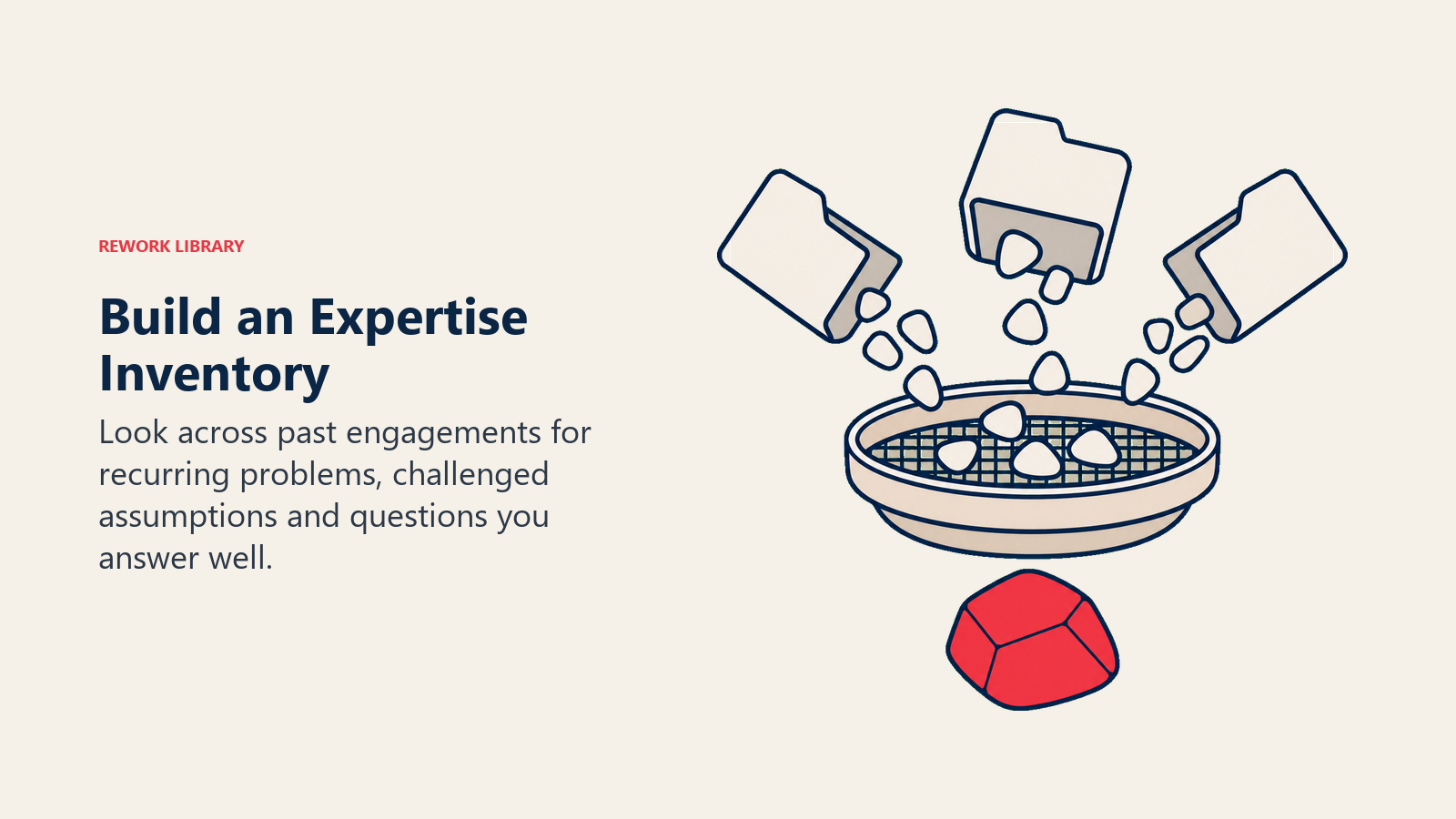
A structured expertise inventory helps surface it. Ask each professional to answer, specifically: what pattern have you noticed across your last 10-15 engagements that a junior colleague wouldn't see? What's a piece of conventional wisdom in your field that your experience suggests is wrong or incomplete? What question do clients ask you repeatedly that you could answer better than almost anyone else at the firm?
Key Facts: Why Individual Thought Leadership Matters
- Per the 2025 Edelman-LinkedIn B2B Thought Leadership Impact Report, 52% of decision-makers and 54% of C-suite executives spend an hour or more per week reading thought leadership content.
- The same report found 9 in 10 decision-makers and C-suite executives are more receptive to sales or marketing outreach from a company that consistently produces high-quality thought leadership.
- The report frames this around a "95-5 rule": at any given time, only about 5% of potential buyers are actively looking for a solution, while the other 95% are dormant prospects that thought leadership reaches first.
These answers rarely come out polished the first time. That's expected. The point of the inventory isn't a finished article, it's identifying the raw material, which someone can then help shape into something publishable.
The Confidence Gap
Even professionals who have real expertise often won't publish it, and the reasons are consistent enough to name directly. Some worry someone smarter has already said it better. Some fear being publicly wrong on a point a client or competitor could challenge. Some simply don't see themselves as "the writing type," having never been asked to write anything beyond client deliverables and internal memos.
None of these fears is solved by telling someone to "just write more." They're solved by lowering the stakes of the first few attempts. Internal memos shared only with colleagues, a well-formed comment on someone else's LinkedIn post, or a five-minute point of view shared in a team meeting are all lower-stakes reps that build the muscle before a byline article with the firm's name on it. Professionals who skip straight to a public 2,000-word article with no prior practice often produce something generic and hedged, because they're writing defensively rather than from a genuine point of view.
Building the Habit Before the Output
Thought leadership development works like any other skill: frequency and feedback matter more than talent. A practical progression that works inside most firms:
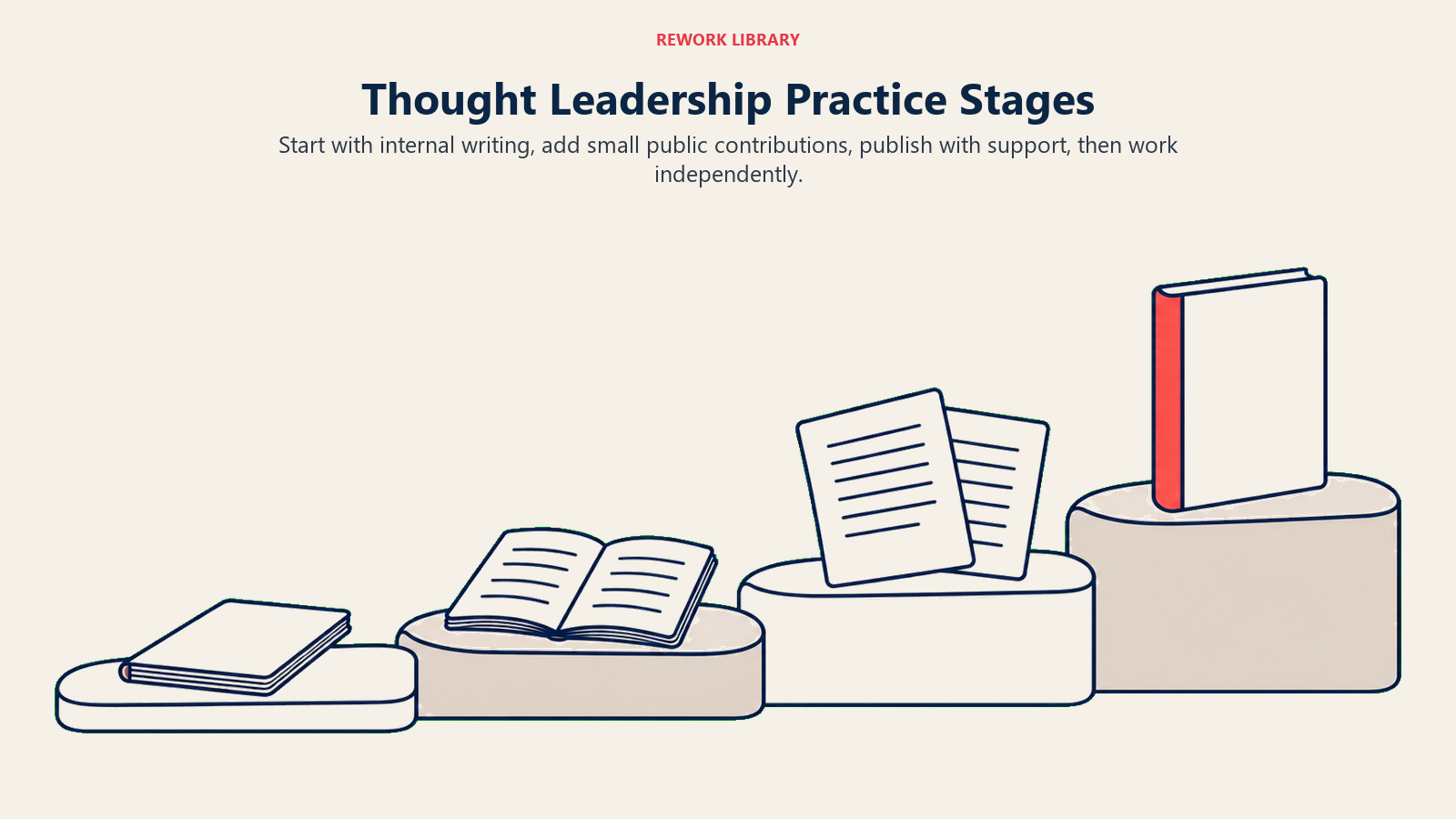
Month 1-2: Low-stakes internal practice. Write a one-page point of view on a recent engagement for internal circulation only. No external audience, no pressure, just the habit of turning experience into a written argument.
Month 3-4: Small public reps. A thoughtful LinkedIn comment on someone else's post, a short internal contribution to a firm newsletter, or a five-minute unscripted point of view offered in a client-facing meeting. These build comfort with having a visible opinion without the exposure of a full article.
Month 5-6: First public byline, co-authored or reviewed. A senior colleague or the firm's marketing lead reviews the piece before it goes out, both for quality and to model what a strong point of view looks like in practice.
Ongoing: Independent publishing with periodic feedback. By this stage, the professional should be producing content with minimal oversight, though periodic feedback on what's landing and what isn't remains valuable indefinitely.
This progression connects directly to how the firm approaches capability development more broadly, since commercial and communication skills develop through the same kind of deliberate, staged practice as technical or client-management skills. It also benefits from the low-risk practice grounds covered in professional networking and the structured opportunities described in speaking and publishing strategy, both of which give developing thought leaders a place to build reps before a wider audience is watching. A local industry panel or a session at a regional gathering covered in conference and event strategy is often a lower-pressure first speaking rep than a keynote, and it produces the same public-practice benefit.
Developing an Actual Point of View, Not a Summary
The single biggest quality gap between developing and established thought leaders is this: beginners tend to summarize what's already known, while established voices take a position. "Here are five best practices for change management" is a summary. "Most change management programs fail because they measure adoption instead of capability, and here's what that actually costs a mid-market manufacturer" is a position.
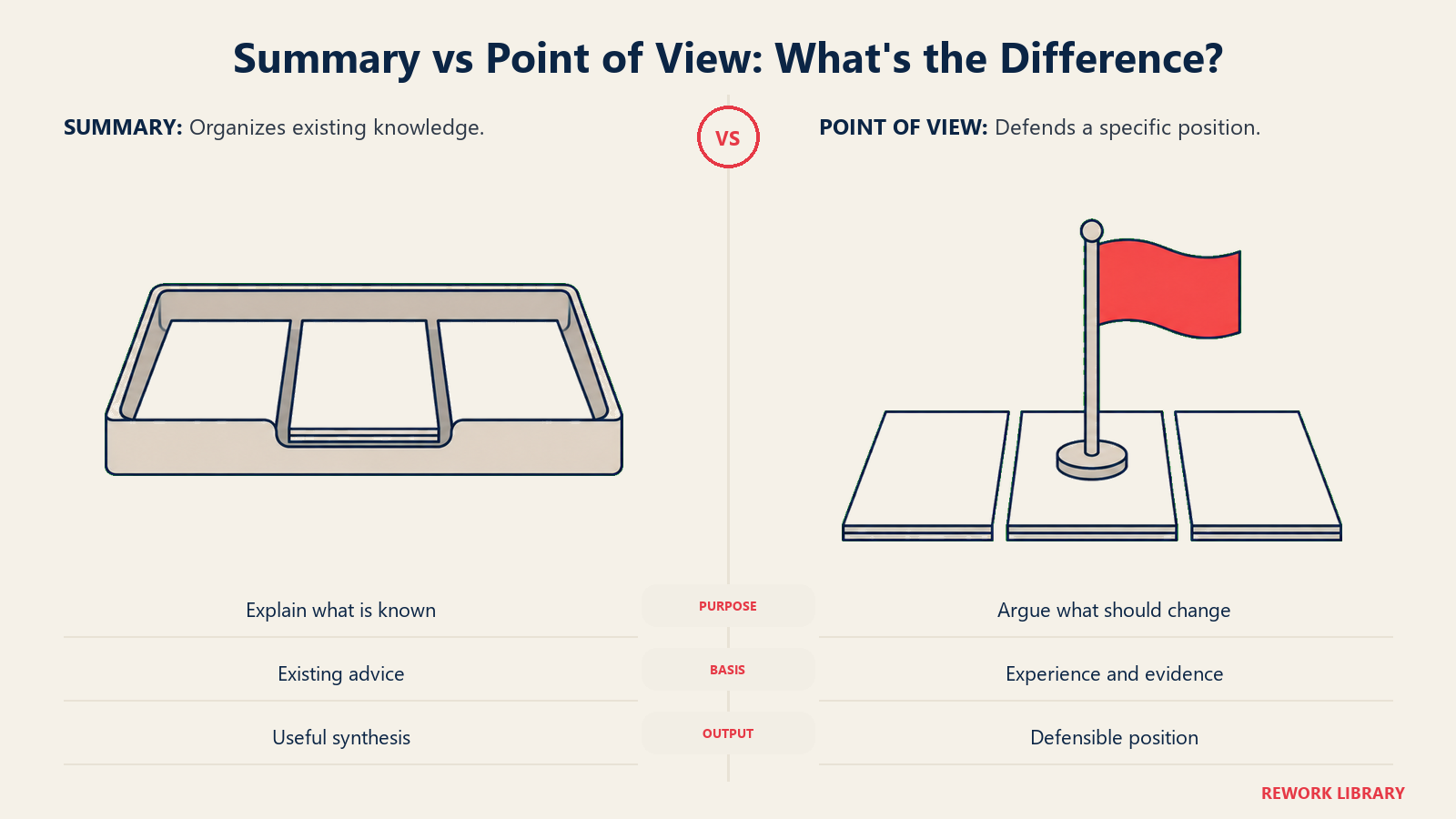
Getting from one to the other is a specific exercise, not a personality trait. Take a commonly accepted piece of advice in your domain and ask: where has my direct experience shown this to be incomplete, situational, or flat wrong? The answer to that question, defended with specific examples from real work, is usually the seed of a genuine point of view rather than a restatement of the obvious. Real client outcomes, handled carefully and with permission, are often the most credible evidence available. Client testimonials and case studies covers how to turn a specific engagement into proof that supports a point of view rather than a generic success story.
The Mentor Model: Developing the Next Generation Deliberately
The firms that build a genuine bench of recognized experts, rather than depending on one visible partner, do it through active mentorship, not passive hope. A senior partner co-authors a piece with a rising manager, giving the byline weight while the manager does real drafting work under guidance. Over several cycles, the byline shifts from co-authored to solo, and the mentee has built both the muscle and the confidence to publish independently.

This mirrors the progression frameworks described in talent development program: explicit stages, deliberate stretch assignments, and regular feedback, applied specifically to public expertise rather than technical or client-management skills. Firms that treat thought leadership development this deliberately end up with five or six people capable of representing the firm publicly instead of one, which directly reduces the key-person risk discussed in thought leadership strategy's treatment of personal versus firm branding.
Measuring Individual Development, Not Just Content Output
Program-level thought leadership measurement tracks audience reach, engagement, and inbound inquiries. Individual development measurement is different and simpler: it tracks progression along a maturity path. A useful version has five stages: no public content, occasional internal-only writing, first published byline, regularly invited to speak or contribute externally, and recognized as a go-to voice in a specific niche, evidenced by inbound speaking invitations or media requests rather than outbound pitching.
Reviewing where each developing professional sits on this path twice a year, alongside the broader capability development review cycle, keeps thought leadership development from becoming an assumption that happens on its own. It usually doesn't.
Common Mistakes in Developing Thought Leaders
Assigning content quotas without capability building. Telling someone to "write two articles a quarter" without ever helping them find their point of view or practice at lower stakes first produces exactly the stalled content calendar from the opening story.
Expecting senior-level output from someone with no reps. A first attempt at public writing is rarely as sharp as a partner's tenth. Reviewing early drafts with that expectation in mind, and coaching toward improvement rather than grading against a partner's polished voice, keeps developing writers from giving up after one discouraging round of feedback.
Letting the firm claim all the credit. When individual expertise only ever appears under a generic firm byline, the professional who did the thinking has little personal incentive to keep investing in the skill. A hybrid approach, similar to the one described in thought leadership strategy, that lets individuals build visible personal expertise while contributing to firm platforms, sustains motivation far better.
No feedback loop. Publishing into silence, without anyone telling a developing thought leader what resonated and what didn't, means they're guessing at improvement rather than actually improving.
Building the Bench
The commercial case for thought leadership is well established. What's less discussed is that the case only pays off if a firm has people capable of producing it, and that capability doesn't appear on its own just because a content calendar exists. It's built the same way any other professional skill is built: through an honest inventory of what someone actually knows, low-stakes practice before high-stakes publishing, deliberate mentorship from people who've already done it, and periodic feedback that tracks real progress.
Pair this individual development work with the firm-level program in thought leadership strategy, the planning discipline in content marketing strategy, and the broader business development strategy it feeds, and a firm ends up with both the system and the people to run it, rather than a calendar with three names on it and nothing to fill the slots. Once someone has published a few pieces under their own name, LinkedIn for professional services is usually the fastest way to find out whether the point of view is actually resonating with the audience it was written for.

Sales Director
On this page
- Thought Leadership Is a Developed Skill, Not a Personality Trait
- The Expertise Inventory: Finding What's Actually Worth Saying
- The Confidence Gap
- Building the Habit Before the Output
- Developing an Actual Point of View, Not a Summary
- The Mentor Model: Developing the Next Generation Deliberately
- Measuring Individual Development, Not Just Content Output
- Common Mistakes in Developing Thought Leaders
- Building the Bench