Issue Resolution Process: Turning Client Problems into Trust-Building Opportunities
Turn this article into takeaways for your work.


Each assistant summarizes the article only for you and suggests best practices for your work.
Every professional services firm will face client issues. A deadline gets missed. A deliverable falls short of expectations. Communication breaks down. A team member drops the ball. It happens.
The firms that survive these moments are the ones that handle them well. The firms that thrive are the ones that turn problems into opportunities to demonstrate their commitment, competence, and integrity.
Here's what most firms get wrong about issue resolution: they treat it as damage control. Something to minimize, smooth over, and move past as quickly as possible. But clients don't just remember how you perform when things go smoothly. They remember how you showed up when things went sideways.
There's research backing this up. It's called the service recovery paradox. Clients who experience a problem that gets resolved exceptionally well often end up more loyal than clients who never had a problem at all. Why? Because anyone can deliver when it's easy. How you handle difficulty reveals who you really are. Excellent issue resolution is central to your client relationship strategy.
This guide shows you how to build a systematic issue resolution process that maintains trust, prevents churn, and strengthens client relationships even when things go wrong.
Why issue resolution matters for retention
In professional services, your reputation is everything. One poorly handled issue can undo months of good work. Not just with that client, but with every prospect they talk to about their experience.
Client churn in professional services is expensive. Acquiring a new client costs 5-7x more than retaining an existing one. And when clients leave because of unresolved issues, they rarely give you the full truth. They'll cite "budget constraints" or "changing priorities" while telling their peers the real story.
But here's the flip side. When you resolve an issue transparently, quickly, and thoroughly, you build something that smooth delivery alone can't create: trust under pressure. Clients learn that when problems happen, you own them. You communicate clearly. You make it right. That trust is the foundation of long-term partnerships.
The firms that treat issue resolution as a core competency, not a necessary evil, build client relationships that last decades.
Issue classification framework
Not all issues are the same. Treating a billing question the same way you treat a project-threatening problem wastes resources and creates confusion. You need a classification system that helps you respond appropriately.
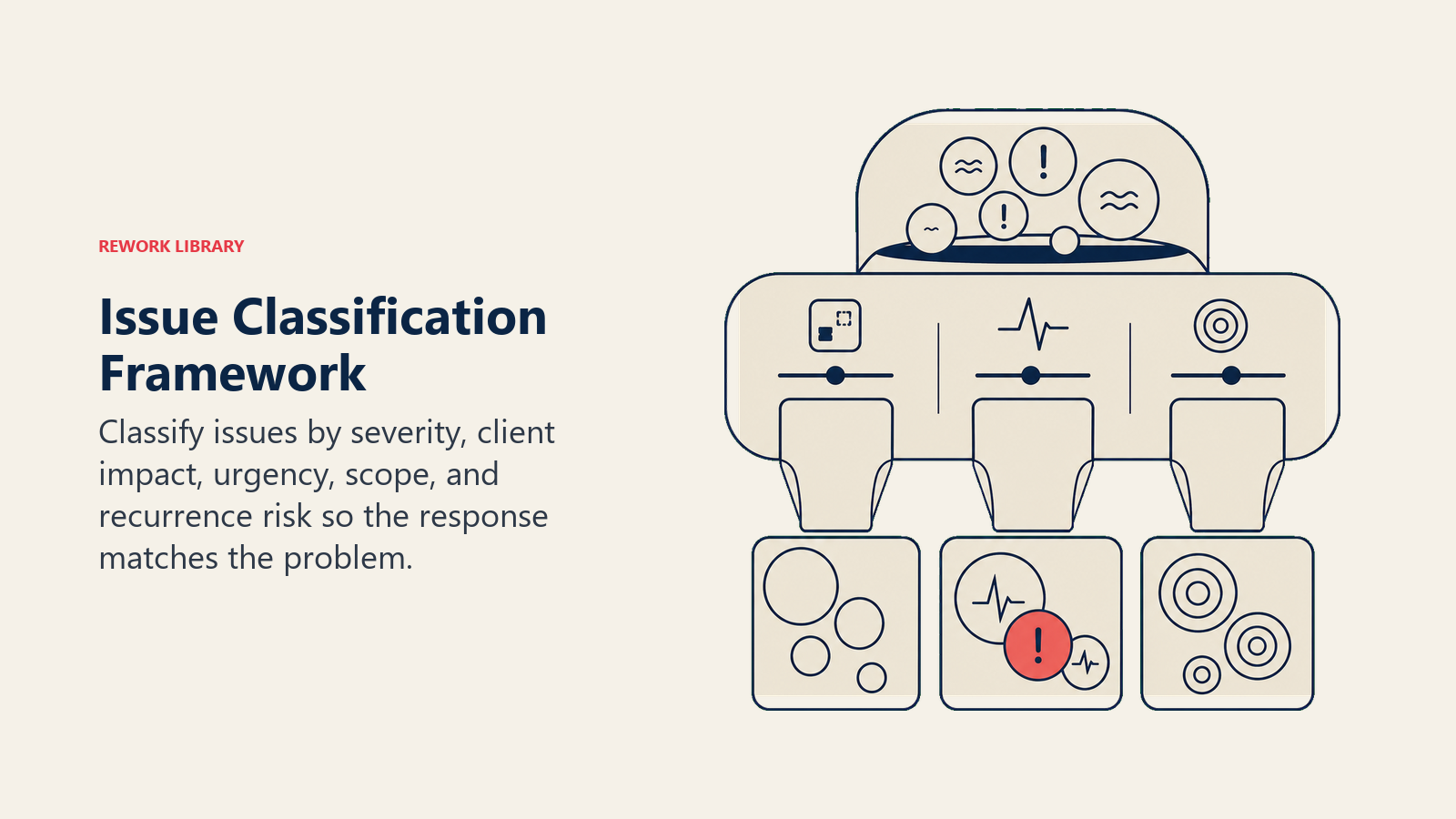
Issue types by category:
Delivery issues are problems with the work itself. Missed deadlines, quality concerns, incomplete deliverables, scope gaps. These strike at the core of what you were hired to do.
Communication issues are breakdowns in information flow. Lack of updates, unclear expectations, unresponsive team members, stakeholder misalignment. These erode confidence even when the work itself is solid.
Scope issues are disagreements about what's included in the engagement. "I thought that was covered" conflicts, unapproved changes, feature creep expectations. These are often preventable with better upfront documentation.
Team issues are problems with people. Personality conflicts, skill mismatches, team turnover, cultural misalignment. These are sensitive and require different handling than tactical problems.
Billing issues are disputes about invoices, payment terms, rate changes, expense disagreements. These need careful handling because they directly involve money and trust.
Severity levels and impact:
Not every issue warrants the same urgency. Use a four-level system to calibrate your response:
Critical issues are existential threats. The project is at risk of failure. The client is threatening to terminate. There's legal exposure or significant financial impact. These need immediate escalation to senior leadership.
High severity issues significantly impact delivery or the relationship. Major deadlines at risk, quality problems requiring rework, executive-level dissatisfaction. These need same-day response and daily updates until resolved.
Medium severity issues affect performance but don't threaten the overall engagement. Minor delays, process frustrations, individual stakeholder concerns. These need response within 24 hours and regular check-ins.
Low severity issues are minor inconveniences. Documentation requests, preference changes, small adjustments. These can be handled in the normal workflow but shouldn't be ignored.
The key is urgency determination. Severity tells you what to do. Urgency tells you when. A critical issue that's already resolved (but needs documentation) is less urgent than a medium issue that's escalating fast.
Early detection and prevention
The best issue resolution process is the one you never need to use. Catching problems early, before they become full-blown crises, is the real skill.
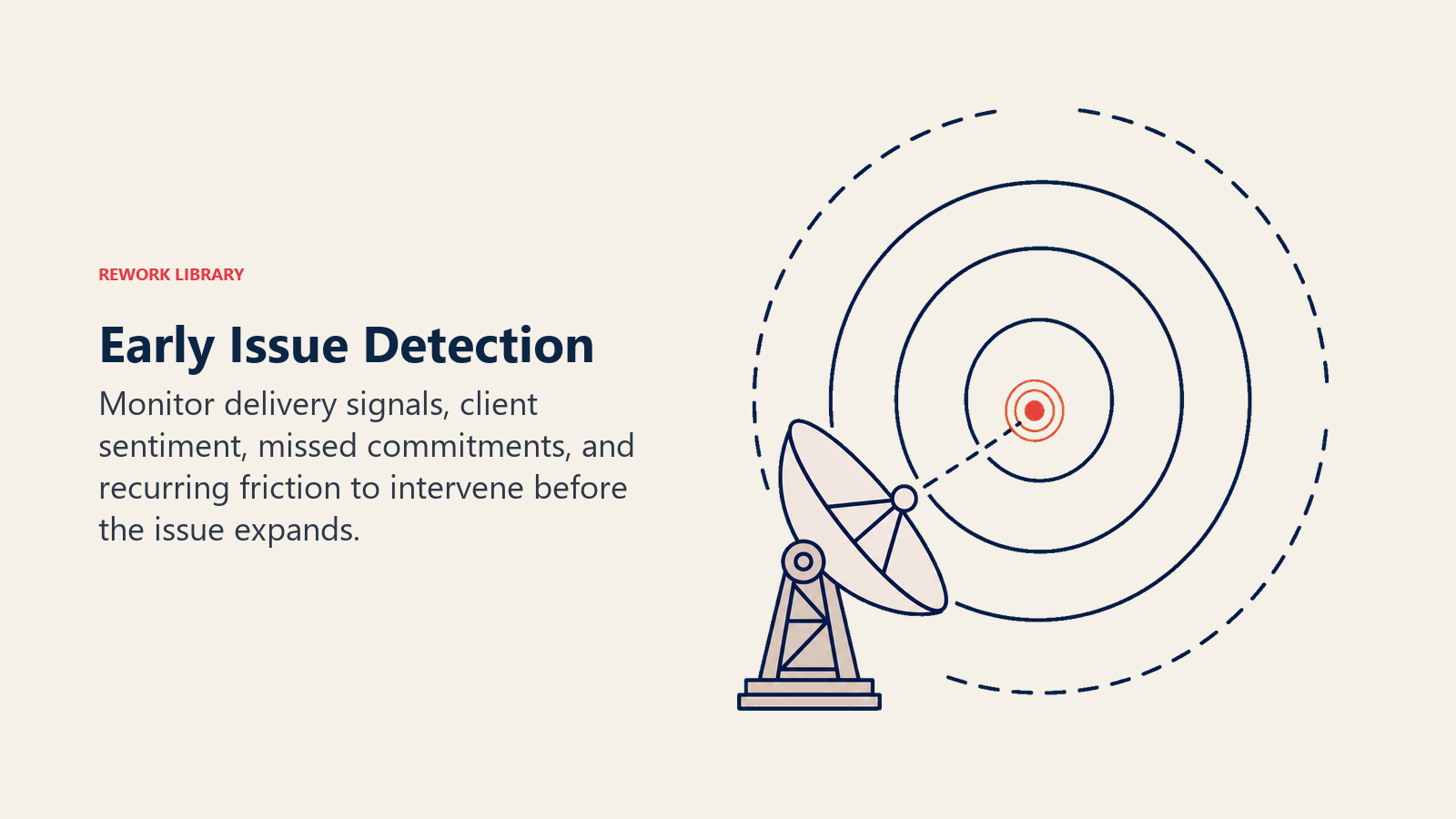
Warning signs to watch for:
Client behavior changes tell you something's wrong before they say it explicitly. They start missing meetings or sending junior people instead of decision-makers. Response times to your emails slow down. Enthusiasm in conversations drops. Small requests become terse demands.
Communication patterns shift. A client who used to respond within hours now takes days. Or the opposite happens and they're suddenly micro-managing things they previously trusted you to handle. Both signal discomfort.
Scope discussion frequency increases. When a client repeatedly asks about what's included, what's extra, what was agreed to, it means they're questioning value or feeling nickel-and-dimed.
Payment behavior changes. Invoices that used to get paid in 30 days now take 60. Or you start getting questions on every invoice when billing was previously straightforward. This is often the first tangible sign of dissatisfaction.
Team members express concerns. Your people are on the ground daily. When they mention that the client seems frustrated or that a stakeholder made a concerning comment, take it seriously. Don't wait for it to escalate to you.
Proactive monitoring systems:
Regular relationship health checks catch issues before they metastasize. Weekly internal check-ins with your delivery team to discuss client sentiment. Monthly stakeholder calls with the client focused on "how are we doing?" not just "what are we delivering?"
Client feedback mechanisms give them a structured channel to raise concerns. Quarterly surveys, retrospectives after major milestones, executive business reviews. Make it easy for them to tell you what's not working while it's still fixable. Your client feedback systems should surface issues before they escalate.
Project health dashboards track leading indicators. Are deliverables on schedule? Is utilization where it should be? Are change orders piling up? These metrics often predict issues before clients voice them.
Escalation triggers and preventive measures:
Define clear criteria for when to escalate internally before clients escalate to you. If you miss two consecutive deadlines, that's an automatic escalation. If client satisfaction scores drop below a threshold, leadership gets involved. If scope change requests exceed a certain percentage of the original budget, pause and realign.
Prevention beats cure every time. Clear scope documentation, regular communication cadences, proactive risk identification, realistic timelines with buffer. Most issues trace back to preventable problems in project setup or management.
Issue escalation protocol
When an issue crosses a severity threshold, you need a defined path for getting the right people involved at the right time.
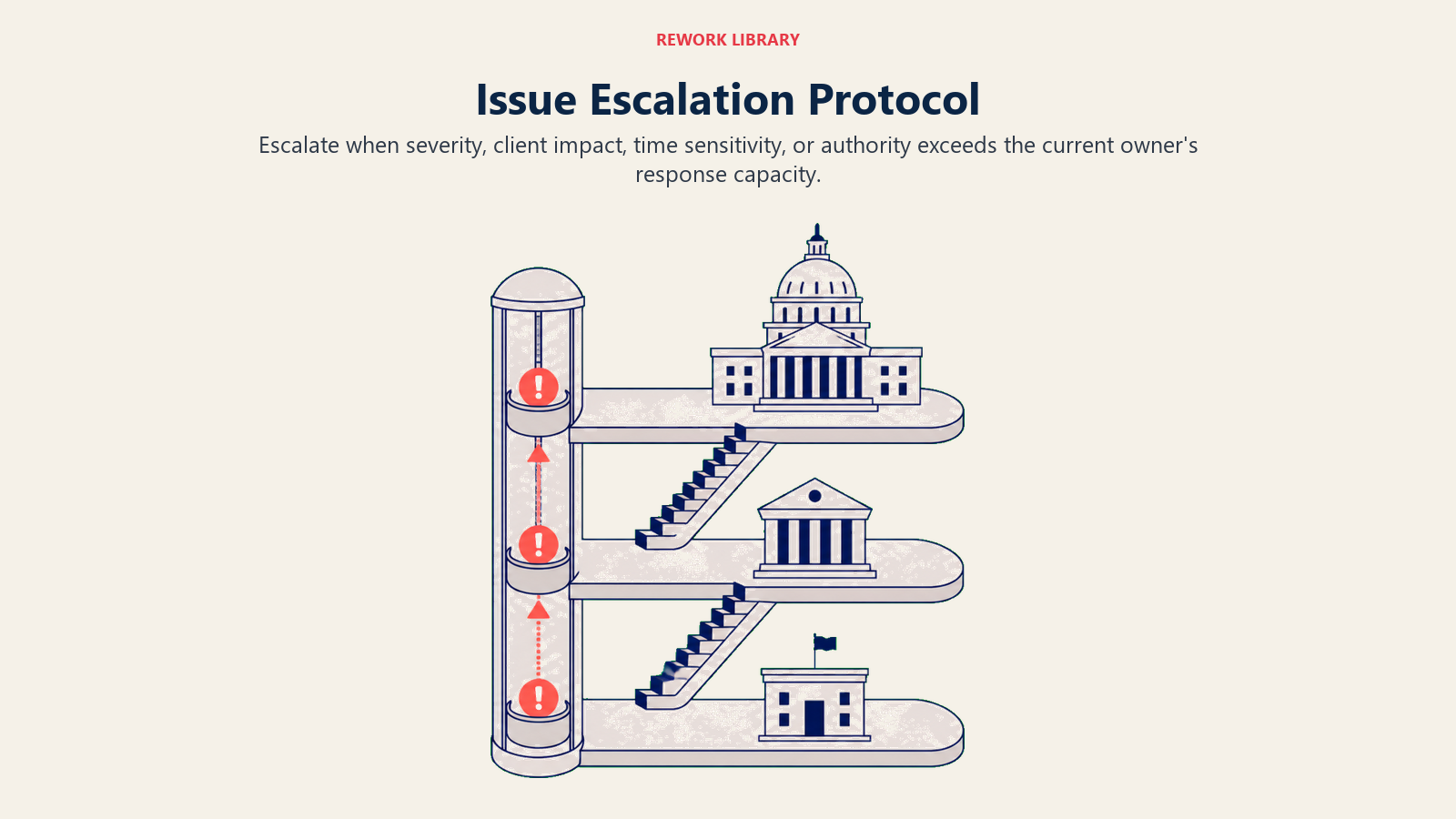
Escalation criteria by level:
Low severity issues stay with the project team. The account manager or project manager handles it directly with the client contact. No need to involve leadership unless it becomes a pattern.
Medium severity issues get reported to the engagement partner or client services lead within 24 hours. They're not necessarily hands-on yet, but they're aware and can provide guidance or resources.
High severity issues trigger immediate escalation to the practice lead or partner responsible for the account. They're involved in crafting the response and may engage directly with the client's leadership.
Critical issues go to executive leadership immediately. If there's risk of contract termination, legal issues, or threats to firm reputation, your managing partner or CEO needs to know now, not tomorrow.
Escalation paths and response SLAs:
Create a simple escalation matrix that everyone knows:
| Severity | Initial Response | Status Updates | Escalation To | Timeline |
|---|---|---|---|---|
| Critical | 1 hour | Every 4 hours | Managing Partner | Immediate |
| High | 4 hours | Daily | Engagement Partner | Same day |
| Medium | 24 hours | Every 2-3 days | Client Services Lead | Within 24 hours |
| Low | 48 hours | As needed | Project Manager | Normal workflow |
Notification requirements:
When you escalate, you're not just passing the problem up the chain. You're providing context so the next level can act effectively.
Include what happened, when it was discovered, who's affected, what immediate actions have been taken, what the client has been told (or hasn't been told yet), and what you're recommending as next steps.
Speed matters, but so does information quality. A panicked "there's a big problem!" escalation without context creates confusion. Take 15 minutes to gather facts, then escalate with substance.
Stakeholder involvement decisions:
Not every escalation means the client needs to know you've escalated internally. If you're bringing in senior resources to help solve the problem, that's often invisible to the client. They just see faster or better resolution.
But if the issue is already on the client's radar, tell them you've escalated. "I've brought this to our practice lead, who's personally focused on resolving this for you." That signals that you're taking it seriously.
The worst move is letting the client escalate to your leadership before you've escalated internally. If your managing partner gets a call from an unhappy client and this is the first they're hearing about it, you've lost credibility twice. Once with the client, and once internally.
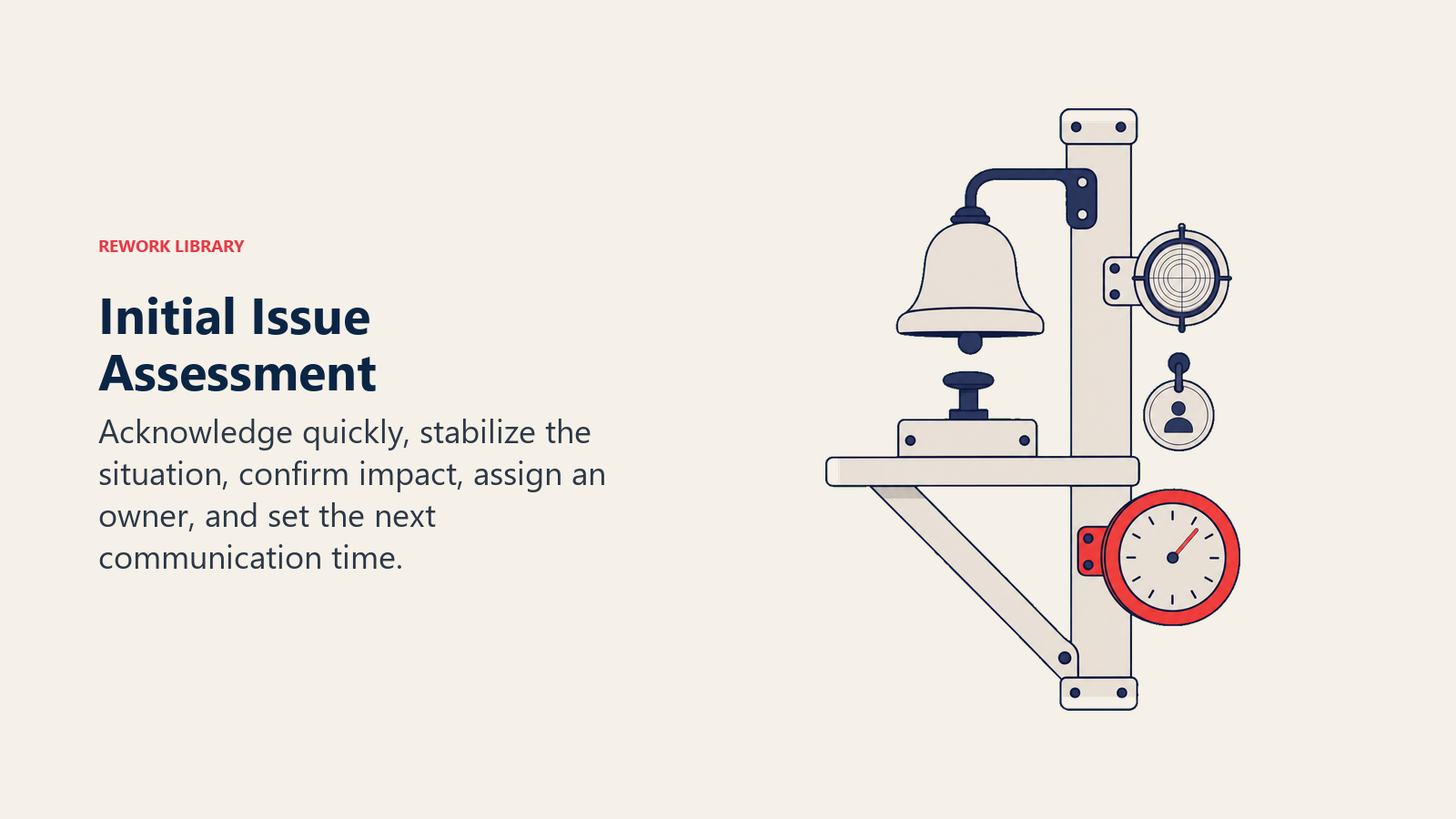
Initial response and assessment
The first 24 hours after an issue surfaces determine how the entire resolution plays out. Move fast, but move smart.
Acknowledgment and timing:
Acknowledge the issue immediately, even if you don't have answers yet. "I received your email about the reporting delays. I'm gathering information and will have an update for you by end of day" buys you time while showing you're responsive.
If a client has to follow up to confirm you even received their concern, you've already made it worse. Acknowledgment isn't about solving. It's about showing you're on it.
Information gathering methodology:
Before you respond substantively, understand what actually happened. Talk to your team members who were involved. Review project documentation, emails, and deliverables. Check timelines against commitments. Get the facts before you form a narrative.
Ask clarifying questions of the client if needed. "To make sure I understand the issue fully, can you walk me through what you expected versus what happened?" This isn't defensive. It's diagnostic.
Avoid assumptions about what the client cares about most. What seems like a tactical problem to you might represent a strategic concern to them. Or vice versa. Let them tell you the impact from their perspective.
Root cause analysis:
Once you understand what happened, figure out why it happened. Surface causes are rarely the real issue.
The report was late. Why? Because the data extraction took longer than expected. Why? Because the client's systems had access restrictions we didn't know about. Why didn't we know? Because the scoping process didn't include technical due diligence on data access.
That's the real problem. Not "the report was late" but "our scoping process has a gap." Root cause analysis helps you fix the actual issue, not just the symptom.
Impact assessment and client communication:
Evaluate the impact honestly. What does this issue mean for the project timeline? For deliverables? For budget? For the client's business objectives?
When you communicate with the client, lead with empathy and ownership. "I understand this puts you in a difficult position with your executive team. Here's what happened, here's why it happened, and here's what we're doing about it."
No excuses. No finger-pointing at the client or external factors. Even if those factors contributed, your job is to own the parts you can control and solve the problem.
Resolution planning
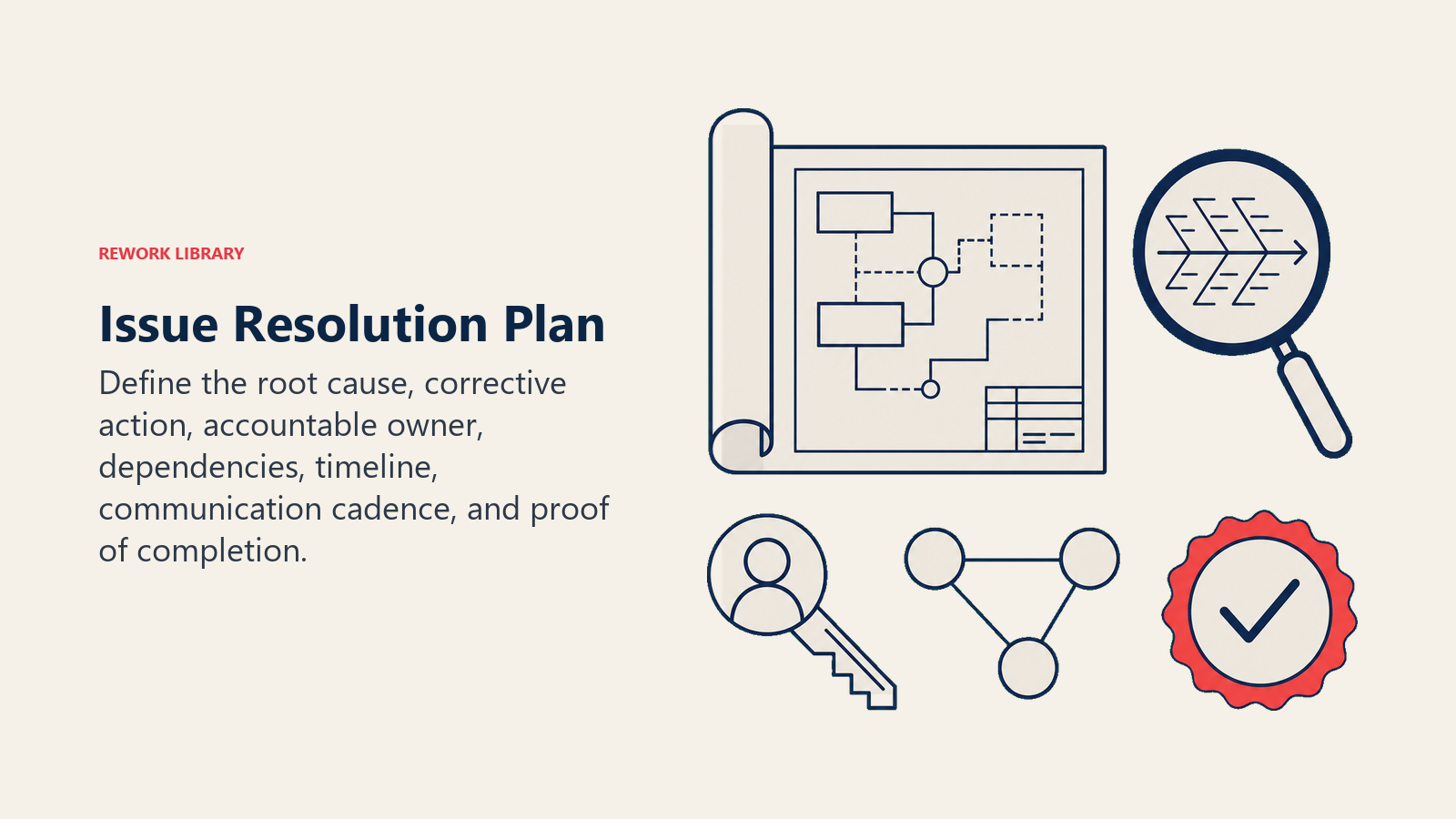
Once you understand the issue, you need a plan to fix it. Not a vague promise that you'll "do better," but a specific roadmap.
Solution development:
Good solutions address both the immediate issue and the underlying cause. If a deadline was missed, the immediate solution is getting the deliverable completed. The underlying solution is fixing the workflow that caused the miss in the first place.
Involve the right people in developing the solution. If it's a technical delivery problem, your technical leads need to be part of the planning. If it's a communication breakdown, your account manager should drive it. If it's a team fit issue, your HR or people operations team might need to weigh in.
Consider multiple options if possible. Sometimes there's a fast solution that's imperfect and a slower solution that's comprehensive. Present both to the client and let them choose based on their priorities.
Resource allocation:
Resolving issues often requires shifting resources. That means pulling people from other projects, bringing in specialists, or having senior people step into execution roles temporarily.
Be realistic about what it takes. If you committed to fixing something in two days but need a week to do it properly, say that. Under-promising and over-delivering rebuilds trust. Over-promising and under-delivering destroys it.
Make sure your team has what they need. If they're already stretched and you pile on issue resolution without clearing capacity, you're setting up the next failure.
Timeline establishment:
Set clear, specific timelines with checkpoints. Not "we'll resolve this as soon as possible" but "we'll have the corrected deliverable to you by Thursday at 5 PM, with a draft ready for your review by Tuesday morning."
Build in buffer. If you think something takes three days, commit to five. Better to deliver early than to miss the new deadline after already missing the original one.
Client alignment on the plan:
Before you start executing, confirm the client agrees with your approach. Walk them through what you're going to do, when you're going to do it, and what they can expect at each step.
Ask explicitly: "Does this plan address your concerns? Is there anything we're missing?" This isn't weak. It's smart. You want to make sure you're solving the problem they care about, not the problem you think they have.
Get written confirmation of the plan if the issue is significant. Email works fine. "Per our call, here's what we agreed to..." This creates clarity and prevents future "I thought you were going to..." conversations.
Implementation coordination:
Assign clear ownership. One person is accountable for making sure the plan happens. They don't have to do all the work, but they're the single point of contact and the one who's responsible for execution.
Set internal checkpoints. If you told the client you'd have an update in three days, check in with your team after one day to make sure you're on track. Don't wait until day three to discover there's a problem.
Execution and communication
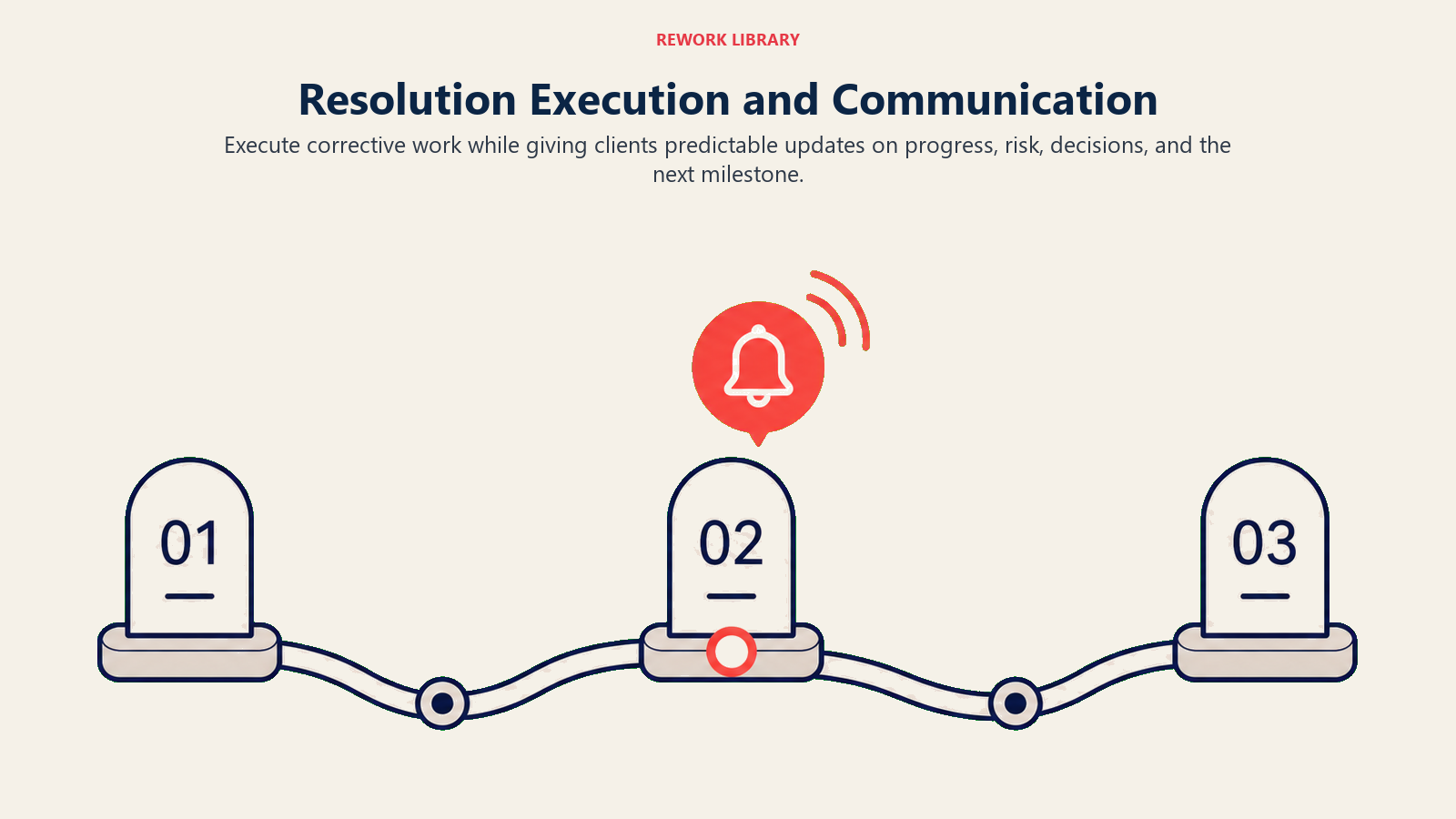
Resolution plans fail more often in execution than in design. The issue is often that coordination breaks down or communication stops.
Implementation excellence:
Execute exactly what you said you would, when you said you would. If circumstances change and the plan needs adjustment, communicate that immediately. Don't just go silent and hope the client doesn't notice.
Quality matters more than speed when you're in recovery mode. If you rush a fix and it's not right, you've compounded the problem. Take the time to do it correctly.
Document as you go. Keep notes on what was done, when, by whom, and what the results were. This helps with transparency and with post-resolution analysis.
Progress updates and cadence:
Tell clients what's happening before they ask. If you committed to daily updates, send them daily. Even if the update is "we're still working on X, it's progressing as planned, next update tomorrow."
Silence creates anxiety. Clients assume the worst when they don't hear from you. Regular updates, even brief ones, provide reassurance that things are under control.
Adjust communication frequency based on severity. Critical issues might need twice-daily updates. Medium issues might be every other day. Match the cadence to the client's anxiety level.
Managing expectations:
If something is taking longer than expected, say so early. "We thought we'd have this done by Wednesday, but we've run into additional complexity. New target is Friday." That's infinitely better than saying nothing until Wednesday and then asking for more time.
Be honest about what you can and can't commit to. If there's uncertainty, acknowledge it. "We believe we can have this resolved by Thursday, but there's a dependency on the vendor response that we can't control. Worst case is Monday if that delays."
Clients can handle bad news. They can't handle surprises or broken promises.
Stakeholder communication strategy:
Different stakeholders need different levels of detail. The executive sponsor might just need to know "we had an issue, here's the impact, here's how we're fixing it, here's when it's resolved." The day-to-day contact might need granular updates on every step.
Tailor your communication to the audience. Don't bury executives in implementation details. Don't leave operational contacts wondering what's actually happening.
If the issue has gotten to the point where client executives are involved, make sure your executives are communicating with them. Peer-to-peer relationships matter for rebuilding confidence.
Documentation practices:
Keep a running log of all communications, decisions, and actions taken. This isn't about covering yourself legally (though that's a side benefit). It's about being able to answer "what happened when?" questions without scrambling.
Document agreements and approvals. If the client approved a workaround or accepted a modified timeline, get that in writing. Email is fine. "Per our conversation, you've confirmed that..."
This documentation becomes the foundation for the post-resolution review and for preventing similar issues in the future.
Service recovery strategies
Resolution isn't just fixing the immediate problem. It's repairing the relationship and preventing recurrence.
Understanding the service recovery paradox:
Research shows that clients who experience a service failure that gets handled exceptionally well can end up more satisfied and loyal than clients who never experienced a failure at all.
Why? Because failure reveals character. When things are going smoothly, any competent firm can deliver. But when things go wrong, you learn who shows up, who owns problems, who communicates honestly, and who makes it right.
This doesn't mean you should create problems to build trust. But it does mean that when problems inevitably occur, you have an opportunity to demonstrate values that routine delivery can't showcase.
Remediation approaches that rebuild trust:
Start with acknowledgment and apology. Not a defensive "mistakes happen" or "this was partly due to factors outside our control." A clear "we fell short of our commitment to you, and I'm sorry" matters.
Make tangible amends. That might mean redoing work at no cost, providing additional services to compensate, adjusting fees, or accelerating other deliverables. The specifics matter less than the gesture of making the client whole.
Go beyond fixing the immediate issue. Show them what you've changed systemically. "Here's what we've implemented to make sure this doesn't happen again" demonstrates that you learned something.
Goodwill gestures that matter:
Financial remediation sends a clear signal. Fee reductions, credits against future work, or absorbing costs you could arguably bill for all show that you're willing to take a hit to make things right.
But money isn't always the answer. Sometimes clients value executive attention more. A managing partner personally working on their project for a week might rebuild trust more than a discount.
Added value can work too. Throwing in an extra analysis, extending support hours, or providing complimentary strategy sessions show you're invested in their success beyond just fulfilling the contract.
The key is that the gesture has to feel proportional to the impact. A minor inconvenience doesn't warrant a major concession. But a significant screw-up deserves a significant response.
Process improvements and lessons learned:
Every issue should trigger a review of your processes. What in your workflow, systems, or practices allowed this to happen? What needs to change?
Share those changes with the client. "Based on what happened with your project, we've updated our quality review process to include an additional checkpoint. We've also implemented new communication protocols for dependencies."
This shows the client that their experience improved your firm, not just their project. That transforms a negative into a contribution. Well-documented recoveries can even become powerful client testimonials and case studies.
Rebuilding trust systematically:
Trust repair takes time. You can't fix it with one conversation or one gesture. You rebuild it through consistent, reliable performance over weeks or months.
Increase visibility temporarily. More frequent updates, more executive engagement, more proactive communication. Show them you're paying attention.
Deliver flawlessly on the next few milestones. You need a string of successes to overcome the memory of the failure. Don't take on risky new initiatives until you've rebuilt confidence through solid execution on core work.
Ask for feedback explicitly. "How are we doing? Are you seeing the improvements we committed to? What else do we need to do?" This shows humility and commitment to their satisfaction.
Post-resolution follow-up
Resolving the issue isn't the end of the process. Follow-up determines whether you actually restored the relationship.
Satisfaction verification:
Within a week of resolution, check in explicitly. "We believe we've resolved the issue we discussed. Can you confirm that it's working as expected and that we've addressed your concerns?"
Don't just assume silence means satisfaction. Ask directly. Some clients won't volunteer that there are still concerns unless you create the opening.
If they're not fully satisfied, you need to know immediately so you can address it while the issue is still active. Discovering weeks later that they're still unhappy wastes time and goodwill.
Relationship health assessment:
Use the issue as a checkpoint for the broader relationship. "Given what we've been through, I'd like to step back and make sure we're aligned on expectations and communication going forward. What's working well? What should we be doing differently?"
This conversation often surfaces issues that weren't part of the immediate problem but have been simmering. Better to address them now when you're already in problem-solving mode.
Assess whether the relationship has been fully repaired or whether there's residual damage. If trust is still shaky, you may need to adjust your approach. More senior involvement, more frequent executive reviews, more conservative commitments until you fully rebuild. Your client satisfaction management metrics should track recovery progress.
Lessons learned and documentation:
Run an internal post-mortem on every significant issue. What happened? Why did it happen? What signals did we miss? What should we have done differently? What are we changing as a result?
Make sure these insights get documented and shared. If the lesson only lives in the heads of the people involved in this project, you'll repeat the mistake on another one.
Create action items from the lessons learned. Specific, assigned changes to templates, processes, checklists, or training. Otherwise, "lessons learned" become "lessons discussed and forgotten."
Team debriefing and learning:
After resolving an issue, debrief with your team. How did they feel about how it was handled? What would they do differently? What support do they need to prevent similar issues?
Use this as a learning opportunity. If the team handled it well, acknowledge that. If there were missteps, coach on what better looks like. Issue resolution skills are learned through experience, and debriefs are where learning happens.
Make sure the team understands the outcome. Did the client accept the resolution? Is the relationship intact? Knowing the full story helps them understand the impact of their work on client relationships.
Handling difficult scenarios
Not all issues are straightforward. Some require navigation of challenging dynamics.
Dealing with unreasonable client demands:
Sometimes clients use an issue as leverage to demand things outside the scope, timeline, or budget. "Since you missed the deadline, you should include this additional analysis for free."
You need to separate legitimate remediation from scope creep disguised as issue resolution. Acknowledge the failure, make appropriate amends, but don't accept unlimited liability.
Respond with empathy but clarity: "I understand you're frustrated, and we take responsibility for missing the deadline. We're crediting you for the delay costs. The additional analysis you're requesting is outside our original scope, but I'm happy to discuss adding it as a change order."
Hold boundaries while remaining client-focused. You can fix your mistake without signing up for things that weren't part of the agreement.
When scope creep presents as issues:
Clients sometimes frame scope changes as quality issues. "This report doesn't include X" when X was never in the scope. "I expected Y" when Y was explicitly excluded.
Go back to the scope documentation. "Let me pull up our original proposal. The scope we agreed to included A, B, and C. What you're asking for is D, which we'd be happy to add through a change order."
If your scope documentation is ambiguous, you have less leverage. That's why clear scope definition up front is your best defense against these scenarios.
Recovering relationships after major failures:
Sometimes an issue is severe enough that you're genuinely at risk of losing the client. The project failed. The deliverable was unusable. The team missed something critical.
Recovering from these requires humility and substantial remediation. Senior leadership needs to be personally involved. You may need to offer significant financial concessions or commit substantial resources to make it right.
But don't throw money at it without a clear recovery plan. "We'll discount this project 50%" doesn't fix the underlying problem if the client still doesn't trust your ability to deliver.
Focus on demonstrating capability: "We've brought in our most senior team to personally oversee the redo. Here's the new plan, here's the oversight structure, here's how we're ensuring quality."
Knowing when to walk away:
Sometimes the relationship is too damaged to salvage, or the client's expectations are too far from reality.
If a client is abusive to your team, making unreasonable demands that no remediation will satisfy, or the relationship has become toxic, you may need to exit gracefully.
This is a last resort, but it's occasionally necessary. "We don't believe we're the right partner for what you need going forward. We'll complete the current phase and transition the work to another firm."
Protect your team. No client relationship is worth burning out good people or accepting abusive treatment.
Technology and tools
Systematic issue resolution requires systems to track, manage, and learn from problems.
Issue tracking and ticketing systems:
Use a system to log every client issue, no matter how small. Jira, Asana, Monday, ServiceNow, or even a structured spreadsheet works.
Track issue details, severity, assigned owner, status, resolution steps, and outcome. This creates visibility and accountability.
The benefit isn't just tracking individual issues. It's pattern recognition. If you're logging everything, you'll notice when the same type of issue keeps appearing or when certain clients report more issues than others.
CRM integration for relationship context:
Your issue tracking should connect to your CRM so you can see issue history in the context of the overall client relationship.
When an issue comes in, you want to know: Is this a first-time problem or are we seeing a pattern? Is this client generally satisfied or have there been multiple recent issues? What's the financial value of this relationship?
That context shapes how you respond. A first-time issue with a long-term, high-value client gets handled differently than a third issue in three months with a new client.
Escalation workflows and automation:
Build automated triggers based on severity levels. High severity issues automatically notify the engagement partner. Critical issues trigger alerts to executive leadership.
Create templates for escalation emails so the right information flows up consistently. What happened, when, who's affected, immediate actions taken, recommended next steps.
Workflow automation ensures issues don't sit in someone's inbox waiting for manual escalation. Speed matters, and automation removes human delay.
Knowledge base and resolution documentation:
Build a knowledge base of common issues and proven resolutions. When your team encounters a problem, they can search for how similar issues were handled before.
This accelerates resolution and ensures consistency. You're not reinventing solutions every time.
Include not just technical fixes but also client communication approaches. "When X happens, here's how to frame it with the client" helps newer team members handle issues more effectively.
Metrics and measurement
What gets measured gets managed. Track these metrics to improve your issue resolution process.
Issue volume and frequency:
How many issues are you dealing with monthly? Is the trend increasing or decreasing? This is your overall quality indicator.
Break it down by type, client, project, and team. Are delivery issues more common than communication issues? Do certain clients report more problems? Are some teams better at preventing issues?
Volume alone doesn't tell the story, but trends do. If issue volume is climbing, something in your delivery or client management process is breaking down.
Resolution time by severity:
Track how long it takes to resolve issues from the time they're reported to when the client confirms satisfaction.
Set targets based on severity. Critical issues should resolve within days, not weeks. Medium issues within a week or two. Low severity within your normal workflow cycle.
If you're consistently missing your resolution time targets, you're either under-resourced for issue management or your processes are inefficient.
Issue recurrence rate:
Are you solving problems permanently or just putting band-aids on symptoms? Track how often the same issue type recurs.
If you've resolved communication breakdowns with a client three times in six months, you haven't actually solved the problem. You're managing symptoms.
Recurrence is a sign that your root cause analysis or process improvements aren't working. You need to dig deeper.
Client satisfaction post-resolution:
Survey clients after issues are resolved. Did we fix it to your satisfaction? How did we handle the process? What could we have done better? These recovery surveys should integrate with your broader client success reviews.
This tells you whether you're successfully repairing relationships or just checking boxes on resolution.
Compare satisfaction scores for clients who've experienced issues versus those who haven't. If resolved issues lead to satisfaction scores as high as clients who never had problems, your recovery process is working.
Churn correlation with issues:
Track whether clients who've experienced issues are more likely to churn. How many issues does it typically take before a client leaves?
This helps you identify when issues are becoming relationship-threatening. If clients who experience three or more issues churn at 50%, you know that third issue is a critical threshold.
Use this data to trigger proactive retention efforts. If a client hits two issues, senior leadership should be engaging to strengthen the relationship before a third issue becomes the tipping point. This proactive engagement is essential to your client retention strategy.
Building team capabilities
Your issue resolution process is only as good as the people executing it. Invest in building these skills.
Issue handling and de-escalation skills:
Train your team on how to respond when a client is upset. Active listening, empathy, avoiding defensiveness, focusing on solutions rather than blame.
Role-play difficult conversations. Practice delivering bad news, acknowledging failures, and proposing solutions. These skills don't come naturally to everyone, especially for technical experts who aren't used to managing relationship dynamics.
Teach de-escalation techniques. How to calm an angry client, how to move from emotional to problem-solving mode, how to create space for the client to feel heard.
Communication training:
Written communication matters enormously in issue resolution. Train your team on how to write escalation emails, client updates, and resolution summaries.
Practice clarity: what happened, why, what we're doing, when it'll be done. No jargon, no excuses, no unnecessary detail.
Verbal communication is equally important. How to have difficult conversations without becoming defensive, how to acknowledge failure without making it worse, how to instill confidence that you can fix it.
Empathy and client perspective:
Help your team understand issues from the client's point of view. What's the business impact of this failure? How does this affect their reputation with their leadership? What pressure are they under?
When team members can see beyond "we missed a deadline" to "this makes our client look bad to their CEO," they respond with appropriate urgency and care.
Empathy doesn't mean accepting blame for things that aren't your fault. It means understanding the client's experience and responding to their actual concern, not just the surface issue.
Ownership and accountability culture:
Create a culture where taking ownership of problems is valued, not punished. If team members are afraid to acknowledge issues, they'll hide them until they're unfixable.
Reward people who surface problems early, even if they caused them. "I made a mistake, here's what happened, here's how I'm fixing it" should be career-enhancing behavior, not career-limiting.
Hold people accountable for resolution, not blame. The question isn't "whose fault is this?" It's "how do we fix it and prevent it from happening again?"
Best practices and principles
Respond fast, even if you don't have all the answers yet:
Acknowledgment within hours matters more than comprehensive solutions within days. Clients need to know you're aware and working on it.
Speed of response sets the tone for the entire resolution process. A slow initial response signals that you don't take it seriously.
Default to transparency, not spin:
Tell clients what happened, including the parts that make you look bad. They'll find out anyway, and honesty up front builds trust.
Spin and excuses destroy credibility. "Here's what we screwed up" is infinitely more effective than "due to unforeseen circumstances beyond our control..."
Take ownership without making excuses:
Even when there are external factors, lead with what you could have controlled. "We should have anticipated that dependency and built more buffer" is better than "the vendor was late."
Clients don't care about your excuses. They care that you're solving their problem.
Fix the root cause, not just the symptom:
If you're only addressing the immediate issue without changing the underlying process, you're setting up the next failure.
Every issue should trigger a "what do we need to change systemically?" conversation. Otherwise, you're just playing whack-a-mole with problems.
Document everything:
From the initial report through resolution, keep detailed records. This protects you legally, helps with pattern analysis, and ensures continuity if team members change.
If there's ever a dispute about what was agreed to or what happened when, documentation is your only defense.
Follow up even after the client says it's resolved:
Check in again a week or two later. "I wanted to circle back and make sure that issue we resolved is still working well." This shows you care about outcomes, not just closing tickets.
Clients remember these follow-ups. It's a small gesture that reinforces your commitment to their success.
Where to go from here
Issue resolution doesn't exist in isolation. It connects to every other aspect of client relationship management:
- Client Satisfaction Management - Preventing issues through proactive satisfaction monitoring
- Client Communication Cadence - Regular communication that surfaces issues early
- Project Management Methodology - Delivery practices that minimize issue occurrence
- Scope Creep Management - Preventing scope issues through clear boundaries
Build your issue resolution process as a core competency, not an afterthought. The firms that handle problems exceptionally well create competitive advantages that smooth delivery alone can't match.
Start with clear classification criteria, defined escalation paths, and fast response protocols. Train your team on the skills that matter. Measure what's working and what's not. And remember: how you show up when things go wrong reveals more about your firm than anything you put in a proposal.

Sales Director
On this page
- Why issue resolution matters for retention
- Issue classification framework
- Early detection and prevention
- Issue escalation protocol
- Initial response and assessment
- Resolution planning
- Execution and communication
- Service recovery strategies
- Post-resolution follow-up
- Handling difficult scenarios
- Technology and tools
- Metrics and measurement
- Building team capabilities
- Best practices and principles
- Where to go from here