Additional Services Introduction: Strategic Framework for Introducing New Services to Existing Clients
Turn this article into takeaways for your work.


Each assistant summarizes the article only for you and suggests best practices for your work.
Here's what happens when professional services firms develop new capabilities: they immediately start marketing to prospects while their existing clients have no idea these services exist. It's backwards. Your current clients are easier to sell, faster to close, and more profitable to serve. They already trust you. They already understand how you work. They're the first people who should know about new offerings.
But introducing new services to existing clients isn't as simple as sending an email announcement. Most firms botch this by treating it like a product launch when it's actually a relationship conversation. The clients who know you for tax work won't automatically think of you for M&A advisory just because you now offer it. You need to shift their perception, educate them on the new value, and prove you can deliver at the same quality level they expect.
This guide shows you how to introduce new services strategically through soft launches, early adopter programs, and phased rollouts that build momentum while managing risk. Combined with white space analysis, you can systematically identify where new services fit into existing client relationships.
Why existing clients are your best market for new services
When you're launching a new service, you're fighting two battles: proving the service is valuable and proving you're credible to deliver it. With prospects, you fight both battles at once. With existing clients, you've already won the credibility battle.
Your clients know your delivery standards, your communication style, your responsiveness. They've seen you execute under pressure. That trust is worth its weight in gold when introducing something new. A client who's happy with your core work will give you the benefit of the doubt on adjacent services. A prospect won't.
The economics are better too. Acquisition costs are zero. Sales cycles are shorter. Deal sizes tend to be larger because clients already understand the value of premium pricing. And there's a defensive angle to this. If you don't offer expanded services, clients will go elsewhere for them, creating competitor entry points.
But here's the catch: existing clients have fixed perceptions of what you do. If you're their audit firm, they don't naturally think of you for cybersecurity consulting. Breaking that perception requires intentional education and proof.
Service packaging and definition
Before you tell clients about a new service, you need clarity on what you're actually offering. Vague capabilities don't sell. Specific, well-defined services with clear deliverables do.
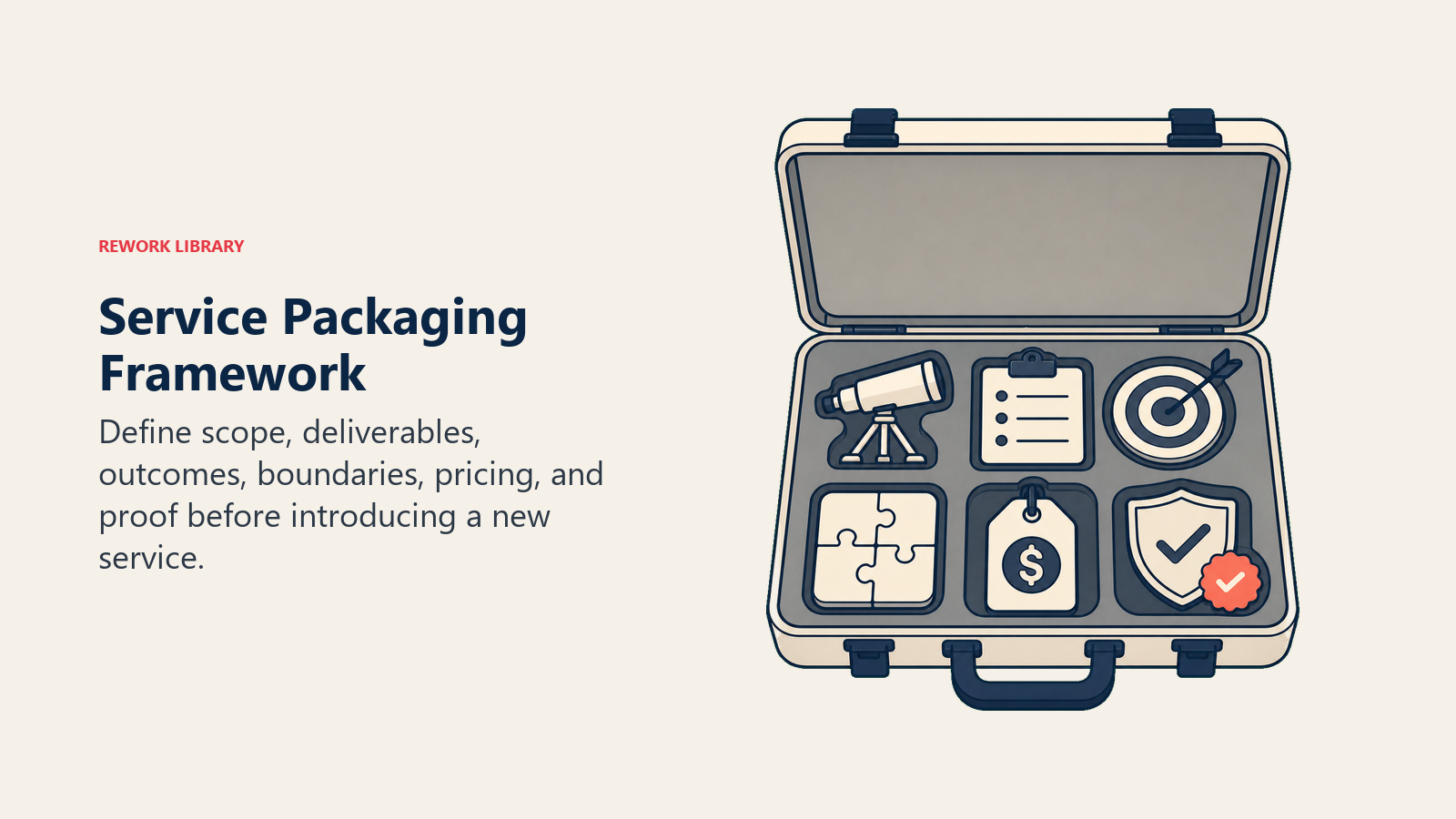
Start with the scope. What exactly does this service include? What's the end deliverable? If you're launching fractional CFO services, does that include monthly financial reviews, fundraising support, board presentation prep, or all three? Be explicit. Ambiguity kills adoption because clients can't evaluate fit or value.
Then think about packaging for different client segments. Your Fortune 500 clients need different service configurations than your mid-market clients. Maybe the enterprise version includes weekly touchpoints and custom reporting while the mid-market version is monthly check-ins with standard dashboards. Same core service, different packaging.
Value proposition by client type matters here. A marketing agency launching SEO services sells it differently to e-commerce clients (direct revenue impact, conversion tracking) than to B2B services clients (thought leadership visibility, lead quality). Same service, different outcomes emphasized.
Pricing strategy for new services is tricky. You're balancing "we need revenue" against "we need adoption to learn and refine." Start with value-based pricing if you can quantify ROI. If the service is new to you and outcomes are uncertain, consider pilot pricing that's discounted but not cheap. You want serious clients, not tire-kickers attracted by low prices. For guidance on defending your pricing decisions, see pricing justification.
Creating client awareness and education
Your clients aren't checking your website daily to see if you've added new capabilities. You have to proactively create awareness, and it needs to be more sophisticated than "we now offer X."
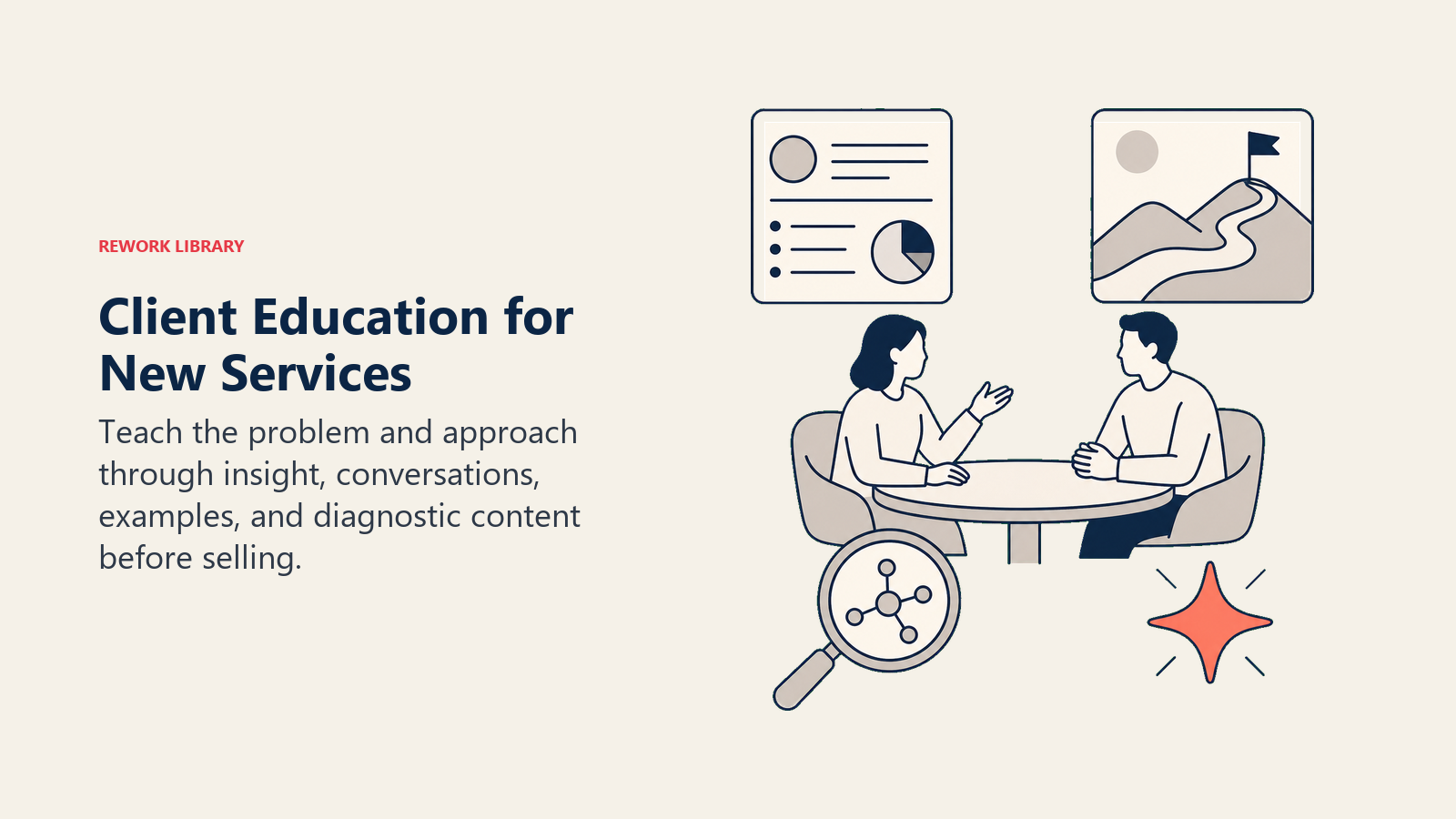
The best awareness comes from demonstrating expertise before announcing the service. If you're launching HR transformation consulting, start publishing thought leadership on talent retention challenges months before the formal launch. Speak at conferences about organizational design. Share case studies (even disguised ones) about companies solving similar problems. When you finally announce the service, clients think "oh, they've been doing this all along" instead of "that's random and new."
Discovery and needs assessment should happen before you pitch. In your regular client touchpoints, ask strategic questions that surface needs your new service solves. If you're launching supply chain optimization, ask clients about their vendor management challenges, inventory costs, or fulfillment delays. You're diagnosing problems before prescribing solutions.
Client education approaches vary based on complexity. Simple services can be explained in emails or one-pagers. Complex services need workshops, webinars, or in-person presentations. If you're launching transfer pricing advisory, most clients won't understand what that means or when they need it. You'll need educational content that builds understanding over time.
Thought leadership establishes credibility. Before clients buy a new service from you, they need to believe you're expert-level. That means publishing research, developing frameworks, creating tools, and demonstrating depth. A law firm launching employment law services should have attorneys writing articles, speaking on panels, and engaging in public dialogue about workplace issues. When clients see that level of expertise, buying the service feels safe. For comprehensive approaches to establishing expertise, explore thought leadership strategy.
Soft launch and early adopters
Don't announce new services to your entire client base at once. That's high-risk and low-feedback. Instead, run a soft launch with carefully selected early adopters who can help you refine the offering before full rollout.
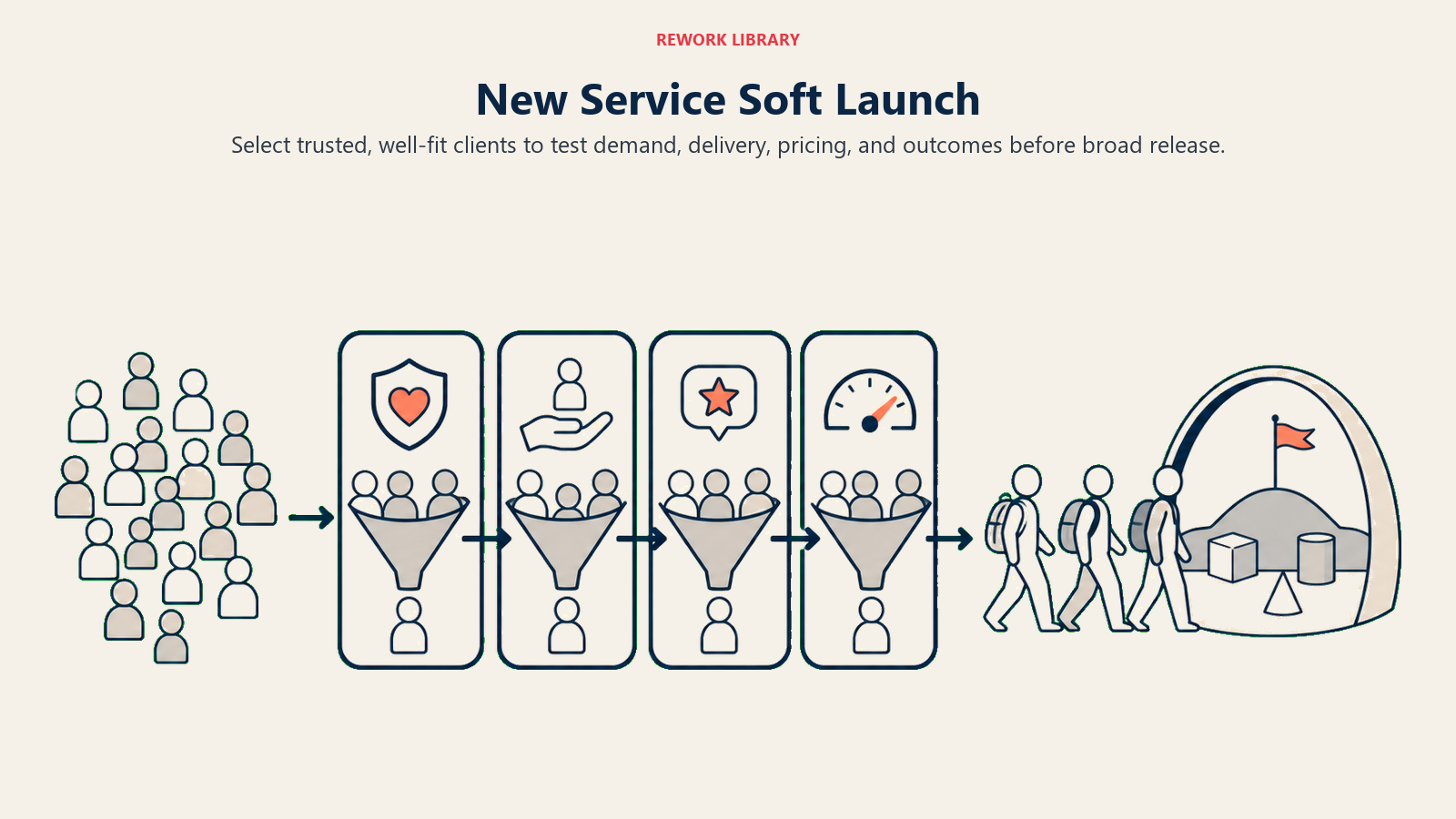
Identifying ideal early adopter candidates requires three filters:
First, relationship strength. You want clients who trust you enough to take a chance on something new. These should be advocates, not just satisfied customers. They need to be forgiving of early hiccups and willing to give feedback.
Second, need alignment. The client should have a clear, current need for the service. Don't ask clients to be guinea pigs on hypothetical problems. They should be facing a challenge your new service solves right now.
Third, visibility and influence. Ideal early adopters can be referenced. They're willing to share their experience, participate in case studies, and talk to other clients. Their success becomes social proof for later adopters.
Soft launch mechanics should feel exclusive, not experimental. Position this as "we're offering this to a select group of clients first before general availability." That creates urgency and makes clients feel valued. Frame it as early access, not beta testing.
Early adopter benefits and incentives should be real but not desperate. Discounted pricing is fine, but don't slash rates to the point where the service seems low-value. Better incentives include:
- Extended support during implementation
- Customization that later clients won't get
- First access to future enhancements
- Public recognition as an early adopter (if they want it)
The feedback and iteration process is why you're doing this. After each early engagement, conduct structured debriefs. What worked? What didn't? What surprised you? What took longer than expected? Use this input to refine deliverables, adjust pricing, improve onboarding, and fix process gaps.
Scaling from pilot to general availability happens when you've delivered 3-5 successful early engagements and the service is consistently meeting expectations. You've worked out the kinks, trained your team, and have reference clients. Now you're ready for broader rollout.
Client communication strategy
How you announce and explain new services determines adoption rates. Generic announcements get ignored. Targeted, relevant communication gets responses.
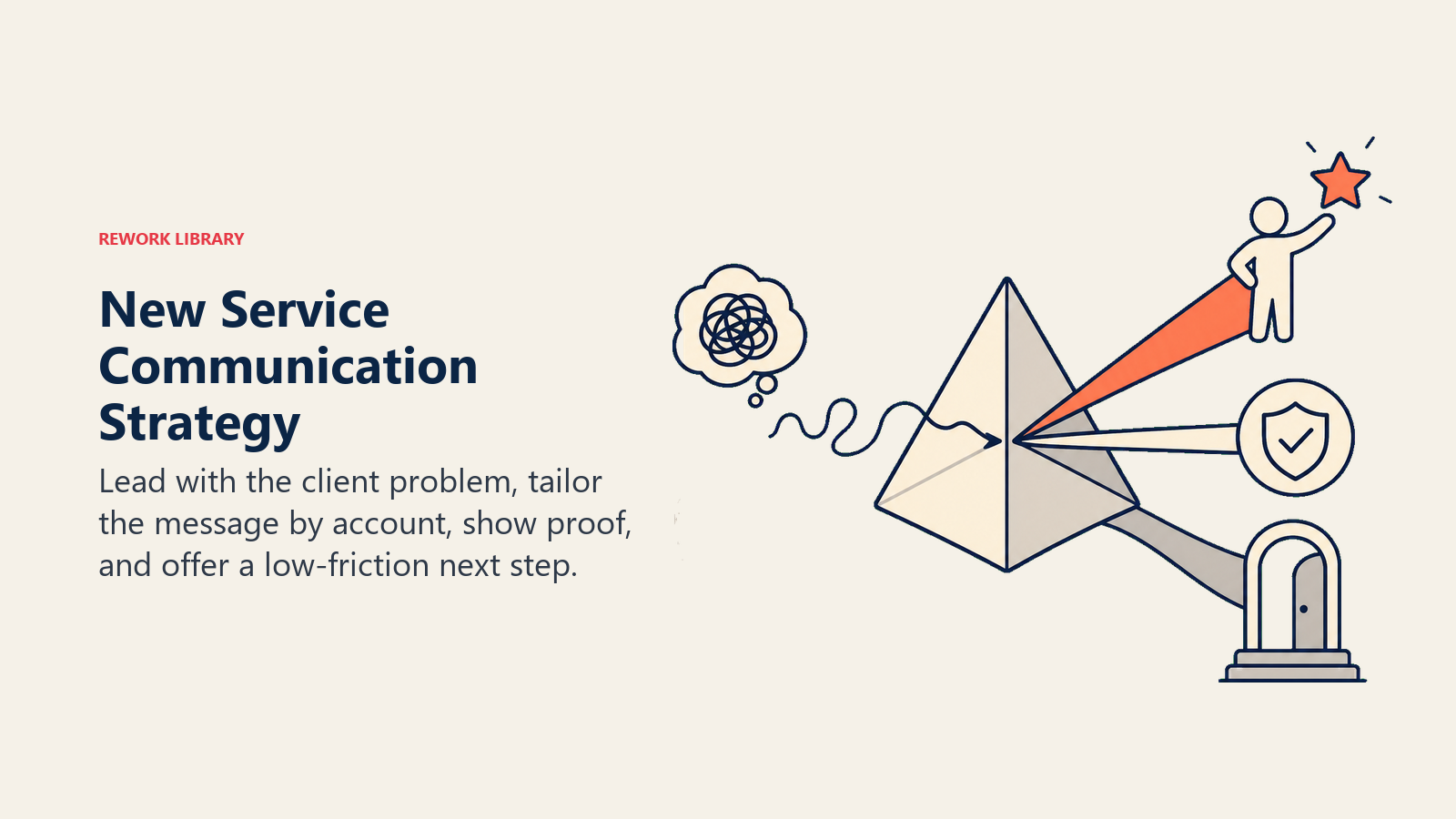
Crafting effective introduction messages starts with the client's problem, not your capability. Don't lead with "We're excited to announce our new compliance monitoring service." Lead with "Many of our clients are struggling with increasing regulatory complexity and audit costs. We've developed a solution." Problem first, service second.
Be specific about who it's for. If the service is designed for private equity-backed companies navigating add-on acquisitions, say that. Clients should immediately know if it applies to them or not. Broad "this could help any company" messaging is lazy and ineffective.
Multi-level communication matters in B2B services. You need messages for three audiences:
Executives care about strategic impact and ROI. They want to know how this service affects growth, risk, or competitive position. Your communication should be high-level, outcome-focused, and tied to business priorities.
Managers care about operational improvement and efficiency. They want to know how this makes their jobs easier, reduces headaches, or solves persistent problems. Your communication should be practical and process-focused.
Practitioners care about implementation and day-to-day impact. They want to know what actually changes in their workflow. Your communication should be specific and tactical.
Send different messages to different levels, or layer them in one communication with clear sections for each audience.
Channel and medium selection depends on relationship depth and service complexity. For simple services to close contacts, a personal email from the relationship partner works. For complex services or broader announcements, consider:
- Client webinars with live Q&A
- In-person presentations at regular business reviews
- Video messages from practice leaders
- Dedicated landing pages with detailed information
- One-on-one discovery calls with high-potential clients
Match the channel to the complexity and the relationship. Don't send a generic email for a seven-figure enterprise service.
Objection handling should be anticipated and addressed proactively. Common objections to new services include:
"We didn't know you did this" - That's why you need thought leadership and education before the pitch. Address by showing your track record, team credentials, and past results (even if delivered differently).
"We already have a provider for this" - That's fine, but are they integrated with your other work? The value proposition is coordination, shared context, and seamless service. Position as complementary or superior, not just alternative.
"This seems outside your core expertise" - This is the credibility gap. Close it with team bios, certifications, case studies, and early adopter testimonials. Show you're not dabbling.
"We're not ready right now" - Perfect. Ask permission to stay in touch and share relevant insights until they are ready. Put them in a nurture track.
Pilot program management
Running structured pilots gives you proof of concept and refines your delivery model before scaling.
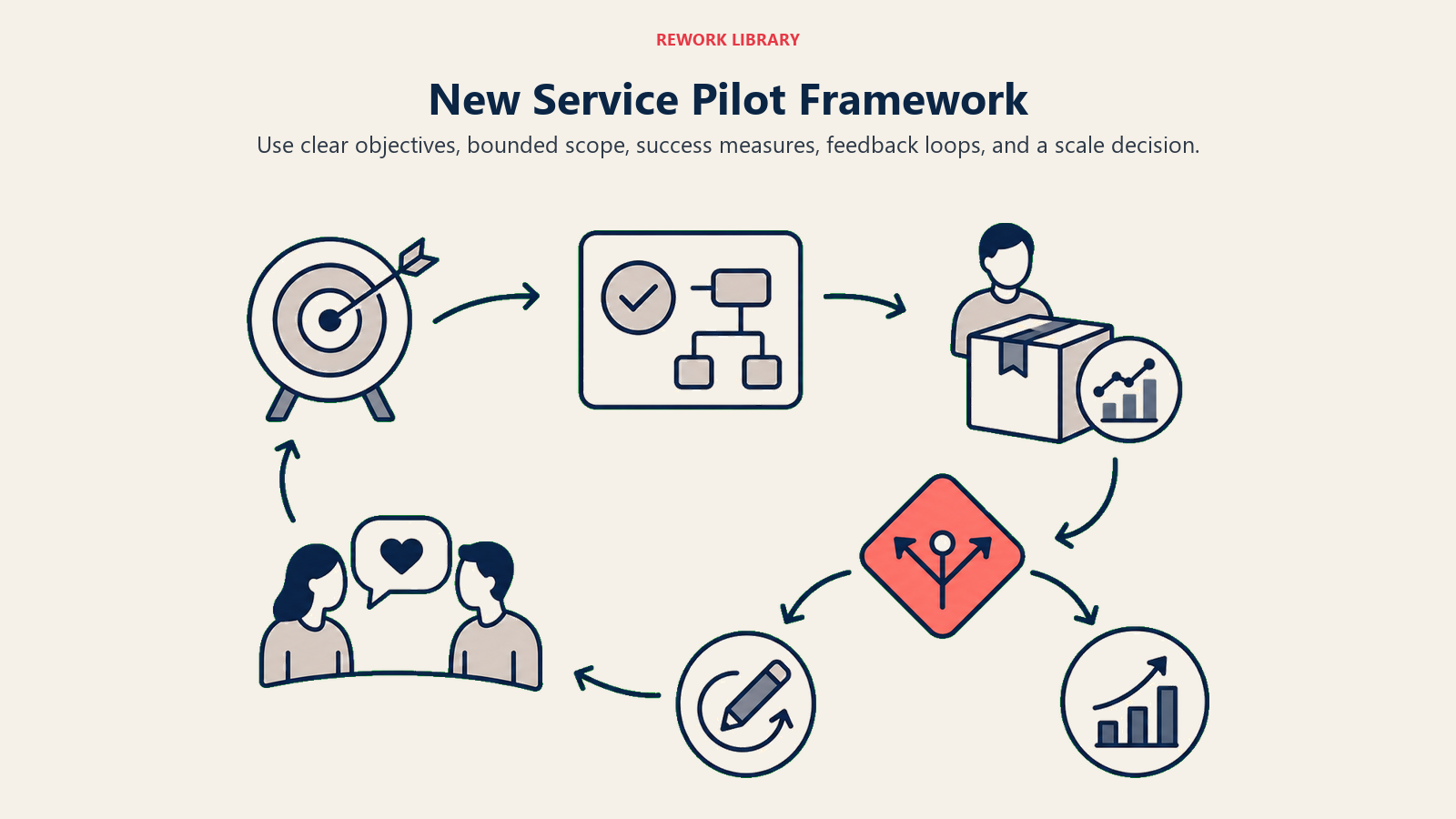
Planning and scoping pilot engagements should be rigorous. Define clear objectives: what are you testing? Is it the delivery model, pricing, resource allocation, client satisfaction, or all of the above? Pilots without clear objectives become regular projects that happen to be early.
Set specific success criteria. What does "successful pilot" mean? Completed on time and budget? Client satisfaction score above X? Specific business outcomes achieved? Reference-able case study? Define this upfront so you know when you've succeeded.
Client selection criteria for pilots should prioritize learning over revenue. You want clients who:
- Have well-defined problems your service addresses
- Are willing to collaborate and give feedback
- Have realistic expectations (they know it's a pilot)
- Can move quickly (you want fast iteration, not six-month approvals)
Avoid clients with extreme complexity, tight deadlines, or political landmines. Pilots should be challenging enough to be real but not so difficult that failure is likely.
Support and resource allocation for pilots needs to be generous. Staff your best people, not your cheapest. Provide more oversight, more check-ins, and more senior involvement than you would on a standard engagement. You're building the playbook, not executing a proven process.
Managing expectations and timeline requires transparency. Clients should know they're participating in a pilot and what that means. They're getting great pricing and extra attention, but there might be adjustments along the way. Set milestones, communicate progress regularly, and be honest when things don't go as planned.
Capturing learning and best practices is the real output of pilots. Document everything:
- What worked better than expected?
- What took longer or cost more than estimated?
- What client questions came up that you didn't anticipate?
- What internal handoffs or processes broke down?
- What tools or templates are needed?
Turn this into a delivery playbook for the next team that runs this service. Every pilot should leave the service more refined than it was before.
Measuring adoption and success
You can't manage what you don't measure. New service introductions need clear metrics to know if they're working.
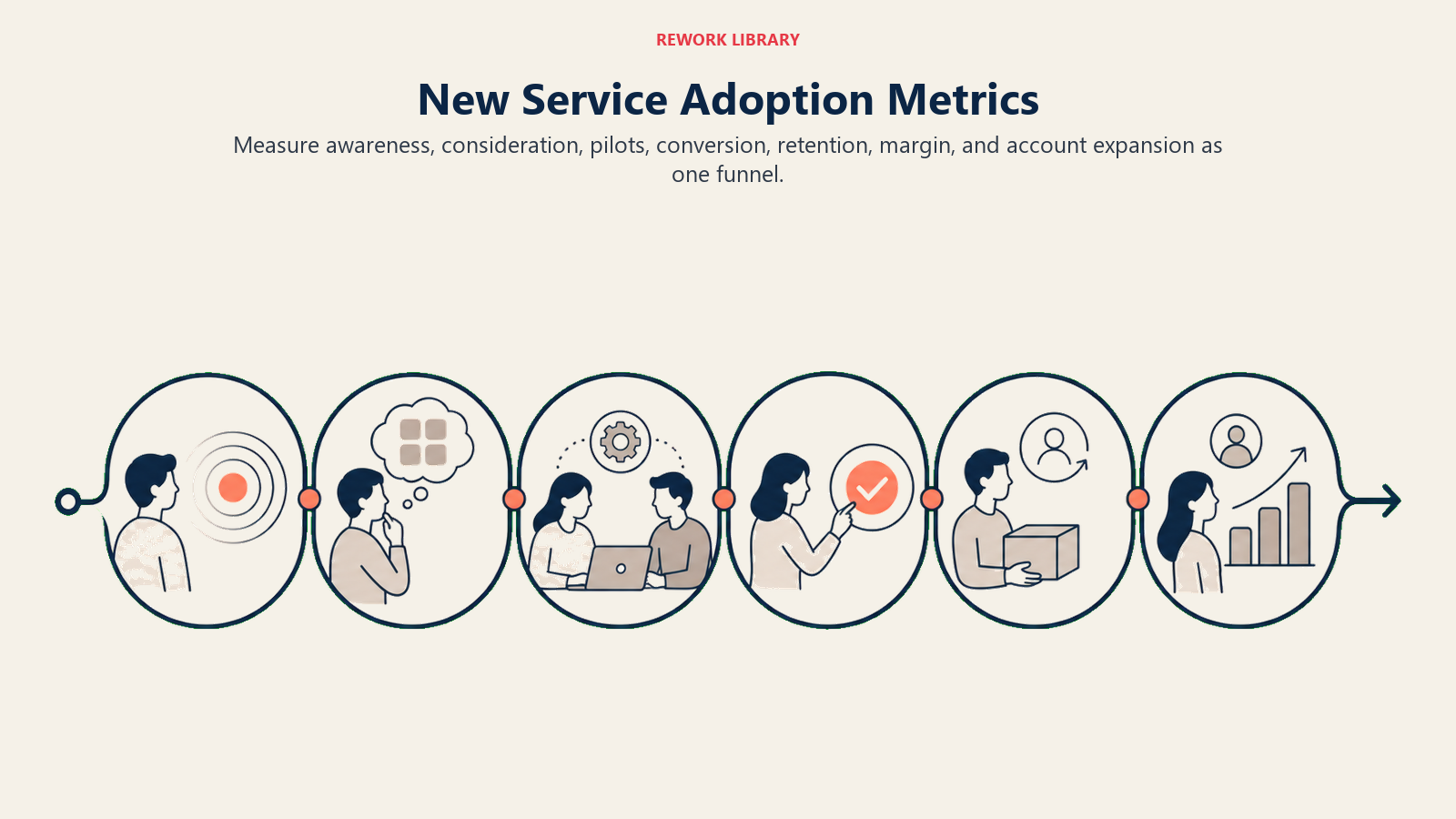
Adoption metrics by service type vary, but common ones include:
Awareness: What percentage of eligible clients know the service exists? Track this through surveys, conversation mentions, or direct questions in client meetings.
Consideration: How many clients are actively exploring the service? This includes discovery calls, proposal requests, needs assessments, or information downloads.
Conversion: What percentage of clients who explore actually buy? This tells you if the service is attractive and priced right.
Utilization: For clients who buy, how extensively do they use it? Are they buying the full offering or a minimal version?
Repeat engagement: Do clients renew or expand? One-time projects suggest interest but not sustained value. Recurring work suggests you've solved a real problem.
Client satisfaction and NPS scoring should be tracked separately for new services. Don't lump them into overall firm NPS yet. You need isolated feedback to know if the service itself is working. Ask specific questions:
- Did this service meet your expectations?
- Would you use this service again?
- Would you recommend this service to a peer?
- What would make this service more valuable?
Track NPS for the new service over time. It should improve as you refine delivery based on feedback.
Business impact and ROI measurement proves the service works. For clients, this means documenting outcomes. If you launched cost reduction consulting, track actual cost savings. If you launched digital transformation advisory, track implementation speed or system adoption rates. Client results become your selling story.
For your firm, track revenue per engagement, margin, resource utilization, and client lifetime value change. New services should increase total account value. If clients spend the same amount but shift dollars from old services to new, you haven't grown - you've cannibalized.
Adoption barriers identification comes from analyzing why clients don't buy. Common barriers include:
Awareness gaps: They don't know it exists. Fix with better communication.
Perception gaps: They don't think you're credible. Fix with thought leadership and proof points.
Fit gaps: They don't have the need right now. Fix with nurture tracks and timing.
Price resistance: They value it, but not at your price. Fix with better ROI demonstration or pricing adjustments.
Competitive alternatives: They're using someone else and see no reason to switch. Fix with differentiation and integration value.
Survey non-adopters periodically. "We noticed you haven't engaged with our X service. Can you help us understand why?" The answers guide your strategy.
Tracking and reporting progress should happen monthly in the early stages. Create a simple dashboard:
- Clients aware of service (% of total base)
- Active conversations (count and value)
- Proposals submitted (count and value)
- Won engagements (count and value)
- NPS for new service
- Revenue vs target
Review this with service leadership monthly. When trends are concerning, diagnose quickly. When trends are positive, double down.
Scaled rollout planning
Once pilots prove the service works, it's time to scale.
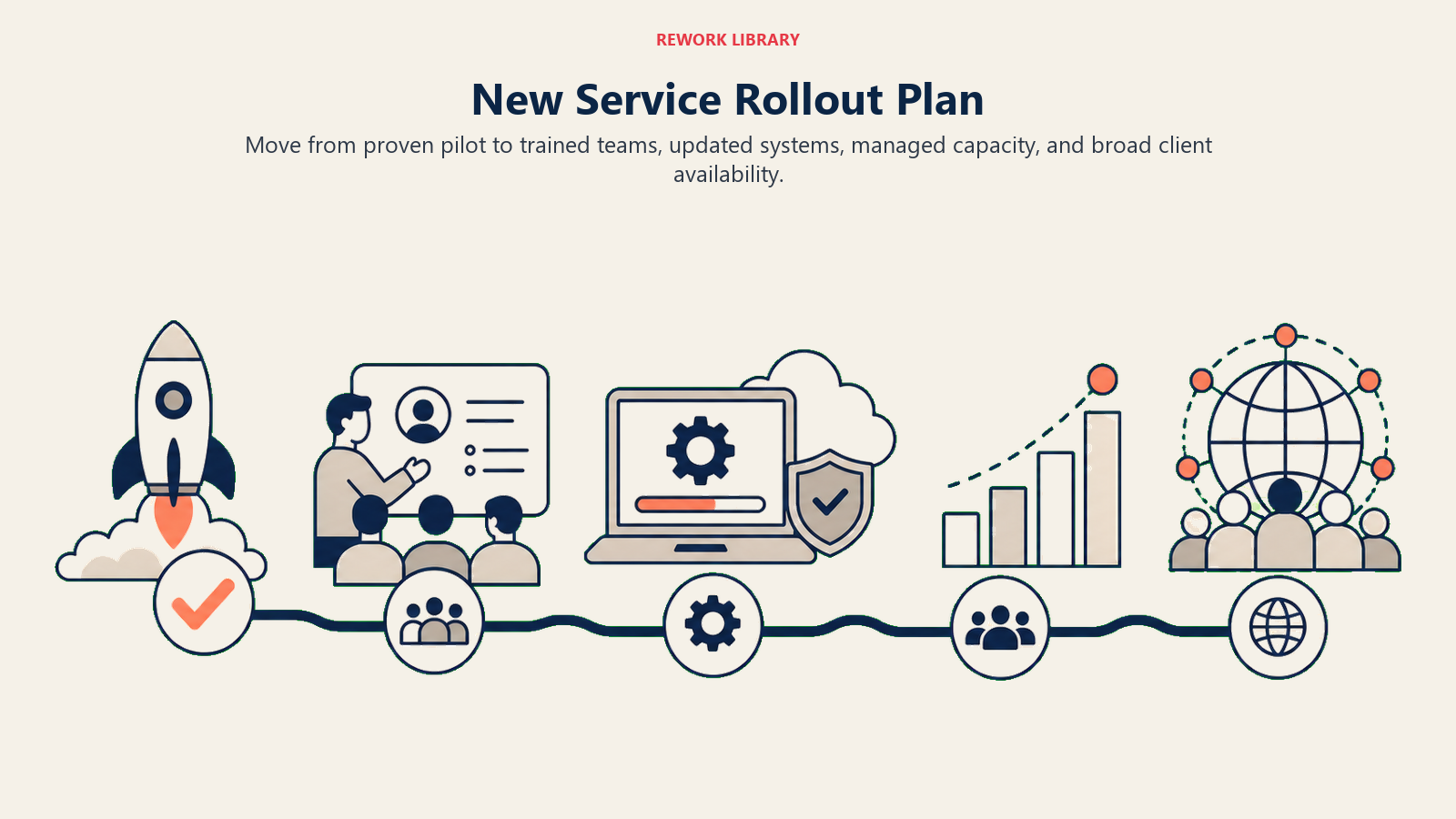
Transition from pilot to general availability should be marked clearly. Announce internally first - make sure all client-facing teams know the service is ready for broad selling. Update website, marketing materials, and proposals. Train sales teams on positioning and objection handling.
Externally, announce to your full client base. This is where the formal launch happens. Use the early adopter success stories as proof. "Over the past six months, we've helped five clients reduce compliance costs by an average of 30%. We're now offering this service to all clients."
Segmentation and rollout strategy matters if you have a large client base. Don't try to reach 500 clients in week one. Prioritize segments based on:
Need intensity: Which client segments have the most acute need right now?
Revenue potential: Which segments generate the largest deals?
Competitive risk: Which segments are most likely to find alternatives if you don't offer this?
Roll out in waves. Week 1 might be top 20% by revenue. Week 3 might be next tier. Week 6 might be long tail. Staged rollout lets you manage response volume and refine messaging based on early reactions.
Sales and marketing launch requires coordination. Marketing creates awareness and generates inbound interest. Sales conducts outbound outreach to high-potential targets. Both need the same messaging, the same proof points, and the same understanding of ideal customer profile.
Develop sales enablement materials:
- One-page service overview
- Detailed capability deck
- Pricing guidelines and discount authority
- Objection handling guide
- Client case studies
- Sample proposals
Conduct role-playing sessions where partners and business developers practice pitching the service. Record common questions and create FAQ documents.
Scaling operations and support is where firms often stumble. You had three people delivering pilots. Now you need ten to meet demand. How do you maintain quality?
Standardize the delivery model. Create templates, checklists, and process documentation. New team members should have a playbook, not just learn by watching.
Invest in training. Don't assume people can deliver a new service just because they're smart. Train them on the methodology, the tools, the client communication approach, and the quality standards.
Build quality assurance into the workflow. Senior practitioners should review deliverables, sit in on client meetings, and provide feedback. Don't let quality slip in the rush to scale.
Revenue recognition and tracking needs its own accounting. Don't mix new service revenue with legacy services in your reporting. You want clean data on what's working. Track revenue, margin, and growth separately so you can see if the new service is actually profitable or being subsidized by other work.
Account expansion through services
New services aren't just about revenue. They're about client relationships and competitive moats.
Upsell and cross-sell opportunities multiply with each new service. A client using you for one thing is a prospect for everything else. But this only works if services are logically connected and introduced at the right time. Understanding the difference between upsell and scope expansion versus cross-sell strategy helps you sequence these conversations appropriately.
Map the client journey and identify natural expansion points. If you do initial tax compliance for a client, when do they typically need tax planning? When do they need international tax? When do they need M&A tax diligence? Introduce services just before the need arises, not randomly.
Deepening client relationships happens when you become multi-dimensional. A client who uses you for one service sees you as a vendor. A client who uses you for four services sees you as a partner. Each additional service increases switching costs, builds institutional knowledge, and creates dependency (the good kind).
But depth requires coordination. If three different teams are serving the same client with no communication, you're not deepening the relationship - you're creating confusion. Implement account management that ensures all services are coordinated, cross-referenced, and strategically aligned.
Preventing competitor entry is the defensive value of expanded services. If a client needs fractional CFO work and you don't offer it, they'll hire someone else. That someone else will see everything, build relationships with decision-makers, and have the inside track on other opportunities. You've invited the competition into your account.
Offering comprehensive services creates a moat. Even if your new service isn't best-in-class initially, clients often prefer integrated delivery over best-of-breed point solutions. "Good enough" with full coordination beats "excellent" with handoff complexity.
Multi-threaded account coverage means having relationships at multiple levels and functions. One service might connect you to the CFO. Another connects you to the COO. Another to the Chief Legal Officer. Each thread makes the relationship more resilient and creates more expansion opportunities.
Intentionally design services that target different buyer personas. Don't just go deeper with the same contact. Go broader across the organization. This multi-threaded approach is central to effective client penetration strategy.
Internal alignment and readiness
New services fail when internal teams aren't aligned on strategy, messaging, or execution.
Sales and marketing coordination prevents the common problem where marketing says one thing and sales says another. Before launch, align on:
Target customer profile: Who is this for? Get specific. "Mid-market companies" isn't specific enough.
Key messaging: What's the value proposition? How does it differ from competitors?
Pricing and packaging: What are we selling and at what price points?
Lead qualification: When does marketing hand off to sales? What criteria indicate readiness?
Create shared dashboards so both teams see the same metrics. Marketing should know conversion rates from leads to deals. Sales should know which marketing channels produce the best leads.
Service delivery preparation is equally critical. Your delivery team needs to be ready before you start selling. That means:
Hiring or training the right people. Do you have enough capacity? The right expertise?
Developing tools and templates. Can your team execute efficiently, or will they reinvent the wheel every time?
Establishing quality standards. What does "done well" look like? How do you ensure consistency?
Creating client communication protocols. How often do you update clients? What format? Who's responsible?
Nothing kills a new service faster than poor delivery on the first few engagements. Get delivery right before you scale sales.
Leadership commitment determines whether new services actually get resources and attention. If partners and executives treat new services as side projects, the rest of the organization will too.
Leaders need to actively sell new services in client conversations, allocate top talent to early engagements, and protect investment in refinement even when short-term revenue is low.
Technology and systems enablement includes CRM updates, project management tools, reporting dashboards, and knowledge management systems. If your CRM doesn't have the new service in dropdown menus, people won't track opportunities properly. If your project management system doesn't have templates for the new service, delivery will be chaotic.
Make sure systems support the new service before launch, not six months later.
Common challenges
Even well-planned service introductions hit obstacles.
Low adoption despite good fit: You built something clients need, but they're not buying. This usually means one of three things:
You haven't created enough awareness. Clients don't know it exists. Fix with more aggressive communication.
You haven't established credibility. Clients don't believe you can deliver. Fix with proof points, case studies, and thought leadership.
You haven't made it easy to buy. The sales process is too complex, pricing is unclear, or decision-making is slow. Simplify.
Client resistance often stems from "that's not what you do" perception. Clients have mental boxes for each vendor. Breaking out of that box requires repeated exposure, education, and proof. Don't give up after one conversation.
Internal resource constraints kill new services when existing work takes priority. If you're not willing to hire, train, or reallocate resources, don't launch new services. Half-baked delivery destroys your reputation faster than no offering at all.
Service quality inconsistency happens when you scale too fast without standardization. The first three clients get your A-team and amazing results. Clients four through ten get junior teams and mediocre results. Word spreads quickly.
Fix this by codifying what good looks like, creating solid training programs, and maintaining quality oversight even as you scale.
Pricing and margin pressures emerge when you price new services too low to "get traction." Now you're stuck. Raising prices on existing clients feels unfair. Maintaining low prices kills profitability.
Price new services based on value, not on what you think will sell easily. If adoption is slow, improve the value or the messaging, but don't race to the bottom on price.
Post-launch support
Launching a new service isn't the end. It's the beginning of continuous improvement.
Ongoing client success management ensures early clients stay happy and become advocates. Assign dedicated success resources to check in, gather feedback, identify expansion opportunities, and solve problems before they escalate.
Track client outcomes closely. Are they getting the results you promised? If not, why not? Fix issues proactively.
Service optimization should happen quarterly. Review delivery efficiency: are projects taking longer than estimated? Are margins where you expected? Are clients asking for things you didn't anticipate?
Refine the offering based on real experience. Maybe you bundled too much and clients only value certain components. Unbundle. Maybe you didn't include something clients consistently need. Add it.
Building advocacy and references turns happy clients into your sales force. Ask successful early clients to:
- Participate in case studies
- Speak on client panels or webinars
- Provide written testimonials
- Take reference calls with prospects
Don't assume clients will volunteer. Ask explicitly and make it easy. Draft the case study for them to review. Prep them for reference calls with likely questions.
Continuous improvement cycles should be baked into operations. After every project, conduct a retrospective. What went well? What didn't? What should we change for next time?
Document lessons learned and update the delivery playbook regularly. A service that doesn't evolve becomes stale. For strategies on building sustainable client partnerships around new services, explore multi-year engagements.
Where to go from here
Introducing new services to existing clients is one of the highest-ROI growth strategies available to professional services firms. You're leveraging trust and relationships to accelerate adoption and revenue while simultaneously deepening accounts and preventing competitor entry.
But success requires discipline: thoughtful packaging, strategic soft launches, client education, and relentless focus on adoption metrics and delivery quality.
Once you've proven a new service works, the framework compounds. You have a model for introducing the next service and the next after that. Your firm becomes known for innovation and comprehensive capabilities, not just narrow expertise.
Related strategies that complement service introductions:
- Upsell & Scope Expansion - Expanding within existing services before adding new ones
- Cross-Sell Strategy - Systematically introducing multiple services to each client
- Client Retention Strategy - Keeping clients long enough to expand service mix
- Service Line Strategy - Deciding which services to add and when
- Client Communication Cadence - Maintaining relationships that enable service expansion
The firms that win aren't the ones with the most services. They're the ones that introduce new capabilities strategically, educate clients effectively, and deliver quality consistently. That's how you grow accounts, build moats, and compound revenue over time.

Sales Director
On this page
- Why existing clients are your best market for new services
- Service packaging and definition
- Creating client awareness and education
- Soft launch and early adopters
- Client communication strategy
- Pilot program management
- Measuring adoption and success
- Scaled rollout planning
- Account expansion through services
- Internal alignment and readiness
- Common challenges
- Post-launch support
- Where to go from here