Pricing Justification: Confidently Defending Professional Services Value
Turn this article into takeaways for your work.


Each assistant summarizes the article only for you and suggests best practices for your work.
There's a painful truth: 40% of professional services deals stall at the pricing stage. Not because the prospect doesn't need the service. Not because they don't like you. But because the conversation shifts from value to cost, and suddenly everyone's focused on the wrong number.
The worst part? Most of those deals should close. The client needs what you offer. They have the budget. But when you present the price without proper justification, they freeze. "Let me think about it" becomes "Let me see if I can find someone cheaper" or "Maybe we'll just do this internally."
This guide is about changing that conversation. When you can confidently justify your pricing by connecting it to measurable value, price objections shrink. Not because you're cheaper (you're probably not), but because you've made the investment obvious.
Why Price Conversations Feel So Uncomfortable
Before we get into frameworks and scripts, let's talk about why pricing conversations feel terrible for so many service providers. The psychology working against you:
You've got internal barriers that have nothing to do with your actual value. Imposter syndrome whispers "who are you to charge that much?" Fear of losing the deal makes you want to cave on price before the client even pushes back. Some providers feel actual guilt about charging premium rates, as if making good money means they're somehow taking advantage.
And when you're uncomfortable talking about money, clients pick up on it. Hesitation signals weakness. Present a price and immediately start justifying it defensively? You're telling them "this price is negotiable and probably too high."
The client's perspective:
Clients evaluate your pricing through their own filters. They anchor to the last price they heard (which might be from a cheaper competitor). They're thinking about this as an expense line item, not an investment that generates returns. They need trust signals to believe your premium pricing is justified. And if they've only worked with commodity providers before, they might genuinely not understand why expertise costs more.
Why premium pricing actually helps:
Low prices attract the wrong clients. Someone shopping purely on price is going to be demanding, suspicious of value, and likely to churn. They'll question every invoice and push back on scope.
Premium pricing attracts quality buyers who understand that expertise costs money. These clients are easier to work with, more loyal, and more profitable. They're buying outcomes, not hours. Use your client qualification framework to identify these ideal buyers early in the process.
And what most providers miss: your pricing signals quality. When a prospect sees your rate and it's significantly higher than alternatives, their first thought isn't always "too expensive." Sometimes it's "they must be really good."
Building Internal Confidence Before Client Conversations
You can't convince a client your pricing is justified if you don't believe it yourself. So start here: Your expertise has measurable value. You're not charging for time. You're charging for years of experience, specialized knowledge, and the ability to solve problems faster and better than alternatives. That has a dollar value, and it's higher than you think.
Discounting damages your brand. When you cut your price 20% to win a deal, you're telling the client your original price was inflated. You've just made them wonder what else you're inflating. And you've set a precedent that your pricing is negotiable.
Your best clients prefer premium pricing. The clients you actually want to work with (the ones with real budgets, clear goals, and respect for expertise) expect to pay well for quality. If your price seems too low, they'll question whether you're actually good enough.
The Value-Based Pricing Framework for Justification
When clients push back on price, they're really asking "is this worth it?" You need to answer that question with numbers, not feelings.
ROI Calculation and Quantification
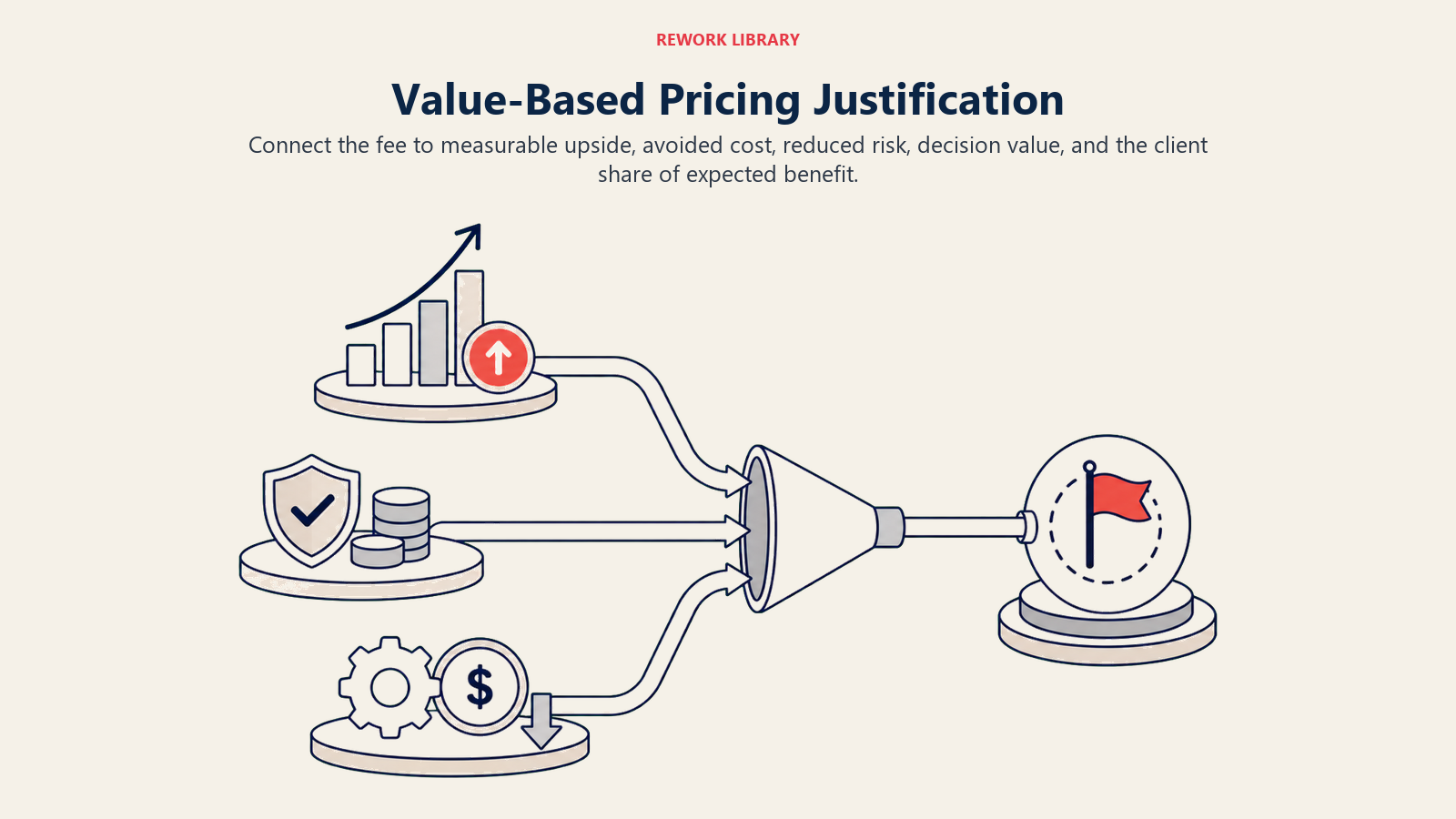
The most powerful justification is a clear ROI calculation. If you can show that your $50K engagement generates $200K in value, the price conversation is over.
Build that calculation like this:
Revenue impact: Will your work help them generate more revenue? A marketing strategy that drives an extra $500K in sales makes a $40K fee look tiny. A sales training program that improves close rates by 10% pays for itself in one quarter.
Cost savings: Can you help them reduce expenses? Process improvements that cut operational costs, technology recommendations that reduce software spend, efficiency gains that reduce headcount needs - these all have dollar values.
Risk reduction: What's the cost of getting this wrong? If they hire someone less experienced and the project fails, what does that cost in time, money, and opportunity? Your higher price is insurance against expensive mistakes.
Time savings: How much faster can you deliver than alternatives? If your expertise means they launch three months earlier, what's that worth in competitive advantage and revenue?
Build a simple ROI template you can customize for each engagement:
Investment: $50,000
Expected Returns:
  - Revenue increase: $300,000 (15% lift in conversion rates)
  - Cost reduction: $75,000 (process efficiency gains)
  - Risk mitigation: $100,000 (avoided cost of failed implementation)
  - Time value: $50,000 (3-month faster time-to-market)
Total Value: $525,000
ROI: 950%
Payback Period: 2 months
When you present numbers like this, price objections evaporate.
Risk Mitigation Value
Clients often underestimate the cost of failure. Make that cost visible.
What happens if they choose wrong? If they hire a cheaper provider who screws it up, what does it cost to fix? How much time is wasted? What revenue do they lose while the problem persists?
What's the downside protection? Your experience means fewer mistakes, faster problem-solving, and proven methodologies. That's worth paying for.
What's your guaranteed approach? Can you de-risk the engagement with milestones, phased delivery, or performance guarantees? That reduces their perceived risk and justifies premium pricing.
Example: "I know the investment feels significant. But consider this: if we get your sales process wrong, you'll lose months of productivity and potentially hundreds of thousands in missed revenue. My methodology has been proven across 50+ implementations. You're paying for certainty, not just consulting hours."
Opportunity Cost of Delay
Sometimes the biggest cost isn't money - it's time.
What are they losing by not solving this now? Every month they delay is another month of lost revenue, increased costs, or competitive disadvantage.
What's the competitive impact? If their competitors are solving this problem while they're still evaluating options, what market share are they ceding?
What's the compounding effect? Revenue gains compound over time. Getting this right six months earlier might mean an extra $500K over two years.
Frame it this way: "You're not just deciding whether to invest $75K. You're deciding whether to capture $400K in additional revenue this year or push that to next year. The cost of waiting is higher than the cost of my engagement."
Expertise Premium: Why You Cost More
You need to articulate why your rate is higher than alternatives without sounding arrogant.
Efficiency gains: You'll solve this in three months. Someone less experienced might take nine months. Even if they're cheaper hourly, your total cost is lower and the time-to-value is faster.
Quality assurance: Your work doesn't need to be redone. You've made these mistakes on someone else's dime, not theirs.
Proven methodology: You have a system that works. They're not funding your learning curve.
Specialized knowledge: You have expertise that's rare. They can't just hire someone internally or find this on Upwork.
Script: "Yes, you can find consultants at $150/hour instead of my $350/hour. But I've done this exact project 30 times. I know every pitfall and how to avoid it. The average engagement takes me 80 hours. Someone learning on your project might take 200 hours. So you're looking at $28K with me versus $30K with them, except I deliver in half the time and with better results."
Total Cost of Ownership vs Alternatives
Don't let clients compare your price to just one dimension. Compare the full picture.
Internal costs: What would it cost to hire someone full-time to do this? Salary, benefits, ramp time, management overhead. Your $100K engagement might be cheaper than a $130K hire who takes six months to get productive.
Competitor pricing: Are they really getting the same scope and quality elsewhere? Often cheaper quotes are for reduced scope, less experienced teams, or offshore resources that introduce communication delays.
Alternative solutions: What if they do nothing? What if they use a DIY tool? What's the total cost including their team's time, learning curves, and likely mistakes?
Example breakdown:
Option A - Hire internally:
  - Salary: $120,000
  - Benefits: $30,000
  - Ramp time: 3-6 months
  - Management overhead: 20% of manager's time
  - Total Year 1 Cost: $180,000+

Option B - Lower-cost consultant:
  - Fee: $60,000
  - Extended timeline: +3 months
  - Risk of rework: 30% chance of $40K in fixes
  - Expected Total Cost: $72,000

Option C - Us:
  - Fee: $95,000
  - Fast delivery: Done in 4 months
  - Proven results: Minimal rework risk
  - Total Cost: $95,000
When you show the full picture, your premium price often becomes the smart choice.
Pricing Justification Techniques That Actually Work
Now let's get tactical. These techniques turn price objections into closed deals.
Investment Framing
Language matters. Words shape how clients think about cost.
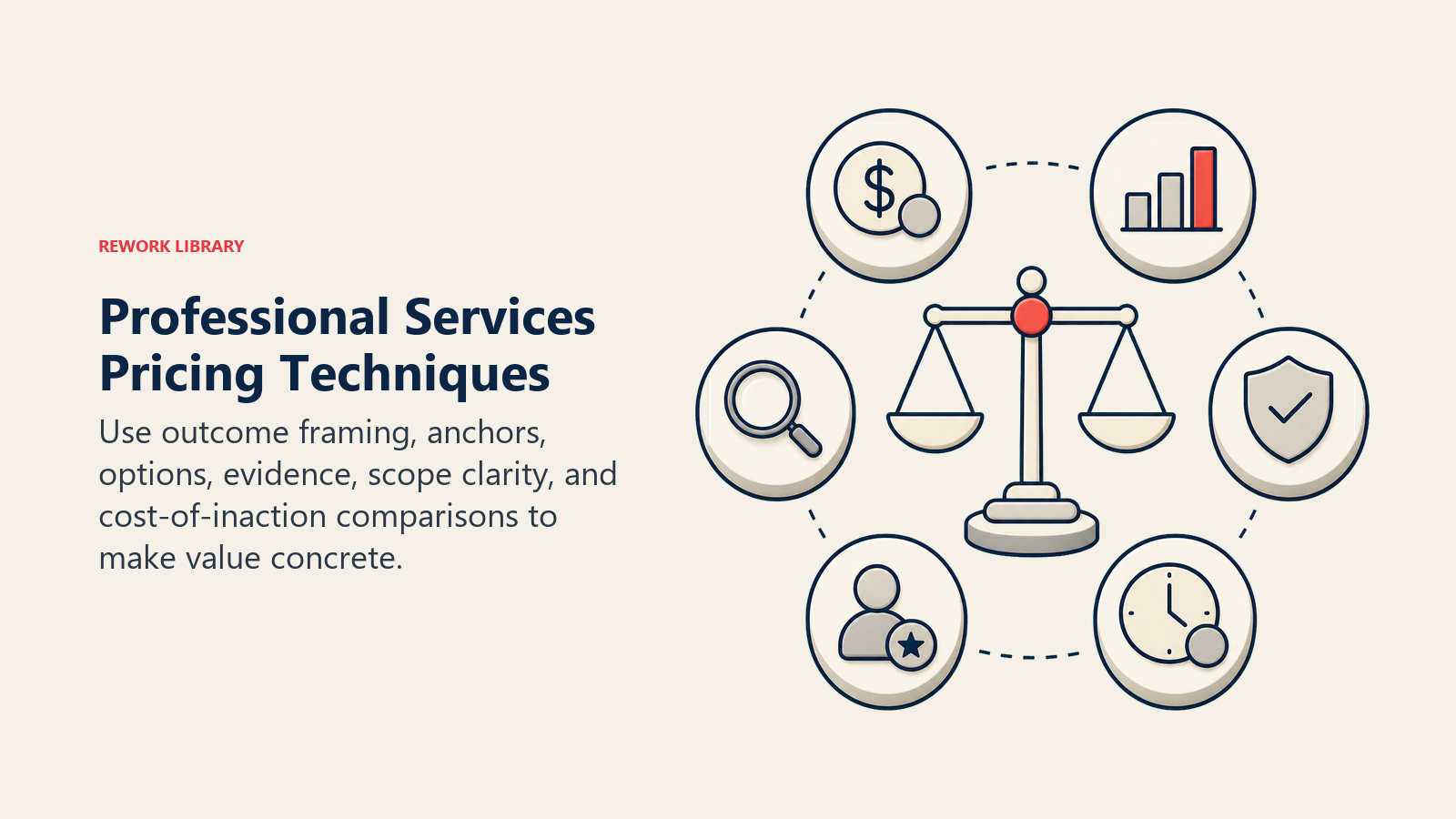
Use "investment" not "cost." Cost is something you minimize. Investment is something you make to generate returns. "This $50K investment will generate $200K in new revenue" hits differently than "This costs $50K."
Focus on outcomes, not inputs. Don't justify price by listing deliverables. Justify it by describing the future state. "You'll have a sales process that consistently converts 35% of qualified leads" is better than "You'll get a 50-page playbook and four training sessions."
Future state value. Paint the picture of what success looks like. "Six months from now, your team will close deals 40% faster with less back-and-forth. Your sales cycle drops from 90 days to 55 days. That's an extra 15 deals per quarter at your current volume."
ROI Demonstration in Action
Always tie pricing to specific, quantifiable outcomes.
Revenue impact script: "Based on your current metrics, a 12% improvement in conversion rates means an additional $280K in annual revenue. This $45K engagement pays for itself in eight weeks."
Cost savings script: "Right now you're spending $15K per month on inefficient processes. My recommendations will cut that to $9K per month, saving you $72K annually. The project fee is $38K, so you're net positive $34K in year one and $72K every year after."
Risk reduction script: "Failed CRM implementations typically cost companies 2-3x the original budget in consulting fees, data cleanup, and lost productivity. You're looking at $200K+ in potential downside. My $65K fee includes implementation oversight that prevents those failures. That's $135K in avoided risk."
Time savings script: "Every month you delay this implementation costs you approximately $40K in lost efficiency. If I can deliver this in three months instead of six, you're capturing an extra $120K in value. That makes the decision to pay a premium for faster delivery a no-brainer."
Comparative Positioning Scripts
When clients bring up cheaper alternatives, don't get defensive. Get specific.
Internal costs comparison: "I understand you're considering handling this internally. Let's look at what that actually costs. You'll need a senior person at $140K salary plus benefits, that's about $180K. They'll take 4-6 months to ramp up. During that time, the problem persists. Then they build something that works for your specific case but isn't informed by what works across the industry. My $95K engagement delivers proven best practices in three months. You're actually saving money and getting better results."
Competitor pricing reality check: "You mentioned a competitor quoted $40K versus my $75K. Can we compare what you're actually getting? Are they including the same scope? Implementation support? Training? Post-launch optimization? Often lower quotes are for design only, and implementation costs another $50K. My quote is comprehensive. But if they're truly offering the same scope, I'd want to understand how - because there's usually a trade-off in experience level or team size."
Alternative solutions honesty: "Sure, you could use a $99/month software tool instead of my consulting. But the tool requires 40+ hours of setup and configuration. If you do that internally at a $75/hour blended rate, that's $3K in time. Then there's a 60% chance you'll hit roadblocks that require consulting help anyway - that's another $5K. Plus the monthly fee. You're at $11K in year one with a DIY approach that might not work. My $18K engagement includes setup, customization, and guaranteed results."
Risk/Reward Framing
Make the cost of inaction visible.
Cost of failure script: "So the real question is: what does it cost if we get this wrong? Based on what you've told me, a failed implementation means six more months of inefficiency at roughly $25K per month in lost productivity. That's $150K in ongoing cost. My fee is $55K. The risk-adjusted cost of not hiring me is significantly higher than hiring me."
Downside protection script: "I know $80K feels like a significant investment. But you're not paying for hope. You're paying for certainty. I've delivered this exact outcome 40 times. I know what works and what doesn't. The 'cheaper' option is riskier because you're funding someone's learning curve on your budget."
Guaranteed approach script: "Unlike cheaper alternatives, I'm offering a phased approach with exit points. After phase one ($25K), you'll see measurable results. If you're not satisfied, we stop there. That means you're risking $25K, not $75K. And based on my track record, phase one alone typically delivers enough value to justify the full engagement."
Expertise Premium Justification
When you're charging more than alternatives, own it.
Efficiency gains script: "Yes, I'm more expensive per hour. And it matters less than you think: I've solved this problem 50 times. I know exactly what to do, what to avoid, and how to accelerate results. Where a junior consultant might take 200 hours figuring it out, I'll take 60 hours. You pay more per hour but less total, and you get results in weeks instead of months."
Quality assurance script: "You're not just paying for my time. You're paying for two decades of experience that prevents expensive mistakes. I've seen every way this can go wrong, and I build solutions that avoid those pitfalls. That means you don't pay twice - once for the initial work and again to fix it."
Proven methodology script: "The reason my pricing is premium is because my methodology is proven. I'm not experimenting on your dime. Every recommendation I make is backed by data from similar engagements. You're buying certainty, not consulting hours."
Specialized knowledge script: "This isn't generalist work you can outsource to anyone. This requires deep expertise in [specific domain]. There are maybe 50 people in the country who can deliver this at a high level, and I'm one of them. Premium expertise commands premium pricing, but the ROI justifies it."
Handling Price Objections Like a Pro
Even with perfect justification, you'll get pushback. How to handle the most common objections:
"This is too expensive"
First, understand what they're really saying. Too expensive compared to what? Too expensive for their budget? Too expensive for the perceived value?
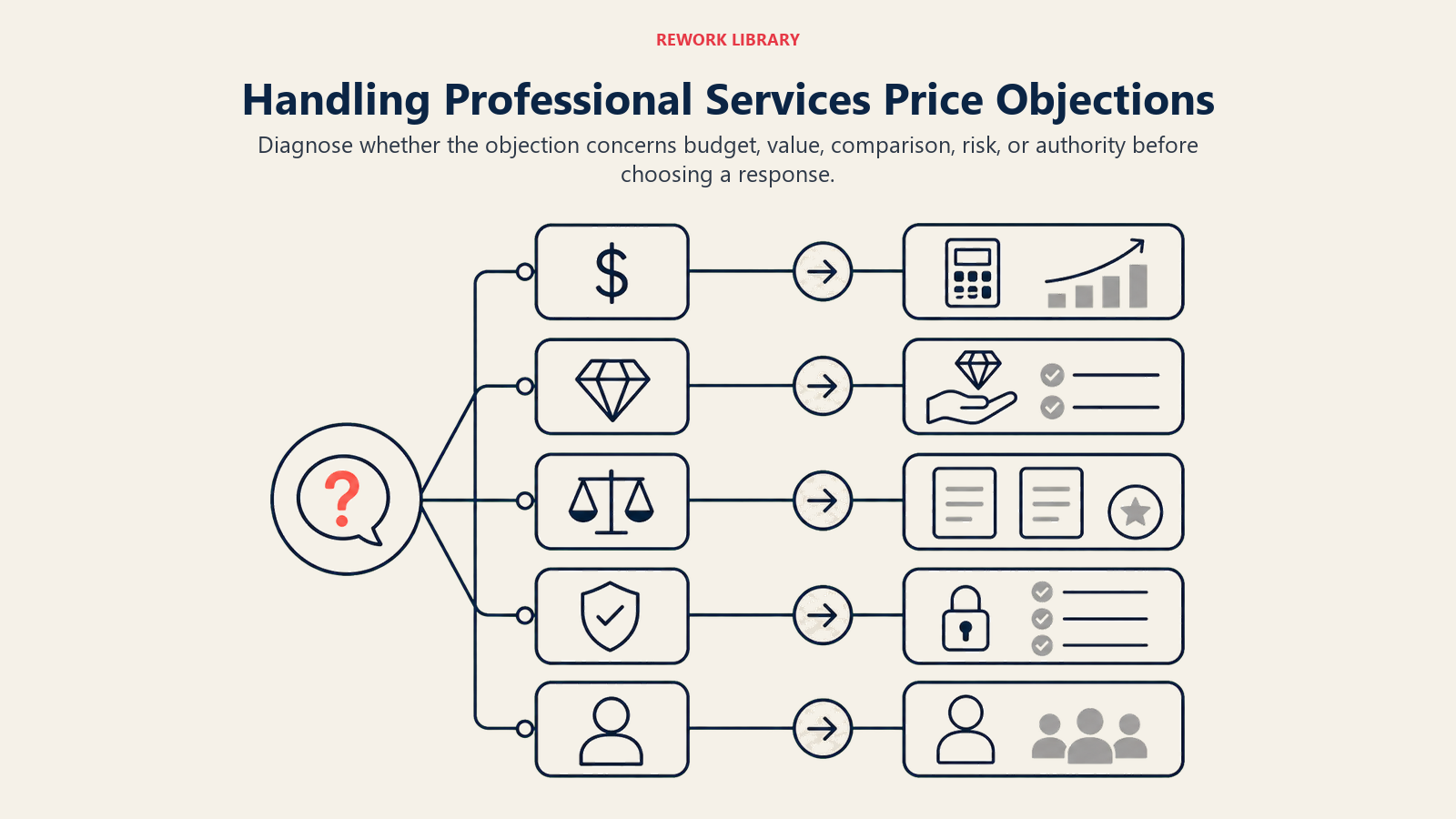
Reframe against value: "I understand it feels like a significant investment. Let's look at it differently: if this project delivers the $300K revenue increase we discussed, is $65K too expensive? The math says you're paying 22 cents to generate a dollar. That's not expensive - that's one of the best returns you'll get anywhere."
Compare alternatives: "Expensive compared to what alternative? Hiring internally would cost you $180K+ in year one. Doing nothing costs you $40K per month in ongoing inefficiency. A cheaper consultant might save you $20K upfront but cost you $50K in delays and rework. Help me understand what option you're comparing this to."
Discuss outcomes not inputs: "You're right that $75K is a lot of money. But you're not buying a pile of spreadsheets and meetings. You're buying a sales process that generates an extra $400K per year. Would you pay $75K once to generate $400K annually? Because that's the actual decision."
"We need to think about it"
This usually means you haven't uncovered the real objection. Price might not actually be the issue.
Uncover the real concern: "Of course, this is a big decision. Help me understand what specifically you need to think about. Is it the total investment amount? The timeline? The approach? If I can address your concerns now, we can make sure you have everything you need to decide."
Provide decision framework: "I totally get it. When you're thinking it over, consider these questions: Does the ROI math work for your business? Do you trust that we can deliver the results? Is now the right time, or should we wait? I'm happy to talk through any of those."
Offer pilot or phased approach: "What if we de-risk this? Instead of committing to the full $80K engagement, let's start with a $20K discovery and strategy phase. You'll get immediate value, and we'll both know if the full engagement makes sense. That way you're not thinking about it - you're testing it."
"Can you do it for less?"
This is a negotiation tactic. Don't panic.
Scope adjustment: "I can absolutely work within a different budget. Let me ask: what number were you thinking? [They give number] Okay, for that investment, what we can do is... [describe reduced scope]. The full value I outlined requires the full scope, but we can phase it or focus on the highest-impact pieces first."
Phased delivery: "Instead of reducing the scope, what if we phase the investment? Phase one focuses on [highest ROI component] for $35K. That delivers immediate results. Phase two builds on that for another $30K. You get the same outcome, just spread over a longer timeline and with proof points along the way."
Payment terms: "I can't reduce the fee because it reflects the real value and effort required. But I can offer payment terms that make it easier to manage. 50% upfront, 25% at midpoint, 25% on completion. Or we could structure it as a monthly retainer over six months. Would either of those help?"
What-if scenarios: "So to reduce the fee, we'd have to cut [specific deliverable], which means you wouldn't get [specific outcome]. Is that trade-off worth $15K in savings? Usually when we look at it that way, clients realize the full scope is worth the investment." Document any agreed changes in your scope definition and SOW.
"A competitor quoted lower"
Good. Use this as an opportunity to differentiate.
Differentiate on value: "I'm glad you're getting multiple quotes - that's smart. I'd love to understand what they're offering so we can compare apples to apples. [Review their scope] I see a few key differences: they're not including [X, Y, Z], which are critical for success. Their timeline is six months versus my four months, which costs you two months of value. And they're using junior consultants where I'm personally leading this. Those differences justify the premium."
Question scope comparison: "A $40K quote versus my $70K suggests we're not quoting the same scope. Can you share their proposal so I can see what they're including? I want to make sure you're not comparing different solutions. Often lower quotes are for phase one only, or they're excluding critical components like implementation support."
Discuss quality and risk: "You'll always find someone willing to do it cheaper. The question is whether you want it done right. I've personally cleaned up failed implementations from 'cheaper' consultants, and it always costs more in the end. You're not just paying for the work - you're paying for expertise that prevents expensive mistakes. Is saving $20K upfront worth the risk of a $100K fix later?"
"We don't have budget for this"
This might be true or it might be a negotiation tactic. Find out which.
Business case development: "I understand budget constraints are real. Let's build the business case together. Based on the ROI we discussed ($250K value for a $60K investment), this pays for itself in under four months. Can you find budget for something that generates a 4X return? Often when leadership sees those numbers, budget appears."
ROI justification to leadership: "Would it help if I presented the ROI case to your CFO or executive team? Sometimes budget decisions change when leadership sees the return clearly. I'm happy to show them how this investment generates measurable value that outweighs the cost."
Phased investment: "What if we stage this to align with your budget cycles? We could start with a smaller phase now using available budget, then continue when next quarter's budget is available. You start seeing results immediately, and the full investment is spread across fiscal periods."
Future planning: "I get it - budgets are set. Let's plan for next budget cycle. What do you need from me to include this in your next year's plan? I can provide an ROI projection and implementation timeline that makes it easy to get approval. In the meantime, we could do a small discovery engagement that delivers immediate value and sets up the bigger project."
Pricing Presentation Best Practices
How you present pricing matters as much as the price itself.
Present Confidently Without Apology
The number one mistake: apologizing for your price.
Don't say:
- "I know this is expensive, but..."
- "I hope this fits your budget..."
- "I tried to keep it as low as possible..."
Do say:
- "The investment for this engagement is $75,000."
- "Based on the scope we discussed, this comes to $60,000."
- "For the outcomes we outlined, the fee is $95,000."
State the price clearly and confidently. Then pause. Let them respond. Don't fill the silence with justification before they've even objected.
Tie Price to Specific Value and Deliverables
Never present a number in isolation.
Bad: "This project will cost $50,000."
Good: "To deliver the sales transformation we discussed (which includes the process redesign, team training, CRM optimization, and 90 days of implementation support), the investment is $50,000. Based on your current metrics, this will generate approximately $220,000 in additional revenue in year one."
Price should always be connected to value. They should hear the outcome in the same breath as the cost.
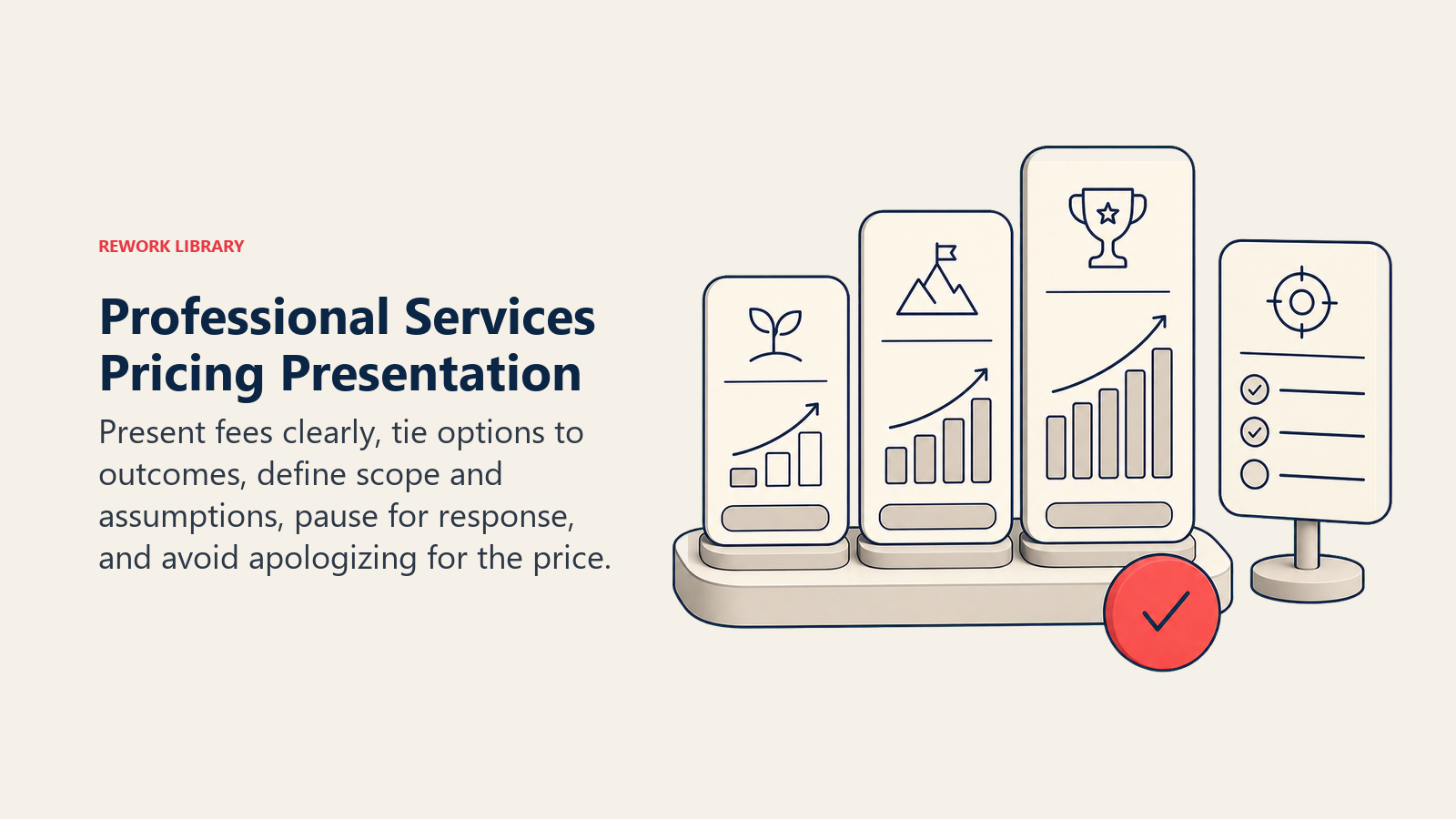
Offer Options (Good-Better-Best)
People hate having only one choice. Give them three.
Structure it like this:
Foundation Package - $35,000 Core deliverables, basic support, longer timeline. Gets them 70% of the value.
Professional Package - $60,000 (Recommended) Full deliverables, comprehensive support, optimal timeline. Gets them 100% of the value.
Premium Package - $90,000 Everything in Professional plus ongoing optimization, executive coaching, extended support. Gets them 130% of the value.
This does two things: it makes $60K feel reasonable (not the cheap option, not the expensive one), and it gives them control. They're not deciding "yes or no," they're deciding "which one."
Use Round Numbers Strategically
Pricing psychology is real.
$50,000 feels more negotiable than $51,250. Round numbers suggest there's room to move. Precise numbers suggest you've calculated exactly what this costs and there's no fat to trim.
Use round numbers when you're open to negotiation. Use precise numbers when you're not.
But don't be weird about it. $73,500 is fine. $73,297 makes people wonder if you're billing by the minute.
Address Pricing Proactively
Don't let price be a surprise at the end of the sales process.
Early in the conversation, give a range: "Projects like this typically run between $50K and $80K depending on scope and timeline. Does that align with your budget expectations?" This is part of effective initial consultation process.
This qualifies them early. If they say "we were thinking $20K," you know immediately there's a gap to address. Better to have that conversation now than after you've invested 10 hours in proposal development.
Common Pricing Mistakes That Kill Deals
Learn from these mistakes so you don't make them. Apologizing for your pricing: Every time you say "I know it's expensive" you're undermining your value. Stop apologizing for charging what you're worth.
Premature discounting: The client hasn't even objected yet and you're already offering 15% off. You just told them your original price was inflated. Wait for them to ask. Then negotiate properly.
Vague value articulation: "This will really help your business" isn't justification. "$180K in cost savings over 18 months" is justification. Be specific.
Comparing on price alone: When a client says "Competitor X is cheaper," don't just defend your price. Differentiate on outcomes, quality, timeline, expertise. Make it about value, not cost.
Negotiating against yourself: Client: "Hmm, let me think about it." You: "Well, I could probably do it for $10K less if that helps." You just negotiated against yourself. Stop. Let them make the first move.
Building Pricing Confidence Over Time
Confidence in pricing justification comes from practice and proof.
Practice Your Delivery
Rehearse how you present pricing. Say the number out loud, by yourself, until it feels natural. "The investment is $75,000" should roll off your tongue without hesitation.
Role-play objections with a colleague. Practice your responses until they're smooth and confident.
Record yourself in mock client calls. Watch the video. Do you look confident or apologetic? Adjust.
Internalize Your Value
Keep a running list of wins. Every successful project, every glowing testimonial, every measurable outcome you've delivered. Review this before pricing conversations.
When imposter syndrome hits ("who am I to charge $500/hour?"), read your wins list. You've delivered millions of dollars in value. You've earned premium pricing.
Collect and Use Success Stories
Nothing builds pricing confidence like proof.
After every successful engagement, document:
- What problem you solved
- What it cost the client
- What results you delivered
- What those results were worth
Then use these in pricing justifications: "When I did this for [Company X], they invested $65K and generated $340K in new revenue in six months. The ROI was 5.2X. That's what you're buying."
Track Your ROI
Start measuring the actual ROI you deliver. Not what you think you deliver - what clients actually achieve.
Survey clients six months after engagement: What revenue increase did you see? What costs decreased? How much time did you save?
When you have real data showing you consistently deliver 4X ROI, pricing conversations get easier. Use these results to build client testimonials and case studies that reinforce your value proposition.
Celebrate Premium Wins
When you close a deal at your full rate with no discount, celebrate it. Acknowledge that you held your ground and the client recognized your value.
When you win against a cheaper competitor, analyze why. What justification worked? What made them choose value over price?
Those are your confidence builders.
The Path Forward
Pricing justification isn't about having perfect scripts. It's about genuinely believing in your value and communicating it clearly.
Start with the fundamentals: know your ROI, practice your delivery, and stop apologizing. When a client questions your price, don't get defensive - get specific. Show the math. Compare alternatives. Make the value so obvious that price becomes a secondary concern.
And remember: clients who choose you based on price will leave you for price. Clients who choose you based on value become long-term partners.
For more on building your pricing strategy and sales process:
- Value-Based Pricing Models - The foundation for premium pricing
- Budget and Timeline Discovery - Qualify financial capacity early
- Proposal Development - Present pricing in context
- Negotiation for Services - Navigate pricing discussions strategically
- Objection Handling - Overcome resistance systematically
Your expertise is valuable. Price it accordingly and defend it confidently.

Sales Director
On this page
- Why Price Conversations Feel So Uncomfortable
- Building Internal Confidence Before Client Conversations
- The Value-Based Pricing Framework for Justification
- ROI Calculation and Quantification
- Risk Mitigation Value
- Opportunity Cost of Delay
- Expertise Premium: Why You Cost More
- Total Cost of Ownership vs Alternatives
- Pricing Justification Techniques That Actually Work
- Investment Framing
- ROI Demonstration in Action
- Comparative Positioning Scripts
- Risk/Reward Framing
- Expertise Premium Justification
- Handling Price Objections Like a Pro
- "This is too expensive"
- "We need to think about it"
- "Can you do it for less?"
- "A competitor quoted lower"
- "We don't have budget for this"
- Pricing Presentation Best Practices
- Present Confidently Without Apology
- Tie Price to Specific Value and Deliverables
- Offer Options (Good-Better-Best)
- Use Round Numbers Strategically
- Address Pricing Proactively
- Common Pricing Mistakes That Kill Deals
- Building Pricing Confidence Over Time
- Practice Your Delivery
- Internalize Your Value
- Collect and Use Success Stories
- Track Your ROI
- Celebrate Premium Wins
- The Path Forward