Client Testimonials & Case Studies: Converting Client Success Into Growth Engine
Turn this article into takeaways for your work.


Each assistant summarizes the article only for you and suggests best practices for your work.
Here's something most professional services firms get backwards: they create case studies after they've already lost deals. A prospect asks "Can you show me an example of this work?" and they scramble to find something relevant. By then, it's too late.
The firms that win consistently treat testimonials and case studies like infrastructure, not afterthoughts. They build a library of proof before they need it. When a prospect in healthcare asks about implementation timelines, they pull up a case study from a similar hospital system. When a CFO questions ROI, they share a video testimonial from another CFO explaining the exact business impact.
This isn't just marketing polish. Case studies are the highest-converting sales asset you can create. Prospects trust other clients more than they trust you. But here's the problem: most firms are terrible at capturing these stories, writing them in ways that resonate, and actually using them in sales conversations. Strong case studies are a key output of your overall client relationship strategy.
This guide shows you how to build a systematic approach to client testimonials and case studies that turns your best work into a repeatable growth engine.
Why testimonials and case studies matter more than you think
Every professional services firm claims they're different, better, more experienced. Prospects have heard it all before. They don't trust what you say about yourself. They trust what your clients say about working with you. Social proof works because it answers the real questions prospects are afraid to ask directly: "Will these people actually deliver what they promise? Will they understand my specific situation? Will this be worth the investment?"
A good case study doesn't just describe what you did. It shows a prospect someone like them who had a problem like theirs and got results they want. That's emotional resonance you can't create with capability statements or methodology decks.
But there's a practical reason too: case studies do the selling work you can't scale. You can't personally talk to every prospect. But a well-written case study puts your best client success story in front of hundreds of potential buyers. It works while you sleep.
The difference between firms that close 30% of proposals and firms that close 50%? Usually it's proof. One group has compelling evidence of results. The other just has promises.
Types of social proof and when to use each
Not all testimonials serve the same purpose. You need different formats for different stages of the buying process. Written testimonials are quick hits of validation. A two-sentence quote from a client saying "This transformed how we operate" or "They delivered ahead of schedule and under budget." These work well on website pages, in email signatures, and sprinkled throughout proposals. They're easy to collect and easy to use. The limitation: they lack context and depth. A quote alone doesn't tell the story of how you got the result or what made it possible.
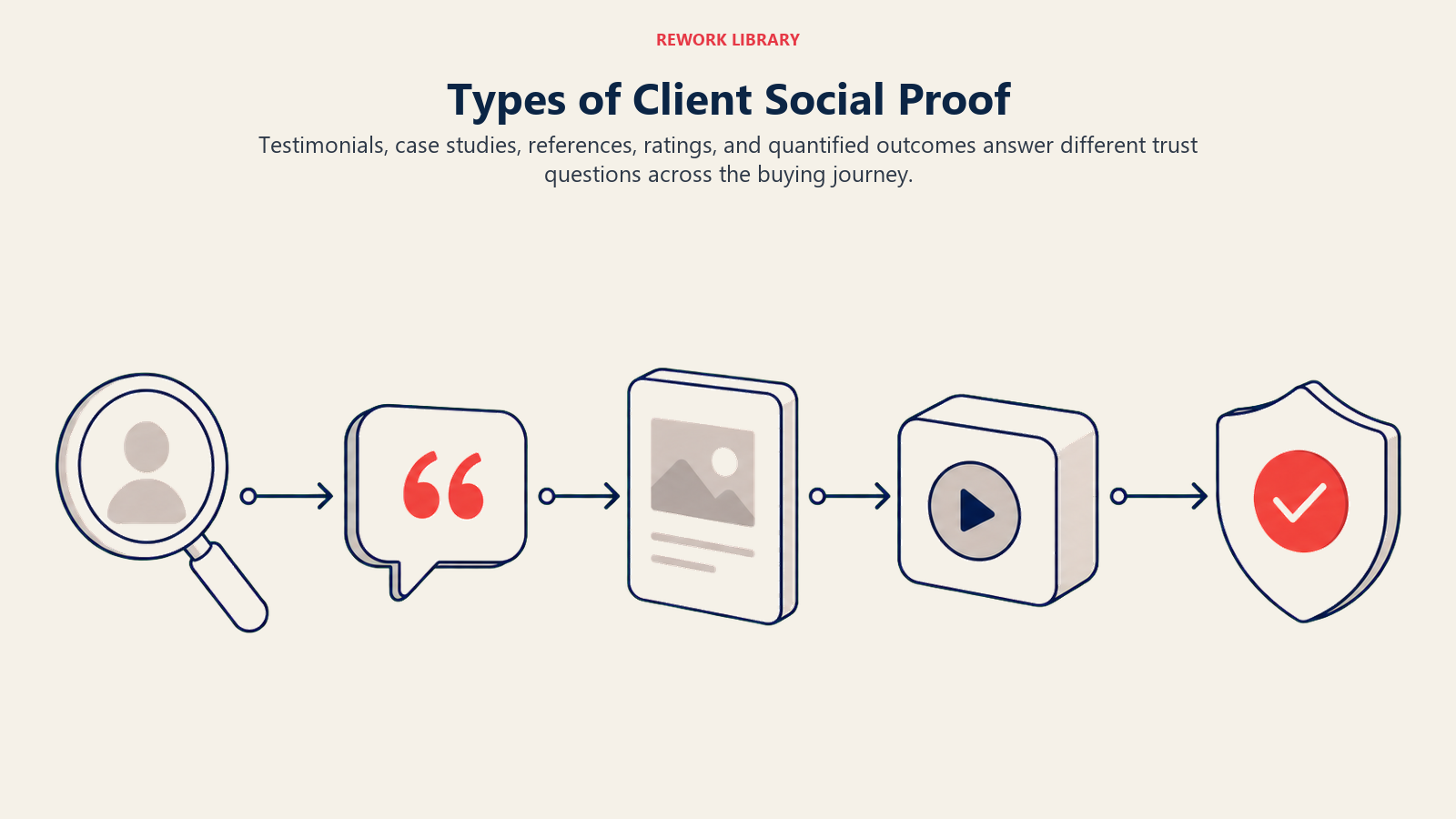
Video testimonials are the most emotionally powerful format. Seeing and hearing a real person describe their experience creates trust that written text can't match. When a CFO looks into the camera and says "This was the best consulting engagement we've ever done," prospects believe it.
Use video for your highest-value client relationships and most impressive results. The production effort is higher, but so is the impact. Save these for late-stage sales conversations and high-profile marketing placements.
Short-form success stories (300-500 words) give you the middle ground. Enough detail to explain the situation, solution, and outcome, but short enough that busy prospects will actually read them. These work as blog posts, LinkedIn articles, and email nurture content.
Long-form case studies (1,500-2,500 words) are deep dives that document the entire engagement. These are PDF downloads, web pages, or sales leave-behinds that prospects review when they're seriously evaluating you. They need detail, data, and narrative structure.
Use these when the work was complex, the results were significant, and you want to demonstrate expertise. A 2,000-word case study about helping a hospital system redesign their revenue cycle shows you understand healthcare operations in ways a paragraph quote cannot.
Client references are live conversations where prospects talk directly to your clients. These are the highest-trust format because there's no filter. But they're also the highest burden on your clients, so save these for final-stage deals where a reference call might be the deciding factor.
Online reviews and ratings (Google, Clutch, G2, industry platforms) create passive credibility. Prospects research you before they ever contact you. A profile with 30 five-star reviews and detailed feedback looks completely different than one with three vague reviews from 2019.
Build this as ongoing background work. Ask every client to leave a review when projects close successfully. Your client feedback systems should include triggers for review requests after positive survey responses.
Identifying the right case study candidates
Not every client success makes a good case study. You want stories that resonate with future prospects and showcase your strengths in ways that drive new business. Start with results. The best case studies have quantifiable outcomes: 40% cost reduction, 6-month implementation instead of predicted 12 months, $2M in new revenue generated. Numbers make stories credible and memorable. If you can't quantify the outcome, the story needs a compelling qualitative angle. "Transformed company culture" or "Avoided regulatory penalty that would have shut down operations" can work, but they need rich detail and client quotes to feel real.
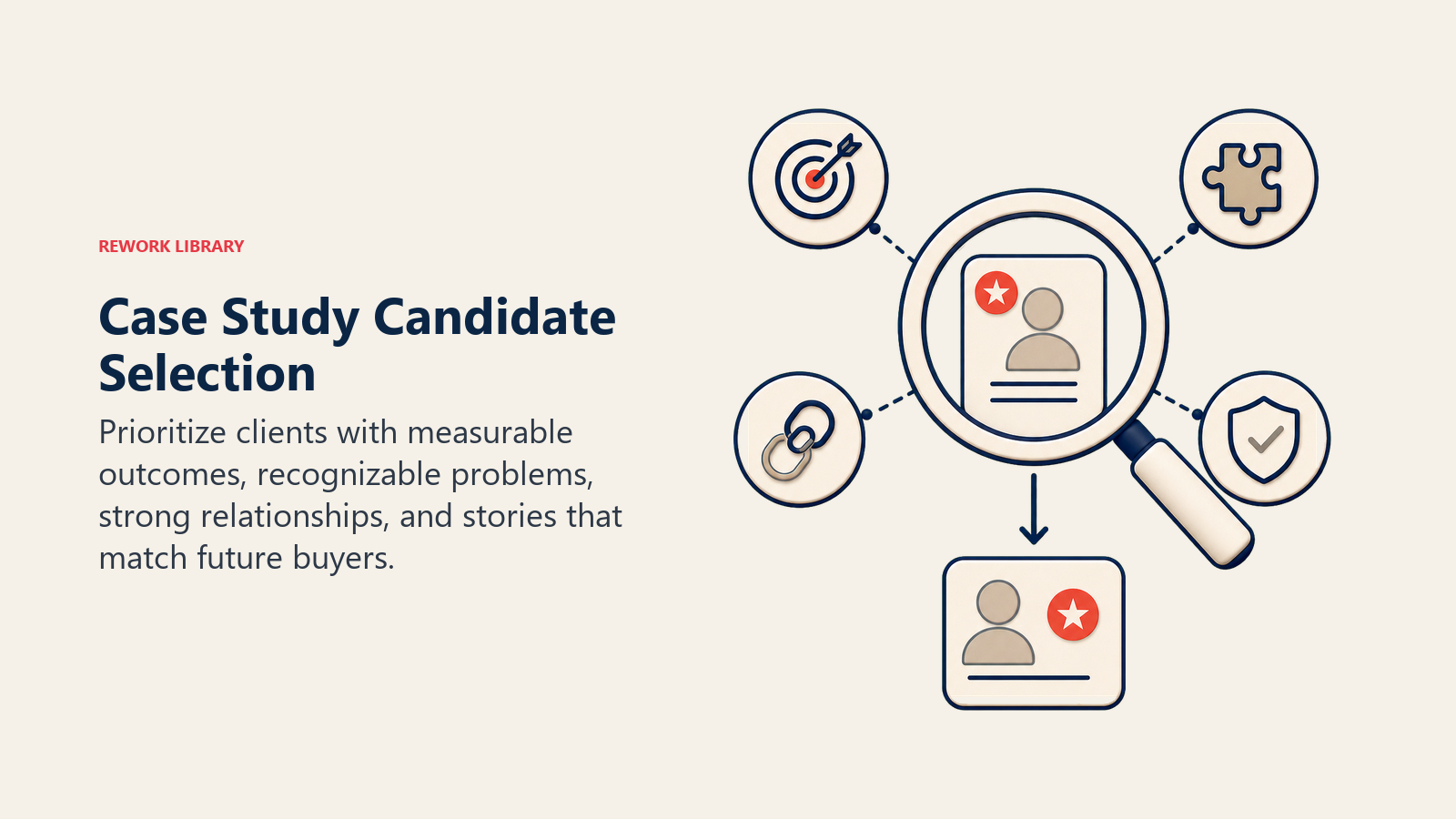
Look for client fit with your target market. If you're trying to win more work in financial services, case studies from banks and investment firms matter more than case studies from manufacturing companies. Prospects want to see that you've solved problems in their world, with their constraints and regulations.
Strategic diversity matters too. You don't want five case studies that all showcase the same service in the same industry. Build a portfolio that covers different services, industries, company sizes, and problem types. That way you always have something relevant when a prospect asks.
Client enthusiasm is critical. The best case studies come from clients who are genuinely excited to share their experience. They give you better quotes, more access, and participate willingly in reviews and approvals. Clients who are satisfied but not enthusiastic produce lukewarm case studies that don't convert.
Timing plays a role. Approach clients when the success is fresh and results are clear. Six months after project completion is often ideal - enough time for outcomes to materialize, but not so long that memory fades or key contacts leave. Client success reviews provide natural opportunities to gauge interest in case study participation.
Watch for clients who are already talking about you. If someone mentions you positively on LinkedIn, refers you to colleagues, or speaks at an event about the work you did together, they're signaling willingness to participate in a case study.
How to request client participation without making it weird
Most firms approach case studies like they're asking for a huge favor. "Would you possibly be willing to maybe let us write something about the work we did, if it's not too much trouble?" That frame makes it sound like burden, so clients say no. Flip the script. Position the case study as an opportunity for the client, not just for you.
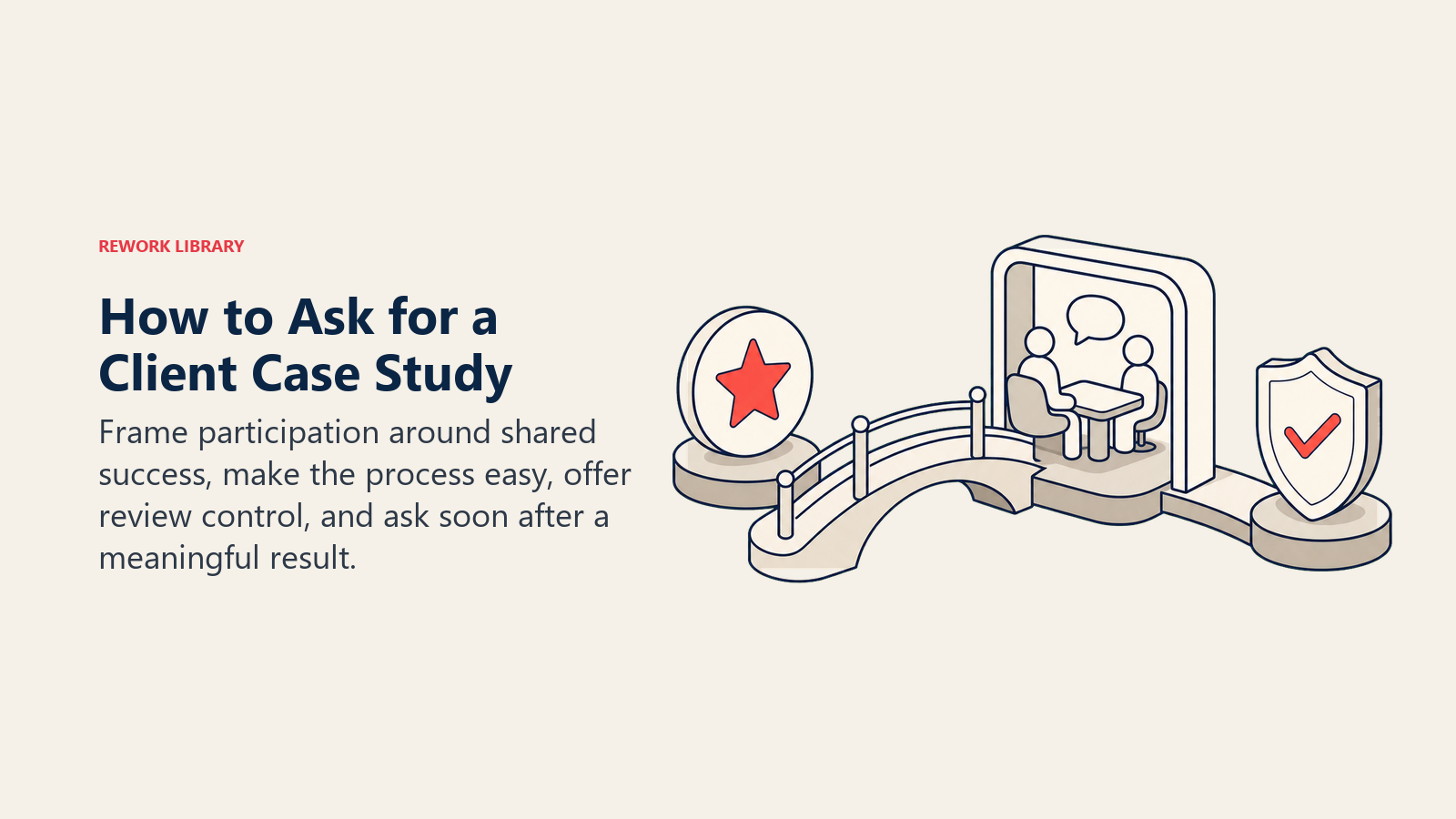
Frame it around their visibility: "We'd love to feature [Company] in a case study that highlights how you're leading innovation in [industry]. It would showcase your forward-thinking approach and the results you've achieved." Now it's about them getting recognition, not you getting marketing material.
Some clients care about thought leadership and welcome the exposure. Others are more private. For those, emphasize control: "You'd have full approval over the content, and we can keep your company name anonymous if you prefer." Anonymous case studies ("A leading healthcare provider...") are less powerful but still useful.
Offer something in exchange. It doesn't have to be payment, but reciprocity helps. Common options:
- Featured placement on your website with link to their site
- Social media promotion to your audience
- Video testimonial that they can also use on their site
- Executive profile/interview that positions their leader
- Complimentary consulting session or service enhancement
For strategic clients, case study participation can be part of the engagement terms. Write it into the contract: "At successful project completion, Client agrees to participate in case study development, subject to approval of final content."
This normalizes the ask and sets expectations early, before you're awkwardly requesting help six months later.
Timing the ask matters. The best moment is right after you've delivered exceptional results and the client is excited. Catch them in that moment of appreciation. "I'm so glad this exceeded expectations. Would you be open to us documenting this success in a case study? We'd love to showcase what you've accomplished."
Make participation easy. Tell them exactly what you need and how much time it requires. "We'd need about 30 minutes for an interview, then your review of a draft. Total time on your end would be under an hour." Clear expectations get more yes answers.
The case study development process that actually works
Great case studies don't happen by accident. You need a repeatable process that consistently produces usable content. Step 1: Interview and data gathering. Schedule a structured interview with the key stakeholders - usually the executive sponsor and the day-to-day project lead. Come prepared with specific questions, not generic "How did it go?" prompts. Ask about the situation before you arrived: What problem were they trying to solve? What had they tried previously? What would have happened if they'd done nothing? This establishes the stakes and makes the story matter.
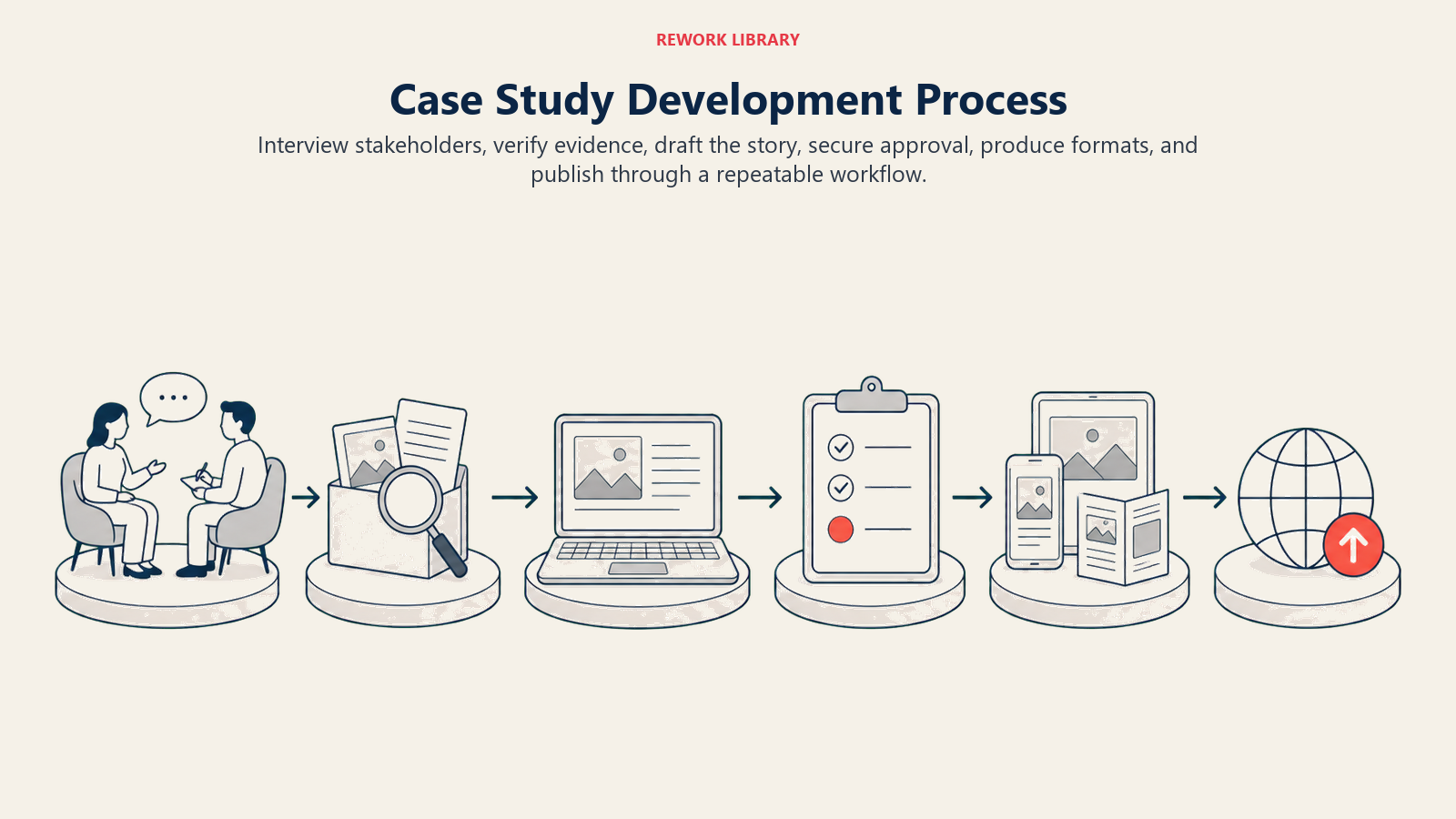
Ask about the solution: Why did they choose you? What surprised them about the process? What was harder than expected? What was easier? These details create authenticity.
Ask about results: What specific outcomes can they point to? What changed in their business? How did their team or customers respond? What are they able to do now that they couldn't do before?
Get direct quotes. When someone says something compelling, mark it for quotation. "That's a great line - can you say that again so I capture it exactly?" Authentic client voice is what makes case studies believable.
Collect supporting data: project timelines, before/after metrics, team sizes, budget comparisons. Even if you don't use everything, having the numbers available creates flexibility in how you tell the story.
Step 2: Narrative structure development. Every case study follows the same basic arc: Challenge, Solution, Results. But the art is in how you tell it.
Start with the challenge in a way that makes prospects nod along. "Like many mid-sized manufacturers, [Company] was losing talent to larger competitors who could offer better benefits and career paths." If your prospect is a mid-sized manufacturer with retention problems, they're already invested.
Describe the solution without drowning in methodology jargon. Prospects don't care about your seven-phase proprietary framework. They care about what you actually did. "We started by interviewing 40 employees across all levels to understand what kept people at the company and what made them leave."
Show the results with specificity. Don't say "improved retention." Say "reduced turnover from 32% to 18% over 12 months, saving an estimated $1.2M in recruiting and training costs."
Include client quotes that add emotional weight. "Before this work, we were losing our best people every quarter. Now we're the employer of choice in our region." That quote does more than any statistic.
Step 3: Draft, review, approval. Write a first draft that tells the story clearly. Don't wordsmith it to perfection yet - you want client feedback on structure and accuracy first.
Send it to the client with clear guidance: "Please review for accuracy, especially numbers and quotes. Feel free to suggest edits, but don't worry about perfect phrasing - we'll polish the writing."
Expect 2-3 rounds of review. Clients will want to soften language, remove anything that might be sensitive, and sometimes add context you didn't know about. This back-and-forth improves the final product.
Get explicit written approval before publication. Email confirmation that says "Approved for publication" protects you legally and ensures there's no confusion later about what they agreed to.
Step 4: Production and formatting. Turn the approved content into the appropriate format: web page, PDF, video script, slide deck. Design matters here. A well-designed case study gets read. A wall of text in a Word doc gets ignored.
If you're creating video, the testimonial interview becomes the filming session. Keep it conversational, not scripted. Coach the client on what to emphasize, but let them use their own words.
Add visual elements: photos from the engagement, charts showing results, logos of technologies used, pull-quotes that highlight key points. These break up text and make the content scannable.
Content framework: what to include and what to cut
A strong case study hits specific beats. Here's the structure that works across formats: Client background (2-3 sentences): Who they are, what they do, why they matter. "XYZ Corporation is a $200M specialty chemicals manufacturer serving the automotive and aerospace industries." Just enough context for credibility. Business challenge (1-2 paragraphs): The problem they faced, the impact it was having, and why it mattered. Make this relatable to your target audience. If the challenge doesn't resonate, the rest of the story won't matter.
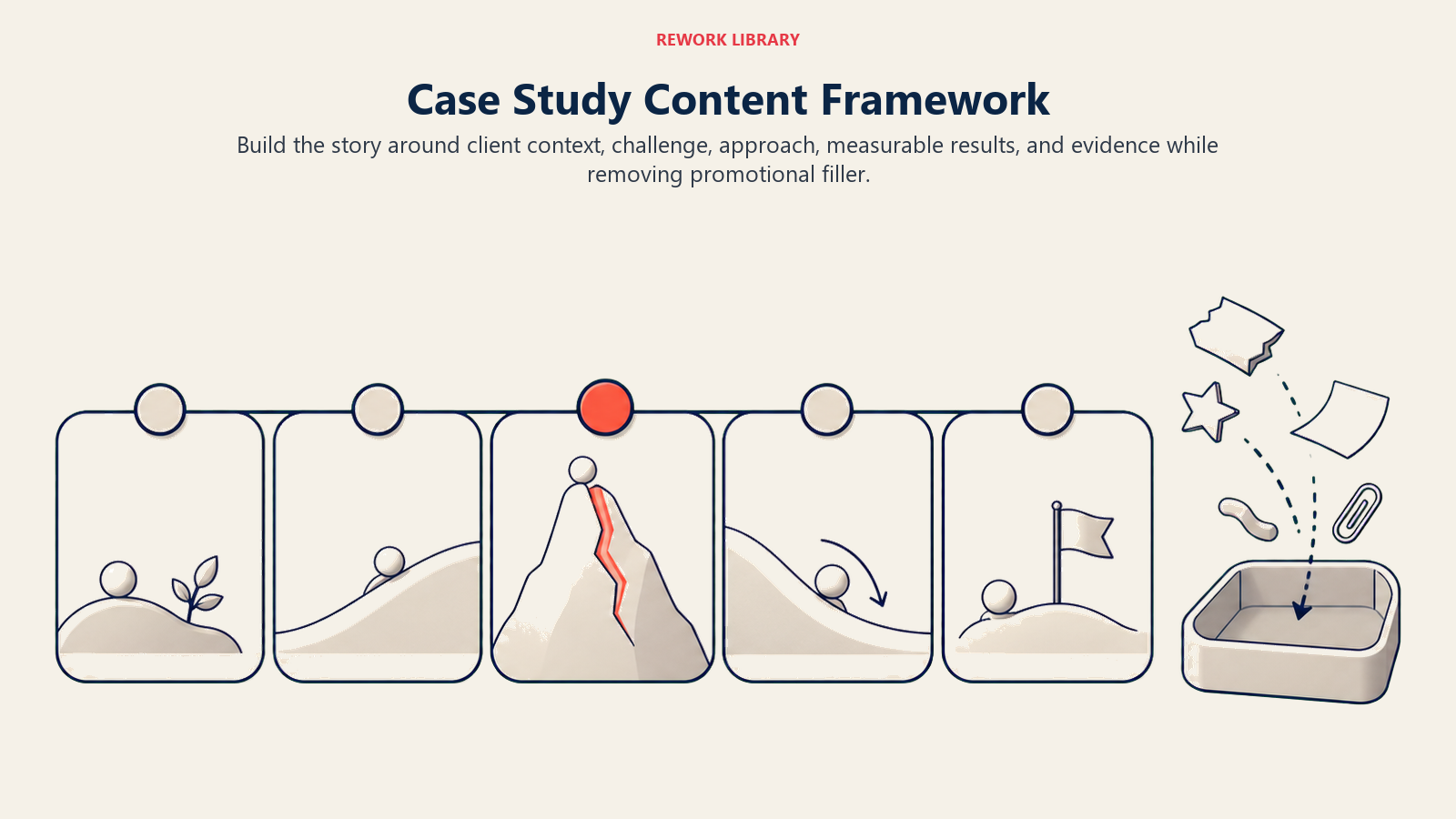
Include what they'd tried before: "They'd attempted to solve this with internal resources but lacked the specialized expertise needed." This explains why they needed outside help and validates that the problem was genuinely difficult.
Solution approach (2-3 paragraphs): What you did, how you did it, and why it worked. This is where you demonstrate methodology and expertise, but in service of the story, not as self-promotion.
Focus on the decisions and trade-offs: "Rather than the typical 12-week assessment phase, we ran a rapid two-week diagnostic that identified the top three opportunities for immediate impact." That shows how you think, not just what you did.
Include collaboration details: "We worked alongside their operations team, not as external consultants dictating changes but as partners building solutions together." This addresses the common fear that consultants don't understand the real business.
Results and outcomes (2-4 paragraphs): The specific, measurable impact. Lead with the most impressive number: "Within six months, operating costs decreased by 23%, representing $4.1M in annual savings."
Then layer in additional results: efficiency gains, quality improvements, employee satisfaction, customer impact. Paint the full picture of value created.
Include unexpected benefits: "An additional outcome was improved cross-functional collaboration, which has continued beyond the original scope of the engagement." These bonus results make the ROI story even stronger.
Client quotes throughout: Don't save all quotes for the end. Sprinkle them throughout the narrative to add voice and credibility. The client should be telling the story as much as you are.
Lessons learned or best practices (optional): For longer case studies, this section adds depth. "Three factors made this engagement successful: executive sponsorship from the CEO, willingness to challenge long-held assumptions, and rapid iteration based on early results."
This positions you as a thoughtful partner who learns from experience, not just a vendor executing tasks.
What to cut: Excessive methodology detail, internal project management logistics, anything the client asked you to remove, results you can't verify, and anything that sounds like a sales pitch instead of a story.
Case studies work when they feel like honest documentation of what happened, not marketing copy.
Collecting testimonials: timing, methods, and question frameworks
The best time to ask for a testimonial is within 48 hours of delivering something that exceeded expectations. Someone just thanked you for great work? That's your moment. "Would you be comfortable putting that in writing? It would really help us share this approach with other firms facing similar challenges." Don't wait until the project is over and everyone has moved on. Capture enthusiasm when it's fresh. Your client satisfaction management processes should flag high NPS scores as testimonial opportunities.
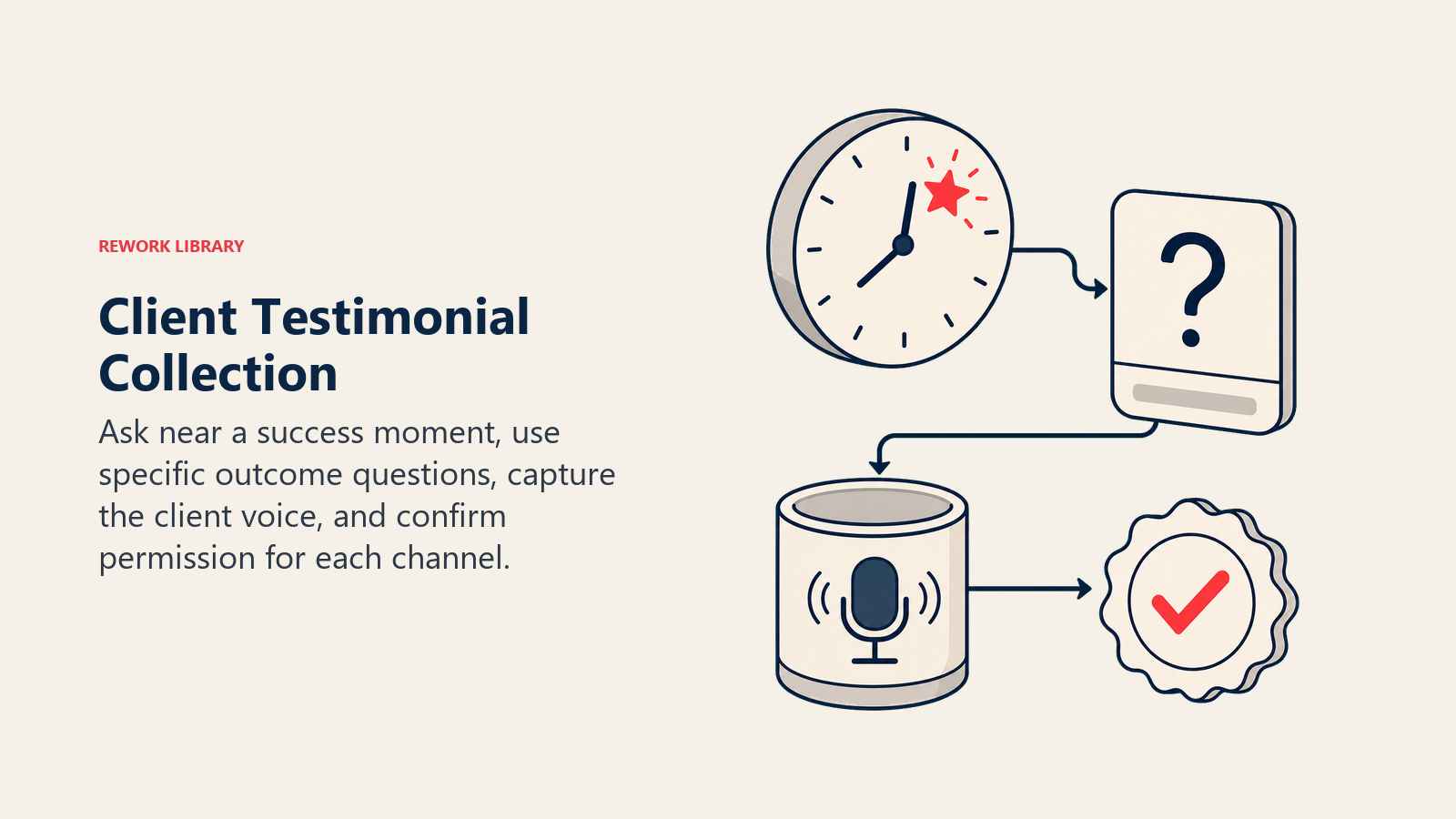
Collection methods:
Email requests work for simple written testimonials. Send a note: "Your feedback this week meant a lot to our team. Would you be willing to provide a brief testimonial about the experience?" Include 2-3 prompt questions to make it easy.
Interviews work better for detailed testimonials. A 15-minute phone call where you ask questions and capture their answers. Then you edit it into a polished quote and send for approval. This produces better content than asking someone to write from scratch.
Surveys can capture testimonials at scale. Send a post-project survey that includes: "If you were to recommend our services to a colleague, what would you say?" Positive responses become testimonials (with permission).
Video testimonials require the most effort but deliver the most impact. Schedule a 30-minute recording session. Send questions in advance so they can prepare, but keep the actual conversation natural. You can edit multiple takes into one polished answer.
Question frameworks that generate usable quotes:
Instead of "How was your experience?" (too vague), ask:
- "What problem were you trying to solve when you first contacted us?"
- "What was the result of our work together?"
- "What surprised you most about working with us?"
- "If a colleague asked whether they should work with us, what would you tell them?"
- "What would have happened if you hadn't done this work?"
These questions produce specific, compelling answers instead of generic praise.
For video testimonials, add visual prompting:
- "Describe the moment when you realized this was working"
- "What did your team say when they saw the results?"
- "How did you feel when we first presented the solution?"
Emotional responses on camera are powerful.
Making the ask comfortable: Most clients are happy to help if you make it easy. Provide the questions in advance, offer to write a draft they can edit, and respect their time. "I know you're busy - would a 15-minute call work, or would you prefer to respond to a few questions via email?"
Always ask permission before using a testimonial publicly: "Would you be comfortable with us featuring this on our website and in sales materials?" Some clients are fine with it. Others want to review specific usage. Honor their preferences.
Formats and distribution: getting your case studies in front of prospects
You've created great content. Now you need to deploy it everywhere a prospect might look. Website case study library: Create a dedicated section of your site with all case studies, filterable by industry, service type, and challenge. Make them easy to find and browse. This is where prospects research you after an initial conversation. Include PDF downloads for case studies people want to save and share. But also make the content readable on the page - many people won't download a PDF.
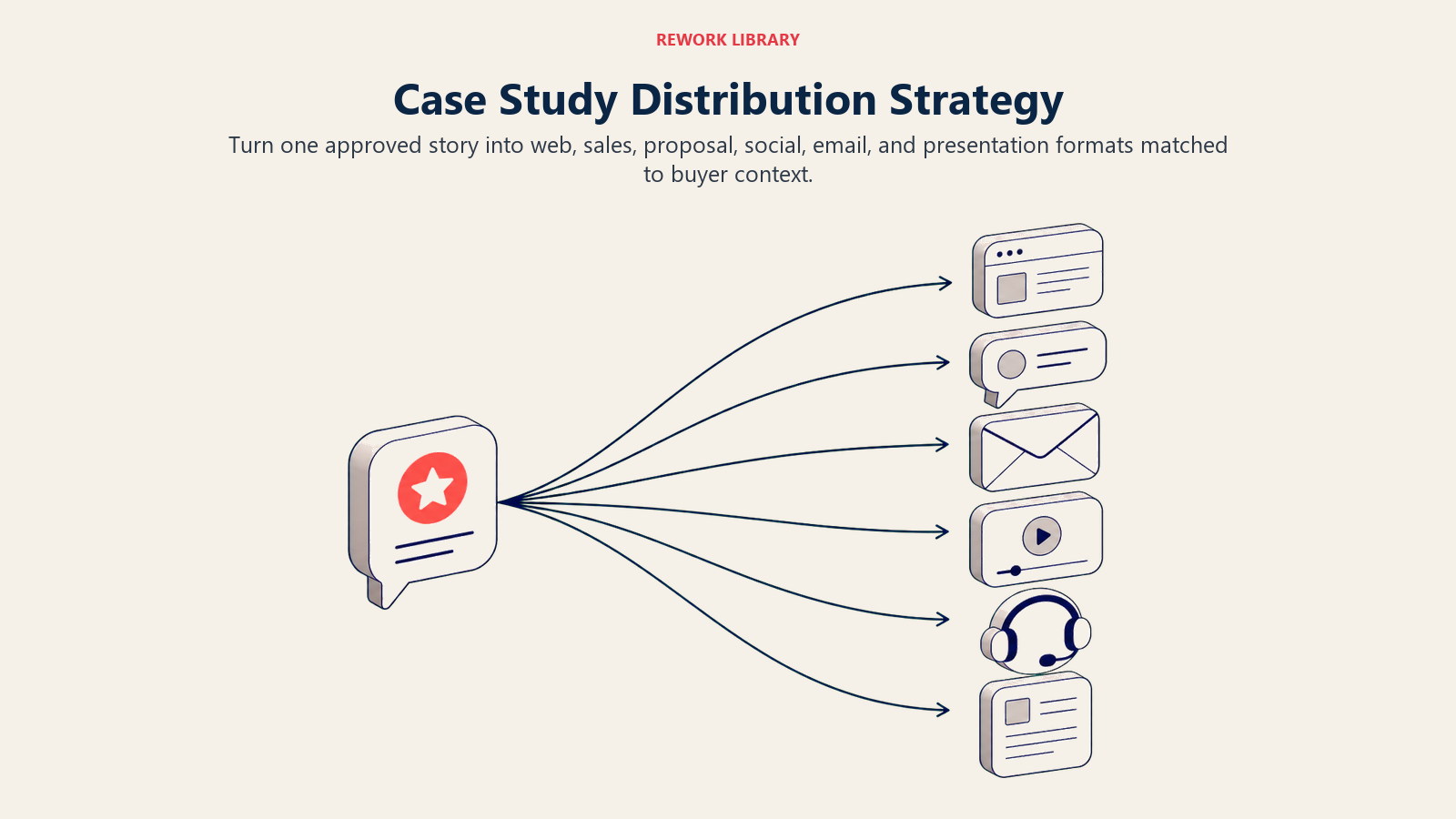
Sales collateral integration: Your best case studies should appear in:
- Proposal appendices (include 2-3 relevant examples with every proposal)
- Capability presentations (one slide per case study with key details)
- Sales decks (pull quotes and results as proof points)
- Email signatures (link to your most impressive case study)
Make it absurdly easy for salespeople to find and use case studies. If they have to dig through folders, they won't do it.
Email marketing campaigns: Feature a case study in your monthly newsletter. Create nurture sequences that share relevant case studies based on prospect characteristics. "Since you're in healthcare, you might be interested in how we helped [Hospital System] reduce claim denials by 34%."
Social media promotion: Break case studies into smaller pieces for social:
- LinkedIn posts with key results and a link
- Quote graphics with client testimonials
- Short video clips from longer video testimonials
- Thread-style posts that tell the story in chunks
Repurpose one case study into 10 pieces of social content.
Industry publication submissions: Many trade publications welcome contributed case studies, especially if they showcase innovation or results. This gets your story in front of your target audience with third-party credibility.
Conference and speaking materials: When you speak at events, case studies make your points concrete. Instead of "Companies struggle with change management," you say "When we worked with ABC Corp, they had 60% employee resistance to a new system. Here's how we addressed it."
Sales leave-behinds: After a meeting, send the prospect a relevant case study. "It was great discussing your inventory challenges. I thought you might find this case study interesting - it covers a similar situation we addressed for a manufacturer in your region."
This keeps the conversation going and provides something valuable.
Using testimonials in the sales process
Case studies aren't just marketing content. They're active sales tools that address objections and build confidence.
Proposal integration: Don't just attach case studies as appendices. Reference them in the narrative. "When we faced a similar challenge with [Client], we took this approach and achieved [Result]. We recommend a similar strategy for you."
This shows you've done this before and know it works.
Objection handling: When prospects raise concerns, testimonials counter them:
- "Will this really work in our industry?" → Share a case study from their industry
- "This seems expensive." → Show ROI from a previous client
- "Our situation is unique." → "We hear that often. [Client] said the same thing initially, but we were able to adapt our approach to their specific needs."
Client reference calls: When a prospect asks to speak with a current client, match them strategically. If they're worried about implementation timelines, connect them with a client who experienced a smooth, fast implementation. If they're focused on ROI, choose a client who can speak to specific financial results.
Prep your client before the call: "They're particularly interested in how we handled the data migration. Would you be comfortable speaking to that?"
Proof of capability: Especially for new service offerings, case studies prove you can deliver. "We know this is a newer area for us. Here's a case study from our first three engagements showing the results we achieved."
Industry-specific examples: The more similar the case study is to the prospect's situation, the more powerful it becomes. Build your library with this in mind - you want relevant examples for each target segment.
Measuring impact: do case studies actually work?
Track whether your case studies drive results. Usage metrics:
- Website traffic to case study pages
- PDF downloads
- Time spent on page (are people reading or bouncing?)
- Which case studies get shared most often by sales team
Conversion impact:
- Win rate for proposals that include case studies vs those that don't
- Lead-to-opportunity conversion for prospects who engage with case studies
- Average deal size for deals where case studies were used
Lead quality:
- Do inbound leads who mention a specific case study convert at higher rates?
- Are prospects who download multiple case studies more qualified?
Sales cycle influence:
- Does sharing a case study accelerate deals?
- At what stage do case studies have the most impact?
Most firms find that proposals with relevant case studies have 15-25% higher win rates than those without. Video testimonials in particular correlate with larger deal sizes, likely because they're used for more strategic opportunities.
If case studies aren't driving results, the problem is usually one of three things: wrong stories (not resonating with target audience), poor distribution (sales team doesn't know they exist), or weak quality (generic or uncompelling content).
Legal and compliance considerations
Before you publish any client work, cover these bases:
Client approval: Get explicit written permission. Email works fine: "You're approving the attached case study for publication on our website, in sales materials, and in marketing communications."
Keep this approval on file. If the client's leadership changes, you might need to reference it later.
Confidentiality review: Even with approval, double-check that nothing in the case study violates confidentiality terms in your original contract. Numbers, internal processes, strategic plans - make sure everything you're sharing is cleared.
Some clients will approve the case study but ask you to remove specific details or numbers. Honor those requests.
Attribution and accuracy: Ensure quotes are accurate and properly attributed. Don't invent quotes or attribute something to someone who didn't say it. Obvious, but worth stating.
If you're using photos or other media, confirm you have rights to use them.
Ongoing permissions: A case study approved in 2023 might need re-approval in 2026 if client leadership changes or if their business situation changes. Check in periodically with clients featured prominently in your marketing.
Some firms include expiration dates: "This case study is approved for use through December 2026." This creates a natural point to reconnect and confirm ongoing permission.
Anonymous case studies: When clients want to participate but need anonymity, you can still create value. "A global financial services firm with $10B in assets..." provides enough context without identifying the client.
The limitation: anonymous case studies are less credible. Prospects wonder if they're real. Use them when necessary, but prioritize named clients whenever possible.
Best practices for a testimonial program that runs itself
The firms with the best case study libraries don't treat it as a special project. They build it into operations.
Standard operating procedure: Make testimonial collection part of every project closeout. Final deliverable includes project retrospective and testimonial request. This normalizes the ask and ensures you never miss the opportunity. Your issue resolution process can also generate powerful recovery stories when problems are handled exceptionally well.
Diversity of proof: Build a portfolio that covers different dimensions:
- Multiple industries
- Different service types
- Various company sizes
- Geographic diversity
- Different results (cost savings, revenue growth, risk reduction, efficiency)
This ensures you always have something relevant.
Regular refreshes: Update your case study library quarterly. Retire outdated stories, add new ones, refresh content that references old data or screenshots.
Case studies from 2019 feel stale. Prospects want recent proof that you're still delivering.
Quantified results: Always push for numbers. "Improved efficiency" is weak. "Reduced processing time from 6 days to 2 days" is strong. Even if you have to help the client calculate the metric, the effort is worth it.
Authentic client voice: The best case studies sound like the client is telling the story, not like you wrote marketing copy and inserted a quote. Keep the language real, the details specific, and the tone honest.
Don't oversell. A case study that says "This was challenging and we had to adjust our approach midway through, but ultimately delivered strong results" is more credible than one that claims everything went perfectly.
Sales team enablement: Train your team on how and when to use case studies. Create a simple guide: "Use this case study when the prospect is concerned about implementation timeline" or "Share this when speaking with healthcare CFOs."
Make the case studies searchable by keyword so salespeople can quickly find what they need. Strong case studies support your broader client retention strategy by demonstrating the value of long-term partnerships.
Where to go from here
Client testimonials and case studies are your proof engine. They validate everything else you say about your capabilities and differentiation.
Start building your library now, even if you only create one case study per quarter. In two years, you'll have eight compelling stories. That's more social proof than most of your competitors have.
Connect this work with your broader marketing and sales systems:
- Thought Leadership Strategy - Case studies fuel thought leadership content
- Content Marketing for Services - Social proof makes all content more credible
- Consultative Business Development - Case studies support business development conversations
The firms that win the best work are the ones that can prove they've done it before. Build that proof systematically, and watch how it changes your close rates.

Sales Director
On this page
- Why testimonials and case studies matter more than you think
- Types of social proof and when to use each
- Identifying the right case study candidates
- How to request client participation without making it weird
- The case study development process that actually works
- Content framework: what to include and what to cut
- Collecting testimonials: timing, methods, and question frameworks
- Formats and distribution: getting your case studies in front of prospects
- Using testimonials in the sales process
- Measuring impact: do case studies actually work?
- Legal and compliance considerations
- Best practices for a testimonial program that runs itself
- Where to go from here