Upsell & Scope Expansion: Growing Account Value Through Organic Expansion and Strategic Service Extension

Turn this article into takeaways for your work.


Each assistant summarizes the article only for you and suggests best practices for your work.
Here's the math that changes everything: acquiring a new client costs 5-25x more than growing an existing one. Yet most professional services firms pour resources into new business development while leaving money on the table with current clients.
The best growth doesn't come from landing new logos. It comes from expanding work with clients who already trust you, know your value, and are actively seeing results. That's what upsell and scope expansion is about - identifying natural opportunities to do more valuable work with existing clients.
But there's a fine line. Push too hard and you look like you're just trying to increase billings. Miss opportunities and you're leaving growth on the table while competitors move in. The difference between smart expansion and annoying overselling is understanding when, how, and why to expand scope.
This guide shows you how to identify expansion opportunities organically, execute them strategically, and grow accounts in ways that strengthen relationships rather than strain them.
Understanding upsell vs cross-sell
Let's start by getting clear on what we're talking about. Upsell and cross-sell are related but different, and the distinction matters for how you approach each.
Upsell is doing more of what you're already doing. If you're running a monthly retainer for marketing strategy and the client wants to increase from 20 hours a month to 40 hours, that's an upsell. More of the same service, bigger scope, higher value.
Cross-sell is introducing different service offerings. If you're doing marketing strategy and you pitch them on website redesign services, that's a cross-sell. Different capability, different team, different value proposition.
This guide focuses on upsell and scope expansion - growing what you're currently doing. For introducing different services to clients, see cross-sell strategy, which requires a completely different approach.
Upsells happen because the current work is successful and the client sees value in expanding it. Cross-sells require educating the client on a new capability and making a separate buying decision. Upsells grow from momentum. Cross-sells create new momentum.
Types of upsell and scope expansion
Expansion takes different forms, and recognizing which type you're pursuing changes your approach.
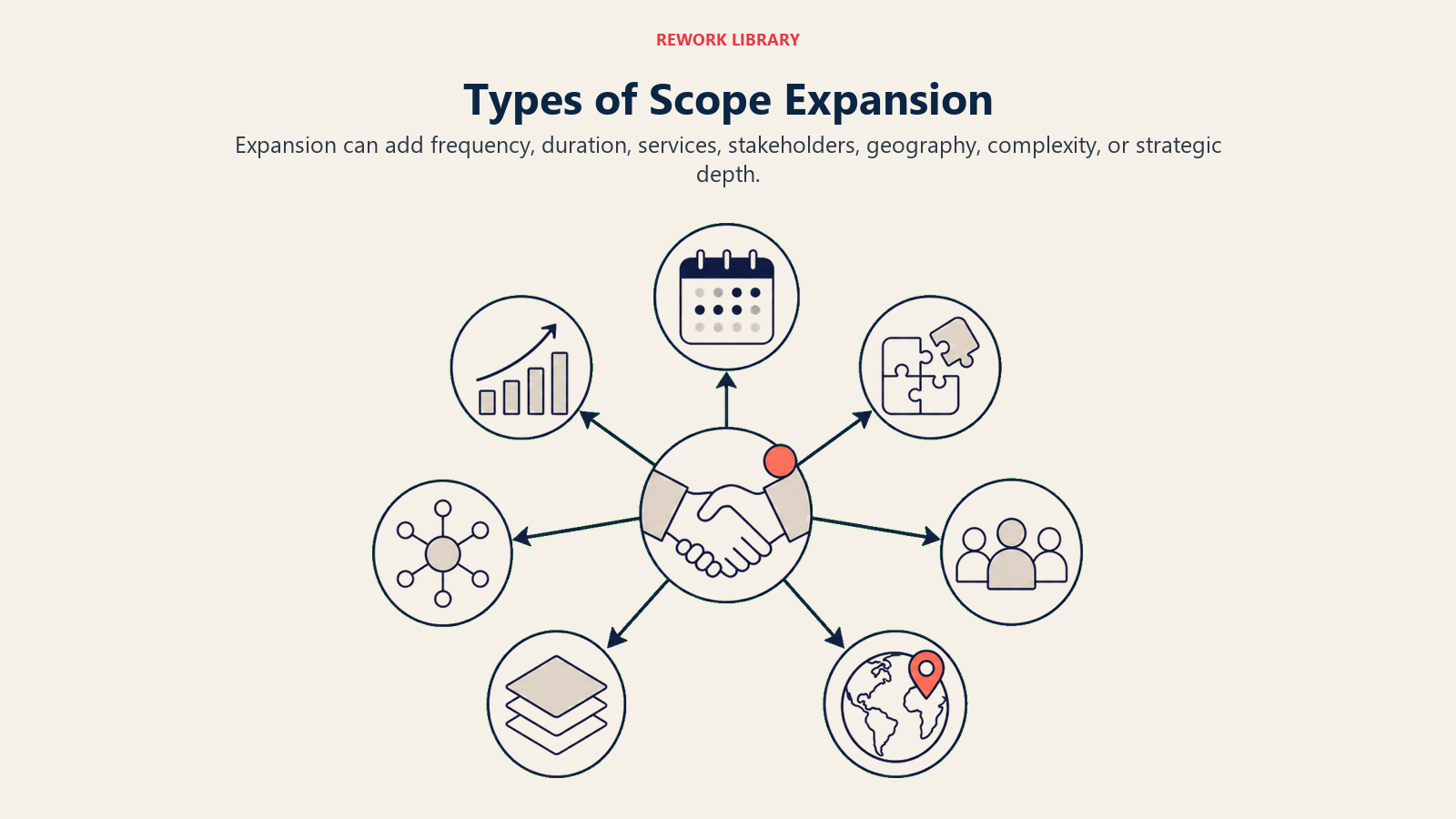
Increased frequency or duration: The client extends the engagement timeline or increases touchpoints. A quarterly strategic review becomes monthly. A 3-month project becomes a 12-month retainer. This is the simplest expansion - same scope, more of it.
Additional stakeholders or business units: You start working with one team and expand to others. You're consulting for the marketing department and get pulled into sales enablement. Or you're working with the US division and expand to EMEA. Same services, new audience.
Geographic expansion: Your client operates in multiple locations and you expand from one region to others. This works particularly well if you've proven results in one market and the organization wants to replicate that success elsewhere.
Deeper service levels: Moving from advisory to implementation. Going from strategy development to hands-on execution support. Adding more specialized expertise or senior resources. This is about depth rather than breadth.
Extended scope within current project: The project reveals adjacent needs or opportunities. You're optimizing their sales process and discover their CRM implementation is broken. You're doing a market analysis and uncover a pricing strategy gap. The work naturally extends into related areas.
Each type has different triggers, different value propositions, and different sales processes. Knowing which you're pursuing helps you position it correctly.
Identifying expansion opportunities
The best upsells don't feel like sales. They feel like natural progressions of work that's already working.

Client needs evolution: As clients grow or their market changes, their needs expand. The startup you helped with initial go-to-market strategy is now scaling and needs help with sales operations, channel partnerships, and international expansion. You're not creating needs - you're responding to real changes in their business.
Success creates expansion: When your work delivers results, clients want more of it. If your pricing optimization project increased margins by 15%, the conversation about optimizing other product lines happens naturally. Success is the best sales tool.
Business growth as expansion driver: Client headcount doubled in the last year? Revenue grew 40%? They got acquired? Major growth events create capacity gaps and new needs. You're already trusted and embedded - you can scale with them faster than a new provider could onboard.
Stakeholder expansion triggers: New executives join the organization. Leadership changes create opportunities because new leaders bring new priorities and aren't locked into existing vendor relationships. If a new CMO arrives and you're already working with the sales team, you have a window to expand.
Phase 2 and beyond opportunities: This is why smart firms design initial engagements as Phase 1. You solve the immediate problem while identifying adjacent opportunities. The conversation about Phase 2 is built into the engagement from day one, not manufactured after the fact. These multi-phase engagements often evolve into multi-year engagements that provide predictable revenue and deeper strategic relationships.
Watch for these signals in regular client interactions. They're not hidden - you just have to be listening for them.
Scope expansion triggers
Beyond general opportunities, specific triggers indicate the right time to propose expansion. Timing matters as much as value.
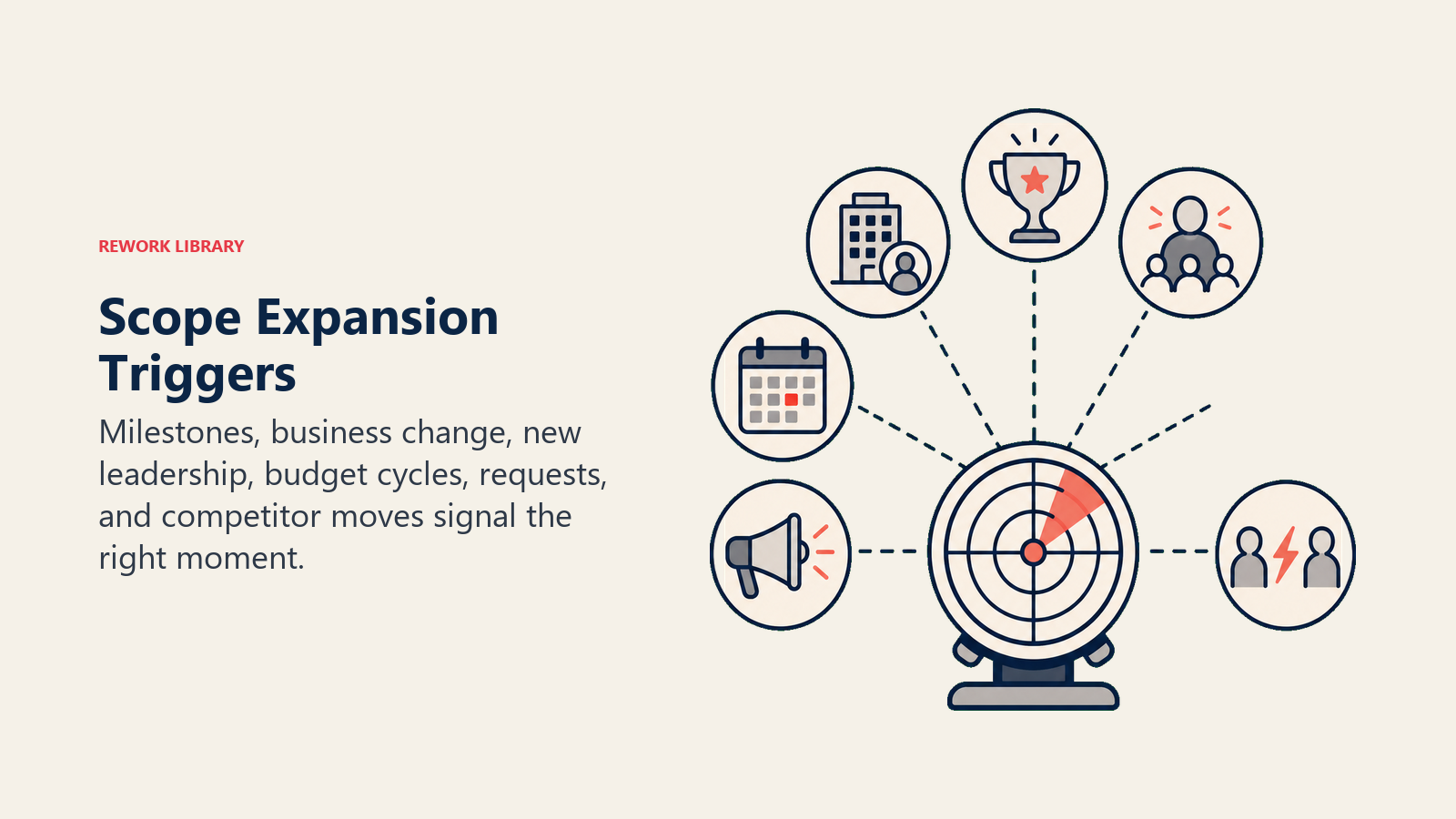
Project success and early results: Don't wait until the engagement ends to discuss expansion. When you hit a major milestone or deliver early wins, that's when enthusiasm is highest. "We just increased conversion rates by 25% in segment A. Want to apply this to segments B and C?" Strike while the results are fresh.
Client requests and inquiries: The best expansions are ones the client asks for. When they say "Could you also look at..." or "We're wondering if you could help with..." they're handing you an opportunity. Don't dismiss these as casual comments - they're buying signals.
Discovered needs during delivery: As you work, you see gaps and opportunities the client might not recognize yet. Maybe their data infrastructure can't support the analytics you're building. Maybe the team lacks skills to maintain what you're implementing. These aren't problems you created - they're realities you uncovered. Addressing them is service, not sales.
Strategic initiatives and changes: Client announces a new strategic initiative. They're entering a new market, launching a new product line, restructuring the organization. These create natural expansion points. "You're launching in Europe? We've helped three other clients with European expansion. Here's how we could support that."
Competitive threats or market shifts: External pressure creates urgency. A competitor launches a disruptive offering. Regulations change. Market conditions shift. When clients face new challenges, your ability to help them respond is valuable. But don't manufacture urgency that doesn't exist.
The common thread: these triggers are external to your desire to grow the account. You're responding to real client circumstances, not inventing reasons to expand.
Assessing expansion opportunities
Not every expansion idea is worth pursuing. Run opportunities through these filters before investing time in proposals.
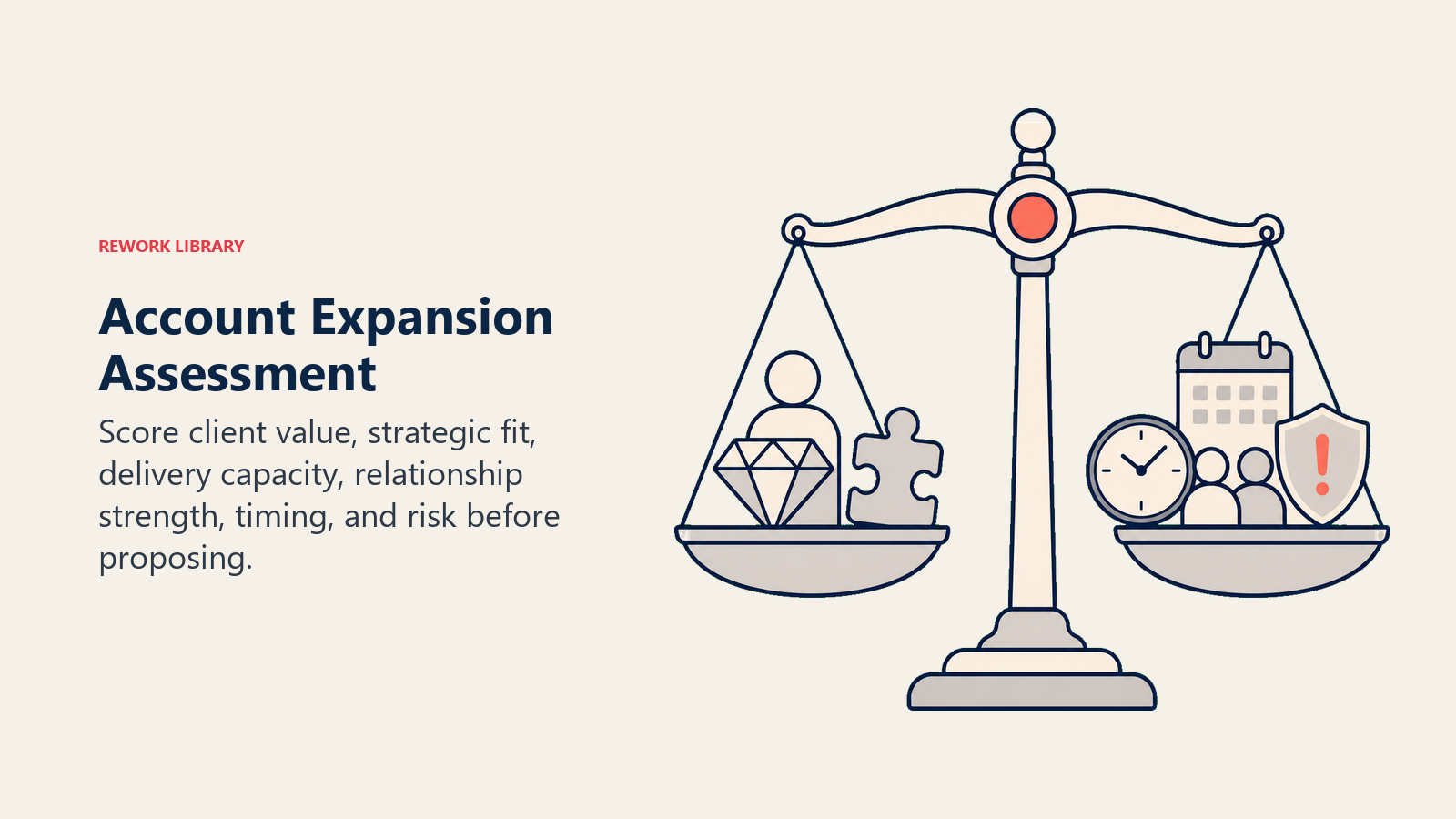
Client value and ROI potential: Will this expansion deliver meaningful value to the client? Can you quantify the benefit? If you can't articulate clear ROI, it's not ready. "This would be valuable" is weak. "This should reduce customer acquisition cost by 20% based on what we've seen in similar situations" is strong.
Internal capability and capacity: Can you actually deliver this well? Expanding into work you're not equipped to do excellently destroys trust. If the opportunity requires capabilities you don't have, be honest about that. Partner with someone who does, build the capability, or pass.
Resource requirements: Do you have the people available? What's the opportunity cost? Saying yes to a mediocre expansion means saying no to better opportunities. If your best team is tied up on low-margin scope expansion, they can't pursue higher-value work.
Pricing and profitability: Will this be profitable at a price the client will accept? Some expansions look good on revenue but terrible on margin. Clients often expect "efficiency discounts" for expanded scope - make sure the economics still work.
Relationship readiness: Is the relationship strong enough to support expansion? If there are unresolved issues with current work, expansion feels pushy. Fix what's not working before proposing more. And some clients simply don't want vendor consolidation - they prefer multiple specialized providers.
If an opportunity doesn't pass these tests, it's not the right move. Better to focus on opportunities with stronger fundamentals. For a systematic approach to evaluating all potential opportunities within an account, conduct a white space analysis that maps your current footprint against total addressable opportunity.
Executing upsell strategy
You've identified a solid opportunity. Now you need to position and sell it in a way that feels natural and client-centric.
Position expansion naturally: The conversation should flow from current work. "As we've been working on the sales process optimization, we've noticed the CRM implementation is creating bottlenecks. We could address that in a Phase 2." You're not randomly pitching new services - you're connecting directly to what you're seeing.
Demonstrate value and ROI: Show, don't tell. Use data from current work to project results from expansion. "In the pilot market, we increased retention 12%. Rolling this to all markets represents about $2.3M in retained revenue annually." Specific numbers beat generic value statements.
Incremental vs transformational expansion: Small expansions are easier to approve. Adding 10 hours a month to a retainer doesn't require executive approval. Proposing a $500K expansion program does. Structure expansion in phases when possible. Get quick wins with incremental expansion, then propose bigger moves once you've proven value.
Proposal and scope of work development: Don't wing it. Even for existing clients, expansion deserves a clear proposal. Define scope, deliverables, timeline, success metrics, and investment. Clarity prevents misalignment. The proposal doesn't need to be formal or lengthy, but it needs to be clear.
Pricing considerations for expansion: You have options here. Some firms offer "expansion pricing" as an incentive - lower rates for increased commitment. Others maintain standard rates but offer better terms (payment, flexibility). Some increase rates because demand for your services proves their value. The key is transparency. Explain your pricing logic. Clients respect consistency more than discounts.
Managing scope creep vs intentional expansion
This is where most firms mess up. They let scope creep happen gradually, then try to charge for it retroactively. That destroys trust.
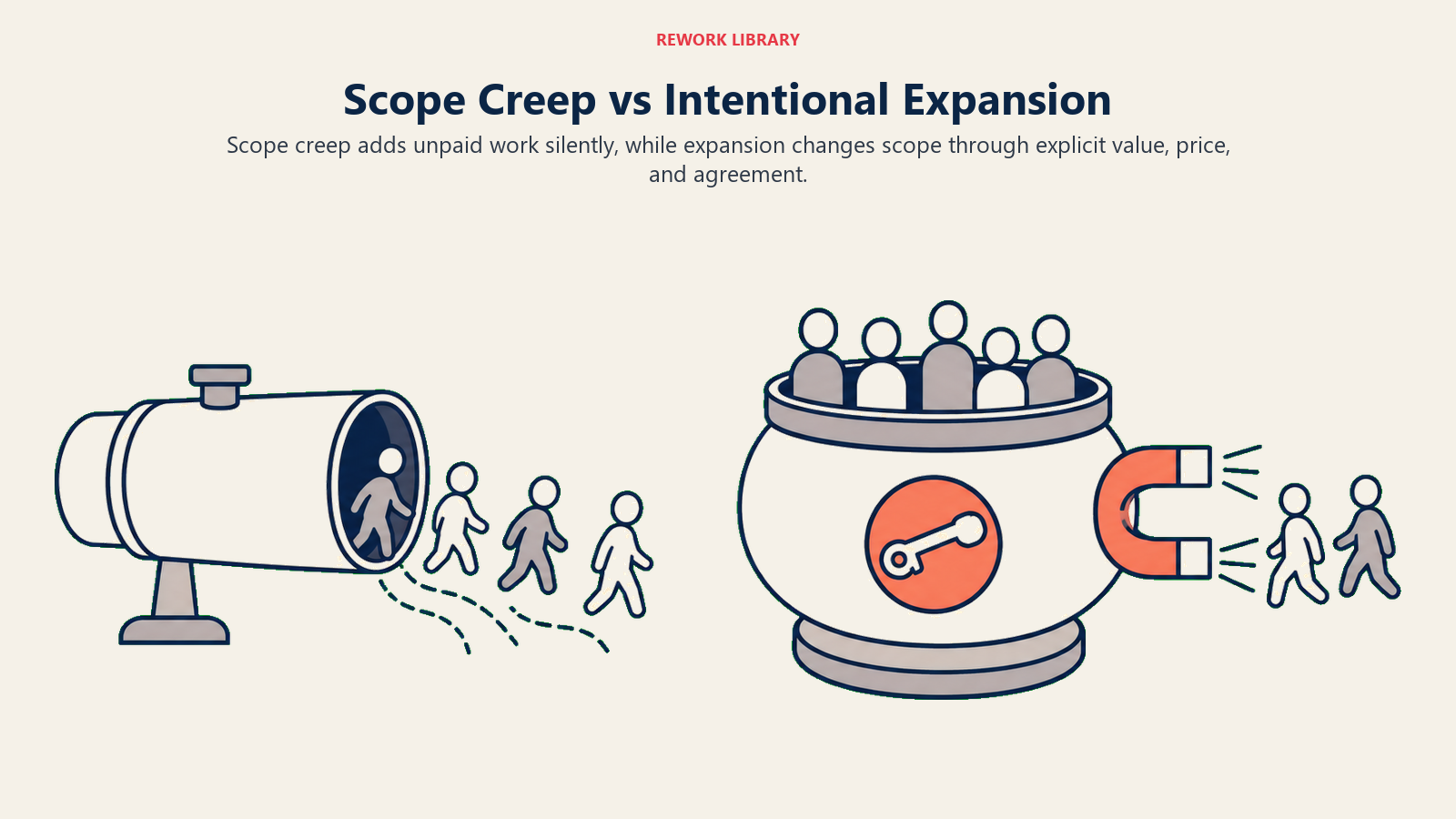
Distinguishing legitimate expansion from scope creep: Scope creep is doing more than agreed without discussion or compensation. Expansion is intentionally increasing scope with mutual agreement. The difference is communication and documentation.
If the client asks for something outside current scope, pause and acknowledge it. "That's a great idea. That would be expanding scope from what we originally defined. Let's talk about what adding that would look like." Don't just do it and hope to charge later.
Change order processes: Establish a clear process for scope changes. When work expands beyond original agreement:
- Identify what's changing and why
- Estimate the additional effort and cost
- Document it in writing (even just an email confirmation)
- Get explicit approval before proceeding
This doesn't need to be bureaucratic. A quick email - "Based on our discussion, we'll add [X] to the scope. This will add approximately [Y] hours at our standard rate of [Z]. Let me know if you want to proceed." - covers you. For more robust change management processes, see change order process.
Pricing scope increases: You have options. Bill at standard hourly rates. Create a fixed fee for the expansion. Add to monthly retainer. The approach depends on the situation, but be consistent with how you price similar work.
Managing client expectations: Some clients will push boundaries. "Can you just quickly look at this?" turns into 10 hours of work. Set boundaries early. "I'm happy to review that, but it's outside our current scope. Would you like me to send you a proposal for that as a separate workstream, or should we discuss adding it to the retainer?"
Protecting project margins: If you keep doing extra work without compensation, margins collapse. Then you resent the client, quality suffers, or you burn out the team. It's not sustainable. Saying yes to scope expansion with proper pricing is good business. Saying yes without pricing is bad business.
Enabling teams to identify expansion
Partners and senior consultants naturally spot opportunities. But if delivery teams don't flag expansion opportunities, you're missing most of them.
Training delivery teams to identify opportunities: Teach consultants and junior team members what expansion looks like. Share examples. "When you hear the client mention new initiatives, that's a potential expansion trigger. When we uncover a gap in their capabilities during our work, that's an opportunity." Make it concrete.
Sales and delivery coordination: Create mechanisms for delivery teams to surface opportunities to sales or account leads. A Slack channel, weekly pipeline meetings, a CRM field for "expansion opportunities identified." Make it easy to hand off.
Incentive alignment: If delivery teams aren't compensated for expansion, they won't prioritize it. Commissions, bonuses, or recognition for identifying opportunities aligns behavior. Even non-monetary recognition works - celebrate teams that spot and close expansions.
Opportunity handoffs: Clarify who owns the expansion conversation. Sometimes the delivery lead should propose it because they have the relationship and credibility. Sometimes account execs should lead because they're better at positioning and negotiating. Know when to hand off and when to stay involved.
Communication protocols: Don't blindside clients with random expansion pitches from different team members. "Hey, Sam from our analytics team mentioned you might be interested in expanding into customer segmentation analysis. I wanted to follow up on that." Coordinate internally before reaching out.
Expansion pricing strategies
Pricing expansion work is different from pricing initial engagements. You have relationship history and delivery proof points.
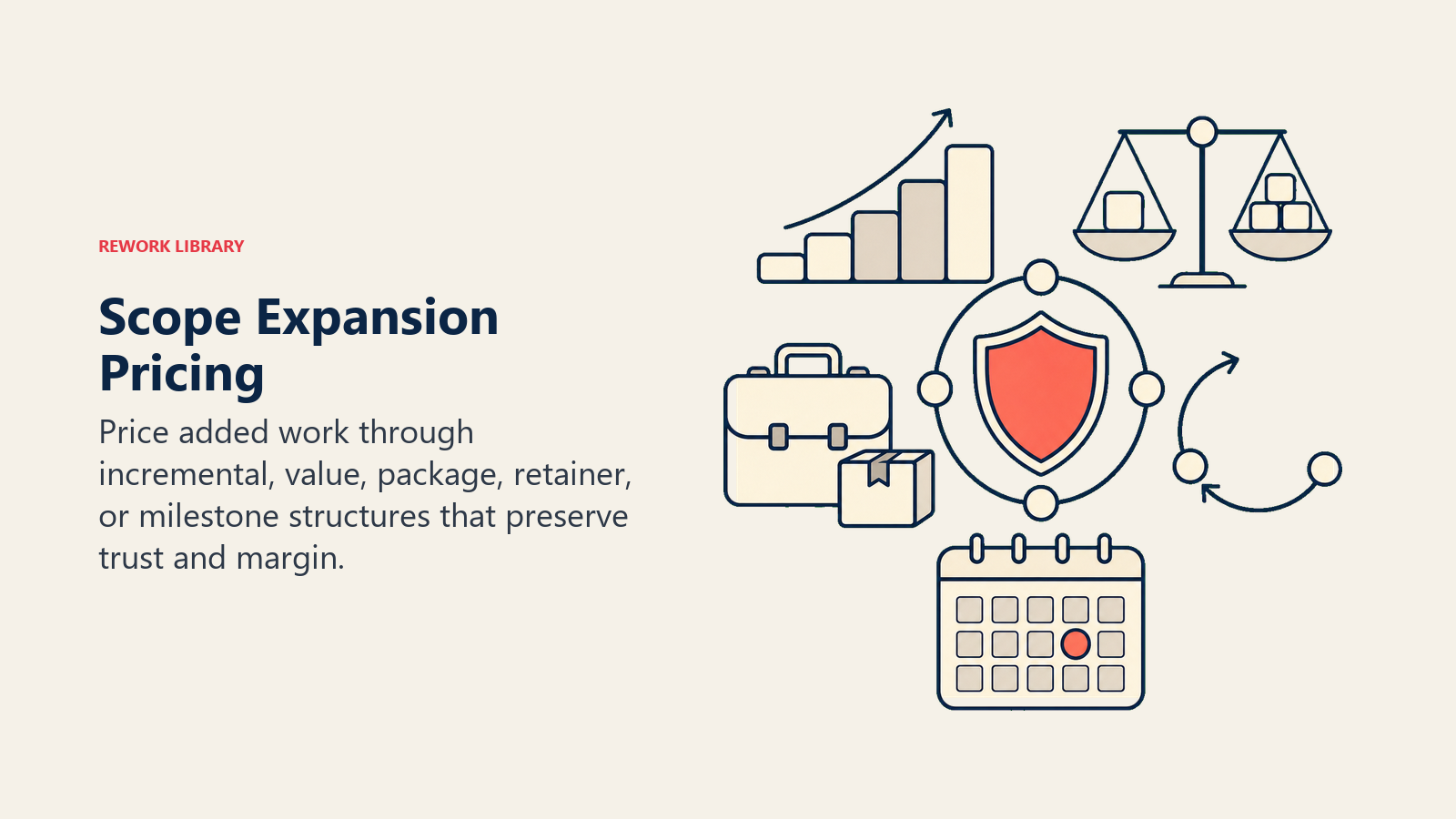
Incremental pricing approaches: Price based on marginal cost rather than full cost. If you're already managing a client relationship, the incremental effort to expand may be lower. You can pass some of that efficiency to the client through better pricing while maintaining margin.
Volume and scale discounts: Larger commitments can justify better rates. "Our standard rate is $250/hour. For a 12-month retainer at 80 hours/month, we can do $225/hour." You're trading rate for predictability and volume.
Long-term commitment pricing: Lock in multi-year agreements with pricing incentives. "Year one at standard rates. If you commit to year two now, we'll hold rates flat instead of our usual 5% annual increase." You get revenue visibility, they get cost certainty.
Value-based expansion pricing: When expansion is directly tied to measurable value, price against outcomes. "Rolling out this program to all divisions should generate approximately $5M in cost savings. Our fee is $750K - a 15% share of the value we create." This works when ROI is clear and measurable. For guidance on justifying premium pricing for expansion work, see pricing justification.
Competitive positioning: Know what clients would pay alternatives for this work. If you're priced significantly higher, justify it with specific value. If you're priced at market or below and delivering excellent results, you might be underpriced. Don't assume existing rates are correct for expansion work.
Tracking expansion metrics
You can't optimize what you don't measure. Track these metrics to understand expansion effectiveness.
Expansion rate: What percentage of clients expand beyond initial engagement? If you close 50 new clients a year and 30 of them expand scope, that's a 60% expansion rate. Higher is better, but context matters - some work naturally expands more than others.
Revenue growth per account: Track how account values change over time. Year-over-year growth in existing accounts shows your ability to expand relationships. Plot this by cohort - clients acquired in 2023, 2024, etc. - to see patterns.
Scope expansion velocity: How quickly do expansions happen? If clients typically expand 8 months into an engagement, you know when to be ready. If expansion conversations stall for months, you know you need to improve conversion or timing.
Margin on expansions: Are expansion projects as profitable as initial engagements? More profitable? Less? If margins are declining, you're probably discounting too much or taking on less profitable work. If margins are higher, expansion is working well.
Expansion by type: Which expansion types are most successful? Increased frequency? New stakeholders? Geographic? Understanding your patterns helps you focus on what works.
Common pitfalls to avoid
Smart firms fall into these traps. Don't be one of them.
Scope creep without compensation: The client asks for "one more thing" and you do it to be helpful. Then another. Then another. Three months later you're doing twice the work for the same fee. This feels customer-centric but it's actually bad for both sides. You resent the client, they don't understand why you're frustrated (they didn't realize they were asking for more), and the relationship suffers.
Poor timing: Proposing expansion when results haven't materialized yet. Or waiting too long and losing momentum. Or pitching during a rough patch in the relationship. Timing determines success as much as the opportunity itself. Read the room.
Forcing expansion: Pushing expansion the client doesn't need or isn't ready for. This happens when you have utilization gaps or revenue targets and try to make existing clients fill them. Clients can tell when you're selling for your benefit rather than theirs. It damages trust.
Misaligned value: Proposing expansion that matters more to you than the client. "We could also do your market research" when they have a great research team and don't need help. Expansion has to solve real client problems, not just create more revenue for you.
Neglecting delivery quality: Getting so focused on expansion that current work suffers. If you're pitching Phase 2 while Phase 1 is behind schedule and over budget, you look ridiculous. Deliver excellent work first. Expansion flows from that. Maintaining deliverable quality assurance standards is essential before pursuing any expansion.
Best practices for sustainable expansion
Here's what firms with strong expansion track records do differently.
Deliver first, expand from success: Don't pitch expansion until you've proven value. When results speak for themselves, expansion is easy. When you're still proving yourself, expansion feels premature.
Clear pricing and scoping: Never expand without clear agreement on what's changing and what it costs. Ambiguity creates conflict. Clarity creates confidence.
Mutual value creation: Expansion should benefit both parties. You grow revenue, they get more value. If it's only good for one side, it won't stick.
Relationship-first mindset: Some clients aren't ready to expand, and that's fine. Pushing anyway damages relationships. Better to maintain a great relationship on smaller scope than ruin it trying to grow too fast.
Regular opportunity reviews: Don't wait for expansion ideas to appear randomly. Build opportunity discussions into regular check-ins. "What's coming up in the next quarter that we should be thinking about?" Make space for expansion conversations.
Where to go from here
Upsell and scope expansion should be a core growth strategy, not an occasional bonus. The economics are too compelling to ignore - higher close rates, lower acquisition costs, faster sales cycles, and stronger relationships.
Once you've got expansion working, these related strategies compound the effect:
- Client relationship strategy builds the foundation that makes expansion possible
- Scope creep management protects margins while maintaining positive relationships
- Change order process formalizes how expansion gets documented and approved
- Cross-sell strategy extends growth beyond just expanding current work
- White space analysis identifies all the potential expansion opportunities systematically
- Client penetration strategy expands your footprint across the organization
Start by analyzing your current client base. Which clients are good expansion candidates right now? Which have delivered strong results that create natural expansion opportunities? Which have business changes that create new needs?
Pick three to start with. Don't try to expand everywhere at once. Focus on the best opportunities, execute them well, learn from the process, and build momentum.
The goal isn't to maximize billable hours with every client. It's to grow accounts where expansion creates mutual value. When you're doing work clients genuinely need and delivering results they can measure, expansion isn't selling. It's solving problems. That's the difference between growth that sticks and growth that strains relationships.

Sales Director
On this page
- Understanding upsell vs cross-sell
- Types of upsell and scope expansion
- Identifying expansion opportunities
- Scope expansion triggers
- Assessing expansion opportunities
- Executing upsell strategy
- Managing scope creep vs intentional expansion
- Enabling teams to identify expansion
- Expansion pricing strategies
- Tracking expansion metrics
- Common pitfalls to avoid
- Best practices for sustainable expansion
- Where to go from here