Project Management Methodology: Framework Selection and Execution for Professional Services
Turn this article into takeaways for your work.


Each assistant summarizes the article only for you and suggests best practices for your work.
Here's what kills most professional services firms: it's not a lack of expertise. It's the project that runs 40% over budget, ships three months late, and leaves the client questioning whether you know what you're doing. Even when you deliver the right solution, bad project management makes you look incompetent.
I've seen brilliant consultants lose clients because they couldn't manage a timeline. I've watched agencies burn relationships by treating every project like an experiment. The irony is that professional services firms sell expertise and rigor, but many run their own projects like startups figuring things out on the fly.
The cost of this approach shows up everywhere. Budget overruns that eat your margin. Scope creep that doubles your workload. Teams that don't know what they're supposed to be doing. Stakeholders who feel blindsided by delays. Deliverables that miss the mark because nobody managed the project with discipline.
This guide is about choosing the right project management methodology for your work and executing it properly. Not because frameworks are magic, but because structured approaches prevent the chaos that makes projects fail.
Why methodology selection actually matters
You can't use the same project management approach for every engagement. A six-week website redesign needs different management than an 18-month enterprise transformation. But most firms pick one methodology and force-fit it everywhere.
Agile works great for iterative work with evolving requirements. But try running a compliance audit with sprints and retrospectives - your client will think you don't know what you're doing. Waterfall makes sense for fixed-scope engagements with regulatory requirements. But use it for a digital product build and you'll deliver something obsolete by the time you're done.
The methodology you choose determines how you plan, how you communicate, how you handle changes, and how you measure progress. Get it wrong and you're fighting your process instead of using it to deliver better work.
Here's what matters when selecting a methodology:
Project type and deliverable nature: Are you building something tangible (software, infrastructure) or creating strategic recommendations? Physical deliverables often need different management than intellectual work products.
Client sophistication and preference: Some clients understand Agile and want that flexibility. Others expect detailed upfront plans and gate approvals. Fighting their expectations is usually a losing battle. Understand their preferences during client onboarding and adapt accordingly.
Scope certainty: If requirements are locked and unlikely to change, you can plan more traditionally. If the client is figuring things out as you go, you need an adaptive approach.
Timeline and flexibility: Tight deadlines with fixed milestones favor waterfall planning. Longer engagements with room to iterate favor agile methods.
Team structure: Distributed teams need more formal coordination. Co-located teams can work more fluidly.
Risk profile: High-risk projects with compliance requirements need more control points and documentation. Lower-risk work can be more flexible.
The best firms match methodology to project. They might run strategy projects with a phase-gate approach while managing software development in sprints. That flexibility is what separates mature delivery organizations from ones still figuring it out.
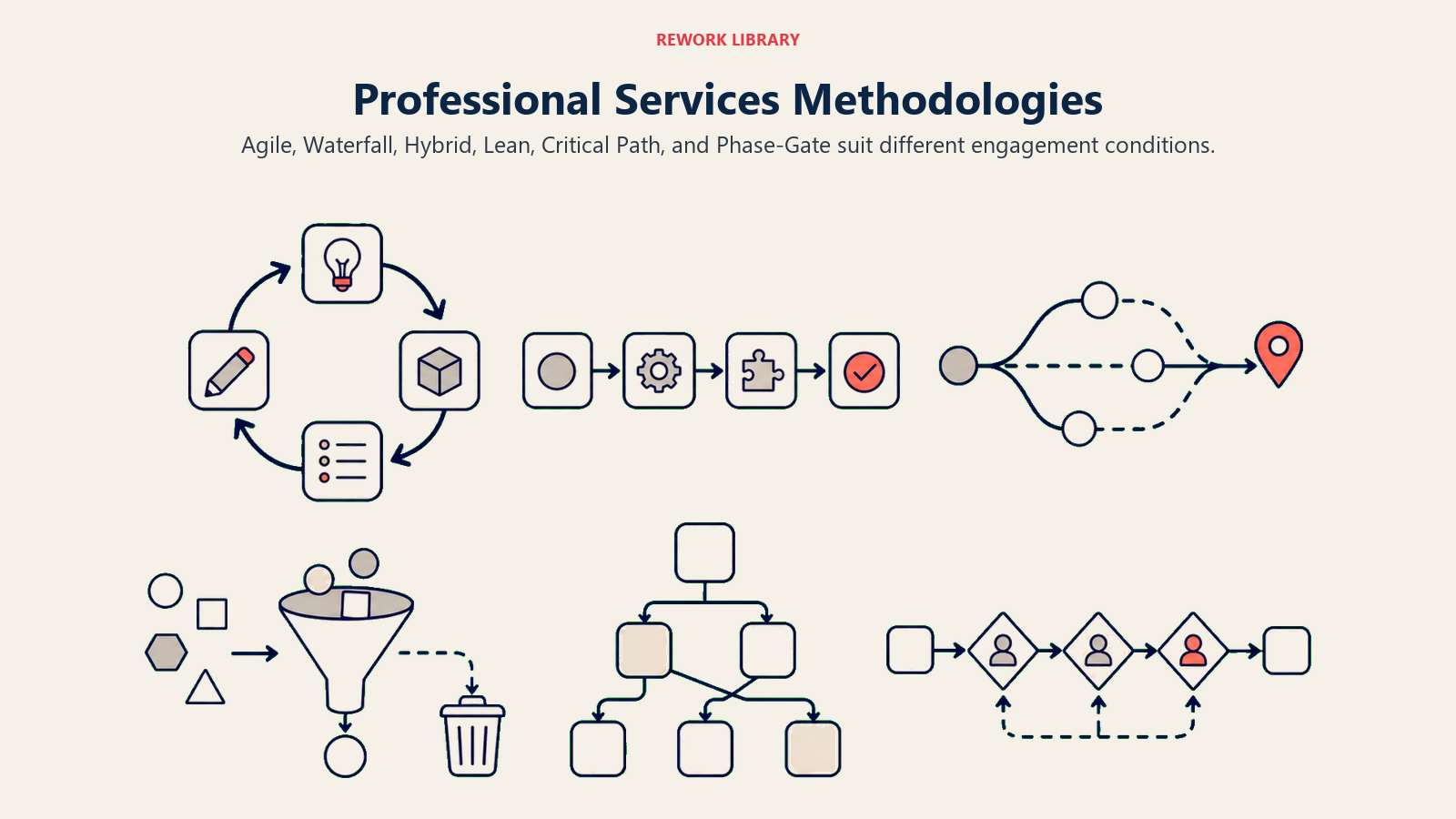
Common methodologies for professional services
Let's break down the main approaches and when each one works best.
Agile: Iterative delivery with continuous feedback
Agile breaks work into short cycles (sprints) where you deliver incremental value, get feedback, and adjust. You plan in iterations rather than trying to map everything upfront.
Core elements:
- Sprint planning (usually 1-4 week cycles)
- Daily standups to coordinate work
- Sprint reviews to show progress and gather feedback
- Retrospectives to improve the process
- Flexible scope within overall project goals
Best for:
- Software development and digital products
- Projects where requirements evolve as you learn
- Work where client feedback shapes the solution
- Situations where showing early progress builds confidence
- Teams comfortable with ambiguity and iteration
Challenges:
- Harder to give firm timeline and budget commitments upfront
- Requires active client participation throughout
- Can feel chaotic to stakeholders used to detailed plans
- Needs disciplined execution or it becomes "no process"
I've seen Agile work brilliantly for product consulting where the client wants to learn and adapt. But it fails when clients expect you to tell them exactly what you're delivering on day one.
Waterfall/Phase-Gate: Linear progression with approval milestones
Waterfall is sequential. You complete each phase fully before moving to the next, with formal approval gates between phases.
Typical phases:
- Requirements definition and planning
- Design and architecture
- Development/execution
- Testing and quality assurance
- Deployment and handoff
- Closure and evaluation
Each phase has defined deliverables. The client approves before you proceed. Changes after approval require formal change control.
Best for:
- Fixed-scope projects with clear requirements
- Regulated industries requiring documentation and approvals
- Large infrastructure or system implementations
- Clients who need predictable timelines and budgets
- Projects where requirements won't change mid-stream
Challenges:
- Inflexible when requirements change
- Delayed feedback - you don't see if it works until late
- Front-loads planning work before you have real learning
- Can create adversarial change management dynamics
Waterfall gets a bad rap in some circles, but it's still the right choice for many professional services engagements. When you're implementing an ERP system with clear specs and regulatory requirements, trying to run it as an Agile project is just forcing a methodology where it doesn't fit.
Hybrid: Blending structure with flexibility
Hybrid approaches combine elements of both. You might have waterfall-style phases for overall project structure, but use agile methods within each phase for actual execution.
Common patterns:
- Waterfall for planning and governance, Agile for development
- Fixed scope for core requirements, iterative approach for enhancements
- Phase gates for client approvals, sprints for team execution
- Traditional approach for documentation, agile for deliverable creation
Best for:
- Complex engagements with both fixed and flexible components
- Organizations transitioning from waterfall to agile
- Projects with multiple workstreams requiring different management
- Situations where you need budget predictability but execution flexibility
Challenges:
- Can become "the worst of both worlds" if poorly implemented
- Requires clear definitions of what's managed which way
- Team confusion about what process to follow when
- More overhead in managing multiple methodologies
The key with hybrid is being explicit about what you're doing. Don't accidentally create a hybrid by having sloppy waterfall. Choose it intentionally and document which parts of your project use which approach.
Consulting-specific frameworks
Professional services firms also use proprietary methodologies that combine project management with their problem-solving approach.
McKinsey has the 7S Framework for organizational change. BCG has growth-share matrices and experience curve approaches. Most large firms have their own "way" of running projects that includes both analytical frameworks and project management practices.
These frameworks are valuable because they codify what works for specific types of engagements. If you're a strategy consultant, your methodology should guide stakeholder engagement, analysis, recommendation development, and implementation support - not just task tracking.
Building your own framework:
Many firms benefit from creating a customized approach that fits their specific service line:
- Define your standard project phases based on your deliverable type
- Create templates for common project documents (plans, status reports, deliverables)
- Build reusable work breakdown structures for recurring project types
- Establish standard governance and communication patterns
- Document decision-making criteria and approval requirements
The goal isn't to be different for the sake of it. It's to have a repeatable approach that makes your team more efficient and your delivery more consistent.
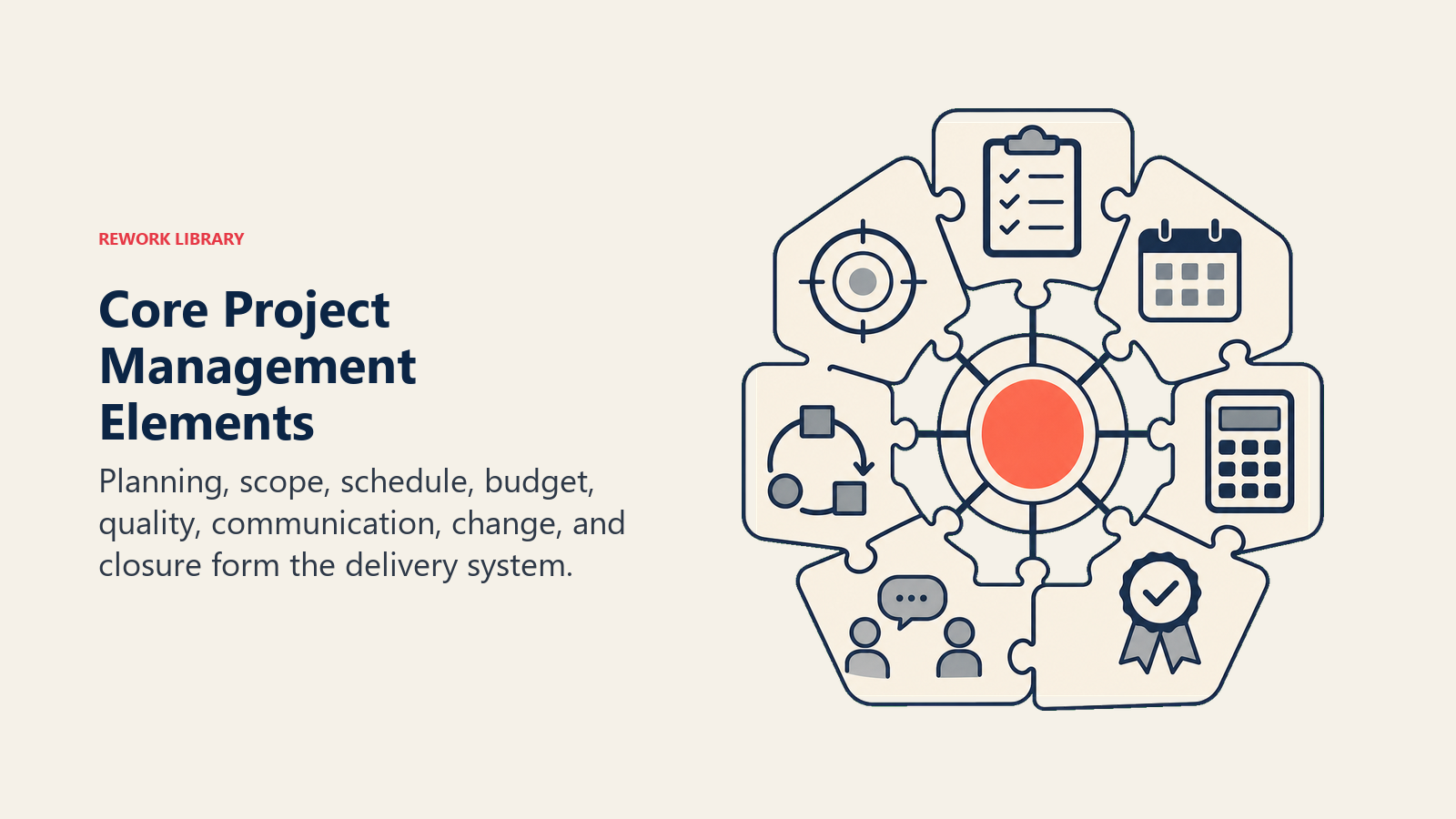
Core project management elements
Regardless of which methodology you choose, certain fundamentals matter for every project.
Planning: Setting up for success
Good planning prevents most project problems. You're defining what done looks like, how you'll get there, and what could go wrong.
Scope definition: Be ruthlessly specific about what you're delivering and what you're not. Vague scope is how projects go sideways. Create a statement of work that details deliverables, acceptance criteria, and exclusions. See Scope Definition & SOW for frameworks.
Work breakdown structure (WBS): Decompose your project into smaller chunks of work. Instead of "conduct market analysis," break it into "identify data sources," "gather competitive intel," "analyze customer segments," "synthesize findings," "create presentation." This level of detail helps you estimate, assign work, and track progress.
Timeline development: Map out your WBS on a calendar. Identify dependencies - what has to happen before something else can start. Find your critical path - the sequence of tasks that determines your minimum timeline. Build in buffer for unknowns, but be realistic about how long things actually take.
Resource allocation: Who's doing what work? Do you have the right skills available when you need them? This is where Utilization & Capacity Planning becomes critical. You might have a great plan, but if your senior consultant is already at 90% utilization, you're going to miss your dates.
Budget estimation: Calculate expected hours by role, multiply by rates, add expenses and contingency. Compare to client budget to spot gaps early. If your plan costs $200K but the client has $150K, you need to descope or figure out how to deliver more efficiently. Use budget and timeline discovery techniques to understand constraints before committing.
Risk identification: What could go wrong? Dependencies on client deliverables they might miss. Key people who might leave. Technology risks. Scope risks. For each significant risk, identify mitigation strategies. Don't just list risks - have a plan for what you'll do if they materialize.
Execution: Actually doing the work
Plans are worthless if you can't execute. Execution is where discipline matters.
Task management: Break your WBS into actionable tasks with clear owners and deadlines. Use project management tools (we'll cover those later) to assign work, track status, and identify blockers.
Team coordination: Make sure everyone knows what they're doing, what's expected, and how their work fits into the bigger picture. Regular standups or check-ins keep the team aligned. Create RACI matrices (more on this below) to clarify who's doing what.
Quality control: Don't wait until the end to check if deliverables meet standards. Build review cycles into your workflow. Have senior team members spot-check work in progress. See Deliverable Quality Assurance for frameworks.
Deliverable production: This is the actual client-facing work. The analysis, the code, the recommendations, the designs. It's easy to get so focused on managing the project that you forget the deliverable is what actually matters.
Communication discipline: Keep stakeholders informed without overwhelming them. Client updates should be regular, concise, and actionable. Internal team communication should be frequent enough to catch issues early but not so constant that nobody gets work done.
Monitoring: Knowing where you stand
You can't manage what you don't measure. Monitoring tells you if you're on track or drifting.
Progress tracking: Compare actual progress to your plan. Are tasks finishing on schedule? If not, why? Use tools like Gantt charts or burndown charts to visualize progress.
Variance analysis: When actual differs from planned, figure out why. A task that took twice as long as estimated tells you something. Maybe your estimate was wrong. Maybe the scope grew. Maybe the team member needed more support. Understanding variances helps you forecast better and adjust plans.
Status reporting: Regular status updates to stakeholders should cover what's done, what's next, what's at risk, and what decisions you need. Good status reports don't hide problems - they surface issues while there's still time to fix them.
Issue management: Track problems that are blocking progress or creating risk. Every issue should have an owner, a deadline, and a resolution plan. Issues that sit unresolved for weeks kill projects.
Budget tracking: Monitor actual costs vs. planned costs continuously. By the time you realize you're 30% over budget, it's often too late to fix it. Track hours by role, check burn rate, and project final costs based on current trajectory.
Control: Managing change and staying on course
Projects drift. Control mechanisms keep them from drifting too far.
Change management: When scope, timeline, or budget needs to change, have a formal process. Document the requested change, assess impact on timeline/budget/resources, get appropriate approvals, update plans, and communicate to all stakeholders. See Scope Creep Management for techniques.
Scope protection: Some change is legitimate. Some is scope creep. Learn to distinguish between the two and push back appropriately. "That's a great idea - let's capture it as a Phase 2 item" is a useful phrase.
Risk mitigation: When risks you identified start materializing, execute your mitigation plans. If a key resource becomes unavailable, activate your backup. If client dependencies are slipping, escalate.
Escalation management: Know when to escalate issues up the chain. Some problems you can solve at the team level. Others need executive involvement. Don't escalate everything, but don't sit on problems that need higher-level attention either.
Closure: Finishing strong
Projects don't end when you deliver the last file. Proper closure matters.
Deliverable acceptance: Get formal sign-off that deliverables meet acceptance criteria. This isn't just bureaucracy - it prevents disputes later about whether you delivered what was promised. Clear acceptance ties directly to what you documented in your contract and engagement letters.
Documentation: Archive all project materials in an organized way. Future teams (or your team on future projects) will thank you. Include final deliverables, key decisions, meeting notes, and any client-specific context that would help someone understand the project.
Transition and handoff: If you're handing work off to a client team or another vendor, do it properly. Training sessions, documentation, knowledge transfer - whatever it takes to set them up for success.
Lessons learned: What worked? What didn't? What would you do differently next time? Capture this while it's fresh. The best project teams get better with each engagement because they learn systematically. See Project Closeout for a complete framework on capturing and applying these lessons.
Relationship closure: Thank people who contributed. Celebrate with the team. Make sure the client knows you're available for questions. Strong closure sets you up for the next engagement with this client.
Project tools and techniques
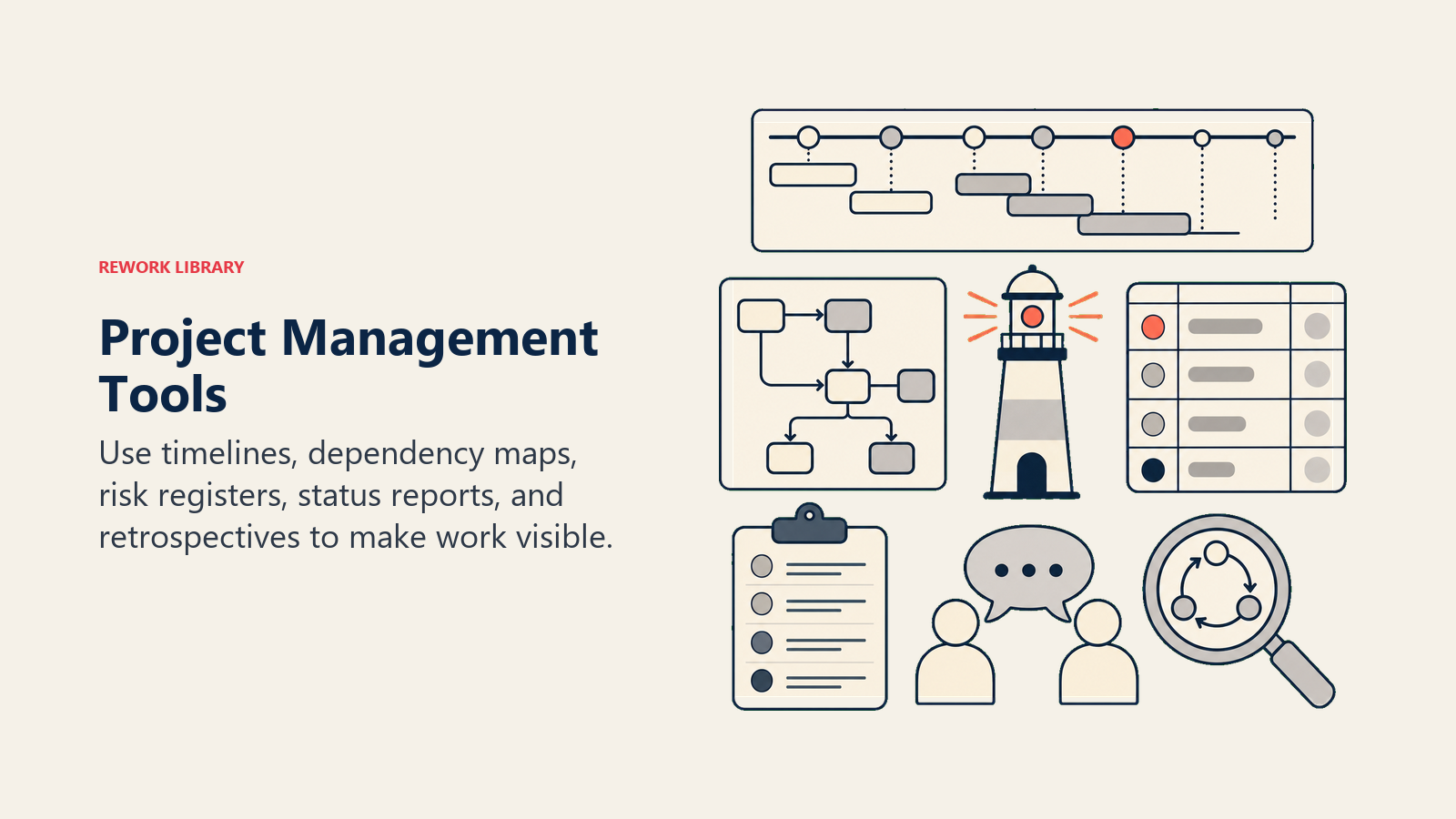
Methodology is strategy. Tools are tactics. Here's what actually helps you manage projects better.
Planning tools
Gantt charts: Horizontal bar charts showing tasks, durations, dependencies, and milestones over time. They're visual, easy to understand, and good for showing the overall timeline. Most project management software creates these automatically.
PERT charts: Network diagrams showing task sequences and dependencies. More complex than Gantt charts but useful for understanding critical path and identifying scheduling risks.
Critical path analysis: Identify the longest sequence of dependent tasks that determines your minimum project duration. Any delay on the critical path delays the whole project. Focus your attention on these tasks.
Resource allocation matrices: Track who's assigned to what tasks when. Helps spot over-allocation (someone assigned 60 hours of work in a 40-hour week) and underutilization (expensive resources sitting idle).
Tracking tools
Status dashboards: Visual overviews showing project health at a glance. Green/yellow/red indicators for schedule, budget, scope, and quality. Executive stakeholders love these because they get the story without reading detailed reports.
Burndown charts: Agile tool showing remaining work over time. You should see a downward trend. If the line is flat or going up, you're not making progress.
Milestone tracking: Key checkpoints throughout the project. Did you hit the milestone on time? If not, by how much did you miss and why? Milestone performance is a leading indicator of project success.
Time tracking: Capture actual hours spent by team members on specific tasks. This tells you if estimates were accurate, where time is going, and whether you're burning budget faster than expected.
Communication tools
Status reports: Regular updates to stakeholders. Keep them short - one page if possible. Cover progress since last report, planned work for next period, risks/issues, and decisions needed.
Stakeholder updates: Different stakeholders need different information. Your project sponsor needs strategic updates. The client team needs tactical details. Tailor your communication rather than sending the same update to everyone.
Meeting management: Run efficient meetings with agendas, clear purposes, and action items. Don't meet just to meet. Every meeting should have a decision to make or information to share that can't be communicated another way.
Collaboration platforms
Asana: Task management with good visualization, easy to use, works well for smaller teams and less complex projects.
Monday.com: Highly visual, customizable, good for teams that want flexibility in how they track work.
Jira: Built for software development but used broadly. More complex to set up but powerful for large projects with many dependencies.
Microsoft Project: Traditional project management software. Robust for waterfall projects, resource management, and detailed planning. Has a learning curve.
Smartsheet: Spreadsheet-like interface that's familiar to most people. Good middle ground between simple tools and complex PM software.
Basecamp: Simple, focused on communication and collaboration rather than detailed scheduling. Works for projects where team coordination matters more than granular tracking.
The tool matters less than using it consistently. A simple tool everyone actually uses beats a sophisticated tool that sits empty because it's too complicated.
Team management: Getting the most from your people
Projects are delivered by people. Good project management includes good people management.
Role clarity with RACI matrices
RACI stands for Responsible, Accountable, Consulted, Informed. It's a simple framework that prevents confusion about who's doing what.
Responsible: Who's doing the work? Usually multiple people can be responsible for different parts of a task.
Accountable: Who owns the outcome? Only one person should be accountable for any given deliverable. They don't have to do the work, but success or failure is on them.
Consulted: Who needs to provide input before the work is done? Two-way communication.
Informed: Who needs to know about progress but isn't actively involved? One-way communication.
Example RACI matrix for "Create market analysis presentation":
| Task | Project Manager | Senior Consultant | Analyst | Client Sponsor |
|---|---|---|---|---|
| Gather market data | I | C | R | I |
| Analyze findings | I | A | R | C |
| Create presentation | R | A | C | I |
| Present to stakeholders | I | R | I | A |
This makes it crystal clear who's doing what. No more confusion about whether the PM or the consultant is supposed to create the presentation.
Accountability and ownership
People do their best work when they own outcomes, not just tasks. Instead of "compile the data," frame it as "you own the competitive analysis section - make it compelling and accurate."
Hold people accountable to commitments. If someone says they'll deliver something Friday, follow up Friday. If they miss deadlines regularly without good reason, address it. Accountability matters more than you think for project success.
Skill development and support
Don't just assign work and hope people figure it out. Junior team members need coaching. Even experienced folks might need support if they're working in an unfamiliar area.
Build in time for review and feedback. A quick check-in when someone is 20% done can prevent them from going down the wrong path for three weeks.
Performance feedback
Give feedback continuously, not just at project end. When someone does something well, tell them immediately. When they miss the mark, address it quickly before it becomes a pattern.
Good project managers develop their people while delivering projects. If everyone on your team is better at their job by the end of the project, you've succeeded at more than just the deliverable.
Conflict resolution
Projects create tension. Conflicting priorities, personality clashes, disagreements about approach. Address conflicts early before they fester.
Most conflicts come from unclear expectations or poor communication. Often you can solve them by clarifying who's responsible for what or improving how information flows.
When there are legitimate disagreements about approach, facilitate a discussion. Hear both sides. Make a decision. Move on. Don't let conflicts drag out indefinitely.
Stakeholder management: Keeping everyone aligned
Your project succeeds or fails based on stakeholder satisfaction. Technical perfection doesn't matter if stakeholders feel blindsided or ignored.
Stakeholder identification
Map out everyone who has a stake in the project. Don't just think about the client sponsor. Consider:
- End users of whatever you're delivering
- Client team members who'll implement or maintain it
- Client executives who approved the budget
- Other vendors or partners whose work intersects with yours
- Your own firm's leadership who care about the client relationship
- Regulatory bodies if your work has compliance implications
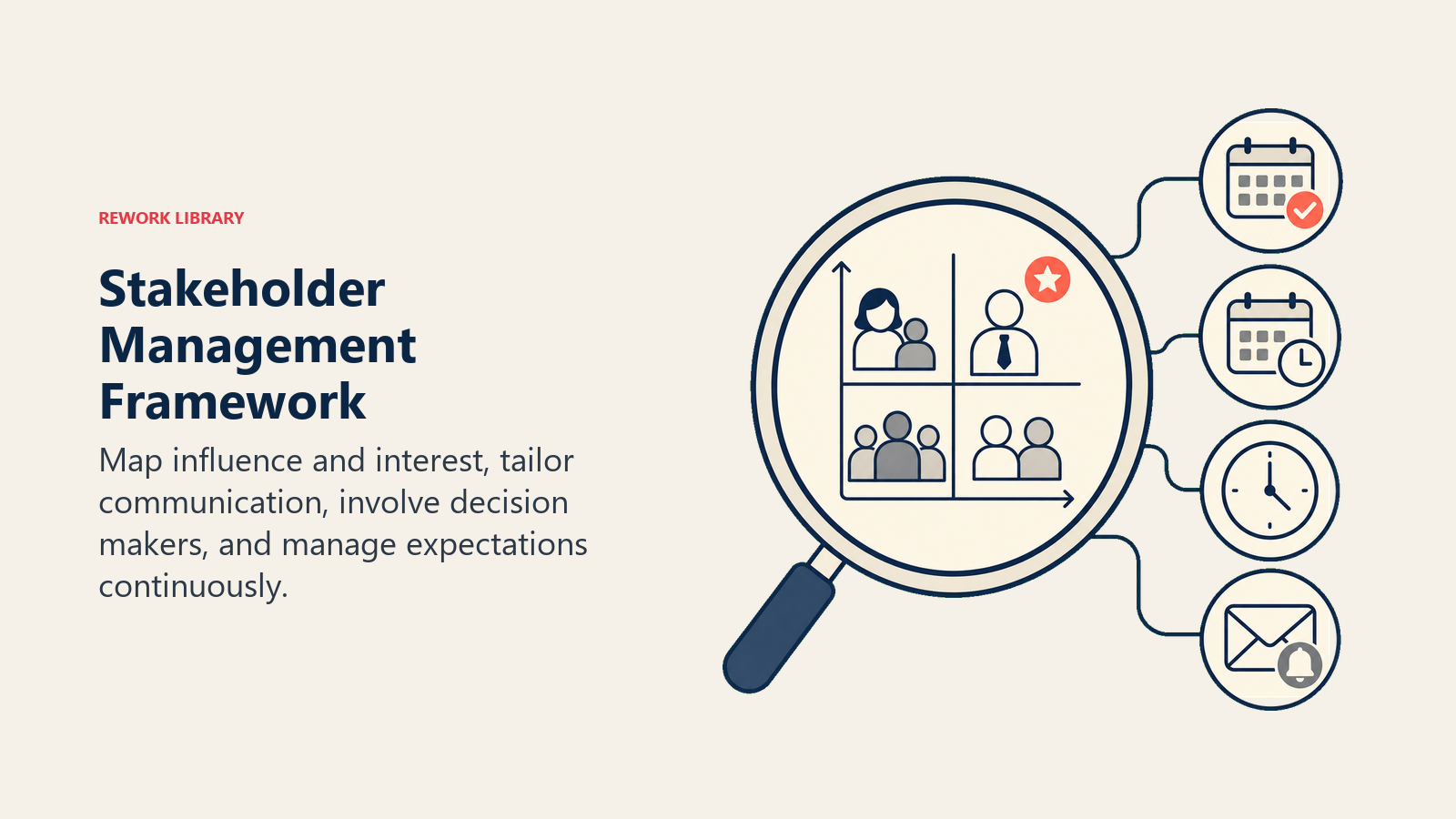
Influence and interest mapping
Not all stakeholders are equal. Map them on two dimensions:
High influence, high interest: These are your key stakeholders. The project sponsor, department heads, anyone who can kill the project or make your life difficult. Manage them actively with frequent communication.
High influence, low interest: Keep them satisfied. They have power but aren't focused on day-to-day details. Give them periodic updates at a strategic level. Don't overwhelm them with details they don't care about.
Low influence, high interest: Keep them informed. They care about the project but don't have much power. They can become advocates or detractors based on how you treat them.
Low influence, low interest: Monitor them with minimal effort. Brief updates so they're not surprised, but don't invest heavily here.
Engagement strategy
Different stakeholders need different engagement approaches:
- Skeptics who don't believe in the project need proof points and early wins
- Champions who already support you need ammunition to advocate for you with others
- Busy executives need concise updates focused on decisions and risks
- Technical experts want details and rigor
- End users care about how the change will affect them personally
Tailor your communication style and content to what each stakeholder group needs and responds to.
Communication plans
Don't just communicate ad-hoc. Build a stakeholder communication plan at project start:
- Who needs to hear from you?
- How often?
- Through what channels? (email updates vs. meetings vs. presentations)
- What level of detail?
- What format? (dashboard vs. narrative vs. presentation)
Having a plan ensures nobody gets forgotten and communication happens proactively rather than reactively.
Expectation management
Most stakeholder issues come from mismatched expectations. They expected X, you delivered Y. Even if Y is objectively better, the mismatch creates dissatisfaction.
Set expectations clearly at project start. Revisit and reset them when things change. If the timeline is slipping, tell stakeholders as soon as you know - don't wait until the deadline passes.
Use the Project Kickoff Process to align everyone on goals, scope, roles, and communication norms. Time invested upfront in alignment pays dividends throughout the project.
Risk and issue management
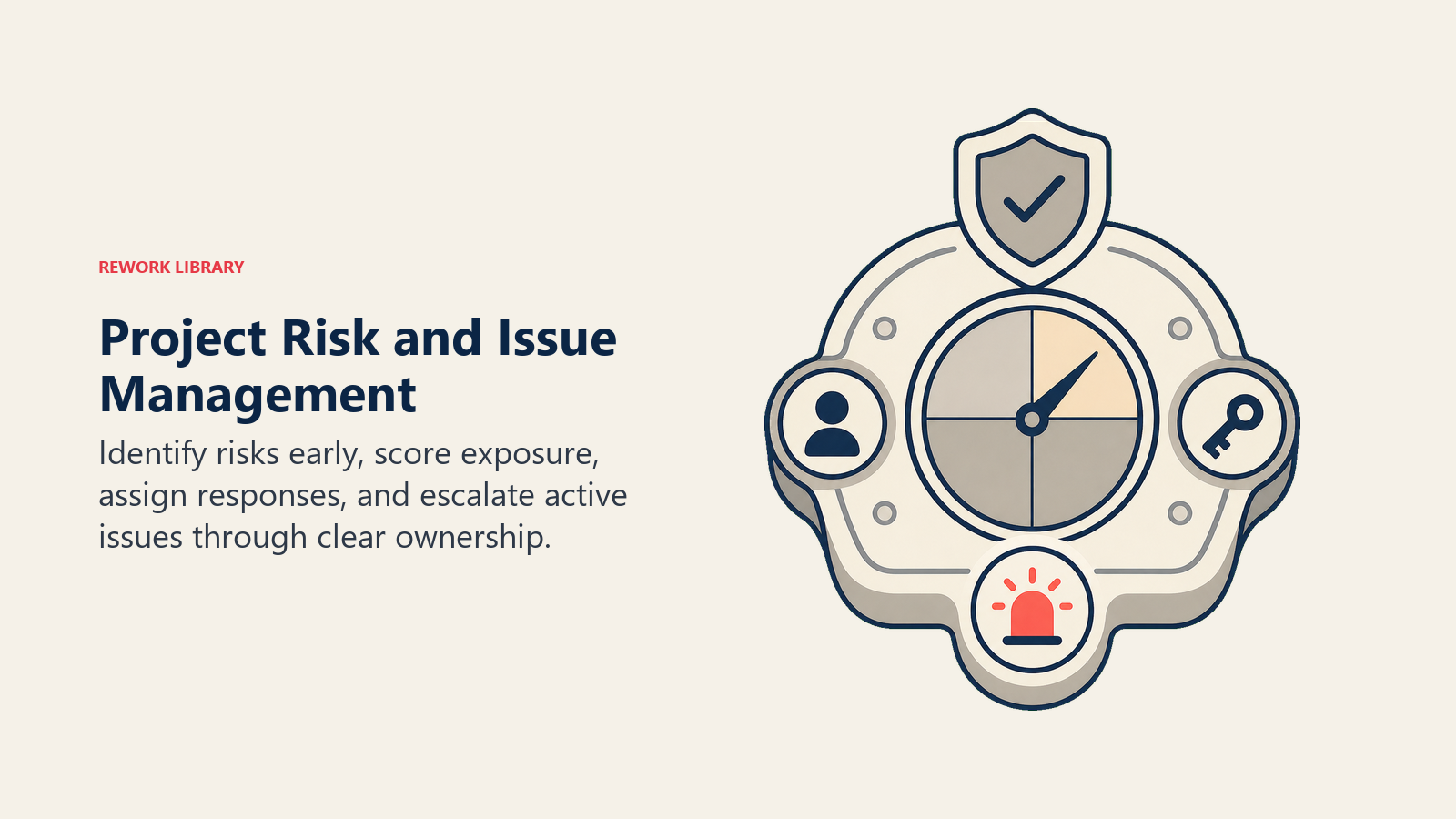
Every project has risks (things that might go wrong) and issues (things that are currently wrong). Good project management addresses both.
Risk identification
At project start, brainstorm everything that could derail success:
- Client dependencies you're waiting on that might be late
- Team members who might leave or become unavailable
- Technology that might not work as expected
- Stakeholders who might resist or block progress
- External factors (economic conditions, regulatory changes, competitor moves)
- Budget constraints that might force tradeoffs
- Timeline pressure that might compromise quality
Don't just identify obvious risks. Think through second-order consequences. If a key person leaves, that's a risk. But it also creates knowledge loss risk, morale risk, and timeline risk from onboarding a replacement.
Risk assessment
Not all risks are equal. Assess each one on two dimensions:
Probability: How likely is this to happen? High/medium/low is usually granular enough.
Impact: If it happens, how bad is it? Would it delay the project a week or kill it entirely? Cost you $5K or $500K?
Focus your attention on high-probability, high-impact risks. Low-probability, low-impact risks you can just monitor.
Risk mitigation and contingency planning
For your significant risks, develop mitigation strategies:
- Avoid: Change your approach to eliminate the risk
- Mitigate: Take actions to reduce probability or impact
- Transfer: Shift the risk to someone else (insurance, contracts, outsourcing)
- Accept: Acknowledge the risk and deal with consequences if it happens
Example: Risk that a client SME won't be available for interviews.
- Mitigation: Get commitment from their manager early, schedule interviews upfront, have backup SMEs identified
- Contingency: If they're unavailable, we'll use alternative data sources and document the limitation
Issue tracking and resolution
When risks materialize or new problems emerge, they become issues. Track issues in a log:
- Issue description
- Who owns resolution
- Deadline for resolution
- Current status
- Impact on project (schedule, budget, quality)
Review your issue log in every status meeting. Issues that sit unresolved for weeks are project killers.
Escalation protocols
Know when to escalate. Some decision criteria:
- Impact exceeds your authority level (major budget increase, timeline extension beyond tolerance)
- Issue involves client stakeholders you can't access directly
- Resolution requires resources you don't control
- Multiple attempted resolutions have failed
- Risk of serious client dissatisfaction or relationship damage
When you escalate, come with:
- Clear problem description
- What you've tried already
- Specific ask (decision needed, resources required, stakeholder intervention)
- Recommendation on path forward
Don't just throw problems upward. Escalate with context and proposed solutions.
Common project challenges
Let's talk about what actually goes wrong and how to deal with it.
Scope creep
This is the killer. Project starts as A, gradually becomes A+B+C+D, timeline and budget stay the same, and you're underwater.
Scope creep happens through small additions that each seem reasonable. "While you're in there, could you also..." or "It would be great if we could just..."
Prevention: Crystal-clear scope definition upfront. Written deliverables with acceptance criteria. Communication to the team that everything not explicitly in scope is out of scope.
Response: When new requests come up, acknowledge them as valuable but frame them as additions. "That's a great idea - let's discuss whether to add it as a change order or capture it for Phase 2." See Scope Creep Management for detailed tactics.
Resource constraints
You planned for 200 hours from your senior consultant. She's now on another client's emergency project. You're 40% through your timeline with 20% of the expected resources.
Prevention: Build in buffer for resource availability. Don't assume 100% allocation. Lock in resources with your resource management team before committing to client timelines.
Response: Flag the issue immediately. Work with your resource manager to find alternatives. Communicate impact to client if timeline or quality will suffer. Consider temporary contractors or redistribution of work to available team members.
Stakeholder misalignment
You thought everyone agreed on the approach. Three weeks in, a key stakeholder reveals they expected something completely different.
Prevention: Explicit alignment at project start. Written documentation of goals, approach, and deliverables. Regular checkpoints with all key stakeholders, not just your main contact.
Response: Stop work if needed to realign. The cost of continuing down the wrong path exceeds the cost of pausing to fix alignment. Use Client Communication Cadence frameworks to maintain ongoing alignment.
Timeline pressure
The client wants it in eight weeks. It actually needs twelve. You commit to eight because you're afraid to lose the business.
Prevention: Honest estimates based on real data, not wishful thinking. Build in contingency. Push back on unrealistic timelines before accepting the project.
Response: If you're behind schedule, communicate early. Discuss options: add resources, reduce scope, extend timeline. Don't just work longer hours hoping to catch up - that rarely works and leads to burnout and quality issues.
Quality vs. speed tradeoffs
You can deliver on time if you cut corners. You can deliver high quality if you blow the timeline. Pick one.
Prevention: Define "done" clearly upfront. What does quality mean for this deliverable? Build quality checkpoints into the timeline so you're not trying to add quality at the end.
Response: When forced to choose, involve the client in the decision. "We can hit the deadline with these scope reductions, or we can deliver the full scope two weeks late. What's more important to you?" Don't make that choice unilaterally and surprise them.
Methodology selection matrix
Here's a practical framework for choosing your approach:
| Project Characteristics | Recommended Methodology |
|---|---|
| Fixed scope, clear requirements, regulatory context | Waterfall/Phase-Gate |
| Evolving scope, digital/software deliverables, collaborative client | Agile |
| Large complex engagement, mix of fixed and flexible elements | Hybrid |
| Strategy or analysis work with expert-driven process | Consulting-specific framework |
| Simple, short-duration, familiar project type | Lightweight Agile or simplified Waterfall |
| Client has strong methodology preference | Match client preference (within reason) |
When in doubt, start with a lightweight approach and add rigor where needed. It's easier to add structure than to remove it.
Sample project templates
Templates save time and improve consistency. Here are the core templates every professional services firm should have:
Project plan template
- Project overview and objectives
- Scope and deliverables
- Work breakdown structure
- Timeline and milestones
- Resource allocation
- Budget and cost tracking
- Risk register
- Stakeholder matrix
- Communication plan
- Success criteria
RACI matrix template
Simple table format:
- Rows: Each major task/deliverable
- Columns: Each role/person involved
- Cells: R, A, C, or I designation
Make it visible and reference it when confusion arises about ownership.
Status report template
Period covered: [dates]
Overall status: Green/Yellow/Red with brief explanation
Completed this period:
- Bullet list of accomplishments
- Link to key deliverables if relevant
Planned for next period:
- Bullet list of upcoming work
- Any dependencies
Risks and issues:
- Current risks with mitigation status
- Active issues with resolution plans
Decisions needed:
- Specific questions requiring stakeholder input
Budget status: Spend vs. plan
Keep it to one page. Link to more detail if needed rather than embedding everything in the status report.
Risk register template
| Risk Description | Probability | Impact | Mitigation Strategy | Owner | Status |
|---|---|---|---|---|---|
| [Description] | H/M/L | H/M/L | [What you're doing about it] | [Name] | [Current state] |
Update this weekly and review with stakeholders monthly.
Making methodology stick in your organization
Having a methodology is different from using it. Here's how to make it stick:
Start with training: Don't just send people templates and expect them to figure it out. Train project managers on the methodology. Walk through examples. Let them practice on low-stakes internal projects.
Make it easy: Remove friction. If your methodology requires filling out seven forms before starting work, nobody will use it. Simplify. Provide templates. Automate what you can.
Enforce consistently: If methodology use is optional, people will skip it when they're busy. Make it a requirement. Include methodology adherence in project manager performance reviews.
Show the value: Track and share data on project outcomes. Show that projects using the methodology hit timelines and budgets more consistently. Make the ROI visible.
Iterate based on feedback: Your methodology should improve over time. Collect feedback from teams. What's working? What's bureaucratic overhead? Refine continuously.
Celebrate good execution: When a project team runs a textbook project with great methodology use, recognize it publicly. Make good project management something people aspire to, not just a compliance exercise.
Where to go from here
Good project management isn't exciting. It's discipline and structure and follow-through. But it's what separates firms that consistently deliver from ones that wing it and hope for the best.
Your methodology choice matters, but execution matters more. A simple methodology executed with discipline beats a sophisticated one that nobody follows.
Start here:
- Pick one project to run with more rigorous methodology as a pilot
- Document what works and what doesn't
- Build templates based on what you learn
- Train your team on the approach
- Expand to more projects as you build capability
Your methodology will evolve as your firm grows and your project mix changes. That's fine. What matters is having an intentional approach that you improve systematically rather than making it up as you go.
And remember: the methodology serves the project, not the other way around. If a process isn't helping you deliver better work, change it. The goal is successful delivery that builds client relationships, not perfect adherence to a framework.
Related Reading:
- Project Kickoff Process - Start projects with alignment and momentum
- Scope Definition & SOW - Define clear boundaries before work begins
- Client Communication Cadence - Keep stakeholders informed and aligned
- Scope Creep Management - Protect project boundaries without damaging relationships
- Deliverable Quality Assurance - Ensure work meets standards before client sees it

Sales Director
On this page
- Why methodology selection actually matters
- Common methodologies for professional services
- Agile: Iterative delivery with continuous feedback
- Waterfall/Phase-Gate: Linear progression with approval milestones
- Hybrid: Blending structure with flexibility
- Consulting-specific frameworks
- Core project management elements
- Planning: Setting up for success
- Execution: Actually doing the work
- Monitoring: Knowing where you stand
- Control: Managing change and staying on course
- Closure: Finishing strong
- Project tools and techniques
- Planning tools
- Tracking tools
- Communication tools
- Collaboration platforms
- Team management: Getting the most from your people
- Role clarity with RACI matrices
- Accountability and ownership
- Skill development and support
- Performance feedback
- Conflict resolution
- Stakeholder management: Keeping everyone aligned
- Stakeholder identification
- Influence and interest mapping
- Engagement strategy
- Communication plans
- Expectation management
- Risk and issue management
- Risk identification
- Risk assessment
- Risk mitigation and contingency planning
- Issue tracking and resolution
- Escalation protocols
- Common project challenges
- Scope creep
- Resource constraints
- Stakeholder misalignment
- Timeline pressure
- Quality vs. speed tradeoffs
- Methodology selection matrix
- Sample project templates
- Project plan template
- RACI matrix template
- Status report template
- Risk register template
- Making methodology stick in your organization
- Where to go from here