Agency New Business Pipeline: Building Predictable Client Acquisition Systems
Turn this article into takeaways for your work.


Each assistant summarizes the article only for you and suggests best practices for your work.
Here's the math that keeps agency owners up at night: even with happy clients and solid retention, you'll lose 15-20% of your client base each year. Budgets get cut, businesses get acquired, priorities shift. And here's the kicker: each new client takes 3-6 months just to break even after you factor in the cost of acquisition, onboarding, and getting them productive. That means if you're not constantly feeding your new business pipeline, you're not growing. You're treading water. And if you hit a dry spell where nothing closes for a quarter? You're underwater.
Most agencies treat new business as something that just happens. A referral comes in, you pitch it. Someone fills out a contact form, you respond. But that's reactive, not systematic. And reactive new business creates feast-or-famine revenue that makes it impossible to plan hiring, invest in your team, or sleep soundly.
This guide shows you how to build a new business pipeline that works like a machine. Not perfectly predictable (nothing in sales is), but consistent enough that you can forecast revenue, plan capacity, and grow deliberately instead of desperately. This pipeline feeds directly into your broader marketing agency growth strategy.
The new business imperative
Let's start with the uncomfortable reality. Client churn isn't optional. Even the best agencies lose clients through no fault of their own. That company you've worked with for three years? Their CMO just left, and the new one wants to bring in their own agency partners. That startup client? They just ran out of runway. That enterprise account? Budget freeze across all external vendors. Some churn you can control through great work and relationship management. But 10-15% is just the cost of doing business. Which means if you bill $2M annually, you need to replace $200-300K in lost revenue every year just to stay flat.
Now add growth targets on top. If you want to grow 20%, you need to close not just replacement business but net new revenue. That $2M agency? You need to close $600-700K in new business to hit a $2.4M run rate after accounting for churn.
The only way that happens consistently is with a pipeline that's always full and always moving. And here's the coverage rule that most agencies miss: you need 3-4x your revenue target sitting in qualified pipeline at any given time to account for losses, delays, and deals that stall.
Chasing a $100K monthly goal? You need $300-400K worth of qualified opportunities in active motion. That's not total pipeline (which includes long-shots and early-stage prospects). That's qualified deals where you have real engagement, clear need, and a path to close.
New business pipeline fundamentals
A pipeline isn't just a list of prospects in your CRM. It's a system with defined stages, measurable progression, and predictable conversion patterns. The typical agency pipeline flows through six stages: Awareness: They know you exist. Maybe they saw you speak, found you through search, got a referral. There's initial recognition but no active engagement yet.
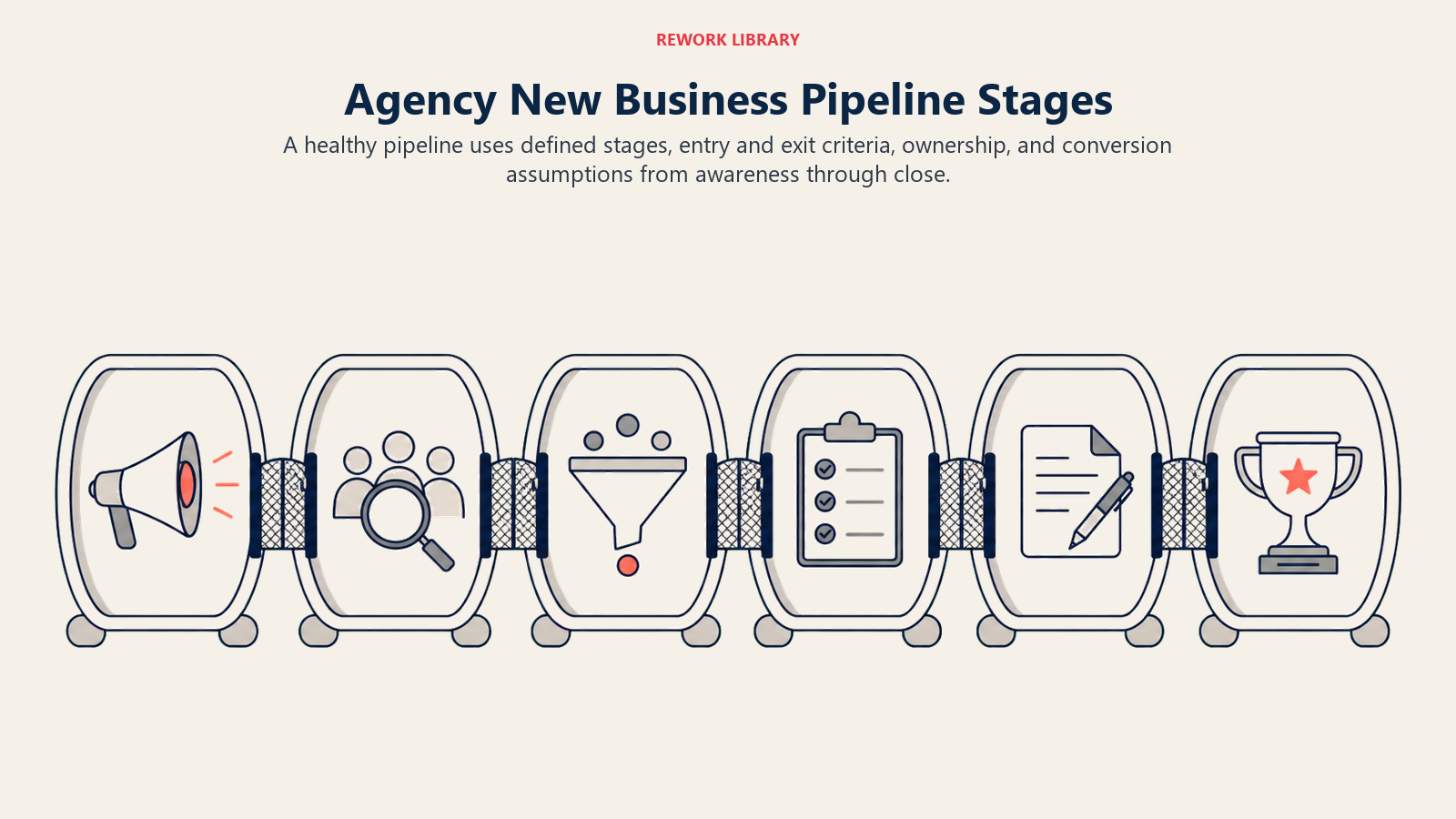
Interest: They're exploring whether you might be a fit. They're checking out your website, looking at case studies, maybe attending a webinar or downloading a resource.
Qualification: First real conversation. You're assessing if there's budget, authority, need, and timeline (BANT). They're assessing if you understand their problem and seem capable.
Pitch/Proposal: Formal evaluation mode. They've invited you to present, you're developing a strategic recommendation and proposal, they're probably talking to 2-3 other agencies.
Negotiation: They want to work with you, now you're working out scope, pricing, terms, start date. It's not done until it's signed, but the momentum is strong.
Closed Won/Lost: Either you signed a contract or you didn't. Time to analyze what happened either way.
Each stage has metrics you need to track: how many opportunities are sitting in each stage, what percentage move to the next stage, how long they typically stay in each stage, and what your win rate looks like once you get to the pitch.
Here's what good looks like for most agencies:
- Awareness to Interest: 20-30% (most aware prospects never take action)
- Interest to Qualification: 40-50% (half aren't a fit or aren't ready)
- Qualification to Pitch: 60-70% (if you qualify well, most should advance)
- Pitch to Negotiation: 30-40% (you're competing, not everyone picks you)
- Negotiation to Close: 70-80% (if you get this far, you usually close)
- Overall Win Rate: 15-25% of qualified opportunities
Your sales cycle length depends heavily on client size and service type. Small business website project? Maybe 2-4 weeks from first call to signed contract. Mid-market brand campaign? 6-12 weeks. Enterprise ongoing retainer? 3-6 months and sometimes longer.
Know your numbers. If your average sales cycle is 90 days and you need to close $100K per month, you need to be getting qualified opportunities into the top of your pipeline 90+ days before you need the revenue. Otherwise you're creating a gap.
Lead generation strategies that actually fill pipelines
You can't manage a pipeline you don't fill. Lead generation isn't a single tactic - it's a portfolio approach where you're running multiple plays simultaneously. Inbound marketing is the long game. Content that ranks in search, thought leadership that builds credibility, case studies that demonstrate results. The benefit: these leads are self-qualified and pre-educated. They found you because they have the problem you solve. The drawback: it takes 6-12 months to build momentum, and you're competing with every agency that figured out content marketing in 2015. Focus on specific, valuable content that addresses real decision-maker questions. "How to choose a performance marketing agency for B2B SaaS" is better than "Digital marketing tips." Write for the person with budget authority, not for junior marketers looking for tactics.
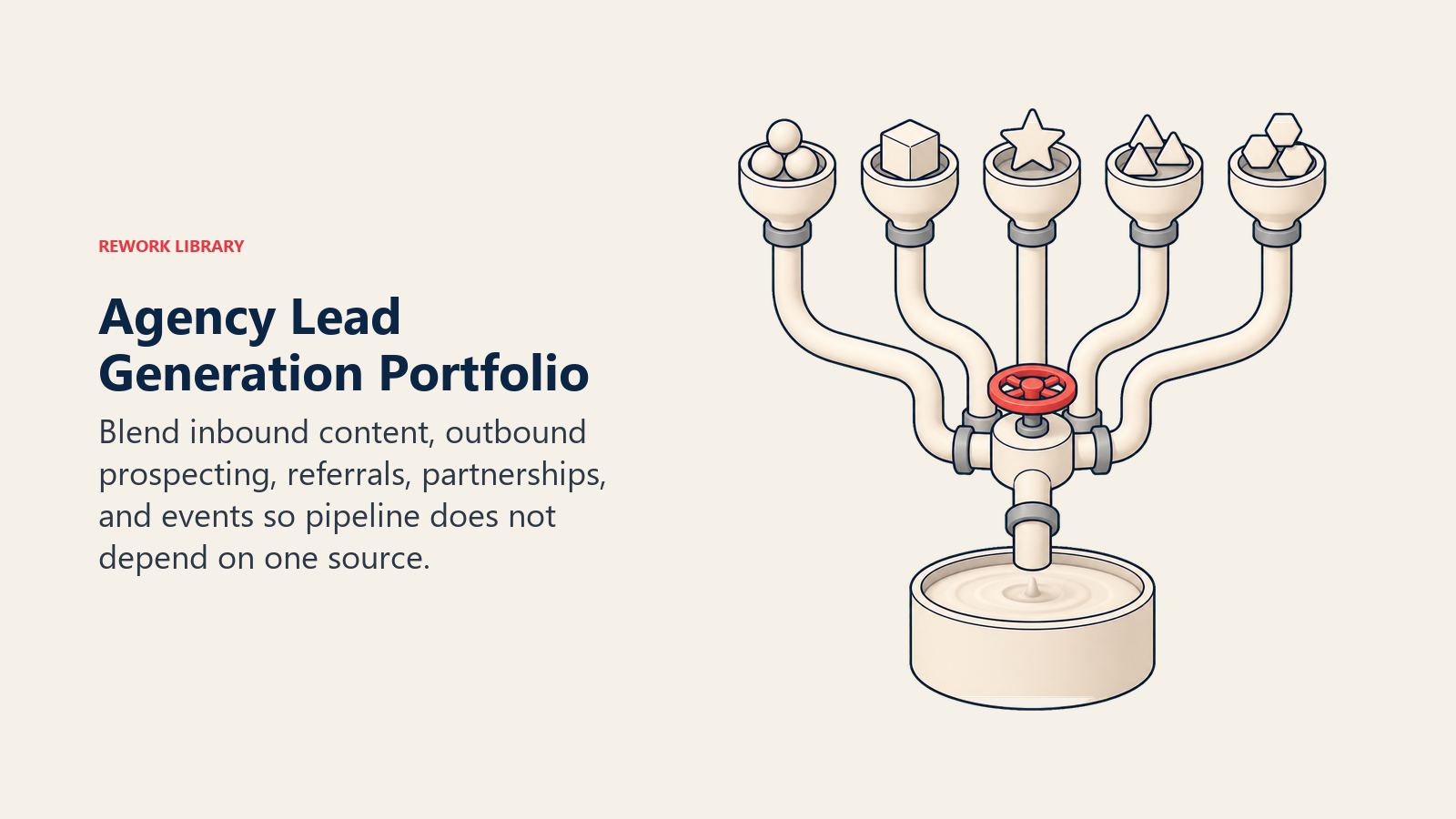
Outbound prospecting is the fast game. You identify target companies that fit your ideal client profile and reach out directly. LinkedIn is the primary channel for B2B agency prospecting - you can identify decision-makers, personalize messaging, and start conversations. The benefit: you control volume and timing. The drawback: it's work, rejection is high, and if your messaging is generic you're just spam.
Effective outbound isn't about pitching. It's about starting conversations with people who should care about what you do. "I noticed you just hired a VP of Growth - I work with companies at that stage on paid acquisition strategy" is better than "We're a full-service digital agency."
Referrals and word-of-mouth are the highest-converting source. Someone who trusts you sends someone who trusts them. The lead shows up warm, pre-sold on your credibility. But referrals are unpredictable unless you systematize them. That means: asking for referrals explicitly, making it easy (who else has this problem?), staying visible to your network, and rewarding referrers appropriately.
RFPs and listings are controversial. Many agencies refuse RFPs because the win rate is low and the effort is high. But if you're in a space where buyers use RFPs (enterprise, government, certain industries), you can't ignore them completely. The key is qualifying hard before investing hours. Do you have a relationship? Is this a real opportunity or checking boxes? Can you shape the outcome?
Directory listings (Clutch, Agency Spotter, industry-specific platforms) generate inbound leads, but quality varies wildly. Track ROI by source. If you're getting 20 tire-kicker leads per month from a directory but no closed deals in a year, stop paying for it.
Events and networking work, but not because you hand out business cards. They work when you create real conversations with people who remember you afterward. Speaking at industry conferences positions you as an expert. Hosting intimate dinners for prospects creates relationship depth. Sponsoring the right events puts you in front of target buyers. But showing up and working the room? That's mostly ego and business cards that end up in the trash.
Strategic partnerships multiply your reach. Find complementary service providers who serve the same target clients but don't compete. If you're a brand agency, partner with web development shops and PR firms. If you do paid media, partner with agencies that do creative but not media buying. Create formal referral agreements, co-market when it makes sense, and make it genuinely reciprocal.
The mistake agencies make is trying all of this at once with no real commitment. Pick 2-3 channels, go deep, measure what works, then expand. A well-executed inbound program plus systematic outbound will outperform dabbling in everything.
Lead qualification framework: not all opportunities are equal
Here's the brutal truth: most agencies waste more time on bad-fit prospects than on clients who'll never pay. You get excited about a big-name company or an interesting project, ignore the warning signs, and spend weeks on a pitch that was dead before it started. Qualification is about asking hard questions early so you don't waste effort late. For a comprehensive approach, see our client qualification framework. You're trying to determine five things: Budget: Can they afford you? Not "do they have money" but "is there budget allocated or accessible for this project?" If your typical engagement is $10K/month and they're hoping to spend $2K, no amount of pitching will change that math. Ask directly: "What budget have you allocated for this?" or "What are you currently spending on [this function]?" If they won't answer or the number is wildly misaligned, you're probably not a fit.
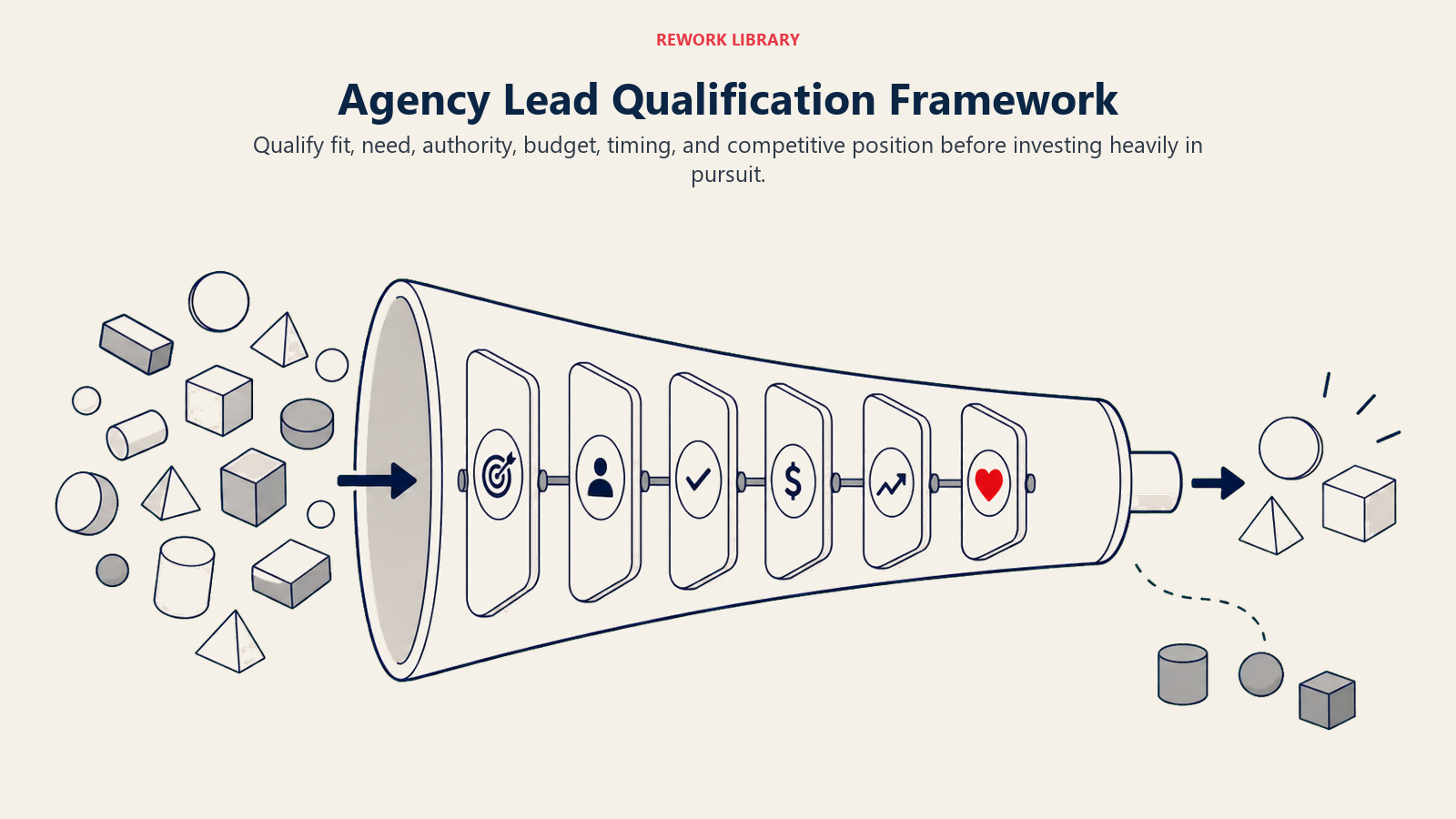
Authority: Are you talking to someone who can make or heavily influence the decision? In small companies, that's usually the founder or CMO. In larger organizations, it's more complex. You need the person with budget authority or direct access to them. If you're three levels removed and the person you're talking to says "I'll take it to my boss," you're not controlling the sale.
Ask: "Who else needs to be involved in this decision?" and "What's the approval process look like?" If the answer involves multiple committees and stakeholders you'll never meet, your win rate drops dramatically.
Need: Do they have a real problem you can solve, or are they exploring? Some prospects are genuinely in pain - revenue is declining, a campaign failed, they're launching something new and need help. Others are casually browsing because they saw your content and thought "that's interesting."
The difference shows up in urgency. Real need creates urgency. Academic interest creates "let's think about it." Ask: "What happens if you don't solve this?" If the answer is vague or low-stakes, they're not a real opportunity.
Timeline: When do they need to make a decision and start? "Sometime this year" is not a timeline. "We need to launch by Q3, which means we need an agency in place by end of Q1" is a timeline. Timeline tells you if this is an active opportunity or a future maybe.
Ask: "When do you need this live/launched/operational?" and "What's driving that timing?" If there's no forcing function (event, deadline, budget cycle), the deal will drag or die.
Strategic fit: Even if they have budget, authority, need, and timeline, are they someone you want to work with? Do they match your ideal client profile? Is the work aligned with your capabilities and where you want to grow? Will working with them improve your portfolio and reputation or just pay bills?
This is where agencies get it wrong. They chase any revenue and end up with clients who are misaligned, demanding, or unprofitable. Be selective. The best agencies turn down opportunities that don't fit.
Red flags and disqualification criteria: Some signals should make you walk away immediately:
- They're shopping entirely on price ("We're talking to five agencies and going with the lowest bid")
- Unrealistic expectations ("We need a Super Bowl-quality video for $5K")
- Bad reputation in the industry (known for non-payment, burning through agencies)
- Misalignment on values or approach (they want black-hat tactics, you don't do that)
- They want to own all your work but pay project rates
- The project is a test to see if you're good enough for the "real" work (that never comes)
Qualification happens in the first conversation or two. If you're not getting clear answers on budget, authority, need, and timeline, you're being strung along. Politely disengage and focus on real opportunities.
Pipeline stages and management: moving deals forward
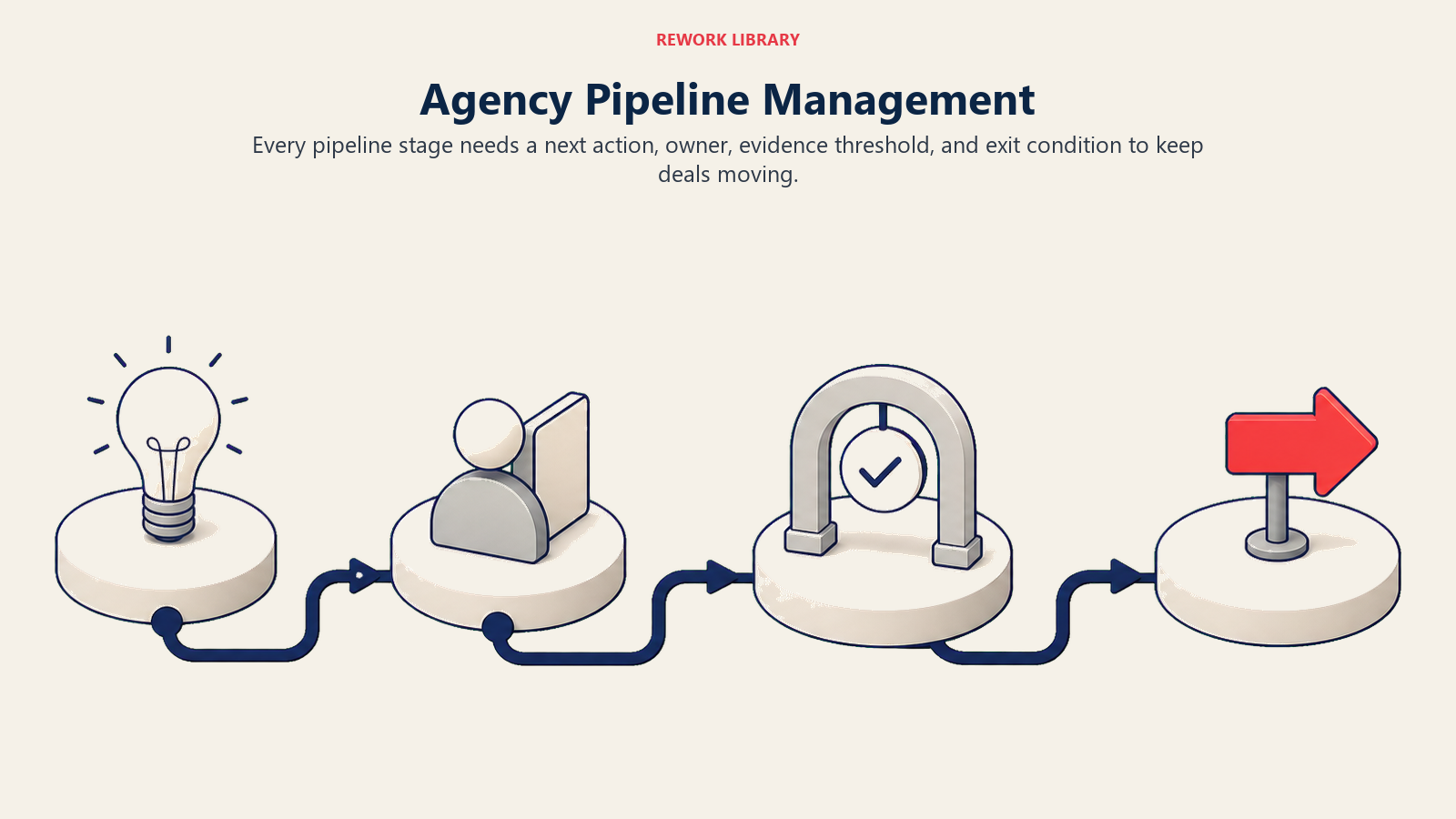
A pipeline only works if opportunities move through it predictably. Each stage has entry criteria, exit criteria, and actions that should happen while the opportunity is in that stage. Stage 1 - Awareness/Lead: Someone has entered your universe. They filled out a form, met you at an event, got referred, clicked an ad. You have their contact info and basic context. Entry criteria: Name, company, contact info, source Actions: Initial outreach, qualify basic fit, schedule discovery call if appropriate Exit criteria: Either they respond and schedule a meeting (move to Discovery) or they don't respond after follow-up sequence (disqualify or nurture)
Stage 2 - Discovery: You're in active conversation, assessing fit, building relationship. This is where most qualification happens.
Entry criteria: Scheduled meeting or active email exchange Actions: Discovery call, needs assessment, stakeholder mapping, budget/timeline discussion Exit criteria: Clear BANT qualification (move to Proposal) or disqualified (not a fit) Typical duration: 1-3 weeks
Stage 3 - Proposal/Pitch: They've invited you to formally propose. You're developing a strategic recommendation, creating a proposal, and presenting.
Entry criteria: Formal request for proposal or pitch invitation, qualified BANT Actions: Deep discovery, develop strategy, create proposal, present/pitch, answer questions Exit criteria: They accept your proposal (move to Negotiation), choose someone else (Closed Lost), or go dark/delay decision (back to Discovery or disqualified) Typical duration: 2-6 weeks depending on complexity
Stage 4 - Negotiation: They want to work with you, now you're aligning on details. This is scope, pricing adjustments, terms, start date, contract review.
Entry criteria: Verbal or written indication they want to move forward Actions: Negotiate scope/price, draft contract, handle procurement/legal, secure signatures Exit criteria: Signed contract (Closed Won) or deal falls apart (Closed Lost) Typical duration: 1-4 weeks
Stage 5 - Closed Won/Lost: It's over. Either you have a signed contract and can start work, or you lost the deal.
Actions if won: Client onboarding, celebrate with team, analyze what worked Actions if lost: Post-mortem analysis, ask for feedback, determine if worth nurturing for future
The key to pipeline management is stage velocity. How long do opportunities sit in each stage? If deals are stalling in Discovery for 8 weeks, something's wrong with your qualification or follow-up. If everything is getting stuck in Negotiation, you've got a contracting or pricing problem.
Track stage-to-stage conversion rates. If 80% of Discovery conversations advance to Proposal, you're qualifying well. If only 20% advance, you're either talking to the wrong people or not building enough value in the discovery process.
Pitch and proposal process: turning interest into commitment
Most agencies lose deals in the pitch. Not because their work isn't good, but because their pitch process is weak. You're either answering the wrong question, presenting in a way that doesn't land, or failing to differentiate from the competition. Discovery before proposal: You can't write a compelling proposal without deep discovery. And deep discovery isn't a 30-minute call where you ask about their goals. It's understanding:
- What's working and what's not in their current approach
- What they've tried before and why it failed
- Who the key stakeholders are and what they care about
- What success looks like specifically (not "grow revenue" but "increase enterprise pipeline by 30% in Q3")
- What their decision criteria are and how they're evaluating agencies
- What constraints exist (budget, timeline, internal politics, tech stack)
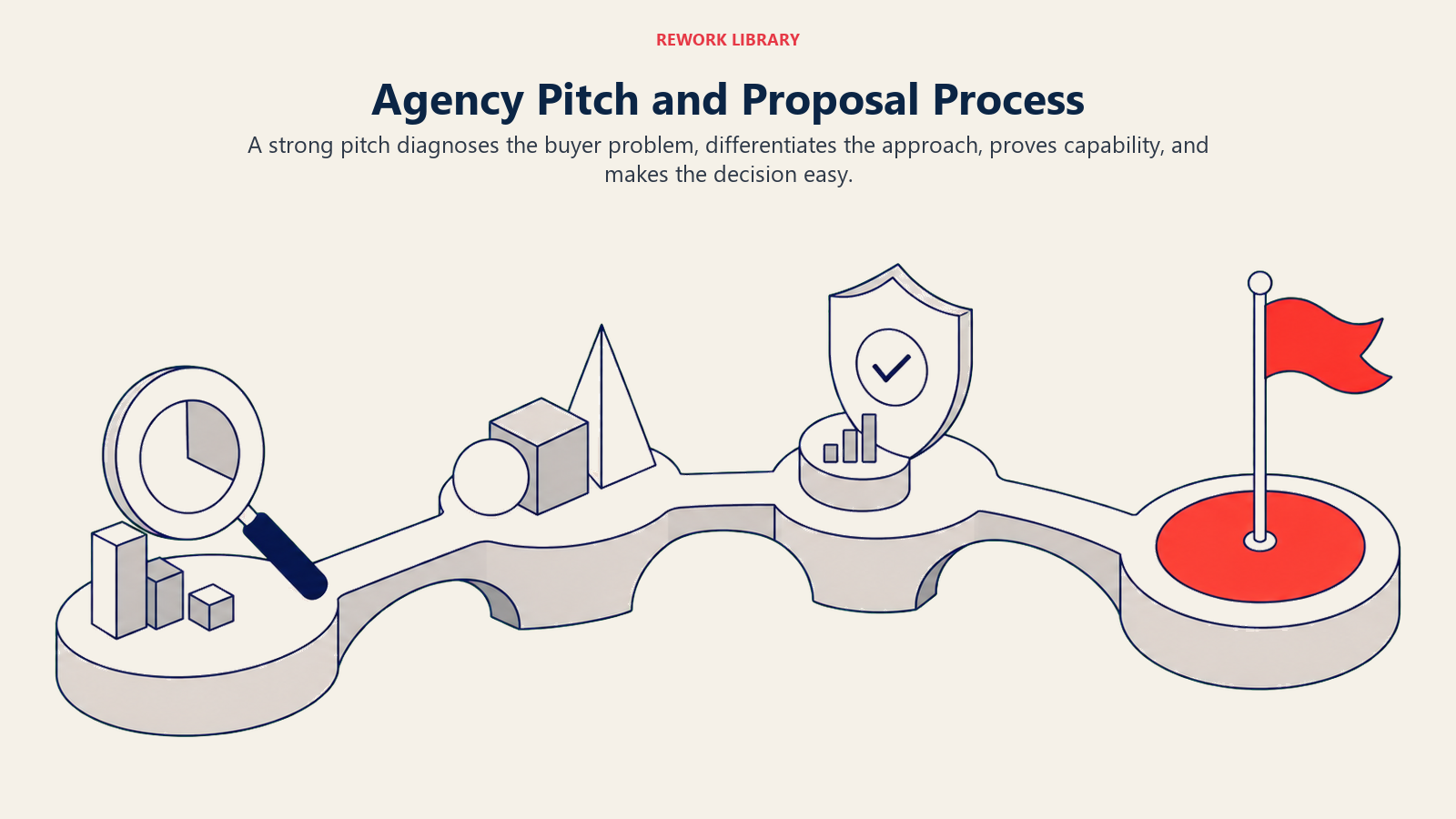
The more you know, the more you can tailor your approach to what actually matters to them.
Strategic approach and recommendation development: Your proposal shouldn't be a list of services and pricing. It should be a strategic recommendation that demonstrates you understand their problem and have a clear point of view on how to solve it. See proposal development for detailed guidance.
Structure it like a consulting engagement:
- Here's what we heard (reflect back their situation)
- Here's what we think (diagnosis and insight)
- Here's what we recommend (approach and strategy)
- Here's how we'll do it (scope, timeline, team)
- Here's what it costs (pricing with clear value connection)
The best proposals include one element most agencies miss: perspective they didn't have before. You're not just restating their problem, you're reframing it or adding insight that makes them think "oh, we hadn't considered that."
Proposal structure and content: Keep it concise. Nobody wants a 40-page proposal with stock photos and generic capability statements. They want:
- Clear understanding of their situation
- Your strategic recommendation
- Scope and deliverables
- Timeline and milestones
- Team and approach
- Pricing and terms
- Case studies/proof points that are actually relevant
Make it visual but not over-designed. Make it specific to them, not templated. Include pricing that's clear and justified, not buried or confusing.
Pricing strategy and presentation: Price based on value, not hours. If you save them $500K or generate $2M in incremental revenue, a $100K engagement is a bargain. If you're just executing tasks, you're a commodity competing on cost. See pricing justification for strategies to communicate value.
Present pricing in context: "This investment of $X will deliver Y, which based on your goals should generate Z in return." Give them the math.
Offer options if it makes sense. One scope at one price feels take-it-or-leave-it. Three options (good, better, best) let them choose their level of investment and give you negotiation room.
Presentation and pitch delivery: If you're presenting live (video call or in-person), don't just read your deck. Have a conversation. Walk them through your thinking, ask questions, create dialogue. The best pitches feel collaborative, not one-way presentations.
If you're presenting to a group, map stakeholders beforehand. Who's the decision-maker? Who's the skeptic? Who cares about ROI vs creativity vs process? Address each person's concerns.
Handling objections and questions: Common objections you'll face:
- "This is more expensive than we expected" → Reframe on value, break down what they're getting, potentially offer phased approach
- "We're talking to other agencies" → Ask what's most important in their decision, differentiate clearly
- "We need to think about it" → Uncover the real objection, create urgency if there's a legitimate deadline
- "Can you do it for less?" → Explain what would need to change in scope, don't just discount
Follow-up and closing strategies: After the pitch, don't just wait. Follow up within 24 hours with a summary of the conversation, answers to any open questions, and clear next steps.
Create urgency when it's legitimate (your availability, their timeline, competitive dynamics). Don't create fake urgency - it destroys trust.
Stay in touch without being annoying. A check-in a week later is fine. Daily "just wanted to see if you've made a decision" emails are desperate.
Win rate optimization: getting better at closing
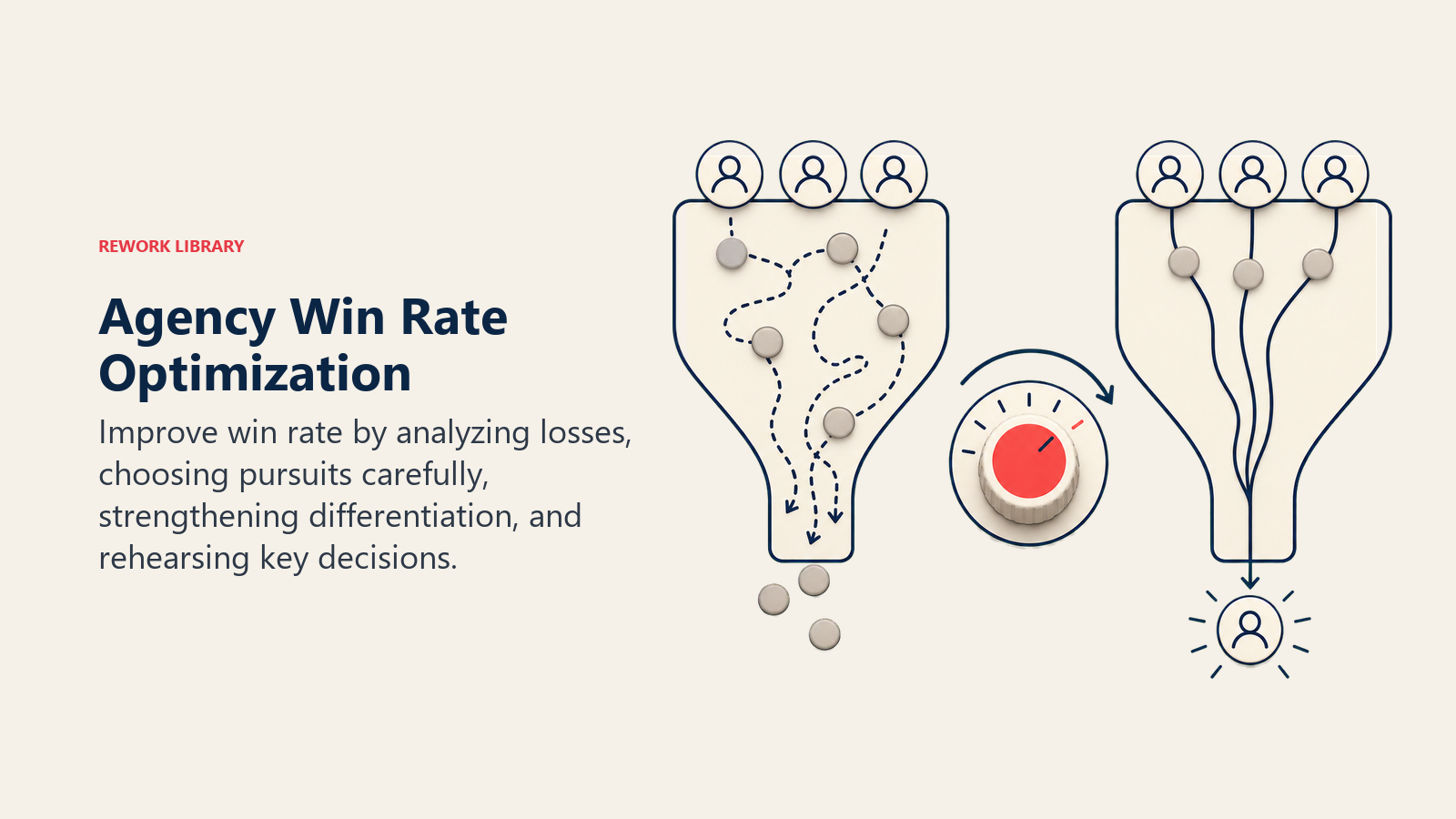
Your win rate is the percentage of qualified opportunities that become clients. If you pitch 20 deals and close 5, that's a 25% win rate. Improving that number has massive leverage. Going from 25% to 35% means closing 7 deals instead of 5 from the same pipeline. That's 40% more revenue without generating more leads. That's the game. Understanding loss reasons and patterns: Track why you lose. Not vague "they went with someone else" but specific reasons:
- Price (we were more expensive)
- Fit (they wanted different services or approach)
- Relationship (they had an existing relationship with competitor)
- Timing (they delayed decision or put project on hold)
- Competitive (we lost to a specific competitor)
- Credibility (they didn't believe we could deliver)
Look for patterns. If you're consistently losing on price, you have a positioning problem or you're pitching to the wrong prospects. If you're losing because you lack specific capabilities, you need to either build them or stop pitching those deals.
Qualification improvement: Most losses happen because you pitched the wrong opportunity. Better qualification means you stop wasting time on deals you can't win.
If you're losing 80% of the time when there's no existing relationship or warm intro, stop pitching cold RFPs. If you win 60% of the time when you have a referral, double down on referral generation.
Pitch and proposal refinement: Record your pitches (with permission) and review them. Where did you lose energy? Where did the prospect disengage? What questions did they ask that you didn't anticipate?
Get feedback from clients you won: "What made you choose us?" The answers will tell you what to emphasize more.
Get feedback from prospects you lost: "Would you mind sharing what drove your decision?" Some won't respond, but the ones who do give you gold.
Pricing and value communication: If you're losing on price but you're not the most expensive, you're not communicating value effectively. Clients don't buy the cheapest option - they buy the option that delivers the most value relative to cost.
Make your pricing make sense. Show the ROI. Compare to their current spend or the cost of not solving the problem.
Competitive differentiation: You need a clear answer to "why you instead of the other agencies we're considering?" If your answer is "we're strategic and data-driven and creative" you sound like everyone else.
Real differentiation comes from: specific expertise (we only work with B2B SaaS companies in this market segment), unique approach (we do X differently than the standard agency model), proven results (we've generated $50M in pipeline for companies like yours), or team credentials (our team includes former executives from the companies you're trying to reach).
Reference and proof point development: Case studies and references close deals. But generic case studies don't work. You need proof points that are relevant to the specific prospect's situation.
Build a library of case studies across different industries, use cases, and service types. When you pitch, pull the 2-3 most relevant examples.
Offer to connect prospects with similar clients who'll vouch for you. A 15-minute reference call with a happy client who says "they delivered exactly what they promised" is worth more than any case study.
Post-decision analysis and learning: After every win and every loss, do a 15-minute debrief with your team:
- What went well?
- What could we have done better?
- What did we learn about this prospect/industry/service?
- Would we pursue similar opportunities again?
Capture those insights and actually use them to improve your process.
Pipeline metrics and reporting: measuring what matters
You can't manage what you don't measure. These are the metrics that tell you if your pipeline is healthy or dying: Pipeline value by stage: How much revenue is sitting in each stage? This tells you where you're strong and where you're weak. If you have $500K in Discovery but only $100K in Proposal, you're either not qualifying people forward or you're losing deals in discovery. Conversion rates between stages: What percentage of opportunities move from one stage to the next? Track this for each transition. Discovery to Proposal should be 50-70%. Proposal to Closed Won should be 25-40% depending on your business.
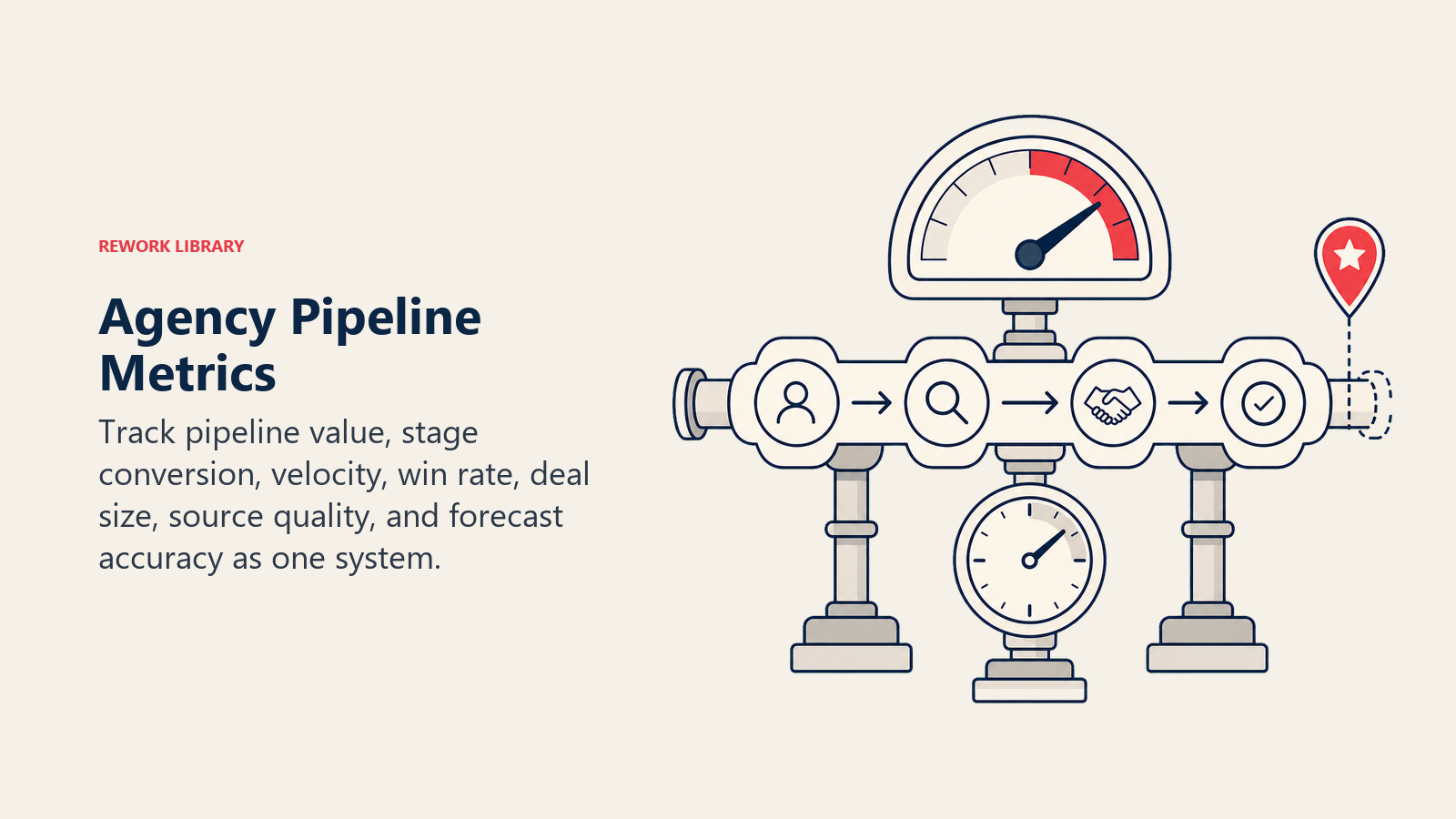
If conversion rates drop, diagnose why. Low Discovery to Proposal? Qualification is weak. Low Proposal to Close? Your pitch process or pricing is off.
Sales cycle velocity: How long does it take for an opportunity to move from first contact to closed deal? Track average, median, and by segment (small vs large deals, inbound vs outbound, by service type).
If deals are taking longer than they used to, something's wrong. Maybe prospects are more cautious, maybe your sales process has gotten sloppy, maybe you're pursuing more complex deals.
Win rate by source and type: Not all pipeline is equal. Track win rates by lead source (referral, inbound, outbound, event, RFP), by service type, by industry, by deal size.
If referrals close at 50% but outbound closes at 10%, you know where to focus your lead generation. If enterprise deals close at 35% but SMB closes at 15%, you know your sweet spot.
Revenue forecasting: Use your pipeline to forecast revenue 30, 60, 90 days out. Take opportunities in each stage, multiply by stage conversion rate, and you have a forecast.
Example: You have $200K in Proposal stage, and your Proposal to Close rate is 30%. You can forecast $60K in closed revenue from that stage. Add up across all stages and you have a pipeline forecast.
This won't be perfectly accurate, but it gives you visibility into whether you're on track or have a gap.
Activity metrics: How many pitches did you do? How many proposals sent? How many discovery calls? These are leading indicators of future pipeline health.
If pitch volume drops, closed deals will drop 60-90 days later. Activity metrics give you early warning.
ROI by lead source: Track cost per lead and cost per closed deal by source. If you're spending $10K/month on a directory that generates 20 leads but zero deals, that's $120K/year burned. If a $5K conference generates two deals worth $200K, do more of that.
New business team structure: who does what
In small agencies (sub-$1M revenue), new business is usually founder-led. The founder is the primary salesperson, pitching deals, leading proposals, closing contracts. That's fine early on, but it doesn't scale. Founder/partner role in new business: Even as you grow, founders typically stay involved in high-value deals and relationship building. They're the face of the agency, the ones prospects want to meet. But they shouldn't be doing all the prospecting, qualification, and pipeline management.
Best practice: Founders focus on relationship sales, strategic deals, and closing. They're involved in discovery and pitches but not running the day-to-day pipeline.
Dedicated new business development roles: As you approach $2M+ in revenue, you can justify hiring dedicated new business people. This might be a Business Development Director or VP of Sales who owns the pipeline, does outbound prospecting, qualifies leads, and manages the sales process.
They're not account managers (they hand off won deals to account teams). They're not strategists (though they need to understand strategy). They're pipeline builders and closers.
Account team involvement in growth: Your best source of new revenue is existing clients. Account teams should be identifying upsell and cross-sell opportunities, asking for referrals, and generating expansion revenue.
Make this part of their job explicitly. Don't just measure account teams on retention and satisfaction. Measure them on account growth and referrals generated.
Marketing support for lead generation: Marketing and sales need to work together. Marketing generates awareness and interest through content, events, campaigns. Sales converts that interest into pipeline and revenue.
Clear handoff points: When does a lead go from marketing to sales? What's the SLA for sales following up? How does sales feed back to marketing on lead quality?
Compensation and incentives: New business people need comp structures that reward results. Base salary plus commission or bonus tied to closed revenue is standard.
Be careful with incentive structures. If you only pay on closed deals, reps will chase short-term wins and ignore pipeline building. If you pay on pipeline added, you'll get a lot of junk leads. Balance is key.
Resource allocation and capacity: New business takes time. If you expect your account teams to also generate new business but they're 100% utilized on client work, it won't happen.
Budget capacity explicitly. If new business is a priority, people need time to do it.
CRM and pipeline tools: systems that enable visibility
You can run a pipeline in a spreadsheet when you have 10 opportunities. When you have 50+, you need a real system. CRM system selection and setup: Choose a CRM that fits your complexity and budget. Options range from simple (HubSpot, Pipedrive) to enterprise (Salesforce). Most agencies are fine with mid-tier options.
Key capabilities you need:
- Pipeline/deal tracking with customizable stages
- Contact and company management
- Activity tracking (calls, emails, meetings)
- Reporting and dashboards
- Email integration
- Calendar integration
Don't overbuy. You don't need Salesforce with all the bells and whistles if you're a 20-person agency. You'll spend more time managing the CRM than using it.
Pipeline tracking and visibility: Build views that show:
- All opportunities by stage
- Opportunities by owner
- Opportunities by expected close date
- Stalled opportunities (no activity in X days)
Make this visible to your leadership team. Everyone should know what's in the pipeline, what's moving, what's stuck.
Activity tracking and accountability: Track sales activities: calls made, emails sent, meetings held, proposals delivered. This creates accountability and helps you diagnose problems.
If someone has 20 opportunities but hasn't logged any activity in two weeks, they're not working the pipeline.
Reporting and forecasting: Build standard reports that run weekly:
- Pipeline value by stage
- Opportunities added this week
- Opportunities moved forward this week
- Opportunities closed won/lost
- Win rate trends
- Sales cycle length trends
Use this data in pipeline review meetings to spot issues early.
Integration with marketing tools: Connect your CRM to your marketing automation (HubSpot, Marketo, Pardot, etc.) so you have full visibility into how leads became opportunities and what marketing touches influenced them.
This closes the loop between marketing and sales and helps you optimize lead sources.
Team adoption and usage: The best CRM is worthless if nobody uses it. Drive adoption by:
- Making it easy (minimize required fields, automate what you can)
- Making it valuable (show people how the data helps them)
- Making it mandatory (CRM hygiene is part of the job)
- Leading by example (if founders don't use it, nobody will)
Common pipeline pitfalls that kill consistency
Most pipeline problems are not mysterious; they show up as repeated habits that make opportunities harder to qualify, close, and learn from. Inconsistent pipeline management and forecasting: You look at the pipeline when you remember to, update it sporadically, and wonder why forecasts are always wrong. Pipeline management is a weekly discipline, not a monthly afterthought.
Set a recurring pipeline review meeting. Every week, go through active opportunities, update stages, identify what's stuck, commit to next actions.
Poor qualification leading to wasted effort: You pitch everything that moves because you're desperate for revenue. You spend 20 hours on a proposal for a prospect who was never going to pick you because they didn't have budget or you weren't a fit.
Get ruthless about qualification. It's better to walk away early than waste time late.
Weak discovery and needs assessment: You jump straight to "here's what we can do for you" without really understanding what they need. Your proposals are generic because your discovery was shallow.
Spend more time in discovery. Ask better questions. Understand the problem deeply before proposing a solution.
Generic pitches and proposals: You use the same pitch deck for every prospect with minimal customization. You copy-paste proposals and change the company name. Prospects can tell, and you lose.
Customize every pitch. Reference specific things they told you. Demonstrate that you understand their unique situation.
Underpricing to win business: You're so hungry for a deal that you drop your price to match what they want to pay. You win the deal but it's unprofitable, and now you have a client who expects low pricing forever.
Hold your pricing. If they can't afford you, they're not the right client. Discounting to win business is a death spiral.
No post-mortem learning from losses: You lose a deal, shrug, and move on. You never find out why you lost or what you could have done differently. You make the same mistakes repeatedly.
Always ask for feedback. Always debrief losses with your team. Always capture what you learned.
Founder bottleneck in new business: Every deal has to go through the founder. The founder is the only one who can pitch, the only one who can close. The agency can't grow faster than the founder's capacity.
Build a team and a process that doesn't require founder involvement in every deal. Yes, founders close bigger deals better. But your $20K deals shouldn't require founder time.
Scaling new business capability: from hustle to system
Early-stage agencies run on founder hustle. The founder is out networking, pitching, closing deals, and doing client work. It's scrappy and exhausting, but it works.
But hustle doesn't scale. At some point, you need to move from founder-led to team-led, from art to science, from reactive to systematic. Moving from founder-led to team-led: This is the hardest transition. Founders are usually the best salespeople - they have the vision, the relationships, the credibility. But if every deal requires them, growth caps at their capacity.
Start by having founders train others. Bring junior team members into pitches, let them run discovery calls with oversight, have them draft proposals with founder review. Over time, transition more responsibility.
Building repeatable processes: Document your sales process. What happens at each stage? What questions do you ask in discovery? What's your proposal template? How do you handle pricing conversations?
Turn what the founder does intuitively into a process that others can follow. It won't be as good initially, but it'll get better with practice.
Training and enablement: New business people need training on:
- Your services and approach
- Your ideal client profile and qualification criteria
- Discovery methodology
- Pitch and proposal development
- Objection handling
- Your industry and competitive landscape
Don't just throw someone into new business and expect them to figure it out.
Marketing automation and support: As you scale, you can't manually handle every inbound lead or outbound prospect. You need marketing automation to nurture leads, score engagement, and surface hot prospects.
Build email nurture sequences, automated follow-ups, lead scoring that prioritizes who sales should contact. Let technology handle the volume so humans can focus on high-value conversations.
Partnership development: Strategic partnerships can scale lead generation faster than internal efforts. If you partner with five complementary agencies who each refer two deals a year, that's 10 deals you didn't have to generate.
Formalize partnerships. Create referral agreements, co-marketing initiatives, regular check-ins. Make it easy for partners to refer to you.
Referral program formalization: Referrals are your highest-converting source, but most agencies leave them to chance. Build a system:
- Ask for referrals explicitly at project completion
- Create an "ideal referral" profile so clients know who to refer
- Make it easy (provide an intro template, create a referral landing page)
- Thank and reward referrers (send a gift, offer a referral fee, give them special treatment)
Track referrals in your CRM so you know who's referring and can nurture those relationships.
Where to go from here
A healthy pipeline doesn't eliminate the challenges of agency growth, but it transforms them from existential crises into manageable problems. When you know you have $400K in qualified pipeline and understand your conversion rates, you can plan hiring, make investment decisions, and sleep at night.
Start with the fundamentals: define your stages, set up tracking, measure your current conversion rates and sales cycle. You can't improve what you don't measure.
Then focus on the highest-leverage improvements:
- If your pipeline is empty, fix lead generation (see Consultative Business Development)
- If your pipeline is full but not converting, fix qualification and pitch process
- If you're winning deals but they're unprofitable, fix pricing and client selection
- If the founder is the bottleneck, build team and process to scale
Your pipeline is the leading indicator of your agency's health. When it's full and moving, everything else gets easier. When it's not, no amount of operational excellence will save you.
Build the machine. Feed it consistently. Measure it relentlessly. Improve it continuously. That's how agencies go from feast-or-famine to predictable growth.

Sales Director
On this page
- The new business imperative
- New business pipeline fundamentals
- Lead generation strategies that actually fill pipelines
- Lead qualification framework: not all opportunities are equal
- Pipeline stages and management: moving deals forward
- Pitch and proposal process: turning interest into commitment
- Win rate optimization: getting better at closing
- Pipeline metrics and reporting: measuring what matters
- New business team structure: who does what
- CRM and pipeline tools: systems that enable visibility
- Common pipeline pitfalls that kill consistency
- Scaling new business capability: from hustle to system
- Where to go from here