Law Firm Business Development: Rainmaking, Referrals, and Thought Leadership

Turn this article into takeaways for your work.


Each assistant summarizes the article only for you and suggests best practices for your work.
Here's the uncomfortable truth about law firms: most lawyers would rather draft a 50-page brief than make a single business development call. They'll spend hours researching case law but won't allocate 20 minutes to coffee with a potential referral source. It's not laziness. Everything in their training prepared them to be excellent lawyers, but nothing prepared them to be client developers.
This creates a weird dynamic. Partners complain that associates don't bring in business. Associates complain they're drowning in billable work and have no time for BD. Meanwhile, the firm's growth depends entirely on three rainmakers who are getting tired of carrying everyone else's revenue burden.
If this sounds familiar, you're not alone. Law firm business development is different from almost any other industry. The sales cycle is measured in years, not weeks. Relationships matter more than cold outreach. Ethics rules constrain what you can say and do. And the product itself (legal expertise) is complex, high-stakes, and deeply personal.
This guide is about building business development systems that work for law firms, not against them. We'll cover how to overcome lawyer reluctance, build rainmaking capacity beyond your top three partners, create referral networks that generate quality leads, and use thought leadership to position your attorneys as the obvious choice in their practice areas.
Why legal BD is different from traditional sales
Let's start with what doesn't work: treating law firm business development like selling widgets. You can't hire a sales team to cold-call prospects about tax law. You can't run discount promotions on litigation services. You can't "close" a general counsel in two meetings with a slick PowerPoint deck.
Legal services are purchased based on trust, expertise, and relationships built over time. When a company needs outside counsel, they're not just buying a service. They're bringing someone into their most sensitive business problems. That requires a level of confidence you can't manufacture with aggressive sales tactics.
The buying process is also fundamentally different. In most B2B sales, there's a defined evaluation period: you demo the software, send a proposal, negotiate terms, and close. With legal services, prospects might stay in "evaluation mode" for two years while they observe your work, read your articles, hear you speak, and ask around about your reputation. Then one day they have a need and you get the call - or you don't.
This means BD activities often have no immediate payoff. You write an article in January, speak at a conference in March, get introduced to a GC in June, have coffee in September, and maybe - maybe - get a call about a matter in November of the next year. That delayed gratification is hard for lawyers trained to bill in six-minute increments.
There's also the ethics dimension. State bar rules regulate what you can say in marketing, how you can solicit clients, and what claims you can make about your expertise. You can't use testimonials in some jurisdictions. You can't pay for referrals. You can't guarantee outcomes. These constraints make standard marketing playbooks difficult to apply.
The result is that effective law firm BD looks less like sales and more like strategic relationship development combined with expertise demonstration. You're not pushing services. You're building a network that thinks of you when needs arise, and you're creating visibility that positions your attorneys as authorities worth calling.
The rainmaker reality and why most lawyers avoid BD
In most firms, 80% of new client revenue comes from 20% of attorneys. These are your rainmakers - the partners who seem to effortlessly generate new business while everyone else struggles.
But here's what people get wrong: rainmakers aren't born, they're made. The difference is that they either figured out BD early in their careers or they were forced to learn when their survival depended on it. Everyone else is stuck in the "I'm too busy billing to do business development" trap.
Let's break down why lawyers avoid BD:
The technical vs business skill mindset: Law school teaches legal analysis, research, writing, and argumentation. Zero hours on relationship building, networking, or client development. Most lawyers spent three years in an environment that valued intellectual rigor and punished social skills. Then they enter a profession that suddenly expects them to schmooze at cocktail parties. This gap between technical training and business development skills mirrors challenges across professional services firms.
Fear of being "salesy": Lawyers have a self-image problem. They see themselves as professionals, not salespeople. The idea of "selling" feels beneath them or unseemly. They don't want to be pushy, aggressive, or overly promotional. So they avoid BD entirely rather than figure out how to do it in a way that aligns with their professional identity.
Time constraints and billable pressure: This is the killer. Associates and even partners face billable hour requirements. Every hour spent on BD is an hour not billed to clients. If you need 1,800 billable hours this year and you're behind, are you going to write a thought leadership article or finish the memo that's due Friday? The short-term incentive always wins.
Lack of immediate feedback: When you draft a motion, you know pretty quickly if it worked. When you attend a networking event, you might not see results for 18 months. That delayed feedback loop is demotivating, especially for people trained to see direct cause-and-effect.
No training or support: Most firms tell lawyers "go do business development" without teaching them how. There's no playbook, no mentoring, no accountability. It's like telling someone to win a tennis match when they've never held a racket.
The fix isn't to force unwilling lawyers into sales roles. It's to reframe BD as expertise building and relationship cultivation, provide structure and training, create incentives that reward long-term behavior, and build a culture where BD is part of what successful lawyers do, not an optional extra.
Understanding rainmaking as relationship architecture
When you ask a rainmaker how they generate business, they'll usually shrug and say something vague like "I just know a lot of people." That's not helpful. But when you dig deeper into what they actually do, a pattern emerges.
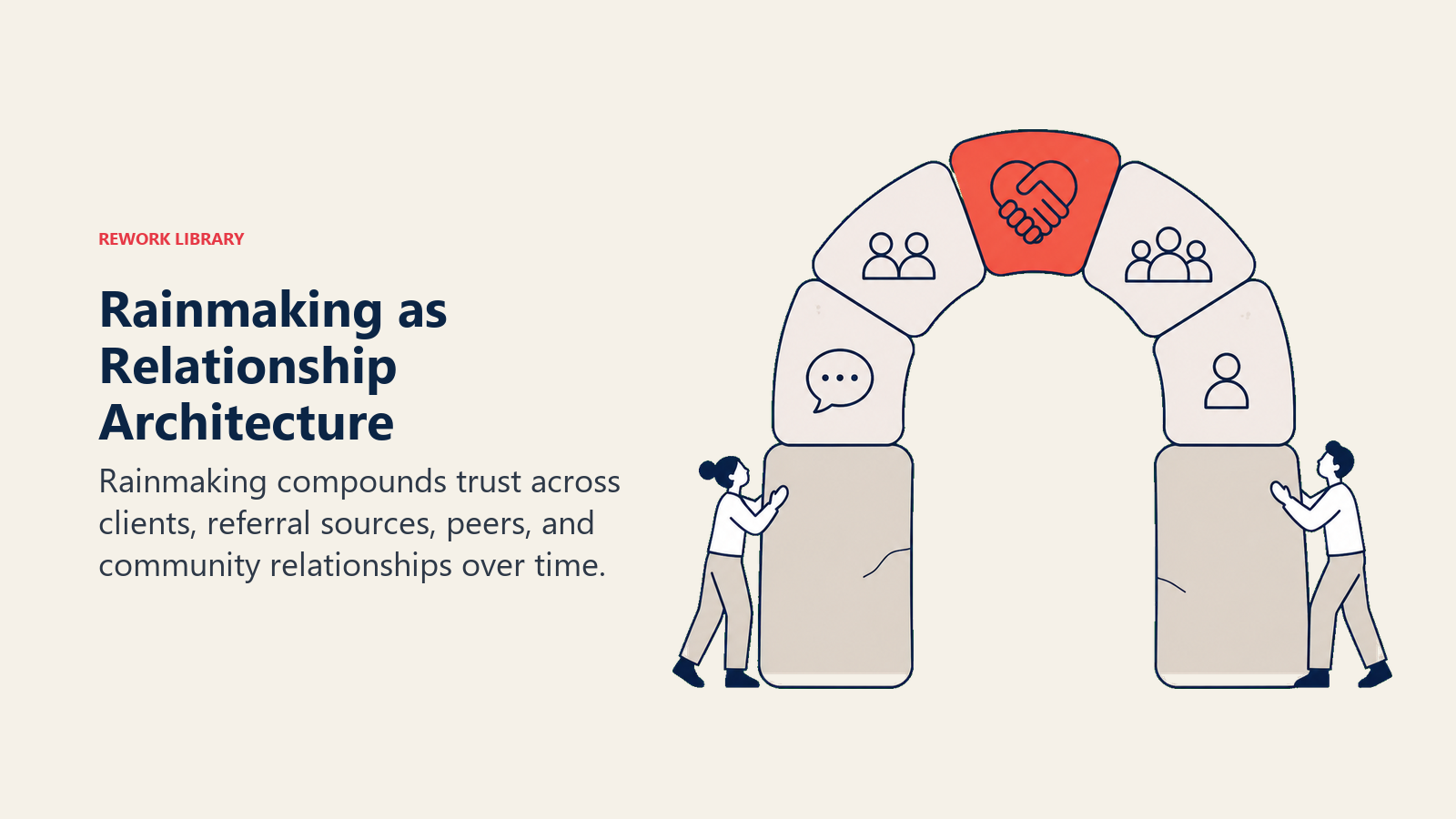
Rainmakers are relationship architects. They don't wait for opportunities to appear. They systematically build networks that generate opportunities over time.
Here's what that looks like in practice:
They maintain relationships with 40-60 people who could refer work or become clients. Not hundreds. A manageable number they can actually stay in touch with through regular, meaningful contact. They know these people's businesses, challenges, and who else is in their networks.
They're strategic about who's in that group. It's not random networking. It's targeted relationship building with general counsels, executives in target industries, fellow attorneys in complementary practice areas, industry association leaders, and past clients who could hire again or refer.
They create reasons to stay in contact that provide value. They share relevant articles, make introductions, invite people to events, offer insights on legal developments affecting the person's industry. Every interaction reinforces their expertise and keeps them top-of-mind.
They're patient. They understand that most relationships won't pay off immediately. They're playing a long game where depth of relationship matters more than breadth of contacts.
They're also systematically visible in the communities they want to serve. They speak at industry conferences, write for trade publications, serve on boards and committees, and show up where their target clients gather. This creates ambient awareness - people know who they are before they ever meet.
The key difference between a rainmaker and everyone else is intentionality. Rainmakers have a strategy. They know who they're targeting, why, and how they'll build relationships. Everyone else networks randomly and wonders why nothing happens.
Rainmaker compensation models and what drives behavior
How you pay lawyers shapes what they do. If you want BD to happen, your compensation structure needs to reward it.
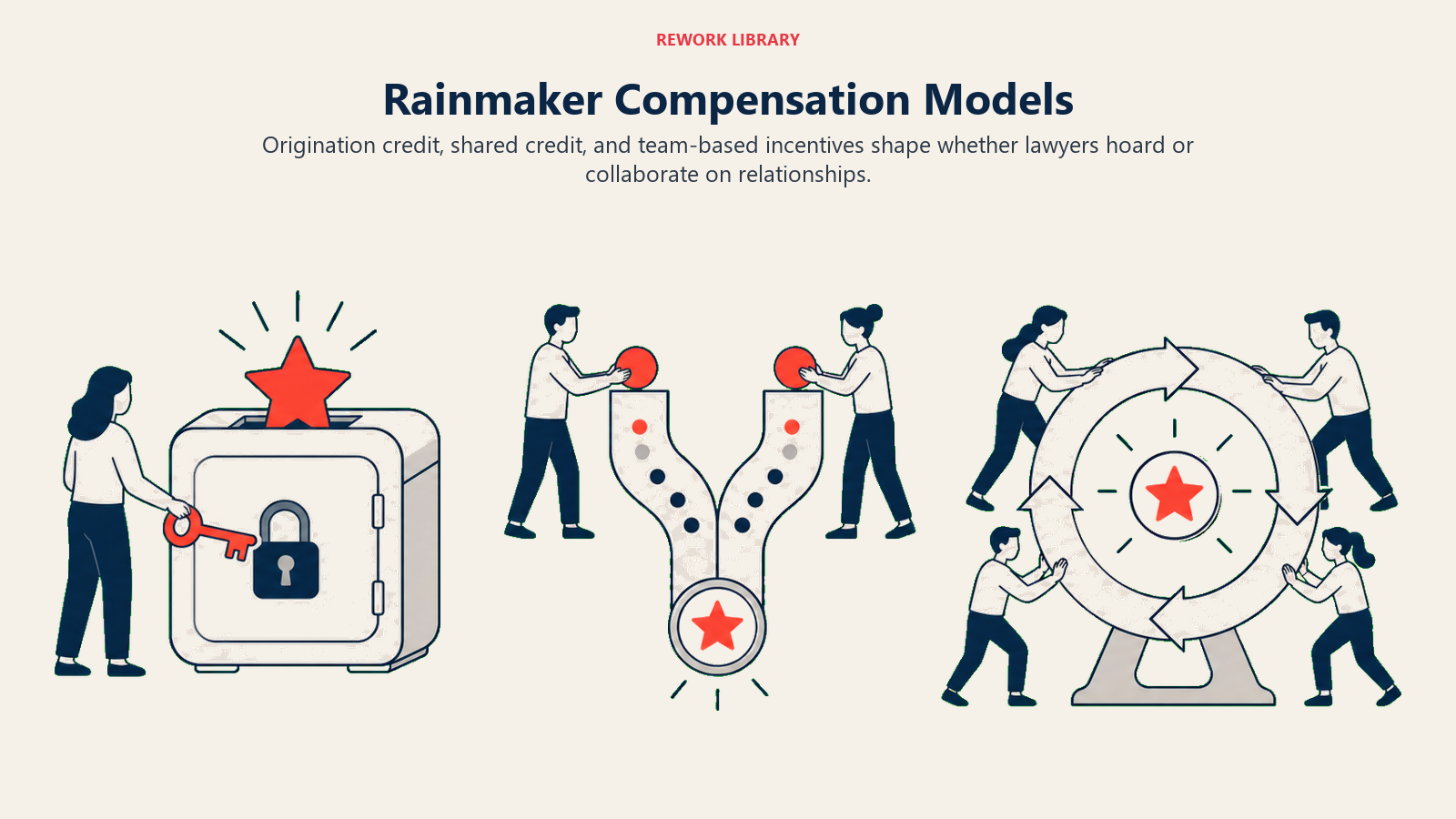
Most firms use one of three models:
"Eat what you kill": Each partner gets credit for the clients they bring in. This is common in smaller firms and certain practice areas. It creates strong individual incentives to generate business. The downside is that it can discourage teamwork and create silos. Why would I refer work to another partner if it doesn't help my compensation?
Team credit and firm-wide metrics: Compensation is based partly on the firm's overall revenue and growth, not just individual origination. This encourages collaboration and referring work to whoever is best suited. But it can also create free-rider problems where some partners coast while others carry the BD load.
Hybrid models with origination and production components: Most sophisticated firms use some combination. You get credit for bringing in work (origination), for doing the work (production/billable hours), and for firm citizenship (mentoring, management, leadership). This balances incentives but can get complex.
The critical factor is whether BD activity is actually valued in the comp formula. If your comp plan only rewards billable hours and closed deals, nobody will invest in long-term relationship building. You need to reward activities that lead to future business: speaking engagements, publishing, networking, strategic relationship development. Moving toward value-based pricing models can help align incentives with long-term client development.
Some firms create explicit BD time allocations. "You need 1,600 billable hours and 200 hours of credited BD activity." Others set participation minimums: every partner must speak at two conferences and publish two articles per year. These structures create accountability without waiting for revenue results that might take years.
You also need to think about timeline expectations. In most industries, if you hire a salesperson and they haven't closed deals in six months, they're gone. For legal BD, the realistic timeline is one to three years before you see meaningful results from sustained effort. Partners need to know they won't be penalized for investing in relationships that haven't paid off yet.
Building your referral network strategy
Here's a stat that should change how you think about BD: referred clients have 3-4x higher retention rates and 2-3x higher lifetime value than clients acquired through other channels. Referrals are the highest-quality lead source available to law firms.
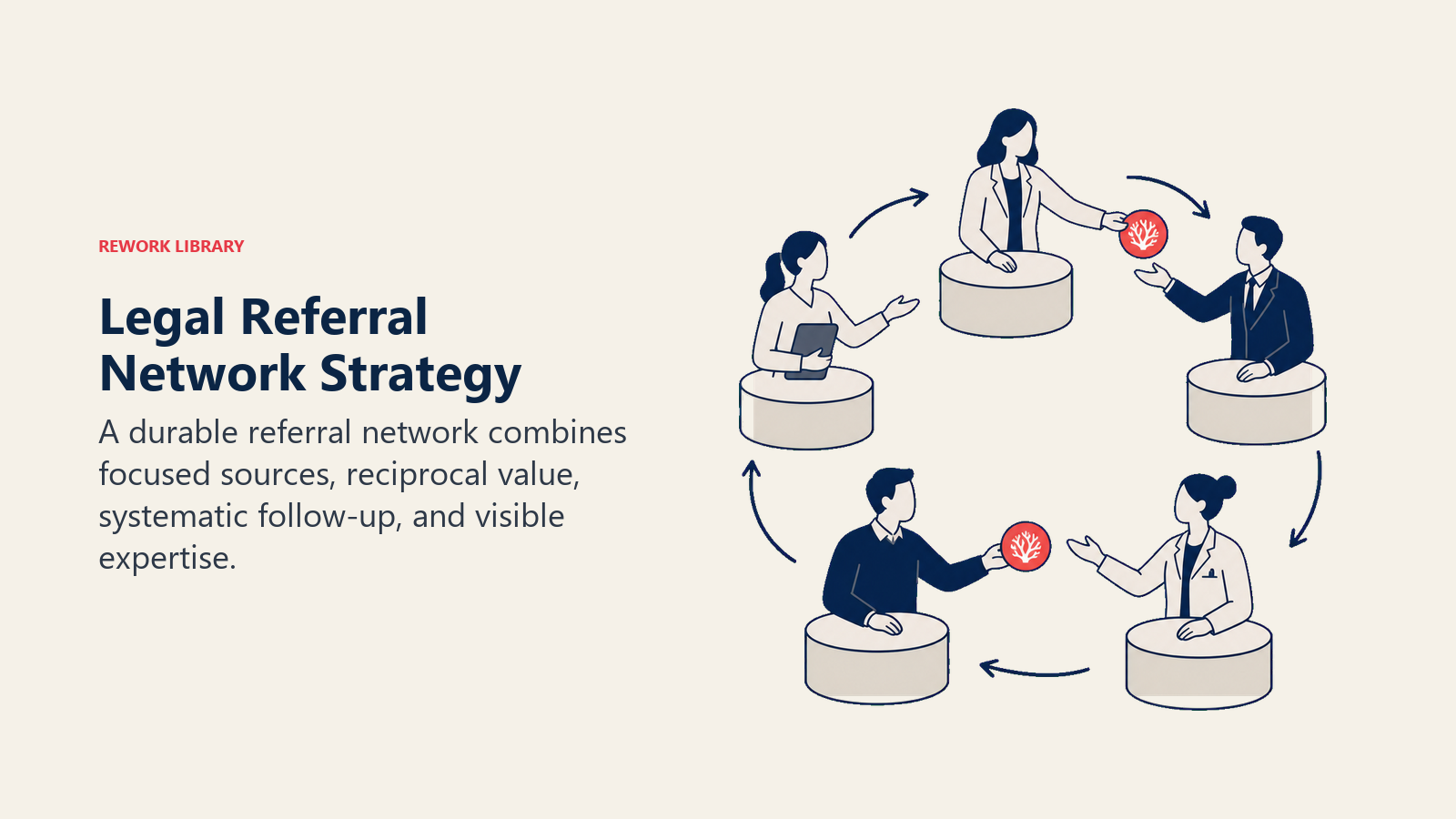
But most firms treat referrals as something that happens by accident. "We get a lot of referral business" actually means "our rainmakers have strong networks and everyone else hopes clients just appear."
A systematic referral strategy starts with understanding the types of referral sources:
Client referrals: Your existing and past clients recommending you to others in their network. This is the most valuable type because the referral comes with implicit endorsement: "I used them and they were great."
Professional referrals: Other attorneys, accountants, consultants, bankers, and advisors who refer clients when they have legal needs outside the referrer's scope. These are your bread-and-butter referral relationships for most practice areas.
Centers of Influence (COIs): People who aren't clients or professional peers but who are connected to many potential clients. Think industry association executives, economic development officials, or well-networked executives who know everyone in their sector.
Strategic partners: Formal or informal partnerships with complementary service providers. A tax attorney partnering with CPAs. A healthcare attorney working closely with hospital consultants. These create systematic referral flows.
Now here's the framework that actually works: every attorney identifies their top 20 referral sources. Not 100. Not "everyone I know." The specific 20 people who are most likely to refer work in the next 18 months.
For each person, you need to know:
- What types of matters would they refer?
- What would trigger them to think of you?
- How often should you be in contact?
- What value can you provide to them?
Then you build a cultivation plan with regular touchpoints:
Quarterly substantive contact: Share an insight relevant to their business or practice. Not a generic newsletter - a specific "I saw this and thought of you" message. Make an introduction to someone in your network who could help them. Invite them to an event where they'd meet valuable contacts.
Annual in-person meetings: Coffee, lunch, or drinks where you're not asking for anything. You're deepening the relationship and understanding what's happening in their world. These conversations often reveal opportunities to help before they're formalized as referrals.
Recognition and acknowledgment: When someone refers work, acknowledge it immediately and report back on how it went (within confidentiality constraints). Send a thank-you gift. Keep them updated. People refer more when they see their referrals are valued and handled well.
The key is systematizing this. You can't remember to stay in touch with 20 people through ad hoc efforts. You need a CRM, calendar reminders, and a plan for what you'll do each quarter. Most firms use practice management systems that can track this, but even a shared spreadsheet is better than nothing.
The mistake most lawyers make is thinking about referrals only when they need them. "I'm slow this month, I should call some people." That's backward. You build referral relationships when you're busy so that when you need work, the network is already there.
Thought leadership as long-term positioning
Thought leadership sounds fluffy. It sounds like something marketing departments dream up to justify their existence. But for professional services, it's actually one of the most effective BD strategies available.

Here's why: when a company needs outside counsel, they're making a high-stakes decision. They need someone who deeply understands their specific issue. How do they evaluate expertise when they're not legal experts themselves? They look for signals.
Those signals include:
- Who's writing about this topic in respected publications?
- Who's speaking at our industry conferences?
- Who do our peers mention as the authority in this area?
- Whose name comes up when we Google this legal issue?
Thought leadership creates those signals. It positions your attorneys as the recognized experts before a prospect ever has a need. When the need arises, you're already on the shortlist.
Building your content strategy: Start with practice area authority. What are the 10-15 topics where you want to be known as the go-to expert? Not everything in law. The specific issues your target clients face.
For each topic, develop a content pillar:
- Core educational content explaining the issue and implications
- Updates on regulatory changes and new case law
- Analysis of trends and what they mean for businesses
- Practical guidance on compliance, risk management, or strategic considerations
The format can be articles, blog posts, white papers, webinars, podcasts, or video content. The medium matters less than consistency and quality. One excellent article per month beats five mediocre ones.
Publishing opportunities: You have multiple channels to consider:
Firm blog and website content - this is your owned media. You control it, it helps SEO, and it demonstrates your expertise to anyone researching your firm.
Legal and industry publications - getting published in relevant journals, trade magazines, or online publications in your target industries. This carries third-party credibility and reaches audiences who don't visit your website.
CLE and educational programs - creating and presenting continuing legal education programs positions you as someone who teaches other lawyers. That's a strong expertise signal.
Bar association and professional publications - writing for state bar journals or practice section newsletters. Your peers read these, which drives referrals from other attorneys.
Media commentary and expert sources - becoming a go-to source for journalists writing about legal issues in your practice area. Even a 30-second quote in a Wall Street Journal article creates visibility.
Speaking strategy: Speaking at conferences and events is thought leadership with face-to-face impact. You're not just presenting information - you're creating a room full of people who have experienced your expertise firsthand.
Target speaking opportunities at:
- Industry conferences where your target clients attend
- Bar association events and CLEs
- Professional association meetings and webinars
- Client-facing educational events hosted by your firm
The key is being selective. Speaking everywhere dilutes your time and message. Speak where your target audience gathers, and deliver value that makes them remember you.
Balancing personal vs firm branding: Here's a tension every firm faces. When an attorney builds a strong personal brand, it benefits the firm - until that attorney leaves and takes the brand with them. But if you only promote the firm brand, individual attorneys don't build the personal relationships that drive referrals.
The solution is both/and, not either/or. Attorneys build personal brands within the context of firm affiliation. You're "Sarah Johnson, healthcare attorney at Smith & Associates," not just "Sarah Johnson" or just "Smith & Associates healthcare practice."
Content is often co-branded: author byline with firm bio. Speaking includes firm logo alongside attorney name. Social media profiles identify firm affiliation while highlighting individual expertise.
The goal is that when someone searches for your attorney, they find the firm. And when someone searches for the firm in that practice area, they find your attorney. That mutual reinforcement is more powerful than either alone.
Creating your client development funnel
Most lawyers think about client development as a yes/no binary: either someone is a client or they're not. But in reality, there's a whole progression from complete stranger to active client. Understanding this funnel helps you move people through it systematically.
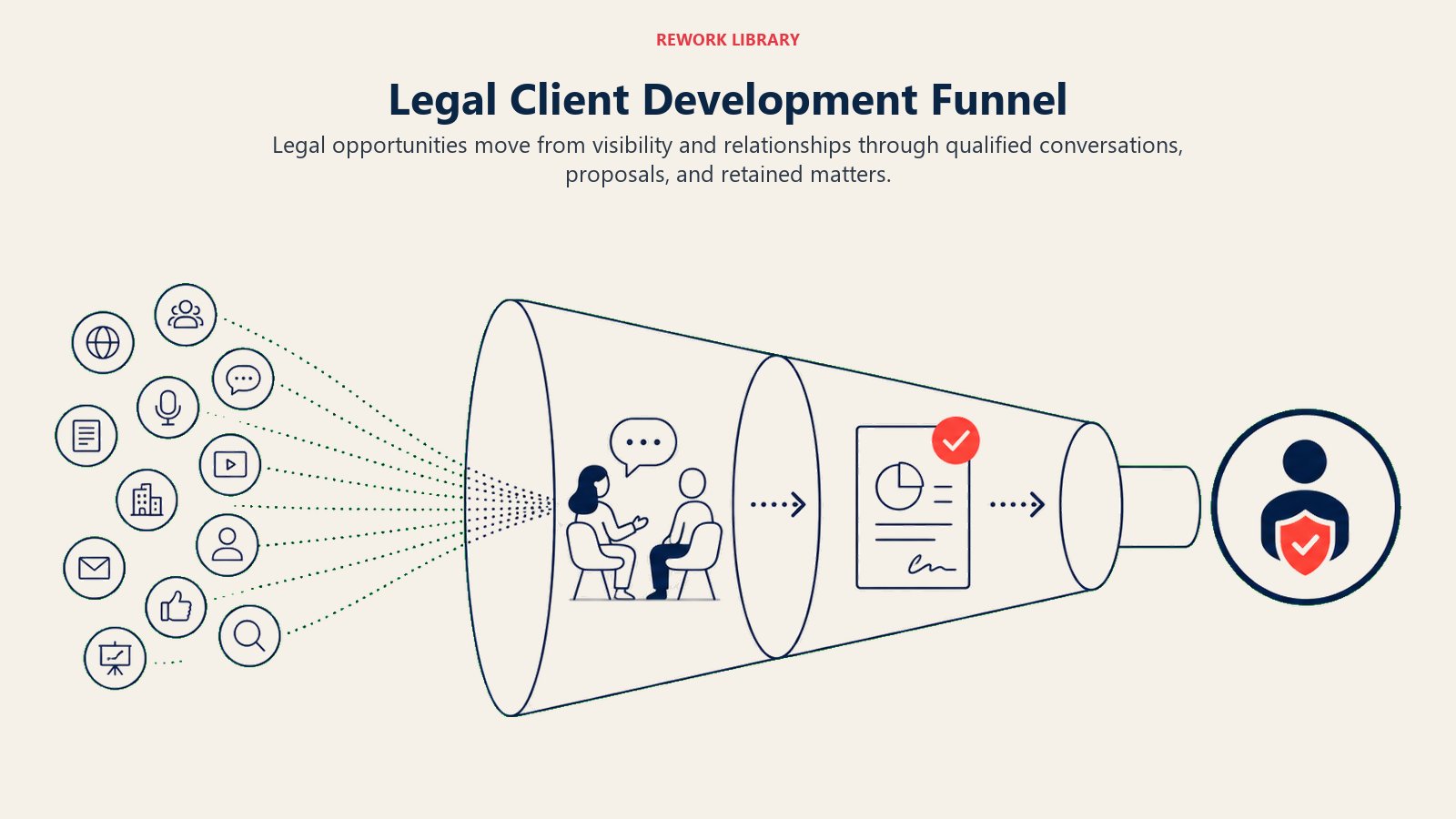
Stage 1: Awareness - The prospect knows you exist and has some idea what you do. This is where thought leadership, speaking, and visibility activities live. You're creating ambient awareness in your target market.
Stage 2: Consideration - The prospect is actively evaluating whether you might be a fit for their needs. They're reading your content, attending your webinars, asking around about your reputation. They're not ready to hire yet, but they're paying attention.
Stage 3: Decision - The prospect has a specific need and is choosing whether to hire you or someone else. This is where relationships, expertise demonstration, and direct engagement convert awareness into clients.
Most lawyers focus exclusively on stage 3. They wait until someone has a need, then try to compete for the work. By then it's often too late - the prospect has already decided who they're calling based on stages 1 and 2.
The strategic approach is working all three stages simultaneously:
Awareness building: Consistent thought leadership, strategic networking, speaking engagements, and visibility in target industries and communities. You're making sure that when people in your target market think about your practice area, your name comes up.
Consideration nurturing: When someone engages with your content or expresses interest, you deepen the relationship. Invite them to firm events. Send them relevant insights. Make introductions to people in their industry. You're building a relationship before they have a need.
Decision-stage engagement: When an opportunity arises, you're positioned to win it because you've already done the work in stages 1 and 2. The initial consultation isn't about convincing them you're qualified - they already believe that. It's about confirming fit and scoping the engagement.
This funnel thinking helps you allocate BD time effectively. You can't spend all your time courting prospects who aren't ready. But you also can't ignore relationship building and expect stage-3 conversions to magically appear.
Essential practice development activities
So what do you actually do day-to-day? Here's the menu of activities that drive law firm BD:
Speaking and visibility: Present at industry conferences, bar events, client seminars, and professional association meetings. Host educational webinars and roundtables. Appear on panels and podcasts. The goal is face-time with target audiences where you're positioned as the expert.
Budget 4-8 speaking engagements per year per BD-active attorney. More than that and you're spreading too thin. Fewer and you're not creating enough visibility.
Content marketing: Write and publish articles, blog posts, client alerts, white papers, and case studies. Maintain an active LinkedIn presence sharing insights. Contribute to newsletters and publications. Create video content or podcast episodes.
Aim for one substantial piece of content per month, plus regular shorter insights and updates. Consistency matters more than volume.
Networking and relationship development: Attend industry events, join relevant associations, participate in boards and committees, and schedule regular coffee meetings with referral sources and potential clients.
This is where the "top 20 referral sources" framework comes in. You're maintaining existing relationships and strategically adding new ones. Budget 2-4 networking events per month plus individual meetings.
Client events and experiences: Host client appreciation events, educational seminars, roundtable discussions, or industry-specific gatherings. These create touchpoints with existing clients (who can refer) and allow clients to bring guests (prospects).
Quarterly client events or educational programs work well. They give you a reason to reach out and a valuable experience to offer.
Strategic partnerships: Develop formal or informal partnerships with complementary service providers who serve the same client base. CPAs for tax attorneys. Benefits consultants for ERISA lawyers. Industry consultants for sector-specific practices.
These don't happen overnight but can create systematic referral flow once established.
The key is picking 3-4 activities you'll do consistently rather than trying everything. An attorney who speaks quarterly, writes monthly, and maintains 20 active relationships will generate more business than one who sporadically does ten different things.
Lead generation channels that work for legal
Lead generation for law firms is different from lead gen for SaaS companies or e-commerce. You're not trying to drive thousands of form fills. You're trying to start high-quality conversations with the right people.
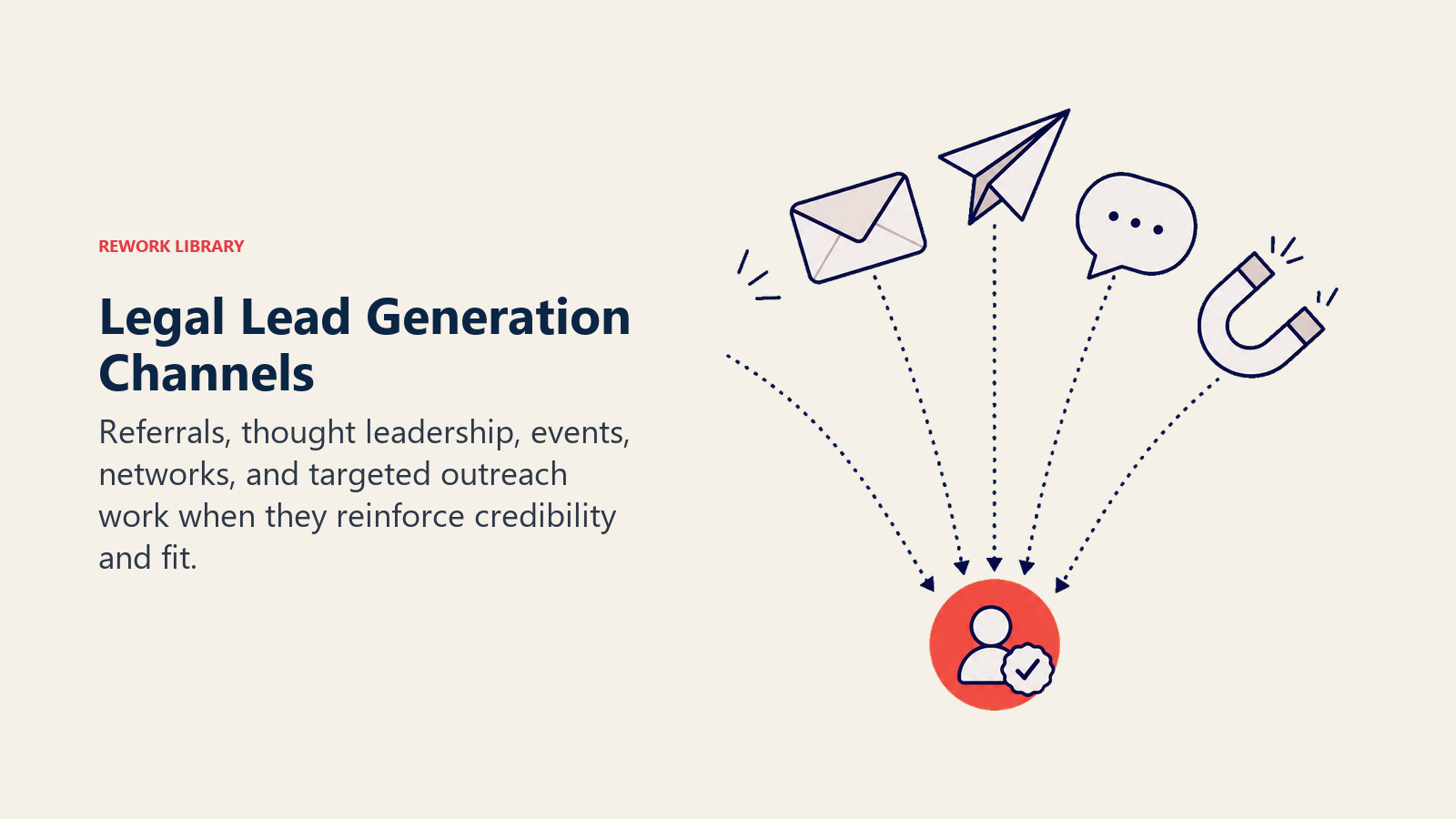
Here are the channels that actually work:
Inbound content and SEO: When someone searches for "healthcare regulatory attorney Chicago" or "M&A lawyer tech startups," you want your firm showing up. This requires strong website content, thought leadership articles, practice area pages optimized for search, and ongoing content production.
The timeline is long - SEO takes 6-12 months to show results - but the leads that come through are often high-intent. They're researching a specific issue and finding you.
See Inbound Lead Generation for broader strategies and Content Marketing for Professional Services for content specifics.
Referral programs: We covered referral networks earlier, but it's worth emphasizing: referrals should be your primary lead source. Every new client should be asked "who else in your network should know about what we do?" Every positive outcome should trigger a referral request.
The structure matters. Create formal processes for requesting referrals, tracking referral sources, and acknowledging contributors. Don't leave it to chance.
See Referral Lead Programs for systematic approaches.
Speaking and event-based leads: When you speak at a conference or host a webinar, collect contact information and permission to follow up. Then actually follow up with value, not a sales pitch. Send the slides, additional resources, an invitation to continue the conversation.
Many attorneys speak and then never contact attendees. That's wasting the lead generation opportunity.
LinkedIn and professional networks: For B2B legal services, LinkedIn is by far the most effective social platform. Share insights, engage with potential clients' content, participate in relevant groups, and use it to maintain visibility with your network.
The key is consistent activity, not sporadic posting. 2-3 meaningful posts per week plus regular engagement with others' content works better than posting daily garbage.
See LinkedIn for Professional Services for platform-specific tactics.
Strategic account targeting: For firms with specific target clients (Fortune 500 companies, private equity firms, healthcare systems), develop account-based approaches. Research specific companies, identify decision-makers, create customized outreach, and build multi-touch engagement campaigns.
This is highly personalized, low-volume, high-value lead generation. You're not casting a wide net. You're systematically pursuing specific targets.
Existing client expansion: Your current clients are your best source of new work. Cross-selling additional services, identifying new matters, and expanding relationships within client organizations should be every attorney's first BD priority. This aligns with advisory services expansion strategies that transform one-time matters into ongoing advisory relationships.
A corporate client you've done M&A work for might need employment counsel, IP protection, or litigation support. Are you proactively identifying those opportunities?
The multi-channel reality is that prospects will engage through multiple touchpoints. They'll find you via search, see you speak at a conference, connect on LinkedIn, receive a referral from a colleague, and then reach out. Your job is making sure you're visible across the channels where your target clients are paying attention.
Overcoming implementation barriers
You now have the strategy. Here's why it won't happen without addressing these barriers:
The time management problem: "I don't have time for BD" is the universal lawyer complaint. The solution isn't finding more time - it's allocating existing time differently.
BD should be scheduled, not squeezed in. Block 3-4 hours per week for BD activities. Treat it like a client meeting that can't be moved. If you wait for free time to appear, it never will.
Firms can help by:
- Setting BD time minimums (200 hours/year)
- Reducing billable requirements to create space
- Providing BD hour credit equivalent to billable credit
- Making BD performance a comp factor
Firm culture and support systems: If the firm culture signals that BD is optional or less important than billable work, nobody will prioritize it. Culture change requires leadership commitment.
Partners need to model BD behavior. Managing partners need to talk about it in firm meetings. High-performers who do BD well need to be celebrated, not just the ones with the most billable hours.
Support systems matter too. Provide:
- Marketing staff who can help with content creation and event planning
- CRM tools for tracking relationships and activities
- Training on networking, writing, speaking, and relationship development
- Templates and resources that make BD easier
Technology and CRM adoption: Most lawyers hate using CRMs. They're clunky, require data entry, and feel like busywork. But without tracking relationships and activities, your BD efforts stay random.
The fix is choosing legal-specific CRMs that integrate with practice management systems, keeping requirements simple (track key relationships, log major interactions), and showing ROI (attorneys who use the CRM generate X% more business).
Popular legal CRM options include Lexicata, Lawmatics, and Clio Grow, plus broader platforms like HubSpot configured for legal.
Training and skill development: Most lawyers have never been taught how to network effectively, write thought leadership content, speak compellingly, or develop strategic relationships. Assuming they'll figure it out on their own is unrealistic.
Invest in:
- BD training programs for associates and partners
- Public speaking coaching
- Writing workshops focused on thought leadership
- Networking skill development
- One-on-one coaching for attorneys who struggle with BD
Accountability structures: What gets measured gets done. Create accountability for BD activities:
- Quarterly BD plans with specific activities and targets
- Monthly check-ins on progress
- Dashboard tracking of speaking, publishing, networking, and relationship development
- Peer accountability groups where attorneys share what they're doing
The goal isn't micromanagement. It's creating gentle pressure so BD doesn't fall off the radar when client work gets busy.
Measuring what matters in legal BD
You can't optimize what you don't measure. But legal BD metrics are tricky because the lag between activity and revenue is so long.
Track two types of metrics: activity metrics (what you're doing) and outcome metrics (what's resulting).
Activity metrics:
- Speaking engagements (target: 4-8 per year per attorney)
- Published articles and content pieces (target: 12+ per year per attorney)
- Networking events attended (target: 24+ per year per attorney)
- One-on-one meetings with referral sources (target: 20+ per year per attorney)
- New relationships added to network (target: 10-20 per year per attorney)
These are leading indicators. They tell you if attorneys are doing the work that should eventually generate business.
Outcome metrics:
- New clients acquired (from which source?)
- Client lifetime value by acquisition source
- Pipeline of potential matters (value and probability)
- Referral source ROI (which relationships generate the most work?)
- Practice area growth rate
- Cross-sell rate within existing clients
These are lagging indicators. They tell you if your BD efforts are actually working.
The key insight is that activity metrics should correlate with outcome metrics over time. If an attorney is hitting all their activity targets but generating no new business after 18-24 months, either the activities are wrong or the execution is poor.
Track both individual performance and firm-level trends. For a comprehensive framework on measurement, see professional services metrics.
Individual attorney dashboards: Each attorney should see their own BD activity and results. How many speaking engagements? How many new clients? What's in their pipeline? This creates personal accountability.
Firm-level tracking: Aggregate data across the firm. Where are new clients coming from? Which practice areas are growing? Which BD activities correlate with revenue? This informs strategy and resource allocation.
Some firms create BD scorecards included in annual reviews. Others tie comp directly to BD metrics. The specific structure matters less than the fact that you're measuring and using data to drive improvement.
Implementation roadmap: building BD capacity over time
You can't transform your firm's BD culture overnight. Here's a realistic multi-year roadmap:
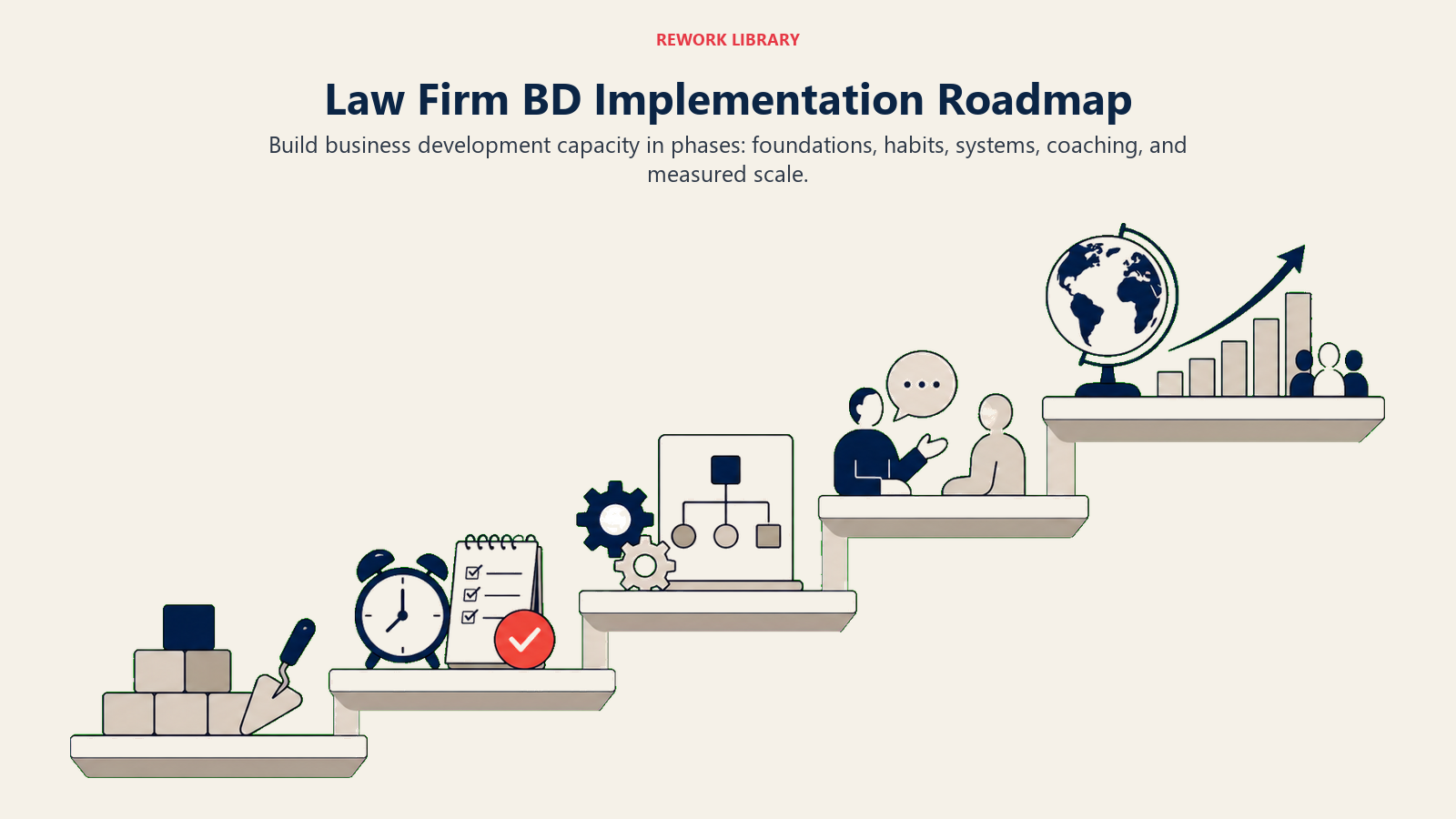
Phase 1: Foundation (Months 1-6)
- Assess current state: Who's doing BD now? What's working?
- Define target client profiles and referral source categories
- Implement CRM and tracking systems
- Provide initial BD training for attorneys
- Launch thought leadership content program
- Identify 3-5 pilot attorneys to test new approaches
Phase 2: Build Momentum (Months 7-18)
- Expand BD training to all partners and senior associates
- Launch speaking program with quarterly events
- Develop referral network strategy with top 20 source framework
- Create accountability structures and reporting
- Publish monthly thought leadership content
- Host quarterly client events
Phase 3: Scale and Refine (Months 19-30)
- Roll out firm-wide BD expectations and metrics
- Refine comp model to reward BD activity
- Expand thought leadership across multiple channels
- Develop strategic partnerships and formal referral relationships
- Implement account-based strategies for target clients
- Build case studies and measure what's working
Phase 4: Optimize and Sustain (Months 31+)
- Continuous improvement based on data
- Advanced training and coaching for high performers
- Leadership development for next-gen rainmakers
- Technology enhancements and automation
- Culture reinforcement through recognition and comp
The timeline is long because behavior change is hard and legal BD requires sustained effort before results appear. Firms that expect transformation in six months will be disappointed and give up.
The goal is building BD capability as a core firm competency, not relying on a few natural rainmakers to carry everyone else.
Adapting for firm size, practice area, and market
Not all law firms are the same. Your BD strategy needs to account for your specific situation:
Firm size considerations:
Small firms (1-10 attorneys): Limited resources but high flexibility. Focus on personal relationships, referral networks, and niche expertise. Every attorney needs to do some BD. Thought leadership can be highly targeted to specific industries or practice areas.
Mid-size firms (11-50 attorneys): Can invest in marketing support and systems but still relationship-driven. Develop practice area thought leadership, host events, and build referral networks systematically. Some specialization is possible - not every attorney needs to be a rainmaker, but most should contribute.
Large firms (50+ attorneys): Need sophisticated BD infrastructure, marketing departments, and specialized roles. Can invest in brand building, content programs, account-based strategies, and formal partnerships. But relationship development still happens attorney by attorney.
Practice area differences:
Litigation: BD often comes from past success and reputation. Case results drive referrals. Thought leadership focuses on trial outcomes, legal trends, and risk management. Speaking opportunities at insurance conferences, corporate legal departments, and bar events.
Corporate/Transactional: Relationship-driven with long sales cycles. Cross-selling opportunities within existing clients. Thought leadership on regulatory changes, industry trends, and strategic guidance. Networking in industry associations and executive groups.
Specialized practices (IP, tax, healthcare, etc.): Highly technical with narrow target markets. Thought leadership must demonstrate deep expertise. Speaking at specialized conferences and publishing in niche journals. Referral networks with other professionals serving the same industries.
Geographic and market factors:
Major markets (NYC, SF, Chicago): Highly competitive with many firms. Differentiation is critical. Thought leadership needs to be sophisticated. Networking opportunities are abundant but crowded.
Regional markets: Relationship networks are tighter. Reputation travels faster (good and bad). Community involvement and local visibility matter more. Bar association leadership can be more impactful.
Niche markets: Whether by industry, practice area, or client type, niche positioning allows for targeted BD. Become the known expert in your niche rather than competing broadly.
Ethics and regulatory compliance:
State bar rules vary on advertising, solicitation, and marketing claims. Know your jurisdiction's rules and build BD programs that comply. Common restrictions include:
- Testimonials and endorsements (prohibited in some states)
- Comparative claims ("we're the best")
- Guarantees of outcomes
- Payment for referrals
- Direct solicitation of prospective clients
- Specialty certifications and claims of expertise
Work with your general counsel or ethics advisor to ensure BD activities don't create compliance issues.
Where to go from here
Law firm business development is a long game. You're building expertise, relationships, and reputation that compound over time. The attorneys and firms that invest consistently in BD create competitive advantages that are difficult for others to match.
Start with the fundamentals:
- Overcome the cultural resistance to BD by reframing it as expertise building and relationship development
- Develop systematic referral networks using the top-20 framework
- Launch thought leadership programs that position your attorneys as authorities
- Create accountability structures so BD actually happens
For deeper strategies on specific components:
Business Development Strategy covers the strategic foundation for professional services growth.
Professional Networking provides frameworks for building valuable professional relationships.
Thought Leadership Strategy details how to position expertise through content and visibility.
Content Marketing for Professional Services explains content approaches that work for expert positioning.
The firms that win at BD are those that make it systematic, not accidental. Build the systems, create the culture, provide the support, and measure the results. That's how you move beyond depending on three rainmakers to creating a firm where business development is what successful lawyers do.

Sales Director
On this page
- Why legal BD is different from traditional sales
- The rainmaker reality and why most lawyers avoid BD
- Understanding rainmaking as relationship architecture
- Rainmaker compensation models and what drives behavior
- Building your referral network strategy
- Thought leadership as long-term positioning
- Creating your client development funnel
- Essential practice development activities
- Lead generation channels that work for legal
- Overcoming implementation barriers
- Measuring what matters in legal BD
- Implementation roadmap: building BD capacity over time
- Adapting for firm size, practice area, and market
- Where to go from here