Leverage Model Optimization: Structuring the Pyramid for Sustainable Profitability

Turn this article into takeaways for your work.


Each assistant summarizes the article only for you and suggests best practices for your work.
Here's the paradox every professional services firm faces: you need leverage to make money, but too much leverage kills your quality and burns out your team. Get it wrong in either direction and you'll either be broke or overwhelmed.
The leverage model - that pyramid of partners, senior staff, mid-level professionals, and junior associates - is what separates profitable firms from struggling ones. But most firms either ignore it completely or copy someone else's structure without understanding why it works for them and won't work for you.
This guide shows you how to design the leverage model that fits your specific business, optimize it as you grow, and avoid the mistakes that tank profitability or destroy culture.
What the leverage model actually is
Let's start with what leverage means in professional services. It's not about working harder or doing more with less. It's about organizational design: the ratio of higher-paid professionals to lower-paid ones, and how that structure affects your economics.
In simple terms, leverage is the number of junior and mid-level staff per partner or senior principal. A consulting firm with one partner and five consultants has a leverage ratio of 5:1. A boutique law firm with three partners and two associates has a leverage ratio of 0.67:1.
But it's not just a headcount number. It's about how work flows through your organization. Partners generate and sell work. Junior staff execute it. Mid-level professionals manage it. The pyramid shape means more people doing execution than selling, which is how you scale beyond founder capacity.
Here's what people miss: leverage is different from utilization. Utilization measures how much time your people spend on billable work. Leverage measures your staffing structure. You can have high utilization with low leverage (everyone's busy, but you don't have enough people). Or low utilization with high leverage (you've got lots of staff, but not enough work to keep them busy).
The goal is getting both right simultaneously. That's the profitability sweet spot.
The mathematics that make leverage work
The reason leverage drives profitability comes down to margin multiplication. Let's look at the actual math.
Say you have a partner who bills at $400/hour and costs the firm $200/hour in compensation and overhead. That's a 50% margin: you make $200 on every hour they work.
Now add a mid-level consultant who bills at $250/hour but costs only $100/hour. That's a 60% margin. And a junior analyst who bills at $150/hour but costs $60/hour. That's also a 60% margin.
If your partner works alone on a 100-hour project, you make:
- 100 hours × $400/hour = $40,000 revenue
- 100 hours × $200/hour = $20,000 cost
- Net profit: $20,000
But if you leverage that work across the team, you might have:
- Partner: 20 hours × $400 = $8,000 revenue, $4,000 cost
- Mid-level: 40 hours × $250 = $10,000 revenue, $4,000 cost
- Junior: 40 hours × $150 = $6,000 revenue, $2,400 cost
- Total: $24,000 revenue, $10,400 cost
- Net profit: $13,600
Wait, that's less profit, right? True. But here's what changed: the partner only spent 20 hours instead of 100. That means they can work on five projects simultaneously instead of one. Now the math looks different:
Five leveraged projects:
- Total revenue: $120,000 (5 × $24,000)
- Total cost: $52,000 (5 × $10,400)
- Net profit: $68,000
The partner's time is the constraint. Leverage removes that constraint by letting them touch multiple projects instead of executing everything themselves. That's where the profitability multiplier comes from.
The leverage multiplier formula is: Profit per Partner = (Partner Revenue + Leveraged Staff Revenue - Total Costs) × Number of Concurrent Projects
The higher your leverage ratio, the more concurrent projects you can handle, and the more profit each partner generates. But only if you actually have the work to keep everyone busy.
The four leverage pyramid structures
Not all professional services firms need the same leverage model. There are four basic structures, each with different economics and trade-offs.
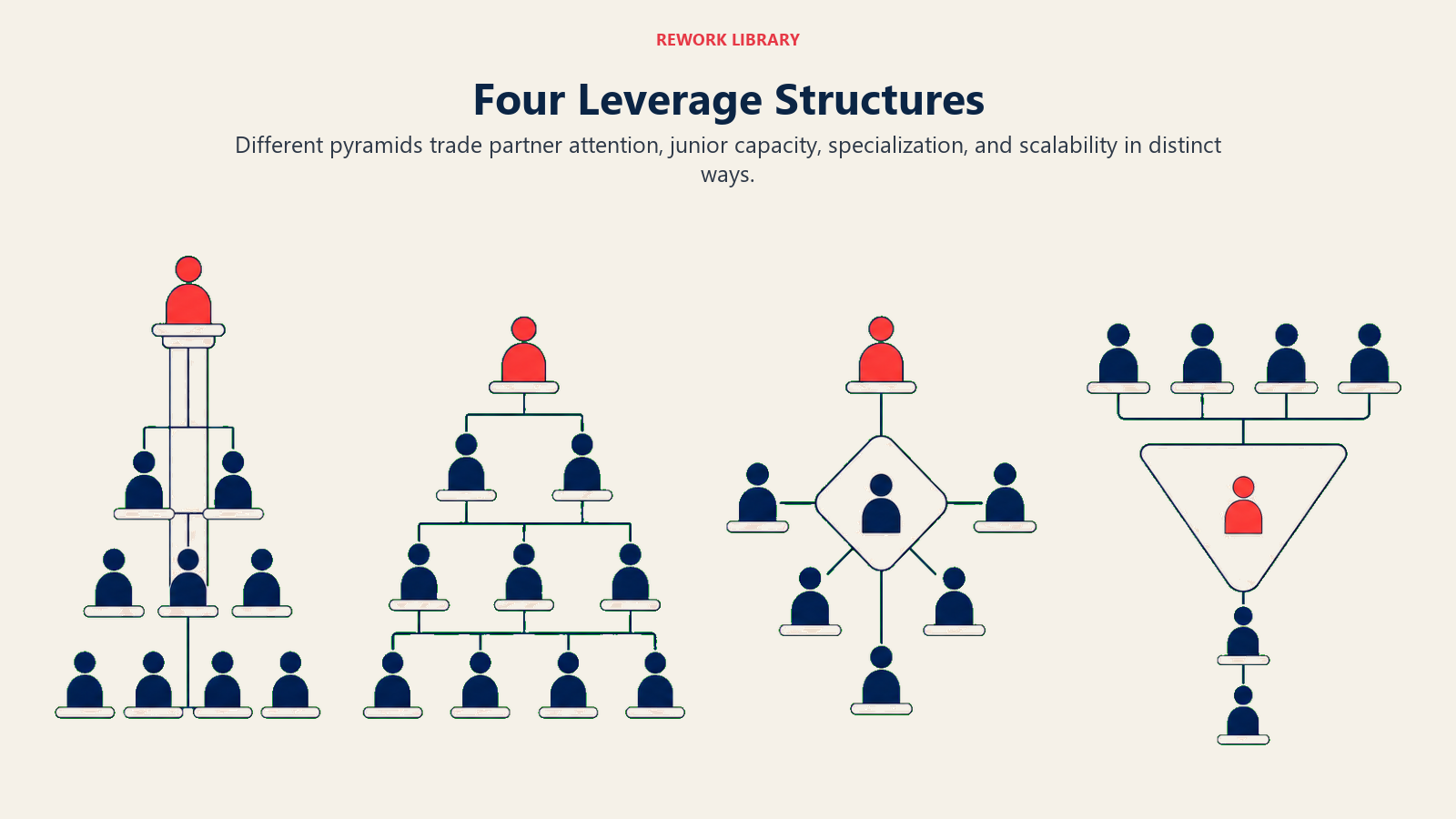
High leverage model (5:1 to 10:1 ratio): This is the McKinsey or Big Four consulting model. One partner supervises five to ten junior and mid-level staff. Partners focus almost entirely on client relationships and sales. Senior managers run the work. Consultants and analysts do the execution.
This model maximizes profit per partner but requires constant pipeline. You need a steady flow of large projects to keep everyone busy. It's also vulnerable to quality issues if you don't have strong training and supervision systems. Junior staff need lots of guidance, and if partners get too removed from the work, things slip.
Works for: Large firms, established brands, project-based work that can be broken down into components, clients who care more about process and credentials than custom insights.
Moderate leverage model (2:1 to 4:1 ratio): This is the mid-market professional services sweet spot. One senior person for every two to four junior or mid-level staff. Partners still do substantive work but delegate execution and portions of delivery.
This balances profitability with quality control. Partners stay close enough to the work to catch problems, but they're not doing everything themselves. It's the most common model for specialized consulting firms, mid-sized law practices, and engineering firms.
Works for: Growing firms, specialized expertise areas, clients who want senior-level attention but don't need partners doing every task, mixed retainer and project work.
Low leverage model (1:1 to 1.5:1 ratio): Boutique firms and premium services. One partner for every one to one-and-a-half junior staff, or sometimes just all senior people with no junior staff at all.
This is the "gray hair" model. Clients pay for deep expertise and senior attention. You're trading leverage profits for premium pricing and lower overhead risk. Your utilization can be lower because you're not supporting a large staff.
Works for: Boutique firms, highly specialized or creative work, executive advisory, clients who demand partner-level attention, high-uncertainty work that can't be templated.
No leverage model (0:1 ratio): Solo practitioners or partner-only firms. Everyone is a senior-level professional. No junior staff at all.
This isn't actually leverage, it's anti-leverage. But it's a valid model for certain practices. You give up profit multiplication, but you also have no hiring risk, no management overhead, and complete control over quality. Your income is capped by your personal capacity, but your overhead is minimal.
Works for: Solo practitioners, very small partnerships, highly specialized expertise that can't be delegated, transitional phases while building up to a leveraged model.
Most firms don't consciously choose their leverage model. They hire opportunistically and end up with whatever structure emerges. That's a mistake. Your leverage model should be a strategic decision based on your service delivery approach and target economics.
Designing your optimal leverage model
Here's the six-step process for designing the right leverage structure for your firm.
Step 1: Define your service delivery approach
Start with how you actually deliver work. Can your services be broken into components that junior staff can execute? Or do they require deep expertise throughout?
If you're doing implementation work, compliance reviews, or process consulting, you can probably delegate execution. If you're doing strategy, turnarounds, or highly specialized technical work, you probably can't.
Also consider client expectations. Do they pay for senior attention or results? If they're buying your insights, you need senior people doing the work. If they're buying process and methodology, you can leverage more.
Step 2: Determine your required skill pyramid
Map out what skills are actually needed for each phase of delivery. Client meetings and relationship management need partners. Project planning and oversight need senior managers. Execution and analysis can be done by consultants. Research and data gathering can be done by analysts.
Be honest about this. Don't assume you can delegate something just because you want to. If your work requires judgment calls every few hours, you can't delegate to junior staff without constant supervision, which defeats the leverage.
Step 3: Calculate economics by role
Run the math on each role level. What do they cost (salary, benefits, overhead)? What can you bill them at? What's the margin?
For example:
- Partner: $400/hour bill rate, $200/hour cost = 50% margin
- Senior Manager: $300/hour bill rate, $125/hour cost = 58% margin
- Manager: $225/hour bill rate, $90/hour cost = 60% margin
- Consultant: $175/hour bill rate, $70/hour cost = 60% margin
- Analyst: $125/hour bill rate, $50/hour cost = 60% margin
Notice that junior staff often have higher margins than partners because the gap between bill rate and cost is proportionally larger. That's why leverage works, you're replacing expensive partner time with cheaper staff time while maintaining or improving margins.
Step 4: Assess market constraints
What will clients actually pay for different role levels? Some markets have clear rate expectations. Legal services have published rate surveys by role and geography. Management consulting has established rate bands.
If clients won't pay $175/hour for a consultant, you can't support that role at a $70/hour cost. Your leverage model has to fit market economics.
Also consider talent availability. If you can't hire good mid-level people in your market, a model that depends on them won't work.
Step 5: Balance profitability with quality
Here's where most firms go wrong. They optimize purely for profit and build too much leverage. Then quality drops, clients complain, and they lose business.
Or they optimize for quality and don't leverage enough. Then partners burn out doing junior-level work, and the firm never scales.
You need to find the balance. What's the minimum senior involvement required to maintain quality? That sets your maximum leverage ratio.
A good test: if a partner gets hit by a bus, can the team deliver the work without them? If yes, you might be over-leveraged (partners aren't involved enough). If no, you might be under-leveraged (too dependent on individual partners).
Step 6: Build your implementation roadmap
You can't go from no leverage to high leverage overnight. You need a hiring sequence and timeline.
Start by identifying your biggest constraint. If partners are doing too much execution work, hire mid-level people first to take that load. If mid-level people are doing too much admin, hire analysts or project coordinators.
Model the economics at each stage. Going from 0:1 to 2:1 leverage changes your cost structure before it changes your revenue. You need cash reserves or financing to cover that gap.
Plan 12-18 months out. Hiring takes time. Training takes time. Building workload to support new roles takes time. Rush it and you'll have expensive staff with no work. Go too slow and your partners burn out before help arrives.
Economics by role level: what each position should generate
Let's get specific about what each role level should contribute financially.
Partner/Principal economics: Partners should generate 3-4x their compensation in revenue. If a partner costs the firm $300K in total comp and overhead, they should generate $900K to $1.2M in revenue annually.
But that's not just from their own billable time. It includes the leveraged work they supervise. A partner billing 1,200 hours at $400/hour generates $480K directly. The other $420K-$720K comes from the team working under them.
Partner profitability comes from two sources: their high billing rate and the profit from leveraged staff. If you only measure partner revenue from their own hours, you'll think they're not profitable enough and won't invest in leverage.
Director/Senior Manager economics: This role should generate 2.5-3x their cost. They're billable at high rates, they supervise junior staff, and they have lower overhead than partners (no equity, smaller bonuses).
A senior manager costing $175K should generate $440K-$525K in revenue. About 60% from their own billable time and 40% from supervised staff.
This is your leverage multiplication layer. They let partners touch more work without doing it all themselves.
Manager/Senior Consultant economics: Target 2-2.5x their cost. These people are your workhorses. They're billing at decent rates, they're executing the core work, and they're starting to supervise analysts.
A manager costing $125K should generate $250K-$310K. Mostly from their own billable hours, with some leverage as they delegate to junior staff.
Consultant/Analyst economics: Target 2-2.2x their cost. Junior staff have less pricing power, but their costs are lower. They should generate positive margins, but the real value is that they free up senior time.
An analyst costing $75K should generate $150K-$165K, almost entirely from their own billable hours.
If junior staff aren't hitting these multiples, something's wrong. Either you're not billing them out enough (utilization problem), your rates are too low (pricing problem), or you're paying them too much (comp structure problem).
How leverage affects delivery quality and sustainability
Here's the uncomfortable truth: every level of leverage introduces quality risk. When you delegate work, you're trusting that it gets done right. Sometimes that trust is misplaced.
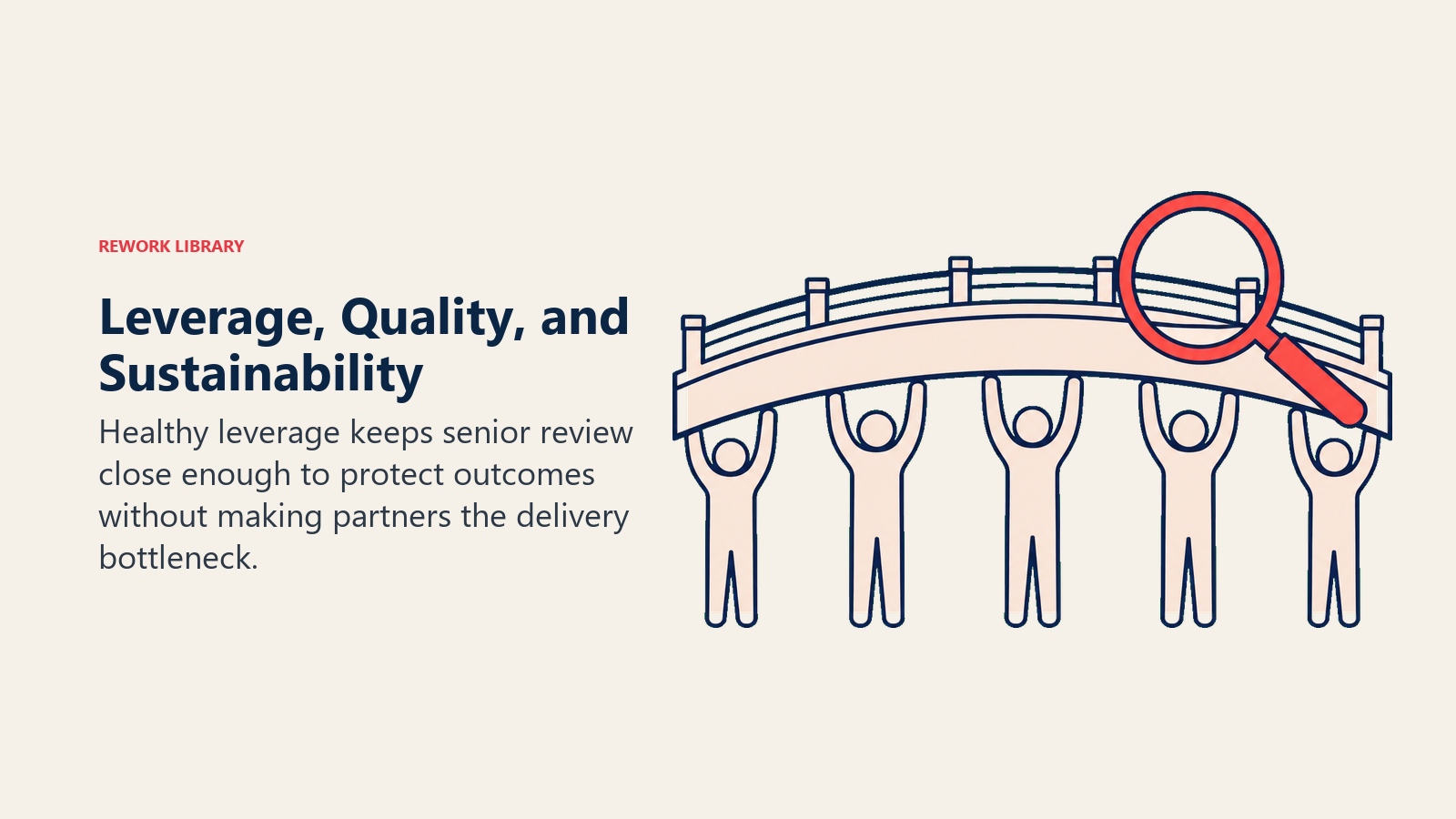
Quality risk from high leverage: When partners are too removed from the work, they can't catch problems early. Junior staff make mistakes that compound. Clients feel like they're not getting what they paid for.
The symptoms show up as rework, client complaints about junior staff doing senior-level work, or partners having to redo things at the last minute. All of that destroys profitability because you're paying for work twice.
The fix isn't eliminating leverage. It's building review systems and quality checkpoints. Templates, methodology, training programs, and regular partner reviews keep quality high even with junior staff executing.
Burnout risk from over-leverage: When you don't have enough senior people, your managers and partners burn out. They're supervising too many direct reports, they're jumping between too many projects, and they can't keep up.
The symptom is senior people working 70-hour weeks consistently while junior staff have 50-60% utilization. That's a staffing imbalance.
The fix is hiring more mid-level people or reducing your client load. You can't sustain that imbalance long-term without losing people.
Client relationship risk: Some clients will only work with partners. If they're paying premium rates, they expect senior attention. High leverage models fail with these clients because partners don't have time for them.
You need to segment your client base. Which clients need constant partner access (low leverage accounts) vs which are fine with partner oversight and manager execution (high leverage accounts)? Price and staff them differently.
Optimal leverage by service type: Different services support different leverage levels.
Strategy consulting: Low leverage (1:1 to 2:1). Clients pay for insights, not execution.
Implementation consulting: Moderate to high leverage (3:1 to 6:1). Execution can be delegated once the approach is set.
Legal services: Varies by practice area. Litigation is high leverage (partners, associates, paralegals). M&A is low leverage (mostly senior attorneys).
Accounting/audit: High leverage (partners, managers, staff accountants, interns). Much of the work is process-driven.
Engineering: Moderate leverage (2:1 to 4:1). Technical work requires expertise but can be delegated to skilled engineers.
Match your leverage model to your service delivery reality, not what you wish you could charge for.
Staffing strategies to achieve your target leverage
You can't just post job ads and hope the right pyramid emerges. You need a deliberate hiring sequence.
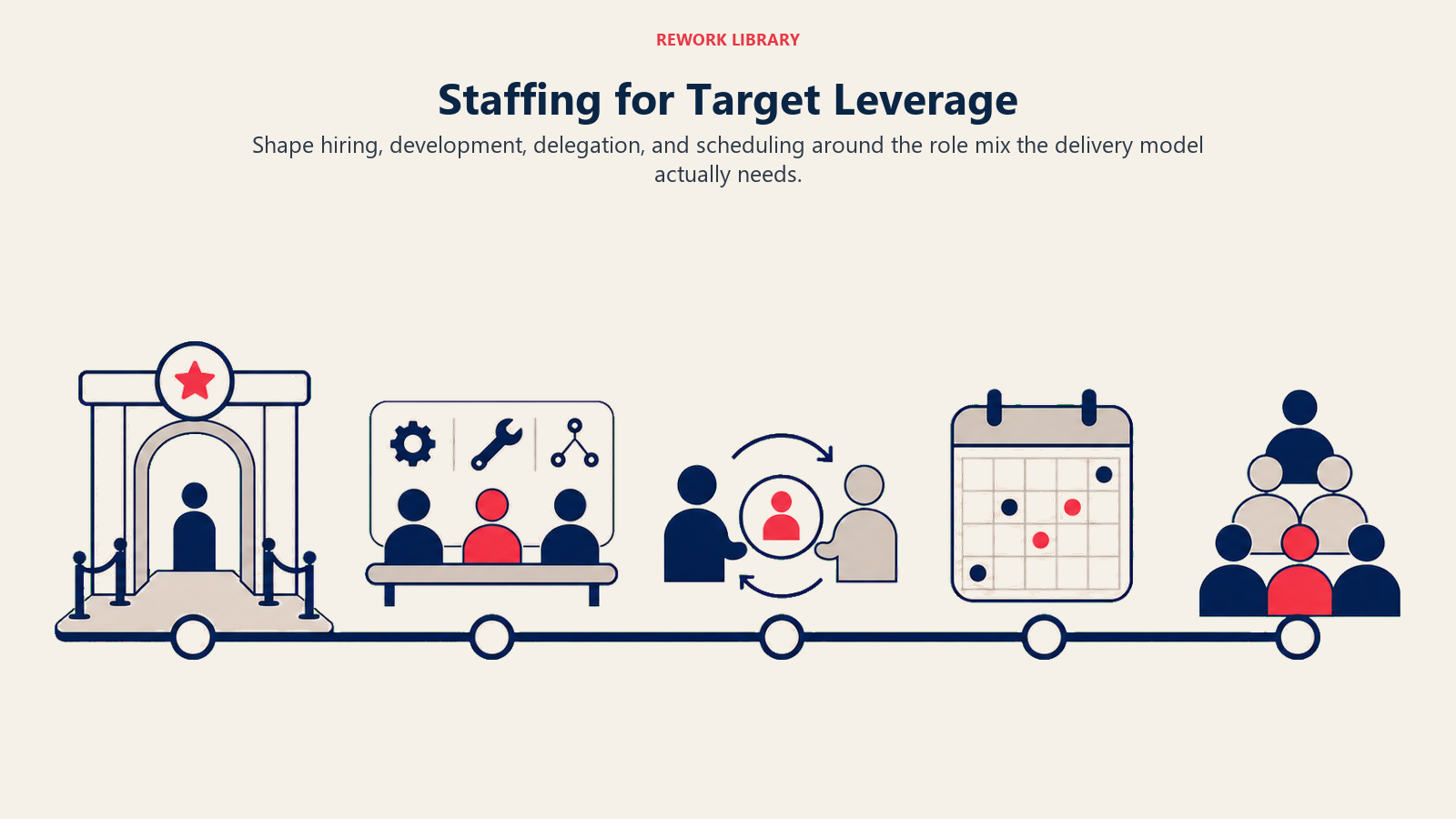
Hiring sequence for building leverage: Start by hiring the layer directly below partners. If you're all partners, hire senior managers first. They can immediately take on work and start building relationships. Once they're busy, hire the next layer down.
Don't hire analysts before you have managers to supervise them. You'll end up with partners babysitting junior staff, which is expensive and inefficient.
A common sequence:
- Partners generate more work than they can handle
- Hire senior managers to take execution load
- Senior managers get busy, hire managers to support them
- Managers need help with research and data, hire analysts
- Analysts create enough work product that you need more managers to review it
- Loop continues as you scale
Your staffing and resource allocation approach should anticipate this sequence.
Organic growth vs acquisition: You can build leverage slowly through hiring, or you can acquire it by buying a team or another firm.
Organic is slower but gives you cultural control. You hire people who fit your approach and train them your way.
Acquisition is faster but riskier. You get immediate leverage, but integration can be messy. If the acquired team has different standards or approaches, you might create more problems than you solve.
Most firms do a mix. Hire for most roles, acquire selectively when you need a capability or market you can't build fast enough.
Promotion ladder management: Your leverage model only works if people move through it. If everyone stays at their level forever, you end up with an hourglass: lots of partners, lots of junior staff, no middle. This connects directly to your talent development program and career pathing.
You need a clear promotion path and timeline. Analyst to consultant in 2-3 years. Consultant to manager in 3-4 years. Manager to senior manager in 4-5 years. Senior manager to partner in 5-7 years.
Not everyone makes it through every stage. That's fine. Some people plateau at manager and that's their career. Others leave for industry roles. The key is having a predictable flow where some percentage moves up and you backfill at the bottom.
If you're not promoting people on schedule, you have a problem. Either you're not developing them (training issue) or you don't have partner slots available (leverage model issue).
Contractor and sub-contractor models: You don't have to hire everyone. Contractors give you leverage flexibility without long-term payroll commitment.
Use contractors for:
- Capacity spikes (you need five extra consultants for three months)
- Specialized skills you don't need full-time
- Testing new service lines before hiring
- Geographic markets where you don't have full teams
The downside is contractors cost more per hour and don't build institutional knowledge. They're a short-term solution, not a long-term leverage strategy.
Partner equity structures: How you bring in new partners affects your leverage model. If every senior manager becomes an equity partner, you're adding to the top of the pyramid instead of the middle.
Some firms solve this with two-tier partnerships: equity partners who own the firm and non-equity partners or principals who are senior but don't have ownership. This lets you promote people to senior roles without diluting equity.
The ratio of equity partners to everyone else is your real leverage ratio. A firm with 10 equity partners and 50 other staff has 5:1 leverage. If five of those staff become equity partners, leverage drops to 3:1 and profit per partner drops.
Leverage model adjustments as you grow
Your leverage model needs to evolve as your firm matures. What works at $500K revenue doesn't work at $5M, and definitely doesn't work at $20M.

Stage 1: Founder-Led ($0-$500K revenue): You're a solo practitioner or very small partnership. No leverage, or maybe one junior person. Your model is 0:1 or 1:1.
At this stage, leverage is premature. You don't have consistent enough revenue to support staff. Focus on getting to repeatable revenue first.
The transition point: when you're consistently turning down work because you don't have capacity, it's time to hire.
Stage 2: Team Formation ($500K-$2M revenue): You hire your first few people. Maybe one senior person and one or two junior staff. Your model is 1:1 to 2:1.
This is the hardest stage. You're learning to delegate, your new hires are learning your approach, and your costs just jumped while revenue lags. Many firms get stuck here because they hire wrong or don't have systems to support staff.
The key is hiring people who can work independently with light supervision. If you're micromanaging everything, you're not scaling.
The transition point: when your senior staff are fully utilized and turning down work, you're ready for the next layer.
Stage 3: Structured Growth ($2M-$5M revenue): You have a real team. Multiple senior people, several mid-level folks, a few junior staff. Your model is 2:1 to 4:1.
This is where you build real leverage structure. You need defined roles, career paths, and quality systems. You're transitioning from "everyone does everything" to specialization.
The challenges: maintaining culture, keeping communication clear, making sure quality doesn't slip as you delegate more.
The transition point: when you have multiple teams or practice areas operating somewhat independently, you're ready to scale to the next level.
Stage 4: Established Firm ($5M-$10M revenue): You've got a proper pyramid. Multiple partners, a healthy layer of senior managers, robust mid-level bench, and junior staff. Your model is 4:1 to 6:1.
At this stage, leverage optimization is about efficiency. You're tweaking ratios, improving utilization, adjusting rates by role, and refining your promotion pipeline.
The challenges: partners staying involved without micromanaging, maintaining quality across multiple teams, building enough leadership bench for continued growth.
Stage 5: Scalable Enterprise ($10M+ revenue): You're a real firm with infrastructure. Your leverage model is 6:1 to 10:1 or even higher. You have formalized training, clear methodologies, and systems for everything.
At this stage, the challenge is avoiding the bureaucracy that kills professional services firms. You need structure, but you can't lose the senior talent who made you successful.
The risk: becoming too leveraged, where junior staff are doing too much and quality suffers, or senior people leave because they're just managing people instead of doing interesting work.
Fixing common leverage problems
Most firms have leverage problems. Here's how to diagnose and fix them.
Problem: Under-leveraged (too many partners)
Symptoms: High profit per dollar of revenue, but low total profit. Partners doing execution work. Long hours for senior people. Can't take on more work even when revenue is there.
Diagnosis: Your partner-to-staff ratio is too low. You might be 1:1 or even 0.5:1. Partners are doing work that could be delegated.
Fix: Hire mid-level people who can take execution load. Promote senior staff to reduce dependency on partners. Document your approaches so they can be taught to others.
Be careful: Don't hire too fast. Add one person, get them busy, then add the next. Over-hiring while under-leveraged kills cash flow.
Problem: Over-leveraged (too many juniors)
Symptoms: Low utilization for junior staff. Partners constantly fixing mistakes. Clients complaining about quality. High staff turnover. Profit margins lower than expected despite lots of leverage.
Diagnosis: You have too many junior people and not enough senior oversight. Your pyramid is too wide at the bottom.
Fix: Stop hiring at the bottom. Hire or promote mid-level people who can supervise. In extreme cases, you might need to cut junior staff.
Also look at your work mix. If you're doing complex projects that can't be delegated, your leverage model is wrong for your service type.
Problem: Misaligned leverage (wrong roles)
Symptoms: Some people are swamped, others are underutilized. You're hiring for roles you don't need. High turnover in certain positions.
Diagnosis: Your pyramid shape is wrong. Maybe you have lots of junior analysts but no managers to review their work. Or lots of managers but not enough senior people to sell work.
Fix: Map your actual workflow. Where are the bottlenecks? Hire to relieve bottlenecks, not to fill org chart boxes.
Problem: Leverage volatility (fluctuating revenue)
Symptoms: Your leverage works great when you're busy, but revenue dips and suddenly you can't keep people utilized. You're hiring and laying off in cycles.
Diagnosis: Your revenue isn't consistent enough to support your leverage model. You've built fixed costs that require steady work.
Fix: Either stabilize revenue (retainer contracts, longer-term engagements) or make your cost structure more flexible (contractors instead of employees, variable comp). Or accept lower leverage until revenue is predictable.
Technology and the evolution of leverage
Technology is changing the leverage equation, but not in the way most people think.
Automation and leverage economics: Tools that automate junior-level work change your leverage model. If software can do what analysts used to do, you don't need as many analysts.
But you still need someone to manage the tools, interpret output, and apply judgment. That shifts your pyramid shape: fewer junior people, more mid-level people who can use technology effectively.
Example: Legal research used to require associates spending hours in libraries. Now AI tools do that in minutes. But you still need lawyers to evaluate the research and apply it to the case. The leverage changes from partners + associates to partners + tech-savvy senior associates.
AI-augmented services: If you integrate AI into your delivery, you can maintain higher margins with lower leverage. A partner using AI tools can produce output that used to require a team of three consultants.
But clients won't pay the same rates for AI-augmented work. They'll expect lower prices. So your revenue per project might drop even as your costs drop.
The firms that win here will find the new equilibrium: lower rates but much lower costs, maintaining margins while reducing leverage needs.
Remote delivery and geographic leverage: Remote work lets you hire anywhere. That changes leverage economics because you can hire talented mid-level people in lower-cost markets.
If your partners are in New York billing at $500/hour and your senior managers are in Austin billing at $275/hour but costing 30% less than New York equivalents, your margins improve.
This is geographic leverage: same skill level, different labor costs. It's particularly powerful for work that doesn't require client-facing presence.
Global delivery models: The extreme version of geographic leverage is the global delivery model. Partners and senior managers in high-cost markets doing client work. Execution staff in low-cost markets (India, Eastern Europe, Latin America).
This works for certain services (software development, data analysis, research) but fails for others (strategy consulting, client advisory). The more judgment and context required, the harder it is to offshore.
Productization and templates: When you turn custom services into productized offerings, you need less leverage. A productized service might be delivered by one person using templates and automation instead of a team of five doing custom work.
This is anti-leverage in a sense: you're replacing people with process. But it can be more profitable because productized services have better margins and scale differently.
Integration with your business model
Your leverage model has to fit your business model. Different revenue models support different leverage structures.
Retainer-based business: Monthly retainers create predictable revenue, which supports higher leverage. You know income for the next 6-12 months, so you can hire with confidence.
The challenge is that retainers often require senior attention. Clients paying monthly expect consistent partner involvement. That limits how much you can leverage unless you set expectations carefully.
A hybrid works well: senior partner oversight with dedicated manager-level delivery. The partner is involved but not doing execution.
Project-based business: Projects create lumpy revenue, which makes leverage risky. You might be slammed for three months then slow for two.
The solution is either maintaining lower leverage so you're not supporting huge staff during slow periods, or using contractors to flex up during busy times.
Or you stagger projects so workload is more consistent. That requires strong sales and pipeline management.
Managed services leverage models: If you're running managed services (running a function for clients), you can use high leverage because the work is ongoing and process-driven.
You might have one partner overseeing five managed service engagements, each with a manager and two analysts. That's 15:1 leverage, which is very high.
This works because managed services are less about custom insights and more about consistent execution. Your margins come from efficiency and scale.
Hybrid models: Most firms have a mix of retainers, projects, and maybe some managed services. Your leverage model needs to account for all of them.
You might segment your team: one group focused on high-leverage managed services, another group focused on low-leverage strategic projects. Different economics, different staffing models.
Compensation strategy and leverage alignment
Your comp structure needs to support your leverage model. If they're misaligned, you'll get the wrong behaviors.
Salary vs profit-sharing: High-leverage firms often have lower salaries but higher profit-sharing for partners. The idea is that you make money from the team's leverage, not just your own billable hours.
Low-leverage firms often have higher salaries and lower profit-sharing because there's less profit to share. Your income comes from billing high rates, not from leverage multiplication.
Make sure your comp philosophy matches your leverage model. If you're trying to build leverage but paying partners purely on their own billable hours, they won't invest time in developing staff or selling leveraged projects.
Partner equity capacity: As you add partners, you're diluting profit. Every new equity partner reduces the profit pool for existing partners unless revenue grows proportionally.
This is the partner leverage constraint. You can only add partners if you're adding enough leveraged revenue to maintain profit per partner. Otherwise, you're just splitting the pie into smaller pieces.
Some firms solve this with non-equity partners or income partners who get high comp but not ownership. They're senior people who generate revenue but don't dilute equity. This lets you maintain leverage without over-partnering.
Performance incentives alignment: If you reward junior staff for billable hours only, they'll maximize hours instead of efficiency. That's fine for high-leverage models where you want maximum utilization.
But if you're trying to build efficiency and productization, you want to reward outcomes, not hours. Different incentive structure, different behavior.
Make sure your comp metrics align with your leverage strategy.
Building cultural alignment: The hardest part of leverage isn't the math, it's the culture. Partners have to trust their teams. Senior staff have to be willing to develop junior people. Junior staff have to accept that they're learning and won't get the most interesting work right away.
If your culture doesn't support leverage, your model will fail regardless of how good the economics look on paper.
Build this through:
- Clear career paths so people know what to expect
- Training investment so people develop skills
- Quality systems so senior people can delegate with confidence
- Recognition for good delegation and development, not just personal billing
Industry-specific leverage considerations
Different professional services industries have different leverage norms. Here's what typical looks like.
Consulting firms: Management consulting is typically 4:1 to 8:1. Strategy consulting is lower (2:1 to 4:1). Implementation consulting is higher (5:1 to 10:1).
The difference is deliverable complexity. Strategy requires senior judgment throughout. Implementation can be delegated once the approach is set.
Legal practices: Litigation is high leverage (5:1 to 8:1) because discovery, research, and document review can be done by junior associates and paralegals. Partners and senior associates do depositions, motions, and trials.
Corporate/M&A is low leverage (1:1 to 3:1) because deal work requires senior judgment and client confidence. You can't have a first-year associate negotiating deal terms.
Accounting firms: Audit and tax are high leverage (6:1 to 12:1). Partners sell and review. Managers supervise. Staff accountants execute. Interns do data entry and basic testing.
Advisory is lower leverage (3:1 to 5:1) because it's more like consulting. Less process-driven, more judgment-required.
Marketing agencies: Creative agencies are typically low leverage (2:1 to 3:1). Clients pay for senior creative talent. You can't delegate great ideas to junior people.
Media buying and execution agencies are high leverage (4:1 to 8:1). Once strategy is set, execution is process-driven.
Engineering firms: Civil engineering is moderate leverage (3:1 to 5:1). Licensed professional engineers must stamp drawings, but much of the design and drafting can be delegated.
Specialized engineering (structural for high-rises, geotechnical, etc.) is lower leverage (2:1 to 3:1) because expertise is required throughout.
Executive search: Traditional retained search is low leverage (1:1 to 2:1). Partners do most of the work: client relationships, candidate sourcing, assessments.
Contingency recruiting can be higher leverage (3:1 to 5:1) because researchers can do candidate sourcing and initial screens.
Don't just copy what competitors do. Understand why their leverage works for them and whether it fits your specific approach.
Creating your leverage model roadmap
Here's how to actually design and implement your optimal leverage model.
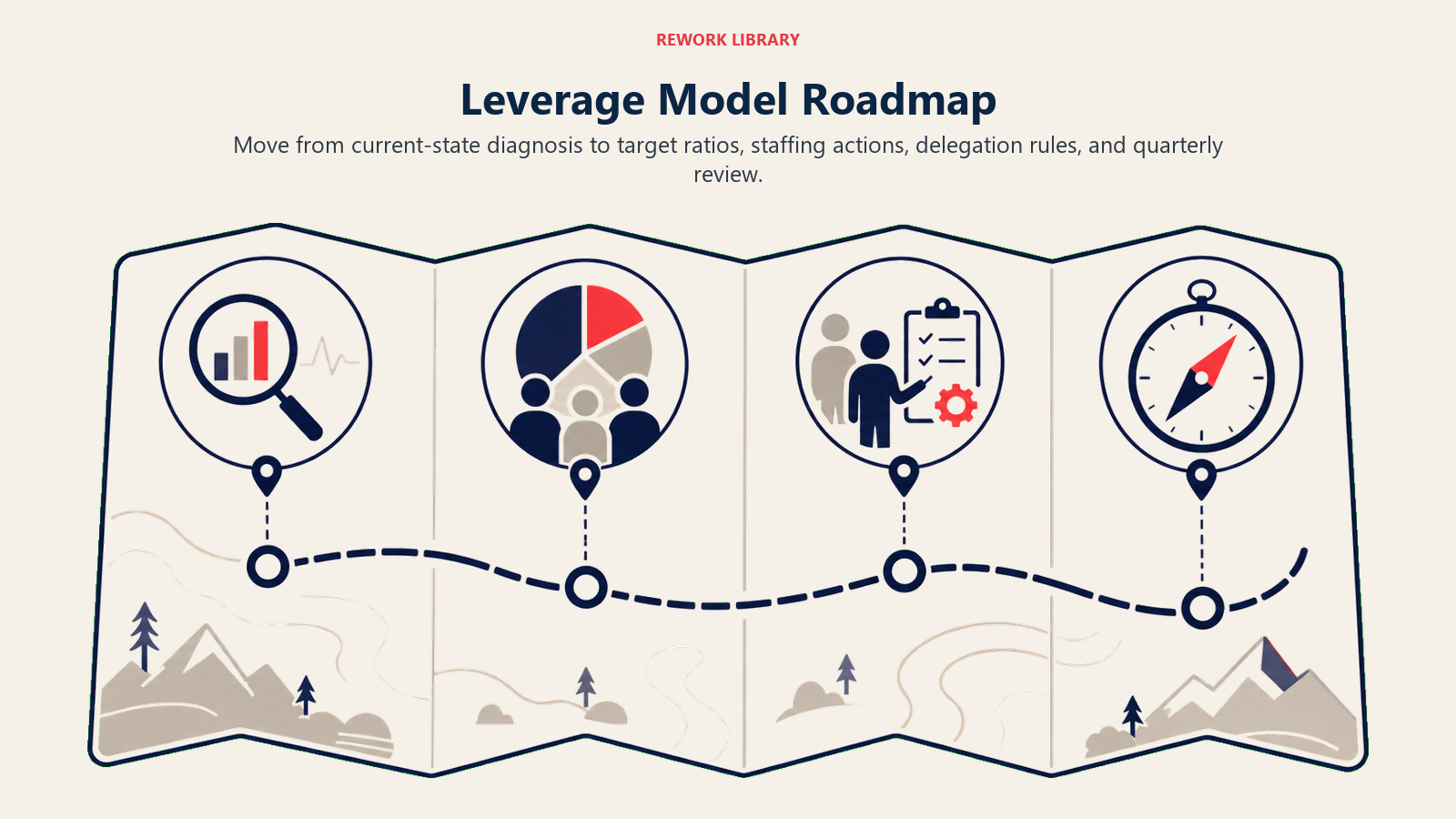
Assessment: Current vs desired state
Start by documenting where you are:
- Current headcount by role level
- Current leverage ratio
- Current revenue and profit per partner
- Current utilization by role level
- Current service mix and delivery approach
Then define where you want to be:
- Target leverage ratio based on your service type
- Target profit per partner
- Target revenue size
- Service mix you want to deliver
The gap between current and desired is your roadmap.
Gap analysis: Roles and hiring sequence
Map the specific hires you need. If you're currently 1:1 and want to get to 4:1, you need to hire three people per partner. But in what sequence? What roles?
Look at your workflow bottlenecks. Are partners doing execution work that could be delegated? Hire senior managers. Are senior managers doing research and admin? Hire analysts.
Build a hiring sequence with time frames:
- Q1: Hire two senior managers
- Q2: Assess utilization, adjust if needed
- Q3: Hire two managers to support senior managers
- Q4: Assess again, plan next year
Resource planning: Costs and payoffs
Model the economics of each hire. A senior manager might cost $150K in total comp and overhead. They need to generate $300K in revenue to break even at 2:1 multiplier.
How long until they're productive? If it takes three months to ramp up, you're carrying that cost before you see revenue. Can you afford it?
Build a cash flow model that shows costs increasing before revenue catches up. Make sure you have enough runway to get through the transition.
Risk mitigation strategies
What could go wrong? The new hire doesn't work out. Revenue drops and you can't keep them busy. Client pushback on junior staff doing work.
Mitigate by:
- Hiring slowly enough to validate each layer before adding the next
- Maintaining cash reserves to cover 6-12 months of payroll
- Building contractor relationships for flex capacity
- Setting clear expectations with clients about team delivery
- Having performance management systems to address bad hires quickly
Monitoring and adjustment metrics
Track these monthly:
- Leverage ratio (total staff / partners)
- Utilization by role level
- Revenue per FTE
- Profit per partner
- Staff to revenue ratio
If utilization starts dropping, you've hired too fast or don't have enough work. If profit per partner isn't improving despite adding leverage, something's wrong with your model or pricing.
Don't just build the model and assume it works. Monitor, adjust, and refine continuously.
Where to go from here
Leverage model optimization isn't a one-time project. It's an ongoing management discipline. As your firm grows, as your services evolve, as your market changes, your leverage model needs to adapt.
Start by understanding where you are and where you want to be. Then build a deliberate path to get there. Don't hire opportunistically. Don't copy someone else's model. Design the structure that fits your specific business.
The goal isn't maximum leverage. It's optimal leverage: the balance of profitability, quality, and sustainability that lets you grow without burning out your team or disappointing your clients.
For more on building a sustainable professional services firm:
- Professional Services Growth Model - The complete framework for scaling your firm
- Utilization & Capacity Planning - Managing your team's time and productivity
- Professional Services Metrics - KPIs that measure firm performance
- Billable Hour vs Value Pricing - Pricing strategies that support different leverage models

Sales Director
On this page
- What the leverage model actually is
- The mathematics that make leverage work
- The four leverage pyramid structures
- Designing your optimal leverage model
- Economics by role level: what each position should generate
- How leverage affects delivery quality and sustainability
- Staffing strategies to achieve your target leverage
- Leverage model adjustments as you grow
- Fixing common leverage problems
- Technology and the evolution of leverage
- Integration with your business model
- Compensation strategy and leverage alignment
- Industry-specific leverage considerations
- Creating your leverage model roadmap
- Where to go from here