Staffing & Resource Allocation: Managing Team Capacity for Profitable Growth
Turn this article into takeaways for your work.


Each assistant summarizes the article only for you and suggests best practices for your work.
Here's the dilemma every professional services leader faces: hire too soon and you burn cash on underutilized people. Hire too late and you can't deliver for clients, burning relationships and revenue. Get resource allocation wrong and your best people burn out while others sit idle. Meanwhile, project margins swing wildly based on who you can actually staff versus who you need.
The difference between profitable firms and struggling ones often isn't the caliber of work or the size of deals - it's how effectively they manage team capacity. Can you predict resource needs three months out? Do you know which skills will be in shortage before it becomes a crisis? Can you balance utilization targets with the strategic bench time people need to develop skills and pursue business development?
This isn't just an operations problem. It's a growth problem. Your staffing model determines how fast you can scale, what types of projects you can pursue, and which clients you can serve profitably. Get it right and you create a sustainable engine for expansion. Get it wrong and growth becomes a cycle of chaos and firefighting. Understanding this is central to the professional services growth model.
The capacity optimization challenge
Professional services firms live in a permanent state of tension between three competing objectives.
Maximizing billable utilization means keeping people busy on client work as much as possible. Higher utilization drives revenue per employee, improves margins, and makes the math work on salaries and overhead. If you're running a consulting firm where senior consultants bill $250/hour but you're only utilizing them 50% of the time, you're leaving serious money on the table.
Maintaining strategic bench capacity means having some slack in the system. People need time for training, business development, thought leadership, internal projects. If everyone is 100% utilized, you have zero capacity to respond to new opportunities, your best people burn out, and nobody has time to sell the next deal. Plus you need buffer for the inevitable project delays and scope changes.
Building for future growth means investing ahead of demand. If you only hire when you already have the work lined up, you're always behind. But if you staff up speculatively, you're carrying expensive talent with nothing to bill them to. The question isn't whether to do this - it's how much buffer to maintain and where to place your bets.
The firms that win this game do three things well. They forecast demand accurately enough to make informed hiring decisions. They optimize resource allocation so the right people are on the right projects. And they manage utilization actively rather than letting it happen by accident.
But here's what makes it hard: demand isn't linear or predictable. Clients delay projects. Scopes change. People get sick or quit. That big pipeline opportunity you were counting on evaporates. The project that was supposed to last three months wraps in six weeks. You're managing probabilities and scenarios, not certainties.
Understanding billable capacity
Before you can optimize anything, you need to understand what capacity you actually have. This sounds simple but most firms get the math wrong.
Start with theoretical capacity. If someone works 40 hours per week for 52 weeks, that's 2,080 hours per year. But nobody bills 2,080 hours. You need to subtract non-billable time:
- Vacation and holidays (typically 15-20 days)
- Sick time and personal days (5-10 days)
- Internal meetings and admin (varies by role)
- Training and professional development (5-10 days)
- Business development and sales (especially for senior people)
For a typical senior consultant, realistic annual capacity might be:
- 2,080 theoretical hours
- -120 hours for vacation (15 days)
- -80 hours for holidays (10 days)
- -40 hours for sick/personal (5 days)
- -160 hours for internal meetings/admin (2 hours/week)
- -80 hours for training (10 days)
- -120 hours for business development (1.5 days/month) = 1,480 billable hours available
That's 71% of theoretical time. If your utilization target is 80%, you're aiming for about 1,184 billable hours per year, or roughly 23 hours per week. That's the real number you're working with.
But here's where it gets more complex: different roles have different capacity profiles. Partners might have 40% billable targets because they're expected to spend half their time on business development. Junior analysts might have 85% targets because they're not yet selling. Project managers might have lower billable targets if they're managing multiple workstreams.
You also need to factor in ramp time for new hires. Someone joining the firm won't hit full utilization for 3-6 months while they learn your methodologies, get trained on tools, and build relationships. Plan for 50% utilization in month one, 70% in month two, ramping to target by month four.
This all rolls up into your total firm capacity. If you have 50 people with an average available capacity of 1,400 hours at 75% target utilization, you have roughly 52,500 billable hours to sell annually. That's your constraint. Everything flows from this number.
Utilization rate targets by role
Not everyone should have the same utilization target. The right number depends on role, level, and what else you expect people to do.
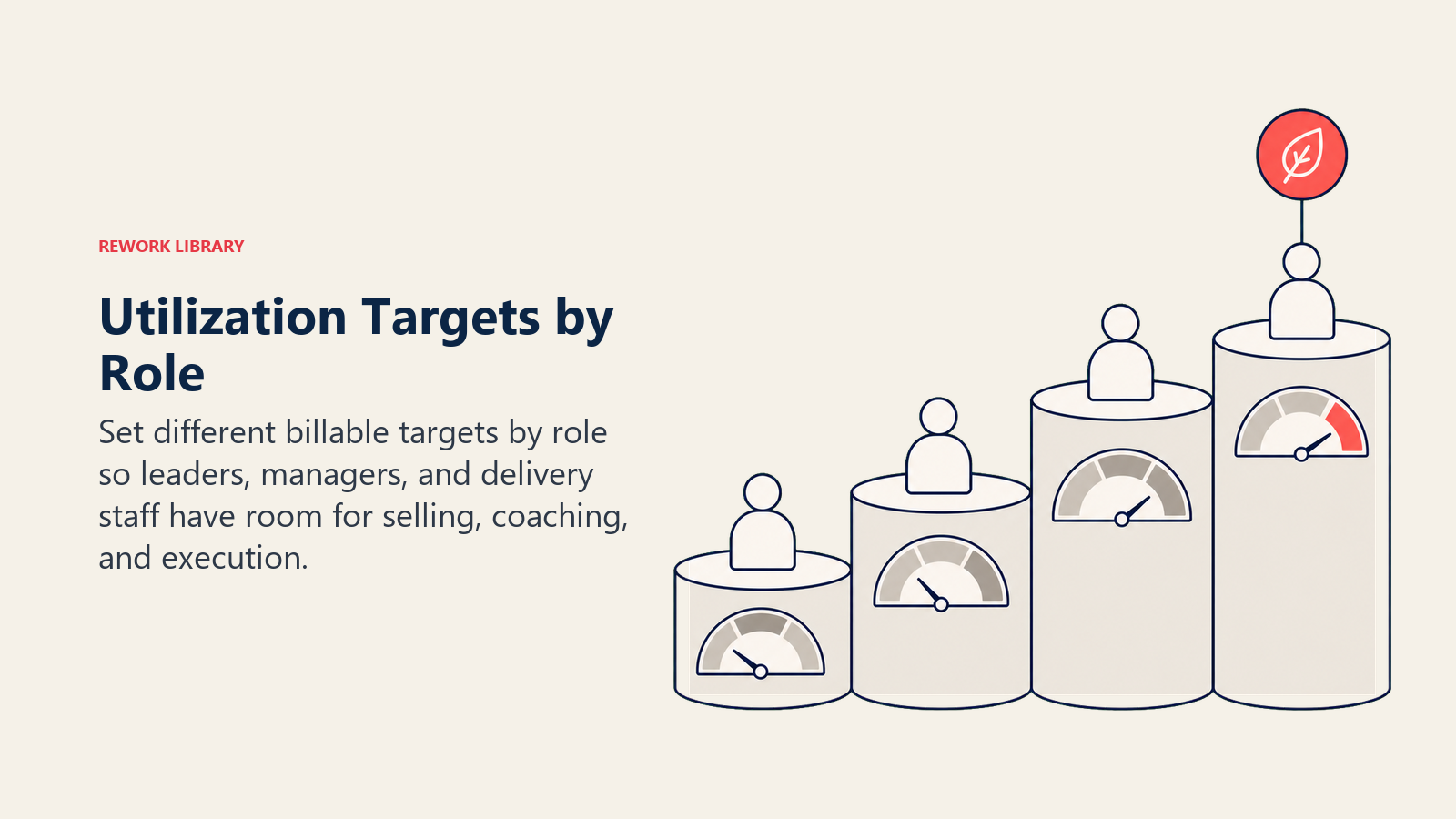
Partners and principals (50-65% utilization): These are your business generators and client relationship owners. Yes, they should still do billable work to stay sharp and provide high-value expertise. But if a partner is at 80% utilization, they're not spending enough time selling, building relationships, and developing the firm. The economics work because their billing rates are much higher.
Senior managers and directors (70-80% utilization): They're splitting time between billable delivery, proposal development, client relationship support, and mentoring junior staff. They should be on projects most of the time, but with room to support sales and guide teams.
Managers and senior consultants (75-85% utilization): These are your workhorses. They're leading project workstreams, managing client deliverables, and producing the bulk of your billable output. High utilization makes sense here because they're not yet expected to generate significant new business.
Consultants and analysts (80-90% utilization): Junior people should be learning by doing. High billable time means they're getting exposure to real client work. But you still need buffer for training and skill development. Pushing to 95%+ utilization means they're not growing.
Specialists and subject matter experts (60-75% utilization): If you have deep technical experts in areas like data science, regulatory compliance, or specific technologies, they might need lower utilization because they're often supporting multiple projects in short bursts rather than being fully staffed on one engagement. Plus they need time to stay current in rapidly changing fields.
The mistake firms make is setting uniform targets or worse, maximizing everyone's utilization. That creates short-term revenue at the cost of long-term sustainability. You want differentiated targets that align with what you need from each role.
Track both individual and firm-wide utilization. If your firm average is 75% but you have huge variance (some people at 95%, others at 40%), you have an allocation problem. The goal is to distribute work relatively evenly within role bands.
Forecasting resource demand
You can't staff proactively if you can't predict what you'll need. The good news is professional services demand is more forecastable than it seems - if you actually build a forecasting process.
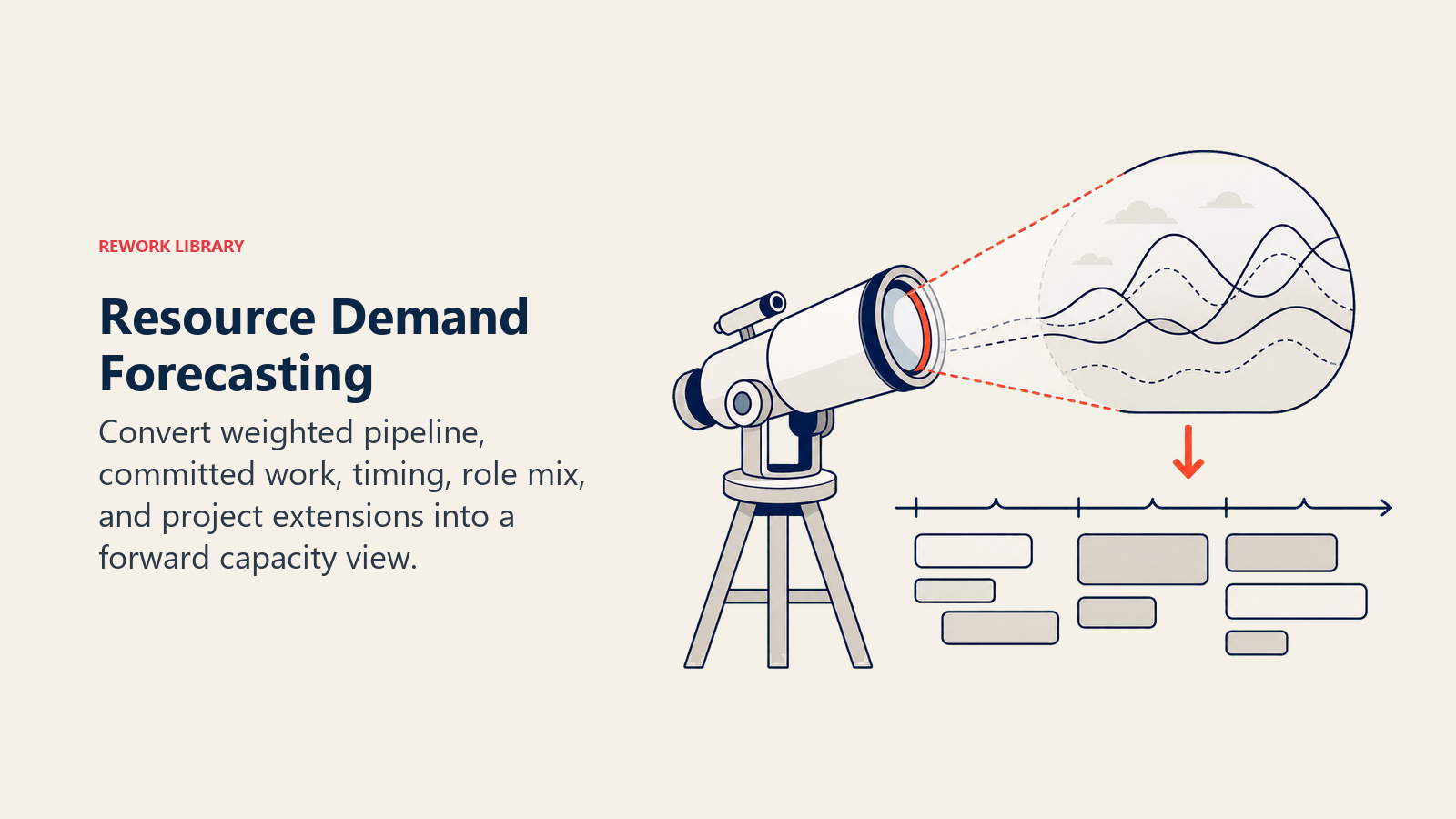
Pipeline-based demand prediction is your foundation. Take your sales pipeline and assign probability-weighted resource requirements to each opportunity:
- Opportunity A: $200K project, 60% win probability, needs 2 senior consultants for 3 months starting in Q2 → forecast 0.6 × 2 × 3 = 3.6 person-months
- Opportunity B: $500K project, 30% win probability, needs 1 manager + 3 consultants for 6 months starting in Q3 → forecast 0.3 × 4 × 6 = 7.2 person-months
Sum these across your pipeline to get expected demand by month and by role. This won't be perfect - your win rate estimates might be off, start dates will slip - but it gives you directional guidance.
Compare forecasted demand to available capacity. If you're forecasting 50 person-months of senior consultant demand in Q2 but you only have 36 person-months of capacity, you've got a problem. Time to start recruiting or adjust what opportunities you pursue.
Existing client projections add another layer. For clients with ongoing engagements or high likelihood of renewal, you can forecast their resource needs with more confidence. If you've had a retained client for two years and they consistently consume 2 FTEs of effort, you can plan for that continuing.
Watch for seasonal and cyclical patterns. If you're a tax advisory firm, you know Q1 is going to be slammed. If you work with retailers, Q4 is peak planning season. If you serve financial services, regulatory deadlines create predictable spikes. Build these patterns into your baseline forecast rather than being surprised every year.
Growth trajectory adjustments account for how your business is trending. If you've grown revenue 30% year-over-year for three years, your baseline demand forecast should reflect continued growth, not flat-line assumptions. Conversely, if you're in a cyclical industry heading into a downturn, adjust expectations accordingly.
Run scenario planning for different outcomes. Build three forecast scenarios:
- Base case (most likely outcome)
- Upside case (if key deals close and demand is strong)
- Downside case (if pipeline stalls or projects delay)
This gives you decision points: "If we're trending toward the upside case by end of Q1, we need to have started recruiting for X roles by then."
The key is updating forecasts regularly - at least monthly, ideally bi-weekly. A forecast built in January that you don't touch until June is useless. As deals move through your pipeline, as projects start and end, as staffing changes happen, your forecast should reflect current reality.
Staffing models and structures
You have more options than just full-time employees. The right staffing mix depends on your business model, margin targets, and how variable your demand is.
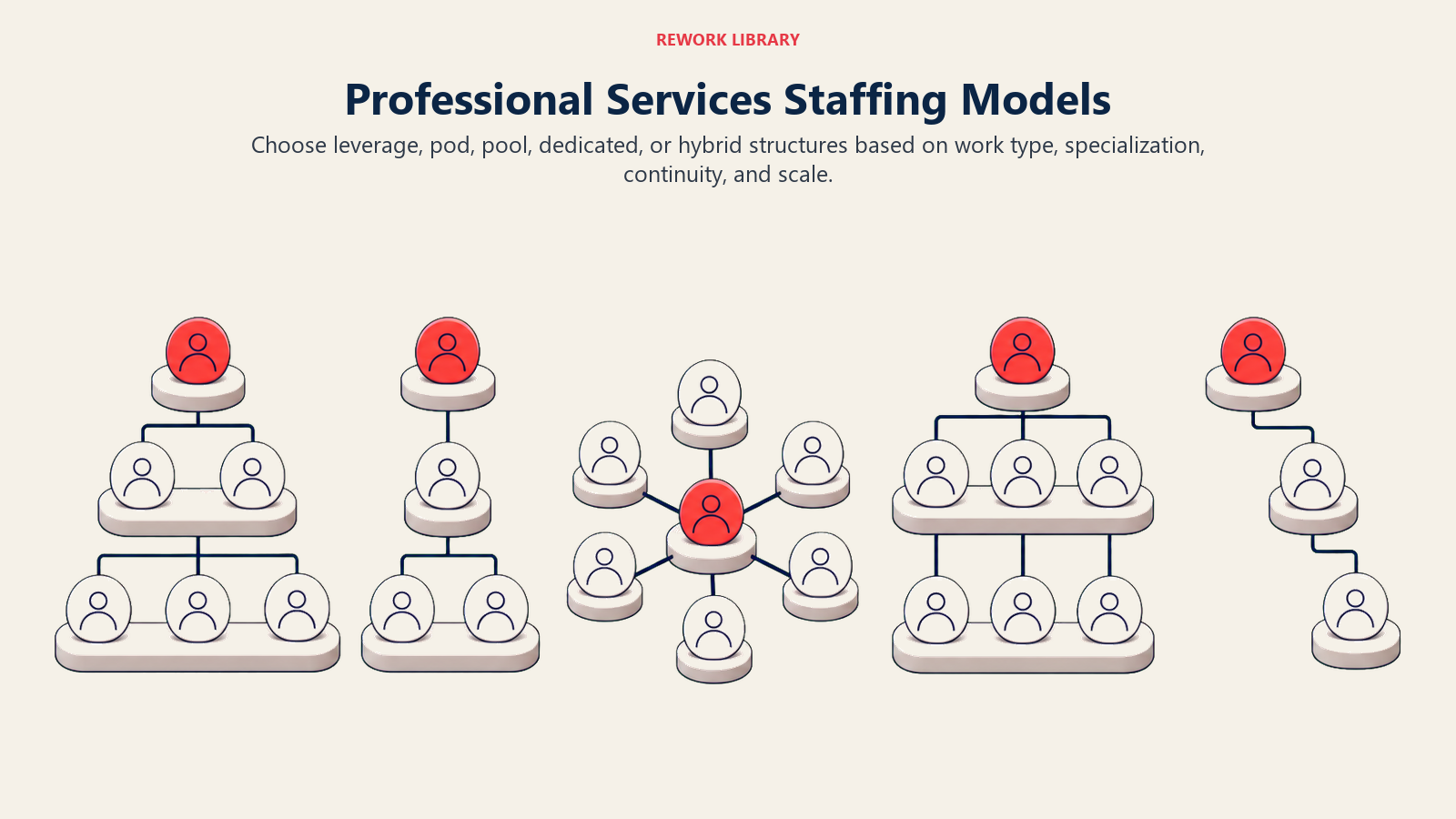
Full-time employees are your core. They carry institutional knowledge, embody your culture, build long-term client relationships. The economics work when you can keep them productively utilized. FTEs give you quality control and continuity, but they're fixed costs that you're paying whether you have work for them or not.
Most firms should staff their "base load" demand with FTEs - the amount of work you can consistently count on. If you have 80 person-months of demand per month on average, maybe you staff 60-70 person-months with FTEs and flex up from there.
Contractors and freelancers give you variable capacity. When a big project lands and you need three extra developers for four months, contractors let you scale up without committing to permanent headcount. The trade-offs: typically 30-50% higher hourly costs, less cultural integration, and you're competing for the same contractor pool as everyone else (which means they're not always available when you need them).
Use contractors for:
- Specialized skills you don't need full-time
- Temporary capacity spikes
- Coverage for FTE gaps (maternity leave, turnover)
- Testing out a new service line before committing to permanent hires
Partner and subcontractor networks let you scale to much larger projects without hiring. If you land a $2M implementation that needs 15 people for 8 months but you only have a 30-person firm, you can partner with other firms to deliver. Building a strategic partner network gives you access to this flex capacity. This works well when you have complementary capabilities or geographic coverage needs.
The margin challenge is that you're splitting revenue. If you bill the client $200/hour but pay your subcontractor $150/hour, your margin is compressed versus having FTEs doing the work. But it's better than turning down the project or hiring 15 people you won't need after it ends.
Offshore and nearshore resources can provide cost arbitrage while maintaining reasonable quality if you build the right processes. Having a delivery center in India, Eastern Europe, or Latin America gives you access to skilled talent at 40-60% of U.S. costs. But you need critical mass to make it work (usually 5+ people minimum), strong project management to coordinate across time zones, and well-defined processes.
This works best for:
- Repeatable delivery tasks (testing, data analysis, documentation)
- Technical work with clear specifications
- 24-hour development cycles (your U.S. team defines requirements, offshore team builds overnight)
It doesn't work well for:
- Highly client-facing work requiring real-time interaction
- Ambiguous strategic work requiring lots of iteration
- Small, one-off projects where coordination overhead exceeds the savings
Hybrid approaches combine these models strategically. A typical consulting firm might be:
- 70% full-time employees (core team)
- 15% contractors (flex capacity and specialized skills)
- 10% offshore/nearshore (delivery support)
- 5% subcontractors (occasional partnerships)
The mix shifts based on utilization. When FTEs are at 85%+ utilization, you lean more heavily on contractors. When utilization drops to 65%, you scale back contractors first.
The decision framework: use the most cost-effective resource that can deliver the required quality level. That's usually FTEs for core capabilities and long-term needs, contractors for variable capacity, and offshore for high-volume repeatable work.
Resource allocation methodology
Having capacity means nothing if you can't deploy it effectively. You need a process for matching available people to project needs. Staffing request intake is where it starts. When a project gets sold or an existing client needs more support, someone (account lead, project manager, or sales) submits a formal resource request:
- Project name and client
- Skill requirements and role levels
- Number of people needed
- Duration and timing (start date, end date, hours per week)
- Location/travel requirements
- Any specific people requested
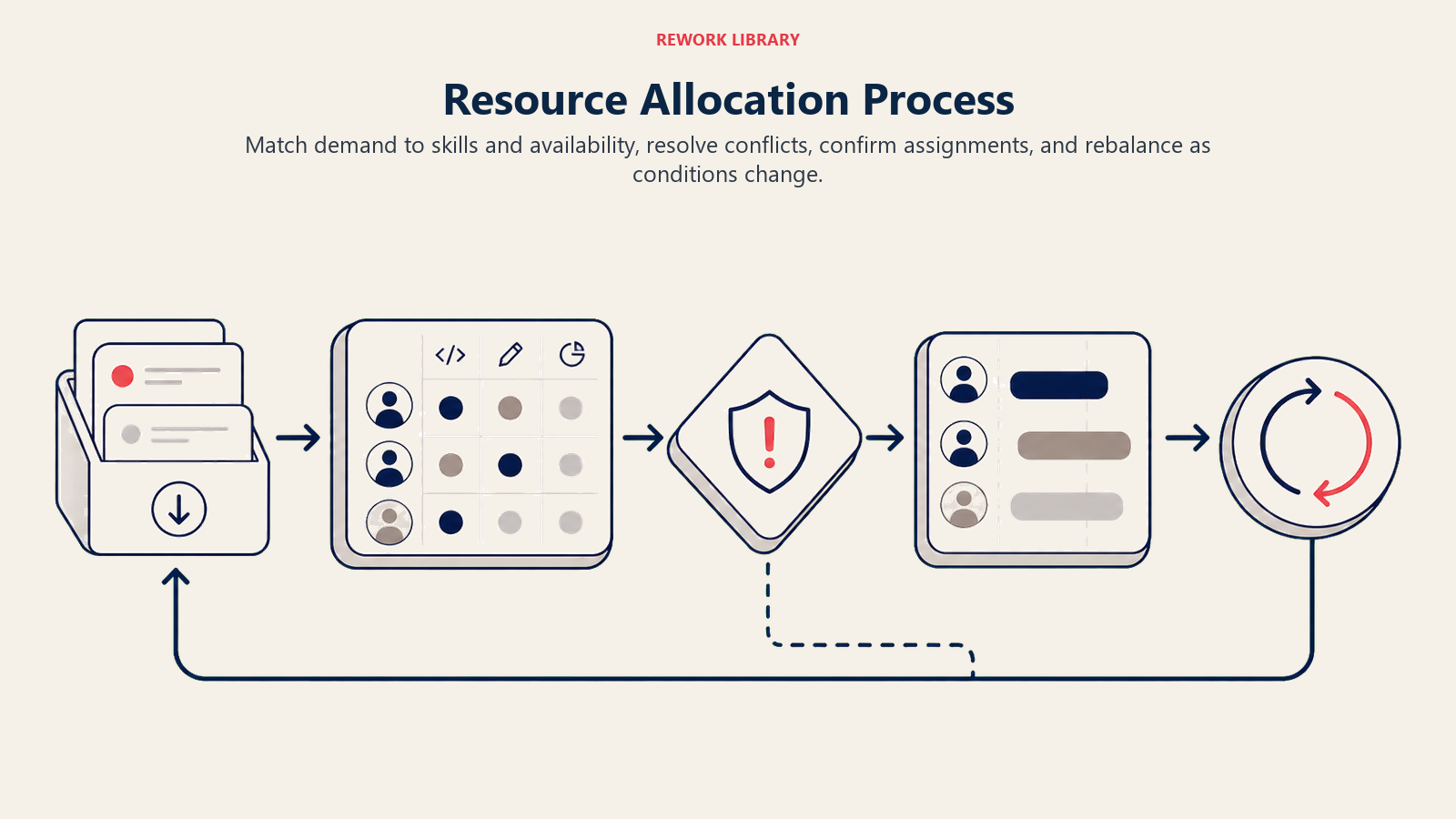
Formalizing this prevents the "I need three people next week" last-minute requests that create chaos. Set a standard lead time - ideally 3-4 weeks for new staffing, 1-2 weeks for extensions.
Resource availability assessment comes next. Your resource manager (or whoever owns allocation) reviews:
- Who has the required skills?
- Who is available during the needed timeframe?
- Who has capacity (not already at 100% allocation)?
- Who has worked with this client before (continuity)?
- Who needs development opportunities (skill building)?
This is where good resource management software helps. You need visibility into:
- Current staffing across all projects
- Scheduled end dates for current assignments
- Planned vacation and time off
- Skill profiles and experience levels
Without this visibility, you're making allocation decisions blind. With it, you can see that Sarah finishes her current project on March 15 and would be perfect for the new engagement starting March 22.
Skills matching and optimization balances multiple factors. The "perfect" allocation would be:
- Everyone exactly matches the skill requirements
- Everyone is at target utilization (not over or under)
- Everyone gets development opportunities aligned with career goals
- Client gets continuity from people who know their business
- Projects get the right mix of senior and junior resources
- Geography and travel requirements are met
In reality, you're making trade-offs. The person who's perfect for a project might be fully utilized on something else. The client wants Sarah specifically, but she's on another client who also wants her. You need to balance client needs, people development, and utilization targets.
Priority and sequencing rules help you make consistent decisions:
- Existing client commitments beat new projects (don't pull people off active work)
- Contracted work beats pipeline opportunities (don't staff phantom projects)
- Strategic clients get priority (your top 10 clients get the team they need)
- Development opportunities matter (don't always put juniors on junior work)
- Utilization balancing (spread work to people who need it, not just easy wins)
Conflict resolution happens constantly. Two partners both want the same senior person. You don't have enough specialists to cover all the projects that need them. Someone you planned to staff on a project takes another job.
Resolution approaches:
- Executive decision (practice leader or resource manager makes the call)
- Client priority framework (highest revenue or strategic importance wins)
- Timeline flexibility (can one project delay a week to make staffing work?)
- Alternative solutions (different person, contractor, offshore support)
The key is making decisions quickly and communicating clearly. Don't leave people in limbo or double-book them hoping something works out. If you can't staff a project adequately, have that conversation early so you can solve it or reset client expectations.
Project staffing best practices
Once you've allocated someone to a project, the handoff needs to be clean. Assignment and confirmation: Resource manager formally assigns people and confirms they understand:
- Project scope and client background
- Their role and responsibilities
- Hours per week expected
- Duration of assignment
- Who they're reporting to
- Any prep work needed before start
Don't assume people know what they're signing up for. A 15-minute conversation prevents week-one confusion.
Transition management: If someone is rolling off another project, coordinate the transition. Can they overlap a few days? Do they need time to wrap up deliverables? Is there documentation they need to hand off? A poor transition from Project A to Project B creates problems for both clients.
Ramp-up planning: New people on a project aren't immediately productive. Build in time for:
- Client background and history
- Project context and status
- Methodology and tools training
- Relationship building with client team
Expect 50-75% productivity in week one, ramping to full speed by week 2-3 for experienced people. For junior staff or complex projects, it might take longer.
Monitoring and adjustment: Track actual hours against planned allocation weekly. If someone is supposed to be 50% allocated to a project but they're consistently working 70%, you have a problem. Either the scope expanded, the estimate was wrong, or they're inefficient.
Make adjustments as soon as you see the variance. If a project is running long, you might need to extend someone's allocation and delay their next assignment. If it wraps early, you need to find them their next home before they go idle.
This continuous monitoring is how you prevent utilization problems. If you're only looking at utilization in monthly reports, you're finding out about idle time or over-allocation three weeks too late.
Managing the bench productively
Bench time - periods when people aren't billable - is inevitable. The question is how much and how you use it. Strategic bench is planned capacity for specific purposes:
- Training and certifications
- Thought leadership and content creation
- Business development and proposal support
- Internal projects and capability building
- Research and development
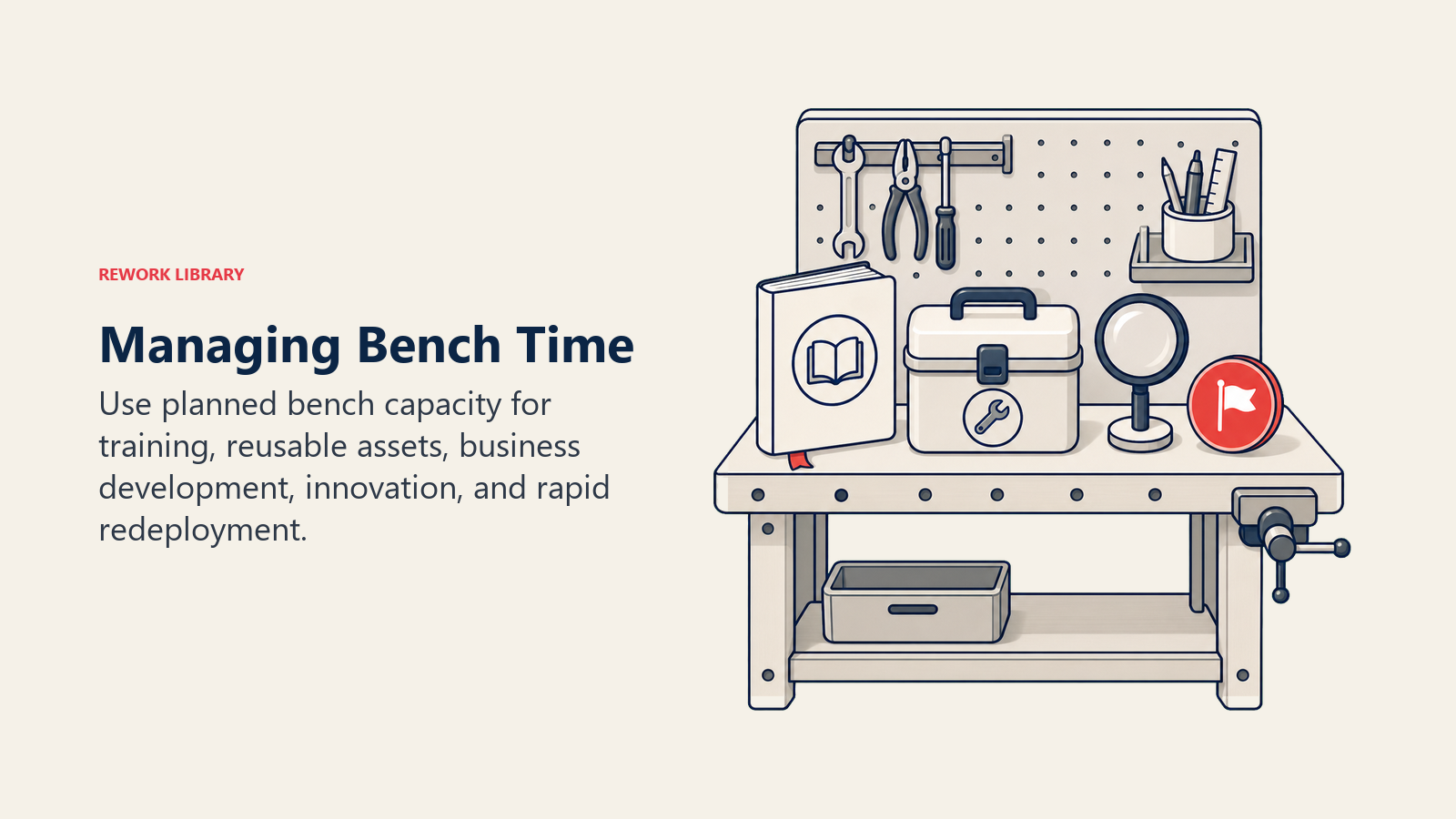
This is healthy bench time. If your senior people are at 65% billable targets, that 35% is strategic bench that's supposed to be invested in growing the business.
Tactical bench is unplanned gaps between projects. Someone finishes a project and the next one doesn't start for two weeks. Or a project gets delayed and they're suddenly available. This creates problems if you have too much of it - you're paying people who aren't generating revenue.
Target tactical bench at 5-10% of total capacity. Some gap between projects is normal and even beneficial (people need breaks, you need buffer for last-minute requests). But if your firm-wide tactical bench is consistently 20%+, you have a demand problem or an allocation problem.
Productive bench activities turn downtime into value:
- Training and certifications: Get people certified in new tools, methodologies, or platforms. Two weeks on the bench is time to complete that AWS certification.
- Proposal support: Put experienced people on proposals to improve win rates. A senior consultant with three days free can make the difference on a big bid.
- Thought leadership: Write articles, speak at conferences, create case studies. These feed your marketing and business development engine.
- Internal projects: Build tools, improve processes, develop IP. Maybe you've wanted to build a financial modeling template library - bench time is when it gets done.
- Business development: Shadow partners on sales calls, help with client research, join networking events. This develops future business generators.
- Client relationship building: If someone has bench time and has a good relationship with a current or past client, have them reach out. "I've got some availability and was thinking about your team - any projects we could help with?"
The worst thing you can do is leave people wondering what they should be doing. When someone hits the bench, their manager should have a conversation: "You've got two weeks before your next project. Let's use one week for training and one week supporting the XYZ proposal."
Bench duration targets keep you disciplined. Set expectations:
- Strategic bench: ongoing (built into utilization targets)
- Tactical bench: less than 2 weeks per person per instance
- If someone is on tactical bench for 4+ weeks, that's a red flag
When someone exceeds the threshold, escalate. Either you need to sell more work, reallocate them to a different practice area, or rethink whether you have the right staff size.
Some firms use "bench budgets" - each practice or office has a pool of acceptable bench hours. If you exceed it, you need to explain why and what you're doing about it. This creates accountability for practice leaders to keep their teams utilized.
Hiring triggers and recruitment planning
Knowing when to hire is one of the highest-leverage decisions you make. Hire too early and you crater margins. Hire too late and you can't deliver.
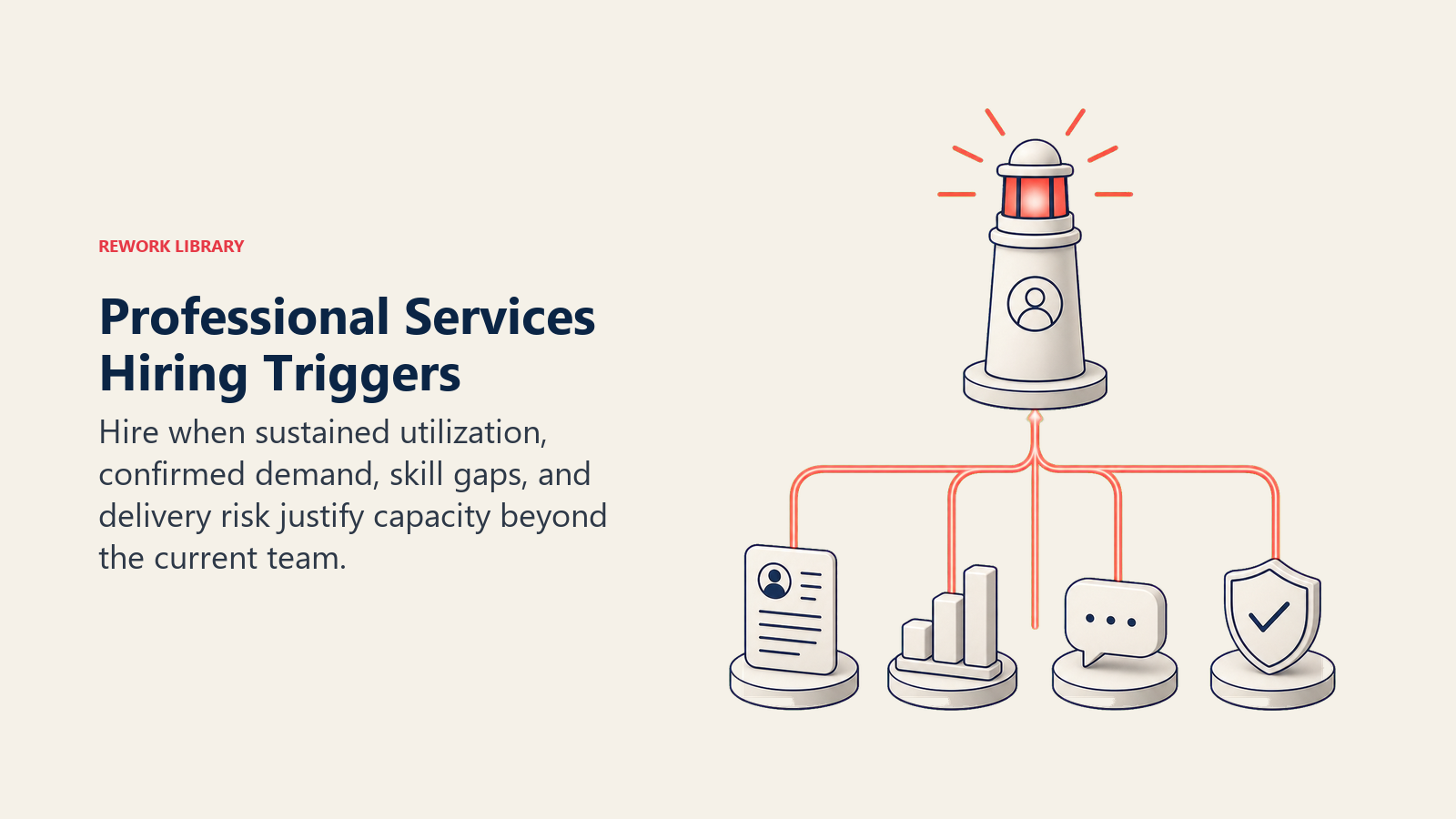
Hiring trigger indicators:
- Utilization threshold: When utilization hits 85%+ for two consecutive months across a role level, it's time to recruit. You're running too hot and have no buffer.
- Pipeline coverage: If your probability-adjusted pipeline exceeds current capacity by 30%+ within the next 3-6 months, start recruiting. You can't wait until projects start to begin hiring.
- Chronic contractor use: If you're consistently using contractors for more than 15% of capacity in a specific role, convert that to FTE. The math works better.
- Project decline or delays: If you're turning down work or pushing project start dates because you don't have capacity, you're leaving money on the table. Hire.
- Quality or service issues: If projects are struggling because people are spread too thin, utilization isn't the only problem - you're risking client relationships.
Recruitment timing needs to account for lag:
- Posting to offer: 4-8 weeks for mid-level roles, 8-12 weeks for senior/specialized
- Offer to start date: 2-4 weeks for immediate availability, 4-8 weeks for people giving notice
- Start to full productivity: 8-12 weeks with ramp-up
Total time from "we need to hire" to "new person is fully productive" can be 4-6 months. That's why you need to forecast demand and trigger hiring before you're desperate.
Role definition and leveling prevents hiring the wrong people. Define each role's:
- Required skills and experience
- Expected utilization target
- Typical project types they'll work on
- Career path and growth opportunities
- Compensation range
This clarity helps recruiting and sets new hires up for success. If you hire someone expecting 85% utilization and project manager work, but they end up doing 60% utilization on analyst tasks, you have a mismatch.
Talent pipeline development means you're always recruiting, not just when you have a specific req. Maintain relationships with strong candidates, past interviewees, contractors you've worked with. When you need to hire, you have a warm list to contact rather than starting cold.
Some firms use "always be hiring" for critical roles. If you know you'll need 2-3 senior data scientists per year and they're hard to find, keep that req open continuously. When you find someone great, hire them even if you don't have immediate project demand. You'll use them soon enough.
Onboarding and ramp-up planning gets new hires productive faster:
- Week 1: Orientation, tools setup, culture and process training
- Week 2-4: Shadow experienced people, small tasks on real projects
- Week 5-8: Increasing responsibility on billable work
- Week 9-12: Full contribution at expected level
Build this into your capacity planning. Don't assume someone starting February 1 is fully utilized in February. They'll hit full utilization in May.
Common challenges and how to solve them
Uneven demand and utilization: Some people are at 95% while others are at 40%. This is usually an allocation problem, not a demand problem.
Solution: Active resource management. Don't let projects hoard people or partners only staff "their" people. Create a firm-wide allocation process that balances utilization. Sometimes this means staffing someone to a project they haven't worked on before or mixing teams across practice areas.
Skills mismatch and gaps: You need three data engineers but you have two and they're fully booked. Meanwhile your business analysts are at 60% utilization.
Solution: Skills development programs. Train people to fill gaps. If you're consistently short on data engineering and have excess business analyst capacity, can you upskill some analysts? This takes 3-6 months but solves structural mismatches. Short term, use contractors or partnerships to fill gaps while you build internal capability.
Resource contention and conflicts: Two big projects need the same senior person. She can't split herself in half.
Solution: Priority framework and early trade-off discussions. If Sarah is your best strategist and everyone wants her, either clone Sarah (hire another senior strategist), limit Sarah's allocation to critical projects only, or teach other people to do what Sarah does. Most firms under-invest in developing more people like their stars, creating bottlenecks.
Last-minute staffing needs: A big deal closes and the client wants to start in two weeks, but you have nobody available.
Solution: Maintain strategic buffer capacity. If you're running everyone at 90% utilization, you have zero capacity for opportunity. Keep 10-15% capacity in reserve either through lower utilization targets or maintaining a small ready bench. Yes, this costs margin points. But it lets you capture opportunities and avoid the revenue volatility of "we can't start for 6 weeks."
Retention during bench periods: People get nervous when they're on the bench too long. They worry they're not valued or the firm is struggling. They start looking.
Solution: Transparent communication and productive bench activities. Explain what bench time is expected and normal. Show them what others are doing on the bench. Give them meaningful work (proposals, training, business development). The worst thing you can do is ignore people on the bench - they'll assume the worst.
Metrics that matter
Track these metrics monthly to understand resource health:
Utilization rate by person and role: Your core metric. Track target vs actual for each person and aggregate by role level. If your senior consultants should average 78% but they're at 65%, why? If analysts should be at 85% but they're at 92%, they're probably burning out.
Bench time and cost: Total person-days on the bench and the dollar cost. Track tactical bench separately from strategic bench. If you're spending $50K/month on unplanned bench, that's $600K/year of missed revenue.
Project margin by resource mix: Look at project profitability based on the team composition. Projects with optimal leverage (right mix of senior and junior) should have higher margins than projects staffed all senior or all junior.
Resource efficiency: Actual hours worked versus estimated hours for projects. If projects consistently run 20% over estimates, you have either scoping issues or efficiency problems.
Forecast accuracy: Track how accurate your demand forecasts are. If you're forecasting 100 person-months of demand but actual is 70, your forecasts are too optimistic. If you're consistently conservative, you might be under-hiring and missing opportunity.
Time to fill: How long it takes from opening a req to someone starting. If it's 5+ months, you need to improve recruiting process or build talent pipelines.
Contractor usage rate: What percentage of delivery is contractors vs FTEs. If it's trending up, you need to hire. If it's trending down, you might be over-staffed.
Allocation lead time: How far in advance can you commit people to projects? If you can only staff 2 weeks out, you'll struggle to close big projects that need team commitments. If you have visibility 3+ months out, you can sell with confidence.
Building your staffing system
Start with forecasting. If you don't have a formal demand forecast that you update monthly, build one. Even a simple spreadsheet tracking pipeline opportunities and their resource implications is better than nothing.
Next, get visibility into capacity. You need to know who's allocated where, when projects end, and who has availability. If you're still managing this in someone's head or scattered across project managers, invest in a resource management tool. Options range from simple (Smartsheet, Excel-based systems) to sophisticated (10,000ft, Resource Guru, Forecast).
Define utilization targets by role and start measuring them. You can't manage what you don't measure. Share the numbers with team leaders monthly so they understand where they stand.
Create a formal allocation process with clear roles. Who owns staffing decisions? Who resolves conflicts? What's the timeline for requests? Putting process around allocation prevents the chaos of partners fighting over people.
Build your hiring trigger framework. Define when you'll start recruiting for each role level based on utilization, pipeline, and contractor usage. Make it systematic rather than reactive.
The goal isn't perfection. It's making staffing and allocation deliberate and data-informed rather than chaotic and reactive. Even basic improvements in these areas - 5% better utilization, 10% more accurate forecasting, 20% faster hiring - have huge profit impacts.
Professional services is a people business. The firms that manage their people capacity strategically - forecasting demand, optimizing allocation, balancing utilization with development, hiring proactively - create sustainable competitive advantages. They can take on bigger projects, serve more clients, and deliver consistent margins. The firms that wing it stay stuck.
Want to build on this foundation? Look at how utilization and capacity planning creates the analytical framework, how professional services metrics tracks what matters, or how the right leverage model structures your team for profitability.

Sales Director
On this page
- The capacity optimization challenge
- Understanding billable capacity
- Utilization rate targets by role
- Forecasting resource demand
- Staffing models and structures
- Resource allocation methodology
- Project staffing best practices
- Managing the bench productively
- Hiring triggers and recruitment planning
- Common challenges and how to solve them
- Metrics that matter
- Building your staffing system