Needs Assessment & Discovery: Understanding Client Needs Deeply
Turn this article into takeaways for your work.


Each assistant summarizes the article only for you and suggests best practices for your work.
Here's a number that should keep you up at night: 70% of proposals fail. Not because the firm isn't qualified or the solution is wrong. They fail because the discovery was shallow. The consultant didn't understand the real problem, missed key stakeholders, or proposed a solution to the wrong question.
Professional services is a high-stakes game where you're selling expertise and outcomes, not products. You can't afford to wing it. Discovery isn't just the first step in the sales process, it's the foundation for everything that comes after. Get it right, and your proposal writes itself. Get it wrong, and you're competing on price against firms who actually understand what the client needs.
This guide shows you how to run discovery that goes deep enough to matter. We'll cover the frameworks, questioning techniques, and documentation practices that separate winning firms from also-rans.
Why most discovery fails (and what it costs you)
Most consultants think they're good at discovery. They schedule a call, ask some questions, listen to the client talk about their challenges, and call it done. Then they're surprised when the proposal loses to a competitor who charged more.
The problem isn't effort. It's that surface-level discovery gives you surface-level understanding. You hear about symptoms without understanding root causes. You talk to one person without mapping the full stakeholder landscape. You learn what the client thinks they need without uncovering what they actually need.
Bad discovery has real costs:
- Proposals that miss the mark get rejected or undervalued
- You compete on price because you can't differentiate on understanding
- Project scope grows because you didn't identify hidden complexity
- Client satisfaction drops when deliverables don't solve the real problem
- Referrals dry up because results disappoint
But here's what good discovery does: it builds trust. When a client feels deeply understood, they're more likely to choose you even if you're not the cheapest option. When you can articulate their challenges better than they can, you become the obvious choice. This trust forms the foundation for successful client relationship strategy throughout the engagement.
Good discovery also protects you. You identify red flags early, spot scope creep before it happens, and surface political dynamics that could derail the project. That alone is worth the investment.
The discovery framework: six layers of understanding
Professional services discovery isn't a single conversation. It's a systematic investigation across multiple dimensions. Here's what you need to understand:
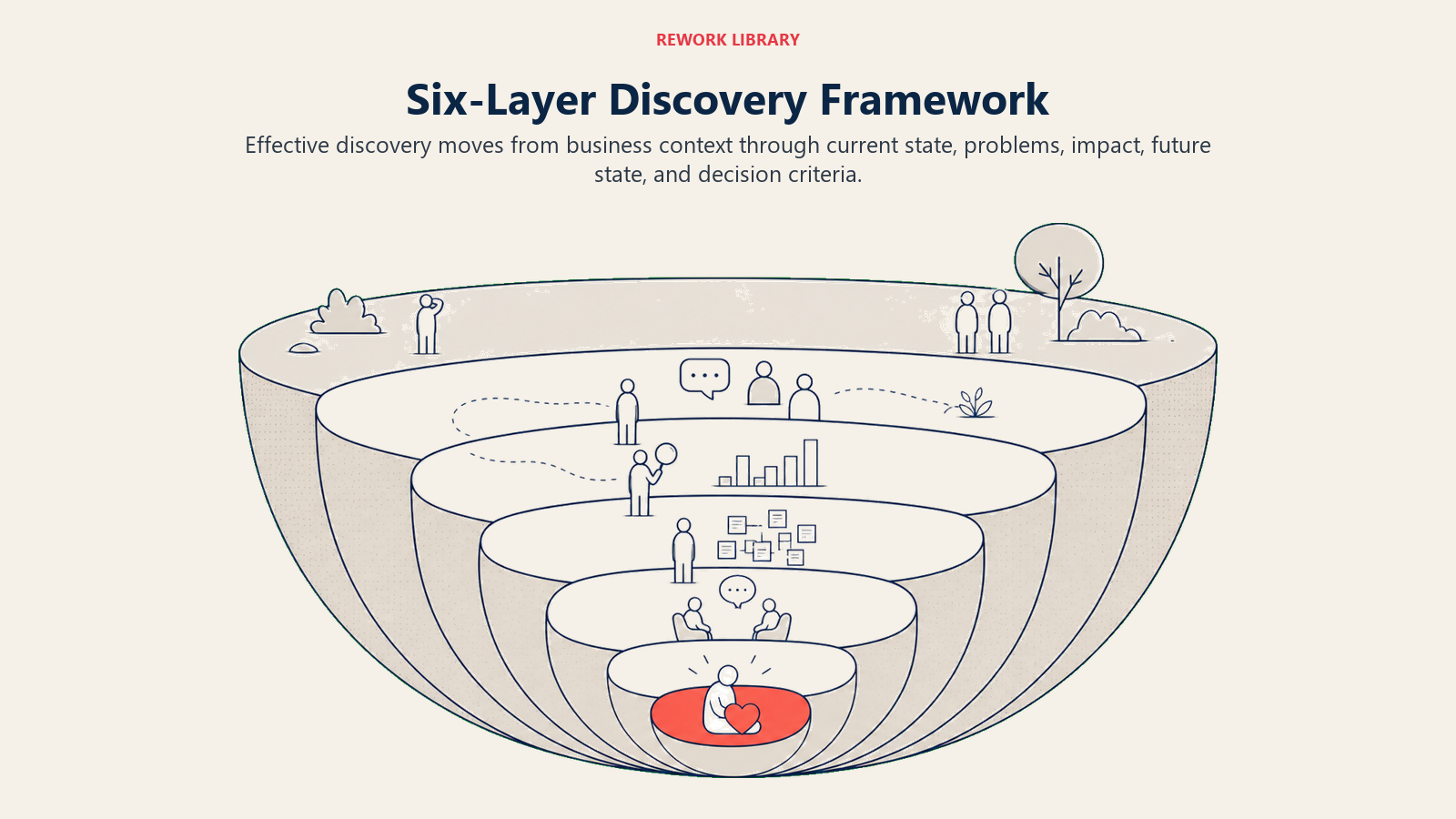
Business context
Start with the big picture. What's happening in their industry? What competitive pressures are they facing? How is their market changing?
You're looking for external forces that create urgency or constraints. A regulatory change that forces compliance by year-end. A competitor launching a disruptive product. Economic shifts affecting their customer base.
This context tells you why they're considering a consulting engagement now versus six months ago. It also helps you position your solution as strategic versus tactical.
Questions to ask:
- "What's changing in your industry that's driving this need?"
- "How are your competitors approaching this challenge?"
- "What market trends are affecting your business right now?"
Organizational assessment
How does their organization actually work? Not the org chart, but the real dynamics. Who makes decisions? What's their culture around risk and change? How do different departments interact?
Professional services projects often fail not because the solution is wrong, but because it doesn't fit how the organization operates. A brilliant strategy dies if the culture can't execute it. A technology implementation fails if the decision-making process is too slow.
You need to understand:
- Formal structure and informal power dynamics
- Decision-making processes and approval requirements
- Culture around change, innovation, and external consultants
- Internal politics that could help or hurt the project
- Past experiences with consulting firms (good and bad)
Pay attention to how they describe their organization. "We move fast" might mean agile decision-making or chaos. "We're very collaborative" could mean inclusive or slow.
Current state assessment
What are they doing today? What processes, systems, and capabilities already exist? You can't design a future state without understanding the starting point.
This isn't just about documenting the status quo. You're looking for:
- What's working (build on it, don't replace it)
- What's failing (root causes, not just symptoms)
- What's already been tried (learn from failures)
- What constraints exist (budget, technology, skills)
- What assumptions they're making (often wrong)
Ask for examples and specifics. Don't accept "our sales process is broken." Dig into which parts are broken, for whom, and why. Get them to walk you through actual scenarios.
The current state often reveals opportunities they haven't considered. A manual process you can automate. A siloed team you can connect. A data source that's not being used.
Challenge identification
Now you get to the pain. What's not working? What's costing them money, time, or opportunity? What keeps the decision-maker up at night?
But here's the critical part: distinguish between stated problems and real problems. A client might say "we need better project management tools" when the real problem is lack of accountability in their culture. They might ask for sales training when the issue is a broken lead qualification process.
Your job is to probe beneath the surface:
- "What's the impact of that problem on your business?"
- "How long has this been an issue?"
- "What have you tried so far?"
- "What's stopping you from solving it internally?"
- "Who's most affected by this challenge?"
Look for patterns. Multiple symptoms often point to a single root cause. Listen for emotion, what they're most frustrated about is usually what matters most.
And pay attention to what they're not saying. If they talk about operational issues but avoid mentioning budget constraints, dig into that. If they describe team problems but don't mention leadership, that's telling.
Desired future state
Where do they want to be? Not vague aspirations, but specific, measurable outcomes.
The difference between mediocre discovery and great discovery shows up here. Mediocre discovery accepts "we want to improve efficiency." Great discovery pushes for "we need to reduce project delivery time by 30% while maintaining quality standards."
Ask about:
- Specific goals and objectives
- How they'll measure success
- What "good" looks like in concrete terms
- What trade-offs they're willing to make
- Timeline for achieving results
Also understand their constraints and non-negotiables. Some things can't change (regulatory requirements, existing contracts, executive preferences). Others are flexible if the value is there.
The future state becomes your target. Everything in your proposal should connect back to how you help them get there.
Decision context
This is where you shift from understanding the problem to understanding the buying process. Who decides? How do they decide? What's their timeline and budget?
You need to know:
- Budget allocated (or budget to be approved)
- Timeline for decision and implementation
- Approval process and who's involved
- Criteria for evaluating firms
- What could change or delay the decision
- Competition (are they talking to other firms?)
Many consultants save these questions for last or avoid them entirely. That's a mistake. If they don't have budget or won't share their timeline, you're flying blind. Effective client qualification depends on getting clear answers here.
Don't be shy about this. Frame it as helping you provide the best solution: "To make sure I'm proposing something that fits your budget and timeline, can you share what you're working with?"
SPIN questioning technique: the backbone of discovery
The best discovery framework for professional services is SPIN, developed by Neil Rackham. It's a progression of four question types that guide prospects from describing their situation to recognizing the value of solving their problem.
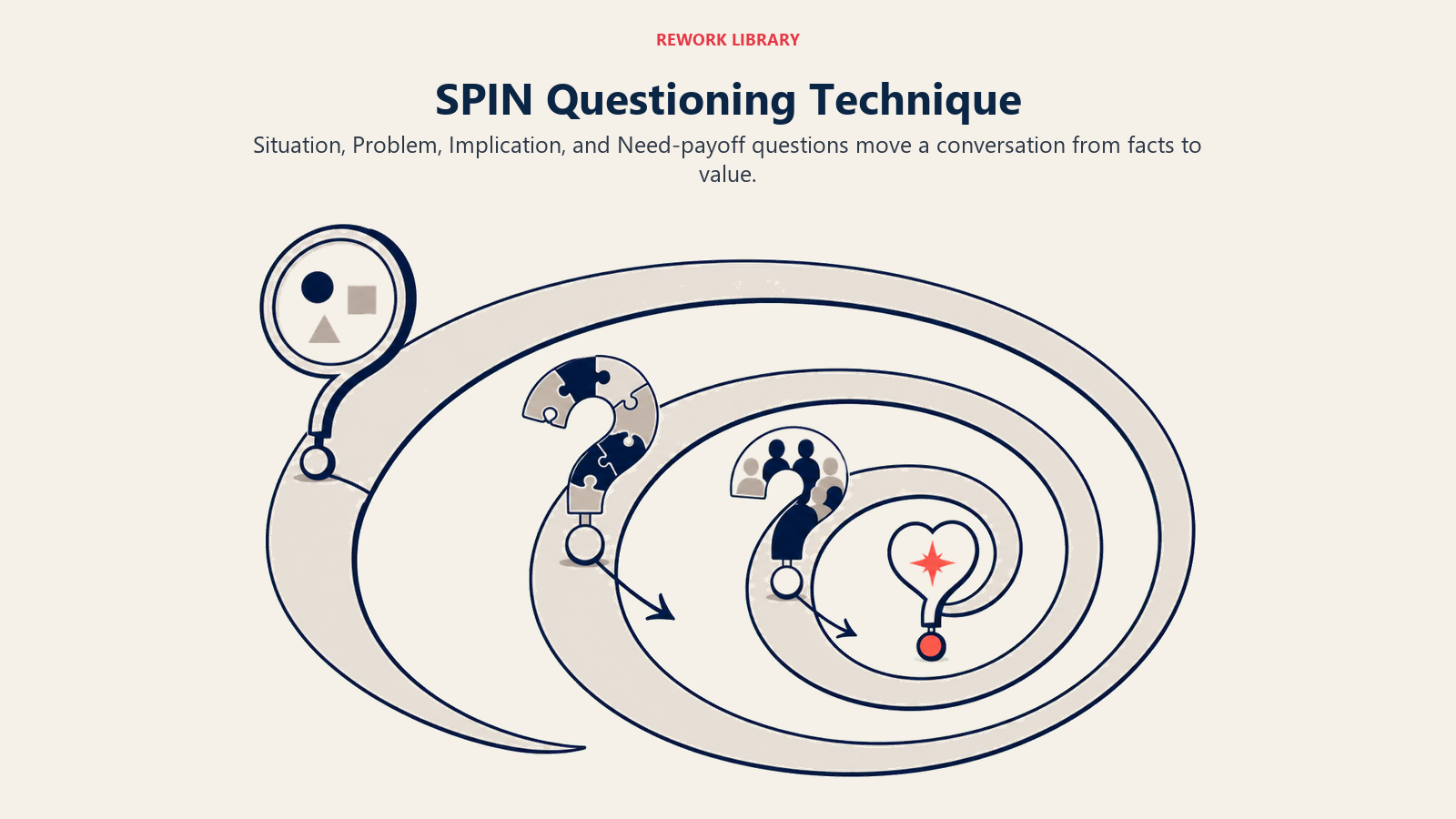
Situation questions establish the context. These are fact-finding questions about their current state:
- "How many people are on your team?"
- "What systems are you using today?"
- "How is the process currently structured?"
Keep these brief. You need the facts, but spending too much time here is boring for the client. They know their situation, you're the one who needs to catch up.
Problem questions identify difficulties and dissatisfactions:
- "What challenges are you facing with the current approach?"
- "Where does the process break down?"
- "What's frustrating about how this works today?"
This is where you start uncovering pain points. Let them vent a bit. The emotion behind their answers tells you what really matters.
Implication questions explore the consequences and impact of those problems:
- "How does that delay affect your ability to serve customers?"
- "What's the cost of having your team spend time on manual work?"
- "If this continues, what happens to your competitive position?"
This is the most important question type, and the one most consultants skip. Implication questions help prospects understand the full cost of inaction. They transform a "nice to have" into a "must solve."
You're not just listing problems, you're quantifying the stakes. A billing error that costs $5K per month is a $60K annual problem. A process delay that affects 20 projects is different than one affecting 3.
Need-payoff questions get prospects to articulate the value of solving the problem:
- "If we could reduce that time by 50%, what would that enable your team to do?"
- "How would fixing this issue affect your quarterly goals?"
- "What becomes possible if you solve this?"
Now the prospect is selling themselves. They're describing the benefits in their own words. That makes your proposal resonate because you're repeating back what they told you matters.
SPIN is powerful because it's a natural conversation flow. You're not interrogating, you're exploring. And by the end, the client has talked themselves into needing your help.
The art of listening (and actually hearing)
Discovery is 80% listening, 20% talking. If you're doing more talking than that, you're doing it wrong.
But listening isn't passive. It's active work:
Stop thinking about your response while they're talking. This is the hardest skill. Your brain wants to jump ahead to solutions or prepare your next question. Resist. Focus on what they're actually saying.
Use silence strategically. After they answer a question, pause for three seconds. Often they'll add something important in that gap. We're uncomfortable with silence, so people fill it, and what comes out is usually more honest than their initial answer.
Take notes visibly. This shows you value what they're saying and helps you remember details. But don't hide behind your laptop. Maintain eye contact and engagement.
Paraphrase and reflect back. "So if I'm understanding correctly, the main issue is..." This confirms you heard them right and gives them a chance to clarify or expand.
Watch for non-verbal cues. When do they lean forward? When do they get animated? When do they deflect or change the subject? Body language tells you what they care about and what they're avoiding.
Probe for depth. When they give a surface answer, dig deeper. "Tell me more about that." "Can you give me an example?" "What else?" These simple prompts uncover layers.
The best discovery conversations feel less like interviews and more like collaborations. You're working together to understand the challenge, not extracting information.
Stakeholder mapping: finding everyone who matters
One of the biggest discovery mistakes is talking to too few people. You get a single perspective, miss political dynamics, and design solutions that work for one person but not the organization.
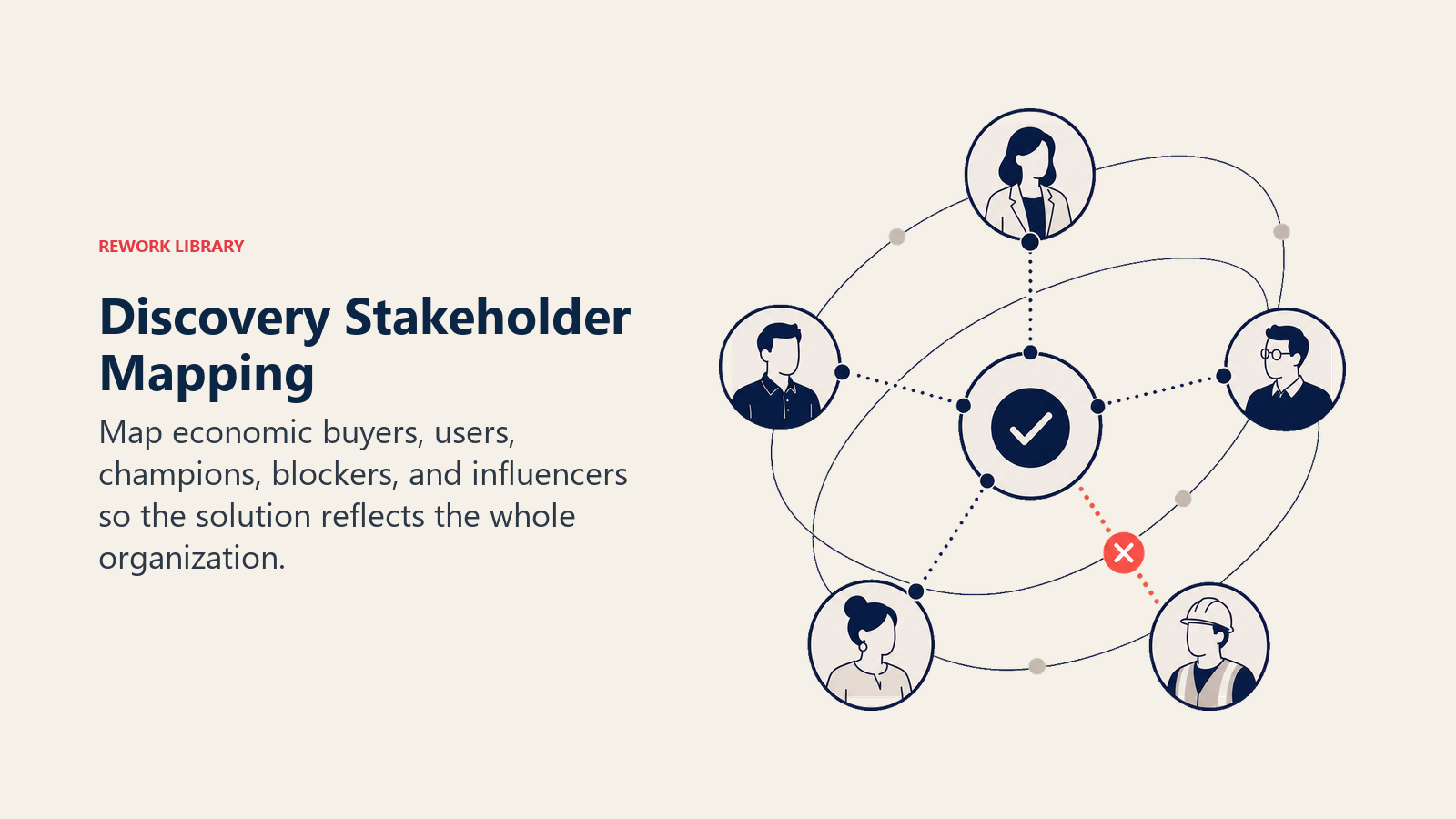
Professional services projects typically involve multiple stakeholders with different roles and motivations:
The economic buyer controls the budget and makes the final decision. They care about ROI, risk, and strategic alignment. Often a C-level executive or senior VP.
The technical buyer evaluates whether your solution will actually work. They care about feasibility, integration, and implementation. Often a director or manager who'll be responsible for execution.
The champion is your internal advocate. They want the project to succeed and will sell it internally when you're not in the room. Find this person and nurture the relationship.
The influencers don't have direct authority but sway the decision. Could be other departments affected by the project, respected senior leaders, or even external advisors.
The users are the people who'll actually interact with your deliverables. They care about usability and how it affects their daily work.
Your goal is to interview representatives from each group. At minimum, talk to the economic buyer and technical buyer. Ideally, also talk to end users and influencers.
Each conversation gives you a different angle on the problem. The CFO sees financial impact. The operations manager sees process issues. The front-line staff sees practical challenges. You need all those perspectives to design a solution that works.
Mapping stakeholders also reveals politics. Who's aligned with whom? Who's resistant? Where are the power dynamics? A project can be technically perfect but fail because you didn't navigate the politics. This understanding becomes critical when you move into negotiation for services.
Ask your primary contact: "Who else should I talk to?" Then ask everyone you talk to the same question. You'll quickly identify the key players.
Structuring the discovery meeting
Good discovery doesn't happen by accident. You need a structure:
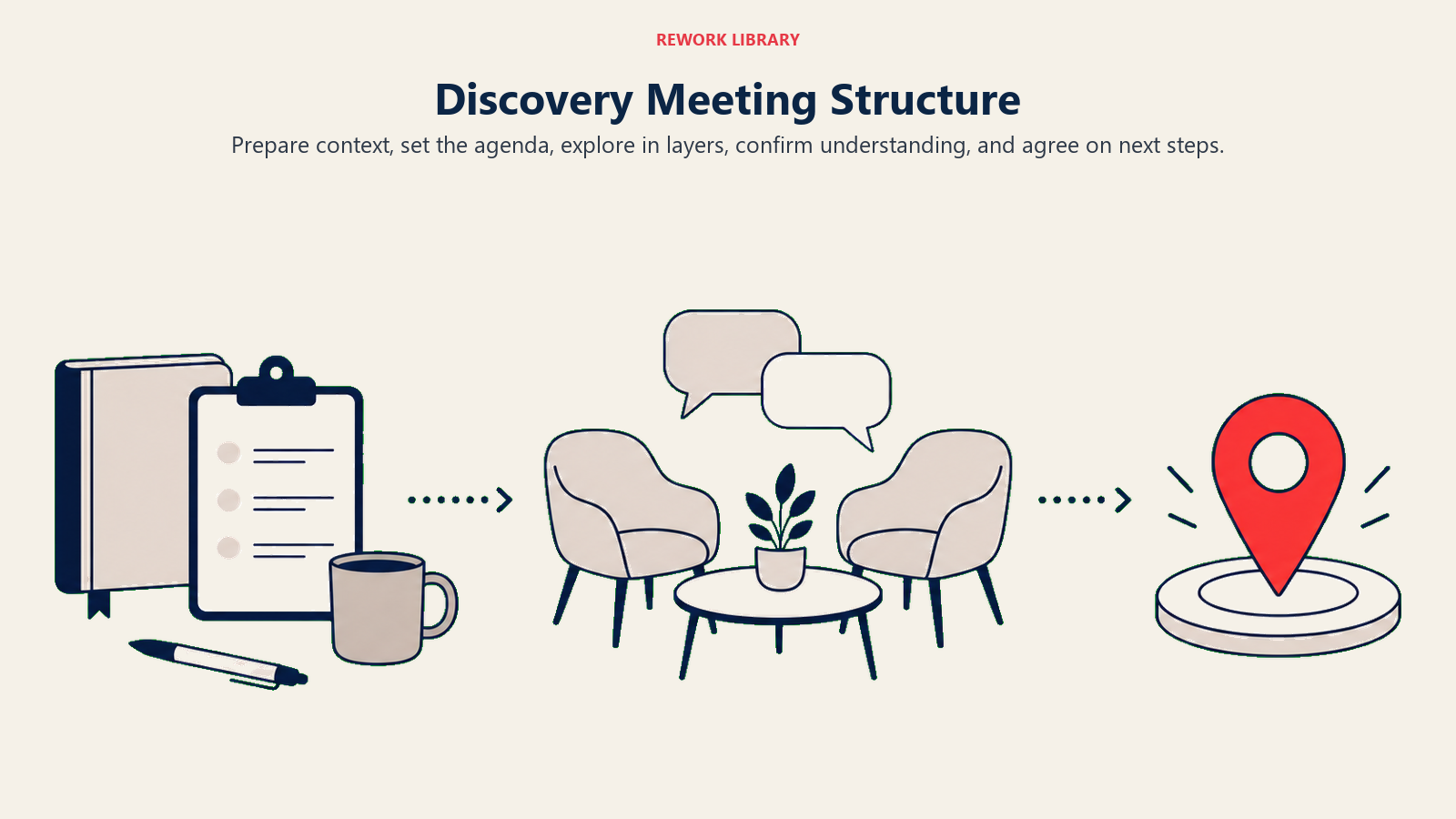
Pre-meeting preparation: Research the company, industry, and key players. Review their website, recent news, LinkedIn profiles. Come in with informed questions, not generic ones.
Prepare a discussion guide, not a rigid script, but a flow of topics and questions. Know what you need to learn.
Opening and agenda: Start by explaining what you want to accomplish in the meeting. "I'd like to spend about an hour understanding your current challenges, what you've tried so far, and where you're hoping to get to. Then we can discuss next steps. Does that work?"
Setting expectations puts everyone at ease and keeps the conversation on track.
Rapport building: Spend a few minutes on relationship building before diving into business. Comment on something you noticed in your research. Ask how they got into their role. Find common ground.
But don't overdo it. This isn't a social call. Build enough rapport to make the conversation comfortable, then get to work.
Questioning flow: Follow the SPIN sequence. Start with situation questions to establish context. Move to problem questions to identify challenges. Explore implications to deepen understanding. Finish with need-payoff questions to build value.
Let the conversation flow naturally. If they go off on a tangent that seems relevant, follow it. Your discussion guide is a map, not a mandate.
Note-taking: Capture key points, specific quotes, and follow-up questions. Don't try to transcribe everything, that kills the conversation. Hit the highlights and fill in details afterward.
If possible, have two people in the meeting, one to lead the conversation, one to take detailed notes.
Closing: Summarize what you heard and confirm understanding. "Here's what I'm taking away... Does that sound right?" This prevents miscommunication and shows you were listening.
Discuss next steps. When will they hear from you? What additional information do you need? Who else should you talk to?
Post-meeting documentation: Within 24 hours, write up a detailed summary. Include key findings, client quotes, opportunities identified, potential risks, and open questions.
Share this with your team and with the client (a sanitized version). It reinforces that you understood them and creates alignment before the proposal.
Common discovery pitfalls to avoid
Talking instead of listening: If you're explaining your services, describing your methodology, or showcasing your expertise in the discovery meeting, you're doing it wrong. Save that for the proposal. Discovery is about them, not you.
Jumping to solutions too early: The client describes a problem, and you immediately say "oh, we can fix that with..." Stop. You don't have enough information yet. Premature solutions feel presumptuous and miss nuance.
Missing key stakeholders: Talking to one person gives you one perspective. You need multiple views to understand the full picture. Insist on speaking with at least the economic buyer and technical buyer.
Not uncovering budget: Many consultants are afraid to ask about money. Get over it. If they won't share budget parameters, you can't propose appropriately. Frame it as helping them: "To make sure I'm proposing something realistic..."
Ignoring organizational politics: Every company has politics. Some teams don't get along. Some leaders have competing agendas. If you don't understand the dynamics, you'll walk into landmines.
Inadequate documentation: If you're relying on memory alone, you're missing details. Document everything while it's fresh. Future you will thank present you when you're writing the proposal at 11pm.
Asking yes/no questions: "Is this a problem for you?" is a weak question. "How is this affecting your team's ability to hit their goals?" is much stronger. Open-ended questions get detailed answers.
Not verifying understanding: Assumptions kill deals. When you hear something important, paraphrase it back: "So what I'm hearing is..." Make sure you got it right.
Documenting discovery findings
Your discovery notes become the foundation for your proposal. You need a consistent way to capture and organize information.
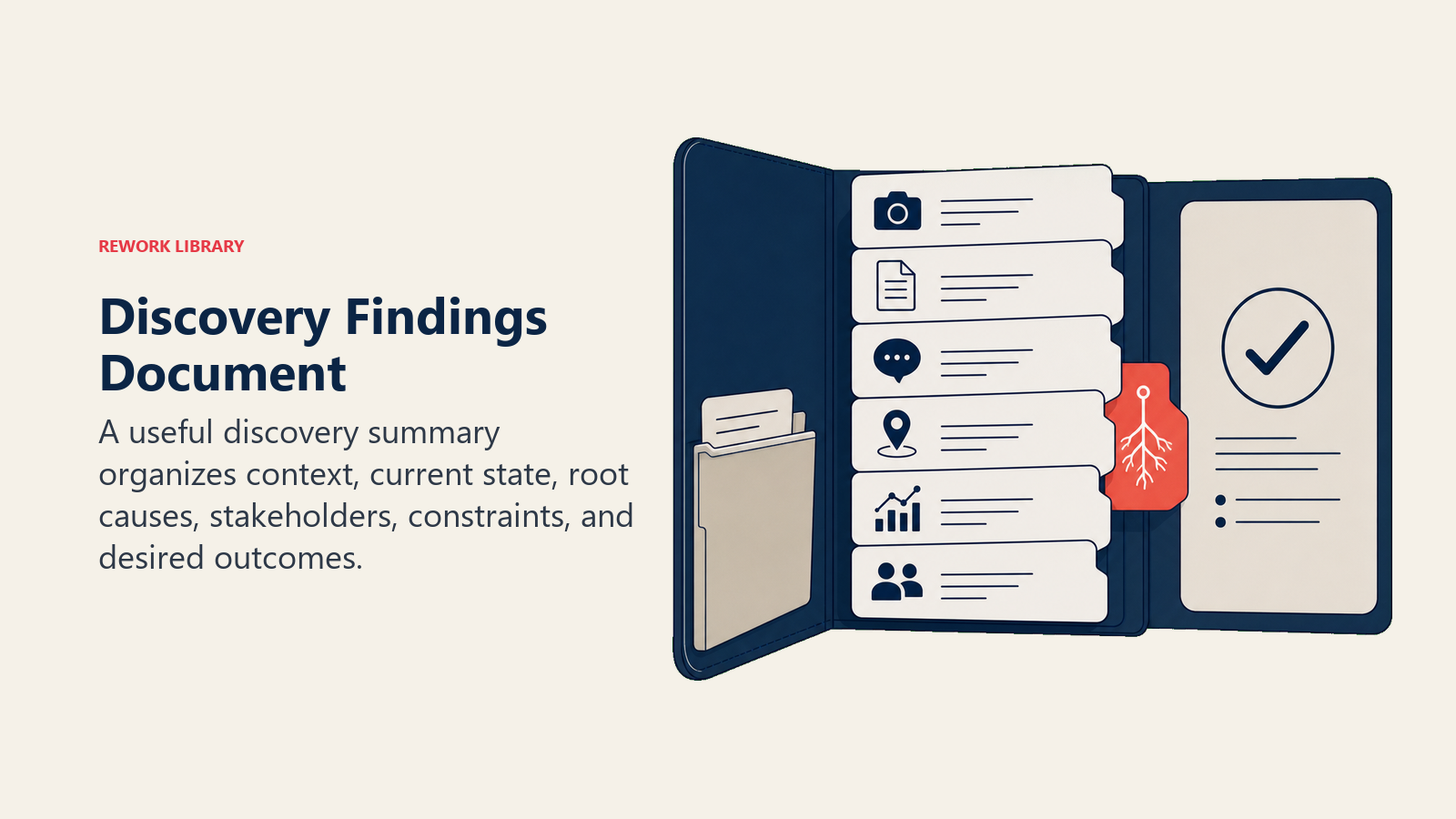
Discovery summary template:
Executive Summary: One paragraph capturing the essence of their situation, challenge, and desired outcome.
Business Context: Industry dynamics, competitive landscape, market position.
Current State: How they operate today, including systems, processes, and capabilities.
Key Challenges: Specific problems identified, prioritized by impact and urgency.
Desired Future State: Goals, success criteria, and timeline.
Stakeholder Map: Who's involved, their roles, motivations, and influence level.
Decision Process: Timeline, budget, approval requirements, evaluation criteria.
Opportunities: Where you can add the most value.
Risks and Concerns: What could derail the project or make it harder.
Competitive Intelligence: Other firms being considered, client's past experiences.
Client Quotes: Verbatim statements that capture their priorities and pain points.
Next Steps: What happens next and when.
This document serves multiple purposes:
- It's your proposal outline
- It's a briefing for your delivery team
- It's a reference during negotiations
- It's a baseline for measuring project success later
Include direct quotes from the client throughout. When they say "our biggest challenge is that projects take twice as long as they should," capture that exact phrasing. You'll use it in the proposal to show you heard them.
Share a version of this summary with the client to confirm understanding. It builds credibility and surfaces any misalignments before you invest time in a full proposal.
Advanced discovery techniques
For complex engagements, basic interviews aren't enough. Consider these advanced approaches:
Workshop-based discovery: Bring key stakeholders together for a structured working session. Use facilitation techniques to map processes, identify pain points, and build consensus on priorities.
Workshops are powerful because they create shared understanding. Instead of getting fragmented perspectives from individual interviews, you see how the team collectively views the challenge.
Process mapping exercises: Walk through current workflows step-by-step with the people who do the work. Document each step, decision point, handoff, and bottleneck.
This uncovers hidden complexity and waste that executives don't see. It also builds buy-in from the teams who'll be affected by your recommendations.
Data-driven diagnostics: Ask for access to their data. Sales numbers, project performance metrics, customer satisfaction scores, operational KPIs.
Quantitative data validates qualitative insights. When someone says "our close rate is terrible," the data might show it's actually industry-average. Or it might show it's even worse than they think.
Competitive assessment: Understand how they compare to competitors or industry benchmarks. What are others doing differently? Where are the gaps?
This positions your solution not just as solving their problem, but helping them gain competitive advantage.
Technology evaluation: For projects involving systems or tools, do a technical assessment. What's their current tech stack? What integrations exist? What technical debt do they have?
This prevents you from proposing solutions that won't work in their environment.
From discovery to proposal: making the connection
Good discovery makes proposal writing straightforward. You're not inventing a solution, you're documenting the one that emerged from your discovery conversations.
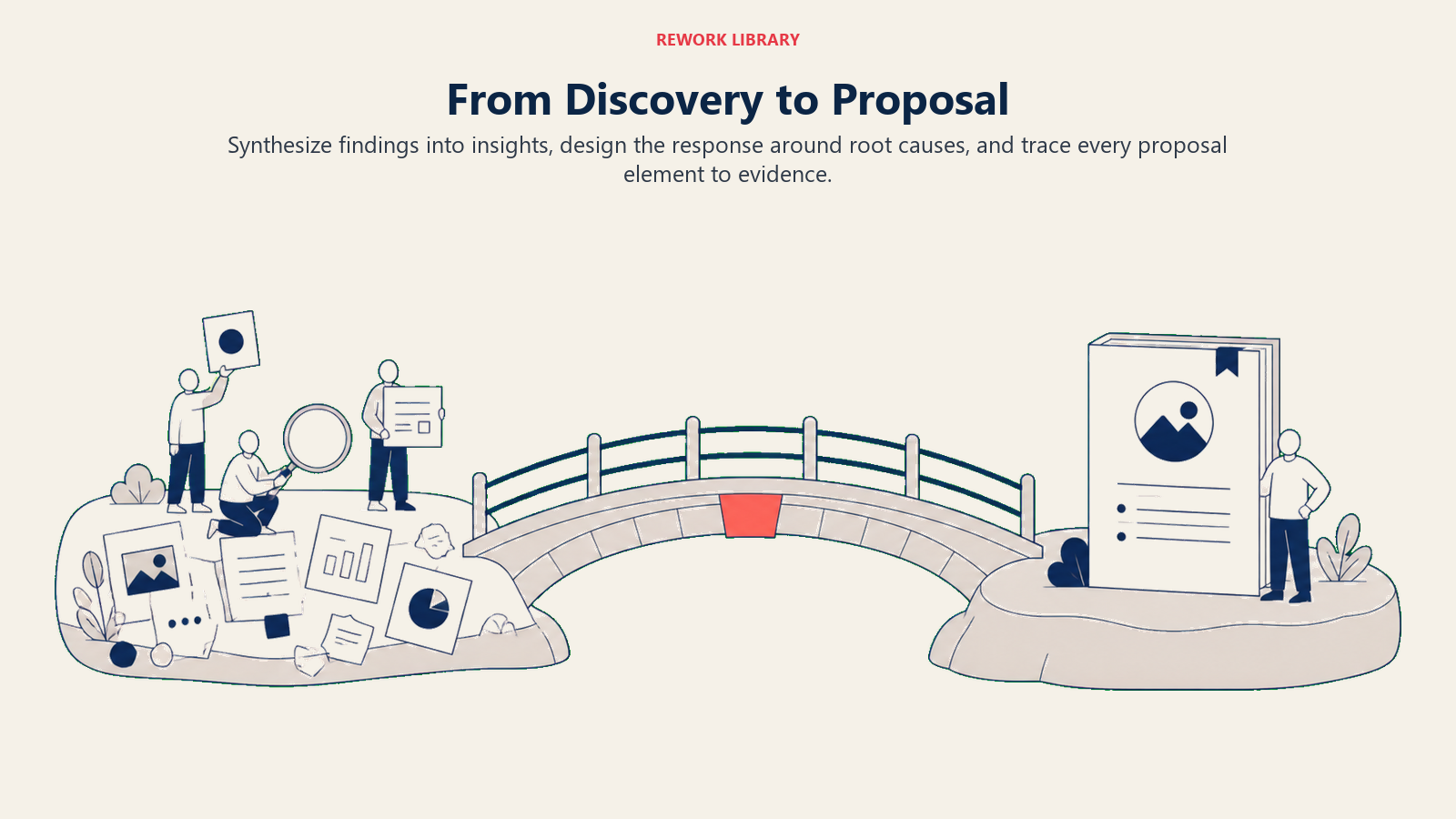
Translate findings into insights: Don't just repeat what they told you. Synthesize it. Connect dots they haven't connected. "Based on our conversations, it appears the root cause isn't the tool you're using, but how roles are defined across teams."
Design solutions that fit their context: Your methodology might be standard, but how you apply it should be customized. Reference specifics from discovery: "Given your timeline of Q2 implementation and the constraint around legacy system integration..."
Build your value proposition from their words: When they told you solving this problem would "free up 20 hours per week for strategic work," that's your value statement. Use their language and priorities.
Scope based on what you learned: Discovery should uncover complexity and clarify boundaries. Your scope should reflect the real project, not a generic version.
Price based on value, not effort: If you uncovered that this problem costs them $500K annually, your $100K engagement is a bargain. Discovery lets you quantify value, which supports higher pricing and makes pricing justification much easier during negotiations.
The best proposals feel like a continuation of the discovery conversation. The client reads it and thinks "yes, they really understood us." That's when you win.
Building trust through discovery
Here's the deeper purpose of discovery: it's not just information gathering. It's relationship building.
When you ask thoughtful questions, listen carefully, and demonstrate understanding, you build trust. The client starts to see you as a partner who genuinely wants to solve their problem, not just sell a project.
That trust is what differentiates you from competitors who send generic proposals after a 30-minute call. It's what allows you to command premium pricing. It's what turns one project into an ongoing relationship.
Good discovery also positions you as the expert. When you ask questions the client hasn't considered, when you identify issues they didn't realize they had, when you connect problems to larger patterns, you're demonstrating expertise without bragging about it.
And you're creating a shared vision. By the end of discovery, you and the client should have aligned understanding of the challenge and what success looks like. That alignment makes everything else easier.
Where to go from here
Discovery is the foundation of successful professional services sales. Get it right, and everything else falls into place.
Before your next discovery meeting:
- Review the SPIN questioning framework and practice the question types
- Create a stakeholder map template you can reuse
- Develop your discovery summary document format
- Build a library of great discovery questions for your specific service area
And integrate discovery with your broader sales process:
- Use initial consultation processes to screen opportunities before full discovery
- Apply consultative business development principles throughout
- Include budget and timeline discovery as non-negotiable elements
- Use findings to inform fit vs misfit identification
- Connect discovery directly to proposal development
The consultants who win the best projects aren't necessarily the most technically skilled. They're the ones who understand client needs better than anyone else. That understanding starts with discovery.
Take the time to do it right. Ask better questions. Listen more carefully. Document thoroughly. Your win rate will thank you.

Sales Director
On this page
- Why most discovery fails (and what it costs you)
- The discovery framework: six layers of understanding
- Business context
- Organizational assessment
- Current state assessment
- Challenge identification
- Desired future state
- Decision context
- SPIN questioning technique: the backbone of discovery
- The art of listening (and actually hearing)
- Stakeholder mapping: finding everyone who matters
- Structuring the discovery meeting
- Common discovery pitfalls to avoid
- Documenting discovery findings
- Advanced discovery techniques
- From discovery to proposal: making the connection
- Building trust through discovery
- Where to go from here