Client Relationship Strategy: Building and Managing Strategic Client Relationships for Sustainable Growth
Turn this article into takeaways for your work.


Each assistant summarizes the article only for you and suggests best practices for your work.
Here's the economics that drive professional services: acquiring a new client costs 5-7x more than retaining an existing one. But that's just the start. Your best clients - the ones you've worked with for years - generate 60-70% of your revenue while requiring a fraction of the effort to close new work.
The difference between firms that scale and firms that struggle isn't just about winning new business. It's about turning clients into partners, relationships into assets, and one-time projects into multi-year engagements. But most professional services firms treat relationship management as something that happens naturally rather than as a strategic discipline.
It doesn't happen naturally. Strong client relationships are built through intentional frameworks, consistent touchpoints, and clear value creation. This guide shows you how to systematically build, manage, and deepen client relationships that drive sustainable growth.
Why client relationships matter more in professional services
Professional services are different from product businesses. You're not selling a widget. You're selling expertise, trust, and outcomes. That fundamentally changes the relationship dynamic.
When a client hires you, they're taking a risk. They're betting that you'll understand their problem, deliver results, and not waste their time or budget. The first engagement is about proving that bet was right. Every subsequent engagement builds on that foundation.
The lifetime value multiplier: A client who gives you one $50K project is worth $50K. A client who gives you projects every year for five years is worth $250K+. But the real value is bigger - they refer others, they advocate for you internally, they're easier to sell to, and they pay premium rates because they trust you.
Retention economics: Let's say you lose 20% of clients annually. You need to replace that 20% just to stay flat. But if you reduce churn to 10%, you can invest that extra capacity in growth rather than replacement. Retention compounds. Your client retention strategy directly impacts your growth trajectory.
Referral quality: Clients who've worked with you for years send better referrals. They understand what you do, who you serve, and how to position you. A cold lead from marketing might convert at 2%. A warm referral from a long-term client converts at 30-40%.
Pricing power: First-time clients negotiate. Long-term partners pay what you're worth. When a client has seen you deliver results repeatedly, price objections disappear. You're not a vendor anymore. You're an investment.
The math is clear: relationship strength directly correlates with firm profitability.
The client relationship tier framework
Not all clients are created equal, and they shouldn't all be managed the same way. Your relationship strategy needs to match the relationship depth.
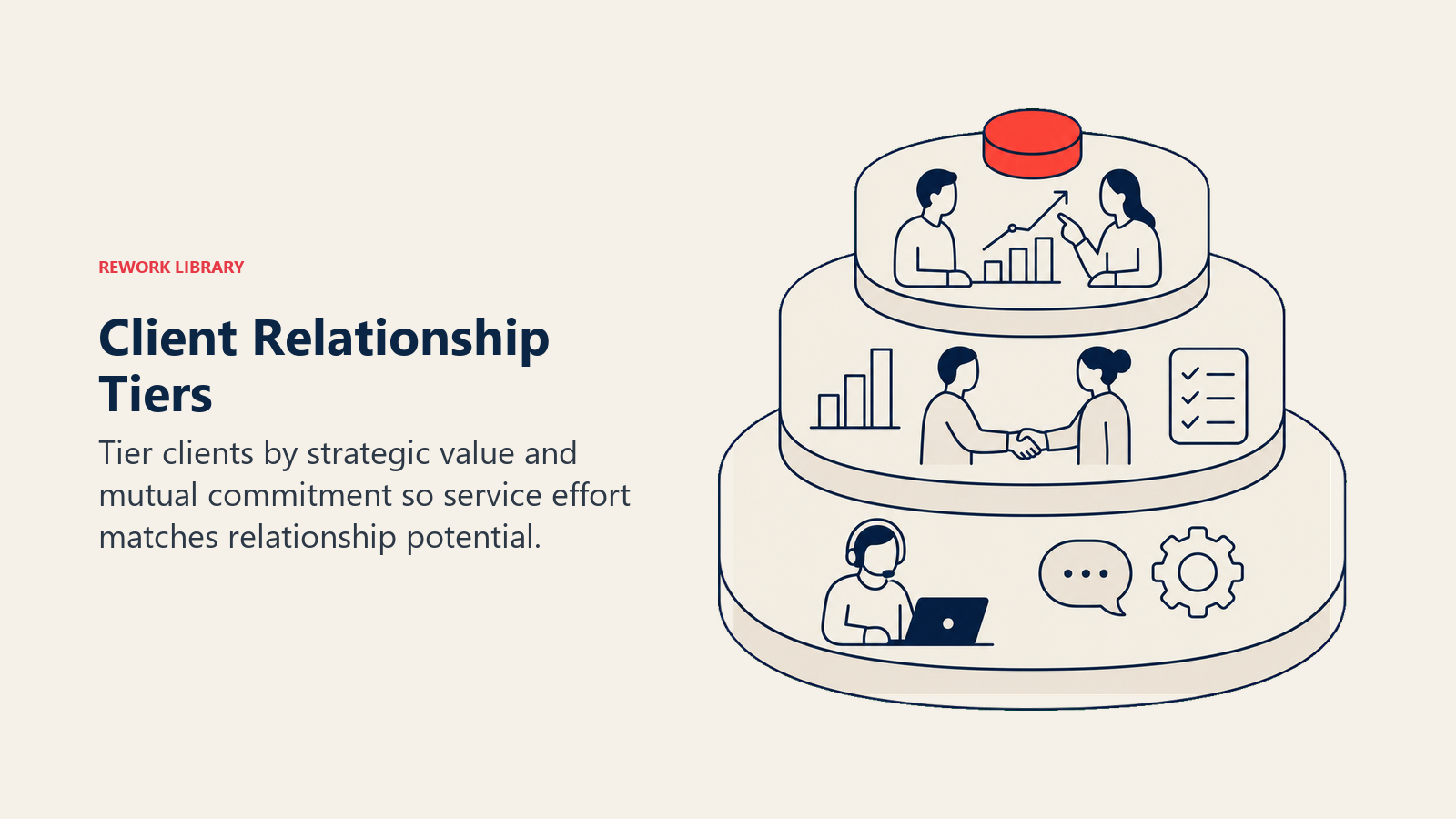
Here's a four-tier framework that segments clients by relationship stage and strategic value:
Tier 1: Transactional Clients
- Characteristics: Project-based, price-sensitive, limited history, arm's-length relationship
- Value driver: Scope completion, cost efficiency
- Your goal: Deliver well, explore fit for deeper relationship
- Management approach: Project manager owns relationship, minimal executive involvement
- Typical revenue: One-off projects, <$50K annually
These clients are testing you. They might become strategic partners, or they might stay transactional forever. Your job is to identify which path they're on and invest accordingly.
Tier 2: Recurring Clients
- Characteristics: Retainer or regular project cadence, predictable needs, trust established
- Value driver: Consistency, reliability, expanding scope
- Your goal: Become indispensable, increase share of wallet
- Management approach: Dedicated account manager, quarterly business reviews
- Typical revenue: $50K-$200K annually
These clients have proven the relationship works. They keep coming back. The opportunity is to deepen the relationship - more services, longer commitments, strategic positioning.
Tier 3: Strategic Partners
- Characteristics: Multi-year history, C-level access, trusted advisor status, cross-functional work
- Value driver: Business impact, strategic outcomes, innovation
- Your goal: Embed yourself in their strategic planning
- Management approach: Partner-level ownership, executive sponsors, annual strategic sessions
- Typical revenue: $200K-$1M+ annually
You're not a vendor here. You're a partner. You get invited to planning meetings. You have a seat at the table. You're helping shape their strategy, not just executing projects.
Tier 4: Anchor Relationships
- Characteristics: 5+ years, deeply integrated, mutual value exchange, advocacy and referrals
- Value driver: Long-term partnership, co-innovation, shared success
- Your goal: Protect and nurture, co-create value, leverage for growth
- Management approach: Executive relationship ownership, strategic account planning, innovation partnerships
- Typical revenue: $1M+ annually, multi-year contracts
These are the clients that define your firm. They're references, case studies, and revenue anchors. Losing one hurts. They get your best people, your best ideas, and your full attention.
The tier you assign determines resource allocation, touchpoint frequency, and relationship ownership. You can't manage 100 clients as Tier 4 partners. You need to be selective and intentional.
Understanding the relationship lifecycle
Client relationships evolve through predictable stages. Knowing where you are in the lifecycle helps you know what to do next.
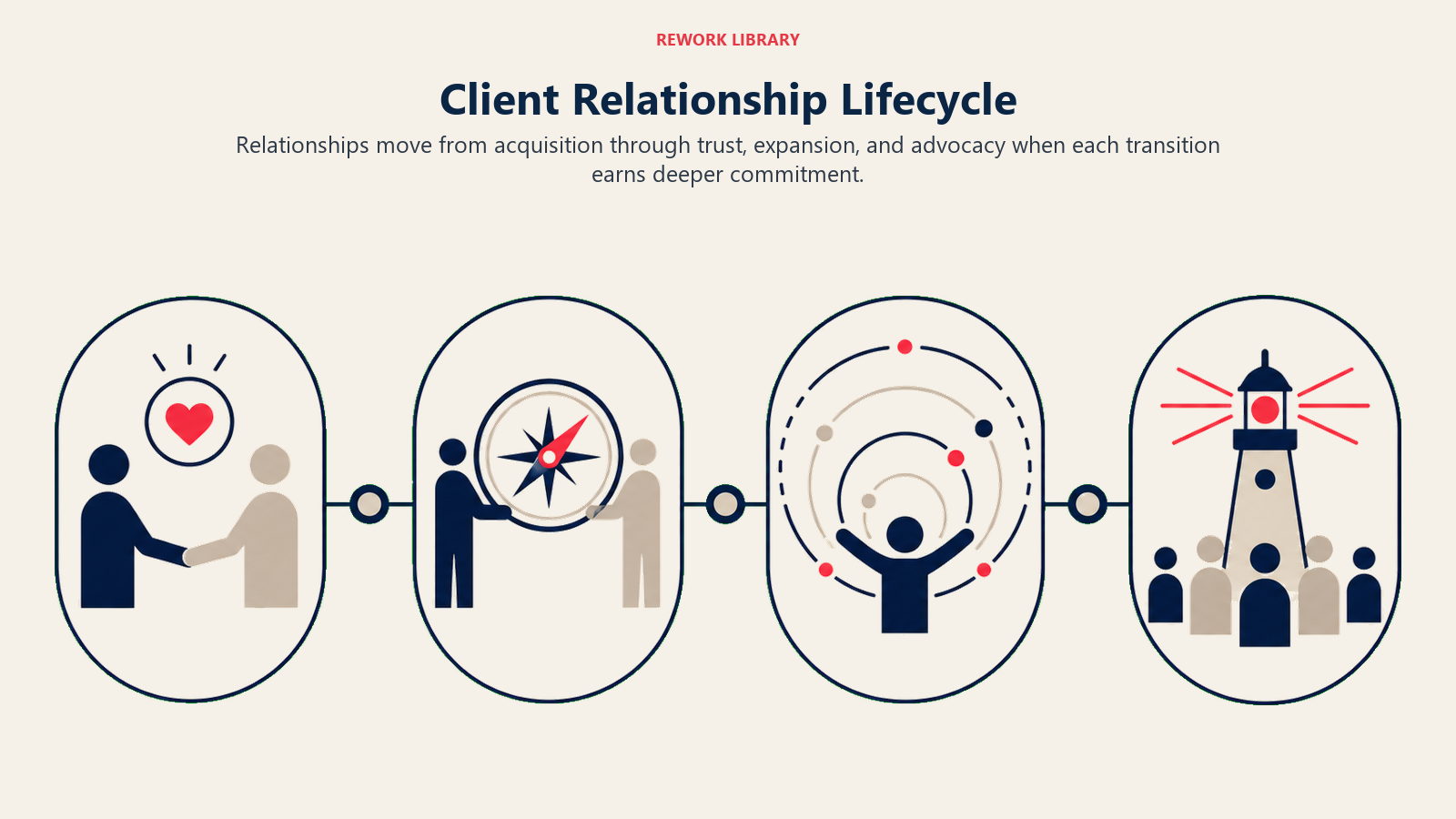
Stage 1: Engagement Initiation This is the "getting to know you" phase. First project, first interactions, first impressions. Your client is evaluating whether you're competent, whether they like working with you, and whether there's potential for more.
What to do: Deliver flawlessly on the stated scope. Under-promise and over-deliver. Start building personal connections. Ask questions about their broader business challenges, not just the project at hand. Use this phase to establish strong client communication cadence that builds confidence.
What success looks like: Project completed on time and budget, client expresses satisfaction, they mention other potential work.
Stage 2: Trust Development You've proven you can execute. Now you're proving you can think strategically. The client starts asking your opinion beyond the immediate project. They introduce you to other stakeholders. They're testing whether you understand their business.
What to do: Bring insights proactively. Share relevant case studies or trends. Start thinking about their success, not just your deliverables. Position yourself as a resource, not just a contractor.
What success looks like: Repeat engagements, broader scope discussions, requests for advice on topics outside your original mandate.
Stage 3: Advisor Status Achievement The client trusts your judgment. They call you before they've fully defined the problem. You're in planning conversations, not just execution. You've moved from "they hire us to do X" to "they hire us to help them figure out what X should be."
What to do: Act like an advisor, not a salesperson. Challenge their assumptions when needed. Bring strategic frameworks and perspectives. Connect dots across their organization. Make introductions to other valuable resources (even if you don't benefit directly).
What success looks like: Proactive outreach from client with open-ended questions, involvement in strategic planning, access to senior leadership.
Stage 4: Partnership Deepening You're embedded in multiple parts of their organization. Your work touches different functions. They see you as an extension of their team. You're invited to offsites, planning sessions, and confidential discussions.
What to do: Think in terms of their outcomes, not your utilization. Propose initiatives that create value even if they don't immediately generate revenue for you. Build relationships across the organization, not just with your primary contact. Look for ways to innovate together.
What success looks like: Multi-year commitments, expansion into new service areas, joint initiatives or co-innovation.
Stage 5: Strategic Alliance The relationship transcends individual projects. You're aligned on long-term goals. They're actively advocating for you externally. There might be formal partnership structures, co-marketing, or shared risk/reward models.
What to do: Protect the relationship fiercely. Assign your best people. Invest in the partnership even when ROI isn't immediate. Look for ways to create mutual value - referrals, case studies, thought leadership.
What success looks like: Multi-million dollar annual revenue, 5+ year tenure, active referrals and advocacy, strategic planning integration.
Most relationships don't reach Stage 5. That's fine. The goal is to identify high-potential relationships early and invest in moving them through the stages deliberately.
Account planning and relationship mapping
If you're managing strategic accounts (Tier 3+), you need a formal account planning process. Winging it doesn't work when there's millions of dollars and years of relationship at stake.
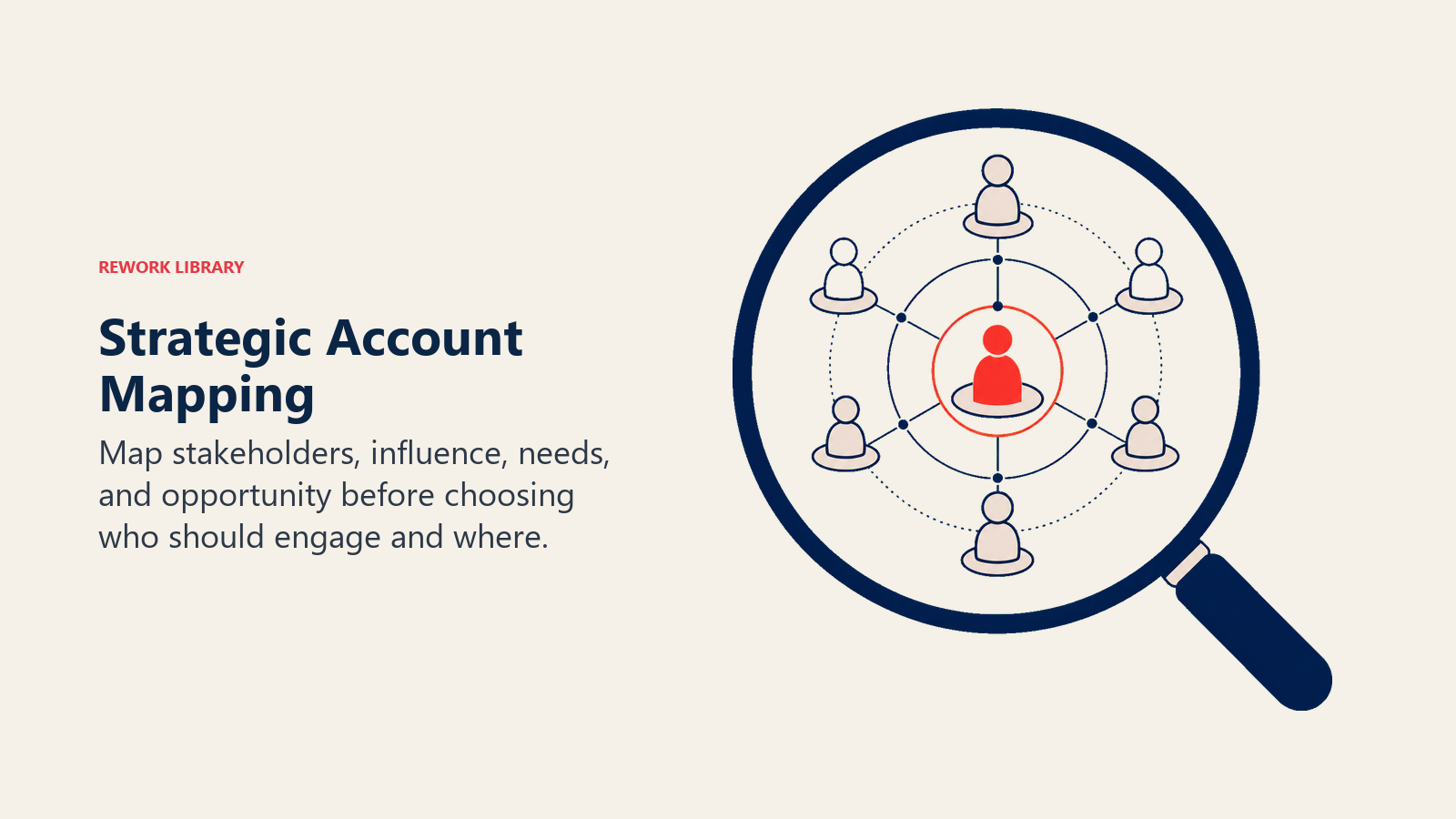
Stakeholder mapping is the foundation. You need to know:
- Who are all the people who influence decisions about working with you?
- What's their role in the organization?
- What do they care about individually?
- What's their perception of your firm?
- How strong is your relationship with each person?
Build a stakeholder map that shows:
- Decision-makers (final authority on budget/scope)
- Champions (actively advocate for you internally)
- Influencers (opinions matter to decision-makers)
- Users (day-to-day contacts, may not have authority but influence satisfaction)
- Blockers (skeptical or oppositional to your involvement)
For each stakeholder, rate your relationship strength on a simple scale:
- Strong: Trust established, regular contact, advocate for you
- Developing: Positive interactions, building rapport, neutral-to-positive perception
- Weak: Limited contact, unknown perception, transactional only
- At-risk: Negative perception, skeptical, potential blocker
Now you know where to invest. If all your relationships are with users but you have no access to decision-makers, you're vulnerable. If you have a strong champion but other influencers are weak, you need to broaden your network.
Relationship depth assessment goes deeper:
- How many touchpoints per quarter with each stakeholder?
- When did you last have a strategic (non-project) conversation?
- Have you met in person or always virtual?
- Do they reach out to you proactively or only respond to your outreach?
- Are you connected on LinkedIn? Do they engage with your content?
- Have they introduced you to others in their organization?
This tells you not just who you know, but how well you know them. Regular client success reviews provide structured opportunities to deepen these relationships.
Account opportunity assessment is about growth potential:
- What services are you currently providing?
- What adjacent services could you provide?
- What business challenges do they have that you could solve?
- What's their budget/capacity for new work?
- What's happening in their business that creates opportunities (growth, new leadership, market changes)?
- Who are your competitors for their business?
- What's your share of wallet vs. potential?
This gives you a pipeline view within existing accounts.
Strategic account plan development pulls it together into an action plan:
Account overview:
- Company background and business model
- Current state of the relationship (tier, tenure, annual revenue)
- Key contacts and stakeholder map
- Services provided and history
Strategic objectives:
- What do we want to achieve with this account in the next 12 months?
- Revenue goals, service expansion goals, relationship depth goals
Relationship strategy:
- Who needs stronger relationships and how will we build them?
- What touchpoints will we execute and when?
- What value can we create proactively?
Opportunity pipeline:
- What specific projects/services are we pursuing?
- What's the expected value and timeline?
- What's needed to close each opportunity?
Risk assessment:
- What could threaten this relationship?
- What's our mitigation strategy?
This plan gets reviewed quarterly with your account team and adjusted based on results.
Articulating your client value proposition
Here's a mistake: assuming your value is obvious. "We did good work, they know we're valuable." Not good enough. You need to actively articulate and reinforce value, especially with strategic clients.
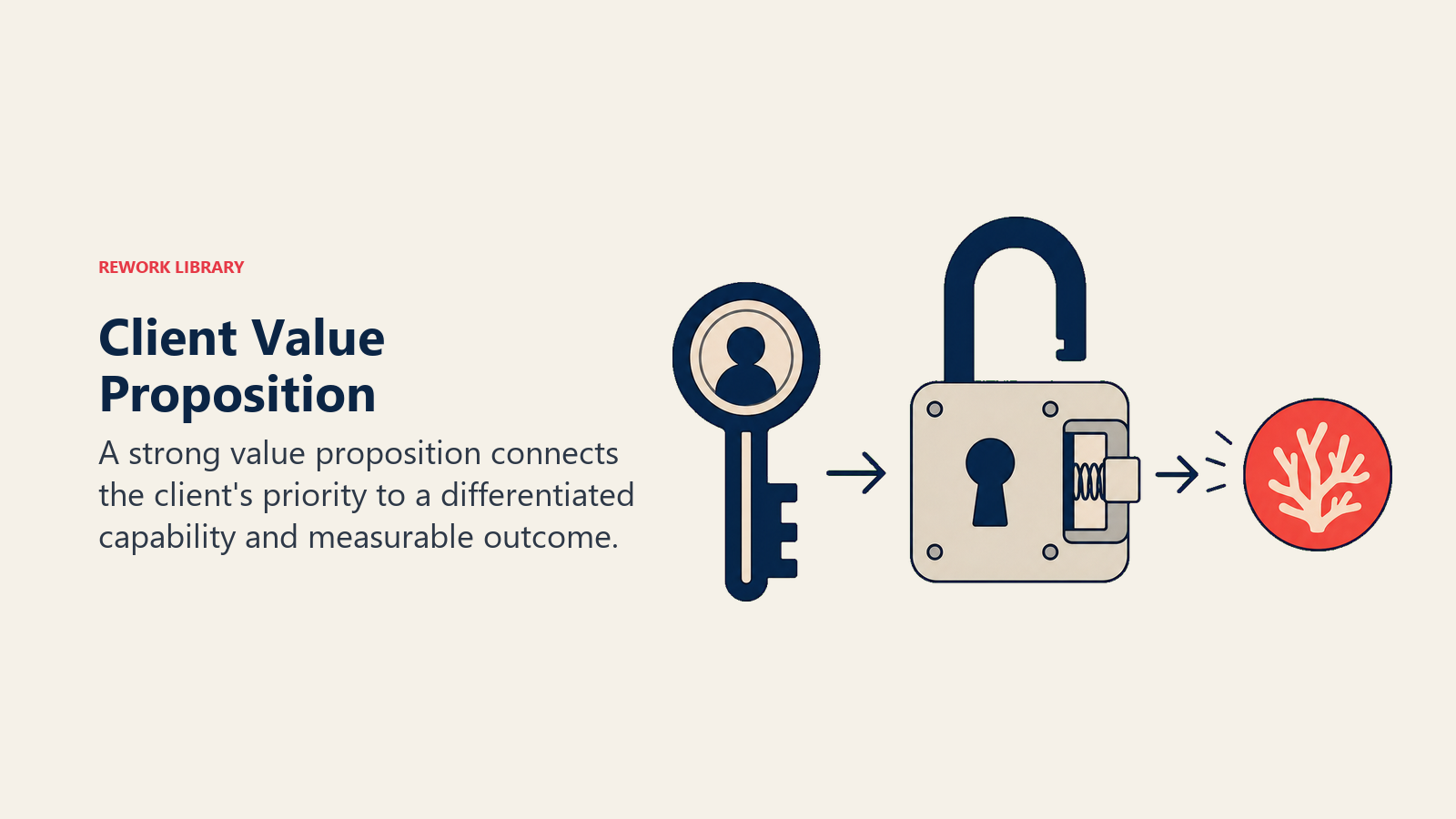
Value creation beyond core service means looking past the immediate deliverable:
- What business outcomes did your work enable?
- What risks did you help them avoid?
- What insights did you bring that they didn't have?
- What efficiency did you create?
- What strategic clarity did you provide?
Example: You're a management consultant hired to optimize operations. The core service is process mapping and recommendations. The extended value is:
- $2M in annual cost savings identified
- 3-week reduction in project delivery timelines
- Framework that can be applied to other departments
- Team capability building (they can maintain improvements without you)
- Strategic insight about where to invest next
That extended value is what justifies your fee and what earns you the next engagement.
Articulating business impact requires translating your work into their language. Don't talk about what you did. Talk about what changed for them.
Weak: "We delivered a comprehensive market analysis report." Strong: "Our analysis helped you validate the expansion into healthcare, which led to closing three new enterprise accounts worth $4M."
Weak: "We implemented a new CRM system." Strong: "The CRM implementation increased sales team productivity by 30% and reduced customer onboarding time from 45 days to 12 days."
Quantify when possible. Use their metrics (revenue, margin, time-to-market, customer satisfaction) not your metrics (deliverables completed, hours worked).
Differentiation drivers are why they should work with you vs. anyone else:
- Deep expertise in their specific industry or challenge
- Track record of outcomes with similar companies
- Unique methodology or frameworks
- Chemistry and cultural fit with their team
- Speed and responsiveness
- Senior-level attention (not handing off to junior staff)
- Network and connections that benefit them
You should be able to complete this sentence for every strategic client: "They work with us instead of other firms because..."
Value reinforcement is ongoing. Don't just create value and assume they remember:
- Quarterly business reviews that recap results and impact
- Case studies and success stories that highlight outcomes
- Proactive "value delivered" summaries at project milestones
- Annual recap of everything achieved together
- Testimonials and references that reinforce their decision to work with you
The goal is to make value visible and memorable. When budget season comes or a competitor pitches them, you want a clear track record of impact in their minds. Your client testimonials and case studies also serve as powerful proof points during these conversations.
Designing your strategic touchpoint framework
Relationships don't maintain themselves. You need a deliberate touchpoint strategy that balances staying connected without being annoying.
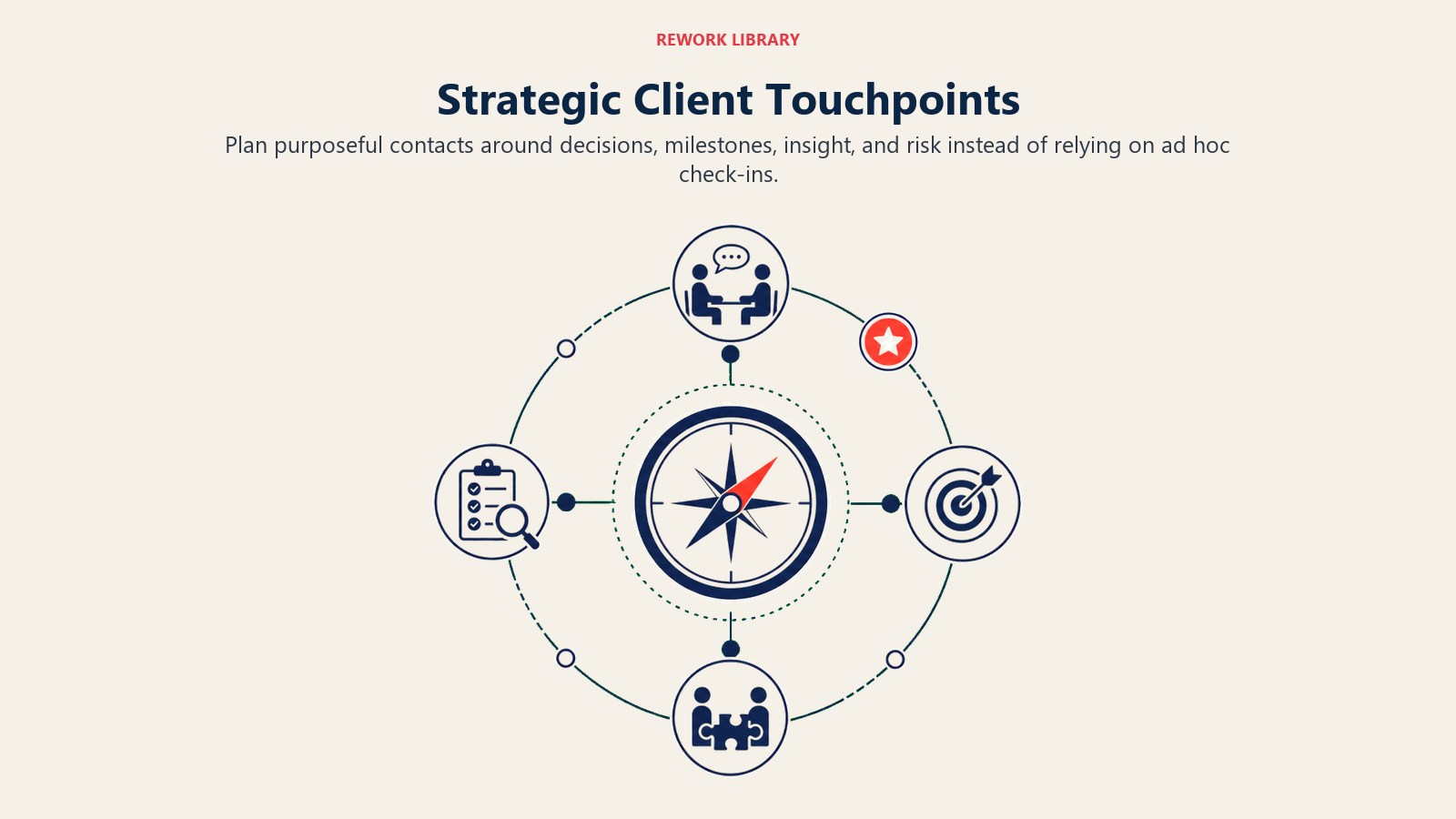
Executive touchpoints are for strategic relationships (Tier 3+):
- Quarterly business reviews: 60-90 min strategic discussion about their business, your work together, future opportunities. Not a status update. A strategic conversation.
- Annual strategic planning session: Half-day or full-day session to align on long-term goals, identify growth opportunities, strengthen executive relationships.
- Executive dinners/events: Social connection with senior leadership, 2-4x per year
These are high-touch, high-value interactions. You're not selling. You're advising and connecting.
Operational touchpoints are project-focused:
- Weekly or bi-weekly project status meetings
- Milestone check-ins and deliverable reviews
- Ad-hoc problem-solving conversations
- Post-project retrospectives
These maintain project momentum and ensure satisfaction, but they're not relationship-building on their own.
Strategic touchpoints are about thought leadership and insights:
- Monthly or quarterly insights sharing: Send relevant articles, research, trends you're seeing
- Webinars or workshops you're hosting that would benefit them
- Introductions to other valuable contacts in your network
- Industry event invitations where you'll both be present
- Proactive recommendations on challenges you've noticed
These position you as a valuable resource beyond billable work. You're bringing value even when you're not actively working on a project.
Relationship maintenance touchpoints are the small things that matter:
- Holiday cards or gifts for key contacts
- Birthday or work anniversary acknowledgments (LinkedIn makes this easy)
- Congratulations on promotions, company milestones, or personal achievements
- Check-in calls with no agenda except "how are things going?"
- Invitations to informal coffee or lunch when you're in their city
These build personal connection and show you care about them as people, not just revenue sources.
Touchpoint frequency planning by tier:
Tier 1 (Transactional):
- Operational touchpoints only during active projects
- Minimal proactive outreach between projects
- Holiday card or occasional insight sharing
Tier 2 (Recurring):
- Monthly operational touchpoints during active work
- Quarterly strategic touchpoints (insights, check-ins)
- Semi-annual relationship maintenance
Tier 3 (Strategic Partners):
- Weekly operational touchpoints during active work
- Monthly strategic touchpoints
- Quarterly executive touchpoints
- Regular relationship maintenance
Tier 4 (Anchor):
- Continuous operational touchpoints
- Bi-weekly or monthly strategic touchpoints
- Quarterly executive business reviews
- Annual strategic planning sessions
- Frequent relationship maintenance
The key is consistency. Irregular, sporadic contact is worse than less frequent but predictable contact. Build a rhythm that works for both sides.
Strategies for long-term value creation
The best client relationships create value in multiple dimensions over time. Here's how to think beyond individual projects.
Cross-sell and upsell strategy is about expanding your footprint:
- Cross-sell: Different services to the same buyer (if they hired you for strategy, offer implementation support)
- Upsell: Higher-value or broader-scope versions of what you're already doing (pilot becomes full rollout)
- Cross-organization sell: Same services to different departments or business units
The approach: Look for natural adjacencies. If you're working with the sales team on pipeline optimization, there's probably an opportunity with the marketing team on lead generation. If you're doing work in one region, there might be opportunity in other regions.
But don't force it. Your first responsibility is delivering excellent results on current work. Expansion comes from success, not aggressive pitching.
Referral and network development turns clients into advocates:
- Ask satisfied clients for introductions to peers (other companies, industry contacts)
- Request testimonials and case study participation
- Invite them to speak at your events or co-present at conferences
- Ask them to review your LinkedIn profile or leave recommendations
- Get them involved in your content (interviews, quotes, perspectives)
Make it easy and valuable for them. Don't just extract. Give them visibility, thought leadership opportunities, or valuable connections in return.
Client success and advocacy means actively investing in their outcomes:
- Proactively monitor project success metrics and share results
- Connect them with resources that help them succeed (even if you don't benefit)
- Celebrate their wins publicly (with permission)
- Advocate for them in your network when they need help
- Think about their career success, not just company success (helping key contacts advance strengthens loyalty)
When you genuinely care about client success independent of your fees, the relationship deepens.
Lifetime value optimization is playing the long game:
- Structure contracts for mutual long-term benefit (retainers vs. project-by-project)
- Build institutional knowledge and continuity (don't rotate teams unnecessarily)
- Create switching costs through integration and customization
- Develop proprietary tools or approaches tailored to their needs
- Invest in onboarding and training that makes them more effective with your services
The goal is to make the relationship more valuable over time, not just more expensive.
Managing relationship risks
Even strong relationships can deteriorate. You need to spot warning signs early and act before it's too late.
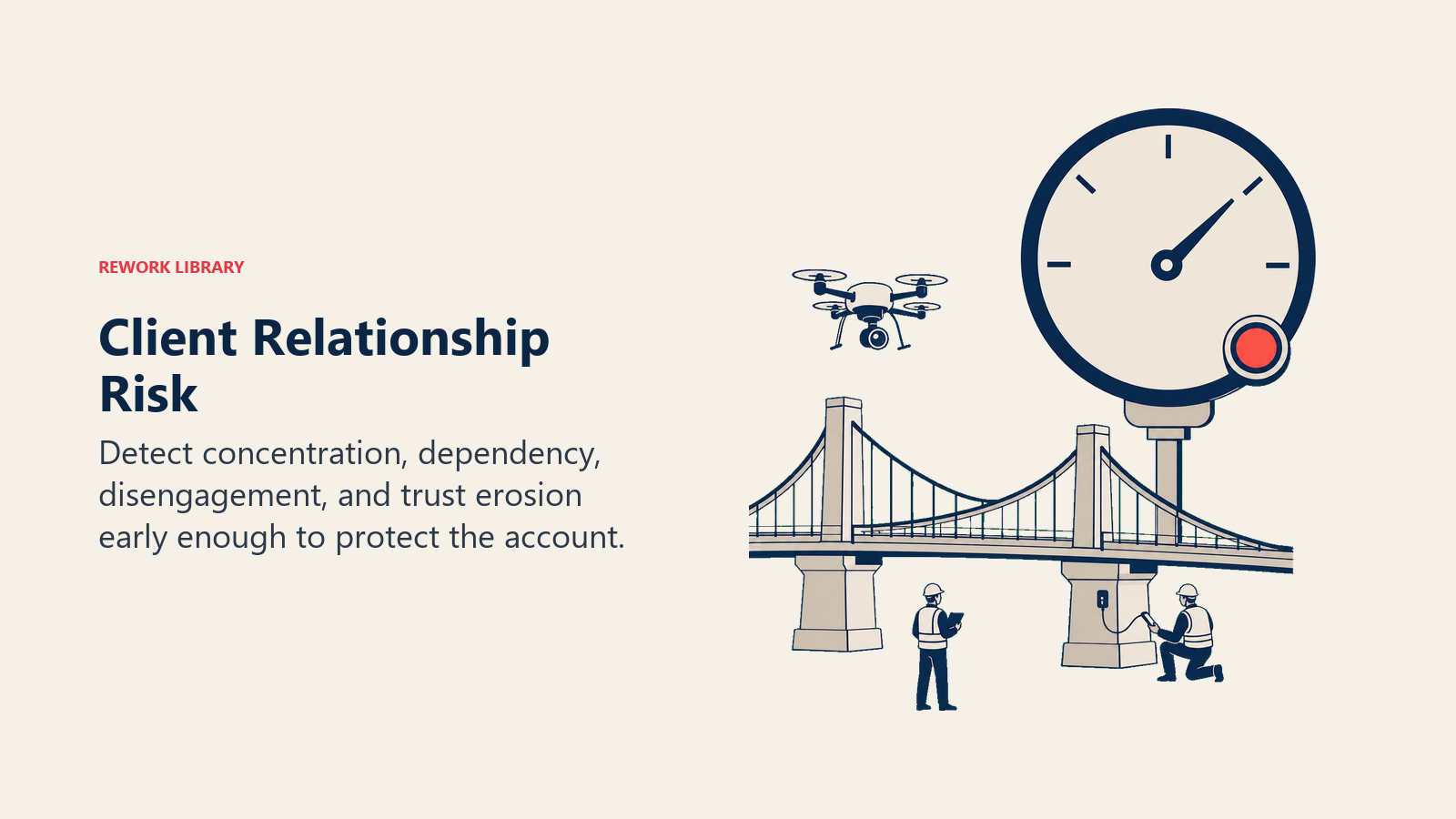
Identifying relationship risks:
- Single point of contact dependency: What happens if your champion leaves?
- Declining responsiveness: They used to reply in hours, now it's days or crickets
- Budget pressure: Company-wide cost cuts or challenging financial performance
- Leadership changes: New executives often bring their preferred vendors
- Competitive threats: Other firms actively pursuing the account
- Project dissatisfaction: Even small issues can compound if not addressed
- Organizational changes: Mergers, restructures, strategic pivots that affect your relevance
Early warning signs:
- Slower payment than usual
- Reduced access to senior stakeholders
- Projects getting smaller or delayed
- Lack of response to proposals that would have been easy yeses before
- Defensive or terse communication
- Reduced invitation to strategic conversations
- Hearing about initiatives you'd normally be involved in
When you see these signs, don't ignore them or assume they'll pass.
Relationship recovery strategies:
- Direct conversation: "I've noticed we're not connecting as frequently. Is everything okay? Is there something we should discuss?"
- Executive escalation: Have your senior leader reach out to their senior leader
- Value audit: Review and present the value you've delivered, remind them of results
- Fresh perspective: Bring new ideas or approaches, signal innovation
- Price or terms adjustment: Sometimes you need to give to get things back on track
- Process improvement: If there were project issues, show what you're doing differently
The key is addressing issues directly and quickly. Hoping they resolve themselves usually makes things worse.
Proactive retention activities prevent problems before they start:
- Regular relationship health checks (stakeholder surveys, NPS scoring)
- Executive sponsor check-ins separate from project teams
- Annual relationship reviews where you ask explicitly: "What would make us more valuable to you?"
- Contract renewal planning that starts 6+ months before expiration
- Expansion initiatives that show continued investment in the relationship
- Team continuity and succession planning (don't surprise them with new faces)
The best retention strategy is delivering consistent value and maintaining strong relationships before there's a problem. Systematic client satisfaction management helps you catch issues before they escalate.
Team coordination and account governance
Strategic accounts need team-level coordination, not just individual relationship owners.
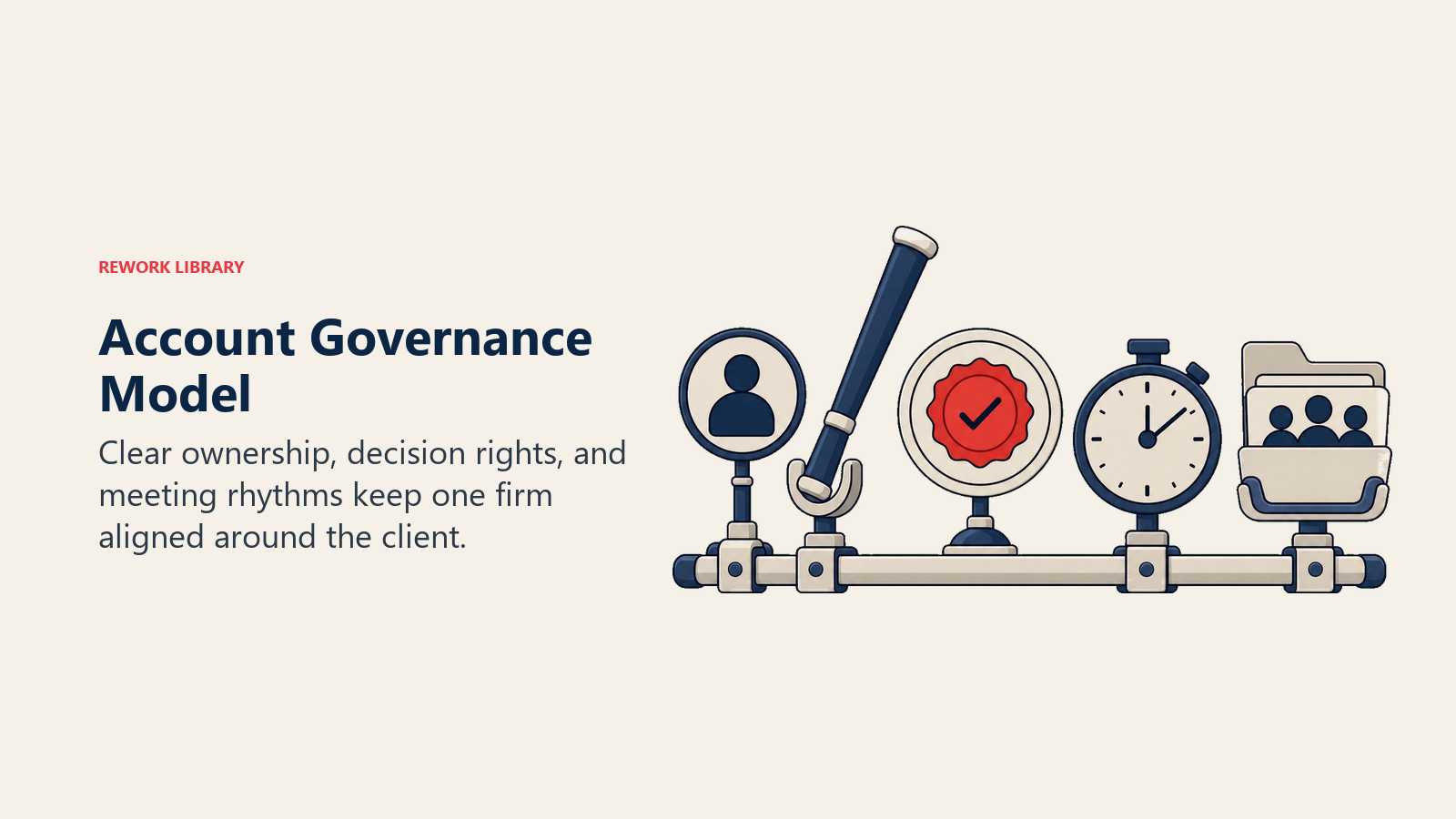
Account team structure and roles:
- Executive Sponsor: Senior leader who owns C-level relationships, involved in strategic decisions only
- Account Lead: Day-to-day owner of relationship health, coordinates across teams, drives growth strategy
- Delivery Lead: Ensures project execution quality, technical excellence, client satisfaction
- Practice/Subject Matter Experts: Brought in for specific opportunities or challenges
Clear role definition prevents overlap and gaps. Everyone knows who owns what.
Accountability and metrics:
- Account Lead is measured on: relationship health, revenue growth, renewal rates, client satisfaction
- Delivery Lead is measured on: project outcomes, margin, quality, team utilization
- Executive Sponsor is measured on: strategic relationship strength, executive access, advocacy
Different roles, different KPIs.
Cross-functional coordination:
- Monthly or quarterly account team meetings to align on strategy
- Shared account plan that everyone contributes to
- Central CRM system where all interactions and opportunities are logged
- Coordination on outreach (avoid three people from your firm contacting them in the same week)
- Knowledge sharing across delivery teams (lessons learned, client preferences, what works)
The client should experience one cohesive firm, not disconnected individuals.
Account continuity and succession:
- Document key relationships, history, preferences, and context
- Gradually introduce new team members rather than abrupt handoffs
- Maintain multiple relationships so you're not vulnerable to single person dependency
- Plan for transitions (retirements, promotions, role changes) well in advance
- Create institutional memory that survives individual departures
You're building firm-level relationships, not just personal relationships.
Communication and engagement best practices
How you communicate shapes relationship quality. Get this right and everything else gets easier.
Channel and preference management: Different stakeholders prefer different channels:
- Email for formal communication, documentation, and low-urgency topics
- Phone or video calls for nuanced discussions, problem-solving, and relationship building
- In-person meetings for strategic planning, complex negotiations, and deepening trust
- Slack or Teams for quick questions and collaborative work (if you're integrated into their tools)
- LinkedIn for social engagement and staying visible
Ask clients their preference. Some people hate phone calls. Some never check email. Adapting to their style shows respect.
Business review cadence: Structure these to be valuable, not perfunctory:
- Send agenda in advance with specific discussion topics
- Share pre-read materials (dashboards, results summaries) 24-48 hours before
- Focus the meeting on insights and strategy, not just reporting data
- Come with recommendations and ideas, not just status updates
- Document action items and follow up
If clients start declining business reviews, they're not finding them valuable. Fix that or stop scheduling them.
Thought leadership and insights: Position yourself as a source of industry intelligence:
- Share relevant research, trends, competitive intelligence
- Provide perspective on how other companies are approaching similar challenges
- Bring frameworks and mental models that help them think through decisions
- Connect dots they might not see (e.g., "This initiative ties to your strategic priority on X")
- Ask thoughtful questions that challenge assumptions constructively
You're not just sharing information. You're helping them think better.
Transparency and trust building: Be honest, especially when it's uncomfortable:
- If a project isn't going well, raise it early and with solutions
- If you don't know something, say so (then go find out)
- If you made a mistake, own it and fix it
- If their strategy seems problematic, respectfully share your concern
- If you can't do something they need, help them find someone who can
Clients value honesty over perfection. Trust is built through authenticity.
Leveraging relationships for growth
Strong client relationships are assets that can be deployed strategically.
Client advocacy: Ask happy clients to:
- Participate in case studies that showcase results
- Provide testimonials for your website or proposals
- Speak at your events or webinars
- Join client advisory boards where they provide strategic input
- Review or endorse your thought leadership content
Brand association: Highlighting prominent clients builds credibility:
- "We work with X, Y, and Z" (with permission) signals that serious companies trust you
- Client logos on your website (with approval)
- Co-branded content or joint webinars
- Speaking opportunities at industry events where they present your joint work
Internal promotion: Help champions sell you within their organizations:
- Provide them with executive summaries they can forward to leadership
- Create presentation materials they can use to advocate for expanded engagement
- Offer to present directly to budget holders or skeptics
- Show them how to build the internal business case for working with you
Make it easy for clients to champion you. Give them the tools and ammunition.
Technology and CRM integration
Manual relationship management doesn't scale. You need systems that help you stay on top of accounts without losing the personal touch.
CRM system capabilities you need:
- Complete interaction history (who talked to whom, when, about what)
- Stakeholder mapping and org chart visualization
- Opportunity pipeline tracking at account level
- Task and reminder management for touchpoint execution
- Document repository for proposals, contracts, deliverables
- Account health scoring and risk flagging
- Revenue and utilization tracking by account
Salesforce, HubSpot, or industry-specific CRMs can do this if configured properly.
Data analytics for relationship insights:
- Engagement trends: Are touchpoints increasing or decreasing over time?
- Revenue trends: Growth, decline, or plateau?
- Margin analysis: Which accounts are most/least profitable?
- Pipeline health: What's in progress vs. at risk?
- Relationship breadth: How many stakeholders do you have relationships with?
These insights inform where to invest and where to course-correct.
Automation with a human touch:
- Automated reminders for touchpoints (but don't auto-send communications)
- CRM workflows that flag important events (contract renewal dates, executive changes)
- Email templates for common communications (that you customize before sending)
- Dashboards that surface account health without manual reporting
Automation should enable personal attention at scale, not replace it.
Measuring relationship performance
You can't manage what you don't measure. Track these metrics by account and across your portfolio.
Client-level metrics:
- Annual revenue and trend (growing, flat, declining)
- Client tenure (how long have they been a client)
- Project margin and profitability
- Client Lifetime Value (CLV): Total revenue over the relationship duration
- Share of wallet: Your revenue as a percentage of their total spend in your service area
Relationship quality metrics:
- Net Promoter Score (NPS): Would they recommend you?
- Client Satisfaction Score (CSAT): How satisfied are they with recent work?
- Relationship depth: Number of stakeholders with active relationships
- Executive access: How many C-level relationships do you have?
- Touchpoint frequency and recency
Building effective client feedback systems helps you collect and act on these metrics consistently.
Business development metrics:
- Cross-sell and upsell revenue from existing accounts
- Referral volume and conversion from clients
- Renewal rate and expansion rate at contract renewal
- Pipeline value from existing accounts vs. new business
- Time to close opportunities with existing clients vs. new
Strategic metrics:
- Percentage of revenue from Tier 3/4 accounts
- Average client tenure by tier
- Client concentration risk (percentage from top 10 clients)
- Account team engagement (number of people with active client touchpoints)
These metrics tell you if your relationship strategy is working and where to focus improvement efforts.
Industry-specific relationship strategies
Different professional services industries have different relationship dynamics.
Consulting firms: Relationship ownership often tied to engagement leadership. Challenge is maintaining continuity between projects. Solution: Partner-level sponsors who stay engaged even when not delivering active work. Annual strategic planning sessions are critical.
Law firms: Relationships are often partner-owned with high personal loyalty. Challenge is succession when partners retire. Solution: Multi-generational relationship building where junior partners develop relationships years before taking over accounts.
Accounting firms: Annual audit cycles create natural touchpoints. Challenge is becoming more than the compliance vendor. Solution: Proactive advisory services that position you as strategic business advisor, not just auditor.
Technology services and implementation: Relationships often start technical and project-focused. Challenge is elevating to business-level conversations. Solution: Business outcome reporting that shows impact beyond technical deliverables, executive sponsors who speak business language.
Marketing and creative agencies: High relationship intensity during campaigns, risk of going quiet between them. Challenge is staying relevant between active projects. Solution: Ongoing strategic retainers, proactive insights sharing, integrated yourself into their planning calendar.
Adapt your relationship approach to how decisions are made and relationships valued in your specific industry.
Common relationship management challenges
Key person dependency: If your entire relationship depends on one champion and they leave, you're in trouble. Solution: Build multiple relationships across the organization. When your champion gets promoted, they often become an even more valuable advocate, but only if you have other relationships to maintain continuity.
Scope creep and relationship strain: Trying to preserve a relationship by saying yes to everything leads to unprofitable work and resentment. Solution: Clear scoping and change control processes. Say yes to the relationship, no to specific requests when appropriate, and propose alternatives.
Price pressure: Long-term clients sometimes expect discounts "because we've worked together so long." Solution: Articulate value consistently, show how your pricing reflects market value, offer value-adds instead of price cuts, and know when to walk away from unprofitable relationships.
Stakeholder transitions: New leadership brings new vendors. Solution: Invest in relationship with new stakeholders early, demonstrate value quickly, position long-term knowledge and continuity as an asset, and be prepared to re-sell the relationship.
These challenges are normal. The difference between firms that lose relationships and firms that preserve them is how proactively they address issues.
Building your relationship strategy
Start by segmenting your current client base into the four tiers. Be honest about which relationships deserve strategic investment and which are transactional by nature.
For Tier 3 and 4 accounts:
- Assign account leads and executive sponsors
- Build comprehensive stakeholder maps
- Develop formal account plans
- Implement consistent touchpoint calendars
- Measure relationship health quarterly
For Tier 2 accounts:
- Identify which have potential to move to Tier 3
- Implement lighter-touch relationship management
- Focus on consistent delivery and selective expansion
For Tier 1 accounts:
- Deliver excellent work
- Look for signals that indicate strategic potential
- Don't over-invest in relationships that aren't going to deepen
The goal isn't to turn every client into a strategic partner. It's to identify high-potential relationships, invest strategically, and create sustainable growth from client relationships that compound in value over time.
Your client relationships are your most valuable asset. Treat them that way.
Where to go from here
Client relationship strategy connects to everything else in professional services growth:
- Client Qualification Framework helps you identify which relationships to invest in
- Consulting Engagement Models structures how you work with clients at different relationship stages
- Billable Hour vs Value Pricing affects pricing power in long-term relationships
- Professional Services Metrics provides the measurement framework for relationship health
- Project Management Methodology ensures delivery excellence that makes relationships strong
Strong client relationships don't happen by accident. They're built through intentional strategy, consistent execution, and genuine commitment to client success. Build the frameworks, invest the time, and watch your relationships become your growth engine.

Sales Director
On this page
- Why client relationships matter more in professional services
- The client relationship tier framework
- Understanding the relationship lifecycle
- Account planning and relationship mapping
- Articulating your client value proposition
- Designing your strategic touchpoint framework
- Strategies for long-term value creation
- Managing relationship risks
- Team coordination and account governance
- Communication and engagement best practices
- Leveraging relationships for growth
- Technology and CRM integration
- Measuring relationship performance
- Industry-specific relationship strategies
- Common relationship management challenges
- Building your relationship strategy
- Where to go from here