Creative Brief Development: Foundation for Effective Creative Work and Client Alignment
Turn this article into takeaways for your work.


Each assistant summarizes the article only for you and suggests best practices for your work.
Here's the harsh truth about creative projects: a vague brief costs you three rounds of revisions, missed deadlines, and a frustrated client who says "that's not what I meant." The creative team blames the account team for unclear direction. The account team blames the client for changing their mind. The client blames everyone for not reading their minds.
A solid creative brief prevents all of this. Research shows well-briefed projects are three times more likely to succeed on the first or second round of feedback. That's not because the creative team suddenly got better. It's because they knew exactly what problem they were solving before they started designing.
But most briefs are terrible. They're either so vague they're useless ("make something that pops") or so restrictive they kill creativity ("use exactly Pantone 286 C and no other blue"). This guide shows you how to write briefs that inspire great work while keeping everyone aligned on what success looks like. Strong briefs are essential for effective campaign results reporting later.
What is a creative brief and why does it matter?
A creative brief is a strategic document that guides creative development. Think of it as the North Star for a project. When the client says "I'll know it when I see it," the brief is what helps them know it. When the designer has five different concepts they could explore, the brief tells them which one solves the actual problem.
The brief serves four critical functions.
First, it creates alignment. It gets everyone on the same page before work starts. The client, the account team, the creative team, and any other stakeholders all agree on what they're trying to accomplish. This prevents the nightmare scenario where the client approves a direction in principle, then rejects execution because they were picturing something completely different.
Second, it provides focus. It defines what's in scope and what's not. A campaign brief for millennial parents isn't also trying to appeal to Gen Z singles. A website redesign focused on conversion isn't also a brand refresh. When you try to accomplish everything, you accomplish nothing.
Third, it gives creative direction. It provides strategic guidance without dictating execution. "Speak to empty nesters who are downsizing for the first time" gives creatives something to work with. "Use warm colors and show happy people" is just instructions.
Finally, it sets success criteria. It establishes how you'll measure if the work succeeded. That might be engagement metrics, brand lift, conversion rates, or simply client satisfaction. But you need to know what winning looks like before you start playing.
Most briefs are one to three pages. Shorter than that and you're missing critical information. Longer than that and nobody reads it. The goal is concise but complete.
Who creates the brief and who uses it?
The account or strategy team typically writes the brief, working closely with the client. The creative team uses it to develop concepts. But here's what people miss: brief development isn't a handoff. It's a collaboration.
The account team gathers client input and business context. What are they trying to achieve? Who are they targeting? What constraints exist? But they shouldn't write the brief in a vacuum and toss it over the wall to creatives.
Smart agencies involve the creative director or lead designer in brief development. They catch vague language, spot missing information, and ask clarifying questions before work starts. Five minutes of "wait, what do they mean by 'premium but approachable'?" during briefing saves three rounds of revisions later.
The client reviews and approves the brief. This is critical. If the client doesn't sign off on the brief, they haven't bought into the strategic direction. When they see creative execution, they'll react emotionally rather than evaluating against agreed criteria.
Once approved, the brief becomes the reference point for everyone. The creative team checks concepts against it. The account team uses it to frame client presentations. The client uses it to evaluate if the work delivers what they asked for.
Core components every brief needs
Here's what has to be in every brief, regardless of project type:
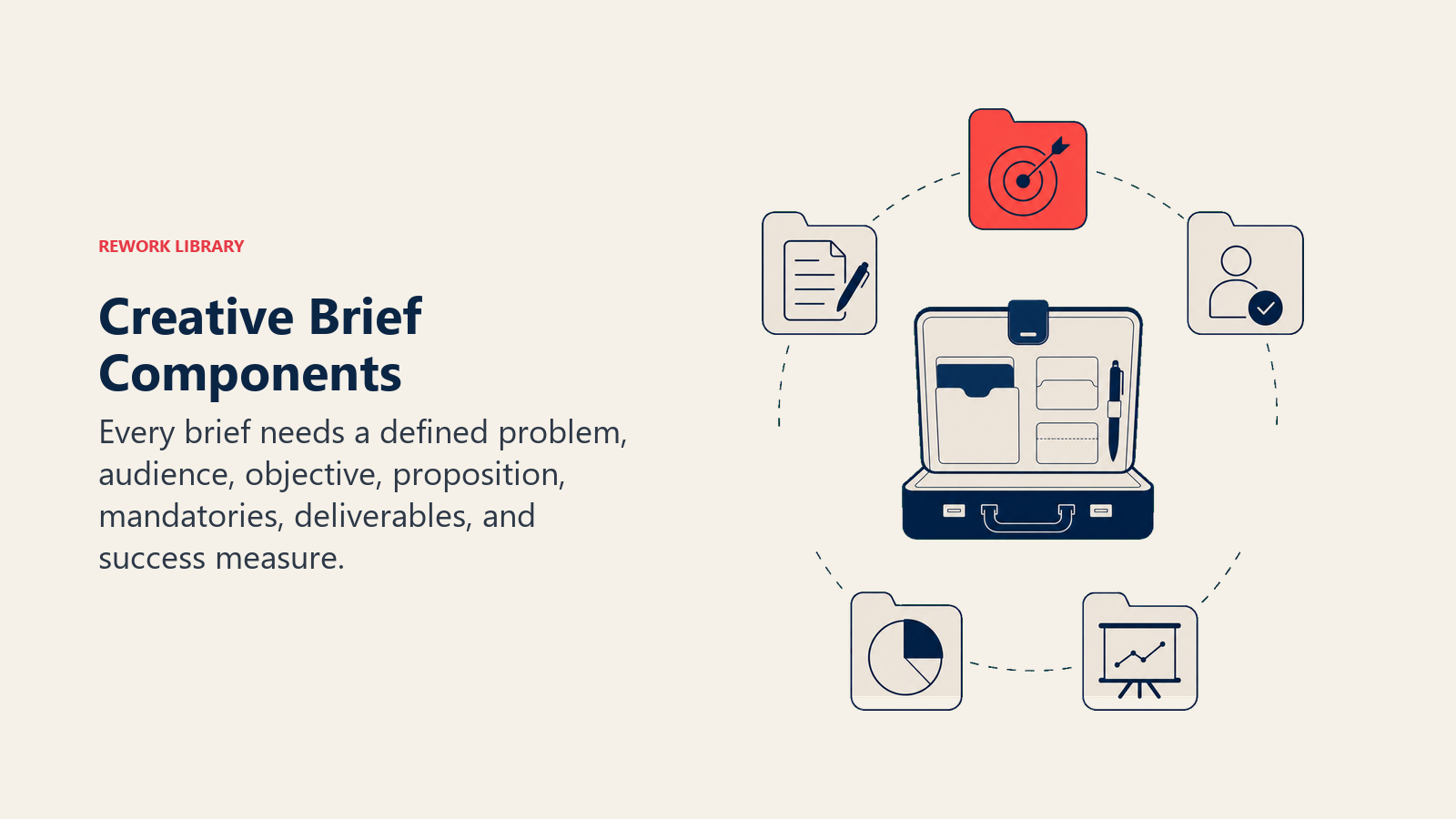
Project overview
What are you creating and why does it exist? "We're creating a digital advertising campaign to launch our new product line" tells you the what. "Our existing customer base doesn't know we offer this category, and we're losing market share to competitors" tells you the why.
One paragraph. If you can't explain the project in one paragraph, you don't understand it well enough to brief it.
Business objective
What business goal does this creative work support? This isn't "create awareness" or "drive engagement." Those are marketing tactics. The business objective is "increase Q2 revenue by 15%" or "reduce customer acquisition cost from $200 to $150."
This connects creative work to business outcomes. When budget questions come up or priorities shift, having a clear business objective helps you defend the project or make smart tradeoffs.
Target audience
Who are you talking to? And I mean specifically. "Women 25-45" isn't an audience, it's a demographic bucket. "Working mothers who feel overwhelmed by managing their household while working full-time, who value products that save them time more than money" is an audience.
The brief should include enough detail that creatives can picture a real person. What keeps them up at night? What do they care about? What misconceptions do they have? The more specific you get, the more focused the creative becomes.
Some agencies use formal persona frameworks. Others just write a detailed description. Either works as long as you're concrete. If your creative team can't describe the target audience to someone else after reading the brief, you haven't done your job.
Key message
What is the single most important thing you want the audience to remember? Not three things. Not five things. One.
This is where most briefs fall apart. The client wants to communicate quality, value, innovation, customer service, industry expertise, and sustainability. You nod politely and write a brief that tries to say all six things. The creative team produces work that says none of them clearly.
Force the choice. What's the one message that, if the audience internalized it, would change their behavior? Everything else is supporting evidence, not the core message.
Desired action
What do you want the audience to do after experiencing this creative? Visit a website? Request a demo? Rethink an assumption? Change a perception?
Be specific about the action and realistic about what one piece of creative can accomplish. A single Instagram ad probably won't make someone buy a $50,000 product. But it might make them visit your website to learn more. That's the action.
Tone and personality
How should this feel? Authoritative or friendly? Playful or serious? Aspirational or practical?
Tone descriptions need examples to be useful. "Professional but approachable" could mean a hundred different things. "Professional but approachable, like a good doctor who explains things in plain language rather than medical jargon" is actionable.
Reference other brands or campaigns that have the right feel. "The tone of Apple's product launches, not the tone of Microsoft's enterprise software ads" immediately communicates something specific.
Mandatory elements
What absolutely has to be included? Logo usage requirements, legal disclaimers, specific product shots, required messaging from legal or compliance, accessibility standards.
Be complete but realistic. If you list forty mandatory elements, you're not guiding creative, you're designing by committee. Flag true requirements and let creatives figure out how to incorporate them elegantly.
Success metrics
How will you measure if this worked? That might be campaign performance metrics (CTR, conversion rate, engagement), brand research (awareness lift, perception change), or subjective client satisfaction.
This section connects back to the business objective. If the objective is revenue growth, the success metric might be attributed pipeline or closed deals. If the objective is brand perception, the metric is pre/post research.
The discovery process that feeds the brief
Good briefs don't come from a template. They come from asking the right questions during discovery and actually listening to the answers.
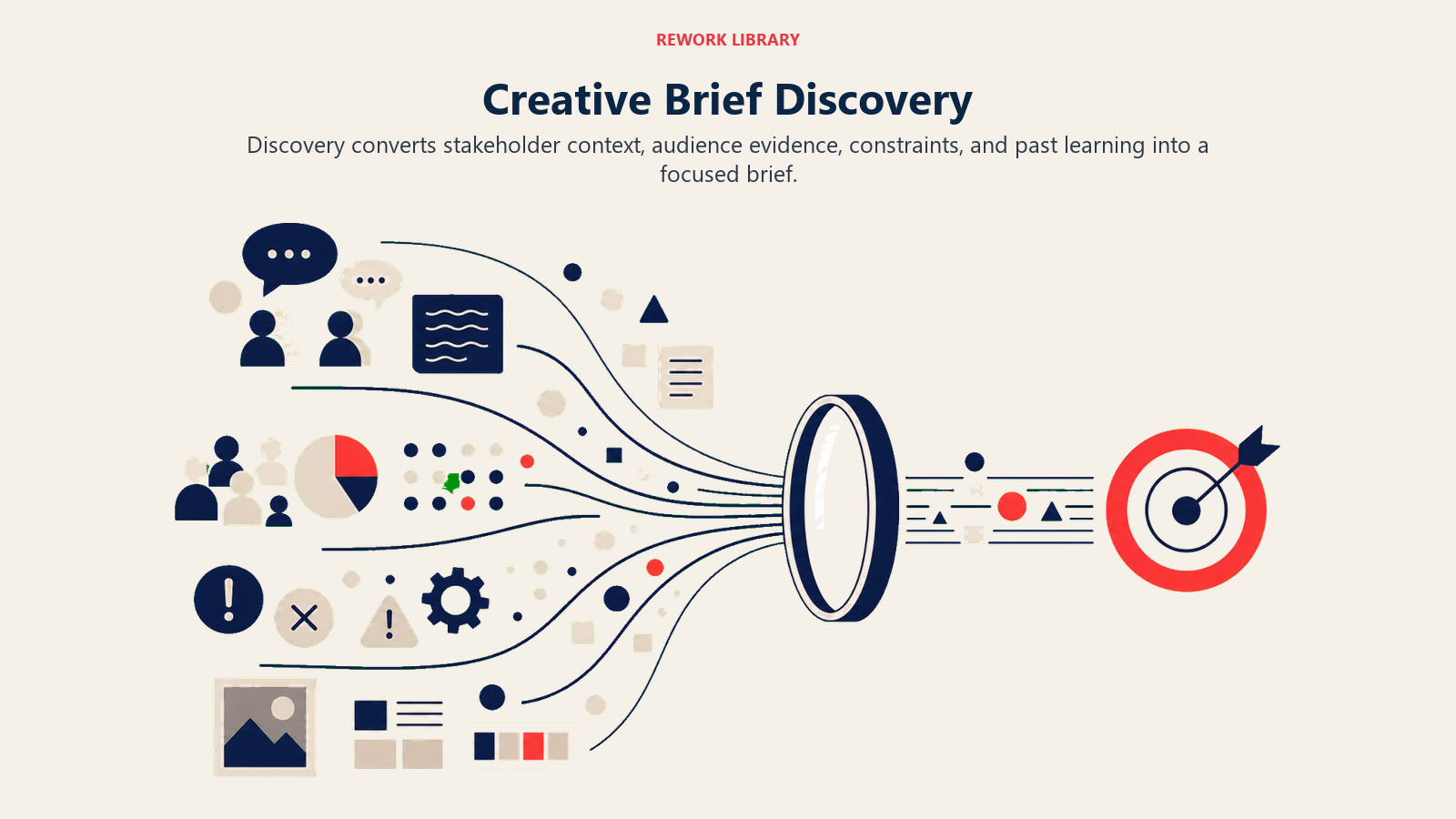
Client kickoff and stakeholder interviews
Start with a kickoff meeting that includes all key stakeholders. Not just the primary client contact, but anyone who has approval authority or valuable input. Marketing, sales, product, executive leadership depending on the project.
Ask about business context first, creative preferences second. What's driving this project? What happens if it fails? What constraints exist (budget, timeline, brand guidelines, legal requirements)? This aligns with the needs assessment discovery process.
Then dig into what they've tried before. What worked? What didn't? Why? This prevents you from pitching ideas they already tested and abandoned.
Finally, understand the approval process. Who needs to sign off? What are their priorities? If the CMO cares about brand consistency and the VP of Sales cares about lead generation, your brief needs to address both.
Audience research and insights
Don't rely on what the client thinks about their audience. Talk to actual customers or prospects when possible. Review existing research, customer feedback, support tickets, sales call recordings.
You're looking for insights, not just demographics. An insight is a non-obvious truth about the audience that informs your approach. "Small business owners feel overwhelmed by technology options" is an insight. "Small business owners are 35-55 years old" is a demographic.
Good insights come from listening for patterns in how people describe their problems, what language they use, what they care about. If five customers independently mention "I just want something that works without a learning curve," that's an insight about their desire for simplicity.
Competitive and market analysis
Look at what competitors are doing, not to copy them, but to find differentiation opportunities. If everyone in your category uses abstract corporate imagery, showing real customers becomes differentiation. If everyone focuses on features, focusing on outcomes stands out.
Also review what's not working. If competitors are all running the same play and still struggling to break through, maybe that play is wrong. You don't have to make the same mistake.
Strategic positioning definition
Where does this brand or product sit in the market? What makes it different from alternatives? This isn't just what the client says makes them different. It's what customers would actually perceive as different if you communicated it well.
Positioning informs everything about the brief. If you're the premium option, your message, tone, and creative approach should reinforce premium. If you're the accessible alternative, everything should feel approachable.
Message hierarchy development
Once you know the key message, map out supporting messages. These are the proof points, benefits, or features that make the key message credible.
If the key message is "the most reliable solution for enterprise teams," supporting messages might include uptime stats, security certifications, customer testimonials, and implementation support. You probably won't communicate all of those in every piece of creative, but they're available to pull from.
Think of it as a pyramid. The key message sits at the top. Supporting messages create the foundation. Specific features and details live at the bottom. When space is limited, you pull from the top. When you have more room, you go deeper.
Writing briefs that actually work
The difference between a good brief and a bad brief often comes down to how it's written.
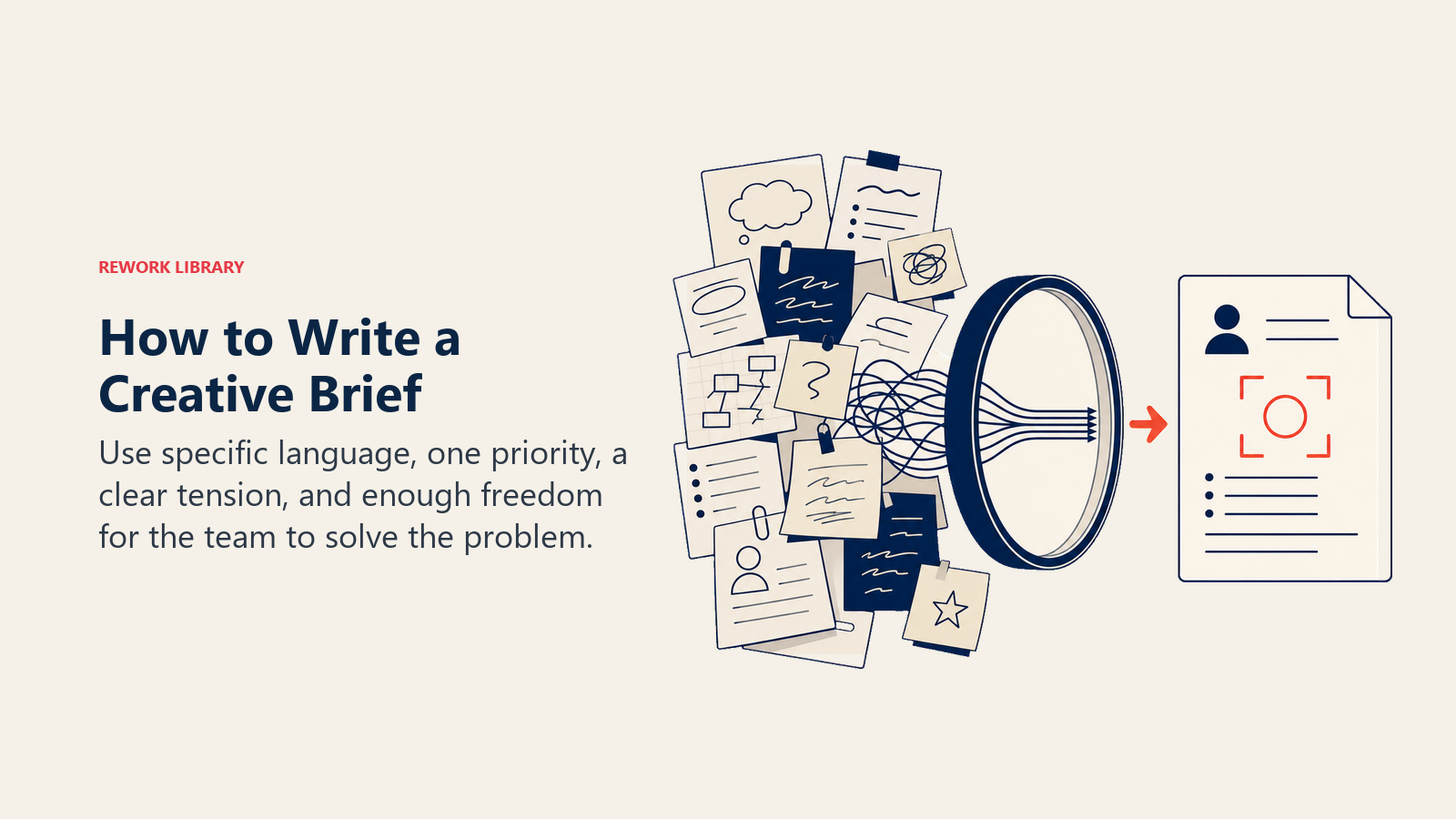
Clear, concise, specific language
Use simple words. If you wouldn't say it out loud to a colleague, don't write it in a brief. "We seek to engender brand affinity among our target demographic" is garbage. "We want empty nesters to prefer our community over competitors" is clear.
Avoid marketing jargon unless it has a specific meaning. "Engagement" could mean email clicks, social likes, time on site, or brand sentiment. Be specific about what you mean.
Every sentence should add information. If you can delete it without losing meaning, delete it.
Single-minded focus
A brief that tries to accomplish too much accomplishes nothing. You're not targeting "everyone who might be interested." You're targeting a specific audience segment with a specific message.
When the client wants to add another objective or audience, push back. Not by saying no, but by asking what they're willing to deprioritize. "If we also try to speak to this secondary audience, we'll dilute the message for the primary audience. Is that worth it?" Usually the answer is no.
Insight-driven vs feature-driven
Bad briefs list features. "Highlight our new dashboard, real-time reporting, and integrations." Good briefs explain the insight that makes those features matter. "Finance teams waste hours compiling reports from multiple tools. Show them how real-time dashboards give them their weekends back."
The creative team can figure out which features to highlight once they understand the audience insight and desired perception.
Inspiring but practical
The brief should excite the creative team while grounding them in reality. "We're introducing a category-defining product to an audience that doesn't know they need it yet" is inspiring. "Here's a PDF with forty slides of product specs, please make ads" is soul-crushing.
But inspiration without boundaries creates problems. If you give creatives infinite freedom, you'll get infinite concepts that are all off-brief. Provide the strategic guardrails that let them be creative within a defined space.
Avoiding jargon and ambiguity
Words like "premium," "innovative," "dynamic," and "impactful" mean different things to different people. If you use them, define them.
"Premium" could mean expensive, high-quality, exclusive, or sophisticated. Which one? If you mean "sophisticated in a way that appeals to educated professionals," say that.
Test your brief with someone outside the project. Can they explain back to you what the audience, message, and objective are? If they're confused, rewrite.
Specific constraints and requirements
If there are limitations, state them upfront. "We have three weeks and a $10,000 production budget" shapes what's possible. "The CEO has final approval and hates the color orange" is good to know.
This prevents the creative team from developing concepts that are brilliant but impossible to execute, or from going down a path that will get killed in final approvals.
Examples and reference points
Show, don't just tell. If you want a certain tone, link to examples that have it. If you want to avoid a certain approach, show what that looks like.
"Aspirational but not unattainable" is vague. "Aspirational like Airbnb's 'Belong Anywhere' campaign, not unattainable like luxury car ads" is specific.
Brief types by project
Different projects need different brief structures, though the core components stay the same.
Campaign creative brief
For integrated campaigns across multiple channels, the brief needs to address how the campaign scales. What's the core idea that works in a 6-second video, a billboard, and a long-form article?
Campaign briefs also need clear channel strategies. Is social driving to a landing page? Is OOH building awareness that email converts? Map out how pieces connect.
Brand identity brief
Brand identity briefs require more depth on positioning, personality, and long-term vision. You're not just designing a logo, you're creating a visual system that will represent the company for years.
Include information about company culture, values, and aspiration. What does the company want to be in five years? How should stakeholders (customers, employees, investors, partners) perceive the brand?
Website or digital experience brief
Website briefs need detailed user journey mapping. Who are the different user types and what are they trying to accomplish? What's the hierarchy of information?
Include technical constraints (CMS platform, integrations required, accessibility standards) and conversion goals for key pages.
Content creation brief
Content briefs should specify format, length, audience expertise level, and distribution channels. A LinkedIn article for industry experts needs different treatment than an explainer blog post for beginners.
Include SEO requirements, brand voice guidelines, and examples of content that resonates with this audience.
Video or production brief
Production briefs require detailed information about deliverables (formats, lengths, versions), usage rights, talent requirements, location needs, and production timeline.
Be specific about mood and style references. Link to videos that have the right feel, pacing, or production value. "Documentary style like Patagonia's films" communicates more than "authentic and cinematic."
Social media brief
Social briefs should address platform-specific requirements, content calendar cadence, community management expectations, and how social connects to broader campaign goals.
Include clear guidelines on tone for different platforms. Your LinkedIn voice probably isn't your TikTok voice, even if it's the same brand.
Client collaboration and approval process
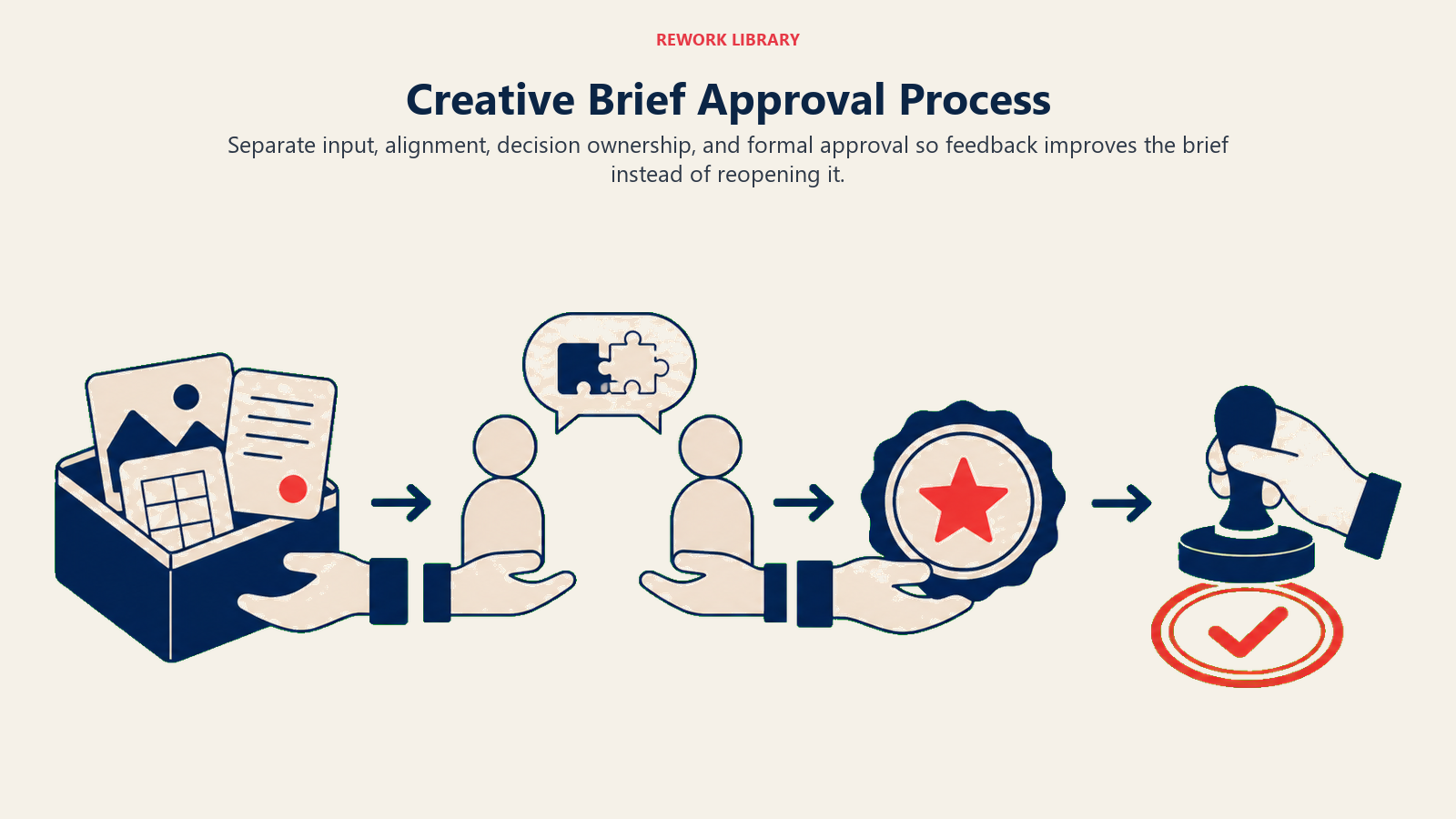
The brief isn't complete until the client signs off. Here's how to get there.
Stakeholder involvement in brief development
Involve key stakeholders early. Don't surprise them with a completed brief. Share the draft, gather feedback, iterate together.
This is especially important when there are multiple stakeholders with different priorities. Getting them to align on the brief prevents them from pulling the creative in different directions later.
Review and feedback cycles
Plan for at least one round of brief revisions. The first draft surfaces assumptions and missing information. The second draft addresses gaps.
When you send the brief for review, ask specific questions. "Does this accurately capture your target audience?" is more useful than "any feedback?"
Managing conflicting opinions
When stakeholders disagree, your job is to facilitate resolution, not just document all opinions. If the VP of Marketing wants one message and the VP of Sales wants another, you need to help them choose.
Use the business objective as the tiebreaker. Which approach better supports the goal? If both could work, test both and use data to decide.
Documenting decisions and rationale
When you make choices in the brief, document why. If you're targeting new customers instead of existing customers, explain that decision. If you're focusing on one benefit instead of another, capture the reasoning.
This helps when questions come up later. It also prevents relitigating decisions you've already made.
Formal sign-off process
Get explicit approval on the brief before creative work starts. This doesn't have to be a signed document (though some agencies do that). It can be an email confirmation.
The key is that the client is on record saying "yes, this is what we're trying to accomplish." When they want to change direction mid-project, you can point back to what they approved.
Change management if brief evolves
Sometimes new information emerges that requires brief changes. A competitor launches something that shifts positioning. Research reveals an audience insight you didn't have before. Budget constraints change what's possible.
When the brief needs to change, version it. Document what changed and why. Get re-approval on the revised direction. Don't just quietly update the document and hope no one notices.
Briefing the creative team
Writing the brief is half the job. The other half is presenting it in a way that inspires great work.
Brief presentation and discussion
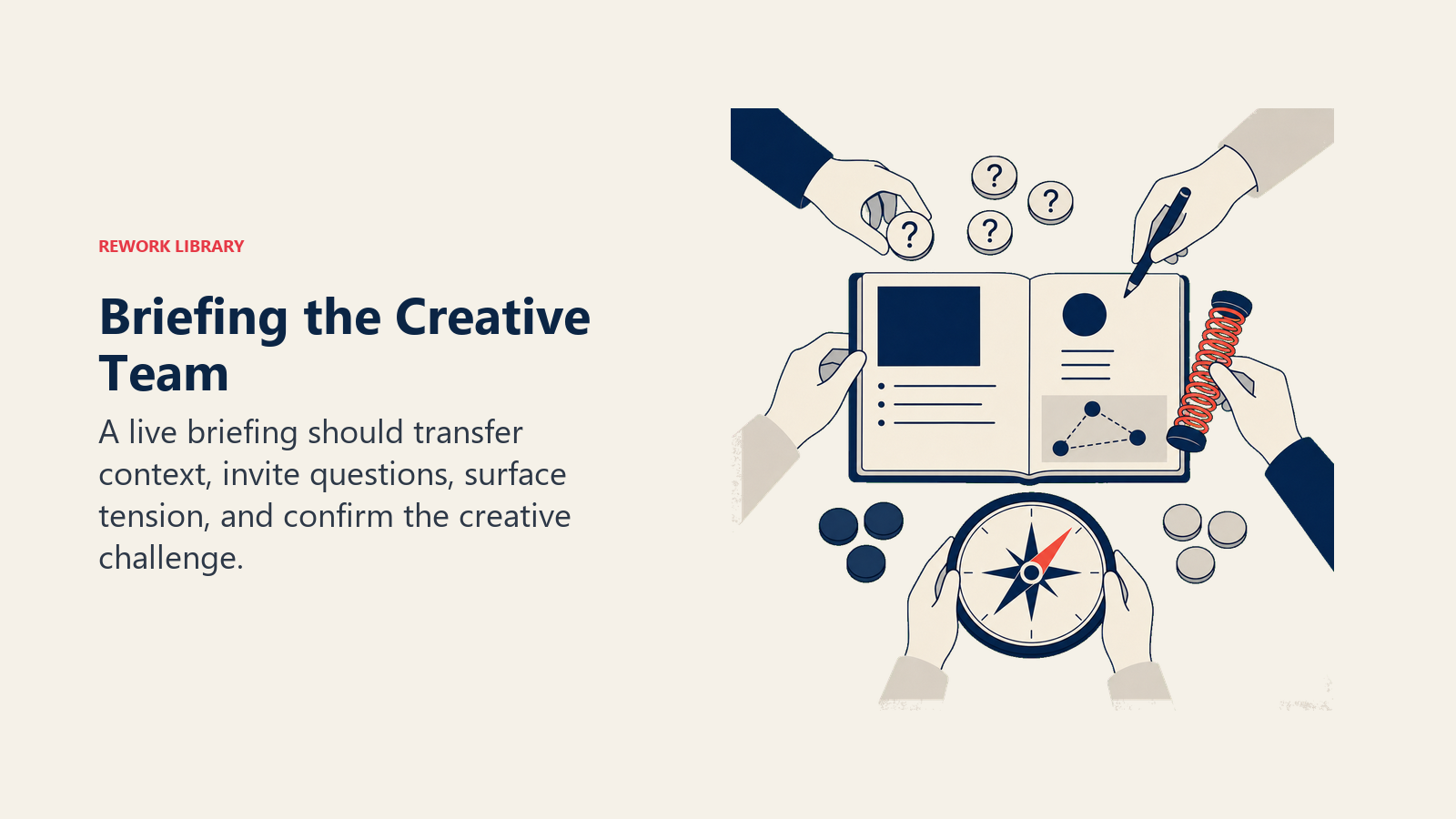
Don't just email the brief and expect magic. Present it in person or on a call. Walk through the thinking, the insights, the constraints.
Tell the story behind the brief. Why does this project matter? What's the opportunity? What makes this audience interesting? Context creates buy-in.
Q&A and clarification
Build in time for questions. The creative team will spot ambiguities and gaps you missed. They'll challenge assumptions that might be wrong. This is good. Better to surface those questions now than after they've spent a week on the wrong approach.
Some questions don't have answers yet. That's fine. "Good question, I'll get clarity from the client on that" beats making something up.
Creative exploration parameters
Be clear about how much latitude the creative team has. Are you looking for safe evolution of existing brand assets, or bold new direction? Do concepts need to feel familiar to what the client already does, or is this a chance to break patterns?
If there are sacred cows (the CEO's favorite tagline, a color they hate, a visual style they love), flag them. Don't let the team waste time on things that will never get approved.
Timeline and deliverable expectations
Lay out the schedule: when are initial concepts due, when is client presentation, what's the revision timeline, when do finals need to be delivered?
Be realistic about how much time the work requires. If you need three concepts for a major campaign by Friday, you're not getting the team's best work.
Feedback and iteration process
Explain how feedback will work. Will the client see initial concepts and choose a direction to refine? Will they see one polished concept? How many revision rounds are in scope?
This prevents the creative team from over-polishing early concepts, or from under-developing work that needs to be client-ready.
Resource and budget constraints
Be honest about limitations. If stock photography is the only option within budget, say so. If you need to use existing brand assets instead of creating new ones, the creative team should know.
They'll find creative solutions within constraints, but only if they know what the constraints are.
Using the brief during development
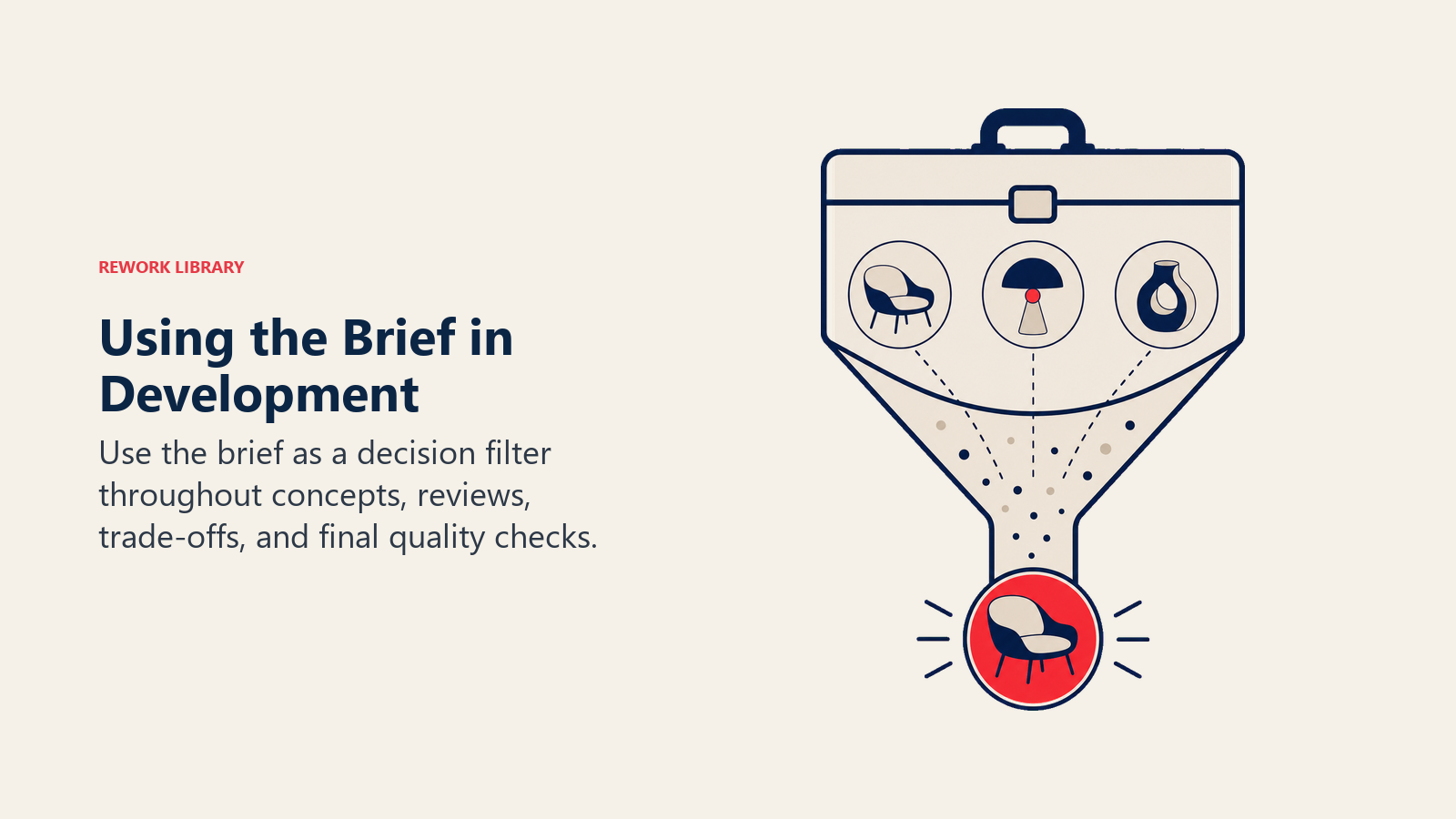
The brief's job isn't done once creative work starts. It's your reference point through the entire project.
Reference point for creative decisions
When the team debates two different directions, the brief tells you which one better solves the problem. When someone suggests adding an element that's off-strategy, the brief is why you say no.
The best creative teams constantly check their work against the brief. "Does this speak to our target audience? Does it communicate the key message? Does it have the right tone?" If the brief is solid, these questions guide you to strong work.
Alignment check during reviews
Before presenting to the client, review concepts against the brief yourself. Can you draw a clear line from the brief to the creative execution? If the client asks why you made certain choices, can you point to specific parts of the brief?
This prevents you from presenting work that's creatively interesting but strategically off-target.
Resolving subjective feedback
Clients give subjective feedback. "I don't like this blue" or "This feels too corporate." The brief helps you understand if that feedback is valid.
If the brief called for a "friendly, approachable tone" and the design feels corporate, that's legitimate feedback tied to strategy. If the brief called for "professional and authoritative" and the client just personally dislikes blue, that's preference, not strategy. You can address it differently.
Managing scope and direction changes
When the client wants to add another audience or shift the message, the brief shows what that changes. "The current brief targets enterprise buyers. Adding SMB buyers would require different messaging and probably different creative. That's possible, but it's a new brief and additional scope."
This prevents scope creep disguised as feedback.
Client presentation and rationale
Present creative work by connecting it back to the brief. "The brief asked us to communicate reliability to risk-averse IT buyers. This concept uses testimonials from Fortune 500 companies because that's the proof point this audience finds most credible."
When you frame creative decisions as strategic choices rooted in the brief, you're having a rational conversation instead of a subjective one. This connects to broader proposal presentation skills.
Success measurement reference
After the campaign runs, evaluate results against the success metrics defined in the brief. Did it achieve what you set out to accomplish? What worked? What didn't?
This learning feeds into better briefs next time.
Common creative brief challenges
Even with good process, you'll hit these issues:
Unclear or conflicting objectives - The client says they want awareness and leads and loyalty. Those require different strategies. Force prioritization. What's the primary objective? Everything else is secondary.
Too broad or trying to be everything - "We want to appeal to millennials and Gen X and boomers, in both B2B and B2C contexts." No. Pick one. Do it well. Then expand.
Missing audience insights - If you can't articulate why the audience should care, you don't have a real insight. Go back and do more research. Talk to actual customers.
Weak differentiation or message - "We're innovative and customer-focused" could describe literally every company. What's true about you that isn't true about competitors? If you can't answer that, you have a positioning problem, not a creative problem.
Unrealistic constraints or timeline - If the timeline is impossible or the budget is a fraction of what the work requires, say so. Proposing a brief that can't be executed sets everyone up for failure.
Client disagreement on brief - If stakeholders can't align on the brief, stop. Don't move forward with creative development. The disagreement will only get worse when they see concepts. Resolve it now.
Brief changes mid-project - Sometimes this is unavoidable. But charge for it. Changing the brief mid-project is like changing the blueprint while building a house. It's possible, but it's not free.
Templates and frameworks to accelerate brief development
You don't need to reinvent the wheel every time. Build templates that capture the core components, then customize for each project.
Standard brief template by project type
Create templates for your most common project types: campaign briefs, website briefs, brand identity briefs, content briefs, social media briefs. Each template should include all standard sections with prompts to fill in.
This ensures you never forget a critical component, and it makes brief writing faster.
Discovery questionnaires
Build standardized discovery questionnaires you send to clients before the kickoff meeting. This gathers basic information upfront so you can spend meeting time on strategic discussions, not fact-gathering.
Questions might include: business goals, target audience description, competitive landscape, brand guidelines, approval process, timeline, budget, mandatory requirements.
Audience persona frameworks
Use a consistent persona format across all briefs. This might include demographics, role/job, goals and motivations, challenges and pain points, buying process, objections or concerns, and media consumption habits.
When personas are consistently structured, they're easier to create and easier for creatives to use.
Competitive positioning tools
Create a simple framework for mapping competitive positioning. This might be a two-by-two matrix (price vs. features, accessibility vs. sophistication) or a feature comparison table.
The goal is to visualize where you sit relative to competitors and where you have differentiation opportunities.
Tone and voice guidelines
Develop a tone description framework that goes beyond one-word descriptors. For each tone characteristic, include what it is, what it isn't, and examples.
"Professional" is vague. "Professional: Knowledgeable and credible without being stuffy. Uses clear language, not jargon. Think consultant, not professor. Examples: McKinsey articles, not academic journals" is actionable.
Briefing presentation format
Build a slide template for brief presentations. Standard sections might include: project overview, business context, audience insights, strategic direction, key message, creative considerations, timeline and process.
This ensures you hit all key points and makes briefings consistent across account teams.
Measuring brief effectiveness
How do you know if your briefs are working? Track these metrics:
Creative team satisfaction and clarity - Regularly ask creatives if briefs give them what they need. Do they have to come back with clarifying questions? Do they feel set up for success? If they're confused or frustrated, your briefs aren't working.
Revision rounds and rework - Count how many revision rounds it takes to get to approved work. If you're consistently hitting three or four rounds, something's wrong. Either the brief isn't clear, or it's not getting proper approval before creative starts.
Client satisfaction with outcomes - Track whether clients are happy with final deliverables. If they love the final work but it took six rounds to get there, your process is inefficient. If they're unsatisfied even after multiple rounds, your briefs aren't capturing what they actually want.
Project efficiency and timeline - Measure how often projects finish on time vs. extending due to revisions or scope changes. Well-briefed projects stay on schedule.
Campaign performance vs objectives - For work that has measurable outcomes, track performance against the success metrics defined in the brief. Did the work accomplish what it set out to do?
Learning and template improvement - Use project retrospectives to improve your brief templates and process. What questions should we have asked in discovery? What information was missing from the brief? What assumptions were wrong?
Where to go from here
Creative brief development is a learnable skill that directly impacts project success and profitability. Strong briefs reduce revisions, improve client satisfaction, and help creative teams do their best work.
If you're building an agency practice, this skill connects to broader growth strategies:
- Marketing Agency Growth Model - How creative operations fit into overall agency growth
- Client Communication Cadence - Managing stakeholder engagement during projects
- Project Management Methodology - How briefing integrates with project workflows
- Scope Definition and Statement of Work - Connecting strategic briefs to project scope
- Client Onboarding Process - Where briefing fits in the client relationship
Start by improving your discovery process. Better questions lead to better briefs. Build templates for your most common project types, but customize them for each client. Train your team on what makes a brief effective and create feedback loops that help you improve.
The brief is where strategy meets execution. Get it right and everything downstream gets easier. Get it wrong and no amount of creative talent can save the project.

Sales Director
On this page
- What is a creative brief and why does it matter?
- Who creates the brief and who uses it?
- Core components every brief needs
- Project overview
- Business objective
- Target audience
- Key message
- Desired action
- Tone and personality
- Mandatory elements
- Success metrics
- The discovery process that feeds the brief
- Client kickoff and stakeholder interviews
- Audience research and insights
- Competitive and market analysis
- Strategic positioning definition
- Message hierarchy development
- Writing briefs that actually work
- Clear, concise, specific language
- Single-minded focus
- Insight-driven vs feature-driven
- Inspiring but practical
- Avoiding jargon and ambiguity
- Specific constraints and requirements
- Examples and reference points
- Brief types by project
- Campaign creative brief
- Brand identity brief
- Website or digital experience brief
- Content creation brief
- Video or production brief
- Social media brief
- Client collaboration and approval process
- Stakeholder involvement in brief development
- Review and feedback cycles
- Managing conflicting opinions
- Documenting decisions and rationale
- Formal sign-off process
- Change management if brief evolves
- Briefing the creative team
- Brief presentation and discussion
- Q&A and clarification
- Creative exploration parameters
- Timeline and deliverable expectations
- Feedback and iteration process
- Resource and budget constraints
- Using the brief during development
- Reference point for creative decisions
- Alignment check during reviews
- Resolving subjective feedback
- Managing scope and direction changes
- Client presentation and rationale
- Success measurement reference
- Common creative brief challenges
- Templates and frameworks to accelerate brief development
- Standard brief template by project type
- Discovery questionnaires
- Audience persona frameworks
- Competitive positioning tools
- Tone and voice guidelines
- Briefing presentation format
- Measuring brief effectiveness
- Where to go from here