Proposal Development: Creating Winning Proposals for Professional Services
Turn this article into takeaways for your work.


Each assistant summarizes the article only for you and suggests best practices for your work.
Here's a frustrating reality: 60% of proposals get rejected despite strong initial conversations. The discovery call goes great, the prospect is engaged, you understand their problem, and then your proposal lands with a thud. Radio silence. Or worse, "we decided to go in a different direction."
The disconnect between discovery and proposal is where most professional services firms lose deals. You're not losing because your services aren't good. You're losing because your proposal failed to translate discovery insights into a clear case for action.
This guide breaks down how to develop proposals that actually win business. We'll cover the full process from pre-proposal planning through final delivery, the essential components that every proposal needs, and the strategies that make clients choose you over competitors.
The proposal development process
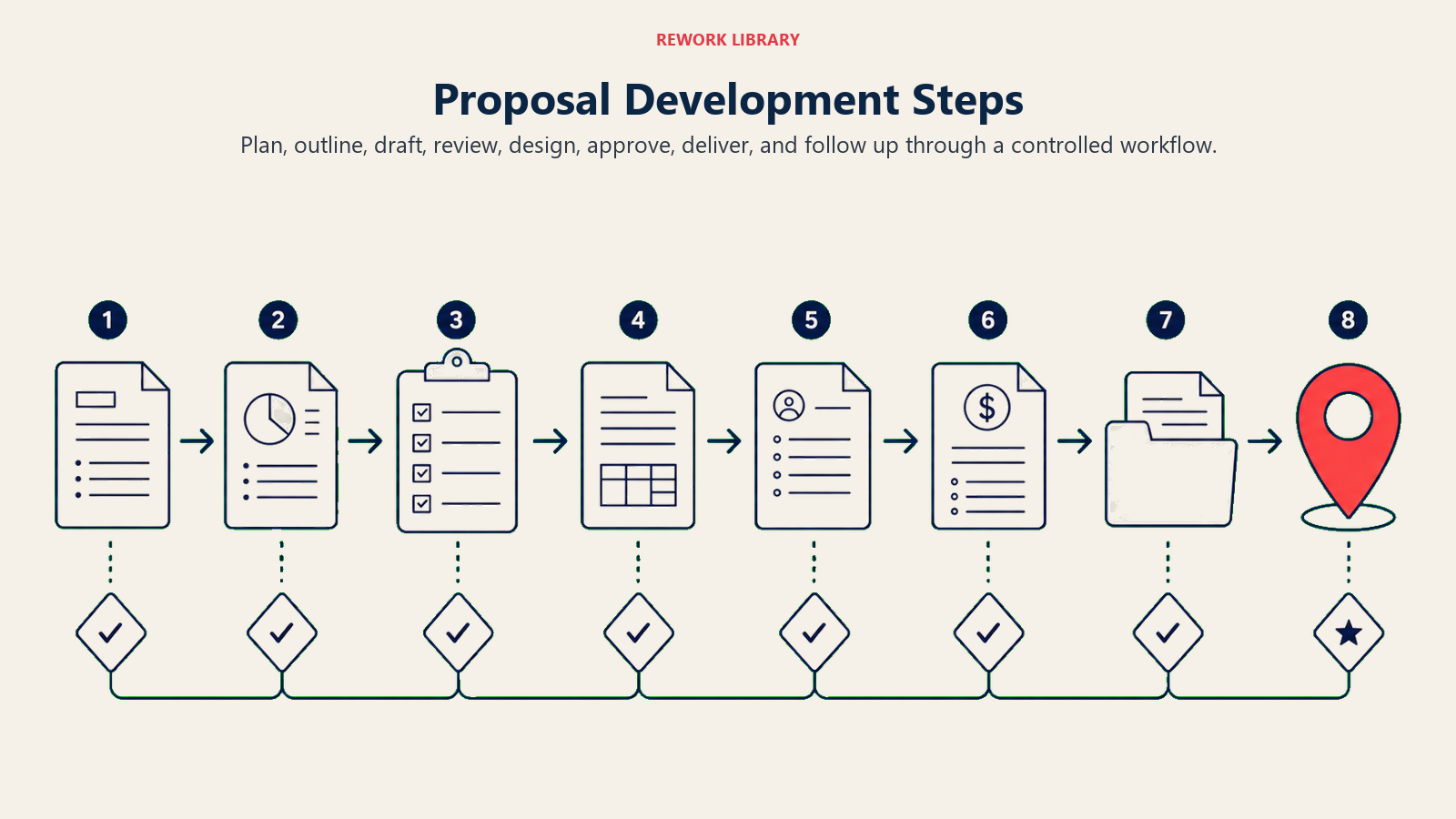
Effective proposals don't happen in a mad scramble the night before they're due. They're the result of a structured process that starts before you write a single word and continues through delivery.
Phase 1: Pre-proposal planning
Before you open a blank document, do your homework. This phase determines whether your proposal will be strategic or generic.
Review discovery thoroughly. Go back through your needs assessment and discovery notes. What did they tell you about their problem? What language did they use? What outcomes matter most to them? Your proposal should reflect this conversation back to them in their own words.
Identify decision criteria. How will they evaluate proposals? What factors matter most? Sometimes they'll tell you explicitly. Other times you need to infer from the conversation. Are they most concerned with cost, timeline, expertise, or methodology? If you don't know what they're optimizing for, you can't position yourself effectively.
Understand the competitive landscape. Who else are they talking to? What's your differentiation? If you know they're evaluating two other firms, research those competitors. What do they typically propose? Where are their weak spots? How can you position yourself differently? This analysis ties back to your overall consultative business development approach.
Assemble your team. Who needs to contribute to this proposal? The person who did discovery, yes, but also the subject matter experts who'll deliver the work, your pricing team if you have one, and someone with fresh eyes who can review for clarity. Don't solo this.
Determine your win themes. Based on everything you know, what are the two or three key reasons they should hire you? These themes should appear throughout the proposal, reinforced at every opportunity. If your themes are "deep industry expertise," "proven methodology," and "rapid implementation," every section should connect back to these points.
Set your timeline. When do they need the proposal? Work backward from that date to create milestones for drafting, review, revision, and design. Rush jobs produce mediocre proposals. Give yourself enough time to do this right.
Phase 2: Strategy and structure
Now you're ready to map out what you're going to say and how you'll say it.
Develop your win themes in detail. Take those two or three key differentiators and build them out. Win themes aren't features - they're benefit-focused statements that connect your capabilities to their specific needs.
Generic feature: "We have 15 years of experience." Win theme: "Our 15 years specializing in healthcare compliance means we've seen every regulatory challenge you're facing and know exactly how to navigate them."
Structure your narrative. Proposals need flow. They should tell a story that moves from problem to solution to value to next steps. Outline the major sections and what each one needs to accomplish. Don't just dump information. Build an argument.
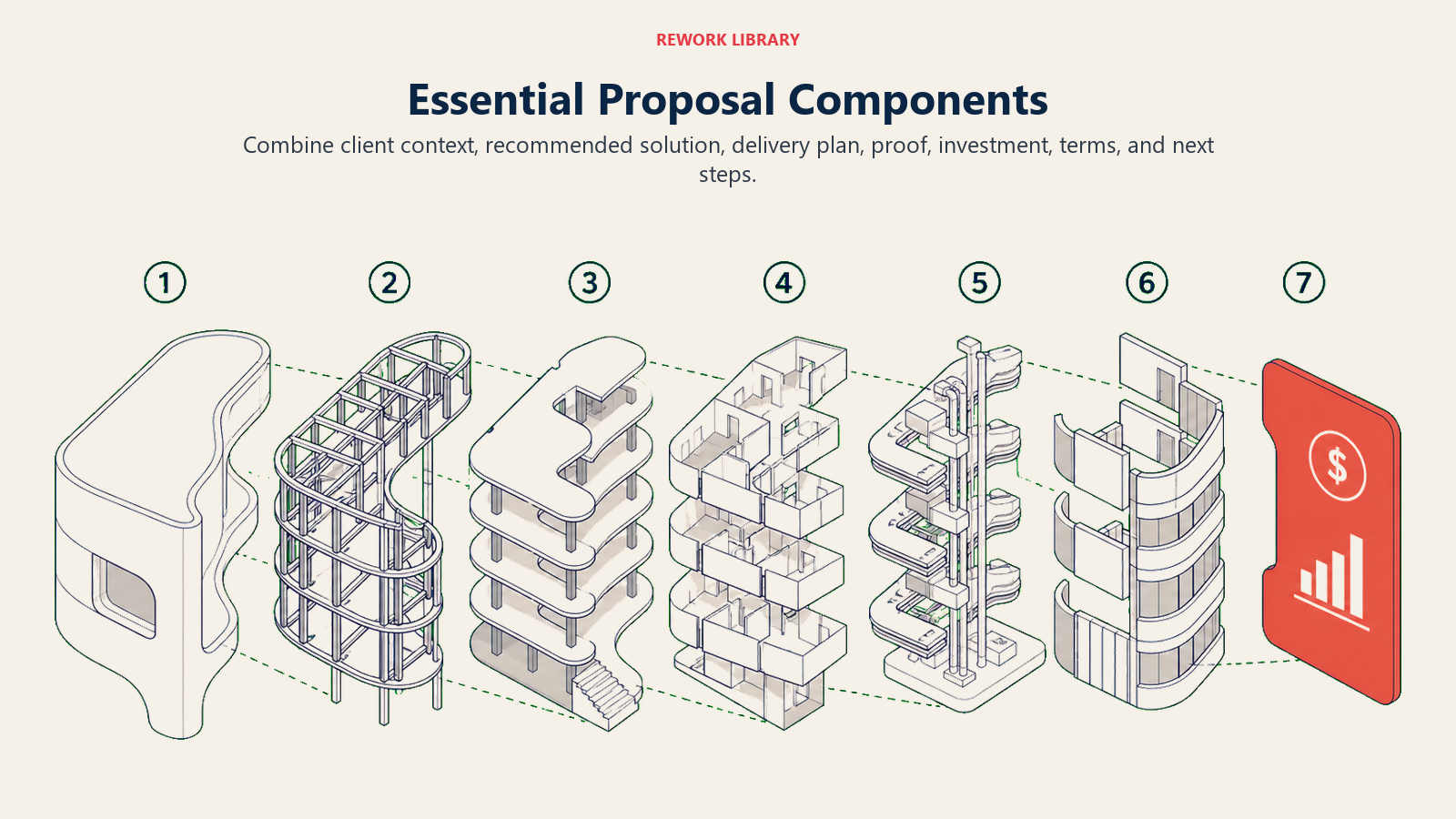
Define your sections. Most proposals include these core sections (we'll detail them later):
- Executive summary
- Understanding of needs
- Proposed approach
- Team and qualifications
- Pricing and investment
- Timeline and milestones
- Terms and conditions
But the order and emphasis can vary based on what matters most to this specific client. If they're skeptical about your ability to deliver on time, put timeline and milestones earlier. If they're price-sensitive, address budget head-on in the executive summary.
Plan customization. Generic boilerplate kills proposals. Every section should feel written specifically for this client. Plan where you'll incorporate their company name, reference their specific challenges, and tie examples to their situation. The more customized it feels, the more seriously they'll take it.
Establish quality checkpoints. Build in review gates. First draft complete by X date. Subject matter expert review by Y date. Client-centricity check by Z date. Don't wait until the last minute to discover the proposal is off-target.
Phase 3: Content development
This is where you actually write the thing. Here's what goes into each section.
Executive summary. This is the most important section of your proposal, and most people write it last because it summarizes everything else. It should be one to two pages maximum and hit these points:
- Your understanding of their problem (demonstrates you listened)
- Your proposed solution at a high level (shows you can solve it)
- The value they'll get (answers "what's in it for me")
- The investment required (no surprises later)
- Next steps (makes it easy to say yes)
Many decision-makers only read the executive summary. If it doesn't grab them, they won't read further. Make it count.
Understanding of needs. This section proves you get it. Reference specific challenges they mentioned in discovery. Use their language. Quantify the problem if you can. "Your current manual compliance process takes 40 hours per month and creates audit risk" is better than "compliance is challenging."
This is where you build credibility. They should read this section and think "yes, exactly, they understand what we're dealing with."
Proposed approach and methodology. Now explain how you'll solve their problem. Break your approach into phases or stages. Identify specific deliverables for each phase. Explain your methodology and why it works.
Don't be vague. "We'll conduct a thorough assessment" isn't helpful. "We'll conduct structured interviews with 10 stakeholders across three departments to identify process gaps and compliance risks, resulting in a detailed findings report with prioritized recommendations" tells them exactly what you'll do.
Connect your methodology to their specific situation. If they mentioned they're concerned about disruption to operations, explain how your approach minimizes that. If they're worried about timeline, show how your phased approach delivers value quickly.
Team and qualifications. Who's actually doing the work? Include brief bios of key team members, highlighting experience that's relevant to this specific engagement. Don't just list credentials - connect their backgrounds to the client's needs.
"Sarah has 12 years of HR consulting experience" is okay. "Sarah has spent 12 years helping healthcare organizations redesign performance management systems, including three implementations similar in scope to yours" is better.
Include relevant case studies here too, but make them specific. "We helped a similar-sized healthcare organization reduce compliance violations by 75%" is more persuasive than "we have extensive healthcare experience."
Pricing and investment. We'll cover pricing presentation in detail later, but the key is clarity. They should understand exactly what they're paying for and what's included versus what's extra.
Break down your fees by phase or deliverable. Explain your payment terms. If you're offering options (good-better-best), present them clearly with the differences highlighted.
Frame this as investment, not cost. Connect the price to the value they'll receive. A $50,000 engagement that saves them $200,000 annually isn't expensive - it's a no-brainer.
Timeline and milestones. Show them exactly what happens when. A Gantt chart or timeline graphic works well here. Include key dates, deliverables, and any dependencies on their team.
Be realistic. Aggressive timelines might win the proposal, but if you can't deliver, you've damaged the relationship before it starts. Build in buffers for review cycles and their internal processes.
Terms and conditions. This is the fine print, but it matters. Payment terms, intellectual property rights, confidentiality, termination clauses, and liability limitations all belong here.
Don't hide important terms. If you require a 50% deposit before starting, say so clearly. Surprises during contract negotiation slow things down or kill deals.
Phase 4: Review and refinement
You've got a draft. Now make it better.
Compliance verification. Did you answer every question they asked? If this is an RFP response, go through the RFP point by point and verify you've addressed everything. Missing requirements is an easy way to get disqualified.
Red team review. Get someone who wasn't involved in drafting to read it with fresh eyes. What's confusing? What's missing? Where does it drag? What doesn't support your win themes? Honest feedback at this stage prevents client confusion later.
Client-centricity check. Count how many times you use "you" and "your" versus "we" and "our." Client-focused proposals talk about their business, their challenges, their outcomes. Vendor-focused proposals talk about how great the vendor is. Flip the ratio.
Value clarity. After reading your proposal, can someone articulate what value they'll get? If the takeaway is "this firm seems qualified" but not "hiring them will solve our problem and deliver these specific outcomes," rewrite.
Design and formatting. Professional formatting matters more than you think. Clear hierarchy, strategic white space, consistent fonts, and good graphics make your proposal easier to read and more credible.
But don't overdo it. You're not designing a magazine. The content is what matters. Design should enhance readability, not distract from it.
Proofreading. Typos and grammatical errors tank credibility fast. If you can't proofread your own proposal, how will you deliver quality work for them? Get multiple people to review for errors.
Essential proposal components
Let's go deeper on the sections that make or break proposals.
The executive summary framework
The executive summary should follow this structure:
Opening: Their situation. Start by demonstrating you understand their business context and current challenge. Reference specific details from your discovery conversation.
Example: "As Acme Healthcare prepares to expand from 3 to 8 locations over the next 18 months, your current compliance management approach won't scale. Manual processes that work for a single-state operation will create significant risk and resource drain when operating across multiple jurisdictions with varying regulations."
Your solution. Introduce your proposed approach at a high level. What are you going to do? How will it work?
Example: "We propose implementing an automated compliance management system tailored to multi-site healthcare operations, combined with staff training and ongoing support to ensure consistent adherence across all locations."
The value they'll get. Translate your solution into specific outcomes they care about. Be as quantitative as you can.
Example: "This approach will reduce compliance management time by 60%, eliminate the risk of jurisdiction-specific violations during expansion, and provide audit-ready documentation across all sites."
Investment and timing. Give them the top-line number and when you can start.
Example: "The total investment for implementation across your current and planned locations is $85,000, with work beginning in February and the system operational before your first new location opens in June."
Next steps. Make it easy for them to move forward. What happens if they say yes?
Example: "To proceed, we'd schedule a kickoff meeting to finalize the implementation timeline and begin site assessments at your current locations. We can have the project plan finalized within one week of engagement."
That's it. One to two pages that answer the key questions: Do you get it? Can you fix it? What will it cost? What do I get? What's next?
Understanding of needs: Demonstrating discovery insights
This section is your chance to prove you were listening during discovery. Pull specific details from your conversations.
Weak: "You're experiencing challenges with your compliance processes."
Strong: "During our conversation, you mentioned that preparing for state audits currently requires pulling together documentation from three different systems, a process that took your team 80 hours last quarter. You also noted that your recent expansion into California revealed gaps in your understanding of state-specific requirements, creating exposure you hadn't anticipated."
Use direct quotes when appropriate. "As you said, 'we're spending more time documenting compliance than actually improving our processes'" shows you were paying attention.
Organize this section around their priorities, not your services. If they told you their top three concerns are audit readiness, cross-location consistency, and staff bandwidth, structure your understanding around those three themes.
Quantify the problem where possible. Numbers make problems feel more real and solutions more valuable. If you uncovered that their manual process costs them $60,000 annually in staff time, say so.
Proposed approach: Methodology, phases, and deliverables
Your approach section should answer three questions: What will you do? How will you do it? What will they get?
Break your work into clear phases. For each phase, include:
Objectives. What are you trying to accomplish in this phase?
Activities. What specific work will you do? Be detailed enough that they understand what's involved but not so granular that you lose them.
Deliverables. What tangible outputs will they receive? A report? A system? Training materials? Be specific.
Timeline. How long will this phase take?
Their involvement. What do they need to contribute? Access to staff? Data? Decisions? Setting expectations now prevents friction later.
Example phase breakdown:
Phase 1: Current State Assessment (Weeks 1-3) Objective: Understand your current compliance processes, documentation gaps, and regulatory requirements across all jurisdictions.
Activities:
- Structured interviews with 8 staff members across compliance, operations, and legal
- Review of current compliance documentation and processes
- Analysis of regulatory requirements for current and planned locations
- Identification of high-risk gaps and improvement opportunities
Deliverables:
- Current state assessment report with findings and risk analysis
- Gap analysis against regulatory requirements
- Prioritized recommendation roadmap
Your team's involvement: 2 hours of interview time per staff member, access to current compliance documentation, list of planned locations and timelines
Connect your methodology to your win themes. If one of your differentiators is "proven methodology," explain why this approach works. "This assessment methodology is based on 50+ compliance implementations and consistently identifies the 80% of gaps that create 80% of regulatory risk."
Team and qualifications: Relevant experience and expertise
Decision-makers want to know who's actually showing up to do the work. Make it clear who they'll be working with and why those people are qualified.
For each key team member, include:
Name and role. What's their title and what will they do on this engagement?
Relevant experience. Not their entire resume - just the background that matters for this specific project. Focus on similar clients, similar challenges, or specialized expertise.
Why they're on this project. Connect their background to the client's needs explicitly.
Example:
Sarah Johnson, Lead Consultant Sarah will serve as your primary point of contact and lead the assessment and implementation. She has 10 years of experience implementing compliance management systems for healthcare organizations, including three multi-location implementations similar in scope to Acme's expansion. Sarah previously led compliance redesign for a regional hospital system expanding from 4 to 12 locations across three states, reducing their audit preparation time by 70% while improving documentation quality.
Skip the fluff. Nobody cares that someone is "passionate about compliance" or "committed to client success." They care about relevant experience and proven results.
Include case studies that mirror their situation. Brief examples work better than lengthy narratives.
Case Study: Regional Healthcare System Expansion Challenge: 5-location system expanding to 15 locations needed scalable compliance approach Solution: Implemented automated compliance management with location-specific workflows Results: 65% reduction in compliance management time, zero violations during first year of expansion, audit preparation time reduced from 60 hours to 15 hours
Use metrics wherever possible. "Improved compliance" is vague. "Reduced compliance violations by 80% and cut audit preparation time in half" is concrete.
Writing for impact
The way you write matters as much as what you write. Here's how to make your proposal more persuasive.
Client-centric language
Your proposal should be about them, not you. Compare these:
Vendor-focused: "We have extensive experience in compliance management and have worked with over 50 healthcare organizations using our proprietary methodology that we've refined over 15 years."
Client-focused: "Your expansion into multiple states creates compliance complexity that most single-location operations never face. We've helped 50+ healthcare organizations work through exactly this challenge, and we know how to build systems that scale without creating administrative burden."
The client-focused version acknowledges their specific situation and frames your experience as relevant to their problem. The vendor-focused version just lists credentials.
Use "you" and "your" liberally. Make them the protagonist of the proposal, not you.
Specificity over generalities
Generic language is forgettable. Specific details stick.
Generic: "We'll conduct a thorough assessment of your compliance processes and provide recommendations for improvement."
Specific: "We'll interview 8 key stakeholders, review compliance documentation from your last 3 audits, analyze regulatory requirements for all 5 states in your expansion plan, and deliver a 25-page assessment identifying specific process gaps and prioritized recommendations ranked by risk level and implementation difficulty."
Specificity builds confidence. It shows you know exactly what you're doing.
Benefits over features
Features describe what you do. Benefits explain why it matters.
Feature: "Our compliance software includes automated workflow management."
Benefit: "Automated workflows mean your team doesn't have to manually track deadlines and follow up on overdue tasks, saving 10+ hours per week and eliminating the risk of missed compliance requirements."
Every feature in your proposal should connect to a benefit that matters to this specific client. If they didn't mention a problem that your feature solves, either skip the feature or explain why they should care about it.
Active voice and clear structure
Passive voice drains energy from your writing. Active voice is more engaging and easier to read.
Passive: "A comprehensive assessment will be conducted by our team."
Active: "Our team will conduct a comprehensive assessment."
Structure your sections with clear headings and subheadings. Use bullet points for lists. Break up long paragraphs. Make it scannable. Many readers will skim first, then go back and read sections that caught their attention.
Executive-friendly formatting
Remember, busy executives often skim proposals. Help them find what they're looking for:
- Use descriptive headings that convey key points
- Pull out important information in callout boxes or sidebars
- Include a table of contents for longer proposals
- Use visual elements (charts, timelines, process diagrams) to break up text
- Bold key phrases and statistics to catch the eye
- Keep sentences and paragraphs short
Pricing presentation
How you present pricing can make or break your proposal. Here's what works.
Value-based framing
Context pricing in terms of value, not just cost. If your $50,000 engagement saves them $200,000 annually, lead with that.
"This implementation costs $50,000" feels expensive in isolation. "This $50,000 implementation delivers $200,000 in annual savings, paying for itself in 3 months" reframes the investment.
Use value language throughout your pricing section. Instead of "cost," use "investment." Instead of "fees," use "investment" or "pricing." It's subtle, but language shapes perception.
Investment vs cost language
The words you choose matter. Compare these:
Cost language: "The total cost for this project is $85,000."
Investment language: "Your total investment to implement automated compliance management across all locations is $85,000."
One sounds like an expense. The other sounds like something that generates returns.
Don't hide from the number, but always connect it to value. "The $85,000 investment includes everything needed to reduce your compliance management time by 60% and eliminate regulatory risk during expansion."
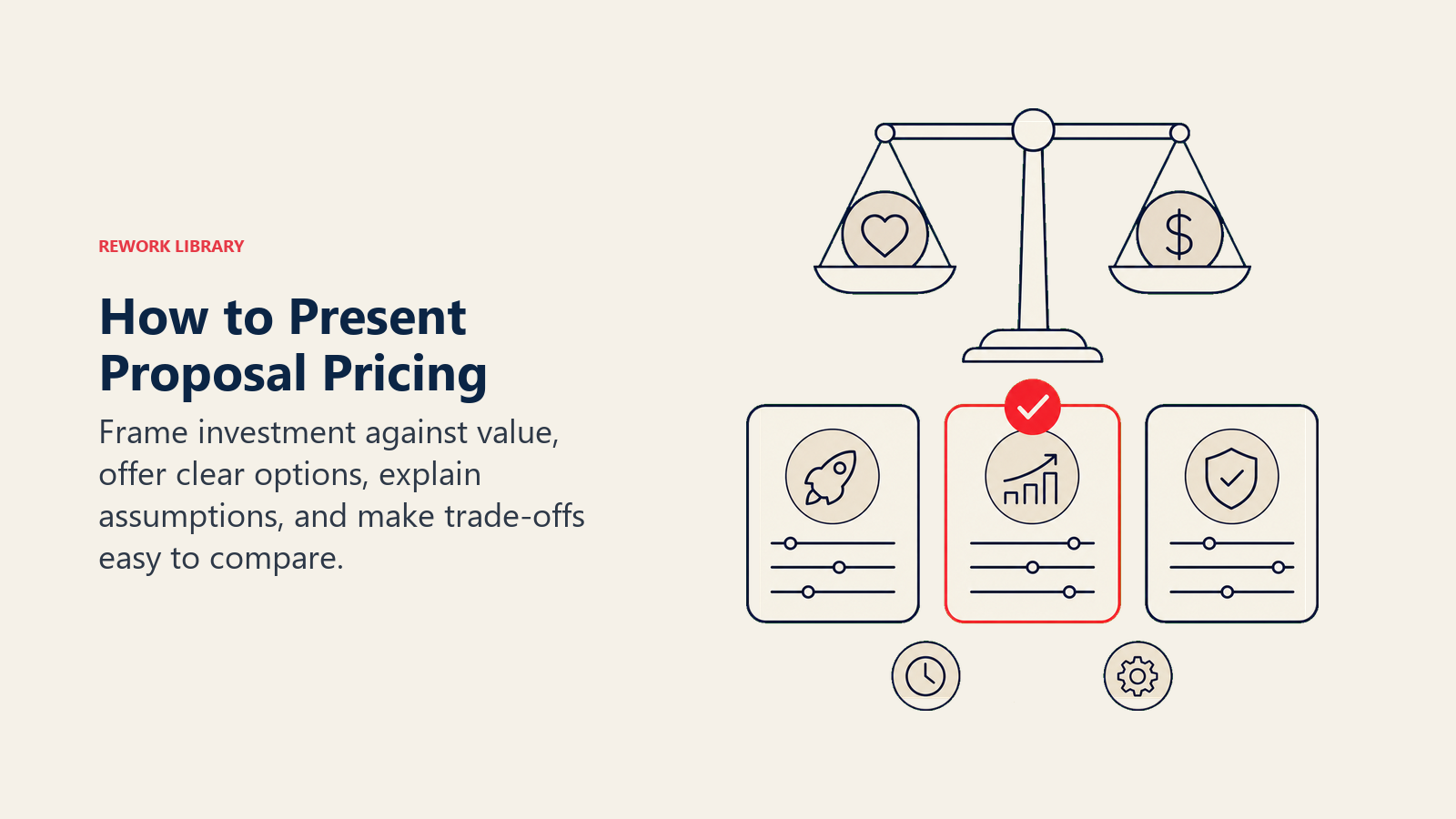
Multiple options: Good-better-best
Giving clients options increases close rates. A single price point is take-it-or-leave-it. Multiple options let them choose what fits their budget and priorities.
The classic approach is three tiers:
Essential Package: $45,000
- Core compliance system implementation
- Documentation templates for current locations
- 2 days of staff training
- 90 days of post-implementation support
Professional Package: $70,000 (Recommended)
- Everything in Essential, plus:
- Custom workflows for each location type
- Integration with your existing systems
- 4 days of staff training
- 6 months of post-implementation support
- Quarterly compliance reviews
Enterprise Package: $95,000
- Everything in Professional, plus:
- Dedicated compliance advisor for first year
- Monthly optimization reviews
- Priority support
- Advanced reporting and analytics
- Ongoing regulatory updates
Mark your recommended option. Most clients will choose the middle tier, but some will see enough value in the premium option to upgrade. And having a lower-tier option makes your recommended tier feel more reasonable.
For more on pricing strategy, see our guides on billable hour vs value-based pricing and pricing justification.
Clear scope boundaries
Be explicit about what's included and what's not. Scope creep starts with unclear proposals. Your proposal should align with what will become your formal scope definition and SOW.
Included:
- Implementation across 3 current locations and 5 planned locations
- Training for up to 20 staff members
- 6 months of support
Not Included:
- Ongoing maintenance after initial 6-month period (available at $1,500/month)
- Training for new staff hired after initial implementation
- Custom development beyond standard workflows
This prevents "I thought that was included" conversations later.
Payment structures
Outline your payment terms clearly. Common approaches:
Milestone-based: 30% at contract signing, 30% at Phase 1 completion, 40% at final delivery
Monthly: For longer engagements, monthly payments based on percentage of work completed
Retainer: Fixed monthly fee for ongoing services
Hybrid: Initial implementation fee + ongoing support retainer
Choose the structure that aligns with your cash flow needs and their budgeting process. Enterprise clients often prefer monthly payments. Smaller clients might want to pay at milestones.
Whatever you choose, spell it out clearly: "Payment terms are net 15 days from invoice. Initial 30% deposit of $25,500 is due upon contract execution and before work begins."
Differentiation strategies
Your proposal needs to answer one critical question: Why should they hire you instead of someone else? Here's how to stand out.
Unique methodology
If you have a proprietary process or methodology, highlight it. But don't just name it - explain why it works better than standard approaches.
"We use our proven ComplianceMap™ methodology" doesn't tell them anything. "Our ComplianceMap™ methodology identifies regulatory requirements at the jurisdiction level and automatically flags location-specific obligations, catching gaps that generic compliance checklists miss" explains the advantage.
Connect your methodology to their specific challenge. If they mentioned being burned by cookie-cutter solutions in the past, emphasize how your approach is customized.
Specialized expertise
General expertise is table stakes. Specialized expertise is a differentiator. If you've done this exact type of project for this exact type of company multiple times, that matters.
"We have healthcare experience" isn't differentiating. Everyone in the healthcare compliance space has healthcare experience.
"We've implemented compliance systems for 15 multi-location healthcare organizations expanding into new states, and we know exactly which regulatory pitfalls to avoid and which shortcuts are safe" is differentiated.
The more specific your specialization and the more closely it matches their situation, the stronger your position.
Proven track record
Results matter more than credentials. Don't just list clients - show what you accomplished for them.
Weak: "Our clients include major healthcare organizations nationwide."
Strong: "We've helped 12 healthcare systems reduce compliance management time by an average of 65% while improving audit outcomes. Our clients have zero regulatory violations in the first year post-implementation."
Quantify your results whenever possible. "Improved efficiency" is vague. "Reduced audit preparation time from 80 hours to 20 hours" is concrete.
Risk mitigation
What could go wrong, and how will you prevent it? Addressing risks proactively builds confidence.
If they mentioned concerns during discovery, address them directly. If they're worried about timeline, explain your timeline management approach. If they're worried about disruption to operations, detail how you'll minimize it.
"We understand that implementing a new compliance system during active expansion could disrupt operations. Our phased rollout approach starts with your current locations, proving the system works before your new locations come online. We schedule all training outside of peak operational hours and provide extensive documentation so staff can reference procedures without interrupting their workflow." These implementation details should align with your client onboarding process.
Implementation support
What happens after they sign? Many firms sell well but implement poorly. If your implementation process is a strength, highlight it.
"Our implementation includes dedicated project management, weekly status calls, documented escalation procedures, and a success manager who's accountable for your outcomes. You'll never wonder what's happening or who to contact when you have questions."
The more hand-holding you offer, the less risky you feel to clients who've been burned before.
Cultural fit
For professional services, relationship matters. If you got a sense during discovery that cultural fit is important to them, address it.
"We work exclusively with growth-focused healthcare organizations that value collaboration over vendor relationships. Our team integrates with yours, and we're available when you need us, not just during scheduled meetings."
But don't fake this. Cultural fit either exists or it doesn't. If you're a buttoned-up consulting firm, don't try to sound like a casual agency. Be authentic.
Visual design and formatting
Design isn't decoration - it's communication. Good proposal design makes your content easier to consume and more credible.
Professional formatting
Consistency matters. Use the same fonts, colors, and styling throughout. Create a clear visual hierarchy with headings, subheadings, and body text that are obviously different.
Standard formatting that works:
- Title: 24-28pt, bold
- Section headings: 18-20pt, bold
- Subheadings: 14-16pt, bold or semibold
- Body text: 11-12pt
- Margins: 1 inch minimum
Don't get fancy with fonts. Stick to professional, readable typefaces. Arial, Calibri, and Helvetica work fine. If you want something with more personality, try Lato, Open Sans, or Montserrat.
Clear hierarchy
Your proposal should have a clear structure that's obvious at a glance. Someone should be able to flip through and find any section immediately.
Use:
- Page numbers
- Headers with section names
- Table of contents
- Consistent section formatting
Break up long sections with subheadings. If you have more than half a page of text without a heading or visual break, it's too dense.
Strategic white space
Empty space isn't wasted space. It makes your content easier to read and less overwhelming.
Don't cram information onto every inch of the page. Use margins. Add space between sections. Let your content breathe.
A proposal with generous white space feels more premium than one that's packed with text. It also reads faster, which matters when your audience is busy.
Compelling graphics
Visual elements should support your content, not just decorate it.
Useful graphics:
- Process diagrams showing your methodology
- Timelines showing project phases
- Charts showing projected results or ROI
- Comparison tables (your approach vs alternatives)
- Team org charts
- Before/after comparisons
Don't use clip art or stock photos that add no value. Every visual should communicate something specific or make your content clearer.
Consistent branding
Your proposal should look like it came from you. Use your logo, colors, and visual identity consistently.
But don't overdo branding. Your logo doesn't need to appear on every page. Your brand should be present but not overwhelming. The focus should be on the content, not your brand elements.
Common proposal mistakes to avoid
Learn from others' failures. Here's what kills proposals.
Generic boilerplate
Copy-paste proposals are obvious and insulting. If you can swap out the client name and send this proposal to anyone, you've failed.
Every section should include client-specific details. Reference their situation, use their language, address their specific challenges. Generic proposals signal that you're not really interested in their business.
Feature dumping
Listing every service you offer and every credential you have overwhelms readers and dilutes your message.
Only include information that's relevant to this specific engagement. If you offer 20 different services but they only need 3, don't list all 20. Focus on what matters to them.
Unclear pricing
Vague pricing creates anxiety and friction. "Pricing depends on final scope" or "TBD based on discovery" forces them to ask for clarification, slowing everything down.
Be as specific as you can. If you truly can't price without more information, explain what information you need and provide a range or typical pricing for similar engagements.
Weak executive summary
Many proposals bury the key information. The executive summary should stand alone. If someone only reads that section, they should understand your proposal and be able to make a decision.
Don't treat the executive summary as an introduction or overview. It's a summary of your entire proposal, hitting all the key points.
Poor formatting
Dense walls of text with no visual breaks make proposals hard to read. If your proposal looks like a term paper, people won't read it.
Use headings, subheadings, bullet points, tables, and graphics to break up text. Make it scannable. Guide the reader's eye to what matters most.
Compliance failures
If you're responding to an RFP, missing required sections or not following submission instructions can get you disqualified before anyone reads your content.
Create a compliance checklist. Go through the RFP requirements one by one and verify you've addressed everything. Follow formatting requirements, page limits, and submission procedures exactly.
For more on RFP responses, see our guide on RFP response strategy.
Proposal delivery and follow-up
You've written a great proposal. Now you need to deliver it effectively.
Delivery timing
When you send your proposal matters. Don't send it at 5pm on Friday - it'll sit in their inbox all weekend and get buried by Monday.
Best times to send:
- Tuesday through Thursday mornings
- Early enough in the day that they see it but not so early it's buried by other emails
- With enough lead time before their decision date that they can review and ask questions
If they gave you a deadline, deliver early. Submitting at the last minute signals poor planning. Early submission shows you're organized and eager.
Presentation accompaniment
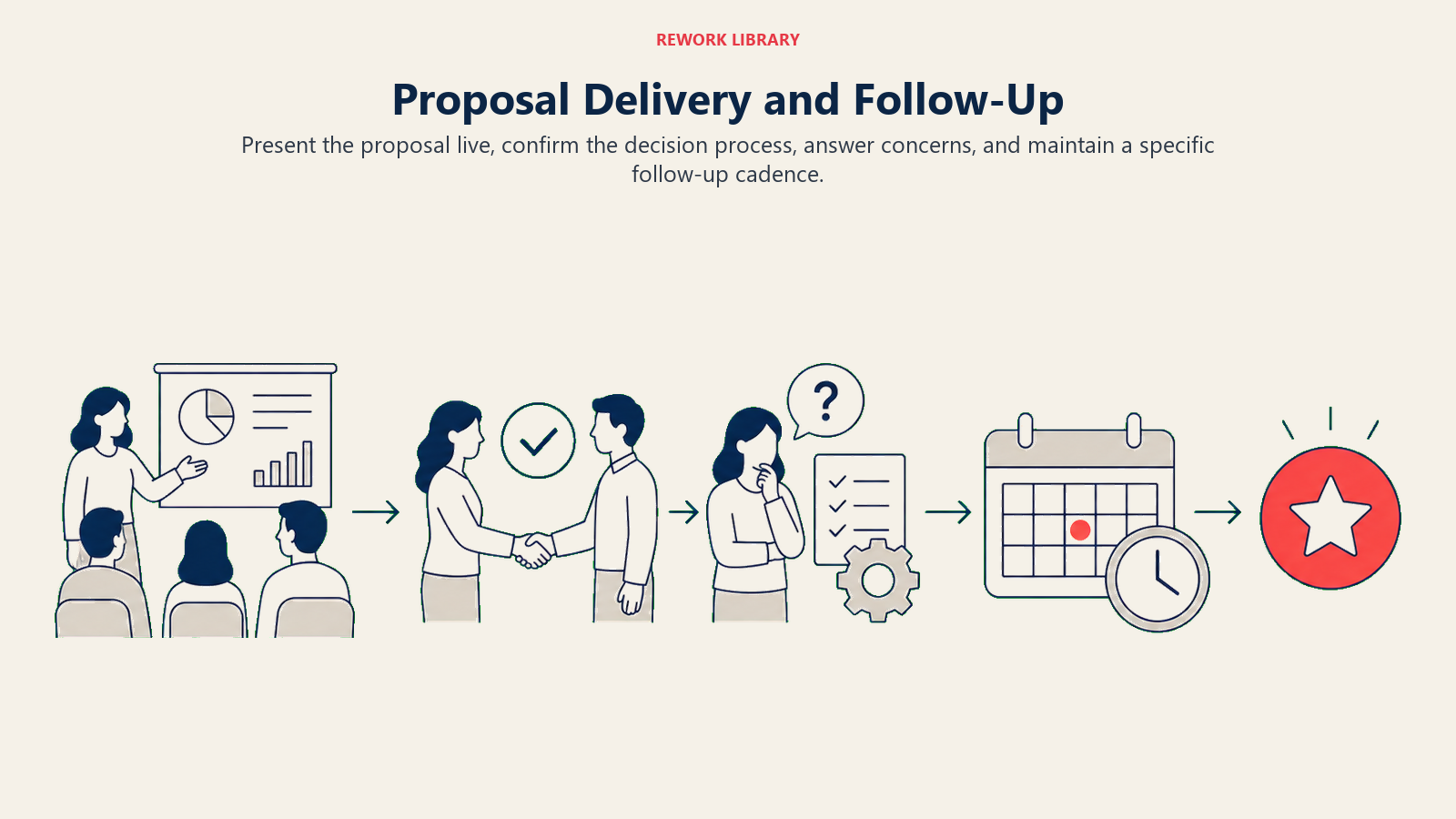
Don't just email your proposal and hope for the best. When possible, present it live or schedule a call to walk through it.
A presentation lets you:
- Highlight key points
- Read the room and address concerns in real-time
- Build enthusiasm
- Answer questions immediately
- Create a sense of partnership
Even a 30-minute call to walk through the executive summary and answer questions significantly improves your chances. For high-value engagements, a formal presentation is worth the effort.
Our guide on proposal presentation covers how to present proposals effectively.
Follow-up plan
After delivery, don't go silent. Have a follow-up plan:
Day 1: Confirm receipt. "I wanted to confirm you received the proposal and see if you have any immediate questions."
Day 3-5: Check in. "I wanted to follow up and see if you've had a chance to review the proposal. I'm happy to walk through any sections or answer questions."
Day 7-10: If you haven't heard back, follow up again. "I know you're busy, and I don't want this to slip through the cracks. Do you have a timeline for making a decision? Is there anything else you need from us?"
Don't be a pest, but don't disappear either. Steady, professional follow-up shows you're engaged and makes it easy for them to move forward.
Objection handling
Be ready for pushback. Common objections and how to handle them:
"The price is too high." Response: Return to value. "I understand price is a factor. Let's talk about the ROI. Based on our analysis, this implementation will save you $200,000 annually. Even if we delivered half that value, you'd see a full return on investment in under 6 months."
"We need more time to decide." Response: Understand why. "Absolutely, I want you to feel confident in your decision. Can you share what additional information would be helpful? Or is there a specific timeline you're working with?"
"We're still evaluating other options." Response: Differentiate. "That makes sense. As you're comparing options, I want to make sure you understand what makes our approach different..." Then reinforce your win themes.
"We want to start with something smaller." Response: If you have phased options, offer them. "We can absolutely start with Phase 1 as a pilot. That gives you confidence in our approach before committing to the full implementation."
The key is listening to what they're really saying. Often objections aren't the real issue - they're a way to slow down and think. Ask questions to understand their concern, then address it directly. For comprehensive guidance on handling these conversations, see our guide on negotiation for services.
Turning discovery insights into winning proposals
Great proposals don't come from templates. They come from understanding what your client actually needs and crafting a solution that's obviously right for their situation.
Everything starts with effective needs assessment and discovery. If you didn't learn enough during discovery, you can't write a strong proposal. If you understood their problem deeply, the proposal almost writes itself.
Your proposal is a conversion document. It needs to take someone from "I have a problem" to "these people can solve it and I should hire them." That transformation happens through clarity, specificity, and client-focused value articulation.
Use the frameworks in this guide - the four-phase development process, the essential components, the differentiation strategies - but don't treat them as rigid templates. Adapt them to your situation, your services, and your client's needs.
And remember: proposals aren't about you. They're about whether you can solve their problem better than anyone else. If your proposal answers that question convincingly, you'll win more business than you lose.

Sales Director
On this page
- The proposal development process
- Phase 1: Pre-proposal planning
- Phase 2: Strategy and structure
- Phase 3: Content development
- Phase 4: Review and refinement
- Essential proposal components
- The executive summary framework
- Understanding of needs: Demonstrating discovery insights
- Proposed approach: Methodology, phases, and deliverables
- Team and qualifications: Relevant experience and expertise
- Writing for impact
- Client-centric language
- Specificity over generalities
- Benefits over features
- Active voice and clear structure
- Executive-friendly formatting
- Pricing presentation
- Value-based framing
- Investment vs cost language
- Multiple options: Good-better-best
- Clear scope boundaries
- Payment structures
- Differentiation strategies
- Unique methodology
- Specialized expertise
- Proven track record
- Risk mitigation
- Implementation support
- Cultural fit
- Visual design and formatting
- Professional formatting
- Clear hierarchy
- Strategic white space
- Compelling graphics
- Consistent branding
- Common proposal mistakes to avoid
- Generic boilerplate
- Feature dumping
- Unclear pricing
- Weak executive summary
- Poor formatting
- Compliance failures
- Proposal delivery and follow-up
- Delivery timing
- Presentation accompaniment
- Follow-up plan
- Objection handling
- Turning discovery insights into winning proposals