Contract & Engagement Letters: Protecting Your Firm and Setting Clear Expectations
 An engagement letter is a written agreement that defines exactly what your firm will deliver, what it costs, who owns the work, and how disputes get resolved. Getting scope, fees, IP, liability caps, and termination right is what prevents the 35-40% of client disputes that come from scope ambiguity alone.
Turn this article into takeaways for your work.


Each assistant summarizes the article only for you and suggests best practices for your work.
Here's an expensive lesson most professional services firms learn the hard way: 35-40% of client disputes come from scope ambiguity. Not from bad work, not from missed deadlines, but from different expectations about what was included in the engagement.
A consulting firm we know ended up in a $120,000 dispute with a client over whether "strategic planning" included implementation support. The partner swore they'd discussed scope limits in the initial meeting. The client insisted implementation was implied. Neither had written it down clearly. They settled for $50,000 just to make it go away, plus months of stress and a damaged relationship.
That's what happens when your engagement documents aren't clear. The worst part? It was completely preventable with a better contract.
This guide shows you how to create engagement letters and contracts that protect your firm, set clear expectations, and actually strengthen client relationships instead of making them feel legalistic.
Why engagement documents matter more than you think
You might think contracts are just legal boilerplate - something your lawyer handles while you focus on the real work. That's a mistake. Your engagement documents do three critical things:
They define reality. When scope gets fuzzy six months into a project, your contract is the single source of truth. If it's not in writing, you're negotiating from memory and goodwill, which is a losing position.
They protect you from catastrophic risk. Without proper limitation of liability clauses, a $50,000 project could expose you to a $500,000 lawsuit. Without clear IP provisions, you might not even own the work product you created. These aren't theoretical risks - they happen to firms every year.
They set the tone for the relationship. A clear, balanced contract tells clients you're professional and thoughtful. A one-sided or confusing contract makes them nervous about working with you. The engagement letter is often the first detailed document a client sees from you. Make it count.
The firms that treat engagement documents as strategic tools, not legal necessities, are the ones who avoid most disputes and build stronger client relationships. These documents formalize everything discussed during proposal development and negotiation.
Types of engagement documents: Which one do you need?
Not every engagement needs the same type of document. Here's when to use each:
Engagement letters
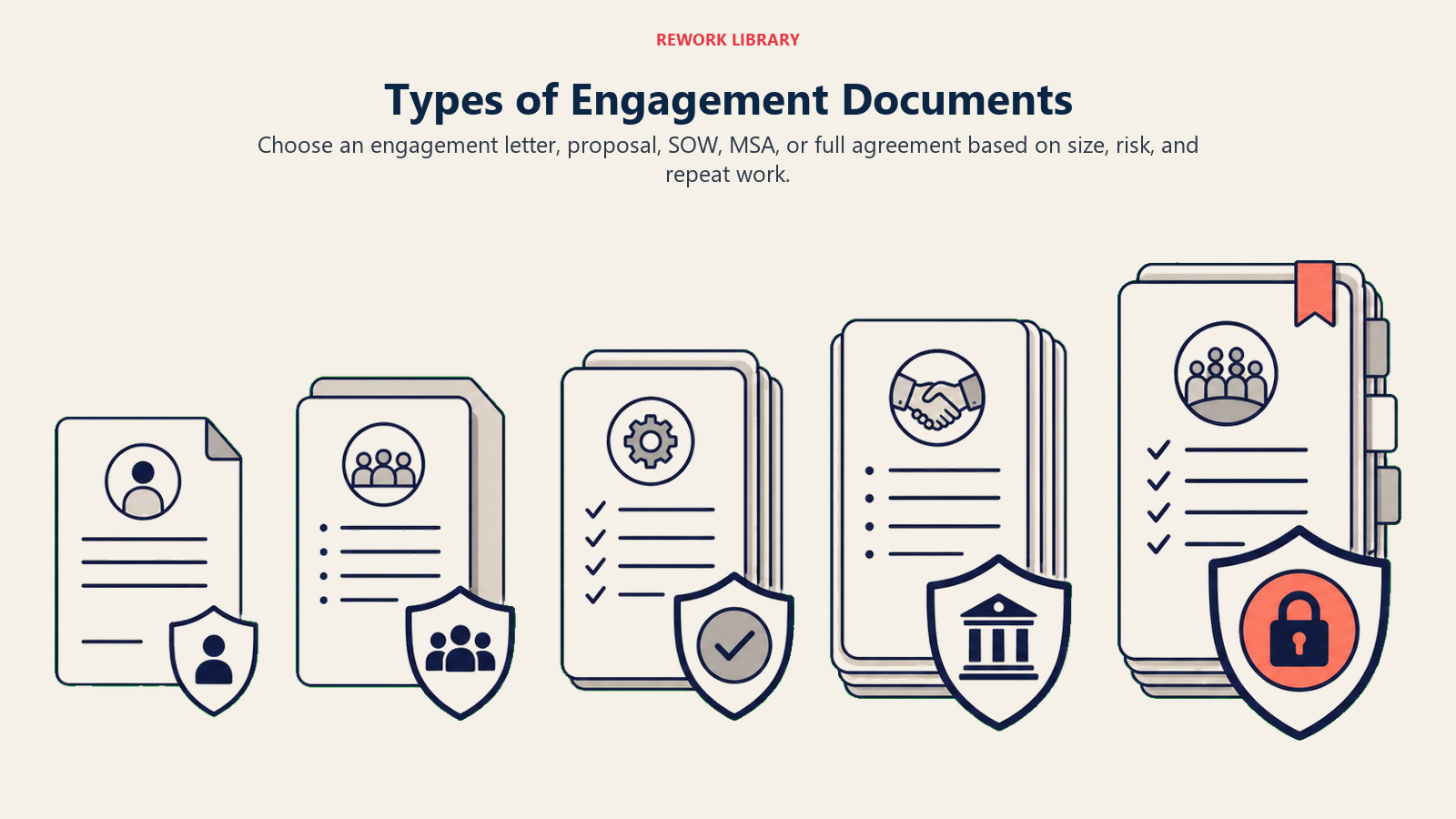
These are the simplest option - typically 2-5 pages, written in plain language, and focused on clarity over legal complexity.
Use engagement letters for:
- Smaller projects under $25,000
- Advisory services with limited deliverables
- Ongoing retainer relationships
- Clients you've worked with before
An engagement letter covers the basics: what you'll do, what it costs, how long it takes, and key responsibilities. It's still legally binding, but it feels more like a professional agreement than a legal contract.
The tone is conversational: "We'll provide strategic marketing guidance for your Q1 product launch" instead of "The Service Provider shall furnish advisory services pertaining to the Client's marketing initiatives."
Engagement letters work when the relationship is straightforward and the risk is manageable. They're faster to draft, easier for clients to sign, and they don't trigger the "I need my lawyer to review this" reflex.
Service agreements
These are mid-weight contracts - typically 8-15 pages with more detailed legal provisions but still readable.
Use service agreements for:
- Mid-sized engagements ($25,000-$200,000)
- First-time clients
- Projects with more risk exposure
- Situations requiring detailed IP or confidentiality terms
Service agreements include everything in an engagement letter plus more protective provisions: indemnification, warranties, dispute resolution, detailed termination rights, and specific risk management clauses.
The tone is more formal but shouldn't be impenetrable. You want clients to actually read and understand what they're signing, not just skim it because the legalese is too dense.
Master service agreements (MSAs)
MSAs are framework contracts that govern your overall relationship with a client across multiple projects.
Use MSAs for:
- Large clients with ongoing needs
- Enterprise relationships
- Situations where you'll do multiple projects over time
The MSA covers all the standard terms: payment, IP, confidentiality, liability, dispute resolution. Then each individual project gets a Statement of Work (SOW) that references the MSA.
This approach saves time. Instead of negotiating a full contract for every project, you negotiate the MSA once. Future projects just need a simple SOW with scope, timeline, and fees.
MSAs work best when you know you'll have a multi-year relationship with a client and want to establish consistent terms upfront.
Statements of work (SOWs)
SOWs are project-specific documents used under an MSA.
A good SOW includes:
- Detailed deliverables and milestones
- Project timeline
- Fees specific to this project
- Unique requirements or assumptions
SOWs are short (2-4 pages typically) because the legal terms live in the MSA. They focus purely on "what we're doing this time."
Essential contract components: What every agreement needs
Whether you're using an engagement letter or a full service agreement, certain elements are non-negotiable.
Parties and effective date
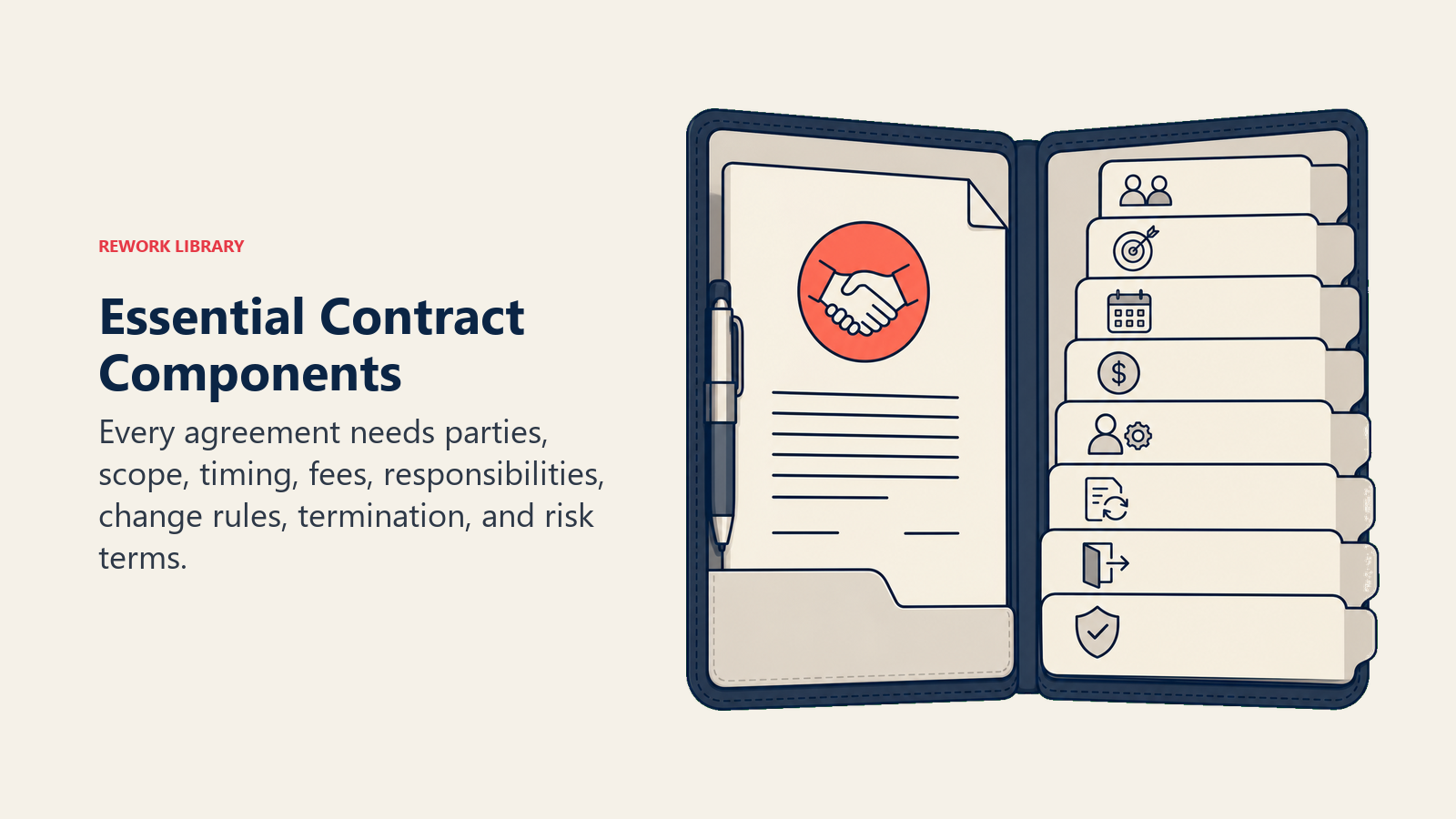
This sounds obvious, but get it right. Include full legal names and addresses for both your firm and the client. If you're contracting with a division or subsidiary, make sure you name the correct legal entity.
The effective date matters for payment terms, deliverable schedules, and termination rights. Don't leave it blank and assume "when we both sign" is clear enough.
Scope of services
This is where most problems start, so get specific.
Bad scope language:
- "Provide strategic consulting services"
- "Support the client's digital transformation"
- "Advise on operational improvements"
These descriptions are too vague. What does "support" mean? What's included in "strategic consulting"?
Good scope language:
- "Conduct 12 stakeholder interviews, analyze current processes, and deliver a 30-page strategic plan including five specific recommendations for organizational restructuring"
- "Implement Salesforce CRM including data migration from existing system, configuration of sales workflows, and training for 15 users"
- "Provide monthly financial reporting including P&L analysis, cash flow forecasting, and board presentation materials"
See the difference? Specific deliverables, quantified activities, clear outcomes.
For longer engagements, break scope into phases:
- Phase 1: Discovery and assessment (weeks 1-3)
- Phase 2: Solution design (weeks 4-6)
- Phase 3: Implementation support (weeks 7-10)
This creates natural checkpoints and makes it easier to manage changes.
Out of scope
Here's a section most people skip that could save you thousands: explicitly state what's NOT included.
Examples:
- "This engagement does not include software development or custom coding"
- "Implementation support is limited to remote guidance; on-site visits are not included"
- "Legal review of contracts or regulatory compliance is not part of this scope"
Clients often assume related services are included. If you're doing strategic planning, they might expect you to also manage the implementation. If you're redesigning their website, they might think hosting and maintenance are included.
State the boundaries clearly. It feels awkward, but it prevents disputes.
Fees and payment terms
Be specific about every aspect of pricing.
Specify:
- Rate structure: Hourly, fixed fee, retainer, or value-based (see billable hour vs value-based pricing)
- Total project fee or estimate: If hourly, provide an estimate with a cap
- Payment schedule: Upfront deposit, milestone-based, monthly, net 30
- Expense handling: Are expenses included or billed separately? What's reimbursable?
- Rate increases: For ongoing relationships, can you raise rates? How much notice?
Example payment language: "The total project fee is $75,000, payable as follows: $25,000 upon signing, $25,000 upon completion of Phase 1, and $25,000 upon final deliverable. Invoices are due within 15 days of receipt. Late payments accrue interest at 1.5% per month."
If you're doing hourly work, include a cap or mechanism for managing overruns: "Estimated at 150 hours at $200/hour ($30,000 total). Client will be notified if hours are projected to exceed estimate and must approve additional work in writing."
The clearer your payment terms, the faster you get paid. Ambiguity creates excuses for slow payment.
Timeline and milestones
Create accountability on both sides by setting clear deadlines.
Include:
- Project start date
- Key milestone dates
- Final completion date
- Any client-dependent deadlines
Example: "Project kickoff: January 15. Client to provide access to systems and data by January 22. Draft deliverable: February 15. Client feedback due: February 22. Final deliverable: March 1."
This does two things: it shows you're organized and committed to timelines, and it makes client delays their problem. If they don't give you access to data by January 22, you're not missing your March 1 deadline - they are.
Client responsibilities
Clients often don't realize they have obligations too. Spell them out.
Common client responsibilities:
- Provide timely access to people, systems, and data
- Assign a main point of contact with decision-making authority
- Review and approve deliverables within specified timeframes
- Make timely payments
- Provide necessary background materials or documentation
Example language: "Client agrees to: (1) Provide access to financial systems and relevant personnel within 5 business days of project start; (2) Assign a primary contact who will respond to requests within 2 business days; (3) Review and provide feedback on draft deliverables within 7 days of submission."
When clients don't meet their responsibilities, it's grounds for timeline extensions or even termination. But only if you documented what they were supposed to do.
Intellectual property rights
Who owns the work you create? This matters a lot.
Standard approach: Client owns the final deliverables specific to their engagement. You retain ownership of your methodologies, tools, templates, and any general frameworks you used.
Example IP clause: "Upon full payment, Client receives ownership of all custom deliverables created specifically for this engagement. Consultant retains ownership of all pre-existing materials, methodologies, tools, and frameworks, and may reuse general knowledge and approaches developed during the engagement."
For software or creative work, this gets more complex. You might need to address:
- Copyright and licensing
- Third-party components or open-source code
- Rights to reuse or repurpose the work
- Whether client can modify your work
If IP is a major component of your engagement (like software development or brand design), get a lawyer to review this section. Standard templates might not cover your specific situation.
Confidentiality and data protection
You'll likely access sensitive client information. Protect it properly.
Basic confidentiality provision: "Both parties agree to keep confidential all proprietary information shared during the engagement and not to disclose it to third parties without written consent."
For more sensitive situations, address:
- What qualifies as confidential (financial data, customer lists, strategic plans)
- How long confidentiality lasts (typically 2-5 years post-engagement)
- Exceptions (publicly available information, information already known)
- Data security requirements (encryption, access controls)
If you're handling personal data (customer information, employee records), you need data protection provisions that comply with relevant regulations (GDPR, CCPA, etc.). This is especially critical for consultants working with healthcare, finance, or European clients.
Limitation of liability and indemnification
This is about limiting your financial exposure if something goes wrong.
Limitation of liability caps how much a client can recover from you if they sue:
"Consultant's total liability for any claims arising from this engagement shall not exceed the total fees paid by Client under this agreement."
This means if you charge $50,000 for a project, the most you can be sued for is $50,000, even if the client claims bigger damages.
Some contracts cap liability at 2x the fees or a specific dollar amount. The point is to prevent a small engagement from creating unlimited exposure.
Indemnification addresses who's responsible if third parties sue:
"Each party agrees to indemnify the other for claims arising from their own negligence, breach of agreement, or violation of law."
Translation: If you get sued because of something the client did, they cover your legal costs. If they get sued because of something you did, you cover theirs.
Be careful with one-sided indemnification where you indemnify the client but they don't indemnify you. That's unbalanced risk.
Warranties and disclaimers
What are you promising, and what aren't you guaranteeing?
Standard warranties:
- You'll perform services in a professional and workmanlike manner
- You have the right to provide the services and own the IP you're licensing
- Your work won't violate any third-party rights
Standard disclaimers:
- No guarantee of specific results or outcomes
- Client is responsible for decisions based on your advice
- You're not providing legal, accounting, or regulatory advice (unless you are)
Example language: "Consultant warrants that services will be performed in a professional manner consistent with industry standards. Consultant does not guarantee specific business results or outcomes. Client acknowledges that all business decisions based on Consultant's recommendations are Client's sole responsibility."
These disclaimers protect you from unrealistic expectations. You're promising to do good work, not to guarantee their business success.
Termination provisions
Relationships end. Make sure you know how.
Address three scenarios:
Termination for convenience: Either party can end the engagement with notice, but there are financial consequences.
Example: "Either party may terminate this agreement with 30 days written notice. Client will pay for all work completed through the termination date plus costs incurred for wind-down activities."
Termination for cause: Immediate termination if someone breaches the agreement.
Example: "Either party may terminate immediately if the other party materially breaches this agreement and fails to cure the breach within 15 days of written notice."
Effect of termination: What happens to deliverables, payments, and confidentiality?
Example: "Upon termination, Client will pay for all services rendered through termination date. Consultant will deliver all completed work products. Confidentiality obligations survive termination for 3 years."
The key is balance. You want the right to terminate if the client doesn't pay or becomes impossible to work with. But you also want to minimize disruption and ensure you get paid for work completed.
Change order process
Scope changes are inevitable. Have a process for handling them.
Include:
- How changes are requested (written only, specific approval required)
- How changes affect fees and timeline
- Who can approve changes (not just any client employee)
Example change order provision: "Any changes to the scope, timeline, or fees must be requested in writing and approved by both parties. Consultant will provide a written estimate of additional fees and timeline impact within 5 business days of receiving a change request. No additional work will begin until Client approves the change order in writing."
This prevents "scope creep" where clients keep adding little requests that balloon the project. Every change goes through a formal process with cost and timeline implications spelled out. For more on managing these situations, see our guide on scope creep management.
Dispute resolution
Hope you never need this, but include it anyway.
Options for dispute resolution:
- Negotiation: Try to work it out directly (always the first step)
- Mediation: Neutral third party helps you reach agreement
- Arbitration: Neutral third party makes a binding decision
- Litigation: Go to court
Most professional services contracts include a multi-step process:
"In the event of a dispute, parties agree to first attempt resolution through good-faith negotiation. If unresolved after 30 days, parties will engage in mediation. If mediation fails, disputes will be resolved through binding arbitration under the American Arbitration Association rules."
Why avoid litigation? It's expensive, time-consuming, and public. Arbitration is typically faster and cheaper.
Also specify:
- Governing law: Which state or country's laws apply
- Jurisdiction: Where disputes will be resolved (usually where your firm is located)
- Attorney fees: Who pays legal costs if there's a dispute (sometimes the losing party pays)
Risk management provisions: Protecting your downside
Beyond the basic contract components, you need specific provisions that limit your risk exposure.
Liability caps and limitations
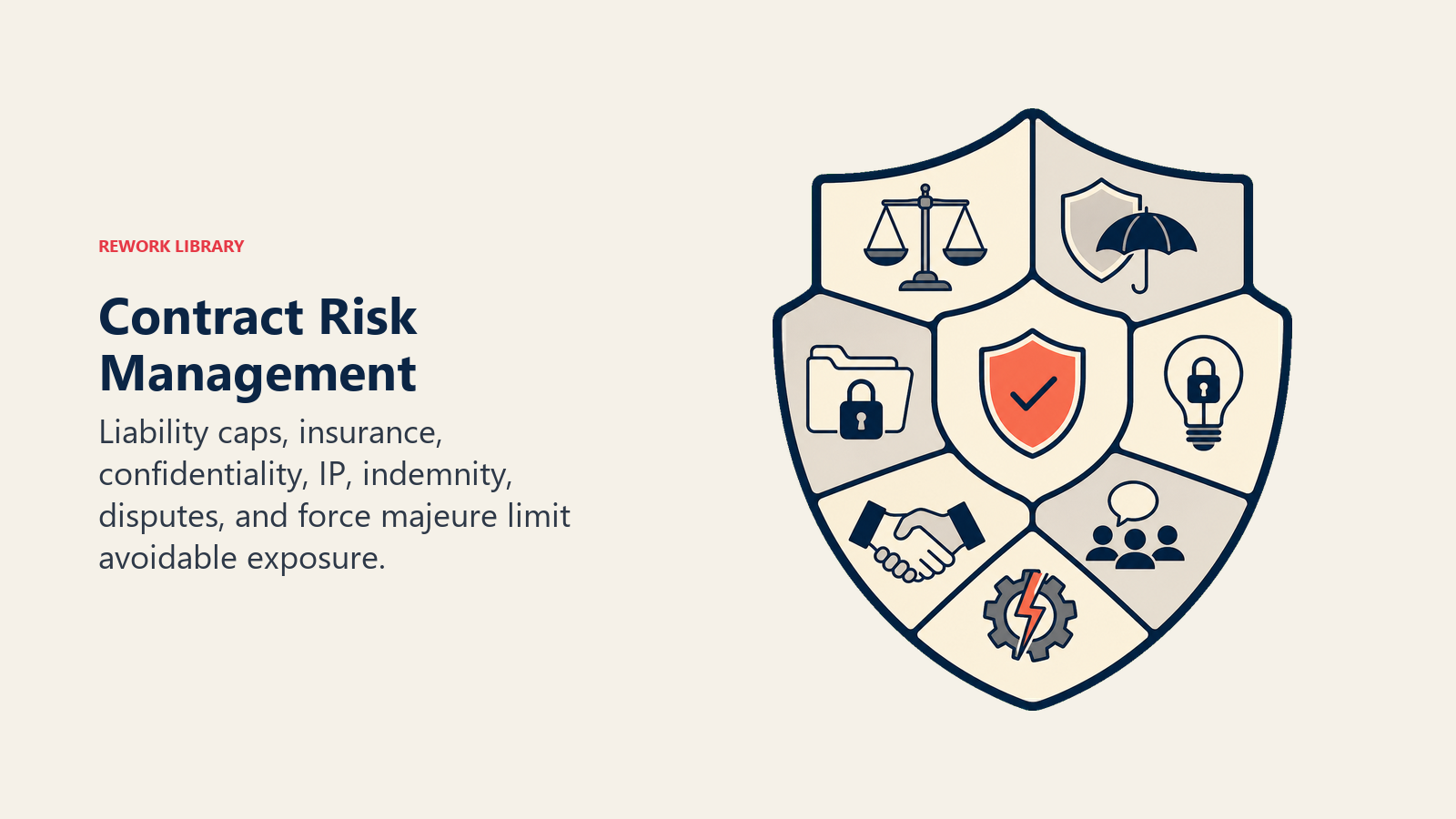
We covered this briefly, but it's important enough to emphasize.
Without a liability cap, you could be sued for any amount, even if it vastly exceeds what you were paid. A client might claim your advice cost them millions, even though you charged $50,000.
Standard liability caps:
- Total fees paid under the agreement (most common)
- 2x the total fees
- A specific dollar amount (e.g., $500,000 maximum)
Some contracts exclude certain claims from the cap:
- Intentional misconduct or fraud
- Breaches of confidentiality
- IP infringement
That's reasonable. You shouldn't be protected if you deliberately harm the client or steal their secrets.
But make sure the cap applies to most claims, especially professional negligence or breach of contract. Those are the common disputes.
Force majeure clauses
What happens if something outside your control prevents you from performing? Pandemic, natural disaster, war, government action?
A force majeure clause suspends your obligations during these events:
"Neither party shall be liable for failure to perform obligations if such failure is caused by events beyond their reasonable control, including acts of God, war, terrorism, pandemic, government action, or natural disasters. Obligations will resume when the event ends, or either party may terminate if the delay exceeds 90 days."
This protects you from being in breach if extraordinary circumstances prevent performance. COVID-19 taught a lot of consultants the value of this clause.
Warranty disclaimers
Professional services are different from product sales. You're providing advice and expertise, not guaranteeing outcomes.
Make that clear:
"CONSULTANT MAKES NO WARRANTIES, EXPRESS OR IMPLIED, INCLUDING ANY IMPLIED WARRANTIES OF MERCHANTABILITY OR FITNESS FOR A PARTICULAR PURPOSE. CONSULTANT DOES NOT GUARANTEE ANY SPECIFIC RESULTS, OUTCOMES, OR BUSINESS PERFORMANCE."
This disclaimer (usually in all caps to stand out) makes clear you're not promising their business will succeed just because they hired you.
You're warranting that you'll do professional work, but not that your recommendations will definitely work or generate specific results. Too many variables are outside your control.
Indemnification terms
We touched on this, but here's why it matters: indemnification shifts the cost of certain risks.
If a client asks you to use their branding materials and it turns out they don't have rights to the logo, you could get sued by the actual trademark owner. An indemnification clause makes the client cover your legal fees in that scenario.
Conversely, if you provide deliverables that infringe someone else's IP, you'd indemnify the client.
Fair indemnification is mutual and limited to each party's own actions:
"Each party agrees to indemnify and defend the other from claims arising from (1) their own negligence or willful misconduct, (2) their breach of this agreement, or (3) their violation of applicable laws."
Watch out for one-sided indemnification where you indemnify the client for everything, including things outside your control. That's unfair risk allocation.
Insurance requirements
For larger engagements or riskier projects, clients might require you to maintain specific insurance.
Common requirements:
- Professional liability insurance (errors & omissions): Covers claims that your advice or work caused financial harm
- General liability insurance: Covers property damage or bodily injury
- Cyber liability insurance: Covers data breaches or cybersecurity incidents
If a client requires insurance, make sure:
- You can actually get it (some professional services are hard to insure)
- The coverage amount is reasonable (don't agree to $5M coverage for a $20,000 project)
- You're not naming the client as additional insured unless your policy allows it
Insurance requirements should match the engagement size and risk. A $10,000 advisory project shouldn't require $10M in coverage.
Data security and privacy
If you're handling client data, especially personal or sensitive information, you need security provisions.
Address:
- How you'll protect data (encryption, access controls, secure storage)
- What happens if there's a data breach (notification requirements, liability)
- Compliance with relevant regulations (GDPR, HIPAA, CCPA)
- Data retention and deletion after engagement ends
Example data security provision: "Consultant agrees to maintain reasonable security measures to protect Client data, including encryption of data in transit and at rest, access controls limiting data to authorized personnel, and regular security reviews. In the event of a data breach, Consultant will notify Client within 48 hours and cooperate in breach response."
Don't take this lightly. Data breaches can be expensive and damage your reputation. If you can't commit to strong data security, don't take on engagements that require it.
Common contract issues that cause problems
Here are the mistakes that lead to disputes:
Vague scope language
We covered this, but it's worth repeating: vague scope is the #1 source of disputes.
"Provide consulting services for the digital transformation initiative" is a disaster waiting to happen. What's included? What's not? When are you done?
Get specific. Define deliverables. Quantify activities. Set clear boundaries.
Unlimited liability exposure
Some contracts have no liability cap. That means a $50,000 engagement could create $5M in exposure if something goes wrong.
Always include a liability cap unless the engagement is truly high-risk and you're being compensated accordingly (and have insurance to cover it).
One-sided termination rights
Some contracts let the client terminate anytime for any reason but don't give you the same right.
That's fine if you're being paid for work completed. But if the contract says "Client may terminate anytime with no payment for work in progress," you're taking all the risk.
Termination rights should be balanced. Either both parties can terminate for convenience (with payment for work completed), or neither can unless there's a breach.
Unclear IP ownership
Who owns the deliverables? The analysis? The recommendations? The templates you created?
If this isn't explicit, you'll argue about it later. Especially if you want to reuse your work for other clients or if the client wants to resell what you created.
Define IP ownership clearly. Typically: client owns the final deliverables, you retain your methodologies and tools.
Missing change order process
Without a formal change process, clients will keep adding "just one more thing" until your $50,000 project becomes $100,000 of work with no additional payment.
Require written change requests with fee and timeline impacts. No informal "can you also look at..." requests without going through the process.
Inadequate payment protection
Net 30 payment terms sound reasonable until you're 90 days past due and the client isn't paying.
Protect yourself:
- Require upfront deposits (25-50% is common)
- Tie payments to milestones, not just final delivery
- Include late fees or interest for overdue invoices
- Reserve the right to stop work if payments are late
- Keep ownership of deliverables until final payment
The easier you make it for clients to delay payment, the more they will.
Negotiating contract terms: Where to hold the line
Clients will push back on your contract, especially enterprise clients with their own procurement teams. Know where you can be flexible and where you can't.
Non-negotiable provisions
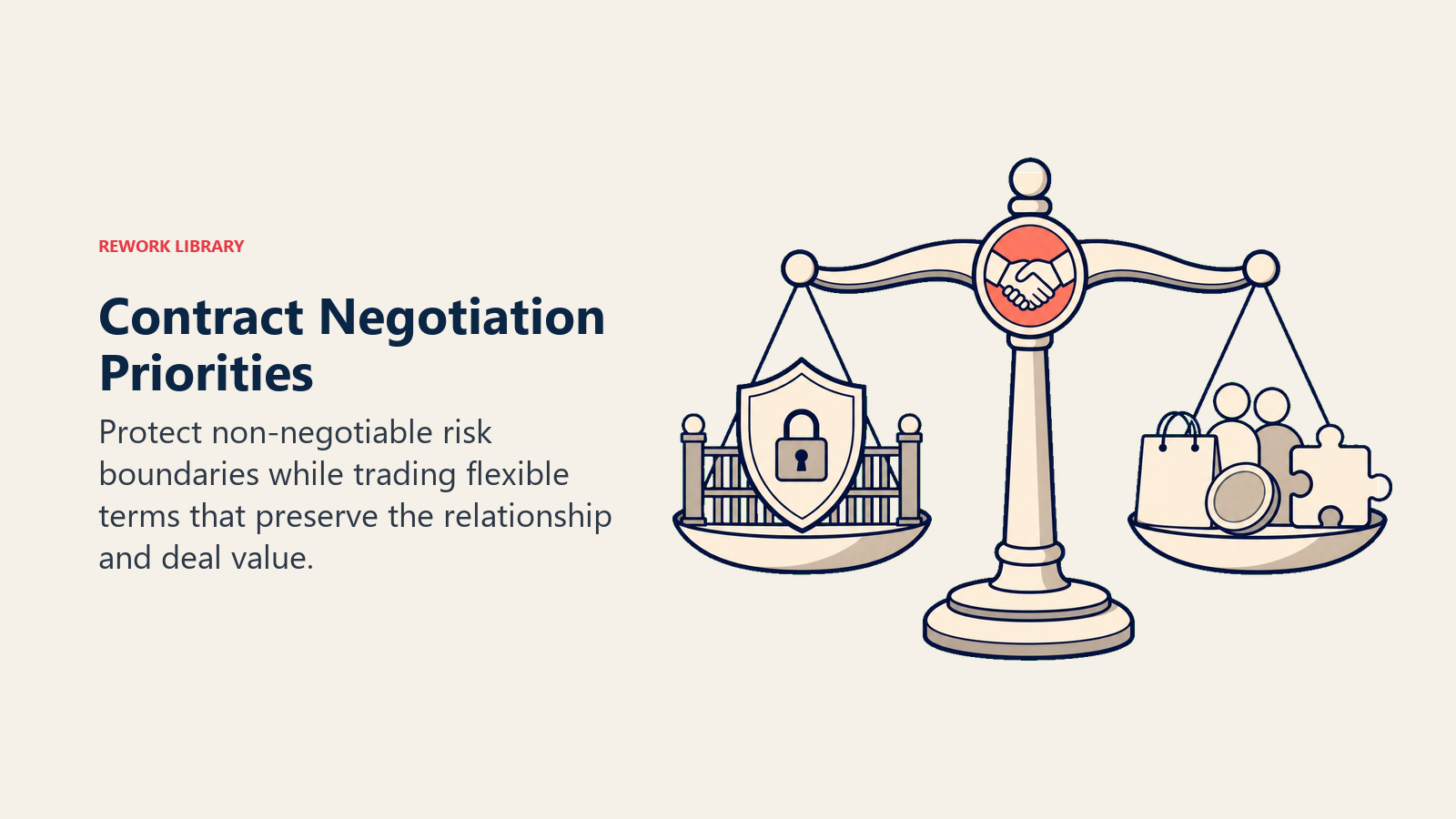
These are the terms you shouldn't compromise on:
Limitation of liability: Don't accept unlimited liability unless you're being paid enough to justify the risk (and have insurance to cover it). If they insist on higher limits, increase your fees to reflect the increased risk.
Payment terms: Don't finance your clients' operations. If they want 60- or 90-day payment terms, either decline or build the financing cost into your fees. And always keep upfront deposits non-negotiable for new clients.
IP ownership of your tools and methodologies: Client can own the deliverables, but you keep your frameworks, templates, and approaches. That's how you stay efficient across clients.
Right to terminate for non-payment: If they don't pay, you need the right to stop work and walk away. No exceptions.
Flexible provisions
These are areas where you can negotiate:
Liability caps: If client wants a higher cap, you can agree if they pay more to offset the risk. Some consultants tie the cap to the fee: $100,000 project = $100,000 cap, $500,000 project = $500,000 cap.
Timeline and milestones: If they need faster delivery or different milestone structure, you can adjust - but make sure fee and resource allocation adjust too.
Confidentiality duration: Standard is 2-3 years post-engagement. If they want 5 years, that's usually fine. If they want 10+ years, push back or get higher fees.
Governing law and jurisdiction: If they're in a different state, they might want their jurisdiction. That's usually acceptable unless it creates major inconvenience for you.
Red flag terms to watch for
Some contract terms are just bad. Push back hard or walk away:
Indemnification for everything: If they want you to indemnify them for claims unrelated to your work, that's unreasonable. You should only indemnify for claims arising from your own actions.
Unlimited revisions: "Client may request unlimited revisions until satisfied" is a recipe for scope creep. Limit to a specific number of revision rounds (typically 2-3).
Non-compete or non-solicit: If they want you to agree not to work for competitors or hire their employees, think carefully. Broad non-competes can kill your business. If you must agree, limit it to specific competitors and reasonable time periods (6-12 months).
Automatic renewal with price increases: Be careful with auto-renewal clauses, especially if they lock in current pricing. You want the ability to adjust rates.
"Client may terminate anytime with no penalty": Termination for convenience is fine if you get paid for work completed. Termination with no payment is not acceptable.
When to escalate to legal counsel
You don't need a lawyer for every contract, but you should get legal review when:
- Deal size exceeds $100,000
- Client is a large enterprise with complex contract requirements
- There are unusual risks or industry-specific regulations (healthcare, finance, government)
- Client is asking for terms you don't understand or haven't seen before
- You're entering a new market or service line
- The relationship is expected to be long-term and strategic
Legal review costs money (usually $1,000-$5,000 for contract review and negotiation), but it's worth it for major engagements. A lawyer can spot issues you'd miss and negotiate better terms.
For smaller deals, use a solid template reviewed by a lawyer once, then customize for each client. Don't pay for legal review of every $20,000 engagement letter.
Documentation of negotiation outcomes
When you negotiate contract changes, document everything in writing.
If client says "we'll need 60-day payment terms but we'll add a 10% expedite fee," get that in writing. Don't rely on verbal agreements.
Use email confirmations for any material changes: "Per our conversation, we've agreed to adjust the payment terms to Net 60 in exchange for a 10% increase in fees. Updated agreement attached."
This creates a clear record if there's confusion later.
Best practices for engagement documents
Beyond specific clauses, follow these practices:
Use plain language over legalese
Legal documents don't need to sound like they were written in 1850.
Bad: "The parties hereto do hereby agree and acknowledge that the Services provided pursuant to this Agreement shall be rendered in accordance with the terms and conditions set forth hereinbelow."
Good: "We'll provide the services described below according to these terms."
Your clients should be able to read and understand the contract. If they need a lawyer just to parse your language, you're creating unnecessary friction.
Some legal terms are necessary ("indemnify," "force majeure," "intellectual property"), but most contracts can be written in plain English and still be legally binding.
Balance protection with relationship
Yes, you need to protect yourself legally. But you also want clients to feel comfortable signing.
If your contract is 40 pages of one-sided terms that protect you from every conceivable risk while giving the client no rights, they'll either refuse to sign or they'll resent the relationship before it starts.
Aim for balanced contracts. You have protections, they have protections. You have rights, they have rights. Both parties commit to making the relationship work.
The best contracts make both sides feel safe, not just you.
Customize for client and project
Don't send the same generic template to every client. Customize based on:
- Engagement size and complexity: Bigger projects need more detailed contracts
- Client sophistication: Enterprise clients expect more formal agreements than small businesses
- Industry requirements: Healthcare, finance, and government clients have specific regulatory needs
- Relationship history: Long-time clients might accept simpler agreements than new clients
A $15,000 engagement letter for a repeat client should look different from a $200,000 service agreement for a new enterprise client.
Legal review for major engagements
We covered this, but it's worth repeating: get legal review for significant deals.
Your standard template is fine for routine work, but when the stakes are high or the terms are complex, spend the money on professional legal advice. It's a lot cheaper than litigation.
Version control and secure signatures
Manage your contracts professionally:
- Version control: Track which version of the contract is current. Use clear file names: "Client-Name-SOW-v3-Final.pdf"
- Signature management: Use electronic signature tools (DocuSign, Adobe Sign, PandaDoc) for faster execution and better tracking
- Centralized storage: Keep all executed contracts in one secure location with access controls
- Expiration tracking: For retainers or ongoing agreements, track renewal dates so nothing lapses unintentionally
Nothing's worse than being six months into an engagement and realizing you can't find the signed contract.
Practical templates and checklists
Here's what to use when creating your engagement documents:
Simple engagement letter template (outline)
For projects under $25,000:
1. Introduction and parties
- Who's contracting with whom
- Effective date
2. Services and deliverables
- Specific scope (bulleted list of what you'll deliver)
- Timeline and milestones
- Client responsibilities
3. Fees and payment
- Total fee or hourly rate with estimate
- Payment schedule
- Expense handling
4. Key terms
- IP ownership (client gets deliverables, you keep methodologies)
- Confidentiality (mutual)
- Termination (either party, 30 days notice, payment for work completed)
- Limitation of liability (capped at fees paid)
5. Standard clauses
- Governing law
- Entire agreement
- Amendment process
6. Signatures
That's it. 2-3 pages, clear language, covers the essentials. For more detailed engagements, use the comprehensive structure outlined in scope definition and SOW.
Contract checklist
Before sending any engagement document, verify:
- Full legal names and addresses for both parties
- Specific, detailed scope with clear deliverables
- Explicit out-of-scope items
- Complete fee structure with payment schedule
- Timeline with milestones and client-dependent deadlines
- Client responsibilities documented
- IP ownership clearly assigned
- Confidentiality provisions (mutual)
- Limitation of liability included
- Termination rights (for convenience and for cause)
- Change order process defined
- Dispute resolution mechanism specified
- Governing law and jurisdiction identified
- Signatures and dates
If you're missing any of these, go back and add them.
Red flag terms guide
When reviewing client contracts, watch for these problematic provisions:
RED FLAGS - Push back strongly:
- Unlimited liability or indemnification
- One-sided termination rights with no payment
- Ownership of all your work product and methodologies
- Broad non-competes that prevent you from serving your market
- Payment terms beyond 60 days with no deposits
- Automatic renewal with locked pricing
- Unlimited revisions or scope changes
YELLOW FLAGS - Negotiate carefully:
- Liability caps below the engagement fee
- Extensive warranties or guarantees of results
- Required insurance above industry standards
- Long confidentiality periods (5+ years)
- Multi-year commitments with no adjustment clauses
- Exclusive service requirements
GREEN FLAGS - Generally acceptable:
- Mutual confidentiality agreements
- Standard IP provisions (client owns deliverables, you keep tools)
- Balanced termination rights
- Reasonable payment terms (net 30-45)
- Professional liability insurance requirements matching engagement size
- Specific deliverables and acceptance criteria
Negotiation decision tree
When clients push back on terms, use this framework:
1. Is this a deal-breaker term for you? (liability cap, payment terms, IP ownership of your tools)
- Yes: Hold firm or walk away
- No: Go to step 2
2. Does accepting their term create unreasonable risk?
- Yes: Propose alternative or require higher fees to offset risk
- No: Go to step 3
3. Can you give them what they want with modifications?
- Yes: Counter with modified language that works for both sides
- No: Go to step 4
4. Is there something else you can trade? (faster timeline, additional deliverables, extended support)
- Yes: Propose a trade that addresses their concern while protecting you
- No: Decline the term and explain why
The key is knowing your non-negotiables before you start negotiating. Don't improvise your way into bad terms.
Frequently Asked Questions
What is the difference between an engagement letter and a contract? An engagement letter is a shorter, plain-language agreement (typically 2-5 pages) used for smaller or lower-risk projects. A full service agreement is a longer, more detailed contract (8-15 pages) with stronger legal provisions for larger engagements and first-time clients. Both are legally binding.
What clauses must every engagement letter include? At a minimum: parties and effective date, a specific scope of services, explicit out-of-scope items, fees and payment terms, timeline and milestones, client responsibilities, IP ownership, confidentiality, limitation of liability, and termination provisions.
How does an engagement letter limit my firm's liability? A limitation of liability clause caps how much a client can recover, often at the total fees paid under the agreement. So a $50,000 project caps exposure at $50,000 rather than leaving you open to an unlimited claim.
When should I use a service agreement instead of an engagement letter? Use a service agreement for mid-sized engagements ($25,000-$200,000), first-time clients, projects with higher risk, or situations needing detailed IP and confidentiality terms. Use a Master Service Agreement plus Statements of Work when you expect multiple projects over time.
Do I need a lawyer to review every contract? No. Have a lawyer review a solid template once, then reuse it for routine work. Get fresh legal review when a deal exceeds $100,000, involves a large enterprise, carries unusual risk, or includes terms you have not seen before.
Where to go from here
Strong engagement documents are just one piece of effective professional services sales. They work best when integrated with your broader processes:
- Start with clear scope definition and SOW development so contracts reflect realistic expectations
- Use negotiation skills to reach agreement on fair terms
- Apply pricing justification methods to support your fee structure in the contract
- Follow up with solid client onboarding processes that reinforce the contract terms
The firms that do this well don't just avoid disputes - they build stronger client relationships because everything is clear from day one. That's the real value of good engagement documents: not just legal protection, but clarity that builds trust.
Start with a solid template reviewed by a lawyer. Customize it for each client. Use plain language. Balance protection with partnership. And always, always get it in writing before you start work.
The $50,000 you save by preventing one dispute will more than pay for the time invested in getting your contracts right.

Sales Director
On this page
- Why engagement documents matter more than you think
- Types of engagement documents: Which one do you need?
- Engagement letters
- Service agreements
- Master service agreements (MSAs)
- Statements of work (SOWs)
- Essential contract components: What every agreement needs
- Parties and effective date
- Scope of services
- Out of scope
- Fees and payment terms
- Timeline and milestones
- Client responsibilities
- Intellectual property rights
- Confidentiality and data protection
- Limitation of liability and indemnification
- Warranties and disclaimers
- Termination provisions
- Change order process
- Dispute resolution
- Risk management provisions: Protecting your downside
- Liability caps and limitations
- Force majeure clauses
- Warranty disclaimers
- Indemnification terms
- Insurance requirements
- Data security and privacy
- Common contract issues that cause problems
- Vague scope language
- Unlimited liability exposure
- One-sided termination rights
- Unclear IP ownership
- Missing change order process
- Inadequate payment protection
- Negotiating contract terms: Where to hold the line
- Non-negotiable provisions
- Flexible provisions
- Red flag terms to watch for
- When to escalate to legal counsel
- Documentation of negotiation outcomes
- Best practices for engagement documents
- Use plain language over legalese
- Balance protection with relationship
- Customize for client and project
- Legal review for major engagements
- Version control and secure signatures
- Practical templates and checklists
- Simple engagement letter template (outline)
- Contract checklist
- Red flag terms guide
- Negotiation decision tree
- Frequently Asked Questions
- Where to go from here