Implementation Consulting: Turning Strategy into Operational Reality
 Here's something consulting firms know but rarely talk about - 70% of strategic initiatives fail during execution. Not because the strategy was bad. Not because leadership didn't care. But because turning a 50-slide PowerPoint into operational reality is exponentially harder than creating it.
Turn this article into takeaways for your work.


Each assistant summarizes the article only for you and suggests best practices for your work.
That's where implementation consulting comes in. It's the work that happens after the handshake and the recommendations deck. Someone has to configure the systems, train the teams, manage the resistance, and make sure the brilliant strategy doesn't become another abandoned initiative gathering dust in SharePoint.
Implementation work is different from strategy work. It's messier, longer, more political, and requires different skills. But it's also where real value gets created. A mediocre strategy executed well beats a brilliant strategy executed poorly every time.
This guide breaks down how to structure and deliver implementation engagements that actually stick. Not just go-live ceremonies that fall apart two weeks later.
What implementation consulting actually means
Implementation consulting is hands-on execution support for strategic initiatives. You're not just advising anymore. You're building, configuring, training, and managing change alongside the client team. Understanding how this fits within consulting engagement models helps you price and structure these extended engagements. The work falls into three broad categories:
Process implementation is about operationalizing new workflows and ways of working. A client wants to restructure their sales process, implement agile methodologies, or roll out a new governance framework. You're designing the detailed processes, creating the templates and tools, training teams, and embedding the changes.
Technology implementation involves deploying and configuring systems. ERP implementations, CRM rollouts, data platform migrations. You're not necessarily doing the technical coding, but you're managing the project, handling change management, configuring workflows, and making sure people actually use it.
Organizational change focuses on restructuring teams, roles, and operating models. Post-merger integration, organizational redesign, new operating model rollout. You're managing the human side: communication, training, capability building, resistance management.
Most real implementations blend all three. A new CRM isn't just technology - it requires process changes and organizational adoption. A new operating model isn't just org charts - it needs enabling technology and process documentation.
The timeline runs 3-18 months typically, depending on scope and complexity. Enterprise-wide ERP implementations can stretch to 24+ months. Focused process improvements might wrap in 12 weeks.
Engagement models that work
You have options for how you structure implementation work: Project-based engagements are time-boxed initiatives with defined deliverables. "Implement Salesforce across the sales org in 6 months." Clear scope, fixed timeline, specific outcomes. This works when the end state is well-defined and the path is relatively predictable.
Embedded team models place your consultants inside the client organization for extended periods. They become part of the team - sitting in their offices, joining their meetings, working their hours. This works for complex transformations where requirements evolve and relationship depth matters.
Hybrid advisory plus execution combines strategic guidance with hands-on implementation support. You're the architect and the general contractor. Monthly steering committee meetings for strategy, weekly working sessions for execution. This balances oversight with tactical progress.
Most firms default to project-based because it's easier to scope and price. But embedded models often deliver better results because you can adapt as you learn. The tradeoff is they're harder to sell and harder to staff consistently. Understanding utilization and capacity planning is critical for staffing these longer engagements.
Phase 1: Implementation planning gets everyone aligned
The first 2-4 weeks set up everything that follows. You're taking the strategic recommendations and translating them into an executable plan that everyone understands and agrees to. Start by converting strategy into specific initiatives. "Improve customer experience" becomes "Implement omnichannel support platform, retrain support team on new protocols, redesign escalation workflows." Vague becomes concrete.
Build a detailed work breakdown structure that maps every task, dependency, and deliverable. Don't just list "configure CRM." Break it into "define user roles and permissions, configure sales stages, build custom fields for lead scoring, create automated workflows for lead assignment." The more granular, the better.
Resource allocation means figuring out who does what when. You need client resources, not just consultant time. If their IT team is underwater, your technology rollout stalls. If their training lead leaves mid-project, your adoption plan falls apart. Map this early.
Risk assessment identifies what could go wrong and how you'll handle it. Common risks: key stakeholders leave, budgets get cut, competing initiatives drain resources, requirements change dramatically. For each risk, define likelihood, impact, and mitigation strategies.
Define success metrics upfront. Not just "go live on time and on budget" - that's table stakes. What business outcomes should change? If you're implementing a new sales process, what happens to win rates, deal cycle time, and forecast accuracy? Lock these in before you start so you can prove value later. These metrics should align with the broader professional services metrics you track for your firm.
Create a governance framework that defines who makes decisions and how. Weekly working team meetings, biweekly steering committee, monthly executive updates. Decision rights matter - who can approve scope changes, budget overruns, timeline shifts? Put it in writing.
The output is an implementation roadmap everyone signs off on. Not a 200-page project plan nobody reads. A visual timeline showing phases, key milestones, decision points, and deliverables. Something people can actually follow.
Phase 2: Design and build creates the foundation
This is where you build everything that'll get rolled out. Depending on the type of implementation, this phase runs 4-12 weeks. Process design and documentation means creating the detailed workflows that teams will follow. Don't just draw boxes and arrows. Write the actual procedures: "When a customer inquiry comes in, the system routes it to available reps using round-robin logic unless the account has a dedicated rep. Reps have 2 hours to respond during business hours." That level of specificity.
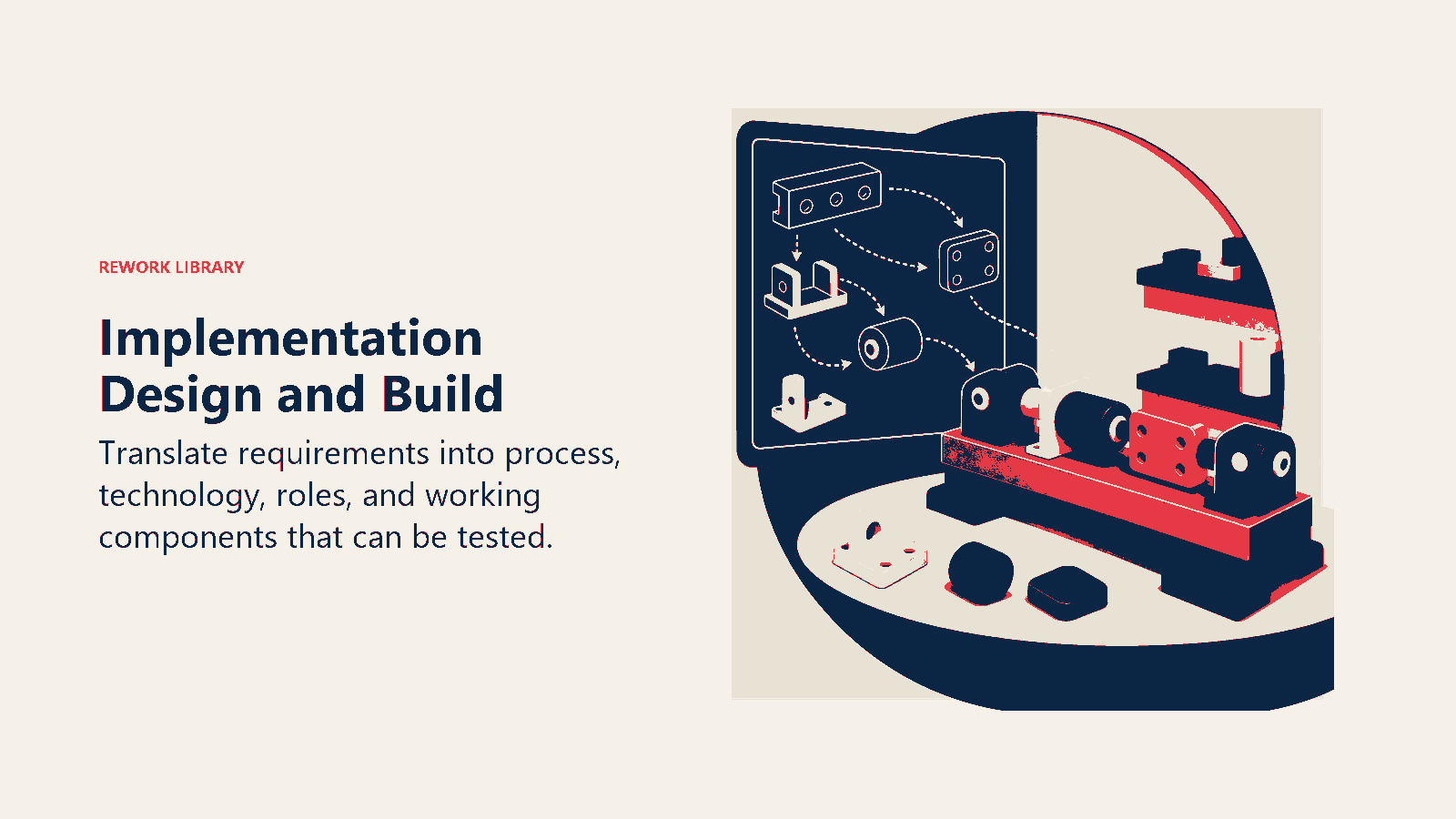
Include decision trees for edge cases. What happens when a VIP customer calls? What if the inquiry is in Spanish and no Spanish-speaking reps are available? Real processes have dozens of these scenarios.
System configuration and customization covers the technical setup. If you're implementing a CRM, you're defining fields, building workflows, setting up integrations, configuring dashboards. If it's an ERP system, you're mapping business processes to system capabilities and deciding what gets customized vs accepting out-of-the-box.
Customization is a trap most implementations fall into. Every stakeholder wants "just one more field" or "this small workflow change." But customizations create technical debt, complicate upgrades, and slow everything down. Push back hard. Accept default functionality unless there's a compelling business reason to customize.
Tool development and integration builds the supporting materials. Reporting dashboards, data migration scripts, integration middleware between systems. Keep it as simple as possible. Over-engineering here creates maintenance nightmares.
Pilot program design plans how you'll test before full rollout. Pick a representative group - not just the enthusiastic early adopters who love all technology. You want normal users who'll surface real issues. Define pilot duration, success criteria, and feedback mechanisms.
Testing and QA validates everything works. Unit testing of individual components, integration testing of connected systems, user acceptance testing with actual users. Document test cases and results. If something breaks in production, you'll need to prove you tested it properly.
Training material development creates everything users need to learn the new way of working. Not 100-slide PowerPoint decks. Quick reference guides, video tutorials, workflow checklists, FAQs. Think: what would help someone do their job, not what looks impressive in a binder.
The mistake here is overbuilding. You don't need perfection. You need good enough to pilot. Save refinement for after you get user feedback.
Phase 3: Pilot and refinement tests reality
Pilot phases run 3-6 weeks typically. This is where your perfect design meets messy reality.
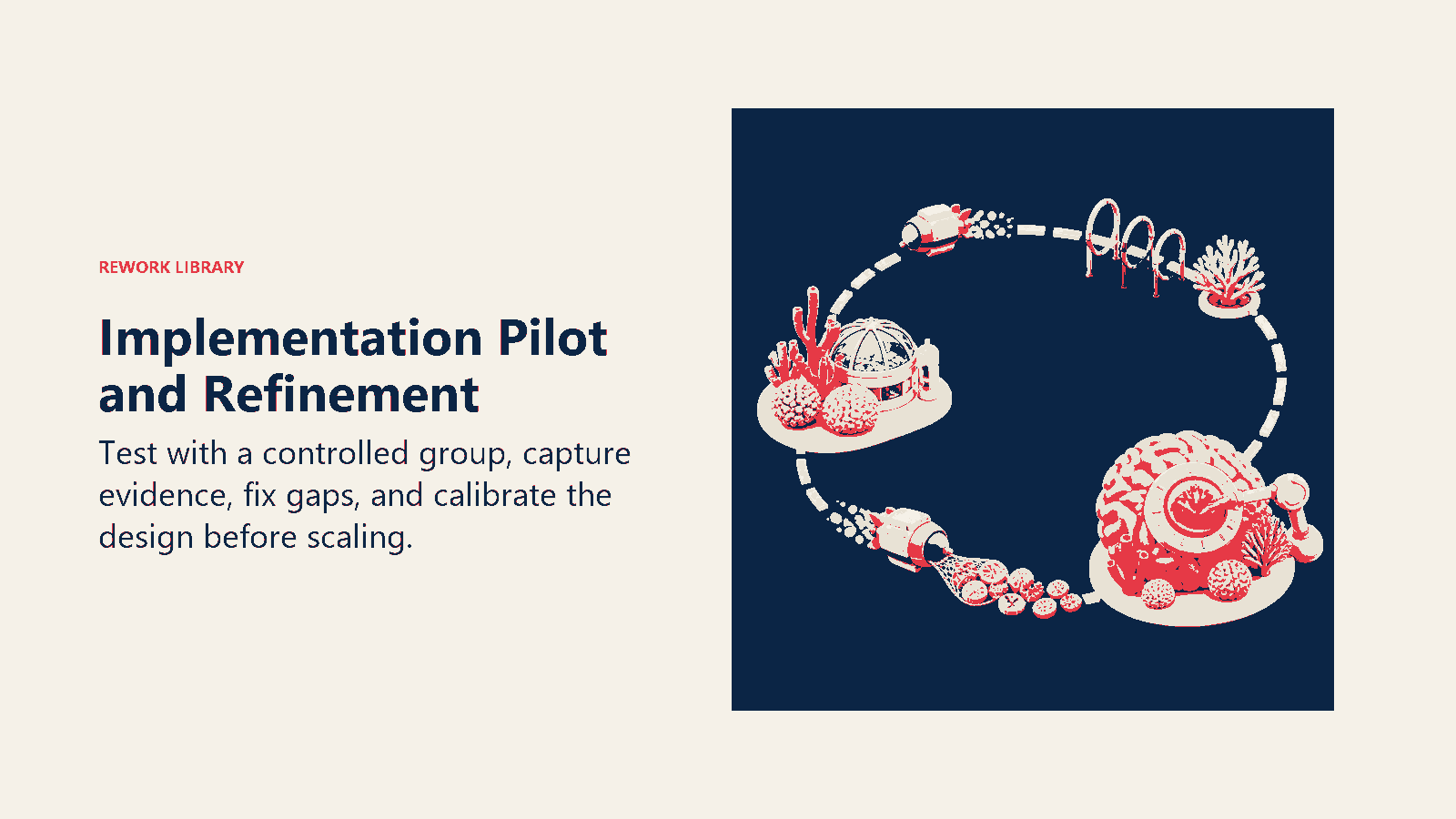
Launch with a defined pilot group - maybe one sales team, one regional office, one product line. Give them the new process, system, or structure and let them work in it for real. Not a training simulation. Actual customer work.
Collect feedback constantly. Daily check-ins the first week, then weekly. Ask specific questions: What's confusing? What's taking longer than it should? What did we miss? What works better than expected?
Watch for workarounds. If users are exporting data to Excel instead of using the new dashboard, your dashboard isn't meeting their needs. If they're skipping steps in the process, those steps are either unclear or unnecessary. Workarounds are signals, not defiance.
Analyze the feedback and prioritize fixes. Some issues require immediate changes - a broken workflow that blocks work. Some are nice-to-haves that can wait. Some reveal fundamental design problems that need rethinking.
Make iterative refinements quickly. If something's broken, fix it this week, not next month. Pilot users are doing you a favor by suffering through version one. Respect that by being responsive.
Track pilot metrics against your success criteria. Are users actually completing tasks faster? Are error rates down? Is customer satisfaction improving? If the data doesn't show progress, the pilot isn't working.
Validate scaling readiness before full rollout. Are there any blockers that only show up at scale? Can your infrastructure handle 10x the users? Do you have enough trainers to roll out to the whole organization?
Document lessons learned while they're fresh. What would you do differently next time? What assumptions were wrong? What surprised you? This becomes the foundation for full rollout.
Phase 4: Full rollout is where adoption happens
Full rollout takes 4-16 weeks depending on organization size and complexity. This is the highest-risk phase because everything is live and everyone is watching. Phased rollout planning determines the sequence. Don't flip the switch for everyone simultaneously unless the implementation is small and simple. Roll out by region, department, or function. This contains risk - if something breaks, it only affects one group.
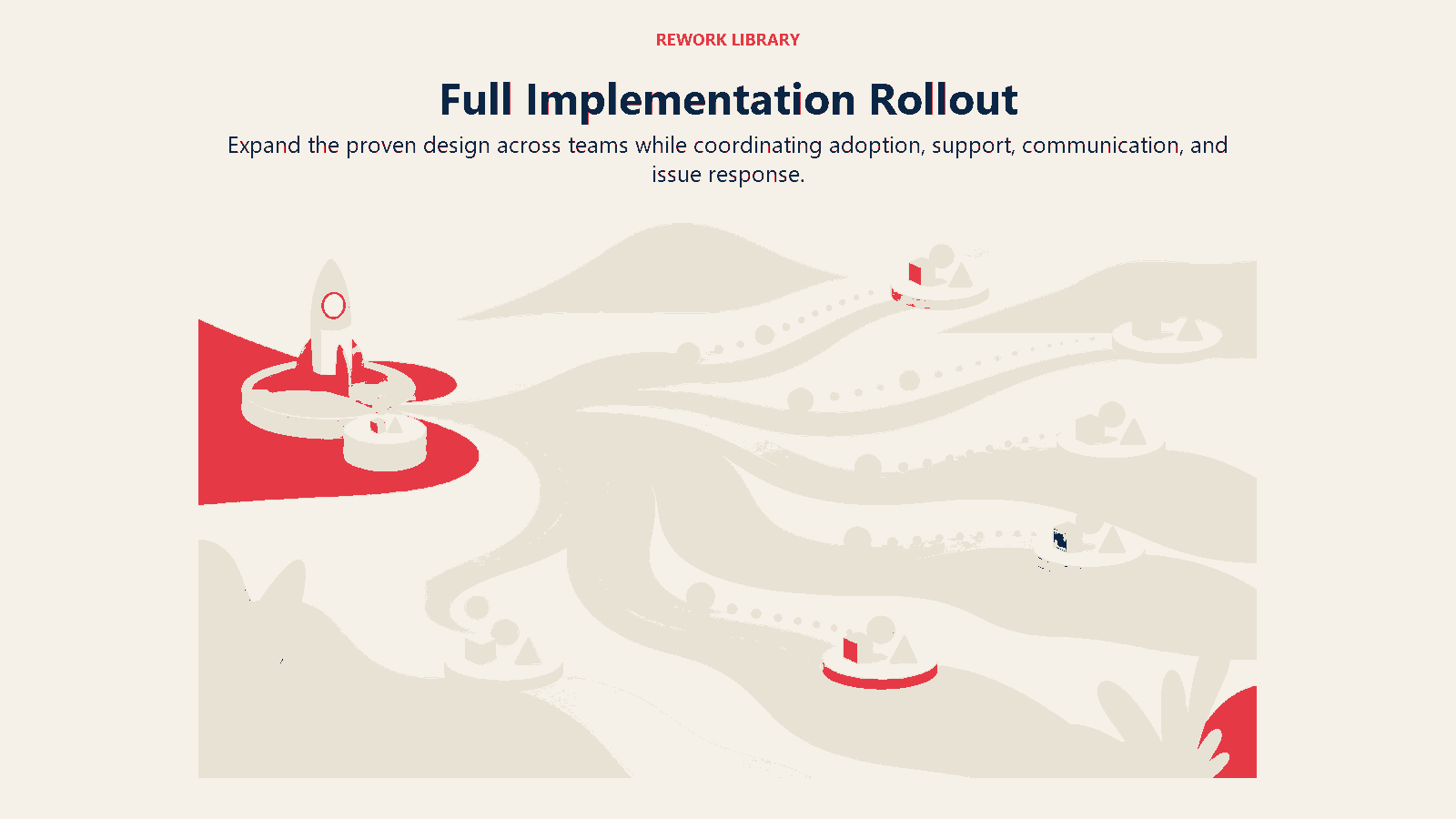
The sequence matters. Start with groups most likely to succeed - good leadership, reasonable workload, openness to change. Early wins build momentum. Avoid starting with the most skeptical or busiest groups.
Communication and change management ramps up significantly. Users need to know what's changing, when it's changing, why it matters, and how to prepare. Not one mass email. A sustained campaign: leadership announcements, team meetings, FAQ sessions, countdown reminders.
Address the "what's in it for me" question explicitly. Don't just say "this new system is better." Explain how it makes their specific job easier, faster, or less frustrating. If it doesn't, be honest about that too.
Training and capability building delivers role-specific instruction. Sales reps need different training than sales managers, who need different training than sales ops. Customize by job function and skill level.
Offer multiple learning formats: live sessions for hands-on practice, recorded videos for reference, written guides for quick lookup, office hours for questions. People learn differently.
Performance monitoring and support tracks how rollout is going in real time. Set up dashboards showing adoption metrics: login rates, task completion rates, time to complete key processes, error rates. If numbers trend wrong, intervene quickly.
Provide robust support during rollout. Dedicated help desk, in-person support staff, rapid response to issues. The first two weeks are critical. If users struggle and can't get help, they'll reject the change. This support cadence should be documented in your client communication cadence.
Issue escalation and resolution needs clear paths. Users report issues, someone triages them, critical issues get fixed immediately, minor issues get queued. You need response time SLAs and someone owning issue resolution.
Stakeholder alignment and buy-in continues throughout rollout. Executives want progress updates. Middle managers want to know how their teams are coping. Keep communication flowing upward and outward.
Celebrate milestones. When each group goes live, acknowledge it. When adoption hits targets, recognize it. Change is hard. Recognition matters.
Phase 5: Sustainment and handoff transfers ownership
This final phase, typically 4-8 weeks, determines whether the change sticks or reverts. You're transitioning from "we're implementing this" to "this is how we work now."
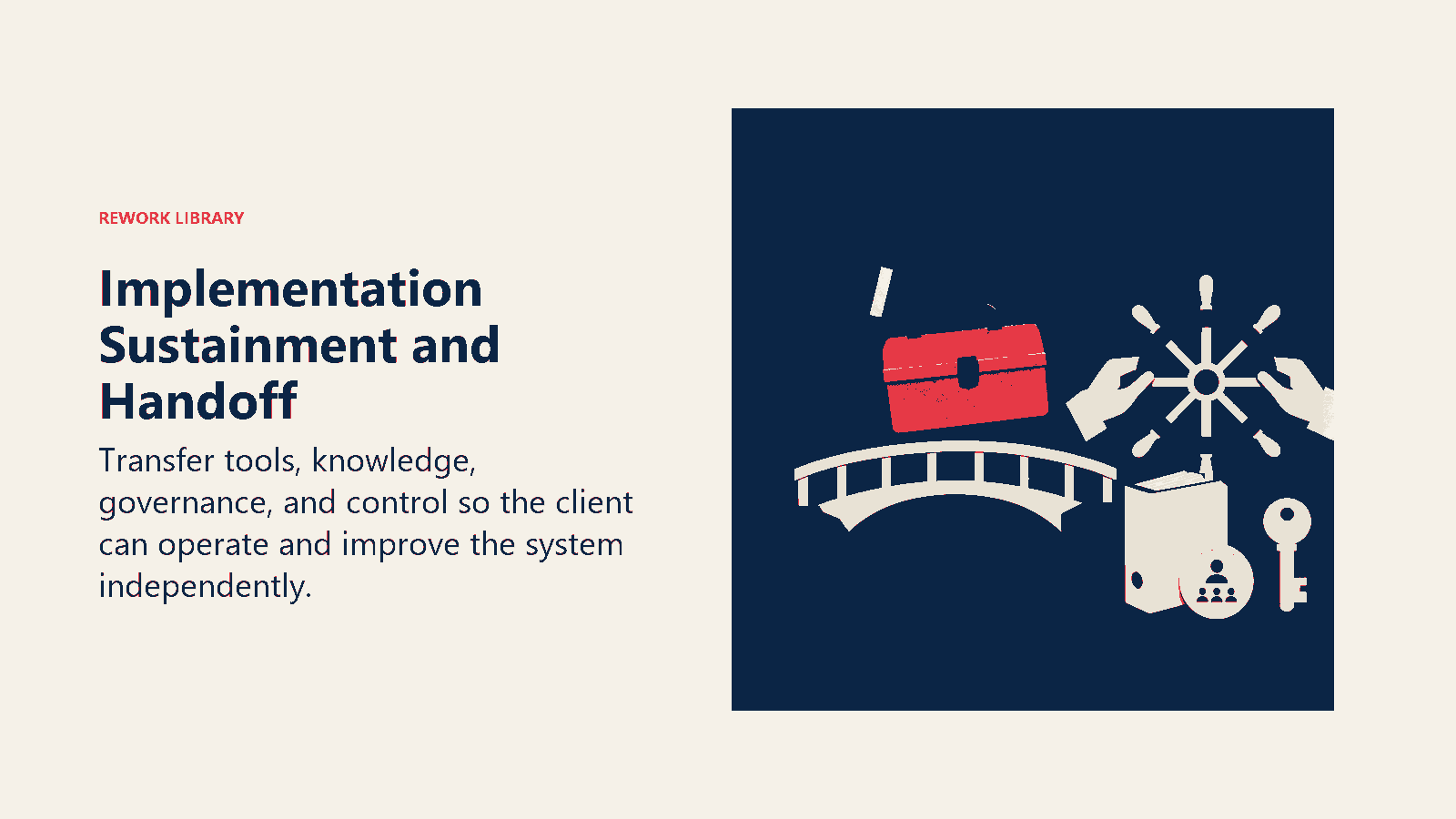
Operational handoff to client team means they take over day-to-day management. They handle user support, monitor performance, make small adjustments, manage ongoing training. You're moving from operator to advisor.
Don't just announce "you're in charge now." Gradually shift responsibilities over several weeks. You handle issues while they watch, then they handle issues while you watch, then they handle issues independently while you check in.
Knowledge transfer and documentation captures everything the client team needs to sustain independently. System architecture documentation, operational procedures, troubleshooting guides, vendor contact information, maintenance schedules.
Include the "why" behind decisions. If they understand why the process is designed a certain way, they can make better decisions when they need to adapt it.
Performance monitoring systems give the client ongoing visibility into how things are working. Dashboards tracking key metrics, automated reports, alert systems for anomalies. Don't make them manually check 10 different places to see if things are on track.
Continuous improvement framework establishes how they'll keep making things better. Monthly review meetings, quarterly process audits, user feedback mechanisms, prioritization criteria for enhancement requests.
Without this, organizations tend to either never change anything (because they're afraid of breaking it) or change everything constantly (because everyone has opinions). Give them a structured way to evolve.
Support model and escalation paths define what happens when they hit issues they can't solve. Maybe you provide ongoing support through a retainer. Maybe you transition them to the software vendor. Maybe you train an internal center of excellence to handle it.
Be explicit about what's included and what's not. "We'll respond to questions about process design within 2 business days. We don't provide technical support for the software - that goes to the vendor." Clear scope definition prevents misunderstandings about support responsibilities.
Success measurement and reporting validates that outcomes are being achieved. Remember those success metrics you defined in phase 1? Now you prove whether you hit them. Are win rates up? Are costs down? Are cycle times shorter?
Package this in a closeout report that tells the full story: what you implemented, how adoption went, what results were achieved, what lessons were learned. This becomes the case study for your next implementation sale.
Change management isn't optional
Here's what separates successful implementations from failed ones: change management. The technology might work perfectly. The process might be brilliant. But if people don't adopt it, you've failed. Stakeholder engagement and communication starts before kickoff and continues through sustainment. Identify everyone affected by the change - not just users, but adjacent teams, managers, executives. What do they care about? What are their concerns? How do you bring them along?
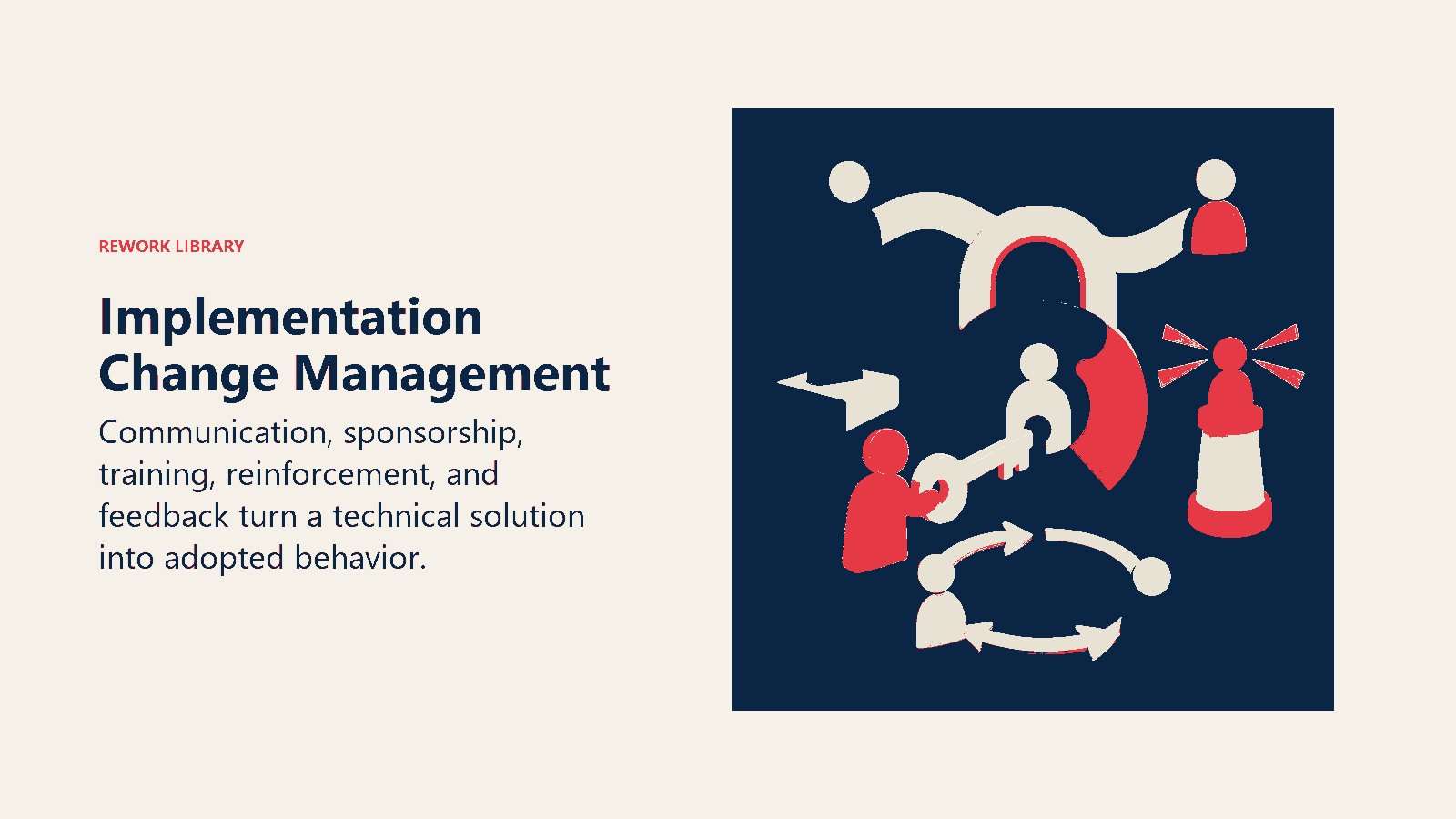
Different stakeholders need different messages. Executives want business outcomes and risk mitigation. Managers want operational impact and resource requirements. Users want to know how their daily work changes and whether they'll still have jobs.
Create a communication plan with the right frequency and channels. Weekly email updates are noise. Monthly town halls might be too infrequent. Find the rhythm that keeps people informed without overwhelming them.
Resistance identification and mitigation means finding the sources of resistance and addressing them. Resistance is usually rational, even when it looks emotional. People resist because they're worried about:
- Job security - will I still be needed?
- Competence - will I be able to do this?
- Workload - is this more work on top of my existing work?
- Change fatigue - didn't we just implement something else last quarter?
Don't dismiss these concerns. Address them directly. If the change does mean some roles are eliminated, be honest about that and provide transition support. If it does create temporary workload increases, acknowledge it and set realistic expectations.
Adoption tracking and acceleration monitors who's actually using the new process or system. Track adoption metrics by team, role, and individual. If a whole team isn't adopting, their manager probably isn't supportive. If specific individuals aren't adopting, they might need extra training or have valid issues.
Use data to drive intervention. When adoption lags, don't send another mass email. Send targeted support to the specific people or teams struggling.
Culture and behavior change happens when the new way of working becomes "how we do things here." This takes 6-12 months minimum. You're not trying to change culture during the implementation. You're trying to make behavior changes that might eventually shift culture.
Reinforce new behaviors through recognition, incentives, and consequences. If the new process requires collaboration but your incentive system rewards individual performance, behavior won't change.
Leadership alignment and sponsorship is non-negotiable. If executives say "this change is important" and then keep asking for reports in the old format, nobody believes the change matters.
Coach executives on visible sponsorship: attending kickoff meetings, asking about adoption in staff meetings, using the new system themselves, celebrating teams that adopt well.
Celebration and recognition programs mark progress and success. When teams hit adoption targets, recognize them. When individuals go above and beyond helping others learn, call it out. When milestones are reached, celebrate as an organization.
This stuff feels soft. It's not. It's the difference between implementations that stick and implementations that become shelfware.
Project management discipline keeps it on track
Implementation consulting is project management under pressure with ambiguous requirements and changing stakeholders. You need structure. Detailed project plans and schedules map every task, dependency, duration, and resource. Use proper project management tools - not Excel spreadsheets. Gantt charts, critical path analysis, resource loading. The whole toolkit.
But don't make the plan so detailed that updating it takes all your time. Weekly updates are sufficient for most implementations.
Resource management and allocation tracks who's doing what when. You're managing your consultants, the client's team members, vendor resources, subject matter experts. Everyone has competing priorities.
Hold weekly resource planning meetings. What's happening this week? Who's working on what? Where are the bottlenecks? What got delayed? Adjust in real time.
Risk and issue management tracks problems and potential problems. Maintain a risk register: what could go wrong, how likely is it, what's the impact, what's the mitigation plan. Review it weekly in project meetings.
Issues are risks that happened. Track them separately: what's broken, who owns fixing it, what's the deadline, what's the impact if we don't fix it. Don't let issues fester.
Budget tracking and financial control monitors spending against the plan. Implementation costs creep. Scope expands. Resources get added. Travel increases. Track actual costs weekly and project forecast costs monthly.
If you're trending over budget, you need to know early enough to do something about it: reduce scope, request a change order, reallocate resources. Surprises at project end are unacceptable.
Quality assurance processes ensure deliverables meet standards. Every deliverable should have acceptance criteria and a review process. Don't just assume your team's work is good. Check it.
Peer review is powerful. Have someone else on your team review before the client sees it. Fresh eyes catch mistakes and gaps.
Stakeholder reporting cadence keeps everyone informed. Weekly working team updates, biweekly steering committee meetings, monthly executive summaries. Different audiences need different levels of detail.
Make reports visual: status dashboards, milestone trackers, issue heat maps. Nobody reads 10 pages of status narrative.
Building client capability so they can sustain
A successful implementation isn't just delivering the solution. It's making the client capable of running it after you leave.
Skills assessment and gap identification maps what capabilities the client needs versus what they have. If they're implementing a new analytics platform, do they have people who can build reports? Interpret data? Maintain data quality?
Be specific. Don't just say "they need data skills." They need SQL querying, dashboard design, statistical analysis, and data governance. Those are different skills.
Training program design and delivery builds those capabilities. Not one-size-fits-all training. Tiered programs: basic training for all users, advanced training for power users, admin training for system managers.
Include hands-on practice, not just lecture. People learn by doing, not by watching someone click through a demo.
Coaching and mentoring approaches provide ongoing support as people build skills. Your consultant works alongside the client's analyst for a month, coaching them through real work. That's more valuable than any training session.
Consider train-the-trainer programs where you develop internal experts who can then train others. This scales your impact.
Knowledge transfer methodologies capture and share expertise. Documentation matters, but don't just dump 100-page manuals. Create searchable knowledge bases, video libraries, worked examples, templates.
Run knowledge transfer workshops where your team shares lessons learned, best practices, and pitfalls to avoid.
Building internal capability for sustainment means leaving them with people who can handle ongoing operations, enhancements, and troubleshooting. If you built a custom integration, train someone on their team to maintain it.
Creating centers of excellence establishes an internal team that becomes expert in the new capability. Maybe it's a Salesforce COE that handles all CRM enhancements. Maybe it's an agile coaching team that spreads agile practices.
The COE becomes the long-term owner of the capability you implemented. Invest in making them successful.
Common pitfalls that derail implementations
Most implementations that fail do so for predictable reasons. Avoid these: Insufficient planning and rushing to execution happens when clients want to "just start building" without thinking through requirements. You end up rebuilding things multiple times as you discover what you really need.
The pressure to show progress is real, but resist it. Two weeks of solid planning saves two months of rework.
Underestimating change management needs is the classic mistake. "We'll just train people and it'll be fine." No. People need communication, explanation, support, reinforcement. Budget 30-40% of your project effort for change management.
Poor stakeholder engagement and communication means you're not bringing people along. They find out about changes at the last minute. They don't understand why things are changing. They feel like things are being done to them, not with them.
Over-communicate. It's almost impossible to communicate too much during an implementation.
Inadequate resource allocation happens when the client commits people who don't actually have time. "Sarah will be your project lead" but Sarah is also leading three other projects and can only give you 5 hours a week.
Be realistic about resource requirements and get written commitment from leadership.
Skipping pilot phase because "we don't have time to pilot." You're gambling that your design is perfect. It's not. Better to find issues with 50 users than 5,000.
Even a mini-pilot of 2 weeks beats no pilot.
Weak knowledge transfer and handoff leaves the client dependent on you forever. They can't make changes, fix issues, or train new users without calling you. That's not implementation success - it's creating annuity revenue, but the client will resent it.
Do proper handoff. Make them self-sufficient.
Tools and frameworks that support implementation work
You don't need fancy proprietary methodologies, but you do need structure.
Implementation roadmap templates provide visual timelines that communicate the journey. Phases, milestones, key decisions, deliverables. Make it simple enough that non-project managers can understand it at a glance.
Project management frameworks give you process structure. You can use agile, waterfall, or hybrid approaches:
- Agile works for implementations with evolving requirements and frequent client interaction. Two-week sprints, daily standups, iterative delivery.
- Waterfall works for implementations with fixed requirements and dependencies that must be sequential. Clear phases, gate reviews, formal handoffs.
- Hybrid combines both: waterfall for the overall structure, agile within phases for execution flexibility.
Pick based on the engagement, not ideology.
Change management models provide frameworks for the human side. ADKAR (Awareness, Desire, Knowledge, Ability, Reinforcement) breaks change into stages. Kotter's 8-step model emphasizes leadership and momentum. Pick one and follow it.
Risk and issue tracking tools keep problems visible. Simple registers work: risk description, likelihood, impact, owner, mitigation plan, status. Review weekly, update as things change.
Training and capability assessment frameworks help measure skill development. Pre-training assessments establish baseline. Post-training assessments measure learning. On-the-job assessments measure application.
Track not just "did they complete the training" but "can they perform the task independently."
Where this leads
Implementation consulting is where strategy becomes operational. It's harder, messier, and longer than strategy work, but it's also where you prove whether consulting delivers value or just delivers PowerPoint.
The best implementation consultants balance technical skills with change management savvy. They can configure a system and coach a reluctant manager. They can read a project plan and read a room. They know when to push forward and when to slow down.
For firms building implementation practices, it creates stickier client relationships. Strategy projects end, but implementation projects often lead to sustainment work, enhancement projects, and implementations of adjacent capabilities. You become embedded in how the client operates.
Related capabilities that complement implementation work:
- Strategy Consulting Process - creates the plans you implement
- Project Management Methodology - provides the structure for execution
- Client Onboarding Process - sets up implementations for success
- Workshop Facilitation - engages stakeholders throughout implementation
- Project Closeout - completes handoff and captures lessons
Implementation isn't glamorous. There are no TED talks about "10 tips for better user acceptance testing." But it's essential. Strategy without execution is just expensive advice. Implementation is where change actually happens.

Sales Director
On this page
- What implementation consulting actually means
- Engagement models that work
- Phase 1: Implementation planning gets everyone aligned
- Phase 2: Design and build creates the foundation
- Phase 3: Pilot and refinement tests reality
- Phase 4: Full rollout is where adoption happens
- Phase 5: Sustainment and handoff transfers ownership
- Change management isn't optional
- Project management discipline keeps it on track
- Building client capability so they can sustain
- Common pitfalls that derail implementations
- Tools and frameworks that support implementation work
- Where this leads