Diagnostic & Assessment Services: Identifying Problems and Opportunities for Client Growth
Turn this article into takeaways for your work.


Each assistant summarizes the article only for you and suggests best practices for your work.
A diagnostic assessment is a structured evaluation that identifies a client's problems and opportunities in a specific area, then delivers a prioritized roadmap to fix them. It's a consulting firm's strongest entry point: short (2 to 6 weeks), high-margin, and it converts to implementation work about 70% of the time.
Here's the consulting playbook nobody tells you - diagnostic assessments are your best sales tool. Not whitepapers. Not thought leadership. Not clever positioning. A well-executed assessment that shows clients exactly what's broken and how to fix it converts to implementation work 70% of the time. These assessments are a powerful component of consultative business development.
The economics are compelling too. Assessments typically run 55-70% margins with shorter duration (2-6 weeks), making them efficient revenue generators. But their real value is as entry points. Clients who won't commit to a six-month transformation project will say yes to a focused assessment. Then you demonstrate value, build trust, and naturally transition into the bigger engagement.
This guide shows you how to structure diagnostic assessments that deliver genuine insight while positioning your firm for follow-on work. We'll cover scoping, data collection, analysis frameworks, and the art of converting assessments into implementation engagements.
What makes a diagnostic assessment valuable?
A diagnostic assessment is a structured evaluation designed to identify problems and opportunities within a specific area of a client's business. You're not implementing solutions yet - you're diagnosing what needs to be fixed and creating a prioritized roadmap. The client value proposition is straightforward: they get an objective outside perspective, benchmarking against best practices, and a prioritized list of improvements with estimated impact. For organizations that know something's wrong but can't pinpoint exactly what, this is gold.
But here's what separates useful assessments from expensive reports that sit on shelves - actionability. Your findings must be specific enough that someone could actually implement them. "Improve operational efficiency" is useless. "Consolidate the three separate order entry processes into a single workflow, eliminating 2.5 hours of duplicate data entry per order" is actionable.
The best assessments balance current state analysis with future opportunity identification. You're showing clients both what's costing them money today and what they're leaving on the table tomorrow.
Common types of diagnostic assessments
Different business problems require different assessment approaches. Here are the most common types: Operational assessments examine how work gets done. You're looking at process efficiency, identifying bottlenecks, finding waste, and evaluating quality issues. Manufacturing operations, service delivery processes, supply chain flows - anywhere work moves through stages. Financial assessments dig into profitability, cost structures, working capital management, and pricing effectiveness. These often uncover margin leakage, inefficient capital deployment, or pricing that doesn't reflect value delivered.
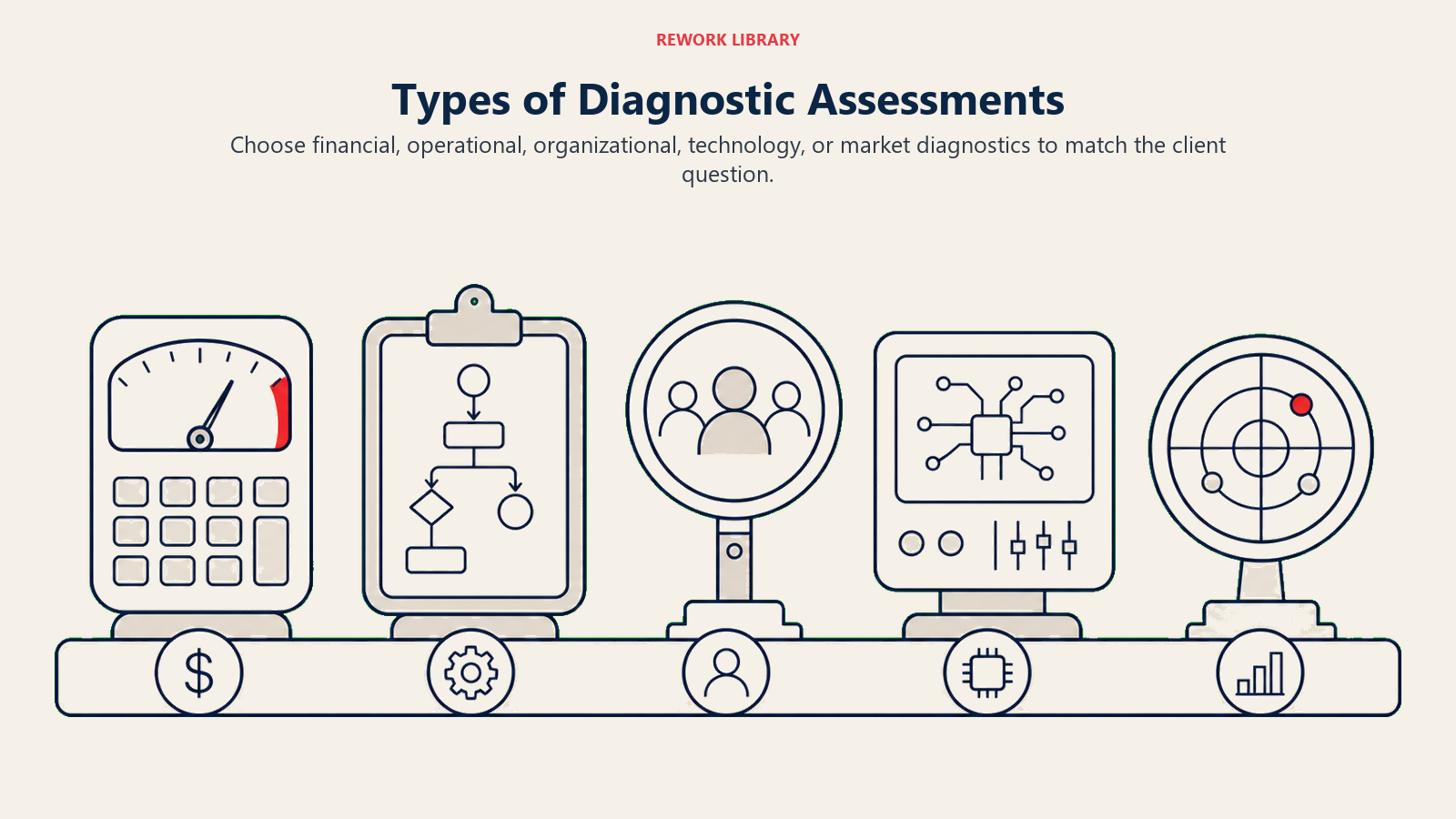
Technology assessments evaluate the systems landscape, technical debt, capability gaps, and security posture. You're answering whether their technology supports or hinders business objectives, and what needs to change.
Organizational assessments look at structure, roles, capabilities, culture, and performance management. Is the org chart aligned with strategy? Do people have the skills needed? Are there clear accountabilities?
Market assessments examine competitive positioning, customer needs, market trends, and growth opportunities. Where should the company play? How should they compete? What segments offer the best prospects?
Go-to-market assessments focus on sales effectiveness, marketing ROI, channel performance, and customer acquisition economics. How efficiently are they generating and converting demand?
Most assessments blend several of these dimensions. An operational assessment might uncover organizational issues. A market assessment often reveals go-to-market problems. Start with the primary focus but be ready to follow where the data leads.
Assessment scoping and design
Scope definition makes or breaks your assessment. Too narrow and you miss root causes. Too broad and you deliver superficial findings within budget constraints. Start by defining clear assessment objectives. What specific questions are you answering? "Why are our projects consistently over budget?" is better than "Assess our project management." Specific questions drive focused data collection and analysis.
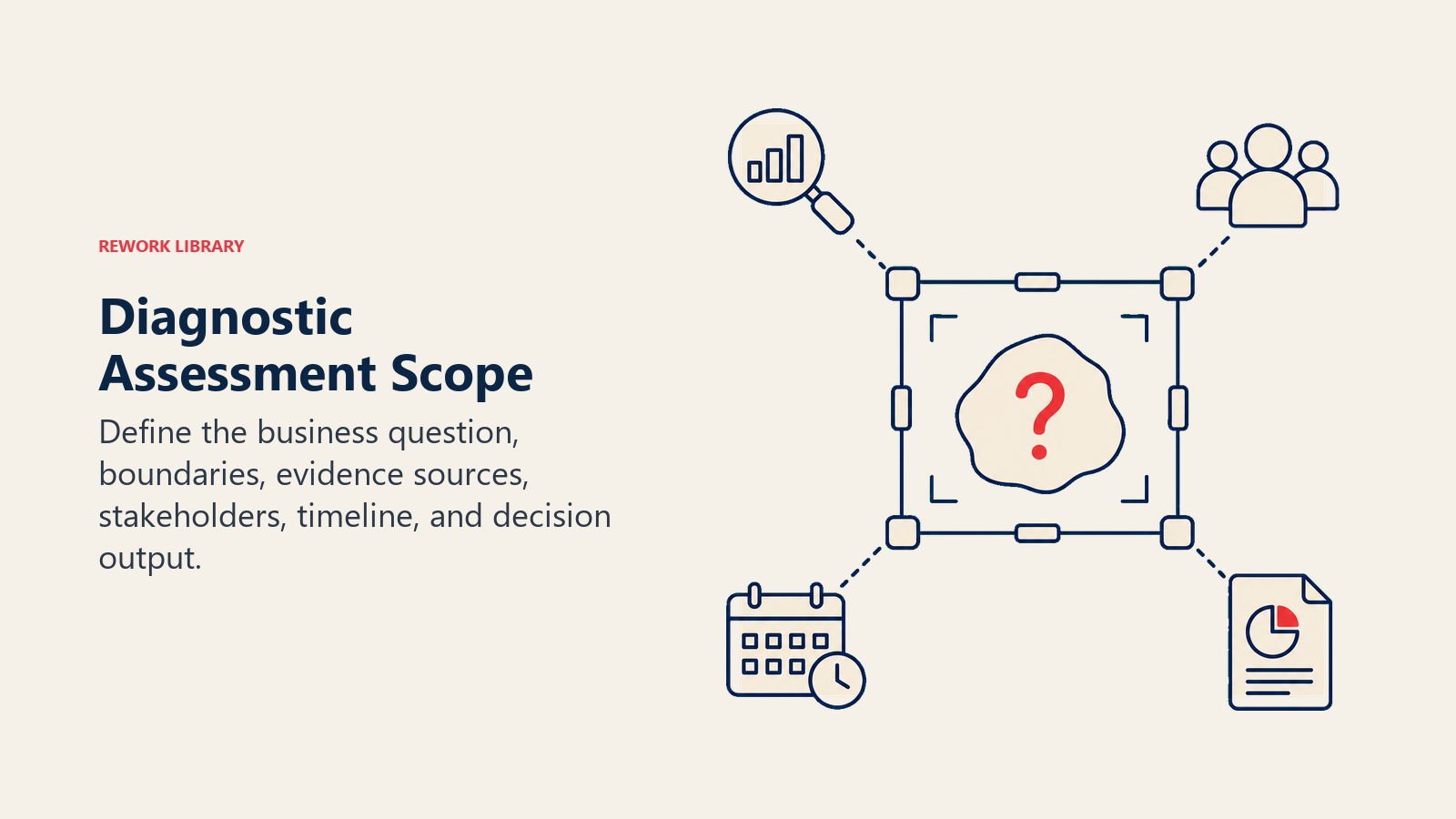
Establish scope boundaries explicitly. Which departments, processes, geographies, or systems are in scope? Which are out? If you're assessing sales effectiveness, are you looking at just the direct sales team or also channel partners? Just North America or globally? This scope definition process is similar to creating a formal scope definition and SOW.
Identify your data sources and collection methods upfront. What documents will you review? Who needs to be interviewed? What systems need analysis? Building this into your scope prevents surprises later.
Create a stakeholder interview plan that balances perspectives. You need input from leadership (strategic context), management (operational detail), and front-line staff (reality of how work actually happens). Each level sees different things.
Define success criteria and deliverables precisely. What will the client receive? An executive presentation? A detailed written report? Implementation roadmap? Prioritization matrix? Data analysis? Be explicit so expectations align.
Timeline and resource requirements flow from scope. A focused operational assessment of one department might take 2-3 weeks. A comprehensive organizational assessment across a multi-divisional company could take 8-10 weeks. Build in time for data collection, analysis, and stakeholder review.
Data collection methods that uncover truth
The quality of your assessment depends entirely on the quality of your data. Garbage in, garbage out. Here's how to collect information that reveals actual problems instead of surface symptoms. Document and data review gives you the official story. Financial statements, operational reports, strategic plans, organizational charts, process documentation, system architecture diagrams. Review these first to understand what management thinks is happening. But documents only tell part of the story. A process map might show a clean workflow while reality involves five workarounds and three spreadsheets nobody documented.
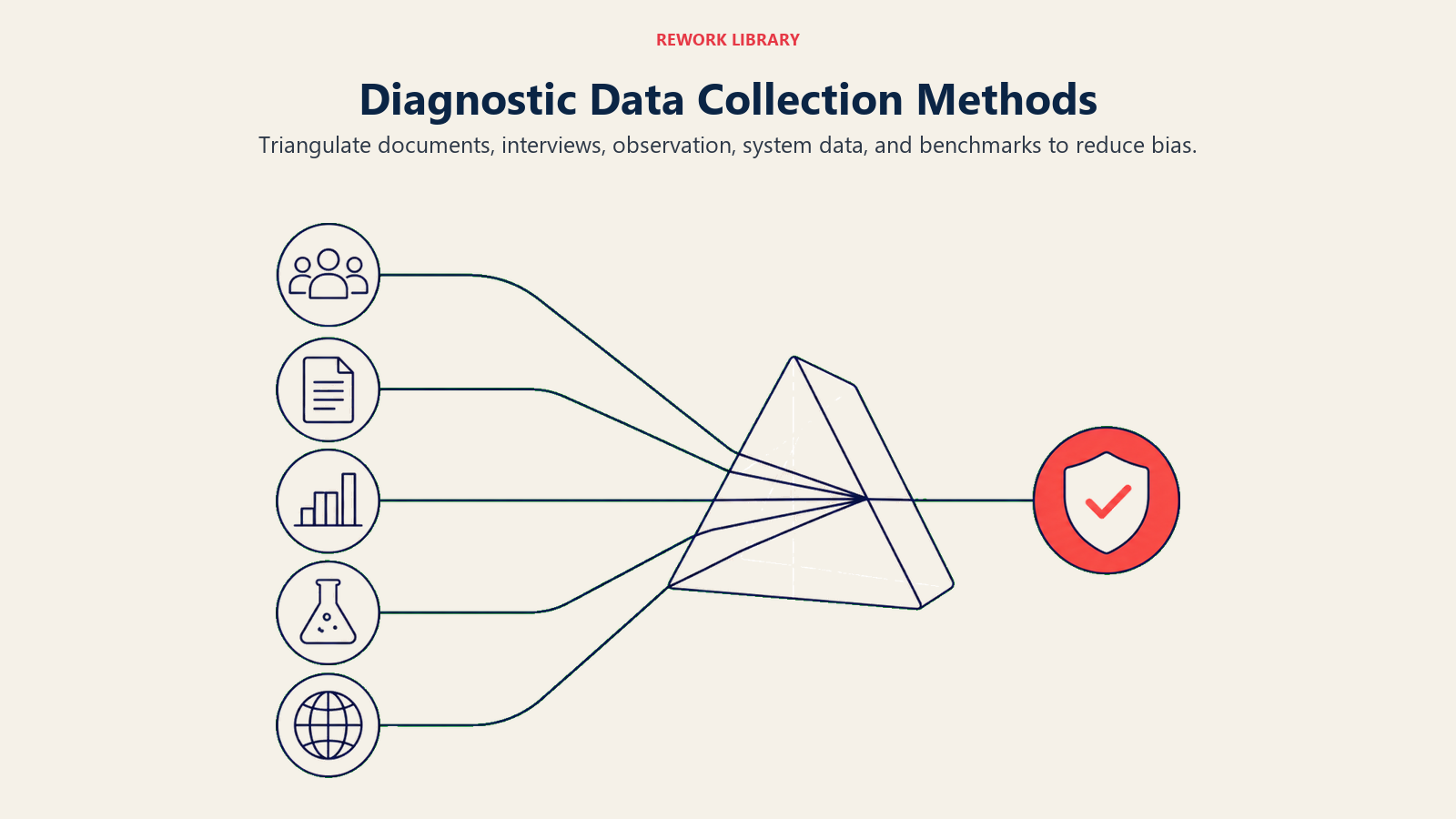
Stakeholder interviews reveal what's really going on. Structure interviews to balance breadth and depth. Leadership interviews focus on strategy, priorities, and constraints. Management interviews dig into operational challenges and resource issues. Front-line interviews uncover the daily reality of broken processes and systemic problems.
Ask open-ended questions that invite honesty: "What makes your job harder than it should be?" "If you could fix one thing, what would it be?" "Where do things consistently break down?" People know where the problems are - they just need permission to say it.
Process observation and shadowing shows you reality unfiltered. Spend time watching work happen. Sit with customer service reps taking calls. Watch orders move through fulfillment. Observe how meetings run. The gap between documented processes and actual practice is often massive.
Surveys and quantitative assessment provide scale and statistical validity to qualitative insights. If three managers mention communication problems in interviews, a survey confirming 68% of employees agree validates the finding across the organization.
Benchmarking and industry comparison provides context. Is this problem unique to them or industry-wide? Are their metrics better or worse than peers? External data prevents you from recommending solutions for problems that don't actually matter. Understanding professional services metrics helps you contextualize these benchmarks.
System and technology evaluation requires looking at actual tools, not just documentation. Log into their systems. Review database structures. Check integration points. Technical debt and capability gaps become obvious quickly when you see what users actually deal with.
The best assessments triangulate findings from multiple sources. If documents, interviews, and observation all point to the same bottleneck, you've found something real.
Analysis frameworks by assessment type
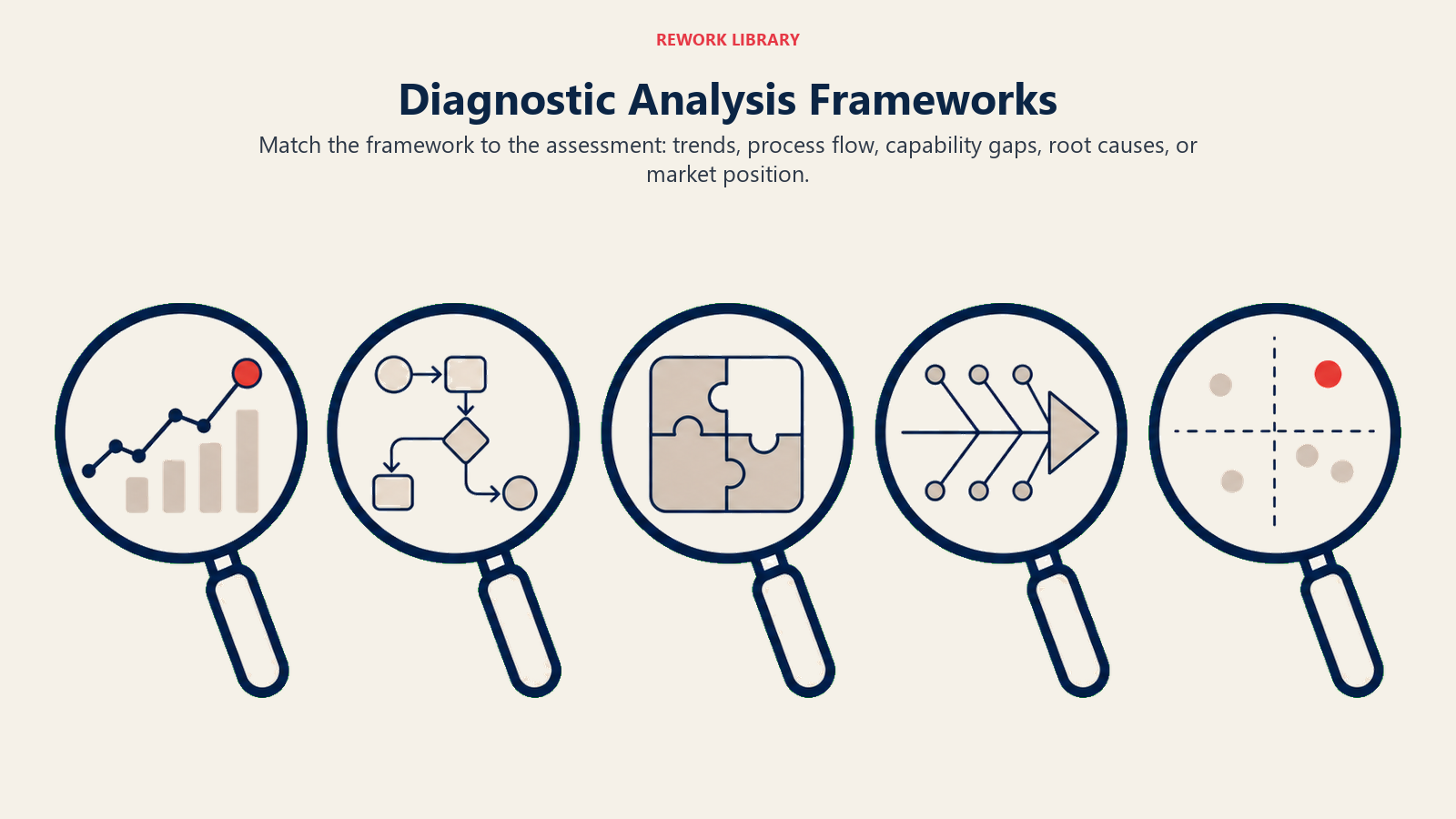
Different assessment types require different analytical lenses. Here's how to structure analysis for each major category.
Operational assessment frameworks
Focus on process efficiency and effectiveness. Map current state workflows end-to-end, then identify:
- Bottlenecks: Where does work queue up or slow down?
- Waste: What steps add no value? (Duplicate data entry, unnecessary approvals, rework)
- Quality issues: Where do errors occur? What causes them?
- Cycle time: How long does each process take? Where's the time going?
- Resource utilization: Are people spending time on the right activities?
Value stream mapping works well here. Track how much time is actual value-adding work versus waiting, moving, inspecting, or reworking.
Financial assessment frameworks
Analyze profitability at multiple levels - company, business unit, product line, customer segment. Look for:
- Margin leakage: Where are costs higher than necessary or revenue lower than it should be?
- Cost structure: Are costs fixed or variable? How does that affect operational leverage?
- Working capital: Is cash tied up unnecessarily in inventory or receivables?
- Pricing effectiveness: Are prices aligned with value delivered? Are discounting patterns destroying margin?
Build waterfall charts showing how gross revenue flows through various cost categories to net profit. Visual representations make problems obvious.
Technology assessment frameworks
Evaluate both technical and business dimensions. Assess:
- Systems landscape: What tools exist? How are they integrated (or not)?
- Technical debt: What's outdated, unsupported, or poorly implemented?
- Capability gaps: What business needs can't current systems support?
- Security and compliance: What risks exist? Are controls adequate?
- Total cost of ownership: What's the real cost including maintenance, support, and workarounds?
Technology assessments must connect technical issues to business impact. "This system is old" doesn't matter. "This system limitation forces manual workarounds that cost 40 hours per week" matters.
Organizational assessment frameworks
Examine structure, capabilities, and culture. Analyze:
- Organization design: Is structure aligned with strategy? Are reporting lines logical?
- Roles and accountabilities: Are responsibilities clear? Any gaps or overlaps?
- Capabilities: Do people have skills needed for current and future needs?
- Performance management: How is performance measured, evaluated, and rewarded?
- Culture and engagement: What behaviors are encouraged or discouraged?
Use span of control analysis, RACI matrices, and skills gap assessments. Survey data on engagement and culture provides quantitative backing to qualitative observations.
Market assessment frameworks
Evaluate positioning and opportunities. Examine:
- Market segmentation: Who are the customers? How are needs different?
- Competitive positioning: Where does the company win or lose? Against whom?
- Customer needs analysis: What problems are customers trying to solve? How well are current solutions working?
- Market trends: What's changing? What new opportunities or threats are emerging?
- Growth potential: Where are the best opportunities for expansion?
Porter's Five Forces, competitor analysis matrices, and customer journey mapping help structure market assessments.
Go-to-market assessment frameworks
Focus on demand generation and conversion. Analyze:
- Sales effectiveness: Win rates by segment, deal size, sales cycle length
- Marketing ROI: Cost per lead, conversion rates by channel, customer acquisition cost
- Channel performance: Which channels work best for which segments?
- Sales process: Where do deals stall or die? What objections come up repeatedly?
- Customer acquisition economics: What does it cost to acquire customers? How long to payback?
Funnel analysis showing conversion rates at each stage reveals exactly where go-to-market breaks down.
Diagnostic analysis and insights
Raw data doesn't help clients. Your job is turning data into insights that drive decisions.
Start with pattern identification. What themes emerge across different data sources? If five different people mention slow approvals, and process observation confirms decisions wait days for sign-off, that's a pattern worth highlighting.
Root cause analysis separates symptoms from underlying problems. Sales are declining - that's the symptom. The root cause might be product-market fit erosion, sales team capability gaps, or channel conflict. You need to dig until you find the fixable cause.
Benchmarking provides context for whether problems are truly problems. If client operational efficiency is at the 30th percentile of industry peers, improvement potential is clear. If they're at the 70th percentile, the problem might be somewhere else.
Gap analysis between current state and desired state quantifies the improvement opportunity. They process 50 orders per day with 3 FTE. Best-in-class handles 80 orders per day with 2.5 FTE. That gap represents either cost savings or capacity for growth.
Quick win identification matters because early momentum builds support for larger changes. Can you deliver meaningful improvement in 30-60 days? Those quick wins prove your recommendations work and justify further investment.
Strategic opportunity assessment looks beyond fixing problems to identifying upside. Maybe the broken process revealed that customers want something the client isn't offering. Maybe operational inefficiency masked a scalability problem that, once fixed, enables growth.
Your analysis should answer three questions: What's broken? What's the business impact? What happens if we fix it?
Developing actionable recommendations
Recommendations are where consultants earn their fees. This is the "so what?" that turns observations into value. Prioritize improvement opportunities along two dimensions: business impact and implementation complexity. High impact, low complexity initiatives are no-brainers. High impact, high complexity require careful planning and resource commitment. Low impact items, regardless of complexity, go to the bottom of the list. For each recommendation, provide implementation complexity and effort estimates. "Consolidate vendor base" sounds simple until you realize it requires renegotiating 30 contracts, migrating systems, and retraining staff. Be honest about what's involved.
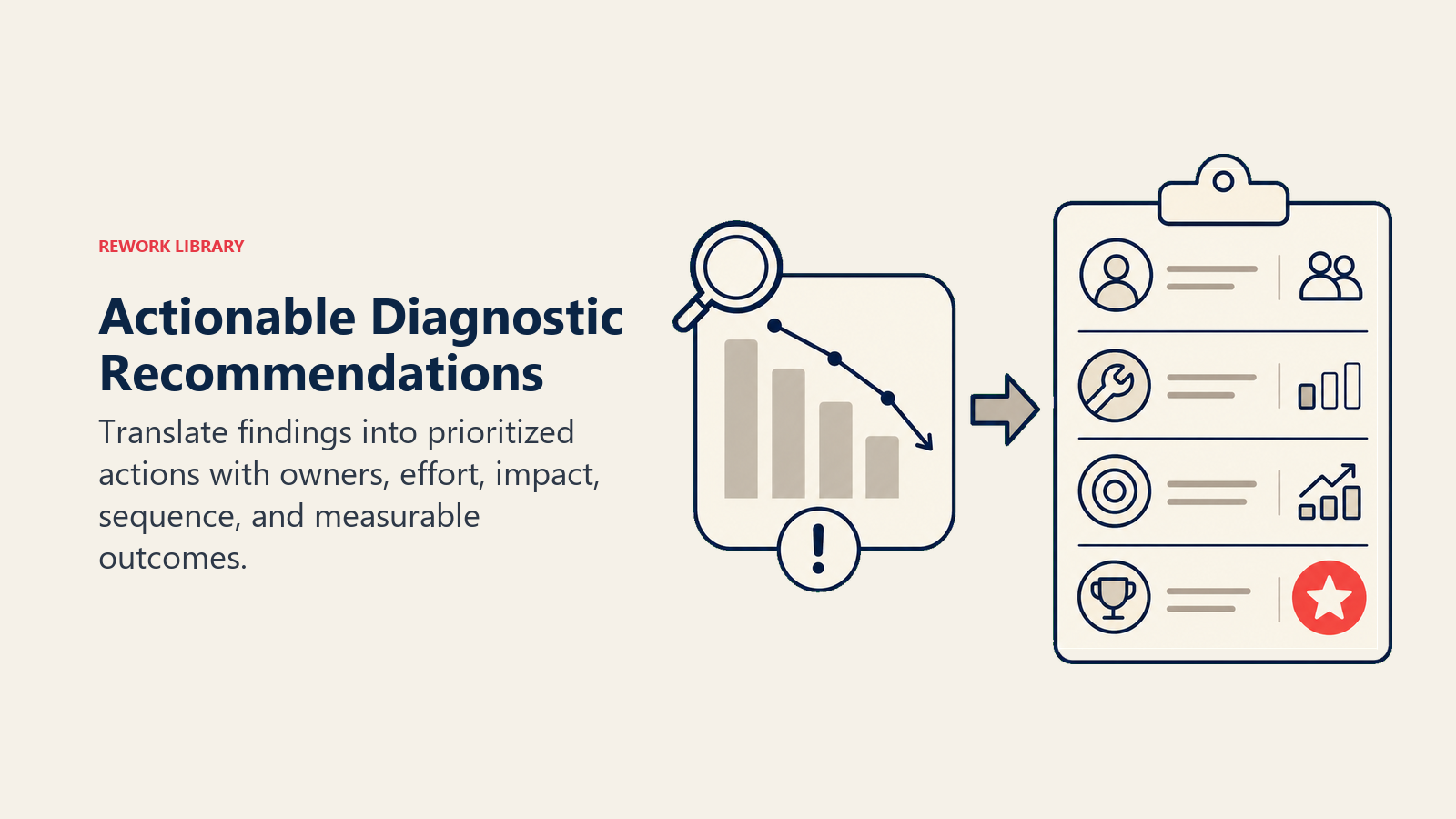
Quantify expected business impact and ROI wherever possible. "This will improve efficiency" is weak. "This will reduce order processing time from 45 minutes to 20 minutes, freeing 5 FTE hours daily, equivalent to $125K annually" gives leadership something concrete to evaluate.
Include risk assessment and mitigation. Every change involves risk. Maybe process consolidation creates a single point of failure. Maybe system upgrades disrupt operations during implementation. Acknowledge risks and explain mitigation approaches.
Recommend a phased approach with logical sequencing. Some improvements must happen before others. You can't optimize a process before you standardize it. Build recommendations into a logical sequence that manages risk and builds momentum.
Estimate resource requirements realistically. What internal team commitment is needed? Will they need external support? What budget allocation makes sense? Leaders need this to decide if they can actually execute.
The best recommendation format includes:
- What: Specific action to take
- Why: Business problem it solves and impact achieved
- How: High-level implementation approach
- When: Proposed timeline and sequencing
- Who: Resource requirements and ownership
- Risks: What could go wrong and mitigation
Assessment deliverables that drive action
The format and structure of your deliverables matter almost as much as the content. An insight buried in page 47 of a dense report won't drive change. Your current state assessment summary should be crisp and visual. Use process maps, org charts, data visualizations, and system diagrams. Leaders should grasp the situation in minutes, not hours. Key findings and insights need to be prioritized and quantified. Don't list 47 findings of varying importance. Focus on the 5-8 findings that really matter, with clear explanations of business impact.
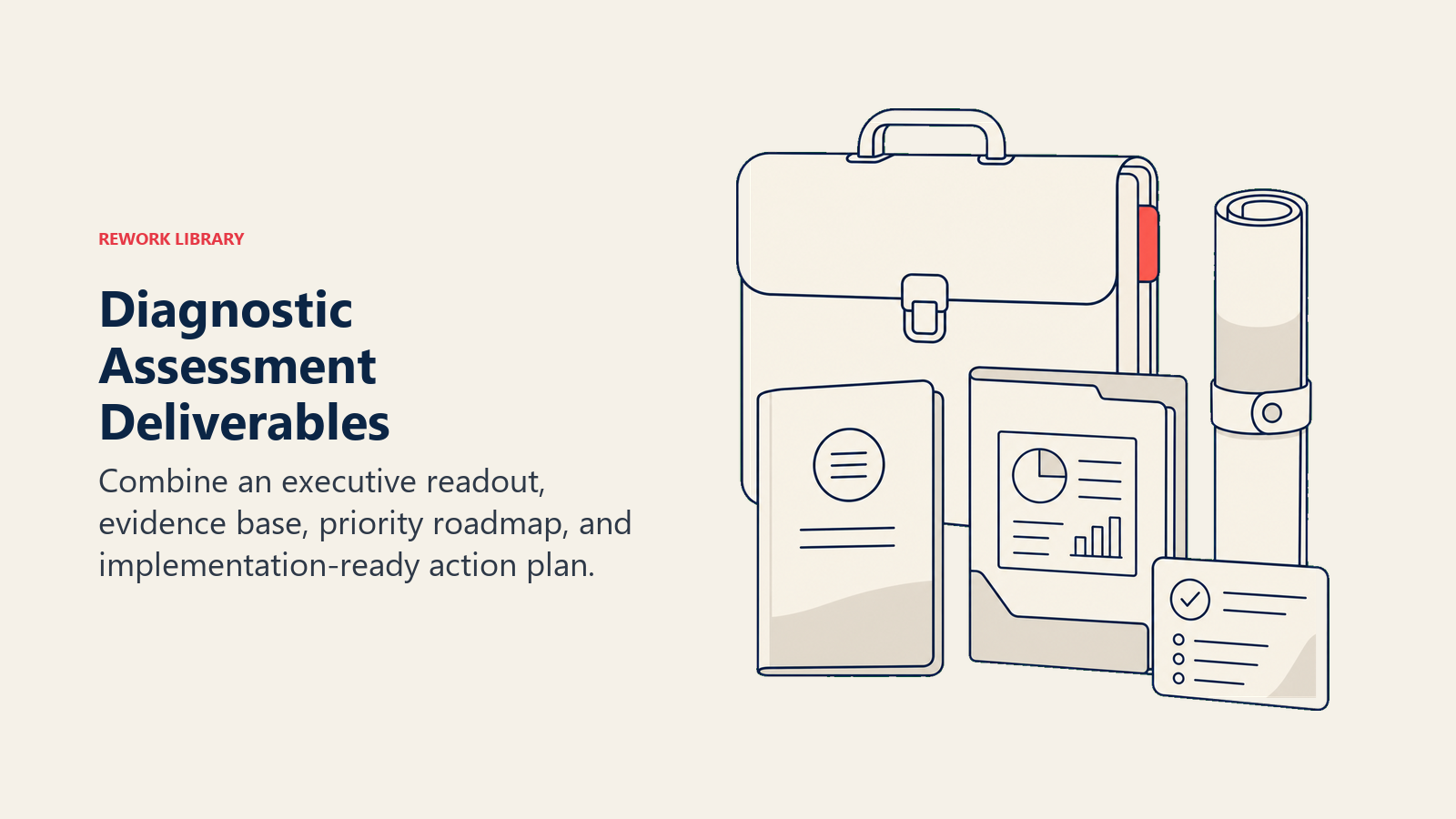
Benchmarking and performance comparisons provide objective validation. Show where they stand versus peers, industry standards, or best practices. This creates urgency and justifies investment.
Prioritized recommendations with rationale should follow a consistent format that enables decision-making. Don't just list what to do - explain why it matters and what happens if they do or don't act.
Your implementation roadmap provides a high-level view of the path forward. Show phases, sequencing, dependencies, and major milestones. This shouldn't be project plans yet - that comes in the implementation engagement - but enough that leadership understands the journey.
The executive presentation deck is often your most important deliverable. This is what gets presented to the board or leadership team. Make it visual, concise, and structured to drive decision-making. Tell a story: here's where you are, here's the impact, here's what we recommend, here's the path forward.
Some assessments also include detailed appendices with supporting analysis, data tables, interview summaries, and technical details. These support your findings but shouldn't be required reading to understand recommendations.
The golden rule: if an executive can't understand your key findings and recommendations in 20 minutes with your deck, you've failed to synthesize effectively.
Client engagement and presentation
Technical competence in conducting the assessment is only half the battle. How you engage stakeholders throughout and present findings determines whether recommendations get implemented or filed.
Maintain stakeholder alignment throughout the assessment, not just at the end. Share preliminary observations in check-in meetings. Test early hypotheses. Get feedback on whether you're focusing on the right issues. This prevents "surprise" findings that leaders reject because they weren't prepared for them.
Managing sensitive findings requires diplomacy and framing. If your assessment reveals that a VP's organization is poorly structured, you can't just bluntly say that in a presentation. Frame it as an opportunity: "The current structure made sense three years ago, but as the business has evolved, realigning accountabilities would improve decision speed and reduce coordination overhead."
Point to data and external factors, not people. "Industry benchmarks show similar companies handle this volume with 30% less overhead" is better than "Your team is overstaffed."
Your executive presentation should follow a clear arc:
- Frame the assessment scope and approach
- Provide key context and current state summary
- Present major findings with business impact quantified
- Introduce prioritized recommendations
- Show the implementation roadmap
- Discuss next steps and investment required
Build in time for discussion. The best presentations involve more client talking than you talking. Ask questions that prompt them to vocalize concerns, connect findings to their priorities, and start thinking about implementation.
Building consensus on priorities is critical. Different stakeholders will care about different findings. The CFO cares about cost reduction. The COO cares about operational efficiency. The CRO cares about revenue growth. Connect your recommendations to what each stakeholder needs. Effective proposal presentation techniques help you address these diverse stakeholder interests.
Creating urgency for action prevents your assessment from becoming shelfware. Quantify the cost of inaction. "This inefficiency is currently costing $2.3M annually. Every quarter we wait is $575K in continued waste." Connect recommendations to business priorities and timelines. "To hit your growth targets for next year, these capacity constraints must be resolved by Q2."
Transitioning to implementation engagement should feel natural, not like a sales pitch. "Based on what we've found, here's the logical next phase. We can help you implement these recommendations, or if you prefer to handle internally, here's what's involved." Give them options but make your value clear.
Converting assessments to implementation
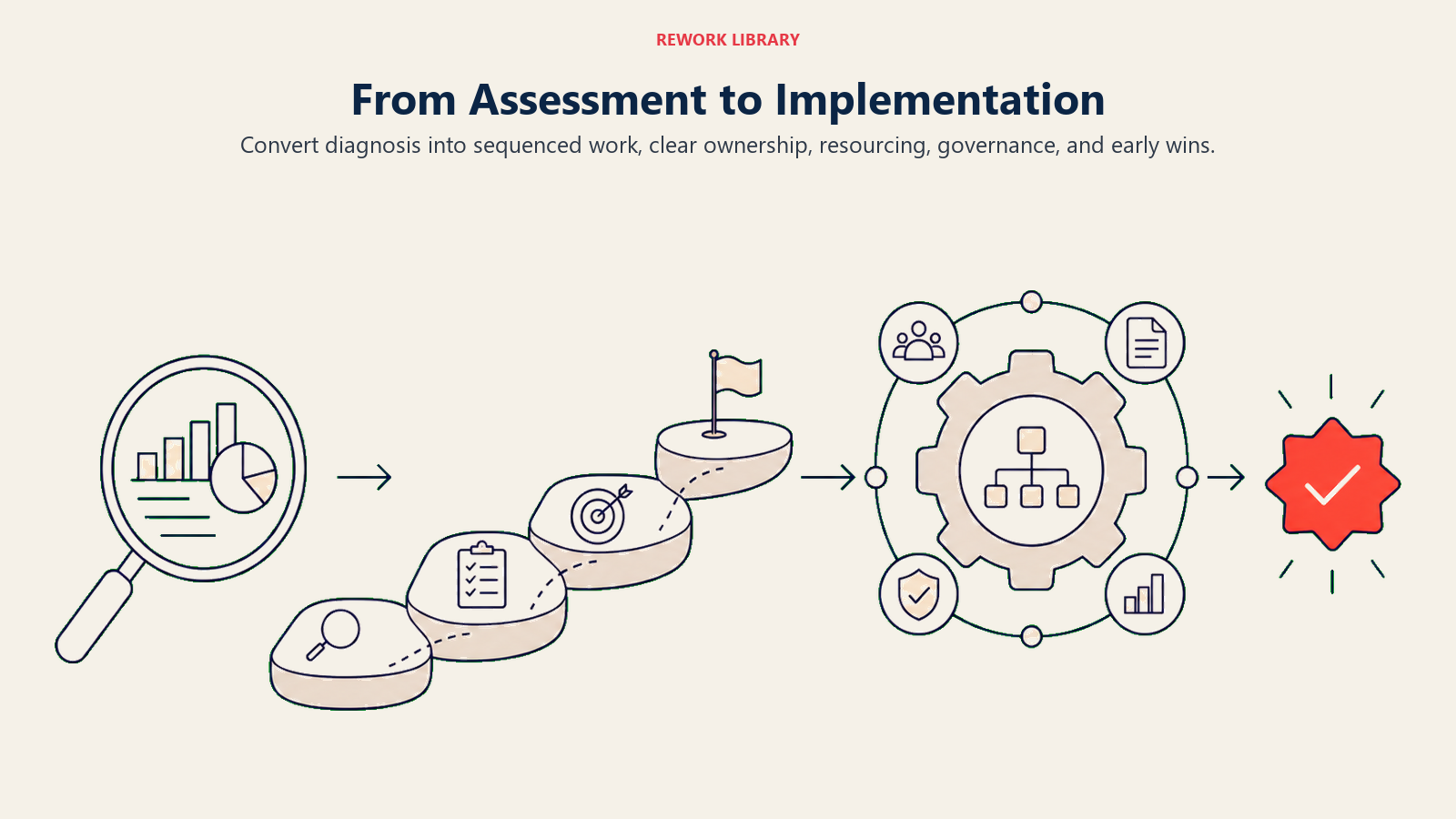
This is where diagnostic assessments become powerful business development tools. You've demonstrated expertise, built relationships with stakeholders, and proven you understand their business. Converting that to implementation work requires strategy, not just good delivery. Position follow-on work during the assessment, not after. As you conduct interviews and analysis, opportunities for expansion become clear. "This assessment is revealing some significant opportunities. We should discuss how to approach implementation once we complete the diagnostic." Demonstrate quick wins and value early. If you can help implement one small improvement during the assessment itself, do it. That proof point makes the case for broader engagement.
Build stakeholder relationships throughout. The people who will sponsor implementation work aren't always the ones who commissioned the assessment. Make sure you're engaging decision-makers who control implementation budgets.
Scoping the implementation proposal should flow naturally from assessment recommendations. Your roadmap becomes the implementation SOW. Your effort estimates inform the proposal. You've already done most of the scoping work.
Pricing the implementation engagement can reference assessment findings. "Based on the $2.3M in annual impact we identified, even a significant investment in implementation delivers ROI within the first year." Tie pricing to value, not just hours.
Create a seamless transition from assessment to execution. Don't deliver findings, disappear for a month, then come back with a proposal. Have the proposal ready. Get decision-maker commitment before leaving the final presentation. "If you'd like to move forward with implementation, we can begin in two weeks with Phase 1 focused on the quick-win opportunities."
The best assessments make implementation feel inevitable. The problems are clear. The solutions are defined. Your firm has demonstrated capability. The decision becomes "when do we start?" not "should we do this?"
Common assessment pitfalls that kill credibility
Even experienced consultants make mistakes that undermine assessment value. Here's what to avoid. Scope creep turning assessment into implementation happens when clients ask you to "just fix this one thing while you're here." Resist. It changes economics, creates accountability issues, and distracts from diagnostic work. Offer to address it in follow-on work instead.
Insufficient data collection or stakeholder engagement produces superficial findings. If you only interviewed senior leaders and reviewed documents, you missed the ground truth. If you didn't talk to customers or front-line staff, your understanding is incomplete. Budget enough time for thorough data collection.
Analysis paralysis without clear recommendations occurs when you produce 100 pages of findings but can't say clearly what to do. Clients hire you for judgment, not just data compilation. Take a position. Make specific recommendations even if they involve uncertainty.
Recommendations too generic or impractical destroy credibility instantly. "Improve communication" or "Strengthen leadership" are worthless. What specific actions should they take? How? With what resources? Generic recommendations signal you didn't actually understand their situation.
Poor communication of sensitive findings creates defensive reactions that shut down progress. If your presentation feels like an attack on people or decisions, you've lost the room. Frame findings constructively. Focus on opportunity, not blame.
No follow-through or implementation support turns assessments into expensive reports. If you deliver findings but provide no path to action, clients are left with a clear picture of problems but no solution. That's frustrating, not valuable.
The best way to avoid these pitfalls - maintain constant communication with your client sponsor, test findings as you develop them, and always be thinking about "what should they do with this information?"
Tools and frameworks to accelerate delivery
Don't reinvent the wheel on every assessment. Build reusable tools and frameworks that accelerate delivery while maintaining quality.
Assessment scope templates for each assessment type create consistency and ensure you don't miss key elements. Your operational assessment scope template should include standard data requirements, stakeholder categories, and analysis frameworks.
Interview and survey guides with question banks for different roles and assessment types. You'll adapt these for each client, but starting with proven questions saves time and ensures coverage.
Analysis frameworks by type that provide structure for evaluation. Process efficiency frameworks, financial analysis models, organizational design principles, market assessment structures. Build a library of frameworks you can deploy.
Benchmarking data sources catalogued and ready to access. Industry reports, analyst research, your own database of client engagements. Having comparative data readily available strengthens findings.
Recommendation prioritization matrices that help clients visualize trade-offs. Impact vs. effort matrices, risk-adjusted return frameworks, implementation sequencing tools. Visual frameworks make prioritization discussions more productive.
Roadmap templates that translate recommendations into phased implementation plans. These should show typical phase durations, dependencies, and resource requirements based on your experience with similar engagements.
The goal isn't to be formulaic - every assessment needs customization. But reusable tools let you focus creativity and expertise on analysis and recommendations rather than recreating basic frameworks.
Where this fits in your service delivery
Diagnostic assessments work best as part of a broader service portfolio, not as standalone offerings. They typically fit between initial consultation and full implementation.
The typical sequence looks like:
- Initial consultation identifies that the client has problems but hasn't diagnosed root causes
- Needs assessment and discovery determines that a formal diagnostic would provide value
- Diagnostic assessment delivers structured analysis and recommendations
- Proposal development for implementation work based on assessment findings
- Implementation consulting executes the recommended improvements
Different consulting engagement models work for assessments. Fixed-price projects are most common since scope is defined and time-bounded. Some firms use retainer phases where assessment is month one of a longer engagement.
For strategy-focused work, diagnostics often inform strategy consulting process by providing data and analysis that grounds strategic recommendations in operational reality.
The key is positioning assessments as valuable standalone engagements that also naturally lead to implementation work. Clients should feel they got full value from the assessment even if they don't proceed with implementation (though 70% conversion rate suggests most do).
Diagnostic Assessment Services FAQ
What is a diagnostic assessment in consulting?
It's a structured evaluation that identifies problems and opportunities in a defined area of a client's business and produces a prioritized roadmap. You diagnose what needs to change rather than implementing the fix, which makes it a lower-commitment first engagement.
How long does a diagnostic assessment take?
Most run 2 to 6 weeks. A focused operational assessment of one department might take 2 to 3 weeks, while a comprehensive organizational assessment across a multi-divisional company can take 8 to 10 weeks.
Why do diagnostic assessments convert to implementation work so often?
A well-run assessment converts to follow-on work about 70% of the time because it demonstrates value, builds stakeholder trust, and produces a roadmap that becomes the implementation scope. The decision shifts from "should we do this?" to "when do we start?"
What are the main types of diagnostic assessments?
The six common types are operational, financial, technology, organizational, market, and go-to-market assessments. Most engagements blend several dimensions, since a problem in one area often surfaces issues in another.
What makes a diagnostic assessment actionable rather than shelfware?
Specificity. Findings must be concrete enough to implement, quantified by business impact, and prioritized by impact versus effort. "Improve efficiency" is useless; "consolidate three order-entry processes to cut 2.5 hours of duplicate data entry per order" drives decisions.
Making diagnostic assessments your entry point
Diagnostic assessments are high-value, high-conversion offerings that showcase your expertise while creating natural paths to larger engagements. The key is delivering genuine insight that clients couldn't develop internally, packaged in formats that drive decision-making.
Focus on these success factors:
- Rigorous data collection that uncovers root causes, not symptoms
- Analysis frameworks that connect problems to business impact
- Specific, prioritized, actionable recommendations
- Clear implementation roadmaps that show the path forward
- Stakeholder engagement that builds buy-in throughout
- Deliverables that enable decision-making, not just documentation
When clients see that you understand their business, identified problems they knew existed but couldn't articulate, and provided a clear path forward, implementation work becomes the obvious next step. That's when assessments become your most powerful growth engine.

Sales Director
On this page
- What makes a diagnostic assessment valuable?
- Common types of diagnostic assessments
- Assessment scoping and design
- Data collection methods that uncover truth
- Analysis frameworks by assessment type
- Operational assessment frameworks
- Financial assessment frameworks
- Technology assessment frameworks
- Organizational assessment frameworks
- Market assessment frameworks
- Go-to-market assessment frameworks
- Diagnostic analysis and insights
- Developing actionable recommendations
- Assessment deliverables that drive action
- Client engagement and presentation
- Converting assessments to implementation
- Common assessment pitfalls that kill credibility
- Tools and frameworks to accelerate delivery
- Where this fits in your service delivery
- Making diagnostic assessments your entry point