Project Kickoff Process: Launching Professional Services Projects Effectively
Turn this article into takeaways for your work.


Each assistant summarizes the article only for you and suggests best practices for your work.
There's a pattern you see in failed projects: they usually started badly. The kickoff meeting was rushed, key stakeholders were missing, expectations weren't clear, or the team never really gelled. By the time anyone realized things were off track, they'd wasted weeks going in the wrong direction.
Here's what most people don't realize: 85% of project success is determined in the first two weeks. Not because the work is done then, but because that's when you set expectations, build relationships, and get everyone on the same page about what success looks like. Get those first 48 hours wrong, and you'll spend the rest of the project fighting uphill.
A good kickoff does more than just explain what you're going to do. It builds momentum, establishes trust, and creates a shared understanding of how you'll work together. When everyone leaves that kickoff meeting knowing exactly what comes next, who's responsible for what, and how you'll communicate, you've set yourself up to succeed.
This guide walks through the complete kickoff process, from preparation to execution to follow-up. Not the theoretical version, but what actually works when you're launching professional services projects in the real world.
Why the kickoff meeting matters more than you think
Every project has a moment when the team goes from "working for the client" to "working with the client." That transition happens in the kickoff. Done right, it transforms a contractual relationship into a collaborative partnership. Think about what you're really doing in a kickoff. You're taking people who've never worked together and asking them to trust each other with deadlines, deliverables, and sometimes their careers. The engagement manager who sold the deal might have promised things the delivery team isn't sure they can deliver. The client stakeholders might have different ideas about priorities. The project team might be unclear on who makes decisions.
All of that confusion and misalignment costs you time and money later. Scope creep happens because boundaries weren't clear from the start. Deliverables get rejected because acceptance criteria were vague. Teams clash because roles were undefined. Most project problems trace back to things that should have been addressed in the kickoff.
But when you nail the kickoff, everything gets easier. People know what to expect. They know how to escalate issues. They know what success looks like. That clarity is worth its weight in gold when you're three weeks in and someone asks "wait, is that included in scope?"
The kickoff also sets the tone for how you'll work together. If you show up prepared, organized, and thoughtful, the client assumes that's how you'll run the whole project. If you're disorganized or unclear, they start to worry. First impressions matter, and the kickoff is your first impression as a project team.
Pre-kickoff preparation: the work that happens before the work
The kickoff meeting is two hours. The preparation takes two days. If you're not willing to invest that time upfront, don't bother with a formal kickoff at all. Start by reading everything. The contract, the statement of work, the proposal, any notes from sales calls. You need to know exactly what was promised, what the client expects, and what constraints you're working within. Read the contract at least twice, looking specifically for scope boundaries, deliverable definitions, and timeline commitments.
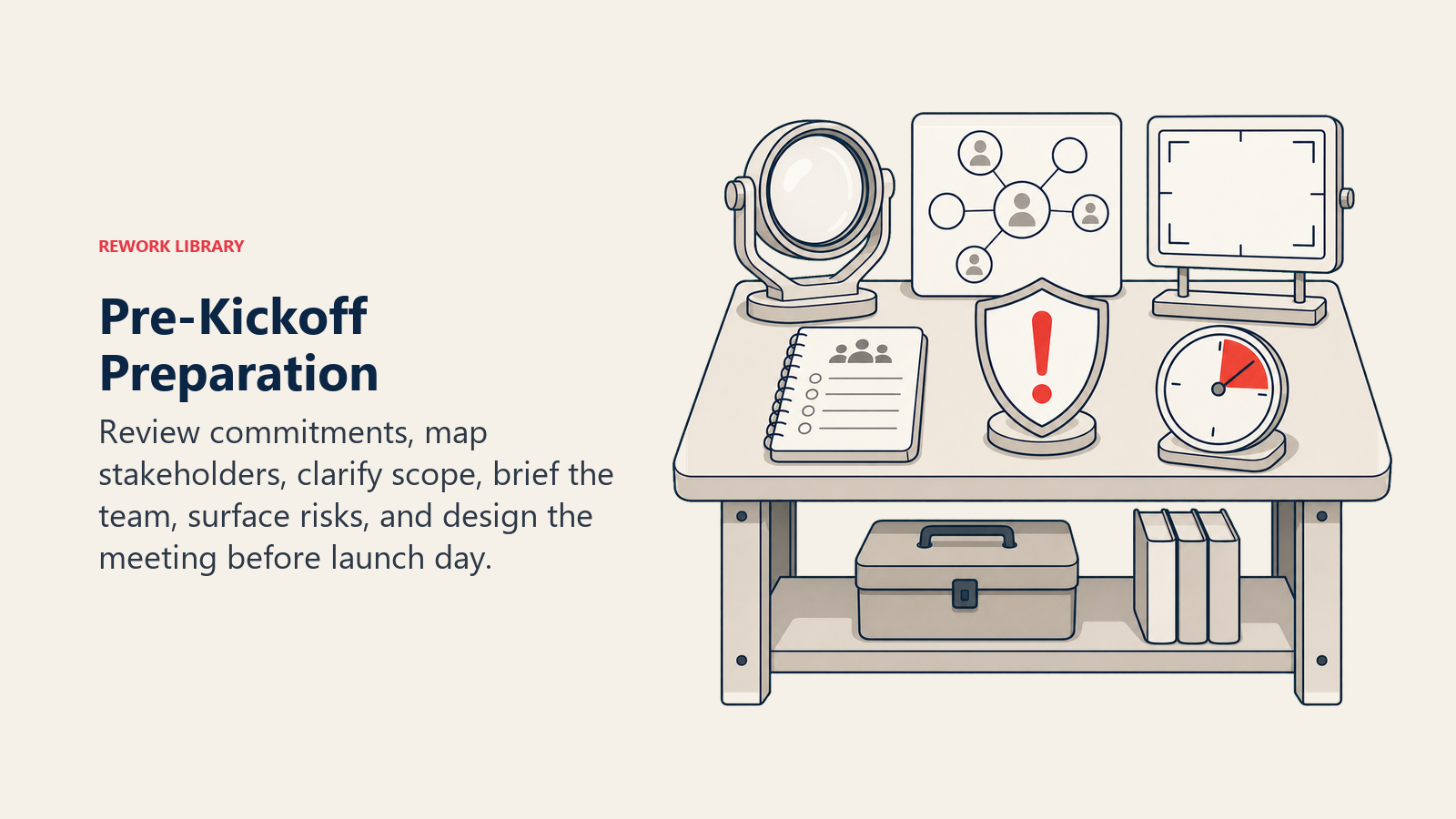
Next, identify every stakeholder, both client-side and internal. Who's the executive sponsor? Who are the day-to-day contacts? Who has approval authority over deliverables? Who's going to use what you build? Create an org chart if you don't have one. Map out who reports to whom and where decision-making authority sits.
For your internal team, be just as thorough. Who's the project manager? Who's doing the actual work? Who's the escalation point if things go wrong? Who needs to be informed but not necessarily involved? Build a RACI matrix before the kickoff, not during it.
Review the timeline in detail. When are the major milestones? What are the dependencies? What's the critical path? Where are the risks in the schedule? You should be able to explain the project timeline without looking at notes.
Understand your team's capabilities and limitations. If you've got someone who's never worked with this client before, they'll need more context. If you've got a junior team member in a critical role, think about how you'll support them. Know who's on vacation when, who's working on other projects, and who might get pulled away mid-engagement. Proper utilization and capacity planning helps you staff engagements appropriately.
Gather relevant case studies, methodologies, and frameworks. If you're using a specific approach or toolkit, prepare to explain it. If you have examples of similar projects, bring them. Clients like to see that you've done this before.
Brief your team before the client kickoff. Don't make the client meeting the first time your internal team hears about the project. Hold a pre-kickoff session where you walk through the scope, answer questions, and make sure everyone's aligned. This is where you surface internal concerns and misalignments, not in front of the client.
Prepare the actual meeting materials: agenda, deck, handouts. Send the agenda to the client at least 48 hours in advance. Give them a chance to add topics or flag concerns. Nothing derails a kickoff faster than "wait, I thought we were going to talk about X."
Set up the project infrastructure before the kickoff. Create the shared workspace, set up collaboration tools, establish communication channels. When someone asks "where should I put this?" you should have an answer ready.
Kickoff meeting structure: what to cover and in what order
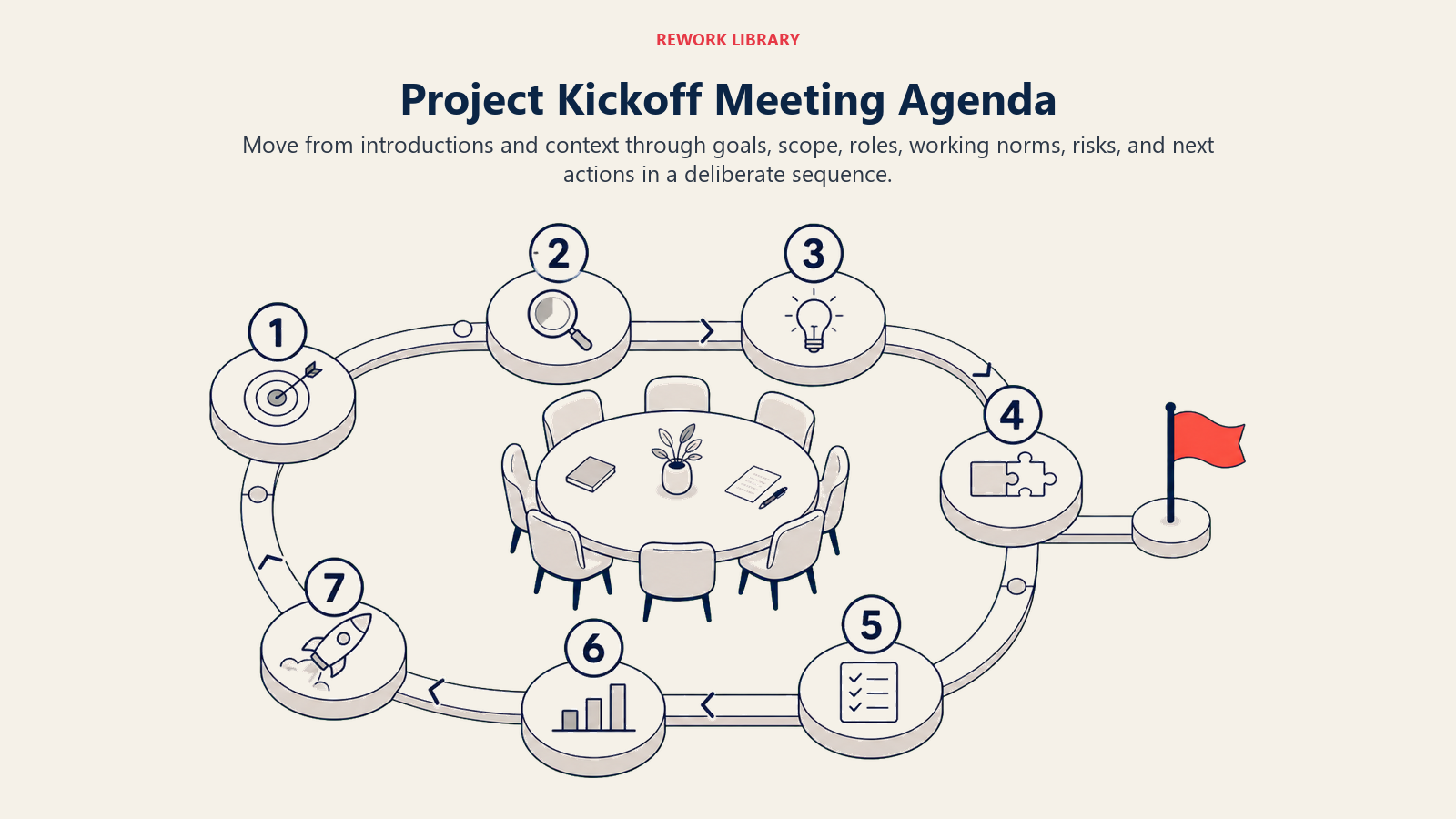
A typical kickoff runs 2-3 hours. You need enough time to cover everything without rushing, but not so much time that people's attention fades. Here's how to structure it: Welcome and introductions (15 minutes): Start with people, not process. Go around the room and have everyone introduce themselves: name, role, what they'll be contributing to the project. If it's a smaller group, add an icebreaker - something like "what's one thing you hope to learn from this project?" or "what's your go-to productivity trick?"
The goal here is simple: help people see each other as humans, not just names on an org chart. When someone needs to reach out later, they'll remember "oh, that's the person who also has three kids" or "the one who used to work in our industry."
Project overview (20 minutes): Now talk about the work. What's the business context? Why is this project happening now? What are the objectives? What outcomes are we trying to achieve? This isn't about deliverables yet, it's about the "why" behind the project.
Paint the picture of success. What does the world look like when this project is done? What changes for the client? For their customers? For their team? Make it concrete and tangible.
Scope and deliverables (30 minutes): This is the most critical section. Walk through exactly what's in scope and what's not. For each deliverable, explain what it is, what it includes, and what the acceptance criteria are.
Be specific about exclusions. "This project includes X, Y, and Z. It does not include A, B, or C." If there are gray areas, call them out now and agree on how you'll handle them. The phrase "that's out of scope" only works if you defined scope clearly upfront.
Talk about how changes will be managed. What's the process if the client wants to add something? How do you handle scope creep? Who approves changes? Get alignment on change order procedures now, before you need it.
Approach and methodology (30 minutes): Explain how you'll do the work. If you're using a specific framework or methodology, walk through it. Show them the phases, the activities in each phase, the outputs.
Explain what you'll need from the client. Data access, subject matter expert time, decision-making participation. Be realistic about the time commitment you're asking for. If you need their VP for an hour every week, say that clearly.
Talk about your tools and platforms. Where will documents live? How will you collaborate? What software will you use? If the client needs to access anything, make sure they know how.
Timeline and milestones (20 minutes): Walk through the project schedule. Show major milestones and key dates. Explain dependencies - "we can't start Phase 2 until you approve the Phase 1 deliverable." Point out the critical path.
Be honest about what could slip and what can't. If there's a hard deadline driven by a regulatory requirement or a business event, make sure everyone understands the stakes.
Build in buffer for the unexpected. Don't show a plan where everything has to go perfectly. Show a realistic plan that accounts for the fact that someone will get sick, a decision will take longer than expected, or a deliverable will need revision.
Roles and responsibilities (20 minutes): Present your RACI matrix. For each major activity or deliverable, show who's Responsible, Accountable, Consulted, and Informed. Make it visual - people should be able to see at a glance where they fit.
Clarify decision authority. Who can approve deliverables? Who can make scope decisions? Who has final say when there's disagreement? These questions will come up, so answer them now.
Define the escalation path. What happens when there's a problem? Who gets involved first? When do we escalate to senior leadership? The worst time to figure out escalation is in the middle of a crisis.
Communication plan (15 minutes): Establish meeting cadence. Weekly status calls? Bi-weekly steering committee? Daily standups? Put them on the calendar now, recurring, for the entire project duration.
Define reporting expectations. What do status reports include? When are they sent? Who gets them? Show a sample if you have one.
Talk about how you'll handle urgent issues. Should people call? Email? Slack? What's the expected response time? Set realistic expectations - if you say "we respond to emails within 2 hours," you better be able to deliver that.
Risk and issue management (15 minutes): Share any known risks and your mitigation plans. If you've identified risks during planning, bring them up now. Show that you're thinking ahead.
Explain your issue tracking process. How do you capture issues? Who triages them? How quickly do you expect to resolve different types of problems? Make it clear that issues aren't failures, they're just part of project management.
Next steps and action items (15 minutes): End with clear next steps. What happens in the next week? Who's doing what by when? Assign owners to every action item right there in the meeting.
Schedule the first few working sessions. Don't leave the kickoff and then spend a week trying to find time on everyone's calendar. Book it now.
Confirm when you'll send meeting notes and materials. Set the expectation that you'll document everything and distribute it within 24 hours.
Key components every kickoff must include
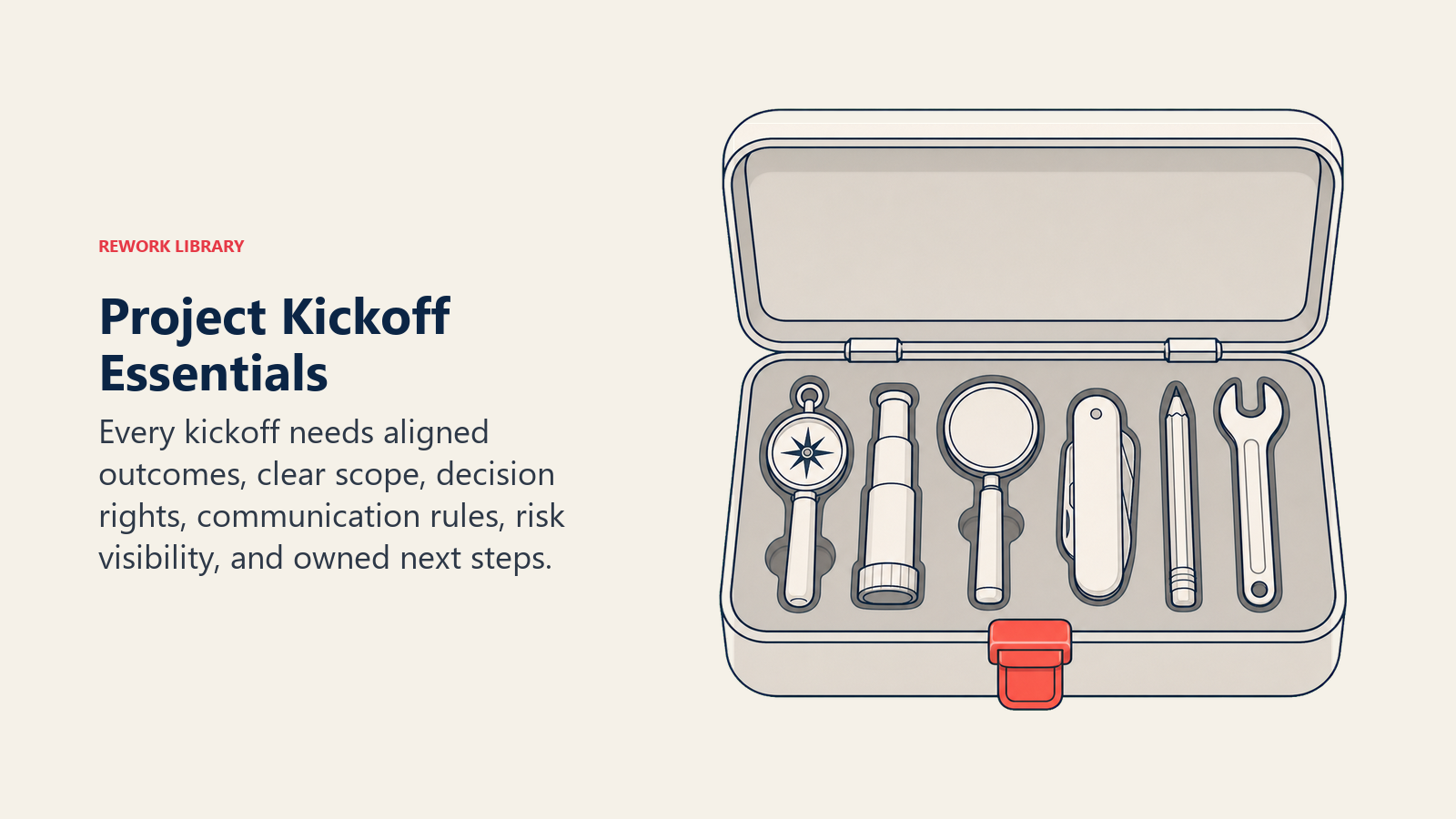
Some things are non-negotiable in a kickoff, regardless of project type or size. Stakeholder alignment on goals: Everyone should leave with the same understanding of what success looks like. Not vague statements like "improve efficiency" but specific outcomes like "reduce processing time from 5 days to 2 days for 90% of transactions."
If stakeholders disagree on goals, that's a problem you need to solve before the project starts. Don't paper over fundamental misalignment with vague language.
Scope confirmation and boundary setting: The kickoff is your last chance to make sure everyone agrees on what's included and what's not. Once the project starts, changing scope gets expensive and contentious.
Use examples to illustrate boundaries. "We're redesigning the checkout flow, which includes pages A, B, and C. We're not touching the account registration flow or the product catalog." Concrete examples prevent confusion later.
Team introductions and relationship building: Projects succeed or fail based on how well the team works together. Invest time in helping people connect. Learn names, understand roles, figure out who to go to for what.
The client team and your team need to become one team. That doesn't happen automatically. It happens when you create moments for people to interact as humans, not just professionals.
Communication protocol establishment: Agreeing on how you'll communicate prevents 90% of project friction. When people know how to reach each other, when to expect updates, and how decisions get made, things move faster.
Document the communication plan and share it. Don't assume people will remember what you said in the meeting.
Risk identification and mitigation: Talk about what could go wrong and how you'll handle it. This builds confidence - it shows you've thought through the challenges and have plans to address them.
Clients appreciate honesty about risks. It's far better to say "we might run into issues with data quality, so we've built in extra time for cleanup" than to pretend everything will be perfect. Your deliverable quality assurance framework should account for these potential issues.
Quick win planning: Identify something you can deliver in the first two weeks that demonstrates value. A quick analysis, a draft framework, a pilot implementation - something tangible that shows progress.
Quick wins build momentum and confidence. They prove you can execute. They give stakeholders something to point to when someone asks "how's the project going?"
Post-kickoff activities: the follow-through that matters
The kickoff meeting is just the beginning. What happens in the next 48 hours determines whether the energy and alignment you created actually translates into progress. Send meeting notes within 24 hours. Include key decisions, action items with owners and due dates, and any open questions that need resolution. Format it so people can scan quickly and find what they need.
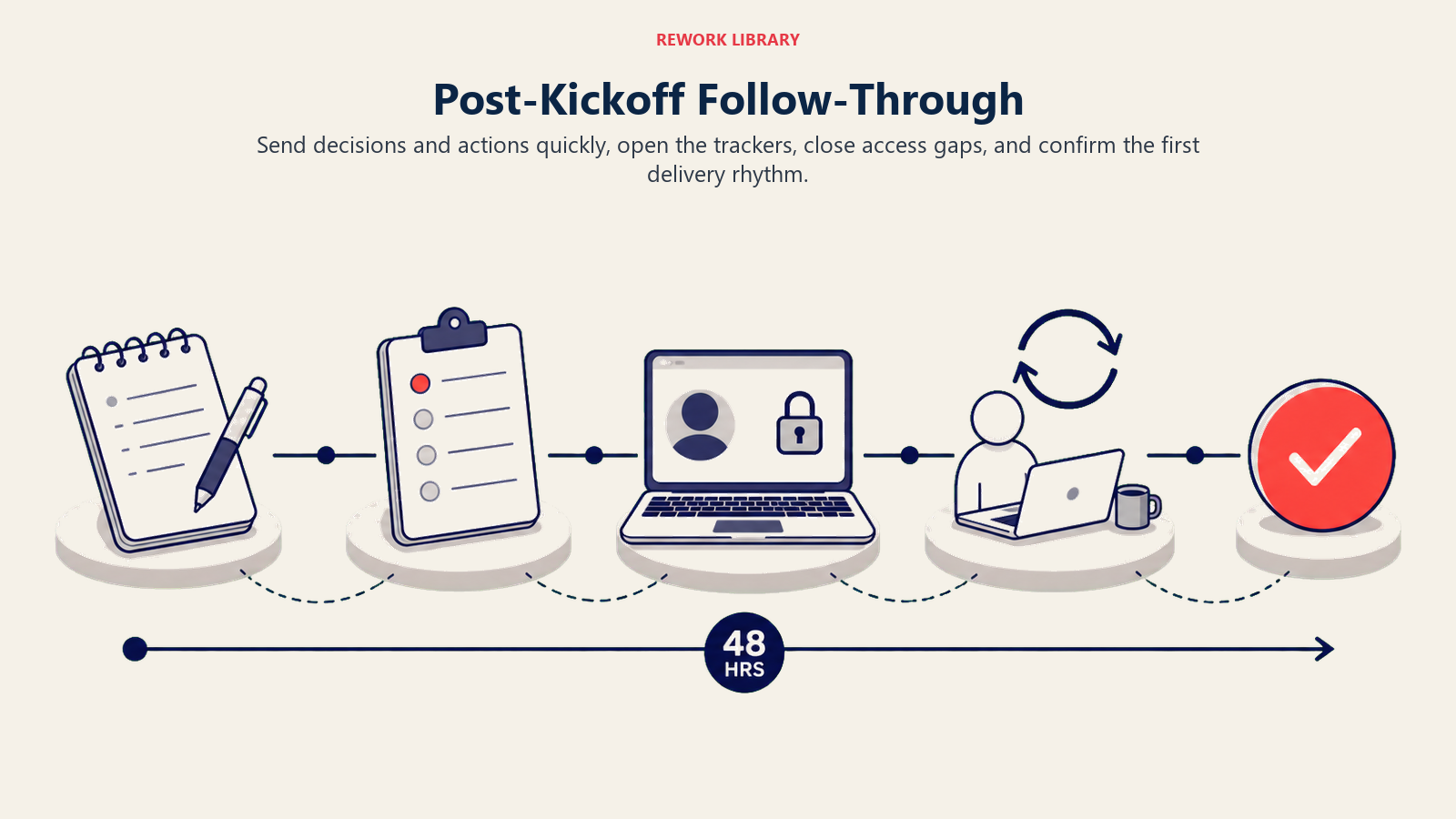
Create an action item tracker and share it with the team. Every action from the kickoff should be captured with owner, due date, and status. Update it regularly and send it with your weekly status reports.
Follow up individually with key stakeholders. A quick email to the executive sponsor: "Thanks for the great kickoff. Just confirming you're good with our approach and timeline." A check-in with your team lead: "How are you feeling about the project? Any concerns we need to address?"
These one-on-one touches catch issues early. Someone might not speak up in a group meeting but will share concerns in a private conversation.
Finalize the project plan based on any feedback or questions from the kickoff. Update timelines, refine deliverables, adjust the approach if needed. Share the updated plan with the team.
Get all recurring meetings on the calendar. Weekly status calls, steering committee meetings, working sessions - schedule them all now for the full project duration. Yes, some will need to be moved. That's fine. But if they're on the calendar, they'll happen.
Execute your first quick win. Whatever you identified as an early deliverable, get it done in the first week or two. Show momentum. Demonstrate capability. Build confidence.
Start the weekly status rhythm immediately. Even if there's not much to report in week one, send the status update. Establish the pattern so it becomes routine.
Common kickoff mistakes and how to avoid them
Some mistakes show up in almost every bad kickoff. Here's how to avoid them: Skipping preparation: If you walk into a kickoff without having read the SOW, built a RACI matrix, or briefed your team, you're going to waste everyone's time. The meeting will be disorganized, questions will go unanswered, and you'll look unprepared.
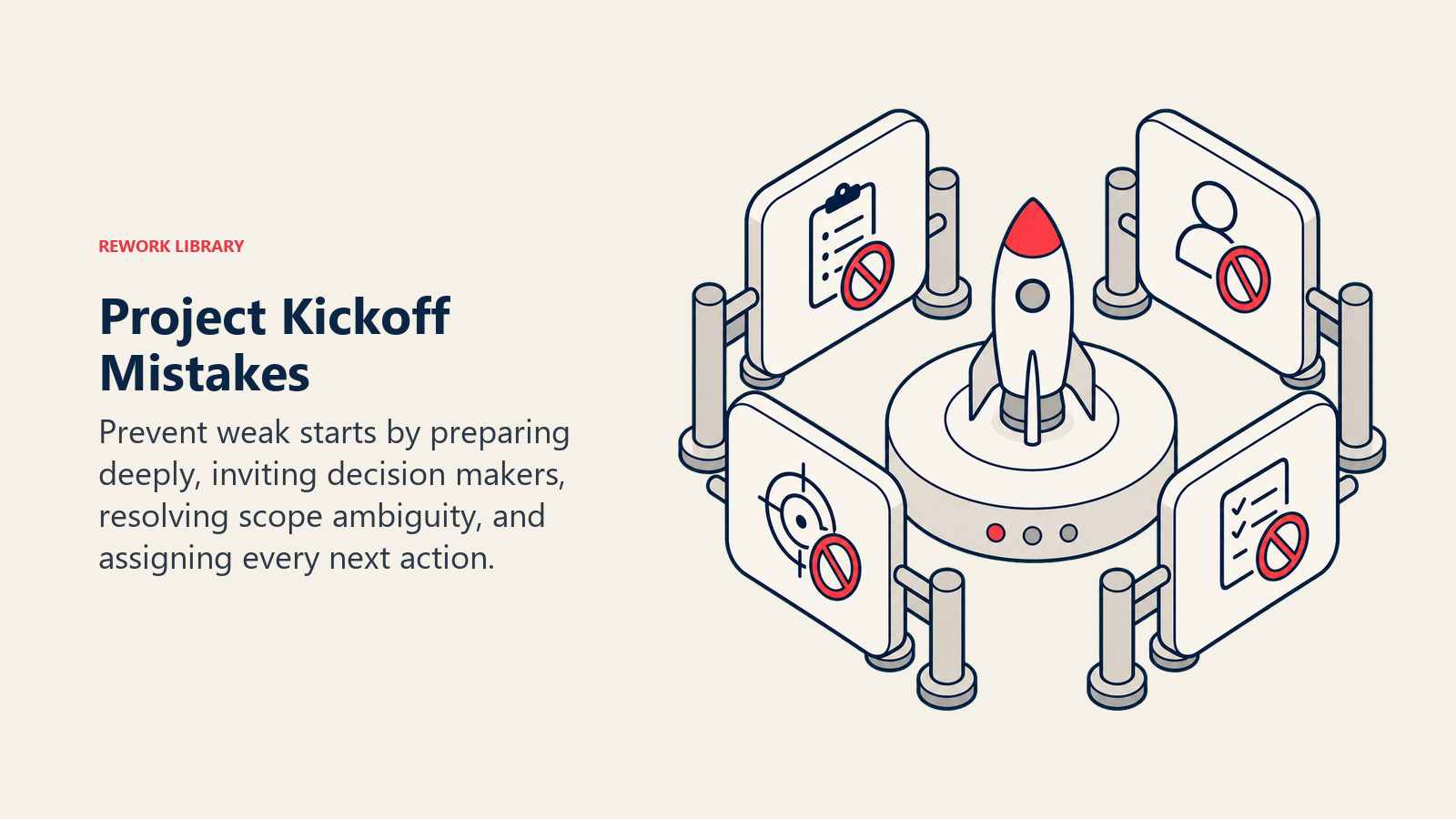
The fix: Block out a full day for kickoff prep. No exceptions.
Unclear objectives: If you can't articulate exactly what the project is supposed to achieve, how will anyone know if it's successful? Vague goals like "improve the customer experience" aren't enough.
The fix: Define specific, measurable outcomes before the kickoff. Get client agreement on what success looks like in concrete terms.
Missing stakeholders: If the person who controls the budget isn't in the kickoff, you might not understand the real priorities. If the executive sponsor doesn't show up, it signals this project isn't actually important.
The fix: Confirm attendance from all key stakeholders at least a week before. If someone critical can't make it, reschedule the kickoff.
Too much detail too early: Don't try to explain every task and subtask in the kickoff. You'll lose people. Focus on the big picture, major milestones, and key decisions. Save the detailed work planning for separate sessions.
The fix: Prepare two versions of your materials - the overview for the kickoff and the detailed version for working sessions.
No action items: A kickoff that ends without clear next steps creates vacuum. People leave unsure what they're supposed to do, so nothing happens.
The fix: Reserve the last 15 minutes specifically for next steps. Don't let people leave without assigned actions and deadlines.
Weak facilitation: If you let the kickoff turn into a free-for-all discussion, you'll run out of time before covering critical topics. But if you're too rigid, you'll shut down important conversations.
The fix: Assign a dedicated facilitator who keeps the meeting on track while staying flexible enough to address important questions.
Ignoring team dynamics: If there's tension between stakeholders or unclear authority structures, they'll surface during the project. Better to address them in the kickoff when you can actually do something about it.
The fix: If you sense organizational politics or role confusion, address it directly. "I want to make sure we're clear on decision authority. [Name], you're the final approver for X, correct?"
Virtual kickoff considerations: making it work when you're remote
Remote kickoffs have different challenges than in-person ones. You can't read the room as easily, side conversations don't happen organically, and technical issues can derail the flow.
Test your technology the day before. Make sure everyone can access the video platform, screen sharing works, and audio is clear. Have a backup plan if the primary platform fails.
Build in more breaks. What would be a 2.5-hour in-person meeting should be 3 hours virtual, with two 10-minute breaks. People need time to step away from screens.
Use engagement techniques to keep energy up. Polls, breakout rooms, direct questions to specific people. Don't just talk at people for two hours.
Send materials in advance and keep them visible during the meeting. Share your screen to show the agenda, timeline, and RACI matrix. Let people follow along rather than just listening.
Record the session and share it afterward. People will miss things or want to reference specific parts later. Make it easy for them to review.
Use a virtual whiteboard for collaborative sections. When you're mapping out risks or brainstorming quick wins, a shared visual workspace keeps people engaged.
Over-communicate on next steps. In virtual settings, it's easier for people to tune out at the end. Send action items in the chat during the meeting and follow up with email immediately after.
Kickoff meeting agenda template
Here's a proven template you can adapt to your needs:
Project Kickoff Meeting Duration: 2.5 hours
I. Welcome & Introductions (15 min)
- Round-robin introductions: name, role, contribution to project
- Icebreaker question
- Meeting objectives and agenda overview
II. Project Overview (20 min)
- Business context and drivers
- Project objectives and success criteria
- Expected outcomes and impact
III. Scope & Deliverables (30 min)
- Detailed scope review
- Deliverables and acceptance criteria
- Explicit exclusions
- Change management process
IV. Approach & Methodology (30 min)
- Project phases and activities
- Methodology and frameworks
- Tools and platforms
- Client involvement requirements
BREAK (10 min)
V. Timeline & Milestones (20 min)
- Project schedule overview
- Key milestones and dates
- Dependencies and critical path
- Assumptions and constraints
VI. Roles & Responsibilities (20 min)
- RACI matrix review
- Decision authority clarification
- Escalation procedures
- Team structure
VII. Communication Plan (15 min)
- Meeting cadence and schedule
- Reporting requirements and format
- Communication protocols and tools
- Response time expectations
VIII. Risks & Issues (15 min)
- Known risks and mitigation plans
- Issue management process
- Risk monitoring approach
IX. Next Steps & Actions (15 min)
- Immediate next steps (next 1-2 weeks)
- Action item review with owners and dates
- Quick win planning
- Questions and wrap-up
RACI matrix template
Use this format to clarify roles and avoid confusion:
| Activity/Deliverable | Client Sponsor | Client PM | Subject Matter Expert | Your PM | Your Analyst | Your Designer |
|---|---|---|---|---|---|---|
| Project Plan Approval | A | C | I | R | I | I |
| Requirements Gathering | I | C | R | A | R | I |
| Design Review | A | I | C | C | I | R |
| Testing & Validation | I | C | R | A | R | I |
| Final Deliverable Approval | A | C | C | R | I | I |
R = Responsible (does the work) A = Accountable (has final authority) C = Consulted (provides input) I = Informed (kept in the loop)
Each row should have exactly one A and at least one R.
Action item tracker template
Track and communicate progress on all commitments:
| Action Item | Owner | Due Date | Status | Notes |
|---|---|---|---|---|
| Provide access to data systems | Client IT | 1/24 | In Progress | Credentials requested 1/18 |
| Schedule SME interviews | Your PM | 1/22 | Complete | All 5 interviews booked |
| Review draft approach document | Client PM | 1/26 | Not Started | Doc will be sent 1/23 |
| Set up project workspace | Your PM | 1/20 | Complete | SharePoint site active |
| Identify quick win opportunity | Your Analyst | 1/25 | In Progress | Three options being evaluated |
Update this weekly and include it in your status reports.
Project kickoff checklist
Use this to make sure you've covered everything:
Two weeks before:
- Confirm kickoff date and time with all key stakeholders
- Send calendar invites with dial-in/location details
- Review contract, SOW, and all project documentation
One week before:
- Create kickoff agenda and presentation materials
- Build RACI matrix
- Develop project timeline with milestones
- Identify known risks and mitigation strategies
- Send agenda to all attendees for review
- Hold internal team pre-briefing
48 hours before:
- Confirm attendance from all critical stakeholders
- Set up project infrastructure (workspace, tools, channels)
- Prepare meeting materials and handouts
- Test technology for virtual meetings
- Finalize presentation deck
Day of kickoff:
- Send reminder with agenda and dial-in details
- Test all technology 30 minutes early
- Have backup facilitator identified
- Print materials if in-person
Within 24 hours after:
- Send detailed meeting notes and action items
- Distribute presentation materials
- Schedule all recurring project meetings
- Follow up individually with key stakeholders
- Update project plan based on kickoff discussions
Within 48 hours after:
- Send first action item tracker update
- Confirm everyone has access to project workspace
- Begin work on first quick win
- Address any open questions from kickoff
Making kickoffs a competitive advantage
Most firms treat kickoffs as a checkbox. You're doing it because it's on the project management checklist, not because you believe it matters. That's a mistake. A great kickoff is a competitive advantage. It differentiates you from firms that rush into execution without alignment. It shows clients you're thoughtful, organized, and invested in their success. It builds relationships that make difficult conversations easier later.
Think about it from the client's perspective. They've just signed a contract, probably spent weeks getting it approved, and now they're hoping they made the right choice. The kickoff is your chance to prove they did. When you show up prepared, with clear plans and smart questions, you validate their decision. This first impression shapes the entire client relationship going forward.
When you facilitate a kickoff that gets everyone aligned and energized, you create momentum that carries through the whole project. When you identify and address risks early, you prevent crises later. When you build relationships between your team and theirs, you create a foundation of trust that helps when things get hard.
The best kickoffs don't feel like meetings. They feel like the start of something important. People leave energized and confident. They understand what's happening and why it matters. They know what they need to do and who to work with. That clarity and energy translates directly into better project outcomes.
Invest in your kickoff process. Prepare thoroughly, facilitate skillfully, and follow up relentlessly. The first 48 hours set the trajectory for everything that follows. Make them count.
Where to go from here
The kickoff is just one part of the client delivery lifecycle. To execute effectively after a successful launch:
- Client Onboarding Process sets up the relationship before the kickoff
- Project Management Methodology defines how you'll execute the work
- Client Communication Cadence maintains alignment throughout delivery
- Scope Definition & SOW clarifies boundaries before the project starts
Get the kickoff right and the rest of the project gets easier. Skip it or rush through it, and you'll spend months fighting problems that could have been prevented in a single well-run meeting. That's the real reason kickoffs matter.

Sales Director
On this page
- Why the kickoff meeting matters more than you think
- Pre-kickoff preparation: the work that happens before the work
- Kickoff meeting structure: what to cover and in what order
- Key components every kickoff must include
- Post-kickoff activities: the follow-through that matters
- Common kickoff mistakes and how to avoid them
- Virtual kickoff considerations: making it work when you're remote
- Kickoff meeting agenda template
- RACI matrix template
- Action item tracker template
- Project kickoff checklist
- Making kickoffs a competitive advantage
- Where to go from here