Interim Executive Placements: Delivering Fractional Leadership for Transformation and Crisis

Turn this article into takeaways for your work.


Each assistant summarizes the article only for you and suggests best practices for your work.
Here's what's happening across professional services - your clients need C-suite expertise, but they can't or won't hire permanent executives. The CFO just quit. They're in the middle of a digital transformation. They raised Series B and need someone who's scaled from 50 to 500 before. Or they're a mid-sized company that can't justify a full-time CMO but desperately needs marketing leadership.
That's where interim executive placements come in. You're providing temporary senior leadership (full-time or fractional) to solve specific business challenges. The economics are attractive - 65-80% margins with recurring revenue potential. But the real opportunity is relationship depth. When you place the right leader who delivers results, you're not just another vendor. You're a strategic partner who shows up when it matters most. Understanding how this service fits within your broader professional services growth model helps you position it effectively.
This guide covers how to build an interim executive practice: scoping engagements, selecting the right leaders, managing performance, and planning transitions that leave clients better than you found them.
What interim executive services actually are
An interim executive placement means you put a senior leader into a client organization temporarily to fill a gap or solve a problem. This isn't staff augmentation where you provide extra hands. You're providing actual decision-making authority at the executive level. Common roles include CFO, COO, CTO, CMO, CHRO, and transformation officers. The leader operates as part of the client's team - attending board meetings, managing direct reports, making strategic decisions. But they work on your contract with a defined timeline and exit plan.
There are three main engagement models:
Full-time interim placements mean the executive is embedded in the client organization 40+ hours per week. They're attending every leadership meeting, fully integrated into daily operations. Duration typically runs 6-18 months. This works for crisis situations or when replacing a departed executive.
Fractional placements mean 2-3 days per week or specific time allocation. The executive splits time between multiple clients or maintains advisory focus. Duration can run 3-12 months or longer for ongoing fractional roles. This works when clients need expertise but can't justify full-time cost.
Project-specific placements are focused on a defined initiative - completing a merger integration, launching a new product line, implementing an ERP system. The executive owns that project from start to finish. Timeline matches the project, usually 3-9 months.
The key difference from traditional consulting: the interim executive has line authority. They're not just recommending what to do. They're doing it, making decisions, managing teams, and being accountable for outcomes.
When clients need interim executives instead of permanent hires
There are specific situations where interim placements make more sense than recruiting a permanent executive. Understanding these triggers helps you position the service correctly. Crisis situations create immediate need without time for a proper search. The CFO was fired for fraud. The COO quit unexpectedly. There's a regulatory investigation requiring immediate leadership attention. The company can't afford a 6-month search process. They need someone qualified sitting in that chair next Monday. Transformation and change programs require specialized expertise the organization doesn't have and won't need long-term. They're moving to the cloud, restructuring operations, implementing new systems. You bring in a CTO who's done cloud migrations five times before. When it's done, that specific expertise isn't needed anymore.
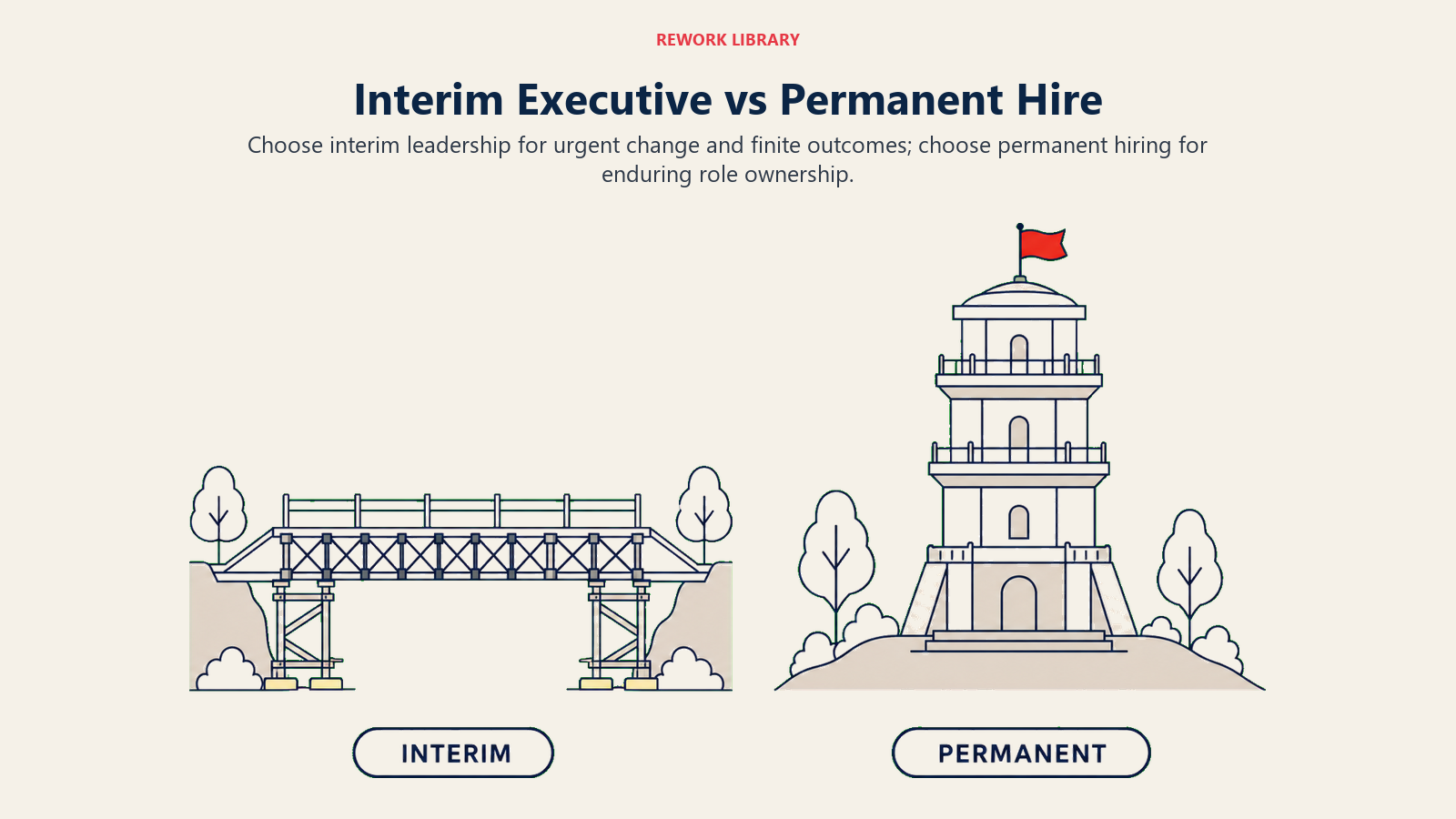
Rapid growth requiring specialized expertise happens when companies scale faster than their talent. They went from 50 to 200 employees in 18 months and the VP of Operations is drowning. They need someone who's built operational infrastructure before, but they aren't sure what the permanent role looks like yet. Interim placement gives them breathing room to figure it out.
Bridge between permanent leaders solves the gap problem. The CEO announced they're leaving in 6 months. The company wants to take their time finding the right replacement. An interim CEO maintains stability during the search and transition.
Seasonal or project-based needs don't justify permanent headcount. A retailer needs an experienced CFO to handle the capital raise but doesn't have ongoing need for that skill level. A construction company needs a safety officer for a major project. Temporary placement matches the temporary need.
Small and mid-size companies needing C-suite expertise often can't afford or justify full-time executive salaries. A 75-person company would benefit from CFO-level financial leadership but can't pay $250K+ salary plus benefits. A fractional CFO two days per week solves this perfectly.
The pattern: clients have a real leadership need that's either temporary, specialized, or can't justify permanent investment. Your interim placement gives them access to executive-level talent with flexibility they can't get through traditional hiring. Using a rigorous client qualification framework helps you identify which prospects are good candidates for these placements.
Scoping and positioning interim placements correctly
The difference between successful and failed interim placements often comes down to how well you scoped the engagement upfront. You're setting expectations, defining authority, and establishing success criteria before anyone starts. Start with understanding the business context. What's really driving the need? If they say "we need an interim CFO because ours quit," dig deeper. Why did they quit? What problems were they struggling with? What's the board expecting to see change? The stated need and the real need aren't always the same thing.
Then define role scope and authority level clearly. This sounds obvious but gets messy fast. The interim executive needs to know: What decisions can I make unilaterally? What requires board approval? Who do I actually manage? What's off limits?
Document this explicitly. If the interim CFO can approve expenses up to $50K but needs board sign-off above that, write it down. If they manage the accounting team but not FP&A, say so. If they're expected to attend board meetings and provide strategic input but the CEO makes final calls on financial strategy, be clear.
Success criteria and deliverables need to be specific and measurable. "Improve financial operations" is too vague. "Implement new budgeting process, close monthly books within 5 days instead of 15, complete audit with clean opinion, hire permanent controller" - those are concrete outcomes you can track.
Duration and time commitment should reflect the actual work required, not arbitrary timelines. If implementing a new ERP system realistically takes 9-12 months, don't promise 6 months to win the deal. Better to set realistic expectations upfront than fail to deliver or need extensions.
Reporting structure and governance prevent the nightmare scenario where the interim executive thinks they report to the CEO but the board thinks they report to them. Who's this person's boss? How often do they report progress? Who evaluates their performance? Get alignment before day one.
Here's the part most consulting firms skip: transition and exit planning upfront. From the first conversation, you're talking about how this ends. What does success look like? Are we building toward a permanent hire, transferring knowledge to internal team, or completing a project and exiting? Planning the exit before you start prevents dependency and ensures knowledge transfer happens. This transition planning is similar to the project closeout process for other engagements.
Selecting the right interim executive for the situation
Matching the wrong leader to the situation is the fastest way to destroy an interim placement. You're not just looking for qualified executives. You're looking for the right executive for this specific challenge. Start with matching expertise to business challenge. If the company is in financial distress and needs turnaround leadership, you need someone who's done successful turnarounds before. Not someone who's been a CFO at stable companies. If they're scaling from 50 to 200 employees, you need someone who's built operational infrastructure during hypergrowth. The specific challenge dictates the specific background required. Industry experience and functional depth both matter, but which matters more depends on the situation. For crisis situations or highly regulated industries, industry experience often matters more. A healthcare CFO understands reimbursement models and compliance requirements that a retail CFO doesn't. But for transformation projects, functional depth sometimes trumps industry knowledge. A CTO who's led three successful cloud migrations in different industries might be better than an industry-specific CTO who's never done one.
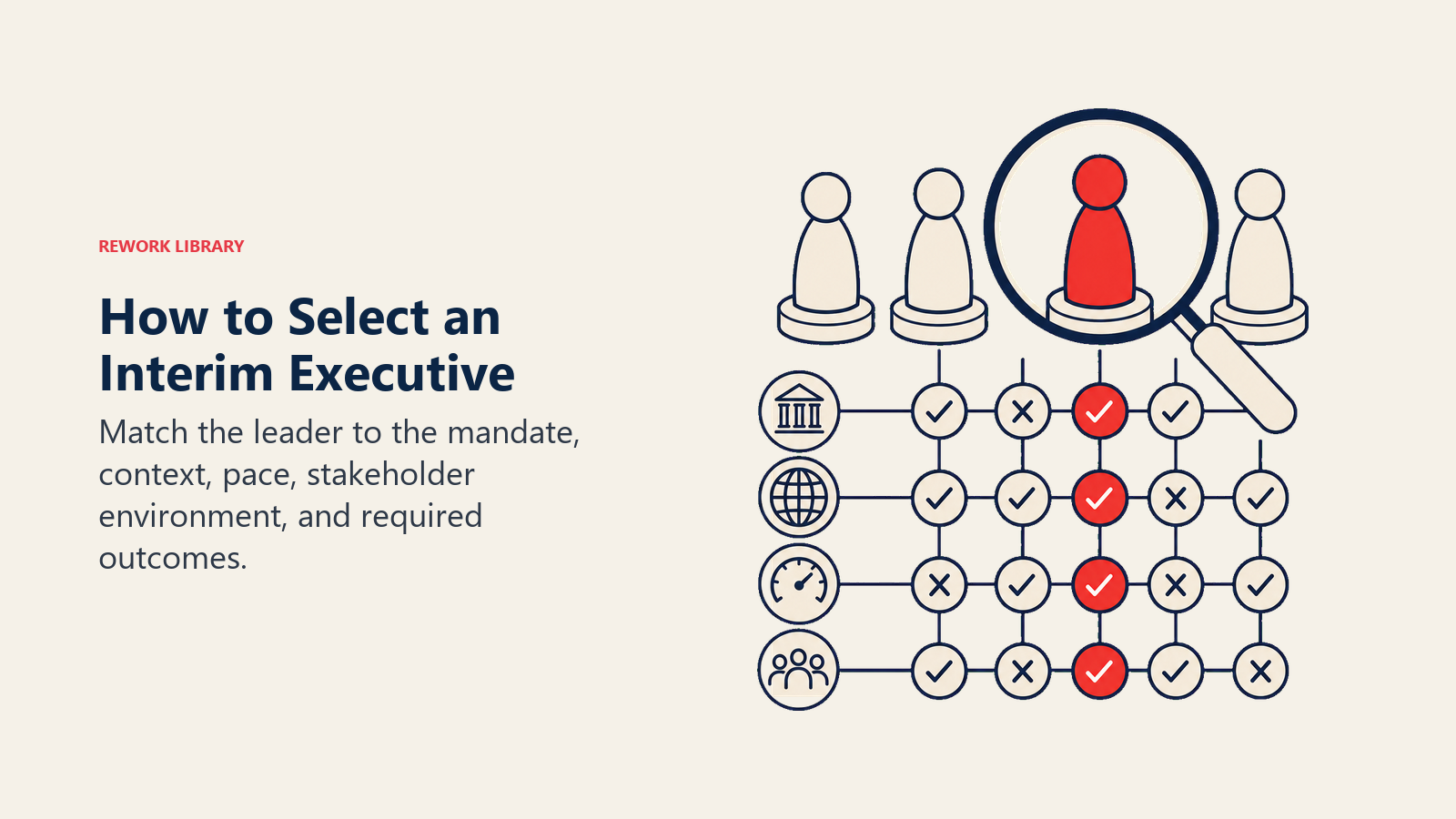
Cultural fit and leadership style can make or break interim placements. An executive who thrives in scrappy startup environments might clash in a corporate setting with established processes. Someone who leads through consensus-building might frustrate a board that wants decisive action during a crisis. You need to assess both the company culture and what the situation requires.
Quick assessment framework:
- Crisis situations need decisive, action-oriented leaders comfortable making tough calls fast
- Transformation projects need change management skills and ability to bring teams along
- Bridge roles need steady, diplomatic leaders who won't disrupt too much
- Growth situations need someone who's been there before and can move fast
Availability and commitment level are practical constraints that eliminate otherwise great candidates. If you need someone starting in two weeks and they're committed elsewhere for 3 months, they're not available regardless of fit. If the role requires 40 hours weekly but they're only available 15, the math doesn't work.
Track record in similar situations is your best predictor. Ask for specific examples: "Tell me about a time you were interim CFO during a crisis. What was the situation? What did you do in the first 30 days? What were the outcomes?" Generic experience isn't enough. You want pattern matching to this situation.
Reference checking and vetting matters even more for interim placements than permanent hires because there's no probation period. They're making decisions from day one. Call multiple references. Ask specific questions about how they handled conflict, worked with boards, managed through ambiguity. One bad placement can kill your interim executive practice.
Accelerated onboarding for immediate impact
Normal executive onboarding takes 90 days. Interim executives don't have that luxury. The client is paying premium rates and expects results quickly. That means the first 30 days are critical for building credibility and identifying quick wins. Start with stakeholder mapping before day one. Who are the key people the interim executive needs to build relationships with? Board members, direct reports, cross-functional leaders, key customers or partners. Schedule 1-on-1 meetings with each in the first two weeks. The goal isn't just gathering information - it's building trust and understanding the political landscape. Quick wins identification happens in parallel. What can the interim executive accomplish in the first 30-60 days that demonstrates value and builds momentum? This should be something visible, meaningful to stakeholders, and achievable without perfect knowledge of the organization.
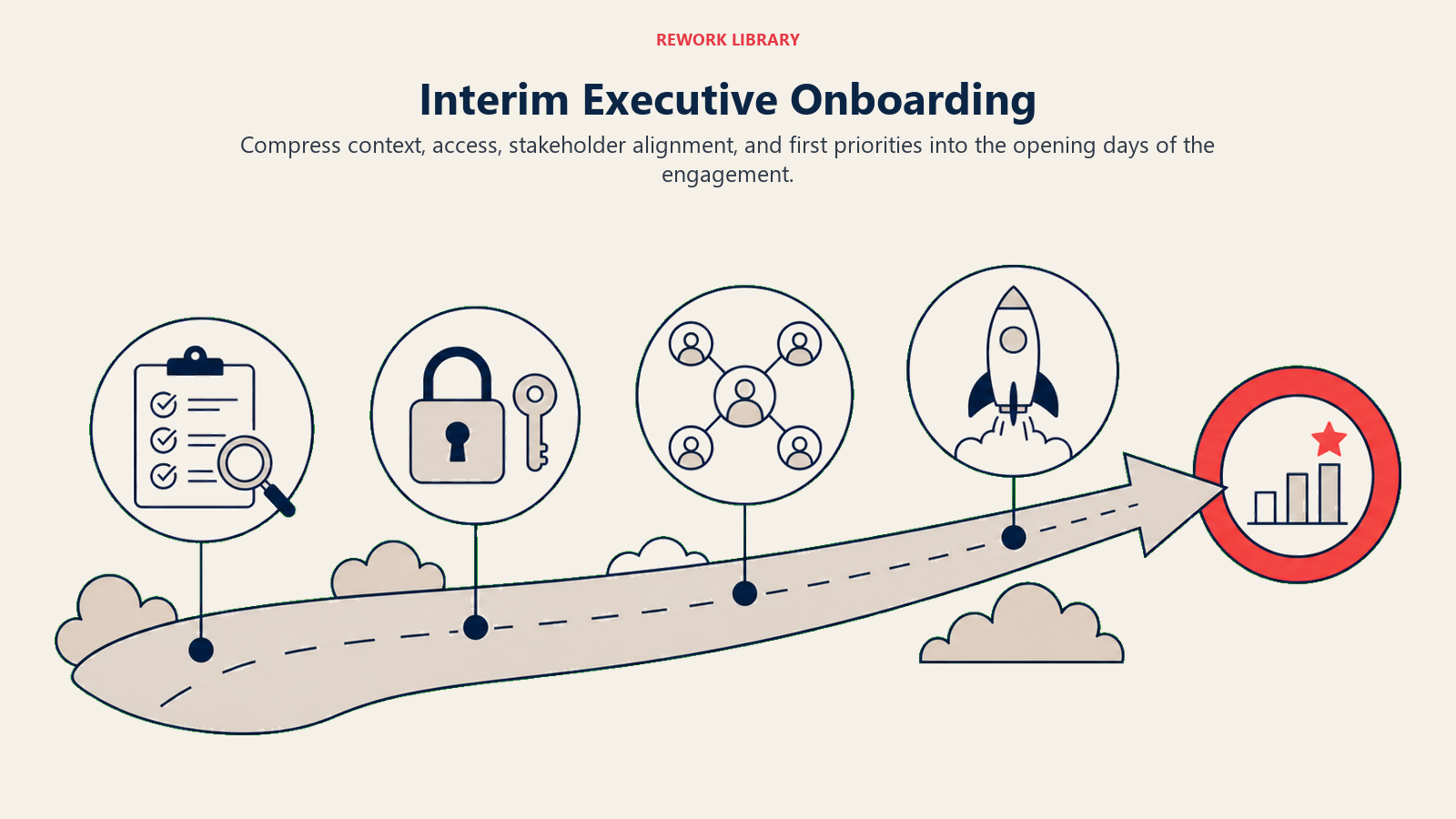
Examples: A interim CFO might clean up month-end close process to deliver financials 10 days faster. An interim COO might solve a persistent operational bottleneck that's been frustrating the team for months. These wins prove competence and earn the credibility to tackle bigger changes.
Team assessment and alignment can't wait. The interim executive needs to quickly evaluate their direct reports. Who's strong? Who's struggling? Where are the gaps? This isn't about firing everyone on day 30 - it's about understanding team capability so you can delegate appropriately and identify where to focus your own time.
Communication and expectation setting prevent the majority of interim placement problems. In the first two weeks, the executive should communicate clearly to their team: Here's what I'm doing here. Here's how long I'm staying. Here's what we're going to accomplish together. Here's how we'll work together.
The mistake is being vague or trying to act like a permanent hire. Be transparent about the interim nature while still demonstrating commitment to success.
Building credibility and trust rapidly requires both competence and relationship building. Show up prepared. Do what you say you'll do. Make smart decisions. But also invest in building relationships. Have lunch with the team. Understand what people care about. Learn the unwritten rules. Technical competence without relationship trust doesn't work at the executive level.
Managing interim executive performance throughout the engagement
Once the interim executive is in place, your job isn't done. You're managing a three-way relationship between your firm, the interim executive, and the client. Drop the ball on any side and the engagement falls apart. Regular check-ins with both client and executive should happen weekly at first, then bi-weekly once things stabilize. Separate conversations - you need honest feedback from each side without the other present.
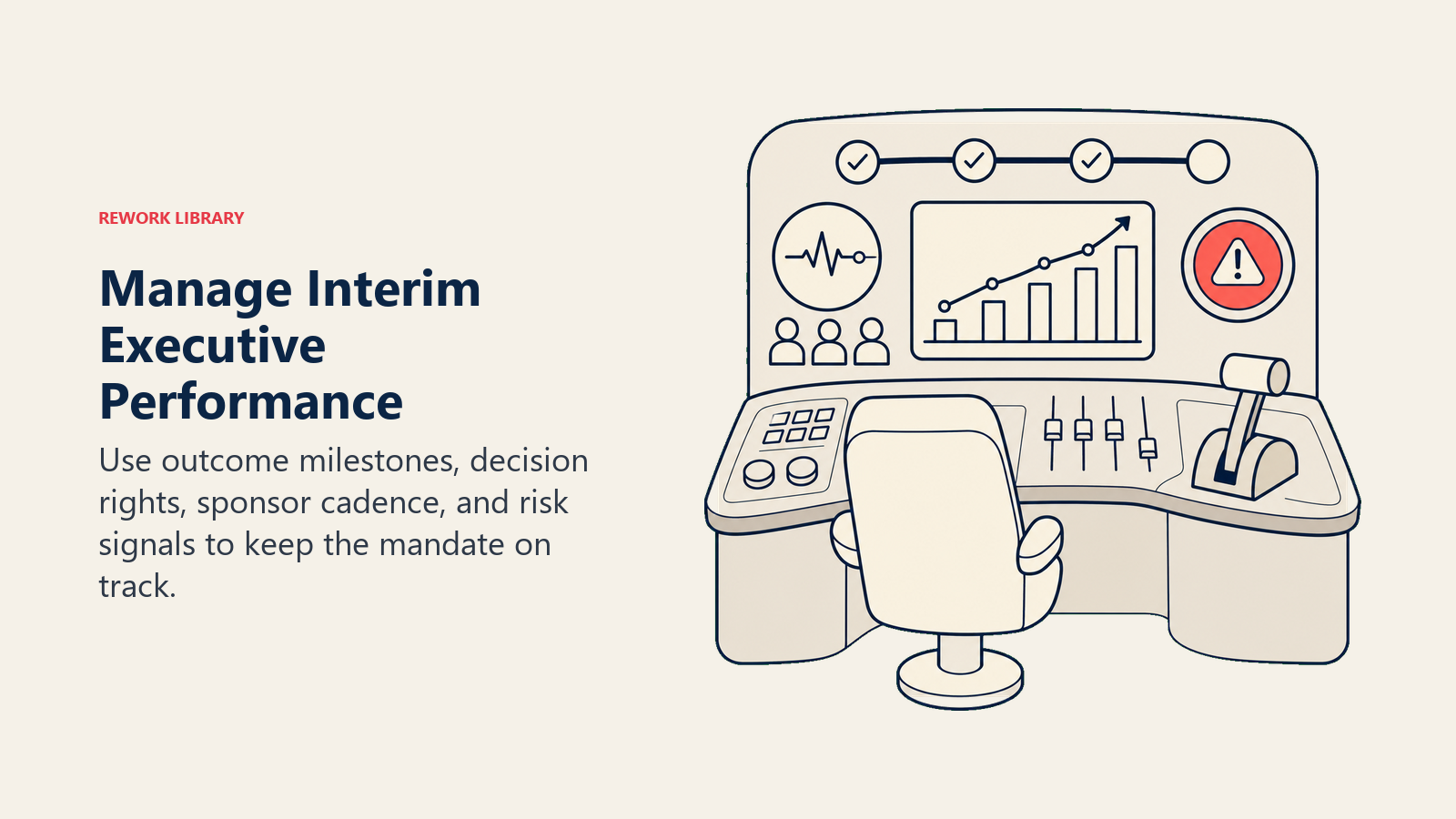
With the client: How's it going? Any concerns? Are we hitting the objectives we set? Do we need to adjust scope or timeline? With the executive: What challenges are you facing? What support do you need? Any red flags I should know about?
Progress against objectives tracking keeps everyone aligned on whether you're succeeding. Go back to those success criteria you defined during scoping. Are we on track? If we said "complete the audit by Q3" and it's July with no progress, that's a problem to address now, not in September.
Create a simple scorecard or dashboard that tracks key milestones and metrics. Share it with all stakeholders monthly. Transparency prevents surprises and builds trust.
Issue escalation and resolution happens faster when you have established channels. The interim executive hits a roadblock - maybe the board won't approve a decision they need, or they're getting resistance from another executive. Your job is to help navigate these situations, using your client relationship to smooth things over or escalate appropriately.
Sometimes the interim executive is the problem - underperforming or creating conflict. Catch this early through your client check-ins and address it directly. Is this a fixable issue with coaching and support? Or do you need to make a change?
Stakeholder feedback collection should be structured, not ad-hoc. Every 60-90 days, gather formal feedback from key stakeholders. How's the interim executive performing? What's working well? What could be better? This gives you early warning of problems and helps you course-correct.
Adjusting scope or approach as needed is normal and expected. The initial scope was based on incomplete information. As the interim executive gets into the work, they discover things that change the plan. Maybe the problem is bigger than you thought. Maybe it's actually different than you thought. Be flexible and adjust the engagement to reflect reality rather than forcing the original plan.
Governance and reporting cadence keeps everyone informed without creating reporting burden. Monthly board presentations or steering committee meetings where the interim executive shares progress, challenges, and next steps. This visibility builds confidence and ensures alignment.
Knowledge transfer and building internal capability
The worst interim placements are the ones that create dependency. The executive leaves and everything they built falls apart because nobody else knows how it works. Great interim placements leave the organization stronger and more capable. Building internal team capabilities should happen from day one. The interim executive isn't just doing the work - they're teaching the team how to do it. If they're implementing a new budgeting process, they're training the finance team on how to run it. If they're building a sales operations function, they're developing the skills of the person who'll run it permanently. Think "work out loud" approach where the interim executive explains their thinking and decision-making process. Team members learn not just what to do, but why and how to think through similar situations.
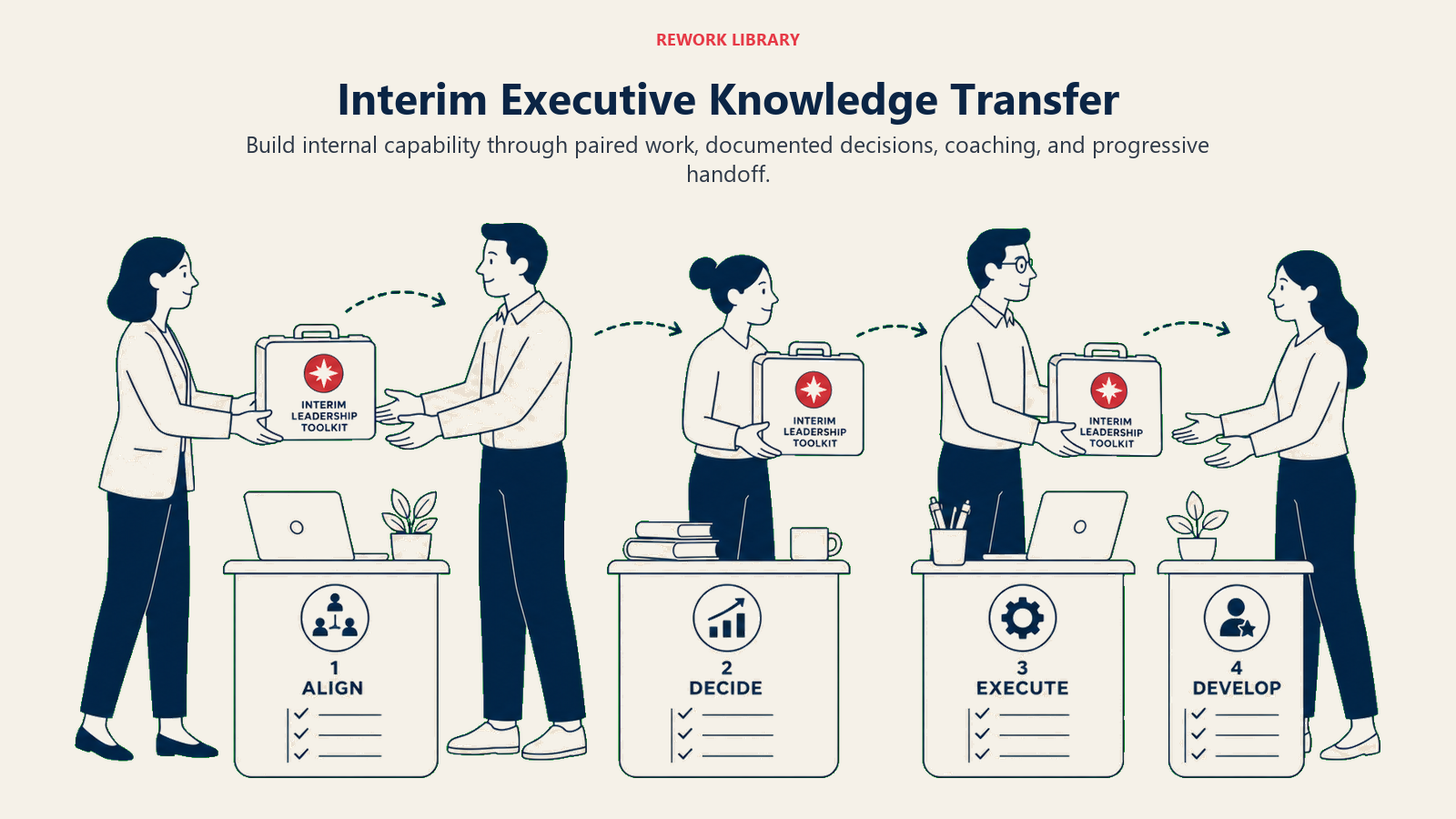
Documenting processes and decisions prevents knowledge loss when the executive leaves. Create playbooks, document new processes, record key decisions and rationale. This shouldn't be a massive documentation project dumped at the end. It's ongoing throughout the engagement.
Standard operating procedures for new processes. Decision frameworks for recurring choices. Org charts and role definitions for new structures. The goal is that someone can pick up this documentation in 6 months and understand how things work.
Mentoring and coaching the client team turns interim leadership into lasting development. The interim CFO is coaching the controller to think strategically, not just process transactions. The interim CTO is developing the engineering managers to make architectural decisions independently. This investment in people development pays dividends long after the interim executive leaves.
Succession planning and transition shouldn't start in the last month. You should be thinking about it from month three. Are we building toward promoting someone internally? Are we hiring a permanent replacement? What skills and knowledge need to transfer? Who's the right person to receive that knowledge?
If you're hiring a permanent executive, involve the interim leader in the search and onboarding. They can help define the role based on what they've learned, assess candidates for fit, and support the new hire's transition. That's much smarter than having the interim executive disappear and the new person start from scratch.
Ensuring sustainability after departure is the ultimate test. Three months after the interim executive leaves, are the improvements still in place? Is the team still running the new processes effectively? Or did everything revert to the old way?
Build sustainability through: clear ownership (who's responsible for what), documented processes (so it's not all tribal knowledge), trained team members (who can execute independently), and embedded habits (not just one-time changes).
Planning transitions and exits that leave clients stronger
How the engagement ends matters as much as how it starts. A poorly managed exit wastes all the good work that came before it. A well-planned transition cements your reputation and creates future opportunities. Planned transition timeline should be established 90 days before the expected end date. If this is a 12-month engagement, you're talking about transition planning in month 9. That gives enough time to execute knowledge transfer without creating awkward "lame duck" period where the interim executive loses effectiveness.
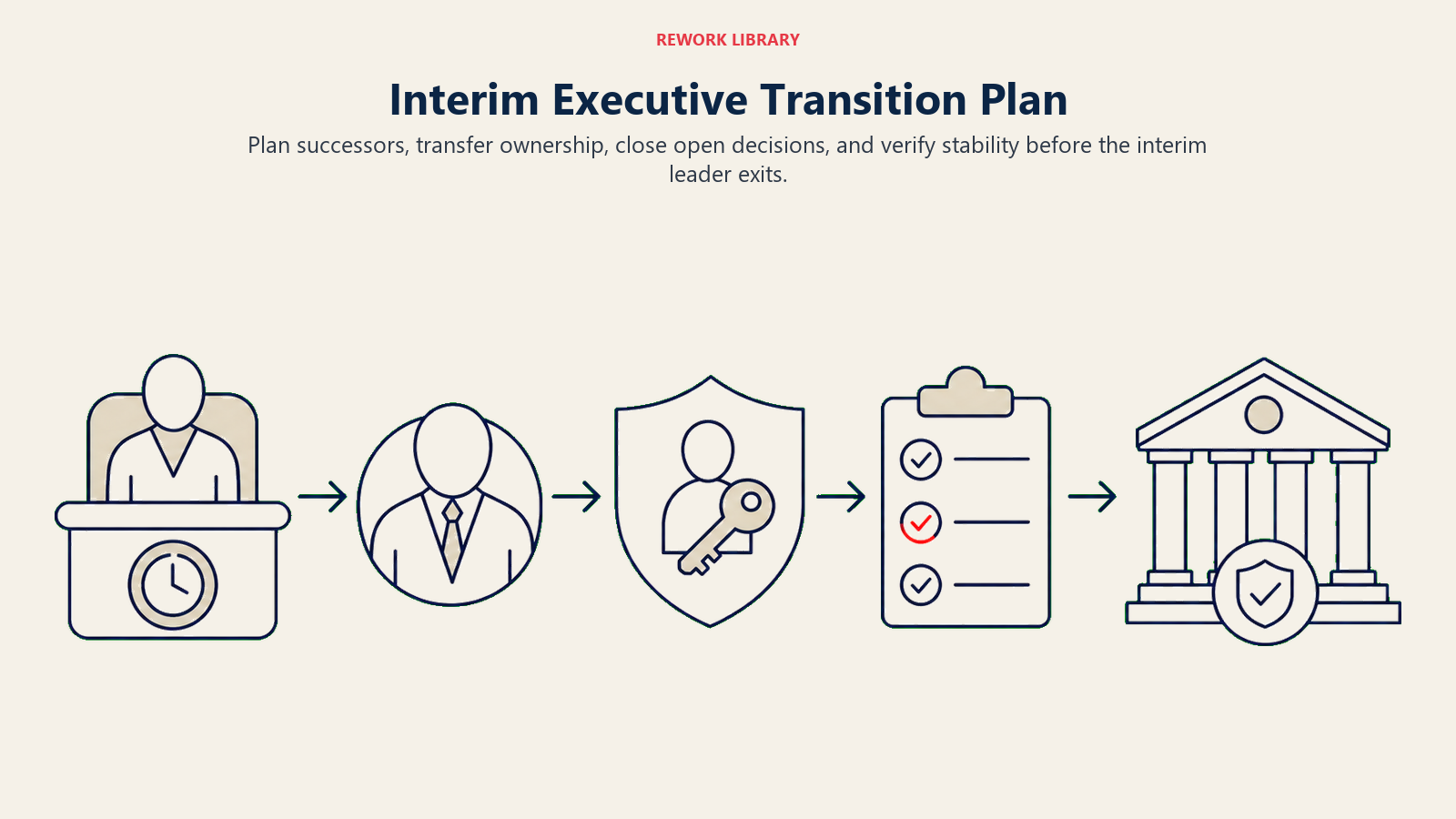
The timeline includes: knowledge transfer activities, permanent replacement hiring or internal promotion, overlapping transition period if possible, final deliverables and documentation, client team readiness assessment.
Identifying permanent replacement or internal successor depends on the situation. Sometimes the plan was always to hire permanent. Sometimes an internal person has been developing into the role. Sometimes the interim executive gets offered the job permanently (which happens in about 20% of placements).
If hiring permanent, start the search 4-6 months before planned exit. Executive searches take time. If promoting internal, you should have been developing that person throughout the engagement. They shouldn't be surprised when succession happens.
Knowledge transfer and documentation accelerates in the final 60 days. The interim executive is actively transferring everything in their head to documentation and direct training. Shadow days where the successor follows the interim executive. Reverse shadow days where the interim executive watches the successor handle situations and provides feedback.
Client team readiness assessment asks the hard question: Is the team actually ready to operate without the interim executive? Test this before the exit date. Have the interim executive step back for a week or two while still available for questions. Does everything keep running? Or does it fall apart?
If the team isn't ready, you have three choices: extend the engagement, accelerate knowledge transfer and capability building, or accept that some performance degradation will happen and plan for it.
Post-exit support and advisory provides a safety net. Even after the interim executive officially exits, maintain some level of availability for questions and guidance. This might be 4-8 hours monthly for 2-3 months. The successor can call with questions. The client feels supported. You maintain relationship continuity.
Success measurement and case study documentation captures the results for your firm's future business development. What were the initial objectives? What did you actually achieve? What metrics improved? What transformation occurred?
Get client testimonials and permission to use the engagement as a case study (with appropriate confidentiality protections). These success stories are your best marketing for future interim placements.
Pricing interim executive services for value and sustainability
Interim executive pricing needs to reflect the value delivered while remaining sustainable for both your firm and the interim executives themselves. Day rate vs retainer models both work but for different situations. Day rates are straightforward - you charge $2,000-5,000 per day depending on role level and industry. Good for project-specific work where scope might vary. Easier for clients to budget against specific time commitment.
Retainers work better for fractional ongoing roles. The client pays $15,000-30,000 monthly for 2-3 days per week of CFO time. Provides predictable revenue for your firm and predictable cost for client. Better alignment when you're focused on outcomes rather than time tracking.
Premium pricing for crisis situations is justified and expected. If the client needs someone to start Monday to handle a regulatory crisis or board emergency, that urgency commands premium rates - often 20-50% above standard. You're providing immediate availability and specialized crisis expertise. Price accordingly.
Fractional pricing for part-time placements should not be a simple pro-rata reduction. A fractional CFO two days per week isn't 40% of full-time cost. You're still providing executive-level expertise and availability. Fractional pricing is typically 50-70% of full-time equivalent rather than the mathematically proportional percentage.
Success bonus and outcome-based components align incentives and share value. If the interim CFO completes the fundraise or the interim CTO delivers the product launch, a success bonus on top of base fees makes sense. This shows confidence in your ability to deliver and creates upside when you exceed expectations.
Structure this carefully - tie bonuses to objective outcomes, not subjective satisfaction. "Company raises Series B" is objective. "Client is happy with performance" is subjective. These pricing approaches align with broader value-based pricing strategies.
Market rate benchmarking keeps your pricing competitive but not cheap. Research what interim executives command in your market and industry. Rates vary significantly:
- Small/mid-market interim executives: $1,500-2,500 per day
- Enterprise interim executives: $2,500-4,000 per day
- Specialized crisis or transformation: $3,000-5,000+ per day
- Fractional C-suite: $10,000-40,000 monthly retainer depending on time commitment and role
Your pricing should reflect the executive's experience level, the client's size and complexity, the urgency and risk level, and the expected business impact.
Typical margin structure: If you're paying the interim executive $1,500 per day, you're billing the client $3,000-3,500 per day. That 70-80% margin covers your overhead, relationship management, risk, and profit. For fractional retainers, similar margin applies to the total monthly fee.
Common pitfalls that destroy interim placements
Even well-intentioned interim placements fail for predictable reasons. Here's what to watch for and how to avoid it.
Unclear scope and authority from the start creates confusion and conflict. The interim executive makes decisions they think are within their authority, but the CEO or board disagrees. Or they're held accountable for outcomes but not given authority to make necessary changes.
Prevention - Document scope and authority explicitly in writing before the engagement starts. Get board and executive team alignment on what the interim leader can and cannot do.
Poor cultural fit and resistance happens when you place a leader who clashes with the organization's values or working style. A direct, confrontational leader in a consensus-driven culture. A process-oriented executive in a fast-moving startup. The skills might be right but the fit is wrong.
Prevention - Assess culture fit as carefully as functional fit. Have the interim executive meet multiple stakeholders before finalizing the placement. Look for style alignment, not just resume matching.
Insufficient onboarding and context leaves the interim executive operating blind. They make decisions based on incomplete information or misunderstanding of history and relationships. This damages credibility and creates friction.
Prevention: Invest heavily in the first two weeks. Provide comprehensive briefing materials. Schedule stakeholder meetings. Give access to key documents and data. Make sure they understand the political landscape and history before they start making changes.
Weak governance and stakeholder management means nobody's really managing the engagement. The interim executive is doing their thing, but there's no regular check-in with the board or CEO. Problems fester until they explode.
Prevention: Establish clear governance structure upfront. Weekly or bi-weekly check-ins between your firm, the interim executive, and key client stakeholders. Monthly steering committee or board updates. Don't let communication gaps develop.
No exit planning leading to dependency is what happens when everyone treats the interim placement like a permanent hire and avoids talking about transition. Then the 12-month mark hits and suddenly you're scrambling to figure out how to exit without everything falling apart.
Prevention: Talk about the exit from day one. Build transition planning into the project plan. Start succession activities 90 days before expected exit. Make knowledge transfer and capability building explicit objectives throughout.
Inadequate knowledge transfer leaves the client vulnerable when the interim executive departs. Nobody documented the new processes. The team didn't learn how to run things. The interim executive held all the knowledge in their head and took it with them.
Prevention: Make knowledge transfer and documentation ongoing activities, not end-of-engagement tasks. Measure success partly on team capability development, not just the interim executive's direct accomplishments.
Building a sustainable interim executive practice
If you're serious about interim executive services as a practice area, you need infrastructure and systems beyond individual placements.
Recruiting and vetting an interim executive pool gives you the bench strength to respond quickly when opportunities arise. You can't afford to start recruiting qualified executives after you win the engagement. Build relationships with experienced executives who are open to interim work before you need them.
Look for executives who are: recently retired but want to stay active, between permanent roles but selective about next opportunity, building portfolio careers across multiple fractional roles, interested in variety and impact over single-company focus.
Vet them thoroughly before adding to your pool. Check references, verify track record, assess communication and relationship skills, understand their availability and commitment level.
Marketing positioning and thought leadership establishes your credibility in the interim executive space. Publish case studies (with client permission). Write articles about when companies need interim leadership vs permanent hires. Speak at industry events about transformation leadership or crisis management.
Position your firm not as "executive recruiting" but as "leadership solutions for transformation and transition." You're solving business problems through strategic talent deployment.
Client relationship development starts with your existing clients. They're the warmest leads for interim placements because they already trust you. When you hear about leadership transitions, departures, or transformation initiatives, you can position interim services as a solution.
But also develop board member and investor relationships. They often see the need for interim executives across their portfolio before the management team does.
Engagement frameworks and templates standardize your approach while allowing customization. Create templates for: scope of work documents, interim executive selection criteria, onboarding checklists, governance and reporting cadence, transition planning frameworks, knowledge transfer protocols.
This consistency improves quality, accelerates deal cycles, and makes it easier to scale the practice.
Quality assurance and performance management prevents bad placements from damaging your reputation. Regular check-ins with clients and executives, structured feedback collection, performance scorecards against objectives, early intervention when issues arise.
If an interim executive isn't performing, you need to know early enough to fix it or make a change. Your reputation depends on the quality of every placement, not just the good ones.
Bench management and utilization balances having enough interim executives available without too many sitting idle. Track your pipeline of opportunities, forecast utilization rates, maintain relationships with your executive pool even when they're not on assignment.
Some interim executives in your pool will work full-time for you. Others might work fractional across multiple clients (yours and others). Some might only take occasional assignments. Managing this mix requires active relationship management.
Where this fits in your professional services growth
Interim executive placements complement and enhance your other consulting services. They're not a standalone offering - they're part of a broader client relationship strategy.
Interim placements often connect to consulting engagement models where you start with advisory work, identify leadership gaps, and transition into interim placement to execute the strategy.
Strong client qualification frameworks help you identify which clients are good fits for interim services. Look for companies in transition, growth, or crisis situations.
Your client onboarding process should include questions that uncover interim executive needs: leadership gaps, pending retirements, transformation initiatives, growth challenges.
Interim placements can lead into strategy consulting when the interim executive identifies strategic issues that need deeper work. Or they can support implementation consulting by providing the leadership to execute the recommendations.
The key is positioning interim executives not as a separate service line but as a leadership solution that solves real business problems. Sometimes clients need advice. Sometimes they need implementation support. And sometimes they need an experienced executive sitting in the chair making decisions and driving results.
That's when interim placements create value that clients will pay premium rates for.

Sales Director
On this page
- What interim executive services actually are
- When clients need interim executives instead of permanent hires
- Scoping and positioning interim placements correctly
- Selecting the right interim executive for the situation
- Accelerated onboarding for immediate impact
- Managing interim executive performance throughout the engagement
- Knowledge transfer and building internal capability
- Planning transitions and exits that leave clients stronger
- Pricing interim executive services for value and sustainability
- Common pitfalls that destroy interim placements
- Building a sustainable interim executive practice
- Where this fits in your professional services growth