Client Penetration Strategy: Expanding Your Footprint Within Existing Client Organizations
Turn this article into takeaways for your work.


Each assistant summarizes the article only for you and suggests best practices for your work.
Most professional services firms chase new logos while ignoring the gold mine sitting in their existing client base. You're working with Finance on tax compliance, but HR is spending six figures with another firm on compensation consulting. You're advising the CFO on financial controls, but Operations is bringing in a competitor for process improvement work.
This happens everywhere. You get hired for one thing, do great work, then watch other departments hand money to your competitors because nobody knows you exist beyond that initial scope.
Client penetration fixes this. It's about expanding from a single entry point to becoming an organization-wide resource, from serving one department to supporting multiple functions, from one service line to a comprehensive relationship.
The economics are compelling. Expanding an existing client generates 3-5x the profit margin of acquiring a new one. You already understand their business, their culture, their decision-making process. You've proven your value. The trust exists. And deeply penetrated accounts are nearly impossible for competitors to displace.
This guide walks through how to systematically expand your footprint within client organizations, department by department, relationship by relationship. When combined with white space analysis, you can identify exactly where expansion opportunities exist and prioritize your pursuit strategy accordingly.
The difference between breadth and depth
Account growth happens in two directions, and you need both.
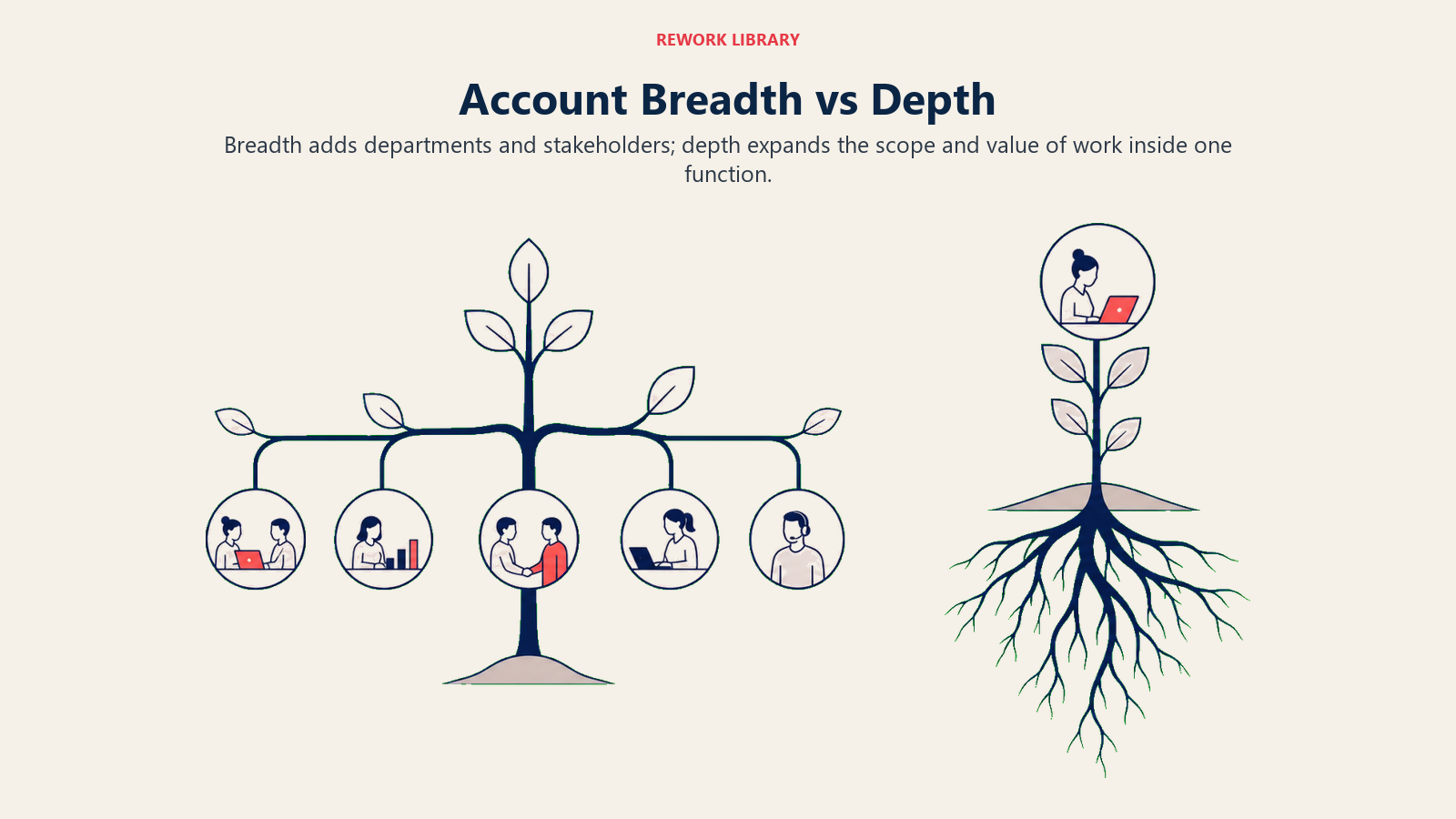
Breadth is expanding horizontally across the organization. You start working with Finance, then add HR, then Operations, then IT. Same service, different departments. Each new department increases your revenue footprint and creates multiple stakeholders invested in the relationship.
Depth is going vertical within a function. You start with basic compliance work for Finance, then add advisory services, then strategic planning, then interim CFO support. You're deepening the relationship by solving more complex problems and becoming more embedded in that function. This vertical expansion is what upsell and scope expansion focuses on.
The most valuable penetration strategies combine both. You deepen within your initial department to demonstrate expanding capability, then use that credibility to spread horizontally to new functions. A client that uses you for compliance and advisory across Finance, HR, and Operations is 10x stickier than one that uses you only for basic compliance work in Finance.
But here's what matters: 80% of your growth opportunity sits inside your current client base, not in prospecting new accounts. The client you're working with today probably spends 5-10x what they're paying you on professional services across all functions. Your job is capturing more of that wallet.
Assessing the opportunity within each client
Before you can expand, you need to understand what's possible. Most firms have no idea how much opportunity exists within their accounts because they've never mapped it.
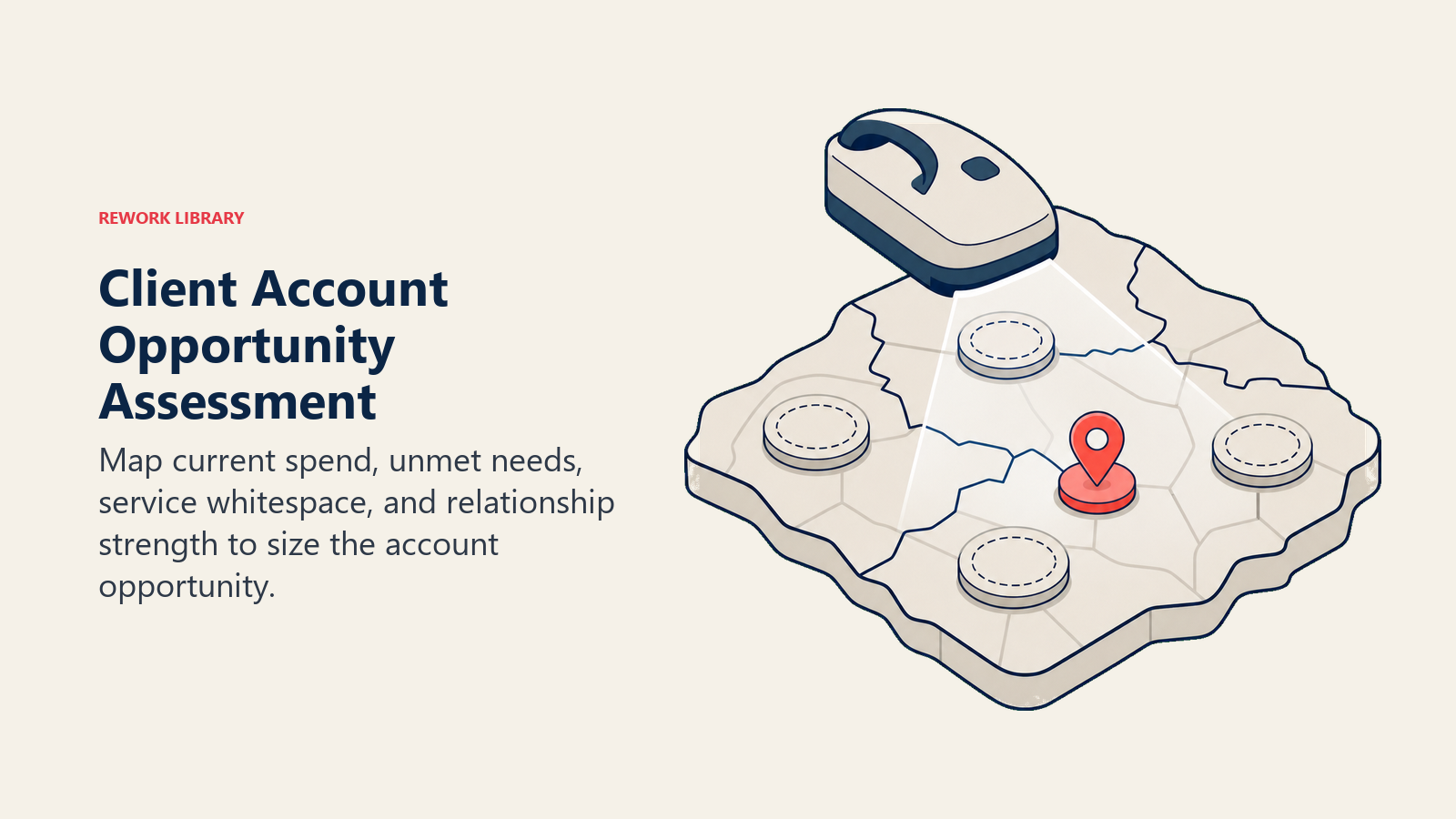
Start with current footprint analysis. Where are you today? Which departments are you serving? What percentage of the organization's total professional services spend are you capturing? If you're billing $200K annually but they spend $2M on external advisors, you have a 10% penetration rate. That's your baseline.
Then map department and division coverage. Large organizations have multiple functions that buy professional services: Finance, HR, Operations, IT, Legal, Sales/Marketing, Risk/Compliance. List them all. Mark which ones you currently serve, which ones you've had conversations with, and which ones don't know you exist.
For each department, estimate the addressable opportunity. What do they typically spend on services like yours? You can use industry benchmarks or ask your contacts what their budgets look like. This gives you a sense of total addressable market within that account.
Next comes service gap analysis. What problems does this client have that you could solve but aren't? Maybe you're doing tax compliance but not M&A advisory. Maybe you're handling cybersecurity but not IT strategy. List the services you offer that this client needs but is either handling in-house or buying from someone else.
Finally, assess competitive presence. Who else is working there? Which departments are they serving? How entrenched are they? A competitor who's been embedded in HR for five years is harder to displace than one who just started a project last quarter. This competitive mapping tells you where you have open field versus where you need displacement strategies.
Mapping organizational structure and stakeholders
You can't expand if you don't understand the terrain. Organizational mapping is about understanding how the company works, who makes decisions, and where the relationships are.
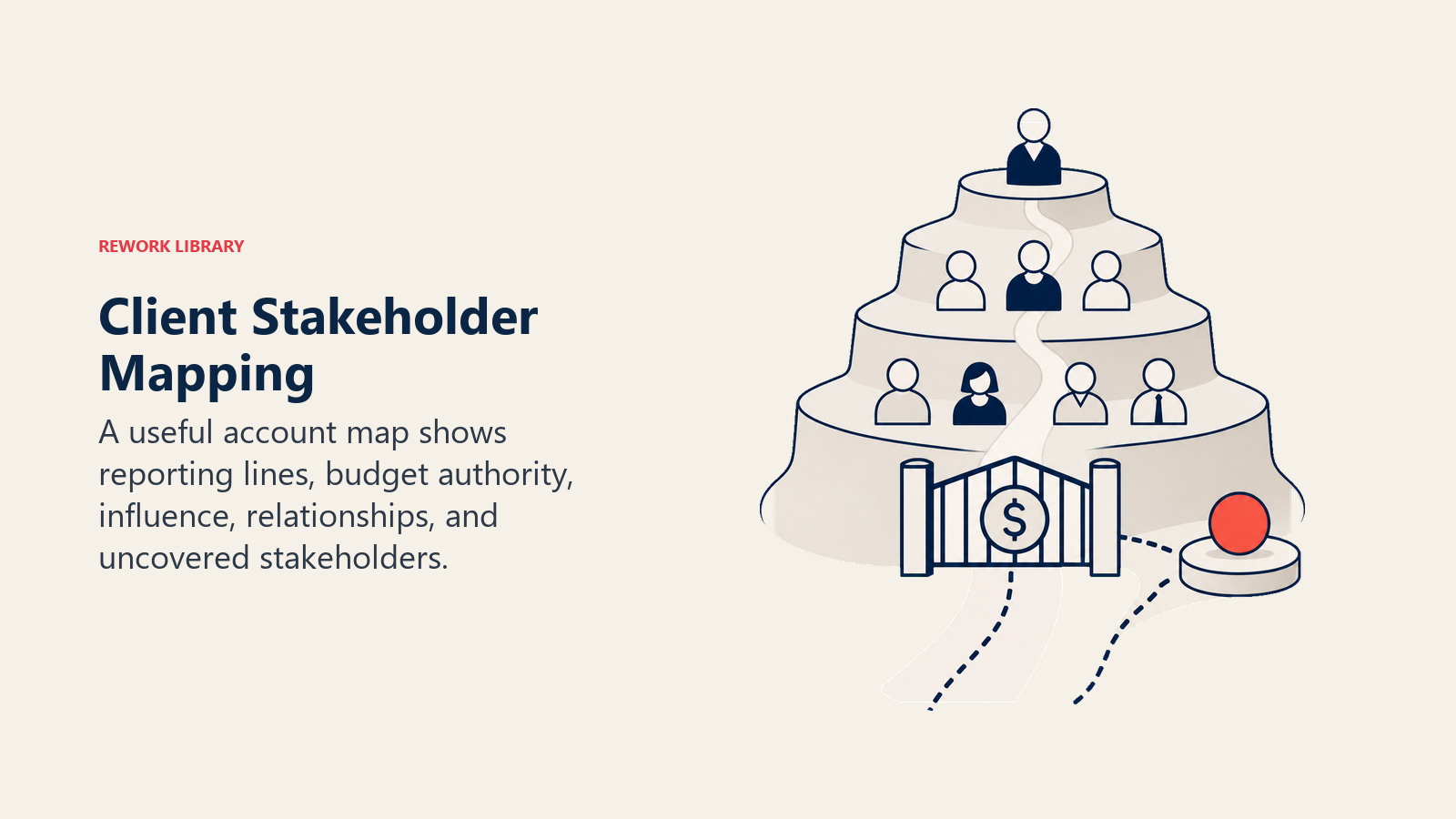
Start with the hierarchy. Who reports to whom? In smaller companies this is straightforward, but in enterprises it gets complex. You need to understand the chain of command because that determines approval processes and budget authority.
Then identify stakeholders by function. List the key players in each department - not just executives, but the people who actually evaluate vendors, manage projects, and influence decisions. You're building a comprehensive relationship map.
Classify each stakeholder as decision-maker, influencer, or end-user. The CFO might make the final call on hiring you for a finance project, but the VP of Financial Planning might be the one who recommends vendors and manages the selection process. The analyst who uses your deliverables isn't making decisions but can become an internal advocate if they love your work.
For each relationship, assess strength on a simple scale: strong (they'd advocate for you), neutral (they know you but no strong opinion), weak (minimal interaction), or adversarial (they prefer competitors or don't trust you). This tells you where you have relationship capital and where you need to invest.
Don't ignore organizational politics. Every company has them. Which departments collaborate well versus compete for budget? Who has the CEO's ear? What initiatives are getting funding versus getting cut? Understanding these dynamics helps you position expansion opportunities in ways that align with internal priorities.
Building multi-level engagement across the organization
Single-threaded relationships are fragile. If your only contact leaves the company, your account is at risk. Multi-level engagement builds resilience by creating relationships at different organizational levels.
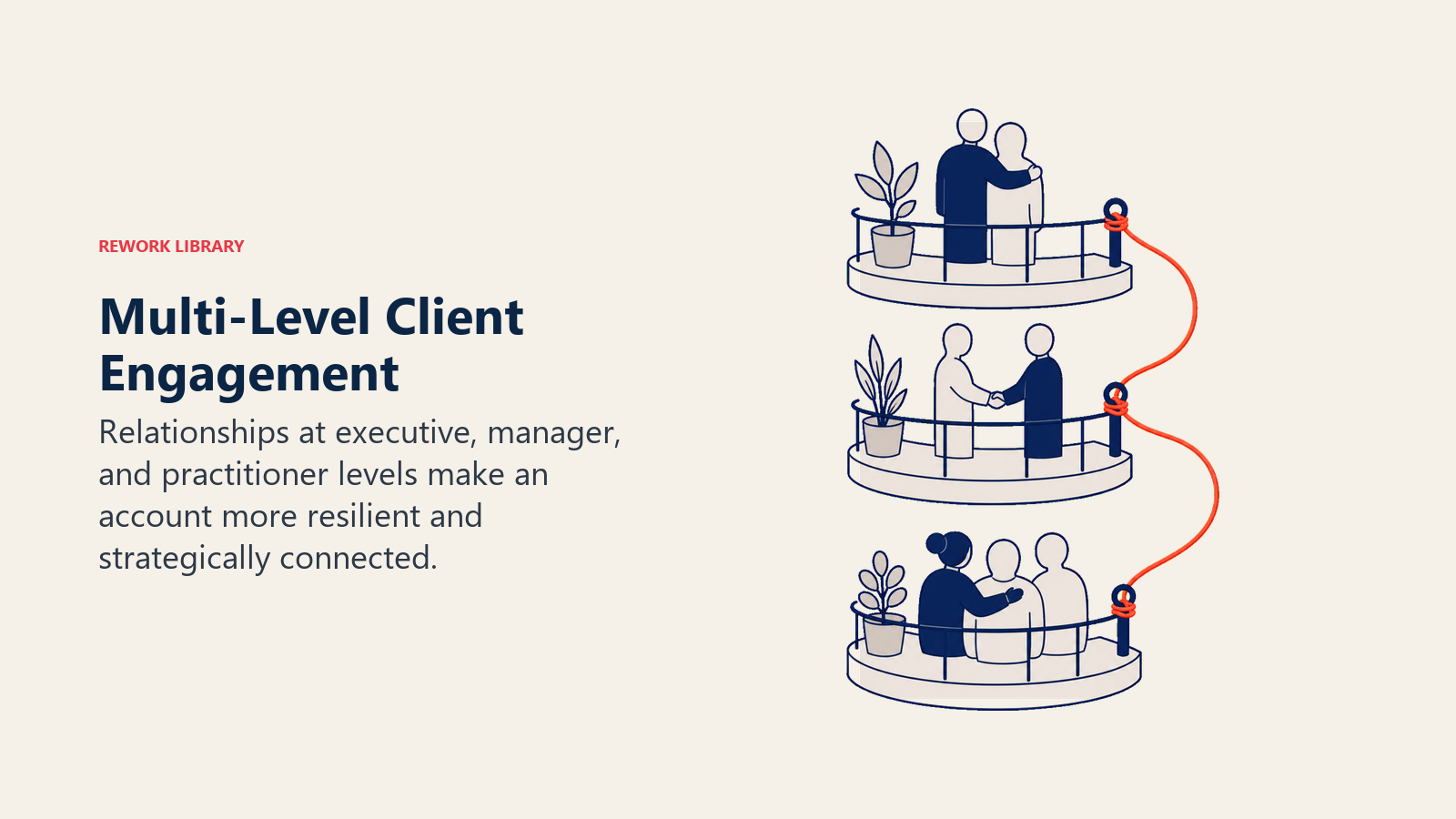
C-suite and executive engagement gives you top-down credibility and strategic visibility. When the CEO or CFO knows who you are and values your work, doors open across the organization. But you need a reason to engage at this level - executives don't care about tactical details. Focus on business outcomes, strategic priorities, and organizational challenges that span multiple functions.
Department head relationships are where budget authority usually lives. These are VPs and directors who control spending within their functions. They're evaluating whether to expand scope or bring you into new projects. Maintain regular touchpoints with these stakeholders, even when you're working with their teams rather than directly with them.
Practitioner and end-user connections are the people doing the work day-to-day. They're analysts, managers, specialists who interact with your deliverables and recommendations. If they find your work helpful and your team easy to collaborate with, they become internal advocates who push for expanding the relationship.
Cross-functional team collaboration happens when you work on initiatives that span multiple departments. Maybe you're on a project team that includes Finance, Operations, and IT. These cross-functional interactions create exposure to stakeholders beyond your immediate client, showing them your capabilities and building credibility for future expansion.
The key is intentional relationship building at each level. You're not just delivering work - you're creating advocates across the organization who can champion bringing you into new areas.
Expanding department by department
Different functions buy professional services differently. Your expansion strategy needs to account for these differences.
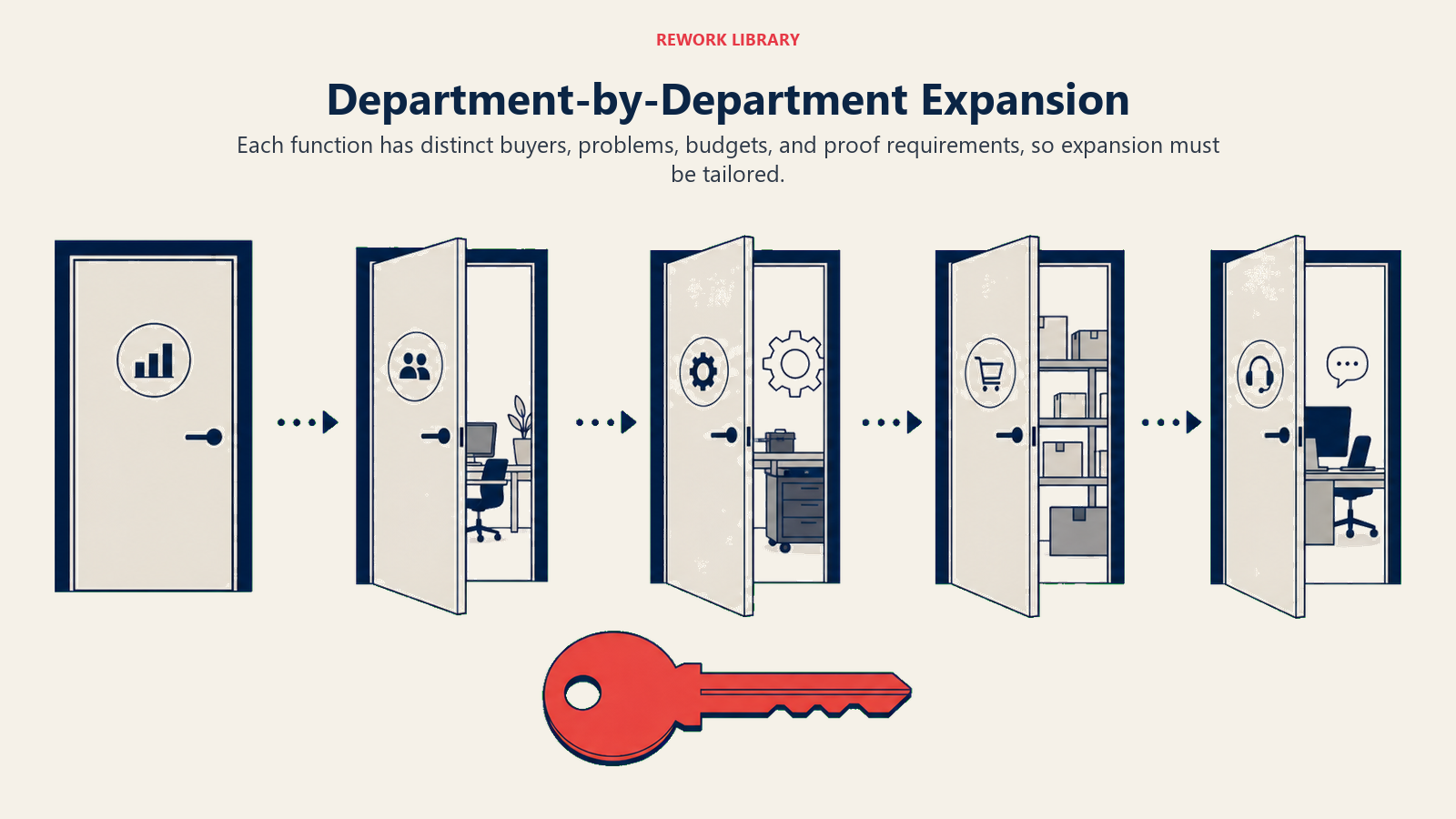
Finance and accounting penetration often starts with compliance (tax, audit, financial reporting) and expands to advisory services (FP&A support, M&A due diligence, financial system implementation). The CFO organization typically has budget authority and makes decisions quickly if they trust you. The challenge is that finance leaders often have long-standing relationships with incumbent advisors, so you need to demonstrate differentiated value.
Operations and supply chain opportunities include process improvement, operational efficiency, supply chain optimization, and interim management. Operations leaders value pragmatic solutions that deliver measurable ROI. They want to see results, not frameworks. If you can demonstrate cost savings or efficiency gains, they'll expand scope readily.
Human resources expansion covers compensation and benefits consulting, talent strategy, organizational design, leadership development, and HR technology implementation. HR teams often work with specialized boutiques, so if you offer generalist services, you'll need to prove domain expertise. But HR budgets are substantial, especially in growing companies.
Technology and IT services include cybersecurity, cloud migration, digital transformation, IT strategy, and system implementations. IT leaders are drowning in vendors, so breaking in requires differentiation. But once you're in, IT projects tend to be large and multi-year, creating significant revenue opportunity.
Sales and marketing opportunities range from go-to-market strategy to sales enablement to marketing technology implementation. These functions value growth and revenue impact, so frame your services around business outcomes, not deliverables. Sales leaders make decisions quickly but also change direction often, so maintain flexibility.
Risk and compliance functions need regulatory advisory, internal audit support, compliance program design, and risk assessment. These areas often have mandatory spending driven by regulations or board requirements, creating consistent demand. The challenge is that risk and compliance leaders are naturally conservative and prefer established, credible advisors.
For each department, your entry strategy should start with understanding their current pain points and priorities, not leading with what you sell. Find the problem they're actively trying to solve, demonstrate how you can help, and deliver exceptional results on that initial project. Then use that credibility to expand into adjacent areas. For systematic approaches to introducing your capabilities to new departments, see additional services introduction.
Service bundling strategies for deeper penetration
Once you've established a foothold, packaging services strategically can accelerate expansion.
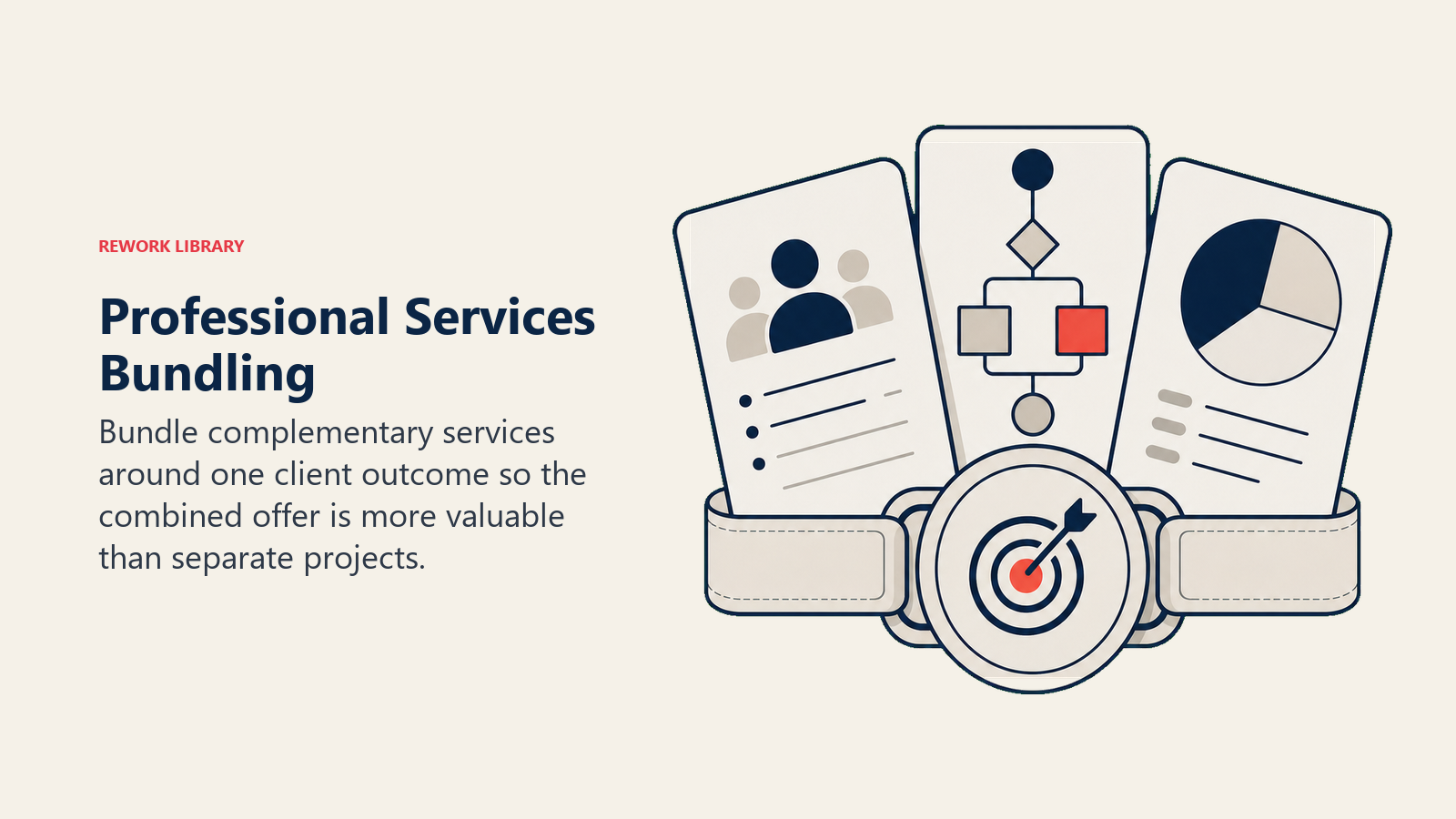
Enterprise-wide packages position your services as organization-level solutions rather than department-specific projects. For example, if you're doing operational assessments, propose an enterprise operational review that covers Finance, HR, Operations, and IT. This creates a natural entry point to multiple departments simultaneously and positions you as a strategic partner, not a tactical vendor.
Department-specific offerings bundle related services within a single function. If you're doing compensation consulting for HR, bundle it with organizational design and talent strategy. This increases deal size within that department and deepens the relationship before you try to expand to other areas.
Phased expansion approach starts with a small, low-risk engagement in a new department, delivers value, then proposes expanding scope. "We're currently helping Finance with financial planning. I'd like to propose a pilot project with Operations to assess operational efficiency, and if that works well, we can expand to a comprehensive operational improvement program." The pilot reduces the barrier to entry, and successful delivery creates momentum for expansion.
Pricing strategy for depth uses volume discounts or package pricing to incentivize broader engagement. If your standard rate for a service is $X, offer a bundled rate that's 15-20% lower if they commit to engaging you across multiple departments or service lines. This makes expansion economically attractive and positions you as a strategic partner rather than a transactional vendor.
The goal is making it easier and more attractive for clients to expand their use of your services than to stay narrow or bring in additional firms. A cross-sell strategy helps you systematically identify which services to bundle and how to introduce them naturally.
Coordinating your internal account team
Client penetration only works if your delivery is coordinated. Nothing kills expansion faster than different people from your firm showing up at the same client with conflicting messages or duplicative outreach.
Account team organization should assign clear roles. Who's the overall account lead responsible for relationship strategy and revenue targets? Who owns each department relationship? Who coordinates delivery across projects? Without clear ownership, opportunities get missed and clients get confused about who they should talk to.
Cross-functional delivery requires coordination between your service lines. If your tax team is working with Finance and your HR consulting team wants to pitch a compensation project, they need to communicate. Share client intelligence, coordinate timing, and avoid competing for the same budget. One firm, one unified approach.
Communication and alignment happens through regular account planning meetings. Monthly or quarterly, the account team should review current projects, upcoming opportunities, relationship status, competitive threats, and expansion priorities. This keeps everyone aligned and prevents surprises.
Resource commitment matters because clients notice when you're under-resourced. If you're trying to expand into three new departments simultaneously but don't have the bench strength to deliver quality work, you'll damage the relationship. Be realistic about capacity and prioritize the highest-value expansion opportunities.
The best account teams operate like a coordinated sales and delivery machine where everyone understands the expansion strategy and their role in executing it.
Strategies for gaining access to new departments
Getting in front of new stakeholders requires intentional strategy, not just hoping your current contacts make introductions.
Entry point strategy by department recognizes that different functions respond to different approaches. Finance leaders want data and ROI models. HR leaders want case studies and testimonials. Operations leaders want to see process improvements in action. Tailor your approach to the audience.
Relationship deepening techniques start with your existing contacts. Ask them directly: "We've really enjoyed working with your Finance team on this project. Are there other areas of the organization where you think we could add value?" Most clients are happy to make introductions if they trust you. Some will even champion your expansion internally without you asking.
Access widening approach uses formal channels like QBRs (quarterly business reviews) or executive briefings to create visibility with senior leaders. Present results from your current work, highlight broader organizational opportunities you've identified, and suggest next steps. This creates natural conversation starters about expansion.
Communication and visibility strategies include sharing relevant insights with stakeholders beyond your immediate client. If you produce a thought leadership piece on supply chain optimization and you know their VP of Operations would find it valuable, send it with a note: "Thought this might be interesting given some of the challenges I've heard the Operations team is working through." You're demonstrating value without asking for anything.
The key is persistence without being pushy. You're planting seeds, building awareness, and creating opportunities for conversations. Some will take root quickly, others take months.
Creating and communicating value across functions
Different departments care about different outcomes. Your value proposition needs to translate across these different lenses.
Department-specific value propositions should speak to what each function cares about. Finance wants cost savings, better controls, and improved decision-making. HR wants talent retention, organizational effectiveness, and employee satisfaction. Operations wants efficiency, quality, and throughput. Sales wants revenue growth and pipeline acceleration. Don't use the same pitch for everyone.
Quantifying and communicating value means translating your work into metrics that matter. If you helped Finance streamline their close process, quantify the hours saved and translate that into cost reduction. If you helped HR redesign their org structure, measure improvements in span of control or decision-making speed. Numbers make your value concrete.
Value reinforcement and updates should happen regularly, not just at project completion. Send brief updates that highlight progress and outcomes: "Quick update: the process improvements we implemented in Finance have reduced month-end close time by 3 days, saving approximately 200 hours per quarter." These updates keep your value top-of-mind and create natural opportunities to discuss expansion.
Executive sponsorship development happens when you consistently deliver results and communicate them effectively. When executives see clear value from your work, they become sponsors who actively support expanding your engagement. They'll make introductions, allocate budget, and champion your firm internally.
Value isn't just about doing good work. It's about making sure the right people know about that good work and understand how it translates to outcomes they care about.
Building a client penetration plan for each account
Strategic account penetration requires a plan, not just opportunistic responses to RFPs.
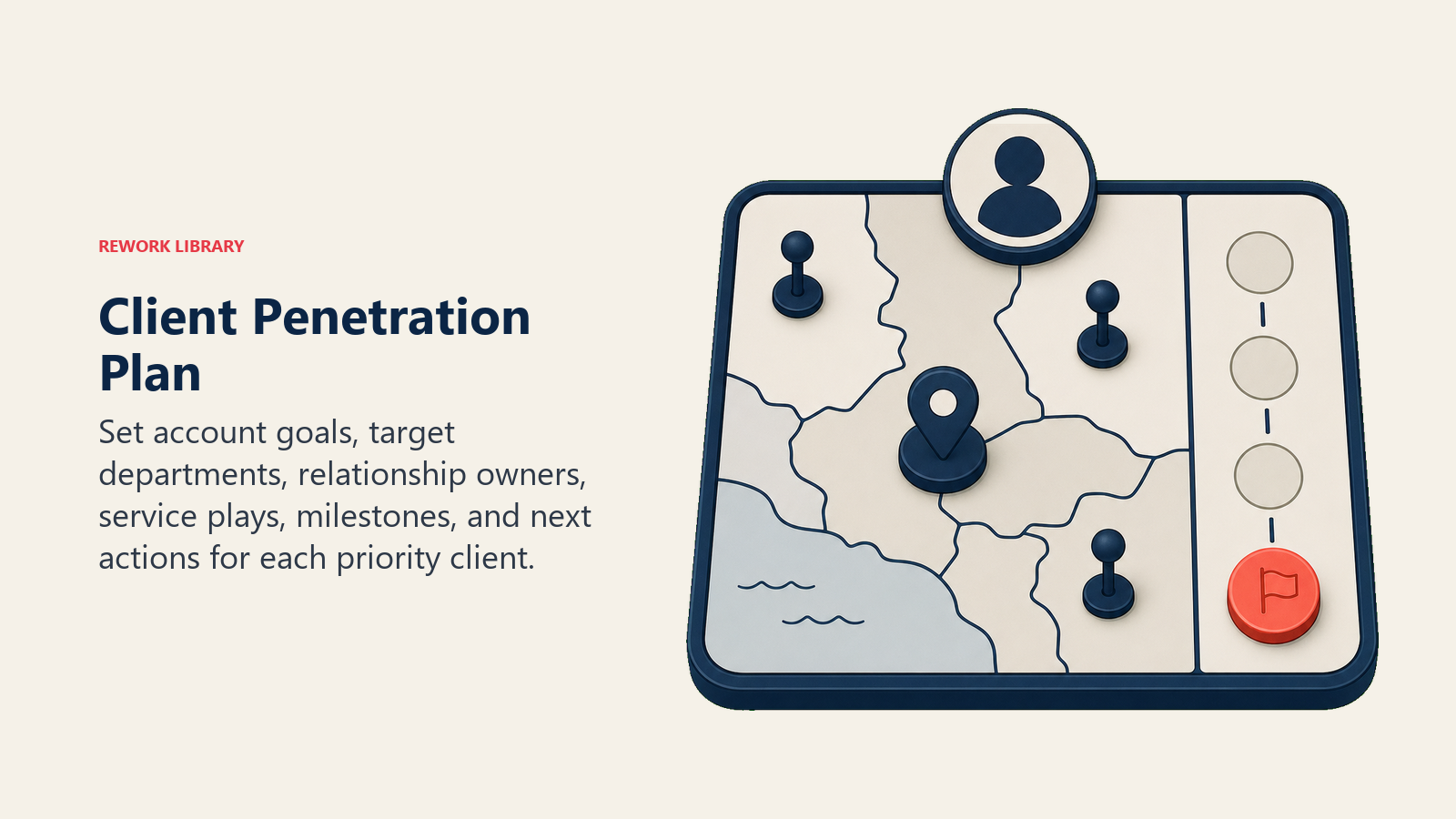
Account penetration plan development starts with setting clear goals. What revenue do you want to generate from this account in 12 months? 24 months? Which departments do you want to penetrate? Which service lines do you want to expand? Write it down.
Then map the path. For each target department, identify:
- Current relationship status (strong contact, weak contact, no contact)
- Key decision-makers and influencers
- Known pain points or initiatives
- Potential services you could provide
- Estimated revenue opportunity
- Timeline and milestones for engagement
Opportunity pipeline management treats each potential expansion like a sales opportunity. Track it in your CRM. Assign ownership. Set next steps. Review progress. This keeps expansion efforts visible and accountable rather than hoping someone remembers to follow up. For significant accounts with substantial expansion potential, structure pursuits around multi-year engagements that create predictable revenue streams.
Execution and implementation requires discipline. Schedule regular touchpoints with target stakeholders. Attend their meetings when invited. Share relevant insights. Propose pilot projects. Most account expansion happens through consistent, incremental relationship building, not big "land and expand" deals.
Performance tracking measures both leading indicators (relationships built, meetings held, proposals submitted) and lagging indicators (new departments served, service lines expanded, revenue growth). This tells you whether your penetration strategy is working or needs adjustment.
Treat your top accounts like strategic initiatives with dedicated resources, clear plans, and regular executive review.
Using penetration as competitive protection
The deeper you penetrate an account, the harder it becomes for competitors to displace you.
Penetration as competitive moat works through three mechanisms. First, you're integrated into multiple functions, so a competitor would have to displace you in several areas simultaneously, which is hard. Second, you have relationships at multiple levels, so even if one stakeholder leaves or changes vendors, others keep you engaged. Third, you understand the organization deeply, making your advice more valuable and your delivery more efficient than outsiders.
Competitive threat assessment should be ongoing. Who else is working there? Are they expanding their footprint? Are you hearing about them in new departments? If a competitor is making moves, you need to counter quickly. Complacency kills.
Relationship stickiness development happens when you become embedded in how the client operates. If your processes integrate with theirs, if their teams are trained on your methodologies, if their leadership views you as an extension of their team rather than an external vendor - that's stickiness. It creates switching costs that protect your position.
Proactive competitive response means not waiting until you're being displaced. If you hear a competitor is pitching a new department, reach out proactively: "I heard [Department] is looking at [Service]. We've done similar work in your Finance organization - happy to share what we've learned if it would be helpful." You're positioning yourself as a resource, not a salesperson.
The best defense is a well-penetrated account where you're so deeply embedded and broadly engaged that displacing you would be organizationally disruptive.
Managing change and organizational transitions
Organizations evolve. Your penetration strategy needs to adapt.
Stakeholder transitions happen constantly. Your champion gets promoted, leaves the company, or moves to a different department. If that person was your only relationship in that function, you're vulnerable. This is why multi-level engagement matters - when one contact leaves, others remain.
When you learn about a transition, act quickly. Congratulate the person on their move. Ask for an introduction to their successor. Offer to brief the new stakeholder on current work. Don't wait for them to reach out to you.
Change initiative integration creates expansion opportunities. If the company is going through a transformation, reorganization, system implementation, or other major initiative, there's budget and momentum. Position your services as supporting that change: "I know you're implementing a new ERP system. We've helped similar companies optimize their processes before migration - happy to discuss if that would be valuable."
Organizational evolution adaptation recognizes that priorities shift. A department that had no budget last year might have significant budget this year because of a new strategic initiative. A function that was outsourcing everything might be insourcing and no longer buying external services. Stay current on what's changing and adjust your penetration strategy accordingly.
The organizations that are easiest to penetrate are often those in transition, because change creates new problems, new budgets, and new decision-makers who haven't yet formed vendor relationships.
Common challenges and how to handle them
Even well-executed penetration strategies hit obstacles.
Budget constraints and priorities mean that even when a department wants to work with you, they might not have funding. Don't give up - ask about timing: "I understand budget is tight this quarter. What does next year look like?" Or explore shared budget models: "Would it make sense to position this as an enterprise initiative with budget coming from multiple departments?"
Departmental silos create situations where your work in Finance creates zero awareness in HR. Break down silos by creating cross-functional visibility. Present results in company-wide forums. Ask your Finance contacts to share your work with peers in other departments. Use executive sponsors to bridge silos.
Incumbent vendor relationships are the hardest barrier. Some departments have worked with the same firm for 10 years and aren't interested in changing. You have two options: wait for the incumbent to screw up, or propose something differentiated that the incumbent can't deliver. Sometimes the right answer is to focus on other departments where you have a better shot.
Complex decision-making slows everything down. In large organizations, getting approval to expand services might require sign-off from multiple stakeholders, procurement reviews, and budget approvals. Understand the process, work it patiently, and maintain momentum by continuing to build relationships while approvals grind forward.
Resource constraints on your side can limit expansion. If you're already stretched thin delivering current work, you can't take on three new departments simultaneously. Prioritize ruthlessly. Pick the highest-value expansion opportunities and sequence others for when you have capacity.
Penetration is a long game. Some departments will expand quickly, others will take years. Stay patient and persistent. Track your progress using the metrics outlined in professional services metrics to ensure your penetration efforts are generating measurable results.
Where to go from here
Client penetration is your highest-ROI growth strategy. You've already won the client once. You've proven your value. You understand their business. The marginal cost of expanding is far lower than acquiring new clients.
But it requires intentional effort. It won't happen just because you do good work. You need to map opportunities, build multi-level relationships, create department-specific value propositions, and execute a coordinated account plan.
Start with your top accounts - the ones where you have strong relationships, where the potential revenue is significant, and where you're not at risk of losing the current work. For each one, build a 12-month penetration plan that identifies target departments, key stakeholders, expansion opportunities, and specific actions you'll take to move forward.
Then execute consistently. This isn't a one-time project. It's an ongoing discipline of relationship building, value demonstration, and strategic expansion.
For more on maximizing value from existing clients, see:
- Client Relationship Strategy - Building long-term strategic partnerships
- Cross-Sell Strategy - Introducing additional service lines
- Upsell & Scope Expansion - Growing engagement depth within projects
- Client Communication Cadence - Maintaining strategic visibility
- Professional Services Metrics - Measuring account growth and penetration
The firms that master client penetration grow faster, more profitably, and more sustainably than those chasing new logos. Your existing clients are your best growth opportunity. Go capture it.

Sales Director
On this page
- The difference between breadth and depth
- Assessing the opportunity within each client
- Mapping organizational structure and stakeholders
- Building multi-level engagement across the organization
- Expanding department by department
- Service bundling strategies for deeper penetration
- Coordinating your internal account team
- Strategies for gaining access to new departments
- Creating and communicating value across functions
- Building a client penetration plan for each account
- Using penetration as competitive protection
- Managing change and organizational transitions
- Common challenges and how to handle them
- Where to go from here