Scope Creep Management: Protecting Profitability While Maintaining Client Relationships
Turn this article into takeaways for your work.


Each assistant summarizes the article only for you and suggests best practices for your work.
Here's the uncomfortable truth: scope creep is killing your profitability, and you probably don't even know the full extent of the damage. Studies show that 40-60% of project failures are directly tied to uncontrolled scope expansion. The average affected project sees margin erosion of 15-25%. That's not a rounding error - that's the difference between a healthy business and one that's slowly bleeding out.
But here's the paradox that trips up most firms: doing more work doesn't create more satisfied clients. In fact, it often does the opposite. When you say yes to everything, timelines slip, quality suffers, and the original deliverables get deprioritized. Clients end up disappointed, even though you gave them "extra."
The firms that master scope management don't just protect their margins. They build stronger client relationships because they deliver what they promised, when they promised it, at the quality they promised. That consistency is what creates trust and repeat business.
This guide shows you how to identify, prevent, and manage scope creep without coming across as inflexible or difficult. Because the goal isn't to say no to everything - it's to make intentional decisions about what you take on and ensure those decisions are properly compensated.
What scope creep actually is (and what it isn't)
Scope creep is the uncompensated, unauthorized expansion of work beyond the original agreed-upon scope. The key words there are "uncompensated" and "unauthorized." Not every project change is scope creep. If a client requests additional work, you assess the impact, agree on pricing and timeline adjustments, and formally approve the change - that's scope change. That's healthy. That's how projects evolve to meet real needs.
Scope creep is what happens when work expands without that formal process. It's the extra features that "just got added." The additional stakeholder meetings that weren't in the SOW. The "quick" analysis that turned into a week-long research project. The deliverables that somehow doubled in complexity without anyone explicitly deciding that should happen.
There are different flavors of creep, and recognizing them helps you address them:
Scope drift is gradual, almost invisible expansion. Each individual change seems minor - adding one more data field to the report, including one more stakeholder in the review process, expanding the analysis by one more market segment. But these "minor" additions compound. Three months in, you're doing 30% more work than planned.
Gold plating is when your team adds features or polish that weren't requested. Your consultant decides the dashboard needs five additional visualizations because it'll look more impressive. Your designer creates three versions of every asset when the client only asked for one. This is self-inflicted scope creep, usually driven by perfectionism or wanting to impress.
Client-driven creep is the most common. "While you're in there, can you also..." or "I know this wasn't in the original scope, but it would be really helpful if..." The requests come casually, often in passing during status meetings or via email. Because they're informal, they feel small. But they add up.
Gray area creep is the most insidious because it lives in ambiguous scope boundaries. If your SOW says "analyze customer data," does that mean analyzing all customer data or just sales data? Does it include creating visualizations or just providing raw analysis? When the scope isn't explicitly defined, different people interpret it differently. The client expects more, you planned for less, and suddenly you're in conflict over what was "included."
The antidote to gray area creep isn't just defining what's included - it's explicitly stating what's excluded. Your scope definition and SOW should make both crystal clear. More on that later.
Why scope creep happens: root causes you can control
You can't manage scope creep if you don't understand why it happens. Some causes are external, but most are internal failures you can address. Poor initial scope definition is the original sin. If your SOW is vague, full of qualifiers like "appropriate," "reasonable," or "as needed," you've left the door wide open. When scope is ambiguous, clients will interpret it generously (in their favor), and you'll discover the mismatch when you're already deep into the work. Inadequate discovery means you didn't uncover the full complexity before committing to a price and timeline. You thought it was a straightforward integration, then discovered their systems are a tangled mess of custom code and workarounds. You can't scope what you don't understand, which is why needs assessment and discovery should never be rushed.
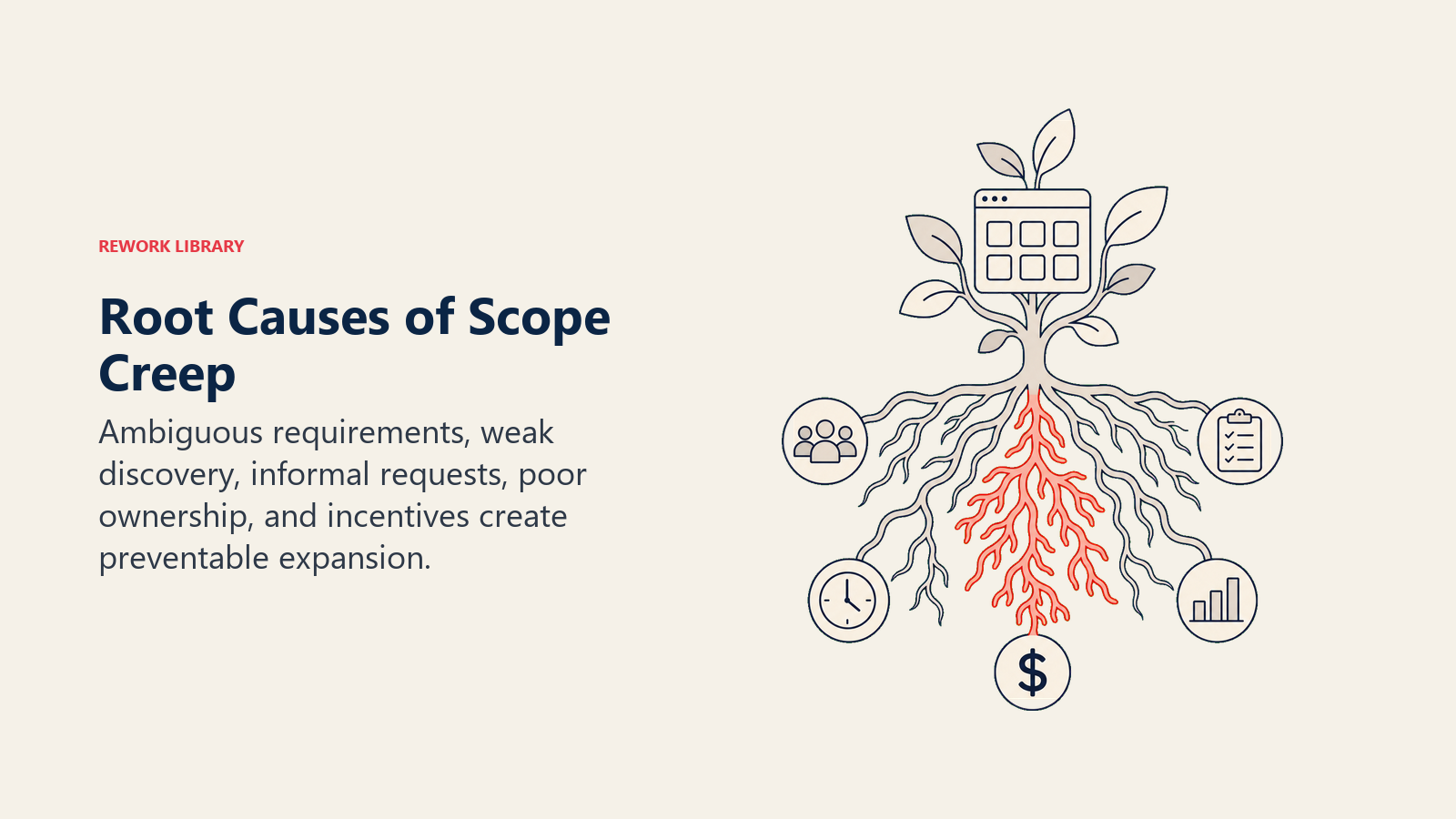
Weak or nonexistent change management processes mean there's no formal way to handle new requests. Without a clear process, every request becomes a negotiation. Some get approved casually. Others don't get captured at all. Soon you've lost track of what was in the original scope versus what got added.
Lack of explicit exclusions in your SOW creates mismatched expectations. Clients assume if you didn't say something was out of scope, it must be in scope. If you're building a mobile app and don't explicitly exclude tablet optimization, the client might reasonably expect both to be included.
Communication gaps and unclear protocols mean requests get made to the wrong people or through the wrong channels. A client mentions something to a junior team member who says "sure, we can do that" without understanding the scope implications. Or requests come via email, Slack, meetings, and text messages with no centralized tracking.
Relationship dynamics and fear of saying no create a pattern of accommodation. You're worried that pushing back will damage the relationship or make you seem difficult. So you say yes to small requests, which trains the client that requests always get approved, which leads to bigger requests, and the cycle continues.
Unclear acceptance criteria mean you don't know when you're done. If the SOW says "build a reporting dashboard" but doesn't specify which metrics, how many views, what level of customization, or what "done" looks like, you can iterate forever. The client will keep requesting changes because there's no defined finish line. Strong deliverable quality assurance standards help define what "complete" actually means.
All of these are preventable. Not easy to prevent, but preventable.
Detecting scope creep early: warning signs and monitoring systems
The earlier you catch scope creep, the easier it is to address. Wait until you're 20% over budget and your options are limited. Catch it in the first week and you can course-correct before it becomes a problem. Watch for these indicators - they should trigger your scope alarm: Hours tracking above estimates is the most obvious signal. If your plan allocated 40 hours to a deliverable and you've already burned 50 with work remaining, something expanded. Maybe the deliverable was more complex than expected (scope gap), or maybe requirements grew (scope creep). Either way, you need to investigate.
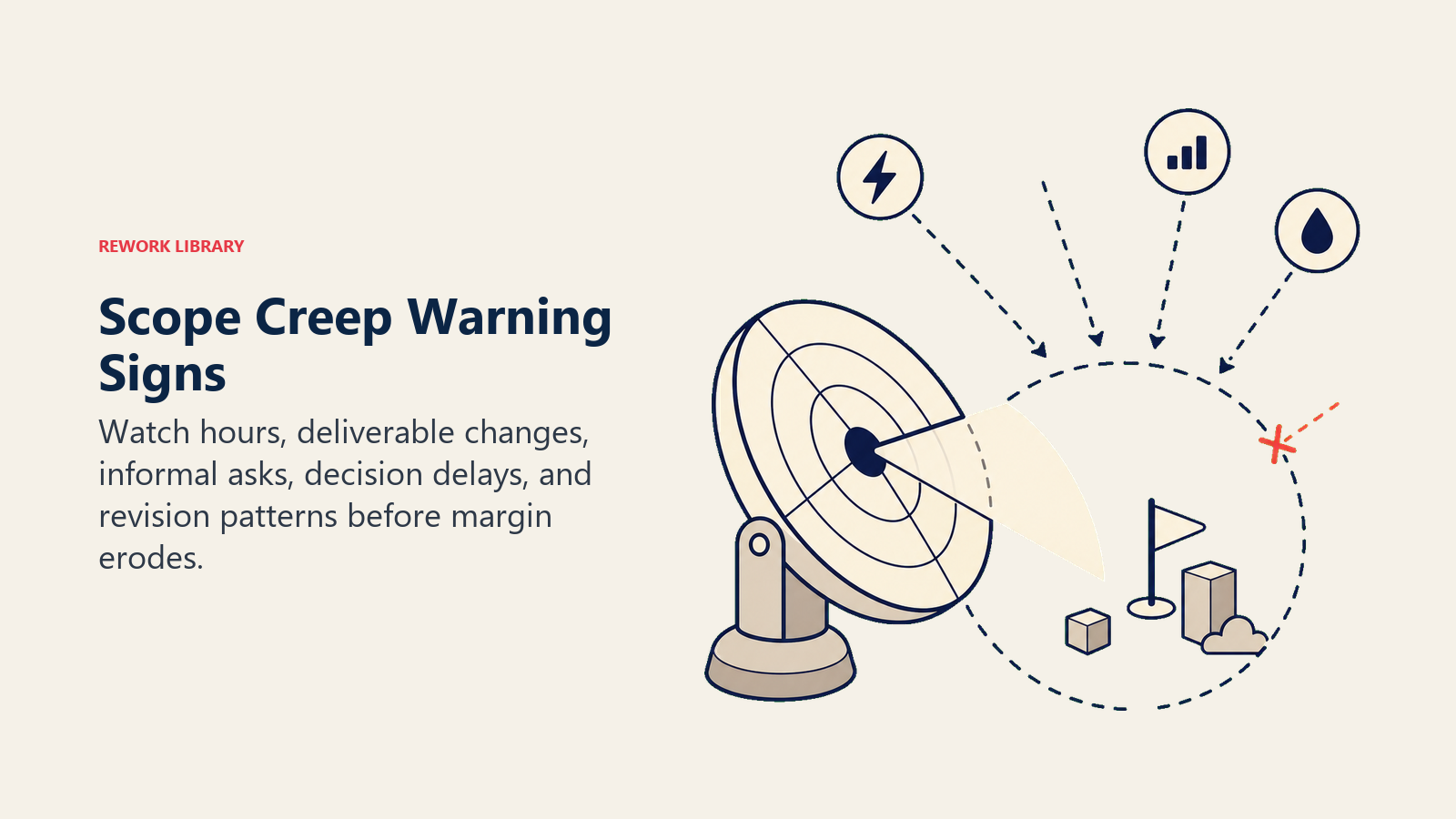
Expanding deliverable lists happen when "just this one more thing" becomes a pattern. Your project plan listed five deliverables. Now the working document shows eight. How did that happen? Who approved those additions? If you can't answer, that's creep.
Unscheduled meetings and status calls eat time and often signal undefined work. If you planned for weekly check-ins but you're now doing three calls per week because "we just need to quickly discuss..." that's a red flag. Meeting time is project time, and if it's expanding, your scope probably is too.
Work happening outside defined deliverables shows up when you ask your team what they're working on and the answer doesn't match your project plan. They're building features that weren't in the spec, conducting analyses that weren't requested, or responding to ad-hoc requests that never got formalized.
Conversation patterns can reveal creep before it shows up in hours. Pay attention when you hear:
- "While you're at it..."
- "This is probably already included, but..."
- "Quick question about adding..."
- "I know we didn't discuss this, but wouldn't it be better if..."
Each of these might be legitimate requests that should go through change management. Or they might be scope creep in the early stages.
Documentation discipline helps you track all of this. What you need:
- Time tracking at the deliverable level (not just total project hours)
- A centralized log of all client requests, even informal ones
- Regular variance reports comparing actual vs. planned hours
- Meeting notes that document what was discussed and agreed to
This isn't bureaucracy for the sake of bureaucracy. It's creating visibility so you can manage scope intentionally instead of discovering overages after the fact.
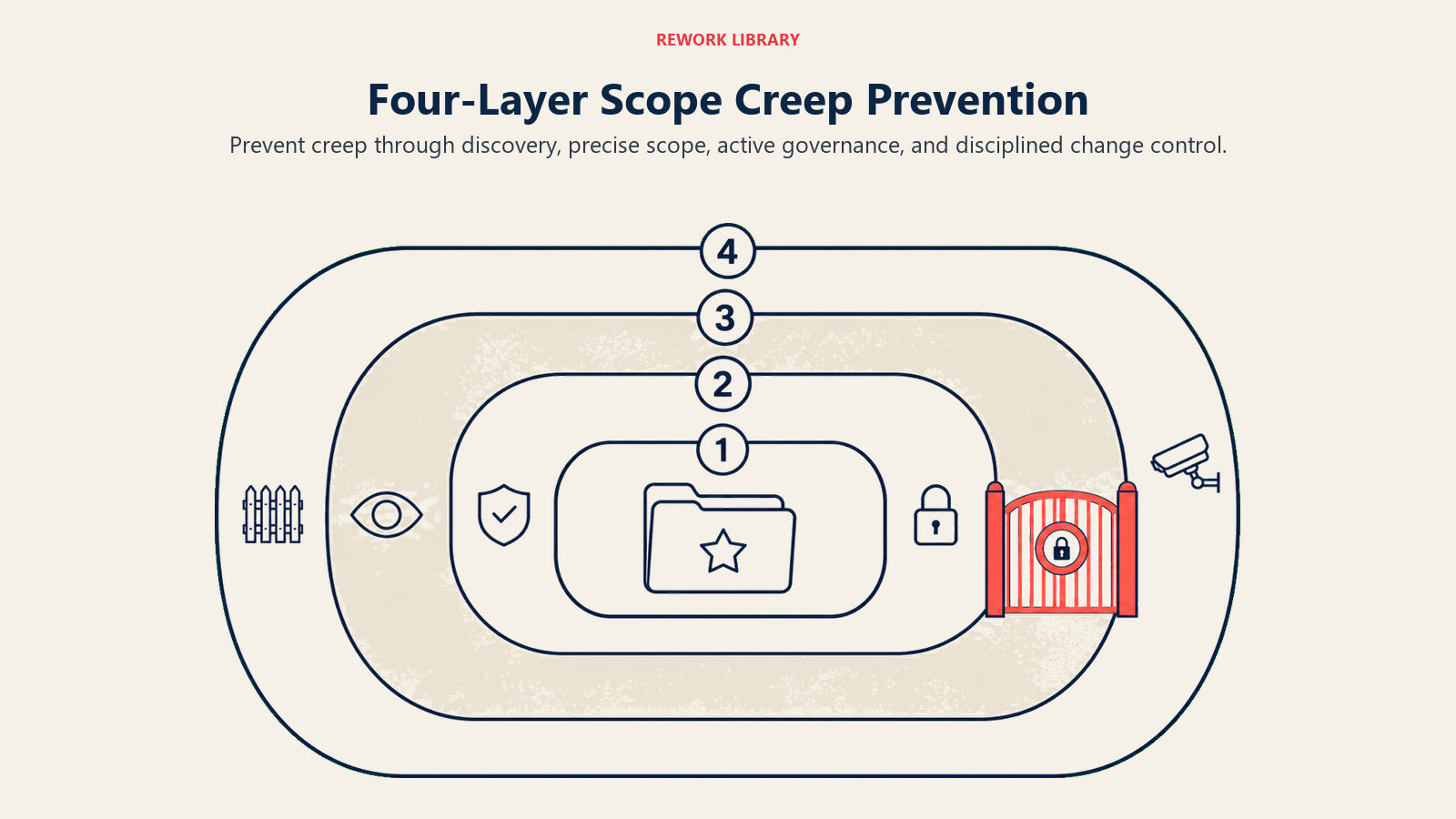
The four-layer prevention framework
The best scope management is proactive, not reactive. Build defenses at every stage.
Layer 1: Front-end discipline
This is where most scope creep is either prevented or guaranteed.
Rigorous discovery means investing time to understand the full complexity before you commit. Don't rush through discovery to get to contract signing. The cheapest time to find complexity is before you've priced the work. Ask questions until you understand not just what the client wants, but why they want it, what they've tried before, what constraints exist, and what success actually looks like.
Detailed scope documentation doesn't mean writing a 50-page SOW. It means being specific where it matters. Instead of "develop marketing strategy," write "develop marketing strategy covering three channels (email, LinkedIn, content marketing) with tactical plans for Q1 execution, including budget recommendations and success metrics." Specific deliverables, specific boundaries.
Explicit exclusions are just as important as inclusions. Have a section in your SOW titled "Out of Scope" and list what you're NOT doing. "This project does not include: paid advertising strategy, PR outreach, website redesign, or implementation support beyond Q1." This prevents the "I thought that was included" conversation later.
Clear deliverable definitions specify not just what you're delivering but what "done" looks like. If you're delivering a dashboard, define: number of views, data sources, refresh frequency, level of customization, training/documentation included, revision rounds permitted. Make the finish line visible.
Layer 2: Process control
Even with great scoping, changes will be requested. You need a system to handle them.
Formal change request process means any request that might affect scope, timeline, or budget goes through a defined workflow. It doesn't have to be heavyweight - it can be as simple as a form that captures: what's being requested, why it's needed, impact on timeline/budget/resources, and approval decision. The key is that it's documented and approved before work begins.
Impact analysis is what separates professional scope management from amateur hour. When a change is requested, analyze:
- Time impact: How many additional hours required?
- Cost impact: What's the budget impact at your standard rates?
- Resource impact: Do we need different expertise or more people?
- Timeline impact: Does this push deadlines or require reprioritization?
- Quality/risk impact: Does taking this on affect our ability to deliver the original scope well?
Share this analysis with the client. Often, when they see the full impact, they'll decide the change isn't worth it or should be deferred to a follow-on engagement.
Approval authority needs to be clear. Who can approve changes? Not your entire project team. Usually it's the project sponsor on the client side and project lead on your side. Anyone else who agrees to scope changes isn't authorized, and their commitments aren't binding.
Change documentation means every approved change gets added to a change log and updates the formal project plan. This creates an audit trail so three months from now, when someone asks why the timeline shifted, you can point to specific approved changes.
Layer 3: Communication protocols
How you communicate about scope matters as much as what you communicate.
Expectation setting during sales is where you introduce clients to your change management approach. Don't wait until the first scope conflict. During the proposal or contracting phase, explain: "We take scope seriously because we want to deliver what we promise. If you need changes during the project, we have a simple process to assess impact and get them approved. This protects both of us."
Kickoff alignment reinforces scope boundaries. At project kickoff, walk through the scope document together. Highlight the explicit exclusions. Explain the change process. Make sure everyone understands what's included, what's not, and how to request additions.
Regular scope reviews during the project prevent drift. In your weekly or bi-weekly status meetings, have a standing agenda item: "Scope check-in." Review what's been delivered against the plan, surface any requests that came up informally, and confirm you're still aligned on priorities and boundaries.
Transparent progress reporting shows where hours are going. Don't just report "project is on track." Show hours consumed versus budgeted, by deliverable. If you're trending over in one area, flag it early. This creates a fact-based conversation about scope before it becomes a crisis.
Layer 4: Team culture and enablement
Your team needs to be empowered to protect scope, not just you.
Empower team members to pause and escalate instead of automatically saying yes. Train them to respond to client requests with: "That sounds valuable. Let me check if that's in our current scope or if we should process it as a change request." This creates a buffer between the request and commitment.
Train on the language of scope management so your team knows how to handle requests professionally. Provide scripts like:
- "I want to make sure we do this right. Let me flag this for formal approval so we can assess impact."
- "That's a great idea. It sounds like it might be beyond our current scope, so let's run it through our change process."
- "I can add that, but it would affect . Let me loop in [project lead] to discuss."
Celebrate scope discipline as much as you celebrate client satisfaction. When someone on your team appropriately escalates a scope question instead of overcommitting, recognize it. This reinforces that protecting scope is part of delivering excellent service, not being difficult.
Make scope visibility everyone's job by sharing budget burn reports with the team. When they can see that you're at 75% of hours but only 50% done with deliverables, they understand the urgency of scope control.
Managing client expectations throughout the engagement
Scope management isn't a one-time conversation. It's ongoing expectation setting. During the sales process, introduce your approach to scope management as a client benefit. "We're very intentional about scope because we've learned that clear boundaries lead to better outcomes. You'll always know what you're getting and when."
At contract signing, walk through the scope document together. Don't assume they read it carefully. Point out the deliverables, the exclusions, the assumptions, and the change process. Get verbal confirmation that this aligns with their expectations. Your contract and engagement letters should explicitly reference your change management procedures.
At project kickoff, reinforce boundaries and establish communication protocols. Who on their team can request changes? How should requests be submitted? What's the expected turnaround time for impact assessment?
During execution, maintain consistent communication cadence. Weekly or bi-weekly check-ins aren't just status updates - they're scope alignment sessions. Surface any informal requests that came up and route them through the change process.
When requests arise, respond quickly and professionally. Don't let requests sit unanswered for a week. Even if you can't do a full impact analysis immediately, acknowledge the request within 24 hours: "Got your request for [X]. We're assessing impact and will get back to you by [date] with options."
When saying no or negotiating, focus on impact and partnership. "I want to make sure we can do this well. Adding this now would push our delivery date by two weeks. We have a few options: we can add it as a change order, defer it to phase 2, or you can tell us what to deprioritize to make room. What makes most sense for your goals?"
The anatomy of a scope conversation
How you handle scope requests determines whether clients see you as rigid or as a trusted partner who's protecting their interests.
Recognizing different request types
Formal requests come through your defined change management process. These are easy - you have a system for them.
Informal requests come up in meetings, emails, or casual conversation. "Hey, while we're talking, can you also look at [X]?" These are dangerous because they feel minor but can compound quickly.
Implied requests are the trickiest. The client describes a problem or mentions a need without explicitly asking you to solve it. If you jump in and solve it without clarifying scope, you've created an expectation.
Response framework
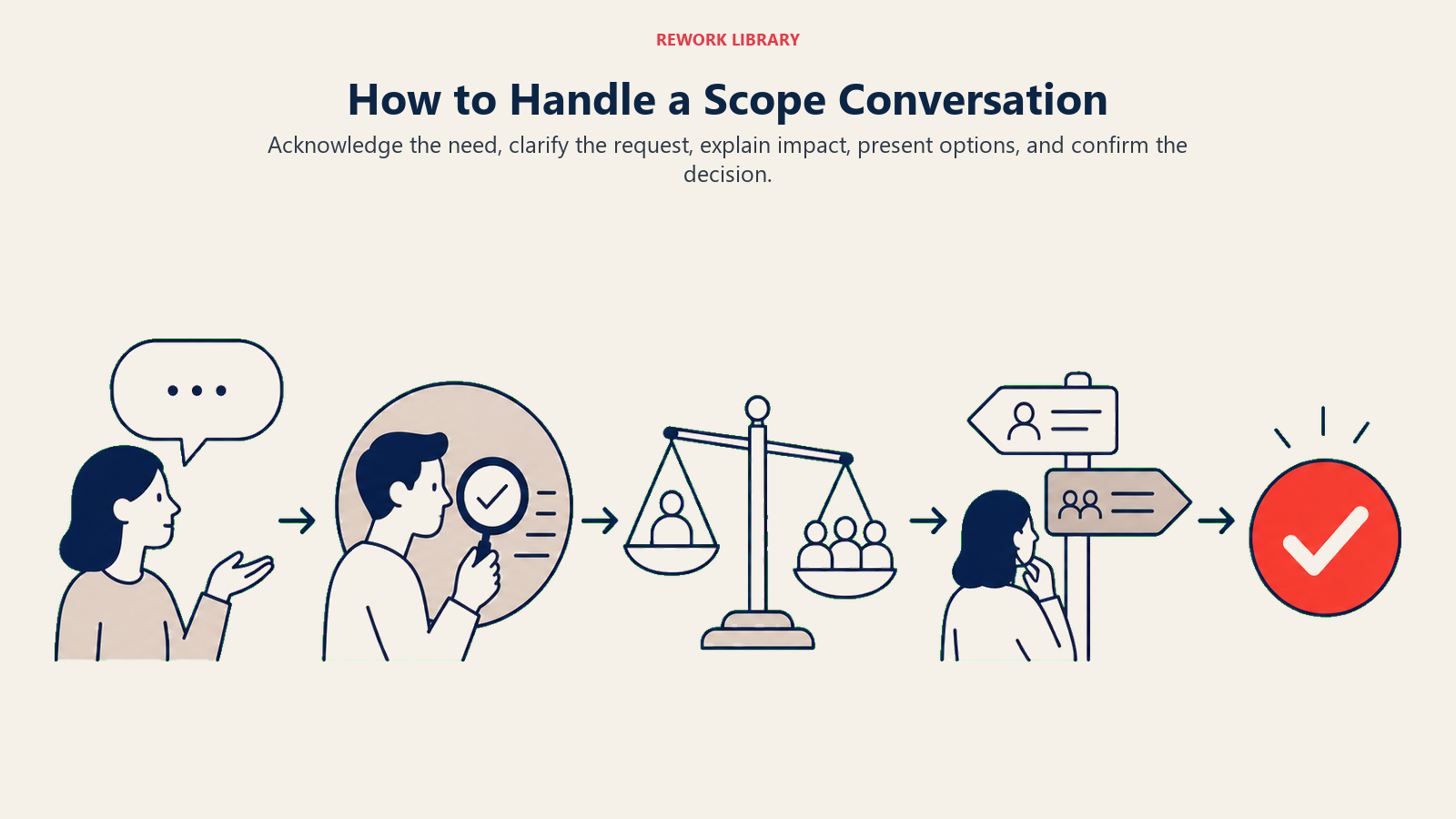
When a request comes in, use this four-step approach:
1. Acknowledge and validate: "That's a great point. I can see why that would be valuable."
This shows you're listening and care about their needs, not just defending your scope.
2. Clarify and confirm: "Just to make sure I understand - you're looking for [describe request]. Is that right?"
This ensures you're responding to what they actually need, not what you think they said.
3. Assess and quantify: "Let me look at what that would involve. It might be part of our current scope, or it might be additional work. I'll get back to you by [specific time] with an assessment."
This creates space to evaluate instead of committing in the moment.
4. Present options: "I've looked into this. Here are your options:
- We can include it in the current scope by deprioritizing [Y], though that would affect [impact]
- We can add it as a change order for [price] and [timeline impact]
- We can defer it to a follow-on engagement
- We can provide guidance on how your team could handle it internally
What makes most sense given your priorities?"
This positions you as a partner helping them make informed decisions, not a vendor trying to avoid work.
Partnership language that works
The words you use matter. Compare these approaches:
Defensive: "That's not in the scope. We'd have to charge extra for that."
Partnership: "I want to make sure we can deliver that well. Let me assess what's involved and get back to you with options so you can decide what makes most sense."
Defensive: "We already agreed on the scope. You can't keep adding things."
Partnership: "I'm seeing several requests coming in, which tells me there's value in expanding this work. Let's step back and look at priorities together. What's most critical to achieve in this phase versus what could wait for phase 2?"
Defensive: "That's scope creep."
Partnership: "That's an evolution from our original plan. Here's the impact of adding it, and here's how we'd recommend handling it."
Language that emphasizes impact, options, and partnership creates collaboration instead of conflict.
Handling common scenarios
Scenario 1: Client casually mentions a request in a status meeting.
Response: "That sounds valuable. Let me make sure I capture that properly so we can assess whether it fits in our current scope or if we should handle it as a change request. I'll follow up by end of week with an assessment."
Scenario 2: Client emails a request positioned as if it's already in scope: "When will you have [thing that's not in scope] ready?"
Response: "I want to make sure I didn't miss something. Looking at our SOW, I have [original deliverables] as what we're working on. [New request] sounds like it might be additional. Can we hop on a quick call to align on what's included versus what should go through our change process?"
Scenario 3: Junior person on client team makes a request to junior person on your team, who says yes without checking.
Response (to client): "I know [team member] said we'd handle [request]. I need to do a quick impact assessment to confirm we can fit it in without affecting our other deliverables. I'll get back to you by [date] to confirm either way."
Response (to your team): "In the future, when you get requests like this, the response is 'Let me check with [project lead] to make sure we can accommodate this.' Then escalate to me before committing. This protects you from overcommitting and protects our ability to deliver quality work."
Building a formal change management process
Every firm needs a simple, repeatable process for handling scope changes. Here's what that looks like.
Change request procedure
Step 1 - Request submission: Client submits a change request using a simple form (can be a shared doc, email template, or project management tool). Required fields:
- Description of requested change
- Business justification (why is this needed?)
- Desired timeline (when is this needed by?)
- Priority (nice-to-have vs. critical)
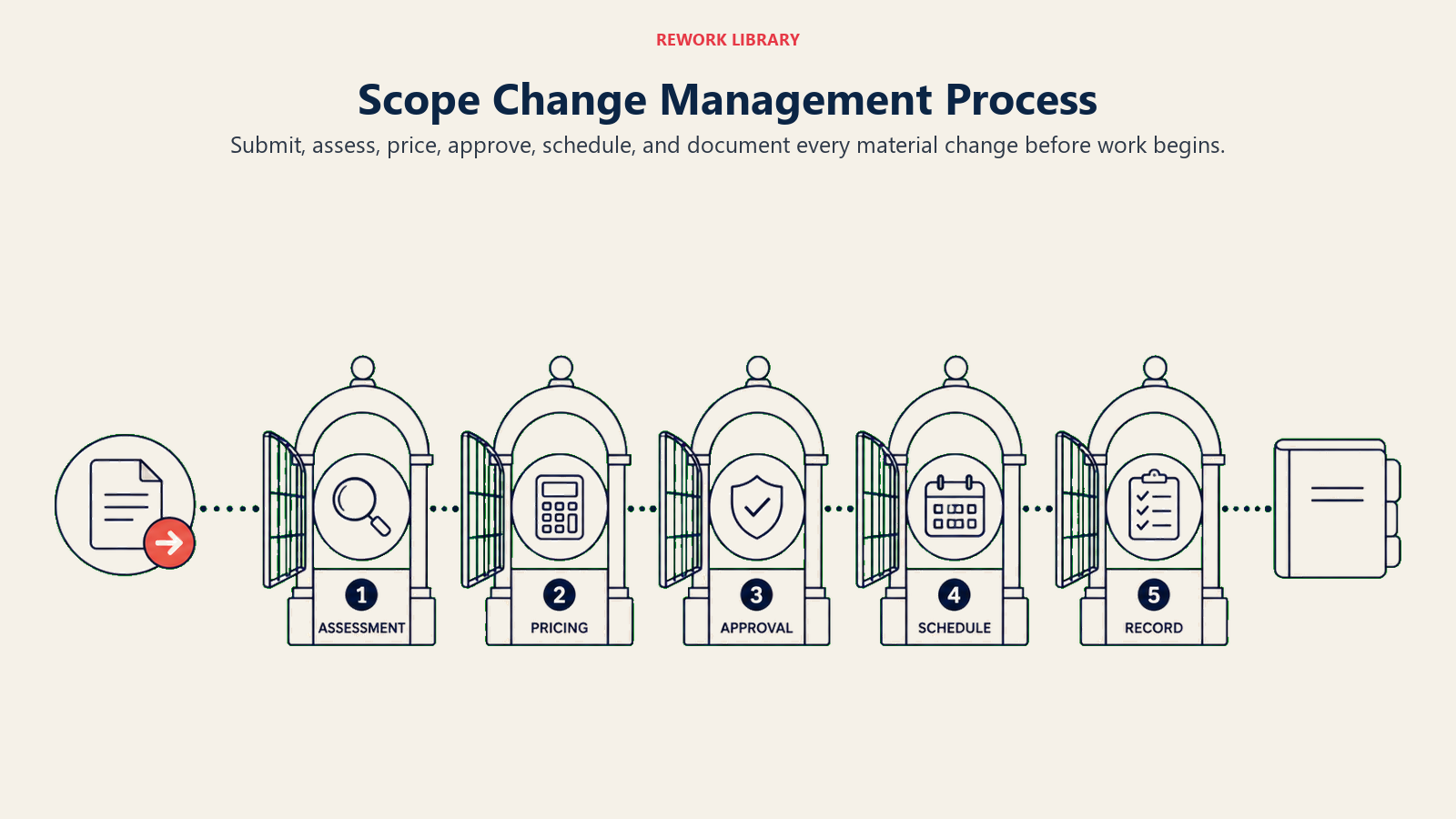
Step 2 - Impact analysis: Your team assesses the request across five dimensions:
- Time: Additional hours required
- Cost: Budget impact
- Resources: People/expertise needed
- Timeline: Effect on delivery dates
- Dependencies: What else is affected
This usually takes 1-3 business days depending on complexity.
Step 3 - Options development: Rarely is the answer just "yes" or "no." Develop options:
- Option A: Add to current scope with [impacts]
- Option B: Defer to phase 2
- Option C: Deliver in reduced form with [constraints]
- Option D: Client handles internally with our guidance
Step 4 - Client review and decision: Present the analysis and options. The client decides based on their priorities and constraints.
Step 5 - Documentation and execution: If approved, update the project plan, SOW, and timeline. Add to change log. Communicate to full team. Then execute.
What good impact analysis looks like
Don't just say "this will take 10 more hours." Break it down:
Time impact: "This change requires:
- 8 hours of data analysis
- 4 hours of documentation updates
- 2 hours of stakeholder review
- Total: 14 additional hours"
Cost impact: "At our standard rates, this represents $2,100 in additional budget."
Timeline impact: "Adding this to the current sprint would push our Phase 1 delivery from March 15 to March 22. Alternatively, we could deliver it in Phase 2 with no impact to Phase 1 timeline."
Resource impact: "This requires specialized data engineering expertise we don't have on the current team. We'd need to bring in [specialist], which has a 1-week lead time."
Quality/risk impact: "Adding this now means we'd have less time for QA on the core deliverables. We recommend either extending the timeline or deferring this to Phase 2 to maintain quality standards."
This level of detail helps clients make informed decisions and shows you've thought it through.
Sample change request form
A simple template you can adapt:
PROJECT CHANGE REQUEST

Project: [Project Name]
Requested By: [Name, Date]
Request Number: CR-[###]

REQUESTED CHANGE:
[Description of what's being requested]

BUSINESS JUSTIFICATION:
[Why is this needed? What problem does it solve?]

PRIORITY:
□ Critical - Cannot proceed without this
□ Important - Significant value add
□ Nice-to-have - Would be beneficial but not essential

IMPACT ANALYSIS (completed by project team):

Time Impact: [X hours]
Cost Impact: [$ amount]
Timeline Impact: [Effect on delivery dates]
Resource Impact: [People/skills needed]
Risk/Quality Impact: [Considerations]

OPTIONS:
Option 1: [Description, cost, timeline]
Option 2: [Description, cost, timeline]
Option 3: [Description, cost, timeline]

RECOMMENDATION:
[Your professional recommendation and why]

DECISION:
□ Approved - Option [X]
□ Deferred to Phase 2
□ Declined

Approved By: _________________ Date: _______
Keep it simple enough that it doesn't create friction, but structured enough that you capture what matters.
Scope discipline across different engagement models
How you manage scope varies based on your billing model.
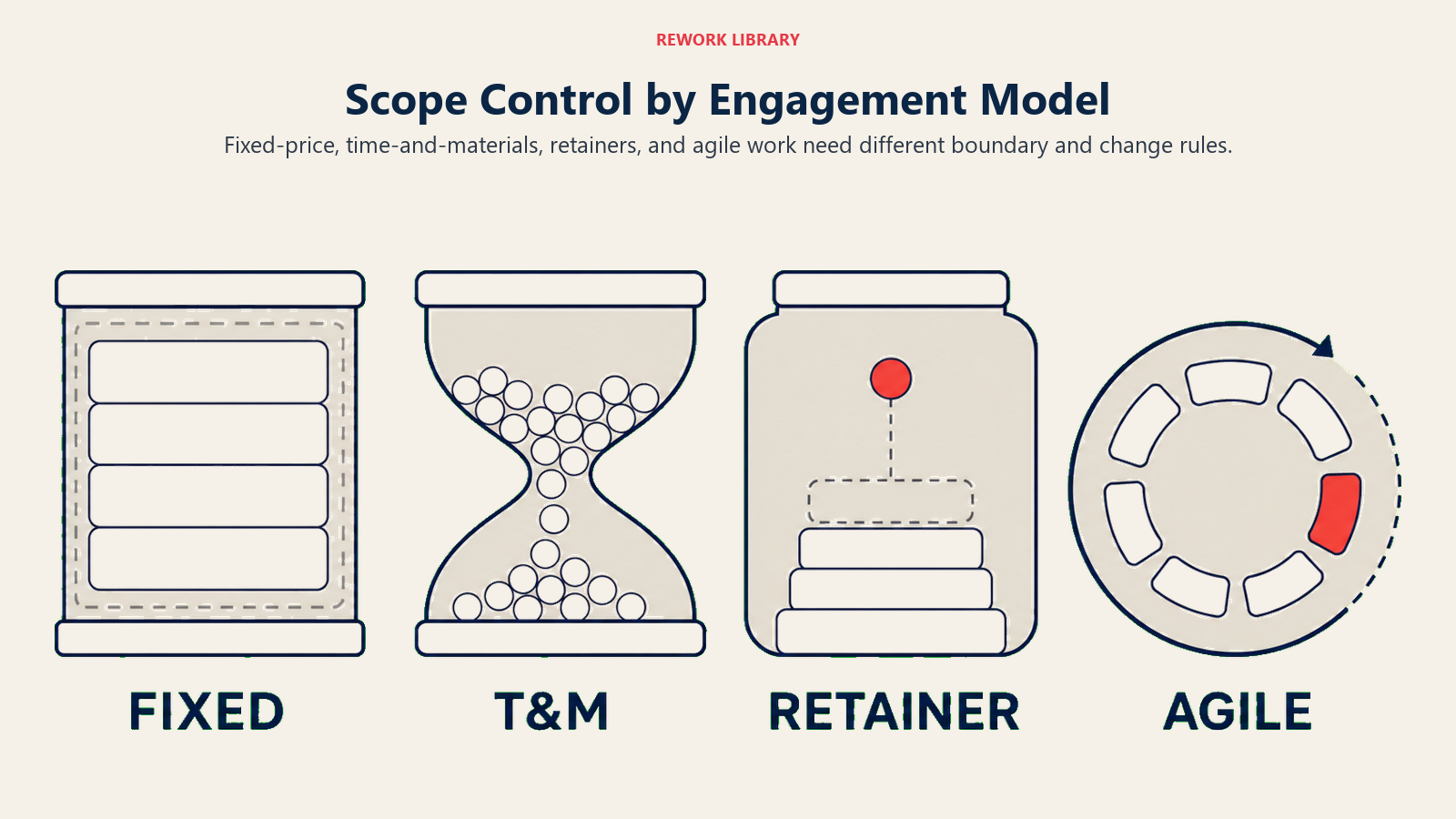
Fixed-price projects
This is where scope discipline matters most because every hour of creep comes directly out of your margin.
Tight scope documentation: Your SOW needs to be airtight. Specific deliverables, explicit exclusions, clear acceptance criteria. If there's ambiguity, you'll lose that argument.
Aggressive change management: Every request that's not clearly in scope goes through the change process. You can't afford to be casual about "small" additions because they compound quickly.
Margin protection mindset: Track actual hours against budget religiously. When you hit 70% of budgeted hours, assess whether you'll finish within budget. If not, you have three options: work more efficiently, reduce scope to fit budget, or negotiate a change order.
Built-in buffer: Don't price at exactly your estimated hours. Build in 10-15% contingency for normal variations and small accommodations. This buffer lets you be generous on truly minor items without destroying profitability.
Time-and-materials engagements
Scope creep is less about margin protection and more about client surprise and budget management.
Budget monitoring: Even though you're billing by the hour, clients still have budgets. If they approved 100 hours and you're on track to use 130, that's a problem. Monitor burn rate and flag when you're trending over.
Scope alignment: T&M doesn't mean "do whatever the client asks forever." You still need alignment on what you're working toward and when you're done. Without that, projects drag on indefinitely.
Value communication: Since clients see every hour billed, they're more sensitive to perceived waste. Regularly communicate what you're working on and why it matters. If you spent 10 hours on something, explain the value created.
Retainer relationships
The challenge here is capacity management, not budget protection.
Capacity allocation: If the retainer covers 40 hours per month, and the client is requesting 60 hours of work, you have a scope problem. Be clear about the capacity included and what happens when requests exceed it.
Prioritization framework: You can't do everything, so you need a way to prioritize. Monthly planning sessions where you review requested work and agree on what fits in the available capacity.
Rollover policies: What happens to unused hours? Do they roll over month-to-month or reset? What about excess requests - do they queue or require additional budget? Define this upfront.
Phased implementations
Phase boundary protection: The biggest risk is work from Phase 2 or 3 bleeding into Phase 1. Use phase boundaries as hard stops. "That's a great idea for Phase 2. Let's capture it in the backlog so we don't lose it."
Backlog management: Keep a running list of ideas and requests that are out of scope for the current phase. Review it during phase planning. This shows you're listening and valuing their input while protecting current phase scope.
Phase scope freeze: Once a phase starts, the scope should be locked. Changes go to the next phase unless they're truly critical and go through formal change approval.
Agile/sprint-based work
Sprint commitment protection: Once a sprint is committed, scope is frozen. New requests go into the backlog for future sprints.
Backlog grooming: Regular sessions to review, prioritize, and estimate backlog items. This creates a transparent process for handling new requests.
Velocity-based planning: Use your historical velocity to set realistic sprint commitments. Don't overcommit to please the client. Consistent delivery beats over-promising.
Team accountability and enablement
Scope management isn't just the project manager's job. Your whole team needs to understand and support it.
Project manager as scope guardian
The PM owns scope discipline. Their responsibilities include:
- Monitoring hours against budget at the deliverable level
- Reviewing all requests and routing them through change management
- Flagging scope issues early, not after you're already over budget
- Educating the client on the change process
- Making tough calls about what's in versus out of scope
If your PMs see scope management as "not their problem," you'll have constant overruns.
Team training and empowerment
Train your team on:
- What scope creep is and why it matters
- How to recognize scope questions versus straightforward work
- The language to use when a request comes up ("Let me check if that's in our current scope")
- When and how to escalate
- The impact of scope creep on the team (if we overrun, it affects everyone's capacity)
Role-play scenarios so they're comfortable with the conversations.
Client education
Don't assume clients understand your change process. Educate them:
- During sales: "Here's how we handle scope changes"
- At kickoff: "When new needs come up - and they will - here's how we'll evaluate them"
- During execution: "We've had a few requests come up. Let me show you how we're tracking and evaluating them"
When clients understand the process, they're more likely to follow it.
Organizational accountability
Scope discipline has to be part of your culture, not just a PM checklist. That means:
- Leadership reinforces that scope protection is part of quality delivery
- Account managers support PMs when they need to have tough scope conversations
- Financial reviews include scope performance, not just revenue
- Comp and performance management recognize good scope discipline
If you reward revenue at all costs, your team will sacrifice scope to keep clients happy. If you reward profitable delivery, they'll protect scope.
Metrics that matter
You can't improve what you don't measure. Track these metrics to understand and improve your scope performance.
Scope variance by project
Metric: Actual hours vs. budgeted hours, by deliverable and overall Target: Within +/- 10% on fixed-price, closer on T&M Insight: If you're consistently over on certain deliverable types, your scoping model is wrong
Change request frequency and value
Metric: Number of change requests per project, total value of approved changes Target: Depends on project type, but track trends Insight: Lots of small changes might indicate unclear initial scope. Few large changes might indicate good scoping or clients not engaging with change process
Change request approval rate
Metric: Percentage of change requests approved vs. declined vs. deferred Target: No universal target, but watch for patterns Insight: 100% approval suggests you're not pushing back enough. 0% approval suggests your change process is too onerous or you're being too rigid
Margin impact from scope changes
Metric: Margin on projects with significant scope creep vs. projects with disciplined scope Target: Minimize margin erosion from uncompensated scope expansion Insight: This quantifies the financial impact of scope discipline
Client satisfaction by scope performance
Metric: NPS or satisfaction scores for projects with good scope management vs. those with scope creep Target: Equal or better satisfaction with disciplined scope Insight: Disproves the myth that saying yes to everything creates happier clients
Trend analysis
Look at patterns over time:
- Are we getting better at initial scoping?
- Are certain client types or project types more prone to scope creep?
- Are certain team members or PMs better at scope management?
- Are scope issues more common in certain phases (discovery, execution, closeout)?
Use these insights to improve your processes, training, and scoping models.
Post-project scope retrospective
After every project, include scope management in your retrospective:
- What scope issues arose?
- Were they due to poor initial scoping, client-driven changes, or our own mistakes?
- How well did our change management process work?
- What would we do differently?
Document lessons learned and update your templates, processes, and training.
Common pitfalls (and how to avoid them)
Even with good intentions, firms stumble on scope management. The most common traps:
Vague SOW language
The problem: Your SOW says things like "comprehensive analysis" or "appropriate level of detail" or "reasonable number of revisions." These qualifiers mean different things to different people.
The fix: Be specific. Not "comprehensive analysis" but "analysis of top 5 customer segments including demographic data, purchase patterns, and churn drivers." Not "reasonable revisions" but "two rounds of revisions on each deliverable."
Missing exclusions section
The problem: Your SOW lists what's included but doesn't explicitly state what's not included. Clients assume if you didn't exclude it, it's included.
The fix: Add an "Out of Scope" section to every SOW. List specific things you're NOT doing. This prevents the "I thought that was included" conversation.
Informal agreements and side conversations
The problem: Someone on your team agrees to something in a hallway conversation or Slack message. There's no documentation, no approval, no impact assessment. But the client considers it committed.
The fix: Train your team that all scope decisions go through one person (usually the PM). If they get a request, the response is "Let me check with [PM] and get back to you." Then document everything in writing.
No formal change process
The problem: When requests come in, you handle them ad-hoc. Sometimes you say yes, sometimes no, sometimes you charge, sometimes you don't. There's no consistency or clear criteria.
The fix: Implement a formal change process with a standard form, impact analysis, and approval workflow. Make it simple enough to use, but structured enough to create consistency.
Fear of saying no
The problem: You're worried that enforcing scope boundaries will damage the relationship or make you seem inflexible. So you accommodate everything, even when it hurts profitability or quality.
The fix: Reframe how you think about scope management. You're not saying no - you're helping the client make informed decisions about priorities and trade-offs. That's partnership, not rigidity.
Saying yes to be collaborative
The problem: You want to be seen as a team player, so you agree to requests without assessing impact. "Sure, we can add that" becomes your default response.
The fix: Separate responsiveness from automatic agreement. You can be very responsive ("I'll assess this and get back to you today") without immediately committing. Collaboration means finding solutions together, not saying yes to everything.
Reactive instead of proactive management
The problem: You only address scope when you're already in trouble - over budget, past deadlines, or in conflict with the client.
The fix: Build proactive monitoring into your project rhythm. Weekly review of hours vs. budget, standing agenda item for scope check-ins, regular communication about capacity and priorities.
Not tracking time at deliverable level
The problem: You track total project hours but not hours by deliverable. So you don't know which parts of the project are over budget until it's too late.
The fix: Track time at the deliverable or task level. This gives you early warning when specific areas are trending over, and you can adjust before it affects the overall budget.
Scope creep as a symptom of poor discovery
The problem: You're experiencing constant scope creep because you didn't uncover the full complexity during discovery. Every week reveals new requirements you didn't plan for.
The fix: Invest more in discovery. Ask more questions. Challenge assumptions. Build in contingency for unknowns. If you consistently under-scope, your discovery process needs improvement.
Where to go from here
Scope management isn't a one-time fix. It's an ongoing practice that requires discipline, communication, and continuous improvement.
Start with your scoping process. If you're experiencing frequent scope creep, the root cause is probably inadequate initial scope definition. Improve your discovery, make your SOWs more specific, and add explicit exclusions.
Then build your change management process. Even with perfect initial scoping, changes will come up. You need a simple, repeatable way to evaluate and approve them.
Train your team on both the process and the communication skills to handle scope conversations professionally. Role-play scenarios until they're comfortable.
Finally, measure your performance and iterate. Track scope variance, change request patterns, and margin impact. Use that data to improve your processes.
Related resources that will help:
- Needs Assessment & Discovery - Prevent scope creep through better discovery
- Project Scope Assessment - Evaluate project scope before committing
- Scope Definition & SOW - Create airtight scope documentation
- Change Order Process - Formalize how you handle changes
- Project Management Methodology - Integrate scope discipline into delivery
The goal isn't to become inflexible or difficult. It's to protect your ability to deliver what you promised, at the quality you promised, when you promised it. That consistency is what builds trust and long-term relationships.
Clients don't want unlimited free work. They want partners who deliver on commitments and help them make smart decisions about priorities. That's what good scope management enables.

Sales Director
On this page
- What scope creep actually is (and what it isn't)
- Why scope creep happens: root causes you can control
- Detecting scope creep early: warning signs and monitoring systems
- The four-layer prevention framework
- Layer 1: Front-end discipline
- Layer 2: Process control
- Layer 3: Communication protocols
- Layer 4: Team culture and enablement
- Managing client expectations throughout the engagement
- The anatomy of a scope conversation
- Recognizing different request types
- Response framework
- Partnership language that works
- Handling common scenarios
- Building a formal change management process
- Change request procedure
- What good impact analysis looks like
- Sample change request form
- Scope discipline across different engagement models
- Fixed-price projects
- Time-and-materials engagements
- Retainer relationships
- Phased implementations
- Agile/sprint-based work
- Team accountability and enablement
- Project manager as scope guardian
- Team training and empowerment
- Client education
- Organizational accountability
- Metrics that matter
- Scope variance by project
- Change request frequency and value
- Change request approval rate
- Margin impact from scope changes
- Client satisfaction by scope performance
- Trend analysis
- Post-project scope retrospective
- Common pitfalls (and how to avoid them)
- Vague SOW language
- Missing exclusions section
- Informal agreements and side conversations
- No formal change process
- Fear of saying no
- Saying yes to be collaborative
- Reactive instead of proactive management
- Not tracking time at deliverable level
- Scope creep as a symptom of poor discovery
- Where to go from here