Proposal Presentation: Winning Contracts Through Strategic Presentation
Turn this article into takeaways for your work.


Each assistant summarizes the article only for you and suggests best practices for your work.
For agencies and professional services firms, growth lives at the proposal stage, where qualified pursuits turn into signed contracts. Winning more of them comes down to four things: pre-meeting intelligence on the room and the decision process, a structure that proves you understand the client before you pitch, confident delivery, and a close with a clear ask. A strong document loses to a strong presentation, so this is where deal growth is actually won or lost.
You spent three weeks on the proposal. Your team crafted a solution that's perfect for the client's needs. The pricing is competitive, the approach is solid, and the written document is polished. Then you show up to present it, and the whole thing falls apart.
40% of well-written proposals fail at presentation. Not because the solution was wrong or the price was too high, but because the presentation itself didn't land. You lost them in the room.
The gap between quality and execution is where deals die. A mediocre proposal delivered brilliantly often wins over a brilliant proposal delivered poorly. This isn't about PowerPoint skills or speaking confidence (though those help). It's about understanding what actually happens in that room and preparing for it.
This guide shows you how to deliver proposal presentations that win. We'll cover pre-presentation strategy, structure, delivery techniques, and how to handle the moment when everything's on the line.
Why proposals fail at presentation
Before we get into how to present well, you need to understand where things go wrong.
For services firms scaling new business, most lost pursuits trace to one of six failure modes, and each has a different fix. Use this as a pre-meeting checklist before any high-value pitch.
| Failure mode | What it looks like | The fix |
|---|---|---|
| Wrong room | Unexpected attendees, a finance skeptic you never met | Map the audience and confirm attendees before the meeting |
| Lost champion | Your contact goes quiet or looks uncomfortable | Re-engage the champion and read the political shift |
| Predetermined favorite | The pitch is a procurement formality | Qualify the real decision and competitive position early |
| Misaligned message | You cover methodology, they wanted timeline and risk | Lead with their scoring criteria, not your process |
| Q&A gaps | An unanswered question or conflicting team answers | Rehearse questions and align numbers across presenters |
| No next step | The meeting ends with no commitment | Close with a specific ask and decision date |
Most of these are preventable with preparation, which is why the strongest agency growth happens before anyone enters the room.
You're presenting to the wrong room. The RFP said three attendees. You prepared for three. Now there are eight people sitting across from you, including someone from finance who wasn't on any earlier calls and seems to hate your pricing already.
Your contact went silent. The person who walked you through the requirements and answered your questions isn't in the meeting. Or they're there but clearly uncomfortable, which means something political happened that you don't know about.
They already have a favorite. Sometimes the presentation is just a formality. They need three bids for procurement rules, but they've already decided on a competitor. You're there to make it look like a real evaluation.
Your presentation doesn't match what they care about. You spent 20 minutes explaining your methodology. They wanted to hear about timeline and risk mitigation. The disconnect kills your momentum.
The Q&A exposes gaps. Someone asks a question you can't answer. Or worse, two of your team members give conflicting answers. Trust evaporates instantly.
Nobody knows what happens next. You finish presenting, thank everyone, and... nothing. No clear next step, no commitment to timeline, no ask for the business. The meeting just ends.
Most of these problems are preventable with the right preparation. But you have to know they're coming.
Pre-presentation strategy: understanding the landscape
Before you walk into that room (or hop on that video call), you need answers to specific questions. Not guesses. Answers.
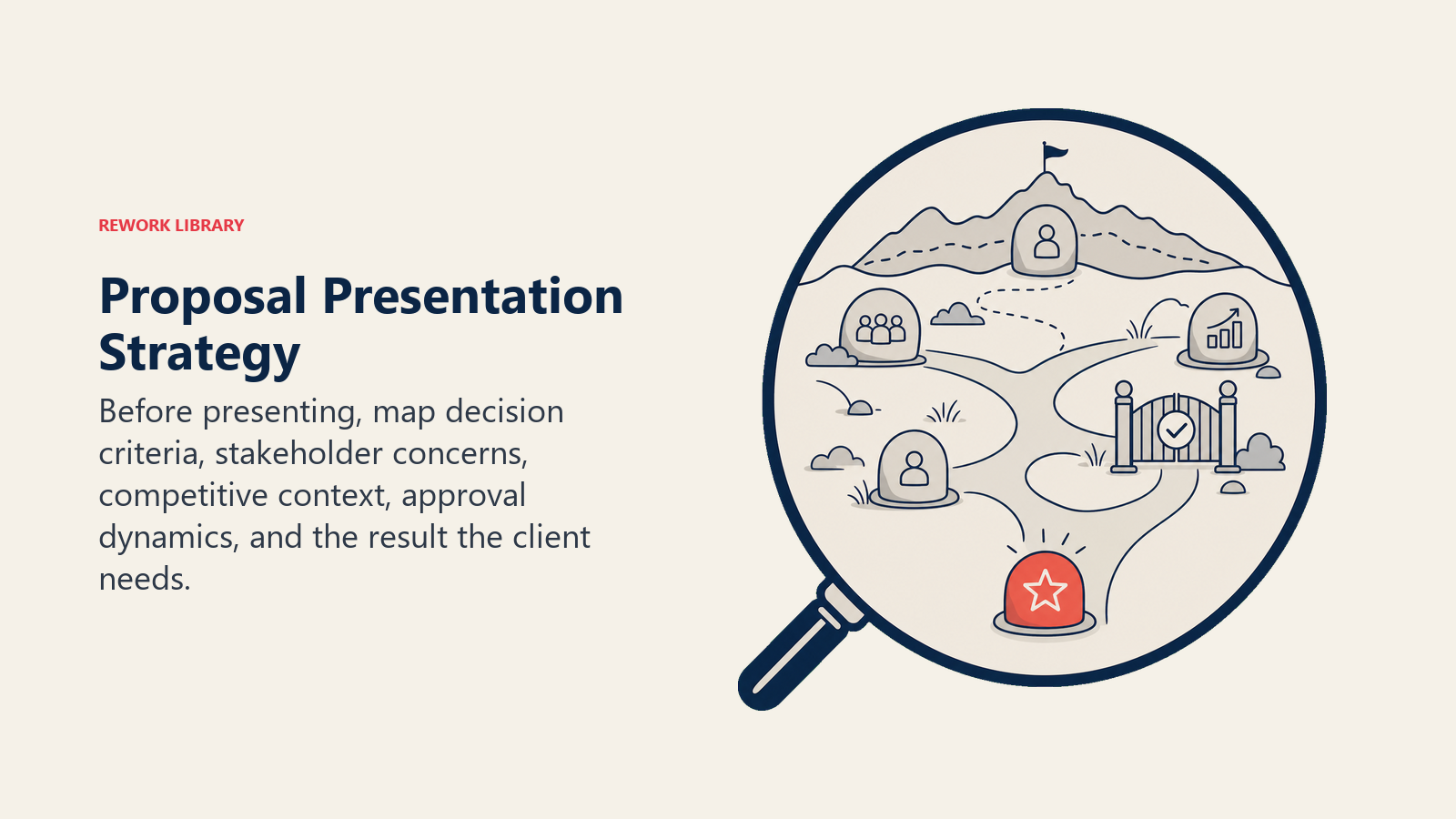
RFP requirements and scoring criteria. If this is a formal RFP, they have a scorecard. What's weighted highest? Is it price, experience, approach, team credentials? You need to know where points come from because that tells you where to focus in the presentation.
If it's not a formal RFP, find out what matters most to them anyway. Every buying decision has implicit criteria. Someone cares about speed, someone else about proven results, someone else about cost control. Map it out.
Competitor landscape. Who else is presenting? When do they present? (Going last is generally better because you're fresh in their minds, but going first means you set the tone.)
What do you know about the competitors' approaches? If you know they're proposing a phased rollout and you're recommending a full implementation, you better have a reason ready. Anticipate where they'll differentiate and prepare your counter-positioning.
Timeline and decision process. When do they decide? Who decides? Is there one decision-maker or a committee? What happens after presentations - do they deliberate immediately or take a week?
Knowing the timeline tells you how aggressive to be with your close. If they're deciding tomorrow, you push harder. If they're not deciding for two weeks, you focus on staying memorable. This information should have been gathered during your budget and timeline discovery.
Audience mapping. This is critical. Who's attending the presentation? You need to know their role and title, what they care about (technical fit, cost, risk, timeline, ease of implementation), whether they're a decision-maker or influencer or gatekeeper, any relationship history with your firm or team members, and the political dynamics between them.
The CFO cares about ROI. The operations director cares about implementation disruption. The technical lead cares about whether your solution actually works. If you present the same message to all of them, you'll lose at least two.
Budget discussion status. Have they discussed budget? Do you know what it is? If they haven't locked in a number yet, your presentation needs to build the case for investment. If budget is fixed and you're over it, you need to address that directly or you're wasting everyone's time.
Q&A format expectations. Is Q&A at the end, or can they interrupt with questions throughout? Some organizations prefer a formal "present then questions" format. Others want interactive dialogue. You need to know because it changes how you structure your content.
If they can interrupt, you need to be ready for questions at any point. If it's structured Q&A at the end, you can build a narrative arc that pays off later without getting derailed mid-story.
Audience analysis: mapping the room
The people in the room make or break the presentation.
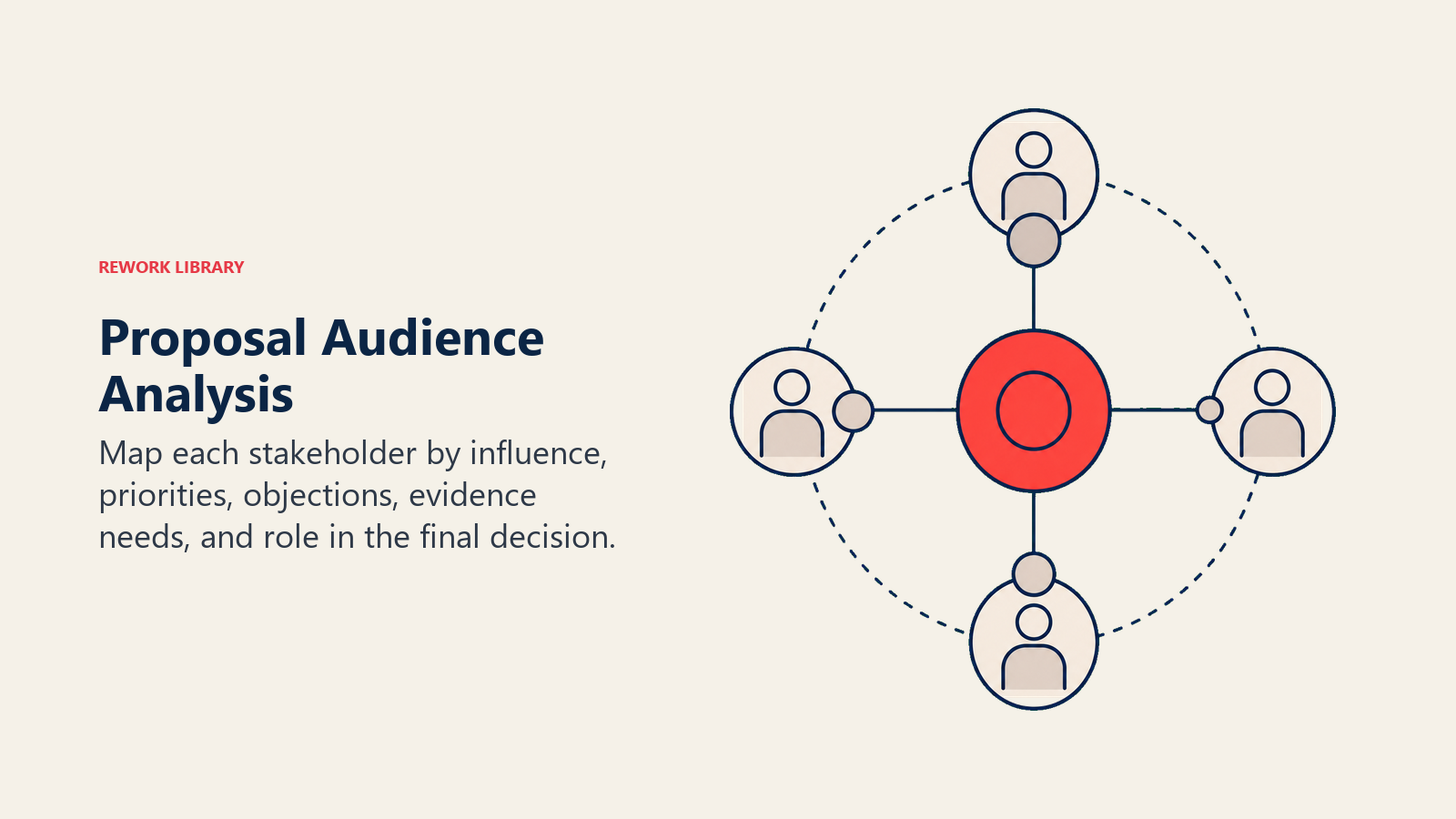
Technical vs. economic buyers. The technical buyer evaluates whether your solution works. The economic buyer decides if it's worth the investment. They're often different people with different concerns.
Technical buyers want proof - case studies, methodology details, team credentials, implementation plans. Economic buyers want ROI - cost savings, revenue impact, risk reduction, competitive advantage.
You need to address both, but timing matters. If the economic buyer is the one who has to recommend you to the board, they need ammunition. Give them the ROI story in simple, repeatable terms. "This saves us 200 hours per month, which at our billing rate is $500K annually." That's a sentence they can repeat.
Influencers and gatekeepers. Influencers don't make the final call, but they sway it. They're the trusted advisor, the subject matter expert, the person whose opinion carries weight. You need them on your side.
Gatekeepers can kill your deal without having formal authority. The procurement manager who "just needs to verify a few things." The IT director who raises security concerns. They can't say yes, but they can say no.
Your job is to neutralize gatekeepers (address their concerns directly and respectfully) and win influencers (give them reasons to advocate for you).
Political dynamics. In any organization with multiple stakeholders, there's politics. Maybe the VP of Operations wants this project but the VP of Finance is skeptical. Maybe there's tension between departments about who owns the outcome.
You can't fix their politics, but you can avoid stepping in them. Watch for signals. Who defers to whom? Who disagrees with whom? Who speaks first, and who waits?
If you sense conflict, don't take sides. Address concerns from all parties. Position your solution as reducing risk for everyone, not favoring one group's agenda.
Team assembly: who should present
Not everyone on your team should be in the presentation. Seriously. Having five people sitting there when three aren't speaking makes you look disorganized.
Define objectives and key messages first. Before you pick presenters, get clear on what you need to accomplish. You need to demonstrate deep understanding of their problem, prove your approach is superior to alternatives, build confidence in your team's capabilities, address obvious concerns before they become objections, and create urgency around moving forward.
Then assign people based on who can deliver those messages best.
Speaker selection principles. You want someone senior to open and close. This signals that you take the opportunity seriously. If the client has C-level attendees, you should too.
You want subject matter experts for the technical sections. The person who'll actually do the work explaining how they'll do it carries weight.
You want client-facing leads who have rapport. If someone on your team has built a relationship with their team, they should present. Familiarity builds trust.
What you don't want are junior people reading slides they didn't write, too many speakers creating choppy transitions, people there "for experience" who don't contribute, or your entire team showing up to fill the room (unless the client requested it).
Role assignments. Each presenter needs a specific job. The lead presenter opens, sets tone, transitions between sections, and closes. The technical lead explains methodology and approach. The delivery lead covers timeline, team, and implementation. The Q&A coordinator fields questions and directs them to the right person.
You also need someone designated to watch the room and read reactions. If you're presenting, you're focused on your content. Someone else should be monitoring body language, side conversations, and confusion signals.
Presentation structure: the 45-60 minute format
Most proposal presentations run 45-60 minutes including Q&A. Here's how to structure that time.
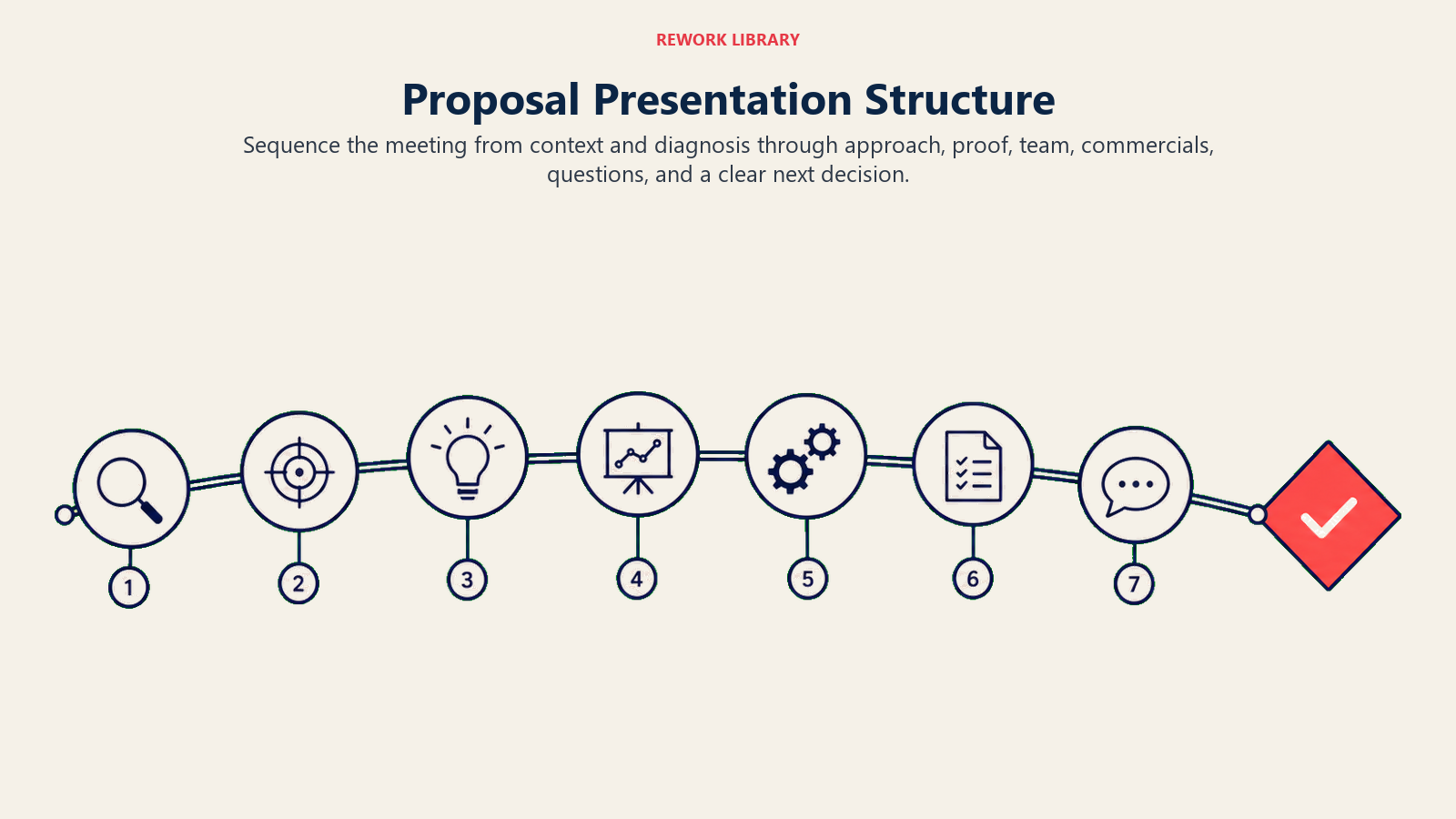
Opening (5 minutes)
You have five minutes to establish credibility and set expectations. Don't waste them on pleasantries or thanking people for their time.
The hook. Start with something that demonstrates you understand their world. "Three months ago, you realized your current system couldn't scale past 50 agents. That's not a technology problem, it's a business limitation. Here's how we remove that ceiling."
You're showing them you get it. You've done your homework. This isn't a generic pitch.
Credibility statement. Briefly establish why you're qualified. "We've implemented this exact system for seven contact centers in the last two years, including two in financial services like yourselves."
Don't belabor it. One or two sentences max.
Agenda and rapport. Tell them what to expect. "We'll cover our understanding of your needs, our proposed approach, the team and timeline, and investment. We've built in time for questions throughout, so please jump in if anything's unclear."
This sets expectations and gives permission for dialogue. You want questions because questions mean engagement.
Understanding of needs (10 minutes)
This is where you prove you listened during discovery. You're articulating their problem better than they could themselves. This section draws directly from your needs assessment and discovery work.
Demonstrate discovery insights. Reference specific things they told you. "In our conversation with Sarah's team, you mentioned losing 15% of customers during the onboarding transition. That's roughly 300 accounts annually at an average lifetime value of $12,000. That's $3.6M in revenue risk."
You're quantifying their pain with their data. This does two things - shows you paid attention and makes the problem feel urgent.
Problem articulation. Describe the current state and the gap. "Right now, onboarding takes 45 days because of manual handoffs between sales, operations, and customer success. Customers get frustrated with the delays, and you lose them to competitors who move faster."
Then describe the future state. "With a streamlined process, onboarding drops to 12 days. Customers see value faster, you reduce churn, and your team handles 3x the volume without adding headcount."
The gap between current and future is your value proposition.
Proposed solution (20 minutes)
This is the meat of the presentation. You're explaining what you'll do, how you'll do it, and why it works.
Approach and methodology. Walk through your solution at a level appropriate to your audience. If they're technical, show the architecture. If they're business-focused, show the process flow.
Use visuals. Diagrams, charts, workflows - anything that makes the approach tangible. People remember pictures better than bullet points.
Deliverables. Be specific about what they get. Not "a comprehensive implementation plan" but "a 90-day rollout plan with weekly milestones, resource allocation, and risk mitigation protocols."
Specificity builds confidence. Vague promises raise skepticism.
Differentiators. Why should they choose you over the other firms presenting? Don't just say "we're better." Show it.
"Unlike a traditional waterfall approach, we use an agile sprint model with two-week cycles. That means you see working functionality in week three, not month six. If something's not right, we course-correct immediately instead of six months into the project."
That's a specific, defensible differentiator. It's not just different, it's better for a reason they'll care about.
This is also where you address potential objections proactively. If you know they're worried about disruption, talk about how you minimize it. If they're concerned about timeline, explain how you've accelerated similar projects.
Team and credentials (10 minutes)
They're not just buying your solution. They're buying the people who'll deliver it.
Key team members. Introduce who's doing the work. Not everyone on the bench, just the core team. For each person, share their name and role, relevant experience (like "Kate led the implementation at [Similar Company], which reduced their processing time by 40%"), and what they'll be responsible for on this engagement.
If possible, have those people in the presentation so the client can meet them. Faces matter.
Relevant experience and case studies. Pick 1-2 case studies that mirror their situation. "Last year we worked with [Company in Same Industry] who had the exact same legacy system challenge. Here's what we did and what happened."
Show results. "Timeline: 4 months. Outcome: 60% reduction in processing errors, $2M annual savings, full adoption across 12 departments within 90 days."
Case studies work because they make abstract promises concrete. They're proof you've done this before.
Don't include irrelevant case studies just to pad credentials. If you're proposing a cloud migration, a case study about marketing automation doesn't help.
Investment and next steps (10 minutes)
Now you talk money. This section needs to be clear, justified, and confident.
Pricing framework. Present your pricing in context. Don't just throw a number on the screen.
"The total investment is $420,000, broken into three phases. Phase one is discovery and planning, $85,000. Phase two is implementation, $260,000. Phase three is training and optimization, $75,000."
Breaking it down makes it digestible. Lump sum numbers feel bigger than phased investments.
Value justification. Immediately connect price to value. "Based on the $3.6M annual revenue risk we discussed earlier, this investment pays for itself in 58 days."
Or "You're currently spending $1.2M annually on manual workarounds. This solution eliminates 70% of that, saving $840,000 per year. Your ROI is six months."
Always tie price to the business outcome. They're not buying a service, they're buying results. This value-based framing is central to effective pricing justification.
Timeline. When can you start? How long will it take? What are the major milestones?
"We can start the week of March 15th. Discovery takes three weeks, implementation is 12 weeks, and we'll have you fully operational by July 1st. That timeline assumes decisions by February 20th."
Notice the last part - you're building in urgency. If they want the July 1st date, they need to decide soon.
Call to action. Don't end with "Any questions?" End with a clear ask.
"We'd like to partner with you on this. What we need to move forward is a commitment by February 20th so we can lock in the March start date and hit your Q3 deadline. What questions do we need to answer to get there?"
You're being direct about what you want and creating a path to yes.
Q&A (15-30 minutes)
If you've done the presentation well, Q&A should be where you close, not where you defend.
Budget more time than you think you need. If questions end early, great. If they run long because there's genuine engagement, that's a good sign.
We'll cover Q&A techniques in detail below, but the key principle is that questions are opportunities. Every question is a chance to address a concern, build confidence, or reinforce a key point.
Presentation best practices: delivery fundamentals
Content is half the battle. Delivery is the other half.
Visual design principles
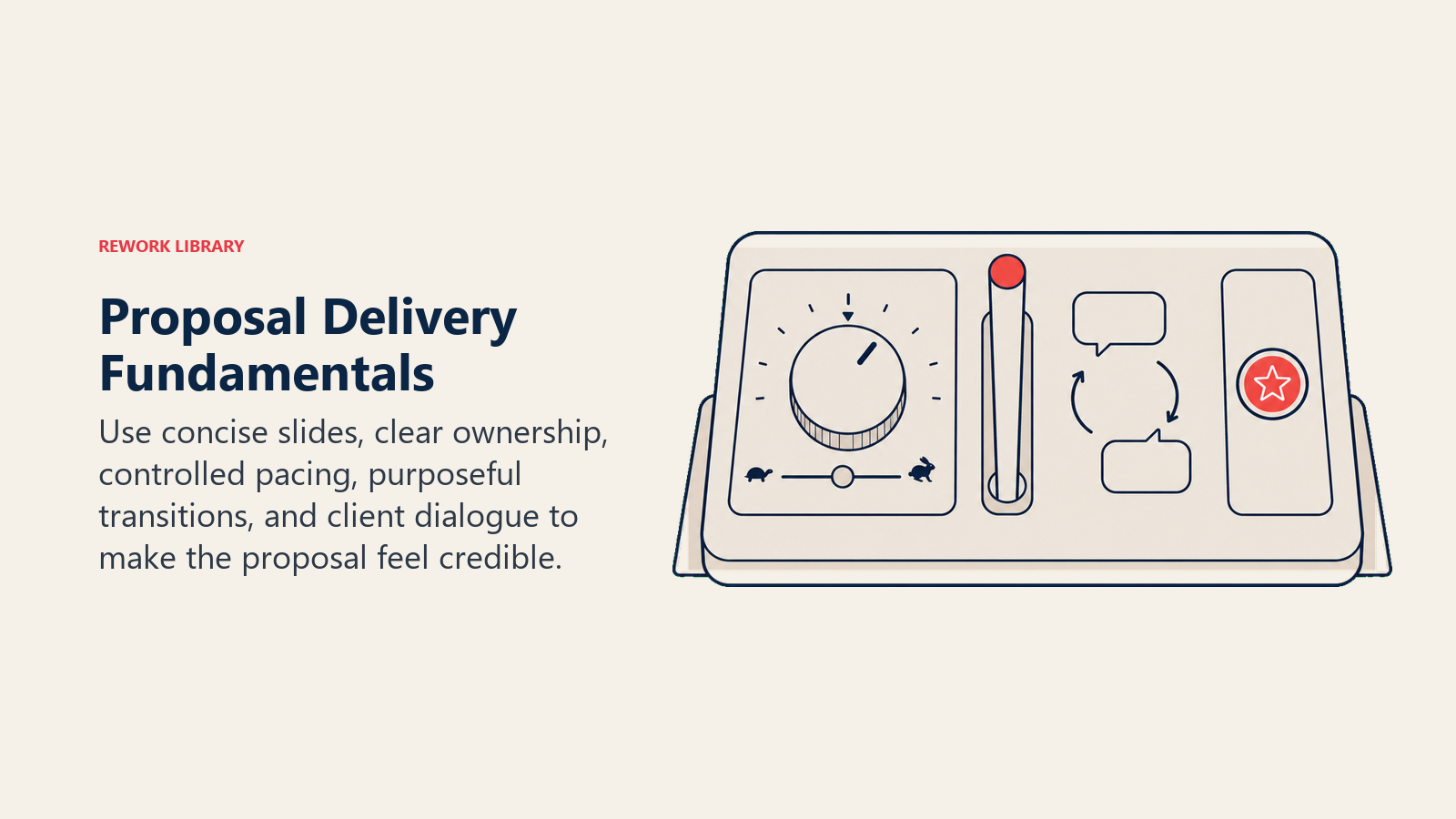
Your slides should support your message, not be your message.
Clean and minimal. One idea per slide. If you have a slide with eight bullet points, you have eight slides. People can't read and listen at the same time. When they're reading your slide, they're not listening to you.
Compelling graphics over text. Use diagrams, charts, images. Visual information processes faster than text. A process flow diagram tells the story better than five bullet points describing the process.
Consistent branding. Your slides should look professional and cohesive. Use your company's brand templates. Consistent fonts, consistent colors, consistent formatting.
Sloppy slides signal sloppy work. If you can't be bothered to format a presentation properly, why would they trust you with a six-month engagement?
Delivery techniques
Confident speaking. You need to sound like you believe in what you're presenting. That doesn't mean being loud or aggressive. It means being clear and certain.
Practice until you can deliver without reading slides. You should know your content well enough that the slides are just visual aids, not a script.
Engagement and eye contact. Look at people, not at the screen. Make eye contact with different people in the room. When someone asks a question, focus on them while answering.
If you're virtual, look at the camera when making key points. It simulates eye contact and creates connection.
Storytelling. Facts tell, stories sell. When you're explaining a solution, frame it as a story.
"We worked with a retail chain facing the same challenge. They were losing customers in the returns process. We rebuilt their system to make returns seamless. Three months later, their customer satisfaction scores jumped 28 points and returns actually increased because customers trusted the process."
That's more persuasive than "Our solution improves customer satisfaction."
Passion and conviction. You should care about solving their problem. If you don't, they'll sense it. Enthusiasm is contagious. If you're excited about the work, they'll be excited about hiring you.
But authenticity matters. Don't fake it. If you're not genuinely interested in their business, don't take the meeting.
Team dynamics
If multiple people are presenting, the transitions need to be smooth.
Seamless handoffs. The lead presenter introduces the next speaker. "Now I'll hand it over to Marcus, who's going to walk through the technical architecture."
Marcus starts with context. "Thanks. As Jamie mentioned, the key challenge is integrating with your existing CRM. Here's how we handle that..."
No awkward pauses, no confusion about who's speaking next.
Complementary roles. Each presenter should add something distinct. Don't have two people saying the same thing in different ways.
If one person covers methodology and another covers team, those are complementary. If both talk about methodology, that's redundant and wastes time.
Unified messaging. Make sure everyone on your team is aligned on key messages. If the lead says "12-week timeline" and the technical lead later mentions "14 weeks," you just created doubt.
Prep together. Agree on the numbers, the positioning, the answers to likely questions. Present a united front.
Client-focused language
This seems obvious but gets missed constantly. Talk about them, not you.
Instead of "We have a proprietary methodology that leverages best practices from Fortune 500 implementations," say "You'll get a proven process that's worked for companies like yours, which means faster results and less risk."
Use "you" and "your" more than "we" and "our." Frame everything in terms of their outcomes, their success, their business.
Don't say "we're going to implement a new system." Say "you'll have a system that eliminates the bottlenecks costing you deals."
Handling Q&A: where deals are won or lost
The formal presentation is your pitch. Q&A is where they decide if they trust you.
Listen fully before responding
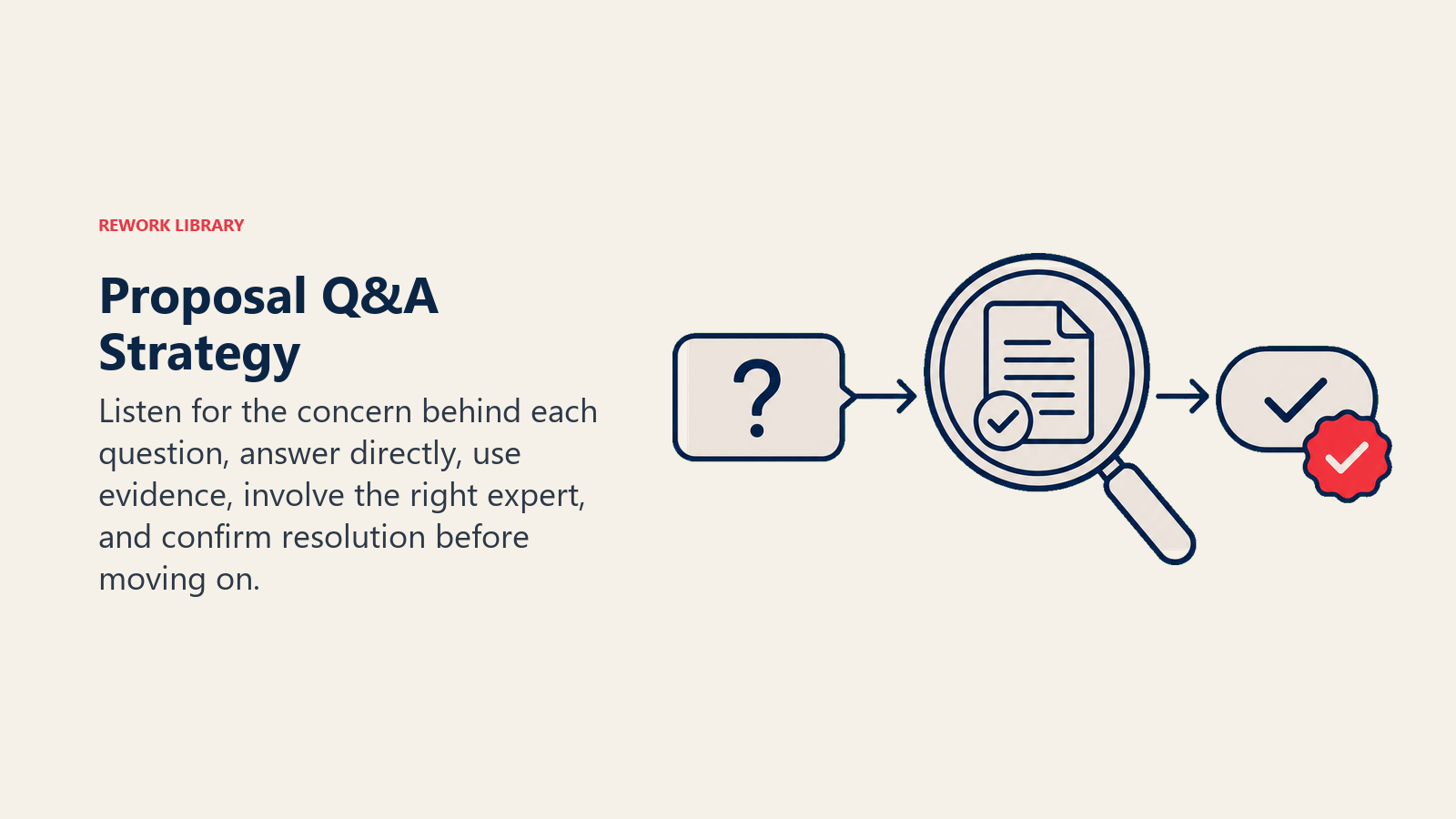
When someone asks a question, let them finish. Don't interrupt, don't assume you know where they're going, don't jump in with an answer.
Sometimes the real question is buried in the setup. If you answer too quickly, you miss what they're actually asking.
Pause before answering
Take a breath. A two-second pause shows you're thinking, not just reacting. It also gives you time to formulate a good answer instead of rambling.
Silence is okay. Rushed, unclear answers are not.
Bridge to key messages
Every answer is a chance to reinforce your value proposition.
Question: "What happens if our requirements change mid-project?"
Weak answer: "We'd handle that through a change order process."
Strong answer: "Great question. We build flexibility into the plan specifically because requirements do evolve. Our agile approach means we review priorities every two weeks, so if something changes, we adjust quickly without derailing the timeline. That's actually one of the reasons we recommend this over a fixed waterfall approach - you maintain control throughout."
You answered the question and reinforced a differentiator.
Handle difficult questions directly
If they ask about something uncomfortable - past failures, team turnover, pricing concerns - don't dodge.
Question: "I see your lead consultant left last month. How does that affect this project?"
Bad answer: "That won't be a problem."
Good answer: "You're right that Sarah left for a director role at another firm. The team on this project is Marcus and Jamie, who've both been with us three years and worked together on six similar engagements. Sarah actually helped train them. Her departure doesn't affect our ability to deliver this work."
You acknowledged the concern, provided context, and showed why it's not a risk. Dodging would have made them more worried.
Admit unknowns
If you don't know something, say so. "That's a good question and I don't have the answer right now. Let me check with our technical team and get back to you by end of day tomorrow."
Then actually get back to them. Missing a follow-up commitment is worse than admitting you didn't know in the first place.
Making up an answer destroys credibility instantly, and someone in the room probably knows the real answer anyway.
Follow-up commitments
If you commit to sending something or answering a question offline, write it down. In front of them.
"I'll get you that case study by Friday" is easily forgotten. "I'm noting that down - you'll have the case study by Friday" shows you're serious about follow-through.
Then send a follow-up email summarizing all commitments. This isn't just good practice, it's a chance to stay top of mind after the presentation.
Addressing objections: turning resistance into opportunity
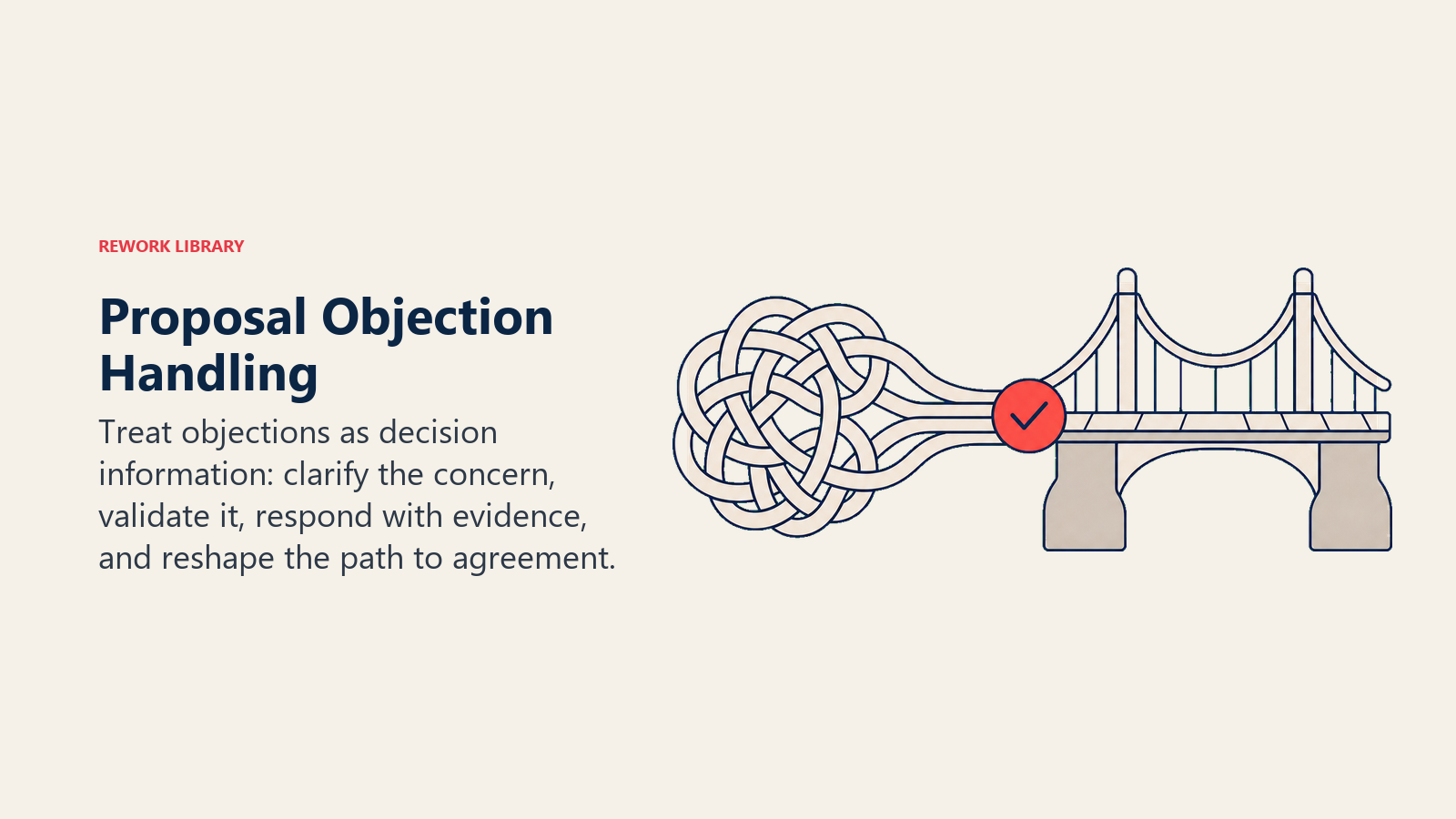
Objections aren't bad. They mean people are engaging with your proposal seriously enough to think about problems.
Acknowledge concerns
Don't minimize or dismiss. "I understand why that's a concern" goes a long way.
Objection: "This timeline feels aggressive."
Wrong response: "It's actually pretty standard."
Right response: "That's fair. Twelve weeks does feel fast, especially if you've had implementations drag on before. Let me show you why this is realistic..."
You validated their feeling before addressing it.
Provide evidence
Back up your responses with proof. Case studies, data, examples.
Objection: "How do we know this will work with our legacy systems?"
Response: "We've integrated with that exact platform twice in the past year. Here's the implementation at [Company], same system version you're running. The integration took three weeks and we hit all functionality requirements."
Evidence beats reassurance every time.
Reframe perspective
Sometimes you need to shift how they're thinking about the issue.
Objection: "This seems expensive compared to the other proposals."
Reframe: "I get the budget concern. But look at cost differently for a second. The lower bid is $100K less but takes twice as long and doesn't include training. That means four extra months of your team operating inefficiently, which based on the numbers we discussed earlier costs you $80K per month. That's $320K in operational cost, plus you're still paying for training separately. Our proposal is actually the lower total cost option when you factor in time and outcomes."
You didn't argue about price. You reframed the evaluation criteria from initial cost to total value.
Offer guarantees or risk mitigation
If they're worried about risk, reduce it.
"We're confident in this approach, which is why we're offering a 30-day checkpoint. If you're not seeing the progress we've committed to, you can pause the engagement with no penalty."
That's putting your money where your mouth is. It shows confidence and reduces their perceived risk. These risk mitigation elements will ultimately be documented in your scope definition and SOW.
Or "We'll run a two-week proof of concept before you commit to the full implementation. That way you see results before making the full investment."
Risk mitigation strategies turn "this might not work" into "let's test and see."
Closing and next steps: ending strong
Never end a presentation with "Well, I think that covers everything. Any other questions?"
That's weak. You built momentum, now use it.
Summary of key points
Recap quickly. "To summarize: we understand your challenge - customer churn during onboarding. Our solution reduces onboarding time from 45 to 12 days using a proven methodology. You'll work with our A-team who've done this for seven similar companies. The investment is $420K with six-month ROI. And we can start March 15th to hit your Q3 deadline."
You just reminded them of everything that makes your proposal strong.
Clear call to action
What do you want them to do?
"We'd love to move forward with this. Our ask: a decision by February 20th so we can lock in the March start date. What needs to happen on your end to get there?"
You're specific about what you want and when you need it. And you're asking what obstacles remain.
Decision timeline
If they're not ready to commit, establish next steps.
"I know you have two more presentations this week. When should we follow up?"
Or "What's your internal process from here? When will you make a decision?"
Don't leave it ambiguous. Pin down the timeline so you can follow up appropriately.
Follow-up plan
Confirm what happens next.
"We'll send a follow-up email today with answers to the technical questions we discussed, plus the case study you asked for. We'll check in on Thursday to see if you need anything else. And we'll plan to hear from you by the 20th on next steps."
You're setting expectations and staying in control of the process.
Express enthusiasm
End with genuine interest in the work.
"We're really excited about this opportunity. This is exactly the kind of challenge our team loves tackling, and we think we can deliver something great for you."
Enthusiasm matters. If you don't seem excited about working with them, why would they be excited about hiring you?
Common presentation mistakes and how to avoid them
What kills presentations:
Reading slides. If you're reading bullet points word for word, you didn't need to be there. Send the deck and save everyone time.
Slides are visual aids. You're the presentation. The slides just support what you're saying.
Too much detail. You know everything about your methodology. They don't need to. Give them enough to understand and trust your approach, not enough to implement it themselves.
If they want more detail, they'll ask. Start high level, go deeper based on questions.
Weak opening. If your first slide is "Agenda" and your first words are "Thanks for having us," you just wasted your most important 30 seconds.
Start strong. Hook them immediately with insight about their problem or a compelling statement about the value you'll deliver.
Poor time management. Running over time is disrespectful. It signals you can't plan or execute effectively. If the meeting is 60 minutes, finish in 55.
Running short is fine. "We covered everything we wanted to share. Let's open it up for questions."
Defensive responses. When someone challenges your approach or raises concerns, getting defensive kills trust.
Stay calm, acknowledge their point, address it with evidence. "That's a fair concern. Here's how we handle that..."
No clear ask. If you finish presenting and don't tell them what you want them to do, you've failed.
End with a specific request: "We'd like your commitment by this date." "We'd like to schedule a follow-up call to address technical questions." Something concrete.
Virtual presentation considerations
If your presentation is remote, everything gets harder. You can't read the room as easily, attention spans are shorter, and technical issues can derail everything.
Technology testing
Test everything before the meeting. Camera, microphone, screen sharing, internet connection. Have a backup plan if something fails.
Join the call 10 minutes early to handle any issues. Nothing says "we're not prepared" like spending the first five minutes troubleshooting audio.
Engagement techniques
Virtual audiences zone out faster. You need active engagement strategies.
Ask questions. "Show of hands, who's experienced this problem?" Even in a formal setting, interaction keeps people engaged.
Use people's names. "Sarah, I remember you mentioned this in our discovery call." Personalization fights the anonymity of video calls.
Check in periodically. "Is everyone seeing the screen? Can you hear me clearly?" This keeps them active instead of passive.
Visual fatigue management
An hour on video is exhausting. Build in breaks if possible.
"We're about halfway through. Let's take a two-minute break, then we'll cover the implementation plan and open it up for questions."
Or just change the visual stimulus. Switch presenters. Show a video. Pull up a live demo instead of slides. Variety helps.
Interactive elements
Use polling, chat, Q&A features if your platform supports them.
"Drop a question in the chat anytime" gives people an outlet even if they don't want to speak up.
Screen sharing the chat so everyone sees questions makes it collaborative instead of one-way.
Practice and preparation: the work before the work
Great presentations don't happen spontaneously. They're practiced.
Run through the full presentation. Out loud, with your team, in real time. Not "I'll just talk through my section," but a full dress rehearsal.
This is where you catch timing issues, awkward transitions, and unclear explanations.
Anticipate questions. Brainstorm every question they might ask. Write them down. Prepare answers.
If you're blindsided by a question in the actual presentation, you didn't prepare enough. Most questions are predictable.
Test technology. If you're doing a demo or showing something interactive, test it multiple times. Murphy's law applies - if something can break during the presentation, it will.
Prepare backup materials. Have extra copies of key documents. Have offline versions of anything cloud-based. Have your presentation on a USB drive and in email.
You probably won't need backups, but when you do, you'll be glad you prepared.
Rest before the presentation. Don't pull an all-nighter polishing slides. You need to be sharp, energized, and focused during the presentation. That matters more than perfect formatting.
The truth about what you're doing
Be direct about what's happening in that room. This isn't just information sharing. It's a sales situation. You're trying to persuade people to give you money and trust.
That means understanding persuasion principles.
Social proof. Case studies and client testimonials work because people trust what others like them have done. If you helped a competitor succeed, that carries weight.
Authority. Credentials matter. Industry recognition, certifications, years of experience, published work - these build credibility.
Scarcity. "We can start March 15th" has more urgency than "We can start whenever." Limited availability (whether timeline or team) creates pressure to decide.
Reciprocity. If you've provided value during the sales process (free assessment, helpful insights, introductions to others in your network), they'll feel some obligation to reciprocate.
Consistency. If they've already agreed that the problem is serious and needs solving, it's inconsistent not to hire someone to solve it. Your job is getting them to commit to the problem first, then showing you're the right solution.
None of this is manipulation. It's understanding how decisions get made and aligning your presentation accordingly.
The bottom line
Proposal presentations are where good solutions win or lose based on execution. You can have the best proposal in the pile and still lose because you didn't present it effectively.
Master the preparation. Understand the audience, anticipate concerns, assemble the right team, rehearse until it's smooth.
Nail the structure. Hook them early, prove you understand their needs, explain your solution clearly, show your team's credibility, justify the investment, close with a clear ask.
Deliver with confidence. Clean visuals, strong speaking, authentic enthusiasm, client-focused language.
Handle Q&A like a pro. Listen fully, address concerns directly, provide evidence, admit unknowns, bridge to key messages.
The difference between winning and losing often comes down to the 60 minutes in that room. Make them count.
Frequently Asked Questions
How do agencies grow by winning more proposal presentations? By raising win rate on the pursuits they already reach. Most services growth is constrained at the proposal stage, not the lead stage, so improving pre-meeting intelligence, presentation structure, and the close converts more qualified opportunities into signed contracts without needing more pipeline.
Why do well-written proposals still lose at presentation? Because delivery and fit beat polish. Common causes are presenting to the wrong room, a message that ignores the client's scoring criteria, Q&A that exposes gaps, and ending with no clear next step. A mediocre proposal delivered well often beats a brilliant one delivered poorly.
How long should a proposal presentation be? Most run 45 to 60 minutes including Q&A. A typical split is a 5-minute opening, 10 minutes on their needs, 20 minutes on your solution, 10 minutes on team and investment, and 15 to 30 minutes for questions. Finish a 60-minute meeting in about 55.
Who should present from the agency side? A senior leader to open and close, subject matter experts for technical sections, and any client-facing lead who already has rapport. Keep the group small, give each presenter a defined role, and assign one person to watch the room and read reactions.
How do you close a proposal presentation? Recap the key points, then make a specific ask tied to a date, such as a decision by a set day to lock a start date and hit the client's deadline. Confirm next steps and follow up in writing. Never end with a vague "any questions?"
For deeper guidance on the foundation that makes great presentations possible, check out Proposal Development to build a winning document, Consultative Business Development to understand relationship-driven selling, and Pricing Justification to handle the investment conversation with confidence.

Sales Director
On this page
- Why proposals fail at presentation
- Pre-presentation strategy: understanding the landscape
- Audience analysis: mapping the room
- Team assembly: who should present
- Presentation structure: the 45-60 minute format
- Opening (5 minutes)
- Understanding of needs (10 minutes)
- Proposed solution (20 minutes)
- Team and credentials (10 minutes)
- Investment and next steps (10 minutes)
- Q&A (15-30 minutes)
- Presentation best practices: delivery fundamentals
- Visual design principles
- Delivery techniques
- Team dynamics
- Client-focused language
- Handling Q&A: where deals are won or lost
- Listen fully before responding
- Pause before answering
- Bridge to key messages
- Handle difficult questions directly
- Admit unknowns
- Follow-up commitments
- Addressing objections: turning resistance into opportunity
- Acknowledge concerns
- Provide evidence
- Reframe perspective
- Offer guarantees or risk mitigation
- Closing and next steps: ending strong
- Summary of key points
- Clear call to action
- Decision timeline
- Follow-up plan
- Express enthusiasm
- Common presentation mistakes and how to avoid them
- Virtual presentation considerations
- Technology testing
- Engagement techniques
- Visual fatigue management
- Interactive elements
- Practice and preparation: the work before the work
- The truth about what you're doing
- The bottom line
- Frequently Asked Questions