Negotiation for Professional Services: Protecting Margins While Building Partnerships
Turn this article into takeaways for your work.


Each assistant summarizes the article only for you and suggests best practices for your work.
Here's an uncomfortable truth: 72% of professional services firms leave money on the table during contract negotiations. Not because they don't know their worth, but because they fold under pressure, make unnecessary concessions, or simply don't have a plan.
The cost isn't just the immediate discount you give. It's the scope creep that follows when you set the wrong precedent. It's the margin erosion that compounds across every similar deal afterward. It's the damaged relationship when you over-promise to close and under-deliver during execution.
Good negotiation isn't about squeezing every dollar from clients or being stubborn about your terms. It's about creating agreements where both parties win, where you protect your profitability while the client gets real value. That balance is what makes negotiations successful and relationships sustainable.
This guide shows you how to negotiate professional services contracts without sacrificing margins or partnerships. You'll learn preparation frameworks, specific strategies for common scenarios, and tactics that actually work when the client says "your competitor is cheaper."
Why services negotiations are different
If you've sold products before, forget most of what you learned. Services negotiations operate under completely different rules.
You're selling intangibles. There's no physical product to show, no manufacturing cost to point to as a price floor. Your value is expertise, time, and outcomes that haven't happened yet. That makes justification harder and pricing more subjective in the client's eyes.
Relationships drive everything. Unlike a one-time software purchase, professional services often mean months or years of close collaboration. How you negotiate sets the tone for the entire relationship. Win too hard, and the client starts the engagement feeling resentful. Give away too much, and they won't respect your boundaries later.
Multiple stakeholders complicate decisions. You're rarely negotiating with just one person. There's the project sponsor who wants quality, the procurement team focused on price, the CFO watching budget, and the end users concerned about implementation. Each has different priorities, and you need to address all of them.
The complexity means you can't just send a proposal and hope for the best. You need a strategy that accounts for these dynamics. This builds on the foundation you established during initial consultation and needs assessment.
Understanding power dynamics and leverage
Every negotiation has an underlying power structure. Understanding it helps you navigate more effectively.
Assess your leverage position. Do they need you more than you need them? If you're the only firm with specific expertise they require, your leverage is high. If they're choosing from five qualified vendors and you need the revenue, their leverage is stronger.
Incumbent vs new vendor dynamics. If you're the incumbent, you have relationship equity and institutional knowledge that's costly for them to replace. But incumbents can get complacent. New vendors bring fresh ideas and competitive pricing but lack established trust. Know which position you're in and play to its strengths.
The importance of alternatives. Your BATNA (Best Alternative To a Negotiated Agreement) determines your walk-away point. If you have three other strong opportunities, you can afford to be firm. If this is your only prospect this quarter, they sense that desperation. Similarly, their alternatives matter. If their only other option is a firm that's twice your price, you're in a strong position.
Strategic importance matters. Is this a routine project or something mission-critical? Are they on a deadline that creates urgency? Understanding the strategic context tells you how much flexibility they actually have, regardless of what they claim.
Run through these questions before you enter any negotiation. They inform your entire approach.
Pre-negotiation preparation
Most negotiations are won or lost before you even sit down. Preparation is everything.
Define your objectives and boundaries
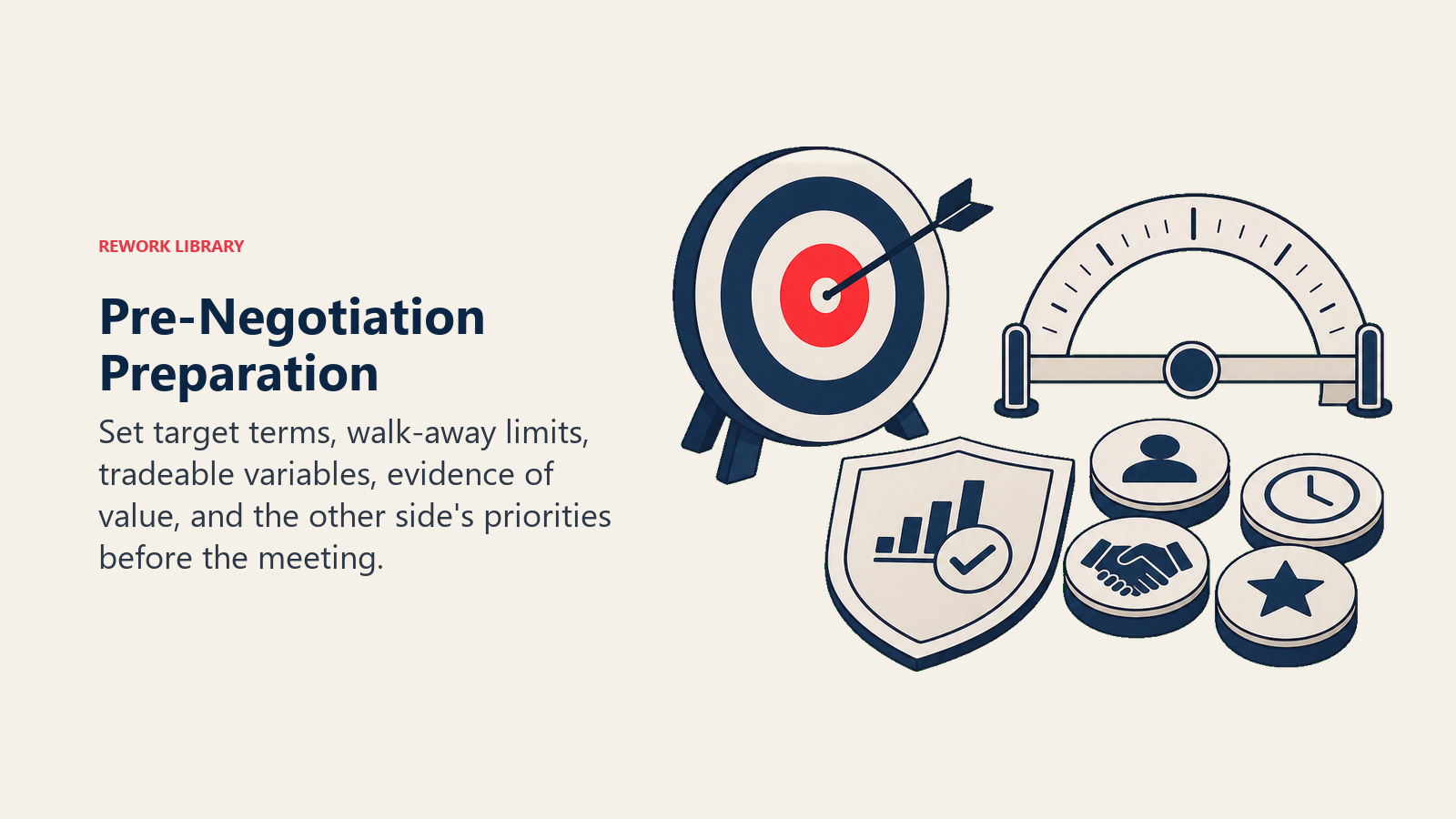
Start with clarity on what you actually want. Not just the ideal outcome, but your minimum acceptable terms.
Your target price is the number you're hoping to get. It should be based on your value-based pricing model, not pulled from thin air.
Your walk-away price is the absolute minimum you'll accept before you'd rather walk away. Factor in your costs, required margin, and opportunity cost. If a deal drops below this threshold, it's not worth doing.
Scope boundaries mean exactly what's included and what's not. Be specific. If the proposal says "develop marketing strategy," define whether that includes competitive analysis, market research, implementation support, and everything else that might be assumed.
Non-negotiables are the terms you won't compromise on. Maybe it's payment milestones, your project methodology, or specific deliverable standards. Know these ahead of time.
Write these down. When you're in the room and feeling pressure, having documented boundaries prevents emotional decision-making.
Research the client situation
The more you know about their constraints and priorities, the better you can position your proposals.
Budget reality: Do they have approved budget? What's the amount? If they're tight on cash but flush with flexibility elsewhere, you might offer different payment terms rather than lowering price.
Decision-making process: Who's involved? What criteria are they using? Understanding this prevents you from negotiating hard with someone who can't actually approve the final terms.
Timeline pressures: Are they under time constraints? A client who needs to start next month has less leverage than one exploring options for next year.
Past vendors and relationships: What worked before? What didn't? This tells you what they value and what frustrations you can address.
Much of this comes from your budget and timeline discovery during the sales process. Don't go into negotiation blind.
Plan your concession strategy
Never give something for nothing. Every concession you make should get you something in return.
Before you walk into any negotiation, map out your trade-offs. Here's what that looks like:
| If they ask for | You might offer | In exchange for |
|---|---|---|
| 10% price reduction | 8% reduction | Removing one deliverable phase |
| Faster timeline | Expedited delivery | 15% rush premium |
| Extended payment terms | Net-60 instead of Net-30 | Higher total fee or upfront deposit |
| Added scope item | Include the feature | Increase overall fee or extend timeline |
| Deferred start date | Hold resources | Non-refundable deposit |
This matrix keeps you from giving away concessions in the moment without getting equivalent value back. When they ask for something, you're not scrambling to think of what to trade because you already know.
Anticipate objections
You can predict 80% of what they'll say. Prepare responses ahead of time.
Common objections you'll hear:
- "We need a discount" means you need prepared responses about value justification and scope trade-offs
- "Competitor is cheaper" requires questions about scope parity and differentiation points
- "We need more included" calls for a framework for discussing scope additions and pricing
- "Our budget is fixed" opens the door to alternative structures like phasing or different service levels
Having thought through these scenarios prevents you from being caught off guard and making reactive concessions.
Core negotiation strategies
Here's what actually works when you're in the room.
Win-win collaborative problem-solving
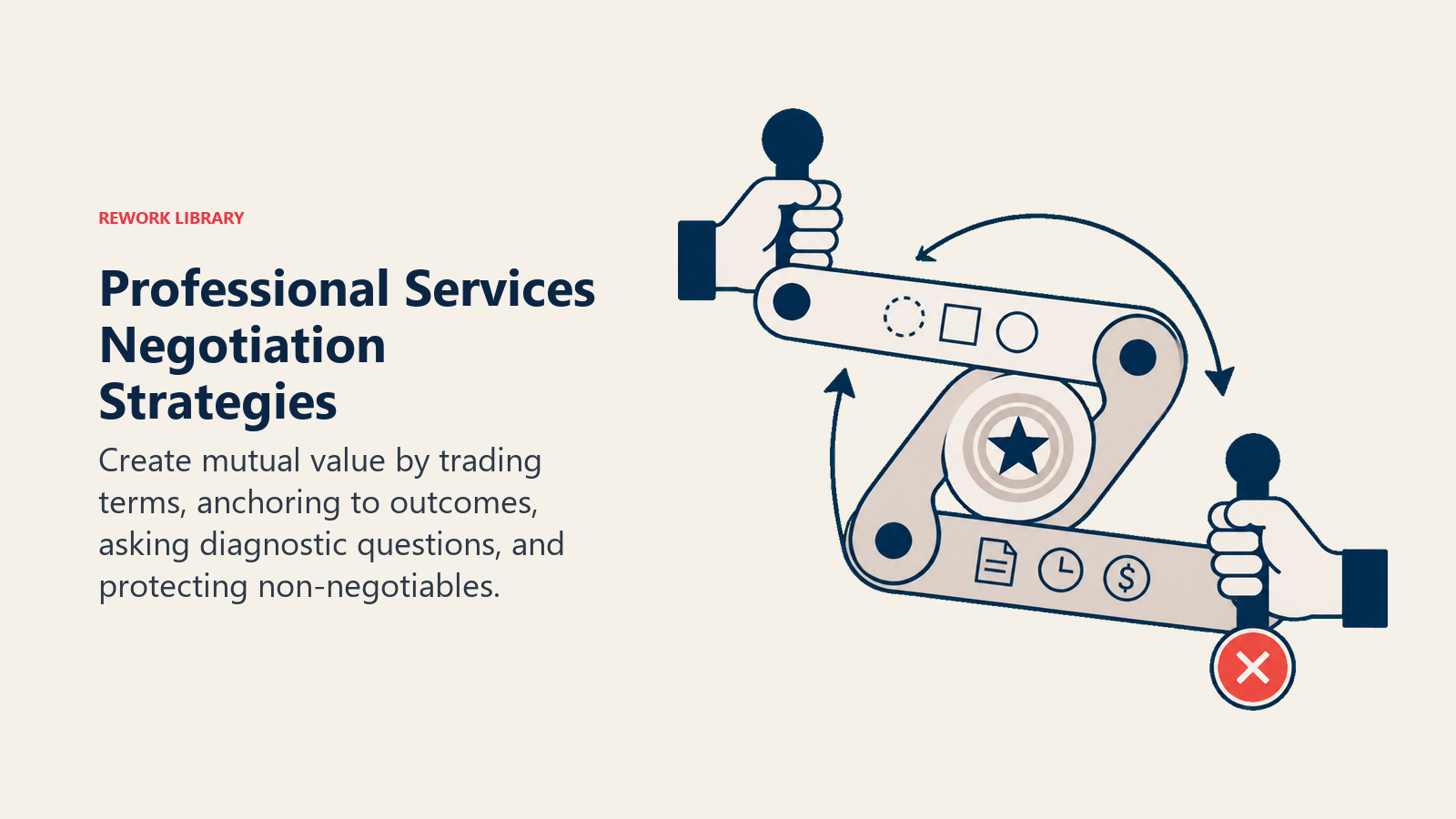
The best negotiations don't feel like battles. They feel like two parties working together to find a solution that works for both.
This changes everything about how you approach the conversation. Instead of "How do I get them to accept my terms?" think "How do we structure this so both sides get what they need?"
Practically, this means asking questions about their constraints and priorities, sharing your own constraints transparently (within reason), brainstorming options together rather than just trading offers, and focusing on expanding value instead of just dividing a fixed pie.
Example: Client wants lower price. Instead of just offering a discount, you explore why. Turns out their budget is allocated quarterly. You propose a phased approach that fits their budget cycle, same total fee but structured differently. Problem solved, no margin sacrifice.
Anchoring and positioning
The first number thrown out in a negotiation tends to anchor the entire discussion. Use this strategically.
Start higher than your target. If you want $100K, don't propose $100K. Propose $115K. This gives you room to negotiate down while still landing at your target. It also positions your services as premium.
But don't go so high that you lose credibility. If market rate is $100K and you propose $200K, you just look out of touch. The anchor needs to be justifiable, even if it's on the higher end.
Use ranges strategically. Bracketing creates a negotiation window. "For this scope, we typically see fees in the $90K-$120K range depending on timeline and deliverables." This sets expectations and makes your specific proposal feel reasonable within that context.
When they counter with a lower number, don't immediately meet in the middle. That's what they expect. Hold closer to your position and make them work for concessions.
Trading concessions, not giving them
This is the single most important rule: never give something without getting something of equal value.
If they ask for faster delivery, you charge a premium. If they want added scope, you increase the fee or extend the timeline. If they want a discount, you reduce scope or ask for other valuable terms.
Bad concession: "Okay, we can do 10% off." Good concession: "We can offer 8% off if you commit to a 12-month contract instead of 6 months."
The second approach maintains value. You're not just discounting. You're getting something that's valuable to you (longer commitment, more stable revenue, potential for expansion).
Keep concessions roughly equivalent in value. If you reduce price by $10K, get back $10K worth of value in commitment, scope reduction, or favorable terms.
Patience and strategic silence
Here's a tactic most people underuse: shut up and wait.
When you make an offer, stop talking. Don't fill the silence with justifications or nervous chatter. Let them process and respond. Often, they'll talk themselves into acceptance or reveal information you didn't have.
Client: "That price is higher than we expected." You: [Pause. Wait for them to continue.] Client: "We were thinking more like $80K. But I guess that probably doesn't include the full implementation support..."
See what happened? By staying quiet, you learned that they need implementation support and they're already rationalizing why your price might be justified. If you'd jumped in with "Let me explain why it costs this much," you'd have missed that.
Silence also shows confidence. You're comfortable with your pricing because you know it's fair.
The good cop/bad cop dynamic
Sometimes you're not the final decision-maker, and that's actually useful in negotiations.
"I think this sounds reasonable, but I need to run it by my managing partner" gives you an out. You can come back with "They approved most of it, but they want to keep the IP ownership clause" or "They'll need a 25% deposit instead of 10%."
This tactic lets you be the friendly collaborative one while having an invisible authority figure who keeps you from giving away too much. Use it sparingly so it doesn't feel like a game, but it's effective when you need breathing room to consult or reconsider terms.
Handling common negotiation scenarios
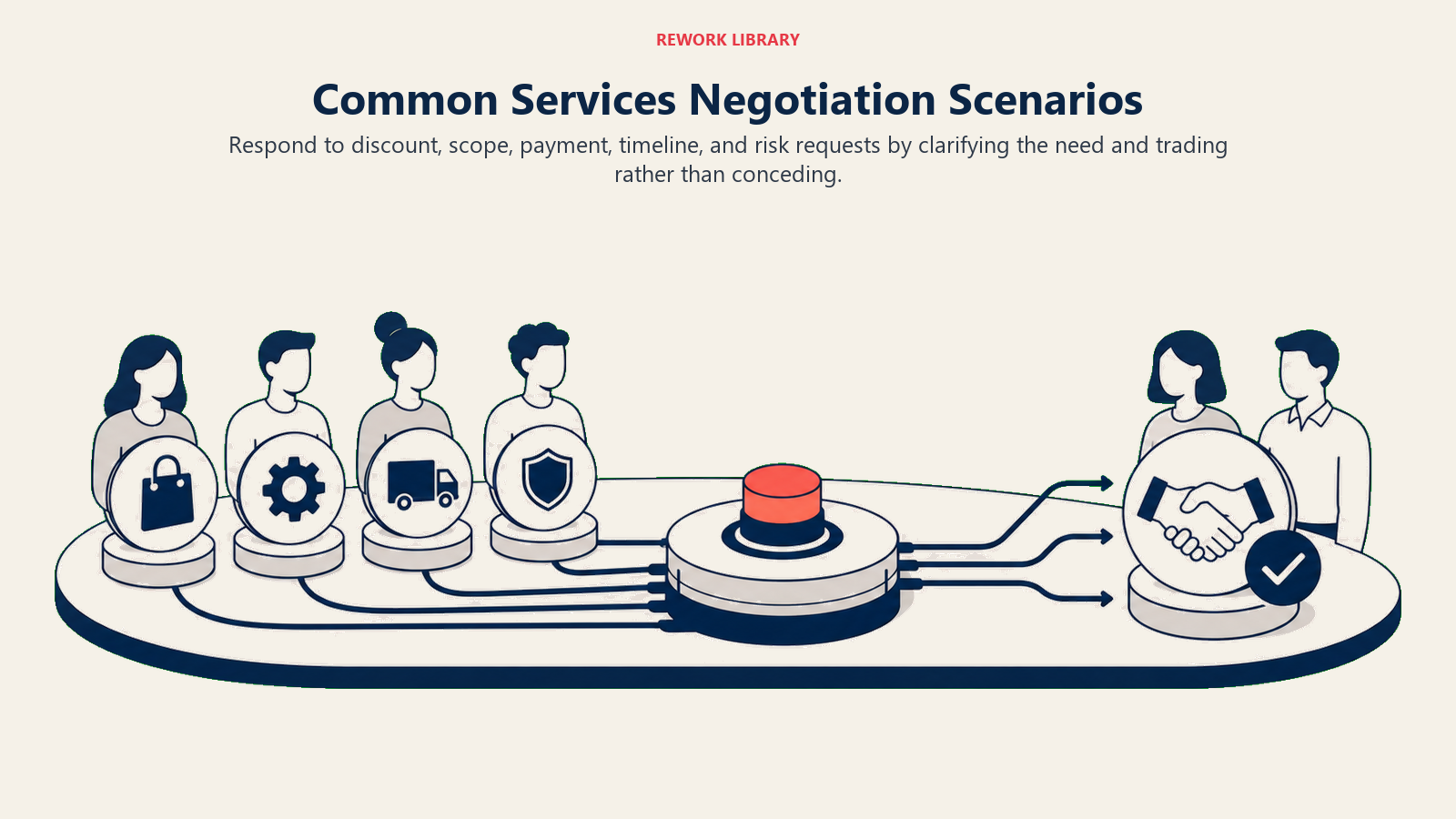
Let's get specific. Here's what to do when you hear these requests:
"We need a discount"
This is the most common negotiation tactic. Clients ask because it works. Many firms fold immediately.
Don't: Offer a discount right away to be accommodating.
Do: Understand why they're asking and what they'll trade.
Response framework:
- Acknowledge: "I understand budget is a concern for every project."
- Reaffirm value: "Our pricing reflects the expertise and outcomes we deliver, which is why [client X] saw [specific result]."
- Explore alternatives: "If budget is a constraint, we could discuss phasing the project, adjusting scope, or different service levels. What's most important to you?"
If they insist on a discount, you have several trade-offs to offer. You could reduce scope by removing Phase 3, which brings it down to the lower number they're looking for. Or consider a volume commitment where you offer 10% off if they commit to a quarterly retainer instead of this one-off project. You might also propose a payment terms trade where you do 8% off if they pay 50% upfront instead of your standard 25%. Another option is starting with a smaller pilot at a reduced investment, and if results meet targets, you continue with the full engagement.
The key is making them choose what to give up. If they want everything in the proposal but at a lower price, the answer is no. But if they're willing to trade scope, timing, or terms, you can find middle ground.
"Your competitor is cheaper"
This one's designed to create pressure. Sometimes it's true, sometimes it's a bluff. Either way, your response is the same.
Don't: Match their price without understanding the difference.
Do: Differentiate based on value and question the comparison.
Response framework: "I'm not surprised there are different price points in the market. There usually are when you're comparing firms with different approaches and capabilities. A few questions to make sure we're comparing apples to apples:
- What exactly is included in their scope? Are they providing [specific differentiator you offer]?
- What's their track record with projects like this? Have you spoken with their references?
- What's their team's experience level? Will you be working with senior consultants or junior staff?
- How do they handle [risk/challenge specific to this project type]?"
This shifts the conversation from price to value. Often, the "cheaper competitor" isn't actually offering the same thing. By asking these questions, you help the client see the differences.
If they truly are comparable, you need to decide: is this a must-win deal where you'll match (and make it up elsewhere), or do you hold firm because your expertise justifies premium pricing?
Don't compete on price alone. If you're just the cheaper option, the relationship is fragile. Compete on value, outcomes, and fit.
"We need faster delivery"
Compressed timelines strain resources and increase risk. That costs you, so it should cost them.
Don't: Agree to aggressive timelines just to win the deal.
Do: Explain the implications and charge appropriately.
Response framework: "We can accelerate the timeline, but that requires pulling in senior resources from other projects and potentially working extended hours. Here are the options:
Option 1: Rush delivery with current scope at 15% premium ($X instead of $Y) to cover expedited resource allocation.
Option 2: Faster timeline with reduced scope. We deliver [core components] by your deadline, and [additional elements] in Phase 2.
Option 3: Original timeline with all deliverables at the proposed price.
What works best for your priorities?"
The premium for rush work isn't arbitrary. It's compensating for the real cost of disrupting your schedule, the increased risk of quality issues, and the opportunity cost of not serving other clients.
If they push back on the premium, ask what's driving the tight deadline. Often it's artificial, or there's flexibility once you understand the real constraint. Maybe they need final deliverables by month-end, but you could deliver interim findings earlier. Problem solved without the rush fee.
"We want to add scope"
Scope expansion during negotiation is common. Handle it clearly or you'll spend the entire engagement fighting scope creep.
Don't: Say "sure, we can include that" to be helpful.
Do: Price it explicitly or create a trade-off.
Response framework: "Adding [new scope item] makes sense given your objectives. To include it, we'd need to adjust either the fee or timeline:
Option 1: Include it as part of the full scope for $X total (original price plus increment for new item).
Option 2: Include it in Phase 2, which we'd scope and price separately after completing Phase 1.
Option 3: Include it now by removing or reducing [another deliverable] to keep the budget at $Y.
Which approach works for you?"
This reinforces that scope changes have costs. You're not being difficult. You're being clear about resource requirements. Setting this expectation now prevents fights later when they ask for "just one more thing."
Document scope changes explicitly in your scope definition and SOW. If it's not written down, it didn't happen.
"Our contract terms are non-negotiable"
Large clients often have standard agreements they claim are set in stone. Sometimes that's true. Often there's more flexibility than they initially suggest.
Don't: Accept unfavorable terms just because they call them "standard."
Do: Identify specific concerns and escalate strategically.
Response framework: "I understand you have standard terms. We do too, and we're usually able to find common ground. I've reviewed the agreement and have concerns about [specific clauses]:
- Unlimited liability: Our standard practice is to cap liability at the contract value, which is industry norm for consulting engagements.
- Broad IP assignment: We're fine assigning work product created specifically for you, but our pre-existing IP and methodologies need to remain ours.
- 90-day payment terms: Our business model requires Net-30 to manage cash flow. Could we do Net-45 as a compromise?
Can we discuss modifications to these specific items?"
Be specific. Don't just say "we can't accept these terms." Identify the 2-3 clauses that are actual deal-breakers and propose reasonable alternatives.
If the procurement contact says they can't change anything, ask for escalation. "I understand you may not have authority to modify terms. Who would be the right person to discuss business terms with?" Often, the business sponsor can override procurement's "non-negotiable" stance.
Some terms genuinely are non-negotiable with large organizations. You have to decide if the opportunity is worth accepting less favorable terms. But don't assume that without testing.
Protecting your profitability
Winning the deal doesn't matter if you lose money delivering it. Build these protections into every negotiation.
Clear scope boundaries
Ambiguity kills margins. "Provide marketing support" means one thing to you and something completely different to the client. Define everything specifically.
Your scope definition should include specific deliverables (quantity, format, detail level), number of revision rounds included, meeting cadence and attendee expectations, response time commitments, and what's explicitly excluded. See our detailed guide on scope definition and SOW for comprehensive coverage.
When scope is clear, change orders are straightforward. When it's vague, you end up doing extra work "because the client thought it was included."
Minimum pricing thresholds
Know your floor. Below a certain price point, the project doesn't make business sense. This threshold should account for:
Direct costs: Staff time, contractor fees, software/tools, travel.
Overhead allocation: Your team doesn't just work on billable projects. They do proposals, training, admin work. Those costs need to be covered.
Required profit margin: You're running a business, not a charity. What margin do you need to make the project worthwhile? 20%? 30%? 40%? Know your number.
If negotiation pushes you below this threshold, walk away. A bad deal that loses money is worse than no deal.
Resource cost considerations
When clients ask for senior resources, premium turnaround, or specialized expertise, those cost you more. Price accordingly.
If they want your managing partner on the project instead of a senior consultant, that's a material difference in cost. Your partner bills at $400/hour, your consultant at $200/hour. Don't absorb that difference.
Similarly, if the project requires hiring specialized contractors or buying specific tools, those are direct costs that should be passed through or built into pricing.
Risk premiums for complexity
Some projects are riskier than others. Fixed-fee pricing on ill-defined strategic consulting? That's risky, so build in premium. Implementation project with clear specifications? Less risk.
Risk factors that warrant higher pricing include vague or changing requirements, aggressive timelines with penalties, multiple stakeholders with conflicting agendas, clients doing this type of project for the first time, unproven methodologies or approaches, and fixed-fee structure on uncertain scope.
The premium isn't about gouging clients. It's about being compensated for the additional management overhead, potential scope debates, and likelihood of scope expansion.
Payment terms that protect cash flow
Professional services firms live and die by cash flow. Payment terms are a negotiation point, not a given.
Avoid: Delivering everything upfront and billing at the end. You're financing the client's project on your dime.
Prefer: Milestone-based payments tied to deliverables.
Standard structure looks like this: 25-30% upfront upon signing (commitment signal and covers initial costs), 35-40% at midpoint or key milestone, 30-35% upon final delivery, with Net-30 payment terms.
For longer engagements, monthly retainer or progress billing keeps cash flowing. Your approach here should align with your retainer vs project model strategy.
Large organizations push for Net-60 or Net-90 terms. Push back. "Our standard terms are Net-30. We can consider Net-45 but would need to adjust pricing to account for financing costs." Make them pay for the privilege of slow payment.
If they insist on unfavorable terms, consider factoring invoices or using a service that pays you upfront and collects from the client. It costs a few percentage points but protects your cash flow.
Negotiation tactics to avoid
Some tactics feel clever but damage relationships or backfire. Don't use these:
Lying or misrepresentation: Never claim a competitor bid something they didn't or make up client success stories. Your reputation isn't worth one deal, and people talk in professional services. Get caught in a lie, and your credibility is shot.
Ultimatums: "This price is only good until Friday" or "Take it or leave it" creates unnecessary pressure and often backfires. Unless you genuinely have another client who wants the slot, don't bluff. Clients can sense it, and it makes you look desperate.
Personal attacks or emotional manipulation: Negotiating can be frustrating, but questioning someone's judgment or making them feel guilty for negotiating is unprofessional. "I can't believe you'd question our value" or "After all the time I've spent on this proposal..." damages rapport.
Negotiating against yourself: Client asks for a discount. You offer 10% off. They don't respond immediately, and you panic and offer 15%. You just bid against yourself. Make one offer and wait for their counter before moving again.
Over-promising to close the deal: "We can definitely deliver all of this in 6 weeks" when you know it takes 10 weeks is setting yourself up for failure. The short-term win of closing the deal becomes a long-term disaster when you can't deliver.
Stay professional, honest, and firm. Those tactics build trust even when you're disagreeing about terms.
Closing the negotiation
When you reach agreement, lock it in clearly.
Summarize terms explicitly: Don't assume everyone understood the same thing. "Just to confirm, we've agreed to: [scope], [timeline], [price], [payment terms], [key deliverables]. Is that your understanding as well?"
Document immediately: Send a follow-up email that same day recapping what was agreed. This prevents "I don't remember agreeing to that" later.
Get it in writing: Move quickly to contract. Verbal agreements fade. People's memories change. Until it's signed, nothing is final. Use your contract and engagement letter process to formalize terms.
Confirm mutual understanding: Before signing, walk through the SOW together. Make sure you both interpret scope, deliverables, and success criteria the same way. This prevents disputes during delivery.
Express partnership commitment: End on a positive note. "I'm excited to work together on this. We're committed to delivering exceptional results." The negotiation might have been tough, but the relationship should start strong. This positive momentum carries into your client onboarding process.
Establish next steps: "We'll send the contract by end of week. Once signed, we'll schedule the kickoff meeting for [date]. Our team will reach out next Monday to coordinate." Clear next steps maintain momentum.
Where to go from here
Negotiation isn't a one-time skill you use only when closing deals. It's something you'll do throughout client relationships when scope expands, timelines shift, or new opportunities emerge.
Build on what you've learned here:
- Start with strong pricing justification so you negotiate from a solid foundation
- Use clear scope definition to minimize negotiation friction during delivery
- Apply budget and timeline discovery to understand constraints before you get to negotiation
- Ensure your contract and engagement letters reflect negotiated terms accurately
The best negotiators protect their margins not by being aggressive, but by being prepared, confident in their value, and willing to walk away from bad deals. Master that, and negotiation stops feeling like a battle and starts feeling like a natural part of building profitable client partnerships.

Sales Director
On this page
- Why services negotiations are different
- Understanding power dynamics and leverage
- Pre-negotiation preparation
- Define your objectives and boundaries
- Research the client situation
- Plan your concession strategy
- Anticipate objections
- Core negotiation strategies
- Win-win collaborative problem-solving
- Anchoring and positioning
- Trading concessions, not giving them
- Patience and strategic silence
- The good cop/bad cop dynamic
- Handling common negotiation scenarios
- "We need a discount"
- "Your competitor is cheaper"
- "We need faster delivery"
- "We want to add scope"
- "Our contract terms are non-negotiable"
- Protecting your profitability
- Clear scope boundaries
- Minimum pricing thresholds
- Resource cost considerations
- Risk premiums for complexity
- Payment terms that protect cash flow
- Negotiation tactics to avoid
- Closing the negotiation
- Where to go from here