LinkedIn for Professional Services: Profile to Pipeline Strategy
Turn this article into takeaways for your work.


Each assistant summarizes the article only for you and suggests best practices for your work.
The networking event is dead. Or at least, it's dying.
Pre-2020, the standard business development advice for consultants, lawyers, and accountants was "show up everywhere." Chamber of Commerce breakfasts. Industry conferences. Golf outings. Wine tastings disguised as networking events. The idea was simple: be visible, shake hands, collect business cards, follow up.
That model worked when buyers had limited ways to research firms and evaluate expertise. If you wanted to know if a consultant understood supply chain optimization, you either called someone you knew or met them at a conference and asked directly.
Now? Buyers research you on LinkedIn before they ever pick up the phone. They read your posts, scan your recommendations, check who you're connected to, and look at the cases you've worked on. By the time they reach out, they've already decided if you're credible.
This shift makes LinkedIn the most important business development channel for professional services firms. Not social media. Not a nice-to-have. The primary platform where expertise gets demonstrated, relationships get built, and pipeline gets generated. It's a core component of the professional services growth model.
This guide shows you how to treat LinkedIn like the business development operation it is.
Why LinkedIn Matters for Professional Services
Professional services firms sell expertise. Unlike products, you can't demo competence in 30 seconds. Buyers need proof that you understand their problem, you've solved it before, and you can do it again for them.
LinkedIn provides that proof at scale. Your profile is your digital storefront. Your content demonstrates your thinking. Your network shows who trusts you. Your recommendations prove you deliver.
But here's what most firms get wrong: they treat LinkedIn like a resume platform. They set up a profile, list their credentials, and wonder why nothing happens. That's not a strategy. That's a placeholder.
The firms generating real business from LinkedIn treat it as a system with four integrated components:
Profile optimization: Your digital business card needs to communicate credibility and specialization instantly.
Content strategy: Regular posts that demonstrate expertise and build authority in your niche.
Relationship building: Systematic outreach and engagement that creates warm connections before you ever ask for a meeting.
Lead generation: Inbound inquiries from prospects who found you through your profile or content, plus targeted outreach to ideal clients.
When these four pieces work together, LinkedIn becomes a predictable source of qualified leads. Not magic. Just systematic execution.
The LinkedIn Strategy Framework
Professional services LinkedIn strategy follows a clear hierarchy. Skip a level and everything above it fails. Foundation: Profile Optimization If your profile doesn't immediately communicate what you do and who you help, nothing else matters. A weak profile kills credibility even if your content is excellent.
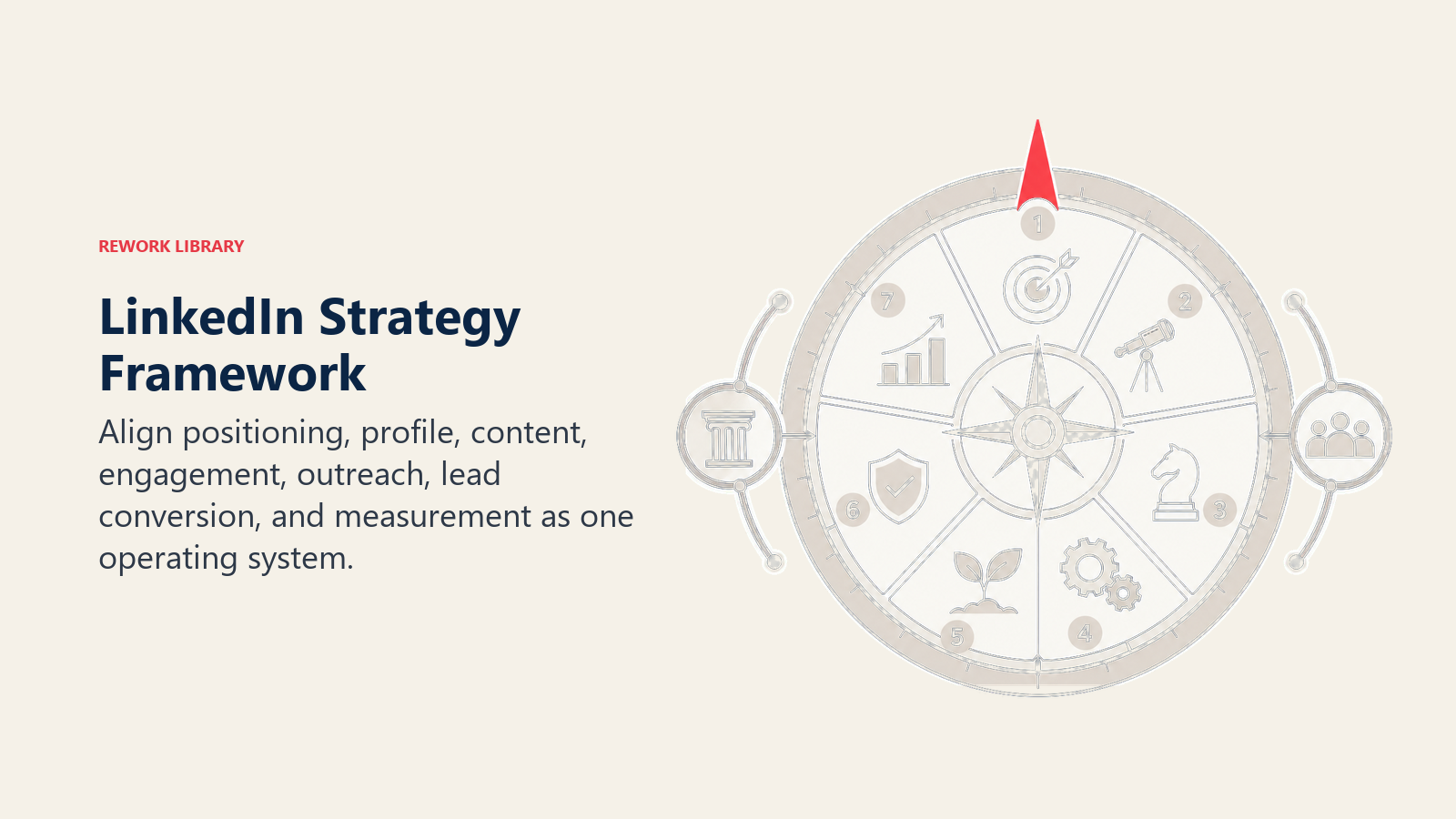
Layer 2: Content Strategy Once your profile works, you need regular content that reinforces your expertise. This builds visibility and gives prospects a reason to follow you.
Layer 3: Engagement Strategy Content without engagement is broadcasting. You need to actively participate in conversations, comment on others' posts, and build relationships.
Layer 4: Outreach & Lead Generation With a strong profile, consistent content, and active engagement, you've earned the right to reach out to ideal prospects. Your outreach works because you've already built credibility.
Most firms try to skip straight to Layer 4 - sending cold connection requests asking for meetings. That doesn't work. The foundation has to be solid first.
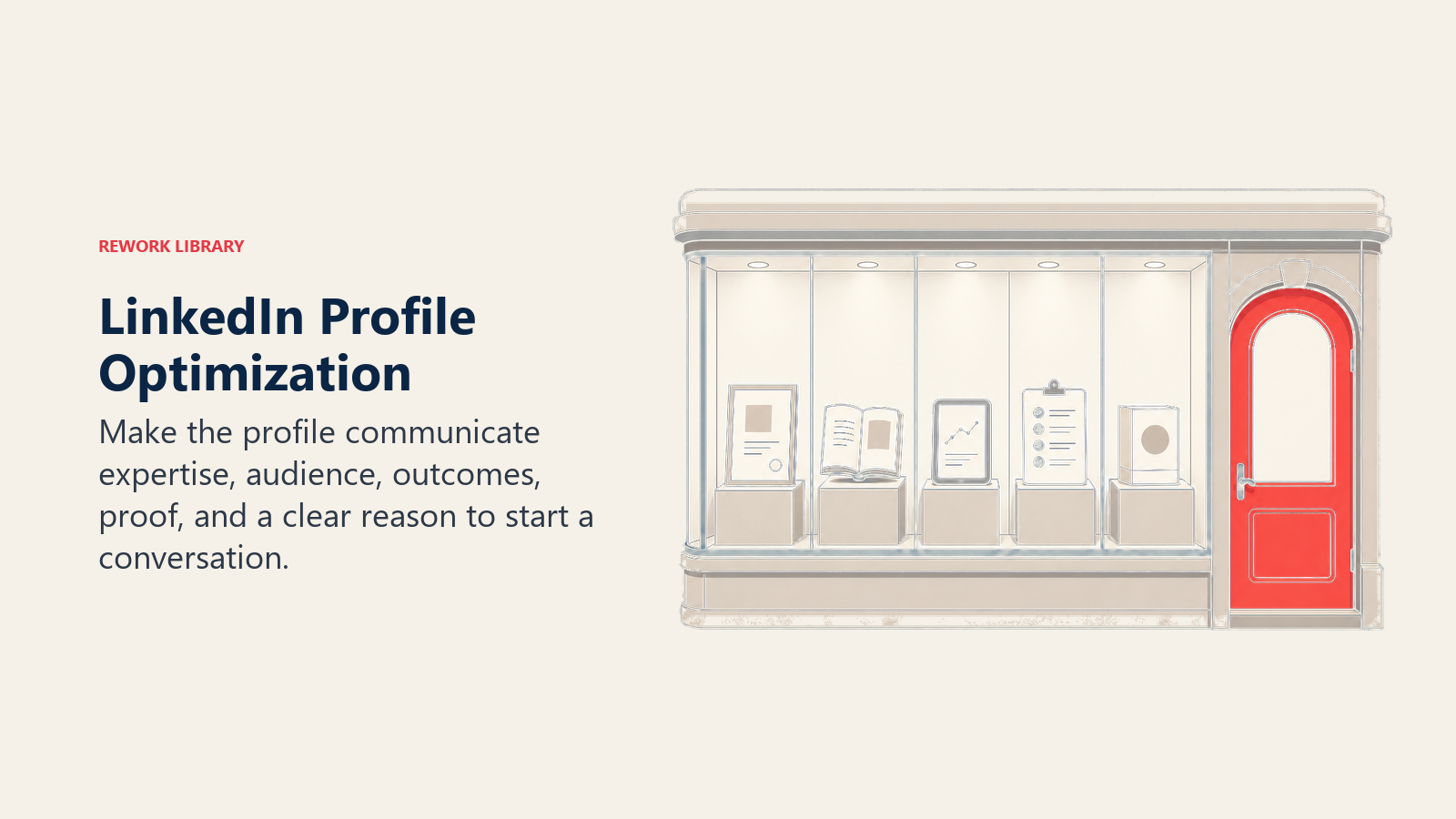
Profile Optimization: Your Digital Storefront
Your LinkedIn profile gets viewed by two types of people: prospects researching you after seeing your content or getting a referral, and ideal clients searching for solutions you provide. Both need to understand what you do in about 10 seconds.
Headline Formula: Role + Specialization + Value Proposition
Your headline is the most important line of text on LinkedIn. It appears everywhere - in search results, comments, connection requests, and messages. Most professionals waste it on job titles: "Partner at Smith & Associates" or "Managing Consultant at ABC Advisory."
Those headlines tell people what you are, not what you do or who you help.
Better formula: [Role] helping [Target Client] with [Specific Problem] through [Approach/Methodology]
Examples:
- "Supply Chain Consultant | Helping manufacturers reduce lead times by 30%+ through lean operations"
- "M&A Attorney | Guiding tech founders through acquisitions from LOI to close"
- "CFO Advisory Services | Helping PE-backed companies scale finance operations without breaking the bank"
Notice the pattern. Each headline answers: Who do you serve? What problem do you solve? How do you solve it?
The target isn't to appeal to everyone. It's to immediately resonate with the right people while everyone else scrolls past.
About Section: Story Over Resume
The About section is where you convert curiosity into interest. Don't list credentials and achievements. Tell a story that connects with your ideal client.
Structure it like this:
Hook (2-3 sentences): State a problem your ideal client faces. Make it specific and painful enough that the right person thinks "that's exactly my situation."
Your approach (2-3 paragraphs): Explain how you help solve that problem. This isn't about methodology details - it's about your perspective and what makes your approach different.
Proof (1 paragraph): Brief examples of results you've delivered. Numbers matter here. "Helped 40+ manufacturing companies reduce supply chain costs by an average of 23%" is better than "extensive experience in supply chain optimization."
Call to action (1-2 sentences): What should interested people do? Schedule a call? Download a resource? Send a message? Make it clear and low-friction.
Keep it conversational. Write like you're explaining your work to someone at a conference, not submitting a journal article.
Experience Section: Projects Over Titles
Your experience section shouldn't just list where you've worked. It should demonstrate what you've accomplished.
For each role, include:
- Brief company context (industry, size, situation)
- 3-5 specific projects or achievements with quantified results
- Skills or methodologies you applied
Example: Senior Consultant, Operations Advisory McKinsey & Company | 2018-2022
Led operational transformation projects for mid-market manufacturing clients:
- Redesigned production planning process for $200M automotive supplier, reducing inventory carrying costs by $3.2M annually
- Implemented lean manufacturing methodology at industrial equipment manufacturer, improving on-time delivery from 73% to 94%
- Developed supply chain risk framework for consumer goods company navigating COVID disruptions
Focus on deliverables and outcomes, not responsibilities. "Managed client relationships" means nothing. "Led 8 Fortune 500 engagements, with 100% client retention and $2.3M in follow-on revenue" tells a story.
Featured Section: Showcase Your Best Work
The Featured section sits right below your About section and can include articles, posts, media, or links. Use it strategically.
Feature:
- Case studies or client success stories
- Your best-performing LinkedIn posts
- Published articles or thought leadership
- Speaking engagements or webinar recordings
- Frameworks or methodologies you've developed
Treat this like a portfolio. When a prospect visits your profile, the Featured section should immediately demonstrate expertise through tangible examples.
Update it quarterly. Your best work from two years ago might not be your best work today.
Content Strategy Framework
Your optimized profile gets you discovered. But content keeps you visible and builds authority over time. The mistake most professionals make: treating LinkedIn content like blogging. They write long-form articles nobody reads, or they share industry news with no commentary. That's not content strategy. That's noise.
Good LinkedIn content does three things:
- Demonstrates you understand your target client's problems
- Shows how you think about solving those problems
- Makes prospects think "this person gets it" and remember you when they need help
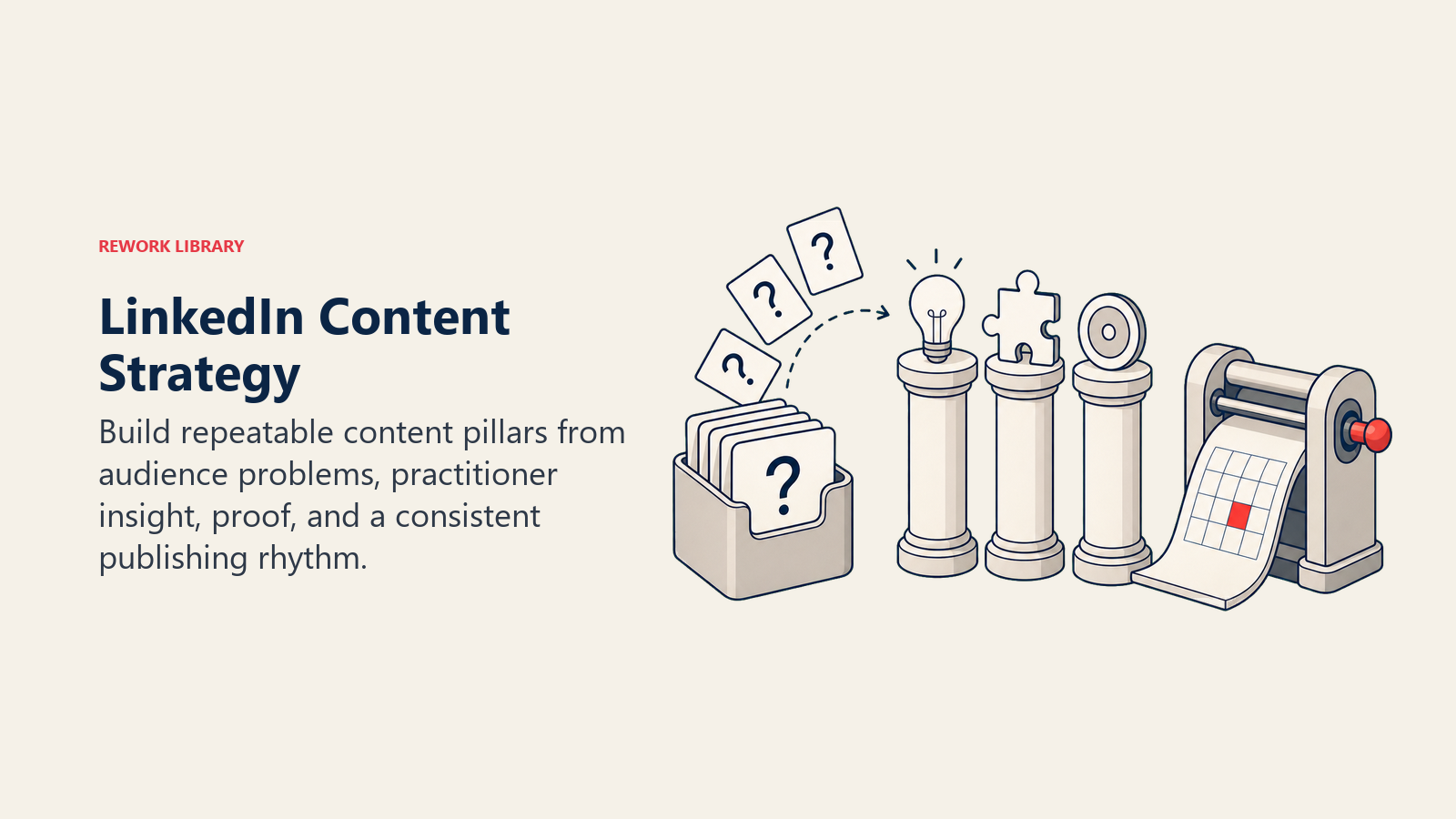
Content Pillars: Pick 3-4 Themes
Don't post about everything. Focus on the 3-4 topics where you have genuine expertise and your ideal clients care about answers.
For a supply chain consultant targeting manufacturers, pillars might be:
- Supply chain resilience and risk management
- Inventory optimization and working capital
- Supplier relationship management
- Digital transformation in operations
For a fractional CFO serving SaaS companies:
- Financial metrics and unit economics
- Fundraising and investor relations
- Finance team scaling
- Strategic planning and forecasting
Your content pillars should map to the problems your ideal clients are trying to solve. These become the themes you return to repeatedly.
Content Mix: The 40-30-20-10 Rule
Not all content serves the same purpose. Balance your content across these categories:
40% Industry Insights and Trends - Your perspective on what's happening in your space. New regulations, market shifts, emerging challenges. These posts position you as someone who understands the landscape.
30% Client Success and Case Examples - Stories about problems you've solved, results you've delivered, or lessons learned from engagements. These build credibility and show prospects what working with you looks like.
20% Personal Brand and Behind-the-Scenes - Your professional journey, mistakes you've made, how you approach problems, what you're learning. These humanize you and build connection.
10% Firm News and Services - New offerings, team announcements, awards. Pure self-promotion, used sparingly.
The ratio matters because most professionals invert it. They make every post about their firm or their achievements. That gets ignored.
The content that performs best is the stuff that's genuinely useful or interesting to your audience, not promotional.
Posting Frequency: Consistency Beats Volume
Three posts per week, every week, beats seven posts one week and nothing for a month. LinkedIn's algorithm rewards consistency because it signals you're an active, valuable member of the platform.
Practical cadence:
- Monday: Industry insight or trend commentary
- Wednesday: Client success story or case example
- Friday: Personal perspective or lesson learned
That's manageable for most professionals without creating content becoming a full-time job.
Batch your content creation. Set aside 2-3 hours once a week to draft your posts for the following week. This prevents the "I need to post something today" scramble that leads to low-quality content or falling off entirely.
Content Formats That Generate Engagement
LinkedIn isn't a blogging platform. Posts that work have specific characteristics:
Short-form posts (150-300 words) perform better than long-form articles. Get to the point fast.
Hook first - Your opening line determines whether people expand your post or scroll past. Start with a provocative question, surprising stat, or bold statement.
Structure for scanning - Short paragraphs, line breaks, occasional bullet points. Nobody reads walls of text on LinkedIn.
End with engagement - Ask a question or invite perspective. "What's your take?" or "Have you seen this in your industry?" Comments boost visibility.
Content topics that consistently generate leads for professional services:
Industry Challenge Breakdowns: "Here's why most manufacturing companies struggle with inventory management" followed by your framework for thinking about it.
Regulatory or Compliance Changes: "New DOL rule impacts how you classify contractors - here's what it means for your agency model"
Client Success Frameworks: "How we helped a $50M logistics company reduce freight costs by 18%" with the approach explained. These connect directly to your client testimonials and case studies library.
Myths and Misconceptions: "Why the billable hour is actually costing your law firm money" (then explain value-based pricing approaches).
Trend Analysis: "Three shifts we're seeing in CFO priorities for 2026" with implications for how companies should respond.
The pattern: share expertise without gatekeeping. Give away the framework. People hire you for the implementation.
Engagement Strategy: 5-5-5 Daily Method
Content without engagement is a one-way broadcast. The LinkedIn algorithm rewards two-way conversations, and prospects notice who engages with their content before reaching out. The 5-5-5 method takes 15-20 minutes daily:
5 minutes: Comment on 5 posts from ideal prospects or industry peers This builds visibility with people you want to know. Thoughtful comments (not "great post!") get you noticed. When you eventually send a connection request, you're not a stranger.
5 minutes: Respond to comments on your posts When someone engages with your content, respond within a few hours. This shows you're approachable, and it signals to the algorithm that your post is generating conversation (boosting its reach).
5 minutes: Send personalized messages to new connections When someone accepts your connection request, don't immediately pitch them. Send a short message acknowledging why you wanted to connect and asking a genuine question related to their work.
Stick with this for a few weeks and you'll start to see it compound. Over time, you've engaged with hundreds of ideal prospects. Your name becomes familiar. When they need help, you're the first person they think of.
Strategic Connection Nurturing
Not every connection turns into a client immediately. Most won't need your services for months or years. Systematic nurturing keeps you visible until timing aligns.
Create three lists in LinkedIn Sales Navigator or a spreadsheet:
- Hot prospects: Currently in buying mode or recently expressed need
- Warm prospects: Good fit but no immediate need
- Peer network: Other consultants, complementary service providers, potential referral sources
Nurture each group differently:
Hot prospects get direct outreach and personalized touches. Comment on their posts weekly, send relevant articles, offer to introduce them to people in your network who can help.
Warm prospects get lighter engagement. React to their posts occasionally, share content they'd find valuable, check in quarterly with "how's your Q2 looking?"
Peer network gets relationship-building. Share opportunities, make introductions, support their content. This group becomes referral sources and collaboration partners.
The goal isn't to sell to everyone. It's to stay visible and helpful so when someone needs your expertise, you're the obvious call. This nurturing approach aligns with building your broader referral generation system.
Outreach & Connection Strategy
With a solid profile and consistent content, you've earned the right to reach out to ideal prospects. But outreach only works if it's strategic and personalized.
Define Your Ideal Client Profile
Don't connect with everyone. Target your outreach to people who match your ideal client profile.
Criteria might include:
- Title/Role: CFO, VP Operations, Managing Partner, etc.
- Company Size: 50-500 employees, $10M-$100M revenue
- Industry: Manufacturing, SaaS, Professional Services
- Geography: North America, specific metro areas, etc.
- Signals: Recent funding, growth trajectory, hiring patterns
Use LinkedIn Sales Navigator or manual search to build lists of people who fit these criteria.
Quality over quantity. Ten highly targeted connections per week beats 100 random ones.
Connection Request Best Practices
Generic connection requests ("I'd like to add you to my professional network") have 20-30% acceptance rates. Personalized requests get 50-70%.
Personalization template:
"Hi [Name] - I noticed you're leading [specific initiative/dept] at [Company]. I work with [similar companies/roles] on [specific challenge], and thought we might have some overlap worth exploring. Would be great to connect."
Key elements:
- Reference something specific about them or their company
- Briefly state your relevance
- Keep it short (under 300 characters if possible)
Don't pitch in the connection request. You're asking to connect, not asking for a meeting yet.
The 3-Touch Nurture Sequence
When someone accepts your connection request, don't go silent and don't immediately pitch. Use a 3-touch sequence over 2-3 weeks:
Touch 1 (Day 1): Thank them for connecting and ask a relevant question about their work.
"Thanks for connecting, [Name]. I saw you recently joined [Company] as [Title]. How's the transition been? What are the big priorities you're focused on?"
Touch 2 (Week 1-2): Share something valuable - an article, framework, or intro - with no ask.
"Thought you might find this useful given what you mentioned about [their challenge]. We put together a framework for [solution] that's helped a few companies in your space."
Touch 3 (Week 2-3): Suggest a conversation if there's mutual interest.
"Based on what you mentioned about [challenge], it might be worth grabbing 15 minutes to discuss how we've approached similar situations with [similar companies]. Would you be open to a quick call?"
Not everyone will respond. That's fine. The ones who do are genuinely interested because you've demonstrated value before asking for anything. Structure your conversations using your initial consultation process for maximum conversion.
Lead Generation System
LinkedIn can drive two types of leads: inbound (people who find you) and outbound (people you proactively reach out to).
Inbound Lead Optimization
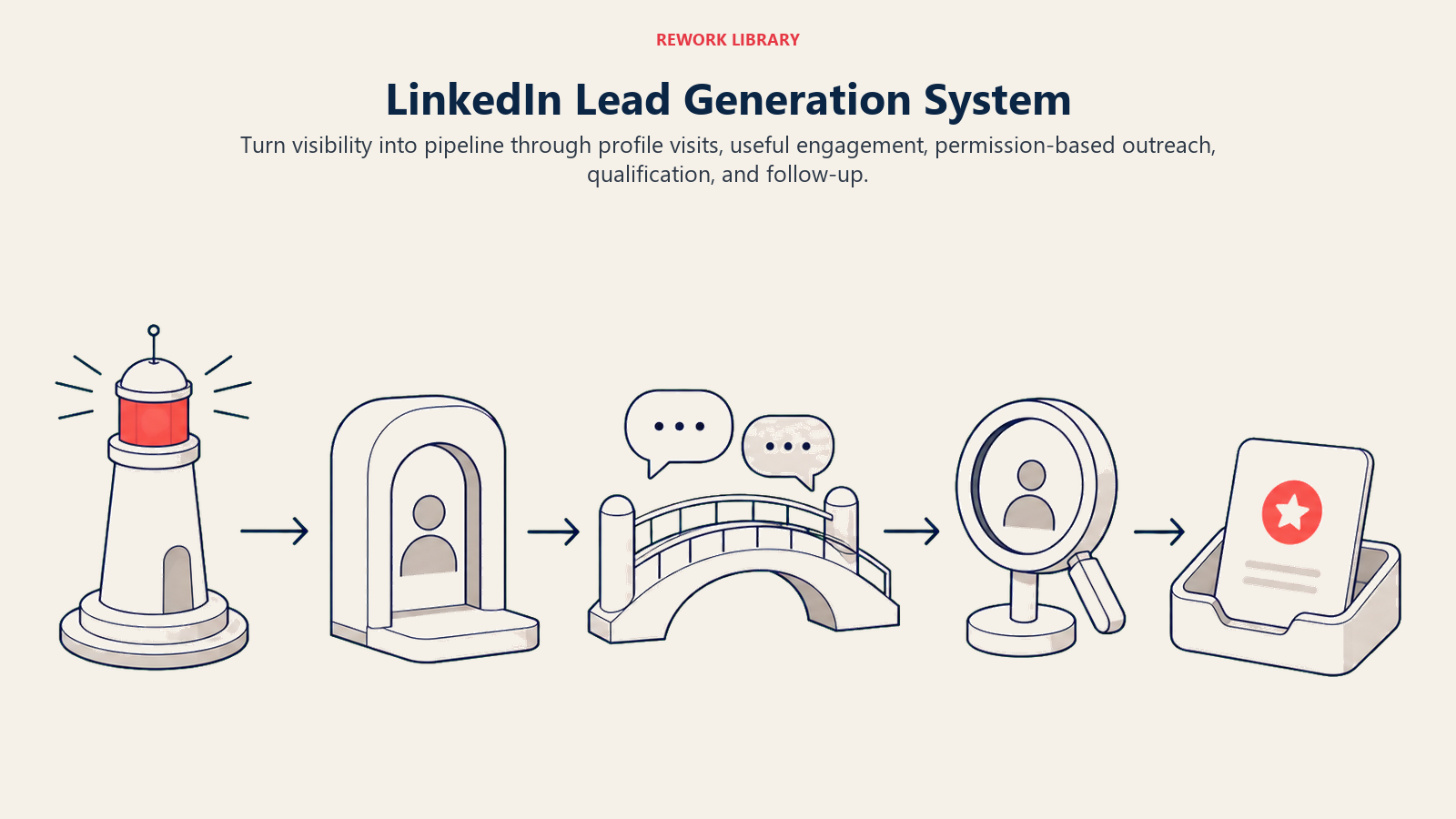
Inbound leads come from people who discover you through content, search, or referrals. Optimize your profile to convert visitors into conversations.
Profile CTA: Your About section should end with a clear next step. "If you're dealing with [challenge], let's talk. Send me a message or grab time on my calendar: [calendly link]"
Featured Section: Include a lead magnet - a framework, assessment, or guide - that prospects can download in exchange for their email. Link to a simple landing page.
Creator Mode: Enable Creator Mode and add relevant hashtags to your profile. This surfaces your content to people following those topics.
Recommendations: Request recommendations from clients highlighting specific results. Prospects reading your profile see proof you deliver.
Track inbound leads by asking, "How did you find me?" in initial conversations. If most say "saw your post about X," you know that content is working.
Outbound Lead Generation with Sales Navigator
For outbound, LinkedIn Sales Navigator is worth the investment. It provides advanced search, lead tracking, and CRM integration.
Boolean Search for Precision Targeting Use search operators to find exact-fit prospects:
"CFO" OR "VP Finance" AND ("SaaS" OR "Software") AND "100..500 employees" NOT "Enterprise"
This finds SaaS CFOs at mid-market companies, filtering out enterprise (where you don't fit).
Account-Based Targeting If you serve specific companies, save them as target accounts. Sales Navigator alerts you to job changes, company news, and new hires - all triggers for outreach.
Lead Lists and Tracking Organize prospects into lists (e.g., "Q1 Outreach," "Warm Prospects," "Event Attendees"). Add notes and track touchpoints so you remember context when following up.
InMail for Breakthrough Conversations Sales Navigator includes InMail credits - messages to people outside your network. Use these sparingly for high-value prospects.
InMail template:
Subject: [Relevant Insight Related to Their Challenge]
Hi [Name],
I noticed [Company] is [specific recent news or initiative]. Companies in similar situations often run into [specific challenge related to your expertise].
We recently helped [similar company] navigate this by [brief approach], which resulted in [specific outcome].
Worth a conversation to see if there's a fit? Happy to share more context.
[Your Name]
InMail works when it's relevant, specific, and offers clear value. Generic sales pitches get ignored.
Advanced Tactics for Maximum Impact
Once you've mastered the basics, these advanced tactics scale your LinkedIn impact.
Employee Advocacy Programs
Your team's networks are larger than yours alone. If you have 5 consultants each with 500 connections, that's 2,500 potential impressions per post versus 500.
Simple employee advocacy:
- Share your best posts in a team Slack channel each week
- Ask team members to engage (comment, like, share) when it's relevant to their network
- Encourage team members to post their own client insights (with approval process)
Don't mandate participation or make it feel like homework. Incentivize by showing how it builds personal brand and generates leads.
LinkedIn Live and Events
LinkedIn Live and LinkedIn Events drive higher engagement than regular posts.
LinkedIn Live: Host monthly "office hours" where you answer common questions in your space. Promotes to your network 24 hours in advance, driving registrations.
LinkedIn Events: Create events for webinars, workshops, or virtual roundtables. Invitees can share with their networks, expanding reach.
These formats position you as a convener and expert, not just a content creator.
Thought Leadership Articles vs Posts
LinkedIn distinguishes between posts (native content in the feed) and articles (longer-form content published to your profile).
Posts get more visibility and engagement. Use them for your regular content.
Articles get indexed by Google and live permanently on your profile. Use them for comprehensive guides or frameworks you want to reference repeatedly.
Publish 1-2 articles per quarter on high-value topics. Link back to them in posts when relevant.
Measuring LinkedIn ROI
LinkedIn business development is measurable. Track these metrics monthly: Profile Activity
- Profile views: Increasing views indicate growing visibility
- Search appearances: Shows you're appearing in relevant searches
- Connection growth: Track both quantity and quality (are they ICP?)
Content Performance
- Impressions per post: How many people see your content
- Engagement rate: (Likes + Comments + Shares) / Impressions
- Click-through rate: For posts with links to resources or content
Relationship Metrics
- New connections (by source: inbound, outbound, events)
- Conversation rate: % of new connections who engage in DM
- Meeting conversion: % of conversations that become calls/meetings
Pipeline Influence
- LinkedIn-sourced leads: Opportunities that came from LinkedIn activity
- Pipeline value: Total contract value of LinkedIn-influenced deals
- Win rate: Do LinkedIn-sourced leads close at higher rates?
Most CRMs let you add "Source" fields. Tag leads as "LinkedIn - Inbound Post," "LinkedIn - Outbound," or "LinkedIn - Referral" so you can track performance.
If you're generating 2-3 qualified conversations per month from LinkedIn, you're on track. If those close at even 20-30%, LinkedIn likely has the highest ROI of any business development channel. Track these against your broader professional services metrics to understand relative performance.
Common Mistakes That Kill LinkedIn Strategy
These mistakes tank LinkedIn results even when the strategy looks right on paper:
Generic Connection Requests "I'd like to add you to my professional network" signals you didn't bother to personalize. Acceptance rates drop by half.
Immediate Pitch After Connecting Sending a sales pitch as your first message after someone accepts your request is the LinkedIn equivalent of proposing on a first date. It destroys trust instantly.
Inconsistent Posting Posting daily for two weeks, then going silent for a month kills your algorithm momentum. Consistency matters more than volume.
Self-Promotion Only If every post is about your firm, your services, or your achievements, people tune out. The 40-30-20-10 content mix exists for a reason.
Not Responding to Engagement When someone comments on your post and you ignore them, you signal "I'm broadcasting, not conversing." Always respond to comments.
No Call to Action Profiles and posts without clear next steps leave prospects wondering, "What should I do with this information?" Tell them.
Treating It Like a Resume LinkedIn isn't where you list your credentials. It's where you demonstrate expertise through content and engagement.
Fix these mistakes and your results improve immediately.
Integration with Overall Business Development Strategy
LinkedIn isn't a standalone channel. It works best when you integrate it with your overall professional networking and thought leadership strategy.
LinkedIn + Speaking Engagements Post about your speaking topics before events to build interest. Share key takeaways after. Connect with attendees and continue conversations online. Coordinate this with your speaking and publishing strategy for maximum impact.
LinkedIn + Content Marketing Your firm's blog posts, podcasts, or videos get amplified through LinkedIn. Content marketing for services creates assets you can share to demonstrate expertise.
LinkedIn + Email Nurture Add LinkedIn profile links to email signatures. Send connection requests to email subscribers. Cross-pollinate your audiences.
LinkedIn + Events and Webinars Use LinkedIn Events to promote webinars. Connect with attendees afterward and continue nurturing relationships. Align this with your broader conference and event strategy.
LinkedIn + Referral Network Your best clients and referral partners are on LinkedIn. Engage with their content, endorse their skills, write recommendations. This keeps you top of mind when they meet someone who needs your help.
Think of LinkedIn as one piece of your business development puzzle, not the whole picture. It amplifies everything else you're doing.
Implementation Roadmap
Don't try to do everything at once. Build your LinkedIn presence systematically.
Weeks 1-2: Profile Optimization
- Rewrite headline using Role + Specialization + Value formula
- Overhaul About section with story-driven content
- Update Experience with project highlights and results
- Add 3-5 items to Featured section (case studies, best posts, frameworks)
- Request 5-10 recommendations from recent clients
Weeks 3-4: Content Foundation
- Define 3-4 content pillars
- Create content calendar for next 4 weeks (3 posts/week)
- Write and schedule first 12 posts
- Enable Creator Mode and add relevant hashtags
Month 2: Engagement Building
- Implement 5-5-5 daily method
- Comment on 5 posts daily from ideal prospects
- Respond to all comments on your posts within 24 hours
- Send personalized welcome messages to new connections
Month 3: Strategic Outreach
- Build list of 50-100 ideal prospects
- Send 10-15 personalized connection requests per week
- Launch 3-touch nurture sequence for new connections
- Track connection acceptance rates and response rates
Quarter 2: Optimization
- Analyze content performance - which posts drove most engagement?
- Double down on topics and formats that work
- A/B test connection request messaging
- Refine target prospect criteria based on who's responding
Quarters 3-4: Scale
- Launch employee advocacy program
- Test LinkedIn Live or Events
- Publish 1-2 long-form articles
- Implement Sales Navigator for advanced targeting
- Build reporting dashboard tracking profile views, engagement, and pipeline
This roadmap gets you from "LinkedIn profile exists" to "LinkedIn generates qualified pipeline" in six months. It's not overnight, but it is systematic. And it works.
The Bottom Line
LinkedIn for professional services isn't about posting motivational quotes or sharing firm announcements. It's about systematically demonstrating expertise, building relationships, and creating visibility with ideal clients.
The firms winning on LinkedIn treat it like an operation:
- Optimized profiles that communicate value instantly
- Consistent content that builds authority over time
- Daily engagement that creates warm relationships
- Strategic outreach that converts visibility into conversations
This isn't fast. It takes 3-6 months to build momentum and 12+ months to generate consistent pipeline. But the firms that commit to the system create a durable competitive advantage.
Your competitors are still relying on referrals and hoping someone mentions them. You're building a platform where ideal clients discover you, follow your thinking, and reach out when they need help.
That's the difference between hunting for clients and having them come to you. LinkedIn makes it possible, but only if you treat it like the business development channel it is, not the digital resume platform most people think it is.
Ready to build systematic business development? Explore consultative business development approaches and content marketing strategies that complement your LinkedIn presence.

Sales Director
On this page
- Why LinkedIn Matters for Professional Services
- The LinkedIn Strategy Framework
- Profile Optimization: Your Digital Storefront
- Headline Formula: Role + Specialization + Value Proposition
- About Section: Story Over Resume
- Experience Section: Projects Over Titles
- Featured Section: Showcase Your Best Work
- Content Strategy Framework
- Content Pillars: Pick 3-4 Themes
- Content Mix: The 40-30-20-10 Rule
- Posting Frequency: Consistency Beats Volume
- Content Formats That Generate Engagement
- Engagement Strategy: 5-5-5 Daily Method
- Strategic Connection Nurturing
- Outreach & Connection Strategy
- Define Your Ideal Client Profile
- Connection Request Best Practices
- The 3-Touch Nurture Sequence
- Lead Generation System
- Inbound Lead Optimization
- Outbound Lead Generation with Sales Navigator
- Advanced Tactics for Maximum Impact
- Employee Advocacy Programs
- LinkedIn Live and Events
- Thought Leadership Articles vs Posts
- Measuring LinkedIn ROI
- Common Mistakes That Kill LinkedIn Strategy
- Integration with Overall Business Development Strategy
- Implementation Roadmap
- The Bottom Line