Client Communication Cadence: Building Trust Through Structured Updates
Turn this article into takeaways for your work.


Each assistant summarizes the article only for you and suggests best practices for your work.
You know what kills professional services engagements faster than missed deadlines? Radio silence. Clients start wondering what you're doing with their money. They imagine problems you haven't told them about. They lose confidence in your ability to deliver. And by the time you show up with your brilliant work, they're already mentally shopping for your replacement.
The frustrating part? Most of these situations happen when the project is going fine. The work is on track, the team is performing, and everything is under control. But the client doesn't know that because you haven't told them.
Communication cadence solves this problem. It's the structured rhythm of status updates, check-ins, and stakeholder engagement that keeps clients informed and confident throughout the engagement. When done right, it prevents surprises, builds trust, and turns clients into advocates. When done wrong (or not at all), it creates the conditions for scope creep, project failure, and relationship damage.
This guide shows you how to establish communication patterns that match your engagement type, stakeholder needs, and delivery complexity. Because consistent communication isn't just good client service - it's how you retain clients and grow accounts.
Why communication cadence determines client satisfaction
Here's what most consultants miss: clients judge your performance as much on how you communicate as on what you deliver. You can do exceptional work, but if they feel out of the loop, anxious about the timeline, or uncertain about progress, they'll remember the stress more than the results. Communication cadence creates predictability. When clients know they'll get a status update every Tuesday morning, or a steering committee review every other Friday, they relax. They don't have to chase you for information. They don't have to wonder if you're addressing that issue they raised last week. The cadence itself becomes reassuring.
It also forces you to stay on top of the engagement. When you know you have to report progress weekly, you can't let things drift for two weeks without noticing. The communication rhythm creates internal accountability for your team.
But here's where it gets strategic: the right cadence varies dramatically based on engagement type, client culture, and project complexity. A three-month implementation needs daily standups. A year-long retainer might need monthly executive summaries. An agile development project requires different rhythms than a waterfall strategy engagement.
The worst thing you can do is pick a one-size-fits-all approach and force it on every client. Your communication cadence should be designed, not defaulted.
Assessing what your engagement needs
Before you can establish a communication cadence, you need to understand the factors that should shape it. Client culture and preferences: Some organizations thrive on detailed weekly status reports. Others find them bureaucratic and just want monthly high-level updates. Some executives want face time in every meeting. Others prefer concise written summaries they can read on their schedule.
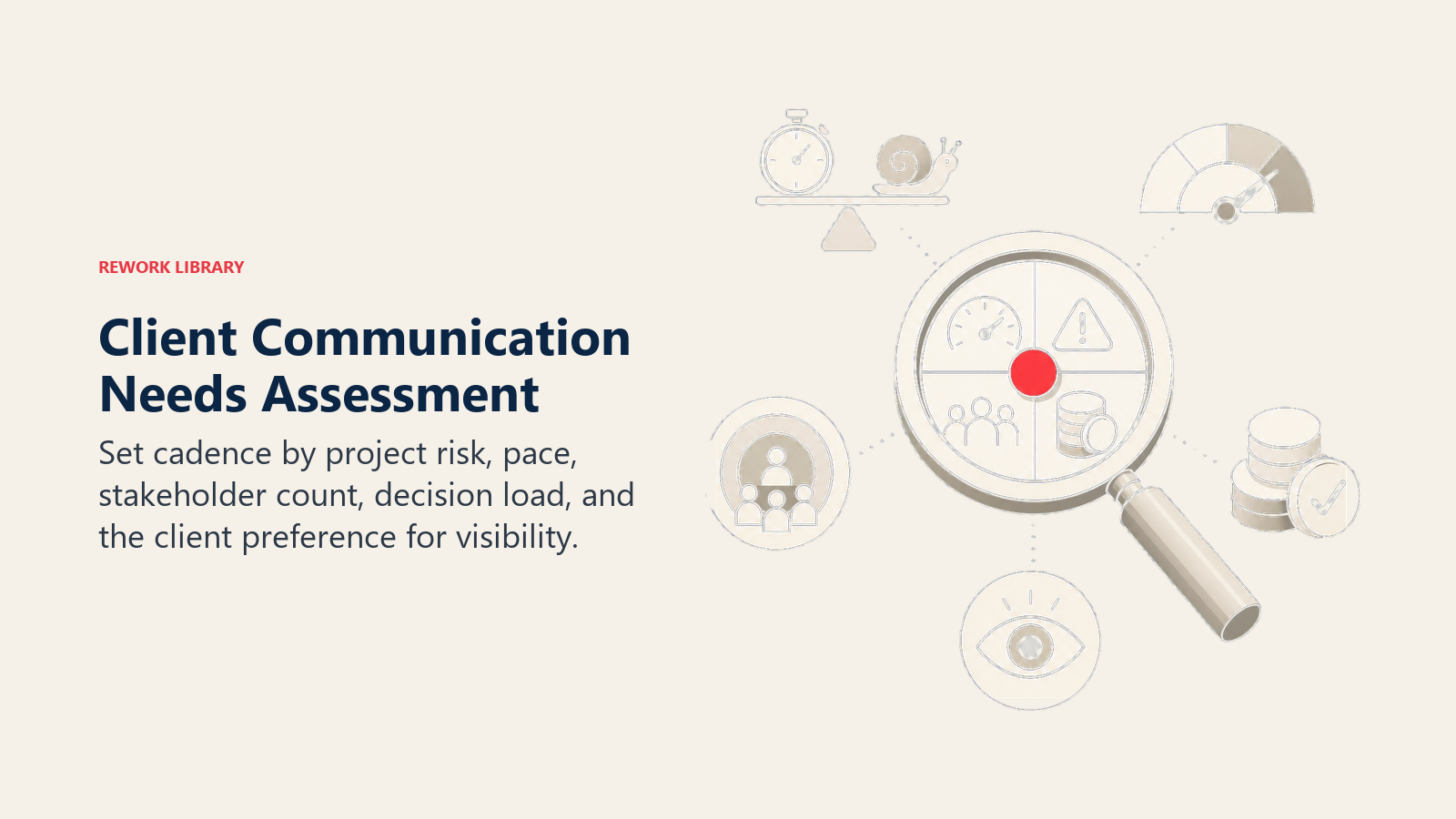
Pay attention during client onboarding and project kickoff. Ask explicitly: "How do you prefer to stay informed on project progress?" and "How often do you want formal updates versus informal check-ins?"
If you're working with a client who has existing project management discipline, align with their rhythms. If they do sprint reviews every two weeks, plug into that schedule rather than creating a parallel cadence.
Engagement complexity: A straightforward process improvement project with clear deliverables needs less frequent communication than a complex system implementation with multiple integration points. The more moving parts, the more frequent the communication needs to be. Your project management methodology should define standard communication rhythms for different engagement types.
Complexity includes:
- Number of workstreams or parallel activities
- Technical difficulty and integration challenges
- Number of stakeholders and decision points
- Dependency on client resources or third parties
- Risk level and potential for scope changes
High-complexity engagements need tighter cadences because there's more that can go wrong and more coordination required.
Stakeholder count and seniority: If you're working with one primary contact, communication is straightforward. If you have eight stakeholders across three departments and two executives who need visibility, you need a multi-layered communication plan.
Senior executives typically want less frequent but more strategic updates. Project team members want more frequent tactical information. End users need different communication (what's changing, how it affects them, what support is available) than decision-makers (progress, ROI, strategic impact).
Risk tolerance and timeline pressure: Clients with low risk tolerance or tight deadlines need more frequent reassurance. A project that must go live before year-end creates more anxiety than one with a flexible timeline. Higher anxiety = more frequent communication.
Some clients are just nervous by nature. They're new to consulting engagements, or they've been burned before, or their executive team is breathing down their neck. These clients benefit from over-communication early in the engagement until trust is established.
Decision cycle alignment: Your update cadence should align with when decisions actually get made. If your client's leadership team meets monthly to review projects, you want your status report landing a few days before that meeting so your sponsor can report confidently. If procurement reviews invoices every two weeks, time your progress updates accordingly.
Design principles for effective cadences
Once you understand the context, apply these principles when designing your communication rhythm.
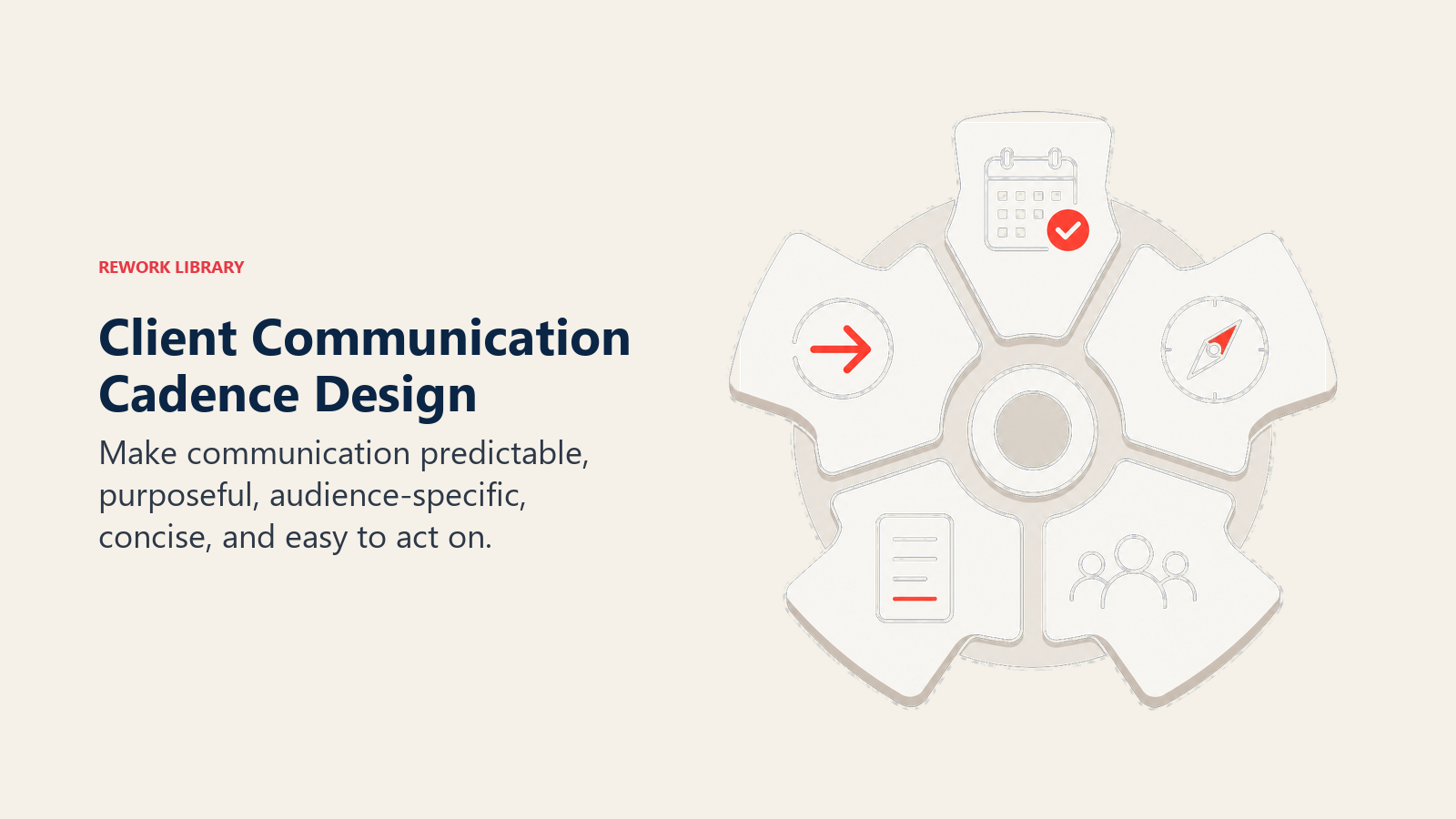
Frequent enough to prevent surprises: The cardinal rule of client communication is "no surprises." If you're going to miss a deadline, blow the budget, or discover a major issue, the client should hear it from you before it becomes a crisis. Your cadence needs to be tight enough that problems surface and get communicated before they escalate.
A good test: if something goes wrong on Monday, how long until the client hears about it through your formal communication process? If the answer is "maybe by Friday's status meeting," your cadence is too loose for a complex engagement.
Not so frequent that it becomes noise: There's a tipping point where more communication becomes less effective. Daily emails that say "nothing new to report" train people to ignore your updates. Three-hour weekly meetings where 80% of the time is wasted create resentment.
Match communication frequency to the rate of actual change and progress. If meaningful updates happen weekly, don't force daily check-ins. If major milestones happen monthly, weekly steering committees might be overkill.
Aligned with natural project milestones: The best communication cadences follow the natural rhythm of the work. Agile sprints create built-in two-week cycles. Waterfall phases create natural checkpoints at phase transitions. Retainer work might align to monthly deliverable cycles.
When your communication rhythm matches work rhythms, updates are more meaningful because there's actual progress to report.
Matching client decision cycles: If decisions need to be made weekly, you need weekly decision-making forums. If approvals happen monthly, structure your cadence to support that. Don't create communication events that require decisions on a timeline that doesn't match the client's availability or process.
Adapted to engagement phases: Your cadence probably needs to change as the project evolves. Early in an implementation, when you're doing discovery and requirements, you might need daily collaboration. Once you're in build mode with clear requirements, weekly updates might suffice. During go-live, you're back to daily communication or more.
Be explicit about these phase transitions. "Now that we've completed discovery and the plan is locked in, we're shifting from daily standups to weekly status meetings."
Communication types and frequency by engagement model
Different engagement types need different rhythms. Here are the standard patterns.
Agile and iterative engagements
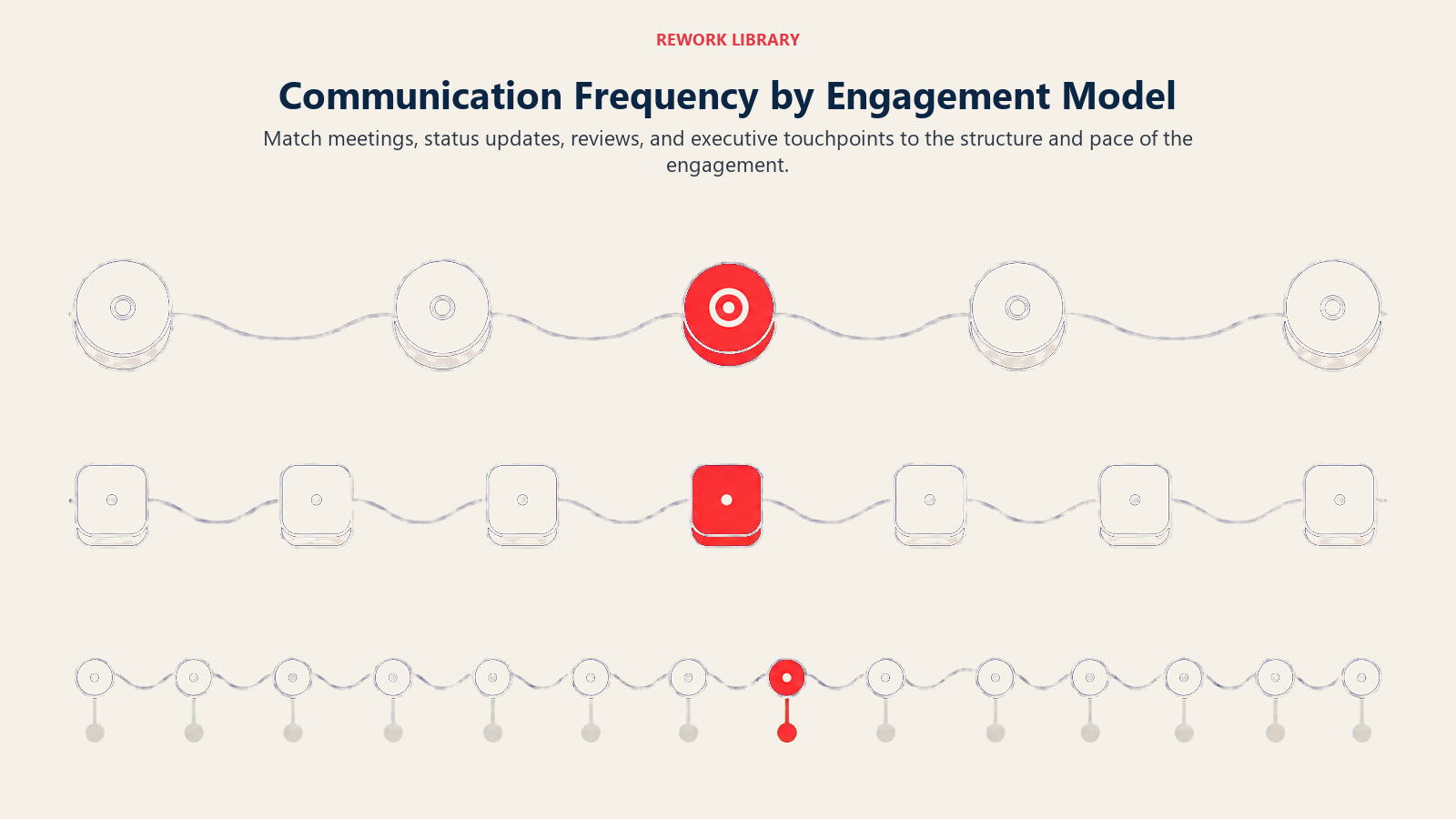
If you're running agile projects or iterative implementations, your cadence typically looks like:
Daily standups (15 minutes): Every morning, the active project team syncs on what was accomplished yesterday, what's planned today, and what blockers exist. These are not status meetings - they're coordination meetings. Keep them short and tactical.
Participants: Core project team only (your team + client's day-to-day participants)
Weekly sprint reviews or iteration demos (30-60 minutes): At the end of each sprint or iteration, show what was completed. Demonstrate working functionality, review what got finished versus what was planned, discuss any adjustments for the next sprint.
Participants: Project team + key stakeholders + anyone interested in seeing progress
Bi-weekly steering committee (60 minutes): Senior stakeholders review strategic progress, make decisions about scope or priority changes, resolve escalated issues, and ensure the project remains aligned with business objectives.
Participants: Project sponsor, key executives, project manager, potentially subject matter experts
This three-tier approach keeps the work moving daily, shows progress regularly, and gives leadership visibility and control without bogging down execution.
Waterfall and phased engagements
Traditional phased projects need less frequent tactical communication but more structured governance:
Weekly status meetings (30-60 minutes): Project team plus key stakeholders review progress against the plan, discuss issues and risks, make tactical decisions, and align on upcoming activities.
Participants: Project team + stakeholders actively involved in current phase
Phase gate reviews (90-120 minutes): At the end of each major phase, conduct a formal review of deliverables, get sign-off, confirm the next phase plan, and reset timeline and budget expectations if needed. These reviews should incorporate your deliverable quality assurance standards.
Participants: All key stakeholders, decision-makers, anyone who needs to approve moving forward
Monthly executive summaries (written + optional 30-minute review): High-level progress report covering accomplishments, plan adherence, budget status, risks, and upcoming milestones. Some executives just want to read it; others want to discuss it.
Participants (if meeting): Executive sponsor, C-level stakeholders, your senior leadership
Waterfall projects live or die by clear phase transitions. Your communication cadence needs to enforce discipline around those gates.
Retainer and ongoing engagements
When you're providing continuous services rather than a discrete project:
Weekly check-ins (30 minutes): Quick sync between your team and the primary client contact to review what was delivered this week, what's planned for next week, flag any issues, and adjust priorities if needed.
Participants: Your account lead + client's main point of contact
Monthly business reviews (60 minutes): Review the month's deliverables, discuss results and impact, review utilization against the retainer hours, address any service quality concerns, and plan next month's priorities.
Participants: Your team + client stakeholders who own the relationship
Quarterly strategic reviews (90-120 minutes): Step back from tactical delivery to discuss bigger picture - is the retainer delivering value, are there new needs or opportunities, should the scope or structure change, what's working and what isn't. These align with client success reviews to assess overall relationship health.
Participants: Senior leaders from both sides, anyone involved in the strategic relationship
Retainer relationships need rhythm because the work is continuous and can easily drift into "we're not sure what we're getting for our money" territory. Regular reviews prevent that.
Crisis-driven or high-urgency engagements
When you're brought in to fix a crisis or working under extreme deadline pressure:
Twice-daily standups (15 minutes morning, 15 minutes end of day): Morning to align on the day's priorities and blockers. End of day to confirm what got done and set up the next morning.
Daily executive updates (written or 15-minute call): Keep leadership informed of progress and decisions. During a crisis, executives need daily reassurance that you're on it.
Real-time communication for critical decisions: Don't wait for the next scheduled meeting if you hit a major issue that requires immediate decision. Have clear escalation protocols.
This intensity isn't sustainable long-term, but for short bursts it's necessary. Just make sure the client understands this is crisis mode, not normal operations.
Transition and change management projects
When your engagement involves organizational change, training, or system transitions:
Weekly core team meetings (60 minutes): Coordinate across workstreams (training, communications, technical implementation, change management)
Bi-weekly change network meetings (45 minutes): Engage the broader stakeholder group who will champion the change in their departments
Monthly leadership updates (30-60 minutes): Keep executives informed on adoption progress, resistance points, and support needs
Go-live daily huddles: During the actual transition period, daily check-ins to address issues, adjust training, and ensure support coverage
Change management requires lots of communication because you're dealing with people and emotions, not just deliverables.
Status update formats that actually work
How you communicate matters as much as when. Different formats serve different purposes.
Written status reports
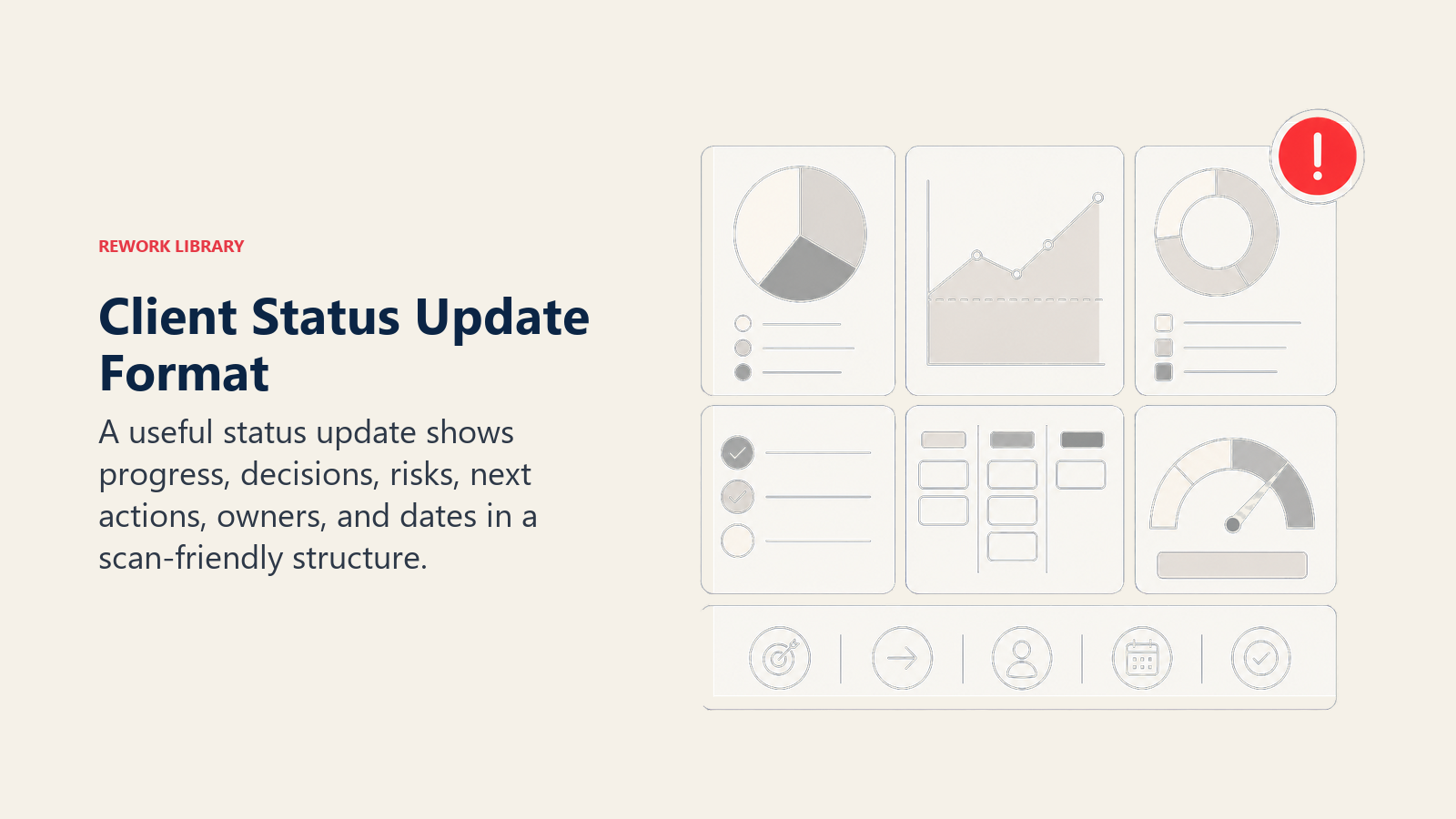
The classic status report still works when done right. Structure it like this:
Executive summary (2-3 sentences): The TL;DR version. "Project is on track for October 15 go-live. Completed UAT this week with no critical issues. One moderate risk around data migration timeline being monitored."
Progress vs plan: What was supposed to happen, what actually happened. If you're behind, say so and explain why. If you're ahead, say that too.
Key accomplishments this period: Bullet list of what got done. Be specific - "Completed configuration of workflows" not "Made progress on workflows."
Next steps and upcoming milestones: What's happening next and when. This sets expectations for the next update.
Issues and risks: Current problems, potential problems, and what you're doing about them. Use a RAG (Red/Amber/Green) status if your client likes that format. Red = critical, needs immediate attention. Amber = concerning, being monitored. Green = under control.
Decisions needed: Anything you need from the client to keep moving. Be explicit about what decision, who needs to make it, and by when.
Keep it to one or two pages. Nobody reads five-page status reports. If you need more detail, attach it as an appendix or link to it.
Dashboard and visual updates
Some clients prefer visual progress tracking. This works particularly well for implementation projects with clear milestones or retainer work with quantifiable deliverables.
Progress dashboards: Show completion percentages, milestone tracking, timeline visualization. Tools like Monday, Asana, Smartsheet, or even a well-designed spreadsheet work fine.
Metrics tracking: If your engagement has KPIs (utilization rates, system adoption, performance improvements, delivered hours), track them visually over time.
RAG status by workstream: Traffic light colors showing which parts of the project are healthy (green), concerning (amber), or critical (red).
The advantage of dashboards is they're scannable. A busy executive can glance at it and know if they need to dig deeper or if things are under control.
The disadvantage is they can oversimplify. A workstream showing green might have nuanced issues that don't fit in a status color. Use dashboards plus narrative summaries, not instead of them.
Meeting-based updates
Sometimes the best way to communicate is face-to-face (or video-to-video) discussion.
Structured meeting agendas: Don't just show up and wing it. Send an agenda in advance:
- Progress review (15 min)
- Issues and blockers (15 min)
- Upcoming work and decisions (10 min)
- Open discussion (10 min)
Stick to the timing. Meetings that consistently run over train people not to attend.
Problem-solving sessions: Sometimes your status meeting needs to pivot to working through a specific issue. That's fine, but acknowledge it: "We've identified a blocker with the data integration. Rather than moving on, let's use the rest of this time to figure out our path forward."
Action item capture: Someone needs to be taking notes and capturing action items with owners and due dates. Circulate these notes within 24 hours while the meeting is still fresh.
Meeting-based communication works best when you have complex topics that benefit from discussion and when relationship-building matters. It's less efficient than written updates but often more effective.
Video updates and async communication
For distributed teams or executives who are hard to pin down for meetings:
Recorded video walkthroughs: Record a 5-10 minute video walking through your dashboard or demo-ing completed work. Clients can watch on their schedule, pause and review sections, and come back with questions.
Loom or similar tools: Great for showing rather than explaining. "Here's the new interface we built" works better as a 3-minute screen recording than a written description.
Async discussion threads: Using tools like Slack, Teams, or project management platforms, create dedicated channels for project communication. Good for quick questions and informal updates between formal status cycles.
Video is personal without requiring schedule coordination. It works particularly well for showing visual work (designs, interfaces, dashboards) or explaining complex topics.
Stakeholder-specific communication strategies
Different stakeholders need different information on different schedules. A one-size-fits-all approach satisfies nobody.
Executives and C-level stakeholders
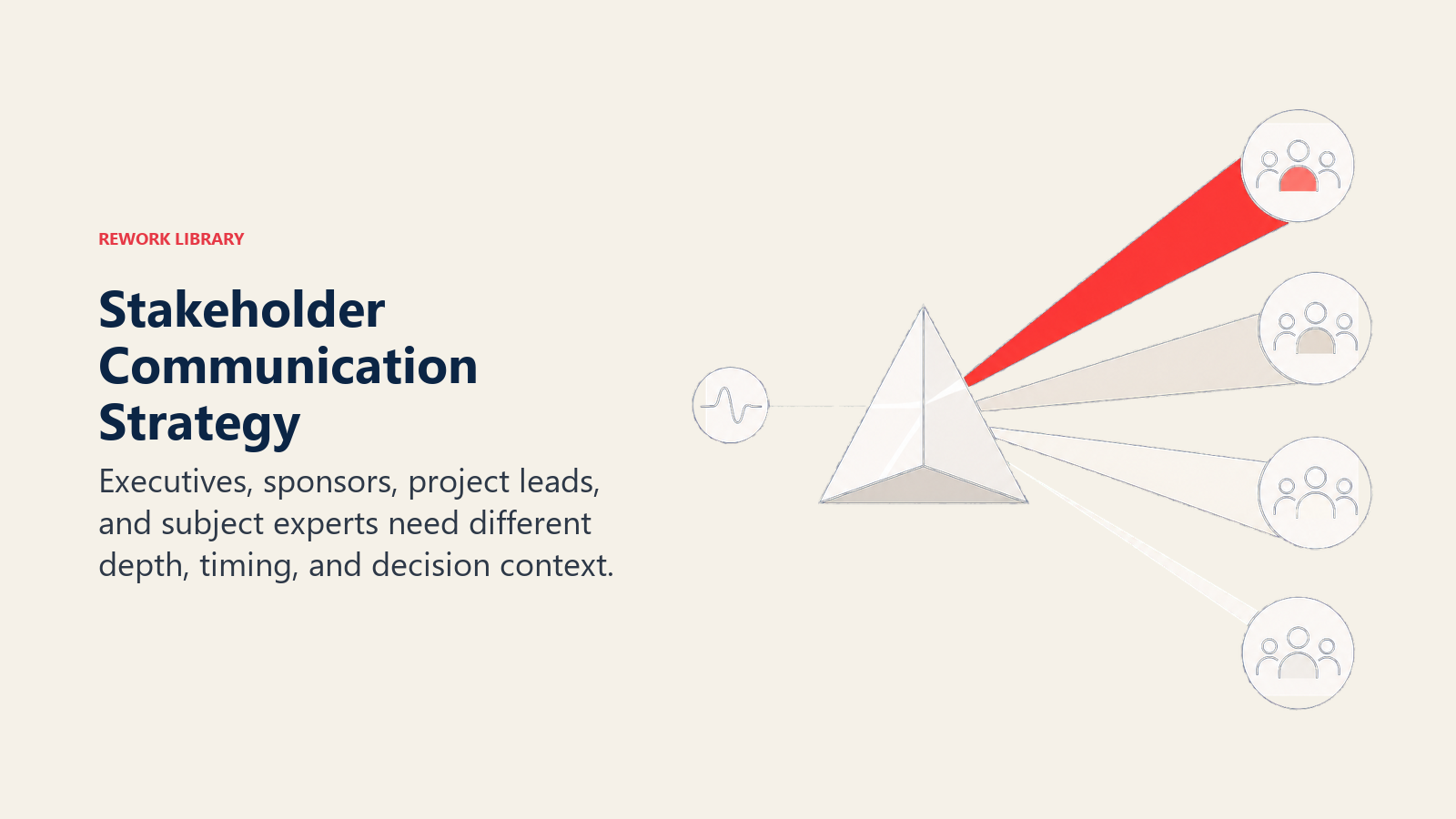
What they care about: Strategic outcomes, ROI progress, major risks, decisions that affect budget or timeline, business impact.
What they don't care about: Implementation details, tactical issues you're already handling, meeting notes, project team drama.
Communication approach: High-level summaries focused on business outcomes. Monthly or quarterly unless there's a crisis. Written is often better than meetings because it respects their time. If you do meet, keep it to 30 minutes and bring solutions, not just problems.
Format: Executive summary plus optional detail appendix. Lead with the bottom line - "We're on track to deliver $2M in cost savings by Q4" - then support it with just enough detail to build confidence.
Project sponsors and primary stakeholders
What they care about: Detailed progress, timeline adherence, how their team is performing, whether you're delivering what was promised, issues that might affect them.
What they need: Enough information to represent the project to their leadership, make tactical decisions, remove blockers for the team.
Communication approach: Weekly or bi-weekly detailed updates. These are your day-to-day partners, so communication can be less formal. A combination of structured updates (status reports, scheduled meetings) and informal communication (quick calls, Slack messages) works well.
Format: Standard status reports plus regular meetings. They should never be surprised by what's in a status report because you've already discussed issues informally.
Technical teams and implementation partners
What they care about: Technical details, dependencies, integration points, timelines for specific deliverables, blockers they need to address.
What they need: Specificity. "We need the API endpoints documented by next Tuesday so we can start integration" is more useful than "We need API documentation soon."
Communication approach: Frequent tactical communication. Daily standups if you're working closely together. Task-level visibility through project management tools. Direct communication channels for quick questions.
Format: Working sessions, technical documentation, task boards, standup meetings. Less formal narrative, more specifications and action items.
End users and change recipients
What they care about: How this affects their work, when changes happen, what training and support is available, whether their concerns are being heard.
What they need: Advance notice of changes, clear explanations of what's different and why, reassurance that they'll be supported through the transition.
Communication approach: Different cadence than project stakeholders. Might be less frequent (monthly newsletter) but broader (email to all affected users). Increase frequency as go-live approaches.
Format: FAQs, training announcements, "what's changing and when" summaries, support resources. Keep it simple and user-focused, not project-focused.
The key insight is that you probably need multiple communication streams for different audiences. Your weekly project status report shouldn't be going to 100 end users. Your monthly change management newsletter shouldn't be your only communication to the project sponsor.
Escalation protocols and critical issue communication
Your regular communication cadence handles normal operations. But when something goes wrong, you need different protocols.
Define issue severity levels
Not every problem requires an emergency call. Create clear severity definitions:
Critical (P1): System down, go-live at risk, major deliverable will miss deadline, budget overrun imminent, relationship-threatening issue.
High (P2): Significant delay possible, important feature at risk, stakeholder concerns about approach, moderate budget risk.
Medium (P3): Minor delays, quality concerns on non-critical items, process issues, team friction.
Low (P4): Suggestions, optimizations, nice-to-haves, minor process improvements.
Make sure your client agrees on these definitions. What you think is medium might be critical in their world.
Escalation paths and response commitments
For each severity level, define:
Who gets notified: Critical issues go to executives and project sponsors immediately. Medium issues get mentioned in the next regular status update.
How quickly: Critical issues = notify within 1 hour, initial response plan within 4 hours. High = notify same day, plan within 24 hours. Medium = next status update. Low = captured and prioritized in backlog.
Communication method: Critical = phone call or video meeting, not email. High = email to stakeholders plus follow-up in next scheduled meeting. Medium/Low = status report.
Decision authority: Who can make what decisions? Your project manager can probably handle medium issues. High issues might need the project sponsor. Critical issues might require C-level sign-off.
Document this in your project kickoff and refer back to it when issues arise. Having agreed-upon protocols prevents the "why didn't you tell me sooner" conversation.
Communication chain for critical issues
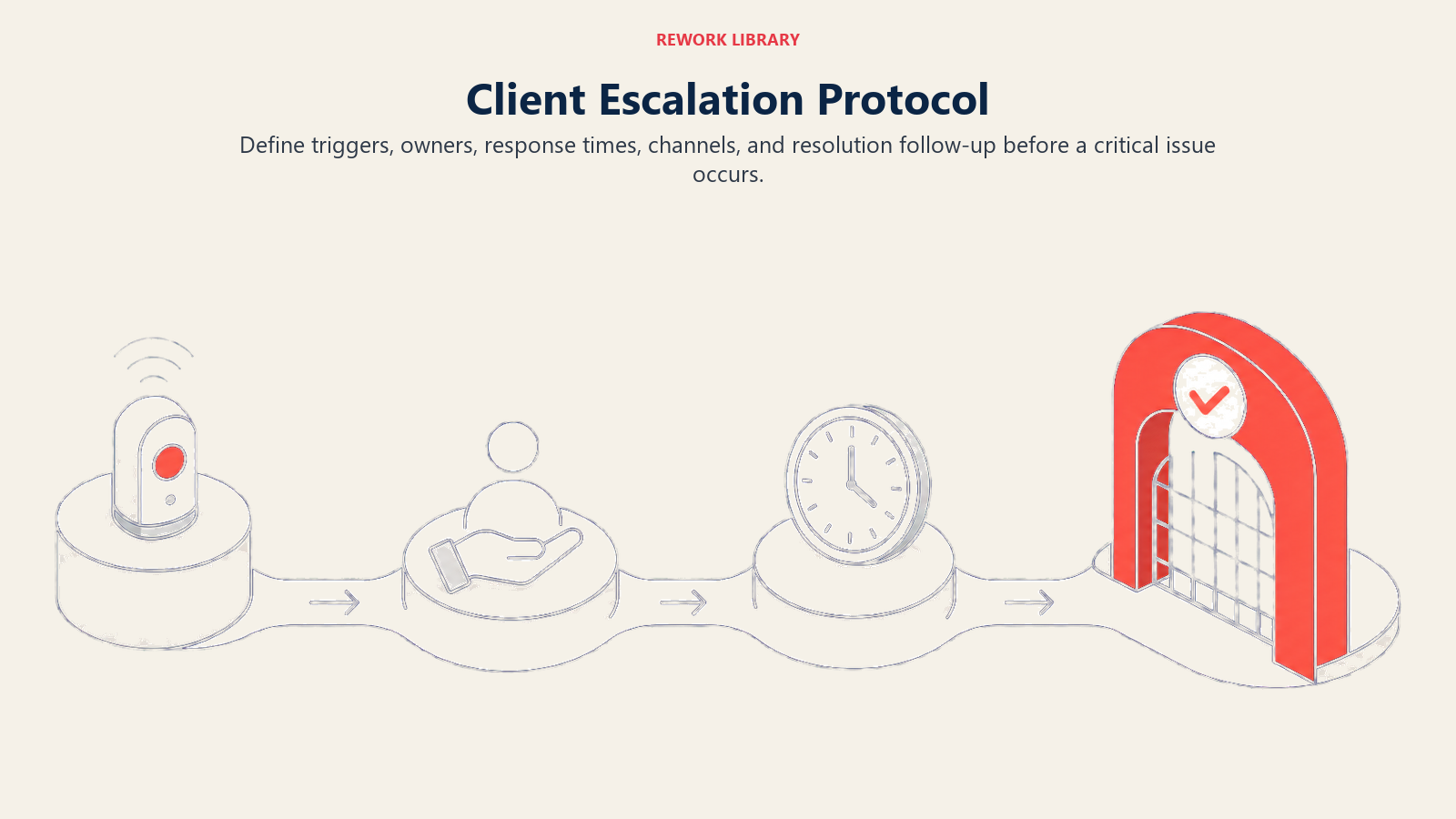
When a critical issue hits, follow this sequence:
- Immediate notification: Call (don't email) the project sponsor and key stakeholders within an hour
- Situation assessment: Brief description of what happened, impact, immediate actions being taken
- Action plan: Within 4 hours, provide a more detailed plan for resolution including timeline
- Regular updates: During crisis mode, provide updates every 4-8 hours even if just "no new information, still working the plan"
- Resolution summary: Once resolved, document what happened, what was done, lessons learned
- Process improvement: Discuss what changes will prevent recurrence
The worst thing you can do with a critical issue is go dark while you're fixing it. Clients can handle problems. They can't handle uncertainty.
Bad news delivery best practices
Nobody likes delivering bad news, but it's part of professional services. Here's how to do it effectively:
Don't sugarcoat: Be direct about the problem. "We're going to miss the deadline" not "We might be a little delayed."
Bring a plan: Never deliver bad news without a proposed solution. "The integration is more complex than scoped. Here are three options for how to proceed." If additional work is required, follow your change order process to document and price the options.
Own mistakes: If your team screwed up, say so. If the client caused the issue, explain it factually without being accusatory. "The spec change last week added two weeks to the timeline."
Provide options: Give the client choices about how to respond. "We can deliver on time with reduced scope, extend the timeline by two weeks for full scope, or add resources and absorb the cost to hit both scope and timeline."
Bad news delivered early and with options builds trust. Bad news hidden until it's a crisis destroys trust.
Communication tools and platforms
The medium matters. Different tools support different communication needs.
Email: Best for formal updates, documentation, decisions that need a paper trail. Worst for urgent communication (people don't check it constantly) or complex discussions (threads get confusing).
Project management software: Tools like Asana, Monday, Jira, Smartsheet are great for task-level visibility, progress tracking, and keeping everyone aligned on what's happening. Less good for strategic discussion or relationship communication.
Video meetings: Zoom, Teams, Google Meet for face-to-face communication, screen sharing, and building relationships. Essential for complex discussions and problem-solving. Can be inefficient if overused for simple status updates.
Instant messaging: Slack, Teams for quick questions, informal coordination, rapid issue resolution. Dangerous if it becomes the primary communication channel because information gets lost in chat history.
Client portals: Dedicated platforms (some consulting firms build custom portals) for centralized access to reports, deliverables, timelines, and documentation. Good for organization, sometimes clunky to maintain.
Dashboards: Tableau, Power BI, custom dashboards for visual progress tracking and metrics. Great for executives who want at-a-glance status.
The best approach uses multiple tools strategically:
- Email for formal status reports and decisions
- Project management platform for task tracking and team coordination
- Video calls for weekly team meetings and monthly steering committees
- Slack/Teams for quick day-to-day questions
- Shared drive or portal for deliverables and documentation
Just make sure everyone knows where to look for what. "Status reports land in your inbox every Monday. Task updates are in Asana. Questions during the week go in the Slack #project-phoenix channel."
Common communication mistakes that damage client relationships
Even with good intentions, consultants mess up client communication in predictable ways.
Over-communicating tactical details to executives
Your CEO client doesn't need to know that you're running behind on updating the test environment or that Bob from accounting was late to the working session. They need to know whether the project is on track for go-live and whether there are any risks to the business outcome.
Flooding executives with implementation details makes them tune out. Then when you actually need their attention on something important, they're not paying attention anymore.
Tailor communication to the audience. Tactical details go to project teams. Strategic summaries go to executives.
Under-communicating risks and issues
Consultants have a bias toward optimism. "This issue is probably manageable, no need to worry the client yet." Then it turns into a bigger problem and the client is blindsided.
The rule should be: if there's a 30% chance this becomes a real problem, mention it as a risk in your status update. The client doesn't need to act on it yet, but they should know it's on your radar.
Clients hate surprises more than they hate problems. A risk that's been flagged for three weeks and then materializes is much easier to manage than a problem that appears suddenly.
Inconsistent cadence
You have weekly status meetings for six weeks, then skip one because "nothing new to report," then have another one, then skip two. This inconsistency creates anxiety. "Did they skip the meeting because the project is going poorly?"
If you establish a weekly cadence, maintain it even if the update is brief. "Not much progress this week due to the holiday, but everything remains on track for next week's deliverables." That takes two minutes and preserves the rhythm.
If you need to change the cadence (moving from weekly to bi-weekly because the engagement phase changed), make that explicit. Don't just stop showing up.
The "no bad news" disease
Some consultants avoid communicating problems because they think it makes them look incompetent. So they hide issues until they can fix them. This sometimes works, but when it doesn't, it's catastrophic.
Professional services is about solving problems. Clients expect there will be challenges. What they don't expect is finding out about those challenges when it's too late to do anything about them.
Frame issues as "here's the situation, here's our plan to address it, here's what we need from you." That's professional problem-solving, not incompetence.
Poor meeting facilitation
Status meetings that ramble for 90 minutes because there's no agenda, or where the same three people dominate the conversation while others tune out, or that end without clear action items - these waste everyone's time.
Run tight meetings: agenda distributed in advance, start on time, stick to time boxes, capture decisions and action items, end on time, circulate notes within 24 hours.
If your client culture is "meetings always run over and nobody follows agendas," you might not be able to change that. But at least make sure your update portion is crisp and organized.
Waiting for the scheduled update when immediate communication is needed
"I know we found out on Wednesday that the vendor can't deliver until next month, but I figured I'd wait until our Monday status meeting to mention it."
No. Critical issues get communicated immediately. The regular cadence handles routine updates. Don't let schedule override common sense.
Making communication cadence sustainable
The cadence you establish at project kickoff needs to last for the entire engagement. That means it has to be sustainable for your team, not just the client.
Build it into project planning: When you scope the engagement, include time for status updates, meetings, and report preparation. If you promise weekly detailed reports but don't budget time to write them, they'll either be low quality or your team will burn out. Factor this into your utilization and capacity planning.
Use templates and automation: Don't reinvent the status report format every week. Create templates for standard updates. Use project management tools that auto-generate progress reports. The less manual effort required, the more sustainable the cadence.
Delegate appropriately: The senior partner doesn't need to attend every weekly status meeting. The project manager can handle tactical updates. Save senior attention for monthly steering committees and critical decisions.
Evolve the cadence as the engagement progresses: What makes sense during implementation might be overkill during steady-state operation. Adjust frequency and format as appropriate, but do it intentionally and with client agreement.
Ask for feedback: Every few months, check in: "Is this communication working for you? Too much? Not enough? Different format would be helpful?" Clients will tell you if something isn't working.
Connecting communication to other service delivery practices
Communication cadence doesn't exist in isolation. It connects to your broader delivery methodology.
Your project management methodology should define standard communication rhythms for different project types. Don't reinvent this for every engagement.
The client onboarding process is where you establish communication expectations and preferences. Get alignment on cadence before the project starts.
Your issue resolution process defines how problems get communicated and escalated. Communication cadence is how those issues get surfaced.
Client success reviews provide a more strategic communication forum to step back from project status and discuss relationship health and value delivery.
When all these pieces work together, communication becomes systematic rather than ad-hoc. That's when it starts building real client confidence.
The bottom line on communication cadence
Good communication doesn't guarantee project success, but bad communication almost guarantees project failure. Clients need to feel informed, involved, and confident that you're on top of things.
The specific cadence matters less than having one and sticking to it. Weekly or bi-weekly, written or meeting-based, detailed or high-level - all can work as long as it's:
- Designed for the specific engagement and client
- Consistently maintained throughout the project
- Appropriate for different stakeholder levels
- Responsive when issues arise
- Sustainable for your team
Start by proposing a cadence during project kickoff. Get client agreement. Execute it consistently. Adjust based on feedback. That's it.
The consultants who master communication cadence don't just deliver good work - they build client relationships that lead to expanded engagements, renewals, and referrals. Because clients remember not just what you delivered, but how it felt to work with you. And "they kept me informed every step of the way" is the feeling that leads to long-term client relationships.

Sales Director
On this page
- Why communication cadence determines client satisfaction
- Assessing what your engagement needs
- Design principles for effective cadences
- Communication types and frequency by engagement model
- Agile and iterative engagements
- Waterfall and phased engagements
- Retainer and ongoing engagements
- Crisis-driven or high-urgency engagements
- Transition and change management projects
- Status update formats that actually work
- Written status reports
- Dashboard and visual updates
- Meeting-based updates
- Video updates and async communication
- Stakeholder-specific communication strategies
- Executives and C-level stakeholders
- Project sponsors and primary stakeholders
- Technical teams and implementation partners
- End users and change recipients
- Escalation protocols and critical issue communication
- Define issue severity levels
- Escalation paths and response commitments
- Communication chain for critical issues
- Bad news delivery best practices
- Communication tools and platforms
- Common communication mistakes that damage client relationships
- Over-communicating tactical details to executives
- Under-communicating risks and issues
- Inconsistent cadence
- The "no bad news" disease
- Poor meeting facilitation
- Waiting for the scheduled update when immediate communication is needed
- Making communication cadence sustainable
- Connecting communication to other service delivery practices
- The bottom line on communication cadence