Consultative Business Development: Building Trust Through Value-First Client Relationships
 Your managing partner just returned from a conference where competitors announced three major client wins. You recognize two of those clients. They'd attended your webinar last quarter, downloaded your white paper, and even had exploratory conversations with your team. Somehow, they still chose someone else.
Turn this article into takeaways for your work.


Each assistant summarizes the article only for you and suggests best practices for your work.
The post-mortem reveals a familiar pattern. Your team presented capabilities, shared case studies, and responded to every question professionally. But they didn't win the work because they never moved beyond transactional selling. They positioned your firm as a vendor when the client was looking for a trusted advisor.
This happens all the time in professional services. Firms with exceptional capabilities lose to competitors who understand something fundamental: clients don't buy services, they buy relationships with people they trust to solve problems they can't solve alone. According to LinkedIn's State of Sales report, 73% of buyers prefer working with sales professionals who act as trusted advisors rather than traditional salespeople.
If you're a partner, business development leader, or senior professional responsible for winning client work, you need to shift from transactional selling to consultative business development. This means prioritizing client success over closing deals, asking more questions than you answer, and demonstrating value long before requesting commitment.
Understanding Consultative Business Development
Consultative business development is a relationship-based approach to winning professional services work that focuses on understanding client problems, providing strategic guidance, and building trust through demonstrated expertise rather than pitching services and closing transactions. The distinction matters because it changes everything about how you approach potential clients.
Traditional sales in professional services looks like this: identify prospects, schedule meetings, present capabilities, propose solutions, negotiate scope and pricing, close the deal. This works fine for commodity services where clients know exactly what they need and are comparing vendors primarily on price and availability.
It fails spectacularly for complex professional services where clients are buying expertise to solve ambiguous problems with uncertain solutions. When clients can't fully articulate their challenges, don't know what good solutions look like, and face internal political complexities around decision-making, they need advisors who help them think through problems, not vendors who pitch predefined solutions.
Consultative business development inverts the traditional sales sequence. So instead of starting with your capabilities and looking for clients who need them, you start with client challenges and business context, then position your expertise as the path to addressing those challenges. The conversation shifts from "here's what we do" to "here's what you're trying to accomplish and why our approach helps you get there."
The Trust Equation Framework
Trust is the foundation of consultative relationships, but most professionals don't understand what creates it. The Trust Equation, developed by David Maister, Charles Green, and Robert Galford, breaks trust into four components:
Trust = (Credibility + Reliability + Intimacy) / Self-Orientation
Credibility comes from demonstrated expertise. Can you speak intelligently about the client's industry, challenges, and potential solutions? Do you have relevant experience and results that prove capability? Credentials, case studies, and thought leadership all build credibility.
Reliability means following through consistently. Do you do what you say you'll do? Are you responsive to questions and requests? Do clients know they can count on you? Small commitments kept over time build reliability that translates into confidence for larger engagements. This consistency extends into every aspect of client communication cadence throughout an engagement.
Intimacy reflects how safe clients feel sharing sensitive information and concerns. Can they discuss fears, political dynamics, and uncertainties without judgment? Do you understand their personal stakes and career implications? Intimacy develops through active listening and genuine empathy for client situations beyond business problems.
Self-Orientation appears in the denominator because it diminishes trust. Are you focused on the client's success or your own agenda? Do conversations center on helping them or selling your services? High self-orientation (the sense that you're primarily interested in closing a deal) destroys trust faster than any other factor.
The framework reveals why traditional sales approaches struggle in professional services. Leading with capabilities and pushing for decisions increases perceived self-orientation, overwhelming whatever credibility, reliability, and intimacy you've built. Consultative approaches minimize self-orientation by focusing conversations on client needs, which amplifies the trust-building impact of credibility, reliability, and intimacy.
Understanding the professional services growth model provides context for where consultative business development fits within overall firm growth strategy.
Deep Discovery: The Foundation of Consultative Selling
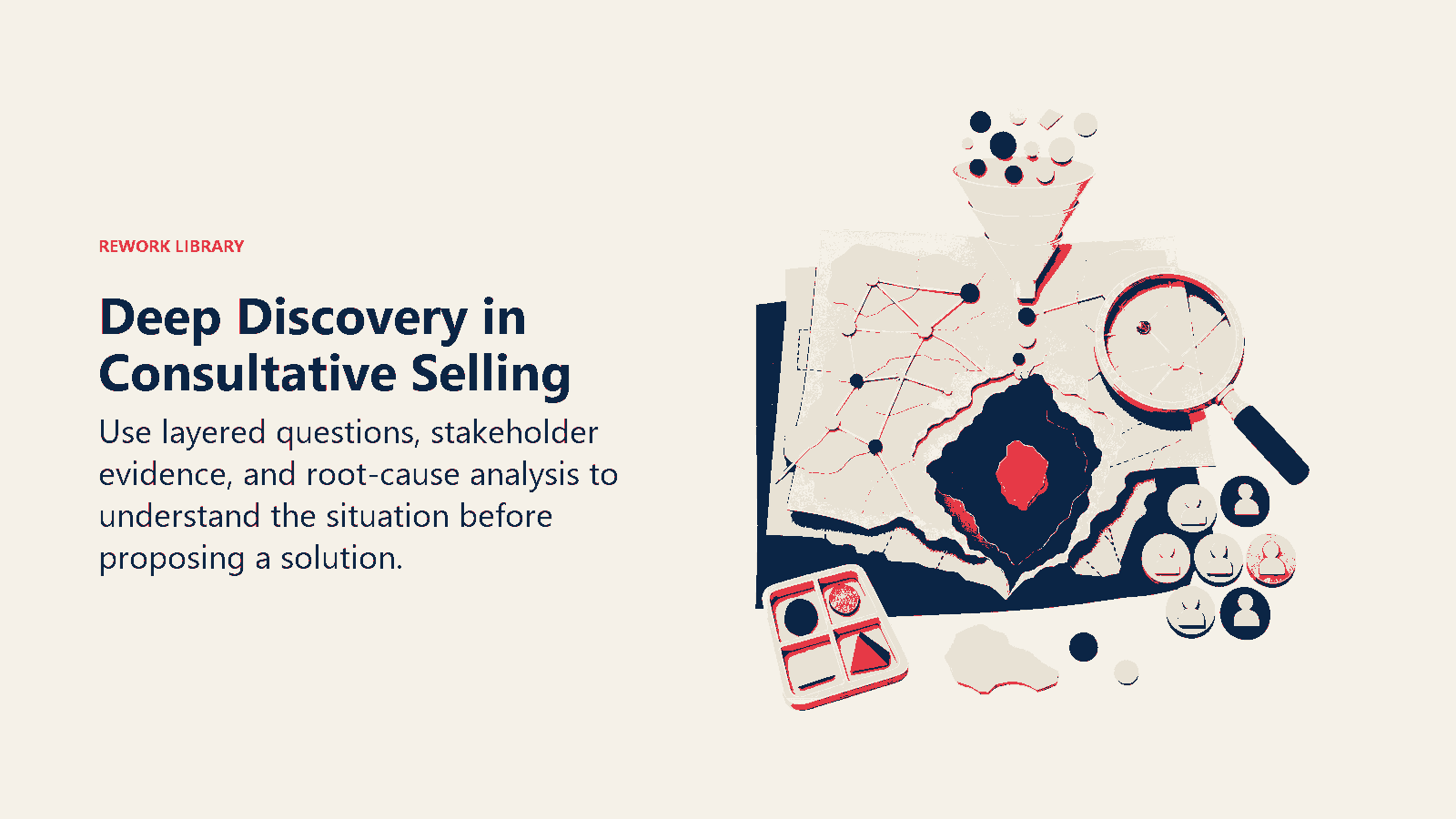
The biggest difference between consultative and traditional selling is how much time you spend understanding before you start proposing. Most professionals rush to solutions, eager to demonstrate expertise and move toward a proposal. This is exactly backward. Deep discovery means systematically exploring client situations, challenges, constraints, and desired outcomes before discussing solutions. The goal is understanding the problem better than the client does, which often means helping them see dimensions of their challenge they hadn't recognized.
Strategic Questioning Frameworks
Two questioning frameworks provide structure for discovery conversations:
SPIN Selling (developed by Neil Rackham) uses four question types in sequence:
Situation questions establish context: "Walk me through how you currently handle this process." "Who's involved in these decisions?" "What systems and tools support this work?" These questions gather facts and build understanding of the current state.
Problem questions surface challenges: "Where does the current approach break down?" "What happens when you face this situation?" "How does this impact other parts of the business?" These questions make implicit problems explicit and quantify their impact.
Implication questions explore consequences: "If this continues, what happens to your market position?" "How does this affect customer satisfaction?" "What does this mean for your team's capacity for other priorities?" These questions help clients recognize the full cost of not addressing problems, which creates urgency for solutions.
Need-payoff questions focus on benefits: "If you could solve this, what would that enable?" "How would this change your competitive position?" "What would success look like six months from now?" These questions shift conversation from problems to desired outcomes, which naturally leads to solution discussions.
The Challenger Sale approach (from Matthew Dixon and Brent Adamson) adds another dimension by teaching clients new perspectives on their business. Challenger-style questions reframe how clients think about challenges:
"Most companies in your industry approach this by [common approach], but our research shows that creates [unintended consequence]. Have you seen that pattern?" This type of question positions you as bringing insight, not just responding to expressed needs.
What matters most is asking more questions than you answer. In consultative conversations, clients should talk 70-80% of the time while you listen actively, probe deeper, and synthesize understanding. If you're talking more than the client, you've slipped back into presentation mode.
Active Listening for Hidden Needs
Asking good questions only works if you actually hear the answers. Active listening means focusing completely on what clients say (and don't say) rather than planning your next point.
Listen for emotion as much as content. When clients express frustration, concern, or excitement about specific issues, they're revealing what matters most. These emotional markers indicate which problems cause real pain versus abstract challenges they acknowledge intellectually but don't prioritize.
Notice what clients avoid discussing or gloss over quickly. These often signal politically sensitive issues or areas where they lack clarity. Following up gently on avoided topics often reveals the most important dimensions: "I notice you moved past [topic] quickly. Is that an area where there are challenges worth exploring?"
Reflect back what you hear to confirm understanding: "So if I'm hearing you correctly, the core challenge is [summary]. Is that accurate?" This verification serves two purposes, it ensures you understood correctly, and it helps clients clarify their own thinking by hearing their situation described back to them.
Business Context Assessment
Technical problems rarely exist in isolation. They're embedded in business contexts involving strategy, culture, politics, economics, and timing. Understanding context separates advisors from vendors.
Strategic context examines how the specific challenge connects to broader business objectives. Why does this matter now? What's the opportunity cost of not addressing it? How does this relate to competitive positioning or market dynamics? Problems that align with strategic priorities get resources and executive attention. Those that don't, regardless of technical importance, struggle to maintain momentum.
Cultural and political context explores the human dimensions. Who champions solutions versus who resists change? What past initiatives succeeded or failed, and why? What unwritten rules govern how decisions get made? The best technical solutions fail when they ignore organizational realities.
Economic context investigates budgets, approval processes, and ROI expectations. Who controls budget decisions? What hurdle rates or payback periods apply? Are there competing priorities for the same resources? Understanding economic constraints early prevents proposing solutions that can't get funded regardless of merit. Effective budget and timeline discovery requires asking these questions directly while maintaining consultative rapport.
Timing context clarifies urgency and constraints. What's driving the timeline? Are there external deadlines, fiscal year budgets, or leadership transitions affecting decisions? Is this an immediate priority or a longer-term improvement? Misreading timing leads to either pushing too hard on clients who aren't ready or moving too slowly when windows close.
Stakeholder Mapping
Professional services buying decisions involve multiple stakeholders with different interests, concerns, and influence levels. Mapping stakeholders reveals the political dynamics you're navigating.
Identify the economic buyer who controls budget and contractual authority. This person may not be your primary contact or the one who initiated the conversation, but ultimately they authorize spending. Understanding their priorities, decision criteria, and concerns is essential.
Find the champion who advocates internally for solving the problem and ideally advocates for your firm specifically. Champions provide inside information, navigate politics, and influence other stakeholders. They have personal stakes in project success and need your help building internal support.
Recognize influencers who don't have decision authority but whose opinions matter to decision-makers. Technical experts, peer executives, or respected senior advisors often play influencer roles. Understanding their concerns and earning their support strengthens your position.
Watch for blockers who oppose either the project or your firm for various reasons. Sometimes blockers have legitimate concerns about risk, disruption, or approach. Other times they're protecting turf or relationships with competitors. Either way, ignoring blockers leads to surprises during decision processes.
Map stakeholders early in discovery conversations by asking: "Who else is involved in thinking about this?" "Whose support do you need to move forward?" "Are there concerns from other parts of the organization we should address?"
Connecting discovery insights to client qualification frameworks helps determine which opportunities deserve pursuit and which should be politely declined.
Value Demonstration Strategies
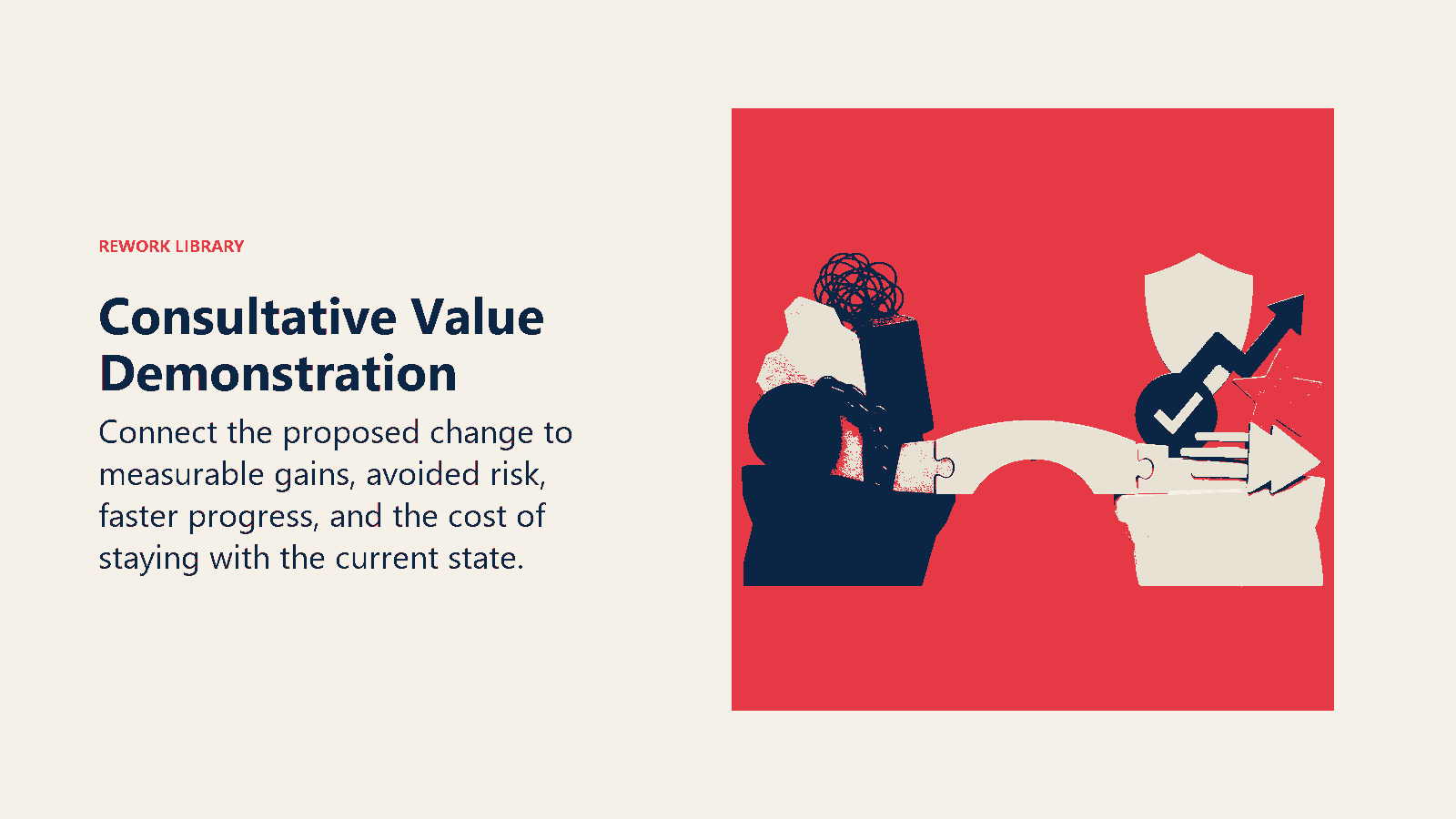
Consultative business development requires demonstrating expertise and providing value before clients commit to engagements. This feels risky. Why give away insights when you could charge for them? Because providing value upfront builds trust, proves capability, and differentiates you from competitors who lead with credentials and sales pitches.
Diagnostic Assessments
Structured assessments that evaluate current state against best practices create value while revealing opportunities. A finance consulting firm might offer a "Financial Process Maturity Assessment" evaluating close processes, reporting capabilities, and planning cycles. A technology consulting firm could provide a "Digital Readiness Assessment" analyzing systems, data infrastructure, and technical debt.
Effective diagnostics balance providing genuine insight against maintaining boundaries around proprietary methodology. You're giving away analysis and recommendations at a diagnostic level, not full implementation roadmaps or detailed solutions.
Diagnostics work because they create shared language and baseline understanding. When you can say "our assessment showed you're operating at Level 2 maturity in these processes, and Level 4 maturity would reduce cycle time by 40%," you've quantified opportunity and established expertise simultaneously.
Following through is critical. If you invest time in diagnostics, ensure findings get presented to appropriate stakeholders with clear next steps, whether that's deeper engagement with you or actions they can take independently. Diagnostics that disappear into client inboxes waste everyone's time.
Industry Insights and Benchmark Sharing
Professional services firms accumulate pattern recognition across multiple clients and projects. Sharing those patterns (while protecting client confidentiality) provides perspective clients can't generate internally.
Benchmark data showing how client performance compares to industry norms reveals gaps and opportunities: "Most companies your size in this industry are achieving 15-20% lower costs in this area. Your 32% higher cost suggests significant optimization opportunity." This type of insight reframes client understanding of their own situation.
Industry trend analysis helps clients see where markets are heading and where they may fall behind: "Three of your top competitors implemented this approach in the past 18 months. Based on their results, we're seeing this becoming table stakes in your market within the next two years." This creates urgency while positioning you as informed about competitive dynamics.
The value comes from synthesis and interpretation, not just data sharing. Clients can find generic industry reports. They can't easily extract implications specific to their situation or know which trends matter versus which are hype. Your expert interpretation is what they're buying.
Custom Frameworks and Methodologies
Sharing simplified versions of proprietary frameworks demonstrates how you think about problems while showcasing intellectual property that differentiates your approach.
A change management consultant might share their "Adoption Readiness Model" showing four factors that predict implementation success. An M&A consultant could present their "Integration Value Capture Framework" outlining where post-merger value typically hides. These frameworks give clients new lenses for evaluating their situations.
The frameworks you share should be educational rather than comprehensive. Enough to provide value and demonstrate thinking, not so detailed that clients could fully self-implement without additional help. Think of them as proofs of concept for your methodology.
Creating custom frameworks for specific client situations shows investment and builds intimacy. When you sketch out a framework during discovery that organizes their specific challenges into a coherent structure, you've demonstrated understanding that generic presentations never achieve.
ROI Modeling and Business Case Development
Helping clients build internal business cases before formal engagement serves everyone's interests. Clients need executive support and budget approval. You need clients to understand value clearly enough to pay appropriately for it. Business case development aligns both.
Collaborative ROI modeling asks clients to help quantify opportunity: "If we improved this process, what would that mean for throughput? For quality? For customer satisfaction? What's each point of improvement worth?" This conversation educates you about their economics while helping them articulate value in terms their executives care about.
The business case should address both financial returns and risk mitigation. Some projects generate revenue or reduce costs directly. Others mitigate compliance risk, reduce operational fragility, or improve strategic positioning. Clients need language for both financial and strategic value to secure support. This foundation becomes essential for pricing justification conversations later in the sales process.
Offering to help develop business cases positions you as invested in their success regardless of whether they choose you. It also ensures decision-makers see the problem through a lens that highlights your expertise and approach. Even if you don't win the work, you've influenced how they evaluate solutions.
Aligning value demonstration to proposal development processes ensures the transition from consultative selling to formal proposals maintains momentum and trust.
Expertise Positioning Without Selling
The paradox of consultative business development is that you close more business when you focus less on closing and more on being genuinely helpful. Expertise positioning means establishing yourself as a valuable resource whether or not clients buy from you.
Educational Content and Thought Leadership
Publishing insights about industry challenges, emerging trends, and solution approaches positions you as an expert before prospects ever engage directly. Articles, white papers, webinars, and podcasts that address real client problems attract potential clients searching for solutions.
Effective thought leadership doesn't promote your services. It solves problems and teaches new ways of thinking. A consultant writing about "Five Signs Your Operating Model Can't Support Growth" helps executives recognize patterns and understand solutions. Readers experiencing those signs naturally wonder whether the author could help them address the challenges. Building this kind of authority requires a systematic thought leadership strategy that positions you as the expert in your niche.
Consistency matters more than volume. Publishing one substantive piece per quarter builds presence over time. Sporadic bursts of content followed by silence signal marketing campaigns rather than genuine expertise sharing.
Distribution matters as much as creation. Great content that sits on your website helps no one. Share through LinkedIn articles, industry publications, speaking engagements, and referral partner channels. Each distribution expands your reach and positions expertise in front of new audiences.
Workshops and Educational Sessions
Hosting workshops on specific topics creates opportunities to demonstrate expertise while providing value to groups of potential clients. A workshop on "Building Scalable Sales Operations" brings together sales leaders facing similar challenges, allows you to teach proven approaches, and positions you as the expert who could help implement those approaches.
Workshops work because they balance education with engagement. Participants see how you think, ask questions specific to their situations, and experience working with you in a low-risk format. Those who find the session valuable naturally consider whether deeper engagement makes sense.
Keep workshops educational rather than promotional. The moment participants feel they've been lured into a sales presentation, trust evaporates. Focus 90% of time on teaching valuable frameworks and approaches, with 10% on explaining how you help clients implement these ideas.
Virtual formats expand workshop reach without travel constraints. A monthly roundtable discussion on industry topics can attract broader audiences than local events while creating ongoing touchpoints that maintain relationships between projects.
Network Introductions and Relationship Building
Sometimes the most valuable thing you can offer potential clients is connecting them with other people who can help them, even when those people aren't you.
Making thoughtful introductions to complementary service providers, potential customers, candidates for open roles, or industry experts demonstrates genuine interest in client success. These introductions build goodwill, establish you as a well-connected resource, and create reciprocity that often leads to future opportunities.
Make strategic introductions that actually help both parties. Random networking introductions waste everyone's time. Thoughtful connections based on specific needs or opportunities create value that reflects well on you.
When you introduce potential clients to competitors who might be better fits for their specific situation, you lose that immediate opportunity but gain reputation as trustworthy. Clients remember when professionals prioritized their needs over short-term sales, and they come back for future work or refer others because they trust your judgment. This relationship-first approach also builds your strategic partner network over time.
Navigating Complex Decision Processes
Professional services purchases rarely involve single decision-makers making quick choices. They're organizational decisions involving multiple stakeholders, competing priorities, and extended timelines. Understanding how to navigate this complexity improves win rates while reducing wasted pursuit effort.
Multi-Stakeholder Engagement
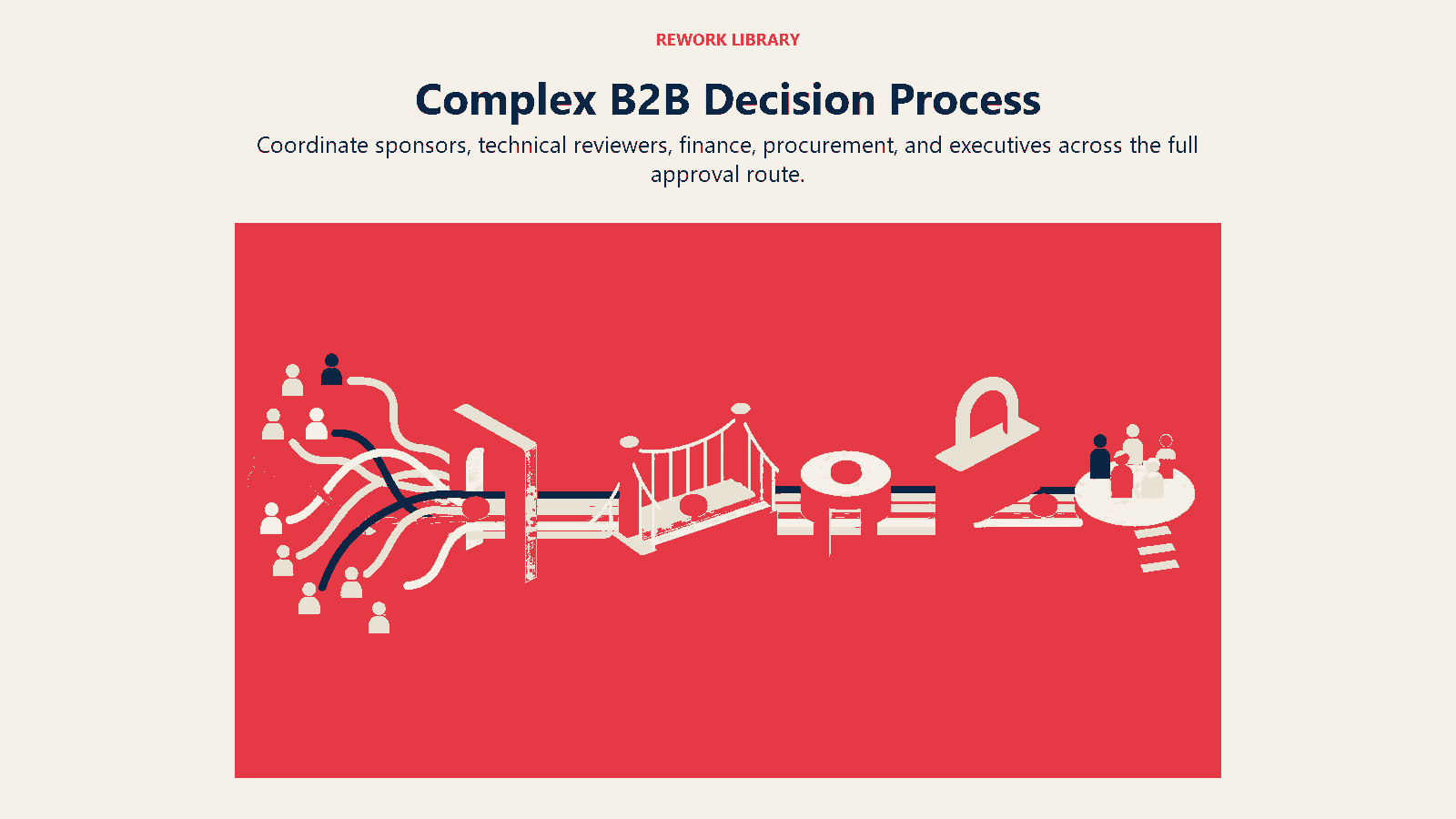
Different stakeholders care about different aspects of decisions. The CFO evaluates financial returns and risk. The operational leader prioritizes implementation feasibility and team impact. The technical expert assesses methodology and approach. Each needs different information to support your solution.
Successful navigation means customizing conversations for each stakeholder's concerns. With financial decision-makers, emphasize ROI, payback periods, and risk mitigation. With operational leaders, focus on implementation approach, change management, and results timelines. With technical stakeholders, discuss methodology, tools, and proven approaches.
Don't assume stakeholder priorities. Ask directly: "What matters most to you in evaluating approaches to this challenge?" "What concerns do you have about potential solutions?" "What criteria will you use to assess alternatives?" These questions reveal what each person needs to hear to support your solution.
Coordinate messaging across stakeholder conversations to prevent contradictions. If you tell the CFO implementation takes six months but tell the operational leader three months, someone will notice the discrepancy. Consistent messaging backed by clear rationale builds confidence that you understand the full scope.
Champion Development
Champions who advocate internally for both the project and your firm dramatically improve win probability. But champions aren't found. They're developed through deliberate relationship building and support.
Strong champions have personal stakes in project success, believe in your approach, and possess organizational influence. They may be the executive who initiated the search for help, a peer who's frustrated with current approaches, or a rising leader trying to make their mark.
Support champions by providing information, analysis, and tools they need to build internal support. Share stakeholder-specific talking points, help them anticipate objections, and offer to meet with skeptical stakeholders to address concerns directly. Your success depends on their success in navigating internal dynamics.
Help champions build strong internal narratives about why change matters now and why your approach makes sense. Abstract problem statements don't motivate action. Specific stories about risks of inaction, opportunities being missed, and benefits of solutions drive organizational momentum.
Recognize that champion relationships extend beyond individual projects. People who successfully advocated for you in one organization often become champions again in future roles at different companies. Investing in champion relationships creates long-term business development assets that contribute to your referral generation system.
Consensus-Building Approaches
In professional services buying, individual stakeholders rarely have unilateral authority. Decisions emerge through consensus among multiple influencers even when one person has formal approval authority. Building consensus means addressing concerns across the stakeholder group.
Identify common ground where stakeholders align despite different priorities. Everyone wants successful outcomes, acceptable risk levels, and efficient implementation. Starting from shared goals rather than individual concerns creates foundation for consensus.
Surface objections early rather than hoping they don't arise. Ask stakeholders: "What concerns do you have about this approach?" "What would prevent this from working in your organization?" "What questions do I need to answer for you to be comfortable moving forward?" Addressing concerns openly builds trust and prevents surprises during decision processes.
Create opportunities for stakeholders to interact with you as a group when possible. Collective discussions where you facilitate problem-solving demonstrate how you'd work with them during actual engagements. These conversations also reveal interpersonal dynamics and decision-making patterns that inform your approach.
Understanding negotiation approaches for professional services helps convert consensus into signed agreements with fair terms.
Timing, Pacing, and Reading Buying Signals
Consultative business development requires patience. Pushing for decisions before clients are ready damages relationships and reduces win probability. But waiting too long allows competitor momentum or changing circumstances to derail opportunities. Reading buying signals and pacing engagement appropriately determines success.
Recognizing True Urgency Versus Exploration
Not every inquiry represents immediate opportunity. Some prospects are genuinely ready to engage. Others are exploring options, building knowledge for future decisions, or satisfying internal requirements to evaluate alternatives to predetermined choices.
True buying signals include: specific budget allocated for this initiative, defined timeline with external drivers, stakeholder alignment on the need to act, and decision process mapped with clear next steps. When these elements exist, opportunities deserve aggressive pursuit.
Exploration signals show up as: general interest without specific timeline, individual stakeholder inquiry without broader organizational involvement, request for information without clear decision criteria, or vague budget discussions. These conversations deserve nurturing rather than closing pressure.
Ask directly about readiness: "Help me understand your timeline. Is this something you're looking to address in the next quarter, or are you gathering information for future planning?" Clear answers help you invest appropriate effort.
When urgency is low, shift to relationship building and value provision without pushing for engagement. Share relevant insights, make helpful introductions, and stay in periodic contact. When urgency increases, as it often does over time, you're the trusted resource they call.
Knowing When to Advance Versus Nurture
Professional services sales cycles span weeks to months depending on project scope and organizational complexity. Advancing too aggressively creates pressure that damages trust. Moving too tentatively allows opportunities to stagnate or competitors to seize initiative.
Advance when clients signal readiness: asking about next steps, requesting proposals or detailed information, introducing you to additional stakeholders, or discussing specific timelines and budgets. These signals indicate they're moving toward decisions and expect you to move with them.
Nurture when signals suggest they're not ready: postponing scheduled conversations, providing vague answers about timeline or budget, limiting stakeholder access, or expressing uncertainty about whether to proceed. Pushing harder in these situations increases resistance rather than creating momentum.
The transition from nurturing to advancing should feel natural based on client readiness, not calendar milestones or quarter-end pressure. When you've built trust through consultative engagement, clients often explicitly say "we're ready to talk about next steps" or "can you put together a proposal?"
Maintain contact during nurturing periods through value provision rather than status checks. Sharing relevant articles, introducing them to useful contacts, or inviting them to events keeps you present without pressure. When timing aligns with readiness, you're top of mind.
Common Consultative Selling Mistakes
Even experienced professionals make mistakes that undermine consultative effectiveness. Recognizing these patterns helps avoid them.
Premature Solution Presentation
The most common mistake is jumping to solutions before understanding problems fully. Eagerness to demonstrate expertise leads to presenting capabilities and approaches before knowing whether they match client needs.
This happens because silence feels uncomfortable. When clients describe challenges, the impulse is showing you have answers. But premature solutions signal you're more interested in showcasing expertise than understanding their situation.
Resist the urge to solve. When clients describe problems, respond with questions that deepen understanding: "Tell me more about what you've tried already." "How does this challenge connect to other priorities you're managing?" "What would success look like from your perspective?"
Solutions become compelling when they directly address well-understood needs. Generic capabilities presentations never generate the same impact as tailored approaches that clearly solve specific problems clients recognize.
Insufficient Discovery Depth
Surface-level discovery produces surface-level differentiation. Asking obvious questions that competitors also ask provides no advantage. Deep discovery uncovers dimensions competitors miss.
This requires time investment that feels risky when you're eager to move toward proposals. But discovery shortcuts mean proposals address symptoms rather than root causes, and clients recognize this. Competitors who did deeper discovery win because their proposals demonstrate superior understanding.
Plan for multiple discovery conversations rather than trying to understand everything in one meeting. Initial conversations establish context and build relationship. Subsequent discussions explore specific dimensions deeper. This paced approach feels natural while generating comprehensive understanding.
The discovery investment pays off not just in immediate opportunities but in relationship depth that creates future opportunities. Clients appreciate professionals who genuinely understand their business beyond the immediate project.
Feature Dumping Versus Outcome Focus
Describing your capabilities, methodologies, credentials, and past projects (what salespeople call feature dumping) bores clients and fails to differentiate. Clients care about their outcomes, not your features.
Transform feature discussions into outcome language. Instead of "we use a proven six-phase implementation methodology," say "our approach ensures you're seeing measurable results within 60 days while managing risk throughout." The methodology becomes evidence supporting the outcome promise rather than the main message.
When clients ask about credentials or approach (and they will), answer briefly then redirect to outcomes: "We've completed 40+ implementations in your industry over the past five years. What that means for you is we've seen most challenges that arise and know how to address them efficiently so your timeline holds."
This pattern, brief feature acknowledgment followed by outcome implication, keeps conversations focused on client value rather than your capabilities.
Connecting consultative approaches to value-based pricing strategies ensures you capture fair value for the outcomes you deliver.
Measuring Consultative Effectiveness
Consultative business development requires different metrics than transactional sales. Traditional sales measures like meetings booked or proposals sent miss the quality and relationship dimensions that drive professional services success.
Engagement Quality Metrics
Track depth of stakeholder engagement rather than just number of interactions. Are you meeting with economic buyers and influencers, or just operational contacts? Are conversations focused on strategic challenges or surface-level questions? Quality engagement creates win probability that quantity alone doesn't.
Measure relationship progression: movement from initial inquiry to discovery conversations to stakeholder expansion to proposal discussions. Opportunities advancing through stages indicate effective consultative engagement. Those stalling at early stages suggest relationship building or value demonstration needs attention.
Monitor unsolicited referrals and introductions. When clients proactively introduce you to colleagues facing similar challenges or suggest other areas where you could help, you're operating consultatively. These organic expansions rarely occur with transactional sellers.
Proposal Win Rates and Sales Cycle Length
Win rates reveal consultative effectiveness. Firms using truly consultative approaches win 50-70% of opportunities where they submit proposals because they only pursue well-qualified situations with strong relationships.
If you're winning less than 40% of proposals, you're either pursuing wrong-fit opportunities or your consultative approach needs strengthening. Above 70% suggests you may be too conservative in qualification or leaving money on table with under-pricing.
Sales cycle length from first conversation to signed engagement should shorten as consultative skills improve. Deep discovery and trust building feel slow initially, but they accelerate decisions by ensuring stakeholder alignment, clear value understanding, and confidence in your approach. Rushed processes that skip consultative steps often stall during decision phases, extending total cycle time.
Track cycle time by engagement type and client segment. Complex transformational work naturally takes longer than focused tactical projects. New clients require more relationship building than existing relationships. Understanding typical cycles prevents mistaking normal patterns for problems.
Client Lifetime Value and Expansion
The ultimate measure of consultative effectiveness is client relationships that expand over time. Consultative approaches create trust that leads to additional work, referrals, and multi-year relationships.
Track revenue per client over time. Healthy consultative relationships show 20-30% annual growth as you expand into new areas, deepen existing work, or move from project-based to retained advisory relationships. A systematic cross-sell strategy helps identify these expansion opportunities within existing accounts.
Measure expansion efficiency through ratio of new work from existing clients versus new client acquisition. When 40% or more of new revenue comes from existing relationships, your consultative approach is creating the foundation for efficient growth.
Monitor relationship tenure and engagement frequency. Clients you've served for multiple years across multiple engagements represent consultative success. Transactional relationships rarely persist beyond individual projects.
Understanding broader professional services metrics ensures business development measurement aligns with overall firm performance management.
From Transactional to Consultative: Making the Shift
Consultative business development represents a fundamental shift in how professional services firms think about winning work. It requires patience, genuine curiosity about client challenges, and willingness to provide value before securing commitments.
The firms that make this transition successfully recognize that trust-based relationships generate more profitable growth than transactional efficiency. They train professionals in questioning and listening skills, not just presentation and closing techniques. They measure engagement quality and relationship progression, not just pipeline volume and conversion rates.
This approach feels slower initially. Consultative conversations take more time than capability presentations. Building trust through value demonstration delays proposals compared to quick-strike selling. But the long-term returns (higher win rates, premium pricing, expanded relationships, and sustainable competitive advantage) justify the investment.
The choice you face is whether to compete on price and availability like vendors, or compete on expertise and trusted advisor relationships like true professionals. Consultative business development is how you make that shift.
For professional services firms serious about growth, it's not about selling harder. It's about building trust deeper, understanding clients better, and demonstrating value earlier. That's what separates firms that grow consistently from those that struggle to fill pipelines despite strong capabilities.
Ready to strengthen your business development approach? Understand how to identify the right opportunities with Client Qualification Framework and master the discovery process through Needs Assessment & Discovery.
Continue building your growth system:

Sales Director
On this page
- Understanding Consultative Business Development
- The Trust Equation Framework
- Deep Discovery: The Foundation of Consultative Selling
- Strategic Questioning Frameworks
- Active Listening for Hidden Needs
- Business Context Assessment
- Stakeholder Mapping
- Value Demonstration Strategies
- Diagnostic Assessments
- Industry Insights and Benchmark Sharing
- Custom Frameworks and Methodologies
- ROI Modeling and Business Case Development
- Expertise Positioning Without Selling
- Educational Content and Thought Leadership
- Workshops and Educational Sessions
- Network Introductions and Relationship Building
- Navigating Complex Decision Processes
- Multi-Stakeholder Engagement
- Champion Development
- Consensus-Building Approaches
- Timing, Pacing, and Reading Buying Signals
- Recognizing True Urgency Versus Exploration
- Knowing When to Advance Versus Nurture
- Common Consultative Selling Mistakes
- Premature Solution Presentation
- Insufficient Discovery Depth
- Feature Dumping Versus Outcome Focus
- Measuring Consultative Effectiveness
- Engagement Quality Metrics
- Proposal Win Rates and Sales Cycle Length
- Client Lifetime Value and Expansion
- From Transactional to Consultative: Making the Shift