Multi-Year Engagements: Structuring Long-Term Client Relationships for Sustainable Growth
 A multi-year engagement is a contractual commitment that spans several years instead of a single project. For agencies and professional services firms, these long-term agreements deliver predictable revenue, lower acquisition costs, deeper client relationships, and a competitive moat that rivals struggle to breach. The trade-off is committing to obligations you cannot easily exit, so structure matters.
Turn this article into takeaways for your work.


Each assistant summarizes the article only for you and suggests best practices for your work.
Most professional services firms chase the same quarterly treadmill: sell a project, deliver it, then scramble to find the next one. Even with recurring clients, you're constantly re-selling, re-scoping, and re-negotiating. It's exhausting, unpredictable, and leaves money on the table.
Multi-year engagements flip that model. Instead of selling individual projects, you're building sustained partnerships with contractual commitments that span years. The economics are compelling: predictable revenue, deeper relationships, lower acquisition costs, and a competitive moat that's hard for competitors to breach.
But long-term contracts aren't just extended project agreements. They require different thinking about pricing, value delivery, relationship management, and risk. Get it right and you build a foundation for sustainable growth. Get it wrong and you're locked into unprofitable relationships that slowly drain your firm.
This guide shows you how to identify the right clients for multi-year relationships, structure engagements that work for both sides, and manage them successfully through renewal and expansion. Combined with effective cross-sell strategy and client penetration, multi-year engagements become the foundation for predictable, profitable growth.
The economics of long-term relationships
Here's what changes when you move from project-by-project to multi-year thinking. Revenue predictability: A three-year engagement with a client worth $500K annually gives you $1.5M in committed revenue. That changes how you plan capacity, hire staff, invest in capabilities, and make strategic decisions. You're not guessing whether next quarter's pipeline will close.
Relationship depth: When you know you'll be working together for years, both sides invest differently. Clients share more strategic context. You learn their business intimately. The relationship shifts from vendor to trusted advisor because there's time to prove value repeatedly.
Lower acquisition costs: Selling one three-year deal costs less than selling three separate one-year deals. You eliminate two renewal cycles, two negotiation processes, and dozens of hours that would go into re-proving value and justifying continued investment.
Competitive protection: Once you're embedded with multi-year contracts, competitors face a much higher barrier. They're not just competing on features or price - they're asking clients to break contractual commitments and disrupt established workflows. That's a tough sell.
But there's a flip side. Long-term commitments create obligations you can't easily escape. If the relationship sours, profitability drops, or scope expands beyond what you priced, you're stuck managing those problems for years. That's why structure matters so much.
Multi-year engagement models
Not all long-term engagements look the same. The model you choose depends on service type, client needs, and risk tolerance. Master Service Agreement (MSA) with rolling projects: The MSA establishes overall terms, pricing frameworks, and relationship governance. Individual projects or work orders get executed under this umbrella but are scoped and priced separately. This gives flexibility while maintaining contractual continuity.
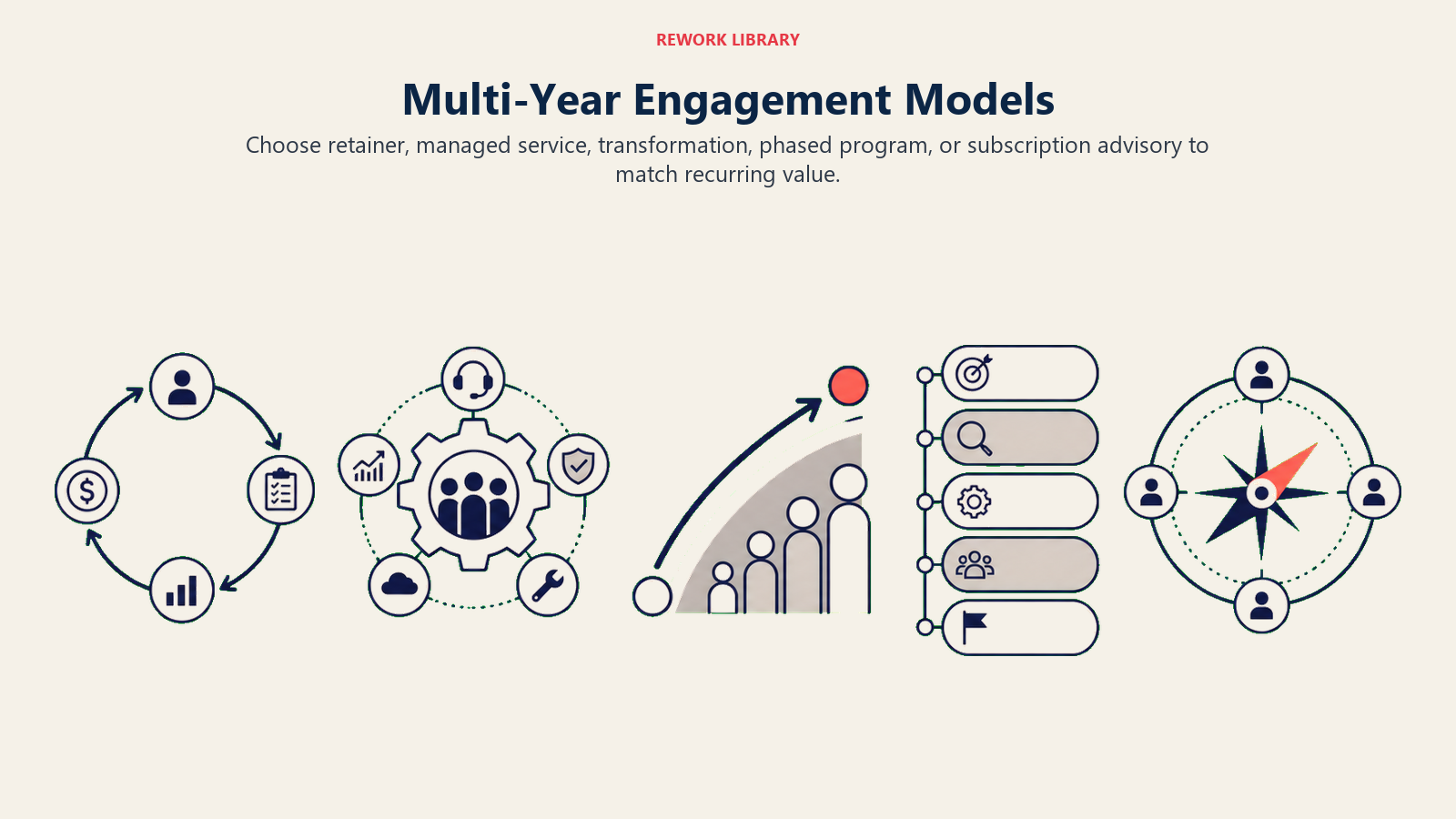
Example: A three-year MSA with a technology consulting firm, where specific implementation projects get defined quarterly based on business priorities.
Retainer-based engagements: Client commits to a monthly or quarterly fee in exchange for a defined level of service or capacity. Common in legal, accounting, marketing, and strategic advisory work where needs are ongoing but variable.
Example: A law firm provides 40 hours per month of general counsel services at a fixed monthly rate, with additional work billed separately.
Capacity commitment models: Client commits to purchasing a certain number of hours, FTEs, or capacity units over the contract term. You commit to making that capacity available. Pricing often includes volume discounts for the long-term commitment.
Example: An implementation consultancy provides two full-time consultants dedicated to the client's digital transformation program for 24 months.
Performance-based partnerships: Payment tied to specific outcomes or KPIs achieved over the contract term. Higher risk but potentially higher reward, and aligns incentives around long-term value creation.
Example: A marketing agency's compensation includes base fees plus bonuses tied to lead generation and revenue growth targets over three years.
Strategic partnership arrangements: Goes beyond transactional service delivery to include joint initiatives, co-development, exclusive relationships, or equity stakes. Common when there's strategic alignment beyond just service provision.
Example: A product design firm partners with a manufacturing client, receiving equity in exchange for exclusive design services and strategic product development guidance.
The right model depends on predictability of needs, value measurement clarity, and both parties' risk tolerance.
Identifying multi-year candidates
Not every client relationship should become a multi-year engagement. You're looking for specific characteristics that indicate readiness and fit. Account characteristics: Size matters, but it's not just revenue. You want clients with strategic importance, organizational stability, and decision-making authority. A $2M client that's constantly restructuring and changing leadership is riskier than a $500K client with stable management and clear priorities.
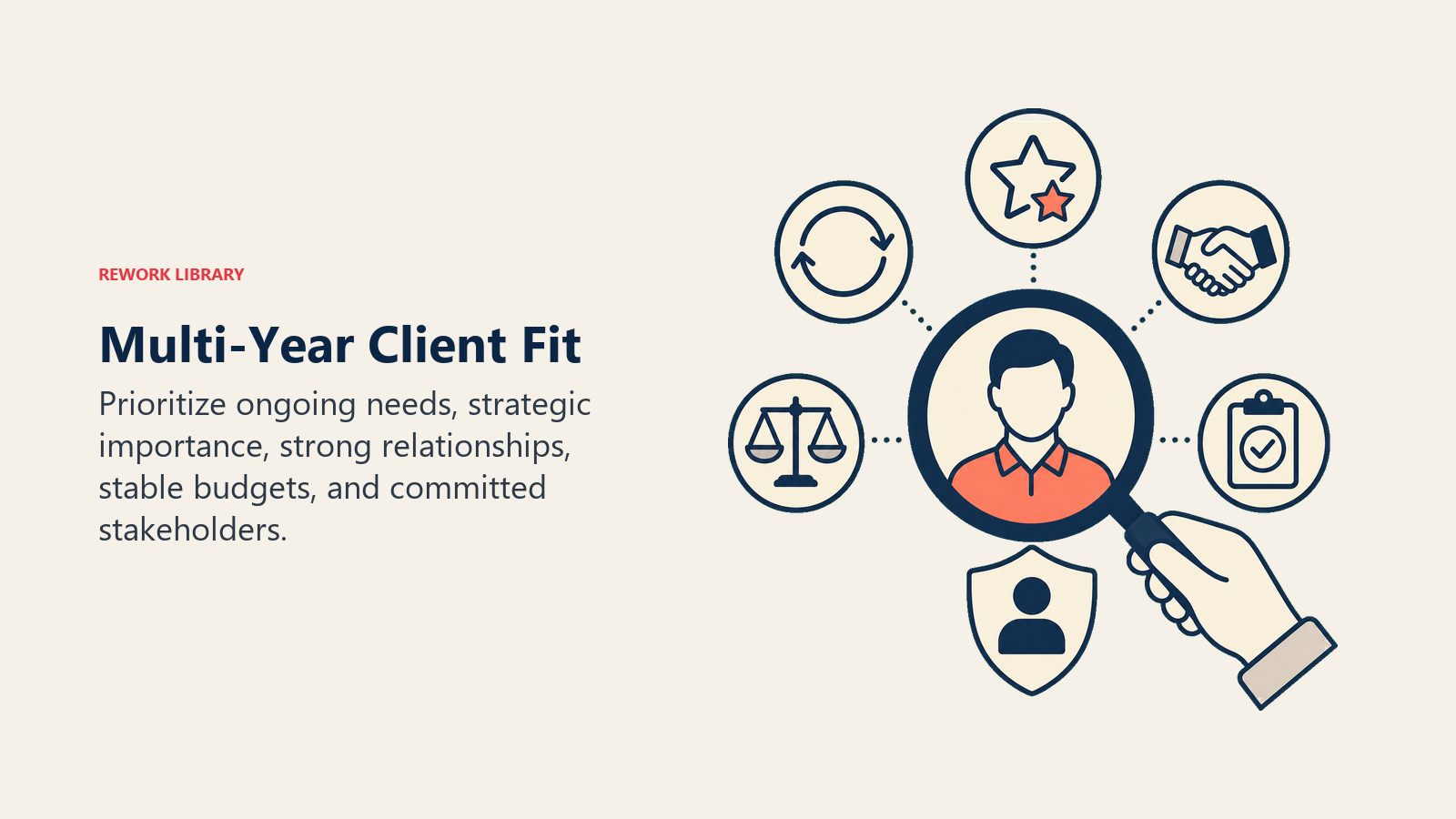
Look for clients who are growing or transforming. They have ongoing needs that will span years. Stagnant organizations might sign multi-year contracts but won't expand scope or deepen the relationship.
Engagement maturity: The best candidates are existing clients where you've already proven value. You understand their business, they trust your delivery, and there's a track record of successful collaboration. Converting a strong one-year relationship into a three-year commitment is easier than selling a multi-year deal to a new prospect. Use white space analysis to identify which accounts have the expansion potential to justify multi-year structures.
Service fit: Some services naturally lend themselves to long-term relationships. Ongoing advisory work, strategic consulting, outsourced functions, and transformation programs all have sustained needs. One-time transactional work like specific audits or discrete implementations are harder to turn into multi-year arrangements.
Client readiness indicators: Watch for signals that a client is thinking long-term. Are they asking about roadmaps beyond the current project? Are they introducing you to more stakeholders? Are they requesting capacity commitments or asking about long-term pricing? These suggest they're open to deeper commitment.
Budget cycles matter too. Clients with multi-year budget planning and committed transformation budgets can make longer commitments more easily than those operating on tight annual budgets.
Structuring the engagement
The structure you create determines whether the engagement succeeds or becomes a source of frustration and unprofitability. Scope definition: In multi-year engagements, scope must balance specificity with flexibility. Too rigid and you can't adapt to changing business needs. Too vague and scope creep destroys profitability.
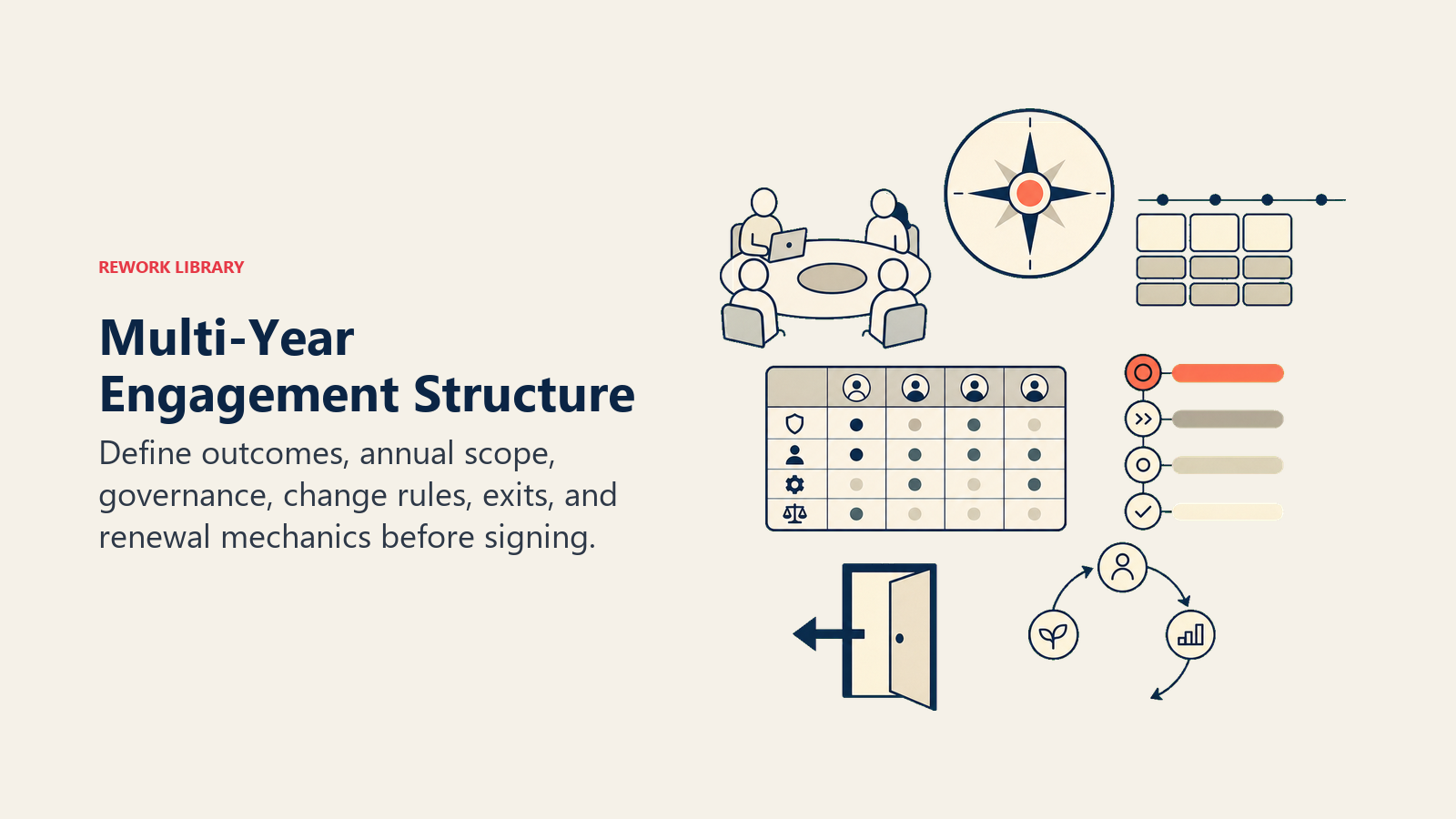
The solution is tiered scope definition. Define core services that are relatively stable and predictable. Then create mechanisms for additional work, scope changes, and emerging needs. Be explicit about what's included in base pricing and what triggers additional fees.
Service level agreements: SLAs define expectations around responsiveness, quality, deliverable timing, and resource availability. In long-term engagements, clear SLAs prevent relationship erosion when one side feels the other isn't meeting commitments.
Example SLA components:
- Response time for requests (2 hours for urgent, 24 hours for routine)
- Turnaround time for deliverables
- Availability commitments (dedicated resources, backup coverage)
- Quality standards and review processes
- Communication cadence (weekly check-ins, monthly reviews)
Volume and capacity commitments: If you're committing specific capacity, define it precisely. "Full-time consultant" could mean anything from 35 to 60 hours per week depending on interpretation. Specify FTE definitions, holiday schedules, vacation coverage, and what happens if committed resources leave.
If the client is committing to minimum volumes, define measurement periods and consequences if minimums aren't met. Can unused hours roll over? Do they expire? Are there true-up payments?
Performance metrics: What does success look like over three years? Define metrics you'll track and report against. This serves two purposes: it keeps both sides aligned on value, and it provides ammunition for renewal conversations later.
Metrics might include project delivery timeliness, cost savings achieved, revenue generated, process improvements implemented, or strategic milestones reached.
Pricing multi-year engagements
Long-term pricing requires different math than project pricing. Pricing model selection: You have several options:
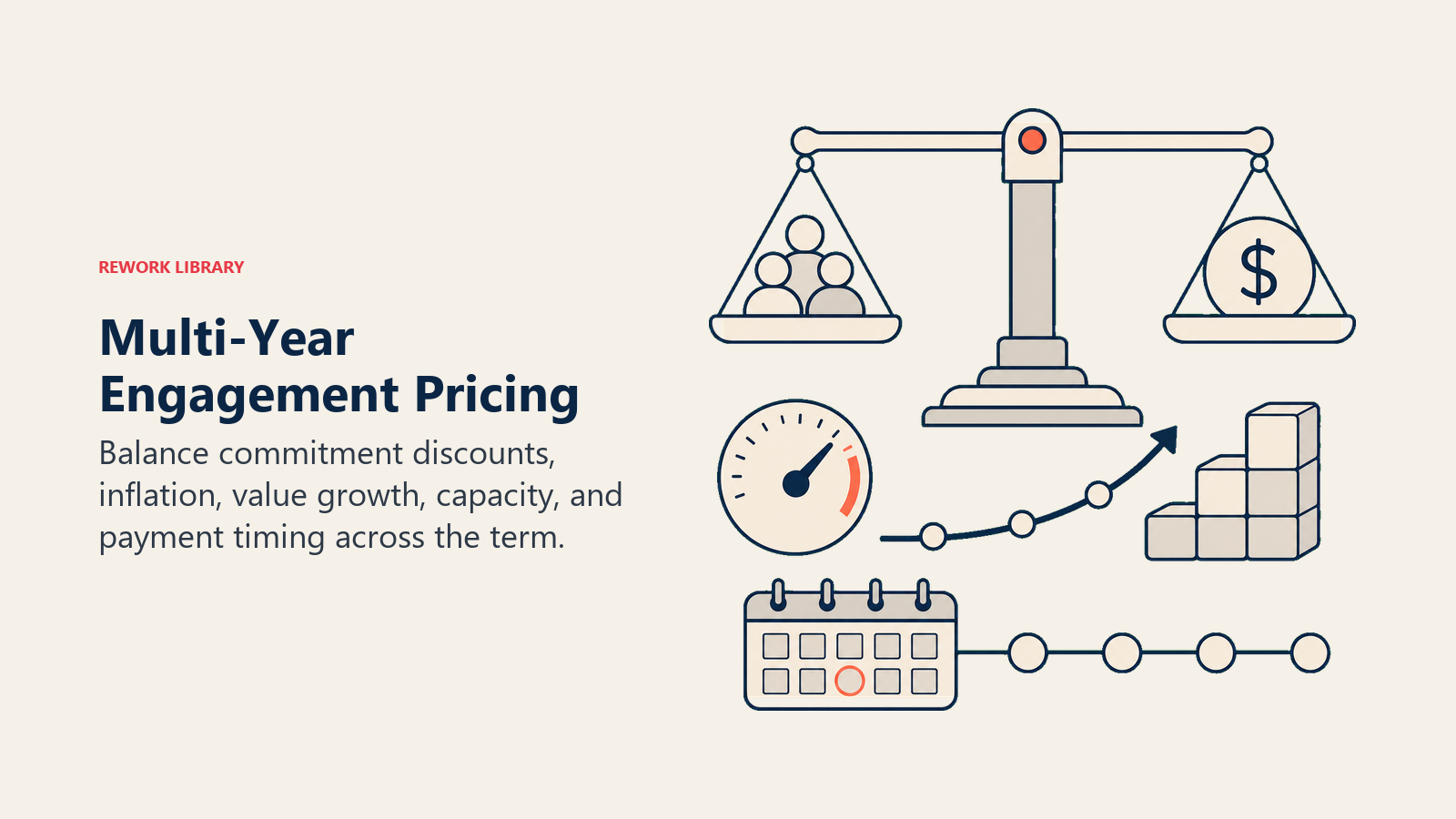
Fixed annual fees with escalators: Clean and predictable, but requires accurate scoping. Include annual price increases (typically 3-5%) to account for inflation and cost growth.
Usage-based with minimums: Client pays for actual consumption but commits to minimum levels. Works when needs fluctuate but you need baseline revenue certainty.
Tiered pricing: Different pricing for different service levels or volume bands. Encourages expansion and rewards commitment.
Multi-year discount structures: Clients expect some incentive for longer commitments. The question is how much to discount and how to structure it.
One approach: discount the rate but require minimum volume commitments. A 10% rate discount for a three-year contract with guaranteed minimum spend protects your revenue while giving the client savings.
Another approach: hold pricing flat over the contract term instead of annual increases. In a 3-5% inflation environment, this represents a 9-15% discount over three years without explicitly cutting your rate.
Watch out for front-loading discounts. If year one is deeply discounted but years two and three are full price, you're betting the client won't renegotiate or leave when prices jump. That's a risky bet.
Risk protection pricing: Long-term contracts carry execution risk. You might underprice scope, underestimate effort, or face unexpected complications. Build in protection:
- Conservative scope assumptions that leave room for complexity
- Escalation clauses for major scope changes or client requests
- Defined processes for change orders and additional work
- Performance-based pricing that rewards efficiency
Financial incentives for commitment: Beyond discounts, you can structure financial incentives that reward long-term partnership. Examples:
- Volume rebates: If the client exceeds committed minimums by X%, they earn a percentage back
- Performance bonuses: Both sides benefit if specific outcomes are achieved
- Shared savings models: Efficiency gains get split between client and service provider
These align incentives and create win-win dynamics that strengthen the relationship. For approaches to defending your pricing in negotiations, see pricing justification.
Value creation over time
Multi-year engagements fail when value delivery becomes routine and complacent. You have to actively manage value creation throughout the relationship. Strategic business planning: Start each year or planning period with strategic discussions. What are the client's priorities? How is their business changing? What emerging needs should you be helping with?
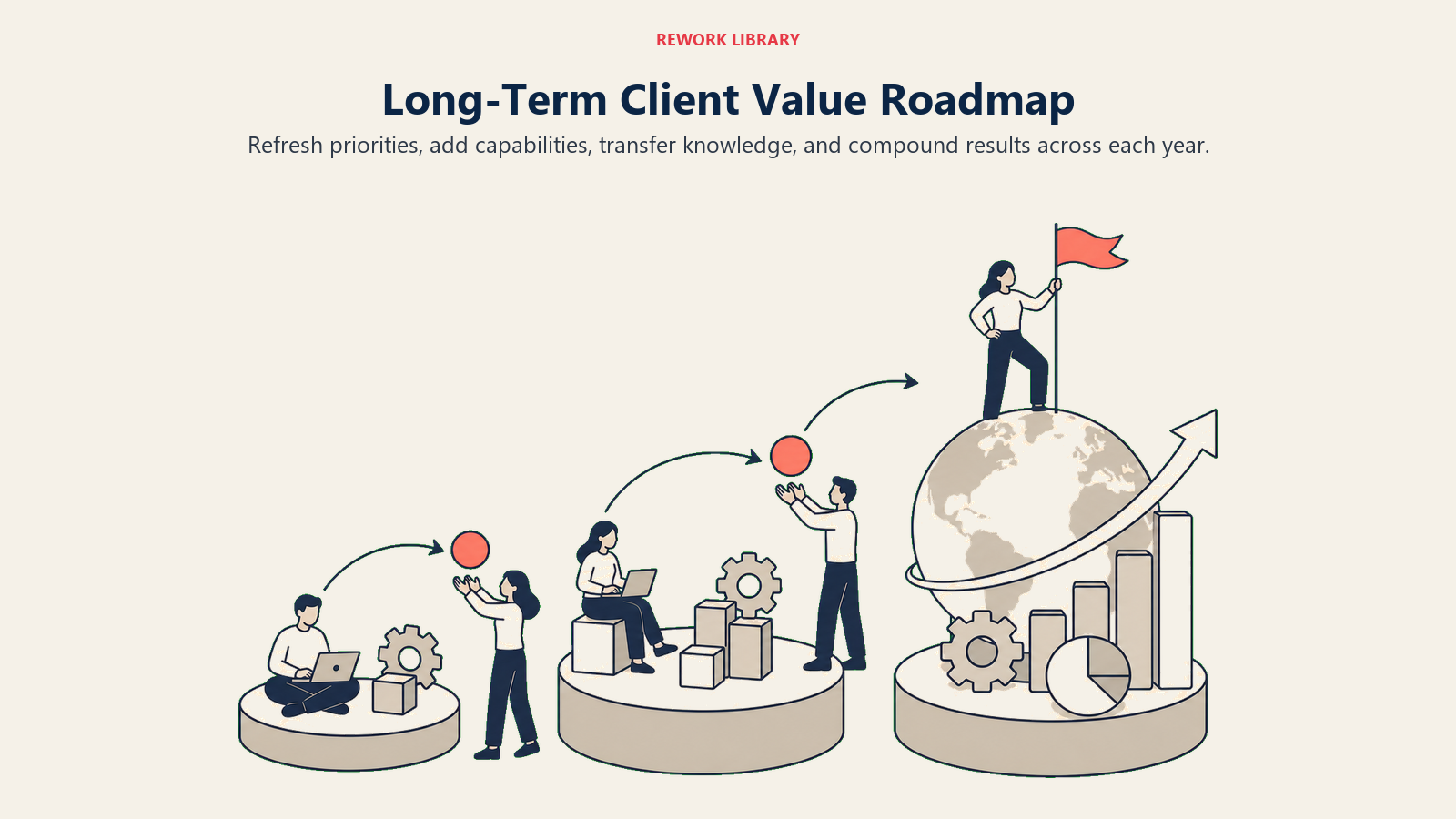
This positions you as a strategic partner, not just a service provider. You're thinking about their business proactively, not just responding to requests.
Ongoing needs assessment: Formal and informal mechanisms to understand evolving needs. Quarterly business reviews are standard, but also maintain regular touchpoints with key stakeholders to hear what's changing before it becomes urgent.
Watch for signals that suggest expansion opportunities: new initiatives launching, org changes, budget increases, strategic shifts. These create openings for additional services. The additional services introduction framework helps you bring new capabilities to existing long-term clients effectively.
Continuous improvement roadmap: Don't just maintain status quo service levels. Build a roadmap of improvements, efficiency gains, capability additions, and value enhancements you'll deliver over the contract term.
This might include process optimizations, technology implementations, team skill development, or strategic initiatives. The roadmap shows you're invested in getting better, not just collecting fees.
Proactive value delivery: Don't wait to be asked. If you see an opportunity to help, an emerging risk, or a way to add value, bring it up. This is what separates transactional vendors from trusted advisors.
Examples: Flagging regulatory changes that affect their business, introducing them to relevant contacts in your network, sharing industry insights before they ask, identifying cost savings opportunities.
Negotiating the contract
Multi-year contracts involve more complex negotiations than project agreements. You're balancing flexibility, risk, and long-term relationship dynamics. Master Service Agreement structure: The MSA is your foundation. It should cover:
- Overall relationship governance and communication
- General terms and conditions
- Pricing frameworks and billing processes
- Intellectual property and confidentiality
- Termination clauses and wind-down procedures
- Dispute resolution processes
- Insurance and liability limits
The MSA stays relatively stable while individual statements of work or project schedules get executed underneath it.
Flexibility mechanisms: Build in ways to adapt as needs change:
- Quarterly scope reviews where either party can propose adjustments
- Volume bands that allow scaling up or down within defined ranges
- Procedures for adding new services or service types
- Price adjustment triggers for major scope changes
The goal is "flexible commitment" - serious enough to provide stability but adaptable enough to remain relevant as business needs evolve.
Risk management provisions: Protect both sides from extreme scenarios:
For the client: Performance guarantees, termination for cause clauses, service level remedies For your firm: Payment terms, scope change processes, force majeure provisions, limitation of liability
Renewal and termination terms: Define what happens at the end of the initial term. Automatic renewal unless one party gives notice? Explicit re-negotiation? What's the notice period?
Also address early termination. What circumstances allow either party to exit? What are the financial consequences? You want to make early termination possible but costly enough to encourage working through problems.
Negotiation strategy: A few principles for multi-year negotiations:
Start high on scope and price. You can always come down, but going up later is hard.
Use the length of commitment as your main negotiating lever. "We can do that price if you commit to four years instead of three."
Get legal and finance involved early. Multi-year contracts have tax, revenue recognition, and risk implications that affect company value.
Document everything that's discussed, even if it doesn't end up in the contract. Verbal agreements about future scope or pricing create expectations that will come back during renewal.
Managing multi-year engagements
The contract is just the beginning. Successful multi-year relationships require active management and governance. Account management structure: Assign clear ownership. Who's the primary relationship owner? Who manages day-to-day delivery? Who handles escalations?
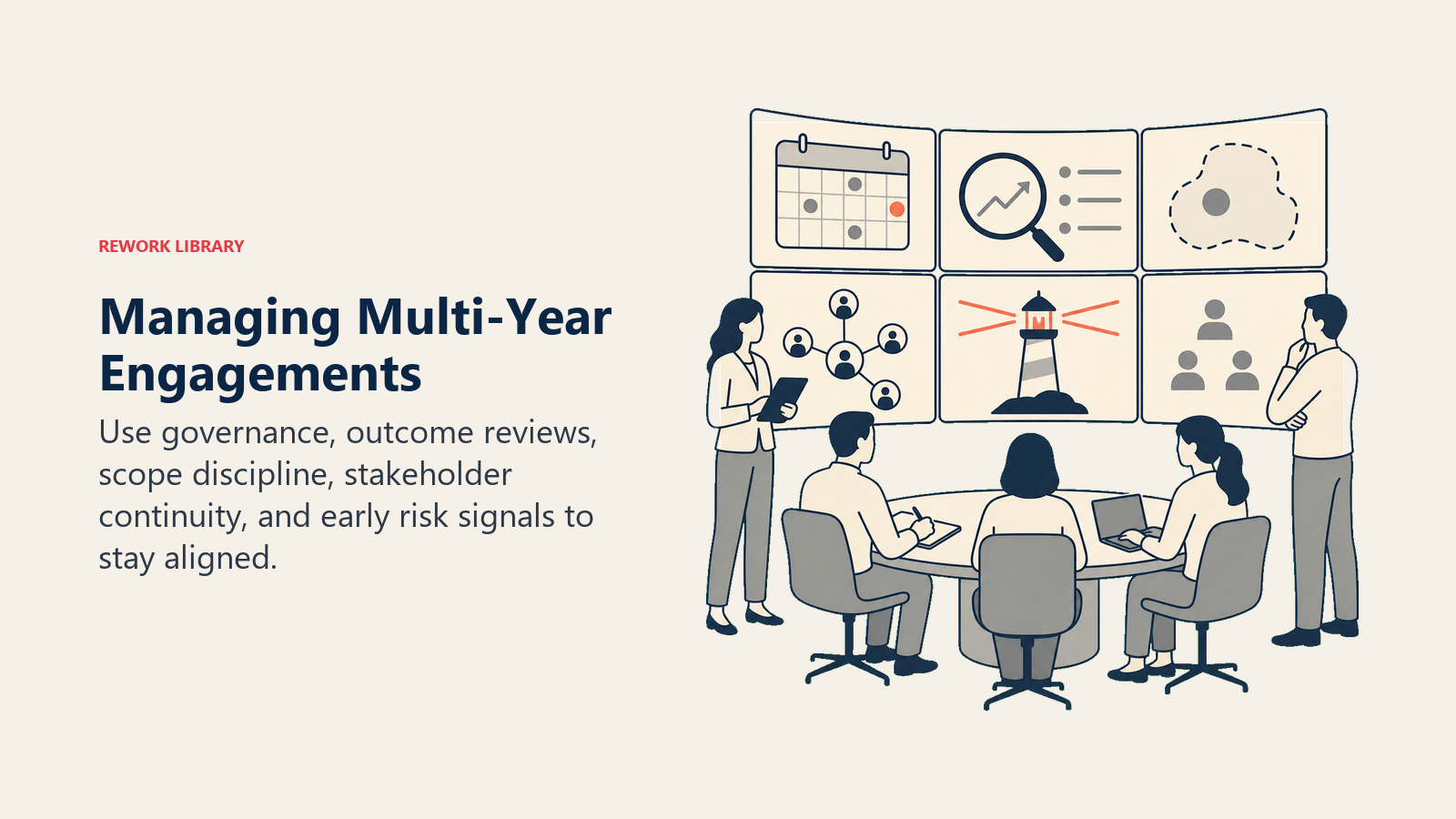
For significant engagements, you might have a dedicated account executive plus a delivery lead, with executive sponsors on both sides for strategic oversight.
Define communication protocols. Who talks to whom about what? How do decisions get made? What requires client approval vs. your autonomy?
Quarterly business reviews: These are non-negotiable for multi-year engagements. Standard agenda:
- Performance against SLAs and KPIs
- Value delivered in the previous quarter (with specific examples)
- Upcoming priorities and resource allocation
- Emerging issues or risks
- Relationship health and satisfaction check
- Strategic initiatives and planning
Come prepared with data, examples, and insights. This isn't a status meeting - it's a strategic conversation about the partnership.
Regular touchpoints beyond QBRs: Weekly or biweekly operational check-ins with key stakeholders. Monthly informal relationship building (coffee, lunch, not just business meetings). Ad hoc communications for important updates or issues.
The more touchpoints you have, the earlier you catch problems and the stronger the relationship becomes.
Service delivery operations: Actual delivery quality matters more in long-term relationships because poor performance compounds over time. Maintain discipline around:
- Consistent quality standards and review processes
- On-time delivery of commitments
- Proactive communication about delays or issues
- Documentation of decisions and work performed
- Knowledge transfer and team continuity
Scope management: This is where most long-term engagements get into trouble. Clients ask for "small favors" or "quick additions" that seem reasonable in isolation but add up to scope creep that kills profitability.
Establish a clear change process:
- Any work outside defined scope requires a written change request
- Change requests get evaluated for effort and impact
- Approval required before starting additional work
- Changes get documented and tracked
Be gracious about truly minor requests, but protect your margins by holding the line on substantive scope expansion. For detailed guidance on managing this balance, see scope creep management.
Renewal strategy
Renewal preparation starts at contract signing, not 60 days before expiration. 12-month renewal timeline: Map out a full year of renewal preparation:
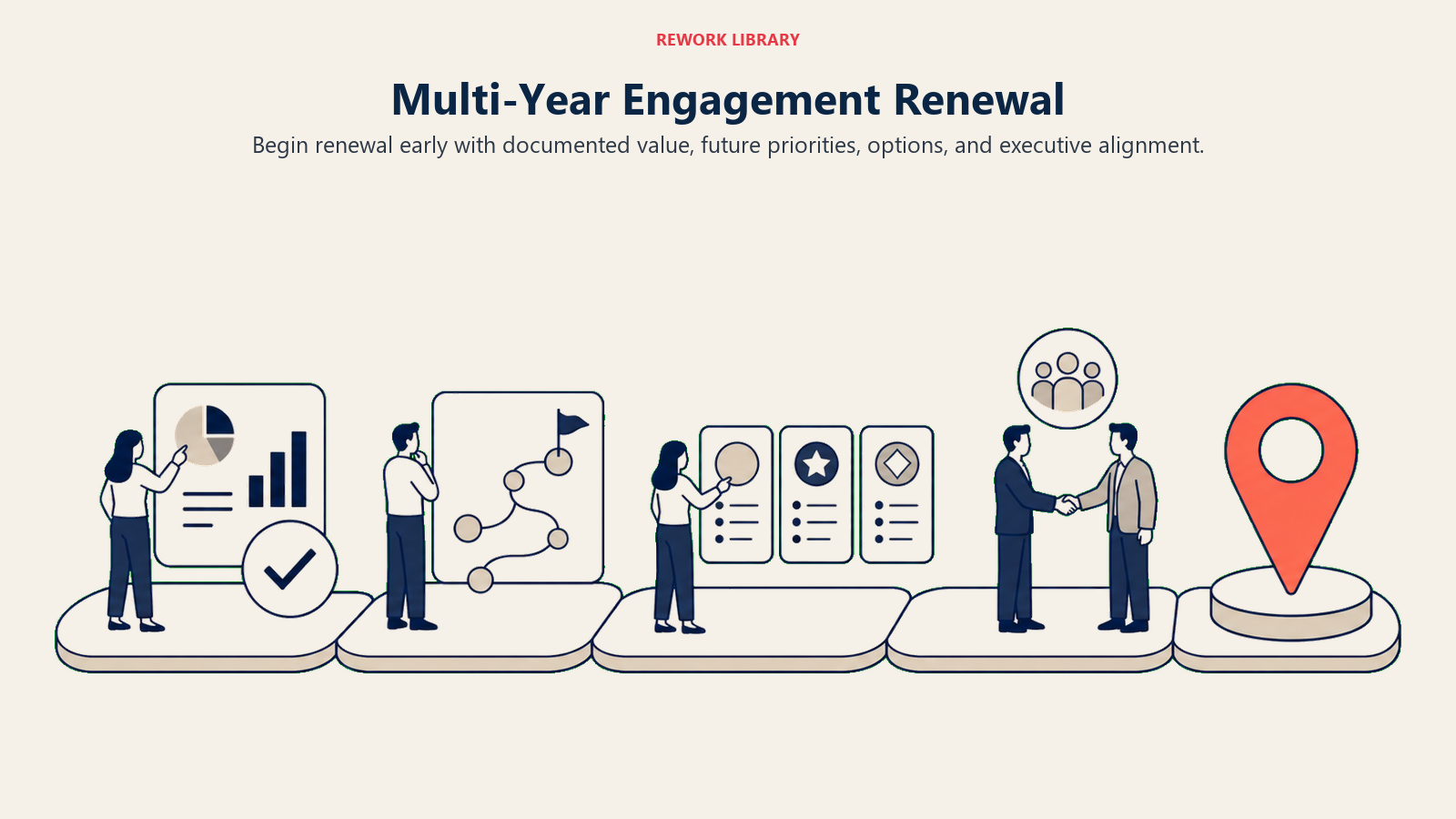
Months 12-10 before expiration: Review engagement performance, identify issues to address, assess relationship health
Months 9-7: Begin strategic renewal conversations, discuss future needs and priorities, explore expansion opportunities
Months 6-4: Prepare renewal proposal, document value delivered, finalize pricing and scope for next term
Months 3-2: Present renewal proposal, negotiate terms, address any concerns
Month 1: Execute renewed contract, transition to next term
Don't wait until the last minute. Late renewal discussions create risk of losing the client and reduce your leverage.
Value documentation: Throughout the engagement, track and document value delivered:
- Projects completed and outcomes achieved
- Cost savings or revenue generated
- Efficiency improvements
- Strategic milestones reached
- Problems prevented or solved
- Relationship expansion (new services, new stakeholders)
Create a value summary document that quantifies your impact. This becomes the foundation of renewal conversations.
Renewal readiness assessment: Before proposing renewal, assess the relationship honestly:
- Is the client satisfied with service quality?
- Have we delivered measurable value?
- Are there unresolved issues or conflicts?
- Has the business relationship expanded or contracted?
- Are key stakeholders still in place and supportive?
If the relationship is weak, address problems before proposing renewal. Don't assume a contract renewal will fix relationship issues.
Renewal proposal development: Your renewal proposal should include:
- Summary of value delivered in the current term
- Proposed scope and services for the next term
- Pricing for the renewal period
- Enhancements or improvements you'll implement
- Strategic initiatives aligned with client's evolving needs
Frame renewal as continuation of partnership, not just contract extension. Show how the next term will build on the success of the current one.
Expansion within renewal: Renewal conversations are perfect opportunities for expansion. The client already values the relationship - can you expand scope, add services, or deepen engagement?
Examples:
- Add new service types that complement current work
- Expand from one business unit to others
- Increase capacity commitment based on success
- Introduce strategic initiatives beyond core service delivery
Make expansion feel like natural evolution, not aggressive upselling. The upsell and scope expansion framework provides tactics for growing engagement value naturally over time.
Risk management
Long-term contracts create risks for both parties. Active risk management prevents small issues from becoming contract-threatening problems. Client-side risks: What could go wrong on the client's end?
- Leadership changes that affect priorities or relationships
- Budget cuts that make commitments unaffordable
- Strategic shifts that make your services less relevant
- Internal politics that undermine the engagement
- Organizational restructuring that changes governance
Mitigation strategies:
- Build relationships with multiple stakeholders, not just one champion
- Demonstrate value regularly so you're protected from budget cuts
- Stay flexible enough to adapt to strategic changes
- Navigate politics carefully and remain neutral in internal conflicts
Provider-side risks: What could go wrong on your end?
- Underpricing that makes the engagement unprofitable
- Team turnover that disrupts delivery continuity
- Capacity constraints that prevent meeting commitments
- Quality issues that erode client confidence
- Scope creep that overwhelms resources
Mitigation strategies:
- Conservative pricing with margin for complexity
- Team redundancy and succession planning
- Regular capacity planning and resource allocation reviews
- Quality assurance processes and continuous improvement
- Strict scope management and change control
Relationship risks: Even if both sides execute well, relationship dynamics can deteriorate.
- Communication breakdowns create misunderstandings
- Expectations drift out of alignment
- Trust erodes from small disappointments
- Engagement becomes routine and uninspired
- Value perception decreases over time
Mitigation strategies:
- Proactive communication and regular relationship check-ins
- Explicit expectation setting and alignment discussions
- Transparency about challenges before they become crises
- Active value creation and continuous improvement
- Strategic thinking beyond transactional delivery
Contract governance: Establish governance mechanisms that address issues before they escalate:
- Regular performance reviews against contract terms
- Escalation paths for resolving disputes
- Formal processes for addressing non-performance
- Financial reviews to ensure engagement remains profitable
- Periodic contract reviews to confirm terms still make sense
Service type variations
Different professional services require different approaches to multi-year engagements. Professional services consulting: Strategy, operations, technology consulting naturally fits multi-year partnerships, especially for transformation programs or ongoing advisory relationships. Structure around strategic outcomes and capability building, not just task completion.
Technology and IT services: Implementation projects, managed services, and application support work well as multi-year engagements. Combine implementation phases with ongoing support and enhancement. Build in technology refresh cycles and capability expansion.
Marketing and creative services: Agencies often use retainer models with multi-year commitments. Define core services (strategy, creative, execution) separately from project-based work. Include performance metrics around campaign results and business impact.
Financial and advisory services: CFO services, accounting, tax, and financial advisory fit long-term relationships. Annual work (audits, tax returns) combined with ongoing advisory creates natural multi-year structures. Consider success-based pricing tied to financial outcomes.
Legal and compliance services: General counsel relationships, regulatory compliance, and specialized legal work benefit from multi-year arrangements. Retainer models with defined capacity and additional work billed separately are common. Include proactive legal strategy, not just reactive problem-solving.
Adapt the engagement model to fit how your service type naturally gets consumed. Don't force a model that fights against normal buying patterns.
Building organizational capability
Winning and delivering multi-year engagements requires firm-wide capabilities. Sales alignment: Train your sales team to sell long-term partnerships, not just projects. This means different conversations, different value propositions, and different pricing approaches.
Sales cycles are longer for multi-year deals. Expect 6-12 month sales processes for significant engagements. Build pipeline and forecasting models that reflect this reality.
Compensation structures: Traditional project-based compensation doesn't work well for multi-year engagements. Consider:
- Larger upfront commission but spread over contract length
- Bonus structures tied to renewal and expansion
- Crediting salespeople for total contract value, not just year one
- Incentives for client satisfaction and retention, not just acquisition
You want salespeople motivated to win good multi-year deals, not just big ones that look good on paper.
Service delivery accountability: Multi-year engagements succeed or fail based on delivery quality over time. Create accountability structures:
- Clear ownership of client relationships
- Performance metrics tied to client satisfaction and renewal
- Quality standards and review processes
- Continuous improvement expectations
- Knowledge management and documentation practices
Financial forecasting: Multi-year contracts change your revenue recognition and forecasting. You have forward revenue visibility but also long-term delivery obligations.
Build financial models that:
- Track booked revenue vs. recognized revenue
- Monitor profitability by engagement and overall
- Forecast capacity needs based on contracted commitments
- Plan for renewal cycles and expansion opportunities
- Account for long-term cost structure changes
Capability development: What skills and capabilities do you need to build to support multi-year client relationships?
- Strategic advisory capabilities beyond technical delivery
- Industry expertise that deepens over time
- Relationship management and communication skills
- Change management for helping clients evolve
- Executive presence for C-level interactions
Invest in developing these capabilities across your team, not just in senior leadership.
Common challenges
Even well-structured multi-year engagements face predictable challenges. Client commitment hesitation: Clients worry about long-term lock-in. What if their needs change? What if you underperform? What if they find a better provider?
Address this by:
- Building in flexibility and exit provisions
- Starting with shorter terms (2 years) before extending to 3-5 years
- Offering performance guarantees or termination for cause
- Demonstrating track record with other long-term clients
- Structuring the deal so they're not financially trapped
Budget constraints: Multi-year commitments require budget certainty clients may not have.
Solutions:
- Structure as annual renewals within a multi-year framework
- Allow volume flexibility within ranges
- Build in price protection but not hard minimums
- Align contract term with client budget cycles
- Consider deferred payment structures or financing
Internal politics: Getting organizational buy-in for multi-year contracts often requires multiple stakeholders and approval levels.
Navigate this by:
- Identifying and engaging all decision influencers early
- Building business cases that address different stakeholder concerns
- Starting with pilot engagements before proposing long-term commitment
- Involving their procurement and legal teams in structure discussions
Resource stability: Can you actually deliver consistently over multiple years? Team turnover, capacity constraints, and capability gaps threaten delivery quality.
Protect yourself with:
- Team redundancy and succession planning
- Knowledge documentation and transfer processes
- Hiring pipeline that anticipates future needs
- Training and development to build internal capability
- Strategic subcontracting for specialized needs
Quality maintenance: It's easy to let quality drift in long-term relationships as they become routine.
Prevent this through:
- Regular quality audits and reviews
- Client feedback collection and action
- Continuous improvement initiatives
- Fresh perspectives (rotating team members periodically)
- Innovation and new approaches over time
Frequently asked questions
What is a multi-year engagement in professional services? It's a client relationship governed by a contract that runs for two or more years, rather than a series of separately sold projects. Common structures include a Master Service Agreement with rolling projects, a retainer, a capacity commitment, or a strategic partnership.
Why do agencies and services firms use multi-year contracts? They convert unpredictable project revenue into committed revenue, cut the cost of re-selling the same client every year, and make competitors break a contract to win the account. That combination protects margin and stabilizes capacity planning.
What is a typical multi-year discount? Most firms offer 10 to 15 percent off standard rates in exchange for a minimum spend commitment, or hold pricing flat across the term instead of applying annual increases. Avoid front-loading the discount into year one.
When should you start renewal planning? At signing, not 60 days before expiry. A practical timeline reviews performance 10 to 12 months out, opens strategic renewal conversations at 7 to 9 months, and finalizes terms in the last quarter of the contract.
Where to go from here
Multi-year engagements transform professional services economics from transactional to strategic. The investment in building these relationships pays dividends through predictable revenue, deeper client partnerships, and competitive protection.
Start by identifying your best existing clients who have ongoing needs and proven track records. Convert those strong relationships into structured multi-year partnerships before trying to sell long-term deals to new prospects.
Build the internal capabilities to support these engagements: sales training, delivery excellence, financial management, and continuous value creation. Multi-year success requires firm-wide commitment, not just good contract language.
Related frameworks that support multi-year engagement success:
- Cross-Sell Strategy - Expand multi-year relationships with additional services
- Upsell & Scope Expansion - Grow engagement value over time
- Client Retention Strategy - Maintain satisfaction that drives renewal
- Pricing Justification - Defend multi-year pricing and value
- Contract & Engagement Letters - Structure agreements that protect both parties
The firms that master multi-year engagements build sustainable competitive advantages. You're not just selling better - you're creating business models that compound value over time.

Sales Director
On this page
- The economics of long-term relationships
- Multi-year engagement models
- Identifying multi-year candidates
- Structuring the engagement
- Pricing multi-year engagements
- Value creation over time
- Negotiating the contract
- Managing multi-year engagements
- Renewal strategy
- Risk management
- Service type variations
- Building organizational capability
- Common challenges
- Frequently asked questions
- Where to go from here