Consulting Engagement Models: Choosing the Right Structure for Client Value and Firm Profitability
Turn this article into takeaways for your work.


Each assistant summarizes the article only for you and suggests best practices for your work.
A consulting engagement model is the commercial structure that defines how an agency or consulting firm scopes, prices, and delivers client work. The five core models are retainer, project-based, staff augmentation, advisory, and outcome-based, and each carries a distinct margin profile (from 35% on staff aug to 80% on advisory). For agencies pursuing growth, the model you choose can swing project margin by 40-60%.
Same consultant. Same expertise. Same firm. But depending on which engagement model you choose, your margin on that project could swing by 40-60%. That's not a rounding error. That's the difference between a thriving practice and one that's barely breaking even.
Engagement models aren't just about how you bill clients. They're structural decisions that affect profitability, team satisfaction, scalability, and client outcomes. Choose retainer work over staff augmentation and you've traded lower utilization requirements for consistent revenue. Pick success-based pricing and you've swapped guaranteed fees for the potential to 3x your take if results hit. Understanding these tradeoffs is fundamental to building a sustainable professional services firm.
But here's what most consulting firms get wrong: they default to whatever model feels familiar instead of matching the model to the situation. They take every engagement as project work because that's what they know, or they chase retainers because predictable revenue sounds attractive. The firms that win understand that engagement model selection is a strategic decision that should align with client needs, problem type, and firm economics.
This guide breaks down the five core engagement models, their economics, best applications, and how to build a portfolio approach that balances growth and stability.
What is an engagement model?
An engagement model defines the commercial and operational structure of how consulting work gets scoped, priced, delivered, and governed. It's the framework that answers: Who does what? How do we measure success? What gets paid and when?
Think of it as the contract architecture. A project-based engagement has fixed scope, timeline, and deliverables. A retainer gives ongoing access to expertise for a recurring fee. Staff augmentation provides bodies who work under client direction. Advisory delivers strategic guidance without execution ownership. Success-based models tie payment to outcomes.
Each model creates different risk profiles, margin structures, and operational requirements. Your choice affects utilization rates, sales cycles, resource planning, and client relationships. Get it right and everyone wins. Get it wrong and you're stuck in a contract that destroys margins or creates impossible delivery expectations.
The five core engagement models
Let's break down each model with clear definitions and when to use them.
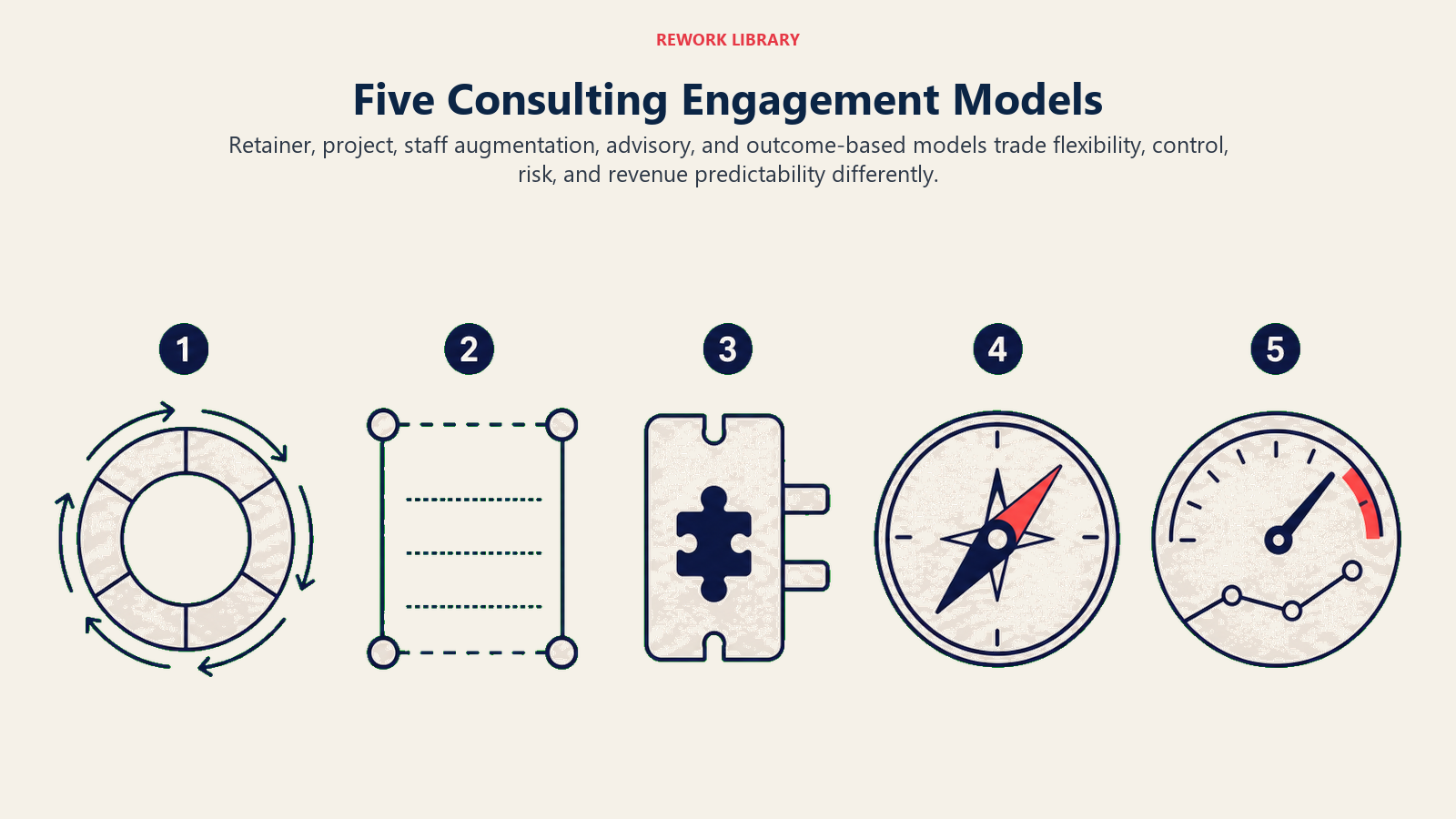
Retainer engagements provide ongoing access to your expertise for regular recurring fees. Clients pay monthly or quarterly, usually for a defined scope like "10 hours of advisory per month" or "fractional CFO services." Economics are strong: 60-75% margins, predictable revenue, and lower customer acquisition costs since renewals are easier than new sales. Best for ongoing advisory, fractional executive roles, board positions, or situations where clients need consistent access but not full-time resources.
Project-based engagements are time-limited contracts with defined deliverables. You scope the work, agree on a price (fixed, time-and-materials, or not-to-exceed), and deliver over weeks or months. Margins run 40-60% depending on how well you estimated. Good for strategy development, problem-solving initiatives, implementations, or any situation with clear beginning and end states. This is the default model most consultants know.
Staff augmentation means providing consultants who integrate into the client's team and work under their direction. You're filling a resource gap with specialized talent. Margins are lower, usually 35-50%, because you're competing on labor rates rather than expertise differentiation. But it's predictable, requires minimal scoping, and scales easily. Use this for technical resource needs, temporary capacity fills, or when clients want control over day-to-day work direction.
Advisory engagements deliver strategic guidance without formal execution responsibility. You advise, recommend, coach, but the client implements. This includes board advisory, executive coaching, strategic planning facilitation, or serving as a subject matter expert. Margins are the highest at 65-80% because you're selling pure expertise with minimal operational overhead. The challenge is demonstrating value when you're not doing the work yourself.
Success-based or outcome-based models tie your fees to achieved business results. Pure success fees, base plus bonus structures, or value-sharing arrangements. Economics vary wildly. If you hit targets, you might earn 2-3x what you'd get on a fixed project. If you miss, you might work for free. Use this when outcomes are clearly measurable, you're confident in your ability to drive results, and the client wants risk-sharing.
Most sophisticated firms don't pick one model. They maintain a portfolio that balances predictability with upside.
Retainer engagement economics and applications
Retainers are the holy grail of consulting revenue. Lock in a dozen clients at $15-30k/month and you've built a foundation that funds everything else.
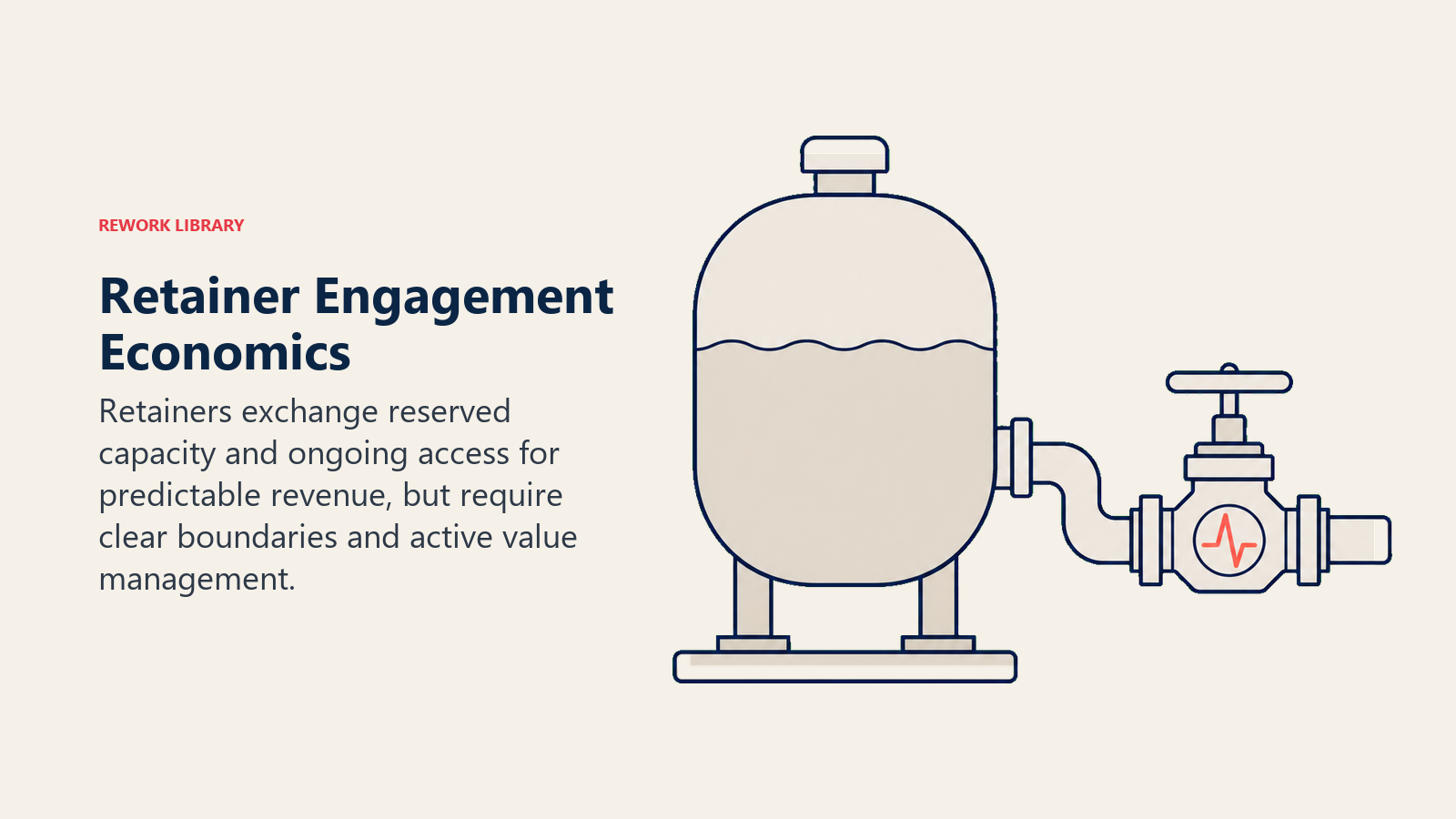
The math works like this: you sell access to expertise, usually structured as a time allocation ("up to 20 hours per month") or as outcomes ("monthly strategic planning session plus ad-hoc guidance"). Clients pay whether they use all the time or not. You retain the risk of delivery but gain revenue predictability.
Types of retainer structures:
Understanding retainer structures is crucial for agencies deciding between retainer and project-based revenue models.
Time-based retainers allocate specific hours per period. "30 hours per month of consulting time." Unused hours might roll over for a quarter or disappear. Clear to track but can turn into hourly billing with extra steps.
Access retainers provide availability without defined hours. "Fractional CMO services - you get me for strategic decisions, planning, and oversight." You're selling expertise and judgment, not time. Harder to track but better margins because clients pay for access to your brain.
Outcome-based retainers commit to specific deliverables each period. "Monthly financial review, quarterly board deck, annual strategic plan." Clients know exactly what they're getting. You need to scope carefully to avoid underpricing.
Blended retainers combine elements: "10 hours of guaranteed time plus unlimited email/Slack access plus one strategic planning session per quarter." This matches how clients actually want to engage.
The advantages are clear: revenue predictability makes financial planning possible. You build deeper relationships because you're embedded in the client's business over time. Customer lifetime value is higher because retainer clients stay longer and spend more. Sales costs drop because renewals are easier than new logo acquisition.
But retainers come with challenges. Scope creep is constant since clients feel like they've paid for unlimited access. "Quick question" turns into a 3-hour research project. You need clear boundaries documented in the agreement and reinforced in practice.
Value demonstration becomes critical. When clients pay monthly, they need to feel like they're getting their money's worth. That means proactive communication, regular check-ins, and visible deliverables even if you're providing advisory input.
Utilization tracking gets complex. If you sell 20 hours per month but only use 12, are you underutilized or efficiently meeting client needs? Track both contracted hours and actual delivery to optimize pricing.
Success factors for retainers:
Define scope precisely. What's included, what requires separate projects, and how do you handle out-of-scope requests? Put it in writing.
Demonstrate value regularly. Monthly summaries of what you delivered, problems you solved, value created. Don't assume clients track your contribution.
Track hours proactively even if it's not an hourly model. You need to know if you're over or under-delivering relative to pricing.
Build in price increases. Annual escalators (3-5%) or value-based pricing reviews that capture expanded scope.
Project-based engagement economics and applications
Projects are the workhorse of consulting. Clear scope, defined timeline, specific deliverables. Client knows what they're buying, you know what you're delivering.
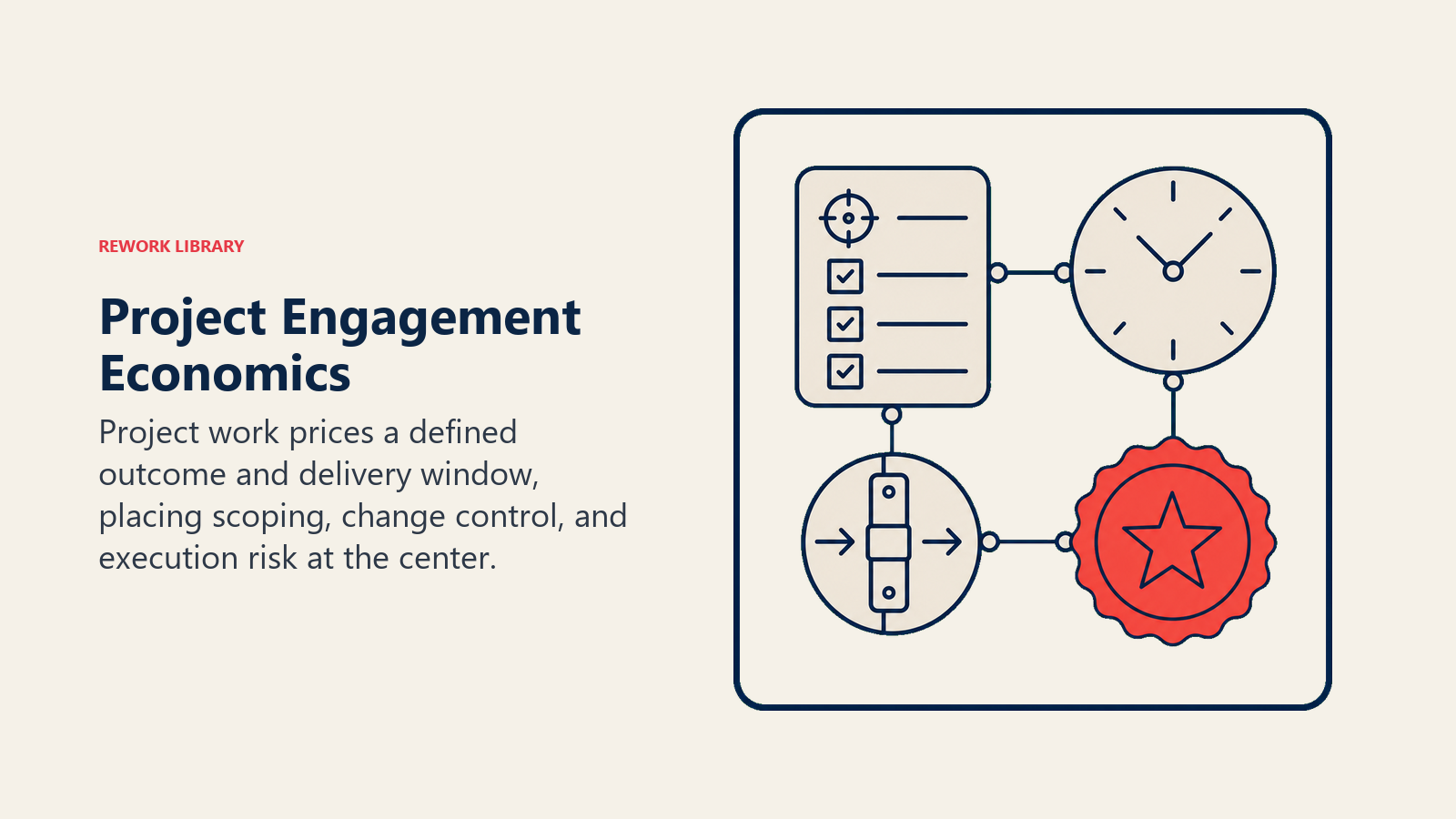
Economics depend heavily on estimation accuracy. Price a 400-hour project at $200k and you're banking $500/hour. But if it actually takes 600 hours, you're down to $333/hour and your margin just collapsed. Most firms target 40-60% margins on project work, but execution determines reality.
Pricing models for projects:
Fixed-price means the client pays a set fee regardless of hours spent. You bear all the risk of estimation errors, but you also capture the upside if you're efficient. This is what clients prefer because it's predictable. You need strong scoping and estimation discipline to make it work.
Time-and-materials bills actual hours at agreed rates. Client bears the risk of scope expansion. You're protected from estimation errors but need to justify every hour. Clients hate this model for anything other than exploratory work because costs are unpredictable.
Not-to-exceed sets a ceiling on a time-and-materials arrangement. You bill hours up to a cap, but can't go over without approval. This splits risk: you're protected from small overruns, client is protected from runaway costs. Good middle ground for uncertain scopes.
Phased pricing breaks projects into stages with separate pricing. "Phase 1: Discovery and strategy - $50k. Phase 2: Implementation - $150k." Client only commits to Phase 1, but you've scoped the full engagement. This reduces their risk and gives you a foot in the door for Phase 2.
The advantages of project work: contract terms are clear and easy to explain. Fixed deliverables and timelines create accountability. You can build a diversified portfolio of different projects. Single engagements turn into multi-project relationships over time.
The challenges: scope creep kills margins. "Just one more iteration" or "can we add this small thing" eats hours fast. Estimation errors are expensive. Underestimate by 20% and your margin disappears. Resource gaps create problems. If your senior person leaves mid-project, you're stuck finding replacement talent. Revenue lumpiness makes forecasting hard, especially if you're closing projects in unpredictable cycles.
Success factors for projects:
Run rigorous discovery before pricing. Understand the problem, the environment, the stakeholders, the constraints. Never estimate without discovery. A structured needs assessment and discovery process is essential for accurate project scoping.
Build detailed project plans with task breakdowns. This isn't busy work. It's how you catch scope gaps before they become overruns.
Implement change control processes. Any scope change requires a formal request, impact assessment, and pricing adjustment. No exceptions.
Track hours in real-time against estimates. Don't wait until week 8 of a 10-week project to realize you're 30% over budget.
Document assumptions clearly in proposals. "This estimate assumes three stakeholder interview rounds. Additional rounds will be billed separately."
Staff augmentation economics and applications
Staff aug is the simplest model: you provide skilled people who work under the client's direction. They need a DevOps engineer for six months, you supply one. They direct the work, you handle employment and administration.
Economics are straightforward but tight. You're billing hourly or daily rates, usually 1.5-2x your fully-loaded cost. If your consultant costs $100/hour all-in (salary, benefits, overhead), you bill $150-200/hour. That's a 35-50% margin before considering bench time, sales costs, and admin overhead.
This model works because it's frictionless. Clients understand it immediately. Scoping is minimal - they need a body with specific skills. Sales cycles are shorter because there's less risk to evaluate. You can scale quickly by adding more consultants.
Staffing models within staff aug:
Dedicated resources work exclusively for one client, usually full-time for an extended period. Pricing is higher because you're guaranteeing availability.
Shared resources split time across multiple clients. Lower rates but requires careful scheduling to avoid conflicts.
On-call or flexible resources provide expertise as needed without dedicated hours. Good for specialized skills that aren't needed full-time.
Team extension embeds multiple consultants as an integrated unit within the client organization. You're augmenting their team with a ready-made squad.
Advantages: pricing is predictable and easy to communicate. Minimal scoping means faster sales. It's a scaling tool for growing revenue without complex delivery models. Clients like it because they maintain control.
The challenges are significant. Low margins mean you need high utilization to stay profitable. If your consultants are on the bench for two weeks, that's two weeks of cost with no revenue. Bench management becomes a critical operational challenge. You need a pipeline of opportunities that matches your available talent.
Quality control is harder when you're not directing the work. Your consultant is working under client management. If they underperform, it reflects on your firm even though you didn't control their day-to-day.
Commoditization pressure is constant. If you're selling bodies rather than expertise, you're competing primarily on price. That's a race to the bottom.
Success factors for staff aug:
Screen rigorously for both technical skills and culture fit. Your consultants represent you even though they're working under client direction.
Define roles and expectations clearly with clients. What decisions can your consultant make independently vs escalate?
Implement regular performance check-ins with both consultant and client. Don't wait for problems to surface.
Build talent pipelines proactively. You need bench depth to respond to opportunities quickly.
Try to layer in higher-value services. Pure staff aug is a foot in the door. Look for opportunities to add oversight, architecture, or strategy services.
Advisory engagement economics and applications
Advisory work is consulting at its purest: you sell strategic guidance without taking on execution responsibility. Your job is to analyze, recommend, advise, and coach. The client implements.
This model has the best economics: 65-80% margins because overhead is minimal. You're not building implementations, managing large teams, or carrying execution risk. One senior consultant can serve multiple advisory clients simultaneously because the time commitment per client is lower.
Types of advisory services:
Strategic advisory means helping executives think through major decisions. Market entry, M&A, organizational design, strategic pivots. You're the external brain that challenges assumptions and brings outside perspective.
Executive coaching develops leadership capabilities through one-on-one or small group sessions. You're improving decision-making, communication, and leadership effectiveness.
Board advisory serves on formal or informal advisory boards, typically meeting quarterly or monthly to provide governance-level guidance.
Subject matter expert (SME) advisory offers deep technical or industry expertise on-demand. Clients tap you when they need specialized knowledge they don't have internally.
Fractional C-suite roles provide part-time executive leadership. Fractional CFO, CMO, CTO arrangements where you're in the role without being full-time.
The advantages are compelling: highest margins in consulting. Scalable because you can serve multiple clients with limited time per client. Intellectually engaging work at the strategic level. Minimal operational complexity compared to project delivery.
But advisory engagements are hard in specific ways. Demonstrating value is difficult when you're not producing tangible deliverables. You gave great advice, but did the client follow it? If they implemented poorly, is that your fault? Attribution of outcomes to your advisory contribution is fuzzy.
Pricing sensitivity is higher because clients are buying intangible expertise. $20k for a strategy document feels concrete. $20k for monthly advisory calls feels expensive even if the impact is larger.
Client maturity matters. Not every organization is ready for advisory input. They might need execution help first, then advisory later.
Success factors for advisory:
Establish credibility early. Clients need to trust your expertise before they'll pay for advice without execution.
Define clear objectives for each engagement. What decisions are we trying to improve? What outcomes are we working toward?
Document your recommendations. Even if you're not executing, capture what you advised so there's a record.
Provide some implementation support. Pure advice often fails without helping clients think through execution challenges.
Build mechanisms for impact measurement. Track decisions influenced, outcomes achieved, problems avoided.
Success-based and outcome-based models
This is the high-wire act of consulting: you get paid based on results you help create, not hours you work. Pure success fees, base plus bonus structures, or value-sharing arrangements where you participate in upside.
Economics are variable by design. In a pure success model, you might work for months and earn nothing if outcomes don't materialize. Or you might earn 3x what you'd make on a fixed project if results exceed targets. Most firms use hybrid approaches: modest base fee plus significant success bonus.
This model makes sense when outcomes are clearly measurable (revenue growth, cost savings, operational metrics), you're confident in your ability to drive results, and the client wants to share risk rather than pay regardless of outcomes.
Common pricing structures:
Pure success fee: you get paid only if defined outcomes are achieved. High risk, high reward. Usually reserved for situations where potential upside is massive and outcomes are clearly attributable to your work.
Base plus bonus: you get a reduced base fee (covering costs) plus a significant bonus tied to results. This splits risk while ensuring you don't work for free.
Value sharing: you take a percentage of the value created. If you save the client $2M in costs, you get 20% ($400k). If you generate $10M in new revenue, you get 10% ($1M). Aligns incentives perfectly but requires clear measurement.
Contingency fee: common in specific domains like M&A advisory or litigation consulting. You get paid based on transaction closure or case outcome.
Defining success metrics is where most outcome-based deals break down. Metrics must be:
Clear and measurable: "Increase customer satisfaction" is useless. "Improve NPS from 35 to 50" is measurable.
Time-bound: when are we measuring results? Six months? One year? Metrics need evaluation windows.
Independent or jointly verified: you can't just self-report that objectives were achieved. Use client data, third-party verification, or agreed measurement methods.
Attributable: can you reasonably claim your work drove the outcome? If the market shifted or the client made other major changes, how do you isolate your impact?
Advantages of outcome-based models: incentives are perfectly aligned between you and the client. You only win if they win. It demonstrates confidence in your capabilities. You're willing to bet on yourself. It's a powerful differentiator in competitive situations. Most consultants won't take outcome risk, so offering it can win deals.
The challenges are serious. Execution risk sits entirely with you. If the client doesn't implement your recommendations, you don't get paid even though your advice was sound. Client accountability becomes a dependency. You need them to follow through on their commitments for outcomes to materialize. Attribution difficulty creates disputes. When results happen, clients might credit their own team rather than your contribution. Payment timing can be delayed. You might work for six months before outcome measurement happens.
Success factors for outcome-based models:
Define outcomes with crystal clarity before engagement starts. Document exact metrics, measurement methods, and timing.
Build in implementation support. Don't just advise. Help ensure recommendations get executed so outcomes can happen.
Establish clear tracking mechanisms. Dashboard both parties can see showing progress toward outcome targets.
Address client accountability explicitly. What do they need to do for success? Document dependencies.
Price for risk appropriately. Your expected value needs to account for probability of success. If there's a 60% chance you hit targets, price the success fee accordingly.
Consider hybrid models. Pure outcome-based is high risk. Base plus bonus gives you downside protection.
Hybrid and blended engagement models
Most sophisticated engagements don't fit neatly into one model. You combine multiple approaches within a single client relationship.
Common hybrid structures:
Initial project plus retainer: you run a 3-month strategy project to solve a specific problem, then convert to ongoing advisory retainer for implementation support. The project establishes value and relationships, the retainer captures long-term revenue.
Advisory plus execution: you provide strategic guidance (advisory model) but also execute specific initiatives (project model). This lets clients choose what they implement vs what you implement.
Augmentation plus oversight: you provide staff augmentation resources but also assign a senior consultant to provide strategic direction and quality oversight. The aug resources do the work, your senior person ensures it's going the right way.
Phased model evolution: start with discovery project, then move to implementation project, then transition to optimization retainer. Each phase uses the model that fits best.
Design principles for hybrid models:
Clarity on phase boundaries: when does project mode end and retainer mode begin? What triggers the transition? Document this explicitly.
Separate pricing for each component: don't blend everything into one fee. Price the project, price the retainer, price the augmentation separately. This maintains clarity and lets you optimize margins on each piece.
Define transition points: how do you move from phase to phase? Automatic? Client decision? Performance-based trigger?
Implementation and packaging:
Structure proposals with clear phase descriptions. "Phase 1: 8-week strategy project at $150k. Phase 2: 6-month implementation retainer at $25k/month." Client understands what they're committing to now vs later.
Use success in early phases to sell later phases. Project results create appetite for ongoing support.
Manage expectations about what each phase delivers. Project phase delivers strategy, retainer phase supports implementation, aug phase provides execution capacity.
Engagement model selection framework
How do you choose which model fits a given situation? Use this three-part analysis.
Client analysis: understand who you're working with and what they value.
Client type: enterprise clients often prefer project-based or retainer because they have budget cycles and procurement processes. Startups might want staff aug because they need flexibility. Private equity portfolio companies might want outcome-based because value creation is the whole game.
Decision maturity: do they know exactly what they need (project), or are they exploring (advisory)? Clear requirements suggest project or augmentation. Unclear problems suggest advisory first.
Budget situation: constrained budgets might prefer staff aug (predictable costs) or outcome-based (pay for results). Healthy budgets can support project or retainer models.
Risk comfort: risk-averse clients want fixed-price projects or retainers. Risk-tolerant clients might embrace outcome-based models.
Problem analysis: what's the nature of what you're solving?
Scope clarity: well-defined scope fits project models. Fuzzy scope needs advisory first or time-and-materials project.
Implementation needs: if they need execution help, use project or augmentation. If they need guidance only, advisory works.
Risk level: high execution risk suggests advisory (you're not on the hook for results) or outcome-based (you get paid for taking that risk). Low risk allows project models.
Duration: short-term problems fit projects. Ongoing needs fit retainers. Long-term capacity needs fit augmentation.
Firm analysis: consider your own capabilities and objectives.
Service offerings: what models match what you sell? If you're a strategy firm, advisory and project models fit. If you're a staffing firm, augmentation is your core.
Resource availability: retainers require consistent capacity. Projects can be staffed episodically. Aug requires bench depth.
Margin objectives: need 60%+ margins? Advisory and retainer are your targets. Okay with 40%? Projects work. Accept 35%? Augmentation is fine.
Risk tolerance: how much execution risk can you carry? Low tolerance suggests advisory or augmentation. High tolerance allows project or outcome-based.
Selection decision matrix:
| Client Type | Problem Type | Best Model | Why |
|---|---|---|---|
| Enterprise | Defined scope, clear outcomes | Project-based | Clear contracting, defined deliverables |
| Enterprise | Ongoing strategic need | Retainer | Predictable for both parties, deep relationship |
| Startup/SMB | Resource gap | Staff aug | Flexible, cost-effective, scales up/down |
| Growth stage | Measurable outcome need | Outcome-based | Aligned incentives, they value results over hours |
| Any | Undefined problem | Advisory | Low commitment, exploratory, builds to projects |
Pricing strategy by model:
Retainers: price based on value of access and outcomes, not just time. A fractional CFO saves the cost of a full-time hire while delivering executive-level expertise.
Projects: price based on value of deliverables and your efficiency. If you can deliver in 200 hours what takes others 400, you've earned higher pricing.
Staff aug: price based on market rates for skills plus overhead. Typically 1.5-2x your cost depending on skills scarcity.
Advisory: price based on the decisions you're influencing. Advising on a $50M M&A decision justifies much higher fees than advising on hiring.
Outcome-based: price based on expected value of outcomes times your probability of success. If there's a 70% chance of generating $5M in value and you want 15% of value, you're targeting $525k.
Transitioning between engagement models
Smart firms don't just pick one model per client. They evolve the engagement over time as relationships mature and needs change.
Project to retainer migration is the most common and valuable transition. You run a successful project that solves a problem, then propose ongoing support to sustain results and tackle new challenges. The project proves your value, the retainer captures long-term revenue.
Frame the transition around implementation risk: "We've built this strategy, but execution is where most strategies fail. Let's structure ongoing support to ensure results stick." Or around continuous improvement: "We've solved the immediate problem. There are opportunities to optimize further over time."
Pricing the retainer is easier after a project because both parties understand value. Use the project results as the baseline: "This project generated $2M in savings. Ongoing optimization can drive another $500k annually. The $20k/month retainer is a fraction of that value."
Staff augmentation to higher-value work means starting with body-shop staffing then layering in strategic services. Your aug consultants are embedded, learning the client's business. You propose adding oversight, architecture, or advisory services because you're now positioned to provide strategic input.
This works because you've earned trust through reliable delivery of augmentation services. You're already embedded, so adding services is a natural extension rather than a new vendor relationship.
Position it as improving outcomes: "Your team is doing great execution work. Adding our strategic oversight ensures efforts align with broader objectives and we can course-correct quickly."
Expansion and cross-selling opportunities emerge when you solve one problem well. Use that success to propose related engagements in adjacent areas.
Map expansion naturally: strategy project leads to implementation project leads to optimization retainer. Or advisory engagement reveals execution needs that become project opportunities.
Use different models for different needs within the same client. Retainer for ongoing CFO advisory, project for financial system implementation, augmentation for month-end close support.
Growing wallet share over time:
Start small with lower-risk engagements (advisory, discovery project) to establish credibility. Then propose larger commitments (implementation project, retainer) once you've proven value. Add services as needs emerge rather than trying to sell everything upfront.
Track expansion metrics: what percentage of clients expand beyond initial engagement? What's the timeline for expansion? Which entry models lead to largest lifetime value?
Engagement model portfolio strategy
Mature consulting firms don't optimize for one engagement model. They build a portfolio that balances different objectives.
Optimal model mix for revenue predictability and scaling:
Retainer and augmentation provide baseline predictable revenue. If 40-50% of revenue comes from recurring models, you can forecast with confidence and invest for growth.
Project work provides upside and new client acquisition. Projects are easier to sell to new clients than retainers, so they fuel new logo growth. Projects also create opportunities for high-margin work.
Advisory and outcome-based models add strategic positioning. They're harder to scale but elevate your brand and enable premium pricing.
A balanced portfolio might look like: 40% retainer/recurring, 40% project-based, 15% staff aug, 5% pure advisory. This gives you stable base revenue, growth from projects, and strategic positioning from advisory.
Margin profile optimization:
Track margins by model type. If your retainers average 70% margin but projects average 45%, you want to shift mix toward retainers over time. But you can't only do retainers because they're harder to sell cold.
Use lower-margin models as feeders to higher-margin models. Staff aug at 40% margin can lead to projects at 50% margin that lead to retainers at 70% margin. The portfolio lifetime margin is what matters.
Manage model economics separately. Don't let low-margin augmentation drag down your overall pricing perception. These are different services with different value propositions.
Resource utilization across models:
Different models require different utilization rates to be profitable. Staff aug needs 85%+ billable utilization because margins are thin. Advisory might only need 40% because margins are high. Understanding these dynamics requires careful utilization and capacity planning.
Match consultant profiles to model types. Junior consultants can deliver staff aug profitably. Senior consultants need to be in advisory or project leadership roles to justify their cost.
Plan capacity across your model mix. You need enough retainer/recurring work to keep people busy in gaps between projects, but not so much that you can't staff project opportunities.
Market positioning by model:
Your engagement model mix signals your positioning. Firms that do mostly advisory are positioned as strategic thought leaders. Firms that do mostly augmentation are positioned as talent providers.
Be intentional about what you want to be known for. If you're trying to move upmarket, shift your portfolio toward advisory and retainer. If you're scaling revenue, augmentation and project work accelerate growth.
Different market segments value different models. Startups want flexible staff aug. Enterprises want structured projects and retainers. Private equity wants outcome-based.
Workforce planning and capacity:
Build the team structure your model mix requires. Heavy project portfolio needs project managers and delivery consultants. Heavy advisory portfolio needs senior experts who can sell and deliver independently.
Plan for different model sales cycles. Retainers take longer to sell but renew easier. Projects sell faster but need constant pipeline. Augmentation sells fast but is price-sensitive.
Common engagement model pitfalls
Forcing the wrong model into the wrong situation happens when you're more committed to a model than to client needs. If a client clearly needs implementation help but you only want to do advisory, everyone loses. Match the model to the problem, not your preference.
Inadequate pricing for risk kills outcome-based and fixed-price projects. If you're taking execution risk, price needs to account for the probability of overruns or failure. Don't price outcome-based work at project rates. You need 2-3x upside to justify the risk.
Scope misalignment between what the engagement model can deliver and what the client expects. If you sell a retainer for "ongoing advisory" but the client expects full implementation support, you'll have conflict. Define boundaries clearly.
Insufficient profitability tracking by model means you don't know which models actually make money. Track margins separately for each model type. You might discover your retainers are wildly profitable while your projects barely break even. That should change your strategy.
Team confusion about model economics leads to delivery problems. If your consultants don't understand that staff aug is a 40% margin business requiring high utilization while advisory is 70% margin with lower utilization needs, they'll make bad decisions about how to spend time.
Poor governance in hybrid models creates chaos. If you're running a project plus a retainer for the same client, you need clear separation of what falls under which model. Otherwise, everything bleeds into the retainer and you're underpricing.
Building your engagement model strategy
Start by auditing your current portfolio. What mix of engagement models are you running today? What are actual margins by model? Where are you making money and where are you just keeping busy?
Analyze your best clients. Which engagement models produced the highest lifetime value? Which models led to the strongest relationships and referrals? That tells you what to do more of.
Map your ideal client to model fit. If your ideal client is a $50M revenue company with a defined strategic challenge, project-based might be your entry model with retainer as the goal state. Build your sales approach around that journey.
Train your team on model economics. Make sure everyone understands why margins vary by model and what that means for how you deliver each type of engagement.
Build model-specific delivery playbooks. Projects need scoping templates, estimation guides, and change control processes. Retainers need scope boundaries, value demonstration frameworks, and utilization tracking. Staff aug needs screening processes and performance management.
Track and optimize your model mix quarterly. Are you moving toward your target portfolio balance? Are margins by model improving? Are you successfully transitioning clients from entry models to higher-value models?
The goal isn't to find the one perfect engagement model. It's to build a portfolio approach that gives you revenue predictability, strong margins, scalability, and strategic positioning. Different models serve different purposes in that portfolio.
Match the model to the situation. Price appropriately for the risk and value. Deliver excellent results regardless of model. Then use each engagement as a foundation for the next one. That's how you build a consulting practice that's both profitable and sustainable.
Frequently Asked Questions
What are the five main consulting engagement models? The five core models are retainer (ongoing access for a recurring fee), project-based (fixed scope and deliverables), staff augmentation (consultants working under client direction), advisory (strategic guidance without execution), and outcome-based (fees tied to measured results). Most mature firms run a portfolio of several rather than relying on one.
Which engagement model has the best margins for an agency? Advisory typically delivers the highest margins at 65-80% because overhead is minimal, followed by retainers at 60-75%. Project work runs 40-60%, and staff augmentation is the thinnest at 35-50% since you compete on labor rates rather than expertise.
How do you choose the right engagement model for a client? Run a three-part analysis: client factors (budget, risk comfort, decision maturity), problem factors (scope clarity, implementation needs, duration), and firm factors (your margin targets, resource availability, risk tolerance). Defined scope favors project work, ongoing needs favor retainers, and undefined problems favor advisory.
What is the best way to grow consulting revenue across engagement models? Start clients on a lower-risk entry model such as advisory or a discovery project, prove value, then migrate them to higher-value retainers. Project-to-retainer migration is the most common and profitable transition because both sides already understand the value delivered.
Where this connects
Engagement model selection affects everything else in your consulting business:
- Billable Hour vs Value-Based Pricing - Your pricing approach aligns with certain engagement models
- Professional Services Metrics - Track model-specific KPIs to optimize portfolio performance
- Service Line Strategy - Different service lines often work best with different engagement models
The engagement model is your business model. Choose wisely, execute well, and build a portfolio that balances growth with stability.

Sales Director
On this page
- What is an engagement model?
- The five core engagement models
- Retainer engagement economics and applications
- Project-based engagement economics and applications
- Staff augmentation economics and applications
- Advisory engagement economics and applications
- Success-based and outcome-based models
- Hybrid and blended engagement models
- Engagement model selection framework
- Transitioning between engagement models
- Engagement model portfolio strategy
- Common engagement model pitfalls
- Building your engagement model strategy
- Frequently Asked Questions
- Where this connects