Deliverable Quality Assurance in Professional Services: Standards, Reviews, and Excellence
Turn this article into takeaways for your work.


Each assistant summarizes the article only for you and suggests best practices for your work.
Here's the uncomfortable truth about professional services: 15-30% of your billable hours go to rework. Not innovation. Not new client work. Just fixing things that should have been right the first time.
And it gets worse. Every quality failure doesn't just cost you time - it erodes trust, damages your reputation, and gives clients ammunition for fee negotiations. "Well, given the issues we had last time..." becomes the opening line of every pricing discussion.
Quality problems aren't just annoying. They're expensive, reputation-destroying business killers. Yet most firms treat quality as something that happens naturally when you hire smart people. It doesn't. Quality requires systems, standards, and discipline - not just talent.
This guide shows you how to build quality assurance frameworks that catch errors before clients do, reduce rework costs, and turn deliverable excellence into your competitive advantage.
The business case for quality
Let's start with the math, because that's what gets partners to pay attention.
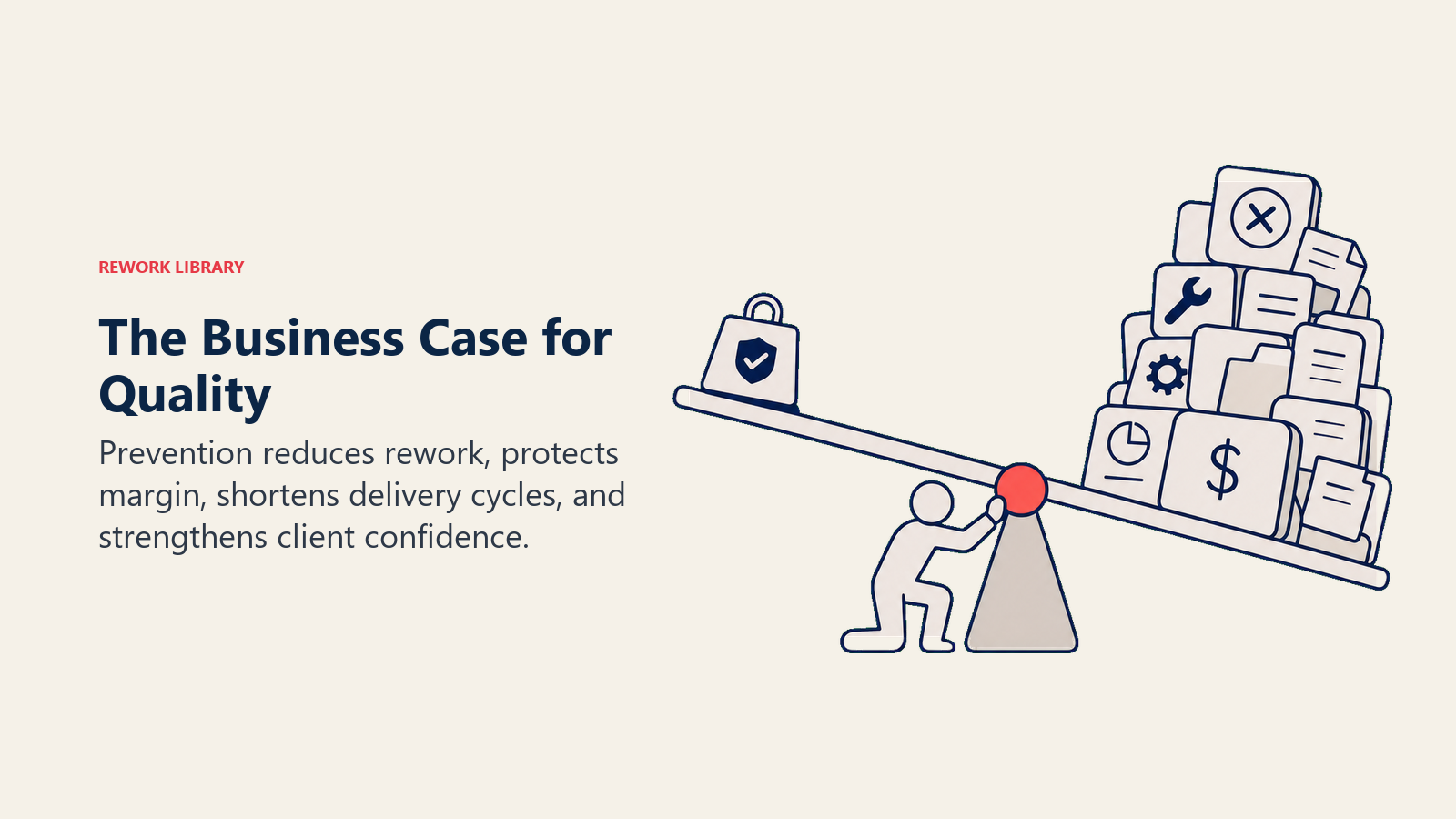
Rework costs real money. If your average project runs 200 hours at $200/hour, that's $40,000 in revenue. If 20% goes to rework (fixing mistakes, addressing missed requirements, redoing analysis), you just spent $8,000 of billable time generating zero value. Do that across 50 projects and you've wasted $400,000 in a year.
But direct rework costs are just the start. Quality failures create cascading problems:
Client satisfaction takes a hit. Every error signals sloppiness, even when the overall work is strong. Clients remember the typo in the executive summary more than they remember the brilliant insights on page 47. Fair? No. Reality? Yes. This directly impacts your client satisfaction management efforts.
Your reputation suffers. Professional services live on referrals and reputation. One botched deliverable becomes "I heard they had some issues on the XYZ project" that follows you for years. Quality problems spread faster than quality wins.
Pricing power erodes. When clients experience quality issues, they discount your value. Even if you fixed everything, their mental math is "this firm is expensive AND they make mistakes." That's a terrible combination.
Team morale drops. Nobody likes rework. Your best people get demoralized spending nights fixing preventable errors instead of doing interesting work. That's how you lose talent.
The flip side is equally compelling. Firms known for quality can charge premium rates, win competitive bids, and attract better clients. Quality becomes a growth engine, not just a cost center.
Prevention vs inspection: the fundamental choice
Most firms approach quality backwards. They rely on inspection - catching errors after the work is done. That's expensive and incomplete. You're paying people to review finished work, find problems, send it back for fixes, and review again. It's quality as damage control.
The better approach is prevention - building quality into the process so errors never happen. That means clear standards, proper training, checkpoints during work (not just at the end), and tools that prevent common mistakes.
Think about it this way: inspection catches 60-80% of defects. Prevention stops 90%+ before they ever happen. One saves you some pain. The other eliminates it entirely.
But here's the catch - you need both. Prevention reduces errors dramatically, but humans still make mistakes. So you build prevention systems AND create review checkpoints. Defense in depth.
Defining quality standards by service type
"High quality" means different things depending on what you deliver. A consulting report has different quality criteria than a software implementation or a creative campaign.
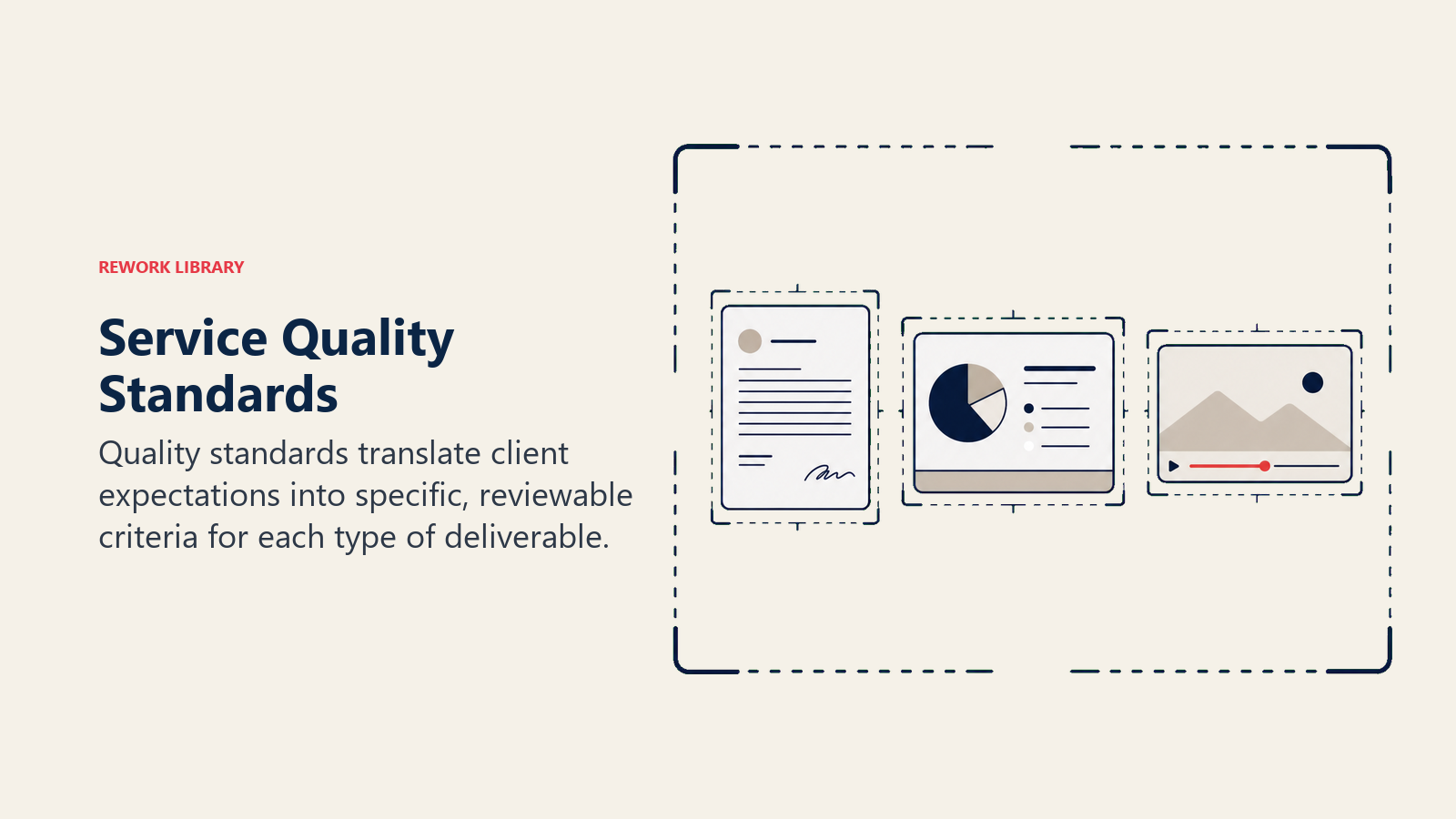
Consulting deliverables (strategy, analysis, recommendations):
- Insight quality: Are the findings actually valuable and non-obvious?
- Actionability: Can clients actually implement the recommendations?
- Business impact: Do the recommendations connect to measurable outcomes?
- Supporting evidence: Is the analysis thorough and well-documented?
- Presentation quality: Is it clear, professional, and easy to digest?
Technology deliverables (software, systems, implementations):
- Functionality: Does it do what it's supposed to do?
- Performance: Does it meet speed and scalability requirements?
- Security: Are vulnerabilities addressed and data protected?
- Maintainability: Can the client's team understand and modify it?
- Documentation: Can someone else figure out how it works?
Creative deliverables (design, content, campaigns):
- Effectiveness: Will it achieve the desired response or outcome?
- Brand alignment: Does it match the client's brand guidelines and voice?
- Originality: Is it fresh, or does it feel generic and templated?
- Technical execution: Is the production quality professional?
- Audience appropriateness: Does it work for the target audience?
Legal deliverables (contracts, filings, legal analysis):
- Thoroughness: Are all relevant issues identified and addressed?
- Compliance: Does it meet all regulatory and legal requirements?
- Research quality: Is the legal analysis current and well-supported?
- Risk identification: Are potential problems flagged clearly?
- Clarity: Can the client understand what they're being told?
Process deliverables (new workflows, operating procedures):
- Efficiency gains: Does it actually improve on the current process?
- Sustainability: Can the client maintain it without you?
- Adoption readiness: Is it realistic for the organization to implement?
- Documentation quality: Can someone follow the procedures?
- Change management support: Are the people issues addressed?
The common thread: quality isn't just "no typos." It's "does this deliverable actually solve the client's problem in a way they can use."
Start by defining what "excellent," "acceptable," and "unacceptable" look like for each type of deliverable you produce. Get specific. "Actionable recommendations" is too vague. "Recommendations include specific actions, responsible parties, timelines, and success metrics" is a standard you can check.
The multi-stage quality review framework
Here's how to catch errors before they reach clients: multiple review stages with different eyes looking for different things.
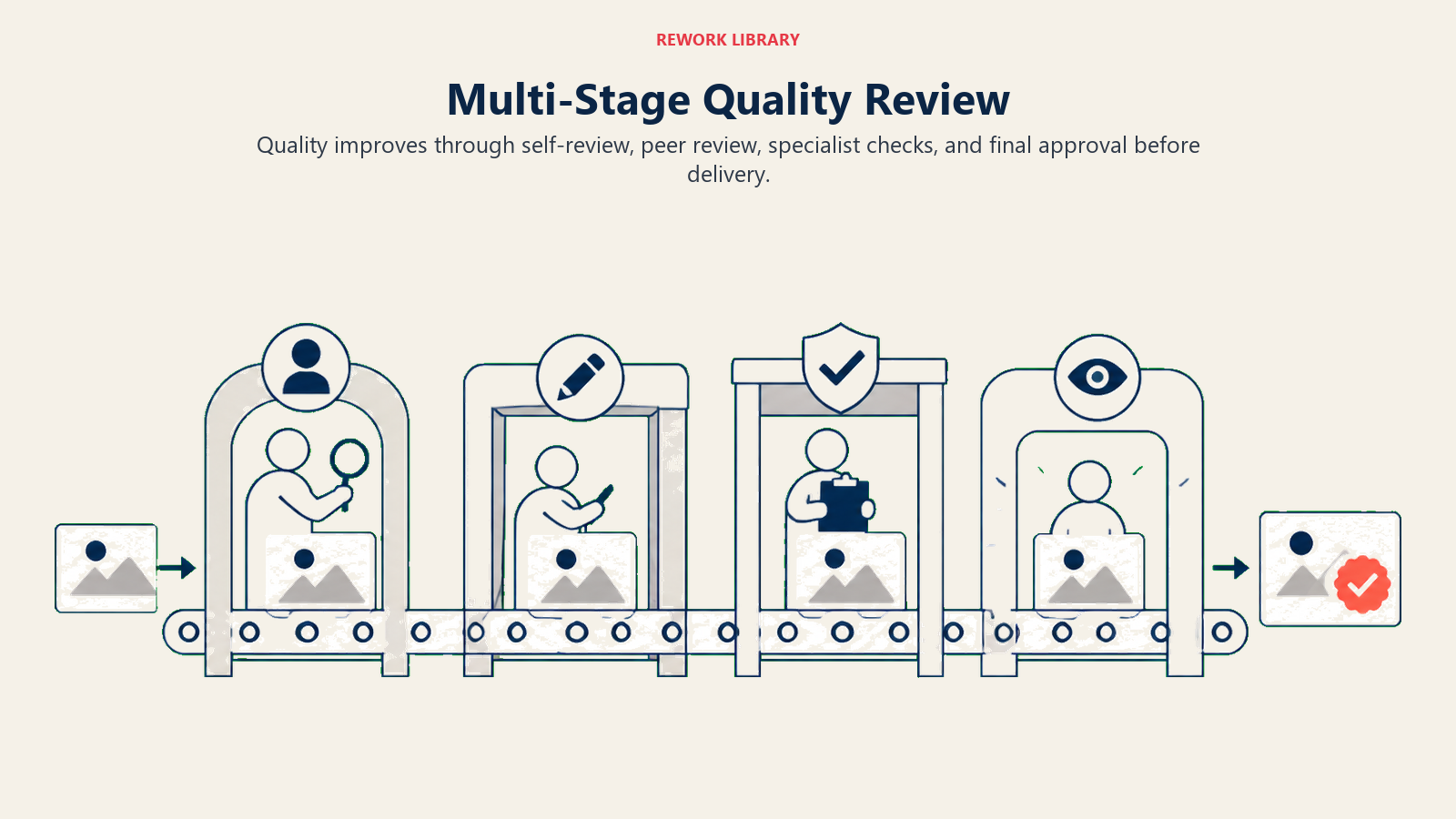
Stage 1: Self-review - The person who created the work reviews their own output using a quality checklist. This catches the obvious stuff: typos, formatting errors, incomplete sections, broken logic. Self-review is the fastest, cheapest quality gate.
The problem: we're terrible at reviewing our own work. We see what we meant to write, not what we actually wrote. That's why you need additional stages.
Stage 2: Peer review - Someone else on the team reviews the work. They bring fresh eyes and can spot issues the original author missed. They also bring different expertise - maybe they know the client better or have deeper subject matter knowledge.
Peer review works best when the reviewer has clear criteria. Not just "does this look good?" but "does this meet our analysis standards? Are the recommendations feasible? Is the evidence sufficient?"
Stage 3: QA review - A dedicated quality professional (or quality-focused partner) reviews the deliverable specifically for quality standards. This person isn't checking if the analysis is brilliant - that's not their expertise. They're checking if it meets structural, formatting, and presentation standards.
Think of this like a professional editor. They make sure citations are formatted correctly, exhibits are labeled consistently, the executive summary actually summarizes the content, and the document follows your firm's standards.
Stage 4: Client review - The client reviews and approves the deliverable. This isn't optional quality assurance - it's your final check that you've actually delivered what they wanted. Client review catches misalignment: "this is technically correct but addresses the wrong question." Establish clear review cycles during your project kickoff process.
Review process documentation: Each stage should have clear entry/exit criteria. You can't move to peer review until self-review is complete and checked off. You can't deliver to the client until all internal reviews are signed off. This prevents shortcuts like "we're behind schedule so let's skip peer review."
Quality checklist framework
Checklists are unglamorous but effective. They catch the errors that humans make when they're tired, rushed, or overconfident.
Universal quality checklist (applies to all deliverables):
- Scope completeness: Does this address everything in the scope/SOW?
- Factual accuracy: Are all facts, data points, and citations correct?
- Client name and details: Correct company name, spelling, branding throughout?
- Professional presentation: Proper formatting, consistent style, no typos?
- Required sections: Everything the contract specifies is included?
- Clear communication: Would someone unfamiliar with the project understand this?
- Action items defined: If next steps exist, are they clearly stated?
- Final deliverable format: Is this in the format the client requested (PDF, PowerPoint, etc.)?
Content-specific checklist items:
For analysis/consulting:
- Data sources cited and current
- Methodology explained and sound
- Assumptions stated clearly
- Alternatives considered
- Risk factors identified
- Implementation feasibility addressed
For technology/implementation:
- Functional requirements met
- Security scan completed and passed
- Performance testing done
- User documentation included
- Code follows standards
- Deployment process documented
For creative work:
- Brand guidelines followed
- Client feedback incorporated
- Multiple formats provided as specified
- Usage rights clear
- All assets organized and labeled
- Revision history documented
Client-specific checklist items:
- Client's preferred terminology used
- Previously stated preferences honored
- Sensitive topics handled appropriately
- Key stakeholders' concerns addressed
- Specific acceptance criteria met
- Client-specific formatting requirements followed
The checklist should be specific enough to catch real errors but not so detailed that people skip it because it's overwhelming. Start with 10-15 critical items and refine based on what errors actually occur.
Managing client expectations around quality
Quality problems often stem from misaligned expectations, not actual defects. The client expected X, you delivered Y, and even though Y is technically excellent, they're disappointed.
Set realistic expectations upfront. During scoping and contracting, define what "done" looks like. What format will deliverables take? How many review cycles are included? What level of detail is expected? If you're delivering a market analysis, are they expecting 20 pages or 200 pages?
Define acceptance criteria at project initiation. Work with the client to establish specific, measurable criteria for deliverable acceptance. "The new system must process 1,000 transactions per hour" is an acceptance criterion you can test. "The new system should be fast" is not.
This protects both sides. You know what you're being held to. They can't move the goalposts mid-project.
Manage scope and quality trade-offs explicitly. When clients ask for more work without more budget or time, don't just say yes and hope for the best. Explain the trade-off: "We can add that analysis, but it means we'll have less time for quality review. Are you comfortable with that risk, or should we adjust the timeline?" Use your change order process to document these decisions.
Most clients will choose quality over scope when you make the trade-off explicit. But if they don't, at least you documented that the quality risk was their choice.
Establish quality communication cadence. Don't wait until final delivery to show the client what you're building. Regular work-in-progress reviews let you catch misalignment early. "Here's our draft analysis framework. Is this the right approach?" is much easier to fix than "Here's the final 100-page report. What do you mean this isn't what you wanted?"
For more on this, see Client Communication Cadence.
Defect and issue management
When quality issues do occur, how you handle them matters as much as preventing them in the first place.
Defect classification helps you prioritize what to fix first:
Critical defects: These make the deliverable unusable or create serious risk. Incorrect financial calculations in a CFO presentation. Security vulnerabilities in delivered software. Legal errors in a contract. Critical defects stop everything until they're fixed.
Major defects: These significantly reduce value or usability but don't make the deliverable completely unusable. Missing a required section. Data that's directionally correct but contains errors. Features that don't work as specified. Major defects must be fixed before client delivery.
Minor defects: These are quality problems that don't materially impact value. Formatting inconsistencies. Typos that don't change meaning. Nice-to-have features that weren't delivered. Minor defects should be fixed, but you can often deliver with a plan to address them.
Identification and logging process: When someone finds a defect (in any review stage), they should log it in a consistent way:
- What's wrong (specific description, not "section 3 is bad")
- Where it occurs (page, section, module)
- Severity (critical, major, minor)
- Who found it
- When it was found
This creates a defect log that you can track to completion. It also generates data for improvement.
Rework process and timeline management: Once defects are identified, someone needs to own fixing them, and you need to manage the timeline. If peer review finds 15 major issues, you can't deliver tomorrow. Be honest with clients: "Our quality review found issues we need to address. We need three more days to get this right." This kind of transparent communication aligns with effective client communication cadence.
Most clients prefer a delay over receiving flawed work. The ones who don't are usually the ones who will be most upset about quality problems later.
Trend analysis and prevention: The real value of defect tracking comes from patterns. If the same team member consistently produces work with data errors, that's a training issue. If the same type of error appears across multiple projects, that's a process or template issue.
Review defect logs monthly or quarterly. What keeps happening? What can you prevent with better templates, checklists, or training?
Quality metrics and measurement
You can't improve what you don't measure. Track these metrics to understand your quality performance:
First-pass acceptance rate: What percentage of deliverables are accepted by the client without requiring rework? If you're at 95%+, your quality systems are working. If you're at 70%, you have significant quality gaps.
Defect rate by severity: How many critical, major, and minor defects are found per deliverable? Track this by review stage (self-review, peer review, QA review, client review). Ideally, defect counts decrease at each stage - most errors caught in self-review, fewer in peer review, almost none reaching the client.
Rework hours: How much time do you spend fixing defects vs. creating new work? This is your direct quality cost. If rework is consuming 20% of project time, quality improvements have massive ROI potential.
Client satisfaction scores: Survey clients specifically about deliverable quality. Use a simple scale: "How would you rate the quality of the deliverables on this project? 1-5." Track this over time and by team/practice area.
Review cycle time: How long does each quality review stage take? If peer review is taking three days, that's either a bottleneck to address or a signal that deliverables are arriving for review in rough shape.
Defect trends over time: Are you getting better or worse? If defect rates are increasing, something in your process or team has changed. If they're decreasing, your quality investments are paying off.
Measurement collection methods: Build quality metrics into your project management workflow. When a deliverable moves from stage to stage, require a quality sign-off that captures relevant data. When projects close, pull quality metrics into your project retrospective.
Don't make metrics collection a separate job. Integrate it into what people are already doing.
Quality tools and automation
Technology can catch errors humans miss and make quality processes faster and more consistent.
Automation opportunities:
Spell-check and grammar tools (Grammarly, Word's editor): Basic but essential. These catch typos and grammar errors that make you look sloppy. The professional versions catch more sophisticated writing issues.
Document comparison tools (Word's compare, diff tools): When you're producing multiple versions of a deliverable, comparison tools highlight exactly what changed. This prevents errors like "we addressed the client's feedback but accidentally deleted a section."
Automated testing (for technology deliverables): Unit tests, integration tests, security scans. These catch functional defects faster and more completely than manual testing. If you're delivering software or data analysis, automated testing is non-negotiable.
Accessibility checkers: If you're delivering documents or digital experiences, accessibility tools check if people with disabilities can actually use what you created. This isn't just ethical - it's often a legal requirement.
Brand and style checkers: Tools that verify your deliverables match the client's brand guidelines. Does the logo appear correctly? Are you using the right color codes? Are fonts consistent?
Data validation tools: For deliverables with lots of data or calculations, validation tools check for errors. Does the math work? Are there outliers that might be errors? Are data sources consistent?
Quality management platforms: Tools like Monday.com, Asana, or specialized QA software can manage your quality review workflow. They track who reviewed what, what defects were found, what's fixed, and what's still open. They create the audit trail that shows clients (and your own partners) that quality isn't an accident.
Integration with delivery workflow: The best quality tools integrate seamlessly into how people already work. If you have to export documents to a separate platform for review, adoption will be terrible. If quality checks happen automatically as part of normal workflows, they just happen.
Continuous improvement through post-project reviews
Every project teaches you something about quality - if you bother to capture the lesson.
Post-project quality reviews: When a project closes, hold a specific conversation about quality:
- What quality issues occurred?
- How were they caught (which review stage)?
- What was the impact (client noticed? internal only?)?
- What caused them (lack of clarity, time pressure, skill gap, bad template)?
- How can we prevent this next time?
This isn't about blame. It's about learning. The goal is to identify systemic issues, not individual failures.
Quality standard evolution: Your quality standards should change as you learn what matters. If you discover that clients care deeply about some aspect you weren't checking, add it to your standards. If you're checking something that never catches errors and doesn't add value, remove it.
Review and update your quality checklists and standards quarterly. Are they catching the right things? Are they clear enough that people can actually use them?
Building improvement into process: Don't just collect lessons learned - actually implement them. If post-project reviews consistently identify that a certain type of deliverable has quality issues, that's a signal to redesign the template, create additional training, or add a quality checkpoint.
Create a closed loop: identify issue → understand root cause → implement fix → verify fix worked.
Knowledge management and best practices: When someone figures out how to avoid a common quality problem, capture that knowledge. Build it into templates, checklists, and training. Quality improvement shouldn't stay in one person's head.
For more on capturing and applying lessons, see Project Closeout.
Common quality pitfalls
Even well-intentioned firms make these mistakes:
End-stage inspection vs built-in quality: Waiting until work is "done" to check quality is expensive and incomplete. By then, fixing errors means significant rework. Build quality checks into the process, not just at the end.
Skipping quality steps for tight timelines: When you're behind schedule, quality reviews feel like a luxury you can't afford. That's exactly backwards. Skipping quality creates more delays when you have to fix errors or, worse, when the client rejects your deliverable.
The right response to time pressure is to reduce scope, not reduce quality. Effective scope creep management helps prevent these situations from occurring in the first place.
Unclear standards and poor communication: "High quality" means nothing if you haven't defined it specifically. And if you've defined it but haven't communicated it to the team, people can't meet standards they don't know exist.
Make quality standards explicit, accessible, and part of onboarding. If someone joins your team, they should know exactly what quality means and how to achieve it within the first week.
No accountability or measurement: If quality failures have no consequences and quality successes have no rewards, people optimize for speed over quality. This doesn't mean punishing mistakes - it means tracking quality, making it visible, and recognizing teams that consistently deliver excellent work.
Quality should be a factor in performance reviews, project retrospectives, and resource allocation. If your best people are rewarded the same whether they deliver excellent or mediocre work, expect more mediocrity.
Treating all defects equally: Not all errors matter equally. A typo on page 47 and a major analytical error in your key recommendation are not the same thing. Focus your quality energy on high-impact areas. Perfect formatting on a deeply flawed analysis is pointless.
Assuming quality happens naturally: Smart people don't automatically produce high-quality work when they're under time pressure, working on unfamiliar topics, or dealing with unclear requirements. Quality requires systems, not just talent.
Where to go from here
Quality assurance isn't separate from delivery - it's a core part of how you deliver value. When quality becomes systematic, several things happen:
Your rework costs drop dramatically. That directly improves project profitability and utilization.
Client satisfaction improves, which drives retention and referrals. Clients remember firms that get it right the first time.
Your team's morale improves. People take pride in doing good work and hate fixing avoidable mistakes.
Your reputation strengthens. You become known as the firm that delivers quality, which lets you charge accordingly.
Quality connects to several other critical areas of professional services delivery:
- Project Management Methodology - Quality checkpoints integrate into your overall project approach
- Client Communication Cadence - Regular communication prevents quality misalignment
- Scope Definition and Statement of Work - Clear scope prevents quality disagreements about what "done" means
- Client Onboarding Process - Setting quality expectations starts at onboarding
- Project Closeout - Quality reviews generate improvement insights
Start with one improvement: implement a two-stage review process (self-review with a checklist, then peer review) for your most important deliverable type. Measure first-pass acceptance rate before and after. You'll see the impact within a few projects.
Quality isn't about perfection. It's about consistently delivering work that meets your standards and exceeds client expectations. That's the difference between firms that struggle and firms that thrive.

Sales Director
On this page
- The business case for quality
- Prevention vs inspection: the fundamental choice
- Defining quality standards by service type
- The multi-stage quality review framework
- Quality checklist framework
- Managing client expectations around quality
- Defect and issue management
- Quality metrics and measurement
- Quality tools and automation
- Continuous improvement through post-project reviews
- Common quality pitfalls
- Where to go from here