Accounting Firm Growth: Building a Scalable, Profitable Accounting and CPA Practice

Turn this article into takeaways for your work.


Each assistant summarizes the article only for you and suggests best practices for your work.
Most accounting firms are stuck in a profitability trap. They bill more hours, hire more staff, handle more tax returns, but the margins stay flat. Partners work 70-hour weeks during tax season and wonder why revenue growth feels like pushing a boulder uphill.
The problem isn't effort. It's the business model. Traditional compliance work (tax prep, bookkeeping, audits) operates on thin margins and seasonal cash flow. You're selling time, and time doesn't scale. Every new client requires proportional labor. There's no leverage.
Firms that break through this ceiling do something different. They transition from compliance commodity to advisory partner. They build service lines that command premium pricing. They create systems that turn seasonal surges into year-round revenue streams. They stop selling hours and start selling outcomes.
This isn't about abandoning compliance work. That's your foundation, your client acquisition engine, your relationship anchor. But it can't be your only revenue source if you want to grow profitably. This guide shows you how to build a scalable accounting practice that expands margins while reducing partner workload.
The accounting firm business model reality
Let's talk about what actually drives profitability in accounting firms, because most partners have never done this math.
Your revenue comes from four main buckets: compliance services (tax prep, audit, review), bookkeeping and controller services, advisory work (tax planning, CFO services, succession planning), and specialty services (valuation, forensic accounting, industry-specific work).
Here's what matters: these service lines have wildly different profitability profiles.
Compliance work generates $150-300 per hour in billings but operates at 30-40% gross margins after you account for staff costs, review time, and administrative overhead. A typical 1040 might bill at $800 but costs you $500 in labor. You're making $300 in gross profit, assuming you collect the full fee and don't write off time.
Bookkeeping services are even tighter. Monthly bookkeeping might bill at $500-2,000 per month but operates at 25-35% margins because the work is repetitive, lower-skill, and faces competition from offshore providers. It's sticky revenue and valuable for cross-sell opportunities, but it's not making you rich.
Advisory services are where margins explode. Tax planning engagements bill at $200-400+ per hour with 60-70% margins because you're providing expertise, not processing work. A CFO advisory retainer at $3,000/month might cost you $800 in partner time monthly. You're selling judgment and strategy, which scales better than data entry.
Specialty services (M&A advisory, business valuation, forensic work) can command $300-500+ per hour at 50-60% margins because fewer firms offer these capabilities. But they require specific expertise and credentials.
The firms making serious money run a portfolio approach. They use compliance work to acquire clients and build relationships, then expand into higher-margin advisory services with those same clients. A client might pay you $3,000 for their tax return (30% margin) but $15,000 for year-round tax planning and financial advisory (65% margin). Same client, same relationship, 5x the revenue at double the margin.
Understanding your client lifecycle economics
Most accounting firms think about clients in terms of annual billing. "This client is worth $5,000 a year." That's the wrong framework.
You need to think in lifetime value. A small business client who starts with a $2,000 tax return could evolve into:
- Year 1: Tax return $2,000
- Year 2: Tax return + quarterly bookkeeping $8,000
- Year 3: Tax return + bookkeeping + tax planning $15,000
- Year 4: Tax return + bookkeeping + tax planning + CFO advisory $30,000
- Year 5-10: Full advisory relationship averaging $35,000/year
That's not a $2,000 client. That's a $200,000+ relationship over ten years if you can expand the service relationship. But most firms never do. They deliver the tax return, see the client once a year at drop-off, and leave $180,000 on the table.
The acquisition happens through the compliance work. The profit happens through advisory expansion. You need both parts working together.
Client acquisition costs matter here too. If you spend $1,500 to acquire a client (marketing, proposal time, initial consultation), you need to recover that quickly. A $2,000 compliance client recovering acquisition cost in year one is break-even. A client who expands to $30,000 over four years has paid back your acquisition cost 20x over. This is why client retention and expansion are more valuable than new client acquisition once you have a base.
Service line expansion strategy
Growing your accounting firm means deliberately adding and optimizing service lines beyond basic compliance. Here's how to think about the progression.
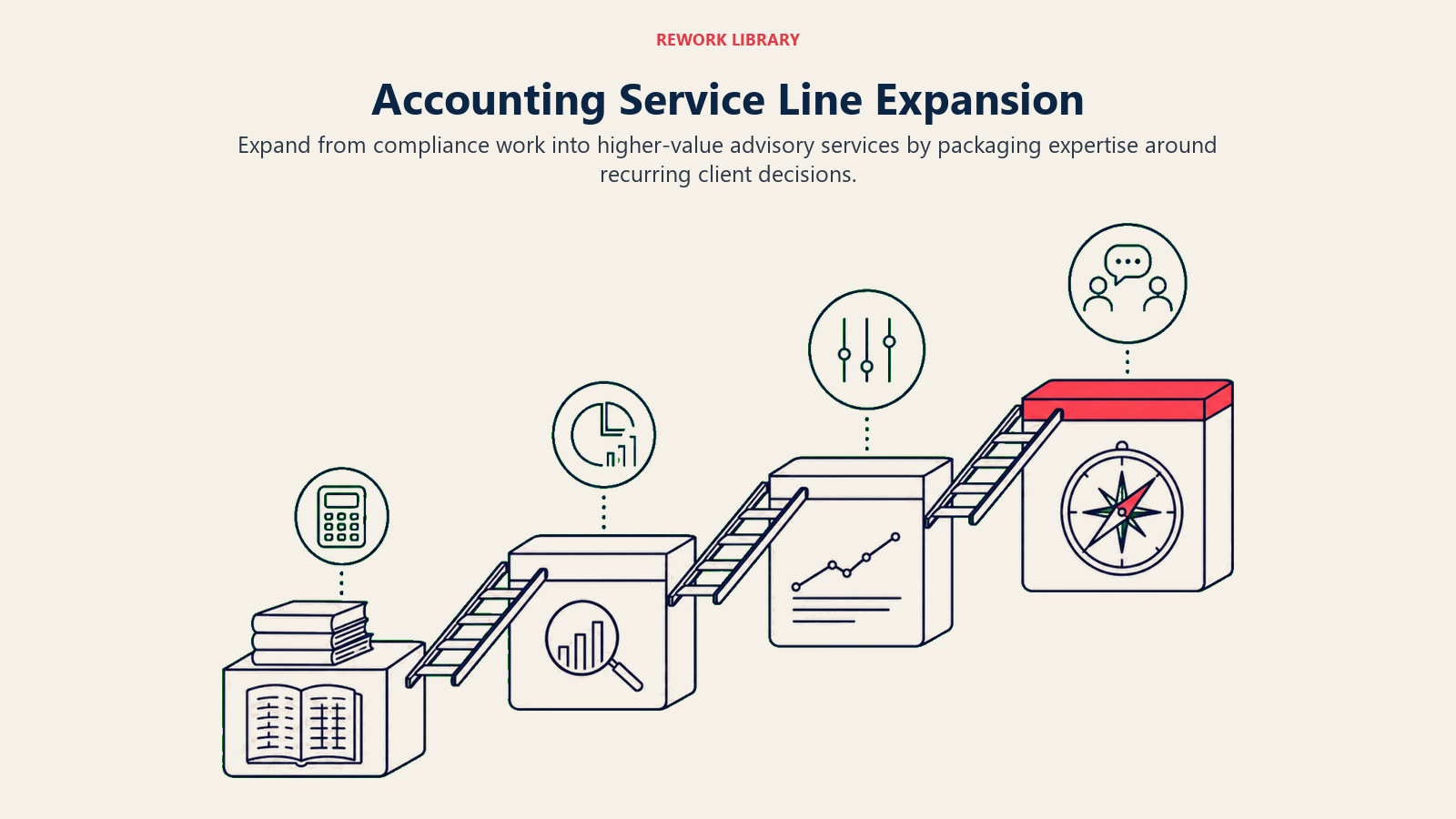
Start with compliance optimization. Before adding new services, make your core compliance work more efficient and profitable. That means:
- Systemizing tax return workflows so junior staff can handle 70% of the work
- Using tax software automation to reduce prep time by 30-40%
- Implementing client portals for document collection (saves 5-10 hours per client)
- Creating engagement letter templates and standardized pricing
- Training staff on common tax situations so partners don't review every return
If you're still doing data entry on individual returns, you're wasting billable capacity. Get your compliance machine running smoothly first.
Layer in tax planning services. This is the easiest expansion because you already have the expertise and the client relationships. The client who paid you $2,000 for tax prep should be paying another $2,000-5,000 for year-round tax strategy if they're a business owner or high earner.
Tax planning services include:
- Quarterly estimated tax calculations and adjustments
- Entity structure optimization (S-corp elections, partnership structures)
- Retirement plan design and contribution strategies
- Multi-year tax projections for major financial decisions
- Estate and gift tax planning for high net worth clients
- Real estate cost segregation and bonus depreciation planning
You're taking the same tax expertise used for compliance and applying it proactively. Instead of "here's what happened last year," you're saying "here's how to save $20,000 next year." Clients pay more because the value is tangible and forward-looking.
Add bookkeeping and controller services. If your clients don't have clean books, you can't do good advisory work. Offering monthly bookkeeping creates recurring revenue, gives you visibility into client financials, and positions you for CFO services later.
The key is not doing low-end bookkeeping yourself. Either:
- Use offshore bookkeeping teams for data entry ($15-25/hour cost)
- Partner with bookkeeping firms and focus on controller-level oversight
- Hire dedicated bookkeeping staff separate from your tax team
- Use AI-powered bookkeeping tools that reduce manual work by 60-70%
Your role should be controller services - reviewing financials, catching errors, explaining what the numbers mean, helping with cash flow management. That's $150/hour work. Data entry is $30/hour work. Don't confuse them.
Develop CFO advisory services. This is where accounting firms create the most value and capture the most margin. Small and mid-market businesses need CFO-level financial guidance but can't afford a $200,000 full-time hire. You can provide fractional CFO services at $3,000-10,000/month and transform client outcomes.
CFO services include:
- Monthly financial review and KPI analysis
- Cash flow forecasting and management
- Budgeting and financial planning
- Financing strategy for growth or acquisition
- Pricing analysis and profitability optimization
- Financial due diligence for acquisitions
- Board presentation preparation
- Strategic financial decision support
The firms doing this well aren't just reporting numbers. They're helping clients make better decisions about hiring, pricing, expansion, financing, and exit planning. You become a strategic partner instead of a compliance vendor.
Add specialty services based on your expertise. Once you have advisory momentum, you can layer in higher-margin specialty work:
- Business valuation (needed for estate planning, M&A, partner buyouts)
- Succession planning (huge opportunity with aging business owners)
- M&A advisory (helping clients buy or sell businesses)
- Litigation support and forensic accounting
- International tax planning
- State and local tax (SALT) consulting
- Industry-specific services (nonprofit, real estate, healthcare)
These services require additional credentials or expertise but can command $300-500/hour. A business valuation might be a $15,000-50,000 engagement. Succession planning advisory could run $25,000-100,000 for complex situations.
Service mix optimization
The goal isn't to do everything. It's to build a service portfolio that fits your market, expertise, and capacity.
High-performing firms typically run a 40/30/30 revenue mix: 40% compliance (stable foundation), 30% recurring advisory (CFO, tax planning, bookkeeping), 30% project-based advisory (valuation, succession, M&A). This creates predictable cash flow, high margins, and year-round work distribution.
Avoid the trap of staying 80-90% compliance because it's comfortable. Those firms are service businesses with accountant margins. You want to be an advisory business that also does compliance.
Client acquisition and market positioning
Accounting firms typically acquire clients through three channels: referrals, inbound marketing, and direct networking. The channel mix matters because acquisition cost and client quality vary widely.
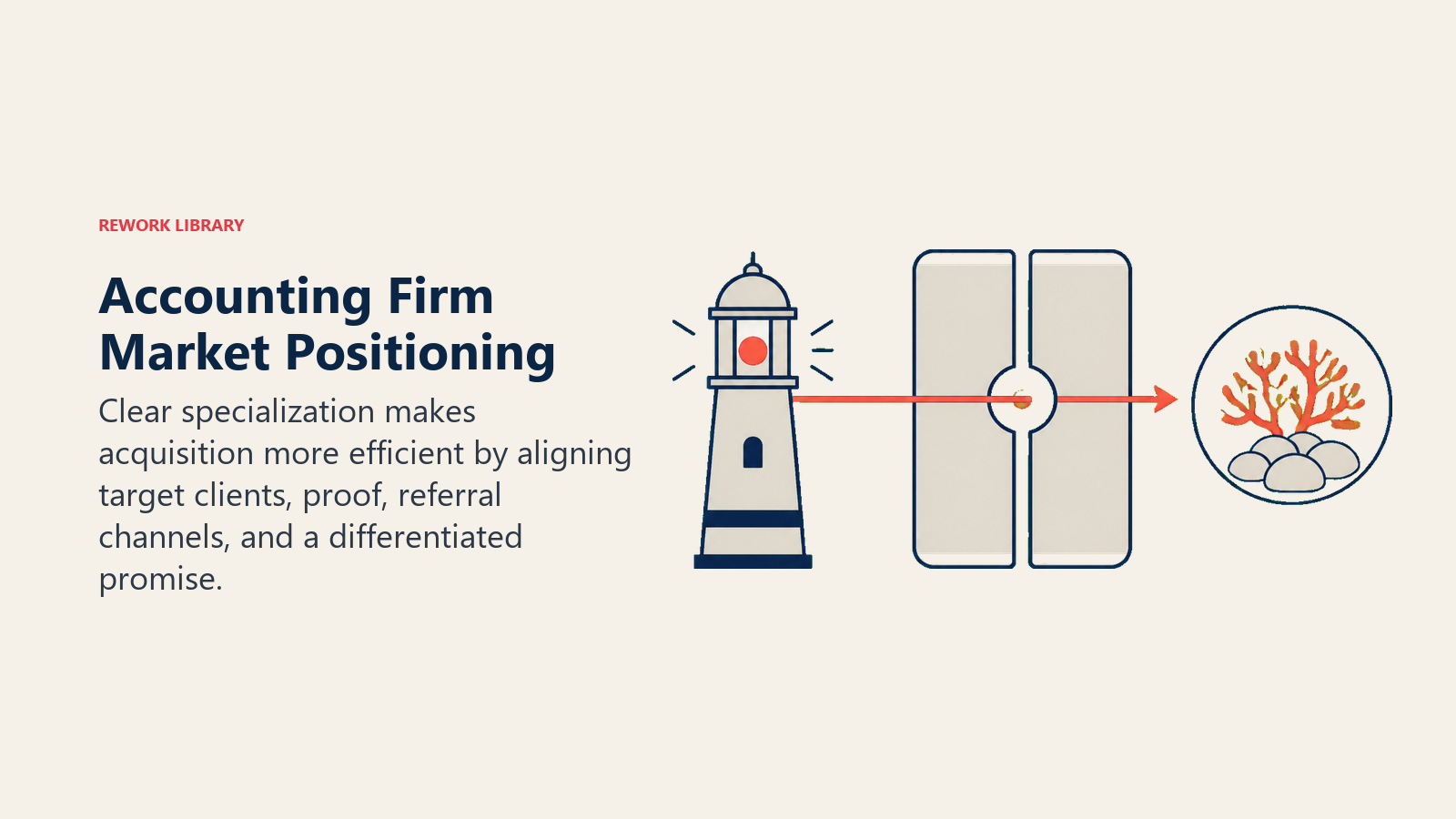
Referrals from existing clients are your highest-value channel. They convert at 40-60%, cost almost nothing to acquire, and typically match your ideal client profile because similar people know each other. A business owner making $500,000/year refers other business owners making $400,000-600,000/year. A referral from a $15,000 annual client usually brings another $10,000-20,000 client. Building systematic referral programs requires the consultative business development approach.
But referrals don't happen automatically. You need a deliberate referral generation system:
- Ask satisfied clients directly: "Who else do you know in a similar situation?"
- Make it specific: "Do you know any other restaurant owners?" is better than "know anyone who needs accounting help?"
- Create referral incentive programs (service credits, gifts, recognition)
- Stay visible to clients year-round so you're top of mind when their friends complain about their accountant
- Deliver exceptional service on advisory work, not just compliance - people refer advisors, not tax preparers
The firms getting the most referrals are the ones doing advisory work. No one gets excited to refer "my tax guy." They do get excited to refer "the CFO who helped me double my profitability."
Inbound marketing generates leads through content, SEO, and digital presence. This scales better than pure networking but requires upfront investment and patience.
Effective inbound strategies for accounting firms:
- Industry-specific content (guides for restaurant owners, medical practices, real estate investors)
- Tax planning calculators and tools that capture leads
- Local SEO optimization (rank for "CPA in [city]" or "small business accountant [city]")
- Educational webinars on tax law changes or financial strategies
- Case studies showing client results: "How we saved a client $45,000 in taxes"
- LinkedIn content demonstrating expertise and thought leadership
The key is specificity. "Accounting services for businesses" is generic noise. "Tax planning for multi-unit franchise owners in Texas" is a clear value proposition for a defined audience. Niche content converts 5-10x better than generalist content.
Networking and direct outreach still works but it's labor-intensive. This includes:
- Professional associations (Chamber of Commerce, industry groups, BNI)
- Strategic partnerships with attorneys, financial advisors, bankers, insurance agents
- Speaking at industry conferences or local business events
- Hosting client appreciation events that encourage bringing friends
- Direct outreach to businesses that fit your ideal client profile
The most effective networking is collaborative, not transactional. Don't pitch your services in every conversation. Build relationships with other professionals who serve your target clients - estate planning attorneys, wealth managers, business brokers, commercial lenders. Create referral partnerships where you're each other's go-to expert.
A wealth manager who trusts you with tax planning for their clients will send you 10-20 high-net-worth referrals per year. That's more valuable than attending 50 networking breakfasts. Learn how to build these relationships systematically through professional networking.
Target market segmentation
You can't serve everyone profitably. Accounting firms that try to be everything to everyone end up with a chaotic client mix, inefficient workflows, and commoditized pricing.
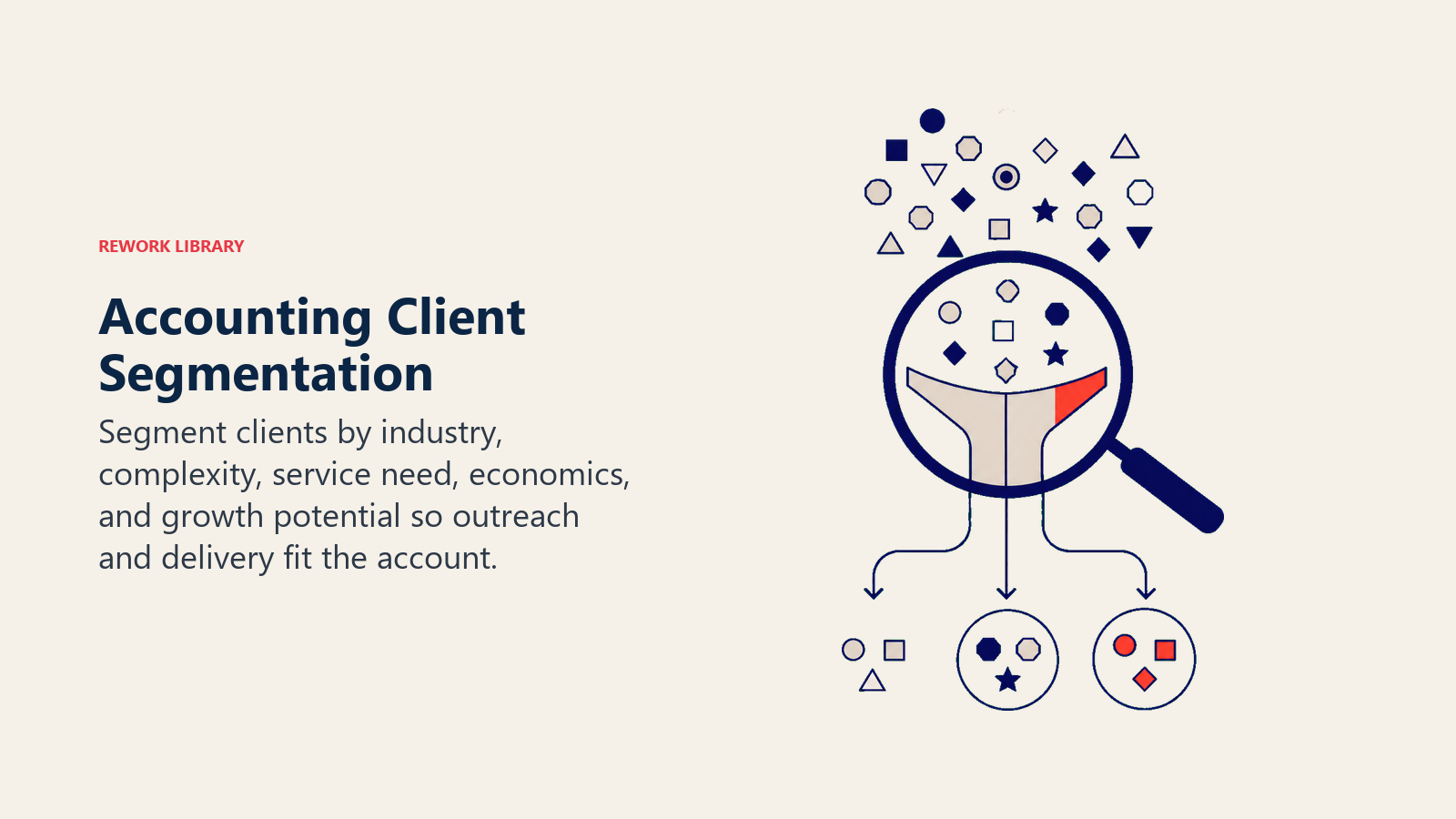
The most profitable firms pick a target market and go deep. Common segmentation approaches:
By company size and revenue:
- Micro businesses ($0-500K revenue): High volume, low complexity, price sensitive, hard to do advisory work
- Small businesses ($500K-5M): Sweet spot for many firms, need bookkeeping and tax planning, can afford $10K-30K/year
- Mid-market ($5M-50M): More complex needs, can afford CFO services, need audit/review, $30K-100K+ annual billing
- Large ($50M+): Audit requirements, complex tax, need national/regional firm resources
Most small CPA firms should target the $1M-20M revenue range. Big enough to need and afford advisory services, small enough to value personalized attention you provide.
By industry vertical:
- Professional services (law firms, medical practices, consultants)
- Restaurants and hospitality
- Real estate (developers, investors, property management)
- Construction and contractors
- Manufacturing and distribution
- Healthcare (practices, surgery centers, home health)
- Technology and software companies
Industry specialization lets you develop deep expertise in industry-specific tax strategies, benchmarking, operational best practices, and regulatory issues. You can command premium pricing because you understand client challenges better than generalist firms.
A CPA who only works with dental practices knows the ins and outs of practice acquisitions, associate buy-ins, equipment depreciation, insurance reimbursement optimization, and succession planning for dentists. That's worth 30-50% higher fees than a generalist who has to learn each client's industry from scratch.
By client type and need:
- High-net-worth individuals (tax planning, estate planning, family office services)
- Business owners (tax strategy, exit planning, CFO services)
- Real estate investors (cost segregation, 1031 exchanges, entity structures)
- Startups and high-growth companies (fundraising support, financial infrastructure)
- Family businesses (succession planning, multi-generational planning)
The tighter your focus, the more referrable you become and the more efficient your operations. Accounting firm positioning should answer: "We help [specific type of client] with [specific outcome]" - not "We do accounting for businesses."
Client qualification framework
Not every prospect is worth pursuing. Bad-fit clients destroy profitability through scope creep, slow payment, unrealistic expectations, and staff burnout.
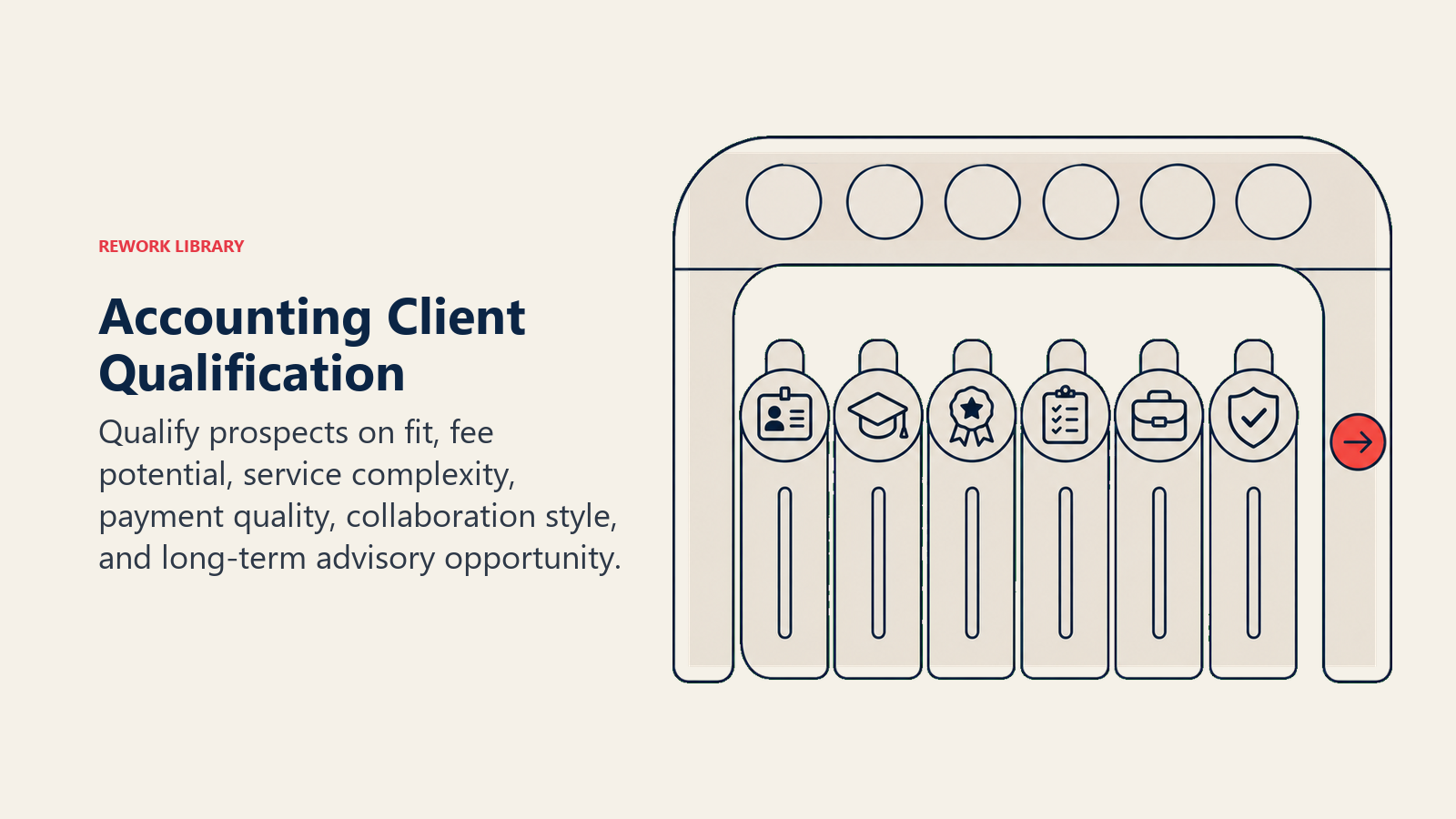
You need a qualification framework that filters out problem clients before you invest time in proposals. Here's what to evaluate:
Financial qualification:
- Can they afford your services? If your minimum engagement is $10,000 annually and they're expecting to pay $2,000, that's a mismatch.
- Do they pay bills on time? Check references or credit if it's a significant engagement.
- What's their revenue and profitability? If a business is barely breaking even, they can't afford advisory services and will fight every invoice.
Complexity and scope fit:
- Is this work you're good at? If they need international tax expertise and you don't have it, refer them out.
- How complex is their situation? Complexity should match your fee - simple returns should be simple fees, complex situations should pay for complexity.
- Do they have reasonable expectations? If they want a $500 tax return prepared in two days with no organized records, that's a red flag.
Values and relationship fit:
- Are they coachable? Advisory work requires clients who take your advice. If they argue with every recommendation, you can't help them.
- Do they respect your expertise? Clients who constantly second-guess you or shop your advice around are exhausting.
- Are they organized and responsive? Clients who don't provide documents for six months, then demand their return be done overnight, create chaos.
Growth potential:
- Can this relationship expand? A $2,000 client who could become a $20,000 client is worth pursuing. A $2,000 client whose situation won't change is less attractive.
- Are they open to additional services? If they say "I just need compliance, I'll never want advisory work," believe them and price accordingly.
The best qualification happens in the first conversation. Ask questions like:
- What are you looking to accomplish with your finances/business over the next 3-5 years?
- What's been your experience with previous accountants? What worked or didn't work?
- Beyond compliance, what other financial challenges are you facing?
- What does good looks like in an accounting relationship for you?
Their answers tell you if there's fit. If they only talk about getting the cheapest tax return, they're a compliance-only client. If they talk about growth challenges, cash flow struggles, or exit planning, there's advisory potential.
Tax season leverage strategy
Tax season is both the biggest opportunity and biggest constraint for accounting firms. You can generate 40-60% of annual revenue in four months, but if you don't handle it strategically, you burn out your team and miss advisory opportunities.
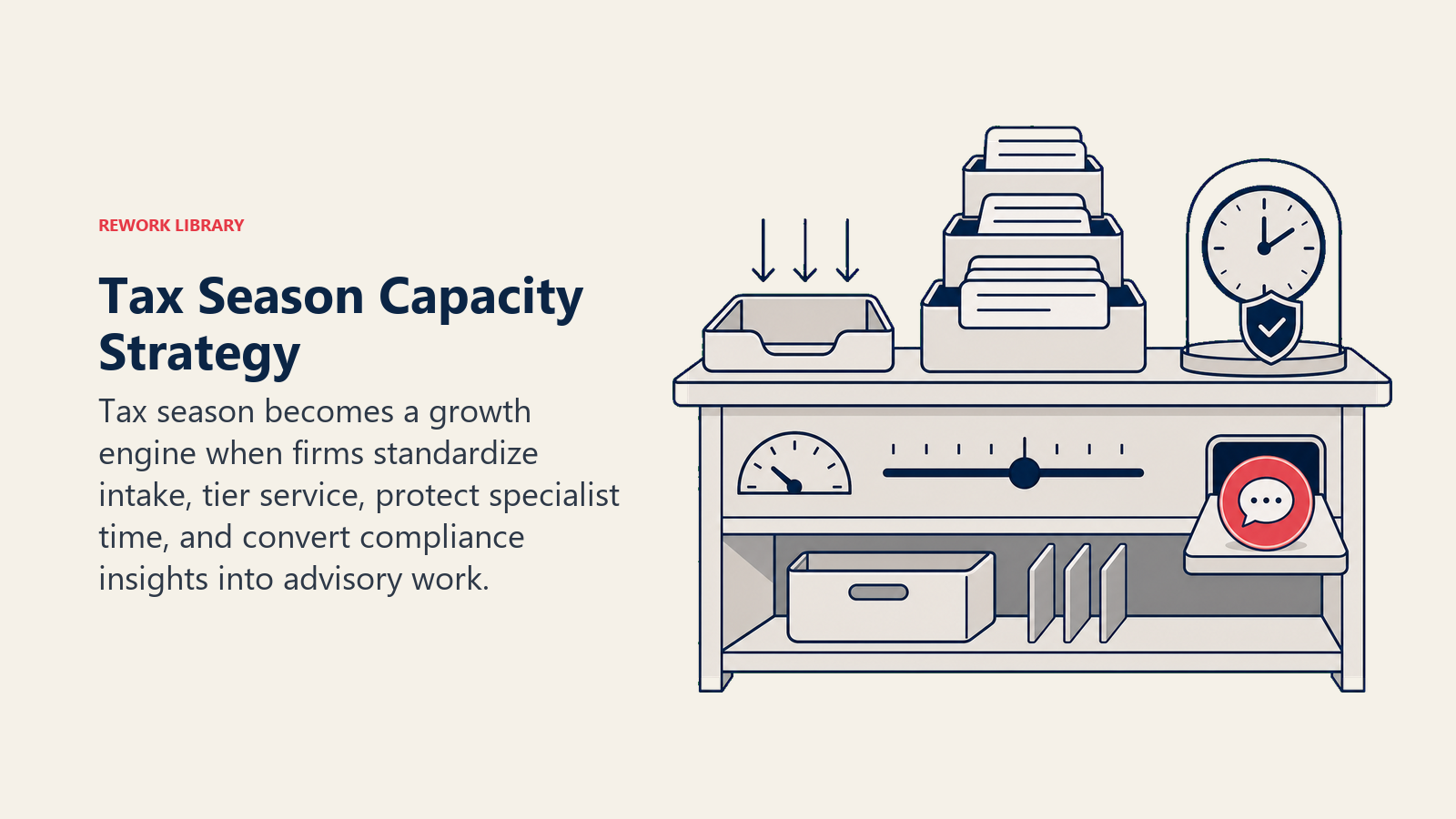
Maximizing tax season revenue
Price based on complexity and value, not just hours:
- Simple W-2 returns: $300-500 (these are loss leaders or break-even)
- Small business returns with basic schedules: $1,500-3,000
- Complex business returns with multiple entities: $3,000-8,000
- High-net-worth returns with investments, real estate, K-1s: $2,500-6,000+
Stop underpricing returns because "that's what we charged last year." Tax season demand is high, your capacity is constrained, and clients pay what you're worth if you communicate value.
Implement value-based pricing riders:
- Amended return protection: +$200-500 to include one amended return if needed
- Year-round tax support: +$500-1,000 for quarterly check-ins
- Tax planning add-on: +$1,500-3,000 for a mid-year planning session
These riders increase average engagement value by 30-50% and seed advisory relationships.
Operations excellence during peak season
Workflow optimization is critical:
- Client portal for document submission (Liscio, SmartVault, SafeSend)
- Standardized document checklist so clients know what to provide
- Automated appointment scheduling to avoid back-and-forth emails
- Tax return assembly automation to reduce review time
- Staff specialization - some people prep, others review, others handle client questions
Time-blocking for partners:
- 7am-10am: Complex returns and planning
- 10am-12pm: Client meetings
- 1pm-4pm: Return review
- 4pm-5pm: Staff questions and admin
- No meetings after 4/1 for final push
Create urgency with deadlines:
- Incentive pricing: "$500 off if you submit documents by 3/1"
- Staged deadlines: Business returns due to you by 3/1, individual returns by 3/15
- Extension fees: "We'll extend but there's a $300 fee for extension prep plus the full fee when we complete the return"
This spreads work across the season instead of everything hitting in April.
Off-season activity planning
Tax season cash flow creates an opportunity - you've just collected 40-60% of annual revenue. Use it strategically:
May-June: Follow up with tax planning opportunities
- Every business owner should get a "post-filing tax planning offer"
- Identify clients who overpaid taxes and could benefit from mid-year strategy
- Schedule Q2 planning meetings while you're top of mind
July-August: Client appreciation and relationship building
- Host client events (casual summer BBQ, golf outing, educational seminar)
- Send mid-year financial planning resources
- Check in on clients' business performance and offer CFO-level insights
September-October: Advisory service expansion
- Launch CFO service offerings to existing clients
- Conduct year-end tax planning for business owners
- Prepare budgets and financial projections for next year
November-December: Business development and recruiting
- Network and prospect for next tax season
- Hire seasonal staff early before competition heats up
- Clean up systems and processes based on last tax season lessons
January-February: Client onboarding and prep
- Onboard new clients before the rush
- Send tax organizers and document requests early
- Pre-schedule all tax season appointments
The key is preventing feast-or-famine cycles. Tax season generates cash, but you need revenue-producing activities year-round.
Tax season as lead generation opportunity
Every tax return is a sales conversation disguised as compliance work. When you deliver a completed return, you should be identifying advisory opportunities. For detailed strategies on leveraging tax season, see tax season client acquisition:
- "I noticed you paid $X in taxes. Can we schedule a planning session to reduce that next year?"
- "Your business grew significantly. Have you thought about CFO-level financial oversight?"
- "You mentioned considering a building purchase. Let's model out the tax implications."
- "You're still operating as a sole proprietor. We should discuss entity restructuring."
Client delivery meetings aren't just about explaining the return. They're about positioning next steps. Every client should leave with one of three outcomes:
- Scheduled for a tax planning or advisory consultation
- Added to a nurture campaign for future advisory services
- Flagged as compliance-only with appropriately limited service
Advisory services development and packaging
The transition from compliance to advisory is where most accounting firms fail. They know they should do advisory work, they have the expertise, but they don't know how to package it, price it, or sell it.
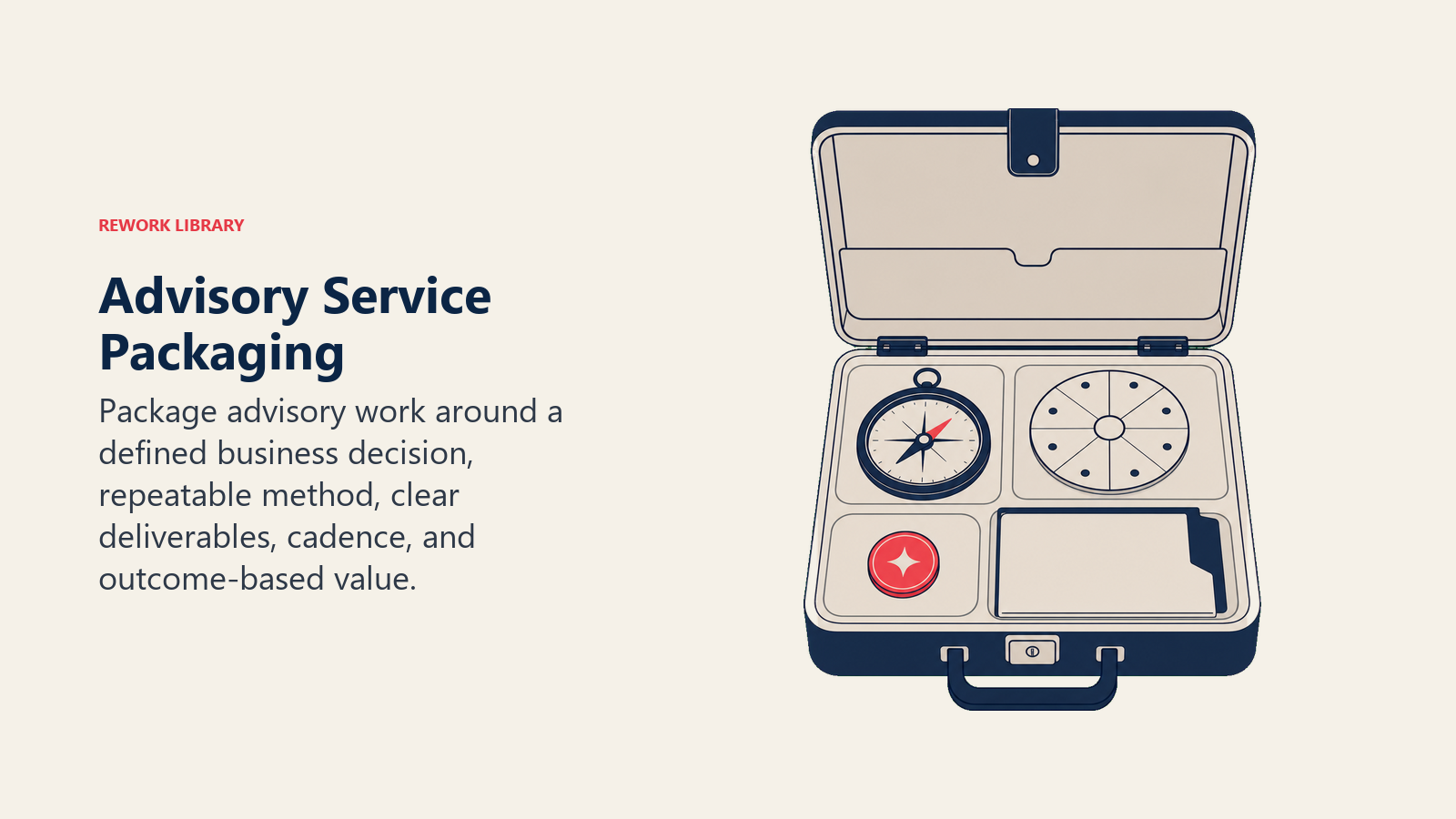
From compliance to advisory mindset shift
Compliance is backward-looking and reactive. Advisory is forward-looking and proactive. The client with a compliance mindset asks "what do I owe?" The client with an advisory mindset asks "how do I optimize my financial position?"
Your job is creating advisory clients, not finding them. When you deliver a tax return and say "you paid $80,000 in taxes last year," you're doing compliance. When you say "you paid $80,000 in taxes last year, and I see three strategies that could save you $25,000 next year - can we schedule time to discuss?" you're creating an advisory conversation.
Every compliance engagement should surface advisory opportunities:
- Tax returns reveal tax planning needs
- Bookkeeping reveals cash flow and profitability issues
- Financial statement review reveals operational inefficiencies
- Audit work reveals internal control gaps
You're already seeing the opportunities. You need to start positioning solutions.
Tax planning and strategy services
This is the easiest advisory expansion because you're already doing tax work. Tax planning is simply taking your tax expertise and applying it proactively.
Packaging options:
- Quarterly Tax Planning Retainer: $500-1,500/quarter for estimated tax calculations, strategy updates, and proactive planning
- Annual Tax Planning Engagement: $2,500-6,000 for a comprehensive tax optimization review and multi-year projection
- Situation-Specific Planning: $1,500-5,000 for planning around major events (business sale, real estate transaction, retirement, inheritance)
What you deliver:
- Multi-year tax projections showing impact of different strategies
- Entity structure optimization recommendations
- Retirement account strategy and contribution planning
- Income timing and expense acceleration opportunities
- Real estate tax strategy (cost segregation, 1031 exchanges, bonus depreciation)
- State tax minimization for multi-state clients
- Quarterly check-ins to adjust based on actual results
The value proposition is simple: "We'll reduce your tax bill by more than you pay us." A $4,000 planning engagement that saves $15,000 in taxes is a no-brainer for clients.
Financial advisory and CFO services
CFO services transform your relationship from vendor to strategic partner. You're no longer "the person who does my taxes" - you're "the person who helps me run my business financially."
Service packaging:
- Fractional CFO Retainer: $3,000-10,000/month depending on company size and scope
- Controller Services: $1,500-4,000/month for financial oversight and review
- Project-Based Financial Advisory: $5,000-25,000 for specific initiatives (fundraising, acquisition, exit planning)
What you deliver:
- Monthly financial review and KPI tracking
- Cash flow forecasting (13-week and annual projections)
- Budget development and variance analysis
- Profitability analysis by product, service, customer, or location
- Pricing strategy and margin optimization
- Financial modeling for growth scenarios
- Board presentation preparation
- Financing strategy and lender relationship management
- M&A financial due diligence
The value here isn't just the deliverables. It's the strategic guidance. You're helping the owner make better decisions about hiring, expansion, pricing, and capital allocation. That's worth $50,000-100,000+ annually to a $5M-20M business.
Business advisory and succession planning
As clients approach retirement or consider selling their businesses, advisory opportunities explode:
- Succession Planning: $15,000-75,000 for comprehensive succession strategy, valuation, tax planning, and transition structuring
- Exit Planning: $25,000-100,000+ for preparing business for sale, buyer identification, deal structuring, and tax optimization
- Business Valuation: $5,000-50,000 depending on complexity (needed for estate planning, partner buyouts, M&A)
- Buy-Sell Agreement Design: $5,000-15,000 for structuring partner agreements and funding mechanisms
These are high-ticket engagements that require specialized expertise, but the clients are already in your practice. Every business owner over 55 should be having succession conversations. Every multi-partner business needs buy-sell agreements. Every growing business will eventually face an exit or acquisition.
Client retention and lifetime value optimization
Acquiring new clients costs 5-7x more than retaining existing ones. Growing your firm means maximizing lifetime value of current relationships.
Client satisfaction and loyalty drivers
What makes accounting clients stay isn't just technical competence. It's relationship quality:
- Proactive communication: Reaching out with ideas, not waiting for clients to call
- Responsiveness: Answering questions quickly, not making clients chase you down
- Strategic value: Providing advice that improves their business or financial position
- Personal connection: Knowing their business, family, and goals - treating them like people, not account numbers
- Clear expectations: No surprises on fees, deadlines, or deliverables
Firms with 95%+ retention rates do quarterly client check-ins even outside tax season. They send relevant tax updates. They proactively identify planning opportunities. They make clients feel like they have a financial partner, not just a compliance vendor.
Communication strategy for year-round engagement
Create a client communication calendar:
- Monthly: Educational email on relevant tax or business topics
- Quarterly: Financial check-in call or meeting
- Semi-annually: Formal review of tax position and advisory opportunities
- Annually: Comprehensive planning session
Use segmentation - not every client needs the same communication frequency. High-value advisory clients might get monthly touchpoints. Compliance-only clients might get quarterly emails and an annual tax meeting.
Client expansion strategy
Every existing client should be mapped on a service expansion potential matrix:
- Current services: What are they buying now?
- Logical next services: What would be a natural expansion? (Tax prep → Tax planning, Bookkeeping → CFO services)
- Trigger events: What life or business events would create new needs? (Business growth → CFO services, Aging → Estate planning, Sale contemplation → Exit planning)
- Annual potential: What could this relationship be worth at full service adoption?
Then create expansion campaigns:
- After completing a tax return, offer a tax planning session at a discounted rate for existing clients
- When reviewing financials, identify clients with cash flow struggles and offer CFO services
- When clients mention business growth plans, position strategic advisory
- Annual client reviews should always include "here's what we're doing, here's what else we could help with"
The goal is moving clients up your service value ladder over time. A $3,000 compliance client becomes a $15,000 compliance + planning client, which becomes a $35,000 full advisory client.
Churn prevention and at-risk client identification
Watch for warning signs of client departure:
- Delayed responses to requests for information
- Pushback on fees or questioning invoices
- Reduced interaction or engagement
- Changes in business situation (sold company, retired, moved)
- Complaints about service quality or responsiveness
When you identify at-risk clients, intervene:
- Schedule a check-in meeting to address concerns
- Offer service adjustments if expectations aren't aligned
- Demonstrate value through proactive planning or advice
- If it's a pricing issue, show ROI of your services
Sometimes clients leave for reasons you can't control (moved out of state, sold business, went out of business). But many clients leave because they don't perceive value or don't feel prioritized. Those are fixable problems.
Pricing and economic optimization
Accounting firm profitability lives or dies on pricing discipline. Underpricing is the most common profitability killer.
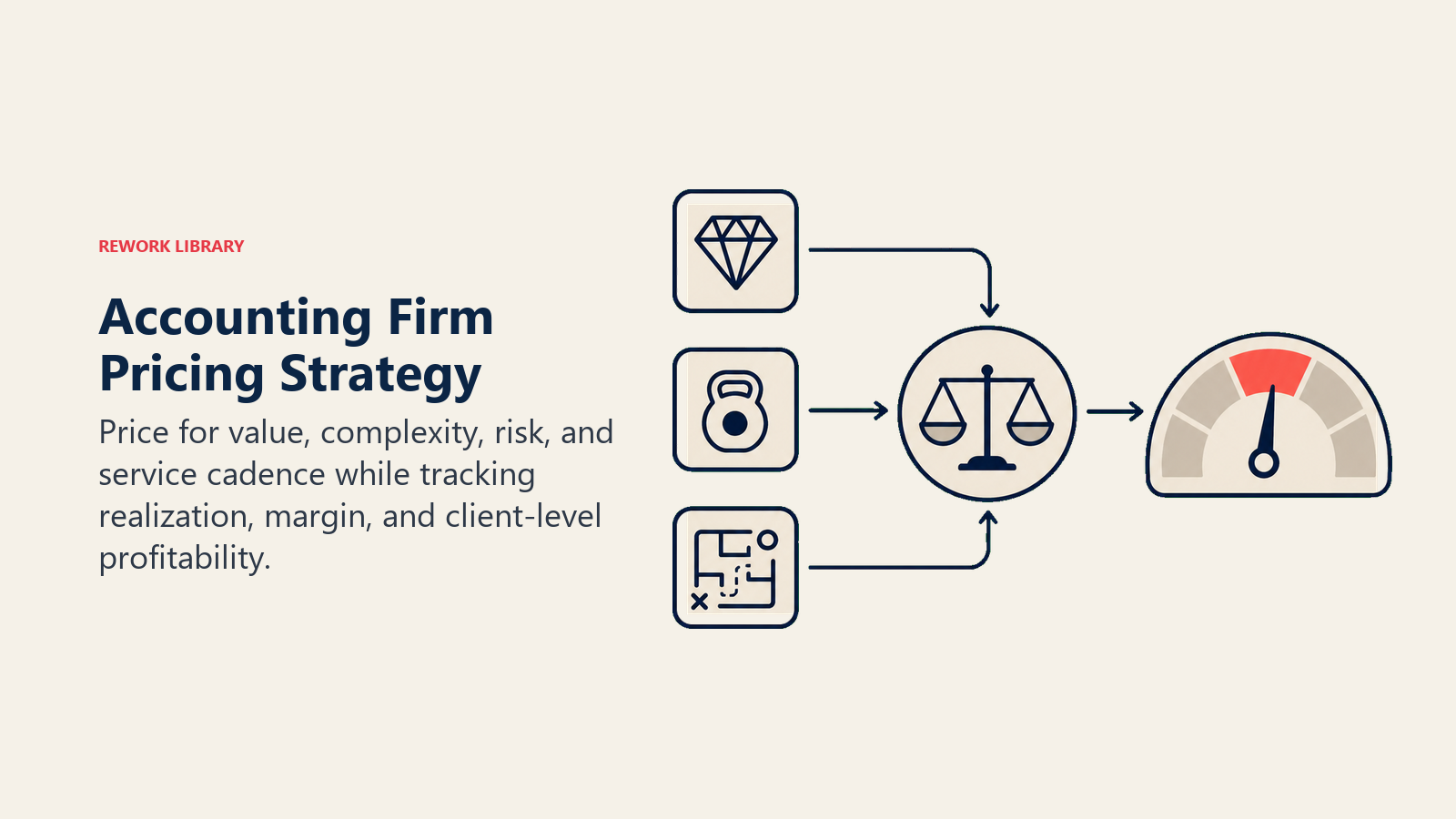
Pricing by service type
Different services should have different pricing approaches:
Compliance work: Fixed-fee pricing based on complexity
- You know roughly how long a 1040 with Schedule C takes. Price accordingly.
- Use past year complexity to guide current year pricing
- Build price increases into engagement letters (5-10% annual increases are standard)
Tax planning: Value-based pricing tied to tax savings
- If you're saving a client $30,000, charging $5,000-8,000 is reasonable
- You're not pricing by hours spent. You're pricing by value delivered.
CFO services: Monthly retainer based on scope
- Price for outcomes and access, not just time
- A $5,000/month CFO retainer might only require 15 hours of partner time, but the value is strategic guidance and availability
Project work: Fixed-fee based on scope and deliverables
- Business valuation: $10,000-30,000 depending on complexity
- Succession planning: $20,000-50,000 for comprehensive engagement
Realization and collection
You can have great rates but terrible profitability if you don't collect what you bill.
Realization = (Amount billed / Standard rate × hours worked). If your standard rate is $250/hour and you write off 20% of time, your realization rate is 80%. Industry average is 85-92%. Top firms are 93-97%.
Write-offs happen when:
- You underestimate fixed-fee engagements
- Partners spend time they didn't budget for
- You provide scope creep services without charging
- Clients dispute fees and you cave
Collection = (Cash collected / Amount billed). If you bill $500K but only collect $450K, your collection rate is 90%. Industry average is 95-98%. Every dollar you don't collect is pure profit loss.
Collection issues happen when:
- You don't have clear payment terms (payment due at delivery, not 30 days later)
- You don't require retainers for large engagements
- You don't have automated billing and follow-up systems
- You work with clients who consistently pay late
Margin improvement strategies
Increase profitability without working more hours:
- Raise prices: 10% price increases on renewals boost profit by 30-40% (assuming you maintain volume)
- Reduce low-margin work: Fire or reprice clients below your profitability threshold
- Automate and systematize: Technology that reduces prep time by 20% increases margin by 25%+
- Leverage staff better: Partners shouldn't do work that staff can handle at $80/hour
- Expand advisory mix: Shift revenue from 70% compliance to 50% compliance, 50% advisory
Fee communication and justification
Clients don't push back on price. They push back on value perception. If a client thinks your $5,000 tax return is just data entry, they'll complain. If they understand you're optimizing their tax position, structuring their business correctly, and preventing costly mistakes, $5,000 feels reasonable.
How you present fees matters:
- Don't apologize for pricing: "The fee for this engagement is $7,500" (not "I know this is expensive, but...")
- Tie fees to value: "This engagement will include X, Y, Z, which should result in $[value] in savings/benefit"
- Use benchmarks: "For a business of your size and complexity, this is consistent with market rates"
- Payment terms upfront: "We require a $3,000 retainer, with the balance due upon completion"
And always have fee conversations before you do work, not after.
Technology and operational efficiency
You can't scale an accounting practice without leveraging technology. Partner time is too expensive to waste on manual tasks.
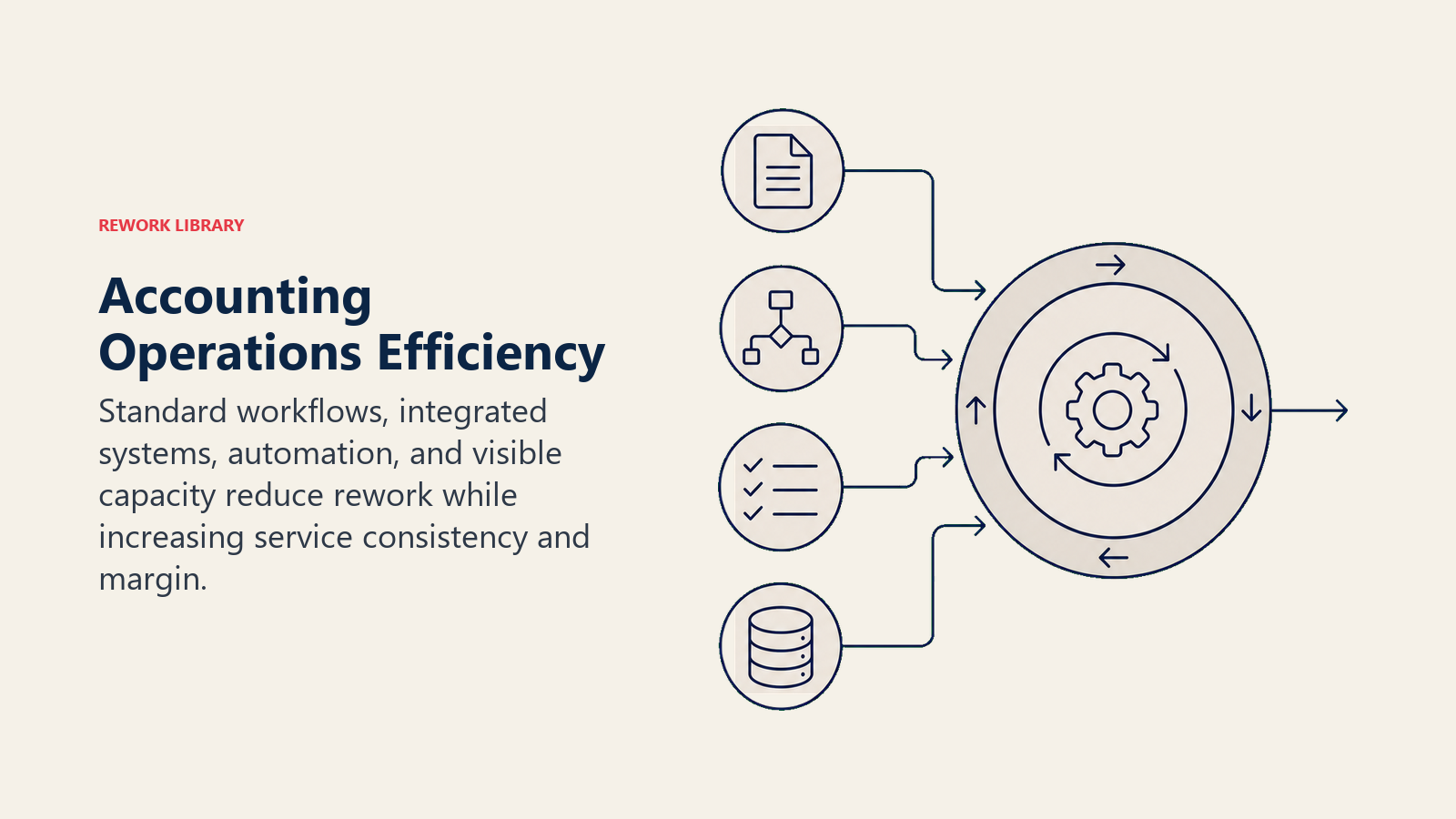
Accounting software ecosystem
Core practice management:
- Tax software: Drake, ProSeries, Lacerte, UltraTax for tax prep
- Practice management: Karbon, Financial Cents, XCM Solutions for workflow and project tracking
- Time tracking: TSheets, Harvest, or built-in practice management time tracking
Client collaboration and document management:
- Client portals: Liscio, SmartVault, SafeSend for secure document exchange and e-signatures
- Document management: Sharefile, NetDocuments, or built-in portal solutions
- E-signature: DocuSign, Adobe Sign for engagement letters and tax forms
Bookkeeping and financial tools:
- Accounting platforms: QuickBooks Online, Xero, NetSuite (depending on client size)
- Bookkeeping automation: Hubdoc, Dext, for automated data capture
- Bank reconciliation: Built-in automation plus AI-powered matching
Advisory and financial planning:
- CFO dashboards: Fathom, Spotlight Reporting, LivePlan for client financial reporting
- Forecasting tools: Jirav, Finmark, Float for cash flow projections
- Tax planning: Corvee, Holistiplan for tax optimization scenarios
Process efficiency and automation
Where to focus automation efforts:
- Document collection and organization (60% time savings)
- Data entry and bank reconciliation (70% time savings with AI tools)
- Tax return assembly and review (30% time savings)
- Client communication and scheduling (40% time savings)
- Billing and collections (50% time savings with automated reminders)
The goal isn't eliminating humans. It's freeing up human time for high-value advisory work. If technology can handle data entry and document organization, your staff can focus on analysis, strategy, and client communication.
Client self-service and portal adoption
The more clients can do themselves, the less time you spend on administrative work:
- Upload their own documents instead of emailing attachments
- Review and approve returns electronically instead of scheduling in-person meetings
- Access prior year returns and documents 24/7 instead of calling your office
- Pay invoices online instead of mailing checks
Portal adoption requires training and expectations:
- Onboarding new clients with "here's how we work" orientation
- Clear instructions on portal usage
- Incentives for early document submission through portal
- Consequences for not using portal (longer turnaround times, additional fees)
Data security and compliance
Accounting firms are high-value targets for cybersecurity attacks. Client data includes SSNs, financial statements, banking information, and tax records.
Minimum security requirements:
- Multi-factor authentication on all systems
- Encrypted email and file sharing for client data
- Regular data backups with offsite storage
- Employee training on phishing and security threats
- Cyber liability insurance
- Annual security audits
- Secure password management (LastPass, 1Password)
One data breach can destroy your firm's reputation and create massive liability. Security isn't optional.
Talent and team development
Your firm's capacity is limited by your team's capacity. You can't grow without developing and retaining talent.
Recruiting and retention challenges
Accounting has a talent shortage. Competition is fierce for good staff, especially experienced seniors and managers. And the profession has a burnout problem - tax season hours scare away potential recruits.
Winning the talent war requires:
- Competitive compensation: Pay at or above market rates, bonus for performance
- Work-life balance: Flexible schedules, remote work options, reasonable busy season expectations (50-55 hours, not 70)
- Career development: Clear advancement path, training budgets, mentorship
- Culture and values: Treat people like humans, not billable hour machines
- Technology investment: Give people good tools so work isn't painful
Firms that market themselves as "we grind during tax season but actually have lives the rest of the year" attract better candidates than "tax season is 80-hour weeks, suck it up."
Skills development and specialization
Not everyone needs to be a generalist. Create specialization tracks:
- Tax specialists who go deep on complex tax issues
- Bookkeeping specialists who handle monthly client financials
- Advisory specialists who develop CFO and strategic skills
- Technology specialists who manage systems and automation
Invest in training:
- Technical CPE for compliance skills
- Advisory training for consultative skills (financial analysis, business strategy)
- Software training for efficiency tools
- Soft skills training for client communication and sales
Team structure evolution
As you grow, your organizational structure should evolve:
Solo practitioner (0-$300K revenue):
- You do everything
- Maybe one admin or bookkeeper
Small firm ($300K-$1M):
- Partner + 2-4 staff
- Staff handles prep, partner reviews and manages clients
- Specialization by service line starts to make sense
Growing firm ($1M-$3M):
- Multiple partners or senior managers
- Team structure by service line (tax team, bookkeeping team, advisory team)
- Client service managers who own client relationships
Mature firm ($3M+):
- Partners focus on advisory and relationship management
- Managers handle complex technical work and client service
- Staff handles preparation and routine work
- Support staff for admin, marketing, IT
The key is leveraging partner time. Partners billing at $300-400/hour shouldn't be doing work that staff can handle at $80-100/hour. Your job as a partner is bringing in clients, managing relationships, providing expert guidance, and developing team. Not preparing tax returns.
Key performance indicators and firm metrics
You can't improve what you don't measure. These are the metrics that matter for accounting firm growth.
Revenue metrics:
- Total revenue: Annual and monthly tracking
- Revenue per client: Average annual billing per client relationship
- Revenue per partner: $400K-600K is typical for small firms, $800K-1.5M for mature advisory-focused firms
- Revenue per employee: $150K-200K is typical
- Recurring revenue percentage: What % comes from monthly retainers vs one-time work?
Profitability metrics:
- Gross margin by service line: What does tax prep vs advisory vs bookkeeping actually make?
- Net profit margin: 20-30% is typical for well-run firms
- Partner income: What are partners actually taking home?
Productivity metrics:
- Utilization rate: Billable hours / available hours. Target 60-70% for partners, 75-85% for staff
- Realization rate: Billed amounts / standard rate × hours. Target 90-95%
- Collection rate: Cash collected / amounts billed. Target 96-98%
Client metrics:
- Client retention rate: What % of clients return each year? Target 95%+
- Client acquisition cost: Marketing + BD time cost to acquire new client
- Lifetime value: Total revenue from client over relationship duration
- Service penetration: How many service lines does average client use?
Pipeline metrics:
- Proposal volume: How many proposals out in market?
- Proposal win rate: What % convert? 40-60% is typical for warm leads
- Sales cycle length: Time from first conversation to signed engagement
- Pipeline value: Total potential revenue in your sales pipeline
Review these monthly, adjust quarterly, and use them to guide strategic decisions.
Growth stage roadmap
Here's how firms typically evolve as they scale:
Stage 1: Compliance Foundation ($0-$500K revenue)
- Solo practitioner or partner + 1-2 staff
- 80-90% compliance revenue
- Focused on building client base and reputation
- Limited technology, manual processes
- Growth comes from referrals and networking
- Priority: Establish credibility, build foundation client base, streamline core processes
Stage 2: Advisory Expansion ($500K-$1.5M revenue)
- 2-3 partners/managers + 3-5 staff
- 60-70% compliance, 30-40% advisory
- Beginning to add tax planning and CFO services
- Implementing practice management and client portal technology
- More deliberate marketing and positioning
- Priority: Build advisory capabilities, systematize compliance work, develop team
Stage 3: Service Line Specialization ($1.5M-$3M revenue)
- Multiple partners with defined roles
- 40-50% compliance, 50-60% advisory
- Clear service packaging for advisory offerings
- Teams structured by service line or industry
- Investment in marketing and business development
- Priority: Scale advisory services, optimize service mix, build sustainable infrastructure
Stage 4: Platform Business ($3M+ revenue)
- Partner group with clear ownership structure
- Advisory-led business with compliance as entry point
- Industry or service specialization strategy
- Sophisticated technology stack
- Brand recognition in market
- Priority: Optimize profitability, build enterprise value, prepare for eventual exit or succession
The goal isn't necessarily reaching Stage 4. Some partners are happiest running a $1M-2M lifestyle practice with great margins and work-life balance. Others want to build $10M+ regional firms. Know your goal and build accordingly.
Where to go from here
Growing an accounting firm isn't about working more hours during tax season. It's about building a business model that creates value beyond compliance, captures that value through advisory services, and scales through people, process, and technology.
The firms winning this game do three things consistently:
- They position themselves as strategic advisors, not just compliance vendors
- They build repeatable systems for delivering high-margin advisory services
- They invest in their team and technology to create leverage
If you're still running your practice like it's 1995 - charging by the hour for compliance work, seeing clients once a year, and hoping for referrals - you're leaving millions on the table and burning yourself out.
Start with one expansion step:
- Add tax planning services to your top 20 clients
- Launch a fractional CFO offering for business clients
- Implement a client portal and automate document collection
- Hire your first advisory specialist
- Raise prices 15% on renewal clients
Then build from there. Growing a firm is a multi-year journey, but every step compounds.
For more on building professional service businesses, see:

Sales Director
On this page
- The accounting firm business model reality
- Understanding your client lifecycle economics
- Service line expansion strategy
- Service mix optimization
- Client acquisition and market positioning
- Target market segmentation
- Client qualification framework
- Tax season leverage strategy
- Advisory services development and packaging
- Client retention and lifetime value optimization
- Pricing and economic optimization
- Technology and operational efficiency
- Talent and team development
- Key performance indicators and firm metrics
- Growth stage roadmap
- Where to go from here