Workshop Facilitation: Driving Client Alignment, Decision-Making, and Action
Turn this article into takeaways for your work.


Each assistant summarizes the article only for you and suggests best practices for your work.
Workshop facilitation is the practice of designing and running a structured, time-boxed session that helps a client team reach alignment, make decisions, and commit to action. For agencies and professional services firms, well-run workshops become inflection points in an engagement: they compress weeks of debate into focused hours and give clients ownership of the outcome, because people support what they help build.
Here's what happens in most strategy meetings - twenty smart people sit in a room for three hours, have intense discussions, take notes, and walk out with vague commitments and zero clarity on what happens next. Six weeks later, nothing has changed. Everyone wasted time they couldn't afford to waste.
Workshops, when done right, are different. A well-facilitated workshop compresses weeks of back-and-forth decision-making into focused hours. It creates alignment among stakeholders who've been talking past each other for months. It turns abstract strategies into concrete action plans with owners and deadlines.
But here's the problem - most consultants run workshops like they're giving presentations. They dominate the conversation, push their agenda, and wonder why clients don't feel ownership of the outcomes. Real facilitation is harder than it looks. It's about creating the conditions for clients to do their best thinking, not showing off yours. Workshop facilitation is a key component of many consulting engagement models.
This guide walks through how to design and facilitate workshops that clients actually value. The kind that become inflection points in engagements, not just expensive meetings.
What makes workshops valuable in consulting
Workshops solve specific problems that normal meetings can't. They're not just "big meetings." They're structured problem-solving sessions with clear objectives and designed outcomes.
The revenue angle matters too. Workshops can be standalone services - "we'll run a half-day strategic planning session for $15K" - or embedded in larger engagements. Some firms build entire practices around facilitation, charging $20-50K for multi-day strategic planning workshops or innovation sprints. Pricing these effectively requires understanding value-based pricing approaches.
But the real value isn't just the fee. Workshops create client value in ways that move engagements forward:
Alignment across stakeholders: Your client's leadership team has been arguing about priorities for months. Everyone has different interpretations of "the strategy." A workshop forces them into the same room with the same frameworks to reach actual consensus. When done well, people walk out with shared understanding and commitment.
Accelerated decision-making: Decisions that would take weeks of email chains and sequential meetings happen in hours when you design the right process. You're compressing the decision cycle by creating space for focused deliberation.
Team engagement and buy-in: People support what they help create. If you just email a strategy deck, it's your strategy. If you facilitate a workshop where the team builds it together, it's their strategy. Ownership changes everything.
Visible progress and momentum: Workshops create events. Before the workshop, there's uncertainty. After, there are decisions, action plans, and momentum. Clients feel movement, which is especially valuable when projects feel stuck.
The best workshops don't just produce outputs (slide decks, action items). They shift how teams think and work together. That's the consulting value that clients remember.
Workshop fundamentals
Let's define terms. A workshop is a structured, facilitated session designed to achieve specific outcomes in a fixed timeframe. The key words are "structured" and "facilitated." You're not just gathering people and hoping for the best. You've designed an agenda with activities that move the group toward defined outcomes.
Common workshop types you'll run as a consultant:
Strategic planning workshops: Defining or refining vision, mission, goals, strategic initiatives, and priorities. Usually involves leadership teams working through frameworks like SWOT, OKRs, or strategic choice cascades.
Problem-solving workshops: Identifying root causes of specific challenges and developing solution options. Might use techniques like fishbone diagrams, 5 whys, or design thinking methodologies.
Decision-making workshops: Evaluating options, building consensus, and committing to a path forward. Often involves scoring frameworks, tradeoff discussions, and structured decision protocols.
Team alignment workshops: Getting groups on the same page about roles, priorities, ways of working, or organizational changes. Less about making decisions, more about building shared understanding.
Innovation workshops: Ideation sessions focused on identifying opportunities, generating new ideas, or designing new offerings. Usually involves brainstorming, customer journey mapping, or opportunity assessment.
Retrospective workshops: Reviewing what happened (after a project, quarter, or incident), extracting lessons learned, and identifying improvements. Common in agile environments but valuable anywhere.
From an engagement model perspective, workshops fit three ways:
Standalone services: Client pays specifically for the workshop. You deliver the session, provide documentation, and you're done.
Embedded in consulting projects: The workshop is part of a larger engagement. "In week 3, we'll run a two-day strategic planning offsite" as part of a 12-week strategy project.
Retainer-based: Clients on retainer might call on you quarterly to facilitate planning sessions or problem-solving workshops as needs arise.
Most workshops run half-day to two full days. Anything shorter is usually just a meeting. Anything longer and you're running a multi-day offsite, which has different dynamics.
Workshop design framework
Good workshops are built backwards. Start with outcomes, then design the process to get there. Most people do it backwards - they pick activities they like and hope they lead somewhere useful.
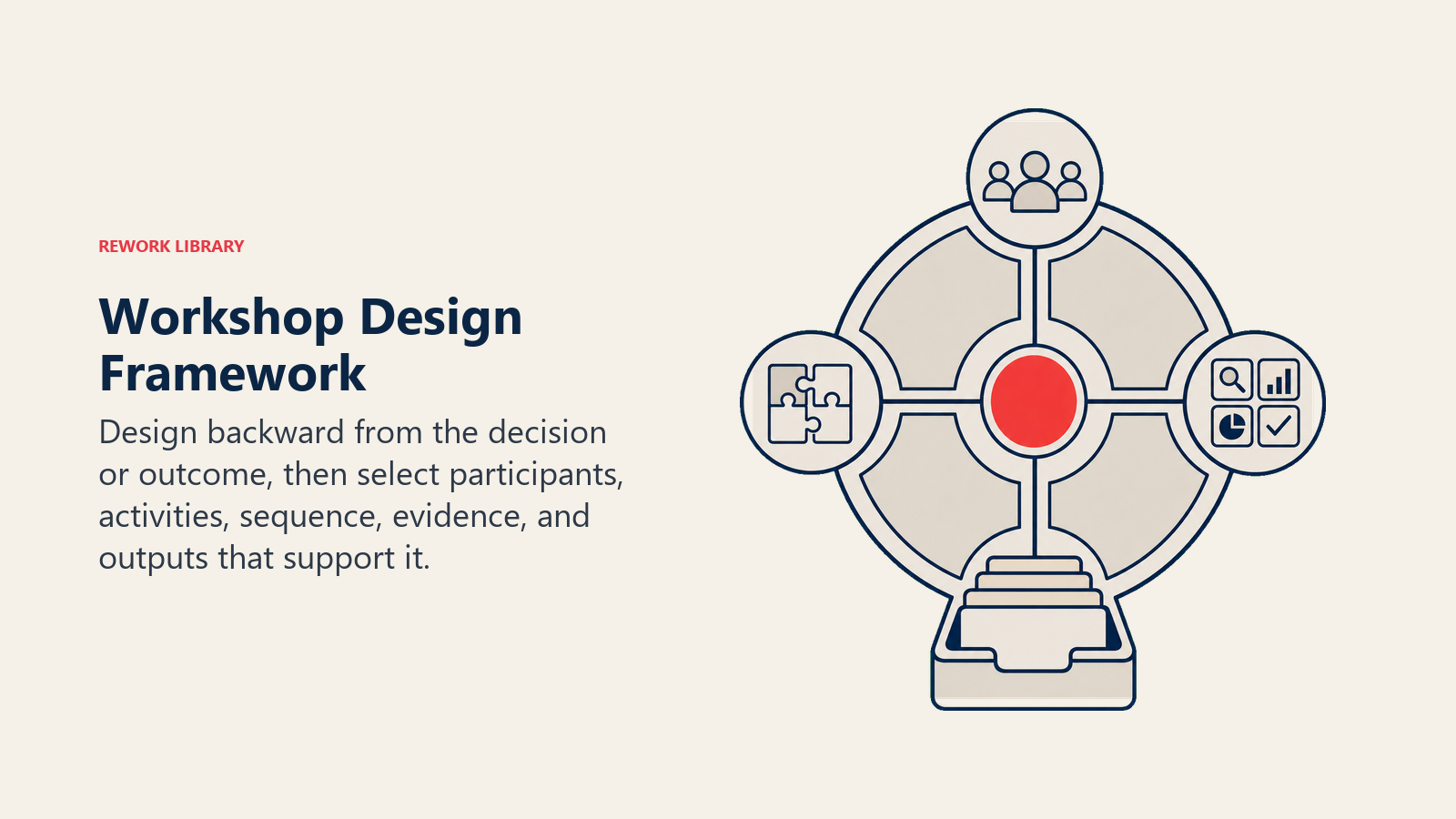
Defining clear objectives and desired outcomes - What needs to be different after this workshop? Not "we'll discuss strategy." That's an activity, not an outcome. Real outcomes look like "Agree on our top 3 strategic priorities for next year with success metrics defined" or "Develop action plan to improve customer retention with owners and 30-day milestones."
Be specific. If you can't describe success in concrete terms, you're not ready to design the workshop yet. Write down "By the end of this session, the team will have..." and complete that sentence with tangible deliverables.
Participant selection and stakeholder alignment - Who needs to be in the room? This is political and strategic, not just logical. You need:
- Decision-makers who can actually commit resources
- People with relevant expertise and context
- Representatives of key stakeholder groups who need to buy in
- The right diversity of perspectives to avoid groupthink
But you also can't have 40 people. Workshops get exponentially harder above 15-20 participants. If you need broad input, consider breakout groups or pre-workshop interviews to gather perspectives that inform the session.
Before the workshop, align with the executive sponsor. What are their non-negotiables? What decisions are really on the table vs already made? What political dynamics do you need to navigate? Going in blind is asking for trouble.
Agenda design and time allocation: Map out the flow. A typical strategic planning workshop might look like:
- 9:00-9:30: Opening, context setting, objectives
- 9:30-10:30: Environmental scan (market trends, competitive landscape)
- 10:30-10:45: Break
- 10:45-12:00: Strategic challenges discussion (breakouts + share back)
- 12:00-1:00: Lunch
- 1:00-2:30: Strategic options development
- 2:30-2:45: Break
- 2:45-4:00: Priority setting and decision-making
- 4:00-4:30: Action planning and next steps
Build in more time than you think you need. Discussions always run long. If you have 90 minutes for a section, plan 60 minutes of content. The buffer is for questions, detours, and unexpected rich conversations.
Activity and exercise selection - Match activities to objectives. If you need divergent thinking (generate lots of options), use brainstorming or brainwriting. If you need convergence (narrow down to decisions), use voting or multi-criteria scoring. If you need understanding, use discussion and Q&A.
Don't fall in love with activities because they're interesting. I've seen consultants run complex gamified exercises that were fun but produced nothing useful. Every activity should have a clear purpose that maps to your outcomes.
Material and logistics preparation - What physical or digital materials do you need?
- Slide decks for framing and transitions
- Templates for exercises (strategy canvas, SWOT frameworks, etc.)
- Sticky notes, markers, whiteboards for analog collaboration
- Digital collaboration tools (Mural, Miro) for virtual or hybrid sessions
- Pre-read materials participants should review beforehand
Logistics matter more than you think. Room setup affects energy. Theater style (lecture) vs U-shape (discussion) vs small tables (breakouts) creates different dynamics. Make sure you have wall space for posting outputs. Check that tech actually works before the session.
Pre-work and participant preparation: Send materials 3-5 days before. Don't send them two weeks early (people forget) or the night before (people don't read). Include:
- Workshop objectives and desired outcomes
- Agenda and timing
- Any background reading or data to review
- Specific requests ("come prepared to discuss our top 3 customer challenges")
- Logistics (location, what to bring, meal arrangements)
Set expectations about participation. "This is a working session. Everyone will be asked to contribute ideas and perspectives." Some people show up thinking they can sit quietly in the back. Make it clear that's not how this works.
Common workshop types and approaches
Let me break down the major workshop types you'll run and what makes each one work.
Strategic planning workshops: These are about setting direction. The classic format:
Start with context and situation analysis. Where are we today? What's changed in our market? What opportunities or threats exist? This grounds the conversation in reality before jumping to blue-sky planning.
Then move to vision and aspiration. Where do we want to be in 3-5 years? What would success look like? This creates the target state.
Next comes the gap analysis. What stands between current and desired state? What strategic challenges must we solve?
Then you develop strategic initiatives or priorities. What big moves will close the gap? This is where you might use frameworks like strategy cascades or playing-to-win choice frameworks.
Finally, translate strategies into actionable plans. Who owns what? What resources are needed? What are the first 90 days of work?
The key is balancing aspiration with pragmatism. Teams love to ideate big visions but struggle with hard choices. Your job as facilitator is to push for specificity and trade-offs.
Problem-solving workshops: These start with problem definition. Use frameworks like "5 whys" or fishbone diagrams to get to root causes. Most teams want to jump straight to solutions, which leads to solving symptoms not problems.
Once you've defined the real problem, move to solution ideation. Brainstorming, case study reviews, benchmarking - whatever generates options.
Then evaluate solutions. Multi-criteria scoring works well: rate each option on feasibility, impact, cost, time to implement. This makes the tradeoffs visible.
Finally, build an implementation plan for the chosen solution(s). What are the steps? Who owns what? What could go wrong and how do we mitigate it?
The hardest part of problem-solving workshops is keeping people from falling in love with their pet solutions too early. Structure the process to separate generation from evaluation.
Decision-making workshops: These work best when you've done pre-work to frame options. If you're starting from scratch in the room, you'll run out of time.
Open with decision context. What are we deciding? What criteria matter? What constraints exist? Get alignment on the decision framework before evaluating options.
Present each option clearly. If there are three strategic paths, give each one a fair hearing. Assign different breakout groups to stress-test different options - this prevents groupthink.
Use structured decision tools. Simple voting works for some decisions. For complex choices, use weighted scoring (rate each option on 5-6 criteria, multiply by importance weights). The math forces clarity on tradeoffs.
Build consensus through rounds. First vote might be all over the map. Discuss why people voted as they did. Second vote often converges as people hear new perspectives.
Document the decision and rationale. "We chose X because of Y, acknowledging tradeoff Z." This helps when people question the decision later.
Team alignment workshops: These are less about decisions and more about shared understanding. The enemy here is assumptions - everyone thinks they're aligned until you actually map out how people see things differently.
Start with individual reflection. Have people independently write down their view of priorities, challenges, or role definitions. Then share. The differences are usually stunning.
Use visual frameworks to map consensus. If aligning on priorities, have everyone put sticky notes on an impact/effort matrix. Clustering shows where agreement exists and where it doesn't.
Discuss divergences without judgment. "Interesting that three people see customer retention as top priority but two don't. Let's explore why." The goal is understanding, not winning arguments.
End with explicit agreements. "We all commit to X." Have people sign off, literally. Verbal agreements evaporate. Written commitments (even just names on a whiteboard) create accountability.
Innovation workshops: Start with framing the opportunity space. What customer problems are unsolved? What market shifts create openings? Don't just say "let's brainstorm ideas." That leads to random noise.
Use structured ideation techniques. I like "How Might We" questions - reframe challenges as opportunities. "How might we reduce customer onboarding time by 50%?" gives direction without prescribing solutions.
Run divergent then convergent phases. First, generate volume. No judgment, no filtering. Then cluster themes, identify patterns, and narrow to the most promising directions.
Prototype and stress-test top ideas. Don't just pick winners based on gut feel. Ask: What would have to be true for this to work? What could kill it? How could we test it cheaply?
Build business cases for finalists. Even rough back-of-envelope math. Revenue potential, cost to build, time to market. This separates interesting ideas from viable ones.
Retrospective workshops: These require psychological safety. If people don't feel safe being honest, you'll get sanitized nonsense.
Start with data and facts. What actually happened? Timeline the project or period. This grounds conversation in reality, not interpretations.
Then explore what went well. People forget to celebrate wins. Pull out lessons from success, not just failure.
Then discuss what didn't work. Use frameworks like "Start, Stop, Continue" or "Mad, Sad, Glad." Structure makes it less personal.
Identify root causes, not symptoms. "Communication was bad" isn't useful. "We didn't have a clear decision-making process, so debates circled endlessly" is actionable.
End with commitments to specific changes. "In the next project, we will [specific behavior]." Make it concrete.
Pre-workshop preparation
The workshop itself is only half the work. What you do beforehand determines success.
Stakeholder interviews: Before designing the agenda, talk to 5-8 key participants. Ask:
- What are you hoping to get out of this workshop?
- What are the biggest challenges or questions we need to address?
- What would make this a waste of time?
- Are there political dynamics or sensitivities I should know about?
These conversations shape your design. You'll discover that half the room thinks you're solving problem A and the other half thinks it's problem B. Better to find out before the workshop, not during.
Pre-work assignments: Don't make pre-work optional or vague. Be specific:
- "Read the attached market analysis and come prepared to discuss implications for our strategy"
- "Complete this 10-minute customer challenge assessment before Tuesday"
- "Review last year's strategic priorities and your assessment of progress"
Chase people who don't do it. If half the room shows up unprepared, you waste the first hour getting them up to speed.
Material preparation: Build your decks, templates, and exercise materials in advance. Don't wing it. Have:
- Opening slides that frame objectives and agenda
- Transition slides between sections that recap and set up what's next
- Templates for each exercise (empty frameworks people will fill in)
- Backup materials in case discussions go in unexpected directions
Test everything. Especially technology. If you're using Mural or Miro, build the board beforehand and make sure everyone can access it.
Logistics coordination: Confirm the room setup you need. Walk the space if possible. Check:
- Is there wall space for posting outputs?
- Are there whiteboards or flip charts?
- How's the lighting? (Dim rooms kill energy)
- Can people actually see screens from all seats?
- Is the wifi fast enough for 20 people on video calls?
Handle meal logistics. If it's a full-day workshop, coordinate lunch. Working lunches are fine, but build in real breaks. People's brains need rest.
Ground rules and participation norms: Set expectations upfront. I send this in the pre-work and repeat it at the start:
- Everyone participates. No observers.
- Phones and laptops closed unless needed for exercises.
- Disagree with ideas, not people.
- Stay on topic. Parking lot for interesting tangents.
- Start and end on time.
- What's discussed here stays confidential.
Having these explicit makes it easier to enforce them when someone inevitably checks email during a breakout.
Communication and expectation setting: Send reminders. One week before: "Looking forward to the workshop next Tuesday. Here's the pre-work." Two days before: "Reminder - workshop this Thursday. See you at 9am at [location]." Day before: "Final reminder - tomorrow 9am. Please review the pre-read if you haven't yet."
Manage executive sponsor expectations separately. Confirm they're clear on their role. Will they kick off the session? Make closing remarks? Participate as equals or sit back and observe? Clarify this so there are no surprises.
Facilitation techniques and tools
Running the actual workshop is where most consultants struggle. They know the content but can't manage group dynamics. Here are the core techniques:
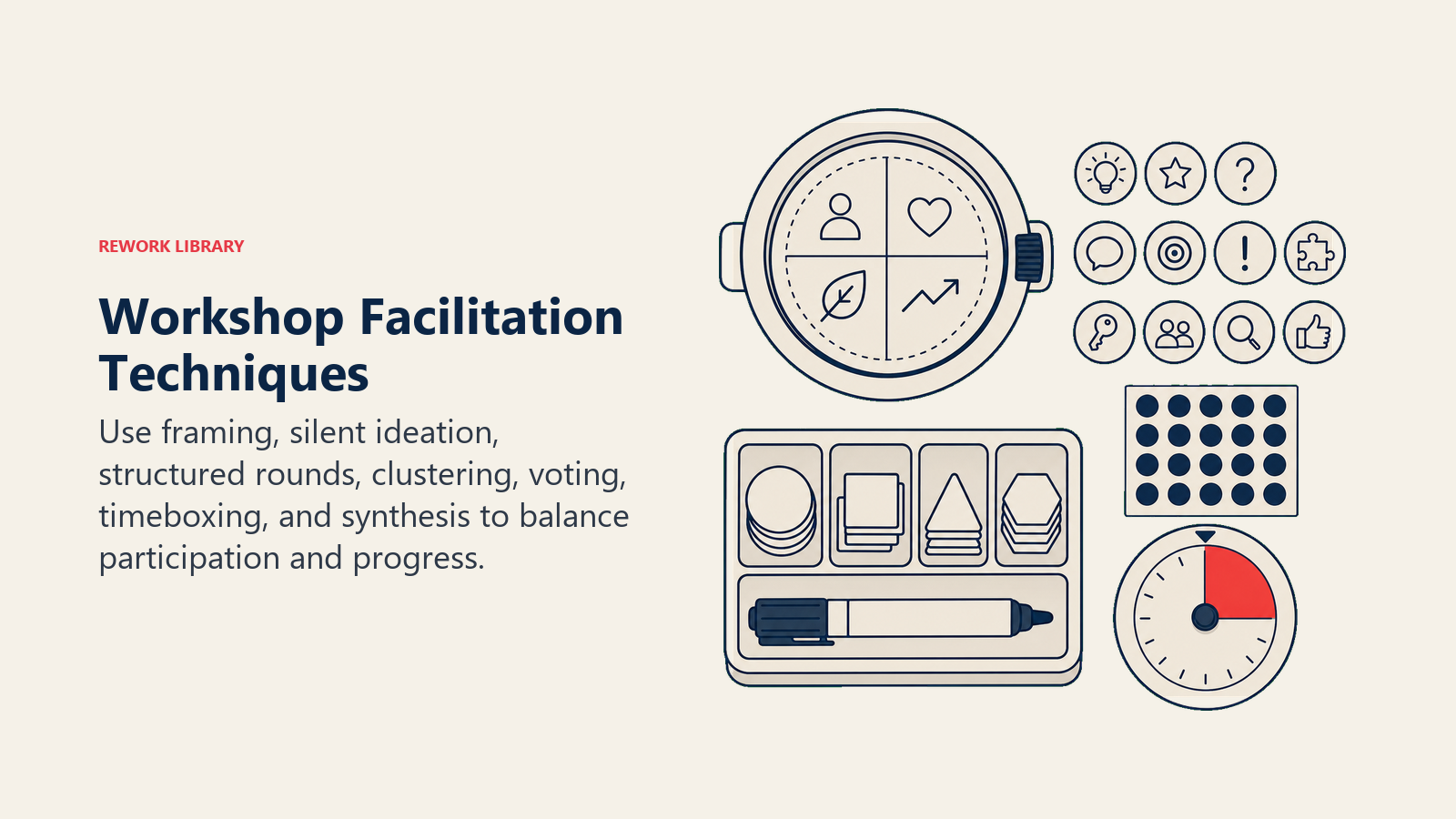
Brainstorming and ideation techniques: Standard brainstorming (shout out ideas while someone writes them down) is actually not that effective. People self-censor. Loud voices dominate. Ideas are forgotten.
Better: Brainwriting. Everyone silently writes 3-5 ideas on sticky notes. Then you collect and post them all at once. This gives you more volume and diversity because introverts contribute equally.
Or use Round-robin brainstorming: Go around the circle. Everyone shares one idea, or passes. No commentary. Just collection. After two rounds, you'll have 30+ ideas to work with.
For remote workshops, digital brainstorming in Mural or Miro works well. Everyone adds sticky notes simultaneously. You can see ideas emerging in real-time.
The key rule: separate generation from evaluation. First, generate volume. Then cluster, categorize, and evaluate. Mixing these kills creativity.
Prioritization frameworks: When you have 40 ideas and need to narrow to 5, use structured approaches.
Impact/effort matrix: Plot ideas on 2x2 grid. High impact, low effort = quick wins. High impact, high effort = strategic bets. Low impact, low effort = fill-ins. Low impact, high effort = avoid.
Dot voting: Give everyone 5 dots. They vote for their top ideas. This surfaces collective priorities fast.
Weighted scoring: Rate each option on 3-5 criteria (impact, feasibility, cost, alignment to strategy). Multiply by importance weights. Sum the scores. The math forces explicit tradeoffs.
Don't let people just argue. Structure surfaces logic and creates fairness.
Group discussion and dialogue facilitation: Your job isn't to have the smartest ideas. It's to draw out others' thinking.
Use open questions: "What's your perspective on this?" not "Don't you think X?" Questions should invite exploration, not lead to your preferred answer.
Paraphrase and reflect: "So what I'm hearing is..." This confirms understanding and makes people feel heard.
Build on ideas: "That's interesting. How does that relate to what Sarah said earlier about...?" Connect threads. Help the group see patterns they might miss.
Probe for depth: When someone makes a claim, ask "What makes you say that?" or "Can you give an example?" Surface the reasoning, not just conclusions.
Balance airtime: If one person dominates, intervene politely. "Thanks, John. That's helpful. I want to make sure we hear from others too. Maria, what's your take?" Don't let loud voices steamroll the room.
Breakout sessions and small group work: For groups over 10, use breakouts. Full-group discussions get unwieldy fast.
Assign clear tasks. "Your breakout group will identify the top 3 barriers to customer retention and come back with initial solutions." Not just "discuss customer challenges."
Set time limits and hold them. "You have 25 minutes. I'll give you a 5-minute warning." When time's up, call people back. Otherwise, breakouts expand endlessly.
Rotate groups across exercises. Don't let the same 4 people work together all day. Mix it up to cross-pollinate thinking.
For report-backs, don't let each group present for 15 minutes. That's death by PowerPoint. Give groups 3 minutes each or have them post outputs and do a gallery walk.
Visual facilitation: Use whiteboards, flip charts, and sticky notes aggressively. Visual beats verbal for capturing complex thinking.
Draw frameworks as you go. If someone describes a process, sketch it on the whiteboard. People will correct or add to it, which deepens the conversation.
Post outputs on walls. When you complete an exercise, put the results where everyone can see them. This keeps work visible and prevents backtracking.
Use color coding. Different colored sticky notes for problems vs solutions, or to represent different stakeholder groups.
Take photos of everything. Whiteboard discussions, sticky note arrays, flip chart pages. You'll need these for documentation.
Time management and agenda control: Start on time even if people are still arriving. Waiting for stragglers teaches everyone that start times are negotiable.
Give time warnings. "We have 10 minutes left in this section." This helps people wrap up thinking.
Use a parking lot for off-topic ideas. "That's an important point but outside our scope today. Let me capture it here and we can address it later." Write it on a flip chart labeled "Parking Lot" so people see you're not dismissing their input.
When discussions run long, make explicit choices. "This is a rich conversation but we're 15 minutes over. We can keep going and skip the next break, or we can table this and move on. What do you want to do?" Give the group agency.
Build in buffer time. If your agenda is back-to-back with zero slack, you'll fall behind by hour two and stress out.
Managing dominant voices and quiet participants: Some people talk too much. Some barely speak. Your job is to balance.
For over-talkers: "John, you've shared a lot of great thoughts. I want to make sure we hear from people who haven't spoken yet." Or assign them a different role: "John, could you be our timekeeper for this exercise?" Gives them something to do besides talk.
For quiet folks: Call on them, but gently. "Lee, I'd love to hear your perspective on this." Don't put them on the spot with "Lee, solve this problem right now." Create safe entry points.
Use techniques that force equal participation. In round-robin sharing, everyone talks. In silent brainstorming, introverts contribute as much as extroverts.
Watch body language. If someone looks like they want to speak but can't get in, jump in: "Hold on, I think Sarah wanted to add something."
Managing workshop dynamics
The hardest part of facilitation isn't running exercises. It's managing people and emotions.
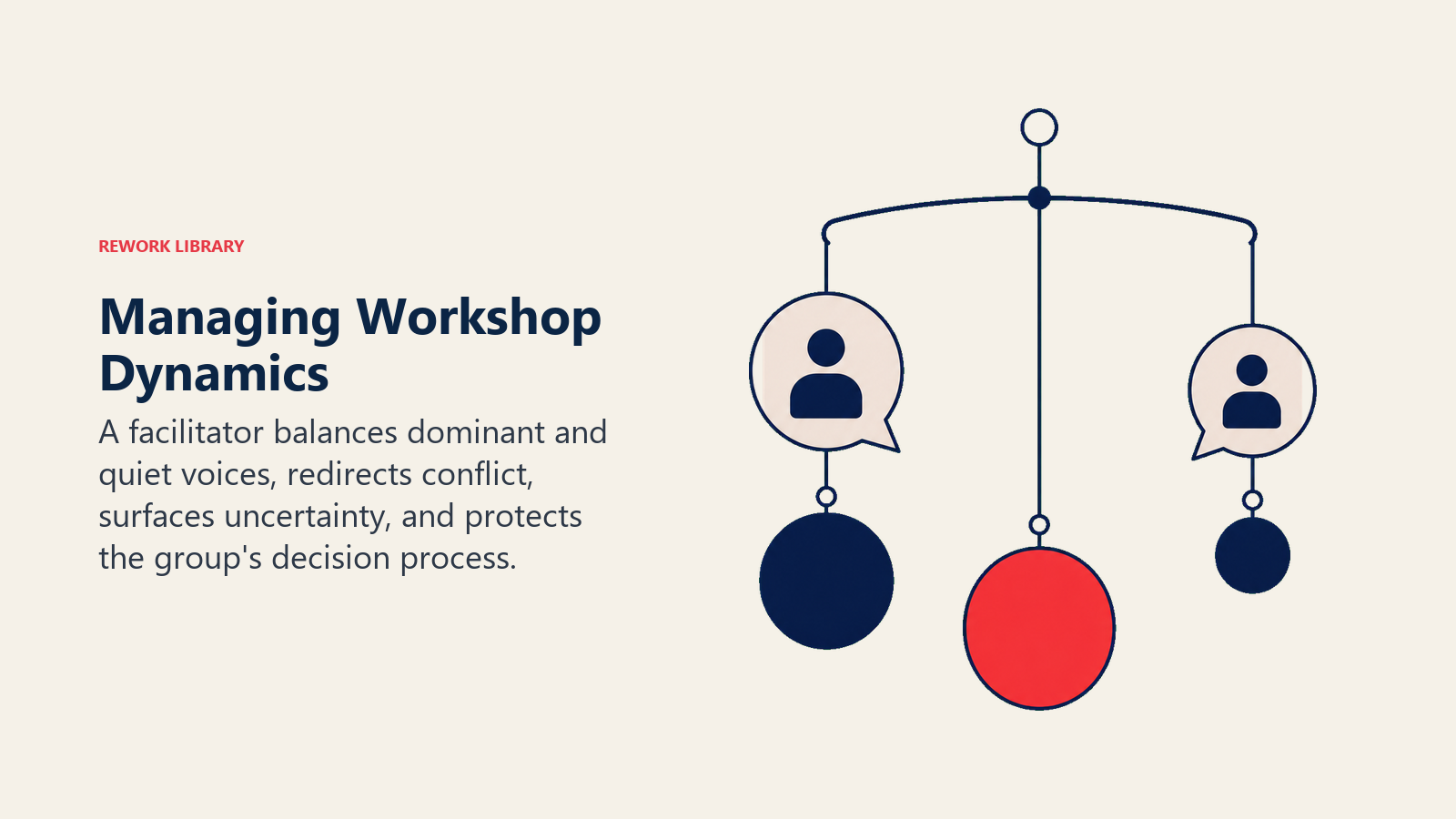
Building psychological safety and trust: People won't share real thoughts if they don't feel safe. You build safety through:
Normalizing disagreement: "We want different viewpoints. That's how we make better decisions." Say this explicitly.
Modeling vulnerability: Share your own uncertainty. "I don't know the answer here. That's why we're working on it together." When the facilitator admits not knowing, others feel safer doing the same.
Enforcing respect: The first time someone dismisses another person's idea with "That's ridiculous," shut it down. "We're critiquing ideas, not people. How could we build on what Alex suggested?" Set the tone early.
Confidentiality: What's said in the room stays in the room (within reason - don't protect truly problematic behavior). Make this explicit.
Handling conflict and disagreement productively: Conflict in workshops is often good. It means people care. But it can spiral.
When tension rises, name it neutrally: "I'm noticing strong feelings about this topic. That makes sense given the stakes. Let's make sure we understand each person's concerns."
Separate positions from interests: People argue positions ("We need to invest in product A!" vs "No, product B!"). Dig into interests. "What outcome are you trying to achieve?" Often the interests are compatible even if positions aren't.
Use data to depersonalize: "Let's look at what the customer data shows." Shifts from opinion battle to evidence-based discussion.
Reframe as problem-solving: "We have two different views on the right path. What criteria should we use to decide?" Turn conflict into a design challenge.
Don't suppress conflict prematurely. Let ideas clash. Just keep it productive.
Keeping discussions on track: Workshops wander. Someone brings up a tangent. Suddenly you're 20 minutes off-topic.
Acknowledge and redirect: "That's an important point about [tangent]. Let me capture it in the parking lot. Right now we need to focus on [main topic] to hit our objectives."
Tie back to objectives: "Remember, our goal for this session is to decide on Q1 priorities. Does this discussion move us toward that?" If not, defer it.
Timeboxing: "We can spend 5 more minutes on this, then we need to move on." Boundaries help.
Managing power dynamics and hierarchy: If the CEO is in the room, junior people will self-censor. You have to actively counteract this.
Separate ideation from evaluation: Have people write ideas individually before the CEO weighs in. This prevents people from just echoing the boss.
Use blind voting: People vote on priorities without seeing each other's votes. Then reveal. This surfaces honest views.
Ask the CEO to go last: In discussions, "Let's hear from everyone else first, then we'll get your take." Prevents people from just agreeing with the highest-paid person's opinion.
Use breakouts: Small groups are less intimidated. Then share back to the full group.
Encouraging full participation: Some people check out. They're physically present but mentally elsewhere.
Assign roles: Make people timekeepers, note-takers, or "devil's advocates" for breakouts. Gives them responsibility.
Direct questions: "Chris, you have a lot of experience with this. What's your take?" Call on people who've been quiet.
Change modalities: If people are zoning during discussion, switch to an exercise. Physical movement (like posting sticky notes) re-engages.
Check energy: "I'm sensing energy is dropping. Let's take a 10-minute break." Sometimes people just need to step away.
Building consensus and alignment: Consensus doesn't mean unanimous agreement. It means "I can live with this and support it even if it wasn't my first choice."
Test for consensus explicitly: "Can everyone commit to this direction, even if you have reservations?" If people say yes, you have consensus. If someone says "I fundamentally disagree and can't support this," you don't.
Identify and address blockers: If someone can't get on board, understand why. Is it a principled objection or a misunderstanding? Can you modify the decision to address their concern?
Document dissent: Sometimes consensus isn't possible. Document who disagreed and why, then move forward with majority support. "Three people had reservations about X for reasons Y. We're proceeding but will revisit in 30 days."
Dealing with difficult participants: Every workshop has one. The person who derails, dominates, or undermines.
The dominator: Uses half the airtime. Redirect: "Thanks. Let's get other voices in." If it continues, address privately during a break: "I need your help balancing participation. Can you give others space?"
The skeptic: Shoots down every idea. Channel it: "You're good at spotting risks. During this exercise, your job is to be devil's advocate and stress-test ideas." Give them permission to criticize, but in a structured way.
The distracted: On their phone or laptop constantly. Address it: "I need everyone fully present. If something urgent is happening, we understand, but otherwise let's close devices."
The underminer: Snide comments, eye rolls, side conversations that signal they don't respect the process. Call it out privately: "I'm picking up some resistance from you. What's going on?" Often there's a legitimate concern underneath.
Don't let bad behavior derail the group. Address it quickly, directly, and professionally.
Virtual and hybrid workshop facilitation
Virtual workshops are not just in-person workshops on Zoom. The dynamics are completely different.
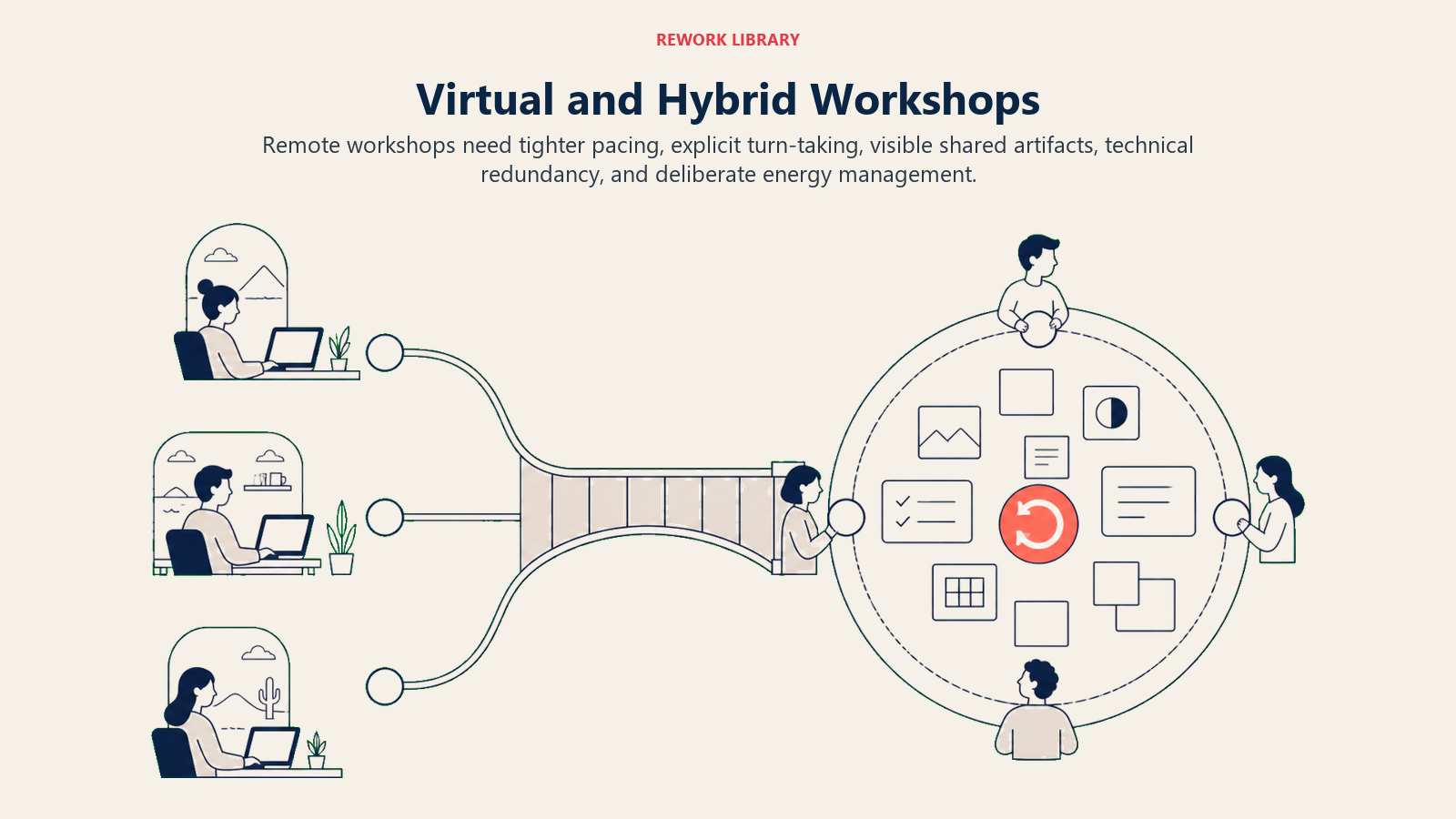
Technology platforms and tools: You need more than just video conferencing.
Video: Zoom, Teams, Google Meet. Enable gallery view so people see each other. Require cameras on (with exceptions for bandwidth issues).
Visual collaboration: Mural or Miro are essential for virtual workshops. These are digital whiteboards where everyone can add sticky notes, move elements, and work simultaneously. They replicate the tactile experience of in-person collaboration.
Polling and voting: Zoom polls, Mentimeter, or Slido for quick surveys and prioritization exercises.
Breakout rooms: Built into most video platforms. Critical for small group work.
Shared documents: Google Docs or Office 365 for collaborative note-taking and drafting.
Test everything before the workshop. Have participants log in 15 minutes early to troubleshoot tech issues.
Adapting activities for virtual environment: What works in person often flops virtually.
In person: Brainstorm on sticky notes, post on wall, cluster themes. Virtual: Use Mural. Everyone adds digital sticky notes. Facilitator or group clusters them together. Works great once people get the hang of it.
In person: Breakout discussions at separate tables. Virtual: Zoom breakout rooms with clear instructions posted in chat. Assign a note-taker for each room.
In person: Gallery walk where people review posted outputs. Virtual: Screen share the Mural board and walk through it, or give people 5 minutes to explore it independently then discuss.
The key: Be more structured and explicit. In person, you can read the room and improvise. Virtually, you need crystal-clear instructions.
Managing engagement and energy remotely: Zoom fatigue is real. People's attention spans are shorter.
Shorter sessions: A full-day in-person workshop might become two half-days virtually. 3-4 hours is the max before brains shut down.
More frequent breaks: Every 60-90 minutes, not every 2-3 hours. "We're taking a 10-minute break. See you back at 10:35."
Vary the pace: Don't do 90 minutes of talking heads. Mix discussion, individual work, breakouts, polls, and visual exercises.
Use cameras and engagement techniques: Ask people to give a thumbs up/down on camera for quick polls. Use chat actively for questions and input.
Call on people by name: More than in person. "Jorge, what's your reaction to this?" Keeps people engaged because they know they might be called on.
Breakout rooms and collaboration: Breakouts are your friend in virtual workshops. They create intimacy and focus.
Give crystal-clear instructions before sending people off. Don't just say "discuss customer challenges." Say "In your breakout: 1) Identify your top 3 customer challenges, 2) For each, note why it matters, 3) Assign someone to report back. You have 15 minutes."
Post instructions in chat so people can reference them in breakouts.
Assign groups thoughtfully. Randomizing is fine for some exercises, but for important discussions, put complementary perspectives together.
Pop into breakout rooms briefly to check progress and answer questions. But don't stay - your presence changes the dynamic.
Virtual facilitation best practices:
Run a tight ship: Timing matters even more virtually. Start on time, end on time, stick to the agenda. Virtual wandering kills engagement.
Use visuals constantly: Screen share frameworks, Mural boards, slides. Don't just talk into the void.
Manage mute strategically: Mute all when presenting to avoid background noise. Unmute for discussion (if the group is small). Use chat liberally.
Record with permission: Record the session so people can review later. But ask first - recording changes how people participate.
Engagement checks: "Show thumbs up if you're following this." "Type in chat your initial reaction." Get frequent participation signals.
Hybrid session considerations: Hybrid (some people in-room, some remote) is the hardest format. The in-room people have advantages. The remote people feel like second-class participants.
Equalize the experience: Have everyone join on their own device, even if they're in the same room. This sounds weird but it levels the playing field.
Or invest in good hybrid tech: camera that shows the whole room, mics that pick up everyone, large screen showing remote participants.
Assign a remote facilitator: If you're in the room, have a co-facilitator who's remote and specifically watches out for remote participants. They flag when someone remote wants to speak or is being overlooked.
Use digital collaboration tools: Even if some people are in-room, use Mural for all collaboration. Don't let in-room people work on a physical whiteboard that remote folks can't contribute to.
Hybrid is legitimately difficult. If possible, go fully in-person or fully virtual. Mixing is twice the work.
Capturing and documenting outcomes
Workshops produce a lot of information. If you don't capture it systematically, 80% will evaporate.
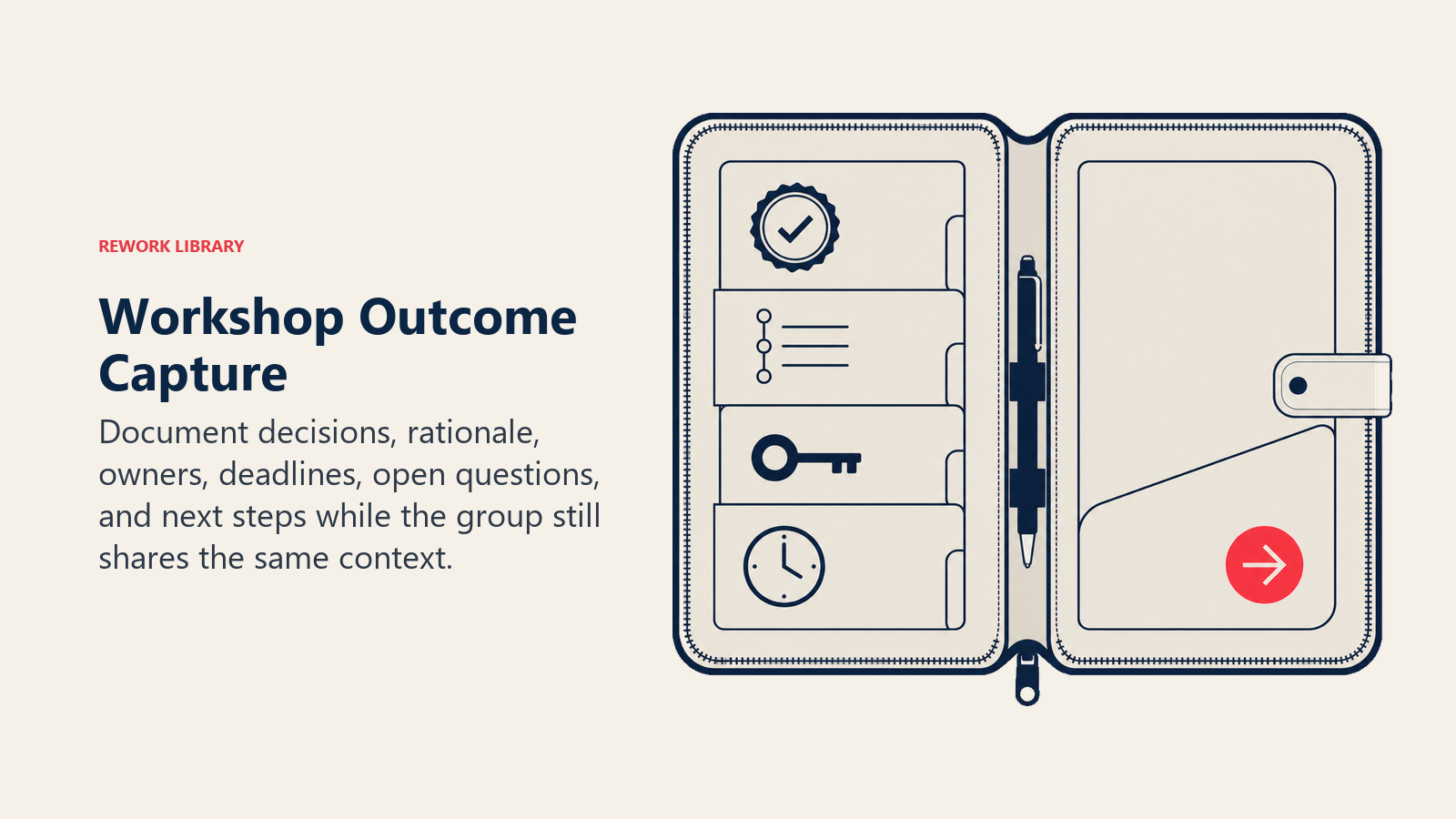
Real-time documentation and note-taking: Assign a dedicated note-taker or do it yourself while facilitating (harder but doable for experienced facilitators).
Capture:
- Key decisions made
- Action items with owners and deadlines
- Important quotes or insights
- Areas of disagreement or open questions
- Frameworks or models developed
Don't try to transcribe everything. Capture the substance, not every word.
Visual documentation: Take photos constantly. Whiteboard discussions, flip charts, sticky note arrays. These visuals often communicate better than written notes.
For virtual workshops, screenshot Mural boards and save them as PDFs.
Action item capture and ownership assignment: Don't let the workshop end without clear next steps.
Before you close, review the action items list: "Let me read what we've committed to. John, you're owning the customer survey by Feb 15. Sarah, you're developing the go-to-market plan by March 1. Any I'm missing?"
Get verbal confirmation from owners. If someone looks uncertain, address it: "Sarah, does March 1 work for you or do we need to adjust?"
Decision documentation and rationale: For major decisions, document not just what was decided but why. "We chose to prioritize product A over B because: 1) Larger addressable market, 2) Faster time to revenue, 3) Better strategic fit with long-term vision."
The rationale matters because in three months, someone will question the decision. Documentation prevents rehashing the same debate.
Post-workshop summary and follow-up: Send a summary within 48 hours while it's fresh. Include:
- Workshop objectives and participants
- Key outcomes and decisions
- Action items with owners and dates
- Next steps and timeline
- Parking lot items that need future attention
- Photos or visuals from the session
Keep it concise. 2-3 pages max. If you send a 20-page document, nobody reads it.
Sharing workshop outputs: Decide who gets the summary. Just participants? The broader leadership team? The full organization?
This is political. Check with your executive sponsor. Some workshop discussions are confidential. Others need to be communicated widely to build buy-in.
For broader communication, you might create two versions: detailed summary for participants, high-level overview for wider audience.
Post-workshop follow-up
The workshop is not the end. It's the beginning. What happens after determines whether the workshop creates change or becomes a forgotten event.
Summary document preparation and distribution: We covered this above, but emphasize speed. If you send the summary two weeks later, momentum is gone.
Use templates. Have a standard format so you're not starting from scratch each time. Plug in the specific content, add photos, done.
Action item tracking and accountability: Don't just document action items and hope they happen. Track them.
Set up a shared tracker (simple spreadsheet works). List each action item, owner, deadline, and status.
Send updates weekly or biweekly. "Here's where we are on workshop commitments. These three are on track. This one is at risk. John, what support do you need?"
This keeps pressure on. Action items without follow-up have a 20% completion rate. Tracked action items with regular check-ins hit 80%+.
Stakeholder communication: Update key stakeholders who weren't in the workshop but need to know outcomes.
Brief the CEO or executive sponsor first. "Here's what we accomplished, here are the decisions, here are next steps." Get their buy-in on communication plan.
Then communicate to broader stakeholders as appropriate. Use the workshop outcomes in leadership meetings, team updates, or company communications.
Implementation support planning: If the workshop produced a strategy or action plan, figure out what support is needed to implement it.
Do they need project management help? Technical expertise? Budget approval? Change management for organizational impact?
This might be a follow-on engagement for you. "The workshop defined the strategy. We can support implementation with..." Don't just leave them with a plan and no way to execute it. This creates opportunities for upsell and scope expansion.
Measuring workshop success and impact: Track both immediate and long-term outcomes.
Immediate:
- Participant satisfaction (quick survey)
- Objectives achieved (did we get the decisions/outputs we targeted?)
- Quality of outputs (are the action plans actually actionable?)
Long-term:
- Action item completion rate
- Did the decisions stick or get reversed?
- Tangible business outcomes from workshop-generated initiatives
If you run multiple workshops, look for patterns. Which types of workshops create the most value? Which facilitation techniques work best with which client types?
Client feedback collection: Send a brief survey within a week:
- Were the workshop objectives clear?
- Did we accomplish what you hoped?
- Was the facilitation effective?
- What would you change for next time?
- Would you recommend our workshop services to colleagues?
Keep it to 5-7 questions max. Make it easy to give feedback.
Use this feedback to refine your approach for the next workshop.
Common workshop pitfalls
I've seen hundreds of workshops. Here are the failure patterns:
Unclear objectives and poor design - The workshop has vague goals like "align on strategy." Nobody knows what success looks like. You spend three hours having unfocused discussions that produce nothing concrete.
Solution - Get ruthlessly clear on outcomes before you design anything. "By the end of this workshop, we will have identified and prioritized our top 5 strategic initiatives with success metrics and owners assigned." That's a clear target.
Wrong participants or poor stakeholder alignment - You don't have the actual decision-makers in the room. Or you have people who shouldn't be there. The CIO isn't at the customer experience workshop even though IT is central to the solution.
Solution - Map decision rights before finalizing the participant list. Who needs to approve decisions made in this workshop? Those people must attend. Also identify who brings essential expertise or perspective.
Over-structured agenda limiting discussion - You've designed the perfect agenda with 15-minute blocks for each topic. But real conversations don't fit in neat boxes. Important debates get cut off because you're "behind schedule."
Solution - Build flexibility into the design. Have core sections that must happen and optional sections you can skip if conversations run long. Prioritize depth over coverage.
Facilitator talking too much, not facilitating: The consultant dominates the workshop, presenting slides and sharing expertise. Clients become passive audience members. This is a presentation, not a workshop.
Solution: Talk less than 30% of the time. Ask more questions than you answer. Your job is to create space for client thinking, not to showcase yours.
Poor time management and running over: The workshop was supposed to end at 4pm. It's now 5:30 and you're still on section 3 of 5. People are exhausted and resentful.
Solution: Ruthless time discipline. Build in buffer. Cut content if you're running behind. End on time even if you don't finish everything. Better to accomplish 80% well than rush through 100% poorly.
No follow-up or action item tracking: The workshop produced great ideas and commitments. Nobody follows up. Three months later, nothing has changed.
Solution: Build accountability into the process. Summary within 48 hours. Action tracking starting immediately. Regular check-ins. Make follow-through non-negotiable.
Failing to manage difficult dynamics: There's tension between two executives. One person dominates every discussion. The team is cynical about "another workshop that won't change anything." You ignore these dynamics and hope they'll resolve themselves. They don't.
Solution: Address dynamics directly. Set ground rules. Intervene when someone dominates. Call out elephants in the room. "I'm sensing some skepticism about whether this will lead to change. Let's talk about that." Name it, don't avoid it.
Tools and templates
Build a workshop facilitation toolkit you can reuse:
Workshop design templates by type: Have template agendas for common workshop types:
- Strategic planning (full-day format)
- Problem-solving (half-day format)
- Decision-making (half-day format)
- Team alignment (half-day format)
For each, document the flow, key exercises, time allocations, and materials needed. Don't start from scratch every time.
Facilitation guides and run-of-show: Create detailed facilitator notes for yourself:
- Exact timing for each section
- Talking points for transitions
- Instructions for exercises (what to say to the group)
- Questions to ask to drive discussion
- What to do if things go off track
This is especially valuable if you have others on your team facilitating. They can pick up your guide and run a consistent workshop.
Activity and exercise library: Build a collection of proven exercises:
- SWOT analysis (with template and instructions)
- Impact/effort prioritization matrix
- Decision-making scoring frameworks
- Brainstorming techniques (brainwriting, round-robin, etc.)
- Customer journey mapping templates
- Retrospective formats (Start/Stop/Continue, Mad/Sad/Glad)
For each, document: purpose, time required, materials needed, step-by-step instructions, tips for facilitation.
Virtual facilitation tool guides: Create quick-reference guides for tech:
- How to set up a Mural board for different workshop types
- Zoom breakout room setup and best practices
- Mentimeter polling templates
- Screen sharing and annotation tips
Share these with participants beforehand so they're not learning tools during the workshop.
Action item tracking templates: Simple spreadsheet with columns:
- Action item description
- Owner
- Deadline
- Status (not started, in progress, complete, at risk)
- Notes/updates
Share this publicly (at least among workshop participants) to create accountability.
Post-workshop summary format: Template with standard sections:
- Workshop objectives and participants
- Key decisions and outcomes (bulleted list)
- Action items (table format)
- Discussion highlights (2-3 paragraphs)
- Next steps and timeline
- Appendix: photos and visual outputs
Use this template every time. Consistency makes it faster to produce and easier for clients to consume.
Where facilitation fits in your consulting practice
Workshop facilitation is a valuable service on its own, but it's even more powerful as part of integrated engagements.
If you're doing strategy consulting (see Strategy Consulting Process), workshops are where strategies get developed and pressure-tested. You're not just analyzing and presenting recommendations - you're facilitating client teams to build their strategy together.
If you're doing implementation work (see Implementation Consulting), workshops drive decision-making at critical junctures. When the project hits a fork in the road, run a decision-making workshop to get alignment and move forward.
Diagnostic assessments (see Diagnostic Assessment Services) naturally lead to workshops. You complete the assessment, identify gaps, then facilitate a workshop where the leadership team decides what to do about them.
Workshops also support ongoing client relationships (see Client Communication Cadence). Quarterly strategic planning workshops keep you engaged with the client even between major projects.
And facilitation fits multiple engagement models (see Consulting Engagement Models). It works as standalone project work, as part of retainers, or embedded in larger transformation programs.
The real skill is knowing when to facilitate vs when to advise. Sometimes clients need you to recommend the answer. Other times they need you to create the conditions for them to figure it out themselves. Great consultants know the difference.
The best workshops don't just produce outputs. They change how teams think, decide, and work together. That's the consulting value that outlasts any deliverable.
Frequently asked questions
What is workshop facilitation in consulting? It's designing and leading a structured session that helps a client team reach specific outcomes, such as agreed priorities or a decision, within a fixed timeframe. The facilitator manages the process and group dynamics rather than presenting answers.
How long should a client workshop be? Most run from a half-day to two full days. Anything shorter is usually just a meeting, and anything longer becomes a multi-day offsite with different dynamics. Virtual sessions should cap at 3 to 4 hours before attention drops.
How many people should attend a workshop? Keep it under 15 to 20 participants. Beyond that, full-group discussion gets unwieldy and you should use breakout groups or pre-workshop interviews to gather broader input.
How much should a facilitator talk? Less than 30 percent of the time. The job is to ask more questions than you answer and create space for the client team to do its best thinking, not to deliver a presentation.
How do you price a facilitation engagement? Workshops can be standalone services (for example a half-day strategic planning session) or embedded in larger engagements, with multi-day strategic sessions often priced in the $20K to $50K range depending on scope and value-based pricing.

Sales Director
On this page
- What makes workshops valuable in consulting
- Workshop fundamentals
- Workshop design framework
- Common workshop types and approaches
- Pre-workshop preparation
- Facilitation techniques and tools
- Managing workshop dynamics
- Virtual and hybrid workshop facilitation
- Capturing and documenting outcomes
- Post-workshop follow-up
- Common workshop pitfalls
- Tools and templates
- Where facilitation fits in your consulting practice
- Frequently asked questions