Conference & Event Strategy: Turning Industry Events Into High-Quality Lead Generation
Turn this article into takeaways for your work.


Each assistant summarizes the article only for you and suggests best practices for your work.
Professional services firms spend over $500 billion annually on conferences and industry events. Yet 78% report that these events fail to generate qualified leads.
Think about that. Hundreds of billions spent on registration fees, booth rentals, travel, and staff time. And most firms walk away with a stack of business cards they'll never touch again.
The problem isn't that conferences don't work. It's that most firms approach them like tourists instead of strategists. They show up, wander the exhibit hall, attend a few sessions, and hope something good happens. That's not a strategy. That's expensive networking tourism.
This guide shows you how to turn conferences into systematic lead generation machines. We'll cover event selection, participation models, preparation workflows, engagement tactics, and post-event follow-up that actually converts.
The Conference Paradox
There's a disconnect: Events bring together concentrated groups of decision-makers in your target market. The opportunity is real. But turning that opportunity into revenue requires work that most firms skip. The best-performing firms treat conferences as campaigns, not one-off events. They invest 4-8 weeks preparing before the event, execute a structured engagement plan on-site, and run disciplined follow-up immediately after. The event itself is just the middle act.
Compare this to the typical approach: register two weeks out, throw together some booth materials, show up unprepared, collect cards randomly, then wait a month to follow up with generic emails. Of course that doesn't work.
Events as Relationship Accelerators, Not Volume Plays
First, reset your expectations about what conferences should deliver.
You're not trying to collect 500 business cards. You're trying to have 15-20 meaningful conversations with qualified prospects who match your ideal client profile. Quality over volume, every time.
Events accelerate relationships that might take months to build through cold outreach. A 20-minute conversation at a conference can accomplish what would normally take six emails and three phone calls. That's the real ROI: relationship velocity, not raw lead count.
Think about the math: If your average deal is worth $100K and you close 30% of qualified opportunities, you only need 10 solid leads from an event to generate $300K in pipeline. That pays for a lot of conference expenses. This calculation aligns with the broader professional services growth model for evaluating business development investments.
But if you're chasing volume and collecting 200 low-quality contacts, you'll spend weeks sorting through garbage and following up with people who were never prospects to begin with.
Understanding Total Cost of Event Participation
Before you commit to an event, calculate the real cost. Registration is just the starting point.
Direct costs:
- Registration or booth fees ($2,000 - $50,000+)
- Travel and accommodation for your team
- Booth design, materials, and shipping
- Sponsorship packages (if applicable)
- Marketing materials and giveaways
Indirect costs:
- Staff time (preparation, travel, attendance, follow-up)
- Opportunity cost (what else could the team be doing?)
- Post-event processing and qualification
A regional conference might run $5,000-$15,000 all-in. A major industry conference with booth and sponsorship can easily hit $75,000-$150,000 when you factor in everything.
Now divide that by the number of qualified leads you realistically expect. If you're spending $50,000 and generating 20 qualified opportunities, that's $2,500 per lead. Is that acceptable for your economics? It might be if your average deal is $200K. It's terrible if your average deal is $15K.
Strategic Event Selection Framework
Not all events deserve your presence. Let's look at how to evaluate which ones to attend.
Target Audience Alignment
Who attends this event? If it's packed with your ideal buyers, it's worth considering. If it's mostly vendors, consultants, or junior staff, probably not.
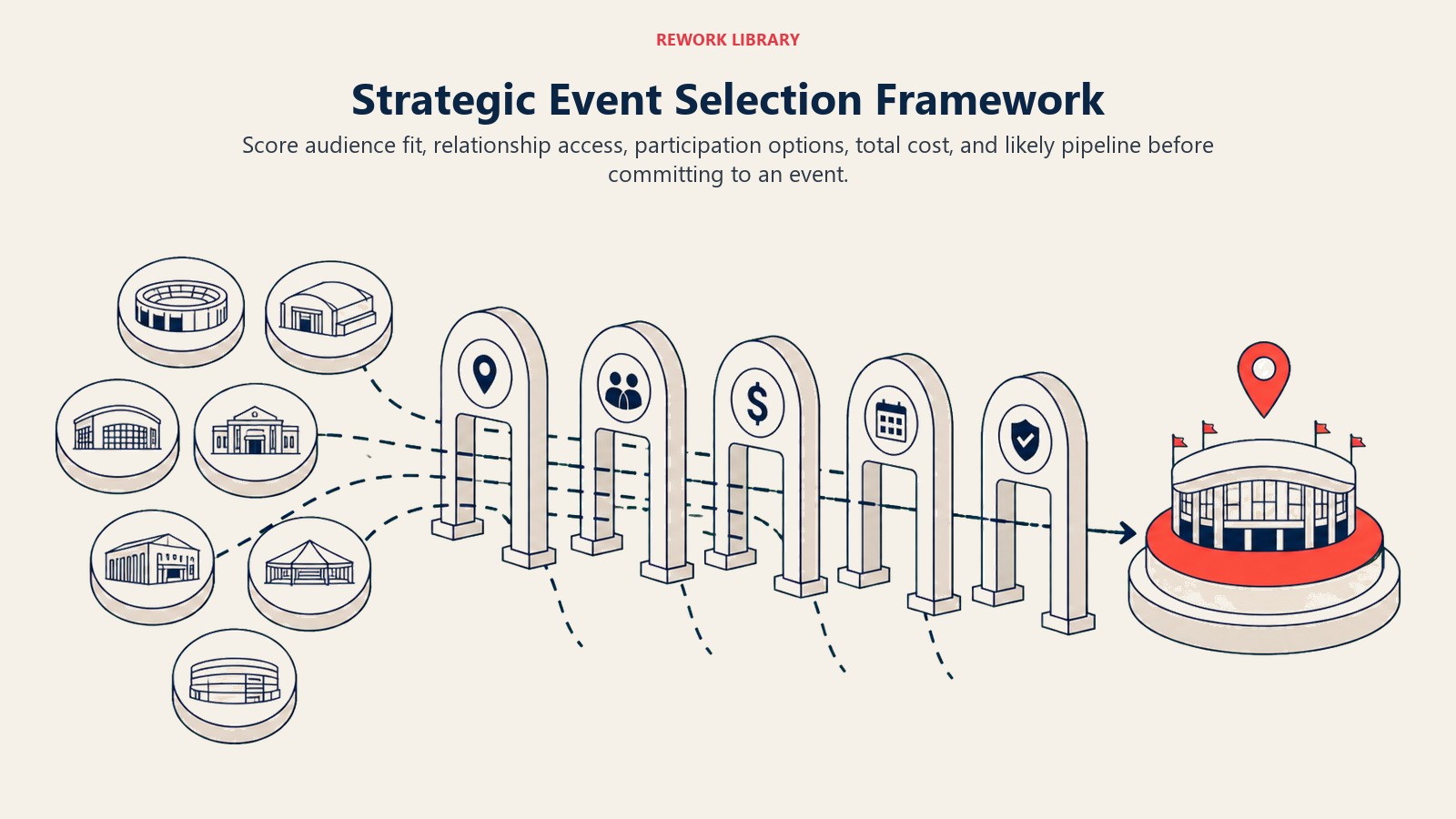
Look at:
- Attendee demographics (roles, seniority, company size)
- Registration lists (some events share these in advance)
- Session topics (do they attract decision-makers or practitioners?)
- Historical attendance patterns
The best events concentrate decision-makers from your target vertical and company size range. A CFO summit for mid-market healthcare companies is gold if that's your ICP. A broad "finance conference" with mixed industries and roles is probably waste.
Decision-Maker Density
What percentage of attendees can actually buy your services? At some events, 60-70% of attendees match your buyer profile. At others, it's 5-10%.
Ask the event organizers for attendee breakdowns by:
- Job title and function
- Company size and revenue
- Industry vertical
- Geographic location
If they can't or won't provide this data, that's a red flag. Serious B2B events know their attendee composition and share it with sponsors and exhibitors.
Competitive Landscape
Who else is attending? If all your competitors are there, that could mean it's the right event or that it's oversaturated.
Check the exhibitor list and sponsorship roster. If you see 15 firms doing exactly what you do, standing out will be harder. But if you see adjacent service providers without direct competitors, there's an opening.
Also consider: can you realistically compete for attention? If three competitors have platinum sponsorships and massive booths and you're buying a basic package, you might get drowned out.
Budget Allocation: Fewer Strategic Events vs Many Tactical Ones
A common mistake: spreading your budget across too many events. You do six regional conferences at $10K each instead of two major events at $30K each.
The problem with spreading thin is you can't execute properly. You show up unprepared, don't invest in booth quality, send junior people, and treat each event as a checkbox.
Better approach: pick 2-3 strategic events per year where you go deep. Invest in sponsorship, speaking opportunities, pre-event outreach, and post-event follow-up. Treat them as campaigns, not line items.
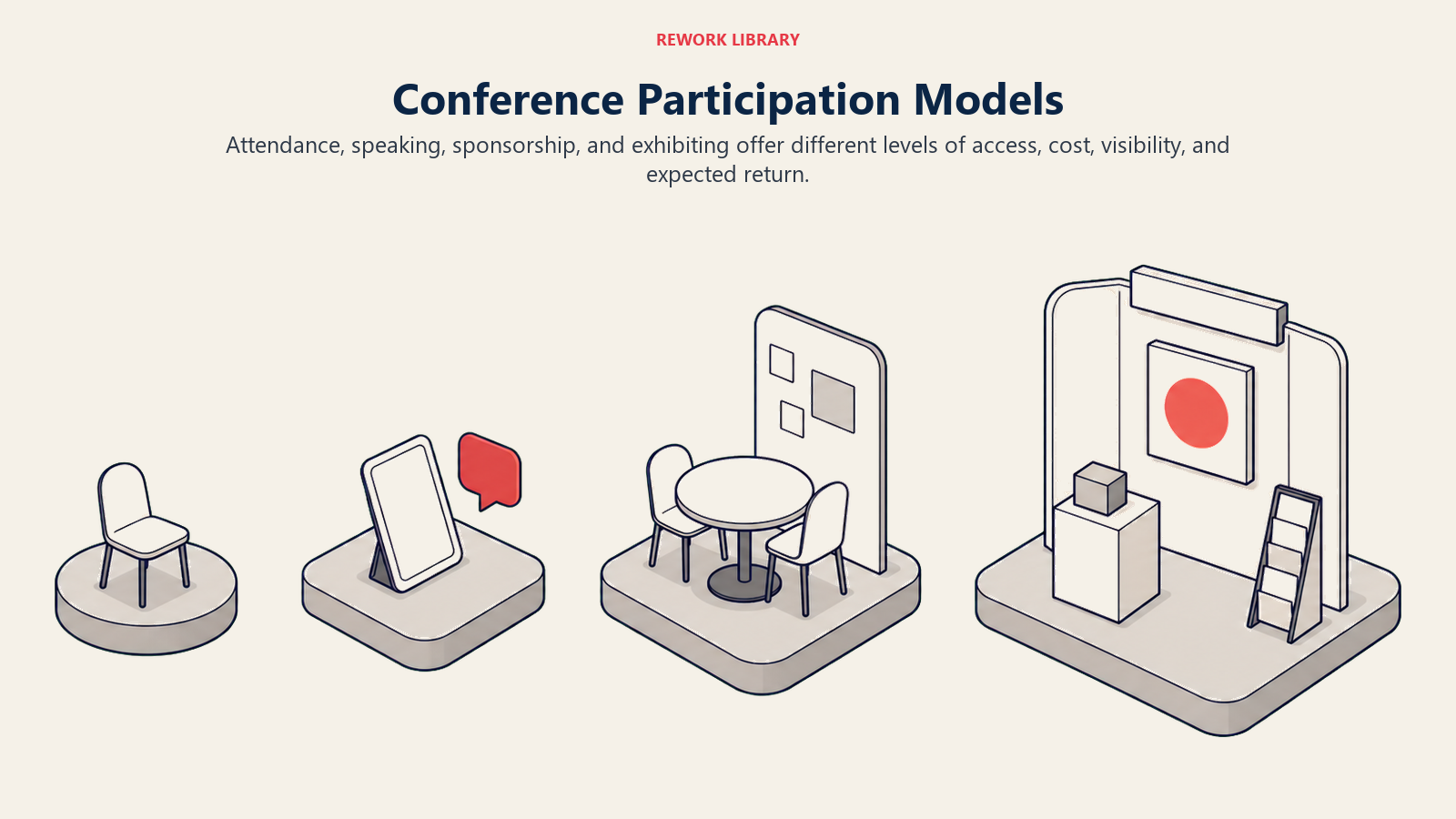
Participation Models and Expected ROI
You have options for how to participate. Each has different costs and potential returns.
Attendee-Only (Lowest Cost, Relationship Building)
Just register and attend. No booth, no sponsorship.
Cost: $500 - $3,000 depending on the event
Best for: Smaller events, exploratory attendance, when your goal is learning and relationship building rather than lead generation.
ROI potential: Low to moderate. You can still have great conversations, but you're relying entirely on networking and hallway interactions. No booth means no magnet for prospects to find you.
When this works: Industry gatherings where most value comes from sessions and side meetings. Events where exhibitors are expected to be vendors, not service providers.
Exhibitor/Booth (Medium Cost, Visibility)
You get a booth in the exhibit hall where attendees can find you.
Cost: $5,000 - $30,000 for booth space, plus materials and staffing
Best for: Events with active exhibit halls where attendees spend time browsing. Trade shows and conferences with dedicated expo hours.
ROI potential: Moderate to high if you execute well. Your booth becomes a destination for qualified prospects to learn about your firm.
Keys to success:
- Location matters (avoid corners and back rows)
- Booth design should communicate your positioning instantly
- Staff must be trained on engagement and qualification
- You need a lead capture system, not just a fishbowl
Speaker/Panelist (High ROI, Thought Leadership)
You or your team present at the conference.
Cost: Often just registration, sometimes a speaker fee or sponsorship requirement
Best for: Positioning as experts, reaching large audiences efficiently, generating inbound interest.
ROI potential: Very high. A good presentation to 100-200 attendees can generate more qualified leads than a booth, and establishes credibility immediately.
How to secure spots:
- Apply through official speaker calls (6-12 months in advance)
- Pitch topics that solve attendee problems, not thinly veiled pitches
- Propose panels and recruit other panelists
- Sponsor speaking slots if the event allows it
For comprehensive guidance on building speaking into your business development, see speaking and publishing strategy.
Sponsorship Tiers
Events offer various sponsorship levels: title sponsor, platinum, gold, silver, etc.
Higher tiers buy you:
- Logo visibility (website, signage, materials)
- Booth location and size
- Speaking opportunities
- Attendee list access
- Email marketing to registrants
Cost: $10,000 - $250,000+ depending on event size and tier
When it's worth it: Major industry events where your target buyers attend, and you have the execution capacity to make the most of the visibility. Sponsoring a 5,000-person conference makes sense if 1,000 match your ICP and you can handle the lead volume.
When it's not: Smaller regional events where basic attendance gets you access to the same people, or when you don't have the team to properly work the leads generated.
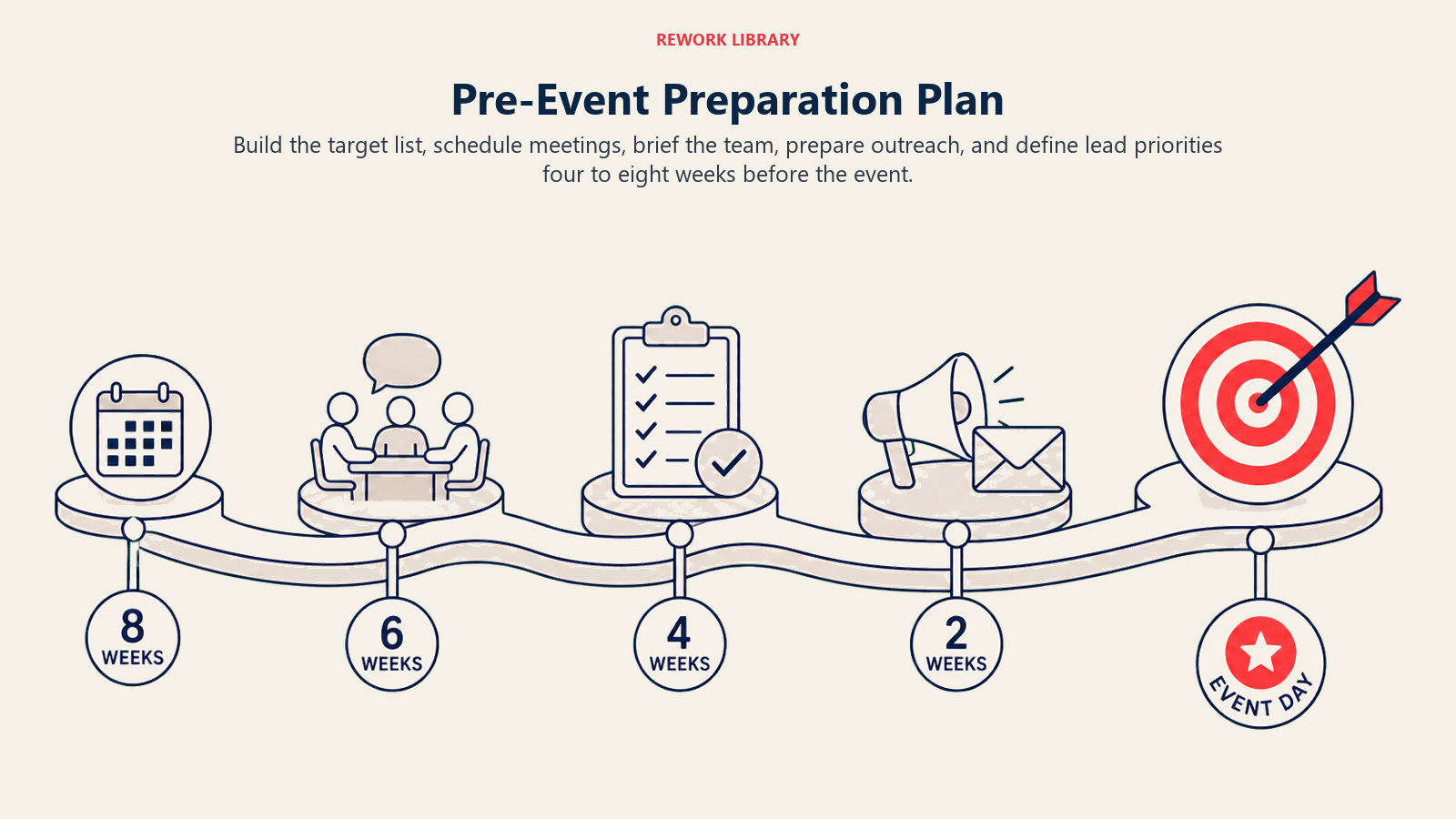
Pre-Event Preparation (4-8 Weeks Out)
This is where most firms fail. They treat preparation as "book travel and print brochures." That's not preparation. That's logistics. Real preparation means identifying targets, scheduling meetings, and briefing your team.
Target Prospect Identification
Most events share attendee lists 2-4 weeks before the event. Request it immediately.
Upload the list to your CRM and cross-reference:
- Which attendees match your ICP?
- Which are existing prospects in your pipeline?
- Which work at target accounts?
- Which have engaged with your content before?
Create a prioritized hit list of 30-50 people you want to connect with. Then segment them:
- Tier 1: Existing warm prospects or high-value targets (15-20 people)
- Tier 2: Good-fit prospects worth meeting (20-30 people)
- Tier 3: Reach targets if opportunity arises (10-15 people)
Strategic Meeting Scheduling
Don't leave meetings to chance. Pre-schedule as many as possible.
Successful conference preparation means you show up with 15-20 meetings already booked. These could be:
- Breakfast or coffee meetings
- Lunch sessions
- Evening drinks
- Scheduled booth visits
- Brief hallway catch-ups
Outreach template for Tier 1 prospects:
Subject: [Name], are you attending [Event]?
[Name],
I saw you're registered for [Event] in [City]. I'll be there as well [speaking on X / exhibiting / attending].
We should grab coffee and discuss [specific topic relevant to their role/company]. I've been working with [similar company type] on [specific challenge] and have some approaches that might be relevant.
Are you available Tuesday morning before the keynote, or Wednesday at lunch?
[Your Name]
Why this works: It's specific, offers value, and proposes concrete times. Generic "let's connect at the event" messages get ignored.
Send outreach 3-4 weeks before the event. Follow up once if no response. Track responses in a spreadsheet with meeting times and locations.
Team Briefing and Role Assignment
If you're bringing a team, everyone needs clear roles.
Booth staffing rotation: Don't leave the same person at the booth for 8 hours. Create 2-3 hour shifts with breaks.
Qualification responsibilities: Designate who qualifies leads on the spot vs who collects info for later follow-up.
Session coverage: Assign team members to attend different sessions and report back on insights and contacts made.
Social event assignments: Evening receptions and parties are where real relationships form. Make sure senior people attend these, not just junior staff.
Brief the team on:
- Your ideal client profile (so they can qualify on the spot)
- Key talking points and positioning
- Lead capture process
- Target prospect list (so they recognize names)
- Competitive landscape (who else is there and how to differentiate)
Booth Strategy That Actually Works
If you're exhibiting, your booth is the base of operations. Get this right.
Location Selection
When you're selecting booth space, look at the floor plan:
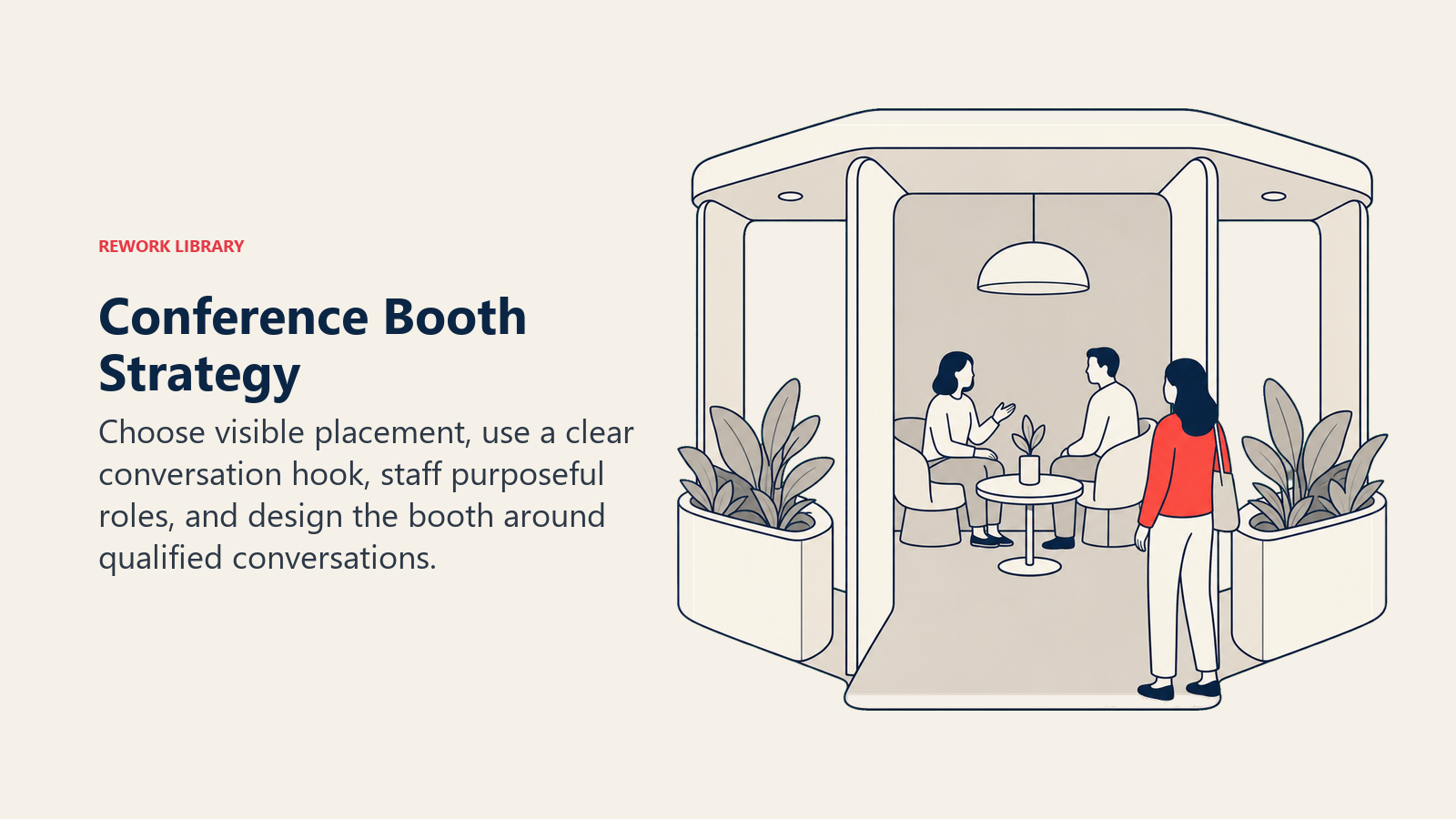
Avoid: Back corners, near bathrooms/exits, spots with low foot traffic, locations behind pillars or obstacles.
Prefer: Near main entrances, along central aisles, next to popular exhibitors or food stations, spots where traffic naturally flows.
If you're a first-time exhibitor, you might not get prime spots. That's fine. Focus on what you can control: your booth design and engagement approach.
Engagement Approach
Your booth shouldn't be a wall between you and attendees. Open design, not fortress.
Bad booth staffing:
- Staff sitting and looking at phones
- Aggressive "Can I scan your badge?" approaches
- Staff talking to each other instead of attendees
- Eating meals at the booth
- Handing out brochures with no conversation
Good booth staffing:
- Standing, approachable, making eye contact
- Starting with questions, not pitches
- Offering something valuable (demo, assessment, insights)
- Qualifying before capturing information
- Following a conversation framework
Qualification Questions
Not everyone who stops by is a prospect. Learn to qualify fast.
Ask:
- "What brings you to [Event]?" (Understanding their goals)
- "What's your role at [Company]?" (Decision-making authority)
- "What challenges are you dealing with around [topic]?" (Pain points)
- "How are you currently handling [problem]?" (Status quo and readiness)
Based on answers, you're sorting people into:
- Qualified prospects: Right role, right company, clear need
- Future prospects: Good fit but no immediate need
- Educational contacts: Want to learn but not buyers
- Not a fit: Wrong profile entirely
Only spend serious time on qualified and future prospects. Be polite to others, but don't invest 15 minutes explaining your services to someone who can't buy. Use the same criteria from your client qualification framework to make rapid assessments.
Lead Capture System
Ditch the fishbowl for business cards. Use a real system.
Options:
- Badge scanners provided by the event (fastest, integrates with event data)
- Mobile apps like LeadCapture or event-specific apps
- QR codes that capture contact info when scanned
- Simple spreadsheet or Airtable on a tablet (works, but slower)
Whatever you use, capture:
- Contact information (obviously)
- Qualification notes (prospect category, pain points mentioned)
- Next steps committed (follow-up call, send materials, schedule demo)
- Source context (how they found you, what they were interested in)
Tag every lead with the event name and date so you can track ROI later.
Avoiding Common Booth Mistakes
Mistake: Talking to every person the same way. Executives want different conversations than practitioners.
Fix: Read the room. Adjust your pitch based on who's in front of you.
Mistake: No clear call-to-action. Conversations end with "Nice talking to you" and nothing scheduled.
Fix: Every qualified conversation should end with a next step: "Let's schedule 20 minutes next week to dive into [specific topic]. Does Tuesday or Wednesday work better?"
Mistake: Overwhelming prospects with information. Handing them three brochures, a case study, and a product spec sheet.
Fix: Give them one thing that's relevant to their specific situation. Better yet, email it to them later with a personalized note.
Speaking Opportunity Maximization
If you secured a speaking slot, you need to make it count.
Topic Selection Strategy
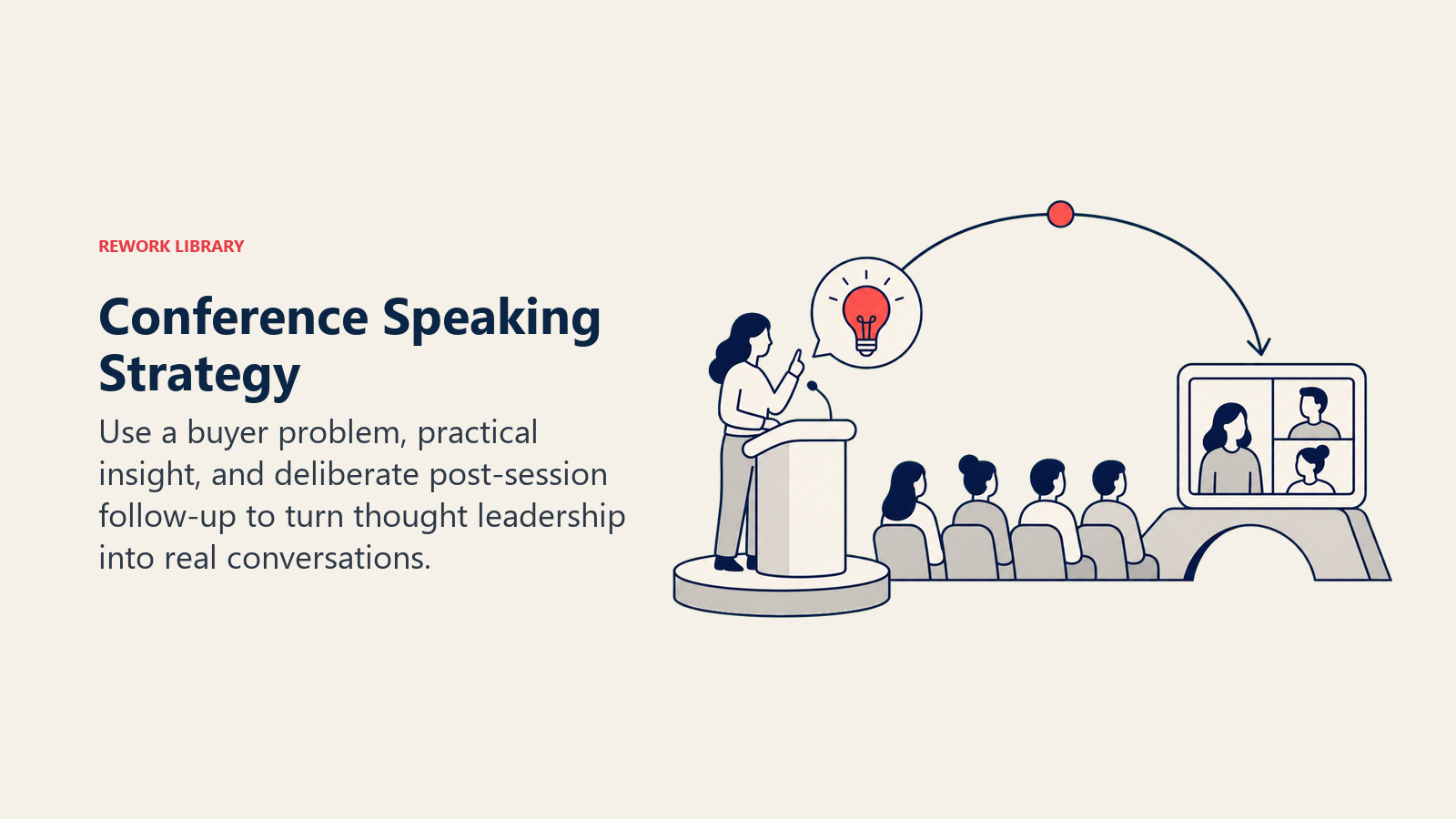
Your topic should solve a problem your target buyers face, not showcase your services.
Bad topics: "How Our Firm Helps Companies Achieve [Outcome]" (this is a pitch, not a presentation)
Good topics: "Three Strategies for [Solving Common Problem] Without [Common Pitfall]" (this provides value and positions you as expert)
The best topics teach a framework or methodology that attendees can immediately apply. Give away your knowledge. The people who recognize its value will want to hire you to implement it. This value-first approach aligns with thought leadership strategy principles.
Presentation Design
Conference presentations should be:
- Highly visual (minimal text slides)
- Story-driven (case examples, not bullet points)
- Actionable (attendees leave with takeaways they can use)
- Credible (data, research, real results)
Slide rule of thumb: If your slide has more than 20 words, it's too dense. Attendees will read instead of listening.
Include your contact information on the opening and closing slides, but don't be salesy. Your expertise is the sales pitch.
Promotion Before the Event
Don't wait for conference marketing to promote your session. Do it yourself.
- Share session details on LinkedIn with why attendees should join
- Email your existing list with session info and an offer to meet after
- Reach out directly to target prospects attending: "I'm speaking on [topic] Wednesday at 2pm. Relevant to what you're working on?"
- Create a one-pager with key points and offer it as a download for attendees
Promotion accomplishes two things: it fills your session and it gives you an excuse to reach out to prospects.
Post-Presentation Follow-Up
Have a system for capturing interested attendees.
Options:
- Sign-up sheet passed around during the session
- QR code on the closing slide linking to a landing page
- Business cards collected after the talk
- LinkedIn connection requests sent same day
Follow up within 48 hours:
"Thanks for attending my session on [topic]. As promised, here's [resource mentioned]. Happy to discuss how [approach] applies to your situation if you want to schedule 20 minutes next week."
The people who attended your session are warmer leads than random booth visitors. They invested time to hear you speak. That signals interest.
On-Site Engagement Tactics
Beyond your booth and any presentations, how you spend your time at the event matters.
Strategic Networking
Don't wander aimlessly. Be intentional about where you spend time.
Morning: Target breakfast sessions and coffee breaks. People are fresh and open to conversation.
Mid-day: Work your booth during peak expo hall hours, attend sessions where your prospects are likely to be.
Evening: Receptions and social events are gold. This is where relaxed, substantive conversations happen. Decision-makers are more accessible outside formal sessions.
Session Attendance Strategy
You can't attend everything. Pick sessions strategically:
- Where your target prospects will be (follow the audience, not just the topic)
- Sessions that give you insights into buyer challenges
- Competitor sessions (know what they're saying)
- Keynotes (good networking during breaks)
During sessions, don't just take notes. Look around. Who else is attending? These are people interested in the same topics your firm addresses.
Hallway Optimization
Some of the best connections happen in hallways, not sessions.
Position yourself near:
- Registration desk (high traffic in mornings)
- Coffee stations (natural gathering points)
- Main session rooms (catch people coming and going)
The casual hallway conversation often leads to "We should talk more about this over coffee" which becomes a qualified lead.
Business Card Management
Physical cards are still common. Have a system for managing them.
Immediate notes: When someone hands you a card, jot notes on the back right away. Where you met, what you discussed, agreed next steps. You'll never remember 50 conversations otherwise.
Digital capture: Photograph cards or use apps like CamCard to digitize immediately. Don't wait until you're back at the hotel with a pile of 40 cards.
Daily processing: Each evening, add new contacts to your CRM with notes while the conversations are fresh.
Lead Capture and Real-Time Qualification
You need a scoring system to prioritize leads on the spot.
Real-Time Scoring Framework
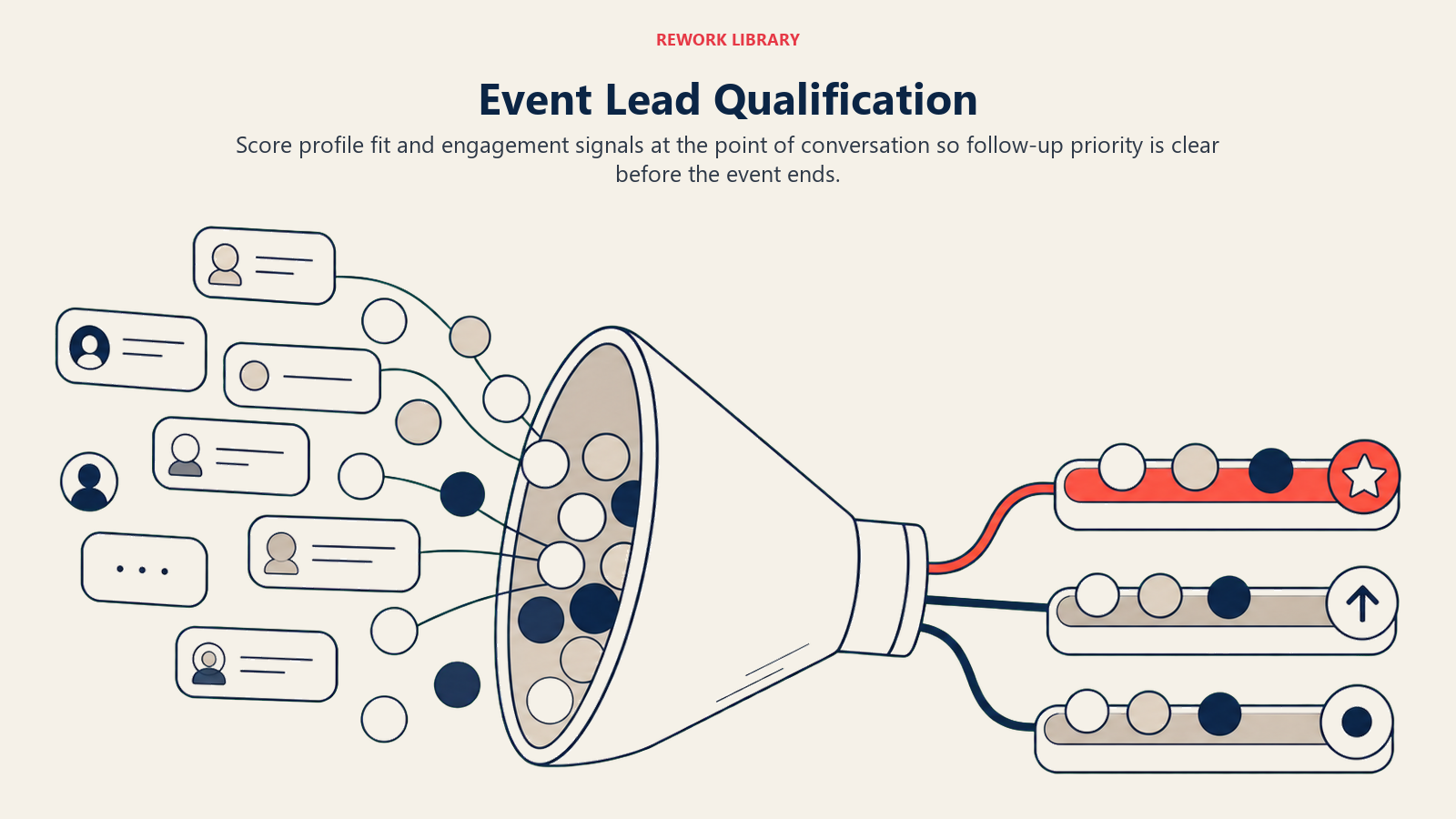
As you talk to people, mentally score them:
Profile fit (0-10 points):
- Right company size and industry: 5 points
- Decision-maker or strong influencer: 3 points
- In your geographic service area: 2 points
Engagement signals (0-10 points):
- Expressed specific pain point: 4 points
- Asked detailed questions about your approach: 3 points
- Mentioned timeline or budget: 2 points
- Willing to schedule follow-up: 1 point
Total score:
- 15-20 points: Hot lead, schedule call within a week
- 10-14 points: Qualified prospect, nurture sequence
- 5-9 points: Future prospect, add to general list
- 0-4 points: Polite conversation, don't invest further time
This sounds clinical, but it's just a structured version of what experienced salespeople do instinctively. You're deciding who's worth prioritizing.
Digital Tools for Lead Capture
Modern events often provide apps with attendee lists, messaging, and scheduling features. Use them.
Features worth using:
- Attendee search: Find your target prospects and request meetings through the app
- Session schedules: Identify which sessions your prospects are attending
- Direct messaging: Faster than email for coordinating meet-ups
- Meeting scheduler: Book time slots on each other's calendars
The app becomes your command center. You can see who's at the event, where they're going, and coordinate connections in real-time.
Getting Next-Step Commitments
The most important thing you can secure at an event isn't a business card. It's a commitment to next steps.
Good next-step commitments:
- "Let's schedule 30 minutes next Tuesday to discuss [specific topic]"
- "I'll send you the ROI framework we discussed, and we can review it on a call next week"
- "Let me introduce you to our practice lead for [vertical] to explore this further"
Vague next steps:
- "Let's stay in touch"
- "I'll send you some information"
- "We should talk sometime"
Vague = never happens. Specific = actually converts.
Post-Event Follow-Up: The 48-72 Hour Window
This is where most firms completely blow it. They wait a week or two to follow up, by which time the momentum is dead.
The Urgency of Immediate Follow-Up
Research consistently shows that lead response time impacts conversion. Waiting a week after a conference to follow up means you're competing with:
- Everyone else the prospect met (they talked to 30-50 people)
- Their regular work (which piled up while they were gone)
- Their fading memory (they barely remember your conversation)
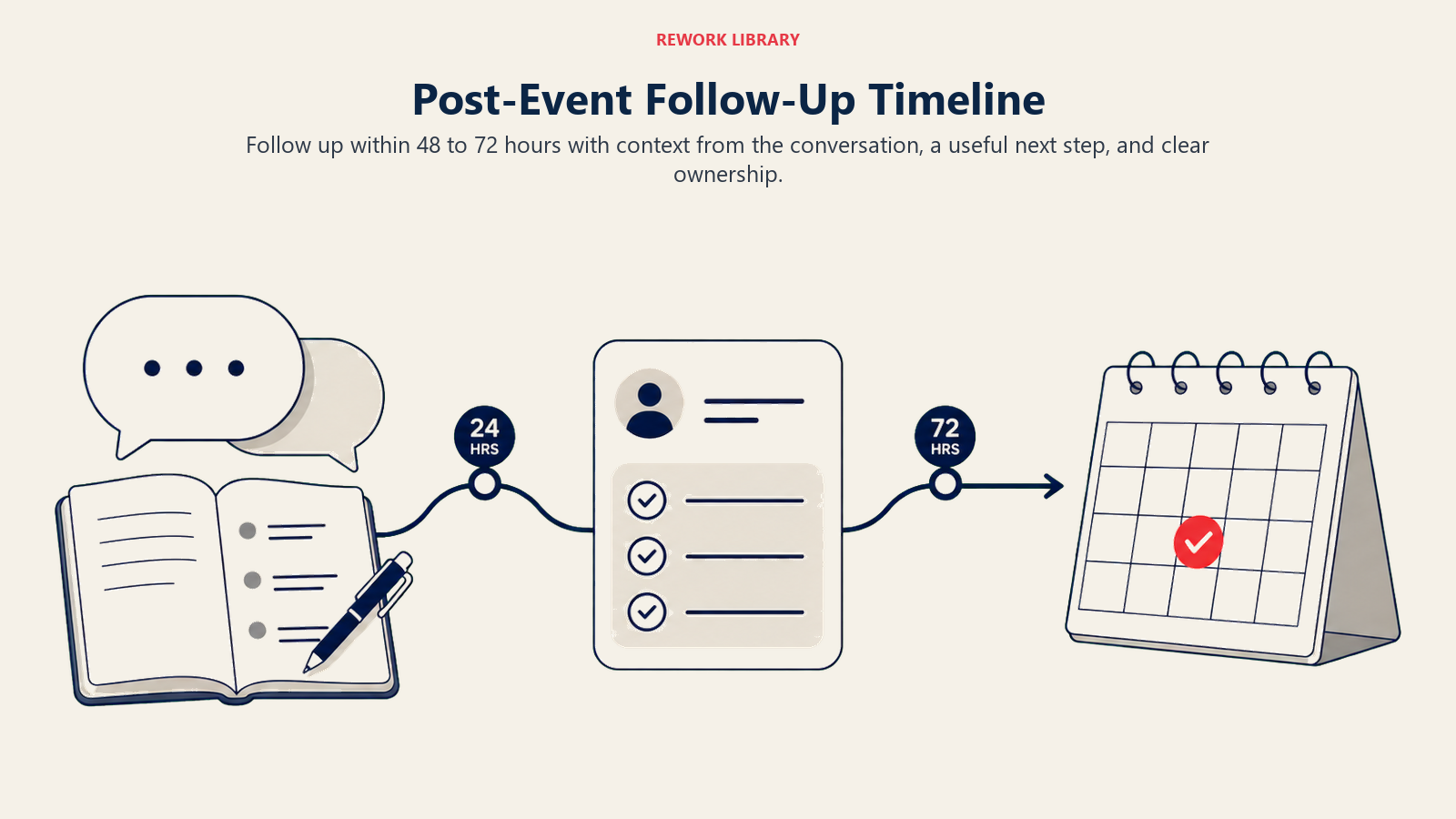
Follow up within 48 hours. 72 hours max.
Lead Categorization for Follow-Up
Before you start following up with everyone, categorize your leads.
Tier 1 - Hot Prospects (met criteria, expressed immediate need, committed to next step):
- Personal email or call within 24 hours
- Schedule the committed next step
- Send relevant resources mentioned in conversation
Tier 2 - Qualified Prospects (good fit, clear pain, no immediate timeline):
- Personalized email within 48 hours
- Add to targeted nurture sequence
- Invite to relevant upcoming webinar or event
Tier 3 - Future Prospects (right profile, no current pain):
- Personalized email within 72 hours
- Add to general newsletter or content list
- Check in quarterly
Tier 4 - Educational Contacts (not buyers, but might refer or influence):
- Thank you email
- Connect on LinkedIn
- Send occasional thought leadership
Don't treat everyone the same. Tier 1 gets your immediate personal attention. Tier 4 gets automation.
Personalization That Matters
Generic "nice to meet you" emails get deleted. Reference specific conversation points.
Generic template (don't use this):
Subject: Great meeting you at [Event]
[Name],
It was great meeting you at [Event]. I enjoyed our conversation and learning about [Company].
I think our services could help you with [generic problem]. Let's schedule time to discuss.
Best, [Your Name]
Personalized approach (use this):
Subject: [Specific topic] we discussed at [Event]
[Name],
Following up on our conversation Tuesday at the [Booth/Session/Reception]. You mentioned [Company] was dealing with [specific challenge around X].
We worked with [similar company] on exactly this issue. They were seeing [specific symptom] and we helped them [specific outcome] using [brief approach].
Happy to share the framework we used if you want to schedule 20 minutes next week. Are you available Tuesday afternoon or Wednesday morning?
[Your Name]
The difference: one shows you were listening and remember the specific conversation. The other is obviously a template. This personalized follow-up reflects the principles of consultative business development.
Meeting Scheduling vs Information Sending
Your goal is getting a meeting, not sending information.
Information (case studies, whitepapers, frameworks) should support meeting requests, not replace them.
Weak approach: "Here's some information about our services. Let me know if you have questions."
Strong approach: "You mentioned [specific challenge]. We have a framework for addressing this that worked for [similar company]. I can walk you through it on a 20-minute call next week. Does Tuesday at 2pm work?"
The information becomes the reason for the call, not the end point. Structure these calls using your initial consultation process to maximize conversion.
Event ROI Measurement
If you're not measuring results, you can't improve your conference strategy.
Lead Quantity and Quality Metrics
Track for each event:
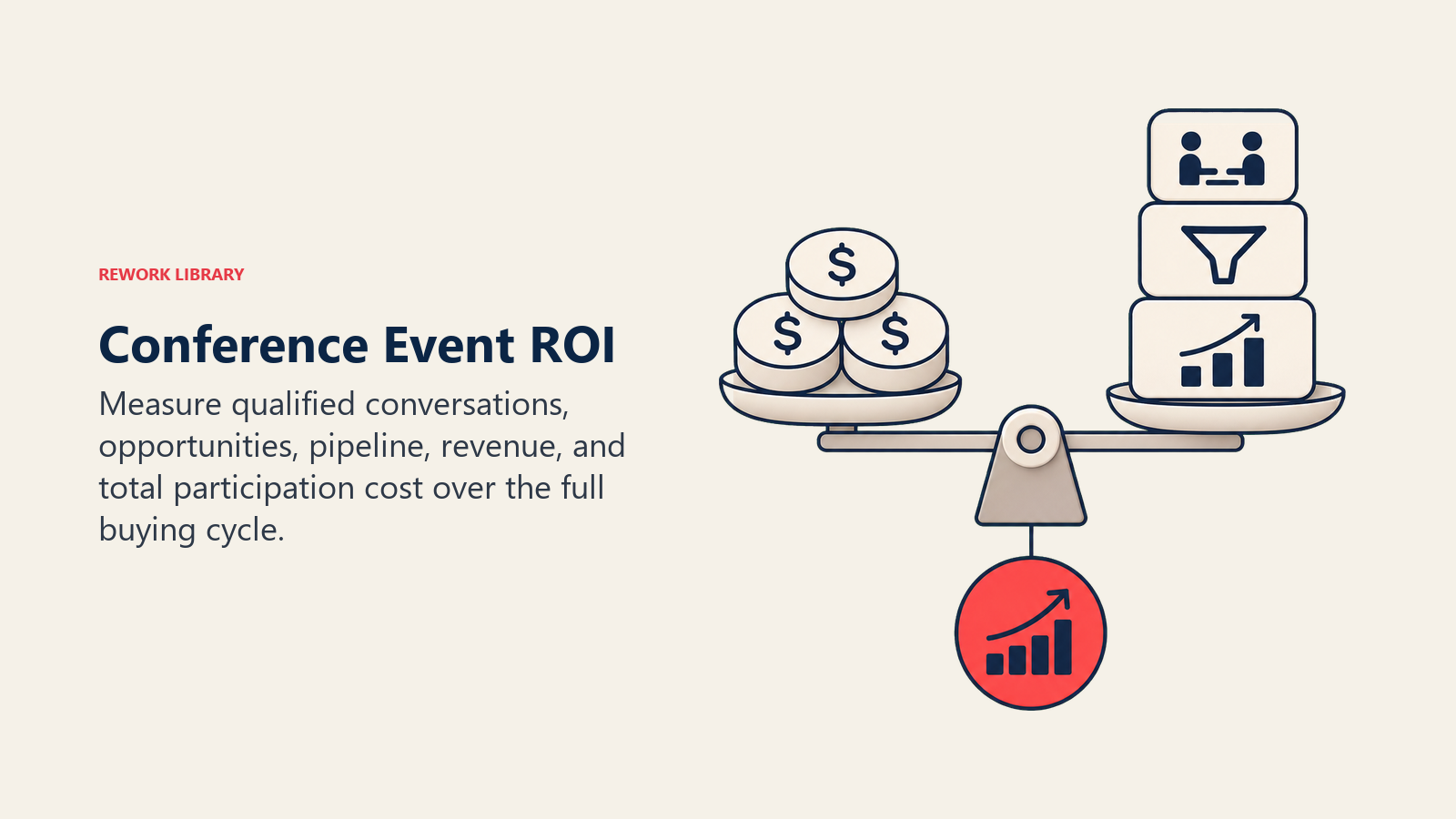
Volume metrics:
- Total contacts captured
- Qualified leads by tier
- Meetings scheduled at event
- Post-event meetings scheduled
Quality metrics:
- Percentage that match ICP
- Percentage with decision-making authority
- Percentage with active buying timeline
- Percentage from target accounts
An event where you met 100 people but only 8 were qualified prospects isn't better than an event where you met 30 people and 15 were qualified.
Cost Per Lead Analysis
Divide total event cost by qualified leads generated.
If you spent $30,000 (all-in) and generated 25 qualified leads, that's $1,200 per lead.
Now compare to your other lead generation channels:
- What's your cost per lead from paid search?
- From content marketing?
- From outbound prospecting?
Context matters. $1,200 per lead sounds expensive until you realize your average deal is $150K and these are higher-quality leads than digital channels produce.
Conversion and Pipeline Metrics
Track leads through your sales pipeline:
- How many event leads convert to opportunities?
- How many close?
- What's the average deal size?
- What's the sales cycle length compared to other sources?
Event leads often have faster sales cycles than cold leads because you've already built initial rapport. They're warm from day one. Track these metrics as part of your overall professional services metrics framework.
Calculate actual pipeline value:
- 25 qualified leads × 40% opportunity conversion = 10 opportunities
- 10 opportunities × 30% close rate × $120K average deal = $360K in closed revenue
- $360K revenue from $30K investment = 12x ROI
Those numbers justify continued investment.
Long-Term Attribution
Don't limit measurement to immediate conversions. Some event leads take 6-12 months to close.
Tag all event leads in your CRM with the event name. Then run reports quarterly:
- Opportunities created from Event X (even if they took months to develop)
- Revenue closed from Event X leads
- Pipeline still active from Event X
Your best ROI calculation comes 12 months after the event, not 30 days after.
Common Event Marketing Mistakes
Mistake 1: No Clear Objectives
Showing up to "get leads" isn't specific enough. Set real targets:
- Schedule 20 qualified meetings
- Generate 15 hot prospects for Q1 pipeline
- Secure 5 intro calls with target accounts
- Connect with 10 influencers for referral partnerships
Mistake 2: Insufficient Preparation
Booking flights and hotel isn't preparation. Real prep means target prospect lists, pre-scheduled meetings, team briefings, and qualification criteria.
Firms that wing it collect random cards and hope for the best. Firms that prepare generate qualified pipeline.
Mistake 3: Passive Engagement
Standing at your booth waiting for people to approach you is passive. Walking around with your target list actively seeking specific people is strategic.
The best leads don't come find you. You find them.
Mistake 4: Delayed Follow-Up
Waiting more than 72 hours means you've lost the momentum. Your prospects met 40 other people and came back to full inboxes. They've forgotten you.
Speed matters. 48-hour follow-up should be non-negotiable.
Mistake 5: Treating All Leads the Same
Not everyone gets the same follow-up. Segment by fit and engagement, then customize your approach.
Hot leads get personal calls and meetings. Future prospects get nurture sequences. Don't waste high-touch effort on low-fit contacts.
Advanced Event Strategies
Once you've mastered the basics, consider these advanced plays.
Hosting Private Events at Conferences
Instead of just attending the main conference, host your own side event.
Options:
- Private dinner for 10-12 target prospects (invite-only)
- Breakfast roundtable discussion on specific topic (invite 20, expect 12-15 to attend)
- Cocktail reception for clients and prospects (50-75 people)
- Workshop or training session (deeper dive than conference sessions)
Why this works: You control the environment, the attendee list, and the conversation. You're positioned as the host and convener, which carries authority.
Logistics: Pick a venue near the conference hotel. Send invitations 4-6 weeks early. Follow up personally with top targets. Keep it intimate enough for real conversation.
Exclusive Roundtables for Executives
High-level buyers don't have time for generic conference sessions. They want peer discussions with other executives.
Host a roundtable:
- Invite 8-10 executives from non-competing companies
- Pick a meaty topic relevant to their roles ("CFO Roundtable: Financial Planning in Uncertain Markets")
- You moderate but don't pitch
- Peer learning and networking is the value
This positions you as a connector and thought leader without selling. The leads generated are extremely qualified because you've curated the room.
Client Appreciation Events
If you have existing clients attending the conference, host something exclusively for them.
Benefits:
- Strengthens client relationships
- Generates referrals (clients bring colleagues or peers)
- Creates organic selling opportunities when clients share their success with your firm
- Shows prospects that you invest in client relationships
Format: private dinner, VIP suite at a sports event, cocktail hour at a unique venue. Make it special, not just "drinks at the hotel bar."
12-Week Conference Campaign Timeline
Treat each major conference as a campaign with defined phases.
12-8 Weeks Out: Strategic Planning
- Finalize participation model (attendee, exhibitor, speaker)
- Secure booth space or speaking slot
- Set measurable objectives
- Assign team roles
- Book travel and logistics
8-4 Weeks Out: Prospect Research
- Request attendee list from organizer
- Upload to CRM and identify target prospects
- Create prioritized outreach list (Tier 1, 2, 3)
- Begin outreach for pre-scheduled meetings
- Prepare booth materials and presentations
4-2 Weeks Out: Outreach Campaign
- Send personalized emails to Tier 1 prospects
- Follow up on meeting requests
- Confirm scheduled meetings
- Brief team on target list and qualification criteria
- Finalize booth setup and materials
Week of Event: Execution
- Arrive early for booth setup and team prep
- Execute meeting schedule
- Active booth engagement during expo hours
- Attend strategic sessions and networking events
- Daily debrief to review leads and adjust tactics
Week After Event: Immediate Follow-Up
- Categorize all leads by tier (24 hours)
- Personal outreach to Tier 1 leads (24-48 hours)
- Schedule committed meetings
- Personalized emails to Tier 2 and 3 (48-72 hours)
- Add all to CRM with proper tagging
2-4 Weeks After: Nurture Activation
- Move leads into appropriate sequences
- First round of follow-up calls
- Send promised materials and resources
- Continue scheduling discovery conversations
30-60-90 Days After: Pipeline Development
- Track opportunity creation from event leads
- Measure conversion rates by source tier
- Analyze cost per lead and pipeline value
- Document lessons learned
- Refine approach for next event
Making Conference Strategy Systematic
One-off conference attendance is a tactic. Systematic conference strategy is a repeatable growth channel.
Build systems around:
- Event evaluation criteria (ROI thresholds, attendee profiles)
- Pre-event workflows (research, outreach, scheduling)
- On-site engagement protocols (qualification questions, lead capture)
- Post-event follow-up sequences (segmented by tier)
- Measurement dashboards (leads, pipeline, revenue by event)
The firms that treat conferences strategically generate consistent pipeline from events. The ones that wing it waste money and wonder why events "don't work."
Where to Go From Here
Conference and event strategy fits into your broader business development approach:
- Professional Networking provides the relationship foundation that makes conference conversations more productive
- Speaking & Publishing Strategy helps you secure speaking slots and establish thought leadership
- Consultative Business Development teaches you how to convert event conversations into qualified opportunities
- Content Marketing for Services creates the materials and resources you reference in event follow-up
Events work when you treat them as campaigns, not calendar entries. Preparation, execution, and disciplined follow-up turn conferences from expensive networking tourism into systematic lead generation machines.
Start with 2-3 strategic events per year. Go deep on preparation and follow-up. Measure everything. Refine your approach based on what converts. That's how you build event strategy that actually drives revenue.

Sales Director
On this page
- The Conference Paradox
- Events as Relationship Accelerators, Not Volume Plays
- Understanding Total Cost of Event Participation
- Strategic Event Selection Framework
- Target Audience Alignment
- Decision-Maker Density
- Competitive Landscape
- Budget Allocation: Fewer Strategic Events vs Many Tactical Ones
- Participation Models and Expected ROI
- Attendee-Only (Lowest Cost, Relationship Building)
- Exhibitor/Booth (Medium Cost, Visibility)
- Speaker/Panelist (High ROI, Thought Leadership)
- Sponsorship Tiers
- Pre-Event Preparation (4-8 Weeks Out)
- Target Prospect Identification
- Strategic Meeting Scheduling
- Team Briefing and Role Assignment
- Booth Strategy That Actually Works
- Location Selection
- Engagement Approach
- Qualification Questions
- Lead Capture System
- Avoiding Common Booth Mistakes
- Speaking Opportunity Maximization
- Topic Selection Strategy
- Presentation Design
- Promotion Before the Event
- Post-Presentation Follow-Up
- On-Site Engagement Tactics
- Strategic Networking
- Session Attendance Strategy
- Hallway Optimization
- Business Card Management
- Lead Capture and Real-Time Qualification
- Real-Time Scoring Framework
- Digital Tools for Lead Capture
- Getting Next-Step Commitments
- Post-Event Follow-Up: The 48-72 Hour Window
- The Urgency of Immediate Follow-Up
- Lead Categorization for Follow-Up
- Personalization That Matters
- Meeting Scheduling vs Information Sending
- Event ROI Measurement
- Lead Quantity and Quality Metrics
- Cost Per Lead Analysis
- Conversion and Pipeline Metrics
- Long-Term Attribution
- Common Event Marketing Mistakes
- Advanced Event Strategies
- Hosting Private Events at Conferences
- Exclusive Roundtables for Executives
- Client Appreciation Events
- 12-Week Conference Campaign Timeline
- 12-8 Weeks Out: Strategic Planning
- 8-4 Weeks Out: Prospect Research
- 4-2 Weeks Out: Outreach Campaign
- Week of Event: Execution
- Week After Event: Immediate Follow-Up
- 2-4 Weeks After: Nurture Activation
- 30-60-90 Days After: Pipeline Development
- Making Conference Strategy Systematic
- Where to Go From Here