Retainer vs Project Model: Choosing the Right Revenue Structure for Agency Growth
Turn this article into takeaways for your work.


Each assistant summarizes the article only for you and suggests best practices for your work.
The revenue model you choose shapes everything about how your agency operates. Cash flow, team structure, client relationships, scaling capacity - all of it flows from whether you're selling retainers, projects, or a mix of both.
Most agency owners struggle with this decision because they're choosing between two imperfect options. Retainers promise stability but come with scope creep and retention pressure. Projects offer easier acquisition but create revenue volatility and constant sales pressure. Neither is perfect on its own.
Here's what the data shows: successful agencies don't pick one model. They run a hybrid approach, typically 60-70% retainer revenue with 30-40% project revenue. This mix gives you the cash flow predictability of retainers while maintaining the growth flexibility and portfolio diversity that projects provide.
This guide breaks down both models - the economics, advantages, challenges, and practical implementation strategies. You'll see why most agencies should adopt a hybrid approach and how to structure it for maximum profitability and growth. For a broader view of building your agency business, see the marketing agency growth model.
Understanding the retainer model
A retainer is recurring revenue for ongoing services. The client pays a monthly or quarterly fee, and you provide a defined set of services, hours, or access to your team. It's subscription economics applied to professional services.
Retainers come in several flavors:
Hours-based retainers: Client gets X hours per month of your team's time. Simple to understand but can create transactional thinking ("I paid for 20 hours, I need to use all 20 hours").
Deliverables-based retainers: Client gets specific deliverables each month (4 blog posts, 2 design concepts, weekly reports). Clear expectations but less flexible when priorities shift.
Access-based retainers: Client gets ongoing access to your expertise and team capacity. You work on whatever's needed that month. Flexible but requires strong client relationships and trust.
Hybrid retainers: Combination approach - base deliverables plus hours for additional work. Most common in mature agency relationships.
The economics are straightforward: retainers typically deliver 25-40% gross margins. Higher if you have strong processes and can work efficiently. Lower if you're constantly over-servicing or dealing with scope creep.
The real value isn't in the margin, though. It's in the predictability. When you know you have $50K in retainer revenue locked in next month, you can plan hiring, invest in tools, and focus on growth instead of survival.
Retainer model advantages
Retainers change the agency operating model by making revenue, capacity, and client relationships more predictable.
Predictable recurring revenue: This is the big one. You start each month knowing what a chunk of your revenue looks like. No scrambling to hit payroll, no panic when a project pipeline dries up. Retainers create the foundation for stable business planning.
Deeper client relationships: When you work with a client monthly for a year, you learn their business. You understand their market, their challenges, their internal politics. That knowledge compounds and makes your work more valuable over time.
Lower customer acquisition cost amortization: It costs the same to land a $10K project client as it does to land a $5K/month retainer client. But the retainer client pays you $60K over a year. Your CAC as a percentage of revenue drops dramatically with longer client relationships.
Team stability and resource planning: You can hire full-time employees because you have revenue to support them. Projects make staffing hard - you're either overstaffed when it's slow or scrambling to hire contractors when it's busy. Retainers smooth that out.
Higher client lifetime value: A good retainer client stays for 18-36 months on average. Some stay for years. That's $90K-$180K in LTV from a single acquisition. Projects might give you $10K-$50K total before the client moves on.
Smoother workload management: Instead of the feast-or-famine cycle of project work, retainers create steady demand. You can optimize team utilization because you know what work is coming each month.
Retainer model challenges
Nothing's perfect. Retainers come with their own headaches.
Scope creep and "always on" expectations: Clients think of retainers like subscriptions. They expect you to be available whenever they need something. "Just a quick call" turns into three hours of work. "Can you take a look at this?" becomes a whole project. Without clear boundaries, retainers bleed profitability.
Value demonstration and retention pressure: Every month, the client has the option to cancel. You need to consistently prove you're worth what they're paying. One slow month and suddenly you're defending your value. Projects end naturally, but retainers require ongoing justification.
Utilization tracking and profitability management: You need to track hours and deliverables closely to know if you're profitable. Are you delivering $8K of work for a $5K retainer? You won't know unless you measure it. Most agencies are bad at this and slowly erode margins.
Price increases and renewal conversations: How do you raise prices on an existing retainer? It's awkward. Clients resist because they're used to the current price. But your costs go up each year. If you don't have a strategy for increases, you'll lock yourself into unprofitable relationships.
Client dependency risk: When 40% of your revenue comes from two retainer clients, you're vulnerable. One cancellation could force layoffs. Retainers create stability but also concentration risk.
Growth requires adding new retainers: You can't scale quickly with retainers alone. Each new retainer is a full sales cycle. To double revenue, you need to double your retainer count. That takes time.
Understanding the project model
Project-based revenue is transactional. Client needs something specific done, you scope it, price it, deliver it, and move on. Clear beginning, middle, and end.
Projects get priced in three main ways:
Fixed-price projects: You quote a total price for defined deliverables. "Website redesign: $25K." Client knows exactly what they'll pay, you absorb the risk if it takes longer than expected.
Time-and-materials (T&M): You bill for actual hours worked at agreed-upon rates. "Our rate is $150/hour, we estimate 100-150 hours." More flexible but harder for clients to budget.
Value-based pricing: You price based on the value created, not time invested. "This will generate $500K in new revenue for you, so we're charging $75K." Highest margins but requires strong business case development.
Project economics vary widely. Margins can range from 15% (poorly scoped, over-delivered) to 35%+ (well-scoped, efficient delivery). The key difference from retainers: projects are one-time revenue. You get paid once and then need to find the next project.
The scaling opportunity comes from volume. With retainers, you need deeper relationships with the same clients. With projects, you can serve more clients with shorter engagements.
Project model advantages
Easier to acquire new clients: The commitment threshold is lower. Clients will try a $15K project who'd never commit to a $5K/month retainer. It's a lower-risk way for them to test working with you.
Clear scope and deliverables: Everyone knows what success looks like. Build the website, launch the campaign, complete the assessment. When it's done, it's done. No ambiguity.
Scaling through volume: Want to grow 50% next year? Close 50% more projects. The math is simple. You're not constrained by how many long-term relationships you can maintain.
Portfolio diversification: Projects let you work across industries and project types. That variety protects you when one sector slows down and gives your team exposure to different challenges.
Premium pricing for specialized projects: If you have deep expertise in a niche area, you can charge premium rates for project work. A $100K brand strategy project for a company going through a major repositioning? They'll pay it. But they won't pay $25K/month for an ongoing retainer.
Natural endpoints for difficult clients: Sometimes you take a project and realize the client is impossible to work with. With projects, you finish the work and don't renew. With retainers, you're stuck for months or have to fire them mid-contract.
Project model challenges
Revenue unpredictability and cash flow volatility: You close three projects in January, none in February. Now March payroll is tight. Project revenue is lumpy and creates cash flow stress. You need reserves to smooth it out.
Constant sales pressure: Your pipeline needs to be 3-4x your monthly target at all times because conversion rates and timing are unpredictable. You're always selling, always prospecting, always worried about the pipeline.
Resource planning and utilization gaps: You bid a project assuming you'll start next month. It gets delayed two months. Now your team is sitting idle or you've assigned them elsewhere and can't deliver when the project finally kicks off.
Scope creep and profitability erosion: Fixed-price projects are vulnerable to scope creep. Client asks for "just one more thing." You say yes to maintain the relationship. Suddenly your $20K project required $30K worth of work.
Shorter client relationships: You deliver a great project and then... nothing. The client doesn't have another project for 18 months. You build expertise in their business and then can't monetize it.
Higher customer acquisition costs: You're paying sales and marketing costs to acquire clients who might only give you one $15K project. The CAC payback period is longer because there's no recurring revenue.
The hybrid model strategy
Most successful agencies run a hybrid model because it combines the best of both approaches while mitigating the worst risks.
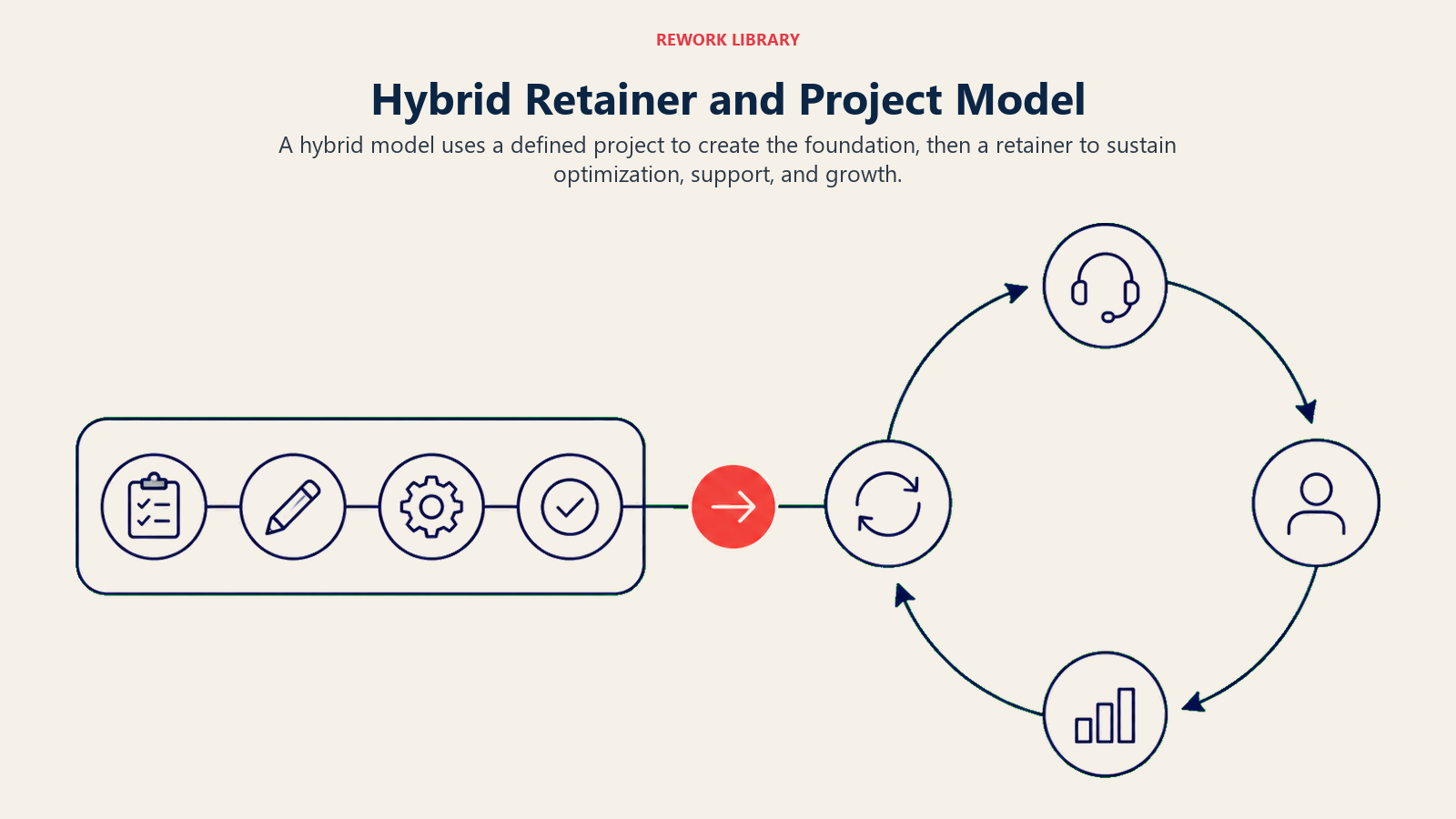
The optimal mix varies by agency type, but data from hundreds of agencies shows that 60-70% retainer revenue with 30-40% project revenue creates the healthiest business model.
Here's why this mix works:
Retainers provide the revenue foundation: 60-70% recurring revenue means you can cover your fixed costs (salaries, rent, software) with confidence. You're not constantly worried about making payroll.
Projects provide growth capacity: That 30-40% project revenue gives you the ability to scale without needing to land massive new retainers. You can grow by doing more project work while gradually converting some projects into retainers.
Resource allocation balances nicely: Your senior team can focus on retainer clients where relationship depth matters, while junior team members cut their teeth on project work. This creates a natural training ground.
Financial planning becomes manageable: You can forecast within a reasonable range. Retainer revenue gives you the floor, project revenue gives you upside. You know your worst-case scenario and can plan accordingly.
How do you structure this in practice?
Use projects as a retainer pipeline: Offer a great $20K project experience. At the end, propose an ongoing retainer relationship. "Now that we've worked together and you've seen our process, here's how we can continue supporting you on a monthly basis."
Position retainers for core services: Ongoing marketing, monthly content, continuous optimization - these are natural retainer services. Save projects for one-time needs like rebrands, website rebuilds, or major campaigns.
Balance stability and opportunity: Some clients will only ever do project work with you. That's fine. Take those projects, do great work, and use that revenue to fund growth while your retainer base provides stability.
Converting projects to retainers
This is where the money is. Every successful agency has a process for converting project clients into retainer clients.
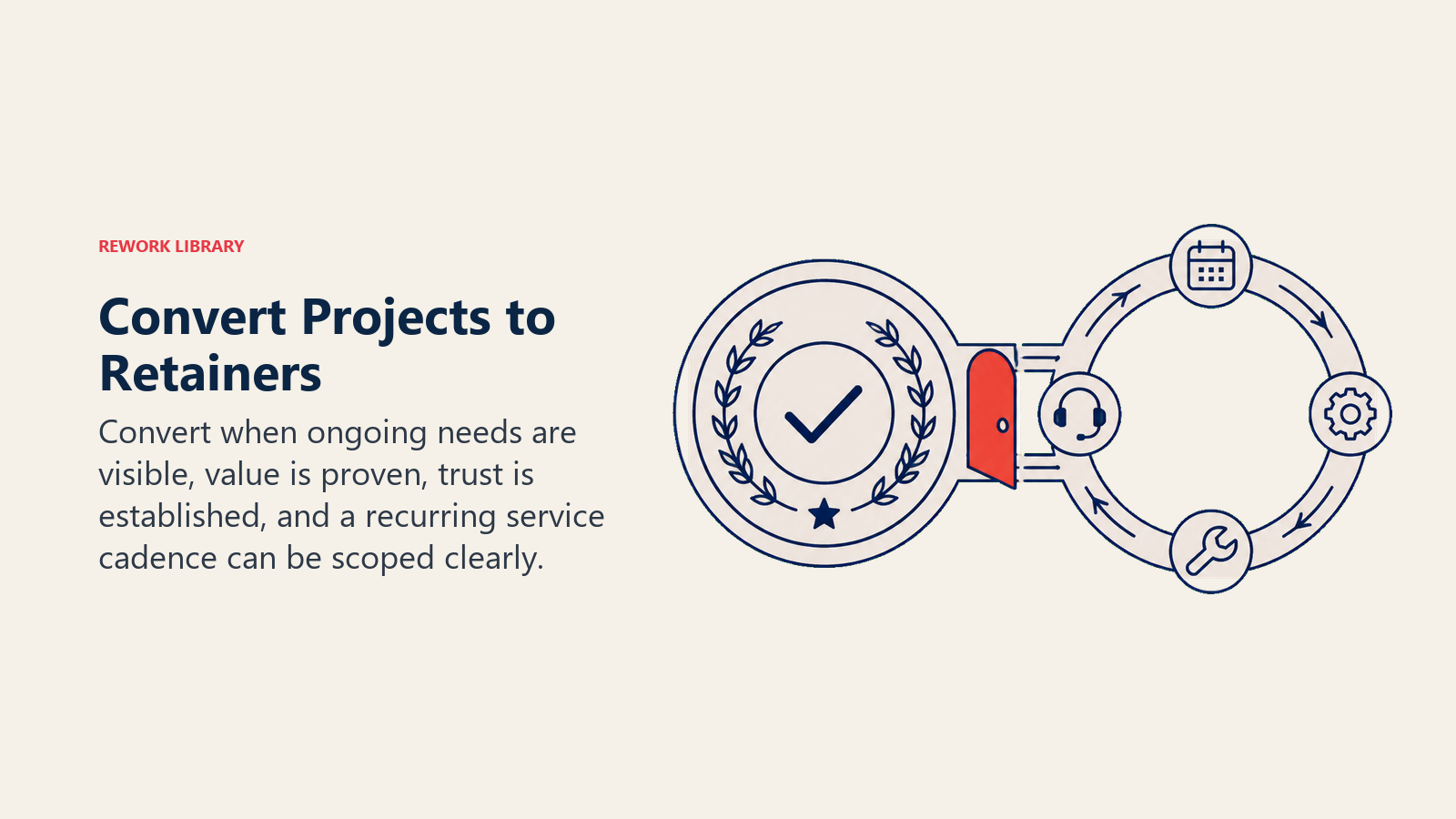
Identify conversion-ready clients: Not every project client will convert. Look for signals:
- They needed the work done because of ongoing needs, not a one-time event
- They asked questions during the project about what else you could help with
- They were collaborative and appreciated your strategic thinking, not just execution
- They have budget for ongoing work (you saw this during the sales process)
Position ongoing value and partnership: The conversation isn't "Would you like to pay us every month?" It's "Here's what we can accomplish together over the next year that we couldn't tackle in a single project."
Show them the roadmap. "We just rebuilt your website, but here's what needs to happen to drive traffic, optimize conversion, and improve over time. That's ongoing work, not a one-time project."
Structure the retainer offer: Take what you learned during the project and package it into ongoing value:
- "We'll handle all content creation and optimization - 4 articles per month, ongoing SEO, monthly performance reporting"
- "You'll have dedicated access to our team for 30 hours per month to support your marketing initiatives"
- "We'll manage your entire digital presence: social, email, paid campaigns, and optimization"
Pricing transition strategy: Don't discount the retainer to get the conversion. Instead, show them the value comparison:
"You paid $25K for this project that took 8 weeks. For $6K/month, you get ongoing access to the same team, consistent work output, and continuous improvement. Over a year, that's $72K - but you're getting probably $120K worth of project work because we already know your business."
Success stories and proof points: Share examples of other clients who started with projects and moved to retainers. "Company X started with a website project, then moved to a $8K/month retainer. After 18 months, their revenue from digital channels has tripled."
Optimize conversion rates: Track your project-to-retainer conversion rate. If you're converting less than 20% of projects, something's wrong with your process. Healthy agencies convert 30-40% of well-qualified project clients into retainers.
The key is timing. Don't wait until the project is completely finished. Start the retainer conversation about 75% of the way through the project when they're seeing results but before the relationship ends.
Retainer scoping and management
Retainers fail when scope is unclear and expectations aren't managed. Here's how to avoid that.
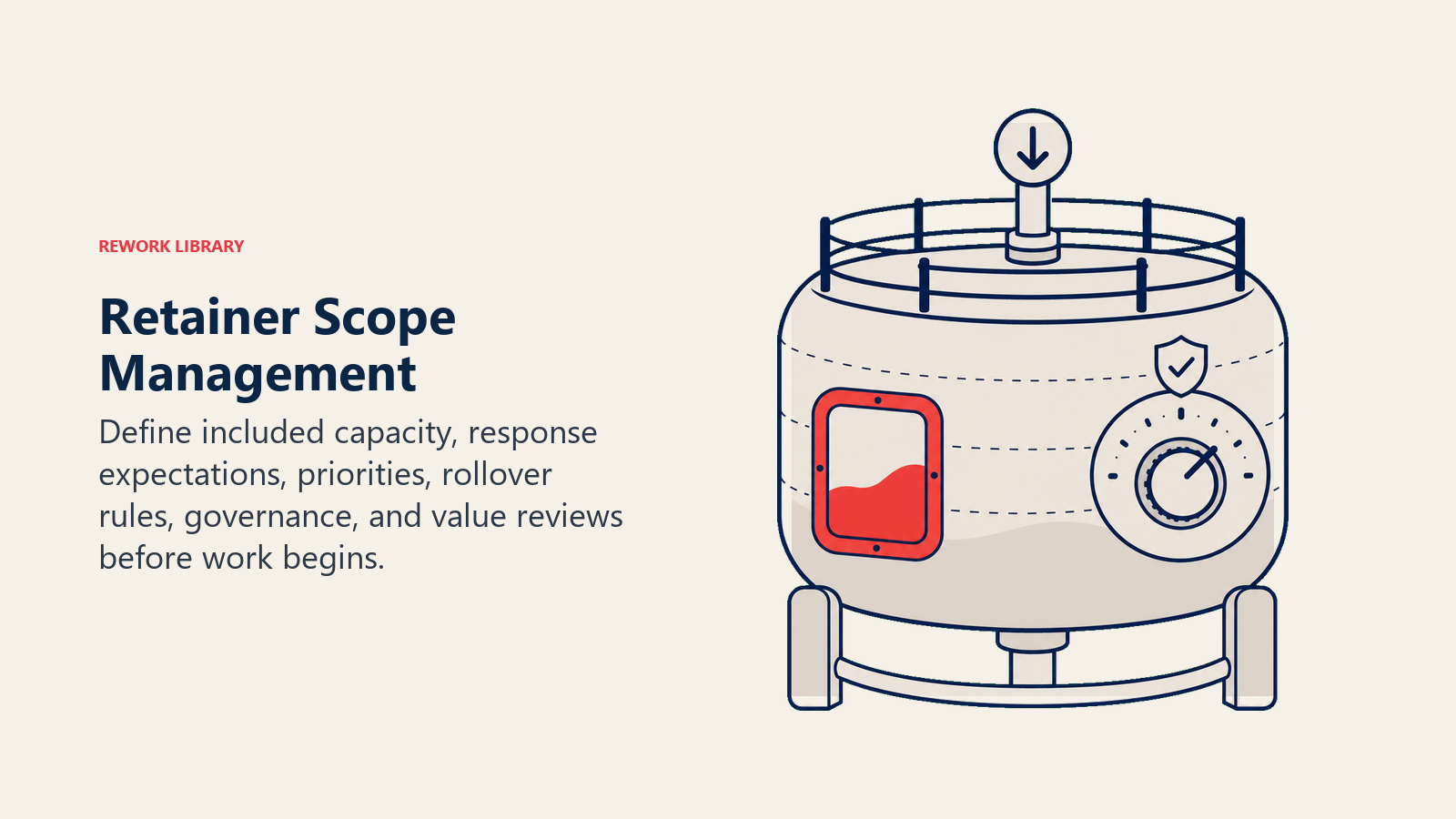
Define clear scope and deliverables: Even with access-based retainers, be specific about what's included and what's not:
- "Included: social media management (3 posts/week), email marketing (2 campaigns/month), monthly strategy calls"
- "Not included: website development, paid advertising management, trade show materials"
Clients need to understand what they're getting. Vague retainers lead to disappointment and churn.
Hours allocation and tracking: If you're selling hours-based retainers, track utilization religiously. Build reports that show clients how their hours were used each month. This transparency prevents disputes and helps justify value.
But don't be rigid about it. If a client uses 18 hours one month and 22 the next, that's fine. The average is what matters. Flexible clients appreciate flexibility in return.
Managing client expectations: Set response time expectations upfront. "We respond to all requests within 24 business hours. Urgent requests require 48-hour notice when possible."
Establish a regular cadence for check-ins. Monthly calls to review work, discuss upcoming priorities, and ensure alignment. This prevents the "I haven't heard from them in weeks" problem that kills retainers.
Handling out-of-scope requests: You'll get them. Someone asks for something clearly outside the retainer scope. Your process should be:
- Acknowledge the request
- Clarify it's outside current scope
- Provide a quick estimate for the additional work
- Get approval before proceeding
Don't just say no. Say "yes, and here's what that would require."
Regular value reporting: Monthly or quarterly, send a summary of work completed and results generated. Show them ROI. "This month we published 8 articles (6,200 visits), sent 3 email campaigns (1,840 clicks), and improved site conversion from 2.1% to 2.6%."
Numbers make the retainer concrete. Without reporting, clients forget what you're doing for them.
Renewal and price increase strategies: Start the renewal conversation 60 days before the current term ends. Don't wait until the last minute.
For price increases, tie them to expanded scope or results. "We've been working together for 18 months. In that time, revenue from our channels has grown 40%. We'd like to expand our work in these areas, and the new retainer would be $7,500/month, up from $6,000."
Or simply: "Our costs have increased, and we're adjusting our retainer pricing by 8% for all clients. Your new rate will be $6,480/month starting next quarter."
Project scoping and delivery
Bad project scoping kills profitability. Here's how to scope and deliver projects that make money.
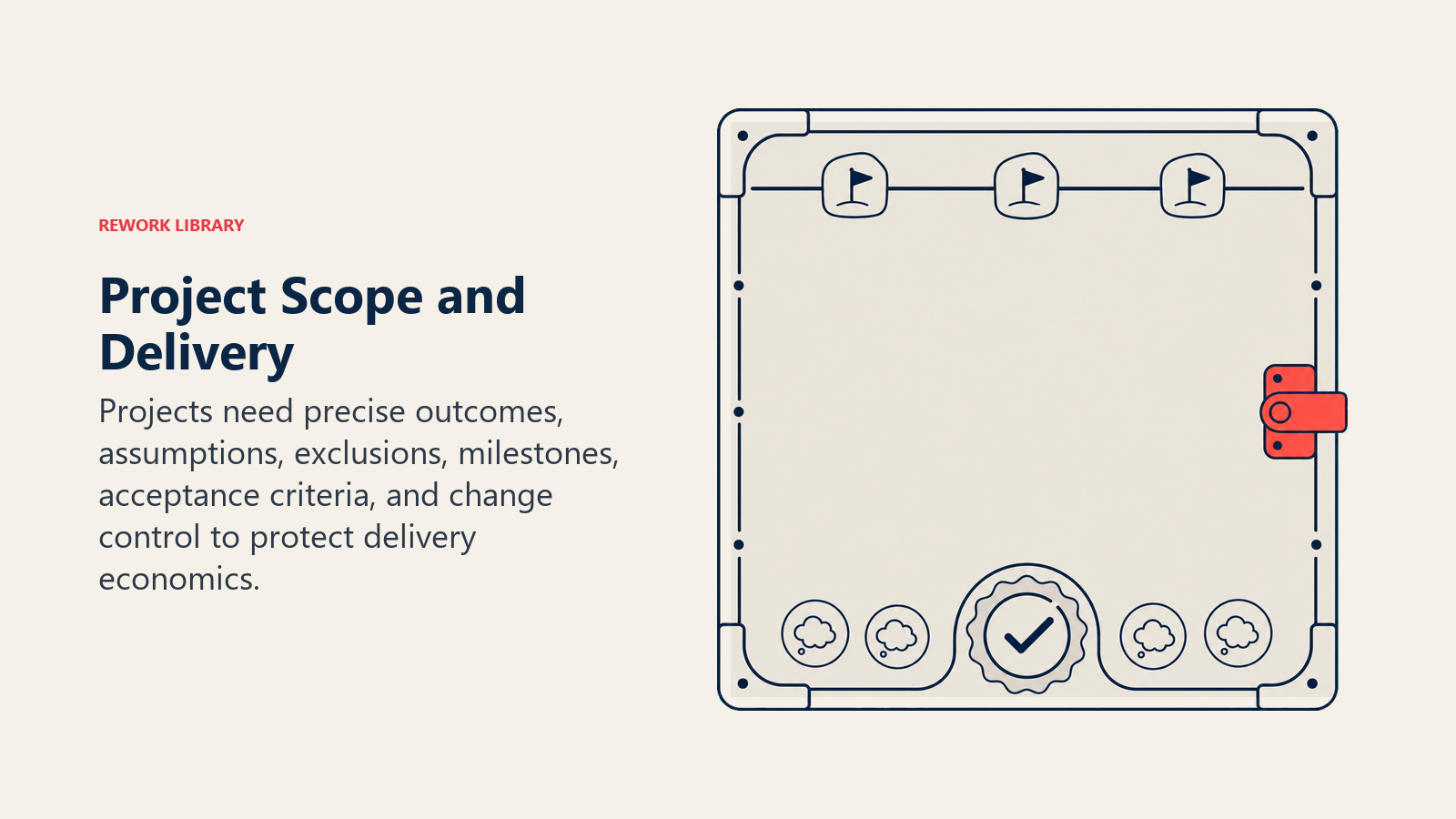
Rigorous discovery and requirements: Before you quote a project, you need to understand exactly what the client needs. Not what they say they need - what they actually need.
Run a structured discovery process using needs assessment techniques:
- What's the business problem you're solving?
- What does success look like?
- What are the constraints (budget, timeline, resources)?
- Who needs to be involved in decisions?
- What's happened with similar initiatives in the past?
Don't skip discovery to get to the proposal faster. Poor discovery leads to bad scoping, scope creep, and unprofitable projects.
Detailed SOW and acceptance criteria: Your statement of work should be specific enough that both parties know exactly what's included:
- Deliverables (with examples if possible)
- Timeline and milestones
- What client needs to provide (content, feedback, approvals)
- Number of revision rounds included
- What's explicitly not included
Acceptance criteria matter: "Project is complete when the website is launched and the client has approved all functionality based on the requirements document."
Change order process: Scope will change. Clients will realize they need additional features or different approaches. That's fine, but it needs to go through a change order process:
- Client requests change
- You assess impact on timeline, cost, and deliverables
- You provide written change order with new price and timeline
- Client approves in writing before work proceeds
Without this process, you'll deliver way more than you were paid for.
Timeline and milestone management: Break projects into clear phases with milestone deliverables and payment terms:
- Phase 1: Discovery and strategy (2 weeks) - $5K upon completion
- Phase 2: Design concepts (3 weeks) - $8K upon approval
- Phase 3: Development (4 weeks) - $7K upon launch
- Phase 4: Training and handoff (1 week) - $5K final payment
This creates accountability on both sides and improves cash flow.
Quality assurance and delivery: Build in QA time before final delivery. Don't rush the handoff because you're late. A sloppy delivery ruins your reputation and leads to endless revision requests.
Client satisfaction and references: End the project with a formal closeout meeting. Review what went well, what could have gone better, and discuss future opportunities. Ask for a testimonial or case study permission while the positive experience is fresh. See project closeout for a complete guide to ending projects well.
Pricing strategies by model
How you price retainers vs projects requires different thinking.
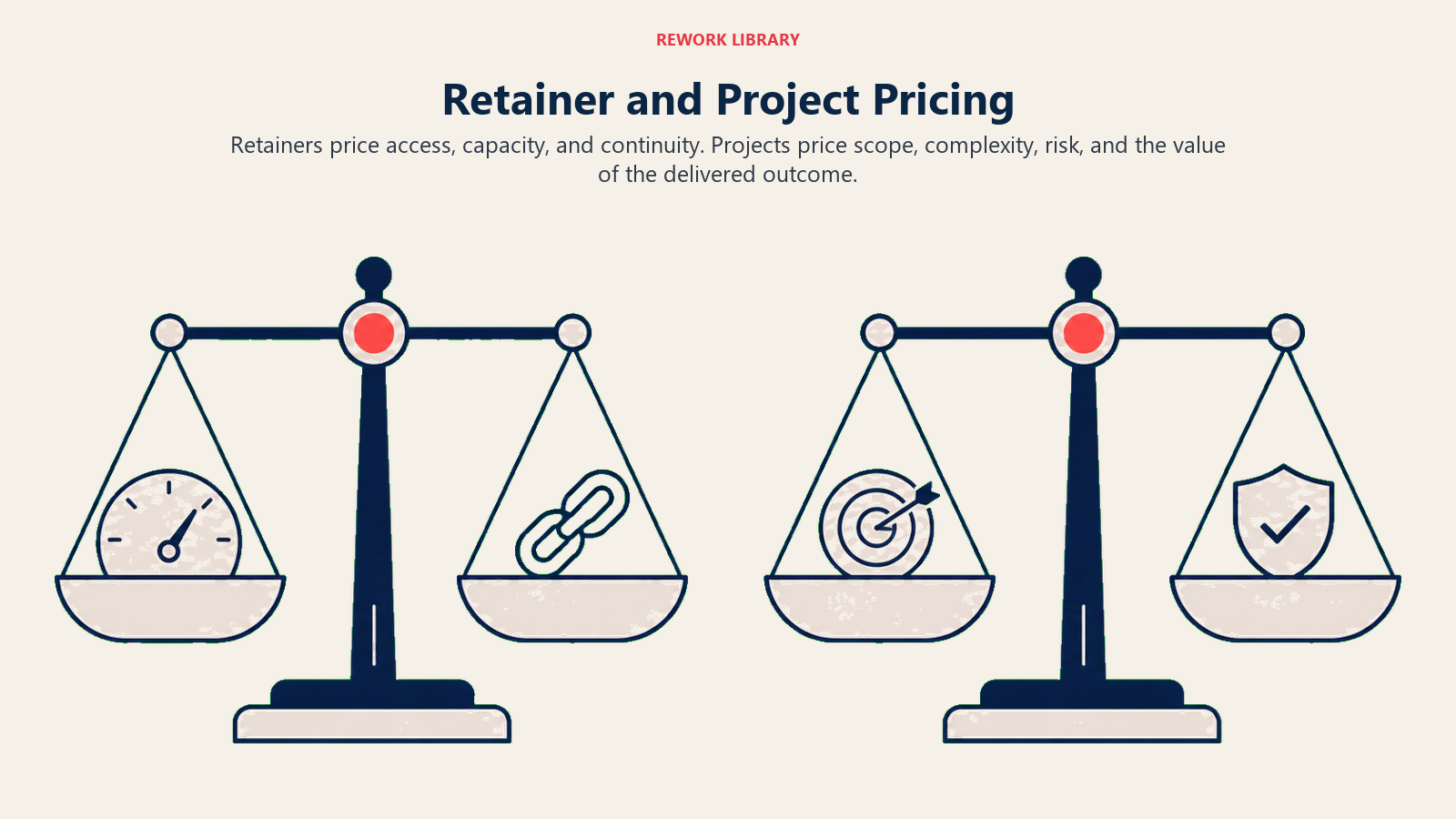
Retainer pricing approach: Think monthly investment, not hourly rates. Position it as "Here's what we'll accomplish together each month" rather than "You're buying X hours of time."
Price based on value delivered, not cost. If your retainer generates $50K/month in revenue for the client, a $8K/month retainer is easy to justify. Focus on outcomes in your pricing conversations.
Project pricing strategies: For projects, you have three main options:
Value-based: Best when you can quantify business impact. "This will reduce customer acquisition costs by 30%, saving you $200K annually. Our fee is $60K." Highest margins but requires strong business case.
Fixed-price: Good for well-defined scope. "Website redesign with these specific features: $35K." Client knows exactly what they'll pay. You absorb scope risk but can optimize for efficiency.
Time-and-materials: Best for uncertain scope or discovery work. "Our blended rate is $175/hour, estimated 120-160 hours." More flexible but harder for clients to budget.
Premium for predictability: Charge more for retainers than equivalent project work. The ongoing relationship and predictability are valuable to you, so pass some of that value to clients while maintaining better margins.
Example: Your hourly rate on project work is $150. For a retainer client, your effective rate might be $175-$200 because they get priority access, deeper strategic thinking, and consistent resource allocation.
Discounts for longer commitments: Offer better pricing for annual retainer commitments vs month-to-month:
- Month-to-month: $8K/month
- 6-month commitment: $7,500/month ($45K total)
- 12-month commitment: $7,200/month ($86,400 total)
The discount is worth it for the revenue certainty and reduced churn risk.
Price testing and optimization: Don't just accept the first price point that works. Test different price levels on similar projects. You might find clients will pay 20-30% more for the same work if you position it differently.
Track win rates by price point. If you're winning 80% of proposals at your current pricing, you're probably too cheap. Healthy win rates are 40-60% - means you're pricing at market rate.
Market rate benchmarking: Know what competitors charge. You don't need to match them, but you should understand where you sit in the market. Premium pricing requires premium positioning.
Financial impact comparison
Let's look at the actual financial differences between the models.
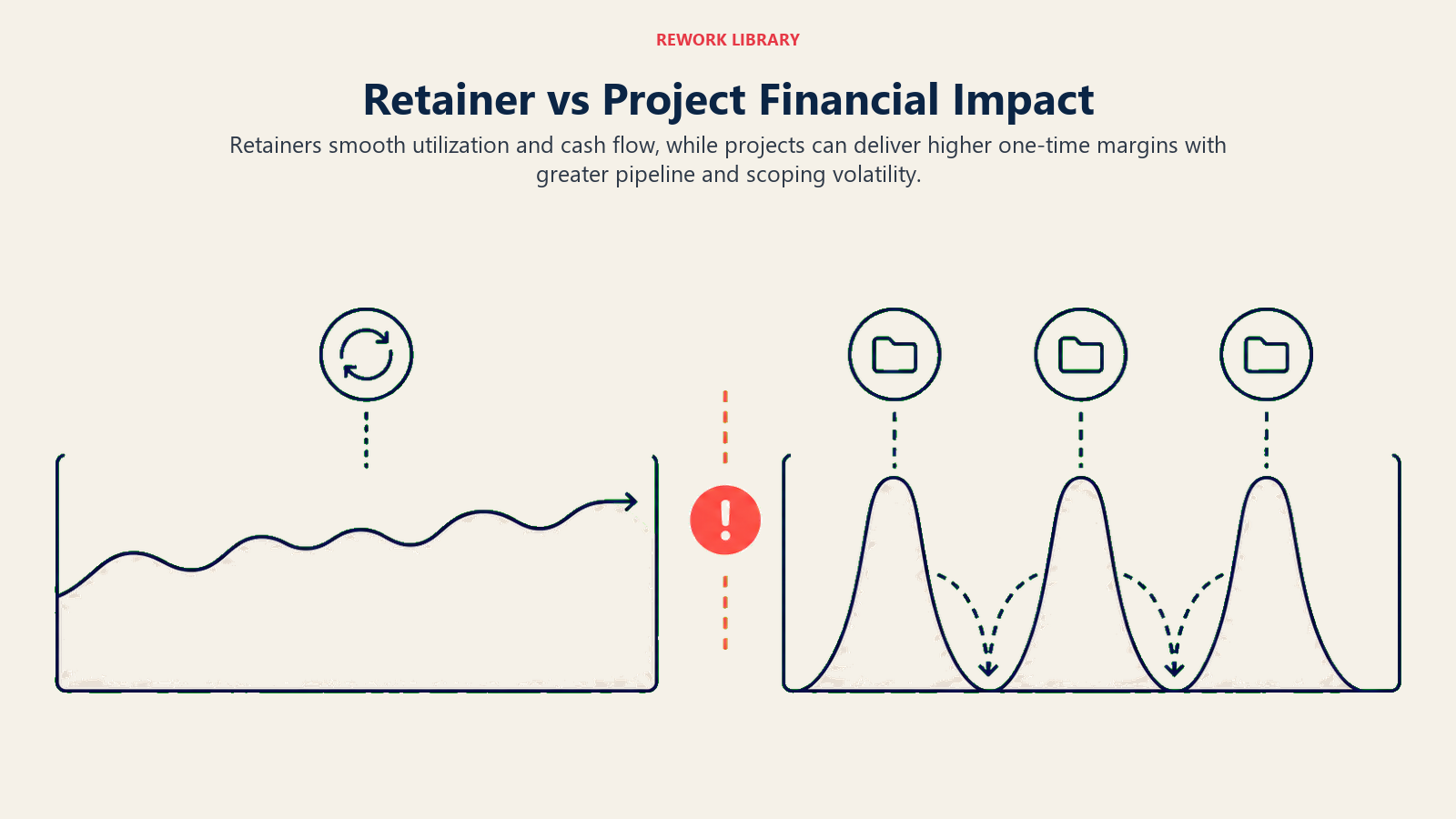
Cash flow patterns:
- Retainers: Consistent monthly revenue, predictable cash flow, easy to forecast
- Projects: Lumpy revenue, deposit upfront then milestone payments, harder to predict
- Hybrid: Retainer revenue covers base costs, project revenue creates upside and growth capital
Profitability drivers and risks:
- Retainers: Profitability comes from efficiency and avoiding scope creep. Risk is over-servicing.
- Projects: Profitability comes from accurate scoping and efficient delivery. Risk is under-pricing or scope expansion.
- Hybrid: Diversified profitability sources. Retainers provide margin consistency, projects provide high-margin opportunities.
Resource utilization requirements:
- Retainers need 80-85% utilization to be profitable at standard pricing. Too much idle time kills margins.
- Projects can handle more utilization variation because you price for specific work, but gaps between projects hurt.
- Hybrid model smooths utilization - retainer work fills gaps between projects.
Growth rates and scaling potential:
- Pure retainer model: Slower growth (15-25% annually typical) but more sustainable and predictable
- Pure project model: Can grow faster (30-50%+ if pipeline is strong) but volatile and hard to sustain
- Hybrid model: Moderate growth (20-35% annually) with better stability
Client lifetime value comparison:
- Retainer clients: 18-36 month average relationship, $90K-$180K LTV (at $5K/month)
- Project clients: 1-3 projects over 24 months, $25K-$75K total LTV
- Hybrid clients (project → retainer): $20K initial project + 24 months retainer = $140K+ LTV
Investment requirements:
- Retainer model needs investment in process, efficiency, and account management
- Project model needs investment in sales, marketing, and project management
- Hybrid model needs both but creates better ROI on each investment
Common pitfalls and solutions
Retainer pitfall: Scope creep without price increases: You start a retainer at $5K/month. Over time, the client asks for more. You say yes to keep them happy. Two years later, you're delivering $9K worth of work for $5K.
Solution: Annual scope reviews and price adjustments. Build it into the contract: "We review scope and pricing annually based on work volume and market rates."
Retainer pitfall: Weak value demonstration: Client doesn't see or understand the value you're delivering. At renewal time, they question whether they should continue.
Solution: Monthly value reporting and quarterly business reviews. Make your impact visible and tie it to their business outcomes.
Retainer pitfall: Under-pricing at inception: You price a retainer based on estimated hours. In practice, it requires way more time than you thought. Now you're stuck in an unprofitable relationship.
Solution: Better scoping and buffer in pricing. Add 20-30% to your initial time estimates. It's easier to over-deliver than to ask for more money.
Project pitfall: Poor scoping leads to scope creep: You quote a website project at $25K. Halfway through, the client realizes they need an e-commerce system, not just a brochure site. You didn't clarify this upfront.
Solution: Rigorous discovery and detailed SOW. Spend 5-10% of project time on scoping before you commit to a price. Use discovery projects for complex work.
Project pitfall: Revenue volatility creates stress: Three great months followed by two terrible months. Your team doesn't know if they should be hiring or worried about layoffs.
Solution: Build cash reserves (3-6 months operating expenses) and add retainer revenue to smooth the volatility. Don't rely purely on projects.
Hybrid pitfall: Resource allocation confusion: Your retainer clients expect priority access. But you've also committed to project deadlines. Now you're over-committed and can't deliver on either.
Solution: Clear capacity planning and resource allocation. Retainer work gets scheduled first, then you fill available capacity with project work. Or dedicate different team members to each revenue stream.
Hybrid pitfall: Inefficient operations: You have different processes, contracts, invoicing, and management approaches for retainers vs projects. The operational overhead kills efficiency.
Solution: Standardize where possible. Same contract templates with model-specific addendums. Same project management tools and reporting formats. Create systems that work for both models.
Making the model work for your agency
The right revenue model depends on your agency type, market position, and growth goals.
If you're an early-stage agency (under $500K revenue), start with projects. They're easier to sell, help you build a portfolio, and give you cash flow to invest in operations. But immediately start working on converting 20-30% of project clients to retainers.
If you're a growing agency ($500K-$2M revenue), focus on building retainer base while maintaining project revenue for growth. Target 50-60% retainer revenue. This creates stability while preserving growth capacity.
If you're a mature agency ($2M+ revenue), push toward 65-75% retainer revenue with selective project work. At this stage, you want maximum predictability and should be choosy about project work. Take projects that are strategic (great case studies) or premium-priced.
Whatever mix you choose, be intentional about it. Track your retainer vs project revenue monthly. Understand the profitability of each. Make conscious decisions about where to invest sales and marketing efforts.
The hybrid model works because it balances competing priorities: stability vs growth, depth vs breadth, efficiency vs flexibility. You don't have to choose one or the other. Build a business that captures the benefits of both.
For more on optimizing your professional services business model, see:

Sales Director
On this page
- Understanding the retainer model
- Retainer model advantages
- Retainer model challenges
- Understanding the project model
- Project model advantages
- Project model challenges
- The hybrid model strategy
- Converting projects to retainers
- Retainer scoping and management
- Project scoping and delivery
- Pricing strategies by model
- Financial impact comparison
- Common pitfalls and solutions
- Making the model work for your agency