Client Qualification Framework: Determining Ideal Client Fit for Professional Services Success
 Here's a stat that most professional services leaders don't want to admit: 40% of their projects fail because they took on the wrong client.
Turn this article into takeaways for your work.


Each assistant summarizes the article only for you and suggests best practices for your work.
Not because the team couldn't deliver. Not because the methodology was flawed. But because from day one, the client was a bad fit. Wrong expectations, wrong budget, wrong attitude, wrong everything.
The best professional services firms turn down 60% or more of their inbound opportunities. That's not arrogance, that's discipline. They've learned that saying yes to the wrong client costs more than saying no costs in lost revenue.
This guide shows you how to build a systematic client qualification framework that protects your profitability, reputation, and team morale. The deals you don't take matter just as much as the ones you do.
Why Client Qualification is Your First Line of Defense
Client qualification isn't about being picky for the sake of being picky. Not every opportunity is worth pursuing, plain and simple. When you take on a misaligned client, the damage compounds fast:
Project profitability tanks. Scope creep runs wild. Timelines stretch. Your team burns hours trying to manage unrealistic expectations. What looked like a profitable engagement turns into a breakeven project, or worse.
Team morale suffers. Your best people don't want to work on nightmare clients. They burn out faster. They leave. You end up staffing problem accounts with junior people, which just makes the problems worse.
Your reputation takes a hit. Bad-fit clients leave negative reviews, refuse to provide testimonials, and tell other potential clients you're difficult to work with. Even if you delivered exactly what they asked for.
Opportunity cost kills you. Every hour spent on a bad client is an hour you can't spend on a good one. Your capacity is finite. Fill it with the wrong work, and you can't take the right work when it shows up.
The firms that get this right understand that qualification is about long-term profitability, not short-term revenue. You're not trying to maximize deal volume, you're trying to maximize the percentage of projects that are profitable, enjoyable, and lead to more good work.
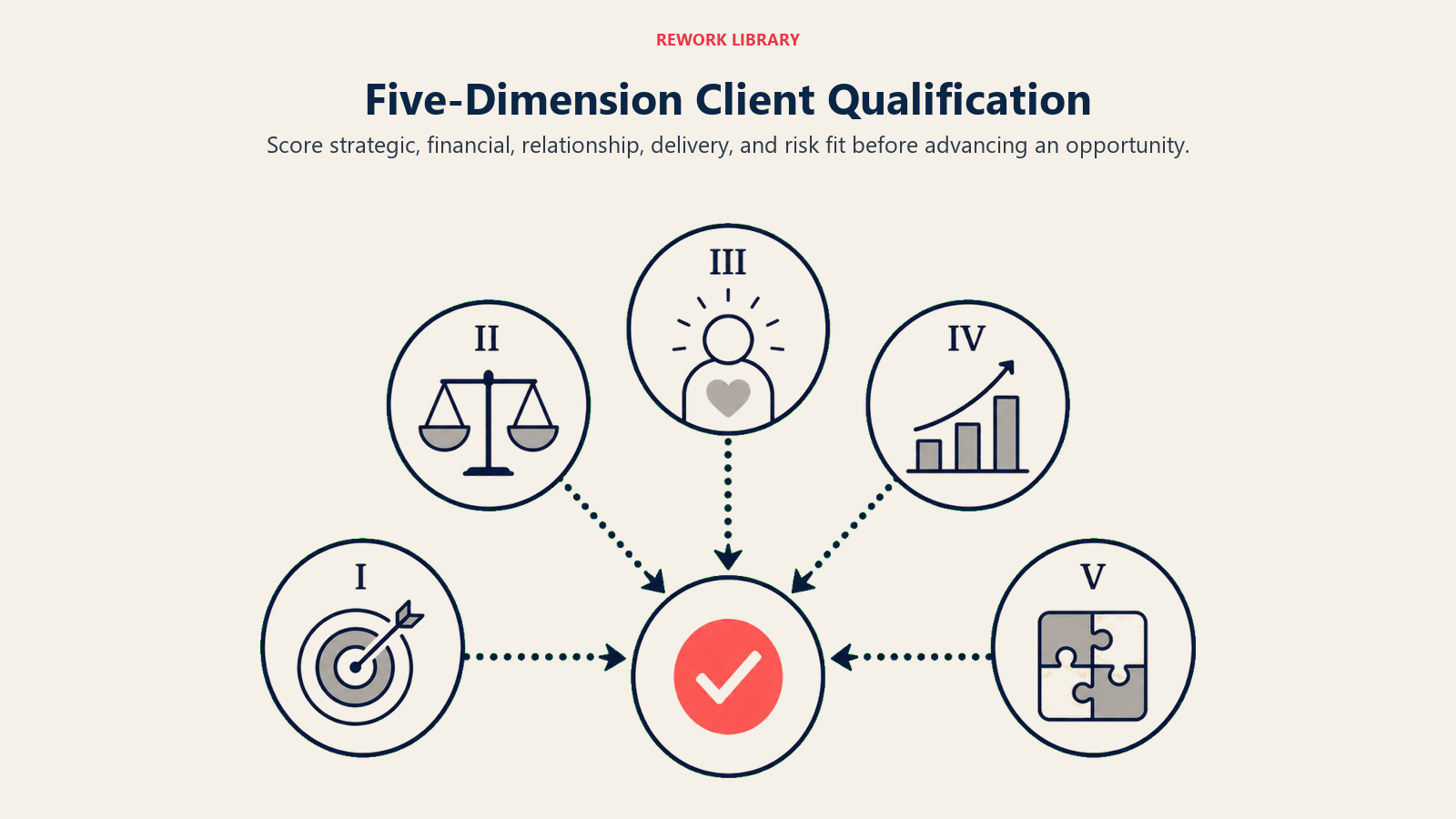
The Five-Dimension Client Qualification Framework
Good client qualification looks at five different dimensions. You need to score well on most of them, or the engagement is probably a mistake.
Dimension 1: Problem-Solution Fit
The most basic question: do they have a problem you can actually solve?
Expertise alignment means the work falls squarely in your wheelhouse. You've done this before. You have proven methodologies. You know the common pitfalls and how to avoid them.
If you're stretching to make the work fit your capabilities, that's a red flag. Professional services firms that chase work outside their core expertise end up reinventing wheels on the client's dime. Destroys margins and often delivers mediocre results.
Value creation potential means you can genuinely help them. Not just check boxes or fulfill requirements, but drive real business outcomes they care about. If you can't articulate the specific value you'll create, chances are they can't either.
Proven methodologies give you confidence you can deliver. You don't need to have done this exact project before, but you should have frameworks, tools, and processes that apply directly. Making it up as you go? Your estimate is probably made up too.
When problem-solution fit is weak, even if you win the work, you'll struggle to deliver it profitably.
Dimension 2: Economic Viability
Can this engagement actually make you money?
Budget reality is about whether they have money allocated that matches the scope of work. Not "might find budget" or "could reallocate from other projects." Actual approved budget, available now.
The budget conversation needs to happen early. If they won't discuss budget until after you've done a full proposal, you're at risk of wasting time on an engagement they can't afford. Master the budget and timeline discovery process to uncover these issues before investing significant effort.
Value perception matters as much as budget. Do they view professional services as an investment or an expense? Clients who see you as an investment will pay for quality and expertise. Clients who see you as an expense will grind you on price and question every hour.
Decision authority means the person you're talking to can actually approve the engagement. Or at least, they have direct access to whoever can. Complex approval chains that involve five layers of sign-off? Slow, unpredictable, and they often result in scope getting cut to hit budget targets.
Payment terms are part of economic viability too. If they want net-90 payment terms, no retainer, and the right to withhold payment pending their satisfaction, that's a cash flow and risk problem.
Red flag: "We don't have a specific budget, but we're ready to move forward once we see your proposal." Translation: they're hoping you'll be cheap enough to fit whatever they scraped together.
Dimension 3: Cultural Alignment
Most firms underweight this dimension, and it's often the one that kills projects.
Working style compatibility means how they work matches how you work. If your process involves weekly check-ins and iterative feedback, but they want to hand off requirements and disappear for three months, that's a mismatch.
Communication expectations need to align. Do they expect instant Slack responses? Are they okay with asynchronous communication? Do they want face-to-face meetings or video calls? Mismatched communication styles create friction.
Decision-making approach tells you how they operate. Do they make decisions quickly based on your recommendations? Or do they need three rounds of internal debate and consensus-building for every choice? Neither is wrong, but you need to know what you're getting into.
Risk tolerance shows up in how they respond to your recommendations. Some clients want proven, conservative approaches. Others want cutting-edge solutions. Pitching innovation to a client who values stability (or vice versa)? You'll fight that tension the entire engagement.
Values alignment is the soft stuff that's actually hard. Do they treat your team with respect? Do they value the same things you value, quality, transparency, partnership? Or are they looking for vendors they can push around?
Cultural misalignment is hard to fix. If you sense it in the sales process, it'll be worse once they're a client.
Dimension 4: Success Factors
Even if everything else looks good, the engagement can fail if these factors aren't in place.
Commitment level from the client is essential. Professional services work requires client participation. If they're not willing to allocate their own people's time, provide access to information, and engage actively in the work, you can't succeed.
Ask directly: "What internal resources are you prepared to commit to this project?" If they hesitate or lowball the commitment, that's a warning sign.
Internal resources they can dedicate matter. Do they have a project manager on their side? Subject matter experts you can interview? Decision-makers who'll attend working sessions? Or are you going to be chasing busy executives for weeks trying to get 30 minutes on their calendar?
Stakeholder alignment means the key people inside their organization actually agree this work needs to happen. If you're dealing with one champion but there's internal resistance, you'll spend half the project managing their internal politics instead of delivering value.
Timeline realism is about whether their expectations match reality. If they want a six-month engagement completed in six weeks, something has to give, scope, quality, or budget. Usually all three.
Clients who start with unrealistic timelines rarely become more reasonable. They just blame you when reality doesn't match their wishful thinking.
Dimension 5: Strategic Value
Not every client has to be strategically valuable, but it helps.
Portfolio contribution means how this work fits your business strategy. Does it expand your capabilities into a new area you want to grow? Does it deepen expertise in a core offering? Or is it a one-off that doesn't build anything for your future? Consider how each engagement aligns with your service line strategy.
Reference potential is huge for professional services. Will this client be willing to be a reference? Will they do case studies? Speak at your events? The best clients become advocates who bring you more good clients.
Market entry value applies when a client opens doors to a new industry, geography, or segment you want to penetrate. Sometimes you'll take lower margins on an engagement because it establishes credibility in a market you're targeting.
Brand association matters. Is this a client whose logo on your website enhances your reputation? Or are they so unknown or poorly regarded that the association does nothing for you?
Strategic value can justify taking on clients who score lower on other dimensions. A marquee client that opens up a new market segment might be worth some extra effort. But don't let strategic rationale blind you to fundamental fit problems.
Building Your Ideal Client Profile (ICP)
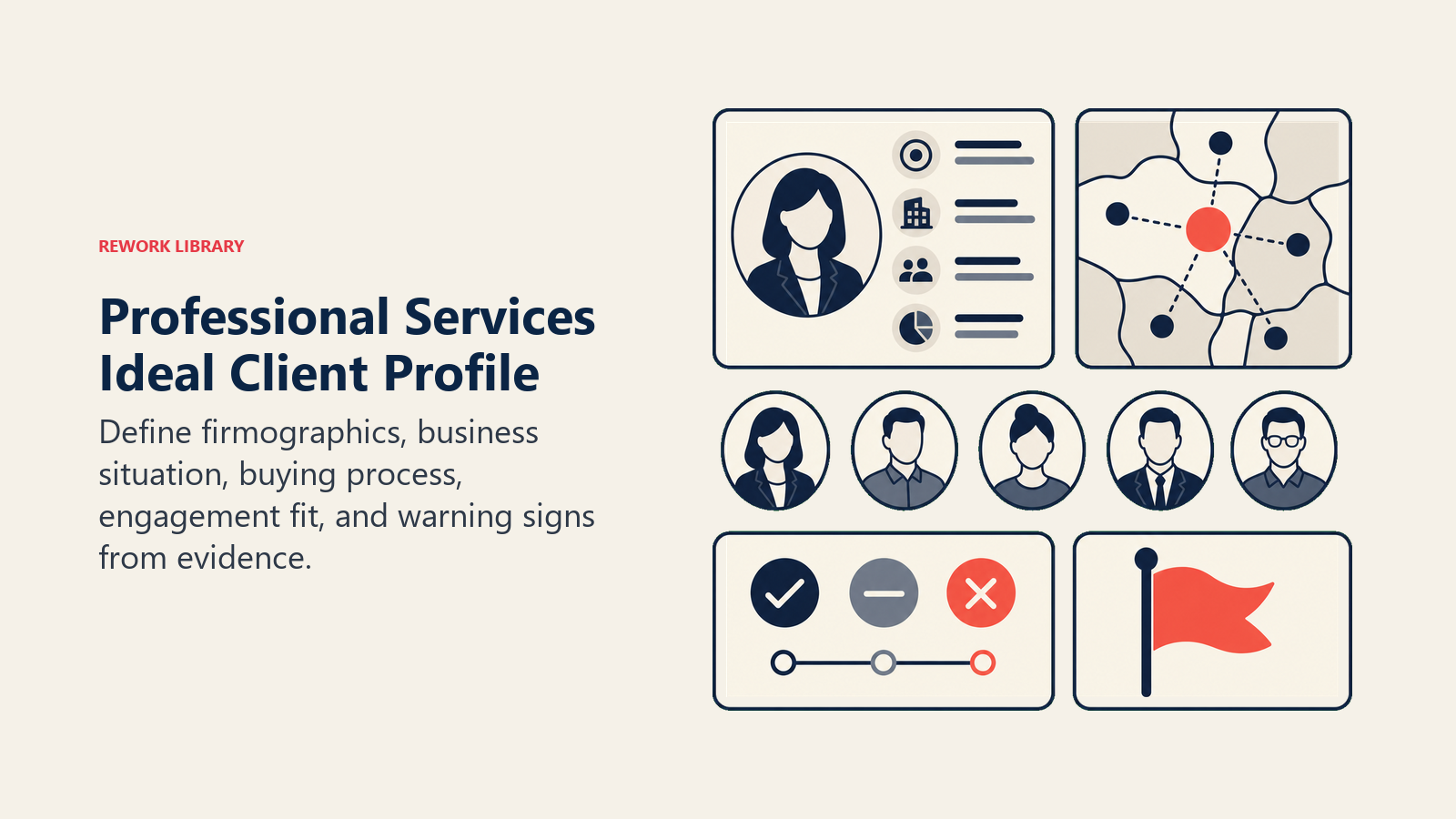
A qualification framework only works if you know what you're qualifying against. That's where your Ideal Client Profile comes in.
Firmographic Criteria
Start with the basic demographic filters:
Industry and vertical should be specific. "Healthcare" is too broad. "Hospital systems with 200+ beds" or "Medical device manufacturers with FDA-regulated products" gives you actual criteria.
Company size and revenue creates boundaries. If you specialize in mid-market firms, don't chase Fortune 500 enterprises or startups. The buying processes, decision-making, and expectations are completely different.
Location and geography matter for services that require on-site work or benefit from time zone alignment. If you're US-based and don't want to work European hours, international clients score lower.
Company maturity and growth stage tells you a lot. Early-stage companies have different needs and budgets than mature enterprises. Align with the stage you serve best.
Behavioral Characteristics
Here's how good clients actually behave:
Values expertise over cost. They care about quality and outcomes, not just hourly rates. They understand that cheap often costs more in the long run.
Seeks long-term solutions, not quick fixes. They want to solve problems properly, even if it takes longer or costs more upfront.
Collaborative and respectful. They treat you as a partner, not a vendor. They value your input and expertise.
Respects professional boundaries. They don't expect you to be available 24/7. They understand scope and change management. They don't try to squeeze free work out of you.
Has realistic expectations. They understand that good work takes time. They've done this before and know what's reasonable.
Engagement Indicators
Look for these signals that suggest good fit:
Problem complexity aligns with your capabilities. The challenge is substantial enough to justify your fees but not so exotic that you're learning on their dime.
Long-term relationship potential. This isn't a one-time project. There's opportunity for ongoing work, retainers, or additional engagements.
Cross-sell opportunities. They have needs across multiple service lines you offer. Solving one problem opens doors to solve others.
Strong internal champion. Someone inside their organization really wants to work with you and will advocate for you internally.
The ICP Matrix: Must-Have vs Nice-to-Have
Not every criterion is equally important. Build a matrix that separates must-haves from nice-to-haves.
Must-have criteria are non-negotiable:
- Budget available that matches scope
- Problem we can solve with existing expertise
- Respectful communication in sales process
- Decision authority confirmed
- Timeline realistic for quality delivery
Nice-to-have criteria improve fit but aren't dealbreakers:
- Prior experience with professional services
- Strong reference potential
- Industry we're trying to grow in
- Long-term relationship opportunity
- Values alignment with our culture
Weight your criteria based on what actually predicts successful engagements. Look at your past projects. Which client characteristics correlated with profitability, smooth delivery, and happy teams?
Set thresholds for moving forward. Maybe you need to hit 4 out of 5 must-haves and at least 3 nice-to-haves. The specific thresholds matter less than having them defined and following them.
Red Flags and Warning Signs You Can't Ignore
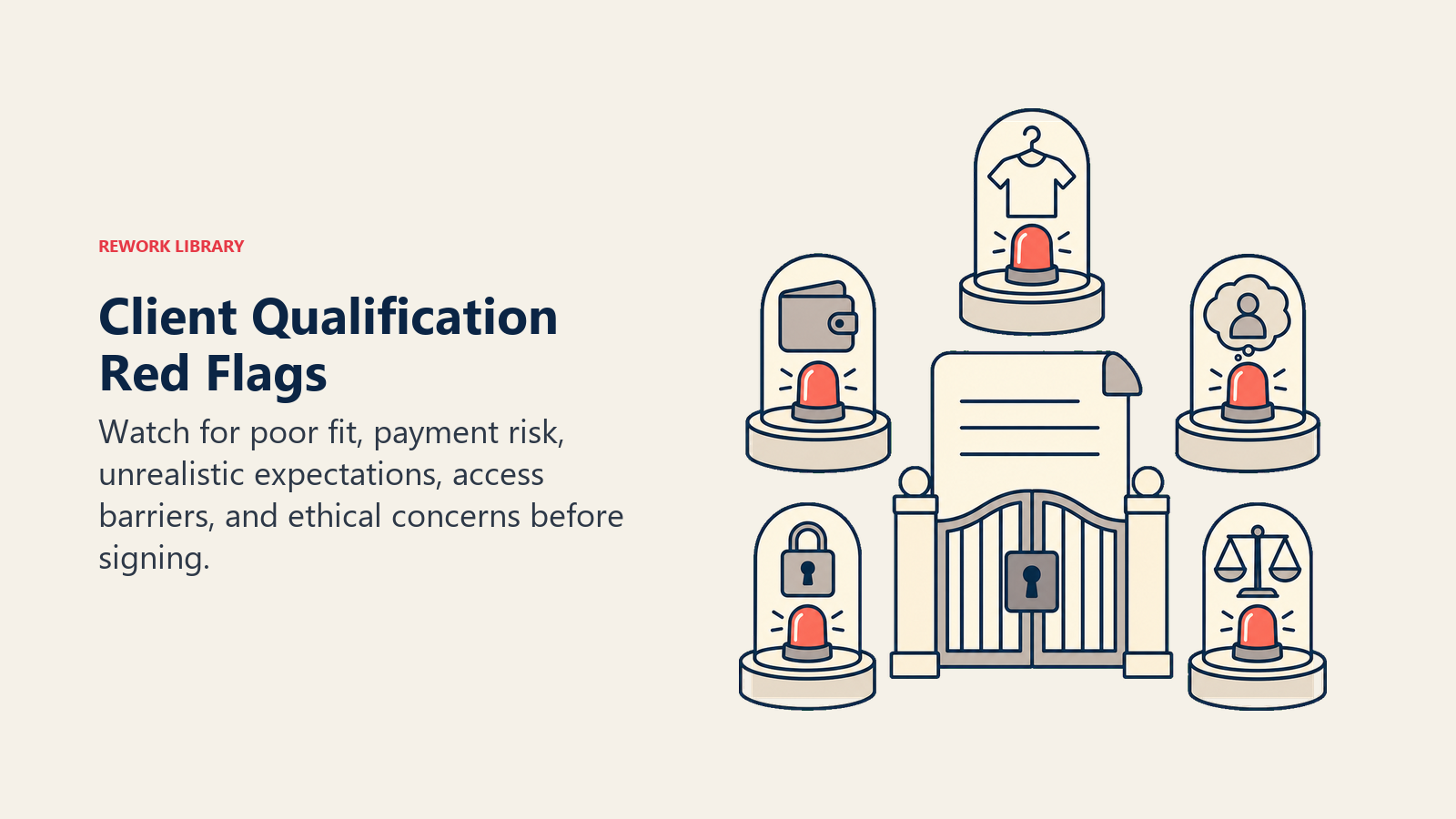
Some signals are so strong they should make you walk away, regardless of the revenue opportunity.
Critical Red Flags (Walk Away)
Unrealistic budget expectations for stated scope. They want a $200K project done for $50K. You can't deliver quality work at that price, and trying will only damage your reputation.
Aggressive timeline that sacrifices quality. "We need this in three weeks but we know it normally takes three months." They're telling you they don't care about quality.
Extreme scope ambiguity with unwillingness to define it. "We'll figure it out as we go" sounds flexible. It means endless scope creep and disputes over what was included.
History of firing service providers. They've been through three firms in two years. Ask yourself: are you really that much better, or will you be number four?
Ethical concerns or misalignment. They want you to do something that makes you uncomfortable, cuts corners, or conflicts with your values. There's no amount of money worth compromising your integrity.
Disrespectful behavior in the sales process. If they're rude to your team, miss meetings without notice, or treat you like they own you before they've even hired you, imagine how they'll act once they're paying you.
Refusal to discuss budget until "we see your proposal." This is a negotiation tactic designed to anchor you at the lowest possible price. It wastes everyone's time.
Warning Signs (Proceed with Caution)
Not automatic disqualifiers, but they require extra diligence:
Multiple decision-makers with unclear authority. Complex approval processes slow everything down and often result in scope getting cut.
Price shopping across many vendors. If they're getting five proposals and choosing based primarily on price, you probably don't want to win on that basis.
Commodity mindset. They view your services as interchangeable with competitors. They don't see your unique value.
Micromanagement tendency. They want to approve every detail and question every decision. This slows delivery and undermines your expertise.
Vague success criteria. They can't clearly articulate what success looks like, which means you'll never satisfy them.
Internal political complexity. Multiple factions with competing agendas. Your work becomes a political football.
When to Override Warning Signs
Sometimes strategic opportunities justify taking on higher-risk engagements:
Market entry value. This client opens access to an industry or segment you're targeting. The reference value outweighs the project risk.
Relationship building with a dream client. You're willing to take a smaller or riskier project to prove yourself for bigger future work.
Strategic learning. The work builds capabilities you want to develop, even if it's not the most profitable project.
But here's the key: if you override warning signs, do it consciously. Acknowledge the risks. Price accordingly. Staff appropriately. Don't pretend the warning signs don't exist.
The Client Qualification Process: Four Stages
Qualification isn't a single conversation, it's a progression through multiple stages, each adding more information and rigor.
Stage 1: Initial Screening (15 Minutes)
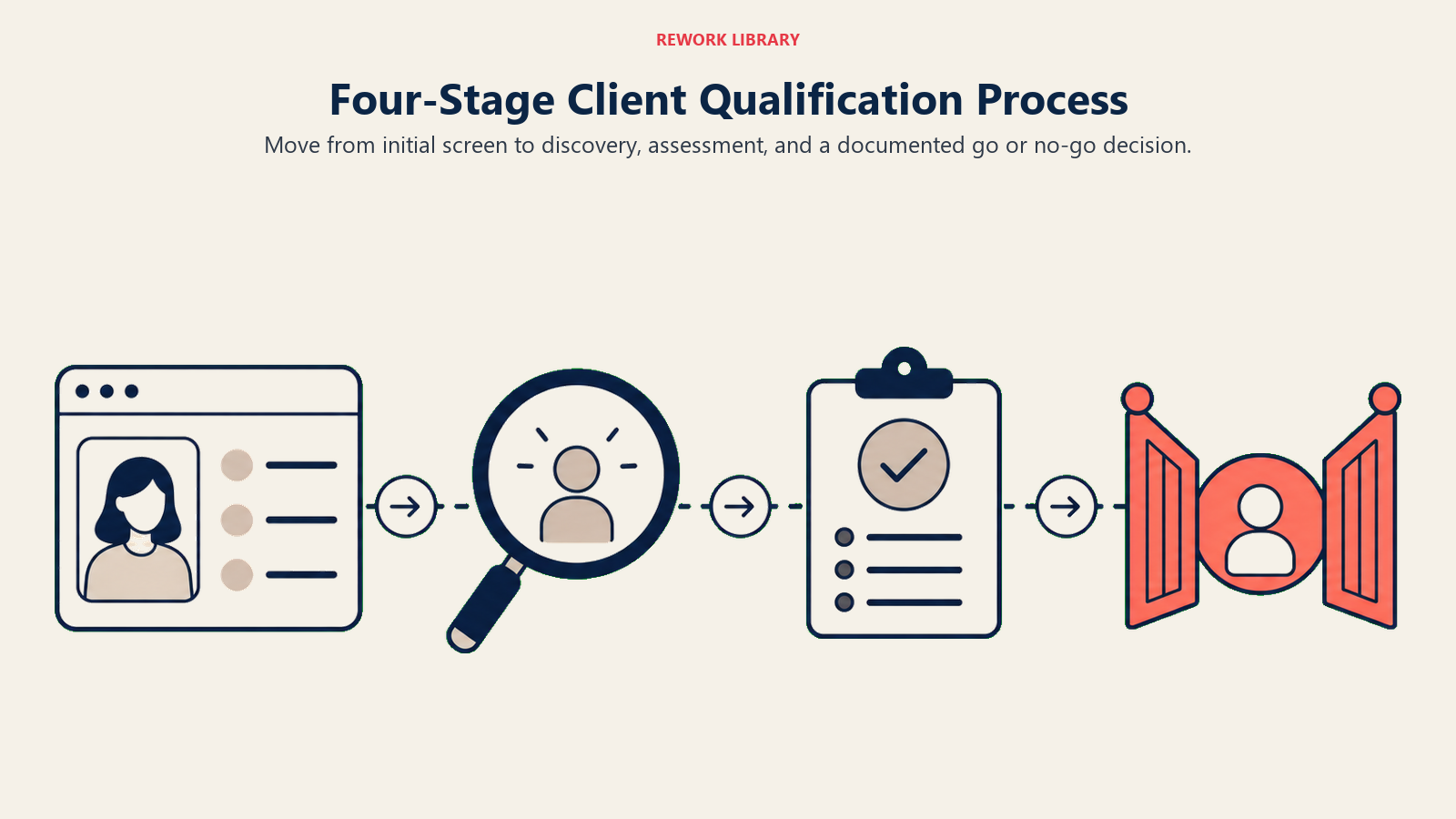
This happens in the first call or email exchange. Look for basic fit:
- Do they match your ICP firmographics?
- Is the problem in your wheelhouse?
- Do they have reasonable budget expectations?
- Is the timeline realistic?
- Are there obvious red flags?
This stage is about quickly disqualifying obvious mismatches so you don't waste time on full discovery.
Sample screening questions:
- "What specific challenge are you trying to solve?"
- "What's your timeline for making a decision and getting started?"
- "Have you allocated budget for this initiative?"
- "Who else is involved in the decision?"
If they pass initial screening, schedule deep discovery.
Stage 2: Deep Discovery (60-90 Minutes)
A structured conversation that digs into all five qualification dimensions. This is where a strong initial consultation process pays dividends:
Problem-solution fit:
- What's the business impact of the problem?
- What have you tried already?
- What does success look like?
- Why now?
Economic viability:
- What budget range have you allocated?
- How was that budget determined?
- Who controls budget approval?
- What's your process for approving expenditures of this size?
Cultural alignment:
- How do you prefer to work with external partners?
- What communication cadence works for you?
- How do you make decisions?
- What's been your experience with similar engagements?
Success factors:
- What internal resources can you commit?
- Who will be our primary point of contact?
- Do key stakeholders support this initiative?
- What could prevent this project from being successful?
Strategic value:
- Would you be willing to serve as a reference if we deliver great results?
- Are there other areas where we might work together?
Document everything. You'll need it for stage 3.
Stage 3: Internal Assessment (Team Review)
Take the discovery information back to your team. Don't make qualification decisions alone.
Evaluate against ICP criteria. Score the opportunity on must-haves and nice-to-haves. Do they hit your thresholds?
Red flag review. Did anything concerning come up? Get multiple perspectives. Sometimes you'll rationalize away red flags that others see clearly.
Capacity and staffing assessment. Do you have the right people available? If you'd have to staff this with B-team players, that affects the decision.
Strategic fit discussion. How does this engagement fit your business priorities?
Go/No-Go decision. Based on everything, should you pursue this? If yes, what's the pricing and approach? If no, how will you decline?
Stage 4: Mutual Fit Confirmation
If you decide to pursue the work, the proposal process is your final qualification checkpoint.
Confirm mutual expectations. Your proposal should make scope, timeline, approach, and investment crystal clear. Their reaction tells you if you're aligned.
Watch for scope creep before contract signature. If they're already trying to add things or negotiate scope, imagine how it'll be during delivery.
Payment terms negotiation. How they approach payment terms reveals their partnership mentality. Fair terms? Good sign. Trying to push all risk to you? Warning sign.
Contract redlines. Some negotiation is normal. Aggressive attempts to rewrite liability, IP ownership, or termination clauses suggest they're preparing for conflict, not partnership.
If they don't sign the proposal you put forward, or if they try to dramatically change terms, treat that as new qualification information. Sometimes the right answer is to walk away even after investing in a proposal.
Qualification Scorecards: Making It Systematic
Ad hoc qualification leads to inconsistency. Scorecards make it systematic.
Building Your Scorecard
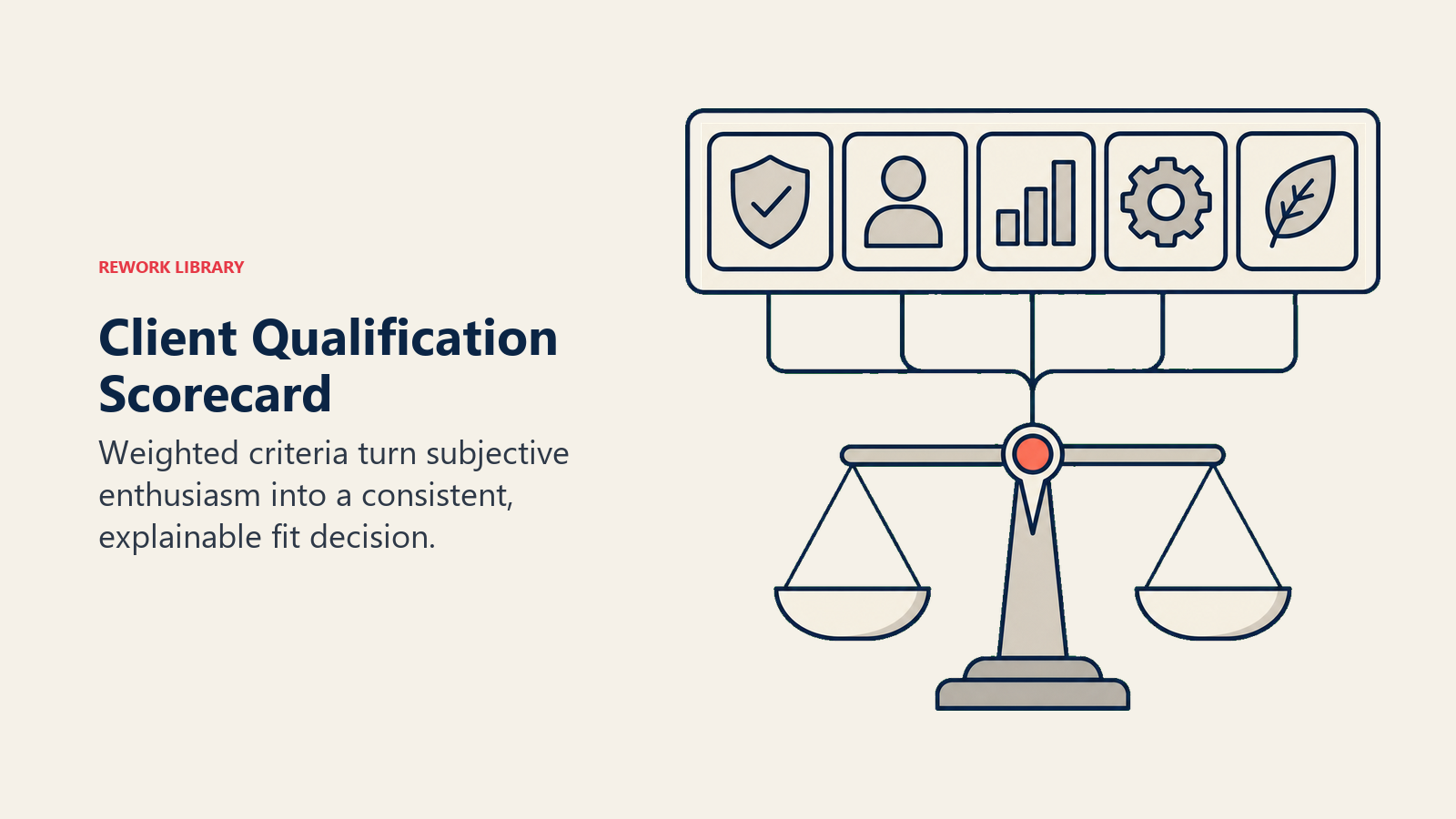
Create a scoring system across the five dimensions:
Problem-Solution Fit (20 points)
- Core expertise match: 8 points
- Proven methodology exists: 7 points
- Clear value creation: 5 points
Economic Viability (25 points)
- Budget confirmed and adequate: 10 points
- Decision authority clear: 8 points
- Payment terms acceptable: 7 points
Cultural Alignment (20 points)
- Working style compatible: 8 points
- Communication style match: 6 points
- Values alignment: 6 points
Success Factors (20 points)
- Client commitment demonstrated: 8 points
- Resources allocated: 6 points
- Timeline realistic: 6 points
Strategic Value (15 points)
- Portfolio contribution: 5 points
- Reference potential: 5 points
- Long-term opportunity: 5 points
Total possible: 100 points
Thresholds:
- 80+: High priority, strong fit
- 65-79: Qualified, proceed with standard approach
- 50-64: Marginal, only if strategic
- <50: Decline
Red Flag Deductions
Even if base score is high, certain red flags trigger automatic deductions or disqualification:
- Disrespectful behavior: -20 points or auto-disqualify
- Ethical concerns: Auto-disqualify
- Budget 40%+ below reasonable estimate: -15 points
- Timeline 50%+ compressed: -15 points
- Pattern of firing providers: -20 points or auto-disqualify
Team Alignment on Scoring
The scorecard only works if everyone uses it consistently:
Train your team on how to score each dimension. Provide examples and calibration exercises.
Review scores together for the first dozen opportunities to ensure consistency.
Track score vs outcome. Did high-scoring opportunities turn into successful projects? Did low-scoring ones cause problems? Refine your model based on results.
Celebrate good "no" decisions. When someone declines a low-scoring opportunity and it would have been a disaster, recognize that. You want to reinforce disciplined qualification.
The Art of Saying No Gracefully
Declining opportunities is uncomfortable, especially when you need revenue. But how you say no matters.
Why Saying No is a Growth Strategy
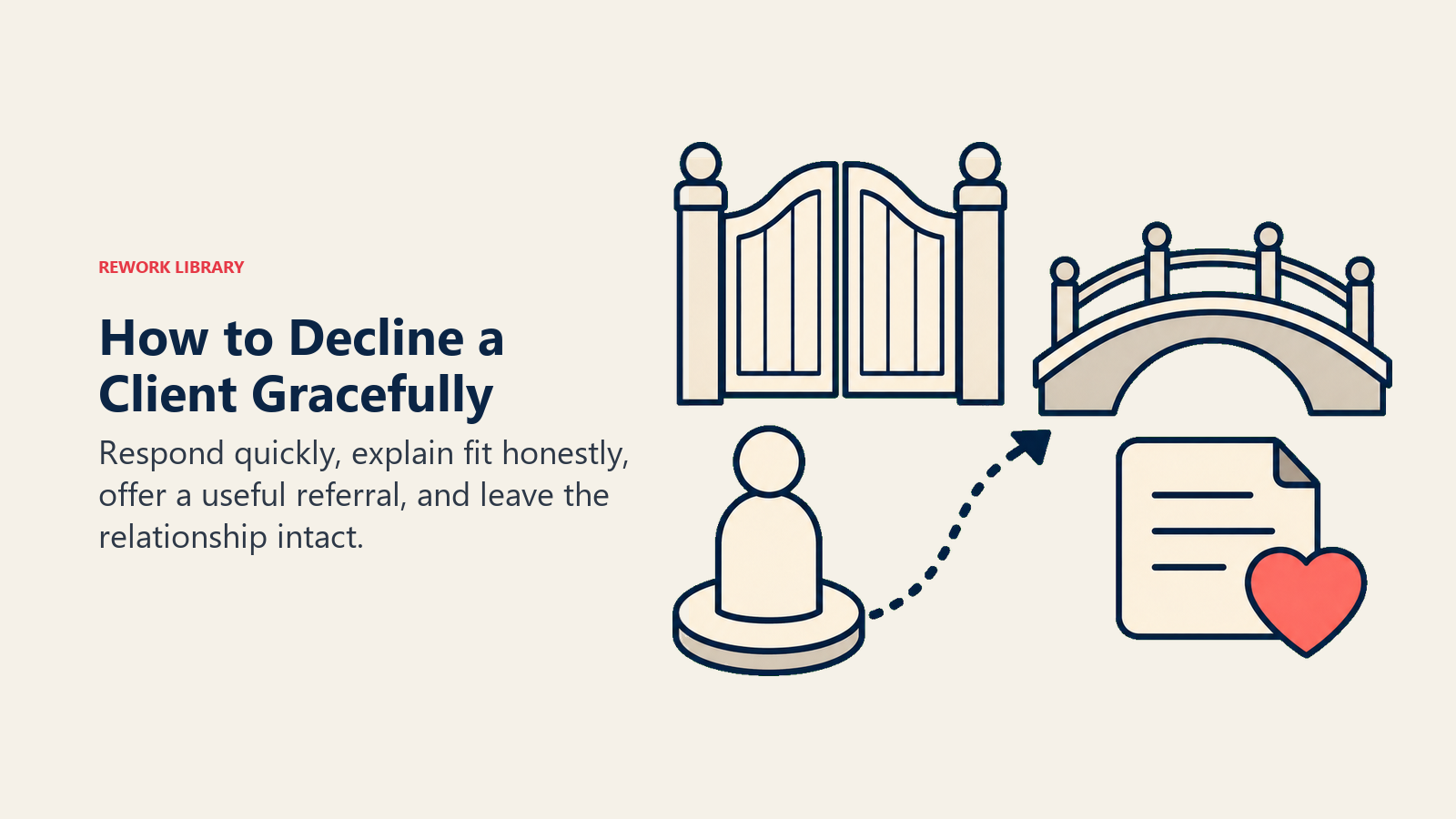
Every no creates capacity for a better yes. When you turn down misfit work, you're protecting:
Your team's capacity for ideal clients who will pay well, treat you well, and lead to more good work.
Your profitability by avoiding projects that will blow up and destroy margins.
Your reputation by not taking on work where you can't deliver excellence.
Your momentum by maintaining team morale and focusing on clients who energize you rather than drain you.
The best professional services firms are selective. Selectivity is a signal of confidence and expertise.
How to Decline Professionally
You don't need to explain every reason. Keep it brief and respectful:
When budget doesn't align: "Thank you for the opportunity to discuss your project. Based on our conversation, I don't think we're the right fit for your budget parameters. I'd recommend [suggest alternative if you can, smaller firm, different approach, etc.]. I appreciate your time."
When expertise doesn't match: "After reviewing your needs, I don't think we're the best firm for this particular challenge. This falls outside our core expertise, and I'd want to make sure you're working with someone who can deliver the best results. Have you considered [suggest alternatives if appropriate]?"
When red flags are present: "I appreciate you thinking of us for this work. After our conversations, I don't think our working styles are well-aligned. I want to make sure you find a partner who's a great fit for how you operate."
When timeline is unrealistic: "Based on what you've described, the timeline you need doesn't align with our ability to deliver quality work. I'd rather be upfront about that now than commit to something we can't execute well."
When you're at capacity: "We'd love to work on this, but our team is at capacity through [date]. If your timeline can accommodate starting after that, let's reconnect. If you need to move sooner, I don't want to delay your project."
Sample Decline Scenarios
Scenario 1: Price shopper who wants the cheapest option "I can see that price is your primary decision criteria. We focus on delivering high-value outcomes rather than competing on price. That's probably not the right fit for what you're looking for. I wish you the best with your project."
Scenario 2: Unrealistic scope and timeline "You've outlined a comprehensive transformation that realistically requires 9-12 months to do properly. Compressing that into 6 weeks would require cutting corners that would undermine the results. I'd rather decline than deliver something that won't actually solve your problem."
Scenario 3: Cultural mismatch evident in sales process "Based on our conversations, I think our approach and your expectations aren't well-aligned. You're looking for [their approach], and our methodology is built around [your approach]. I think you'd be better served by a firm whose process matches what you're looking for."
When to Reconsider or Negotiate
Sometimes a "no" can become a "yes under different terms":
Adjusted scope: "At the $75K budget, we can't deliver everything you outlined. But we could focus on Phase 1 [specific deliverables] and create a path to Phase 2 once you see results. Would that work?"
Timeline flexibility: "We can't hit your original deadline, but if you can extend the timeline by 6 weeks, we can deliver this properly."
Pilot or proof-of-concept: "Rather than committing to the full engagement before we've worked together, what if we start with a smaller pilot project? That lets us prove the approach and build trust before a larger commitment."
Different service tier: "Our full-service offering doesn't fit your budget, but we have a guided self-service model that might work. Here's how that would look..."
The key is not compromising on fit. You can adjust scope, timeline, or approach. But if the fundamental fit issues remain, no amount of negotiation fixes that.
Building a Qualification Culture in Your Firm
Client qualification can't be one person's responsibility, it needs to be a firm-wide discipline.
Leadership Sets the Tone
Qualification culture starts at the top:
Partners and principals need to model selectivity. If leadership chases every opportunity regardless of fit, the team will too.
Celebrate good "no" decisions publicly. When someone turns down bad-fit work, recognize it in team meetings. Make it clear that disciplined qualification is valued.
Make pipeline quality metrics matter more than pipeline volume. Track win rates, project profitability, and client satisfaction, not just deal count.
Don't punish people for turning down bad opportunities. If compensation is purely based on revenue closed, you incentivize taking anything. Build in quality metrics.
Team Training and Empowerment
Give your team the tools and authority to qualify effectively:
Train everyone on the qualification framework. Make sure business development, account managers, and delivery teams all understand the criteria and why they matter.
Provide decision-making authority. Don't make people get approval to decline obviously bad fits. Trust them to use the framework.
Share qualification stories. Run post-mortems on both successful projects and problematic ones. What did qualification miss? What did it catch?
Create feedback loops. After projects complete, revisit the initial qualification. Did the scores predict reality? Where were you wrong? Use that to improve.
Making Qualification Part of CRM and Process
Build qualification into your systems:
CRM qualification fields that capture scores across the five dimensions. Make it part of the opportunity record.
Stage gates that require qualification before moving opportunities forward. Can't create a proposal without completing the qualification scorecard.
Reports and dashboards that show qualification metrics: average scores, distribution, correlation with win rates and profitability.
Regular pipeline reviews where you discuss not just what's in the pipeline, but whether it should be there.
Industry-Specific Qualification Considerations
Different types of professional services firms need to adjust the framework:
Consulting Firms
Expertise depth matters more than breadth. Consultants sell expertise, so problem-solution fit is the highest-weighted dimension.
Stakeholder complexity is common. Expect longer sales cycles and multiple decision-makers. Build that into your timeline expectations.
Engagement value varies widely. A $2M strategy project justifies more qualification rigor than a $50K assessment.
Creative and Marketing Agencies
Portfolio fit is critical. Will this work showcase your capabilities and attract more good work? Or is it commodity work that doesn't build your brand?
Creative chemistry matters. Cultural alignment and working style compatibility predict success more than in other services.
Scope creep is rampant. Clients often struggle to define creative scope upfront. Your qualification process needs to address this head-on.
Law Firms
Conflict checks are non-negotiable. But beyond conflicts, ethical alignment matters. Will this client drag you into situations that compromise your professional standing?
Matter complexity affects staffing. Can you deliver this with existing expertise or will it require building new capabilities?
Payment risk is real. Some clients are notoriously slow to pay legal bills. Qualify their payment history and financial stability.
Accounting Firms
Compliance vs advisory work requires different qualification. Compliance work (tax prep, audits) has more standardized criteria. Advisory work needs deeper qualification.
Industry specialization often matters. If you specialize in manufacturing clients, retail clients are harder to serve well even if they're the right size.
Relationship longevity is the goal. Annual tax and accounting work creates recurring revenue. Qualify for long-term fit, not just the immediate project.
Common Qualification Mistakes to Avoid
Even firms with qualification frameworks make these errors:
Mistake 1: Qualifying on Budget Alone
Just because they have money doesn't mean they're a good client. All five dimensions matter.
Budget-only qualification leads to profitable disasters - clients who pay well but make your life miserable.
Mistake 2: Overriding Red Flags Because You Need Revenue
When you're under revenue pressure, it's tempting to rationalize away red flags. "Maybe they won't be that difficult." "Maybe the scope ambiguity will resolve itself."
It won't. Red flags are predictive. Trust them.
Mistake 3: Inconsistent Application of Standards
If qualification standards shift based on who's selling or what month it is, they're not really standards.
You need consistent criteria applied consistently. Otherwise it's just gut feel with extra steps.
Mistake 4: Not Qualifying Referrals Differently
Just because someone you trust referred them doesn't mean they're automatically qualified. Referrals need to go through the same process.
Your referral source might have different standards for what makes a good client than you do.
Mistake 5: Qualifying Once and Never Revisiting
Qualification isn't just for new opportunities. Existing clients can become bad fits:
- Their priorities change
- Leadership changes
- Budget gets cut
- They get acquired by a company with different values
Periodically re-qualify existing clients. Sometimes you need to exit relationships that have deteriorated.
Mistake 6: No Feedback Loop Between Sales and Delivery
Sales does qualification, then hands off to delivery. Delivery discovers the client is a nightmare. Sales never hears about it, so they keep qualifying the same way.
Create structured feedback from delivery to sales on what qualification missed and what it got right.
Measuring Qualification Effectiveness
How do you know if your qualification framework is working?
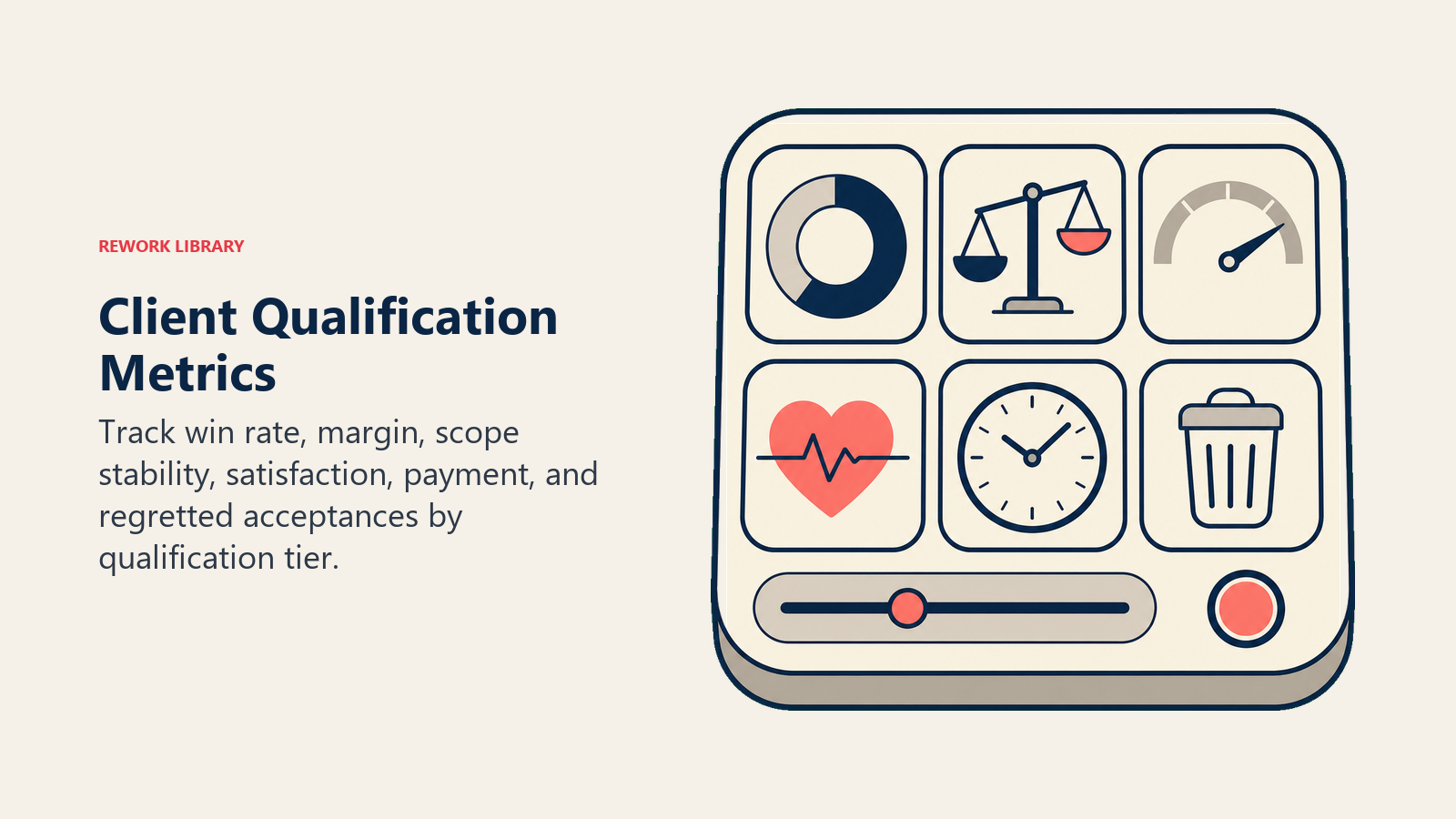
Lead-to-Proposal Conversion Rate
What percentage of qualified opportunities progress to proposal stage?
If it's too high (over 80%), you might not be qualifying rigorously enough. You're probably working too many marginal opportunities.
If it's too low (under 30%), your qualification might be too restrictive or you're not actually using it.
Target range: 40-60% for most professional services.
Proposal Win Rate
What percentage of proposals result in signed contracts?
Strong qualification should improve win rates because you're only proposing to well-qualified opportunities.
If win rates are low despite strong qualification scores, either your qualification criteria don't predict well, or your proposals aren't competitive.
Project Profitability
Do higher-scoring opportunities turn into more profitable projects?
This is the ultimate test. If qualification works, you should see correlation between qualification scores and actual project margins.
Track profitability by client qualification score. If there's no correlation, your qualification dimensions aren't measuring what matters.
Client Satisfaction
Do well-qualified clients rate their experience higher?
Client satisfaction surveys should show better scores for clients who scored high in qualification, especially on cultural alignment and success factors.
Team Satisfaction
Are your people happier working on well-qualified clients?
Survey your delivery teams. Do they prefer working with clients who scored high on qualification? If not, what's the disconnect?
Correlation Analysis
The most powerful measure is looking at which qualification dimensions actually predict success:
- Which dimensions correlate most strongly with profitability?
- Which predict client satisfaction?
- Which predict project success?
- Which don't seem to matter much?
Use this data to refine your framework, adjusting weights and criteria based on what actually predicts outcomes.
Advanced Qualification Strategies
Once you've mastered basic qualification, these advanced tactics improve results:
Pre-Qualification Content
Create content that self-qualifies prospects before they contact you:
Pricing guides that set realistic budget expectations. People who reach out after seeing your pricing are less likely to have sticker shock.
Process overviews that explain how you work. Prospects who don't like your approach self-select out before wasting your time.
Case studies that show ideal client profiles. "We work best with companies like these" helps prospects self-assess fit.
FAQ addressing common concerns. Answer the qualification questions proactively in your content.
Paid Discovery
For large, complex engagements, charge for the discovery process itself:
"Before we can commit to a full engagement, we need 2-3 weeks of paid discovery to fully understand your situation, validate the approach, and scope the work properly."
This accomplishes multiple things:
- Tests their commitment (willing to pay for discovery)
- Generates revenue even if the main project doesn't proceed
- Gives you much deeper qualification data
- Establishes your value from day one
Pilot Projects
When fit is uncertain but strategic value is high, propose a pilot:
"Let's start with a focused 6-week pilot project that addresses [specific outcome]. That gives us both a chance to validate the approach and working relationship before committing to the full engagement."
Pilots reduce risk on both sides and give you real qualification data - how they actually work, not just how they say they work.
Reference Checks
For large opportunities, check references with their previous service providers:
"Can you provide references from other firms you've worked with on similar projects?"
Then actually call them. Ask:
- How was the client to work with?
- Did scope stay stable?
- How were they with payment?
- Would you work with them again?
- What advice would you give someone starting a new engagement with them?
Former providers will often be candid about red flags current prospects won't mention.
Implementation Roadmap: From Framework to Culture (12 Weeks)
Here's how to roll out systematic client qualification: Weeks 1-2: ICP Definition
- Analyze your best and worst clients from the past 2-3 years
- Identify common characteristics of each group
- Define your must-have and nice-to-have criteria
- Build your ICP matrix
Weeks 3-4: Framework Design
- Map the five qualification dimensions to your business
- Determine weighting for each dimension and criterion
- Create your qualification scorecard
- Define thresholds for pursue/decline decisions
- Document your red flags
Weeks 5-6: Process Integration
- Build qualification into your CRM
- Create qualification checklists for each stage
- Develop standard decline templates
- Design reporting dashboards
Weeks 7-8: Team Training
- Train business development team on framework and scoring
- Practice with past opportunities to calibrate scoring
- Role-play qualification conversations
- Establish escalation process for edge cases
Weeks 9-10: Pilot and Refine
- Apply framework to all new opportunities
- Run weekly reviews of qualification decisions
- Capture feedback and refine criteria
- Address edge cases and exceptions
Weeks 11-12: Full Implementation
- Roll out to entire team
- Integrate qualification metrics into KPIs
- Establish quarterly review process
- Begin tracking qualification vs outcomes data
Ongoing: Quarterly Reviews
- Review qualification effectiveness metrics
- Analyze correlation between scores and outcomes
- Refine criteria and weights based on data
- Update ICP as business strategy evolves
The Bottom Line: Selectivity as Strategy
Client qualification isn't about being difficult or turning away business for the sake of it. It's about recognizing that your capacity is finite, your reputation is precious, and your team's time is valuable.
The best professional services firms are selective. They say no more than they say yes. They understand that the right clients at the right price doing the right work is how you build a sustainable, profitable firm.
Your qualification framework is your first line of defense against the clients who will destroy your margins, burn out your team, and damage your reputation.
Build the framework. Train your team. Use it consistently. Measure whether it's working.
The short-term revenue you might lose by saying no to bad fits is nothing compared to the long-term profitability you'll gain by focusing on ideal clients.
Learn More
Ready to strengthen your professional services growth? Learn how consultative business development complements client qualification, and explore proposal development strategies for the clients who pass your qualification framework.
Related reading:
- Inbound Lead Generation - Attract qualified prospects through strategic content
- RFP Response Strategy - Apply qualification discipline to RFP decisions
- Fit vs Misfit Identification - Deep dive into recognizing client fit patterns
- Project Scope Assessment - Evaluate project complexity and feasibility

Sales Director
On this page
- Why Client Qualification is Your First Line of Defense
- The Five-Dimension Client Qualification Framework
- Dimension 1: Problem-Solution Fit
- Dimension 2: Economic Viability
- Dimension 3: Cultural Alignment
- Dimension 4: Success Factors
- Dimension 5: Strategic Value
- Building Your Ideal Client Profile (ICP)
- Firmographic Criteria
- Behavioral Characteristics
- Engagement Indicators
- The ICP Matrix: Must-Have vs Nice-to-Have
- Red Flags and Warning Signs You Can't Ignore
- Critical Red Flags (Walk Away)
- Warning Signs (Proceed with Caution)
- When to Override Warning Signs
- The Client Qualification Process: Four Stages
- Stage 1: Initial Screening (15 Minutes)
- Stage 2: Deep Discovery (60-90 Minutes)
- Stage 3: Internal Assessment (Team Review)
- Stage 4: Mutual Fit Confirmation
- Qualification Scorecards: Making It Systematic
- Building Your Scorecard
- Red Flag Deductions
- Team Alignment on Scoring
- The Art of Saying No Gracefully
- Why Saying No is a Growth Strategy
- How to Decline Professionally
- Sample Decline Scenarios
- When to Reconsider or Negotiate
- Building a Qualification Culture in Your Firm
- Leadership Sets the Tone
- Team Training and Empowerment
- Making Qualification Part of CRM and Process
- Industry-Specific Qualification Considerations
- Consulting Firms
- Creative and Marketing Agencies
- Law Firms
- Accounting Firms
- Common Qualification Mistakes to Avoid
- Mistake 1: Qualifying on Budget Alone
- Mistake 2: Overriding Red Flags Because You Need Revenue
- Mistake 3: Inconsistent Application of Standards
- Mistake 4: Not Qualifying Referrals Differently
- Mistake 5: Qualifying Once and Never Revisiting
- Mistake 6: No Feedback Loop Between Sales and Delivery
- Measuring Qualification Effectiveness
- Lead-to-Proposal Conversion Rate
- Proposal Win Rate
- Project Profitability
- Client Satisfaction
- Team Satisfaction
- Correlation Analysis
- Advanced Qualification Strategies
- Pre-Qualification Content
- Paid Discovery
- Pilot Projects
- Reference Checks
- Implementation Roadmap: From Framework to Culture (12 Weeks)
- The Bottom Line: Selectivity as Strategy
- Learn More