Client Retention Strategy: Economics, Prevention, Detection, and Relationship Deepening
Turn this article into takeaways for your work.


Each assistant summarizes the article only for you and suggests best practices for your work.
Here's a stat that should change how you think about growth: acquiring a new client costs 5-10 times more than retaining an existing one. Yet most professional services firms spend 80% of their energy chasing new business and 20% on keeping the clients they already have. Understanding this fundamental economics is central to the professional services growth model.
The math doesn't lie. A consulting firm with 100 clients and a 90% retention rate needs to land 10 new clients to maintain size. That same firm with 95% retention only needs 5. Those 5 extra client slots can drive growth instead of plugging holes.
But here's what makes retention tricky in professional services: clients leave quietly. There's rarely a dramatic exit. They just don't renew the retainer, stop calling with new projects, or gradually shift work to a competitor. By the time you notice, the relationship is already gone.
This guide shows you how to build a retention system that works - one that understands the economics, detects problems early, and deepens relationships before clients start looking elsewhere.
Understanding retention economics
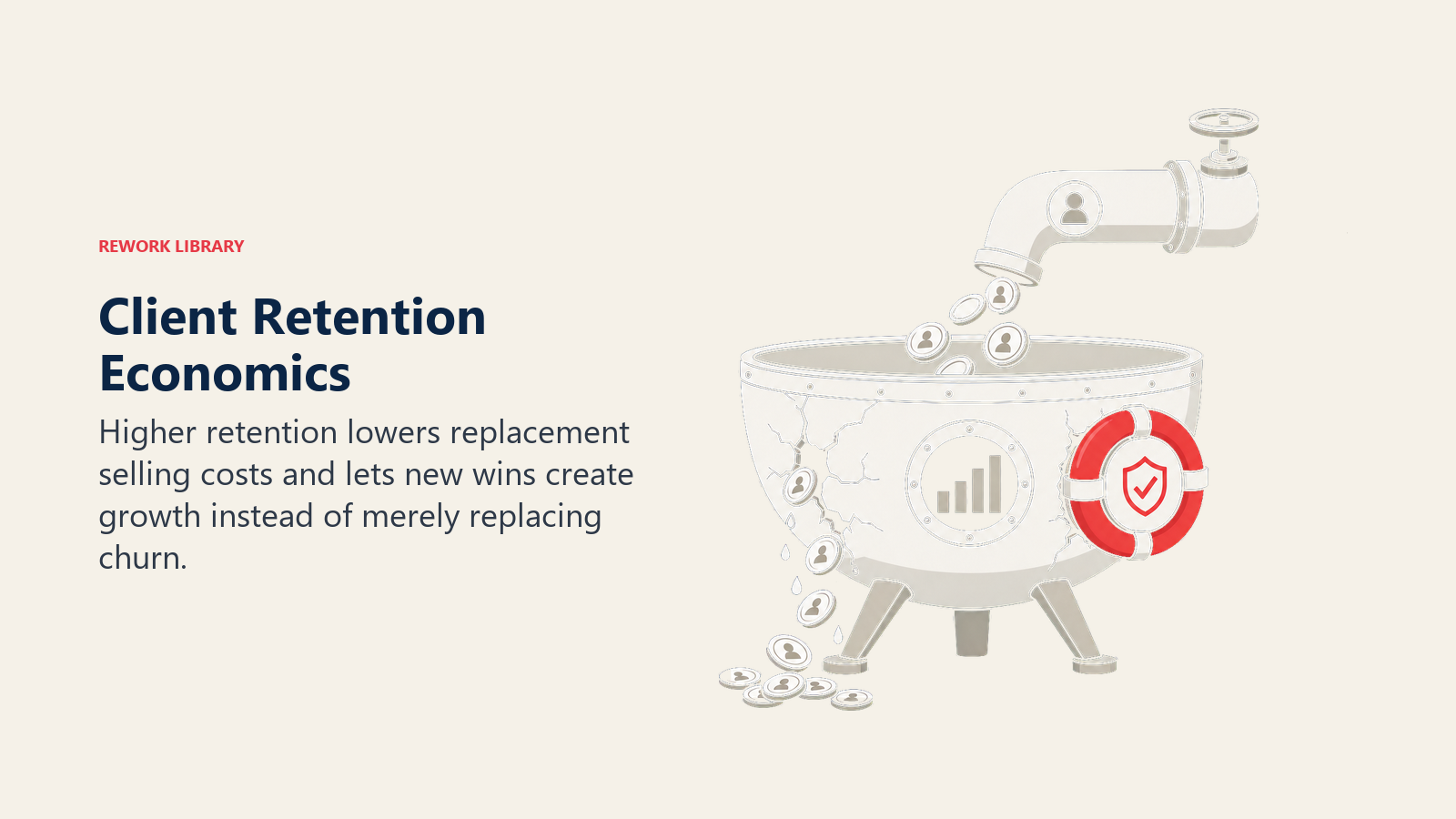
Let's start with the numbers that justify why retention deserves as much attention as acquisition. Client acquisition cost (CAC) in professional services includes everything you spend to land a new client: business development time, proposals, pitches, networking events, content marketing, thought leadership. For most firms, this runs between $5,000 and $50,000 per client depending on engagement size.
A mid-sized consulting firm might spend:
- 200 hours of partner time at $300/hour = $60,000
- Marketing and events = $20,000
- Proposal development and pitches = $15,000
- Total CAC for 10 new clients = $95,000, or $9,500 per client
Client lifetime value (CLV) measures the total profit a client generates over the relationship. For a client paying $100,000 annually with a 30% profit margin over 5 years, CLV is $150,000.
The payback period - how long it takes to recover CAC from profit - matters because you're investing heavily upfront. If CAC is $10,000 and annual profit per client is $30,000, you break even in 4 months. That's healthy. If it takes 18 months, you've got a cash flow problem.
The retention multiplier effect: A 5% improvement in retention can increase profitability by 25-95% depending on your business model. Why? Because:
- You stop paying to replace lost clients
- Retained clients often expand their spend over time
- Long-term clients require less service delivery overhead
- They generate referrals that reduce CAC for new clients
Here's the real kicker: most firms have an 80/20 revenue concentration where 20% of clients generate 80% of revenue. Losing one of those top clients means replacing them with 4-5 average clients just to maintain revenue. The economics get brutal fast.
Client churn analysis: understanding why they leave
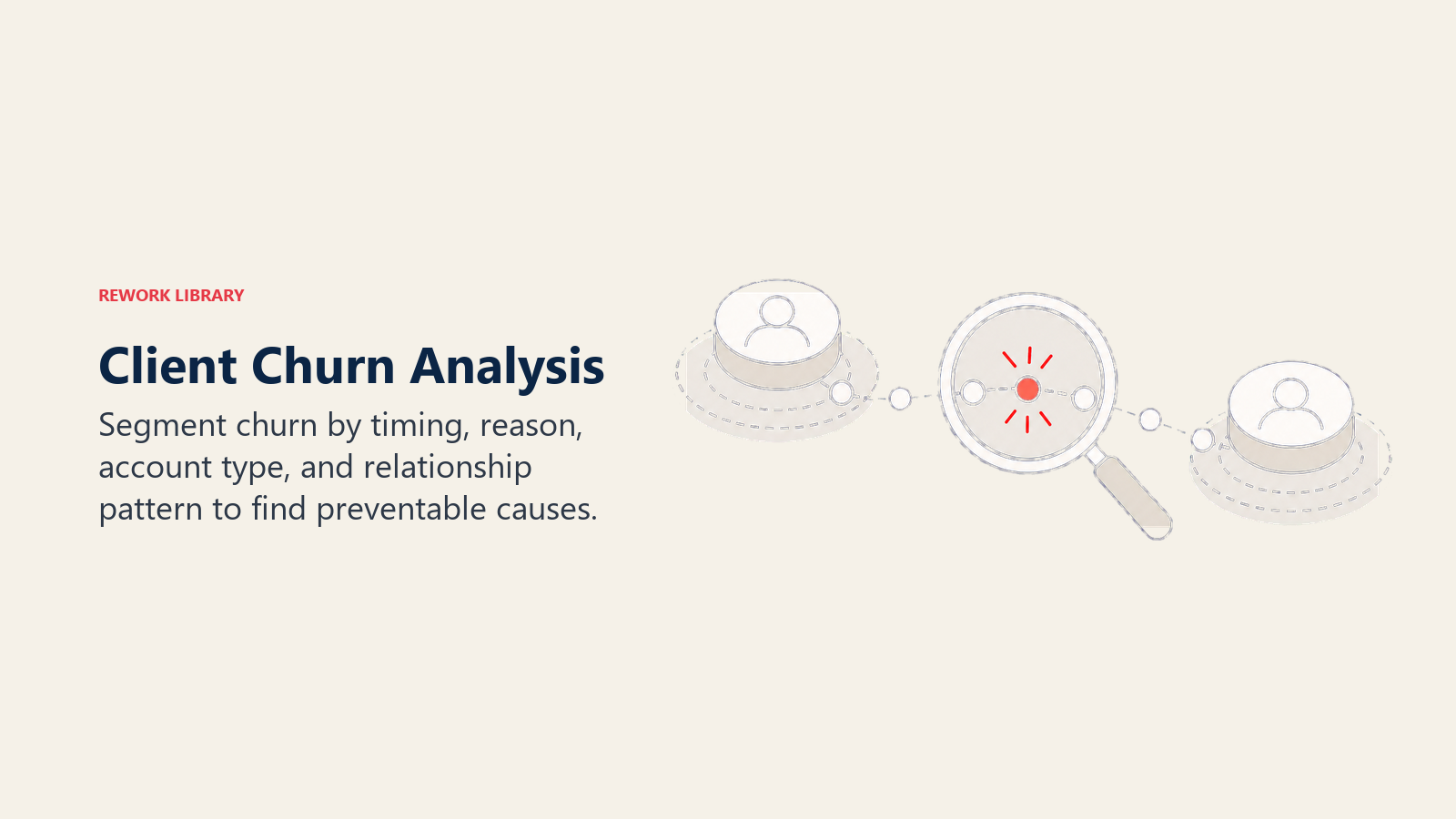
You can't prevent churn until you understand what causes it. And in professional services, the reasons are rarely what you think. Understanding churn patterns starts with tracking when clients leave. Do they churn after the first project? After 2-3 years? Is there a seasonal pattern? Each pattern tells you something about the problem.
First-year churn (0-12 months) usually means:
- Misaligned expectations from the sales process
- Poor onboarding experience
- Wrong service fit for their needs
- Billing or project management friction
Mid-term churn (1-3 years) often indicates:
- Complacency in the relationship
- New decision-maker who didn't choose you
- Competitor offering something you're not
- Service quality inconsistency
Long-term client departures (3+ years) typically stem from:
- Change in their business priorities or strategy
- Budget cuts or consolidation
- Key relationship person leaving their company or yours
- Failure to evolve with their changing needs
The primary reasons clients actually leave professional services firms:
- Took the relationship for granted (35%)
- Inconsistent service quality or team changes (25%)
- Competitor offered better value or specialization (20%)
- Internal budget cuts or restructuring (10%)
- Key relationship person departed (10%)
Notice what's missing? Price is rarely the primary driver. Clients will pay premium rates if they're getting consistent value and feel valued.
High-risk client categories you need to watch:
- New executive in procurement or your sponsor role
- Clients you haven't spoken to in 60+ days
- Projects that went over budget or timeline
- Anyone with recent service issues or complaints
- Clients at renewal time with flat or declining spend
Early warning systems: detecting at-risk clients
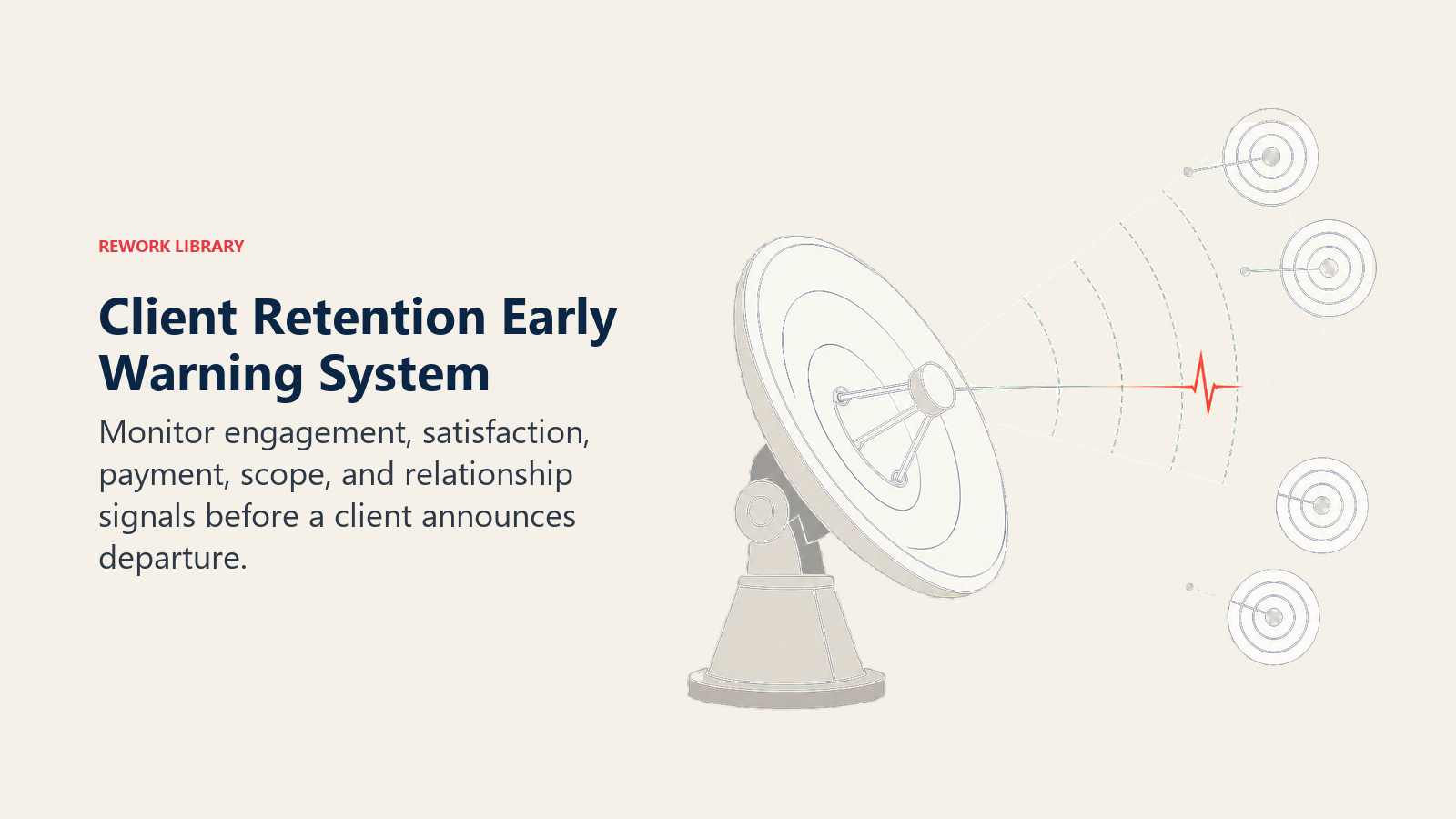
The difference between saving a client and losing them is usually timing. If you catch the problem when they're frustrated, you can fix it. If you catch it when they've already signed with a competitor, it's over. An early warning system monitors signals that predict churn before the client tells you they're leaving.
Identifying at-risk signals:
Behavioral changes:
- Declining engagement (fewer calls, slower email responses)
- Canceling or rescheduling meetings more frequently
- Stopping regular check-ins or business reviews
- Not introducing you to new stakeholders
- Scope of work getting smaller or more tactical
Relationship indicators:
- Your main contact is harder to reach
- You're dealing with junior people instead of decision-makers
- They mention competitors or alternative approaches
- Positive language shifts to neutral or critical
- They stop asking for your strategic input
Financial signals:
- Payment delays (especially if that's new)
- Budget questions or pushback on standard fees
- Requesting discounts or unbundling services
- Declining to commit to multi-month agreements
- Spending trending down quarter over quarter
Monitoring mechanisms and dashboards make these signals visible instead of relying on account managers to notice. Build a simple scorecard that tracks:
Client health score (0-100):
- Engagement frequency (30 points): Meetings, calls, email exchanges
- Relationship depth (25 points): Access to senior stakeholders, strategic vs tactical work
- Financial health (25 points): Payment timeliness, spending trend
- Satisfaction signals (20 points): NPS scores, feedback, complaints
Any client scoring below 60 triggers intervention. Below 40 is critical.
Data integration pulls this from multiple sources:
- CRM for engagement frequency and contact patterns
- Project management tools for scope and deliverable tracking
- Billing system for payment and spending trends
- Survey tools for satisfaction metrics
Escalation protocols define what happens when scores drop:
- Score drops 15+ points in 30 days: Account manager reaches out
- Score below 60: Account review meeting scheduled within 1 week
- Score below 40: Partner involvement, intervention plan created
- Payment 30+ days late: Executive outreach, relationship audit
The key is making this systematic, not ad hoc. You can't rely on gut feel when you have 50+ client relationships.
Relationship deepening framework
The best defense against churn is a relationship so valuable that switching feels risky. You want clients thinking "we can't afford to lose them" instead of "we could probably find someone else." Moving beyond transactional means shifting from project executor to strategic advisor. Transactional relationships are fragile because they're purely economic. Strategic relationships have emotional and intellectual switching costs that protect you.
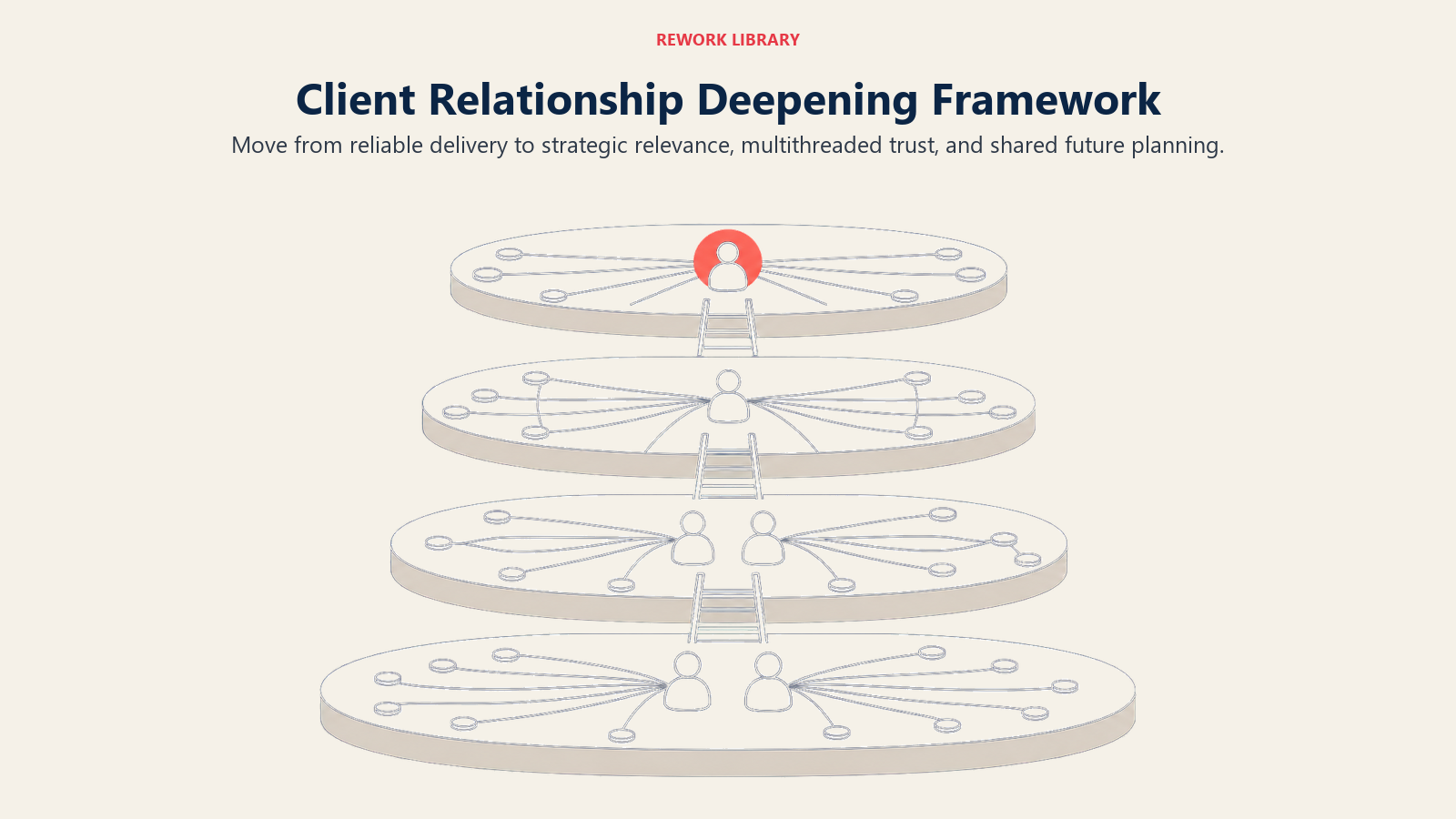
Signs you're stuck in transactional mode:
- All conversations are about current deliverables
- You only hear from them when they need something
- Scope is rigidly defined, no exploration
- They compare you to alternatives on price alone
- Relationship is single-threaded to one contact
Expanding relationship footprint creates redundancy and resilience. If your entire relationship depends on one person, you're one resignation away from churn.
Build multiple connection points:
- Executive sponsor relationship (partner to their C-level)
- Day-to-day operational contact (your PM to their PM)
- Technical or functional experts (your specialists to theirs)
- Cross-functional relationships (you to their adjacent departments)
Each additional relationship thread makes the switch calculation harder.
Strategic account planning for your top clients involves:
- Understanding their 3-year business strategy
- Mapping how your services support their objectives
- Identifying expansion opportunities before they ask
- Positioning yourself as thought partner, not vendor
Hold quarterly strategy sessions where you discuss their business, not your projects. Bring insights about their industry, competitors, or market trends. Show you're thinking about their success beyond the current SOW.
Demonstrating ongoing value requires making your impact visible. Clients forget what you did for them 6 months ago. Your job is to remind them.
Regular value documentation:
- Quarterly business reviews showing outcomes delivered
- ROI analysis tying your work to their metrics
- Before/after comparisons on key performance indicators
- Testimonials from their internal stakeholders
- Industry benchmarking showing where they stand
Creating switching costs - not in a manipulative way, but by becoming genuinely embedded:
- Develop proprietary frameworks specific to their business
- Build tools or templates customized for their needs
- Integrate with their systems and workflows
- Develop institutional knowledge about their operations
- Create dependencies where your expertise becomes critical infrastructure
The more integrated you are, the higher the switching cost in time, risk, and knowledge loss.
Retention activities: staying top of mind
Retention doesn't happen passively. You need a structured cadence of activities that maintain presence, reinforce value, and catch problems early.
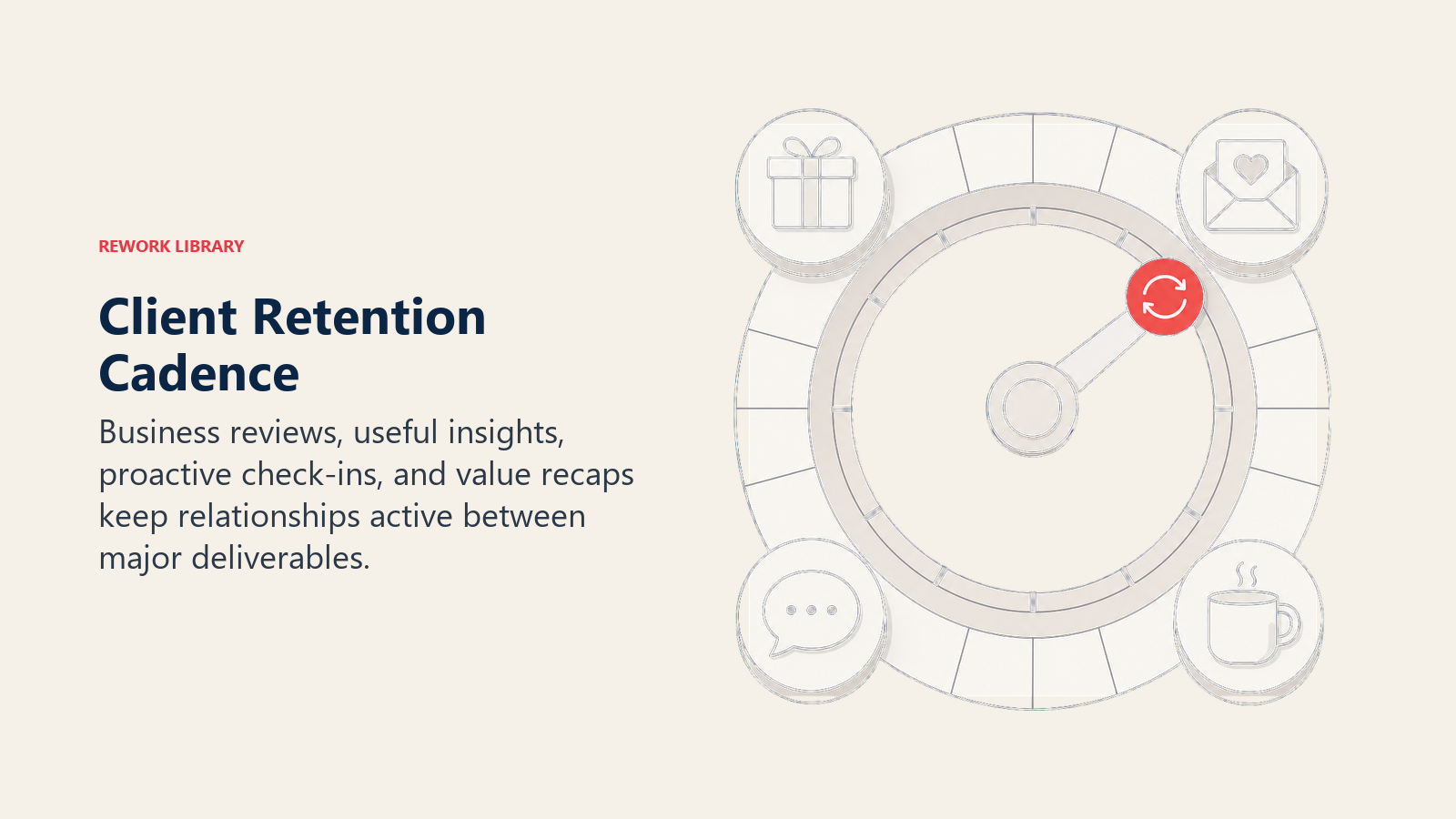
Regular business reviews - not project status updates, but strategic conversations about outcomes:
- Quarterly for strategic accounts
- Semi-annual for standard clients
- Covers results achieved, trends identified, recommendations
- Led by partner or senior leader, not just account manager
- Forward-looking, not just backward-looking
The format: 30-minute meeting with their executive sponsor where you show:
- Key outcomes delivered this period
- Industry insights or trends relevant to them
- Opportunities we've identified for next period
- Question: "How are we doing? What could we do better?"
Proactive communication schedule ensures consistent contact:
- Monthly check-in calls (15 minutes, "how's it going?")
- Weekly project updates during active work
- Quarterly thought leadership sharing (articles, research)
- Semi-annual strategy discussions
The goal is visibility without being annoying. You want them to think "I hear from them regularly" not "they won't leave me alone."
Value reinforcement activities remind them why they hired you:
- Share case studies from similar clients (without breaking confidentiality)
- Send relevant industry research or news with quick context
- Invite them to webinars, workshops, or events
- Introduce them to strategic contacts in your network
- Offer informal advice on questions outside current scope
Each touchpoint reinforces that you're thinking about their success, not just billing hours. Client advocacy programs help identify clients who can become champions for your firm while reinforcing these relationships.
Client success programs formalize the support structure:
- Dedicated account manager for each client
- Clear escalation path for issues
- Regular health checks and satisfaction surveys
- Priority access for urgent needs
- Client advisory board for top accounts
Relationship investment allocation - how much time and resource do you dedicate to retention per client segment?
A typical model:
- Top 20% of clients (by revenue/strategic value): 50% of relationship investment
- Middle 60%: 40% of investment
- Bottom 20%: 10% of investment
Top clients get partner attention, quarterly reviews, strategic planning sessions. Middle clients get solid account management and semi-annual reviews. Bottom clients get efficient delivery but limited strategic attention.
Retention by lifecycle stage
Different clients need different retention approaches based on how long they've been with you. New client retention (0-12 months): The focus is delivering on expectations and building trust.
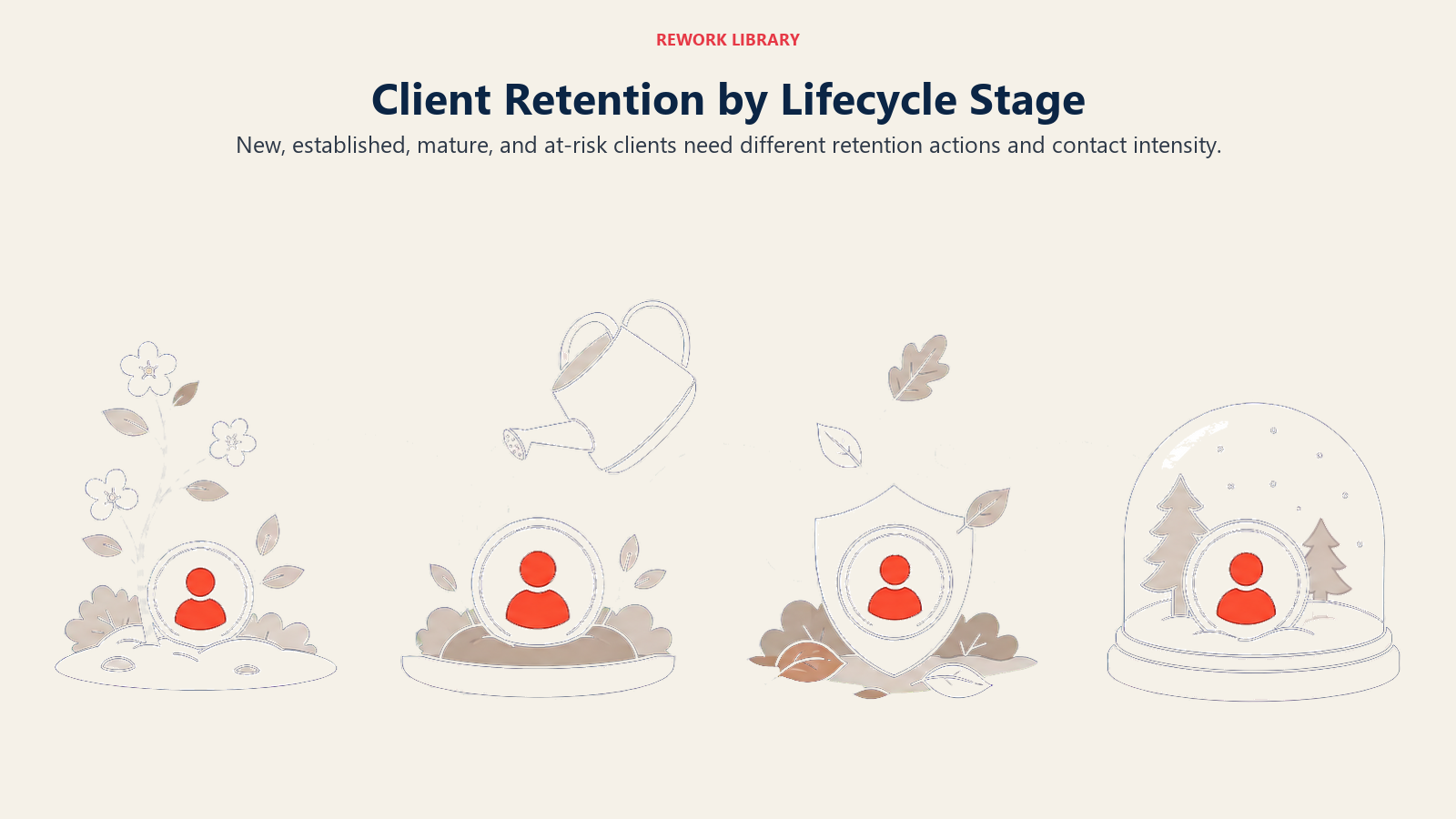
First 90 days are critical:
- Exceptional onboarding experience
- Deliver first results faster than promised
- Over-communicate during initial projects
- Schedule 30-day and 90-day check-ins
- Address any issues immediately and visibly
The first project outcome determines whether they expand or explore alternatives. Nail it.
Established clients (1-3 years): The risk is complacency on both sides.
Active engagement strategies:
- Introduce new team members to prevent single-threading
- Expand service offerings based on evolving needs
- Share industry insights they haven't asked for
- Challenge their thinking with strategic perspectives
- Create reasons to involve senior leadership
This is when relationships either deepen into strategic partnerships or plateau into transactional patterns.
Long-term strategic accounts (3+ years): These relationships can run on autopilot if you're not careful.
Renewal strategies:
- Annual strategic planning sessions
- Relationship mapping to identify new stakeholders
- Service portfolio reviews to add new capabilities
- Joint success planning (their goals + your support)
- Executive sponsor engagement to maintain C-level relationships
The biggest risk is taking them for granted because "they've always been with us." That's exactly when competitors make inroads.
Risk management and recovery
Even with perfect retention activities, some clients will become at-risk. Having a recovery protocol makes the difference.
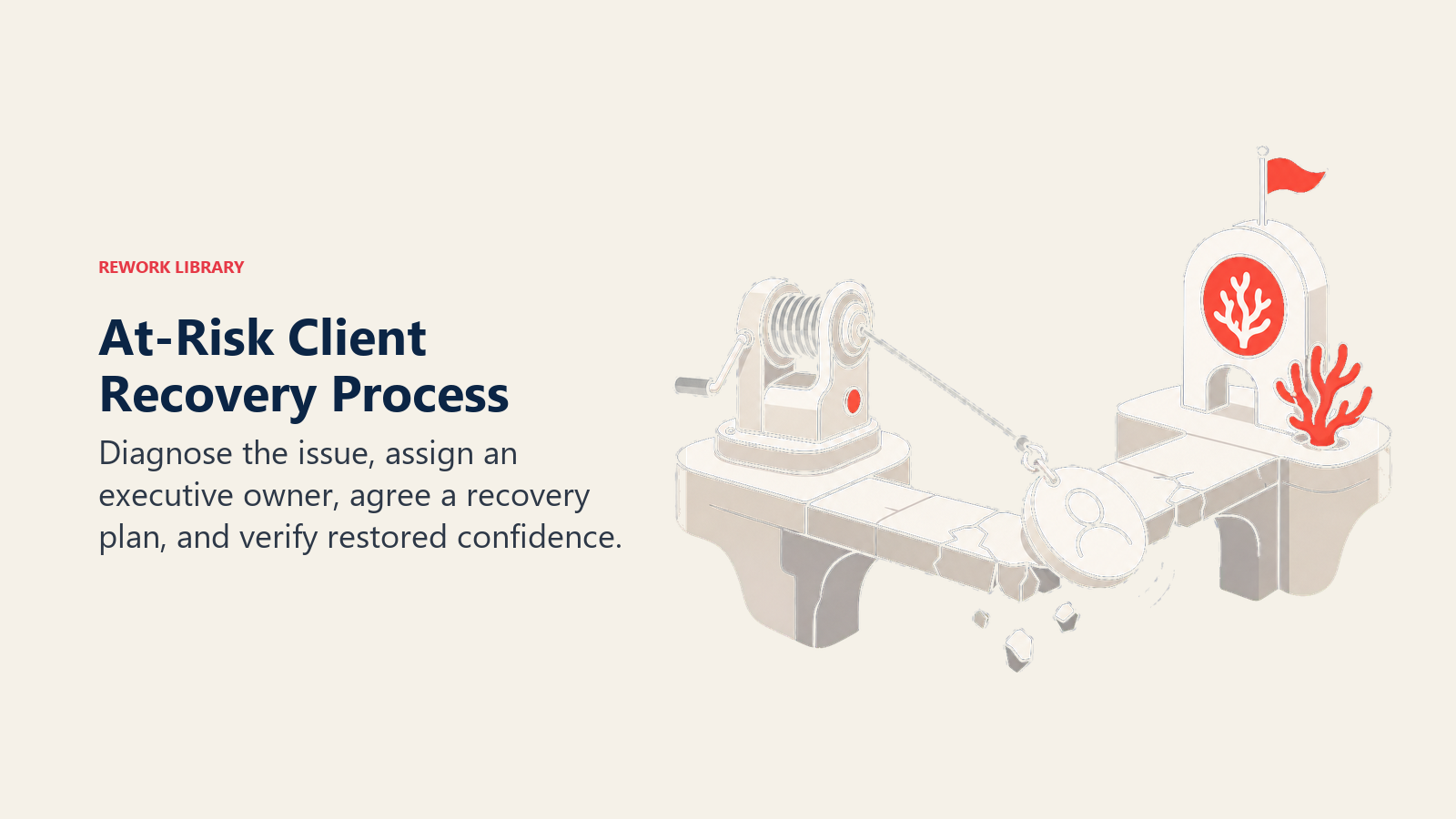
At-risk account intervention process:
- Identify the specific issue (relationship, service quality, value perception, competitive threat)
- Assemble response team (account manager + partner + relevant experts)
- Schedule diagnostic conversation with client
- Develop recovery plan with specific actions and timeline
- Execute with increased communication and oversight
- Follow up weekly until status returns to healthy
Service recovery protocol for when you've screwed up:
- Acknowledge the problem immediately and specifically
- Take ownership without excuses or blaming others
- Present fix plan with clear timeline and accountability
- Deliver on the fix faster than promised
- Follow up to ensure resolution stuck
- Implement process changes to prevent recurrence
The client doesn't expect perfection. They expect you to handle problems professionally.
Winning back lost clients: Don't write them off permanently.
Wait 3-6 months after they leave, then:
- Reach out with "how's the new arrangement working?"
- Share relevant insights with no sales pitch
- If they express frustration, offer to discuss options
- Come back with improved proposal addressing why they left
- Make it easy to return (flexible terms, risk mitigation)
About 15-20% of lost clients return if you maintain professional relationship. Building a systematic referral generation approach helps you stay connected with former clients who may return or refer others.
Preventing future churn means learning from losses:
- Exit interviews with every departing client
- Root cause analysis for each churn incident
- Pattern identification across multiple losses
- Process or service improvements based on findings
- Team training on common failure modes
Each loss should improve your retention system.
Competitive defense strategies
Competitors are actively trying to displace you. You need to know when you're under attack and how to respond. Competitive threat assessment:
- Client mentions they're "exploring options" or "getting second opinions"
- RFP process when you're the incumbent
- Questions about your approach compared to alternatives
- Engagement with competitor content or events
- Scope reductions that align with competitor capabilities
Competitive positioning strategy:
- Document your unique value proposition specific to this client
- Highlight switching costs (institutional knowledge, integration, relationship)
- Demonstrate results competitors can't yet claim with them
- Reinforce relationship depth competitors don't have
- Price-to-value justification showing ROI
Client retention activities when under competitive threat:
- Increase executive engagement (partner involvement)
- Accelerate value demonstration (quick wins)
- Introduce new capabilities or team members
- Propose strategic initiatives competitors can't match
- Create short-term engagement to prove value before they switch
Proactive response planning: Don't wait for the threat to materialize.
For each top client, document:
- What would make them vulnerable to competitive approach?
- Which competitors are most likely to target them?
- What's our unique defensible position?
- Who are the key relationships we need to maintain?
- What's our response plan if we detect competitive activity?
Retention metrics: measuring what matters
You can't improve what you don't measure. These metrics tell you if your retention efforts are working. Core retention metrics:
Client retention rate:
- Formula: (Clients at end of period - new clients) / Clients at start of period
- Target: 90%+ for professional services
- Track annually and rolling 12-month
Revenue retention rate:
- Formula: Revenue from existing clients / Previous period revenue from those clients
- Net revenue retention includes expansion, so can exceed 100%
- Target: 95-110% depending on business model
Logo retention vs revenue retention matter differently. Losing small clients impacts logo retention but barely touches revenue. Losing one strategic client devastates revenue retention.
Relationship health metrics:
- Engagement score: Frequency and depth of interactions
- Relationship breadth: Number of stakeholder connections
- Strategic vs tactical work mix: Percentage of strategic engagements
- Expansion rate: Clients increasing spend vs flat or declining
- Referral generation: Clients actively recommending you
Risk and early warning metrics:
- Percentage of clients with declining health scores
- Number of at-risk accounts by severity tier
- Time from risk detection to intervention
- At-risk client recovery rate
- Average time to detect churn risk
Business impact metrics:
- Cost of retained client vs acquiring new client
- Lifetime value by client segment
- Revenue from retained vs new clients
- Profitability of long-term clients vs new
- Churn cost impact on growth rate
Reporting and dashboarding: Your leadership team needs visibility.
Monthly retention dashboard showing:
- Overall retention rate (logo and revenue)
- At-risk client count and severity distribution
- Intervention activities and outcomes
- Top churn risk factors
- Retention program ROI
Quarterly deep dives on:
- Client health score trends by segment
- Retention vs acquisition cost analysis
- Competitive threat assessment
- Win-back pipeline status
- Service quality correlation to retention
Retention organization: who owns it?
Retention can't be everyone's job or it becomes no one's job. You need clear ownership.
Program leadership: Assign a retention program owner (typically VP of Client Success or Partner responsible for accounts).
Their role:
- Define retention strategy and goals
- Own retention metrics and reporting
- Coordinate cross-functional retention activities
- Escalation point for at-risk accounts
- Drive continuous improvement of retention programs
Team roles and responsibilities:
Account Managers:
- Monitor client health scores daily
- Execute relationship maintenance activities
- Early problem detection and escalation
- Expansion opportunity identification
Partners/Senior Leaders:
- Executive sponsor relationships for top accounts
- Intervention for at-risk strategic accounts
- Quarterly business reviews
- Strategic planning sessions
Delivery Teams:
- Service quality excellence
- Client satisfaction during projects
- Relationship building at working level
- Issue flagging and resolution
Client Success/Support:
- Onboarding new clients
- Ongoing enablement and training
- Health monitoring and check-ins
- Satisfaction surveys and feedback collection
Compensation and incentives: What gets rewarded gets done.
Include retention metrics in comp plans:
- Account managers: Retention rate and expansion of their portfolio
- Partners: Overall client retention and strategic account growth
- Delivery teams: Client satisfaction scores and project NPS
Reward not just retention but early detection: bonuses for identifying and recovering at-risk accounts before they churn.
Cross-functional coordination: Retention requires marketing, delivery, finance, and leadership alignment.
Monthly retention meetings with:
- Review of at-risk accounts
- Intervention progress updates
- Cross-team support needs
- Process improvement discussions
- Wins and losses analysis
Technology and systems
The right tools make retention systematic instead of heroic.
CRM and client data platforms:
- Central repository for all client interactions
- Health scoring automation
- Relationship mapping and org charts
- Engagement tracking and alerts
- Historical data for pattern analysis
Essential CRM features for retention:
- Custom fields for health score components
- Automated scoring rules and alerts
- Client relationship hierarchy mapping
- Activity tracking across all touchpoints
- Integration with other systems
Engagement and communication tools:
- Email tracking to measure response patterns
- Meeting scheduling and attendance tracking
- Video call platforms for remote relationship building
- Collaboration spaces for ongoing client projects
- Survey tools for regular feedback collection
Analytics and prediction:
- Churn prediction models using historical data
- Spending trend analysis and forecasting
- Relationship depth scoring
- Competitive displacement risk assessment
- CLV calculation and tracking
Automation and workflow:
- Automated health score calculations
- Alert triggers when scores drop
- Workflow routing for at-risk escalations
- Automated check-in reminders
- Business review scheduling and prep
The tech stack doesn't need to be complex. Most firms can run effective retention with:
- Good CRM (Salesforce, HubSpot, Dynamics)
- Survey tool (Delighted, SurveyMonkey)
- Communication platform (Slack, Teams)
- Analytics tool (Tableau, PowerBI, or built-in CRM analytics)
Industry variations: one size doesn't fit all
Retention strategies vary by professional services type.
Management consulting:
- Project-based work means retention is winning next engagement
- Heavy relationship focus at C-suite level
- Thought leadership critical for staying top-of-mind
- Alumni networks important for future opportunities
- Retention measured by repeat engagement rate
Legal services:
- Mix of ongoing (retainer) and episodic (litigation) work
- Multiple practice areas create cross-sell opportunities
- Relationship often tied to specific attorney
- Conflicts management affects retention strategy
- Industry specialization drives retention
Accounting and tax:
- Annual cycles create natural retention checkpoints
- Compliance work provides baseline relationship
- Advisory services expansion drives retention value
- Tax season delivery quality determines renewal
- Local market relationships matter more
Technology services:
- Implementation projects lead to ongoing support
- Product evolution creates renewal opportunities
- Customer success teams own post-sale retention
- Usage data predicts churn risk
- Support quality directly impacts retention
Marketing agencies:
- Retainer model focuses on monthly retention
- Campaign performance drives renewal decisions
- Creative freshness prevents staleness
- Account team stability critical
- Results reporting determines perceived value
Adapt your retention approach to your specific service model and client dynamics.
Common challenges and how to solve them
Key person dependency: When the relationship lives with one person on your team or theirs.
Solution:
- Mandate multi-threading for all accounts
- Include team introductions in onboarding
- Rotate project leadership to build bench
- Create partner + account manager model
- Document relationship knowledge centrally
Team continuity issues: High turnover disrupts client relationships.
Solution:
- Smooth transition protocols when people leave
- Client communication about changes
- Overlap period for handoffs
- Institutional knowledge documentation
- Retention bonuses for account managers
Service quality consistency: Variable delivery across projects or teams.
Solution:
- Standardized delivery methodologies
- Quality assurance reviews before client delivery
- Client satisfaction tracking per project
- Performance feedback to delivery teams
- Continuous training and improvement
Competitive displacement: Losing clients to competitors with better positioning.
Solution:
- Regular competitive intelligence gathering
- Proactive capability demonstrations
- Innovation in service offerings
- Client-specific customization
- Executive relationship insurance
Pricing compression: Clients demanding lower fees over time.
Solution:
- Value-based pricing tied to outcomes
- Regular ROI documentation
- Scope clarity to prevent scope creep
- Service unbundling for transparency
- Premium positioning for specialized expertise
Building a retention culture
The best retention systems only work if the whole organization cares about keeping clients.
Organizational alignment: Everyone from partners to junior staff needs to understand that retention drives growth.
Cultural elements:
- Client success stories celebrated publicly
- Retention metrics visible company-wide
- Client feedback shared transparently
- Post-mortems on lost clients
- Retention impact on compensation
Team training: Equip everyone with retention skills.
Essential training:
- How to spot early warning signs
- Relationship building techniques
- Value articulation and ROI conversations
- Escalation protocols and when to use them
- Recovery strategies for service failures
Performance culture: Make retention performance visible and rewarded.
Recognition systems:
- Monthly retention wins shared in meetings
- Awards for highest retention rates
- Client testimonials showcased
- Recovery success stories highlighted
- Team celebrations for renewal milestones
Recognition and celebration: Make retention victories feel as important as new business wins.
When you treat retention as an afterthought, that's what it becomes. When you celebrate it as critical to growth, behavior changes.
Connecting to related strategies
Client retention works best when integrated with broader relationship management:
- Client Relationship Strategy provides the foundation for retention through systematic relationship building
- Client Satisfaction Management gives you the feedback loops to catch problems before they cause churn
- Client Success Reviews create the structured touchpoints that maintain relationship health
- Cross-Sell Strategy deepens relationships through expanded service engagement
- Professional Services Metrics shows how to measure retention alongside other growth indicators
- Client Renewal Process formalizes the transition from active relationship to contracted renewal
The firms that win on retention don't just execute projects well. They build relationships so valuable that clients can't imagine working with anyone else. That's the goal.
Start with the economics, build your early warning system, and invest in relationship depth. The rest follows from there.

Sales Director
On this page
- Understanding retention economics
- Client churn analysis: understanding why they leave
- Early warning systems: detecting at-risk clients
- Relationship deepening framework
- Retention activities: staying top of mind
- Retention by lifecycle stage
- Risk management and recovery
- Competitive defense strategies
- Retention metrics: measuring what matters
- Retention organization: who owns it?
- Technology and systems
- Industry variations: one size doesn't fit all
- Common challenges and how to solve them
- Building a retention culture
- Connecting to related strategies