Client Feedback Systems: Building Systematic Approaches to Gather, Analyze, and Act on Client Input
Turn this article into takeaways for your work.


Each assistant summarizes the article only for you and suggests best practices for your work.
Most professional services firms treat client feedback like an annual health checkup. They send out a survey once a year, get a 23% response rate, glance at the results, and file them away. Then they wonder why clients leave without warning or why referrals dry up.
Here's the reality: feedback isn't a checkbox exercise. It's your early warning system for problems, your roadmap for improvement, and your best source of competitive intelligence. But only if you build a real system that captures meaningful input, analyzes it for patterns, and actually changes how you work.
The firms that do this well don't lose clients to fixable problems. They catch issues early, improve continuously, and turn satisfied clients into vocal advocates. The ones that don't? They get blindsided by departures and blame "budget cuts" instead of facing the truth that they never asked if they were delivering value. Strong feedback systems are the foundation of your client relationship strategy.
This guide shows you how to build feedback systems that work. We'll cover the collection methods, the analysis frameworks, and the action protocols that turn input into improvement.
Why systematic feedback matters
You're already getting feedback whether you want it or not. Clients share opinions in project meetings, email exchanges, and casual conversations. The question is whether you're capturing it systematically or letting it evaporate into scattered recollections. Ad hoc feedback has three problems. First, it's biased toward whoever speaks up. Your most satisfied clients and your most frustrated clients will say something. The quietly disappointed ones just leave. Second, it's inconsistent. You might catch feedback on deliverable quality but miss issues with communication or responsiveness. Third, it's not comparable. When every conversation is different, you can't spot patterns or trends.
Systematic feedback fixes this by asking everyone the same questions at the same milestones. You get coverage across your entire client base, consistency in what you measure, and comparability over time. That's when feedback becomes strategic instead of anecdotal.
The competitive advantage comes from the loop: collect, analyze, act, and close by showing clients you listened. Firms that do this retain clients 30-40% longer than those that don't. Not because they're perfect, but because they fix problems before they become reasons to leave.
Foundations of effective feedback strategy
Before you start sending surveys, you need clarity on what you're trying to learn and why. Define your feedback objectives: Are you trying to predict retention risk? Identify service improvement opportunities? Validate that you're delivering value? Spot training needs? Your objectives determine what you ask, who you ask, and when. Most firms need feedback that serves multiple purposes:
- Relationship health monitoring (are clients satisfied and likely to stay?)
- Service quality assessment (are we delivering what we promised?)
- Improvement prioritization (what should we fix first?)
- Renewal and expansion signals (are they likely to buy more?)
- Advocacy potential (will they refer or be a reference?)
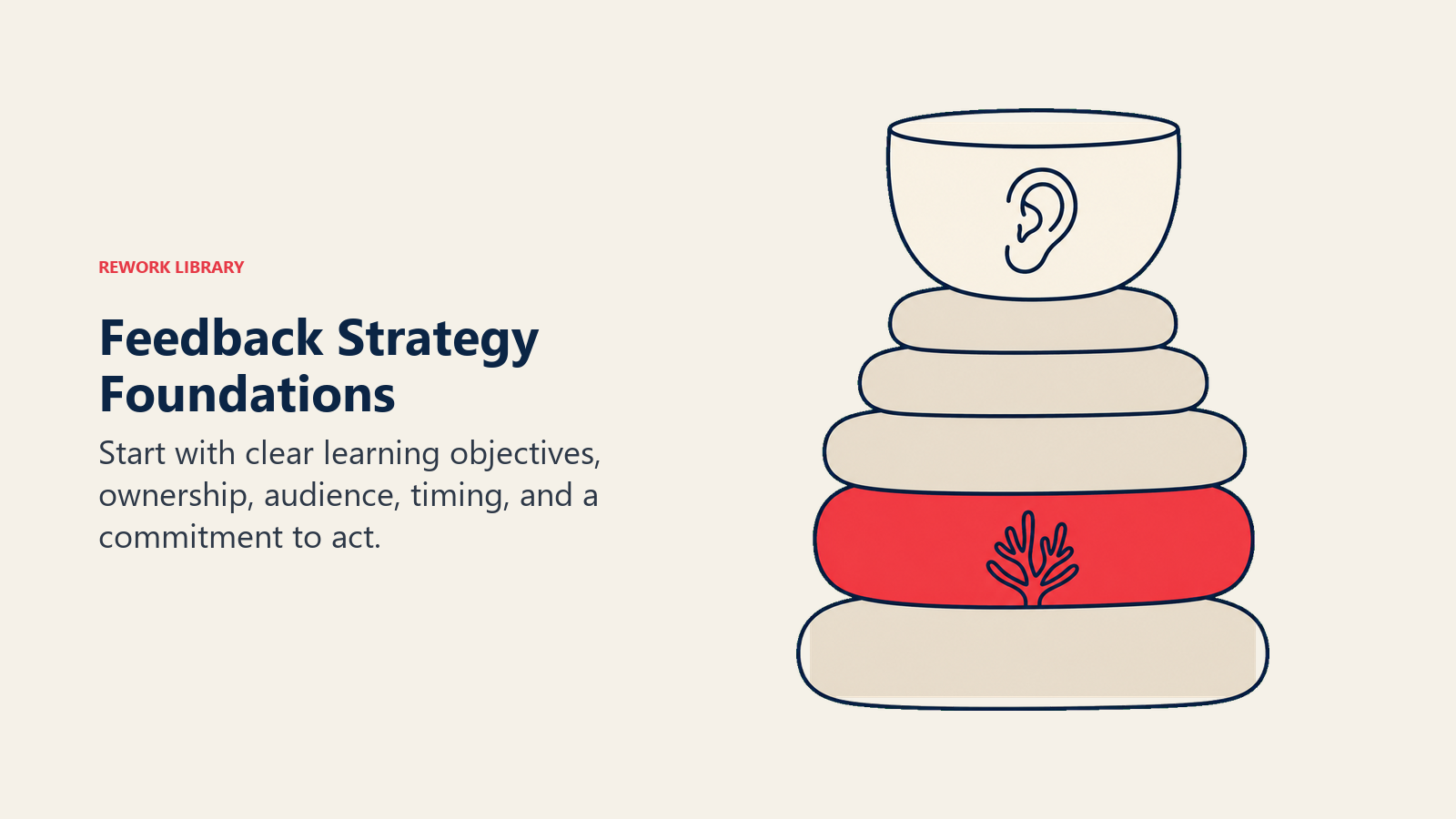
Establish feedback culture first: The best system fails if your culture treats feedback as threatening. If partners get defensive about criticism or ignore suggestions, clients learn that input disappears into a black hole. They stop responding.
Building feedback culture means:
- Leadership models asking for and acting on feedback
- Negative feedback is treated as a gift, not an attack
- Teams discuss feedback openly in retrospectives
- Improvements get credited back to client input
- Response is valued over defensiveness
Organizational readiness: You need infrastructure to handle feedback. Can you track it? Analyze it? Route it to the right people? Follow up on action items? If you collect feedback but can't do anything with it, you've wasted everyone's time and damaged trust.
Feedback collection methods
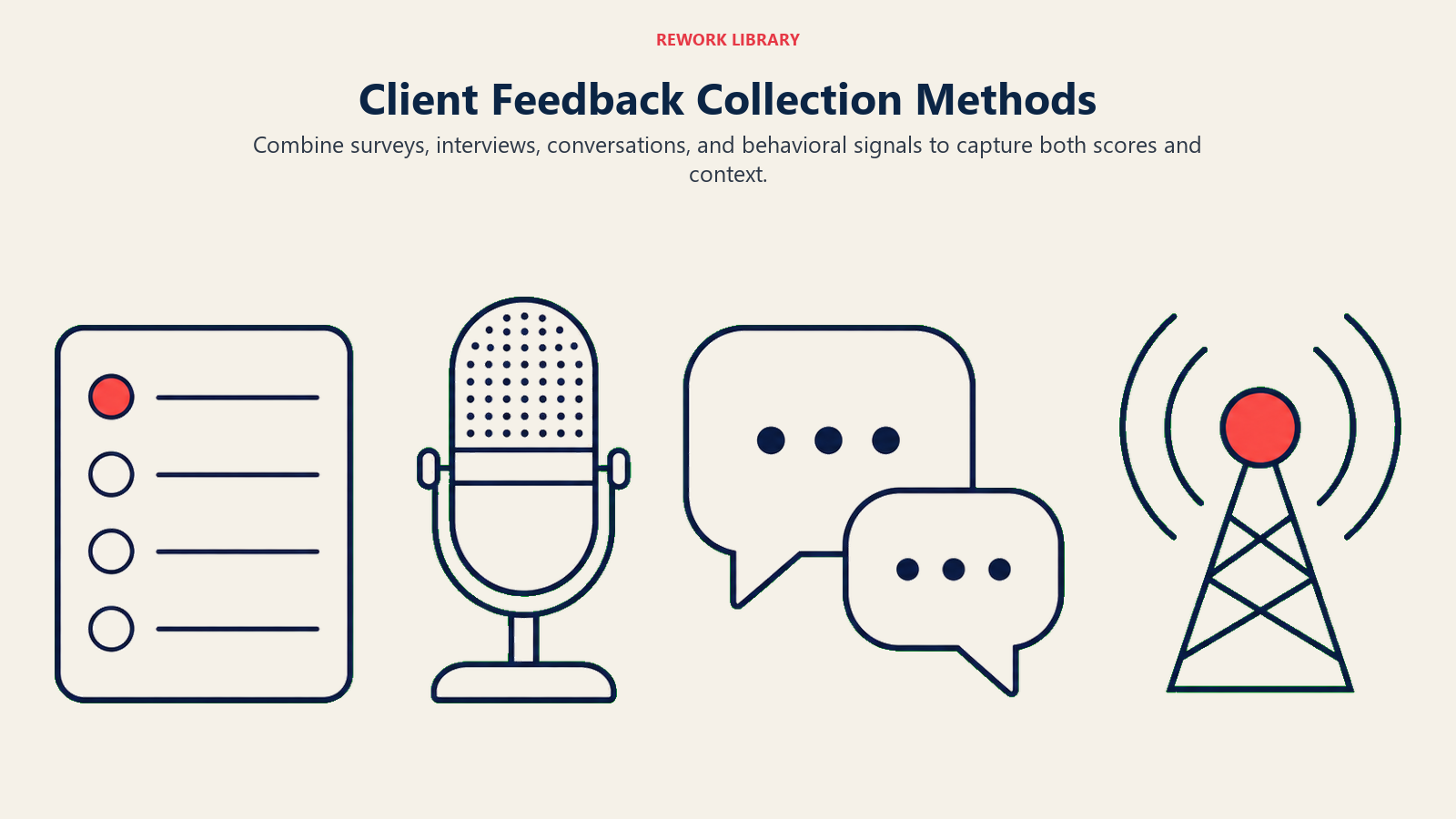
Different methods capture different types of input. You need multiple approaches to get the full picture.
Survey-based feedback
Net Promoter Score (NPS): The classic "How likely are you to recommend us to a colleague?" on a 0-10 scale. NPS is useful because it's simple, standardized, and predicts loyalty. But it's a lagging indicator - by the time NPS drops, damage is done.
Run NPS quarterly or semi-annually for active clients. Follow up the score question with "What's the primary reason for your score?" That open-ended response is often more valuable than the number.
Client Satisfaction (CSAT): "How satisfied are you with [specific aspect of service]?" Usually a 5-point scale. CSAT is more granular than NPS. You can measure satisfaction with deliverable quality, communication, responsiveness, expertise, value for money separately.
Use CSAT at project milestones or after specific deliverables. It's too broad for annual surveys but perfect for touchpoints.
Pulse surveys: Short, frequent check-ins with 3-5 questions. "How's the project going? Any concerns? Anything we should do differently?" Pulse surveys keep a finger on the temperature without survey fatigue.
Run pulse surveys monthly for active engagements, especially long-term retainer relationships. Keep them under 2 minutes to complete.
Annual relationship reviews: Comprehensive surveys that cover the full relationship: service quality, business impact, future needs, competitive positioning. These go deep but only once or twice a year.
Annual reviews work best for strategic accounts where the relationship is worth the investment in detailed feedback. These reviews often evolve into formal client success reviews that drive strategic alignment.
Direct conversation-based feedback
Surveys have limitations. People rush through them, misinterpret questions, or give socially acceptable answers. Conversations capture nuance and follow-up.
Regular check-ins: Schedule standing meetings (monthly or quarterly) where feedback is the agenda. Not project status - relationship health. "How are we doing? What's working? What should we change?" Make it routine, not a special event.
Quarterly business reviews (QBRs): Structured meetings with key stakeholders where you review results, discuss value delivered, and ask for feedback on the partnership. QBRs combine reporting with relationship maintenance.
For strategic accounts, QBRs are non-negotiable. For smaller clients, semi-annual or annual works.
Exit interviews: When a project ends or a client leaves, ask why and what could have been better. You'll get more honest feedback at exits than during active relationships. People are less worried about offending you when they're already out the door.
Make exit interviews standard practice. Even if only 50% agree to talk, those conversations reveal patterns you'd never catch otherwise.
Passive and observational feedback
Not all feedback is spoken. Watch for signals:
Usage and engagement patterns: If clients aren't using deliverables, aren't attending meetings, or stop responding quickly to emails, that's feedback. Declining engagement predicts churn.
Track email response times, meeting attendance, portal usage, or how often they reference your work. Changes in these patterns flag issues before clients articulate them.
Escalation and issue frequency: How often do small problems escalate? How many support tickets or "fix this" requests? Rising issue frequency suggests quality gaps or misalignment.
Stakeholder behavior changes: If your main contact stops bringing you to meetings, doesn't loop you into decisions, or goes quiet on renewal discussions, read the signals.
Passive feedback doesn't tell you what's wrong, but it tells you something is wrong. Then you dig in with direct questions.
Feedback across the client journey
Different stages of the relationship need different feedback approaches. Onboarding and kickoff: After the first 30 days, ask how onboarding went. "Was the kickoff clear? Do you have what you need? Are we aligned on goals and process?" Early feedback catches misalignment before it compounds.
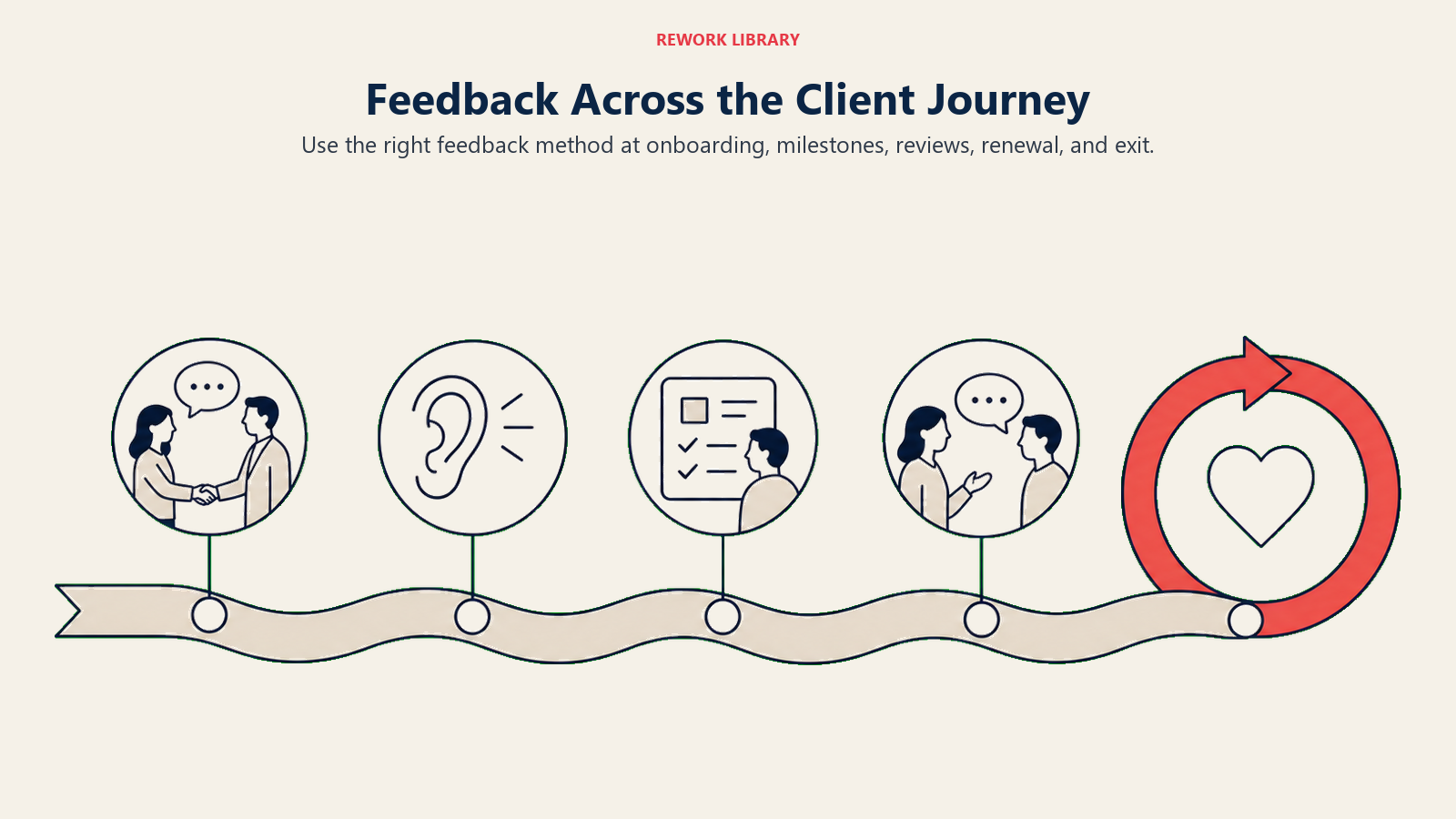
Mid-engagement check-ins: Don't wait until the end to ask if things are on track. At project milestones or quarterly for retainers, check in: "How's it going? Are we meeting expectations? Anything we should adjust?" Mid-course corrections prevent disaster.
Milestone and deliverable reviews: After every major deliverable, get feedback. "Did this meet your needs? Was it on time? Clear? Actionable?" This feedback improves the next deliverable in real-time.
Project completion: At the end, do a retrospective. "What went well? What didn't? What should we do differently next time?" Project completion feedback feeds into process improvement. This is also the ideal time to request client testimonials and case studies while the experience is fresh.
Ongoing relationship touchpoints: For long-term clients, schedule regular relationship health checks separate from project work. "How's the overall partnership? Are we delivering value? What do you need from us in the next 6-12 months?"
The key is cadence and predictability. Clients should expect feedback conversations as part of the rhythm, not random check-ins when you're worried.
Survey design and implementation
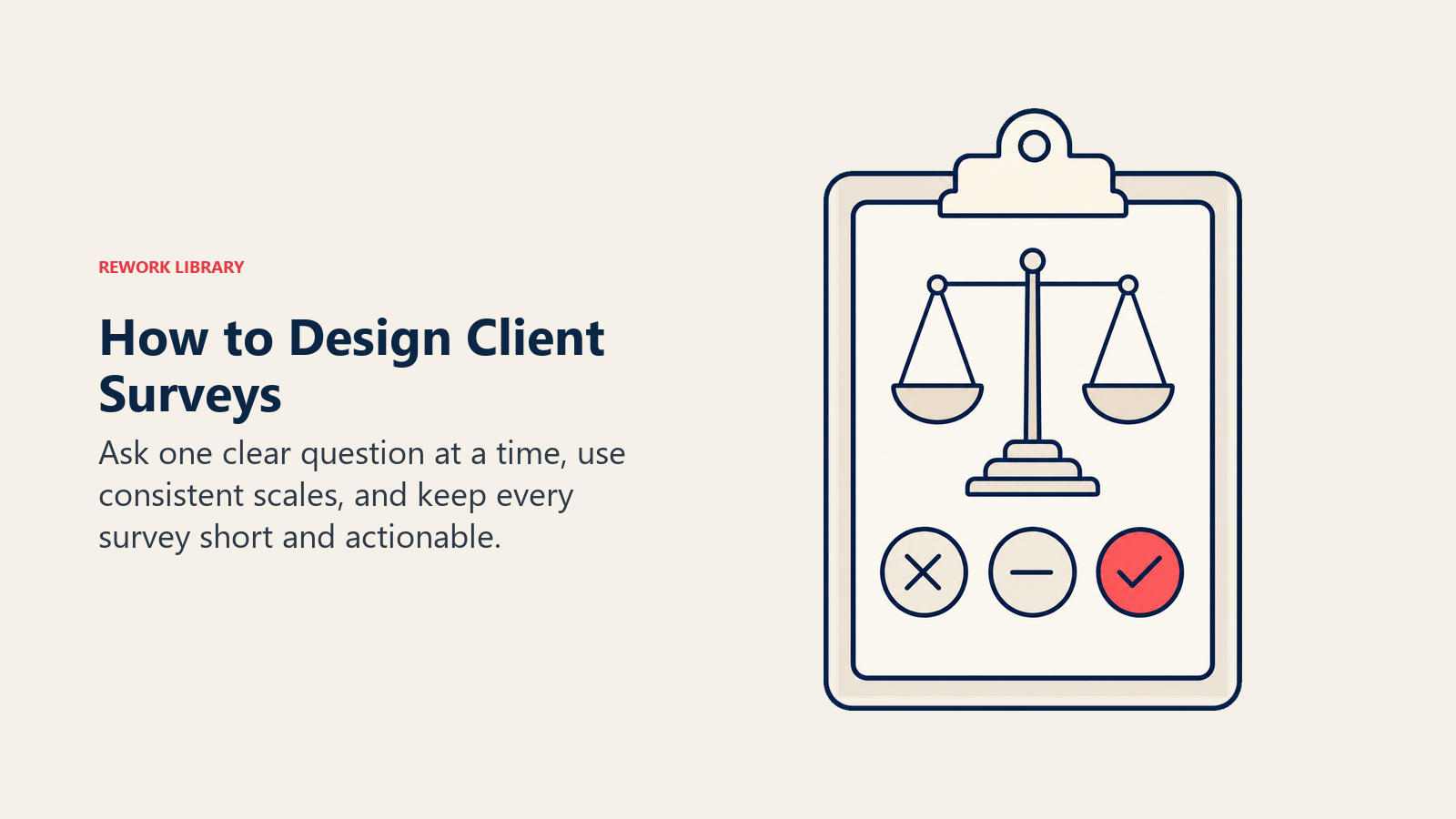
Bad surveys produce garbage data. Here's how to design surveys that people actually complete and answer honestly. Question design principles:
- Ask one thing per question (not "How satisfied are you with our communication and responsiveness?")
- Use clear scales consistently (don't mix 5-point, 7-point, and 10-point scales)
- Make questions answerable (if clients don't have visibility into internal processes, don't ask about them)
- Include both quantitative and qualitative questions (numbers show trends, comments explain why)
- Avoid leading questions ("How great was our service?") Survey timing and frequency: Too frequent, you annoy clients. Too rare, you miss issues. Balance by survey type:
- NPS: Semi-annually or quarterly
- CSAT: After deliverables or milestones
- Pulse: Monthly for active engagements
- Annual reviews: Once a year
Never send multiple surveys in the same week. Coordinate across teams so clients aren't bombarded.
Channel selection: Email is standard, but consider:
- In-app or portal surveys for clients who work in your systems
- Phone surveys for strategic accounts (higher response, deeper input)
- In-person for executive relationships
- Slack/Teams for clients who communicate there
Match the channel to where clients already are. Don't make them go somewhere new.
Response rate optimization:
- Keep surveys short (under 5 minutes for routine surveys, under 15 for annual)
- Explain why you're asking and how you'll use the input
- Make it easy to start (one click from email)
- Send from a person, not "noreply@company.com"
- Follow up once if no response (but only once)
- Close the loop by sharing what changed based on previous feedback
If response rates drop below 30%, your surveys are too long, too frequent, or you've lost trust by not acting on past input.
Avoiding survey fatigue: You can kill your feedback program by over-surveying. To avoid this:
- Coordinate across teams (sales, delivery, account management shouldn't all survey the same client)
- Alternate question depth (some surveys short and focused, some comprehensive but rare)
- Respect opt-outs (if someone says "no more surveys," honor it)
- Show the value (clients participate when they see you actually change things)
Qualitative feedback approaches
Numbers tell you what's happening. Qualitative feedback tells you why.
Structured interviews: Schedule 30-60 minute conversations with a standard discussion guide. Ask open-ended questions and follow the thread. "Tell me about the last project we did together. What worked? What was frustrating? If you were running our firm, what would you change?"
Interviews work best for strategic accounts or when scores flag issues but you don't know the cause.
Focus groups: Gather 5-8 clients and facilitate a discussion about their experiences. Focus groups reveal shared frustrations and surface ideas one client might not mention alone. But be careful - one vocal client can dominate.
Use focus groups when you want to explore a specific topic deeply (e.g., "How should we improve our reporting?") or test new service ideas.
Advisory boards: Invite a rotating group of clients to quarterly meetings where they advise on your strategy, services, and approach. Advisory boards give you ongoing qualitative input and deepen key relationships.
Advisory boards work if you actually listen and give members visibility into how their advice shaped decisions. Otherwise they feel like theater.
Open-ended survey questions: Add "What else should we know?" to quantitative surveys. Some clients skip it, but the ones who fill it in often surface the most valuable insights.
Observational feedback: Sit in on client meetings (if they'll allow it), watch how they use deliverables, observe their workflow. You'll spot friction points they don't think to mention.
Feedback analysis and insights
Collecting feedback is pointless if you don't analyze it. Here's how to turn raw responses into actionable insights. Quantitative analysis: For numeric scores (NPS, CSAT), track:
- Overall average (is satisfaction rising or falling?)
- Distribution (are most clients clustered at high scores or spread across the range?)
- Trends over time (scores by quarter, by cohort)
- Segmentation (scores by service line, industry, engagement type, team)
- Correlation (do NPS scores predict retention? Which CSAT dimensions correlate with NPS?) Look for outliers. If most clients score you 8-9 but a few score 3-4, dig into the low scorers. They're either edge cases or canaries signaling a broader issue.
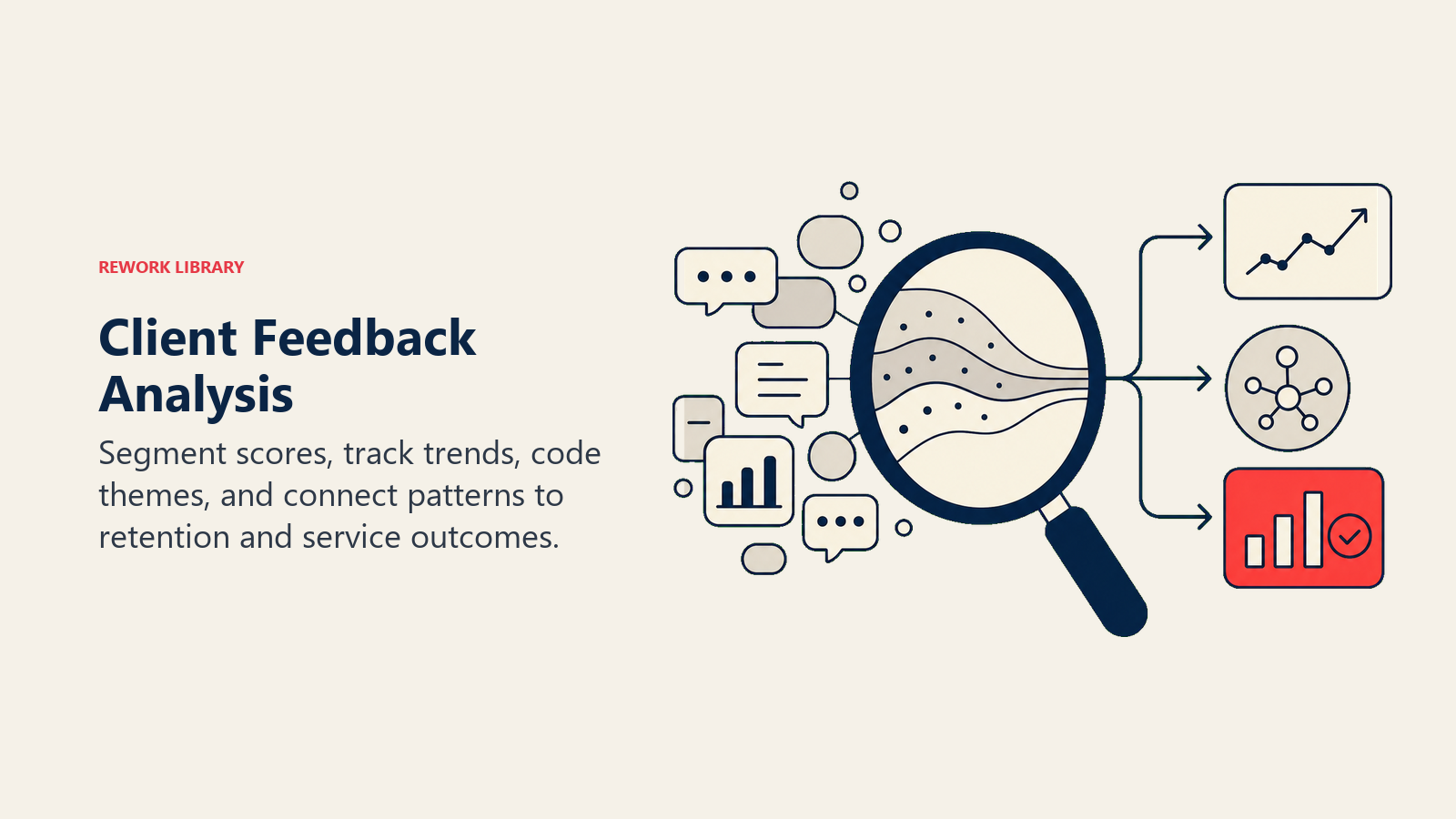
Qualitative coding and themes: For open-ended responses, code comments into themes:
- Read through all comments
- Identify recurring topics (communication, responsiveness, expertise, value, process)
- Tag each comment with relevant themes
- Count frequency of each theme
If 40% of comments mention communication issues but only 5% mention pricing, you know where to focus.
Sentiment analysis: Beyond topics, code for sentiment. Is feedback positive, neutral, or negative on each theme? A theme that appears frequently with negative sentiment is high priority.
For firms with volume, sentiment analysis tools (built into platforms like Qualtrics or Delighted) automate this. For smaller firms, manual coding works fine.
Pattern recognition: Look across time, segments, and touchpoints:
- Are certain teams or partners getting consistently lower scores?
- Do scores drop at specific points in the engagement lifecycle?
- Are complaints concentrated in specific service lines or client industries?
- Do issues correlate with team size, deal size, or engagement length?
Patterns reveal systemic issues. One-off complaints are noise. Recurring patterns across multiple clients are signal.
Segmentation and correlation: Break down feedback by:
- Client tenure (new vs. long-term)
- Revenue size (small vs. large accounts)
- Service line or practice area
- Engagement model (project vs. retainer)
- Industry or vertical
Different segments have different needs. What delights a small client might frustrate a large one. Segmentation helps you target improvements.
Closing the feedback loop
Here's where most firms fail: they collect feedback, analyze it, and then... nothing. Clients never hear back. Trust evaporates. Closing the loop means responding to feedback and showing clients their input mattered. Acknowledgment and response: After every survey or interview, acknowledge receipt. "Thanks for your feedback. We're reviewing it and will follow up on [specific items you mentioned]." Even if you can't fix everything, acknowledge that you heard.
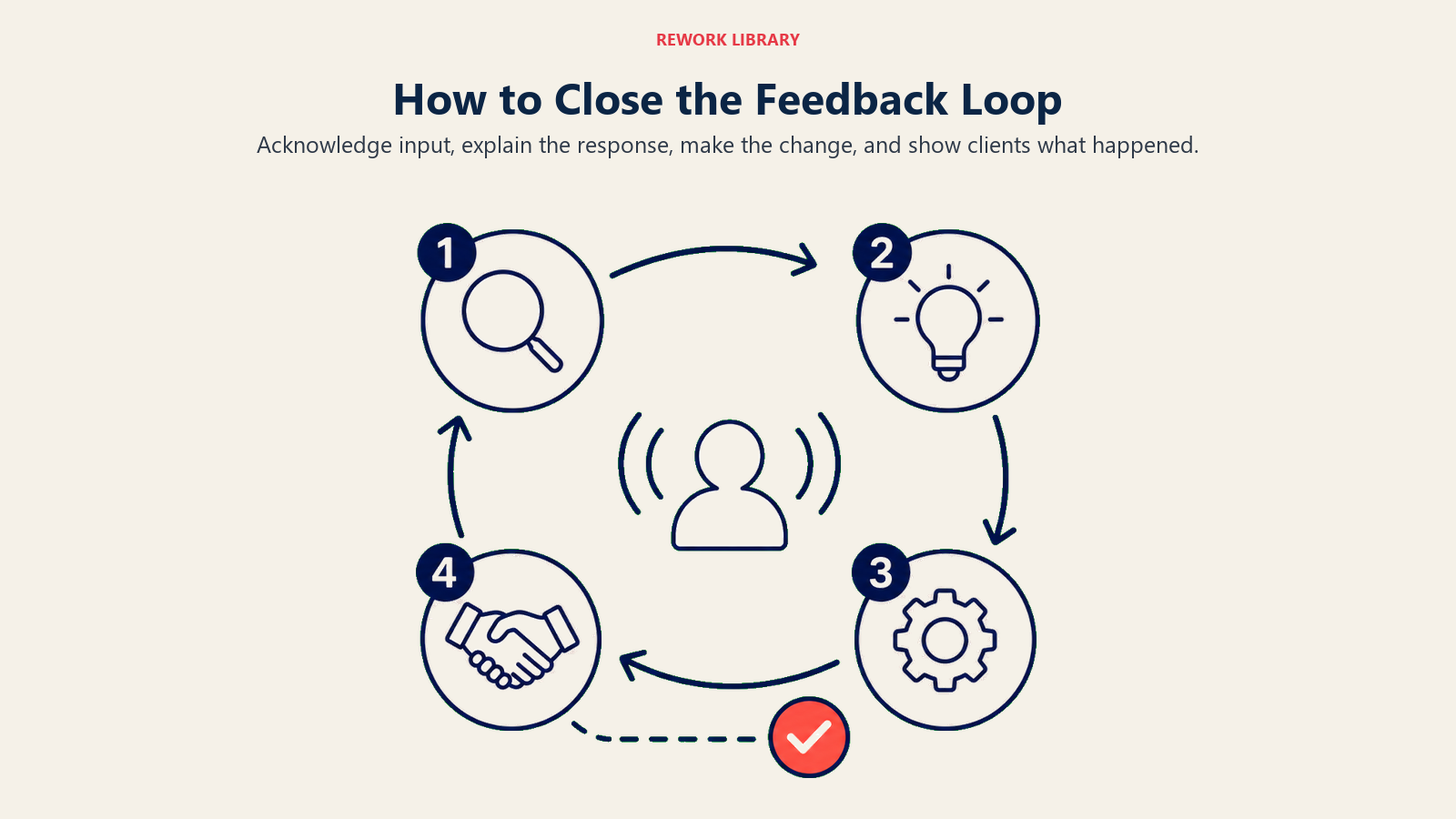
For individual feedback, respond within a week. For aggregate feedback (surveys), share results within two weeks.
Action planning from feedback: Prioritize feedback into three buckets:
- Quick fixes: Things you can address immediately (responsiveness, communication cadence, specific process tweaks)
- Strategic improvements: Changes that require planning and resources (training, tools, methodology updates)
- Not actionable: Feedback that's conflicting, impossible, or outside your control
For categories 1 and 2, create action plans with owners and timelines. For category 3, explain why you can't act but show you considered it. When feedback reveals problems, your issue resolution process should kick in immediately.
Communicating changes back to clients: When you implement improvements based on feedback, tell clients. "Based on input from you and others, we've changed [process/tool/approach]. Here's what's different and why."
This can be individual outreach for client-specific issues or broader communication for systemic changes. The point is closing the loop: "You spoke, we listened, here's what changed."
Tracking implementation: Create a feedback action tracker:
- Feedback theme
- Requested by (specific clients or aggregate pattern)
- Action planned
- Owner
- Status
- Completion date
- Impact measurement
Review this tracker monthly in leadership meetings. If actions sit in "planned" status for months, you're not serious about feedback.
Measuring improvement impact: After implementing changes, check if they worked. If you improved response time based on feedback, measure if response time actually improved and if client satisfaction scores went up.
This validates that you're fixing the right things and gives you proof points for future communication.
Feedback-driven improvement
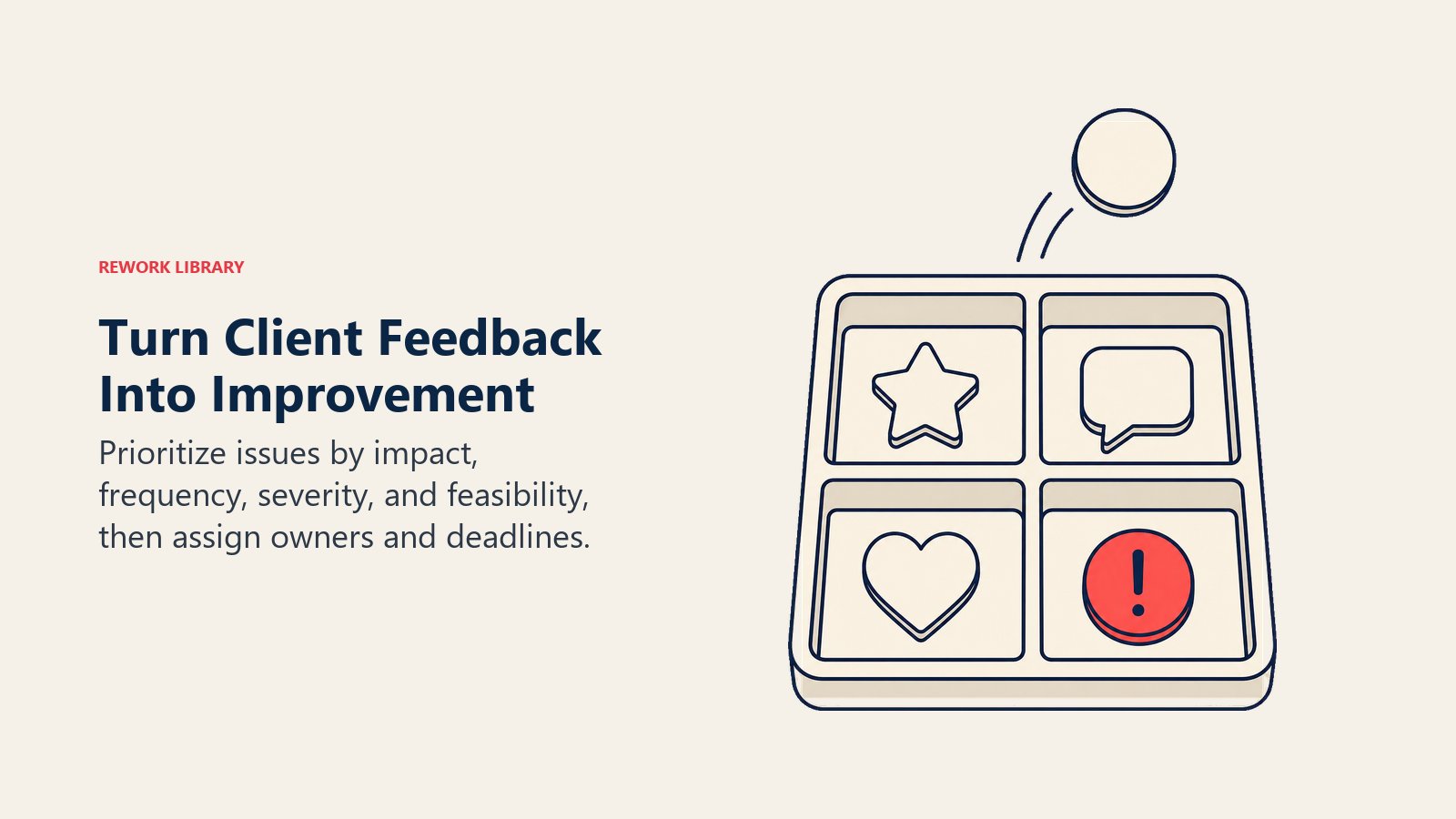
Feedback is useless if it doesn't change how you work. Here's how to turn input into outcomes. Prioritizing improvement opportunities: You can't fix everything at once. Prioritize based on:
- Impact (will this fix affect many clients or just a few?)
- Frequency (is this mentioned repeatedly or once?)
- Severity (is this causing client departures or mild annoyance?)
- Feasibility (can you fix it quickly or does it require major investment?) High impact, high frequency, high severity issues that are relatively feasible? Do those first. Low frequency, low impact issues mentioned once? Probably ignore.
Systemic vs. individual client fixes: Some feedback reveals individual client needs. "We need reports formatted differently for our CFO." Fine, customize for them. But if five clients mention report formatting, you have a systemic issue. Fix the standard, not just one-offs.
Watch for patterns that indicate systemic problems:
- Multiple clients mention the same issue
- The same issue appears across different service lines or teams
- Root cause analysis reveals process or capability gaps
Systemic problems require systemic solutions: process redesign, training, tools, methodology changes.
Process and service redesign: When feedback points to process issues, map the current process, identify where it's failing, and redesign. Examples:
- Clients complain about unclear project status → implement standard weekly status updates
- Clients don't understand deliverables → create templates with explanatory context
- Clients feel surprised by timelines → add milestone preview meetings
Service redesign might mean changing deliverable formats, communication cadence, team structure, or how you onboard clients.
Training and skill development: Sometimes feedback reveals capability gaps. Clients say "your team doesn't understand our industry" or "we wanted more strategic thinking." That's a training signal.
Build training programs that address skill gaps:
- Industry knowledge for specific verticals
- Communication and presentation skills
- Strategic advisory vs. execution mindset
- Project management and client management
Track whether training moves the needle on satisfaction scores related to those dimensions.
Technology and tool improvements: Feedback might indicate that your tools create friction. "Your client portal is confusing." "We can't find past deliverables." "Your invoices don't show enough detail."
Invest in tools that solve recurring pain points:
- Client portals that are actually usable
- Project management systems that give clients visibility
- Reporting dashboards that answer common questions
- Communication tools that match client preferences
Technology fixes scale better than human workarounds.
Technology and tools for feedback systems
You can run feedback programs manually, but technology makes them scalable and consistent.
Survey platforms: Tools like Qualtrics, SurveyMonkey, Typeform, or Delighted handle survey creation, distribution, and basic analysis. Choose based on:
- Ease of use (will your team actually use it?)
- Integration with CRM (can you trigger surveys automatically and track responses?)
- Analysis capabilities (does it code themes, track trends, segment results?)
- Cost (most are subscription-based per response or per user)
For most firms, Delighted or SurveyMonkey handles NPS and CSAT well. Qualtrics is overkill unless you're enterprise-scale.
CRM integration: Store feedback in your CRM alongside other client data. When you look at a client record, you should see their latest NPS score, satisfaction ratings, and recent comments. This context informs how account teams engage.
Most CRM platforms (Salesforce, HubSpot, Microsoft Dynamics) integrate with survey tools or have native feedback features.
Analytics tools: Beyond survey platforms, use analytics to spot patterns:
- BI tools (Tableau, Power BI) for visualizing trends and segments
- Text analytics (MonkeyLearn, Luminoso) for coding open-ended responses at scale
- Predictive analytics to model retention risk based on feedback scores
Workflow automation: Automate feedback workflows:
- Trigger surveys automatically at engagement milestones
- Route negative feedback to account managers for immediate follow-up
- Create tasks in project management tools when action items emerge
- Send reminder emails for incomplete surveys
- Generate monthly feedback reports for leadership
Automation ensures consistency and reduces manual work.
Metrics and accountability
What gets measured gets managed. Track these metrics to ensure your feedback system is working. Response rates: Target 40-60% for relationship surveys, 30-40% for transactional surveys. If you drop below 30%, investigate why. Are surveys too long? Too frequent? Have you lost trust by not acting? Track response rates by client segment. Low response from specific industries or service lines might indicate relationship issues.
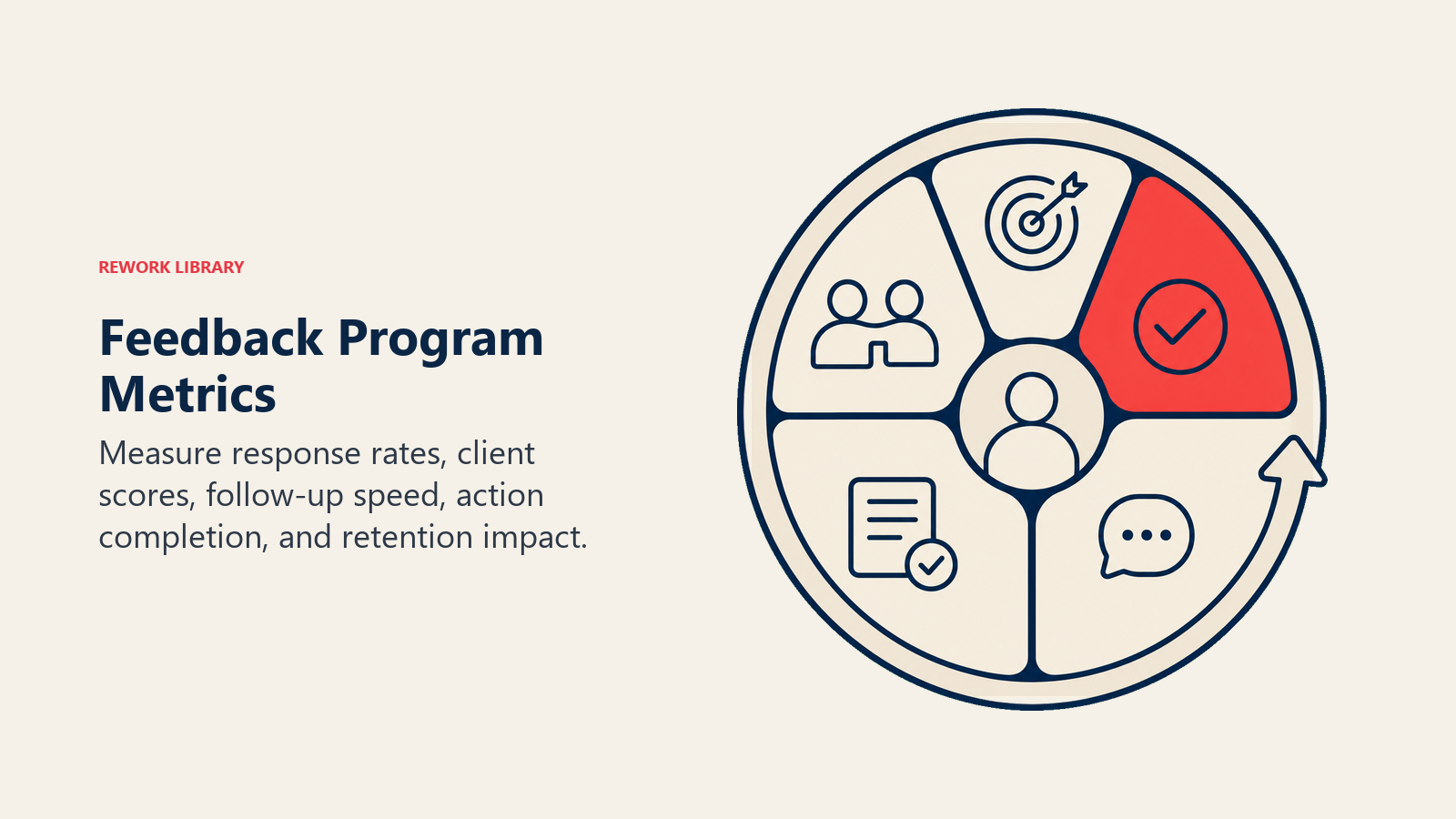
Feedback scores: Track NPS, CSAT, and other scores over time. Goal is upward trend or stable high scores. Declining scores are early warning of problems.
Benchmark against industry standards if available (average B2B professional services NPS is 25-40, CSAT is 75-85%).
Action completion rate: What percentage of feedback-driven action items get completed? Target 80%+. If you plan improvements but don't execute, you've wasted effort and damaged trust.
Track time-to-completion. How long from feedback to implemented fix? Faster is better.
Improvement validation: After implementing changes, did the related satisfaction scores improve? If you fixed responsiveness issues, did CSAT on communication go up? This validates your improvements actually worked.
Impact on retention and expansion: Does high NPS correlate with renewal rates? Do CSAT scores predict expansion revenue? If feedback doesn't predict business outcomes, refine what you're measuring. Your client satisfaction management approach should incorporate these predictive insights.
For firms with enough data, build predictive models: "Clients with NPS below X have Y% churn risk."
Common challenges and solutions
Every firm runs into these obstacles. Here's how to get past them. Survey fatigue: Clients stop responding because they're over-surveyed or they don't see results.
Solutions:
- Reduce frequency (survey less often but with higher quality questions)
- Show impact (share "you said, we did" stories)
- Vary methods (not every touchpoint needs a survey, use conversations)
- Respect time (keep surveys under 5 minutes)
Low response rates: You send surveys, get 15% response, and can't draw conclusions.
Solutions:
- Send from a person, not a generic email
- Explain why their input matters
- Make it stupid-easy to start (one click)
- Follow up once, personally, from account manager
- Offer incentive for strategic accounts (e.g., executive dinner if they complete annual review)
Not acting on feedback: You collect input but nothing changes.
Solutions:
- Assign owners to every piece of actionable feedback
- Review feedback action tracker in leadership meetings
- Tie feedback response to performance evaluations
- Make improvement part of annual planning process
Closing the loop: You act on feedback but forget to tell clients, so they don't know you listened.
Solutions:
- Create standard "here's what changed based on your feedback" communication template
- Build loop-closing into project close-out or QBR agendas
- Track whether clients were notified of actions (not just whether actions completed)
Defensive culture: Team members get defensive about negative feedback instead of seeing it as a gift.
Solutions:
- Leadership models non-defensive response
- Separate feedback review from performance evaluation (feedback isn't about blame)
- Celebrate improvements that came from client input
- Train teams on how to receive feedback productively
Best practices for sustainable feedback systems
Establish regular cadence: Feedback isn't a one-time project. Build it into your rhythm:
- Pulse surveys monthly for active engagements
- CSAT after major deliverables
- NPS quarterly or semi-annually
- Annual relationship reviews for strategic accounts
- Exit interviews always
Multi-channel approach: Don't rely on surveys alone. Combine:
- Quantitative surveys for trends and benchmarks
- Qualitative interviews for depth
- Passive signals (usage, engagement) for early warnings
- Direct conversations for relationship health
Stakeholder-specific feedback: Different stakeholders have different perspectives. Ask:
- Executive sponsors about strategic value and relationship
- Day-to-day users about deliverable quality and usability
- Procurement about pricing and contracting
- Technical teams about expertise and collaboration
You'll get different feedback from each. That's useful.
Transparent action: When you can act, do it and share what changed. When you can't act, explain why. Transparency builds trust even when you can't give clients what they want. This transparency is essential to your overall client retention strategy.
Create feedback champions: Designate someone (or a small team) as owner of the feedback system. They ensure surveys go out on time, analysis happens, action items get assigned, and loop-closing occurs. Without ownership, feedback programs fade.
Sample feedback collection calendar
Here's a reference calendar for a typical professional services engagement: | Timing | Method | Audience | Topics | |--------|--------|----------|--------| | Week 2 (post-kickoff) | Pulse survey | Primary contact | Onboarding clarity, initial alignment | | Month 1 | Check-in call | Project sponsor | Early impressions, any adjustments needed | | Each major milestone | CSAT survey | Key stakeholders | Deliverable quality, timeliness, communication | | Quarterly (long engagements) | Pulse survey | All stakeholders | Relationship health, project trajectory | | Quarterly | QBR meeting | Executive sponsor | Strategic value, business impact, future needs | | Project completion | Retrospective survey | All stakeholders | Overall satisfaction, lessons learned | | Project completion | Exit interview | Primary contact | What worked, what didn't, likelihood to re-engage | | Semi-annually (ongoing clients) | NPS survey | All contacts | Loyalty and advocacy potential | | Annually (strategic accounts) | Comprehensive review | All stakeholders | Full relationship assessment |
Adjust timing based on engagement length and client preference.
Where to go from here
Client feedback systems sit at the center of client relationship excellence. Once you have systematic feedback, everything else improves:
- Client Satisfaction Management becomes proactive instead of reactive
- Client Communication Cadence aligns with what clients actually want
- Issue Resolution Process catches problems early based on feedback signals
- Continuous Improvement gets driven by real client needs, not guesses
- Professional Services Metrics include the voice of the client in performance tracking
Start simple: pick one survey type (NPS or CSAT), implement at one touchpoint, close the loop consistently, and expand from there. Perfect is the enemy of good. A basic system you actually use beats a sophisticated one that never launches.
The goal isn't to survey everything and everyone. It's to listen systematically, act decisively, and show clients their voice matters. That's how feedback becomes competitive advantage.

Sales Director
On this page
- Why systematic feedback matters
- Foundations of effective feedback strategy
- Feedback collection methods
- Survey-based feedback
- Direct conversation-based feedback
- Passive and observational feedback
- Feedback across the client journey
- Survey design and implementation
- Qualitative feedback approaches
- Feedback analysis and insights
- Closing the feedback loop
- Feedback-driven improvement
- Technology and tools for feedback systems
- Metrics and accountability
- Common challenges and solutions
- Best practices for sustainable feedback systems
- Sample feedback collection calendar
- Where to go from here