Advisory Services Expansion: Building Profitable Advisory Practices Beyond Compliance
Turn this article into takeaways for your work.


Each assistant summarizes the article only for you and suggests best practices for your work.
Here's what nobody tells you about professional services: compliance work is a race to the bottom. Tax prep, audit, legal filings - these are necessary services that clients increasingly see as commodities. They'll pay for them, but they won't pay premium rates, and they'll switch firms over a 10% price difference.
Advisory services are different. When you help a client structure their business for a sale, plan their tax strategy to save $200K annually, or guide them through a complex regulatory challenge, you're not a vendor. You're a trusted advisor. And trusted advisors command different economics - higher fees, better margins, longer relationships, and clients who refer instead of shop around.
But here's the hard part: building an advisory practice requires different skills, different pricing models, different client relationships, and a different mindset than compliance work. Most firms struggle with this transition. They bolt on some "advisory services" but still operate with a compliance mentality, pricing by the hour and waiting for clients to ask for help.
This guide shows you how to actually build an advisory practice that works - from developing capabilities to transitioning clients to pricing models that capture value.
The advisory services opportunity
Let's start with economics. A typical accounting firm might generate $500K in revenue from a client doing compliance work - monthly bookkeeping, quarterly taxes, annual audit. That work runs at 35-40% margins because it's labor-intensive and competitive.
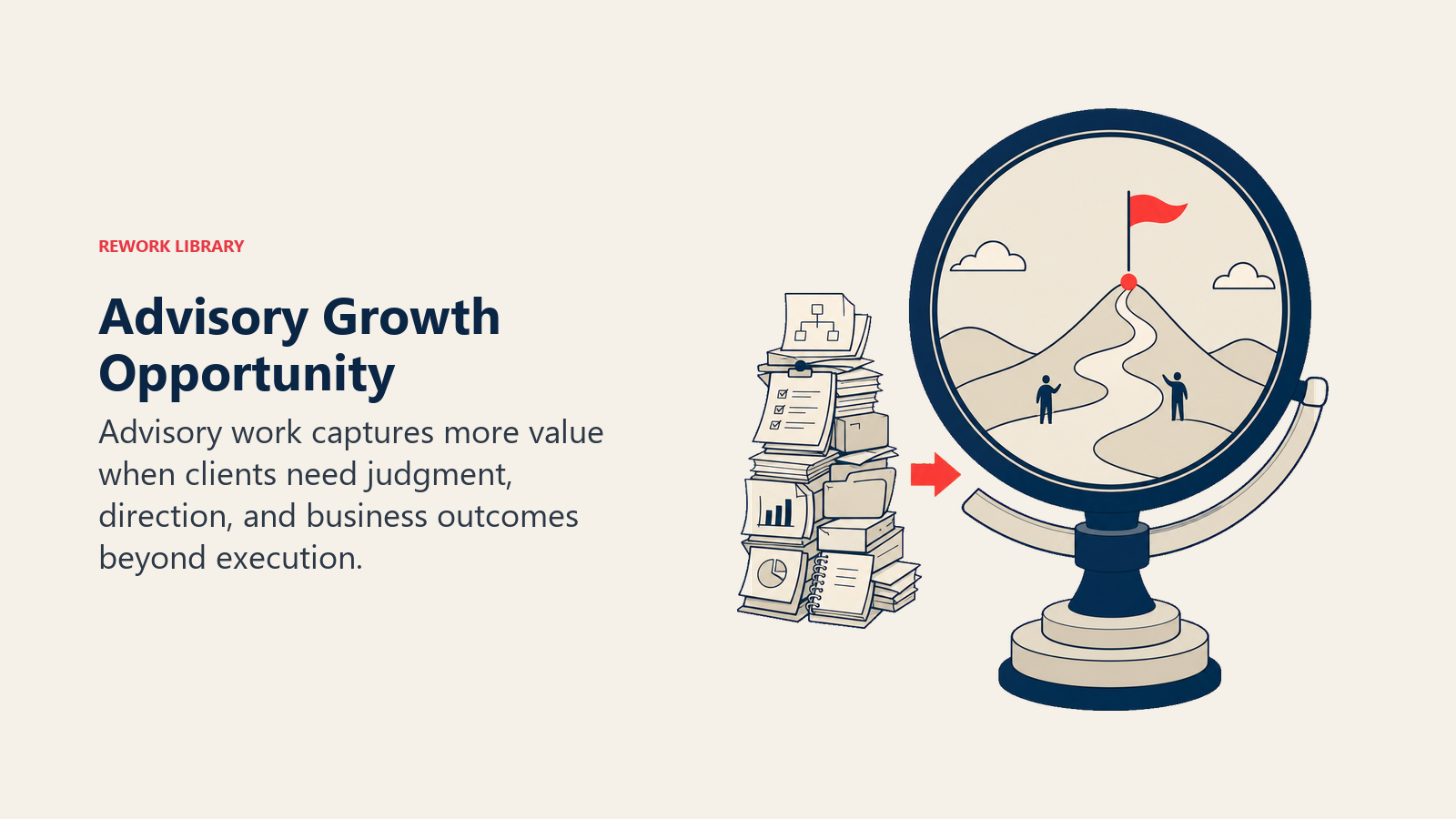
The same firm adds advisory services - tax planning, CFO consulting, M&A support. They generate another $200K from that same client at 60-70% margins. The work requires less hours per dollar because you're charging for expertise and outcomes, not just time.
That's the opportunity: same client, higher revenue, better margins, stronger relationship.
Advisory vs compliance economics:
Compliance work is transactional. You do the thing, you get paid, it's done. Tax return filed, audit completed, contract drafted. The pricing is usually straightforward - hourly rates or fixed fees based on scope. Competition is fierce because the deliverable is relatively standardized.
Advisory work is relational. You're solving ongoing problems, providing strategic guidance, helping clients make better decisions. The value compounds over time. And because each situation is unique, pricing has much more flexibility.
Types of advisory services by discipline:
For accounting firms:
- Tax planning and strategy (not just preparation)
- Financial planning and analysis
- CFO services and fractional CFO
- Business valuation and transaction advisory
- Succession planning
- Risk management and internal controls
For law firms:
- Strategic legal counsel and risk advisory
- Compliance strategy (not just execution)
- Business structuring and transactions
- Employment and HR advisory
- Intellectual property strategy
- Regulatory planning
For consulting firms:
- Strategy development and execution
- Digital transformation advisory
- Process improvement and efficiency
- Technology selection and implementation
- Change management
- Performance optimization
The pattern: you're moving from "do this thing" to "help me figure out what to do and how to do it."
What makes advisory work different:
Effective advisory services share three qualities:
Proactive, not reactive. Compliance work happens because it has to - deadlines, regulations, required filings. Advisory work happens because you identify an opportunity or risk and bring it to the client's attention. You're driving the conversation instead of responding to requests.
Strategic, not tactical. You're helping clients make better decisions about big questions. Should we expand internationally? How do we structure for a potential exit? What technology investments make sense? These aren't task-based questions.
Higher-margin, naturally. When you charge for expertise and outcomes instead of hours, and when you're solving valuable problems, pricing reflects that value. Advisory work running at 50-70% margins isn't unusual if priced correctly.
Building advisory capabilities
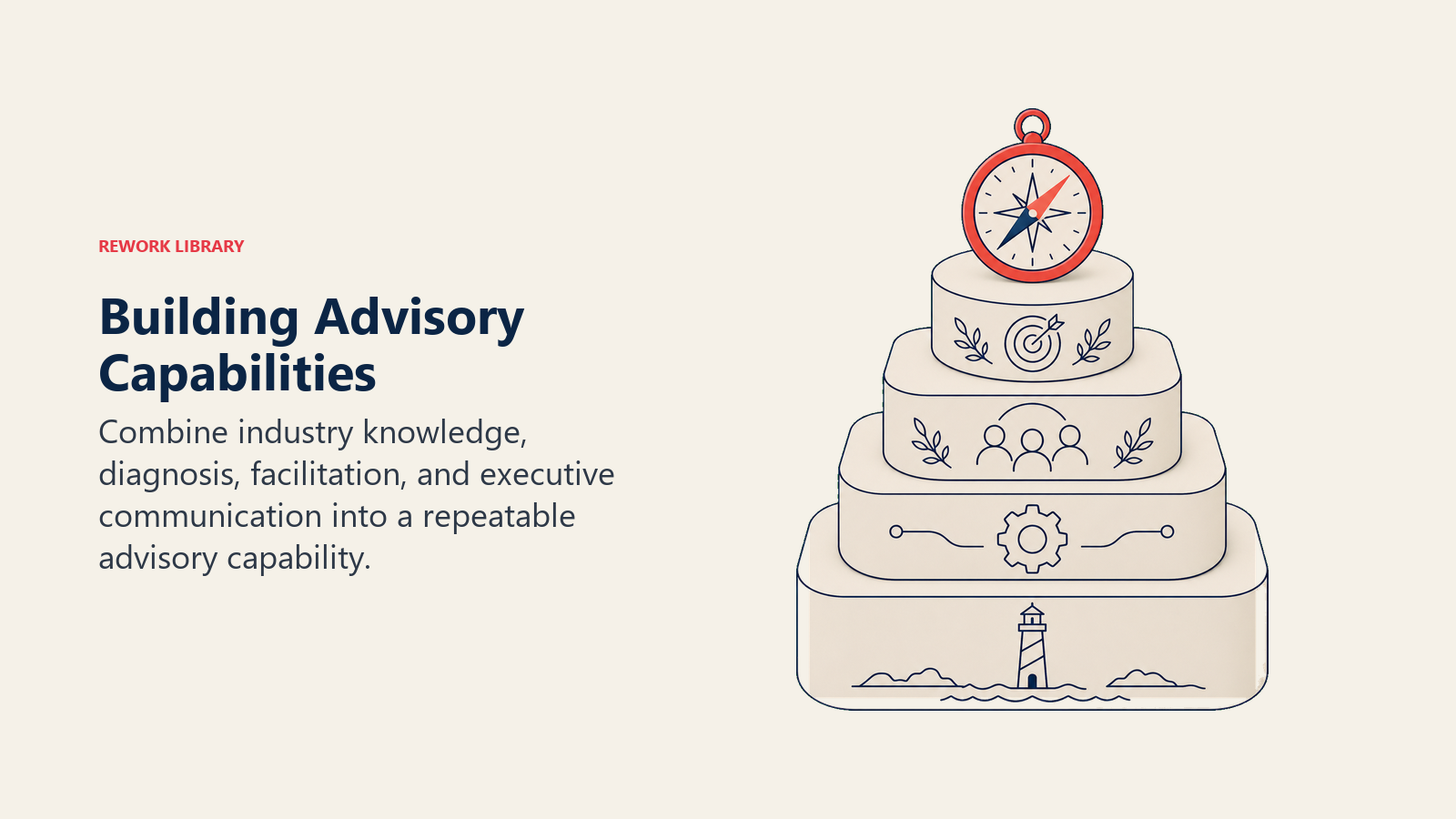
You can't just declare "we do advisory now" and start selling. You need actual capability - skills, knowledge, processes, and tools.
Skill and knowledge development:
Advisory work requires judgment and experience that goes beyond technical expertise. Your best tax preparer might not be ready to advise on tax strategy. Your most efficient legal associate might not have the business acumen for strategic counsel.
The skills you need:
- Business acumen: Understanding how businesses actually work, what drives value, what keeps owners up at night
- Strategic thinking: Ability to see patterns, anticipate consequences, identify opportunities
- Communication: Explaining complex topics clearly, asking good questions, managing difficult conversations
- Industry expertise: Deep knowledge of specific verticals - you can't advise effectively on healthcare regulatory strategy without understanding healthcare
- Analytical capability: Modeling scenarios, quantifying options, building business cases
Build these through:
- Formal training programs (executive education, industry certifications)
- Mentorship and shadowing of experienced advisors
- Industry immersion (conferences, associations, reading)
- Client work with guidance (junior advisors working under senior oversight)
Conference attendance and speaking provide key development opportunities. See conference and event strategy for building these into your professional development program.
Don't rush this. A firm that pushes people into advisory roles before they're ready damages client relationships and reputation.
Mindset and culture shift:
This is harder than skills development. Compliance firms build cultures around accuracy, efficiency, and risk mitigation. Advisory firms build cultures around value creation, proactive thinking, and client impact.
The mindset differences:
- From "complete this work correctly" to "solve this client's problem"
- From "bill for time spent" to "charge for value delivered"
- From "respond to requests" to "identify opportunities"
- From "technical expert" to "trusted business partner"
- From "this isn't my job" to "what does the client need?"
You can't mandate this change. You model it through leadership behavior, hire for it, promote people who demonstrate it, and eventually build a culture where advisory thinking is normal.
Service delivery infrastructure:
Advisory work needs different processes than compliance work.
For compliance, you have workflows: gather documents, complete forms, review for accuracy, file on deadline. It's repeatable and systematic.
Advisory work is messier. Each engagement is different. But you still need structure or you'll waste time and deliver inconsistent quality.
Build these systems:
- Diagnostic frameworks: Structured ways to assess client situations and identify issues (business health assessment, risk audit, strategic review templates)
- Advisory playbooks: Repeatable approaches for common advisory scenarios (preparing for sale, international expansion, technology strategy)
- Collaboration tools: Ways for teams to work on complex client problems (project management, knowledge sharing, document collaboration)
- Quality assurance: Peer review processes for advisory recommendations before client delivery
- Client communication: Templates and structures for advisory reports, presentations, executive summaries
The goal: consistent quality and efficiency even when the work itself varies.
Service package development:
Don't just offer "advisory services." That's too vague. Package specific offerings with clear scope and value.
Examples:
- Tax Planning Retainer: Quarterly tax strategy sessions, proactive planning, coordination with business decisions
- CFO Advisory: Monthly financial review, strategic guidance, board-ready reporting
- Transaction Support: Business valuation, deal structuring, due diligence management
- Compliance Strategy Package: Regulatory roadmap, risk assessment, implementation oversight
Each package should have:
- Clear deliverables (what the client gets)
- Defined engagement model (monthly retainer, project-based, ongoing)
- Transparent pricing (fixed fees, value-based, retainer)
- Typical outcomes and ROI examples
This makes advisory tangible. Clients can understand what they're buying and make decisions.
Transitioning client relationships
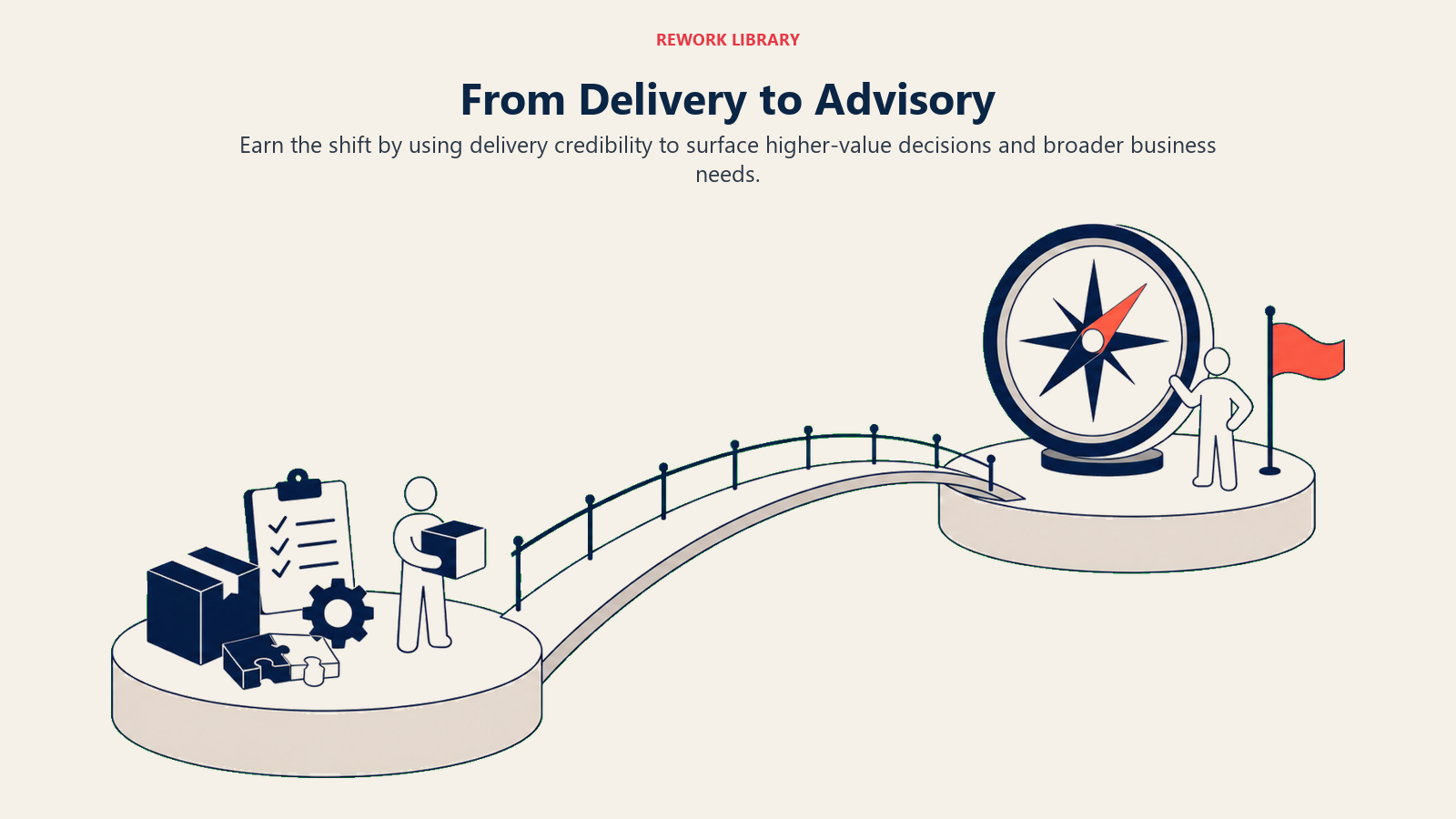
Your best advisory opportunities are existing compliance clients. They already trust you, you already understand their business, and you've likely identified advisory needs while doing compliance work.
Identifying advisory opportunities:
While doing compliance work, watch for these signals:
- Business changes: expansion, new products, entering new markets, ownership transitions
- Financial stress: cash flow issues, profitability challenges, rapid growth strains
- Strategic questions: "We're thinking about..." conversations that happen informally
- Risk exposure: compliance issues, process gaps, governance weaknesses
- Repeated tactical questions that point to strategic gaps
When you see these, don't just answer the immediate question. Think about the underlying issue and whether advisory services could help.
Client conversation and positioning:
The transition conversation is critical. Done wrong, it feels like you're upselling. Done right, it feels like you're helping.
The framework:
- Observation: "While preparing your tax return, I noticed your effective tax rate increased significantly this year..."
- Implication: "At this rate, you're likely leaving $150K on the table annually in tax savings through strategies we could implement..."
- Advisory positioning: "We work with similar businesses on proactive tax planning that typically saves 15-25% on tax liability. Would it make sense to explore what that could look like for you?"
- Value clarity: "The engagement would be X, and if we achieve typical results, you'd save Y in the first year alone."
You're not selling services. You're identifying problems and offering solutions.
Transition strategy and timeline:
Don't try to convert every client overnight. Segment your client base:
Tier 1 (High-potential advisory clients):
- Strong business fundamentals
- Significant advisory opportunities identified
- Demonstrated willingness to invest in their business
- Good cultural fit for deeper relationship
Focus here first. These clients get proactive outreach, dedicated relationship management, and first access to new advisory offerings.
Tier 2 (Medium-potential):
- Some advisory opportunities
- Good compliance clients but less sophisticated
- May need education on advisory value
Transition these gradually through pilot programs, specific project work, or bundled compliance + advisory packages.
Tier 3 (Compliance-only):
- Price-focused clients
- Small scale with limited advisory needs
- Poor fit for advisory relationship
Keep them on compliance, maintain good service, but don't invest heavily in advisory conversion.
Relationship deepening:
Advisory relationships require more frequent, higher-value interactions than compliance.
Compliance rhythm: quarterly check-ins, annual deliverables, respond to questions.
Advisory rhythm: monthly strategic calls, proactive recommendations, regular business reviews, executive access.
Build this through:
- Regular strategic reviews: Quarterly business reviews that go beyond financials to discuss strategy, challenges, opportunities
- Proactive insights: Sending relevant industry information, regulatory updates, strategic ideas even when not asked
- Multi-level relationships: Connecting with multiple stakeholders in the client organization, not just your primary contact
- Social connection: Inviting key clients to firm events, networking introductions, personal relationship building
The client should feel like you're invested in their success, not just delivering services.
Pricing and economic models
This is where most firms struggle. They know how to price compliance work. Advisory pricing feels harder because the value is less tangible and the deliverables vary.
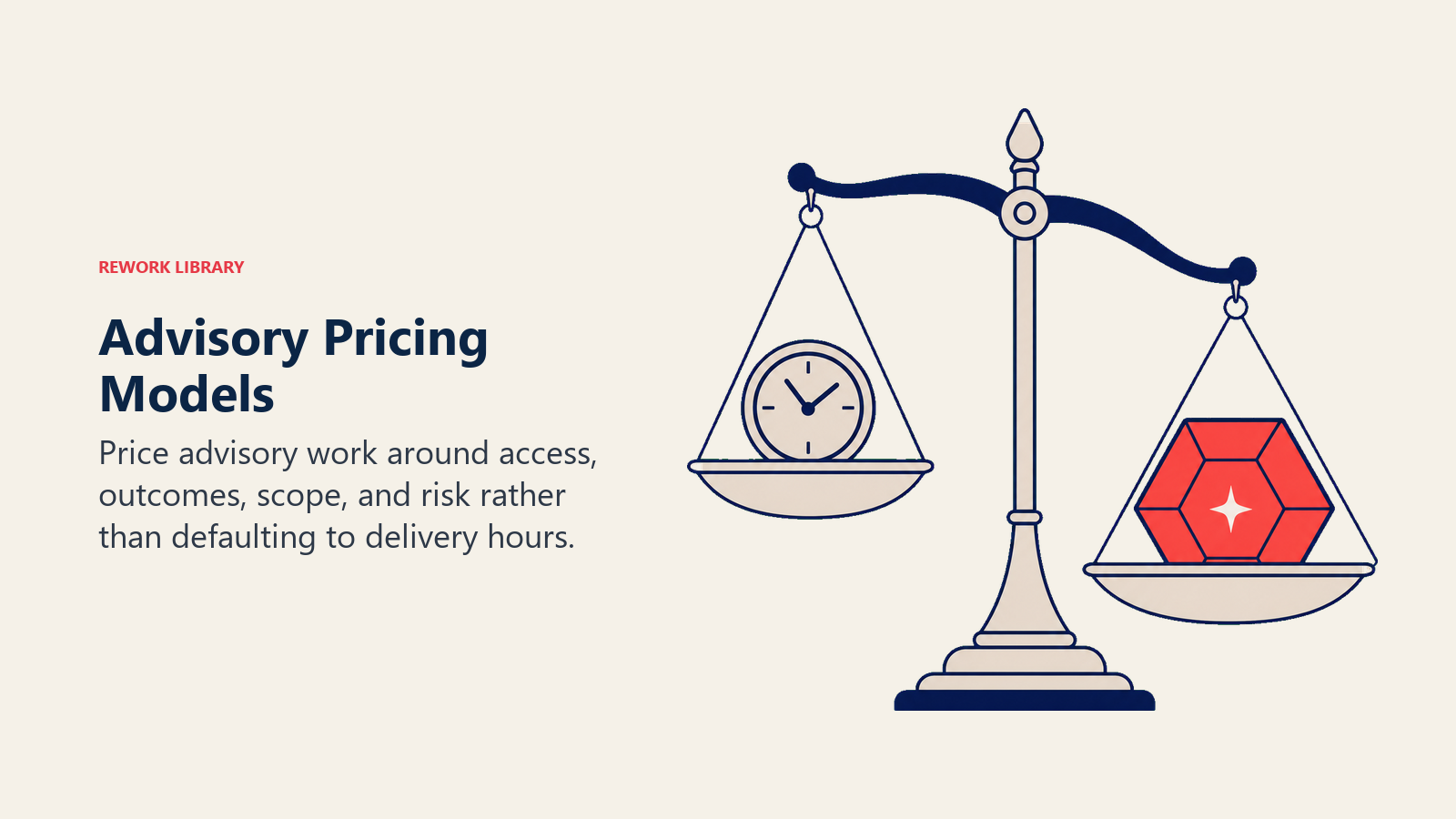
Advisory pricing strategies:
You have four main options:
Hourly billing: Charge based on time spent, just like compliance work. This is the default for many firms because it's familiar. But it's the worst option for advisory work because:
- It caps your revenue to available hours
- It penalizes efficiency (faster work = less revenue)
- It disconnects fees from client value received
- It makes clients focus on time instead of outcomes
Only use hourly for truly unpredictable advisory work where scope is impossible to define upfront.
Fixed-fee projects: Charge a set amount for a defined scope of work. Better than hourly because it aligns incentives - you benefit from efficiency. But still limited because fees are tied to delivery, not value.
Good for: Specific advisory projects with clear boundaries (business valuation, transaction support, compliance strategy development).
Retainer models: Client pays a recurring monthly or quarterly fee for ongoing advisory access and services. This is where advisory economics really improve:
- Predictable recurring revenue
- Long-term client relationships
- Pricing based on value and access, not hours
- Ability to be proactive without worrying about billable time
Great for: Ongoing advisory relationships (CFO services, strategic counsel, continuous tax planning).
Value-based pricing: Fee is based on the value delivered to the client, not the cost to deliver. If your tax planning saves a client $200K, pricing is a percentage of that savings or based on the value of the outcome.
This is the most profitable model but requires:
- Clear ability to quantify client value
- Strong client relationships and trust
- Confidence in your ability to deliver results
- Willingness to have difficult pricing conversations
Retainer model economics:
Let's work through an example. You have a mid-sized business client that currently pays you $50K annually for compliance work (monthly bookkeeping, quarterly taxes, annual statements).
You identify advisory opportunities:
- Tax planning could save them $150K annually
- CFO guidance could improve cash flow by $75K
- Strategic planning around expansion could be worth millions in better decisions
You propose an advisory retainer: $8,000/month ($96K annually) that includes:
- Monthly CFO advisory sessions
- Quarterly tax planning reviews
- Ongoing strategic guidance
- Proactive recommendations
- Priority access when issues arise
Client math: They're paying $96K but saving $150K in taxes alone, plus the value of better decisions. ROI is clear.
Your math: $96K in advisory revenue at 65% margins ($62K contribution) plus $50K compliance revenue at 35% margins ($17.5K contribution) = $79.5K total contribution from a client that previously generated $17.5K. And the relationship is stickier because they depend on your advisory guidance.
Value-based pricing:
The framework: Price based on a percentage of value created or saved, with a floor to ensure you're compensated fairly even if results vary.
Example structures:
- Tax planning: 15-25% of first-year tax savings, with a minimum fee of $15K
- Transaction advisory: 1-2% of transaction value, with a minimum of $50K
- Strategic planning: Fixed fee plus success bonus if specific outcomes achieved
- Efficiency improvement: Percentage of cost savings achieved in first year
The key is quantifying value upfront: "Based on our assessment, we believe we can save you $200K annually. Our fee will be 20% of realized savings, assessed at year-end based on actual results."
Pricing model selection:
Match your pricing model to the service type:
| Service Type | Best Pricing Model | Why |
|---|---|---|
| Ongoing advisory (CFO, strategic counsel) | Monthly retainer | Predictable revenue, aligns with ongoing value |
| Project-based advisory (transaction support, valuations) | Fixed fee | Clear scope, defined deliverable |
| Results-oriented advisory (tax planning, efficiency) | Value-based or hybrid | Fee reflects outcomes achieved |
| Exploratory advisory (new service, uncertain scope) | Hourly with cap | Protects both parties during exploration |
Profitability and margin management:
Track margins separately for compliance vs advisory work. You should see:
- Compliance services: 30-45% margins (labor-intensive, competitive)
- Advisory services: 50-75% margins (expertise-based, value pricing)
If your advisory margins are below 50%, either your pricing is too low or your delivery is too inefficient. Investigate both.
Calculate margin by service line:
- Revenue per engagement
- Direct labor costs (burdened rates for staff time)
- Allocated overhead
- Net margin
Watch for advisory services that look profitable on pricing but get killed by scope creep or inefficient delivery.
Building the advisory sales function
Advisory work doesn't sell itself. Even existing clients need to be shown value and guided through buying decisions.
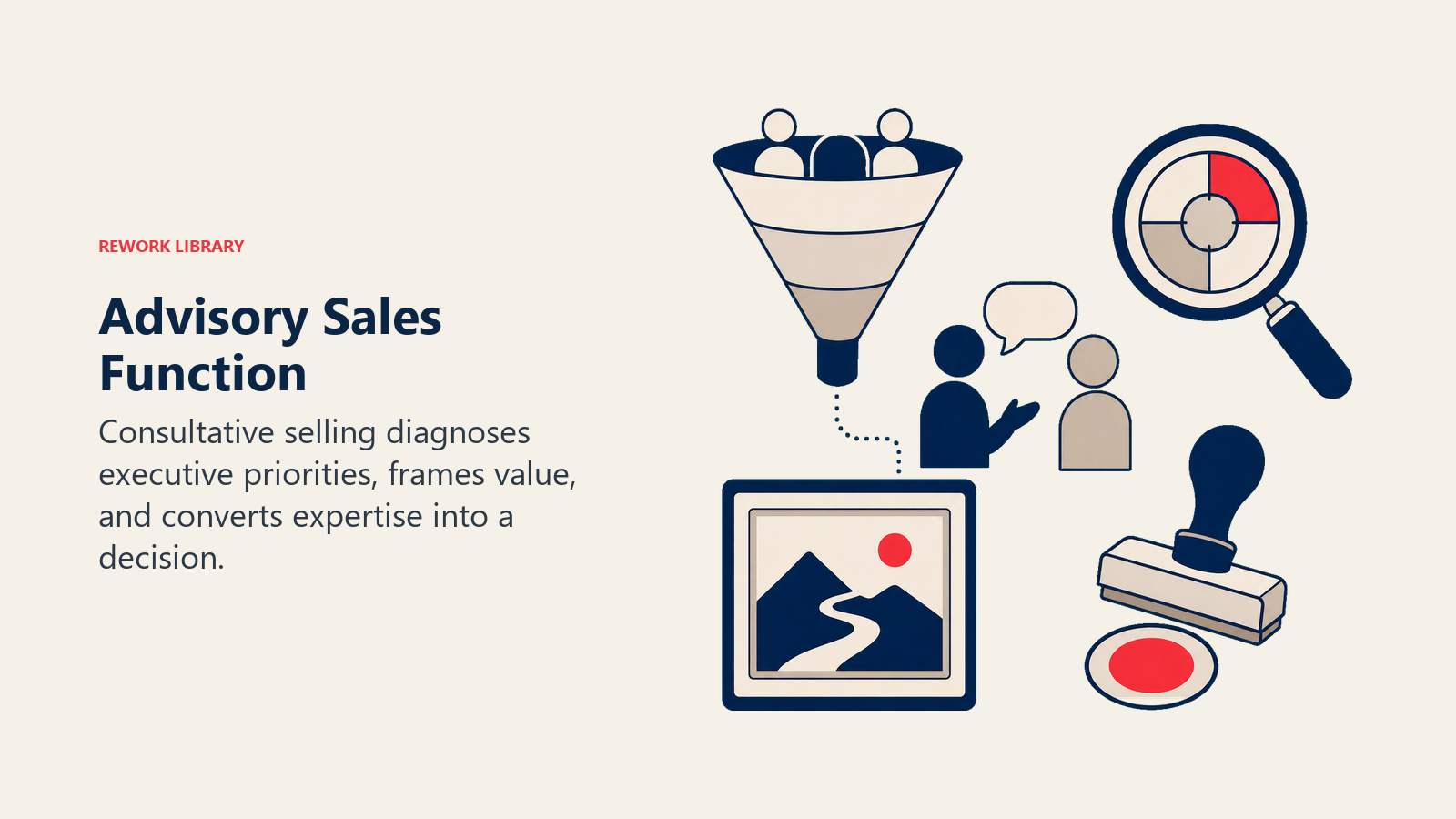
Business development for advisory:
Compliance work often comes from referrals, reputation, and inbound leads. Someone needs tax prep, they ask for referrals, they call a few firms, they pick one.
Advisory work requires more proactive business development:
- Thought leadership: Publishing insights that demonstrate expertise and thinking
- Speaking and presenting: Industry conferences, client events, webinars
- Networking: Building relationships before there's an immediate need
- Education: Teaching clients about problems they don't know they have
- Referral relationships: COIs (centers of influence) who regularly see advisory needs
This is uncomfortable for many technical professionals. They're experts at doing the work, not selling it. Invest in business development training or hire people with these skills.
Advisory selling skills:
Selling advisory is different from selling compliance. You're not responding to a defined need ("I need my taxes done"). You're identifying latent needs and helping clients see value in addressing them.
The skills:
- Diagnostic questioning: Asking questions that uncover issues and opportunities
- Business conversation: Talking about client challenges, not your services
- Value articulation: Explaining outcomes and ROI, not features and deliverables
- Handling objections: Addressing "I don't need this" or "Too expensive" conversations
- Consultative approach: Positioning yourself as advisor, not vendor
Train your team on these. Role-play client conversations. Record and review sales calls. This is learnable.
Compliance to advisory conversion:
Your compliance work is a pipeline for advisory services. Build a systematic approach:
- During compliance delivery: Note advisory opportunities you observe
- Post-delivery review: Schedule business review meetings after major compliance deliverables
- Proactive outreach: "While doing your audit, we noticed... can we schedule 30 minutes to discuss?"
- Advisory assessment: Offer complimentary business health assessments or strategic reviews
- Proposal and engagement: Formal scope, pricing, and value proposition
Track conversion rates: What percentage of compliance clients buy advisory services? What's the average time from first advisory conversation to engagement? Which partners or teams convert best?
Advisory lead generation:
Don't rely solely on existing clients. Generate new leads specifically for advisory:
- Content marketing: Publish guides, case studies, and insights on advisory topics
- Industry specialization: Become known for advisory work in specific verticals
- Referral partnerships: Build relationships with complementary advisors (attorneys refer accounting advisory, accountants refer legal advisory)
- Speaking circuit: Present at industry events where prospects attend
- Thought leadership: Publish research, host events, create tools that attract advisory prospects
The goal: prospects who come to you specifically for advisory expertise, not just compliance services.
Service-specific development strategies
Different advisory services require different approaches. Let's look at the major categories:
Tax planning and strategy:
The opportunity: Most businesses overpay taxes because they don't plan proactively. They do what their accountant tells them at year-end, but by then options are limited.
Advisory approach:
- Quarterly planning sessions reviewing income, expenses, and planning opportunities
- Proactive recommendations on timing (when to recognize income/defer expenses)
- Entity structure optimization (C-corp vs S-corp vs partnership)
- Multi-year tax modeling for major business decisions
- Coordination between business and personal tax strategies
Pricing: Retainer model ($2K-10K/month depending on complexity) or value-based (percentage of tax savings).
Financial planning and CFO services:
The opportunity: Most small and mid-sized businesses don't have a CFO, so owners make financial decisions without proper analysis or guidance.
Advisory approach:
- Monthly financial reviews and variance analysis
- Cash flow forecasting and management
- Profitability analysis by product/service/customer
- Strategic planning and budgeting
- Board-ready financial reporting
- M&A and transaction support
Pricing: Monthly retainer ($3K-15K depending on company size and complexity).
Business advisory and strategy:
The opportunity: Business owners are experts in their industry but often lack broader business perspective or strategic frameworks.
Advisory approach:
- Strategic planning facilitation
- Growth strategy and market analysis
- Operational efficiency and process improvement
- Succession planning and exit preparation
- Board advisory and governance
- Business model evolution
Pricing: Retainer for ongoing advisory or project fees for specific initiatives.
Risk advisory and internal controls:
The opportunity: Growing businesses outgrow informal processes and face increasing risk exposure.
Advisory approach:
- Risk assessment and mitigation planning
- Internal controls design and implementation
- Compliance strategy (regulatory, industry-specific)
- Fraud prevention and detection
- Process documentation and improvement
- Technology risk and cybersecurity planning
Pricing: Project-based for assessments, retainer for ongoing risk management.
Technology advisory:
The opportunity: Business technology decisions are increasingly critical and complex.
Advisory approach:
- Technology strategy and roadmap
- System selection and vendor evaluation
- Digital transformation planning
- Implementation oversight and project management
- Data strategy and analytics
- Automation and efficiency technology
Pricing: Project-based or retainer depending on engagement type.
Staffing and team structure
Advisory work requires different people than compliance work, or at minimum, different development of the same people.
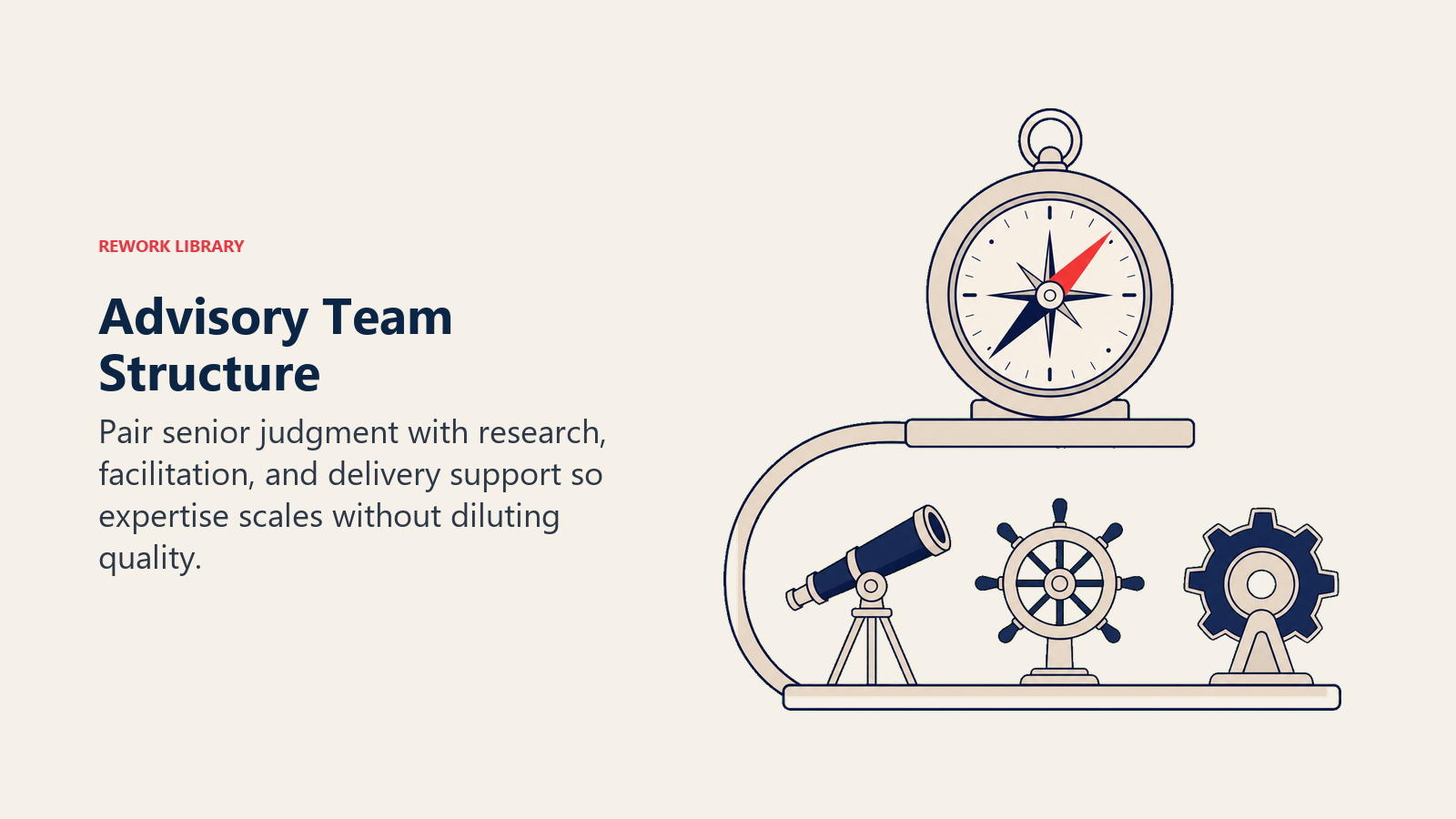
Advisor vs technician roles:
Technicians are excellent at executing work: completing tax returns, conducting audits, drafting contracts. They're detail-oriented, accurate, efficient.
Advisors are excellent at solving problems: identifying opportunities, developing strategies, guiding decisions. They're strategic, communicative, business-oriented.
Some people can do both. Many can't or prefer one over the other. Don't force your best technicians into advisory roles if they're uncomfortable or ineffective there.
Consider two-track career paths:
- Technical track: Senior accountant → Manager → Senior Manager → Technical Director
- Advisory track: Advisor → Senior Advisor → Advisory Principal → Advisory Partner
Both tracks should have compensation parity and respect. Advisory isn't inherently "better" than technical - they're different skills.
Compensation and incentive models:
Advisory compensation should reflect both individual contribution and business development.
Components:
- Base salary: Competitive for market and experience
- Advisory revenue incentive: Percentage of advisory revenue generated (5-15% depending on level)
- Client satisfaction: Based on client feedback and retention
- Thought leadership: Recognition for publishing, speaking, building reputation
- Team development: Mentoring junior advisors, building capability
Avoid purely commission-based models early. People need stability while building advisory practices.
Training and development:
Build structured development programs:
- Advisory fundamentals: Business acumen, strategic thinking, client communication
- Service-specific training: Deep expertise in particular advisory services
- Industry specialization: Vertical knowledge for target industries
- Soft skills: Selling, presenting, facilitating, questioning
- Apprenticeship: Junior advisors working with senior advisors on real client engagements
Budget 100+ hours annually per advisor for training and development. Advisory capability doesn't happen accidentally.
Utilization and capacity planning:
Advisory utilization should be lower than compliance utilization. Here's why:
Compliance work: Target 75-85% utilization (billable hours / available hours). Work is relatively predictable and schedulable.
Advisory work: Target 50-65% utilization. You need unscheduled time for:
- Business development and client relationship building
- Thinking and research on complex client issues
- Content creation and thought leadership
- Internal collaboration and knowledge sharing
- Professional development
If your advisors are at 80%+ utilization, they're probably not doing the non-billable work that builds long-term advisory success. You're optimizing for today while undermining tomorrow.
Plan capacity accordingly. An advisory team of 10 people at 60% utilization generates about 12,000 billable hours annually. At $250/hour average realization, that's $3M in revenue. But because of advisory pricing models and value-based fees, actual revenue might be $4-5M.
Client success and retention
Advisory relationships live or die based on client perception of value. Unlike compliance (where success is completing the work correctly), advisory success is subjective.
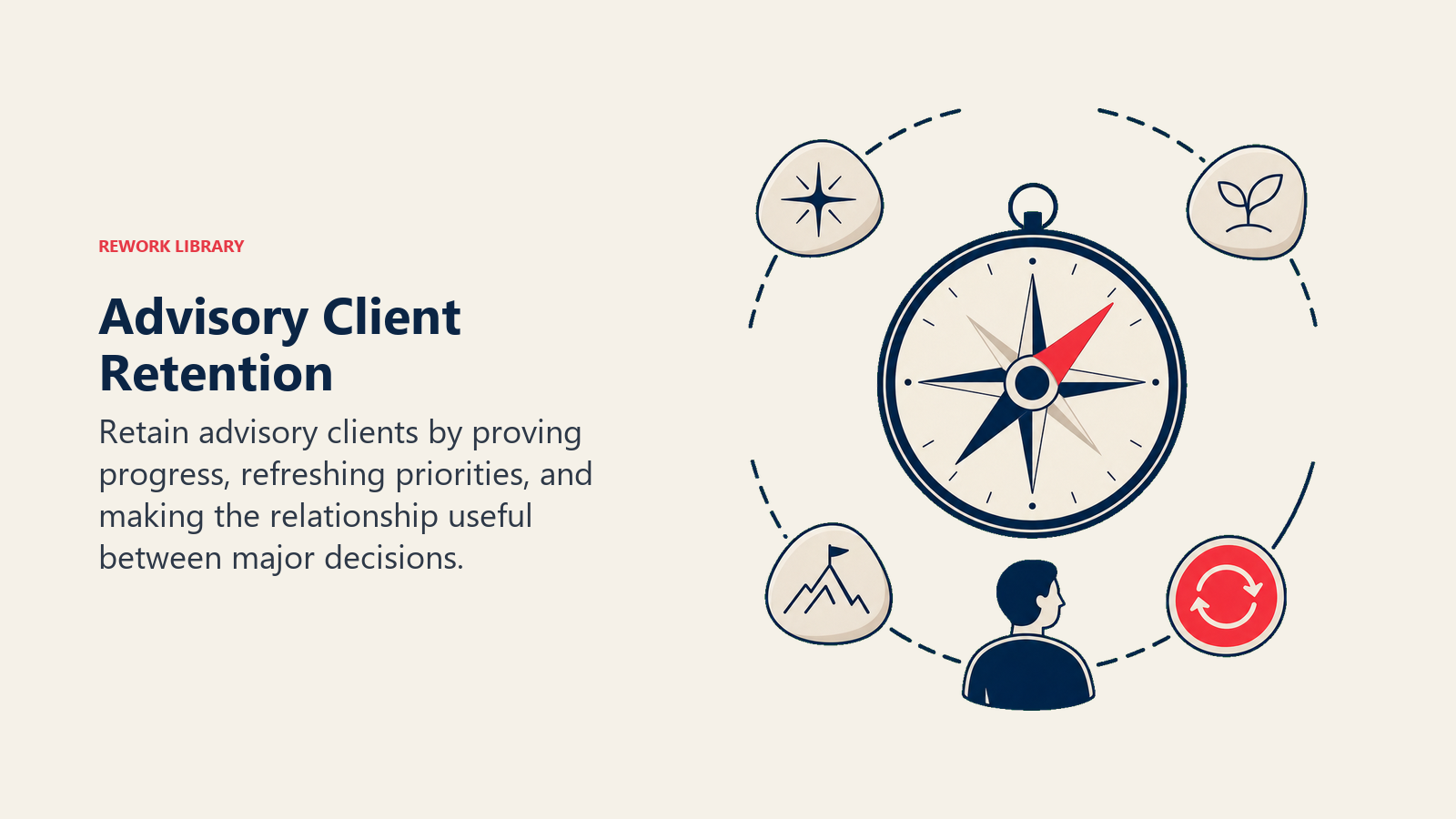
Measuring advisory impact:
Track both quantitative and qualitative measures:
Quantitative:
- Tax savings achieved vs projected
- Financial improvements (cash flow, profitability, working capital)
- Cost reductions implemented
- Revenue growth (when advisory contributed)
- Transaction value (successful M&A outcomes)
Qualitative:
- Client confidence in decisions made
- Speed and quality of strategic decision-making
- Risk avoided through proactive identification
- Client testimonials and case studies
- Relationship depth and trust
Survey clients quarterly: "How valuable was our advisory guidance this quarter?" and "What specific impact did our advisory work create?"
Service delivery excellence:
Advisory clients expect more than compliance clients:
Responsiveness: Faster replies, priority access, proactive communication. If a client texts you at 9pm about a business decision they're making, they expect a response.
Preparation: Coming to meetings with insights, not just asking what they want to discuss. Review their financials before the call, bring ideas.
Business perspective: Understanding their business deeply enough to provide contextual advice, not generic recommendations.
Discretion and confidentiality: Advisory work involves sensitive strategic information. Clients need absolute trust.
Follow-through: When you recommend something, track whether it gets implemented and what results it generates. Close the loop.
Communication cadence:
Compliance communication is event-driven: tax deadline approaching, audit scheduled, filing completed.
Advisory communication is ongoing:
- Monthly check-ins: Scheduled calls or meetings, even when there's no immediate deliverable
- Proactive outreach: Sending relevant articles, flagging regulatory changes, suggesting ideas
- Quarterly business reviews: Structured review of financial performance, strategic initiatives, upcoming opportunities
- Annual planning: Strategic planning session, goal setting, roadmap development
- Ad hoc availability: Responsive when client has urgent questions or needs guidance
Retention and expansion:
Advisory clients should have very high retention (95%+) and natural expansion opportunities.
Retention strategies:
- Consistent value delivery (obvious, but critical)
- Relationship deepening over time (more stakeholders, deeper understanding)
- Integration into client's decision-making (they depend on you)
- Proactive value creation (identifying new opportunities)
- Executive-level relationship (not just transactional contact)
Expansion opportunities:
- Additional advisory services (start with tax, add CFO services)
- Deeper engagement (monthly retainer increases as business grows)
- Related entities (client opens new business, acquires company)
- Personal services (business advisory extends to personal financial planning)
Track expansion revenue: What percentage of advisory clients increase spend year-over-year? This should be 50%+ for healthy advisory practices.
Metrics and performance management
What you measure drives behavior. Track these advisory-specific metrics:
Advisory revenue metrics:
- Total advisory revenue and % of firm revenue
- Advisory revenue per client (average and by segment)
- Advisory revenue per advisor (productivity)
- New advisory revenue vs recurring (growth vs stability)
- Advisory revenue by service line
Margin and profitability:
- Advisory gross margin by service line
- Advisory contribution margin (after direct costs)
- Realization rates (billed vs collected)
- Price per engagement vs hours invested (value capture)
Client metrics:
- Advisory client count and growth rate
- Compliance-to-advisory conversion rate
- Advisory client retention rate (should be 95%+)
- Client lifetime value (LTV) - advisory clients should be 3-5x compliance-only
- Net Promoter Score for advisory clients
Pipeline and sales:
- Advisory pipeline value (weighted by probability)
- Conversion rate (proposals to engagements)
- Average sales cycle length
- Win rate vs competitors
- Source of advisory leads (referral, existing client, inbound, outbound)
Capacity and utilization:
- Advisory headcount and capacity
- Billable utilization (target 50-65%)
- Advisory hours per FTE
- Revenue per advisor (should increase over time as expertise and pricing improve)
Client success:
- Advisory impact delivered (savings, value created)
- Client satisfaction scores
- Testimonials and case studies generated
- Advisory upsell/cross-sell rate
Set targets for each and review monthly. Share results with the team so everyone understands how the advisory practice is performing.
Marketing and thought leadership
Advisory services don't sell themselves. You need to build reputation and demonstrate expertise.
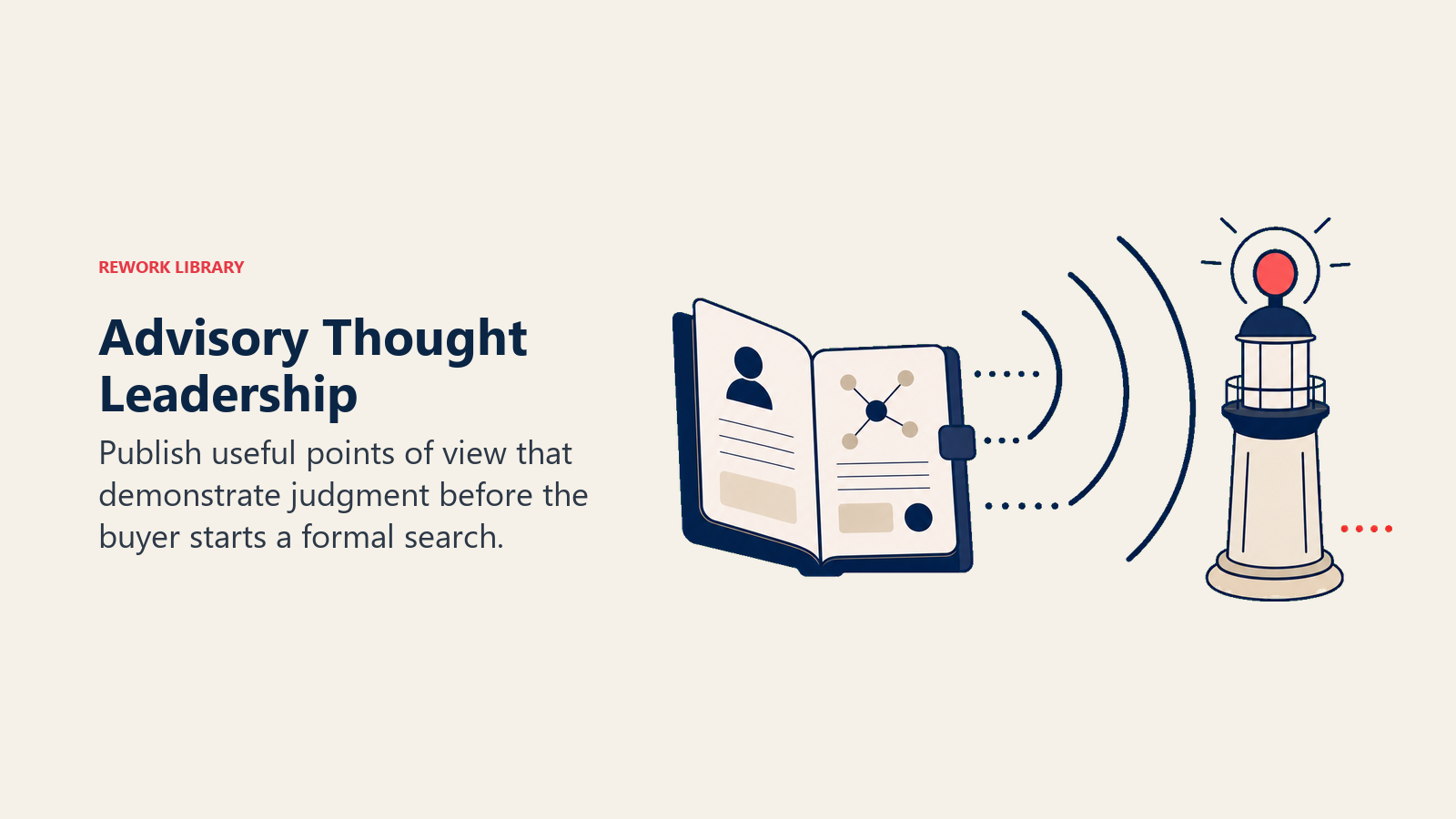
Content marketing:
Publish insights that showcase your advisory thinking:
- Blog posts and articles: Practical guidance on advisory topics your clients care about
- Case studies: Real examples of advisory work and client outcomes (with permission)
- Guides and playbooks: Comprehensive resources on specific advisory areas
- Research and reports: Original research on industry trends, benchmarks, best practices
- Video content: Short-form expertise sharing, client testimonials, educational content
The goal: Prospects find your content, recognize your expertise, and reach out for advisory help. For detailed approaches to building content programs, see content marketing for services.
Digital presence:
Build your online reputation:
- Website: Clear advisory service descriptions, client outcomes, team expertise
- LinkedIn: Regular posting, thought leadership, professional brand building
- Speaking portfolio: Video recordings, slide decks, client testimonials
- Reviews and ratings: Google, industry platforms, client testimonials
When someone researches your firm, they should immediately see advisory expertise, not just compliance capabilities.
Referrals and word-of-mouth:
Advisory work generates referrals more naturally than compliance work because:
- Results are often significant ("they saved us $200K in taxes")
- Clients are emotionally invested in their success
- Advisory relationships are deeper and more personal
Systematize referrals:
- Ask for referrals after successful outcomes
- Make it easy (introduction templates, specific asks)
- Reward referrers (recognition, reciprocal referrals, gifts where appropriate)
- Track referral sources and thank them
Your best advisory clients should generate 2-3 referrals over their lifetime.
Partnerships and centers of influence:
Build relationships with people who regularly encounter clients who need advisory services:
- Complementary professionals: Attorneys refer accounting advisory, accountants refer legal advisory
- Financial advisors: Wealth managers whose clients need tax or business advisory
- Bankers: Commercial bankers see businesses that need CFO or strategic advisory
- Industry associations: Connect with trade groups in your target industries
- Technology partners: Software vendors whose clients need implementation advisory
These relationships are long-term investments. Don't expect immediate results, but cultivate them consistently. Law firms building advisory practices face similar referral dynamics - see law firm business development for complementary strategies.
Overcoming transition challenges
Building an advisory practice is hard. You'll face resistance from multiple directions.
Client resistance:
Why clients hesitate:
- "We don't need advisory services" (they don't see the problem)
- "Too expensive" (they don't see the value)
- "We'll handle it ourselves" (they overestimate internal capability)
- "Not right now" (legitimate timing issues or polite no)
Overcome this through:
- Education: Help them understand the cost of NOT doing advisory work (taxes overpaid, opportunities missed, risks unaddressed)
- Small starts: Pilot projects or trial advisory engagements to demonstrate value
- ROI clarity: Quantify expected outcomes ("Typical clients save 3x our fee in the first year")
- Risk framing: Focus on what they stand to lose, not just gain
- Timing: Present advisory ideas when they're most relevant (year-end for tax planning, pre-transaction for M&A advisory)
Internal resistance:
Your own team might resist the advisory transition:
Why staff resist:
- "I'm not a salesperson" (uncomfortable with business development)
- "Advisory work is risky" (fear of not delivering results)
- "We're too busy with compliance work" (can't find time)
- "Clients won't pay for this" (lack of confidence in value)
- "I don't know how to do advisory" (skill gaps)
Address through:
- Training and support: Build capability before expecting results
- Gradual transition: Don't abandon compliance overnight
- Success stories: Share examples of advisory wins internally
- Compensation alignment: Reward advisory work appropriately
- Leadership modeling: Partners and leaders must demonstrate advisory mindset
Competitive dynamics:
You're not the only firm trying to build advisory services. Differentiate through:
- Industry specialization: Deep expertise in specific verticals
- Service innovation: Unique advisory offerings competitors don't have
- Relationship depth: Existing client relationships give you advantage over external competitors
- Outcome focus: Better at demonstrating and delivering results
- Delivery experience: Superior client experience and communication
Don't compete on price for advisory work. You'll win by being better, not cheaper.
Advisory growth roadmap
Building a meaningful advisory practice takes 5+ years. Here's a realistic progression:
Year 1: Foundation (0-10% of revenue)
- Build initial advisory capabilities and service packages
- Train team on advisory skills and approaches
- Launch pilot advisory services with select existing clients
- Develop pricing models and engagement templates
- Start thought leadership and content creation
- Target: $100K-300K advisory revenue from 5-10 clients
Year 2: Validation (10-20% of revenue)
- Refine services based on year 1 learnings
- Systematize advisory delivery processes
- Expand advisory offerings to more clients
- Hire or develop dedicated advisory talent
- Increase marketing and thought leadership
- Target: $300K-800K advisory revenue from 15-25 clients
Year 3: Scaling (20-35% of revenue)
- Build advisory team with specialized expertise
- Launch formal business development program
- Develop industry-specific advisory offerings
- Implement value-based pricing models
- Create case studies and proof points
- Target: $800K-2M advisory revenue from 30-50 clients
Year 4-5: Maturity (35-50%+ of revenue)
- Advisory becomes primary practice identity
- Specialized advisory service lines
- National/regional recognition for advisory expertise
- Robust pipeline of advisory-first clients
- Multiple revenue streams (retainers, projects, value-based)
- Target: $2M+ advisory revenue from 50+ clients
Each firm's path will differ based on starting size, market, and focus. But the pattern holds: slow initial growth, accelerating as capabilities and reputation build.
Technology and tools
Advisory work requires different technology than compliance work.
Advisory delivery platforms:
- Financial planning software: Projections, modeling, scenario analysis
- Business intelligence tools: Data visualization, dashboards, reporting
- Collaboration platforms: Client portals, document sharing, communication
- Project management: Tracking advisory engagements, deliverables, milestones
- Knowledge management: Storing and sharing advisory insights, playbooks, templates
CRM and pipeline management:
- Advisory-specific CRM: Tracking advisory opportunities, proposals, engagement status
- Pipeline reporting: Visibility into advisory sales funnel
- Client communication tracking: History of advisory conversations and touchpoints
- Task management: Follow-up on advisory recommendations and action items
Productivity and efficiency:
- Document automation: Proposal generation, engagement letters, reports
- Time tracking: Capturing time for pricing analysis even if not billing hourly
- Meeting tools: Video conferencing, screen sharing, recording for notes
- Signature and payment: Electronic signatures, online payment for retainers
The technology should enable advisory work, not complicate it. Start simple and add tools as you identify specific needs.
Common pitfalls and success factors
Let's end with what typically goes wrong and what separates successful advisory practices from those that struggle.
Common pitfalls:
Pricing too low: Firms charge compliance rates for advisory work, leaving money on the table and signaling low value.
Scope creep: Advisory engagements expand beyond original scope without pricing adjustments, killing margins.
Inconsistent delivery: Different advisors provide different quality, damaging reputation and client trust.
Neglecting business development: Assuming advisory work will come naturally without proactive marketing and sales.
Wrong people in advisory roles: Promoting good technicians into advisory positions they're not suited for.
Abandoning compliance prematurely: Trying to go all-in on advisory before building sustainable revenue, creating cash flow problems.
Lack of specialization: Trying to be advisory generalists instead of building deep expertise in specific areas.
Insufficient client communication: Not maintaining the frequent, proactive communication advisory clients expect.
Success factors:
Start with capability: Build real advisory skills and knowledge before selling advisory services.
Price for value: Use retainer and value-based models that reflect client outcomes, not just hours.
Focus on industries: Deep vertical expertise makes advisory work more effective and differentiable.
Invest in relationships: Advisory success comes from relationship depth, not transactional efficiency.
Measure and iterate: Track results, learn from successes and failures, continuously improve.
Leadership commitment: Partners must champion advisory transition and model advisory behaviors.
Long-term perspective: Accept that building an advisory practice takes years, not quarters.
Client success obsession: Make client outcomes and satisfaction the primary metric of success.
Where to start
If you're ready to build or expand your advisory practice, here's your starting point:
First, assess your current state. Review the Professional Services Growth Model to understand where you are and where you're headed. Look at your existing client base and identify those with the highest advisory potential.
Next, develop your service strategy. The Service Line Strategy guide will help you decide which advisory services to build based on your expertise and market opportunity.
For accounting firms specifically, the Accounting Firm Growth article provides industry-specific context on the compliance-to-advisory transition.
Then tackle pricing. Read Billable Hour vs Value Pricing to understand why hourly billing undermines advisory work and how to transition to better models.
Finally, establish measurement systems using Professional Services Metrics to track your advisory practice performance.
The firms that thrive over the next decade won't be those that do compliance work most efficiently. They'll be those that build genuine advisory capabilities, price for value, and become true business partners to their clients. That transition starts with a decision to build differently than you have before.
The compliance work will still be there. But the advisory work is where you build a business worth owning.

Sales Director
On this page
- The advisory services opportunity
- Building advisory capabilities
- Transitioning client relationships
- Pricing and economic models
- Building the advisory sales function
- Service-specific development strategies
- Staffing and team structure
- Client success and retention
- Metrics and performance management
- Marketing and thought leadership
- Overcoming transition challenges
- Advisory growth roadmap
- Technology and tools
- Common pitfalls and success factors
- Where to start