Client Advocacy Program: Building Champions, Case Studies, and Testimonials
Turn this article into takeaways for your work.


Each assistant summarizes the article only for you and suggests best practices for your work.
Here's the thing about professional services marketing: nobody believes your ads. They don't trust your website copy. They're skeptical of your thought leadership. But when their peer at a similar company says "these folks changed our business," that cuts through instantly.
Client advocates are your most valuable marketing asset, yet most firms treat advocacy like an afterthought. They'll scramble to find a reference when a big deal needs one, or they'll occasionally email clients asking for testimonials with fingers crossed. That's not a program. That's hope disguised as strategy.
A real advocacy program turns satisfied clients into a systematic engine for testimonials, case studies, speaking engagements, and referrals. This is a cornerstone of your broader client retention strategy. But here's what most firms get wrong: they think advocacy is about asking for favors. It's not. It's about creating value exchanges where both sides win.
This guide shows you how to build an advocacy program that generates consistent social proof without burning out your best clients or feeling like you're begging for help.
Why client advocates matter more than ever
Let's start with what the data shows. Peer recommendations drive 84% of B2B purchase decisions. Social proof accelerates deal velocity by 30-50%. And buyers contact vendors 70% of the way through their decision process, meaning most of their research happens before you're in the room. If prospects aren't hearing from your happy clients during that invisible research phase, you're losing deals before you know they exist.
The trust differential is massive. A prospect values a customer testimonial 12x more than vendor claims. Case studies with measurable results convert 3x higher than generic content. Reference calls where buyers hear directly from peers close deals that pricing concessions can't save.
And the cost-effectiveness is ridiculous compared to paid marketing. A single well-produced case study generates qualified leads for years. A client speaking at an industry conference reaches hundreds of prospects in one hour. Advisory board members become champions who refer multiple opportunities annually.
But here's the strategic advantage most firms miss: your competitors probably don't have a systematic advocacy program either. They're still relying on ad hoc requests and hoping clients say yes. That means a deliberate advocacy program creates differentiation that's hard to replicate.
What client advocacy actually means
Before you start asking clients to do things, you need to understand what advocacy is and isn't. Advocacy is when clients willingly share positive experiences with your firm to help others make decisions. The key word is willingly. Coerced testimonials or reluctant references aren't advocacy. They're favors that damage relationships.
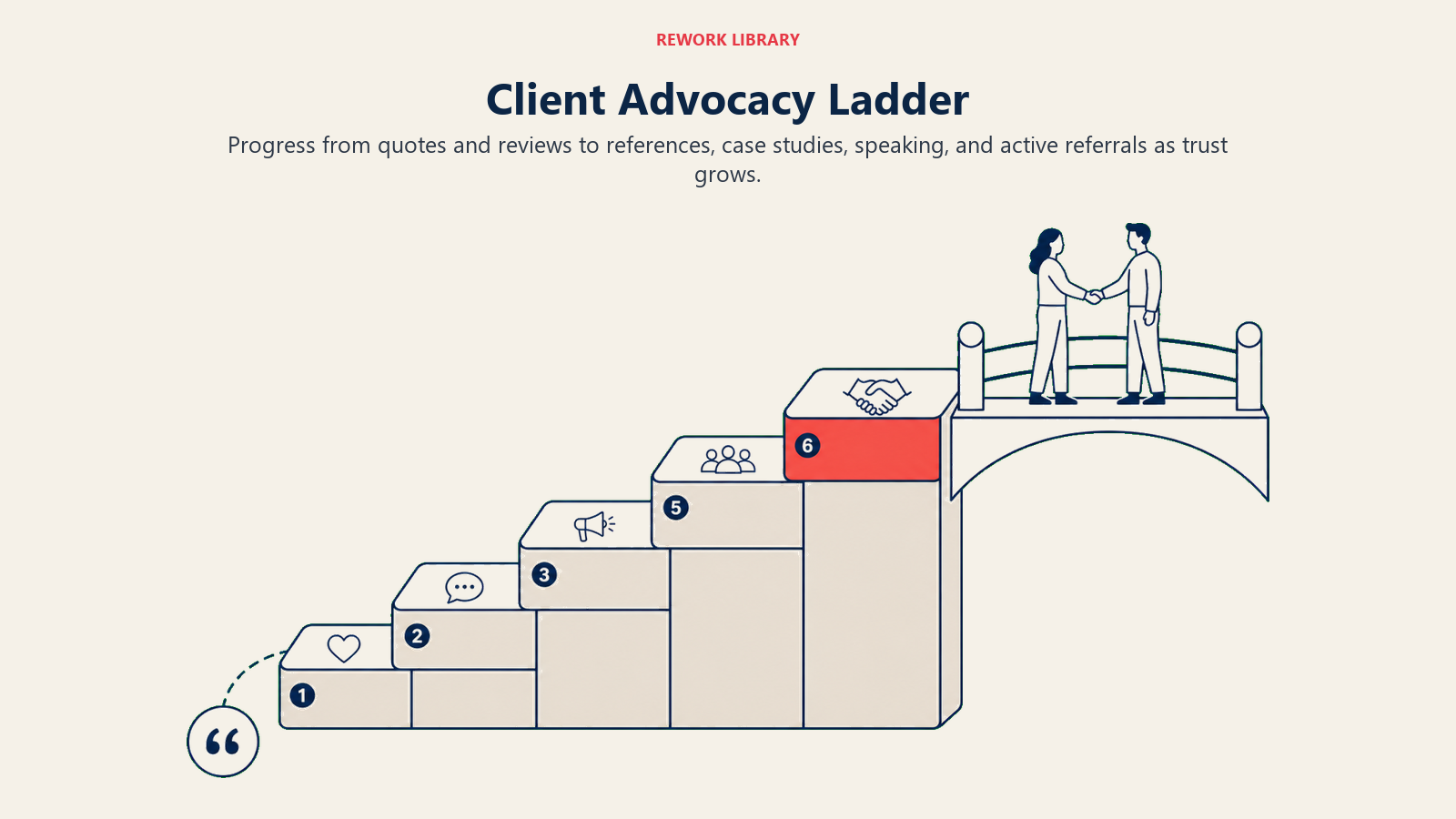
There's an advocacy ladder that progresses from low to high commitment:
Level 1: Providing a quote or written testimonial (15 minutes, low effort)
Level 2: Participating in a case study interview and review process (2-3 hours over weeks)
Level 3: Taking reference calls from prospects (30-60 minutes per call, unpredictable timing)
Level 4: Speaking at events, webinars, or appearing in video content (substantial time and visibility)
Level 5: Joining advisory boards or becoming brand ambassadors (ongoing commitment)
The ladder matters because you need to match asks to relationship depth and results achieved. A client who's six months in and saw moderate results might give you a testimonial. They're not ready to keynote your user conference.
And here's the distinction that matters: satisfaction isn't advocacy. A client can be perfectly satisfied yet never advocate for you. Advocacy requires them to have achieved meaningful results and to be emotionally invested in your relationship. Those are different bars.
Identifying advocacy candidates
Not every happy client makes a good advocate. You're looking for a specific combination of factors. Start with satisfaction and success indicators. Obvious, right? But dig deeper than NPS scores. You want clients who:
- Renewed or expanded their engagement with you
- Achieved measurable business outcomes they care about
- Actively engage with your team beyond required meetings
- Voluntarily share positive feedback or compliments Relationship depth matters tremendously. The best advocates have multiple touchpoints with your firm. Their executives know your partners. Their teams collaborate well with yours. You've been through challenges together and come out stronger.
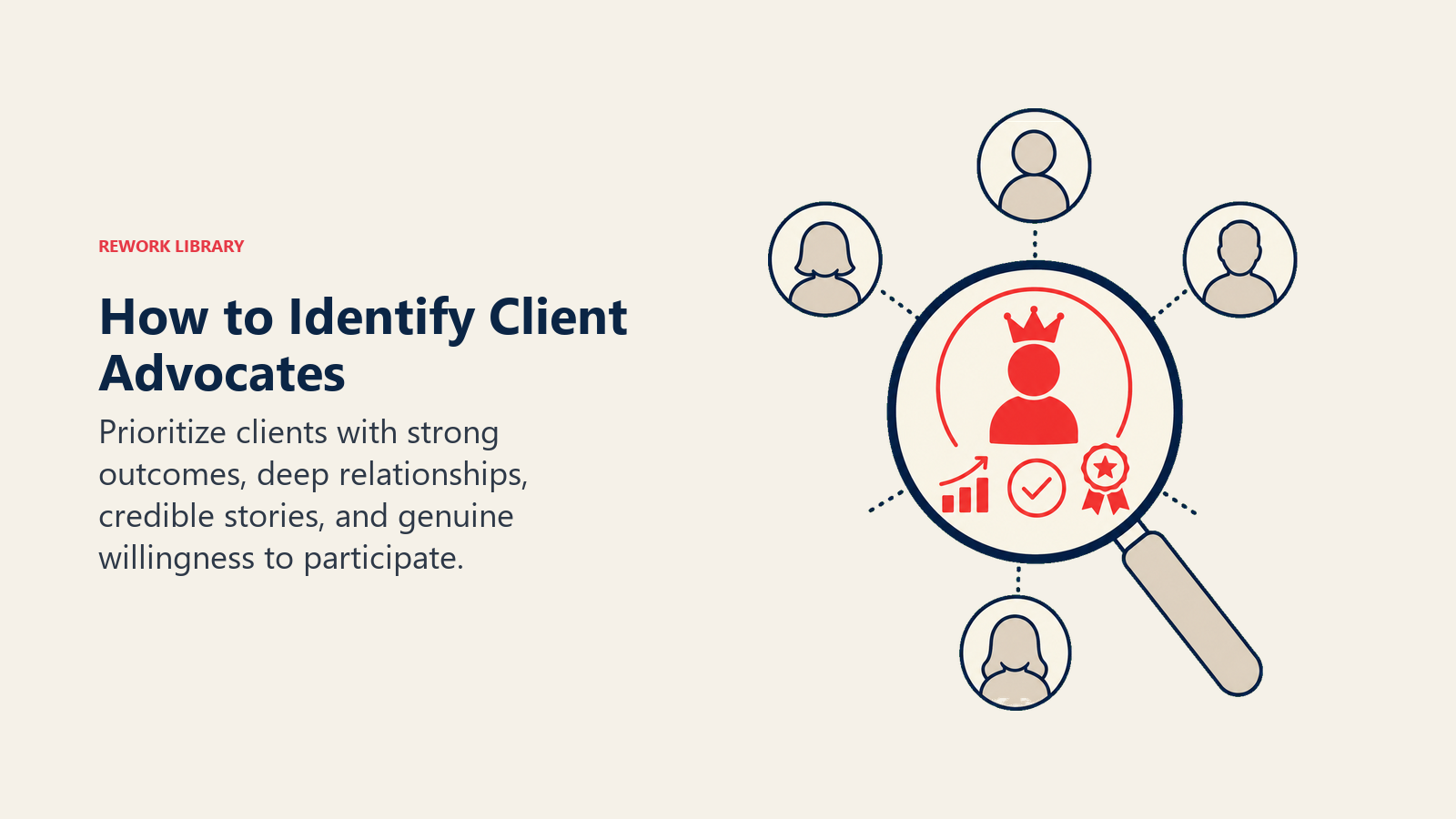
Business impact is non-negotiable. Your best advocates are clients where you drove results they talk about internally. Revenue growth. Cost reduction. Risk mitigation. Strategic transformation. Whatever your value proposition is, they experienced it viscerally.
Executive engagement is a strong signal. When the CFO or CEO personally knows your team and values the relationship, advocacy opportunities expand. They'll take reference calls. They'll speak at events. They'll introduce you to their network.
Look for advocacy willingness signals in normal interactions:
- They proactively share success stories with you
- They've already recommended you to peers informally
- They engage with your content on social media
- They participate in your events or programs voluntarily
- They respond quickly and positively when you ask for small favors
These signals tell you who's ready to move up the advocacy ladder.
The advocacy ladder in practice
Let's break down each level and how to execute it effectively.
Level 1: Testimonials and quotes
This is your entry point. Low effort, low risk, high volume potential. Ask for testimonials at natural moments:
- Right after a major milestone or success
- At project completion or engagement review
- Following positive feedback in a meeting
- During renewal conversations when they're recommitting
Don't send a generic "will you give us a testimonial?" email. That produces garbage. Instead, make it specific and easy:
"We just wrapped up the supply chain optimization project that reduced your logistics costs by 18%. Would you be willing to share a brief quote about the results for our case study library? I can draft something based on our conversation and send it for your approval."
Notice what that does: It's specific to their results. It connects to a real outcome. It offers to do the work for them. It requires minimal effort on their part.
When you draft testimonials for approval, make them concrete and results-focused:
Weak: "XYZ Consulting was great to work with and helped us improve our operations."
Strong: "Our logistics costs dropped 18% in six months, and the team transformation XYZ facilitated has sustained those gains for two years. They didn't just analyze our problems, they got in the trenches with our people."
Specific numbers. Specific timeframes. Specific value delivered. That's what prospects believe.
Get clear permission for how and where you'll use testimonials. Website? Marketing materials? Social media? Sales presentations? Don't assume. Ask explicitly and respect their boundaries.
Level 2: Case studies
Case studies are your highest-ROI advocacy content. A well-crafted case study works for years across multiple channels. Identify case study candidates based on:
- Exceptional, measurable results
- Interesting challenges that prospects relate to
- Willingness to share details publicly
- Brand value (recognizable company names help)
- Diverse representation across industries and use cases
Getting commitment requires a different conversation than testimonials. You're asking for 2-3 hours over several weeks, plus internal approvals. Frame the value exchange:
"We'd love to feature your results in a detailed case study. It positions you and your team as innovators in the industry, gives you content to share internally about the success, and helps us share your approach with peers facing similar challenges. The time commitment is about 60-90 minutes for an interview, then 30 minutes to review the draft."
The case study development process:
Interview: Talk to multiple stakeholders, project sponsor, implementers, executives if possible. Get the before/after story. Understand challenges, solution approach, results, and lessons learned.
Write the narrative: Use a problem-solution-results structure. Start with relatable challenges. Show how you worked together (it's not about you being heroes). Focus heavy on measurable outcomes. Include quotes that show emotional impact and relationship quality.
Get approval: Send the draft for review. Expect 2-3 rounds of edits as they get legal and PR approvals. Be patient. Don't skip this step.
Design and produce: Create multiple formats, PDF, web page, one-pager, slide deck. Make it visually strong with pull quotes, metrics callouts, and clean layout.
Distribute strategically: Don't just post it on your website. Promote it in email campaigns. Use it in sales conversations. Share it on social media. Send it to prospects in similar situations. Track downloads and engagement.
Document ROI religiously. How many prospects downloaded it? How many became opportunities? What deal value can you attribute to case study influence? That data justifies the investment and helps you prioritize which case studies to create.
Level 3: Reference programs
Reference calls are high-value but high-effort for clients. You need a systematic approach that respects their time. Build a reference pool of 15-25 clients across different industries, company sizes, and use cases. That diversity lets you match references to prospect profiles. A healthcare prospect wants to talk to a healthcare client, not a manufacturing client.
When you need a reference, be strategic about who you ask:
- Match industry and company profile
- Match project type or challenge
- Consider relationship strength and recent engagement
- Check when they last did a reference (rotation matters)
Make the request specific and respectful:
"We're working with a healthcare system in the Midwest that's evaluating us for a supply chain project similar to what we did with you. Would you be willing to take a 30-minute call with their VP of Operations sometime in the next two weeks? I'll prep you beforehand with their specific questions."
Preparation is critical. Send the reference:
- Background on the prospect and their situation
- Likely questions they'll ask
- Talking points about your engagement together
- Your availability to answer questions beforehand
Follow up afterward:
- Thank them immediately (call and email)
- Share the outcome if you win the deal
- Send a small token of appreciation (not cash, professional services ethics matter)
- Note the reference in your CRM to manage rotation
Reference burnout is real. Your top advocates get asked repeatedly because they're great. Protect them by:
- Rotating across your reference pool
- Limiting requests to 3-4 per year per client
- Only asking for critical opportunities, not every prospect
- Building a large enough pool that no one feels overused
Level 4: Speaking and content participation
When clients speak publicly about working with you, the credibility is off the charts. But the ask is substantial, public visibility, time commitment, potential employer approvals.
Conference speaking opportunities:
- Industry conferences where your clients are already attending
- Your own user conferences or events
- Webinars co-hosted with clients
- Panel discussions where they share peer insights
The pitch to clients: "You get visibility as an industry innovator. Your team gets credit for the results. It's professional development and networking. And you're helping peers learn from your experience."
Many clients want to speak but don't know how to get accepted. Offer to help:
- Co-submit session proposals with them
- Ghost-write or heavily edit their submissions
- Prepare presentation decks together
- Provide speaking coaching if needed
Video testimonials and interviews follow similar principles. Keep them short (2-3 minutes), focus on specific results, make production quality professional, and give clients full approval over the final cut.
Joint thought leadership content is another avenue. Co-author articles, research reports, or whitepapers where their expertise and your methodology combine. This aligns with your thought leadership strategy while creating shared value. It works especially well with executives who value personal brand building.
Social media engagement is the lightest touch. Ask advocates to engage with your content, comment on posts, share articles, participate in LinkedIn discussions. This creates ambient social proof without formal commitments.
Level 5: Advisory boards and VIP programs
The deepest advocacy relationships become strategic partnerships.
Client advisory boards give you a structured forum for feedback, strategic input, and relationship deepening. Run them 2-4 times per year. Keep groups small (8-12 participants) for meaningful discussion.
Advisory board value exchange:
- They get early access to your thinking and roadmap
- They influence your service development
- They network with peer executives
- They're positioned as trusted advisors to your firm
- You often provide economic value (free consulting hours, discounts)
VIP customer programs create tiering where top advocates get preferential treatment:
- First access to new services or tools
- Invitations to exclusive events
- Deeper relationship access to your leadership
- Priority support and resources
Executive forums and networking events provide value by connecting your advocates with each other. A CFO roundtable where your clients network with peers is valuable independent of your services.
Beta testing and input opportunities let advocates shape your offerings. When you're developing new capabilities, invite your advocacy board to test and provide feedback. They get influence, you get better products.
The strategic benefit: these deep relationships create switching costs. Advocates who are embedded in your innovation process, who've invested time in your success, who've built relationships with your team, they don't leave easily.
Systems and technology
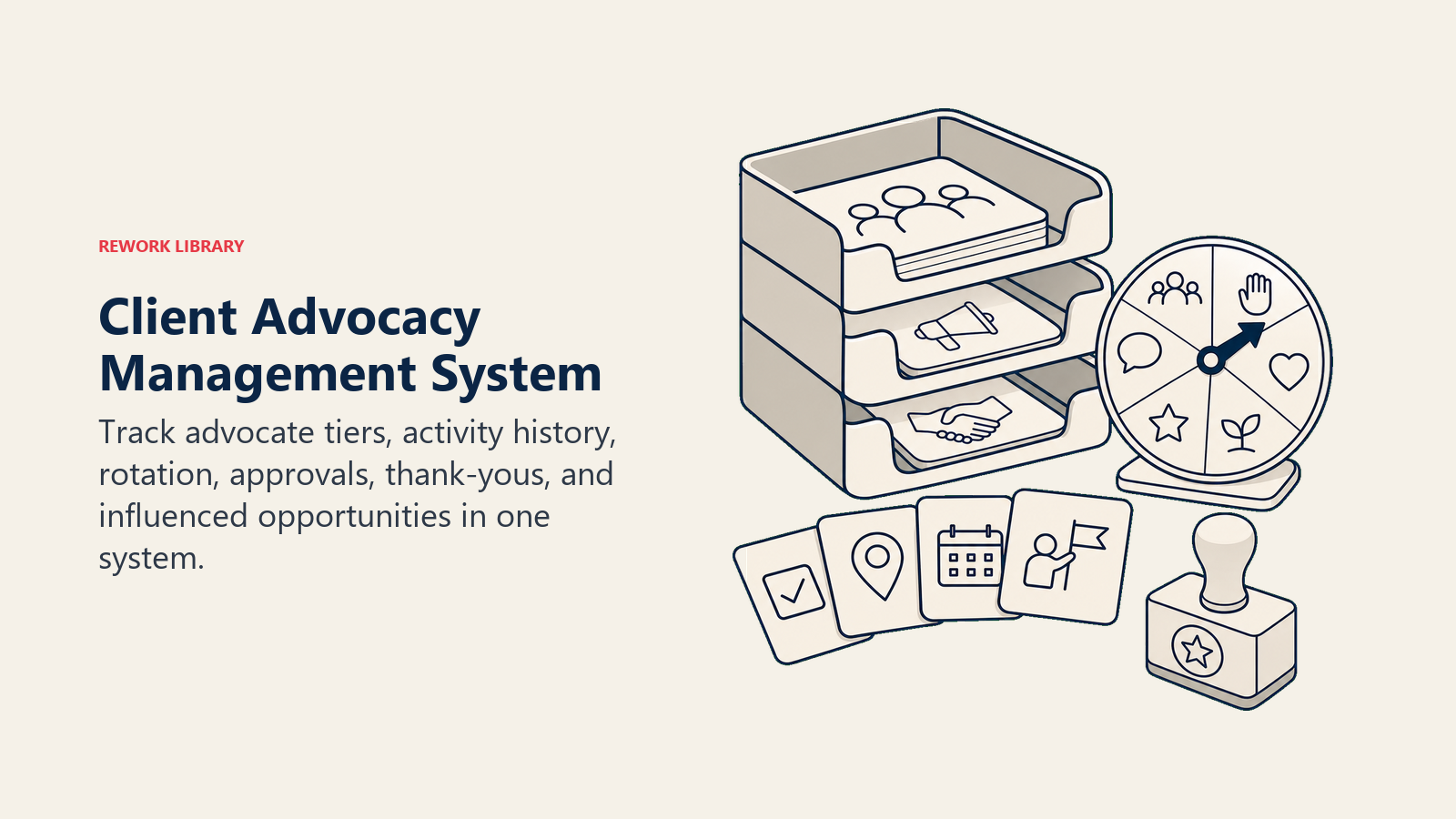
Advocacy doesn't scale without systems. At minimum, track advocacy activities in your CRM:
- Flag clients as advocates with different tiers
- Log every advocacy activity (testimonials, references, speaking)
- Set reminders for rotation and thank-yous
- Track frequency to prevent burnout
- Link advocacy to opportunity influence for ROI Dedicated advocacy management platforms exist for larger programs:
- Influitive (gamified advocacy with rewards)
- Apostle (employee and customer advocacy)
- CustomerGauge (integrates with account health)
- Cintell (customer marketing and advocacy)
These tools help you:
- Automate requests at the right moments
- Provide self-service options for clients to submit content
- Manage approval workflows
- Track program metrics centrally
- Scale beyond what spreadsheets can handle
Content management systems need to organize your advocacy assets:
- Searchable library of testimonials by industry, service, outcome
- Case study repository with tagging and filters
- Reference client database with profiles and availability
- Usage tracking for each asset
Analytics and measurement close the loop. Track:
- How advocacy content performs (downloads, views, shares)
- Deal influence (opportunities where advocates played a role)
- Win rates when references are used vs not used
- Time to close for prospects who consumed case studies
- Source attribution for advocacy-driven leads
Advocacy program metrics
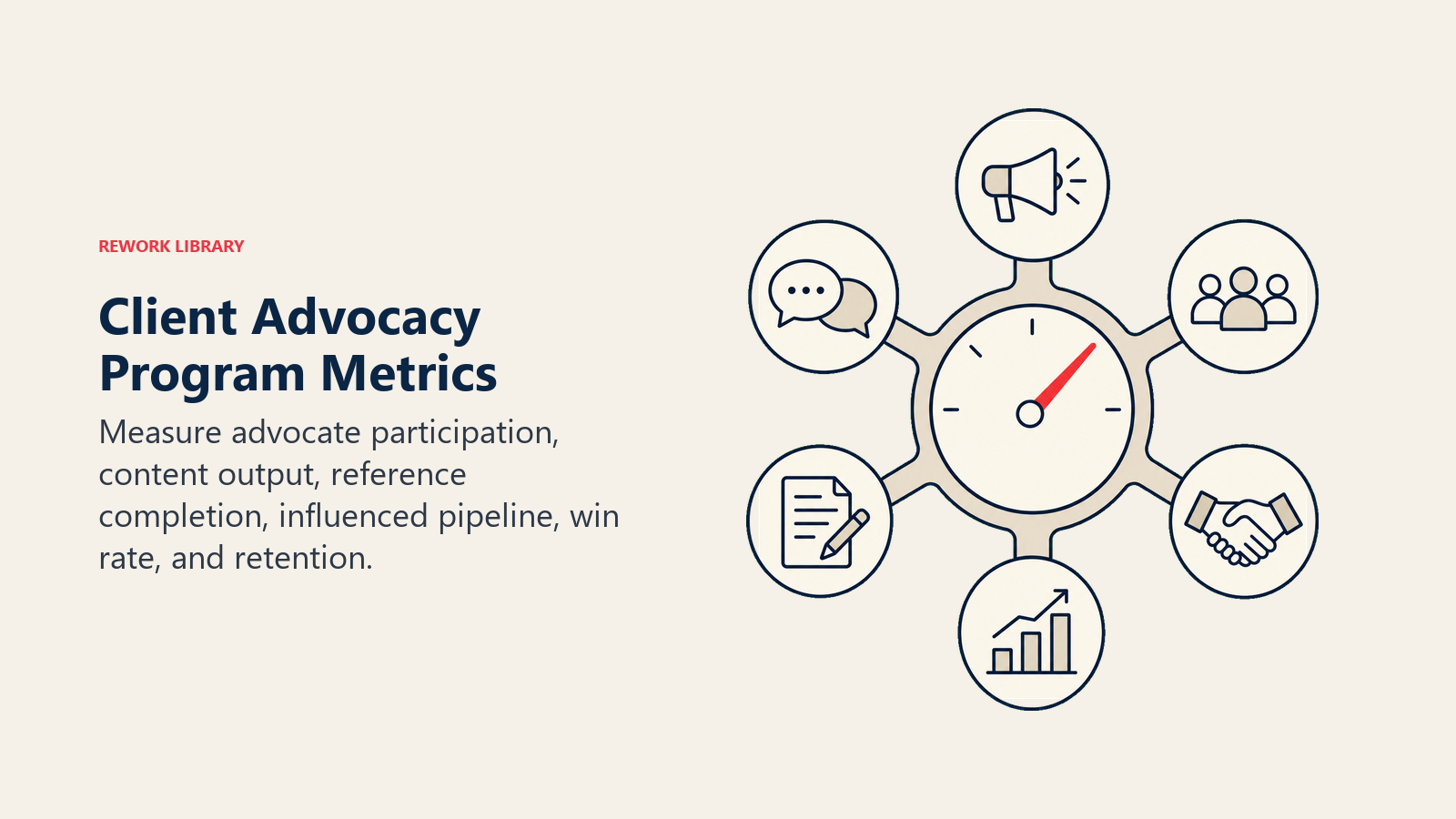
What you measure determines what you optimize. Track both activity and outcome metrics. Activity metrics:
- Advocate identification rate (% of eligible clients who become advocates)
- Participation rate (% of advocates who say yes when asked)
- Content production volume (testimonials, case studies created per quarter)
- Reference completion rate (% of requested references that happen)
- Speaking event participation Outcome metrics:
- Advocacy-influenced pipeline value
- Win rate improvement with advocacy vs without
- Deal velocity impact (days to close with references)
- Cost per lead for advocacy-driven leads vs paid channels
- Customer lifetime value of advocates vs non-advocates
Program health metrics:
- Request frequency per advocate (watching for burnout)
- Time from request to delivery (efficiency)
- Approval/rejection rates for case study requests
- Net promoter scores of advocates vs general client base
ROI calculation gets tricky but try anyway. Estimate:
- Pipeline value influenced by advocacy content
- Win rate lift attributable to references
- Marketing cost savings (case studies vs paid content)
- Referral revenue from advocates
- Retention value (advocates churn at lower rates)
Even rough attribution helps justify investment in the program.
Common challenges and how to solve them
Advocacy challenges are predictable: clients may hesitate, approvals may drag, and your strongest supporters can get overused. Treat those constraints as program design inputs instead of reasons to avoid asking. Client reluctance or resistance
Some clients are satisfied but don't want to advocate publicly. Reasons vary: competitive concerns, internal politics, approval complexity, time constraints, or just personality.
Don't force it. Respect their boundaries and find other ways they can help. Private references instead of public case studies. Internal success stories that don't get published. Informal introductions instead of formal testimonials.
For approval-constrained clients (common in large enterprises), help them navigate internal processes. Offer to draft everything, work with their PR and legal teams, and be patient. Some of your best case studies will take six months to approve.
Legal and approval processes
Professional services case studies often involve confidential work. You need clear frameworks:
- Define what can and can't be shared upfront
- Get legal review on your side before asking clients
- Provide templates that make client legal review easier
- Be willing to anonymize or obscure sensitive details
- Have backup plans if specific metrics can't be disclosed
Build relationships with client marketing and legal teams. They're gatekeepers, but they also want good stories about their success. Make their jobs easier.
Quality and consistency
Not every advocate is articulate. Not every success story is compelling. You'll get testimonials like "they were great!" or case studies that bury the lead.
Solution: Do the work for them. Draft the testimonial based on conversations and send for approval. Conduct thorough interviews and write the narrative yourself. Coach clients before speaking engagements.
Your job is to extract the story and shape it professionally. Don't expect clients to be marketers.
Attribution and measurement
Tracking advocacy influence on deals is messy. Prospects consume case studies, then take reference calls, then close. Which activity gets credit?
Use multi-touch attribution if you have sophisticated systems. If not, use surveys: ask closed-won customers what influenced their decision. You'll hear "the ABC Company case study was really compelling" or "the reference call with XYZ sealed it."
Track advocacy assets mentioned in deal notes and CRM activities. Imperfect data is better than no data.
Program sustainability
Advocacy programs die when they become burdensome. Either you burn out managing requests manually, or advocates burn out from over-asking.
Sustainability comes from:
- Systems that reduce manual work
- Large enough advocate pool to rotate
- Clear value exchange so clients benefit too
- Celebration and recognition of top advocates
- Executive sponsorship so the program has staying power
Treat advocacy as a program with dedicated resources, not a side project someone does when they have time.
Best practices that make programs work
Strong advocacy programs make participation easy, valuable, and respectful of client time. The practices below turn advocacy from a one-off favor into a repeatable relationship habit. Make asking easy and routine
Build advocacy requests into normal business rhythms. Quarterly business reviews include a standard question: "Would you be willing to share your results with peers?" Annual planning conversations: "As we look at next year, how can we showcase this success together?"
When advocacy asks feel natural, not transactional, clients say yes more often.
Provide clear value exchange
Always answer "what's in it for them?" Visibility and thought leadership. Professional development. Networking with peers. Influence over your roadmap. Early access to innovations.
Don't just take. Give generously to your advocates.
Respect time and commitments
Show up prepared to reference calls. Don't ask for "quick calls" that stretch to an hour. Honor their approval deadlines. If they say no or not now, accept gracefully.
Your best advocates are busy executives. Respect proves you value the relationship beyond what they can do for you.
Show appreciation consistently
Thank-you notes. Small gifts. Public recognition. Invitations to special events. Executive-level gratitude from your leadership.
Appreciation doesn't have to be expensive, but it has to be genuine and consistent.
Optimize based on data
Review your program quarterly. What's working? What's not? Which case studies drive the most pipeline? Which advocates are most effective on reference calls? Which industries need more representation?
Use data to improve continuously. Your year-two program should be significantly better than year one.
Where advocacy connects to everything else
Client advocacy doesn't exist in isolation. It's the natural outcome of excellent client work and strong relationships.
Your advocacy program feeds from and feeds into:
- Client satisfaction management creates the foundation, satisfied clients become advocates
- Referral generation systems leverage advocates for introductions and opportunities
- Thought leadership strategy gets amplified when clients co-create content with you
- Content marketing becomes more credible with real client stories and case studies
- Client success reviews identify advocacy moments and document results worth sharing
- Strategic partner network creates additional channels for advocate visibility
The firms that do advocacy well don't treat it as a marketing tactic. They treat it as the natural expression of client relationships where both sides win.
Start small. Identify your five best client relationships. Ask for testimonials. Turn one into a case study. Build from there. You don't need a sophisticated platform on day one. You need intentionality and systems that respect clients' time while generating social proof.
Because at the end of the day, nobody believes your marketing. But they believe their peers. Build an army of those peers, and your business development becomes exponentially easier.

Sales Director
On this page
- Why client advocates matter more than ever
- What client advocacy actually means
- Identifying advocacy candidates
- The advocacy ladder in practice
- Level 1: Testimonials and quotes
- Level 2: Case studies
- Level 3: Reference programs
- Level 4: Speaking and content participation
- Level 5: Advisory boards and VIP programs
- Systems and technology
- Advocacy program metrics
- Common challenges and how to solve them
- Best practices that make programs work
- Where advocacy connects to everything else