Scope Definition & Statement of Work: Creating Clear Boundaries and Protecting Profitability
Turn this article into takeaways for your work.


Each assistant summarizes the article only for you and suggests best practices for your work.
Here's an uncomfortable truth about professional services: scope creep kills more projects than bad execution ever will. You start with a clean estimate, clear deliverables, and healthy margins. Three months later, you're working evenings to deliver things that were never in the original agreement, your team is frustrated, and the client still thinks you're behind schedule.
The problem isn't that you did bad work. It's that you never clearly defined what "good work" looked like. Without precise scope definition and a comprehensive Statement of Work (SOW), every conversation becomes a negotiation about what's included. And guess who usually loses those negotiations?
This guide shows you how to define scope so clearly that there's no room for misinterpretation, and how to write SOWs that protect your profitability while setting clients up for success.
Why scope creep costs you more than you think
Most professional services firms track scope creep as "extra hours worked." But that's just the visible part of the cost. The real damage goes deeper.
First, there's the margin erosion. When you quoted 80 hours but delivered 120, that 50% overrun comes straight out of your profit. If you were running at 40% margin, that extra 40 hours turned a profitable project into a break-even one.
Second, there's the opportunity cost. Those extra 40 hours could have been spent on new business development, delivering a different project, or building internal capabilities. Instead, they went to work you're not getting paid for.
Third, there's team morale. Nothing burns out good people faster than endless scope creep. They feel like their work is never done, never good enough, and never appreciated. That leads to turnover, which costs you way more than a few extra project hours.
And here's the thing that nobody talks about: scope creep trains clients to expect free work. Once you've said yes to "just one more thing" a few times, they learn that your boundaries are negotiable. The next project starts with those same expectations baked in.
The solution isn't saying no to everything. It's defining scope so precisely that everyone knows exactly what's included, what's not, and how changes get handled. This clarity starts with thorough project scope assessment during your sales process.
Scope definition techniques that actually work
Good scope definition isn't about writing more words. It's about breaking down the work into components that can't be misinterpreted.
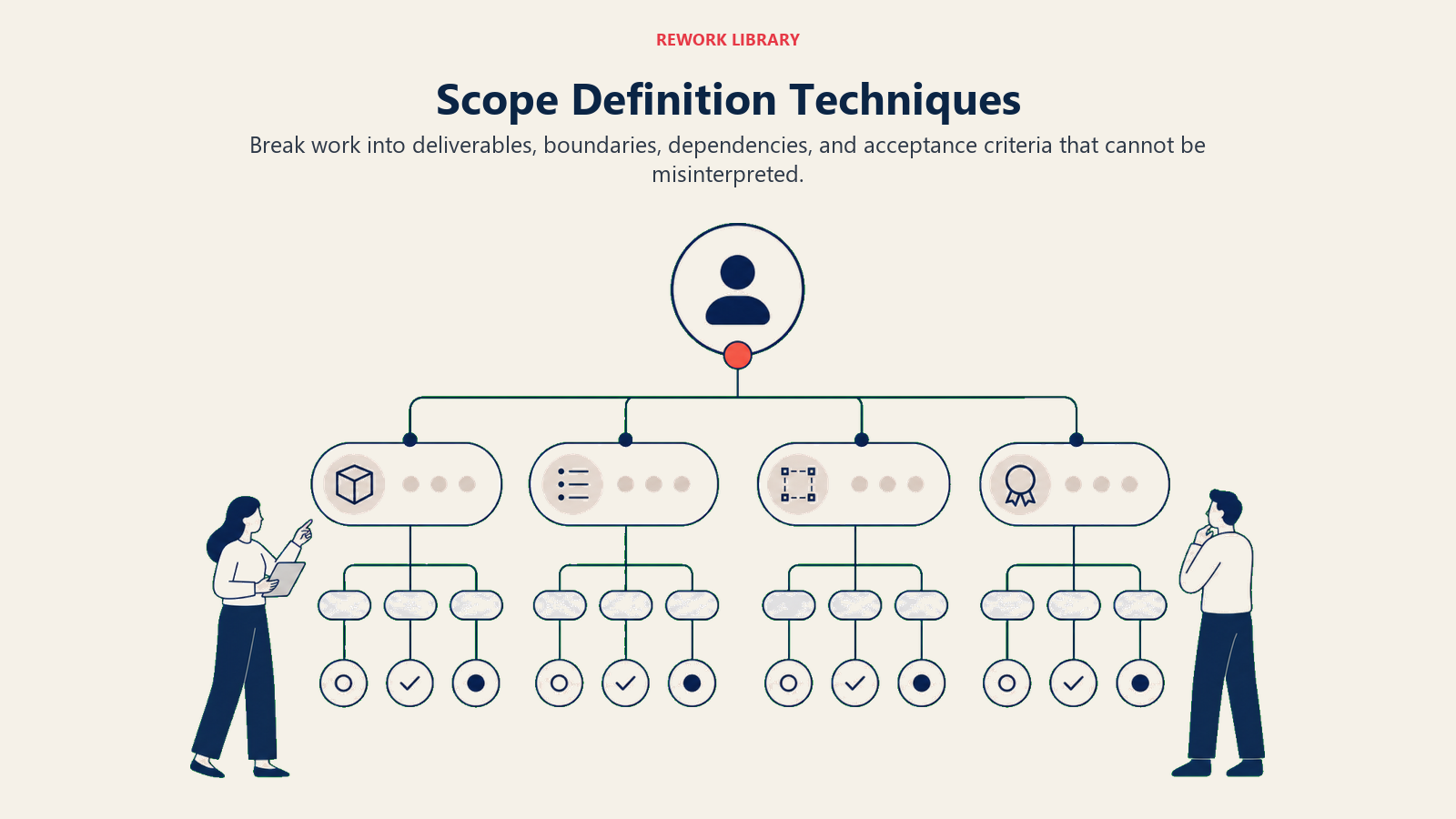
Work breakdown structure: Decompose into components
Start at the highest level and work your way down. If you're implementing a CRM system, the top level might be "CRM Implementation." The next level down: "Requirements Gathering," "System Configuration," "Data Migration," "Training," "Go-Live Support."
But don't stop there. Break each of those down further. "Data Migration" becomes "Data Assessment," "Mapping Design," "Test Migration," "Production Migration," "Validation." Keep going until you hit tasks that take 4-40 hours each.
Why this matters: when you decompose work to this level, you can spot missing pieces. It's easy to miss "Data Validation" when you're thinking about "Data Migration" as one big task. It's hard to miss it when you're listing out every sub-task.
The WBS also makes it easier to price accurately. Estimating "CRM Implementation" is guesswork. Estimating 30 specific tasks is mathematics.
Deliverable definition: Tangible outputs with acceptance criteria
Every piece of work should produce something tangible that the client receives and approves. Not activities, not effort - deliverables.
Bad scope: "Conduct requirements gathering sessions." Good scope: "Requirements documentation including business process maps, user stories, and technical specifications. Client approves document before configuration begins."
The difference is specificity. The first one is vague about what you're delivering. The second one tells you exactly what the client receives and when they need to approve it.
For every deliverable, define acceptance criteria. What does "done" look like? How will the client know if it meets their needs? When do they need to review and approve it?
This protects you both. You know when you've completed your obligation. They know what they're supposed to receive. No ambiguity, no arguments later.
Activity-level scoping: Tasks and subtasks
Some work doesn't produce standalone deliverables but still needs to be scoped. Think about project management, status meetings, review cycles, revision rounds.
Define these as activities with clear parameters:
- "Weekly status meetings (1 hour) with project sponsor and key stakeholders"
- "Two rounds of revision per deliverable based on client feedback"
- "Project management including planning, tracking, and reporting (15% of project hours)"
The key phrase here is "clear parameters." Not "ongoing project management" but "project management including X, Y, and Z activities." Not "revisions as needed" but "two rounds of revision."
When activities are bounded, clients understand what's included. When they're open-ended, clients assume unlimited access to your time.
Exclusion definition: What's NOT included
This is where most SOWs fail. They list what's included but never explicitly state what's excluded. Then three months in, the client says "I assumed that was part of it" and you're stuck.
The "Out of Scope" section might be the most important part of your SOW. Be specific about common things that clients often assume are included:
- "Integration with legacy systems not listed in Section 3.2"
- "Custom feature development beyond standard configuration"
- "Training for end users beyond the train-the-trainer session"
- "Ongoing support after the 30-day warranty period"
- "Data cleanup or enrichment beyond the mapping defined in Appendix A"
You'll feel awkward writing these. You'll worry that you're being negative or that the client will think you're trying to hide things. Write them anyway. The conversation you have during contract review is infinitely better than the argument you'll have mid-project.
Assumption documentation: Conditions that must be true
Every project operates under assumptions. Document them explicitly because when assumptions break, scope changes.
Common assumptions to document:
- "Client will provide access to all systems within 5 business days of project kickoff"
- "Subject matter experts will be available for 2-hour sessions weekly"
- "Client will complete UAT testing and provide feedback within 5 business days"
- "Existing data is clean and structured according to specifications provided"
- "Third-party vendors will deliver their components on schedule"
Frame these as "This project assumes that..." and list them clearly. When the assumption breaks - and some will - you have documented grounds for a change order.
Constraint identification: Timeline, budget, resources, technical
Constraints are factors outside your control that limit how you can execute. Document them so everyone understands the boundaries you're working within.
Timeline constraints: "Project must go live before fiscal year end (June 30)" Budget constraints: "Total project cost not to exceed $150,000" Resource constraints: "Client will provide one dedicated analyst for data work" Technical constraints: "Must integrate with existing Salesforce instance (version 22.0)"
When constraints are documented, you can point to them when the client asks for something that violates them. "We can add that feature, but it conflicts with the June 30 deadline constraint. Which is more important to you?"
Statement of Work components: The complete structure
A comprehensive SOW isn't just a contract. It's a project roadmap that both parties refer to throughout the engagement. Here's what needs to be in it.
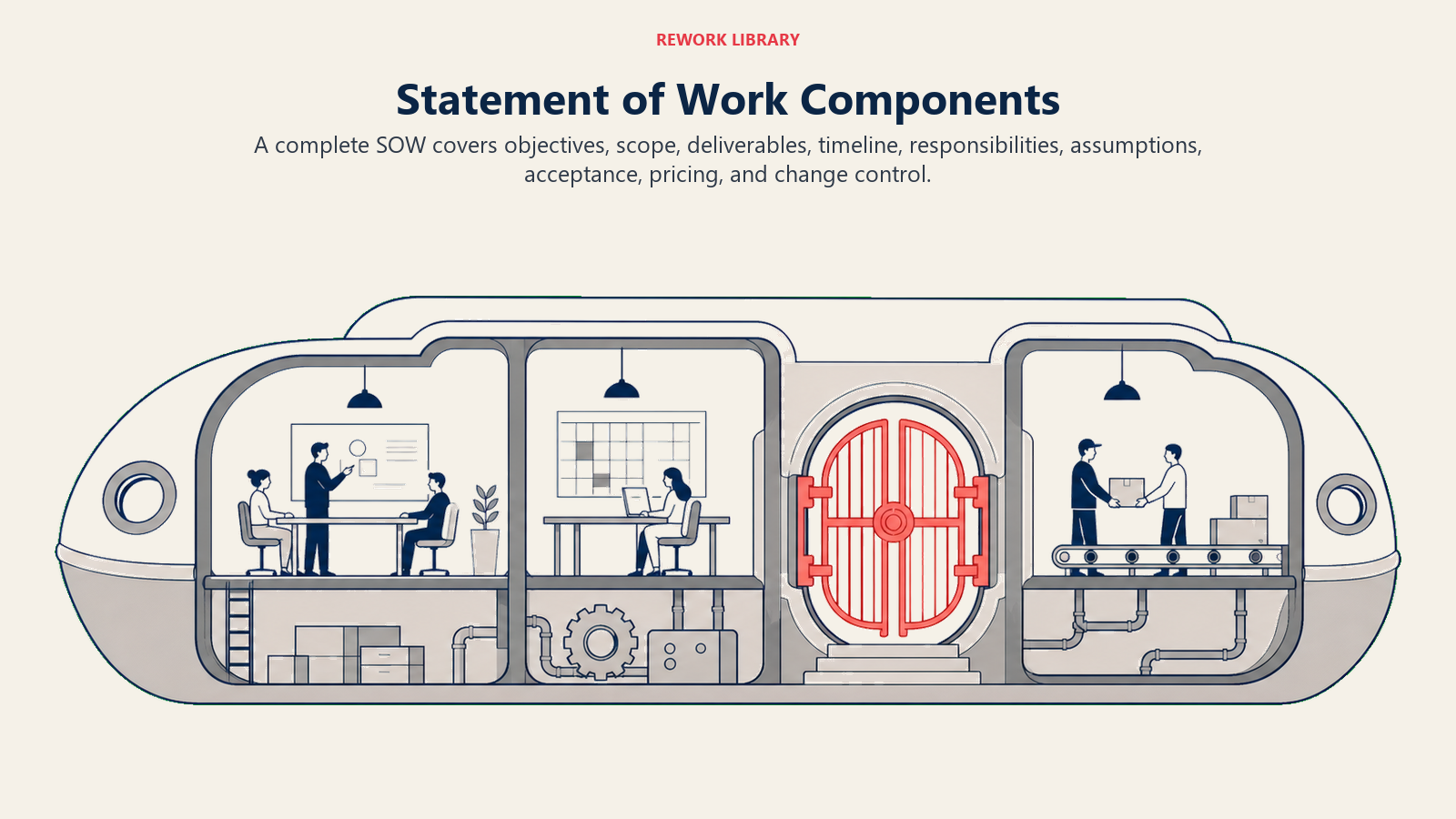
Executive summary: Engagement overview
Start with a one-page summary that anyone can read and understand what this project is about. Include:
- Project objectives and business outcomes
- High-level scope summary
- Timeline and key milestones
- Total investment
- Success metrics
This section is for executives who won't read the full SOW but need to understand what they're approving. Keep it strategic, not tactical.
Scope of work: Services, deliverables, activities
This is the detailed section where you document everything covered in your scope definition: the work breakdown, deliverables with acceptance criteria, activities with parameters.
Organize this logically - usually by phase or by functional area. Use numbered lists so you can reference specific items later. Be exhaustive but organized.
Don't bury important details in paragraph form. Use tables, bullet points, numbered lists. Make it easy to scan and reference.
Deliverables schedule: Timeline, milestones, sequencing
Map out when deliverables are due and how they sequence. Not just "project completes in 12 weeks" but a detailed timeline:
- Week 1-2: Requirements gathering, Requirements document delivered Week 2
- Week 3-5: System configuration, Configuration complete and ready for UAT Week 5
- Week 6-7: UAT and revisions, UAT sign-off Week 7
- Week 8: Training, Training complete Week 8
- Week 9: Go-live, System live Week 9
Include dependencies. Make it clear that Week 6 can't start until the client completes their Week 5 UAT review. When clients cause delays, you can point to the schedule and adjust downstream dates accordingly.
Resource plan: Team composition, roles, responsibilities
Who's doing what? Name your team members (or at least title their roles) and explain what each person is responsible for.
Your side:
- "Lead consultant (Sarah Johnson): Overall project leadership, requirements gathering, client workshops"
- "Technical consultant (Mike Chen): System configuration, integrations, technical documentation"
- "Project manager (Alex Rivera): Scheduling, status reporting, issue tracking"
Client side:
- "Project sponsor: Final decision authority, weekly status review"
- "Implementation lead: Day-to-day coordination, UAT coordination, training liaison"
- "Technical contact: System access, IT coordination, integration testing"
When roles are clear, nobody says "I thought you were handling that."
Success criteria: How outcomes are measured
How will you know if this project succeeded? Don't leave this to subjective judgment. Define measurable criteria:
- "System successfully processes 1,000 test transactions without errors"
- "All 50 users complete training and pass assessment"
- "Client sponsor signs off on final deliverables"
- "Go-live occurs on or before target date with no critical issues"
These become your finish line. When you hit these criteria, the project is done. Everything else is a change order.
Assumptions and dependencies: Prerequisites, constraints
Pull together all the assumptions and constraints you documented during scope definition. This section makes it clear what needs to be true for the project to succeed as scoped.
When something changes - the client can't provide resources as assumed, or a third-party vendor misses their deadline - you reference this section to explain why the scope or timeline needs to adjust.
Out of scope: Explicit exclusions
Your detailed list of what's NOT included. This section protects you from the "I thought that was part of it" conversations.
Group exclusions logically:
- Services not included
- Deliverables not included
- Support not included
- Related work not included
Consider adding: "If uncertainty exists about whether something is in scope, refer to the Scope of Work section. Only items explicitly listed there are included."
Pricing and payment terms
Break down your pricing so it's clear what the client is paying for. Fixed fee? Time and materials? Milestone-based?
For fixed-fee projects:
- "Total project fee: $150,000"
- "Payment schedule: $50K at contract signing, $50K at UAT completion, $50K at go-live"
For T&M projects:
- "Senior consultant: $250/hour"
- "Junior consultant: $175/hour"
- "Estimated total: $100,000-120,000 based on 500 hours"
- "Invoiced monthly in arrears"
Include payment terms: "Net 30 days from invoice date." Include late payment terms if applicable. Your pricing approach should align with your billable hour vs value-based pricing strategy.
Change management process
This is critical. When something needs to change - and something always does - how does it happen?
Define the process:
- "Client or consultant identifies potential change"
- "Consultant prepares change order documenting: scope change, cost impact, timeline impact"
- "Both parties review and discuss change order"
- "Client approves change order in writing"
- "Work proceeds on changed scope"
Make it clear: "No changes to scope, timeline, or budget are effective until approved in writing by both parties. Work performed without an approved change order is performed at consultant's risk."
This protects you from informal scope creep. When the client says "can you also..." in a hallway conversation, you refer to the change process.
Acceptance and sign-off procedures
How do deliverables get approved? What's the timeline? What happens if the client doesn't respond?
Standard procedure:
- "Consultant delivers work product to client"
- "Client has 5 business days to review and provide feedback"
- "Client either: (a) accepts deliverable with sign-off, (b) requests revisions with specific feedback"
- "If no response within 5 business days, deliverable is deemed accepted"
That last point matters. Without it, clients can hold up projects indefinitely by just not responding to review requests.
Terms and conditions
Standard legal terms: warranties, liability limits, intellectual property, confidentiality, termination clauses. Work with your lawyer to get standard T&Cs that protect you.
Don't skip this section thinking "we have a good relationship, we don't need legal stuff." You need it especially when the relationship goes bad.
Writing effective scope: Making every word count
The difference between a good SOW and a great one isn't length. It's precision.
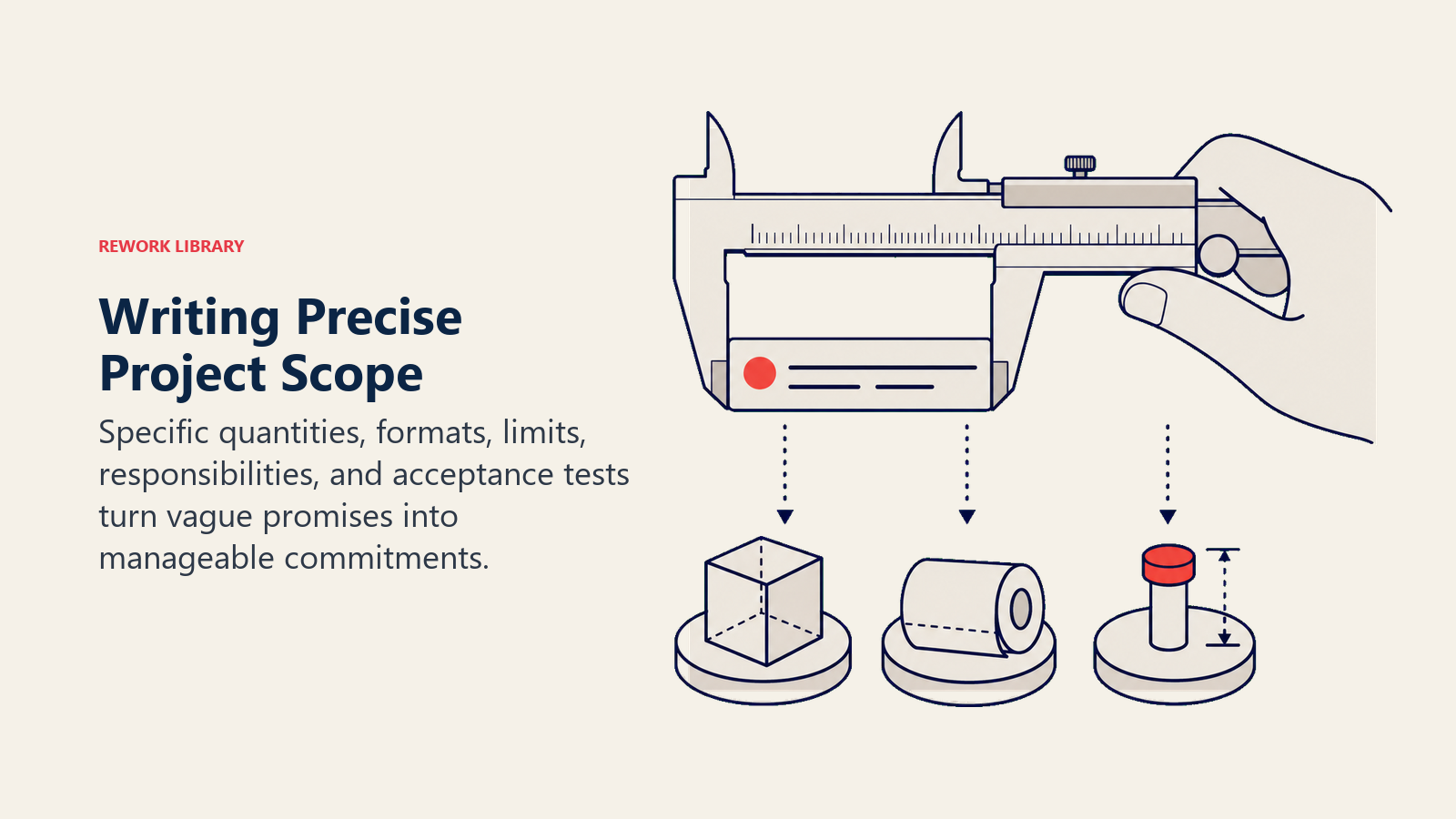
Specificity and clarity over vague language
Bad: "Consultant will configure the system according to client requirements." Good: "Consultant will configure 15 custom fields, 8 workflows, and 12 reports as defined in the approved requirements document (Appendix A)."
Bad: "Provide training to client staff." Good: "Deliver two 4-hour training sessions for up to 20 users covering topics in training outline (Appendix B). Provide training materials and recorded sessions."
The specific version leaves no room for interpretation. The vague version leads to arguments about what "configure the system" means.
Measurable outcomes, not activities
Focus on what the client receives, not what you do.
Bad: "Hold weekly meetings with stakeholders." Good: "Deliver weekly status reports documenting progress, issues, and upcoming milestones."
The first one is about your activity. The second is about what the client gets. Big difference.
Deliverable-focused language
Structure everything around deliverables. Not "we'll do requirements gathering" but "we'll deliver a requirements document containing X, Y, Z."
Each phase should have clear deliverables:
- Phase 1 deliverables: Requirements document, project plan, kickoff presentation
- Phase 2 deliverables: System configuration, integration test results, UAT test plan
- Phase 3 deliverables: Training materials, go-live checklist, final documentation
When everything is tied to deliverables, it's easy to track progress and determine when you're done.
Avoiding ambiguity: The dangerous words
Certain words are red flags. When you see them in your SOW, replace them with specifics:
- "Support" becomes "Monthly check-in call and email response within 24 hours"
- "As needed" becomes "Up to 10 hours per month"
- "Ongoing" becomes "For 90 days after go-live"
- "Reasonable" becomes "Within agreed parameters documented in Appendix C"
- "Assist with" becomes "Complete tasks X, Y, Z; client responsible for tasks A, B, C"
Every ambiguous word is a future argument waiting to happen.
Balancing detail with flexibility
You need enough detail to prevent scope creep, but not so much that you can't adapt to changing circumstances. The balance is in defining outcomes precisely while leaving some flexibility in how you achieve them.
For example: "Deliver data migration resulting in 100% of active records transferred with zero critical errors. Consultant determines technical approach and tools used."
The outcome is specific (100% of records, zero critical errors). The method is flexible (you choose the approach). That's the balance.
Managing assumptions: Documenting what needs to be true
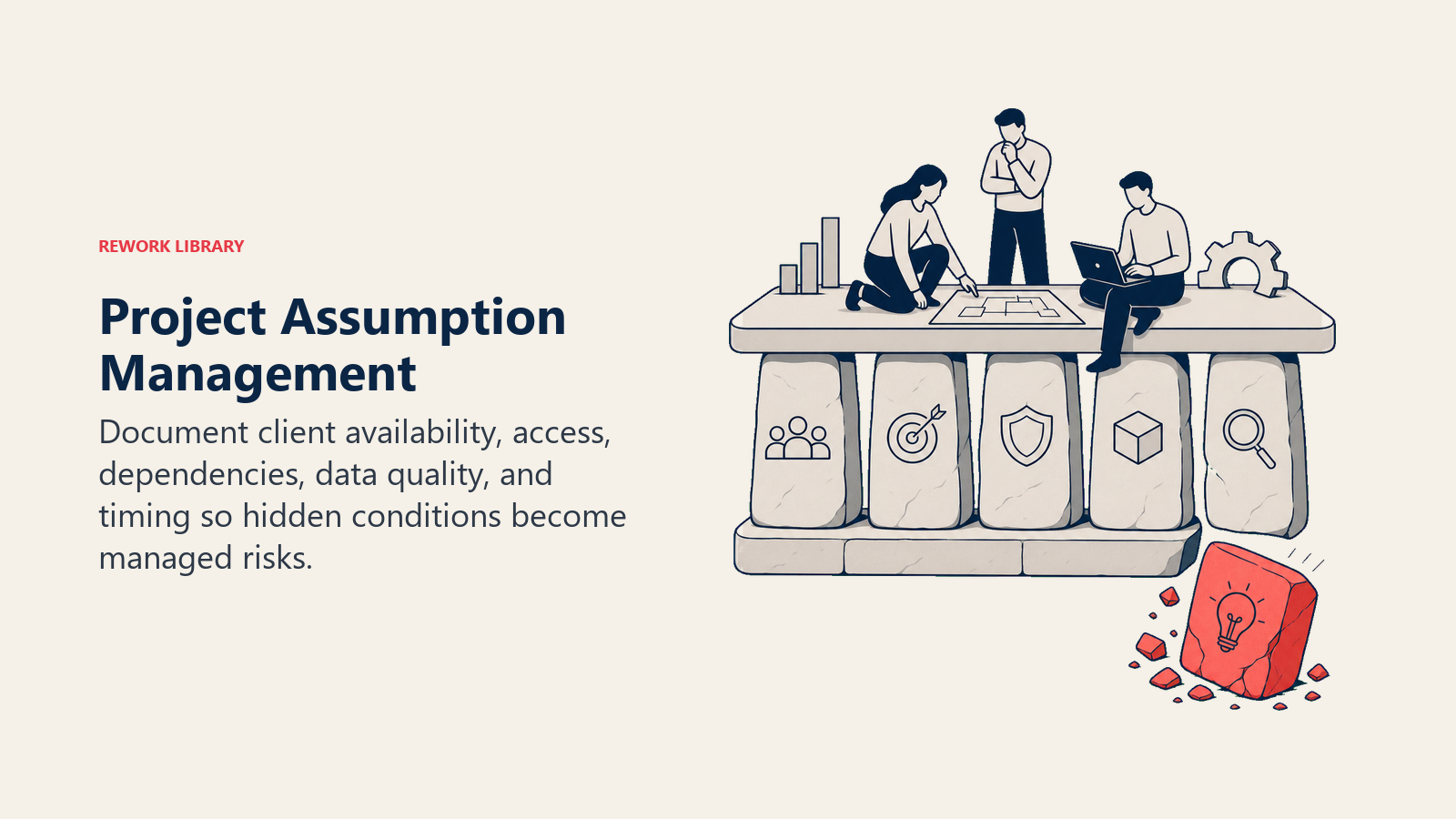
Assumptions are the silent killers of professional services projects. They seem reasonable at the start, then reality intervenes.
Client resource availability
Never assume the client will be available when you need them. Document exactly what you need:
- "Client will provide [Job Title] for 4 hours per week for requirements gathering in Weeks 1-3"
- "Client subject matter experts will complete UAT testing within 5 business days of each test cycle"
- "Client project sponsor will attend weekly status meetings and provide decisions within 48 hours"
When you document required availability, you can hold clients accountable for delays. When their SME is "too busy" for UAT, you point to the assumption and extend the timeline.
System and data access
Technology projects fall apart when you can't access what you need. Be specific:
- "Client will provide admin-level access to production environment within 2 business days of contract signature"
- "Client will provide data extract in agreed format (Appendix D) no later than Week 2"
- "Client IT will provision test environment matching production specifications by Week 3"
Include security and access procedures: "All access subject to client security requirements. Consultant assumes security review and approval will not exceed 5 business days."
Decision timelines
Projects stall when clients can't make decisions. Set expectations upfront:
- "Client will provide feedback on deliverables within 5 business days"
- "Client will make go/no-go decisions at milestone gates within 2 business days"
- "Client procurement will approve change orders within 3 business days"
Then add the consequence: "Delays in client decisions will result in proportional delays to project timeline and may impact resource availability."
Third-party deliverables
When success depends on someone else's work, call it out:
- "Project assumes [Vendor Name] will deliver integration API documentation by Week 2"
- "Project assumes [Partner Company] will complete their portion of data migration by Week 5"
- "Project assumes [IT Department] will complete infrastructure setup by Week 1"
Make it clear these are outside your control: "Delays or issues with third-party deliverables may require scope or timeline adjustments."
Environmental factors
Sometimes external conditions affect project execution:
- "Project assumes client office will be accessible for on-site workshops"
- "Project assumes no major organizational changes during project period"
- "Project assumes current system will remain operational through migration"
- "Project assumes regulatory requirements will not change during project period"
These seem obvious until they're not. The client reorganizes mid-project, or the legacy system crashes, or new regulations drop. Document the assumption so you have grounds for adjustment.
Defining out of scope: What you're NOT doing
The out-of-scope section is your protection against endless expansion. Be explicit and comprehensive.
Explicit exclusions: Line items that aren't included
List specific work that's related to your project but not included:
- "Custom report development beyond the 12 standard reports included in scope"
- "Integration with systems other than those listed in Section 4.2"
- "Data cleanup or de-duplication beyond the mapping defined in Appendix A"
- "Mobile app configuration (web interface only)"
- "Advanced analytics or dashboard customization"
These are things clients might reasonably expect. By explicitly excluding them, you prevent misunderstandings.
Common add-ons not included
Think about what clients often ask for as you get into a project. Call those out:
- "Additional training sessions beyond those specified in Section 5.3"
- "Extended post-go-live support beyond the 30-day warranty period"
- "On-site presence beyond the workshops specified in project schedule"
- "Documentation translation or localization"
- "Customization for specific departments beyond the pilot group"
Related services you offer but aren't included
You might offer these as separate engagements, but they're not part of this SOW:
- "Change management and organizational readiness services"
- "Process optimization consulting"
- "Executive coaching and leadership development"
- "Ongoing managed services"
By listing these, you're showing the client what else is available while making it clear they're separate engagements.
Future phase opportunities
If this is phase 1 of a larger initiative, be clear about what's in future phases:
- "Phase 2 (not included): Advanced workflow automation and AI integration"
- "Phase 2 (not included): Expansion to European operations"
- "Phase 2 (not included): Integration with marketing automation platform"
This sets up future sales opportunities while protecting the current project scope.
Boundary clarity: Where your work stops
Sometimes you need to define the edge of your responsibility:
- "Consultant configures system according to requirements; client responsible for internal change management"
- "Consultant provides training materials; client responsible for training delivery to all staff"
- "Consultant delivers recommendations; client responsible for implementation"
This is especially important when work requires client action. You don't want to be held responsible for things they need to do.
Change order process: Controlling scope expansion
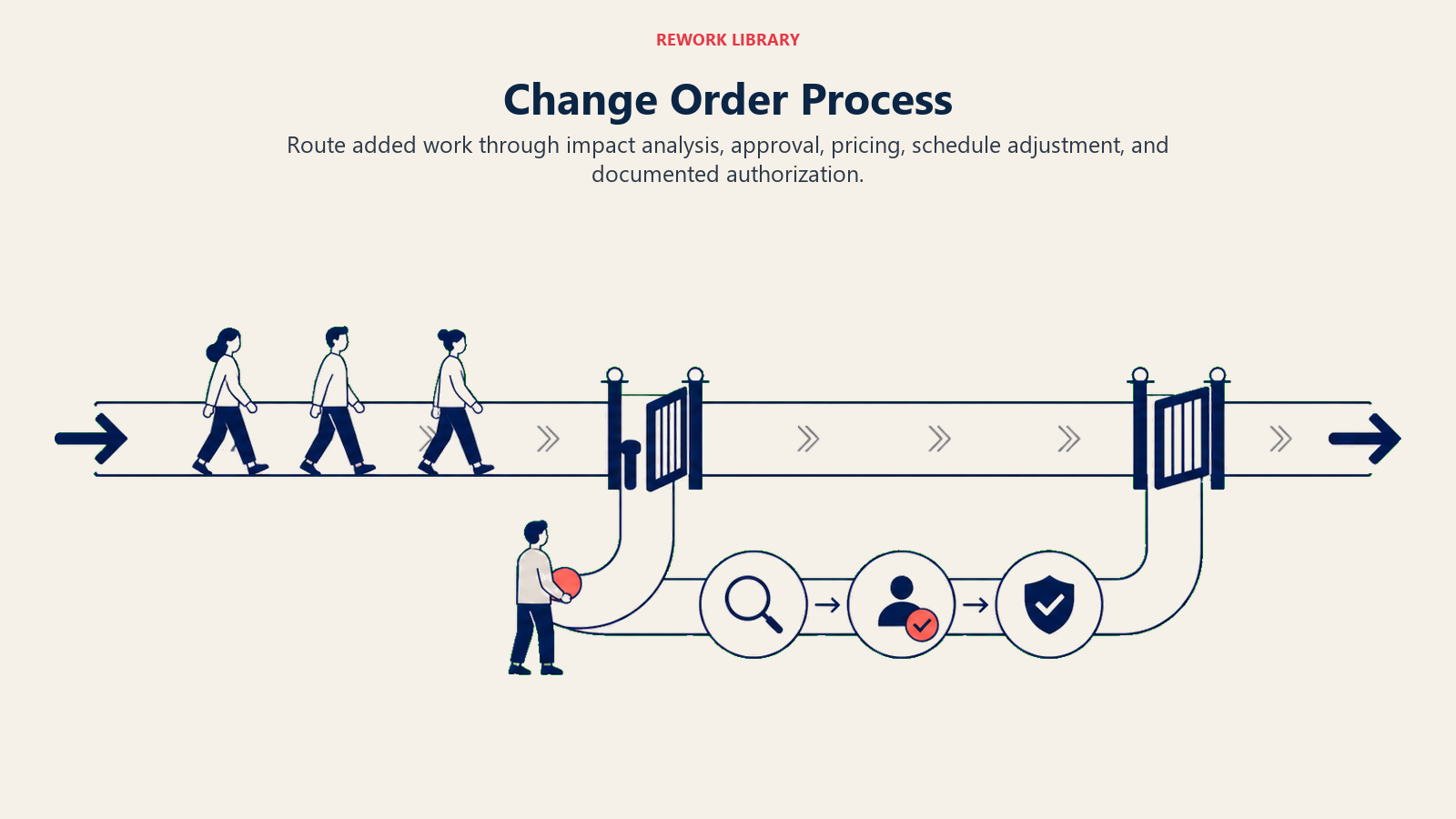
Changes will happen. The question is whether they happen in a controlled way that protects your profitability or in an ad-hoc way that destroys it.
When changes are needed
Define what triggers a change order:
- Any work not explicitly included in the Scope of Work section
- Timeline extensions beyond agreed milestones
- Additional deliverables or revisions beyond specified rounds
- Resource changes requiring different skill sets
- Assumption violations that require additional work
Make it clear: "Any of these conditions requires a formal change order before work proceeds."
Approval workflow
Map out exactly how changes get approved:
- Change is identified by either party
- Consultant prepares written change order including:
- Description of change and rationale
- Impact on scope, deliverables, and timeline
- Cost impact (additional fees or time)
- Resource implications
- Both parties review and discuss
- Client approves in writing (email acceptable)
- Change order becomes part of contract
- Work proceeds under revised scope
Include who has approval authority. Is it the project sponsor? The procurement department? Both? Get this clear upfront.
Pricing methodology
How do you price changes? Define it now:
- "Changes priced at standard hourly rates: Senior consultant $250/hour, Junior consultant $175/hour"
- Or: "Changes priced at 15% markup over time and materials cost"
- Or: "Changes priced case-by-case based on estimated effort"
Also address rush changes: "Change orders requiring work within 5 business days subject to 20% premium."
Timeline impacts
Changes affect schedules. Make this clear:
"All change orders include revised timeline showing impact on subsequent milestones. Client acknowledges that changes may delay final delivery and agrees to revised dates as part of change order approval."
This prevents clients from expecting you to absorb schedule impacts from their changes.
Documentation requirements
No verbal change orders. Ever.
"All changes must be documented in writing and approved by authorized representatives of both parties. Verbal approvals are not binding. Work performed without written approval is performed at consultant's risk and may not be billable."
This might seem harsh, but it's necessary. Otherwise every hallway conversation becomes billable work.
Common SOW pitfalls to avoid
Let's talk about where SOWs typically fail, so you can avoid these traps.
Vague deliverables that can't be objectively evaluated
"Consultant will optimize system performance" - what does that mean? How do you know when it's done?
Better: "Consultant will reduce average page load time to under 2 seconds and reduce batch processing time by 30%, as measured by client's monitoring tools."
If you can't measure whether you've delivered it, don't write it that way.
Missing exclusions that lead to assumptions
You list what's included but forget to exclude the things clients often assume. Then mid-project: "Wait, I thought you were doing that too."
Always ask: "What might a client reasonably expect that we're NOT doing?" Then exclude it explicitly.
Unrealistic timelines that set you up for failure
You promise 6 weeks because that's what the client wants to hear, even though you know it needs 8 weeks. Now you're starting from a position of guaranteed failure.
Better to set realistic expectations upfront and deliver early than to set impossible expectations and deliver late.
Weak assumptions that don't protect you
"Client will provide reasonable access to staff" - what's reasonable? Who decides?
Better: "Client will provide designated SMEs for 4-hour weekly workshops. If SMEs are unavailable, consultant will reschedule and adjust timeline proportionally."
Inadequate change process that allows scope creep
Your change process is vague or nonexistent. Changes happen informally. Now you're doing work you can't bill for because there's no paper trail.
The change process isn't bureaucracy. It's protection for both parties.
One-sided terms that clients won't accept
Your SOW has all the protections for you and none for the client. They push back, negotiations drag out, and the project starts late or on bad terms.
Balance is key. Yes, protect yourself, but also give the client reasonable protections. Mutual commitments build trust.
SOW review and approval: Getting to signature
Writing the SOW is half the battle. Getting it signed is the other half.
Internal review checklist
Before you send it to the client, review it internally. This should align with your deliverable quality assurance processes:
- Does scope match the proposal and pricing?
- Are all deliverables clearly defined with acceptance criteria?
- Is the out-of-scope section comprehensive?
- Are assumptions documented and realistic?
- Does the timeline account for dependencies and client review cycles?
- Is the change process clear and enforceable?
- Can your team actually deliver this on schedule and on budget?
That last one is critical. Don't let sales commitments write checks your delivery team can't cash.
Legal review
Have your lawyer review your standard SOW template. They should check:
- Liability limitations are enforceable
- IP provisions protect your work product
- Termination clauses are balanced
- Payment terms are clear
- Warranty disclaimers are valid
You don't need legal to review every SOW, but they should review your template and any non-standard terms.
Client negotiation
Clients will push back on some things. Use the strategies outlined in negotiation for services to navigate these conversations. Common negotiation points:
- Payment terms (they want net 60, you want net 30)
- Liability caps (they want unlimited, you want limited)
- IP ownership (they want everything, you want to keep your tools and methodologies)
- Deliverable counts (they want unlimited revisions, you want two rounds)
Know your negotiables and non-negotiables before you start. Where can you be flexible? Where must you hold the line?
Final sign-off
Get signatures from people with actual authority. Not just the project manager - the person who can commit the organization financially.
Use electronic signature tools (DocuSign, Adobe Sign, etc.) to speed this up. But make sure you get actual signatures, not just email approval.
Version control
As you negotiate and revise, keep track of versions:
- SOW_ProjectName_v1_Draft.pdf
- SOW_ProjectName_v2_ClientReview.pdf
- SOW_ProjectName_v3_Final.pdf
The signed version becomes your master. Store it somewhere accessible to your delivery team. They'll need to reference it.
Connecting to the broader sales and delivery process
Your SOW doesn't exist in isolation. It connects to everything else in your professional services operation.
It starts with project scope assessment - you can't write an accurate SOW until you understand what the client actually needs.
Your proposal should align with your SOW. Don't propose one thing and scope another. Inconsistencies kill trust.
Your pricing needs to match your scope. If the scope is detailed and bounded, your pricing should be too. If the scope has uncertainties, your pricing should reflect that risk.
Once the SOW is signed, it becomes part of your contract and engagement letter. The legal team needs to ensure everything aligns.
During delivery, your SOW is your primary tool for scope creep management. Every time someone asks for something extra, you reference the SOW.
The bottom line on scope and SOWs
A good SOW is worth its weight in gold. It prevents arguments, protects margins, keeps clients happy, and makes delivery teams effective.
The time you invest in writing a detailed, precise SOW pays back 10x during project execution. Every hour spent clarifying scope is an hour you won't spend arguing about whether something was included.
Yes, it takes work. Yes, clients sometimes push back on the detail. Yes, it feels uncomfortable to be so explicit about exclusions and assumptions.
Do it anyway. Your profitability depends on it.
Because scope creep isn't a delivery problem. It's a sales and contracting problem. Fix it at the source, and your projects run smoother, your teams stay happy, and your margins stay healthy.
That's the whole point.

Sales Director
On this page
- Why scope creep costs you more than you think
- Scope definition techniques that actually work
- Statement of Work components: The complete structure
- Writing effective scope: Making every word count
- Managing assumptions: Documenting what needs to be true
- Defining out of scope: What you're NOT doing
- Change order process: Controlling scope expansion
- Common SOW pitfalls to avoid
- SOW review and approval: Getting to signature
- Connecting to the broader sales and delivery process
- The bottom line on scope and SOWs