Project Closeout: The Critical Phase That Determines Client Retention and Expansion
Turn this article into takeaways for your work.


Each assistant summarizes the article only for you and suggests best practices for your work.
Here's an uncomfortable stat: 68% of professional services clients who churn do so within 90 days of project completion. Not during the project, after it. The transition from active delivery to ongoing support is where relationships collapse.
Most firms treat closeout like paperwork - collect signatures, send final invoices, archive files, done. But that's exactly when clients are most vulnerable. They're anxious about taking ownership, uncertain about what happens next, and evaluating whether you actually delivered value. Get this phase wrong and you'll never see that client again. Get it right and you've set up the next engagement before this one even ends.
This guide shows you how to run project closeouts that protect revenue, capture expansion opportunities, and turn completed projects into reference accounts. We're talking about a 30-day process that determines whether you've just completed a transaction or built a long-term relationship.
The hidden value in project closeout
Think about what's happening in the client's world when your project wraps up. Your team has been deeply embedded for months, solving problems, delivering work, and being responsive. Then suddenly you're gone. They're staring at deliverables they need to maintain, systems they need to operate, and processes they need to run - often without the expertise that built them in the first place.
This moment is terrifying for clients. It's also revealing for you. How smoothly this transition happens tells you everything about whether the project was actually successful. Did you build something sustainable or something that only works while you're there? Did you transfer knowledge or just complete tasks? Did you solve the problem or create dependency?
The business case for treating closeout as strategic, not administrative, is simple:
- Firms with structured closeout processes retain clients at 2.3x the rate of those without
- 40% of expansion revenue comes from conversations that happen during closeout
- Projects with formal retrospectives are 60% more likely to generate referrals
- Every week you extend the transition increases retention likelihood by 12%
But here's the real opportunity: most of your competitors are terrible at this. They disappear the moment the final deliverable ships, leaving clients scrambling. If you do closeout well, you're not just avoiding churn - you're creating competitive differentiation.
Defining project closeout: the three-phase model
The mistake most firms make is thinking the project ends on go-live day. It doesn't. What ends is active development. What begins is the most critical phase for relationship health. Professional closeout takes 30 days and breaks into three distinct phases:
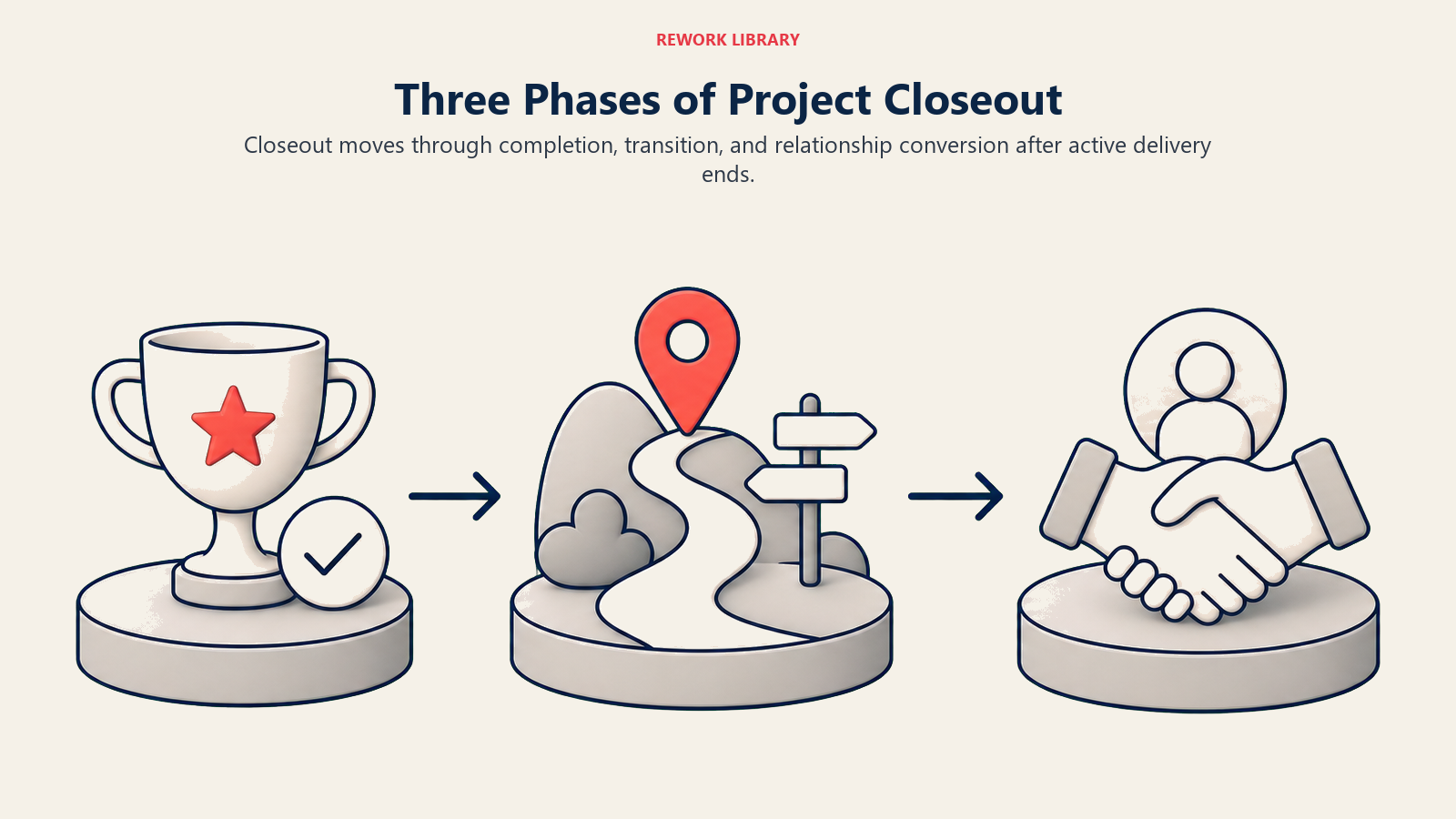
Final Delivery Phase (Days 1-10): This is about getting everything across the finish line. You're completing final deliverables, conducting acceptance testing, resolving punch-list items, and securing formal sign-off. The project is functionally complete, but you're still in delivery mode.
Transition & Handover Phase (Days 11-20): This is where knowledge transfer happens. You're conducting training sessions, documenting processes, establishing support procedures, and briefing the teams who'll maintain what you built. You're moving from "we do it" to "they do it with our help."
Closure & Reflection Phase (Days 21-30): This is where you extract value from the experience. You're running retrospectives, measuring satisfaction, reconciling financials, documenting lessons learned, and transitioning relationship ownership from delivery team to client success. This is also where expansion conversations naturally occur.
The phases overlap slightly, and timelines adjust for project size. A three-month project might compress this to 15 days. A two-year implementation might extend it to 60. But the structure remains: deliver, transition, reflect.
Why 30 days? Because that's how long it takes for clients to encounter real problems with what you handed off. If you disappear on day 10, you'll miss the issues that surface in week three - and those issues will define their perception of the project.
Final deliverables management
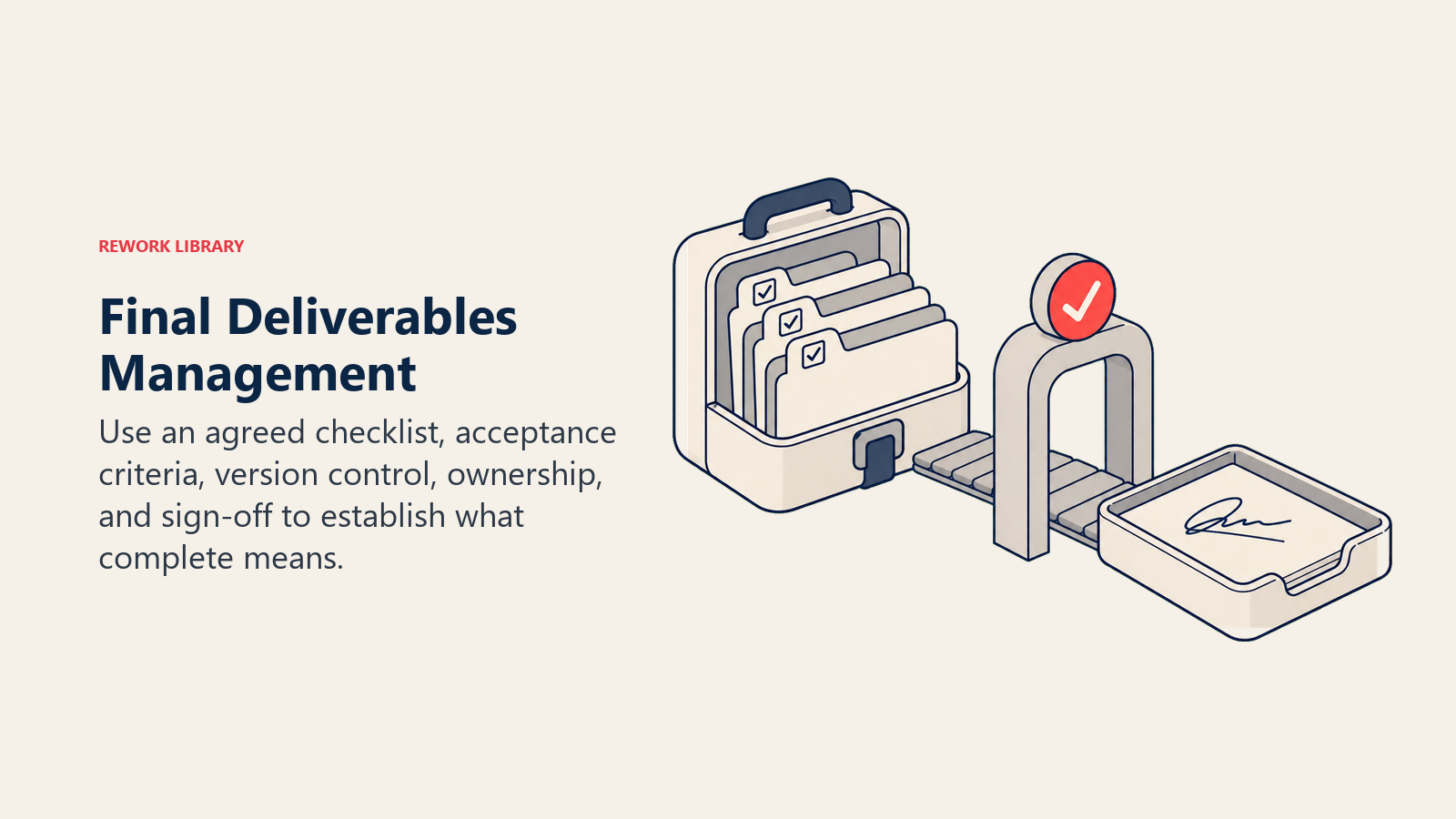
Sounds obvious, right? Finish the work, hand it over. But the details matter here, because "complete" means different things to different people. Start with a deliverable checklist framework that both sides agreed to at project kickoff. If you don't have one, create it now before closeout starts. List every deliverable, the acceptance criteria, the format, and who signs off. This becomes your punch list.
Documentation requirements: Every project should produce:
- Technical documentation (architecture, code/design specs, API references)
- Operational documentation (runbooks, maintenance procedures, troubleshooting guides)
- User documentation (guides, training materials, FAQs)
- Administrative documentation (licenses, credentials, vendor contacts, SLAs)
The test for documentation quality: could a reasonably skilled person who wasn't on the project team maintain and operate what you built using only the documentation? If not, you're not done.
Code and asset handover protocols: If you're delivering software, designs, or other digital assets, you need clear transfer procedures:
- Repository access and ownership transfer
- Code review and cleanup (no commented-out code, no hardcoded credentials)
- Dependency documentation and version pinning
- Deployment scripts and environment setup instructions
- Backup and recovery procedures
Sign-off procedures: This is where things get political. You need formal acceptance, but not all stakeholders have equal authority. Define who must sign off versus who should review. Get this in writing at the start of closeout, not the end. Otherwise you'll be chasing signatures for weeks while someone who wasn't involved suddenly wants veto power. This should align with what was established in your scope definition and SOW.
Completion criteria definition: What does "done" mean? Is it when the code passes UAT? When it's in production? When it handles production load for 30 days? When all training is complete? Define this explicitly. If you say "done" and the client says "not yet," you've got a problem.
The goal is zero ambiguity about what's been delivered and zero surprises about what's missing.
Knowledge transfer operations
This is where most projects fail. You hand over beautiful deliverables with zero capability to use them. Six months later, the client calls asking you to fix something trivial because their team never learned how. Knowledge transfer isn't a single meeting or document dump. It's a planned operation.
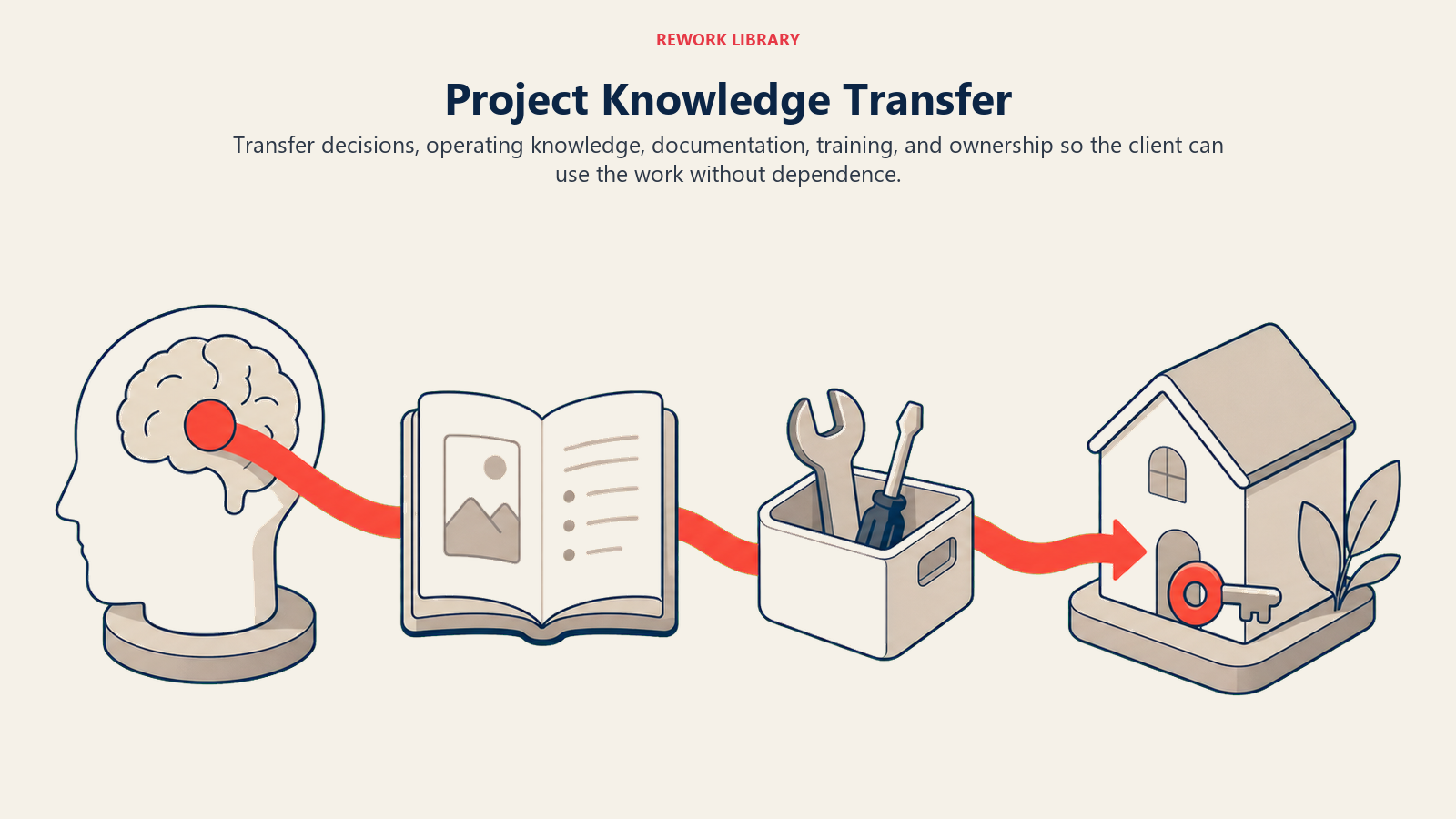
Knowledge transfer plan structure: Build this before delivery is complete, not after. Identify:
- What knowledge needs to transfer (systems, processes, context, decision rationale)
- Who needs to receive it (operators, administrators, executives, support staff)
- How it'll transfer (training, shadowing, documentation, office hours)
- How you'll verify transfer (testing, certification, demonstration)
- What happens if transfer fails (extended support, additional sessions)
Training and enablement sessions: Schedule multiple sessions with different audiences:
- Administrator training: How to configure, monitor, maintain
- End-user training: How to use day-to-day
- Support training: How to troubleshoot and escalate
- Executive briefing: What was built, why it matters, what to watch for
Don't make these passive lectures. Use hands-on exercises, real scenarios, and problem-solving. The client needs to do the work while you watch, not watch you do the work.
Documentation delivery: Written guides are necessary but not sufficient. People don't read manuals until they're stuck. So your documentation needs to be:
- Searchable (good structure, index, clear headings)
- Scenario-based (not just "here's what this button does" but "when X happens, do Y")
- Maintained (someone needs to own keeping it current)
Support escalation procedures: Before you leave, establish:
- What issues they should try to resolve internally first
- When and how to escalate to you
- SLA expectations for different severity levels
- Who on your side they contact (names, not just support@)
- What information to provide when escalating
Key person dependency mapping: Identify any single points of failure in their team. If only one person knows how to restart the database, you haven't transferred knowledge - you've transferred risk. Work with the client to cross-train or document thoroughly.
Knowledge retention verification: Don't just assume transfer happened. Test it:
- Have them complete real tasks while you observe
- Give them scenarios and see if they can troubleshoot
- Ask them to explain key decisions or architecture
- Let them handle minor support issues during the transition period
If they can't demonstrate competency, you need more sessions or better documentation.
Post-delivery retrospectives
Retrospectives are where you learn what actually happened versus what you thought happened. Skip this and you'll repeat every mistake on the next project. Retrospective structure and facilitation: Run two separate retros - one internal, one with the client.
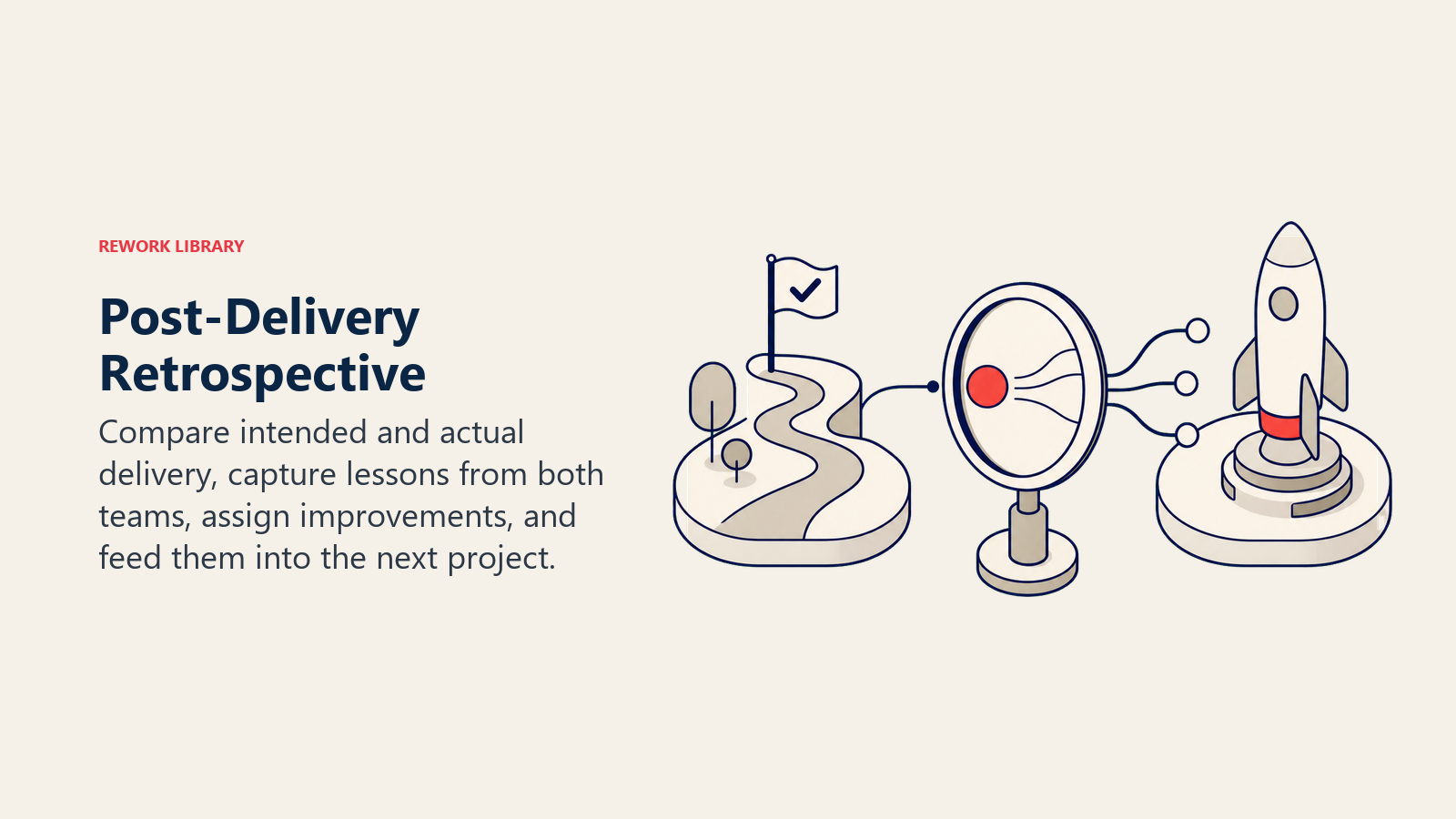
Internal retrospective (90-120 minutes):
- What went well that we should repeat?
- What went poorly that we should fix?
- What surprised us?
- What would we do differently next time?
- What processes or tools failed us?
External retrospective with client (60-90 minutes):
- What exceeded expectations?
- What fell short?
- Where did communication break down?
- What would have helped you be more successful?
- What should we do differently on future engagements?
The key is psychological safety. People won't be honest if they're afraid of blame. Make it clear you're looking for systemic issues, not individual fault.
Participant selection: For internal retros, everyone on the delivery team. For client retros, key stakeholders from both sides - sponsors, project leads, power users. Not everyone, or you'll never get honest feedback.
Root cause analysis for project issues: When problems come up in retros, dig deeper. Don't stop at "communication was bad." Ask why. Was it infrequent check-ins? Wrong stakeholders? Unclear escalation paths? Tools that didn't support collaboration? Keep asking "why" until you hit something you can actually fix.
Lessons learned documentation: Capture insights in a structured format:
- What was the issue or success?
- What was the impact?
- What was the root cause?
- What action should we take?
- Who owns implementation?
Then actually implement those actions. A lessons learned database that nobody reads is useless. Assign owners and deadlines for process improvements.
Success factor identification: What made this project work? Don't just focus on problems. If you had an exceptional client champion or a tool that saved time, document it. Success factors are patterns to repeat.
Client satisfaction verification
You think the project went well. What does the client think? Project acceptance criteria verification: Go back to the original SOW and success criteria. Did you hit them all? If not, why not? If scope changed, is there documentation? This isn't just about protecting yourself legally - it's about confirming you delivered what was promised. Your deliverable quality assurance process should have validated this throughout the project.
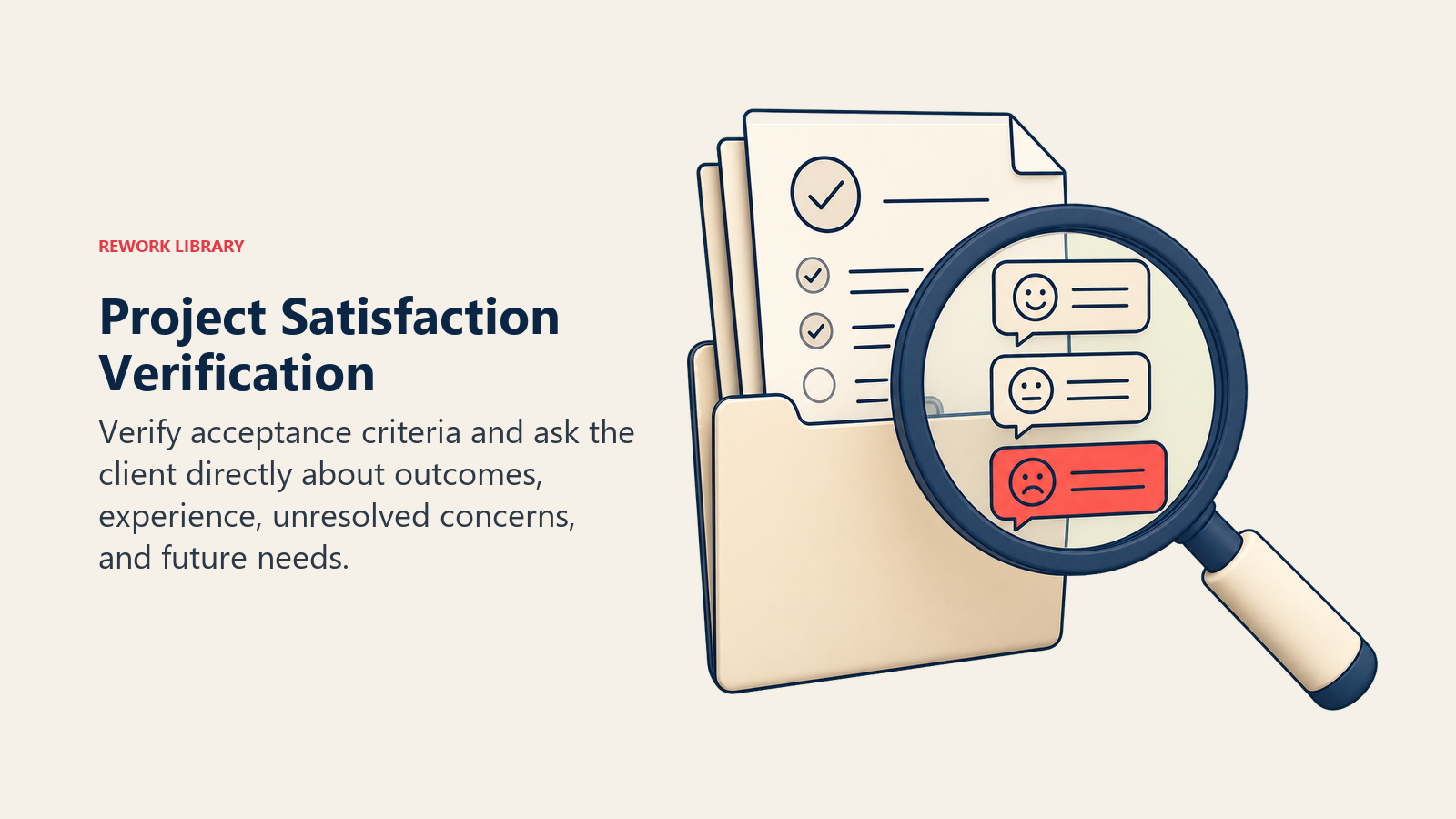
Client satisfaction measurement: Use multiple methods:
- Formal survey (NPS, CSAT, specific questions about deliverables, process, team)
- One-on-one interviews with key stakeholders (deeper insights than surveys)
- Observation of early usage (are they actually using what you built?)
Ask specific questions:
- "Did this project achieve the business outcomes you needed?"
- "Would you hire us again?"
- "Would you refer us to a colleague?"
- "What's your level of confidence in maintaining this going forward?"
Expectation vs delivery gap analysis: Sometimes you deliver exactly what was scoped but the client is still unhappy. That's an expectation management failure. Document where gaps occurred:
- Did we clearly communicate what was in scope?
- Did they understand limitations or trade-offs?
- Did requirements change without updating expectations?
- Were there unstated assumptions?
This analysis tells you where to improve communication on future projects.
Issue resolution tracking: If problems arose during the project, did you resolve them? Are they truly closed or just papered over? Open issues at closeout are ticking time bombs. Either resolve them or explicitly document them as known limitations.
Change order completion and reconciliation: Did all approved change orders get completed? Did you bill for them? Are there any disputed changes? Financial surprises during closeout destroy trust.
Reference-ability assessment: Can you use this client as a reference? Would they write a case study or testimonial? If the answer is no, figure out why. If yes, ask while the project success is fresh in their minds.
Transition to support and retention
The delivery relationship is ending. The support relationship is beginning. Don't let that handoff break. Support model handoff procedures: Define what support looks like post-project:
- What's covered under warranty/guarantee?
- What requires a separate engagement?
- What are response time expectations?
- How long does post-project support last? Get this in writing and make sure both teams (delivery and support) understand it.
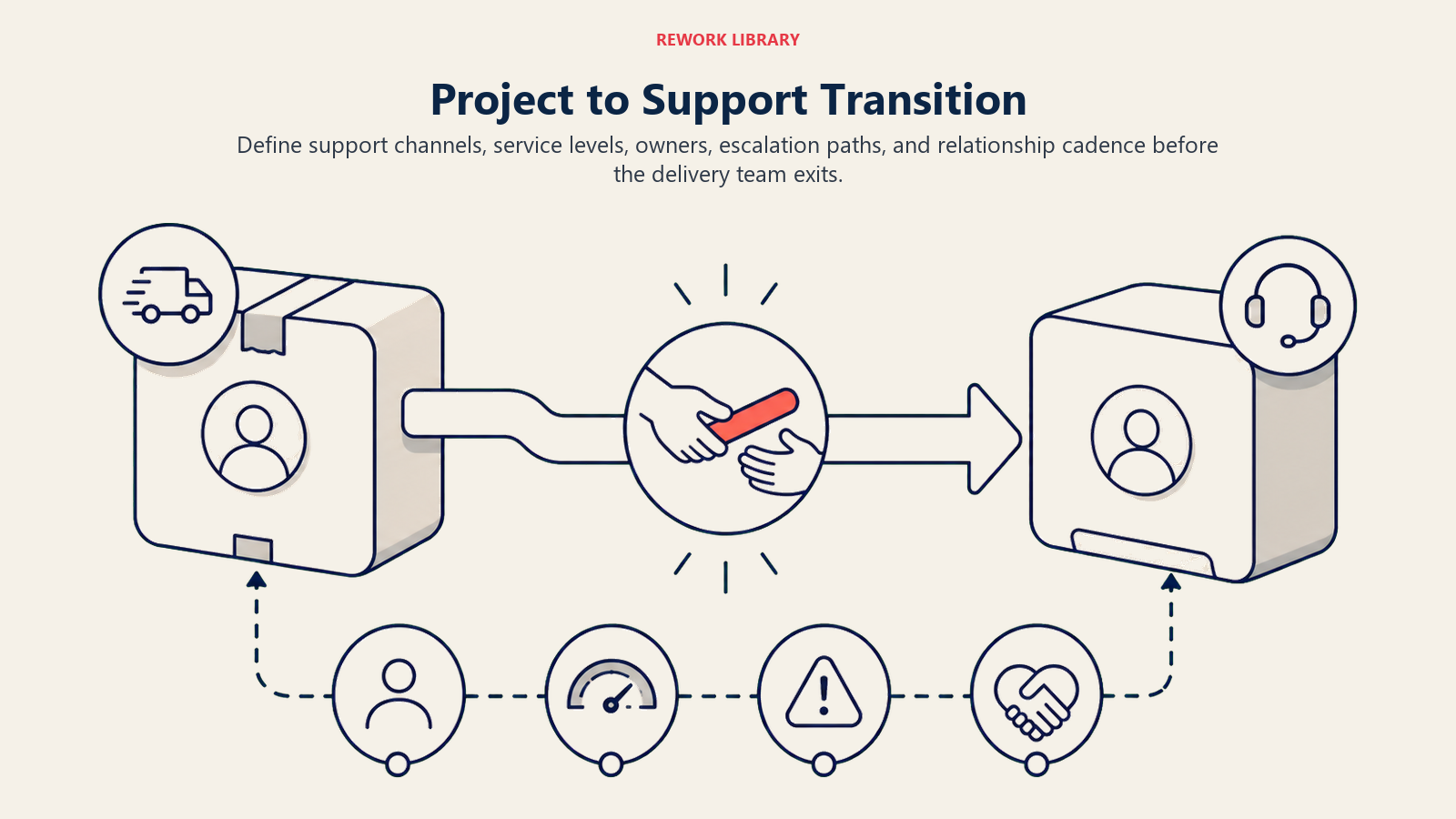
SLA definition and documentation: If you're providing ongoing support, document service levels clearly:
- Priority 1 (system down): 2-hour response, 8-hour resolution
- Priority 2 (major issue): 4-hour response, 24-hour resolution
- Priority 3 (minor issue): 24-hour response, 5-day resolution
Define what constitutes each priority level. Your "minor" might be their "critical."
Support team orientation and briefing: The people providing support weren't on the delivery team. They need context:
- What was built and why?
- What are known issues or limitations?
- What are common user questions?
- Who are key client contacts?
- What's the escalation path?
Schedule a proper handoff meeting, not just an email with attached docs.
Escalation paths and ticketing setup: Make sure support systems are configured:
- Client can submit tickets easily
- Tickets route to the right team
- Escalation happens automatically for SLA violations
- Client can track ticket status
Test this before you transition. Nothing kills confidence like a support system that doesn't work.
Client relationship transition: The project manager or engagement lead who the client trusted is stepping back. The account manager or customer success manager is stepping in. Introduce them explicitly:
- Joint meetings during transition
- Clear communication about who handles what going forward
- Continuity of relationship, not a cold handoff
The client should feel they're still in good hands, not being passed to someone who knows nothing about them.
Ongoing issue tracking: Create a shared log of known issues, enhancement requests, and things to monitor. This becomes the agenda for early check-ins post-closeout.
Financial closeout
Money is always awkward. Handle it professionally. Final invoicing and payment reconciliation: Send the final invoice promptly with clear line items. Include:
- All completed work through project end
- Any approved change orders
- Expenses with receipts
- Credits or adjustments
If there's any possibility of dispute, address it before you invoice.
Change order settlement: Make sure every change order is either completed and billed or explicitly cancelled. Ambiguity here leads to payment delays or disputes.
Resource cost reconciliation: Internally, close the books on project costs:
- Actual hours vs budgeted hours by role
- Subcontractor costs vs estimates
- Travel and expense actuals
- Tool or license costs
This tells you if the project was profitable and informs pricing for similar work.
Profit realization and variance analysis: Compare financial actuals to the original estimate:
- Where did you come in under budget? Why?
- Where did you overspend? Why?
- What assumptions were wrong?
- What scope creep occurred?
- What efficiency gains or losses happened?
Use this data to improve estimating on the next project.
Subcontractor and vendor settlements: Pay everyone you owe. Close vendor accounts you no longer need. Get final invoices from partners. Don't leave financial loose ends.
Revenue recognition compliance: Make sure your accounting team properly recognizes revenue according to your accounting policies and the contract terms. If you use percentage-of-completion accounting, final true-up happens now.
Risk management during closeout
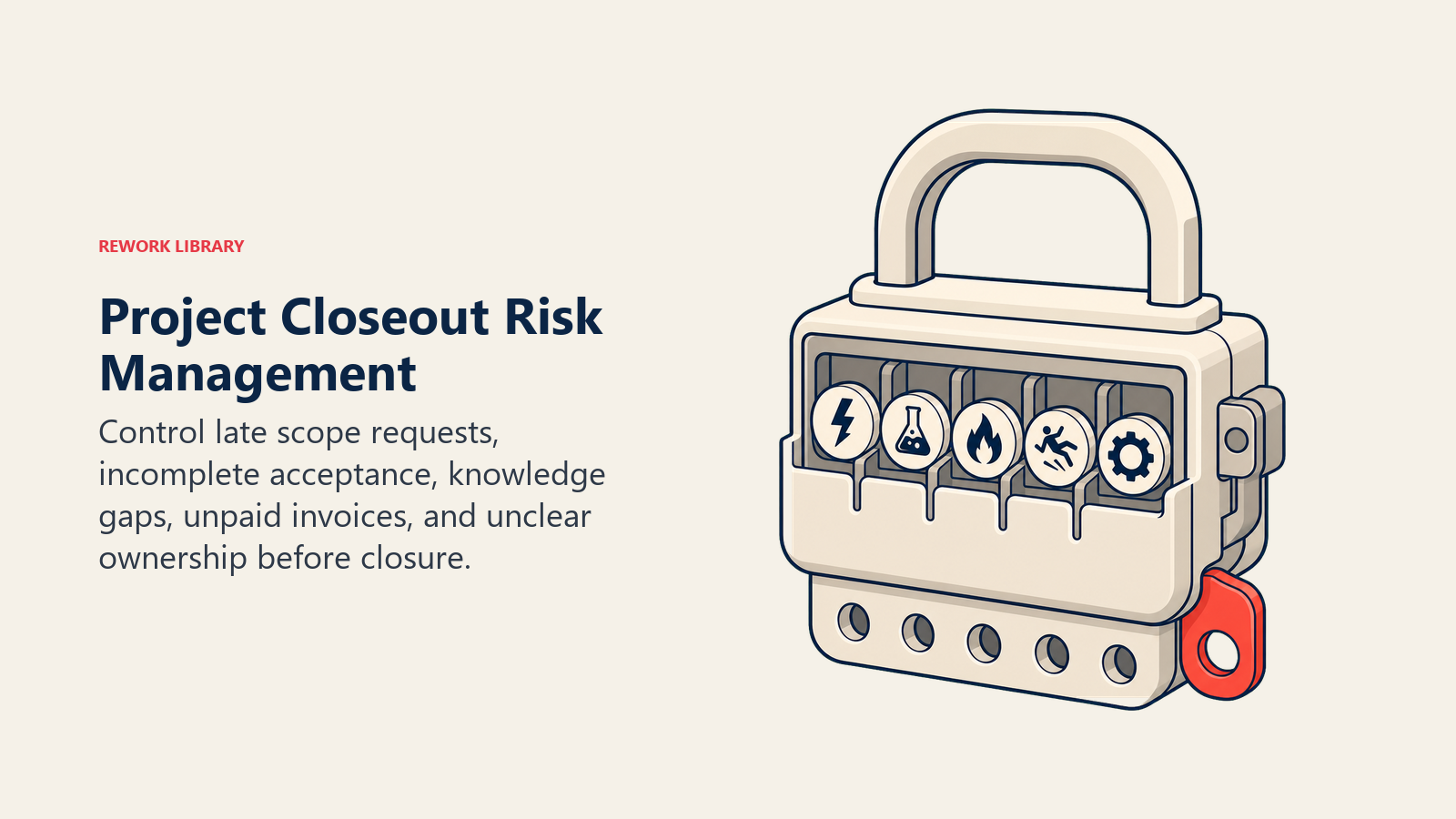
Closeout is when things go wrong if you're not careful. Common closeout pitfalls:
- Rushing to get the team on the next project before transition is complete
- Assuming documentation is sufficient without testing comprehension
- Letting junior team members handle knowledge transfer while seniors move on
- Skipping retrospectives because everyone's busy
- Not getting formal sign-off, leaving completion ambiguous Scope creep during final phases: Clients often ask for "just one more small thing" during closeout. This is dangerous. Apply the same scope creep management discipline here as during active delivery. Either:
- Say no and explain that you're in transition mode
- Scope it as a separate engagement
- If truly trivial, do it but document it clearly as out-of-scope goodwill
Don't set a precedent that "closeout" means "we'll keep working for free."
Knowledge siloing risks: If only one person on your team can explain key decisions or architecture, you've got a problem. Cross-train internally during the project so closeout knowledge transfer isn't dependent on one individual.
Client dissatisfaction triggers: Watch for warning signs:
- Delayed feedback or sign-off requests
- New stakeholders suddenly getting involved
- Questions about what was "really" in scope
- Reluctance to take ownership
These signal problems you need to surface and address, not ignore.
Documentation quality issues: Poor documentation creates support burden forever. Invest time in quality review. Have someone not on the project try to follow your docs and see if they can.
Retention risk identification: Is this client at risk of not renewing or not engaging again? Red flags:
- Low satisfaction scores
- Unresolved issues
- Lack of usage or adoption
- Budget constraints they've mentioned
- Leadership changes on their side
If you spot retention risk, involve your account team immediately.
Team communication and morale
Your team just spent months on this project. Don't let closeout feel like abandonment.
Internal team acknowledgment: Recognize what the team accomplished. Specific praise is more meaningful than generic "good job":
- "The way you handled that mid-project requirement change kept us on track"
- "Your documentation work is going to make support so much easier"
- "The client specifically mentioned how responsive you were"
Celebration of milestones: When the project closes successfully, celebrate it. Team lunch, happy hour, shoutout in company meetings - something. It reinforces that finishing strong matters.
Recognition programs: If your firm has formal recognition, nominate team members. If you don't, create informal recognition. Public acknowledgment drives morale and retention.
Team retrospective insights: Share what you learned from retros with the broader organization. "Here's what this project taught us" helps everyone improve and makes the team feel their experience matters.
Next project transitions: Don't roll people onto the next thing without a breather. Closeout is intense. Give people at least a few days between projects to decompress, document, and mentally shift. Burnout happens when you chain intense projects without breaks. Factor this into your utilization and capacity planning.
Documentation and record keeping
You need this later. Do it right now.
Project completion documentation: Create a project summary document:
- What was delivered
- Key metrics and outcomes
- Timeline and milestones
- Budget and financials
- Client feedback
- Team composition
This is what you reference when a similar project comes in three years later.
Asset and code repository organization: Clean up and archive:
- Remove work-in-progress or experimental code
- Organize files logically
- Document repository structure
- Archive if no longer actively maintained
Future you will thank current you for this.
Lessons learned database: Add your retrospective insights to a centralized knowledge base. Tag by project type, industry, technology, team size - whatever makes it searchable later.
Client feedback archival: Store satisfaction surveys, testimonials, and feedback in the client record. This informs future work with that client and helps with case studies or references.
Compliance and audit trail: If you're in a regulated industry, make sure all required documentation is complete and stored properly:
- Sign-off records
- Change order approvals
- Compliance certifications
- Security assessments
- Data handling records
Metrics and success measurement
You can't improve what you don't measure.
Project completion on-time rate: Track percentage of projects that complete on the original timeline versus extended. If you're consistently late to closeout, figure out why. Is it poor estimation? Scope creep? Client delays?
Client satisfaction scores: Measure NPS and CSAT at closeout. Track trends:
- How do closeout scores compare to mid-project scores?
- What's the correlation between satisfaction and retention?
- Which project types or teams score highest?
Knowledge transfer effectiveness: This is harder to measure but critical. Options:
- Quiz or certification for client team post-training
- Support ticket volume in first 90 days (lower is better)
- Client self-sufficiency rate (what percentage of issues do they resolve without escalating?)
Support ticket volume post-closeout: Track tickets by category:
- How many are "how do I...?" (training gaps)
- How many are bugs or defects (quality issues)
- How many are enhancement requests (scope gaps)
High ticket volume right after closeout signals problems.
Client expansion and retention rate: Track what happens after closeout:
- Do they engage for additional work within 90 days?
- Do they renew support agreements?
- Do they expand scope?
- Do they refer you to others?
This is the ultimate measure of closeout success.
Retrospective action item completion: It's not enough to identify improvements. Track whether you actually implement them. If action items never get done, stop doing retrospectives - they're theater.
Making closeout a competitive advantage
Most firms don't do this well. That's your opportunity.
Build closeout into your project plans from day one. Don't treat it as an afterthought. Include time and budget for the full 30-day process. If your SOW ends on delivery day, you've already failed.
Train your teams on closeout procedures. Make it a competency, not just a checklist. The best project managers excel at transitions because they understand closeout isn't the end - it's the beginning of the next relationship.
Measure and reward good closeout behavior. If you only track delivery timeline and budget, people will rush through transition to hit those metrics. If you track satisfaction, retention, and knowledge transfer, behavior changes.
Use closeout conversations to uncover expansion opportunities. "Now that we've delivered X, what's next for your team?" Ask about related initiatives, other departments, upcoming needs. The trust is highest right after successful delivery. That's when clients are most open to expanding the relationship.
Document everything you learn and make it accessible. A firm that actually applies lessons from past projects gets faster and better. A firm that rediscovers the same issues every time stagnates.
Where to go from here
Project closeout connects to every other part of your service delivery system:
- Project Management Methodology defines how you plan and execute work
- Client Communication Cadence sets expectations throughout the project lifecycle
- Deliverable Quality Assurance ensures what you hand off actually works
- Client Satisfaction Management provides frameworks for measuring and improving satisfaction
- Client Retention Strategy shows how to turn completed projects into ongoing relationships
Start by building a closeout checklist for your next project. Include every item we've covered here: deliverables, knowledge transfer, retrospectives, satisfaction measurement, financial reconciliation, support transition. Then actually use it. Track what works and what doesn't. Iterate.
The goal isn't perfect closeout. It's dramatically better closeout than your competitors. If you can make clients feel supported and confident at the moment when most firms disappear, you've created a relationship that lasts. That's how you turn projects into partnerships and transactions into long-term clients.

Sales Director
On this page
- The hidden value in project closeout
- Defining project closeout: the three-phase model
- Final deliverables management
- Knowledge transfer operations
- Post-delivery retrospectives
- Client satisfaction verification
- Transition to support and retention
- Financial closeout
- Risk management during closeout
- Team communication and morale
- Documentation and record keeping
- Metrics and success measurement
- Making closeout a competitive advantage
- Where to go from here