Client Onboarding Process: Successfully Launching Professional Services Engagements
Turn this article into takeaways for your work.


Each assistant summarizes the article only for you and suggests best practices for your work.
Here's something most professional services firms learn the hard way: 85% of client satisfaction is determined in the first 30 days of an engagement. Not during project delivery. Not at the final presentation. In the first month.
The problem? Most firms treat onboarding as an administrative checklist. Get contracts signed, set up billing, schedule a kickoff meeting. Then they wonder why clients feel disconnected, why projects stall, why relationships that started with enthusiasm turn into frustration.
Good onboarding isn't about paperwork. It's about building a partnership. You're establishing trust, clarifying expectations, demonstrating competence, and creating the foundation for everything that follows. When you get those first 30 days right, projects run smoother, clients are happier, and you avoid the damage control that eats your margins.
This guide walks you through what actually works. Not a theoretical ideal, but a practical framework you can implement immediately.
Why Onboarding Fails (And What It Costs)
Most onboarding problems come from one of three places:
Poor handoff from sales to delivery. The sales team made promises, set expectations, and built a relationship. Then they disappear and a new team shows up. The client feels like they're starting over, explaining everything again to people who don't seem to know what was already discussed. A structured needs assessment and discovery process can help prevent this disconnect.
Delayed or unfocused kickoff. Weeks pass between contract signing and the actual start of work. Or the kickoff meeting happens but it's all pleasantries with no real substance. No clarity on what happens next, who's responsible for what, or how you'll work together.
Lack of early wins. You talk about value but don't show it quickly. Clients need to see progress and feel confident they made the right decision. If the first month is all planning and setup with nothing tangible to show, doubt creeps in.
The cost isn't just client dissatisfaction. It's rework when scope wasn't clarified upfront. It's scope creep when boundaries weren't set. It's relationship tension that makes every conversation harder than it should be. Projects that start poorly rarely recover.
Pre-Engagement Setup: Before Day One
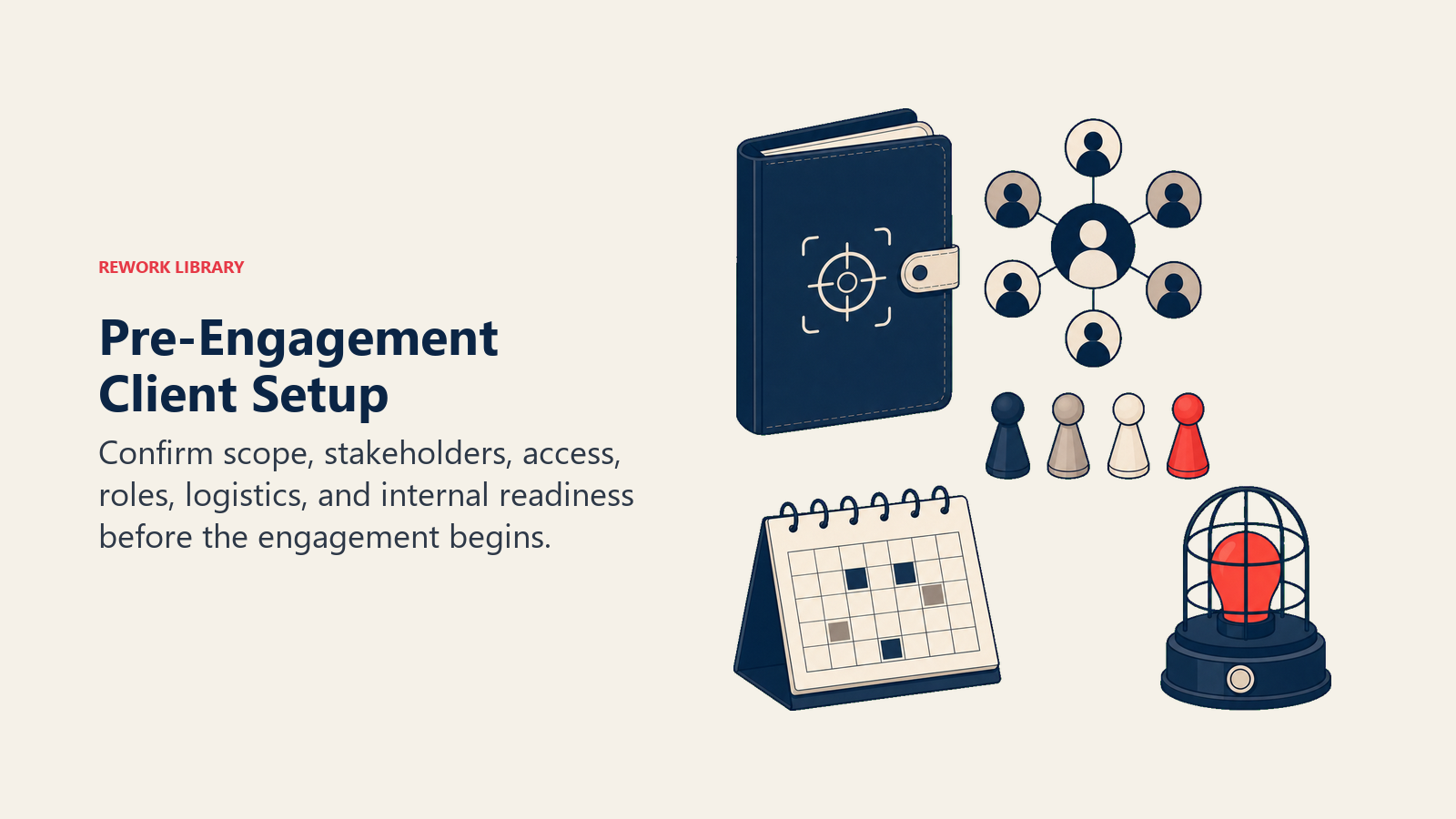
The best onboarding starts before the engagement officially begins. This is the transition period between contract signing and project kickoff, and it's where you set yourself up for success or create problems you'll be dealing with for months.
Sales-to-Delivery Handoff
Don't just throw the client file over the wall to your delivery team. You need a structured knowledge transfer that captures everything the client said, expected, and cares about.
Information transfer checklist:
- What specific problems does the client need solved?
- What outcomes are they measuring success by?
- Who are the key stakeholders and what does each one care about?
- What commitments were made during the sales process?
- What concerns or objections did they raise?
- What's their working style and communication preferences?
- Are there any political dynamics or sensitivities to be aware of?
This shouldn't be a 5-minute conversation in the hallway. Schedule a proper transition meeting where sales walks through the account in detail. The delivery team lead should be asking questions, taking notes, and flagging anything that needs clarification.
If the salesperson who closed the deal isn't involved in onboarding at all, you're starting with a handicap. Even if they're not leading the engagement, they should introduce the delivery team and participate in the kickoff. That continuity matters to clients.
Consolidate all contact information. You'd be surprised how often teams don't have accurate contact details for key stakeholders. Get names, titles, emails, phone numbers, and understand who should be contacted for what. Build this directory before you need it.
Align your internal team. Everyone who'll touch this engagement needs to be on the same page about objectives, scope, timeline, and approach. If your project manager thinks it's a 3-month engagement but the client thinks it's 2 months, that's a problem you need to catch now, not six weeks in.
Resource Allocation and Team Assignment
Match the right people to the engagement based on expertise, experience, and availability. Clients notice when they're getting your B-team because everyone else was busy.
Consider these factors:
- Technical skills needed for the specific work
- Industry knowledge and context
- Client relationship and communication skills
- Availability and capacity (don't overbook people)
- Growth opportunities for team members
Introduce the team early. Don't wait until the kickoff meeting to tell the client who'll be working on their project. Send team bios and photos as soon as they're assigned. It makes people feel less like vendors and more like partners.
Technical and Administrative Preparation
Get the logistics out of the way before day one so the kickoff can focus on substance, not system access and paperwork.
Administrative setup:
- Contracts and engagement letters finalized and signed by all parties
- Billing information and payment terms confirmed
- Insurance certificates and compliance documents exchanged
- NDA and security requirements addressed
- Purchase orders or approval numbers obtained
Technical setup:
- Access to client systems, tools, and data sources
- Collaboration platform accounts created (Slack, Teams, project management tools)
- Document sharing permissions configured
- Client portal or workspace prepared
- Calendar invites for recurring meetings sent
Data gathering:
- Request background materials, reports, previous analyses
- Identify data sources you'll need access to
- Clarify what information the client will provide vs what you'll collect
- Set expectations for turnaround time on data requests
The goal is simple: when the kickoff meeting happens, you're ready to work. Not still figuring out how to log into their network or waiting for them to send you last year's financial statements.
Welcome Package
Send a welcome package 3-5 days before the kickoff meeting. This isn't marketing fluff. It's practical information that helps the client prepare and shows you're organized.
What to include:
- Welcome letter from the engagement lead
- Team bios with photos and contact information
- Project overview with objectives and timeline
- Kickoff meeting agenda and logistics
- What to prepare or bring to the kickoff
- Communication protocols and escalation paths
- Portal access instructions if applicable
- First steps and what happens in week one
This package answers the questions every client has: Who's working on this? What happens next? How do we communicate? What do you need from me? When clients have this information in advance, the kickoff meeting is more productive because you're not covering basics.
Week One: Building the Foundation
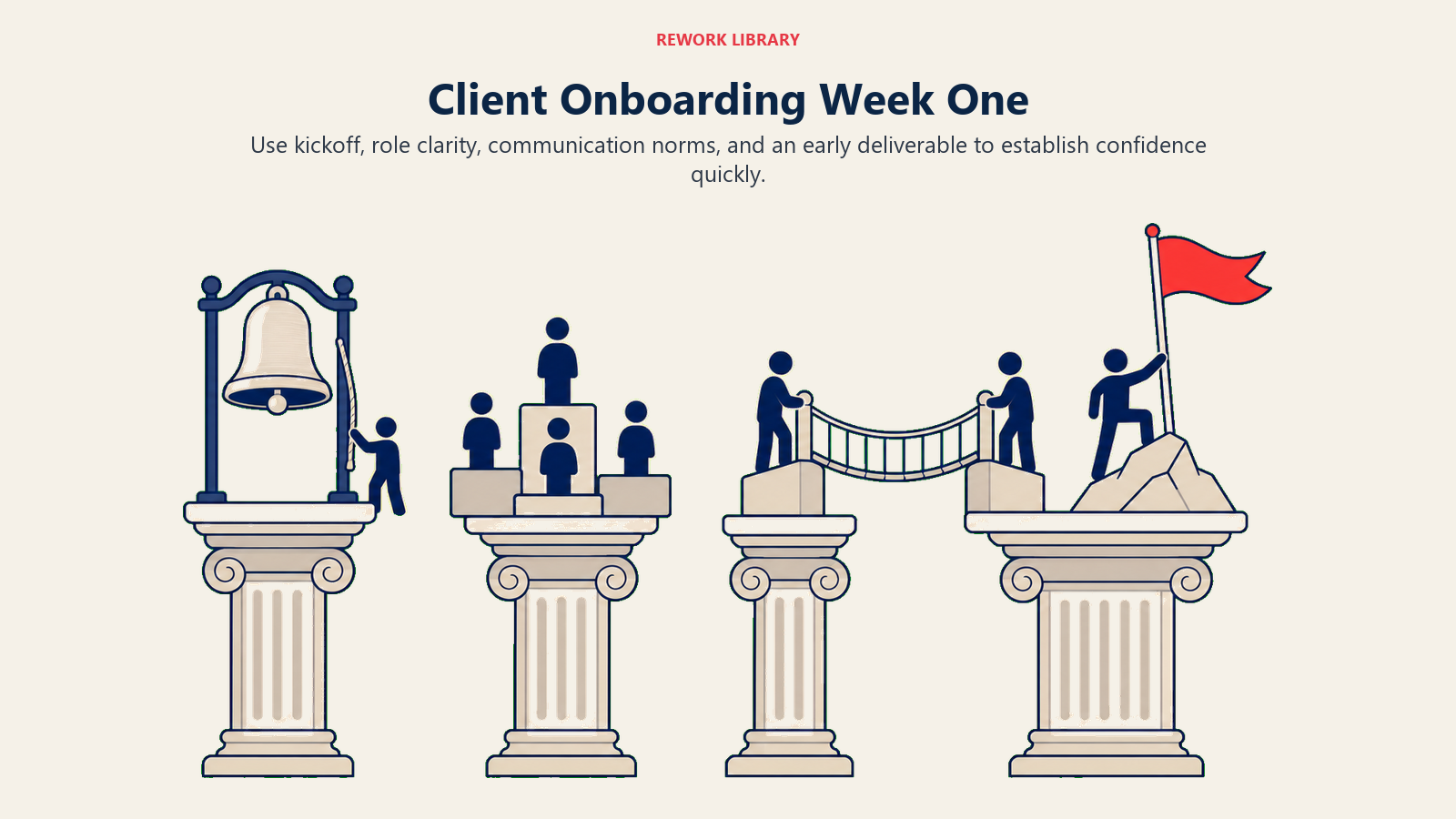
The first week sets the tone for the entire engagement. This is when you establish working relationships, clarify the plan, and start creating momentum.
The Project Kickoff Meeting
The kickoff is your most important meeting. Done well, it creates alignment and excitement. Done poorly, it creates confusion and anxiety.
Kickoff meeting agenda (2-3 hours):
1. Introductions and relationship building (20-30 minutes)
- Everyone introduces themselves, not just name and title but what they bring to the project
- Client stakeholders share their role and what they care about
- Establish the working dynamic as partners, not vendor and customer
2. Objectives and success criteria (30 minutes)
- Confirm what success looks like from the client's perspective
- Align on business outcomes, not just deliverables
- Identify how you'll measure progress and results
- Surface any unstated expectations or concerns
3. Scope and deliverables (30 minutes)
- Walk through what's in scope and what's explicitly out of scope according to your scope definition and SOW
- Clarify deliverable formats, quality standards, and acceptance criteria
- Address the change order process for scope adjustments
- Discuss priorities if trade-offs are needed
4. Timeline and milestones (20 minutes)
- Present the project timeline with major phases and milestones
- Identify dependencies and critical path items
- Flag any timing constraints or busy periods on either side
- Agree on checkpoints for progress review
5. Roles and responsibilities (20 minutes)
- Define who does what on both sides
- Clarify decision-making authority and approval processes
- Establish escalation paths for issues and risks
- Set expectations for responsiveness and availability
6. Communication protocols (20 minutes)
- Agree on meeting cadence (weekly status calls, bi-weekly reviews, etc.)
- Confirm preferred communication channels for different types of updates
- Set reporting format and schedule
- Establish documentation and file sharing practices
7. Immediate next steps (10 minutes)
- Outline what happens this week
- Assign specific action items with owners and due dates
- Schedule the next meeting
- Address any urgent questions or concerns
The kickoff should feel collaborative, not like a presentation you're delivering at the client. Encourage questions. Take notes on concerns and follow up. Make sure everyone leaves knowing what happens next.
Initial Planning and Setup
Beyond the kickoff, week one is about getting your operations running smoothly.
Complete access and system setup. If there were any technical items that couldn't be finished before the kickoff, get them done now. Don't let access issues delay your work.
Start data collection. Begin gathering the information you need, whether that's through interviews, document review, or system analysis. The sooner you can get into the real work, the better.
Build relationships with key stakeholders. Schedule individual conversations with the people who'll be most involved. Understand their perspectives, priorities, and concerns. These one-on-one connections matter when you need support later.
Identify a quick win. Look for something valuable you can deliver in the first 2-3 weeks. It doesn't have to be a major deliverable, but it should be something the client finds useful. Early wins build confidence and momentum.
Setting Communication Patterns
How you communicate in week one establishes the pattern for the whole engagement.
Be proactive, not reactive. Don't wait for clients to ask for updates. Send them. Even if the update is "we're making progress as planned," that communication builds trust.
Respond quickly. In the first few weeks, responsiveness matters more than usual. You're proving you're reliable and engaged. If the client emails a question, answer within a few hours, not a few days.
Document everything. Send meeting notes, confirm decisions in writing, track action items. This isn't bureaucracy, it's preventing misunderstandings that turn into conflicts later.
Check in informally. Beyond scheduled meetings, reach out to see how things are going from the client's perspective. Are they getting what they need? Any concerns or questions? This shows you care about the relationship, not just the deliverables.
The First 30 Days: Establishing Rhythm and Trust
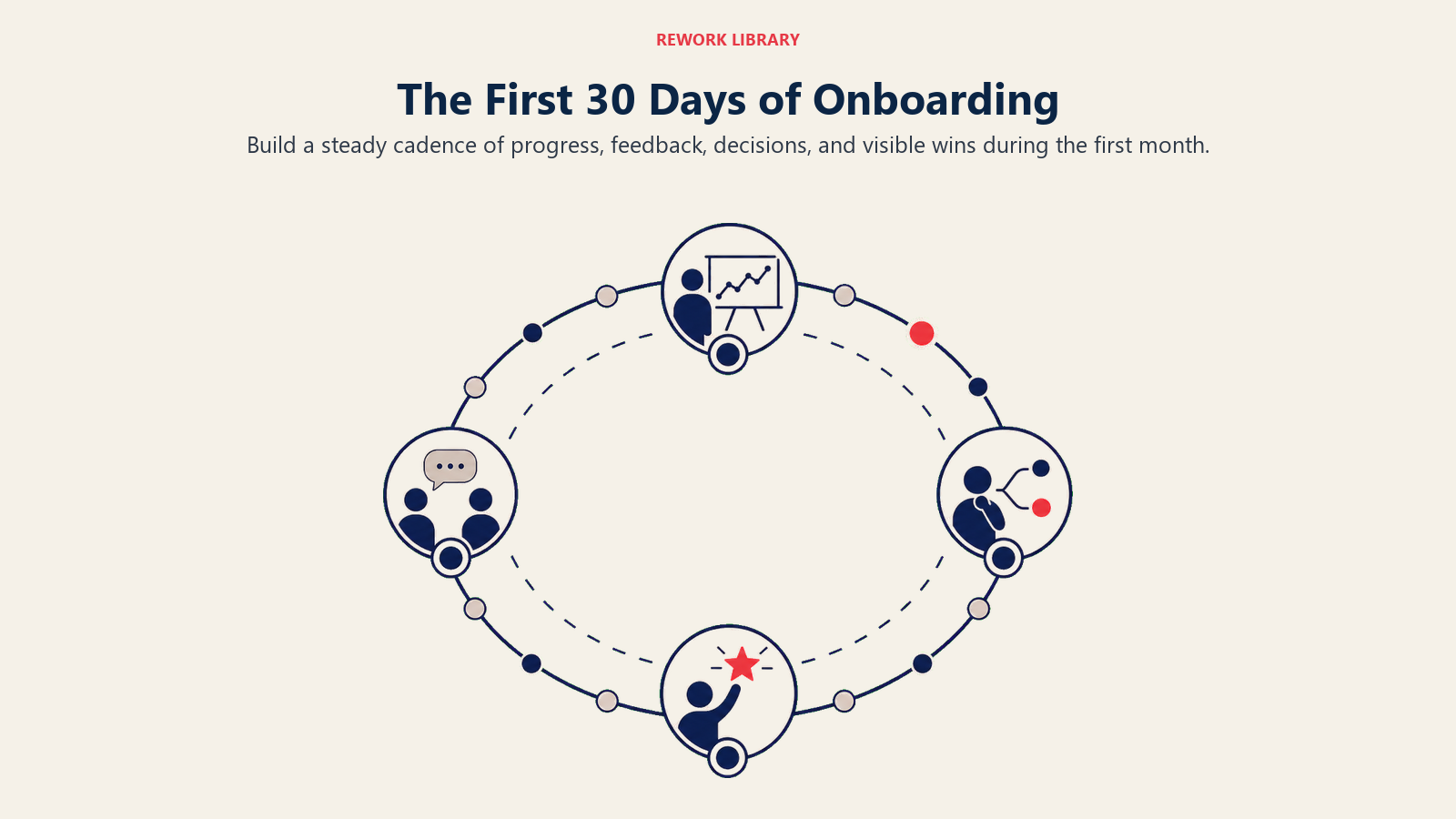
After the intense setup of week one, the next three weeks are about building consistent execution and deepening the relationship.
Regular Check-ins and Status Updates
Establish a predictable rhythm of communication that keeps everyone informed without creating meeting overload.
Weekly status calls or meetings. These should be brief, focused check-ins on progress, blockers, and upcoming work. Don't make them longer than needed, but don't skip them either. Consistency matters.
Status report cadence. Whether it's weekly or bi-weekly, send a written update that covers:
- What was accomplished since the last update
- What's planned for the next period
- Any issues or risks that need attention
- What you need from the client
- How you're tracking against the overall timeline
Keep status reports concise. One page is usually enough. Clients are busy and won't read three pages of detail. If they want more depth, they'll ask.
Early Deliverable Completion
Get something tangible into the client's hands as quickly as possible. This is different from the quick win in week one - this is an actual project deliverable, even if it's an interim one.
Why early deliverables matter:
- They demonstrate progress and competence
- They give the client something concrete to react to
- They surface any misalignment in expectations early when it's easier to correct
- They create momentum and confidence in the engagement
Even if your main deliverable isn't due for months, break it into phases and deliver something in the first 30 days. An initial assessment, a preliminary analysis, a draft framework - whatever makes sense for your work.
Process Establishment and Refinement
The first month is when you're figuring out how to work together effectively. Some things will work smoothly, others won't. Adjust as needed.
Watch for friction points:
- Are meetings productive or do they feel like time wasters?
- Is information flowing easily or are there bottlenecks?
- Are decisions getting made or stalled in bureaucracy?
- Is the team on both sides engaged or checked out?
Don't wait until these small issues become big problems. Address them quickly. If weekly meetings aren't working, suggest a different format or cadence. If you're not getting the access or information you need, escalate appropriately. If the client seems confused about what's happening, improve your communication.
Be open to feedback. Check in explicitly: "How is this working for you? Is there anything we should be doing differently?" Most clients appreciate being asked and will tell you what's working and what's not. Building strong client feedback systems creates ongoing opportunities for improvement.
Issue Identification and Resolution
Problems happen. The question is how quickly you spot them and how effectively you resolve them.
Common early-stage issues:
- Scope ambiguity that leads to different interpretations of what's included
- Resource availability on the client side (people too busy to participate)
- Data quality or access problems
- Misaligned expectations about deliverable format or detail level
- Timeline pressure from external factors
When you spot an issue, address it immediately. Don't hope it resolves itself. Small problems become big problems when ignored.
Issue resolution approach:
- Identify and document the specific problem
- Assess impact on scope, timeline, or deliverables
- Develop options for resolution
- Discuss with the client and agree on the path forward
- Document the decision and any scope or timeline adjustments
- Communicate to all relevant stakeholders
Being proactive about problems builds trust. Clients know things don't always go perfectly. What they care about is whether you're on top of it and communicating clearly.
Progress Against Milestones
Track and report on how you're progressing against the plan established during kickoff. Are you on track? Ahead? Behind? If there are delays, why, and what are you doing about it?
Monthly milestone review. At the end of the first 30 days, do a more thorough progress assessment. Look back at what was accomplished, assess health of the engagement, identify any course corrections needed.
This is also a good time to check in on the relationship. Is the client satisfied with how things are going? Any concerns or suggestions? Use the 30-day mark as a natural checkpoint for feedback and adjustment.
The Four Dimensions of Effective Onboarding
Client onboarding isn't just about project setup. You're establishing four different dimensions of the working relationship simultaneously.
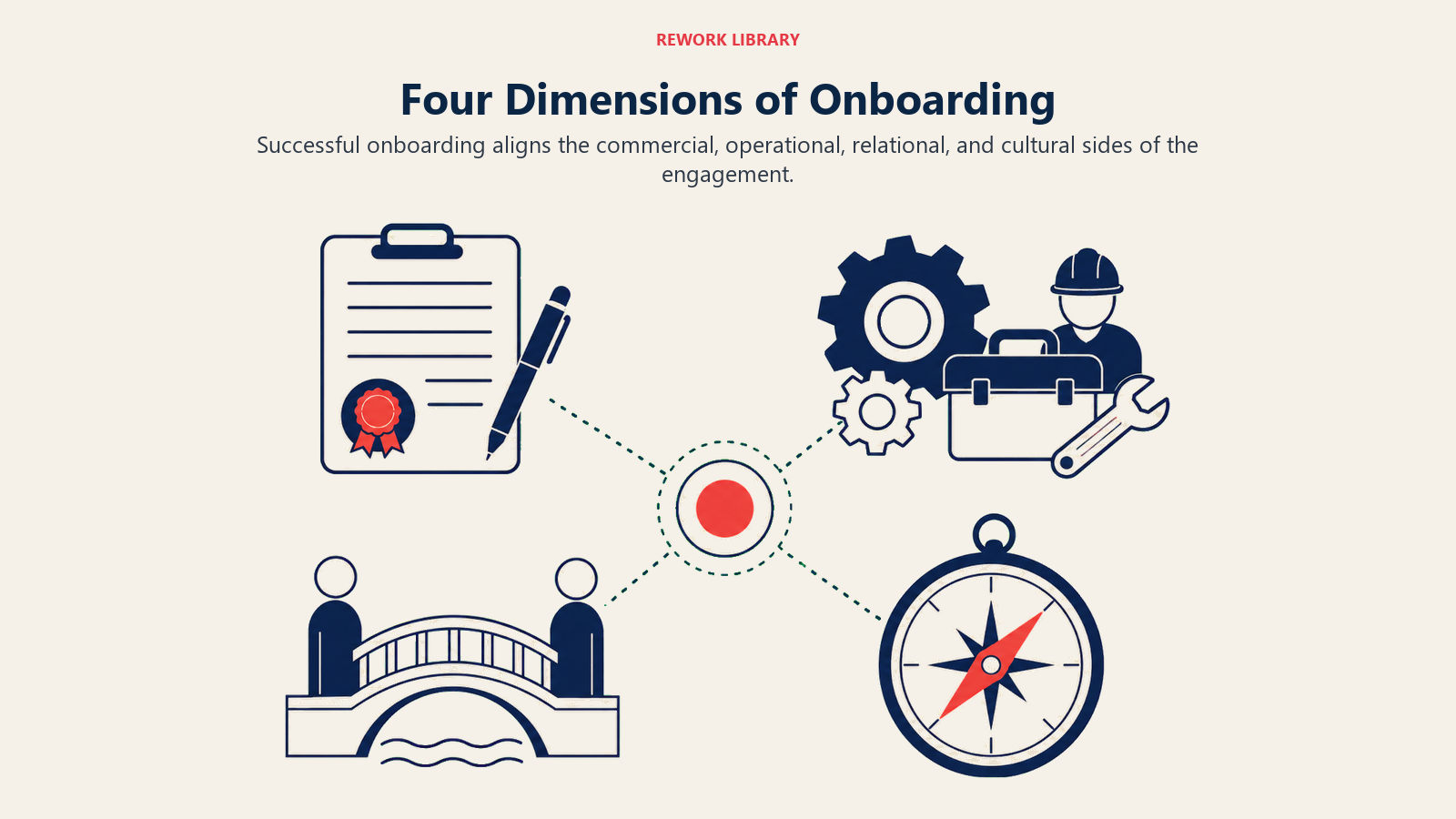
Administrative Dimension
This is the logistics and paperwork that enables the engagement.
Key components:
- Contracts and legal agreements finalized
- Billing setup and payment processes confirmed
- System access and technical permissions granted
- Compliance and security requirements met
- Insurance and regulatory documentation handled
- Project code or tracking numbers established
Get the administrative stuff done early and efficiently so it doesn't distract from the real work. Nothing kills momentum like waiting two weeks for system access or having invoices rejected because of wrong purchase order numbers.
Operational Dimension
This is how you work together day-to-day.
Key components:
- Communication protocols and channels established
- Meeting cadence and formats agreed upon
- Reporting structure and templates in place
- Escalation paths defined for different types of issues
- Documentation and file sharing systems set up
- Change management processes clarified
The operational dimension is about creating efficient, predictable workflows. When everyone knows how communication works, how decisions get made, and where to find information, everything else flows more smoothly.
Strategic Dimension
This is about alignment on the bigger picture and ensuring everyone's working toward the same goals.
Key components:
- Expectations clearly defined and documented
- Success criteria agreed upon and measurable
- Decision processes and governance established
- Stakeholder engagement plan implemented
- Risk management approach defined
- Value realization framework in place
The strategic dimension keeps the engagement from devolving into task completion without purpose. You're not just doing work, you're solving business problems and creating value. Keep that focus.
Relationship Dimension
This is the human side of the engagement - the trust, rapport, and working dynamic between your team and the client's team.
Key components:
- Trust built through reliability and competence
- Cultural integration and working style adaptation
- Individual relationships with key stakeholders
- Psychological safety for raising concerns or issues
- Mutual respect and collaborative dynamic
- Shared commitment to success
The relationship dimension can't be forced or rushed. It develops through consistent positive interactions, follow-through on commitments, competent work, and genuine care for the client's success. But you can create the conditions for it to develop by being intentional about relationship building from day one.
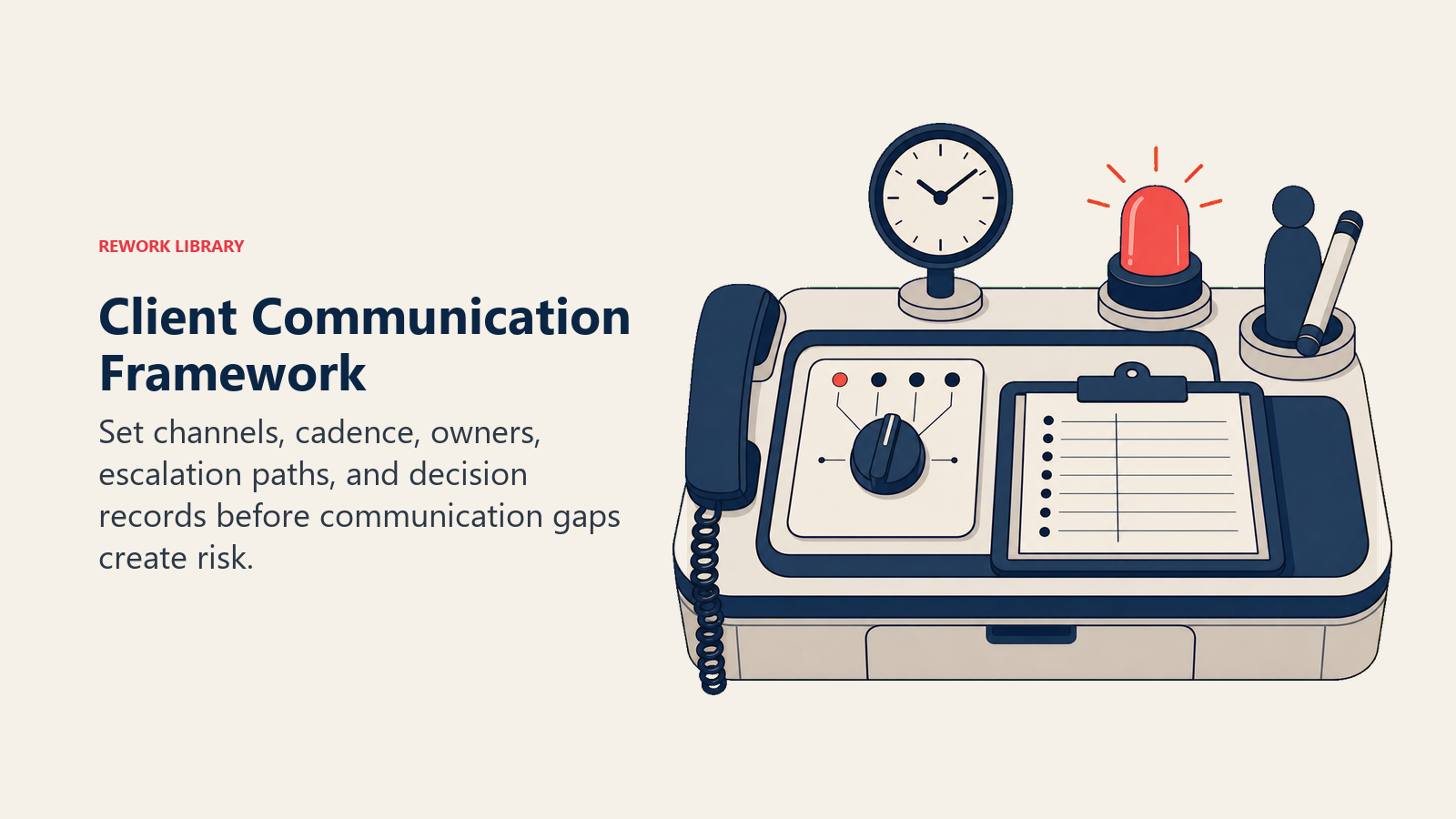
Communication Framework for Client Success
How you communicate determines whether clients feel informed and confident or confused and anxious. Here's a practical framework.
Kickoff Meeting Agenda Template
Project Kickoff Meeting - [Client Name] - [Date]
Attendees: [List both client and your team members]
Meeting Objectives:
- Align on project goals, scope, and success criteria
- Establish working relationship and communication protocols
- Clarify roles, responsibilities, and timeline
- Address questions and concerns
- Define immediate next steps
Agenda:
Welcome and introductions (15 min)
- Brief background from each participant
- What each person brings to the project
- Working style preferences
Project overview and objectives (20 min)
- Business context and why this project matters
- Specific goals and desired outcomes
- Success criteria and how we'll measure it
Scope and deliverables (25 min)
- What's included in this engagement
- What's explicitly out of scope
- Deliverable formats and quality standards
- Change management process
Timeline and approach (20 min)
- Project phases and major milestones
- Critical dependencies
- Key decision points
- Risk factors and mitigation
Team and responsibilities (15 min)
- Roles on both sides
- Decision-making authority
- Escalation process
- Availability and response expectations
Communication and reporting (15 min)
- Meeting schedule and formats
- Status reporting cadence and content
- Documentation approach
- Preferred communication channels
Questions and discussion (15 min)
- Open floor for any concerns or questions
- Clarification on anything covered
- Topics for follow-up
Next steps (10 min)
- What happens this week
- Action items with owners and dates
- Next meeting scheduled
- How to reach the team
Post-Meeting Actions:
- Distribute meeting notes within 24 hours
- Send action item summary with assignments
- Schedule recurring meetings
- Follow up on any questions that couldn't be answered during the meeting
Regular Status Update Template
Weekly Status Update - [Client Name] - Week of [Date]
Overall Status: [On Track / At Risk / Ahead]
This Week's Accomplishments:
- [Bullet list of what was completed]
- [Focus on outcomes and progress, not just activities]
Next Week's Focus:
- [Bullet list of what's planned]
- [Align with milestones and priorities]
Progress Against Milestones:
- [Milestone 1]: On track for [date]
- [Milestone 3]: At risk - [brief explanation and mitigation plan]
Issues and Blockers:
- [Issue 1]: [Impact, proposed resolution, action needed]
- [Issue 2]: [Impact, proposed resolution, action needed]
Decisions Needed:
- [Decision 1]: [Context, options, deadline]
- [Decision 2]: [Context, options, deadline]
Requests from Client:
- [Specific items needed, with deadlines]
- [Access or information required]
Upcoming Key Events:
- [Meeting, review, deliverable due date]
Questions or Concerns:
- [Open items for discussion]
Keep this concise. One page maximum. If you need to provide more detail on something, attach it as a supplement but don't bloat the core status update.
Escalation Procedures
Define clear escalation paths so issues get resolved quickly at the appropriate level.
Level 1 - Team Level:
- Day-to-day questions and minor issues
- Handled by project manager and client project lead
- Resolution expected within 1 business day
Level 2 - Management Level:
- Significant issues affecting scope, timeline, or budget
- Escalated to engagement manager and client executive sponsor
- Resolution expected within 2-3 business days
Level 3 - Executive Level:
- Critical issues threatening engagement success
- Escalated to partner/principal and client C-level stakeholder
- Resolution expected immediately
Document the escalation criteria and contact information for each level. Make sure both teams know when and how to escalate. The goal isn't to avoid escalation, it's to ensure issues reach the right level quickly.
Client Portal and Collaboration Platform
Whether you use a formal client portal or a shared workspace like Slack, Teams, or a project management tool, set it up properly.
What to include:
- Project overview and objectives
- Team directory with contact information
- Timeline and milestone tracker
- Document repository organized logically
- Communication channels for different topics
- Meeting schedules and recordings
- Status reports and updates
- Issue and decision logs
Make the platform easy to navigate. If clients can't find what they need quickly, they won't use it and will email you instead, creating information scattered across multiple channels.
Common Onboarding Pitfalls to Avoid
Even with the best intentions, these mistakes happen regularly. Watch for them.
Poor Sales-to-Delivery Handoff
The client feels like they're starting over with a new team that doesn't know the context. Commitments made during sales are forgotten or contradicted.
How to avoid:
- Involve delivery team in late-stage sales conversations when possible
- Conduct thorough transition meeting with detailed notes
- Have salesperson participate in kickoff meeting
- Review sales materials and proposals before kickoff
- Confirm all commitments and document any gaps
Delayed Kickoff
Weeks pass between contract signing and actual engagement start. Enthusiasm fades, client priorities shift, people forget why this mattered.
How to avoid:
- Schedule kickoff within 5-10 business days of contract signing
- Use pre-kickoff period for preparation, not waiting
- If delay is unavoidable, maintain engagement through interim communication
- Send welcome package immediately to maintain momentum
Unclear Roles and Responsibilities
Nobody knows who's supposed to do what, leading to confusion, duplication, or things falling through cracks.
How to avoid:
- Create RACI matrix (Responsible, Accountable, Consulted, Informed) for major activities
- Discuss and confirm roles explicitly during kickoff
- Document decision-making authority clearly
- Revisit roles if confusion emerges
Lack of Quick Wins
First month passes with lots of meetings and planning but nothing tangible to show for it. Client starts wondering if you're making progress.
How to avoid:
- Identify quick win opportunity during planning
- Deliver something valuable within first 2-3 weeks
- Make early deliverables visible to key stakeholders
- Use quick wins to validate approach and build confidence
Infrequent Communication
You're heads-down working and assume no news is good news. Client feels in the dark and starts worrying.
How to avoid:
- Set regular communication cadence from day one
- Send updates even when there's not much new to report
- Respond promptly to client inquiries
- Proactively surface issues rather than waiting to be asked
Unaddressed Concerns
Client has worries or questions but doesn't voice them, or voices them and they're dismissed or ignored. Concerns fester into bigger problems.
How to avoid:
- Create psychological safety for clients to raise concerns
- Actively ask for feedback and concerns in check-ins
- Take concerns seriously even if they seem minor
- Follow up to ensure concerns were actually resolved
- Don't get defensive when concerns are raised
Measuring Onboarding Success
How do you know if your onboarding is working? Track these indicators.
Client Satisfaction Scores
Survey client stakeholders at the 30-day mark. Keep it simple - 5-10 questions maximum. Your client satisfaction management process should define how you collect and act on this feedback.
Questions to ask:
- How would you rate the kickoff and onboarding process? (1-10 scale)
- Do you have clarity on project objectives and scope? (Yes/No/Somewhat)
- Is communication meeting your needs? (1-10 scale)
- Do you have confidence in the team's ability to deliver? (1-10 scale)
- Are there any concerns about the engagement at this point? (Open-ended)
- What's working well? (Open-ended)
- What should we be doing differently? (Open-ended)
Aggregate the scores and read the open-ended feedback carefully. Trends across multiple engagements tell you if you have systemic onboarding problems.
Time to First Value
How long does it take from engagement start to the client receiving something valuable? This could be an insight, a quick win deliverable, or a meaningful piece of progress.
Track this metric across engagements. If time to first value is consistently 6-8 weeks, look for ways to accelerate it. The faster clients see value, the more confident they feel about the engagement.
Issue Resolution Speed
When problems arise during onboarding (and they will), how quickly are they resolved?
Measure time from issue identification to resolution. Fast resolution builds trust. Slow resolution or unresolved issues damage the relationship.
Engagement Momentum
This is more qualitative but important. Is the engagement gathering momentum or losing steam?
Positive momentum indicators:
- Meetings are productive and decisions get made
- Client stakeholders are engaged and responsive
- Work is progressing smoothly against the plan
- Both teams are collaborating effectively
- Energy and enthusiasm are high
Negative momentum indicators:
- Meetings feel like going through motions
- Client stakeholders are disengaged or hard to reach
- Work is stalling due to blockers or unclear direction
- Teams are working in silos rather than collaborating
- Frustration or tension is building
If you're not feeling positive momentum by the end of the first 30 days, something's wrong. Figure out what it is and address it.
Relationship Quality Indicators
Assess the health of the working relationship.
Relationship health factors:
- Trust level between teams (do people feel comfortable being direct?)
- Communication quality (efficient, clear, respectful?)
- Problem-solving approach (collaborative vs adversarial?)
- Mutual respect and appreciation
- Shared commitment to success
Strong relationships make everything easier. Weak relationships make everything harder. If relationship quality is poor after onboarding, the rest of the engagement will struggle.
Setting Up Long-Term Success
Good onboarding isn't just about the first 30 days. It's about establishing patterns and systems that serve the engagement for its entire duration.
Document decisions and agreements. Memories fade and people change. What you agreed to in the kickoff meeting needs to be written down so you can reference it later when there's confusion about scope or approach.
Build in regular checkpoints. Don't just have weekly status calls for the first month and then let communication slide. Establish a sustainable rhythm of check-ins that continues throughout the engagement.
Create feedback loops. Make it normal to ask "How are we doing?" and "What could be better?" If feedback only happens when there's a problem, you'll miss opportunities to improve before problems emerge.
Invest in relationships. The rapport you build in the first 30 days carries you through the rough patches later. When things go wrong (and they will), strong relationships help you work through issues collaboratively instead of contentiously.
Stay proactive. The pattern you establish early tends to persist. If you're proactive and communicative during onboarding, you're more likely to stay that way. If you're reactive and hard to reach, that becomes the norm.
What to Do Next
If your firm doesn't have a standardized onboarding process, create one. It doesn't have to be perfect on day one, but having a framework is better than winging it on every engagement.
Start with these steps:
- Document your current onboarding approach - what happens now, what works, what doesn't
- Create templates for key onboarding deliverables (welcome package, kickoff agenda, status reports)
- Define roles and responsibilities for onboarding activities
- Establish timeline expectations (kickoff within X days, first deliverable by week Y, etc.)
- Build a checklist of all onboarding tasks to ensure nothing gets missed
- Test the process on your next new engagement and refine based on what you learn
For deeper integration with your overall service delivery:
- Connect onboarding to your project kickoff process for seamless transition from sales to delivery
- Establish clear client communication cadence during and after onboarding
- Ensure contract and engagement letters support smooth onboarding with clear terms
- Align onboarding with your project management methodology for consistent execution
- Build onboarding as part of your broader client relationship strategy
Remember: clients decide whether they made the right choice in hiring you within the first 30 days. Make those days count.

Sales Director
On this page
- Why Onboarding Fails (And What It Costs)
- Pre-Engagement Setup: Before Day One
- Sales-to-Delivery Handoff
- Resource Allocation and Team Assignment
- Technical and Administrative Preparation
- Welcome Package
- Week One: Building the Foundation
- The Project Kickoff Meeting
- Initial Planning and Setup
- Setting Communication Patterns
- The First 30 Days: Establishing Rhythm and Trust
- Regular Check-ins and Status Updates
- Early Deliverable Completion
- Process Establishment and Refinement
- Issue Identification and Resolution
- Progress Against Milestones
- The Four Dimensions of Effective Onboarding
- Administrative Dimension
- Operational Dimension
- Strategic Dimension
- Relationship Dimension
- Communication Framework for Client Success
- Kickoff Meeting Agenda Template
- Regular Status Update Template
- Escalation Procedures
- Client Portal and Collaboration Platform
- Common Onboarding Pitfalls to Avoid
- Poor Sales-to-Delivery Handoff
- Delayed Kickoff
- Unclear Roles and Responsibilities
- Lack of Quick Wins
- Infrequent Communication
- Unaddressed Concerns
- Measuring Onboarding Success
- Client Satisfaction Scores
- Time to First Value
- Issue Resolution Speed
- Engagement Momentum
- Relationship Quality Indicators
- Setting Up Long-Term Success
- What to Do Next