Strategy Consulting Process: From Diagnosis to Implementation Roadmap
Turn this article into takeaways for your work.


Each assistant summarizes the article only for you and suggests best practices for your work.
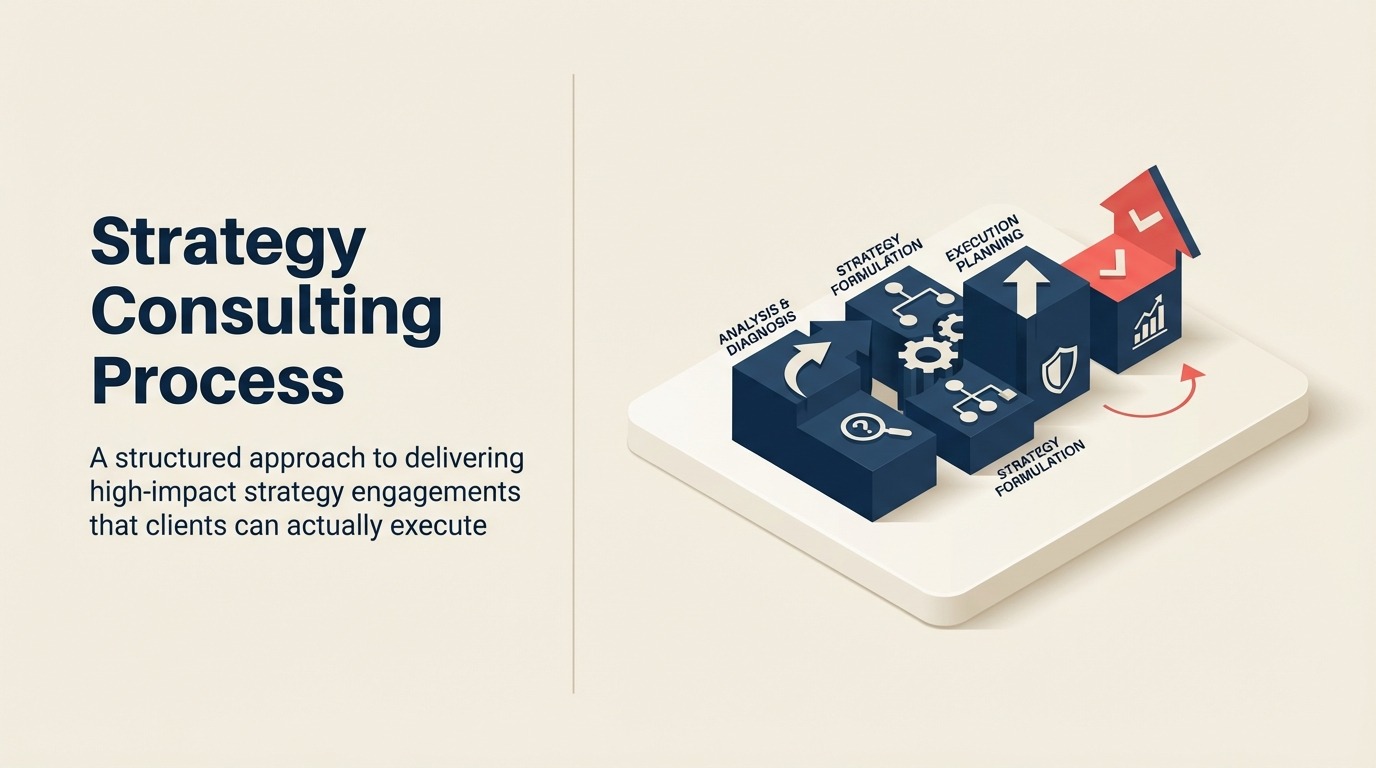
The strategy consulting process runs through five phases: discovery and situation assessment, strategic analysis, strategy development, options analysis and recommendation, and implementation planning. Each phase pairs analytical rigor with client engagement so the final roadmap is something the organization can actually execute, not a deck that sits on a shelf. The sections below break down each phase.
Strategy consulting commands 60-80% margins. Clients pay premium rates because they expect one thing: insights that actually change their business. Not theoretical frameworks. Not 200-slide decks that sit in SharePoint. Real strategic direction that leads to measurable results.
But here's the uncomfortable truth - most strategy projects fail to deliver that value. They produce beautiful analysis, insightful observations, and logical recommendations. Then nothing happens. The strategy sits on a shelf. The organization continues operating exactly as before. And the consulting firm gets blamed for being "too academic" or "not understanding the real business."
The failure usually isn't in the analysis. It's in the process. Strategy consulting succeeds when you combine rigorous analytical frameworks with deep client engagement and implementation reality checks. This guide walks through that proven process, from initial diagnosis through to an executable roadmap.
What makes strategy consulting valuable
Strategy consulting helps clients define direction and make critical decisions about where to compete and how to win. That's the textbook definition. In practice, you're helping executives answer hard questions they've been avoiding or debating internally for months.
Should we enter this new market? Which product lines should we divest? How do we respond to competitive disruption? Where should we allocate our limited capital? These questions carry high stakes and high uncertainty. Executives hire strategy consultants because they need external expertise, analytical rigor, and political neutrality.
The economics work because the impact is large. If your strategy work helps a client capture $50M in new revenue or avoid a $20M strategic mistake, a $500K consulting fee is cheap. But you only earn those fees when you deliver real insight, not generic frameworks.
Types of strategy work - Corporate strategy defines the overall portfolio and direction. Business unit strategy focuses on competitive positioning within a specific market. Functional strategy (sales, operations, technology) aligns support functions with business goals. Growth strategy identifies expansion opportunities and paths to scale. Each type may benefit from different service line strategies.
Engagement models - Most strategy projects are project-based, lasting 8-16 weeks for major engagements. Larger firms sometimes offer retainer advisory relationships where they serve as the ongoing strategy partner. Project-based gives you clear scope and deliverables. Retainer models provide continuity but require demonstrating value every quarter.
The failure modes are predictable: analysis paralysis where you never get to recommendations, recommendations disconnected from implementation reality, insufficient stakeholder buy-in that kills adoption, and generic frameworks that don't account for the client's specific context.
Avoiding those failures requires a structured process that balances analytical depth with practical execution.
Phase 1: Discovery and situation assessment
Strategy work starts by understanding the current state and framing the right questions. You can't recommend direction until you know where the client is today and where they're trying to go.
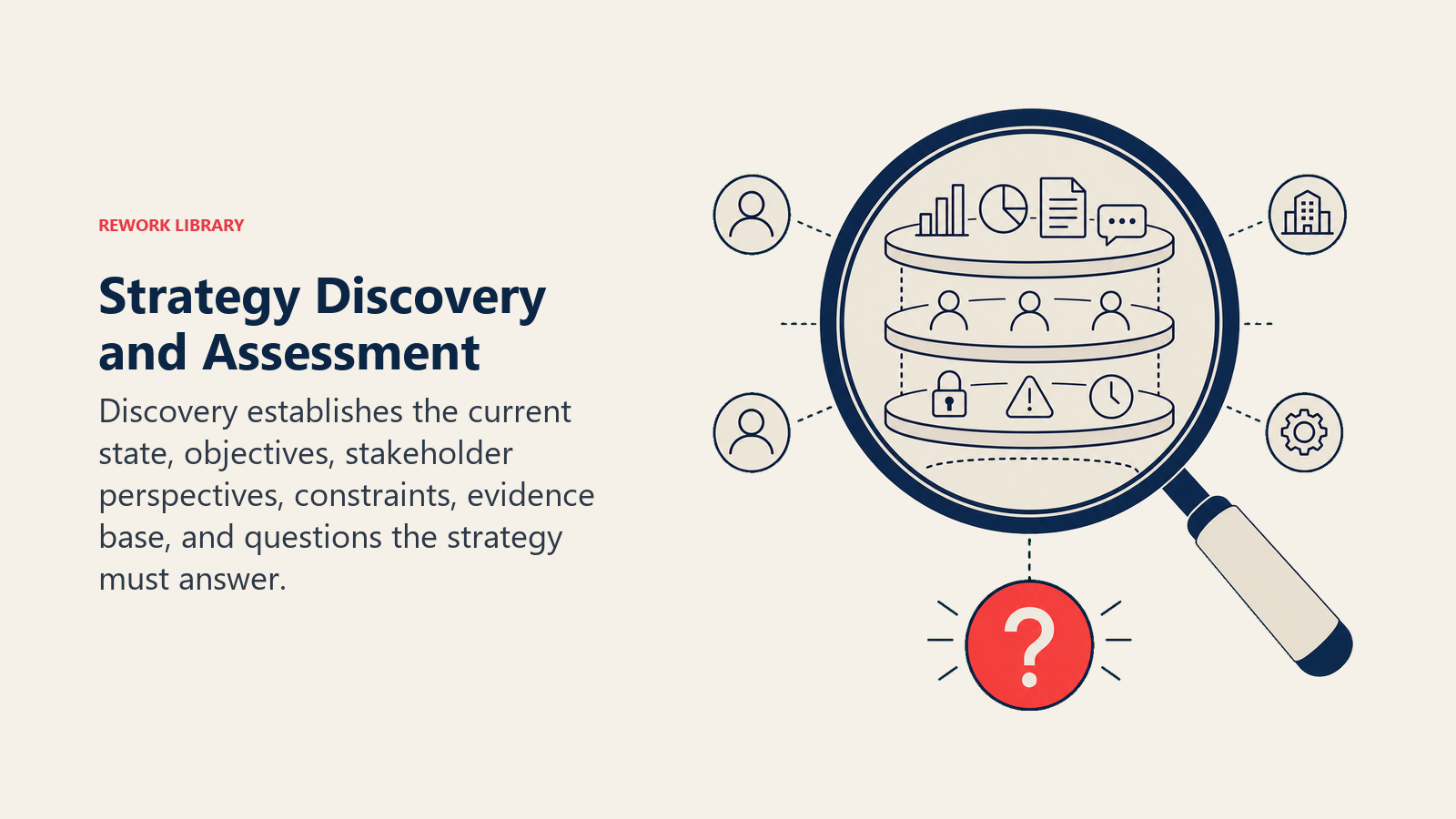
Stakeholder interviews and alignment come first. You need to talk to the CEO, business unit leaders, functional heads, and key board members. Listen for several things - What do they see as the core strategic challenge? Where do they agree and disagree on priorities? What constraints are real versus perceived? What's the underlying political dynamic?
These conversations reveal the actual problem. A client might say "we need a growth strategy" but interviews show the real issue is organizational misalignment on target customers. Or they ask for competitive positioning analysis when the core problem is actually a broken operating model. Get the problem definition wrong and the rest won't matter. This is why client qualification and proper needs assessment are so critical.
Internal data collection means gathering financial performance, customer data, operational metrics, and strategic plans. You want 2-3 years of historical data to spot trends. Revenue by product line, customer segment, geography. Gross margins and contribution margins. Customer acquisition costs and retention rates. Whatever metrics define business performance.
Most clients have this data somewhere, but it's scattered across systems and inconsistencies abound. Budget time to clean and normalize data. And watch for what's missing - if they can't tell you customer profitability by segment, that gap tells you something.
External market and competitive research provides context. Market size and growth rates, competitive landscape and positioning, regulatory environment, technology trends, customer buying behavior shifts. You're building the outside-in view to complement the internal perspective.
Use a mix of sources: industry reports, public company filings, customer interviews, expert networks, and your firm's research databases. The goal isn't to become a subject matter expert in two weeks. It's to understand enough to ask smart questions and spot patterns the client might miss from inside their bubble.
Current state assessment framework organizes findings. Where does the client compete today (markets, segments, geographies)? How do they compete (differentiation, cost leadership, niche focus)? What capabilities enable that positioning (technology, talent, distribution, brand)? What's working and what isn't (growth rates, profitability, market share trends)?
This assessment produces your baseline. You're documenting "here's where you are today" with data-backed clarity. That baseline becomes the starting point for "here's where you could go."
Identifying strategic questions is the output of discovery. You should have 3-5 core questions the strategy needs to answer. "Which of our three business units should receive growth investment?" "Can we defend our market position against digital-native competitors?" "Should we build or buy our way into adjacent markets?"
These questions guide your analysis. Everything you do next should help answer them.
Phase 2: Strategic analysis
Analysis is where you apply frameworks and tools to evaluate options and understand dynamics. Done well, this phase generates insights that weren't obvious at the start. Done poorly, it produces data overload with no clear conclusions.
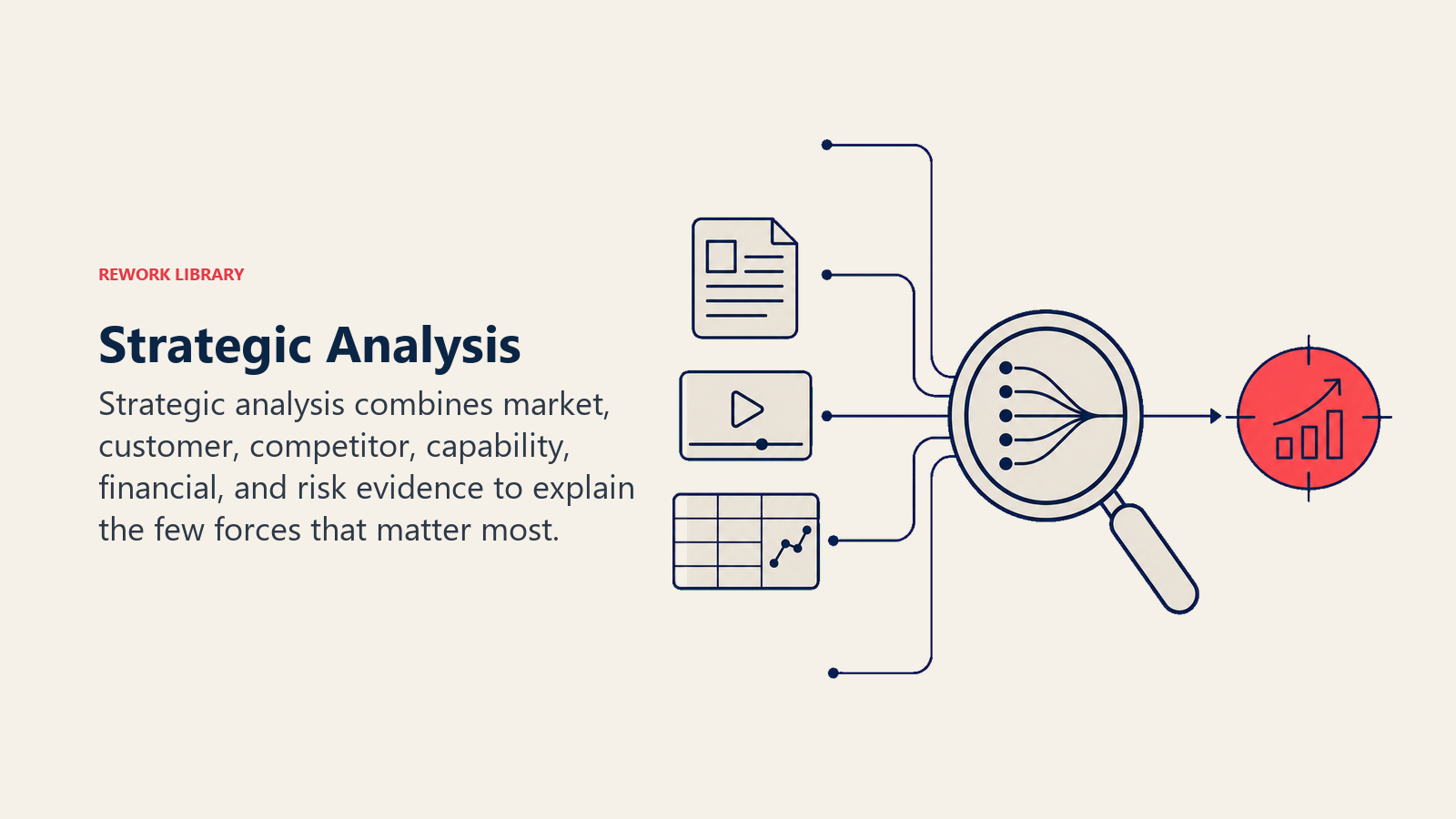
Market attractiveness analysis evaluates which markets or segments are worth competing in. You're assessing size, growth rate, profitability, competitive intensity, and structural trends. A market might be large but if it's declining and commoditized, it's not attractive. A smaller market growing 30% annually with healthy margins could be ideal.
Use the classic attractiveness criteria: market size (total addressable market in dollars), growth rate (historical and projected), profitability (typical margins in the industry), competitive structure (concentrated or fragmented), barriers to entry (how defensible is position once you're in), and customer power (do customers have lots of alternatives and price sensitivity).
Plot markets on an attractiveness matrix. This visual quickly shows "these are your best opportunities" versus "these markets might not be worth the investment."
Competitive positioning assessment examines how the client stacks up against competitors. Who are the real competitors (not just who they think they compete with)? How is the client positioned (premium, value, specialist)? What's the competitive advantage or disadvantage? How sustainable is that position?
You're building competitive profiles: each major competitor's strategy, strengths, weaknesses, recent moves, and likely future direction. This gives you a fact-based view of the competitive landscape versus "we think they're doing X."
Capability gap identification compares what the client needs to win versus what they have. If the strategy requires world-class digital customer experience but their technology is 10 years old and they have no digital talent, that's a critical gap. If international expansion demands local market knowledge but they have no international presence, another gap.
Map required capabilities to current state using a simple rating: strong, adequate, weak, missing. Gaps in the "strong required" quadrant are your biggest implementation risks.
Financial performance analysis digs into unit economics and profitability drivers. Which products or segments are actually profitable? Where are margins declining or improving? What's the return on invested capital by business unit? Where is cash being generated versus consumed?
This analysis often reveals uncomfortable truths. The product line everyone loves might be destroying value. The "strategic" market might have terrible economics. You need this financial clarity before recommending direction.
Framework application is where classic tools come in. SWOT analysis (strengths, weaknesses, opportunities, threats) organizes situational factors. Porter's Five Forces examines competitive intensity and profit potential. Value chain analysis identifies where value is created and captured.
But don't just fill out templates. Use frameworks to generate insight. A SWOT that lists "strong brand" as a strength is useless. A SWOT that identifies "brand strength in traditional channels but weakness in digital-native segments where growth is happening" tells you something actionable.
Identifying strategic options and trade-offs is the goal of analysis. By the end of this phase, you should see 3-5 possible strategic directions. Each option should be grounded in the analysis with clear logic - "Given market dynamics X, competitive position Y, and capability set Z, option A makes sense because..."
You're also surfacing trade-offs. Pursuing growth in market A means less investment in market B. Building organic capabilities takes 3 years, acquiring them costs $50M upfront. Every strategic choice involves saying yes to some things and no to others. Make those trade-offs explicit.
Phase 3: Strategy development
This is where you move from analysis to direction. You're synthesizing everything learned into a coherent strategic vision and set of priorities.
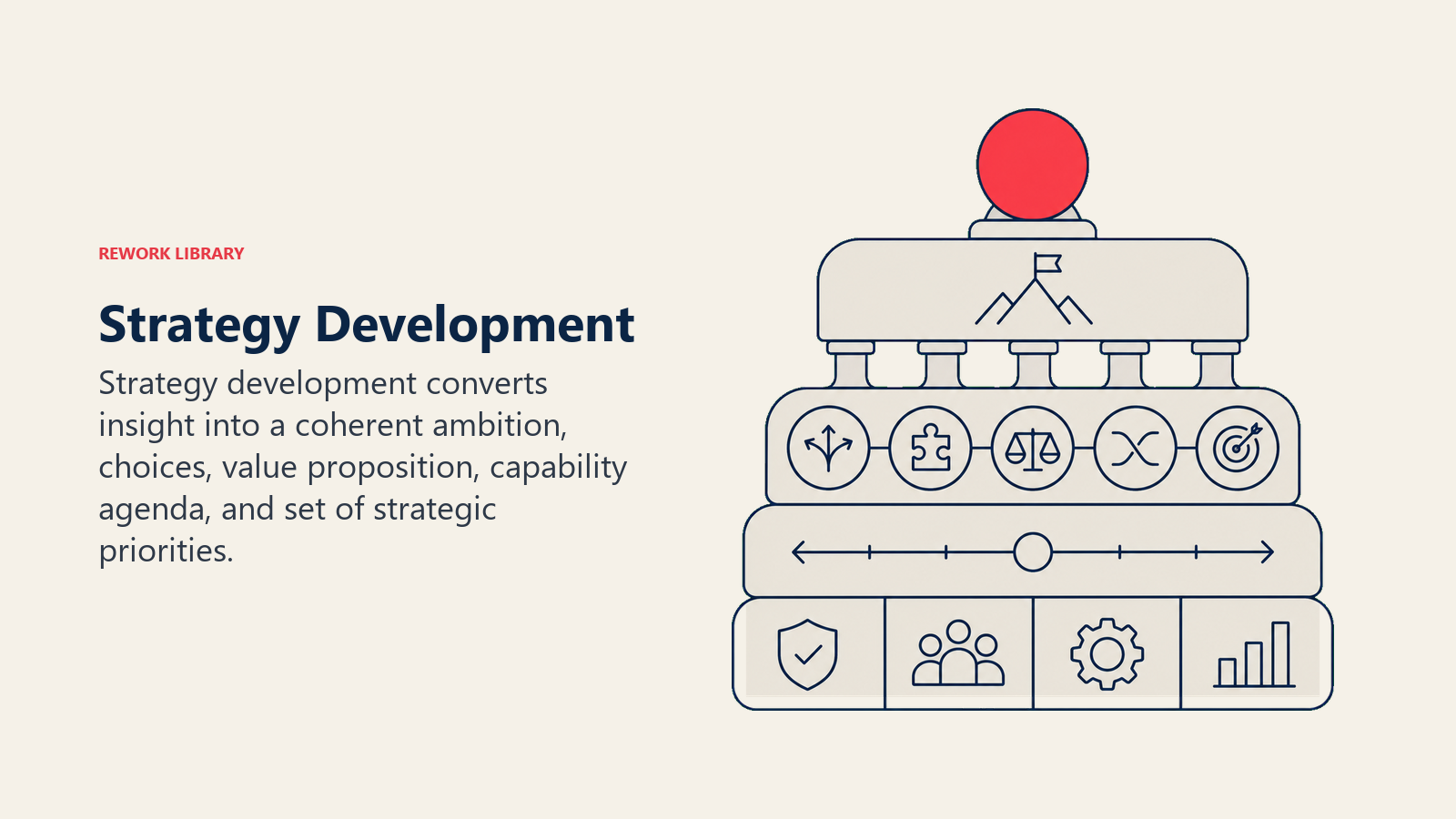
Defining strategic vision and mission creates the aspirational picture. Where should this organization be in 5 years? What markets will they serve? What will they be known for? How will they create value differently than competitors?
Vision statements can be fluffy and useless ("be the leading provider of innovative solutions"). Good vision is specific and motivating: "Become the preferred platform for mid-market manufacturers in North America seeking to digitize their supply chain operations." That's concrete. People can picture it.
Mission connects vision to purpose. Why does this organization exist beyond making money? What customer problem are they solving? Mission should be authentic to the company's history and culture, not corporate word salad.
Setting strategic objectives and goals translates vision into measurable targets. "Achieve $500M revenue by 2027 with 25% EBITDA margins" is an objective. "Capture 15% market share in the industrial automation segment" is an objective. "Launch in three new geographic markets" is an objective.
Objectives should be SMART-ish (specific, measurable, achievable, relevant, time-bound). But don't get lost in goal-setting frameworks. The test is: if the organization achieves these objectives, will they have realized the strategic vision? If yes, they're the right goals.
Identifying strategic initiatives and priorities is the bridge to execution. Initiatives are the major programs required to achieve objectives. Examples: "Build digital commerce platform," "Acquire competitors in fragmented markets," "Restructure go-to-market model around verticals," "Invest in AI-driven product capabilities."
Each initiative should connect clearly to objectives. And you need to prioritize ruthlessly. Most organizations can only execute 3-5 major strategic initiatives at once. More than that and you dilute focus, spread resources too thin, and nothing gets done well.
Developing strategic positioning defines how the company will compete. What's the value proposition to customers? What's the differentiation versus competitors? What's the basis for competitive advantage (cost, differentiation, focus)?
Positioning flows from market dynamics and capabilities. If the analysis shows customers increasingly value speed and convenience over customization, positioning should emphasize operational excellence and streamlined service. If competitors are all going downmarket, positioning might lean into premium segments.
Resource allocation framework determines where capital and talent go. If you have three business units and $50M to invest, how much does each get? That decision should align with strategic priorities. High-potential businesses get growth investment. Cash cows get maintenance capital. Underperforming assets get restructured or divested.
Build a simple resource allocation model that shows investment by initiative or business unit, expected returns, and strategic rationale. This forces discipline and makes trade-offs visible. These financial projections should tie into the broader pricing justification for your consulting work.
Risk assessment and mitigation identifies what could go wrong. Market risks (demand doesn't materialize), competitive risks (rival launches disruptive product), execution risks (can't hire needed talent), and financial risks (costs overrun projections).
For each major risk, define likelihood, potential impact, and mitigation approach. You're not eliminating risk - strategy involves risk. You're ensuring leadership understands what they're signing up for and has thought through responses.
Phase 4: Options analysis and recommendation
You've developed possible strategic directions. Now you need to evaluate them rigorously and recommend the best path forward.
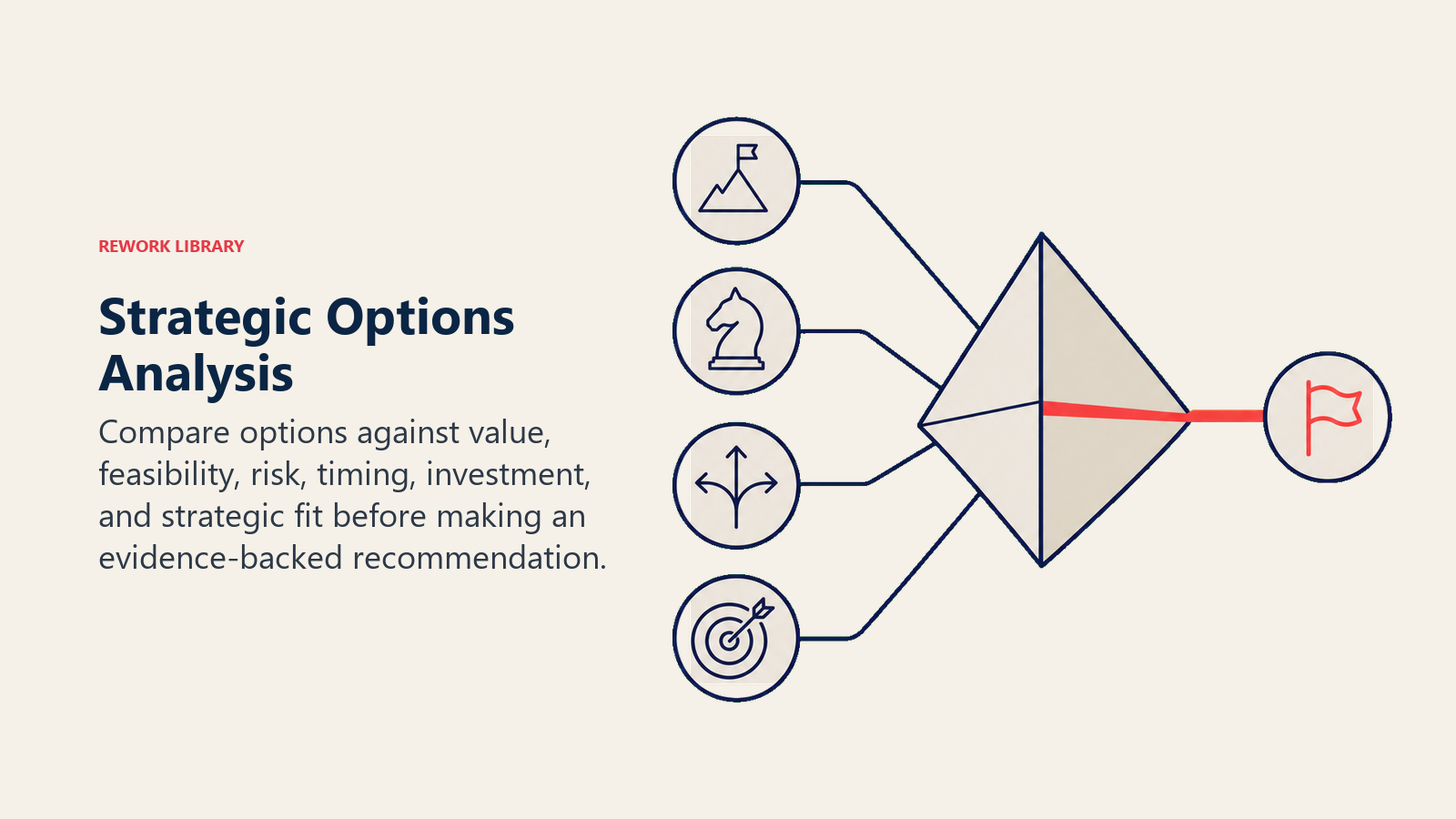
Developing 3-5 strategic options means defining distinct approaches. Option A might be "double down on core market with product innovation." Option B could be "expand to adjacent markets through acquisition." Option C might be "pivot to new customer segment with existing capabilities."
Each option needs to be fleshed out: What markets would we compete in? What's the competitive positioning? What initiatives are required? What investment is needed? What returns can we expect? How long does it take?
Options should be meaningfully different, not minor variations. And include a "status quo" option as a baseline: what happens if we keep doing what we're doing?
Evaluating options against criteria provides structured comparison. Common criteria include financial returns (NPV, IRR, payback period), strategic fit (alignment with vision and capabilities), risk level (execution difficulty and market uncertainty), time to results (how quickly does this generate returns), and organizational feasibility (can this organization actually pull this off).
Build a scoring matrix that rates each option against criteria. This isn't about mathematical precision - a 7.2 versus 7.4 doesn't matter. It's about making evaluation transparent and forcing hard conversations about trade-offs.
Scenario planning and sensitivity analysis tests how options perform under different futures. What if the market grows half as fast as expected? What if a competitor launches a disruptive product? What if costs run 30% higher?
Run scenarios on key assumptions: market growth rates, competitive response, execution timelines, and cost structures. Options that only work in the optimistic case are risky. Options that still deliver acceptable returns in the downside case are more robust.
Sensitivity analysis shows which assumptions matter most. If a 10% change in price assumptions makes the strategy fail, pricing is a critical variable that needs attention. If market size estimates can vary 50% and the strategy still works, you have buffer.
Recommended strategy with rationale is the heart of your deliverable. Based on analysis and evaluation, which option do you recommend and why?
Your recommendation needs clear logic: "We recommend Option B (geographic expansion through acquisition) because: 1) Core market is mature with 2% growth while target markets grow 15% annually, 2) Client has strong products but weak distribution in new markets - acquisition solves that, 3) Financial modeling shows 25% IRR with acceptable risk, 4) Competitive window is closing as rivals eye the same markets."
Be direct. Clients hire you to have a point of view, not to say "here are options, you decide." You can acknowledge uncertainty and present alternatives, but make a recommendation.
Expected outcomes and business case quantifies what success looks like. Over three years, we expect this strategy to generate $X in incremental revenue, $Y in profit improvement, and Z basis points of market share gain. Here's the investment required and the return profile.
Build a detailed financial model that shows year-by-year revenue, costs, profits, and cash flow. Include assumptions and sensitivities. CFOs will tear apart your numbers - make sure they're grounded in reality and defensible.
The business case should also include non-financial outcomes: competitive position improvement, capability development, organizational transformation. Strategy isn't only about financial returns, but you need to prove financial viability.
Phase 5: Implementation planning
The best strategy fails without an execution plan. This phase translates strategic direction into an actionable roadmap.
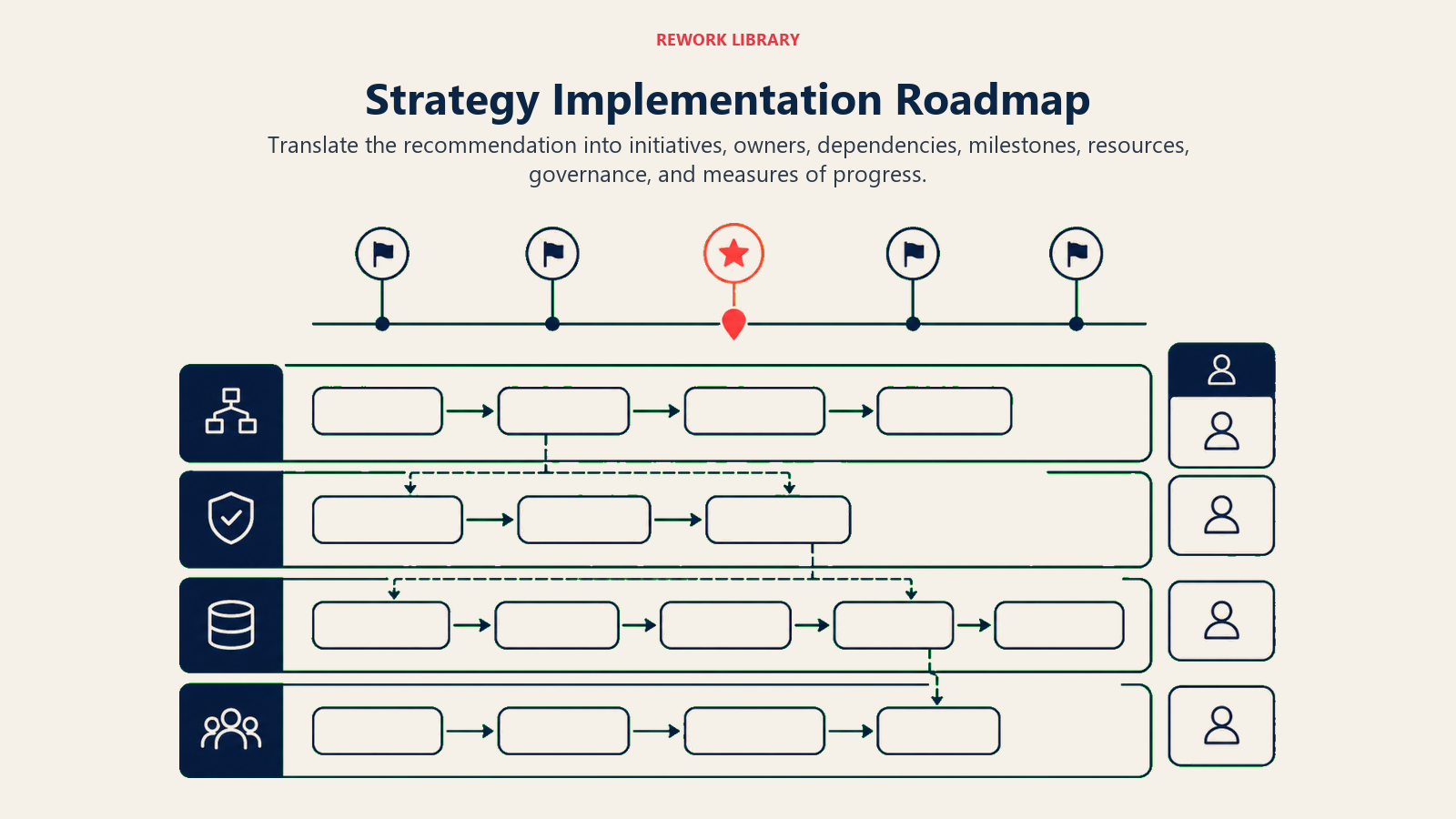
Strategic roadmap development creates a 12-36 month timeline showing what happens when. Phase 1 might be "build foundational capabilities and launch pilot programs" (months 1-6). Phase 2 could be "scale successful pilots and enter new markets" (months 7-18). Phase 3 might be "optimize operations and drive profitability" (months 19-36).
Map major milestones: product launches, market entries, organizational changes, technology implementations, partnership agreements. The roadmap should show how initiatives build on each other and where dependencies exist.
Initiative prioritization and sequencing determines what happens first. Some initiatives must come early because others depend on them. You can't launch in new markets until you've built the distribution capability. You can't scale digitally until you've implemented the technology platform.
Other priorities are about resource constraints. If the organization can only handle two major initiatives at once, sequence the rest. Quick wins that build momentum often make sense early. Foundation-building that takes time might need to start now even if payoff comes later.
Resource requirements and organizational design defines what the organization needs to execute. How many people in what roles? What budget by quarter? What technology and systems? What external partnerships or vendors?
This is also where you address organizational structure. Does the current structure support the strategy or fight it? If the strategy requires cross-functional collaboration but the structure creates silos, you need to redesign. If the strategy emphasizes customer segments but the organization is product-centric, that's a mismatch.
Don't reorganize just to reorganize, but don't ignore structural barriers to execution.
Change management and adoption planning acknowledges that strategy requires people to work differently. What mindset shifts are needed? What skills must people develop? How do you build buy-in across the organization?
Identify change resistance sources: people whose roles change, teams that lose resources, leaders who disagree with direction. You need a plan to address each source - communication, involvement, incentives, training, or tough conversations.
Classic change management applies: create urgency, build a coalition, communicate vision, empower action, generate short-term wins, and consolidate gains. But customize to this organization's culture and situation.
Governance and decision-making framework defines who decides what and how progress gets monitored. Create a steering committee with executive sponsors. Define decision rights - what can the project team decide versus what needs steering committee approval versus what needs board input.
Establish cadence: weekly team meetings, monthly steering committee reviews, quarterly board updates. Standardize reporting so everyone knows how to track progress and surface issues.
Without governance, strategic initiatives drift. With too much governance, they bog down in meetings. Find the right balance for this organization.
KPIs and measurement framework defines how you'll know if the strategy is working. Leading indicators track progress (number of pilots launched, new customer acquisitions, capability development milestones). Lagging indicators measure outcomes (revenue growth, market share, profitability improvement).
Be specific: not "increase customer satisfaction" but "achieve NPS of 50+ by Q4." Not "improve profitability" but "reach 22% EBITDA margin by year-end." These metrics become the foundation for tracking success against your professional services metrics.
Build a simple dashboard that tracks 8-12 key metrics. Share it monthly. When metrics are off track, investigate why and adjust. KPIs create accountability and enable course correction before small problems become big failures.
Client engagement throughout the process
Strategy consulting isn't something you do to a client. It's something you do with them. The best strategy work involves deep client engagement at every phase.
Stakeholder alignment workshops bring key leaders together to debate and decide. After initial discovery, run a workshop to align on the strategic questions you're answering. After analysis, facilitate discussion of findings and implications. Before final recommendations, workshop the options to surface concerns and build buy-in.
These sessions are where the real work happens. A two-hour workshop where executives wrestle with trade-offs and make hard choices creates more value than a perfect deck delivered cold.
Regular steering committee updates keep sponsors informed and engaged. Weekly or biweekly, share progress, emerging findings, and issues needing input. Don't save everything for the final presentation - involve them throughout.
Steering committee meetings are also where you test thinking. "We're seeing these patterns in the data. Does that match your experience?" "We're leaning toward this recommendation. What concerns do you have?" Course correct early based on their input.
Working sessions for co-creation mean collaborating with client team members on analysis and development. Don't operate as a separate consulting team that shows up with answers. Embed in their organization. Work alongside their strategy team, finance analysts, and business unit leaders.
Co-creation builds capability transfer. They learn your frameworks and approaches. They own the strategy because they helped build it. And you get better results because you tap into their deep organizational knowledge.
Presentation and communication approach matters as much as content. Tailor your message to the audience. The board needs high-level strategic direction and financial implications. The executive team needs that plus details on initiatives and organization impacts. Middle managers need clarity on how this affects their teams.
Use storytelling, not just slides. Start with the strategic challenge, walk through what you learned, show why your recommendation makes sense, paint the picture of what success looks like, and outline the path to get there. Make it compelling, not just logical.
Managing political dynamics is an unavoidable part of strategy work. Different executives have different agendas. Business units compete for resources. Past strategic initiatives created winners and losers. Your recommendations might threaten someone's empire or validate someone's long-held position.
You can't ignore politics, but you can navigate them professionally. Stay neutral and data-driven. Acknowledge differing perspectives without taking sides. Facilitate healthy debate while shutting down unproductive conflict. Use your external position to say hard truths that internal people can't.
Deliverables and documentation
At the end of the engagement, you need clear, actionable deliverables that the client can use to drive execution.
Situation assessment report documents the current state analysis. This is typically 20-40 pages covering market dynamics, competitive landscape, financial performance, capability assessment, and strategic challenges. Include supporting data and analysis in appendices.
This report becomes the baseline reference. When people question strategic direction, you point back to the situation assessment: "Here's why we concluded the core market is maturing."
Strategic analysis deck presents findings from the analysis phase. Market attractiveness, competitive positioning, financial modeling, scenario analysis, option evaluation. This is usually 50-80 slides with detailed backup.
The analysis deck is your evidence. It shows the work behind recommendations and provides depth for people who want to dive into specifics.
Strategy recommendation presentation is the executive summary for leadership and board. 30-40 slides maximum, often less. Open with strategic context, present your recommendation with clear rationale, show expected outcomes and business case, outline implementation approach, address risks and mitigation.
This deck needs to tell a story that a busy executive can absorb in 45 minutes. Every slide should advance the narrative. If you can't explain why a slide is essential, cut it.
Implementation roadmap is the execution guide. Timeline with phases and milestones, prioritized initiatives with owners and resources, quick wins for the first 90 days, organizational changes required, and governance structure. This should be practical enough that a program manager can use it to drive execution.
Business case and financial model quantifies the strategy in a detailed Excel model. Revenue projections by business unit or initiative, cost structures and investment requirements, P&L impact by year, cash flow and working capital needs, key assumptions and sensitivities. CFOs will scrutinize this, so make sure the math works and assumptions are defensible.
Executive summary for board/leadership distills everything into 5-10 pages. Strategic recommendation, key supporting points, expected outcomes, investment required, major risks, implementation timeline. Board members don't have time to read 200 pages. Give them the essence.
Common strategy consulting pitfalls
Even experienced consultants fall into predictable traps. Watch for these failure modes.
Analysis paralysis without clear recommendations - You've done brilliant analysis, but when it's time to recommend direction, you hedge. "Option A has these benefits, Option B has these benefits, here are considerations for choosing." That's not strategy consulting, that's analysis consulting. Clients pay you to take a position. Make the call.
Recommendations disconnected from implementation reality - Your strategy looks perfect on paper but ignores that this client has limited digital talent, a risk-averse culture, and systems held together with duct tape. Strategy that can't be executed isn't strategy, it's fantasy. Ground recommendations in organizational reality.
Insufficient stakeholder buy-in - You worked with the CEO and strategy team, but didn't engage business unit leaders or the CFO until final presentation. Now they're poking holes and blocking progress because they weren't involved. Build coalition throughout the process, not at the end.
Ignoring organizational culture and politics - The logical answer is to consolidate three business units, but the heads of those units are powerful executives who'll sabotage anything that threatens their autonomy. You can't ignore culture and politics. Address them head-on or design around them.
Generic frameworks without customization - You've applied the same Porter's Five Forces and BCG Matrix to every client. The analysis feels paint-by-numbers and the insights are generic. Frameworks are tools, not answers. Customize them to the specific situation and go deeper where it matters for this client.
Overly complex strategies that can't be executed - Your strategy involves 12 major initiatives across 8 different markets with interdependencies that require a Gantt chart to understand. Nobody can execute that. The best strategies are simple and focused - "We're going to own this segment by being better at these three things." Complexity is the enemy of execution.
Tools and frameworks reference
Here are the core frameworks and tools you'll use throughout the strategy process.
Strategic frameworks: Porter's Five Forces (competitive intensity analysis), BCG Growth-Share Matrix (portfolio prioritization), Ansoff Matrix (growth strategy options), Blue Ocean Strategy (value innovation), Core Competence framework (capability-based strategy).
Analysis templates: Market sizing and attractiveness scoring, competitive positioning maps, SWOT analysis grids, value chain diagrams, capability heat maps, financial modeling templates.
Stakeholder mapping and engagement plans: Power/interest matrices for identifying key stakeholders, influence maps showing relationships and politics, engagement planning templates for involvement strategy.
Financial modeling and business case templates: Three-statement models (P&L, balance sheet, cash flow), scenario analysis frameworks, NPV and IRR calculators, sensitivity analysis tools.
Implementation roadmap formats: Gantt charts for timeline visualization, initiative charters for project definition, RACI matrices for role clarity, dashboard templates for KPI tracking.
Don't get religious about frameworks. They're mental models that organize thinking and analysis. Use what works for the situation. The best consultants know when to apply classic frameworks and when to develop custom approaches.
Frequently Asked Questions
What are the phases of the strategy consulting process?
There are five: discovery and situation assessment (understand the current state and frame the right questions), strategic analysis (apply frameworks to evaluate options), strategy development (set vision, objectives, and initiatives), options analysis and recommendation (score alternatives and pick one), and implementation planning (turn the strategy into a phased roadmap with governance and KPIs).
How long does a strategy consulting engagement take?
Most project-based strategy engagements run 8-16 weeks for major work. Smaller diagnostics can be shorter, while retainer advisory relationships are ongoing but require demonstrating value each quarter. The timeline depends on the number of strategic questions, data availability, and how much stakeholder alignment is needed.
Why do strategy projects fail to deliver value?
The failure is usually in the process, not the analysis. Common causes are analysis paralysis without a clear recommendation, recommendations disconnected from implementation reality, insufficient stakeholder buy-in, ignoring culture and politics, and generic frameworks applied without customization to the client's situation.
What frameworks are used in strategy consulting?
Core tools include Porter's Five Forces for competitive intensity, the BCG Growth-Share Matrix for portfolio prioritization, the Ansoff Matrix for growth options, value chain analysis, and SWOT. The point is to use them to generate insight, not to fill in templates.
What deliverables come out of a strategy engagement?
Typical deliverables are a situation assessment report, a strategic analysis deck, a strategy recommendation presentation, an implementation roadmap, a business case with a financial model, and a short executive summary for the board.
Where to go from here
Strategy consulting is high-stakes work that requires both analytical rigor and practical judgment. The process outlined here gives you a structured approach, but execution requires adapting to each client's unique situation.
The key is balancing three elements: analytical depth that generates real insight, client engagement that builds buy-in and ownership, and implementation focus that turns strategy into results.
Related resources that complement strategy consulting:
- Consulting Engagement Models - How to structure and price strategy work
- Needs Assessment & Discovery - Techniques for the diagnostic phase
- Proposal Development - How to win strategy engagements
- Workshop Facilitation - Running effective strategy sessions
- Implementation Consulting - Taking strategy through to execution
Start with a clear process, involve clients deeply, make bold recommendations grounded in analysis, and build roadmaps that people can actually execute. That's how strategy consulting creates value worth premium fees.

Sales Director
On this page
- What makes strategy consulting valuable
- Phase 1: Discovery and situation assessment
- Phase 2: Strategic analysis
- Phase 3: Strategy development
- Phase 4: Options analysis and recommendation
- Phase 5: Implementation planning
- Client engagement throughout the process
- Deliverables and documentation
- Common strategy consulting pitfalls
- Tools and frameworks reference
- Frequently Asked Questions
- Where to go from here