Tax Season Client Acquisition: Seasonal Marketing, Capacity Management, and Year-Round Conversion
 Tax season creates the ultimate professional services paradox: unlimited demand meets limited capacity. Between January and April, accounting firms can acquire more clients in 16 weeks than they typically get in the other 36 weeks combined. But here's the problem: most firms treat this surge like a burden instead of an opportunity.
Turn this article into takeaways for your work.


Each assistant summarizes the article only for you and suggests best practices for your work.
The average tax practice turns away 30-40% of January inquiries because they're already at capacity. Then they spend the rest of the year scrambling for work. This isn't just a scheduling problem. It's a strategic failure to think beyond April 15th.
This guide shows you how to approach tax season as a client acquisition engine, not just a revenue spike. You'll learn to market effectively when competition is fierce, manage capacity without burning out your team, and convert one-time tax filers into year-round advisory relationships.
The tax season acquisition cycle
Tax season follows a predictable pattern, but most firms only activate marketing during the panic phase when it's too late to be strategic. Pre-season (August-December): This is when smart firms build their pipeline. While competitors are quiet, you're capturing leads who want to plan ahead and avoid the rush. These are often your best clients: organized, willing to pay premium rates for early attention, and open to year-round services.
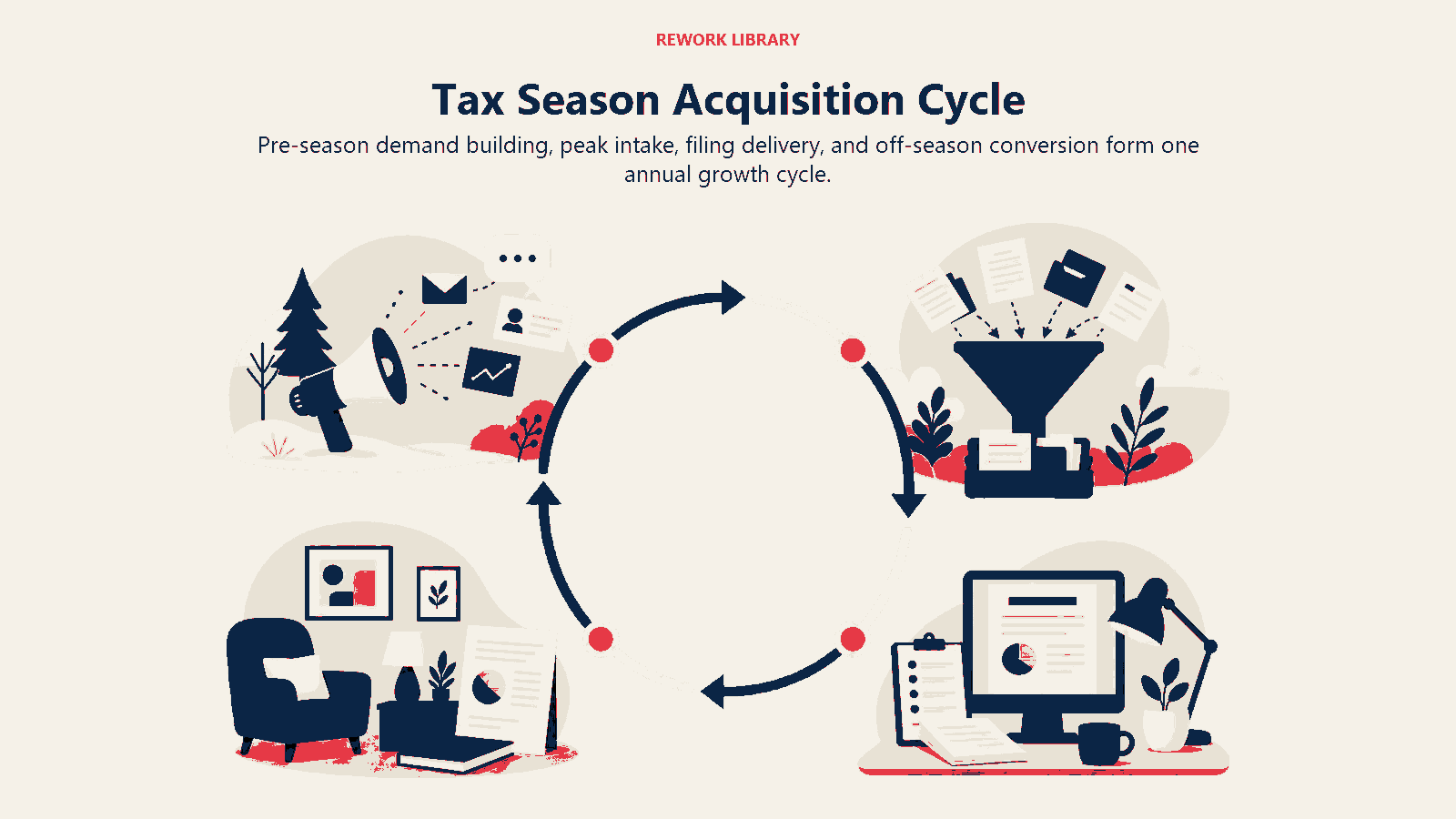
Peak season (January-March): The flood hits. Search volume spikes 400% for "tax preparation near me." Everyone wants help now. Prices compress because competitors are desperate to fill capacity. Quality varies wildly as procrastinators and deal-hunters dominate the market.
Post-filing (April-June): The cliff. Inquiries drop 80% overnight. Firms that didn't build year-round relationships face months of slow work until next season.
The firms that win play the long game. They use pre-season to capture premium clients, peak season to fill remaining capacity strategically, and post-filing to convert seasonal clients into ongoing relationships. This approach aligns with the broader accounting firm growth strategy of building advisory-focused practices.
Client types during tax season: You'll see three distinct segments. Individual filers are high-volume, low-complexity, and price-sensitive. Small business owners need returns but often need bookkeeping, payroll, and advisory services too (your conversion targets). High-net-worth individuals require specialized expertise, pay premium rates, and value year-round tax planning.
The competitive landscape: From January to March, you're competing with H&R Block storefronts, independent CPAs, online DIY tools like TurboTax, and unlicensed preparers who undercut everyone. Your differentiation can't just be "we do taxes." It has to be expertise, service quality, or strategic value that justifies your rates.
Pre-season marketing (August-December)
August through December is when you build your foundation. While most firms coast, you're capturing the best clients before they even think about filing season. Positioning and messaging: Your pre-season pitch isn't "file early to avoid the rush" (though that's part of it). It's about control and planning. Position early tax preparation as strategic: "Get your return done in November, know exactly what you owe, and have five months to plan your payment or refund strategy."

For businesses, the message shifts to year-end planning: "Your Q4 decisions affect your tax liability. Let's plan together before the year closes." This positions you as advisor, not just compliance processor.
Content marketing for lead generation: Start publishing tax planning content in September. Write about year-end tax moves, deduction strategies, changes in tax law for the upcoming year, and estimated payment deadlines. This content ranks in Google before the January rush when competition for those keywords explodes.
Host webinars on tax planning topics in October and November. "5 Year-End Moves to Reduce Your 2024 Tax Bill" attracts business owners who need help beyond basic filing. You're building relationships before they need returns prepared.
Lead capture mechanisms: Create tools that generate leads naturally. A tax refund estimator on your website captures contact info from people trying to forecast their situation. A deductions checklist for small businesses does the same.
Offer a free "tax readiness review" in November and December. It's a 20-minute consultation where you identify missing documents, flag potential issues, and quote your services. This converts leads while they still have time to get organized.
Digital advertising: Run Google Ads starting in October for terms like "tax planning," "year-end tax strategies," and "CPA near me." Your cost per click will be 60% lower than January rates. On Facebook and LinkedIn, target business owners and high-income professionals with content offers and early-bird discounts.
Build retargeting audiences from your website traffic. When these people search for tax help in January, your ads are waiting.
Peak season onboarding (January-March)
When the flood hits, you need systems to handle volume without chaos. Lead response and qualification: Speed matters. Someone searching for tax help on January 10th is contacting five firms. The first to respond with clarity gets the business. Set up automated responses that acknowledge inquiries within 15 minutes, outline your process, and link to scheduling.

Qualify fast. Your intake form should collect enough info to determine complexity: employment type (W-2, 1099, business), income level, filing situation (simple, rental property, investment income), and preferred service tier. This lets you route leads appropriately instead of wasting discovery calls on bad fits.
Initial consultation strategy: Don't do free consultations in January unless you're desperate. Your time is too valuable. Instead, offer a paid "tax situation review" for $150-200. You'll assess their complexity, provide a quote, and give preliminary advice. If they hire you, credit the fee toward their return.
This accomplishes two things: it filters out price shoppers who'll waste your time, and it positions you as an expert worth paying for advice.
Conversion techniques: During that initial conversation, identify upsell opportunities. Do they have rental properties? Flag that you offer ongoing bookkeeping and advisory. Are they self-employed? Mention quarterly tax planning and estimated payment help.
But don't oversell in January. Plant seeds: "I noticed you had some investment income. After we finish your return, we should talk about tax-loss harvesting strategies for next year." Now you have a natural reason to follow up in May.
Managing capacity during peak: You need clear capacity rules. Define how many returns your team can handle weekly without overtime, and stop accepting clients when you hit that limit. Sounds obvious, but firms routinely overcommit, deliver poor service, and burn out staff.
Create service tiers based on complexity and deadlines. Premium tier (higher fee) guarantees completion by February 28th. Standard tier (normal fee) guarantees completion by March 31st. Budget tier (lower fee) gets done by April 10th, no exceptions. This lets you manage workflow and charge appropriately for rush jobs.
Capacity management
Capacity planning separates sustainable firms from those that crash and burn every April. Forecasting and staffing: Look at last year's client count and project 10-20% growth. Break that down by service tier (individual, small business, complex). Calculate hours per return type based on historical data. Now you know total capacity needed.
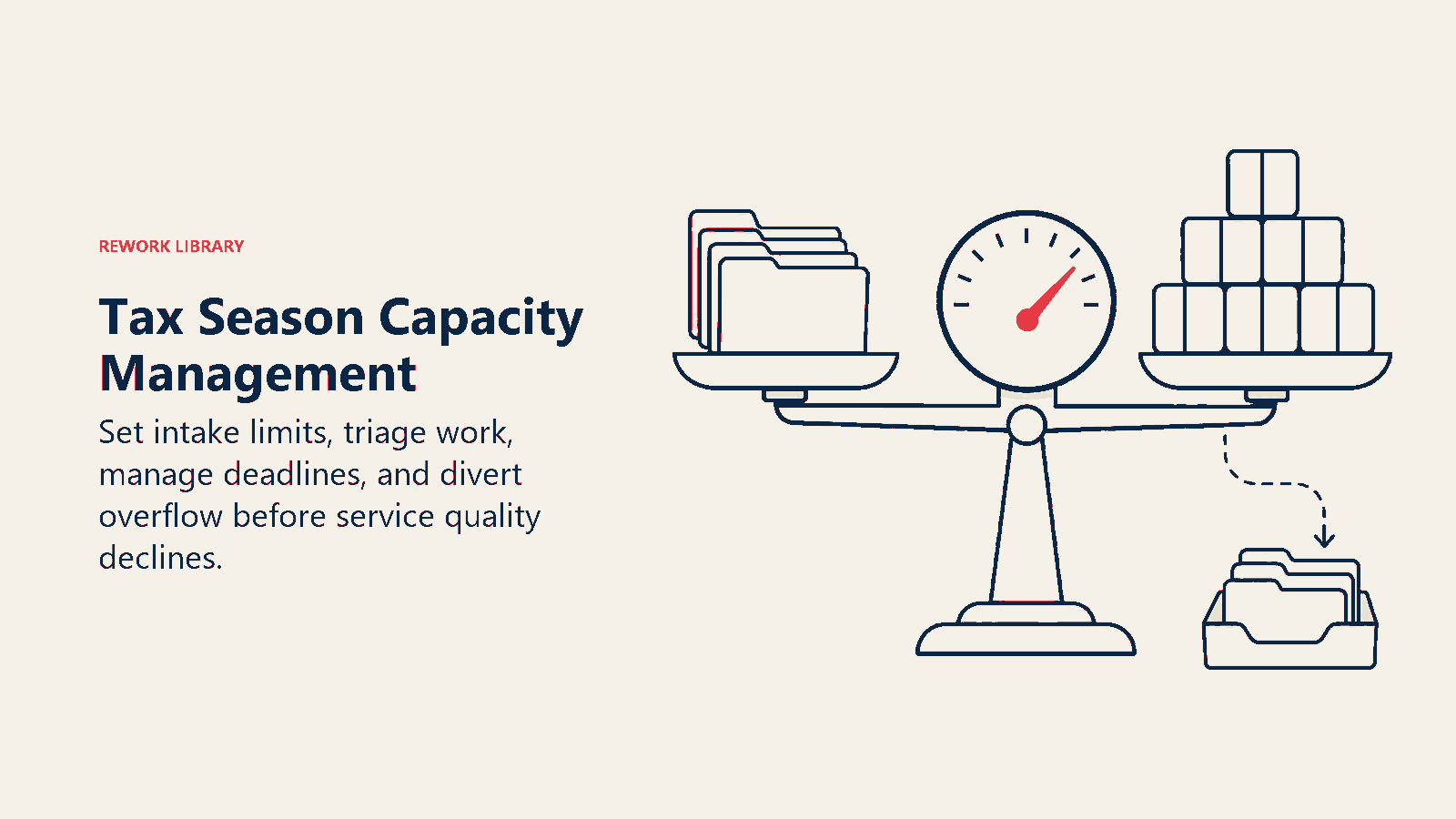
If you're short, your options are hiring (expensive), outsourcing (risky), or limiting intake (strategic). Most firms should limit intake rather than compromise quality trying to serve everyone.
Service delivery optimization: Standardize everything you can. Create checklists for each return type. Use client portals for document collection instead of email chaos. Batch similar returns together so preparers aren't context-switching between simple W-2s and complex partnership returns.
Automate status updates. Clients don't need to call asking "where's my return?" if they get automatic emails when you receive their docs, when preparation starts, when review is complete, and when it's ready to file.
Managing expectations: Be ruthlessly clear about timelines. If someone submits documents on March 20th, they're not getting a review before filing. You'll prepare accurately, but they won't have time for tax planning conversations. Make this explicit upfront.
Tell clients what you need and when. "Submit all documents by February 15th for standard tier completion." If they miss deadlines, they move to budget tier or get pushed to extension. Don't let their procrastination become your crisis.
Seasonal hiring strategies: Bringing on temp staff for tax season works if you start early. Recruit in November, train in December, and have them productive by mid-January. Look for recent accounting grads, retired CPAs who want part-time work, or experienced preparers moonlighting.
The mistake is hiring in January when you're already drowning. By then, the good people are taken and you're stuck training someone while simultaneously trying to serve clients.
Converting tax clients to year-round relationships
Tax prep is a foot in the door. The real money is in advisory, bookkeeping, payroll, and planning services that generate recurring revenue. This transition is the core focus of advisory services expansion. Strategic positioning during engagement: The conversion starts during tax preparation. As you review their return, identify issues that need ongoing attention. "You paid $8,000 in estimated taxes but still owed $3,000 at filing. Let's set up quarterly check-ins so you're never surprised again."
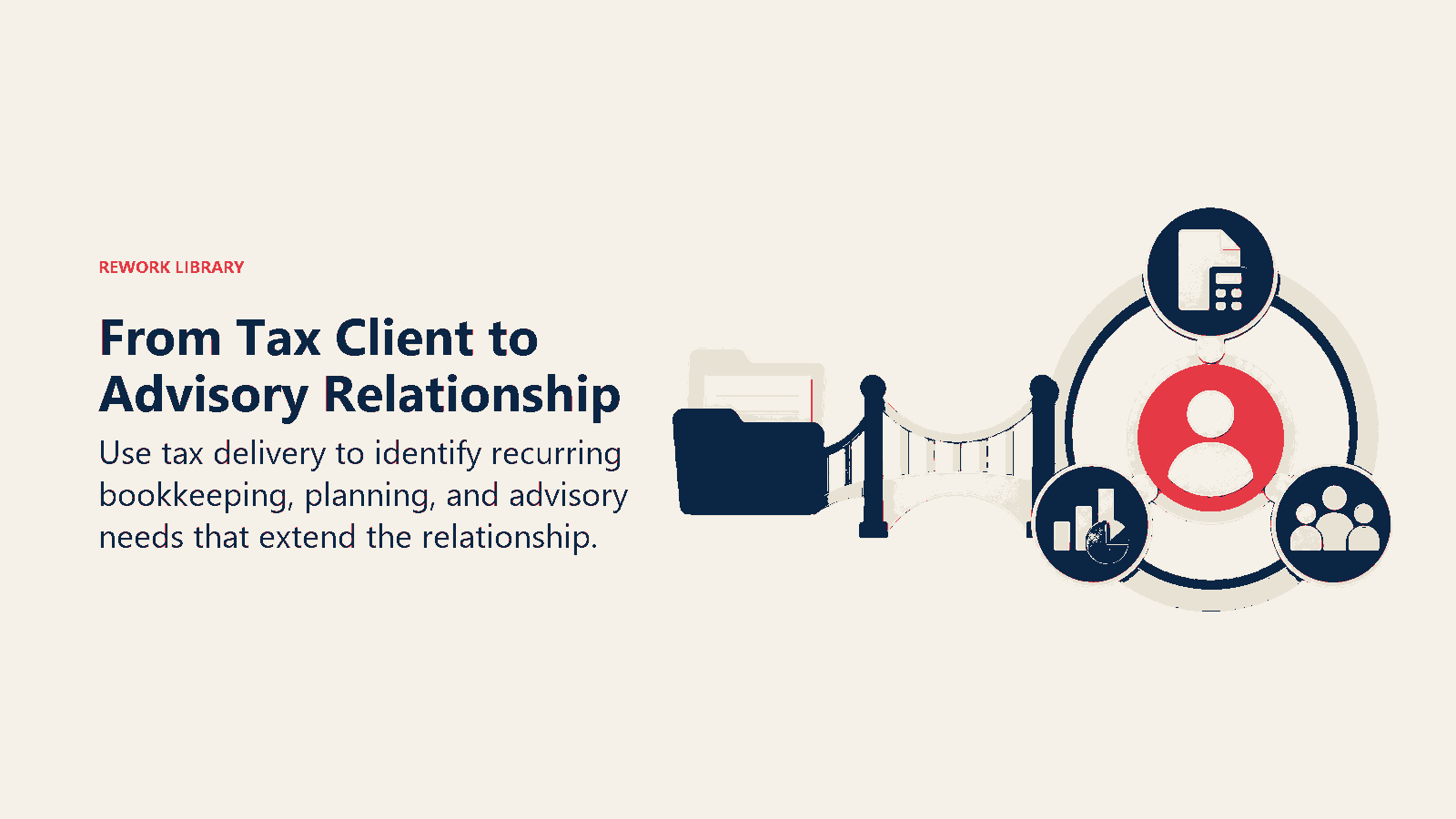
For business owners, notice problems in their bookkeeping: "Your books show irregular categorization and missing receipts. We should talk about monthly bookkeeping support to avoid these issues."
You're not selling. You're observing problems that cost them money or stress and offering solutions.
Value-added services for expansion: The services that work best for conversion are those that solve pain points uncovered during tax prep:
- Quarterly tax planning calls to optimize estimated payments
- Monthly or quarterly bookkeeping to keep records clean year-round
- Payroll processing tied to employment tax compliance
- Financial statement preparation for bank or investor requirements
- Entity structure consulting for business owners who've outgrown their current setup
- Retirement plan setup and management
Each of these creates regular touchpoints and ongoing revenue.
Post-tax season follow-up: In May and June, reach out to every tax client with a personalized observation from their return. "I noticed your business grew 40% last year. As you scale, let's discuss whether your current entity structure still makes sense."
This isn't a generic email blast. It's specific, relevant, and helpful. You're demonstrating that you paid attention and see opportunities to help them beyond basic compliance.
Conversion tactics and bundling: Offer bundles that make year-round services feel like natural extensions. "Tax Return + Quarterly Planning" at a package price. "Business Return + Monthly Bookkeeping" with the bookkeeping paying for itself through better deductions.
Give them a reason to decide now: "If you sign up for quarterly planning by June 30th, we'll credit your tax prep fee toward the annual package." Create urgency without being pushy.
Pricing strategy
Tax season pricing is more art than science, but a few principles hold true. Seasonal pricing models: Should you charge more during peak season? Depends on positioning. Premium firms charge flat rates year-round, emphasizing consistent service. Volume firms use early-bird discounts (10% off if you file in November-December) and rush fees (20% premium for submissions after March 1st).

The discount approach works if you want to shift demand to off-peak times and reward planning. The premium approach works if you're capacity-constrained and want to filter for clients who value speed.
Bundling and upselling: Your base tax prep price should be competitive but not the lowest. You make money on add-ons: state returns, amended returns, prior year catch-up, audit support, tax planning consultations.
Bundle strategically. "Complete Business Package" includes federal return, state return, quarterly tax planning, and year-end strategy session for one price. It sounds premium but costs less than buying each separately. You lock in recurring revenue and the client feels they're getting value.
Retention pricing: Returning clients should get better terms than new clients, not worse. Offer "client loyalty rates" or lock in pricing for multi-year commitments. "Sign a 3-year tax and advisory agreement and your rate won't increase."
This rewards loyalty and creates predictable revenue. You'd rather have 100 clients at $2,000 each on 3-year agreements than 150 one-time clients at $1,500.
Pricing communication: Be transparent. Put your pricing on your website, at least in ranges. "Individual returns start at $300. Small business returns start at $800." This filters out people looking for $99 returns and attracts those who understand value.
When quoting, break down what's included: "Your $1,200 fee includes federal and state return, unlimited questions during preparation, two revision rounds, and e-filing. Additional state returns are $150 each. Tax planning consultation is $250/hour if needed."
Clarity builds trust. Mystery pricing creates anxiety.
Marketing channels and tactics
You need multiple channels working together. No single tactic will fill your pipeline. Digital channels: Google search ads for high-intent keywords ("CPA near me," "small business tax preparation," "accountant for rental property") starting in October. Your cost per lead will be $30-80 depending on market.
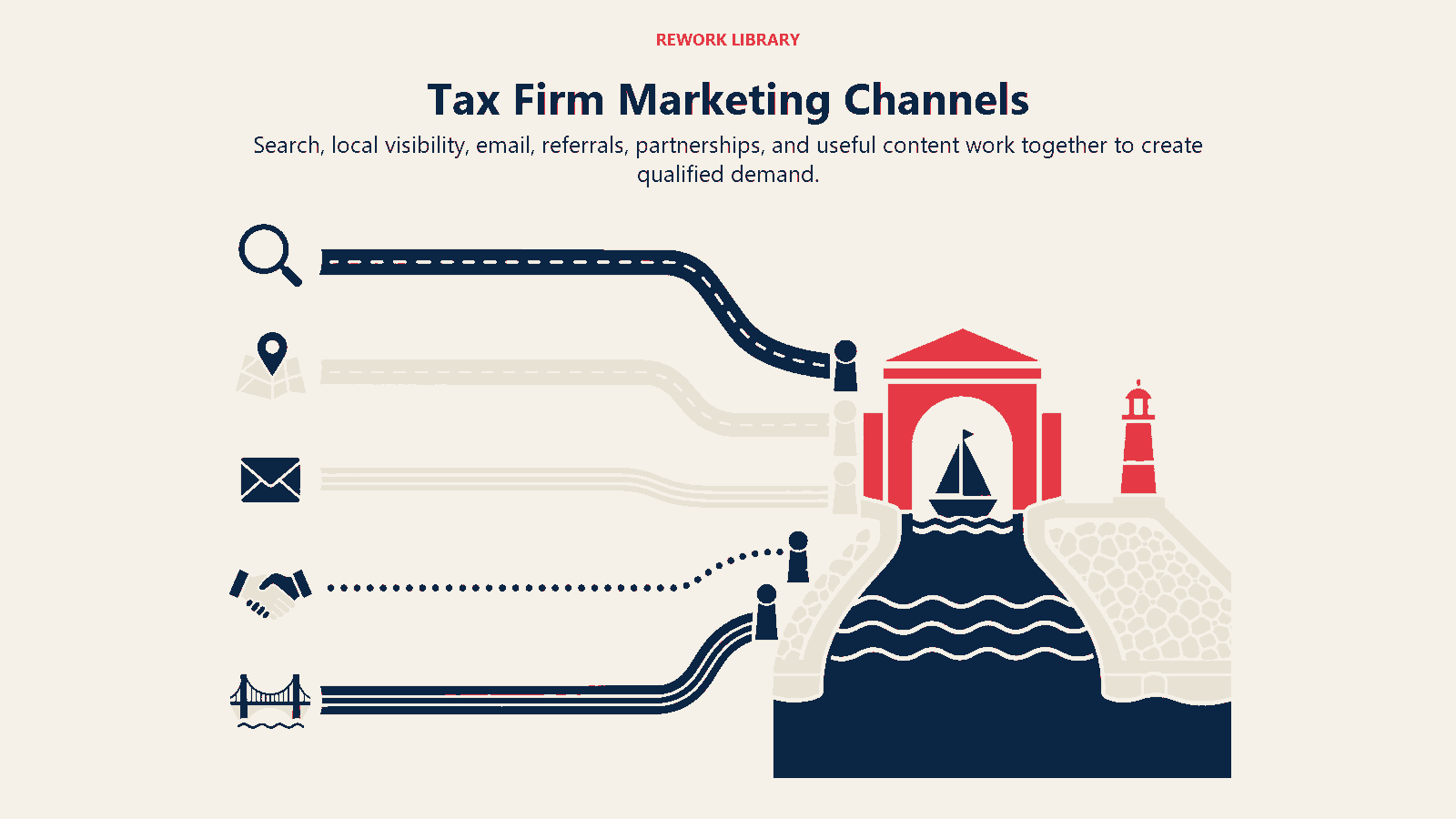
Local SEO matters more than you think. Optimize your Google Business Profile, get client reviews (ask every satisfied client), and publish location-specific content. "Tax Services in [City]" pages actually work if you serve a specific geography.
Facebook and Instagram for brand awareness and content distribution. Post educational content, client success stories (anonymized), and tax tips. Run targeted ads to small business owners and high-income professionals in your area.
Email marketing to your existing list. Start in October with planning tips, ramp up in December with early-bird offers, and continue through March with deadline reminders and last-minute availability.
Traditional and local channels: Don't ignore offline tactics if they work in your market. Sponsor local business events, join chambers of commerce, host in-person tax workshops at libraries or co-working spaces.
Direct mail still works for certain demographics. A well-designed postcard to high-income neighborhoods in December offering "stress-free tax season" can generate solid ROI.
Local partnerships with financial advisors, real estate agents, and attorneys who refer tax clients in exchange for reciprocal referrals.
Referral and word-of-mouth: Your best clients are walking billboards. Ask for referrals explicitly: "We're accepting new clients through February 15th. If you know anyone frustrated with their current tax preparer, we'd love an introduction." Systematic referral development is covered in professional networking.
Create a referral incentive: "$100 credit toward next year's return for every client you refer who hires us." Make it easy with referral cards or a simple online form.
Content and thought leadership: Publish useful content that demonstrates expertise. A weekly blog post on tax topics, a monthly video Q&A, a podcast interviewing business owners about their tax challenges.
This content does three things: it builds SEO over time, establishes you as an expert, and gives you material to share on social media and in email campaigns.
Year-round lead generation system
Relying on tax season surges is exhausting and risky. You need consistent pipeline.
Off-season marketing: What do you market when it's not tax season? Business services, advisory work, and next year's planning. In summer, target new businesses that need accounting setup. In fall, focus on year-end planning for established businesses.
Keep your brand visible with educational content year-round. "Tax Tip Tuesday" emails every week, even in July. Webinars on non-tax topics: cash flow management, hiring your first employee, business entity selection.
Year-round foundation: Build marketing systems that run consistently. Monthly email newsletters, weekly blog posts, steady Google Ads spend, active social media presence. This creates a baseline of leads that smooths out seasonal volatility.
Develop service lines that aren't seasonal. Monthly bookkeeping, payroll processing, CFO advisory, financial planning. These create steady work and revenue that fill the gaps between tax seasons.
CRM integration: Your CRM should track where every lead came from, what services they inquired about, and where they are in your funnel. Tag leads by season: "Q4 2024 inquiry," "Jan 2026 rush," "Referral from existing client."
This lets you analyze what channels work, what timing produces the best clients, and where to invest marketing dollars next year.
Technology and automation
Manual processes break during tax season. You need systems. Client onboarding tools: Use portals like Liscio, Suralink, or practice management software with client portals. Clients upload documents directly, you send secure messages, and everything is tracked without email chaos.
Automated checklists for each client type. As soon as someone hires you, the system sends a customized list of needed documents, instructions for accessing the portal, and deadlines.
Marketing automation: Email sequences that trigger based on actions. Someone downloads your tax planning guide in October? They get a 5-email sequence over three weeks with tips, case studies, and an offer to schedule a consultation.
Lead scoring so you know who's most engaged. If someone opens three emails, visits your pricing page, and downloads your checklist, they're hot. Your system should flag them for immediate outreach.
Communication systems: Use tools like Calendly integrated with your CRM so leads can book consultations without phone tag. Automated appointment reminders reduce no-shows.
Text message updates for status changes. Many clients prefer texts to emails for quick updates: "We received your documents and will start preparation within 48 hours."
Analytics and reporting: Track marketing ROI by channel. You spent $5,000 on Google Ads and acquired 30 clients at an average fee of $1,200. That's $36,000 revenue from $5,000 spend, clear winner. Compare that to $2,000 on Facebook ads that generated 8 clients at $800 average.
Monitor operational metrics: average days to complete a return, client satisfaction scores, capacity utilization rates. This data tells you where to improve next season.
Team training and development
Your team determines whether tax season is profitable or chaotic.
Consultation skills training: Not everyone is naturally good at initial consultations. Train your team on asking qualifying questions, identifying upsell opportunities, and closing the sale without being pushy.
Role-play scenarios: "Client says they just need a simple return but you notice rental property income. How do you explore if they need bookkeeping support?"
Tax knowledge updates: Tax law changes every year. Schedule training sessions in December to review new regulations, deduction changes, and credit updates. Your team should be confident answering client questions about current law.
Specialize roles. One person becomes the expert on rental properties, another on cryptocurrency taxation, another on small business deductions. Clients appreciate specialized knowledge and your team develops deeper expertise.
Lead management processes: Everyone should know what happens when a lead comes in. Who responds? How fast? What information do we gather? When do we quote vs. schedule a call?
Document these processes so there's no confusion during the chaos of January. New hires can follow the playbook instead of guessing.
Customer service excellence: Train on scenarios that come up repeatedly. Angry client because they owe more than expected. Disorganized client who sent 50 emails instead of using the portal. Procrastinator who shows up March 31st expecting same-day service.
Have scripts for common situations and role-play the tough conversations. "I understand you're frustrated about the balance due, but let's look at why this happened and how we can plan better for next year."
Common mistakes to avoid
Over-committing capacity: The fastest way to ruin tax season is taking on more clients than you can handle well. You miss deadlines, make errors, burn out your team, and damage your reputation. It's better to turn away 20 clients in January than lose 50 from poor service.
Generic marketing that doesn't differentiate: "Professional tax services, great customer service, competitive rates" describes every CPA firm. You need a specific angle: "Tax specialist for real estate investors," "Small business tax and advisory," "High-net-worth tax planning." Narrow focus attracts better clients. Building thought leadership around your specialization is covered in thought leadership strategy.
Poor follow-up with leads: Someone inquires about your services and you don't respond for 48 hours? They've already hired someone else. Set up systems for immediate acknowledgment and same-day response during peak season.
After tax season, most firms ghost their seasonal clients. That's where conversion opportunities live. Follow up in May with relevant advice and service offers.
Underpricing to compete with DIY software: You can't beat TurboTax on price and you shouldn't try. Your value is expertise, personalized advice, error prevention, and audit support. If someone wants the cheapest option, they're not your client.
Price based on the value you provide, not what competitors charge. If your advice saves a business owner $5,000 in taxes, a $1,500 fee is a bargain.
Measuring success and continuous improvement
You can't improve what you don't measure. Key performance indicators: Track these metrics every tax season:
- Lead volume by channel (where are inquiries coming from?)
- Lead-to-client conversion rate (what percentage hire you?)
- Average revenue per client by service type
- Client acquisition cost by channel (how much did you spend to get each client?)
- Capacity utilization (what percentage of your available hours were booked?)
- Client satisfaction scores (survey after filing)
- Retention rate (how many come back next year?)
- Conversion to year-round services (what percentage buy advisory or bookkeeping?)
Attribution and channel performance: Use UTM codes on all digital campaigns so you know which ads, emails, or content pieces drove conversions. Ask new clients "How did you hear about us?" and record it accurately.
After tax season, analyze cost per acquisition by channel. Maybe Google Ads cost you $50 per client while referrals cost you $10. That tells you where to invest more.
But also look at client quality by channel. Maybe Google Ads clients average $1,200 in fees while referrals average $2,000. Now the equation changes.
Continuous improvement process: After filing deadline, hold a team debrief. What worked well? What broke down? What should we do differently next year?
Review every client complaint or service failure. Was it a process problem, a communication issue, or a capacity problem? Fix the root cause, not just the symptom.
Update your systems based on what you learned. If document collection was chaotic, maybe you need better portal training for clients. If quoting took too long, create pricing templates by return type.
The firms that dominate tax season are the ones that treat each year as a learning opportunity and systematically improve.
The tax season client acquisition calendar
Here's a month-by-month framework to guide your efforts:
August-September: Launch content marketing (blog posts, webinars on year-end planning). Set up or refresh your Google Ads campaigns. Review last year's capacity data and set this year's client limits. Begin recruiting seasonal staff if needed.
October: Start early-bird promotions. Host year-end tax planning webinars for business owners. Send email campaigns to existing clients about scheduling early. Finalize pricing and service tiers.
November: Heavy push on early tax prep offers. Follow up with leads from October campaigns. Train seasonal staff. Update website with current year messaging and pricing.
December: Last call for year-end planning. Push hard on early filers with deadline messaging. Complete team training. Lock in your capacity limits and intake process.
January: Peak lead flow. Fast response times, efficient qualification, clear quoting. Marketing shifts to "limited availability" and "schedule now before we're full" messaging. Monitor capacity daily.
February: Continue client intake if capacity allows. Start planting seeds for year-round services during tax prep conversations. Marketing emphasizes expertise and deadline security.
March: Close intake except for premium rush clients. Focus entirely on delivery. No new marketing except deadline reminders for existing clients.
April: Final push to filing deadline. Immediately after, send satisfaction surveys and ask for reviews. Begin post-season follow-up campaigns offering year-round services.
May-July: Analyze season results. Calculate ROI by channel. Follow up with seasonal clients about advisory services. Plan improvements for next year. Shift marketing to business services and off-season needs.
What makes tax season different
Tax season acquisition isn't like normal B2B lead generation. The surge is predictable, the deadline is absolute, and everyone needs your service at the same time. That creates unique dynamics.
You're selling a compliance service (tax filing) to open the door for advisory services (planning, bookkeeping, strategy). The initial sale is almost guaranteed demand, but low margin and high effort. The real profit comes from converting those compliance clients into ongoing relationships.
Your biggest constraint isn't leads, it's time. From January to April, you could probably sell more work than you can deliver. That's why capacity management is as critical as marketing. Firms fail by saying yes to everyone, then delivering poorly.
The other unique factor: tax season clients are often price-shopping because they're procrastinating on a task they don't want to do. Your job is to identify which of these last-minute shoppers are actually good clients having a disorganized moment vs. chronic price-shoppers who'll never value your expertise.
Look for signals. Do they mention they're frustrated with their current preparer? That's a quality lead worth converting. Do they ask "what's your cheapest rate?" before asking anything about your services? Probably not your ideal client.
Building a sustainable tax practice
The goal isn't to survive tax season. It's to use tax season as an acquisition channel that feeds a year-round advisory practice.
Think of tax prep as your marketing expense. You might charge $800 for a small business return that takes you six hours. That's not amazing margin. But if that client becomes a bookkeeping client at $500/month, you just acquired $6,000 in annual recurring revenue from an $800 initial sale.
The math changes completely. Now you can afford to provide excellent service on that initial return, knowing the lifetime value is much higher than the first transaction.
This is how elite tax practices operate. They're not fighting for every tax prep dollar. They're using tax season to build relationships with business owners who need ongoing financial support, then converting them to advisory retainers.
Your marketing, pricing, and service delivery should all support this strategy. Use pre-season marketing to attract organized, growth-minded clients. During peak season, have conversations about ongoing needs. After filing, follow up with specific opportunities for continued partnership.
Next steps
Tax season client acquisition is one piece of a larger professional services growth strategy. To build a complete system, explore these related areas:
- Content Marketing for Services - How to create content that attracts ideal clients
- Billable Hour vs Value Pricing - Pricing strategies beyond hourly rates
- Professional Services Metrics - KPIs that matter for service businesses
- Service Line Strategy - Building complementary services that expand client relationships
Start with one improvement. Maybe it's launching pre-season marketing in August instead of waiting until January. Maybe it's creating a formal conversion program for turning tax clients into advisory clients. Maybe it's implementing capacity limits so you deliver better service.
Whatever you choose, do it consistently. Tax season comes every year. The firms that win are those that learn, improve, and systematically build better acquisition systems each cycle.
The opportunity is there. You just have to approach it strategically instead of reactively.

Sales Director
On this page
- The tax season acquisition cycle
- Pre-season marketing (August-December)
- Peak season onboarding (January-March)
- Capacity management
- Converting tax clients to year-round relationships
- Pricing strategy
- Marketing channels and tactics
- Year-round lead generation system
- Technology and automation
- Team training and development
- Common mistakes to avoid
- Measuring success and continuous improvement
- The tax season client acquisition calendar
- What makes tax season different
- Building a sustainable tax practice
- Next steps