White Space Analysis: Uncovering Untapped Opportunities Within Client Accounts

Turn this article into takeaways for your work.


Each assistant summarizes the article only for you and suggests best practices for your work.
White space analysis is a structured method for finding untapped revenue inside accounts you already serve. You map your full capabilities against the client's whole organization, mark where you are active, and treat every blank space as a prioritized opportunity. It works because you are selling to clients who already trust you. Here's something most professional services firms know but hate to admit: you're leaving money on the table with your existing clients. Not because you're doing bad work. The opposite, actually. You're doing great work in one corner of their organization while three other divisions have problems you could solve, but nobody's asked.
That's the white space problem. You have a footprint in the account, but it's smaller than it should be. Other parts of the organization don't know you exist. Service lines you offer aren't being utilized. Geographic offices are working with your competitors. The client relationship is good, but narrow.
White space analysis fixes this by systematically mapping what you could be doing versus what you are doing. Then you prioritize the gaps and execute against them. When done well, it's the most efficient way to grow revenue because you're working with clients who already trust you.
This guide walks through the framework for conducting white space analysis, identifying opportunities, and turning gaps into revenue. When combined with effective client penetration strategy, white space analysis becomes your roadmap for systematic account growth.
What is white space in account management?
White space refers to untapped potential within an existing client account. It's the gap between your current footprint and your total addressable opportunity within that organization. Think of it like a building with 20 floors, but you only have access to three of them. White space is floors 4 through 20. They have the same problems your current floors have, they'd benefit from your services, but they don't know you're an option.
The term comes from the literal white space on an account map. You draw out the client's organizational structure, mark where you're active, and everything blank is potential opportunity. Those blank spaces represent real revenue you could capture if you had the right relationships and approach.
But white space isn't just organizational. It comes in different forms, and good analysis looks at all of them.
Four types of white space
Service white space is the simplest to identify. You offer 10 service lines but the client only uses three. The other seven are opportunities if the client has those needs. A law firm providing employment law services might discover the client needs IP work but is using another firm. That's service white space. Filling these gaps is the core of cross-sell strategy. Stakeholder white space exists when you have relationships with one part of the organization but not others. You work closely with the CFO but have never met the COO or CMO. Each executive owns budgets and has problems you could solve. Those unconnected relationships are opportunities. Geographic white space shows up in multi-location organizations. You serve their headquarters but they have six regional offices using local providers. If you can support those locations, that's expansion potential. This is especially common with global companies where different countries have different vendor relationships.
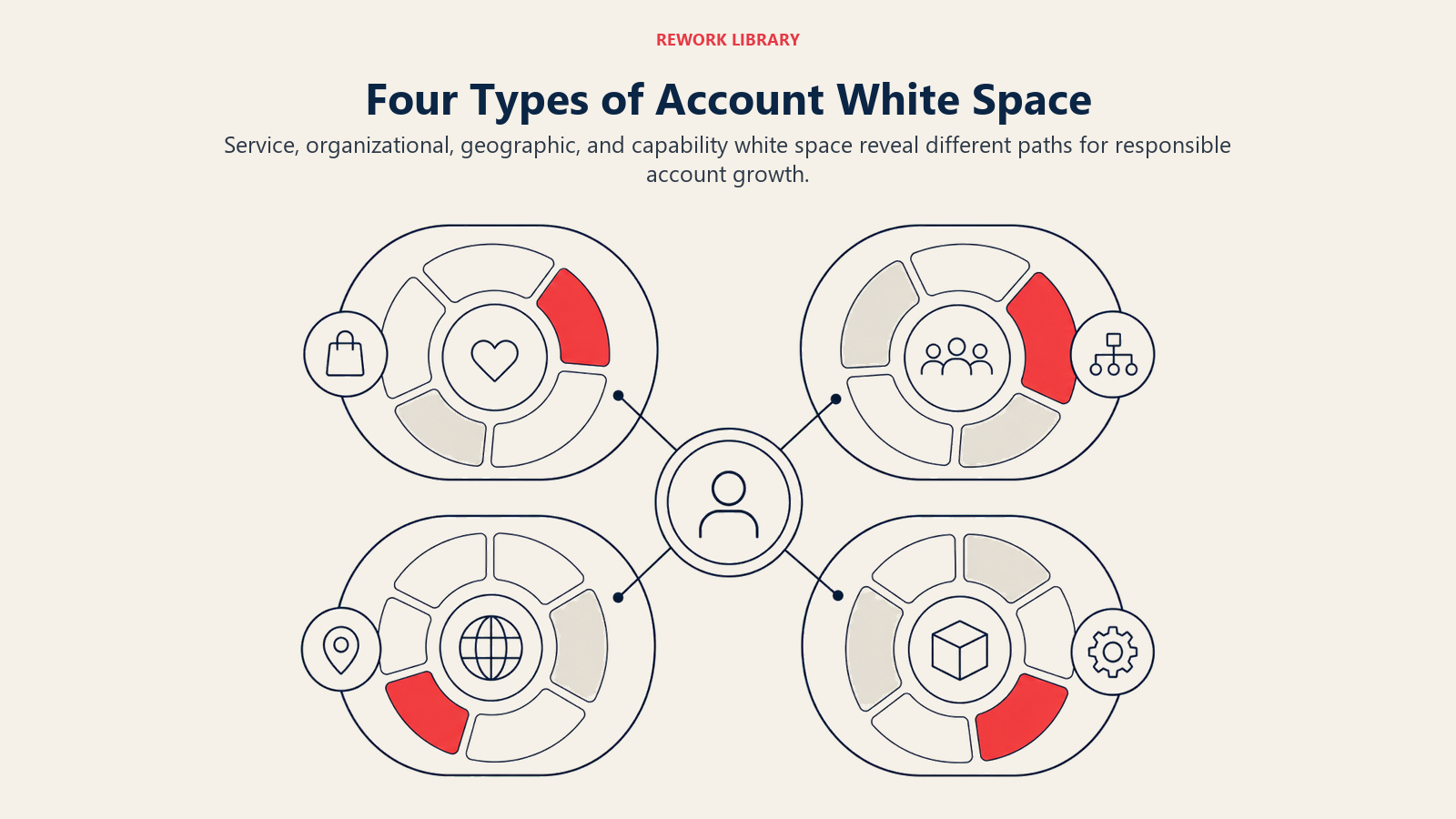
Temporal white space is about timing and business cycles. Maybe the client needs tax services annually but you only engage for year-end. They're doing quarterly tax planning with someone else. Or they have seasonal needs you're not capturing. These cyclical or event-based opportunities are easy to miss if you're not looking for patterns.
Most accounts have all four types. The question is which ones represent the biggest opportunity and which are realistic to pursue. The table below is a quick reference for spotting each type and where to look first.
| White space type | What it is | Where to look |
|---|---|---|
| Service | Service lines the client doesn't buy from you | Your full capability list vs. their active engagements |
| Stakeholder | Budget holders you have no relationship with | The org chart beyond your current sponsor |
| Geographic | Offices or regions served by a competitor | Multi-location and multi-country structures |
| Temporal | Cyclical or event-driven needs you miss | Annual planning, quarterly cycles, M&A, leadership change |
A practical rule: service and stakeholder white space usually convert fastest because the relationship foundation already exists, while geographic white space in autonomous regions takes longer because each location requires fresh relationship building.
The white space analysis framework
White space analysis follows a systematic process. You can't just look at an account and guess where the opportunities are. You need structured data collection and mapping. Service offering mapping starts with listing everything you offer. Not just what you currently provide this client, but your full capabilities. Then you map which services they're using, which they're not, and which they're potentially buying from competitors or handling internally. Create a simple matrix: your services on one axis, their organizational structure on the other. Mark each intersection with status codes: active engagement, past engagement, known need but no engagement, unknown need, or not applicable. The gaps between what's active and what's applicable are your opportunities.
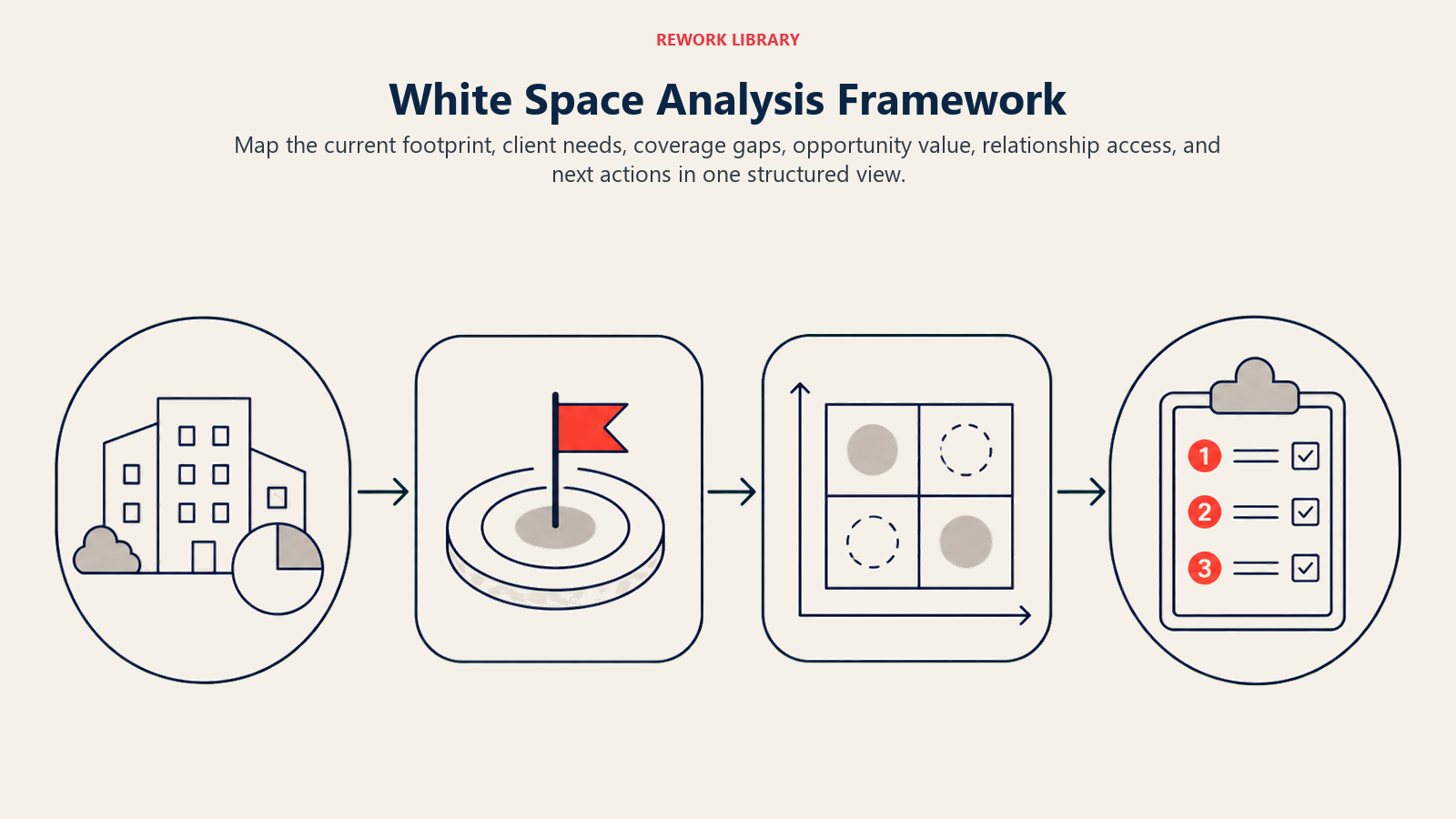
Organizational mapping requires understanding their structure. Most professional services relationships start in one function. You're working with finance, or operations, or HR. But the organization has other divisions, business units, and geographies. Each might have independent budgets and decision-making.
Build an org chart that goes beyond your current contacts. Who reports to whom? Which divisions operate autonomously? Where are budget holders? This often requires research beyond what your day-to-day contacts will volunteer.
Stakeholder mapping overlays relationships onto the org chart. Who do you know? How strong is each relationship? Who are the economic buyers, influencers, and champions? Where do you have no relationships at all?
Use relationship strength ratings: strong advocate, supportive contact, neutral, skeptical, or blocker. Your white space analysis needs to account for both opportunity size and relationship access. A huge opportunity in a division where you have no contacts and a blocker in charge is harder than a smaller opportunity with a champion.
Current footprint assessment documents exactly what you're doing today: which services, in which parts of the organization, at what revenue level, with which key contacts. Be specific. "We provide tax services" isn't enough. "We provide quarterly tax planning for the U.S. headquarters finance team, annual returns preparation, and ad-hoc M&A tax consulting, generating $280K annually" gives you a baseline to measure against.
Gap identification is where you synthesize all this data. For each potential service/division combination, ask: Do they have this need? Are we capable of serving it? Is someone else serving it now? Is it being handled internally? Is the need unmet? What's the estimated value if we captured it?
The output is a list of specific opportunities ranked by size and accessibility.
Data collection for white space analysis
Good analysis requires good data. Here's where to get it. Client organizational structure research starts with publicly available information. Their website usually has leadership team bios, locations, and division descriptions. LinkedIn shows you who works there, their titles, and reporting relationships. If they're public, investor relations materials and 10-K filings detail business segments.
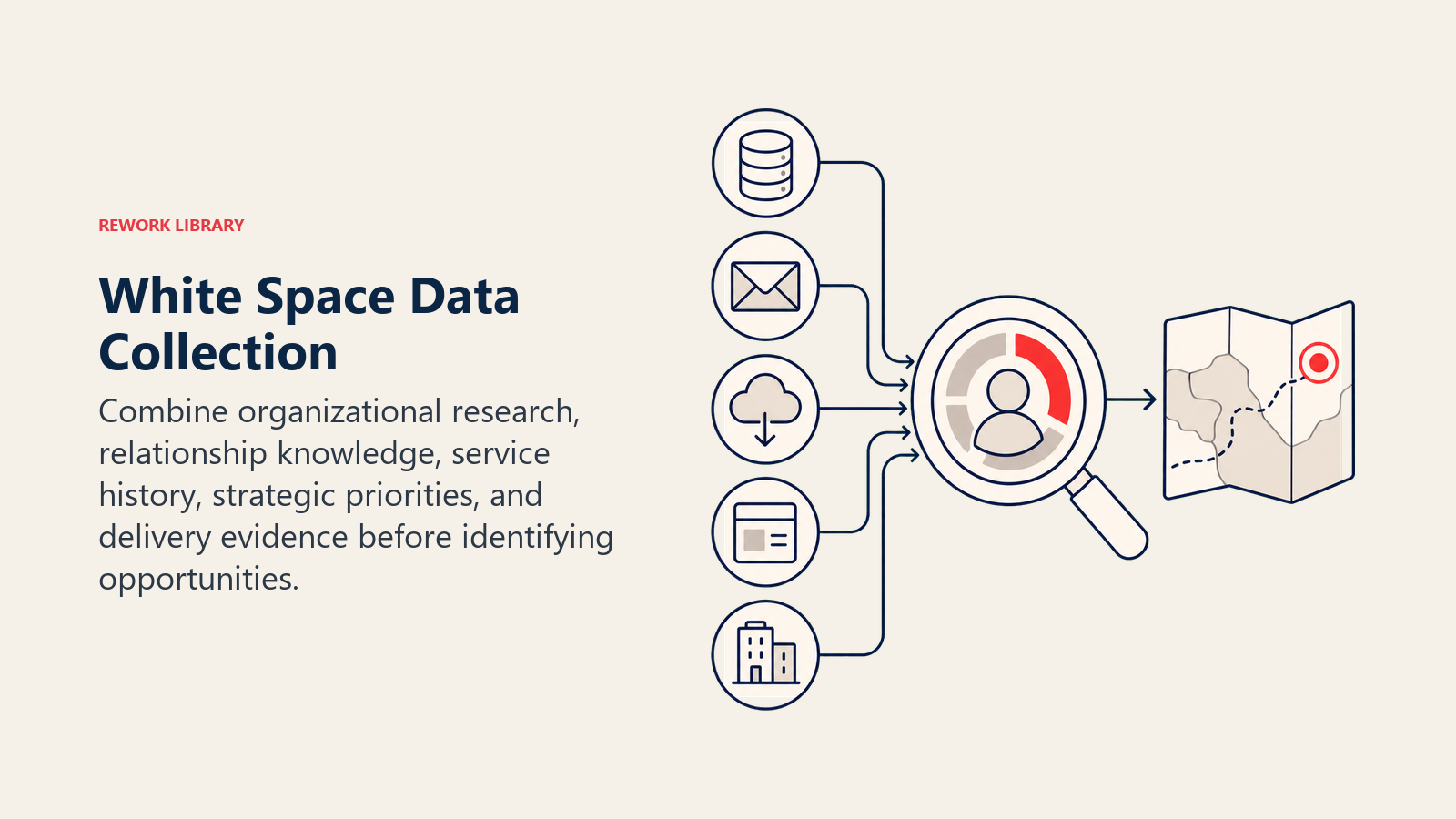
Ask your existing contacts for org charts. Most people will share this if you frame it as "I want to understand your organization better so we can be more helpful." You're not asking for confidential information, just structure.
Service consumption patterns require tracking what they buy from you and what you see them buying from others. Your finance team knows revenue by service line. That's baseline consumption. But you also want to know what they're spending on similar services elsewhere.
Discovery conversations with contacts can reveal this. "Who handles your IT consulting?" or "How do you approach strategic planning?" opens the door to learning about other vendors. RFP participation lists, vendor management portals, and casual mentions in meetings all provide clues.
Competitor presence mapping identifies where you're competing for wallet share. You won't always know who the competition is, but you can often find out. Vendor lists, project credits, conference speaking slots, and LinkedIn connections all create visibility.
Sometimes you discover you're not competing at all because they don't know you offer that service. That's actually good news - easier to enter an unserved space than displace an incumbent.
Stakeholder interviews and discovery are your richest data source. Schedule periodic business reviews or strategy sessions that go beyond current project status. Ask about upcoming initiatives, budget priorities, pain points in other areas, and organizational changes.
These conversations surface needs before they become formal RFPs. You learn about projects in the planning stage where you can shape requirements rather than responding to them.
Financial and business intelligence gives you context. What's their revenue trend? Are they growing or contracting? Have they made acquisitions that create integration needs? Are they expanding into new markets? Financial health affects buying capacity and priorities.
Industry news, earnings calls, and analyst reports provide this context for public companies. For private companies, your contacts and industry publications are your sources.
The goal is building a complete picture of the organization, not just your corner of it.
Opportunity identification process
With data in hand, you start identifying specific opportunities. Unserved business units or functions are your first target. You work with finance but not operations. You support the North American division but not Asia-Pacific. Each separate unit is a potential opportunity if they have relevant needs.
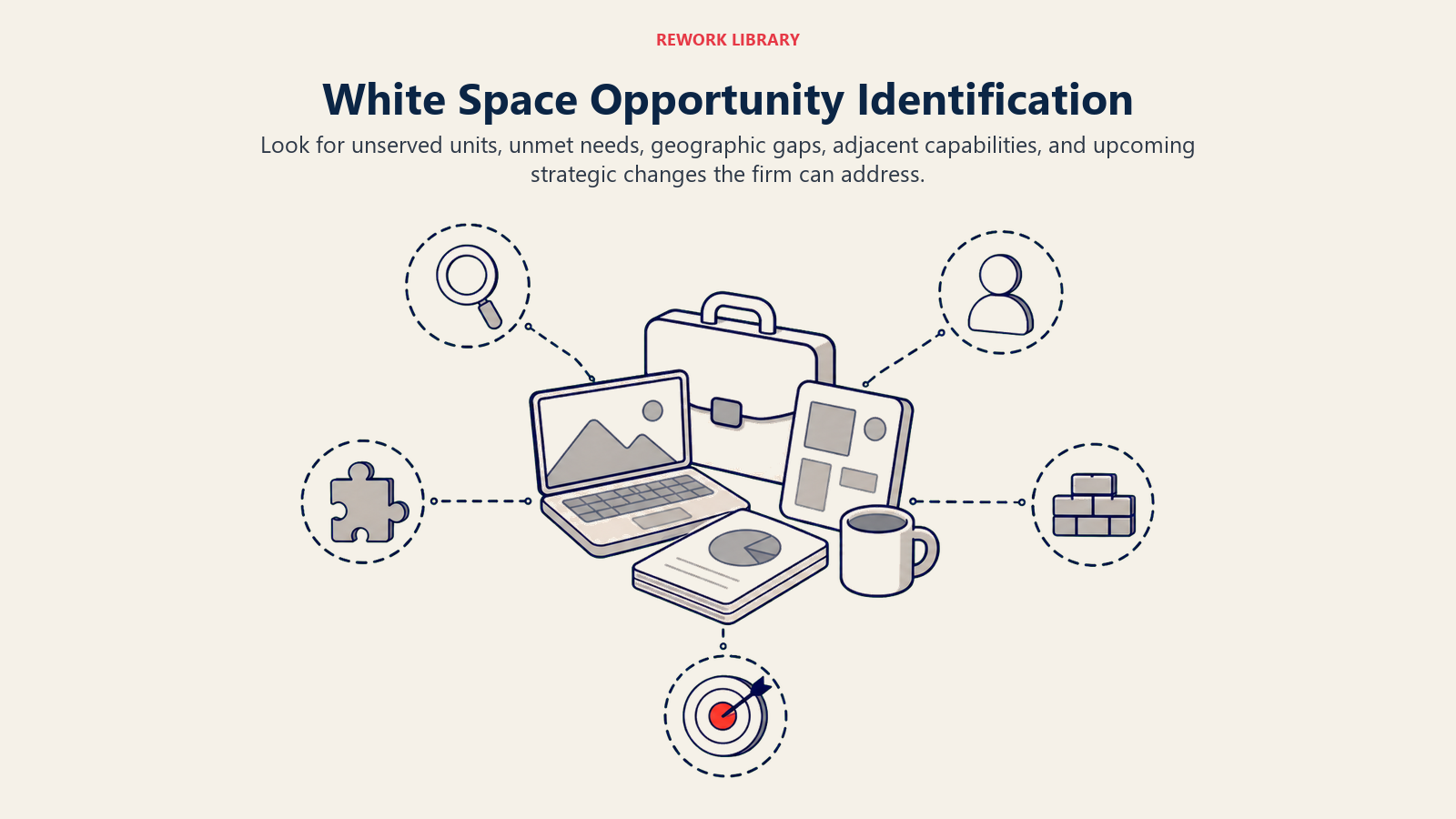
Look for business units that mirror the ones you serve. If you're doing change management consulting for division A, division B probably has similar needs. The work might be replicable with minor customization.
Unutilized service offerings show up when you compare your capabilities to their needs. You offer cybersecurity consulting but they're only using you for compliance work. They probably need cyber strategy, risk assessment, and incident response planning. Ask why they're not using you for those services.
Sometimes they don't know you offer it. Sometimes they have an incumbent they're happy with. Sometimes nobody's doing that work and they don't realize they need it. Each scenario requires a different approach.
Geographic expansion potential exists when they have multiple locations and you're only in one. Can you support their other offices? Do those offices have autonomy to choose vendors, or does headquarters control it?
If headquarters controls vendor selection, you're in a strong position - expand through the existing relationship. If regions are autonomous, you need to build new relationships in each location, which is harder.
Stakeholder access gaps represent relationship-based opportunities. You have no contact with the CIO, but you know they're investing heavily in digital transformation. Getting introduced to the CIO opens up new service discussions.
Map the org chart against your relationship inventory. Every senior leader you don't know is a potential access gap that limits opportunity visibility.
Temporal opportunities emerge from business cycles. They run annual strategic planning in Q4. They have quarterly board meetings that need prep work. They do annual employee engagement surveys. Each recurring event is a service opportunity if you can align your offerings to their calendar.
Also watch for one-time events that create needs: mergers, leadership changes, regulatory shifts, market expansions. These create demand spikes you can capture if you're paying attention.
The key is being specific. "They might need consulting" is useless. "The Asia-Pacific division is expanding into three new markets and will need market entry strategy, regulatory compliance guidance, and organizational design work" is actionable. Once you've identified specific opportunities, additional services introduction frameworks help you bring new capabilities to market effectively.
Opportunity prioritization
You'll identify more opportunities than you can pursue. Prioritization ensures you focus on the highest-value, most winnable work. Revenue potential assessment starts with estimating the size of each opportunity. What would this engagement be worth if you won it? Use comparables from similar clients or similar work. If you do this service for others, what's typical project size? Don't just look at initial project value. Consider lifetime value and recurring potential. A small project that leads to ongoing retained work is more valuable than a one-time large project with no follow-on opportunity.
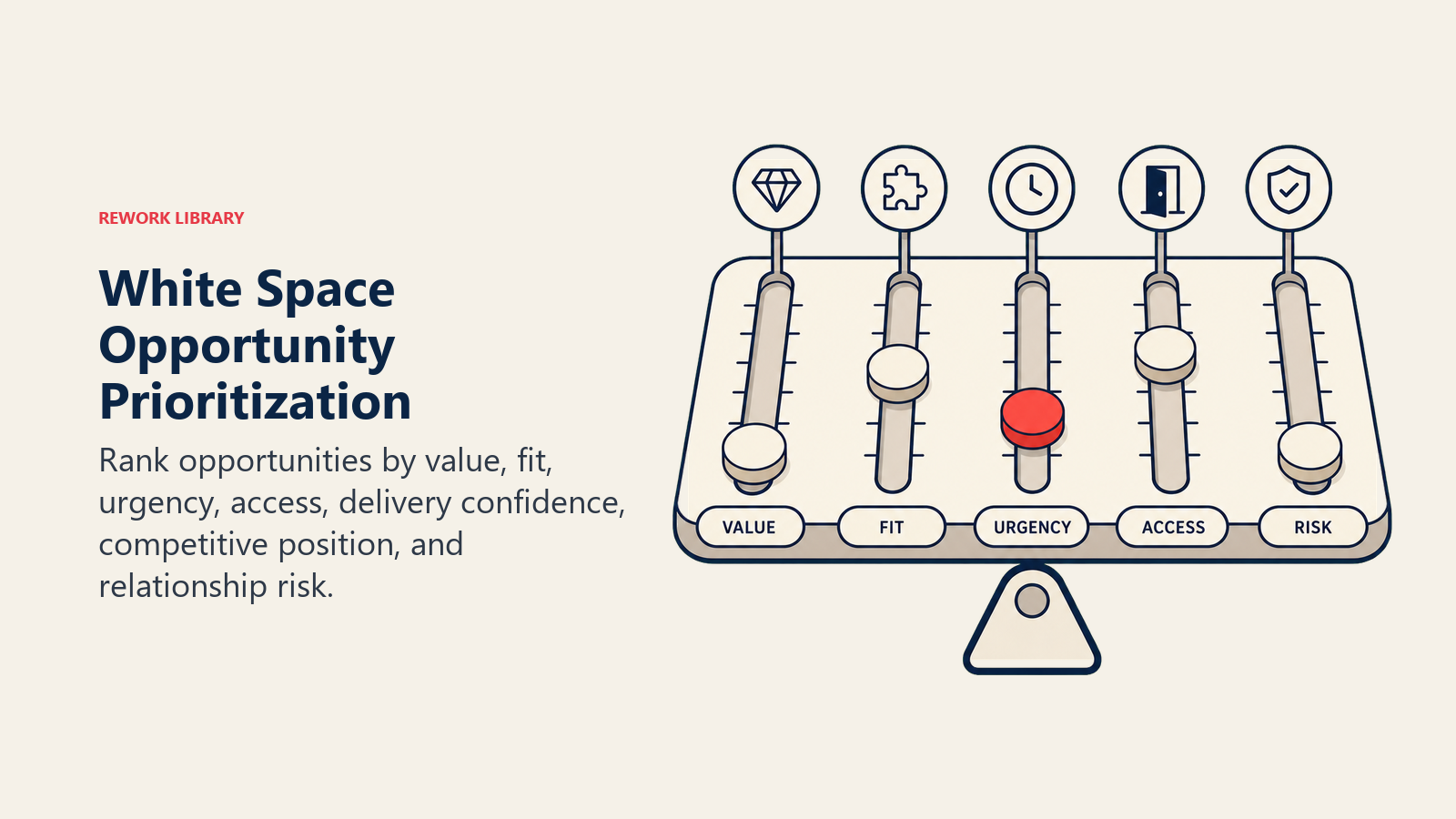
Strategic value and relationship impact goes beyond pure dollars. Some opportunities strengthen critical relationships even if they're not your highest-revenue work. Serving a senior executive who's never worked with you builds trust that unlocks bigger opportunities later.
Other opportunities expand your footprint into divisions that have larger long-term potential. Taking on a modest project in a new business unit establishes your presence and credibility for future work.
Win probability and barriers bring realism to the analysis. A huge opportunity you have 10% chance of winning is less valuable than a moderate opportunity you'll probably close.
What are the barriers to winning? Entrenched competitors? Budget constraints? No relationships? Lack of relevant case studies? Each barrier reduces your win probability. Score each opportunity on likelihood of success.
Resource requirements affect prioritization because capacity is limited. Some opportunities need specialized expertise you don't have readily available. Others require significant time investment in proposal development or relationship building.
If you can serve five opportunities with existing resources versus two opportunities that require hiring or extensive partnerships, factor that into the decision.
Competitive dynamics matter. Are you displacing an incumbent, or entering an unserved space? Displacement is harder and takes longer. If a competitor has been serving them for five years with good results, you need a compelling reason for them to switch.
Unserved spaces are easier to enter but might indicate no real demand. Why hasn't anyone filled this gap? Is it because they don't value the service, or because nobody's offered it effectively?
Prioritization matrix development pulls all these factors together. Create a scoring model that weights each criterion:
- Revenue potential (30%)
- Win probability (25%)
- Strategic value (20%)
- Resource requirements (15%)
- Timing/urgency (10%)
Score each opportunity on a consistent scale, apply the weights, and rank order your list. The top quartile becomes your active pursuit list. The second quartile is on deck for when capacity opens up.
This sounds analytical and it is, but don't lose the qualitative judgment. Sometimes your gut says an opportunity matters even if the scoring model ranks it lower. Account for that intuition - you know your client relationships better than any formula.
Integrating white space into account planning
White space analysis isn't a one-time exercise. It's a core component of ongoing account planning. Strategic account plans should include a white space section that documents current footprint, identified opportunities, and pursuit strategies. Update this quarterly or whenever major changes happen in the account. Your account plan template needs fields for: services currently provided, services not provided but relevant, organizational coverage map, key relationship inventory, and prioritized opportunity pipeline.
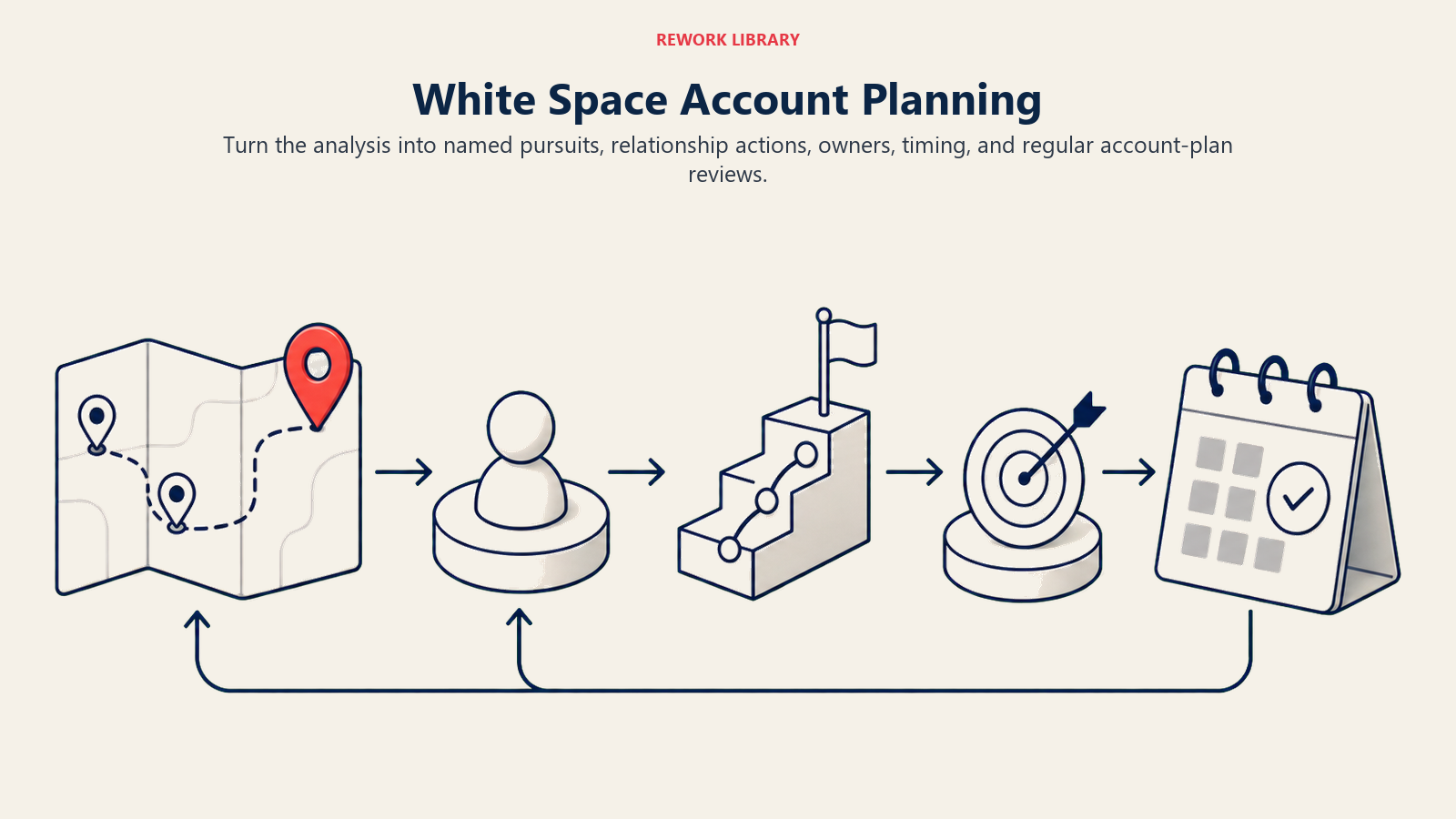
Opportunity pipeline development treats white space opportunities like a sales pipeline. Each identified opportunity gets tracked with status: identified, qualified, in discussion, proposal stage, negotiation, won, or lost.
This creates visibility for account teams and leadership. You can see which accounts have robust opportunity pipelines versus which are stagnant. It also drives accountability - opportunities shouldn't sit in "identified" status for months without action.
Resource allocation decisions flow from white space analysis. Which accounts have the most expansion potential? Those should get more attention and better resources. Accounts with limited white space might be right-sized for maintenance mode rather than active growth pursuit.
This is especially important when you have more opportunities than delivery capacity. White space analysis helps you choose where to invest scarce expert time.
Timeline and phasing recognize that you can't pursue everything simultaneously. Your account plan should sequence opportunities: immediate term (next quarter), near term (2-3 quarters), and long term (4+ quarters). For high-value accounts with significant white space, consider structuring pursuits around multi-year engagements that provide sustained revenue visibility.
Sequencing often depends on relationship building. You might need to win a small project with a new stakeholder before they'll trust you with a larger engagement. Phase 1 is the beachhead, phase 2 is expansion.
Success metrics and tracking ensure accountability. What constitutes success for your white space efforts? Metrics might include:
- Number of new services introduced to the account
- Number of new divisions/business units served
- Percentage increase in account revenue
- Expansion of stakeholder relationships
- Win rate on identified opportunities
Track these quarterly and compare against plan. If you identified 12 opportunities and won none after two quarters, either your identification was bad or your execution is failing. Either way, adjust.
Execution strategy for pursuing white space
Identifying opportunities is one thing. Capturing them requires deliberate execution.
Stakeholder engagement approach starts with mapping who you need to influence. For each opportunity, identify the economic buyer, technical evaluators, champions, and potential blockers. Then plan your engagement sequence.
Often you'll leverage existing relationships to get introductions. Your current sponsor can introduce you to the division president. The finance contact can connect you to operations. These warm introductions are far more effective than cold outreach.
Schedule discovery meetings framed around helping them, not selling to them. "I'd love to learn about your priorities so we can be a better partner" works better than "Let me tell you about our services."
Service introduction tactics need to be client-centric. Don't pitch services in a vacuum. Connect them to business problems you've heard about. "You mentioned the Asia-Pacific expansion is creating complexity. We've helped other clients with market entry strategy and localization. Would it be useful to share some examples?"
Provide value before asking for work. Share insights, make introductions, offer perspective. This builds credibility that makes the eventual proposal feel natural rather than pushy. Effective consultative business development approaches work particularly well when pursuing white space opportunities.
Proof of concept and pilots reduce risk for clients trying something new with you. If they're hesitant to commit to a large engagement in a new area, propose a smaller pilot. "Let us do a diagnostic in one division. If the value is clear, we can expand to others."
Pilots work especially well when you're entering a new part of the organization that doesn't know your work. The small success creates confidence for larger commitments.
Proposal development for white space opportunities requires extra care. You're not just proposing work - you're proposing to expand the relationship. Frame proposals around business outcomes, not just deliverables.
Reference your existing work as proof of understanding their organization. "Based on our work with your finance team, we understand your focus on operational efficiency. This project would apply similar principles to the supply chain."
Pricing and positioning can leverage your incumbent advantage. You have lower ramp-up costs because you already understand their business. You might propose preferred pricing for expanded scope that benefits both parties.
But don't assume you'll win on relationship alone. If you're not competitive on value, they'll look elsewhere. Price fairly, emphasize your unique advantages, and make the decision easy.
Team coordination for white space execution
White space analysis and execution requires team coordination, not solo effort.
Account team white space reviews should happen quarterly. Bring together everyone who touches the account: partners, project leads, business development, and delivery teams. Review the white space map, discuss what you're learning, and identify new opportunities.
These reviews also surface risks. Maybe you've lost a key relationship. Maybe a competitor is making inroads. Early warning lets you respond proactively.
Service line specialist involvement brings deep expertise to opportunity development. Your account team knows the client, but the specialist knows the service. When you identify a cybersecurity opportunity, bring in your cyber practice leader to assess feasibility and shape the approach.
This collaboration ensures you're proposing work you can actually deliver well. Nothing damages a relationship faster than overpromising and underdelivering in a new area.
Cross-functional collaboration with marketing, proposal development, and subject matter experts enhances quality. Marketing can provide case studies and thought leadership relevant to new stakeholders. Proposal teams can craft compelling narratives. SMEs can validate technical approaches.
White space pursuit isn't just account management's job. It's a team sport.
Information sharing and CRM updates keep everyone aligned. When you have a discovery meeting that surfaces new needs, document it in your CRM. When you get introduced to a new stakeholder, update the contact database. When you learn about upcoming initiatives, log it for the team.
Information trapped in individual heads doesn't help the account. Shared knowledge multiplies effectiveness.
Accountability and ownership means assigning responsibility for each opportunity. Who's leading the pursuit? Who's supporting? What are the next steps and deadlines? Without clear ownership, opportunities languish.
Use your account planning process to assign roles and track progress. Review assignments in team meetings and hold people accountable for forward movement.
Technology and tools for white space analysis
The right tools make analysis easier and more systematic.
Account mapping software like Altify, Prolifiq, or Lucidchart helps visualize organizational structure and relationships. You can build interactive org charts, color-code relationship strength, and identify gaps visually.
These tools are especially valuable for complex enterprise accounts with dozens of stakeholders across multiple divisions. Trying to track that in spreadsheets gets messy fast.
Org chart tools like OrgChartNow or The Org provide data on company structures. LinkedIn Sales Navigator also offers organizational insights including reporting relationships and recent hires.
These tools reduce the manual research burden and keep your maps current as organizations change.
CRM systems like Salesforce, HubSpot, or Microsoft Dynamics are your central repository for account information. Use custom fields to track:
- Services currently provided and not provided
- Relationship strength by stakeholder
- White space opportunities with status
- Revenue by division or service line
- Key dates and buying cycles
Good CRM hygiene makes white space analysis a reporting exercise instead of a research project.
Opportunity tracking within your CRM creates pipeline visibility. Each white space opportunity should be a CRM record with size estimates, win probability, next steps, and owner. This allows leadership to see aggregate opportunity across all accounts.
You can also build dashboards showing white space metrics: accounts with identified opportunities, average opportunity size, win rates, and pipeline coverage.
Metrics for measuring white space success
You need metrics to know if your white space efforts are working. Account penetration rate measures how much of the available opportunity you've captured. This is challenging to calculate precisely because total addressable market within an account is somewhat subjective. But you can track directionally.
If you offer 10 services and the client uses three, your penetration is 30%. If you expand to five services, you've improved to 50%. Track this by account and in aggregate.
Services per client is a simpler metric. How many distinct service lines does each client buy? The average across your client base tells you how well you're cross-selling. Growth in services per client indicates successful white space execution.
Break this down by account size. Enterprise clients should have higher services per client than small accounts. If they don't, you have white space opportunity.
White space conversion rate tracks how many identified opportunities convert to revenue. If you identify 20 opportunities and win five, that's 25%. Low conversion might mean poor opportunity qualification, weak execution, or unrealistic opportunity identification.
Track conversion by opportunity type. Do service white space opportunities convert better than geographic opportunities? That tells you where to focus effort.
Revenue per account growth is the ultimate measure. White space analysis should drive account revenue expansion. Track year-over-year growth rates by account and correlate with white space activity.
Accounts where you're actively pursuing white space should grow faster than accounts in maintenance mode. If they're not, your white space strategy isn't working.
Also track new revenue sources versus existing service expansion. White space efforts should generate revenue from new services or divisions, not just organic growth in existing work. For comprehensive guidance on key performance indicators, see professional services metrics.
Best practices for white space analysis
Regular analysis cadence prevents opportunities from going stale. Annual white space reviews are too infrequent. Quarterly is better for active accounts, even if updates are incremental.
Set a calendar for when account teams conduct reviews. Make it part of the account planning cycle, not an ad-hoc exercise that happens when someone thinks about it.
Collaborative approach produces better insights than solo analysis. The partner has relationship perspective. The delivery team sees operational needs. Business development spots market trends. Combine those viewpoints.
Run white space analysis sessions as workshops where the account team brainstorms together. The collective intelligence identifies opportunities individuals would miss.
Client-centric framing is critical when discussing opportunities. You're not "selling more services." You're "helping them solve more problems." The internal conversation can be about revenue growth, but the client-facing conversation needs to be about value creation.
When you approach stakeholders about white space opportunities, frame it as "we've been thinking about how we can be more helpful to you" not "we want to sell you more things."
Systematic tracking ensures opportunities don't fall through the cracks. Use whatever project management or CRM system you have to track each opportunity with clear next actions and owners.
Review progress weekly or biweekly. Opportunities that stall for 30+ days without action should be reassessed - either reinvigorate pursuit or remove from the active list.
Where to go from here
White space analysis is most powerful when integrated with broader account management and growth strategies:
- Client relationship strategy builds the trust that makes white space accessible
- Cross-sell strategy focuses specifically on introducing new services to existing clients
- Upsell and scope expansion deepens existing engagements alongside white space pursuit
- Account planning provides the framework for systematic account development
Start with your top 10 accounts by revenue. Map their organizational structure, your current footprint, and the obvious white space. Prioritize the 3-5 most realistic opportunities and assign ownership. Execute against those for a quarter and measure results.
You don't need sophisticated software or complex methodologies to start. You need systematic thinking about where you are versus where you could be in each account. The analysis reveals the opportunities. Disciplined execution captures them.
The best part about white space growth is you're working with clients who already trust you. The relationship foundation exists. You're not starting cold. That makes white space the highest-probability, most efficient growth strategy in professional services.
Frequently Asked Questions
What is white space analysis?
White space analysis is a structured method for mapping untapped revenue inside existing client accounts. You list your full service capabilities, map them against the client's whole organization, mark where you are already active, and treat every gap as a potential opportunity ranked by size and accessibility.
What are the four types of white space?
Service white space (service lines the client doesn't use), stakeholder white space (budget holders you don't know), geographic white space (locations served by competitors), and temporal white space (cyclical or event-driven needs you miss). Most accounts contain all four.
How do you prioritize white space opportunities?
Score each opportunity with a weighted model: revenue potential (30%), win probability (25%), strategic value (20%), resource requirements (15%), and timing or urgency (10%). The top quartile becomes your active pursuit list, and the second quartile waits on deck for capacity.
How often should you run white space analysis?
Quarterly for active accounts. Annual reviews are too infrequent because opportunities go stale and relationships shift. Build the review into your account planning cycle rather than treating it as an ad-hoc exercise.
Why is white space growth more efficient than new-client acquisition?
You're selling to clients who already trust your work, so ramp-up costs are lower and win probability is higher. The relationship foundation already exists, which makes expansion the highest-probability growth path in professional services.

Sales Director
On this page
- What is white space in account management?
- Four types of white space
- The white space analysis framework
- Data collection for white space analysis
- Opportunity identification process
- Opportunity prioritization
- Integrating white space into account planning
- Execution strategy for pursuing white space
- Team coordination for white space execution
- Technology and tools for white space analysis
- Metrics for measuring white space success
- Best practices for white space analysis
- Where to go from here
- Frequently Asked Questions