Utilization & Capacity Planning: Balancing Revenue, Profitability, and Team Sustainability
Turn this article into takeaways for your work.


Each assistant summarizes the article only for you and suggests best practices for your work.
The fastest way to kill a professional services firm is to push for 100% utilization.
It sounds counterintuitive. More billable hours equals more revenue, right? But firms that chase maximum utilization discover a painful truth: they burn out their best people, miss growth opportunities, and watch profitability decline even as utilization climbs.
Here's what happens: Your team spends every hour on client work, leaving no time for consultative business development. Your pipeline dries up. Partners have no capacity to sell, so you hire salespeople who don't understand the work. Senior consultants become glorified production workers with no time to develop client relationships or train junior staff. Your best people leave because they're exhausted and see no path to partnership.
Meanwhile, firms that target 70-80% utilization and invest the remaining time strategically grow faster, retain talent better, and generate higher profits per partner.
What is Utilization & Capacity Planning?
Utilization and capacity planning is how professional services firms optimize their most valuable asset: people's time. It's the framework for balancing revenue-generating client work with the non-billable activities that drive long-term growth and sustainability.
This isn't just time tracking. It's how you think about resource optimization across three dimensions:
Utilization measurement and targeting. Understanding how much of your team's available time should be billable versus invested in growth, training, and thought leadership. Different roles need different targets based on their responsibilities and career stage.
Capacity forecasting and allocation. Projecting future resource needs based on your sales pipeline, matching available capacity to client commitments, and making informed decisions about hiring, outsourcing, or turning down work.
Investment time management. Protecting and allocating non-billable hours for business development, proposal work, skill development, and the activities that compound into future revenue and competitive advantage.
The relationship between utilization and professional services metrics is fundamental. You can't optimize what you don't measure, and capacity planning provides the foundation for sustainable growth.
The Mathematics of Utilization
At its core, utilization is straightforward math:
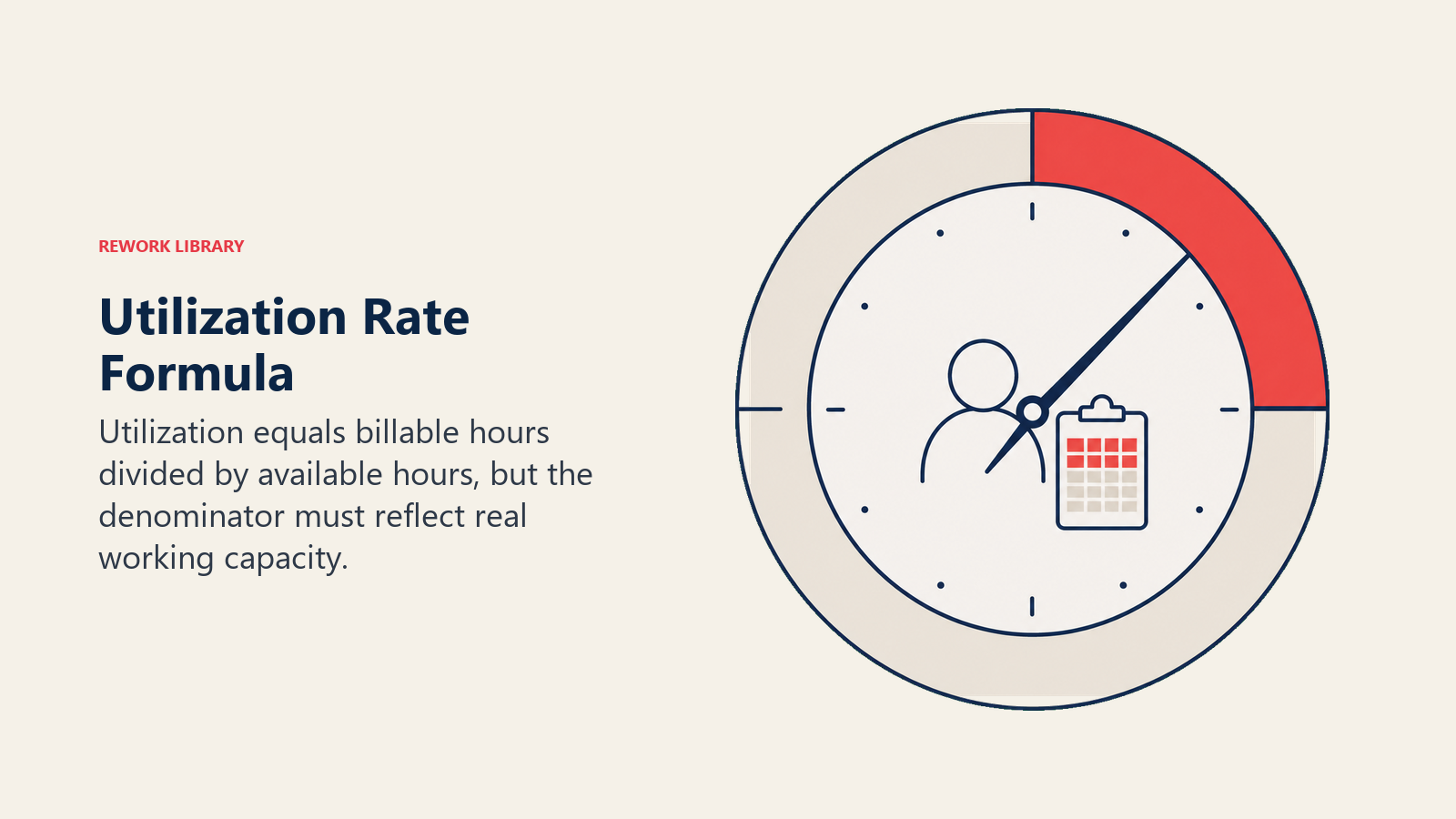
Utilization Rate = Billable Hours / Available Hours
But the nuance matters. Let's break down what these numbers actually mean and why small changes create massive financial impact.
Available hours isn't the same as total hours. If someone works 2,000 hours per year but you account for vacation (2 weeks), holidays (10 days), sick time (1 week), and internal meetings (5%), available hours drops to about 1,750. That's your realistic capacity baseline.
Billable hours is time actually charged to clients. Not time spent on projects - time that generates revenue. The difference matters because not all project time is billable. Pre-sales work, proposal development, and internal project management often aren't.
Now here's where it gets interesting: every 5% change in utilization creates a 3-7% impact on profit margins. This multiplier effect happens because most of your costs are fixed. You're paying salaries, rent, and overhead regardless of utilization. When billable hours increase, nearly all that additional revenue flows to the bottom line.
Let's look at real numbers:
A consulting firm with 20 consultants averaging $150/hour in billing rates and $80K in annual salary plus benefits ($100K fully loaded cost):
At 70% utilization:
- Available hours per person: 1,750
- Billable hours: 1,225
- Revenue per person: $183,750
- Fully loaded cost: $100,000
- Contribution margin: $83,750
- Firm total: $1,675,000
At 75% utilization:
- Billable hours: 1,313
- Revenue per person: $196,950
- Contribution margin: $96,950
- Firm total: $1,939,000
That 5-percentage-point increase in utilization generated $264,000 in additional profit - a 15.8% improvement - without adding headcount or raising rates.
Understanding these economics, as detailed in the professional services growth model, explains why utilization management has such outsized importance.
Industry Benchmarks by Service Type
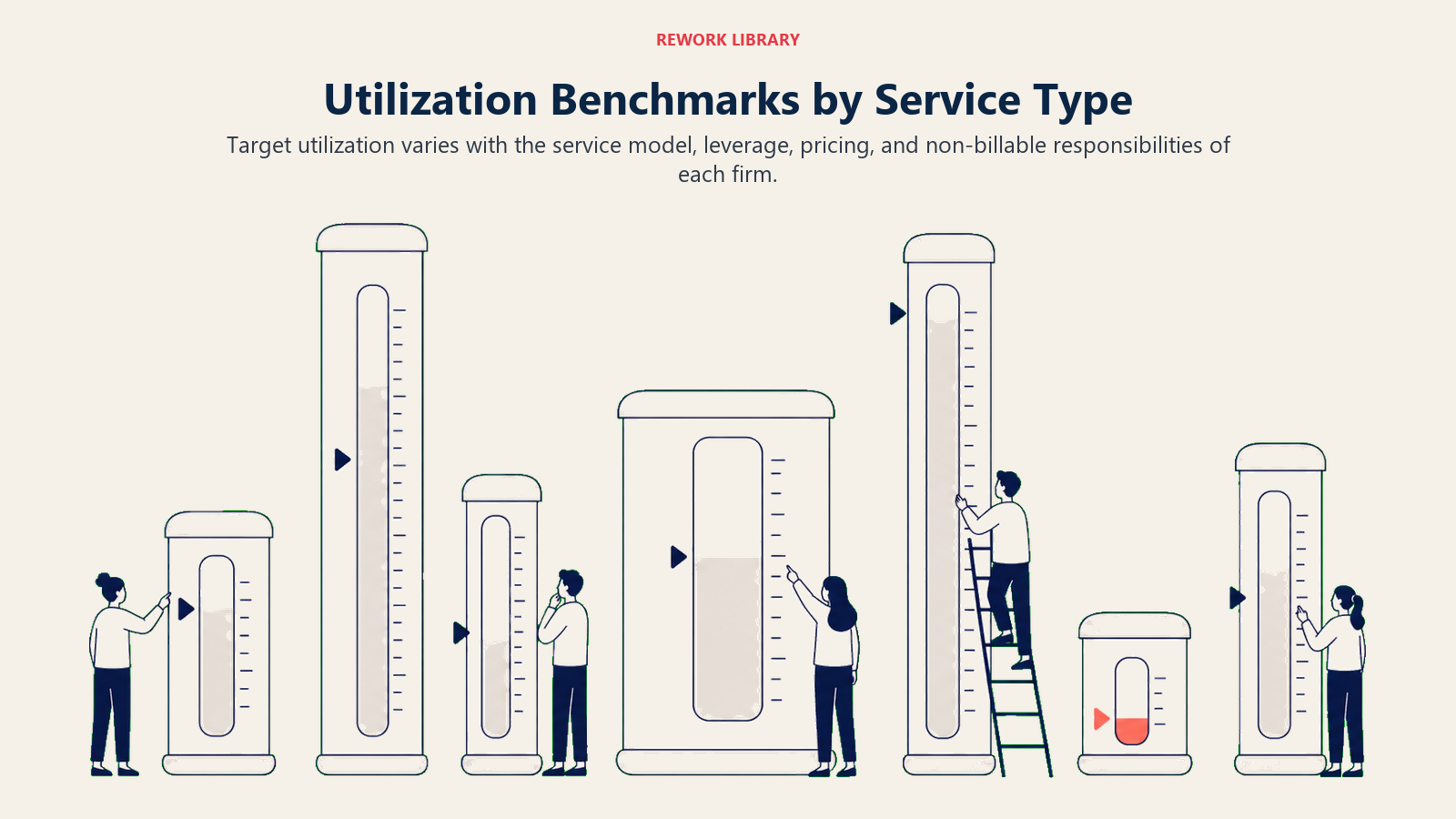
Different types of professional services firms have different utilization targets based on their business models, pricing approaches, and leverage ratios:
Management Consulting (70-75%): Strategy firms like McKinsey and Bain target this range. Partners need substantial non-billable time for business development, thought leadership, and firm leadership. The high rates compensate for lower utilization.
Marketing Agencies (65-70%): Agencies balance billable client work with pitch preparation, creative development, and new business activities. The project-based nature means gaps between engagements that pull down utilization.
Law Firms (75-85%): Legal practices, especially litigation and transactional work, run higher utilization because they operate on billable hour models with strong leverage ratios. Partners still need BD time, but associates and junior partners carry heavier billable loads.
Accounting Firms (70-80%): Seasonal variation is extreme here. Tax season pushes utilization above 90% while summer months drop below 50%. Annual averages mask this volatility, making capacity planning essential.
Engineering & Architecture (75-80%): Technical services firms with project-based work maintain high utilization because technical delivery dominates the work, with less emphasis on ongoing client relationship management.
The correlation between pricing models and utilization is direct. Firms using billable hour vs value-based pricing models generally target higher utilization because their revenue is directly tied to hours worked. Value-based firms can afford lower utilization because pricing isn't constrained by time.
Target Utilization Rates by Role
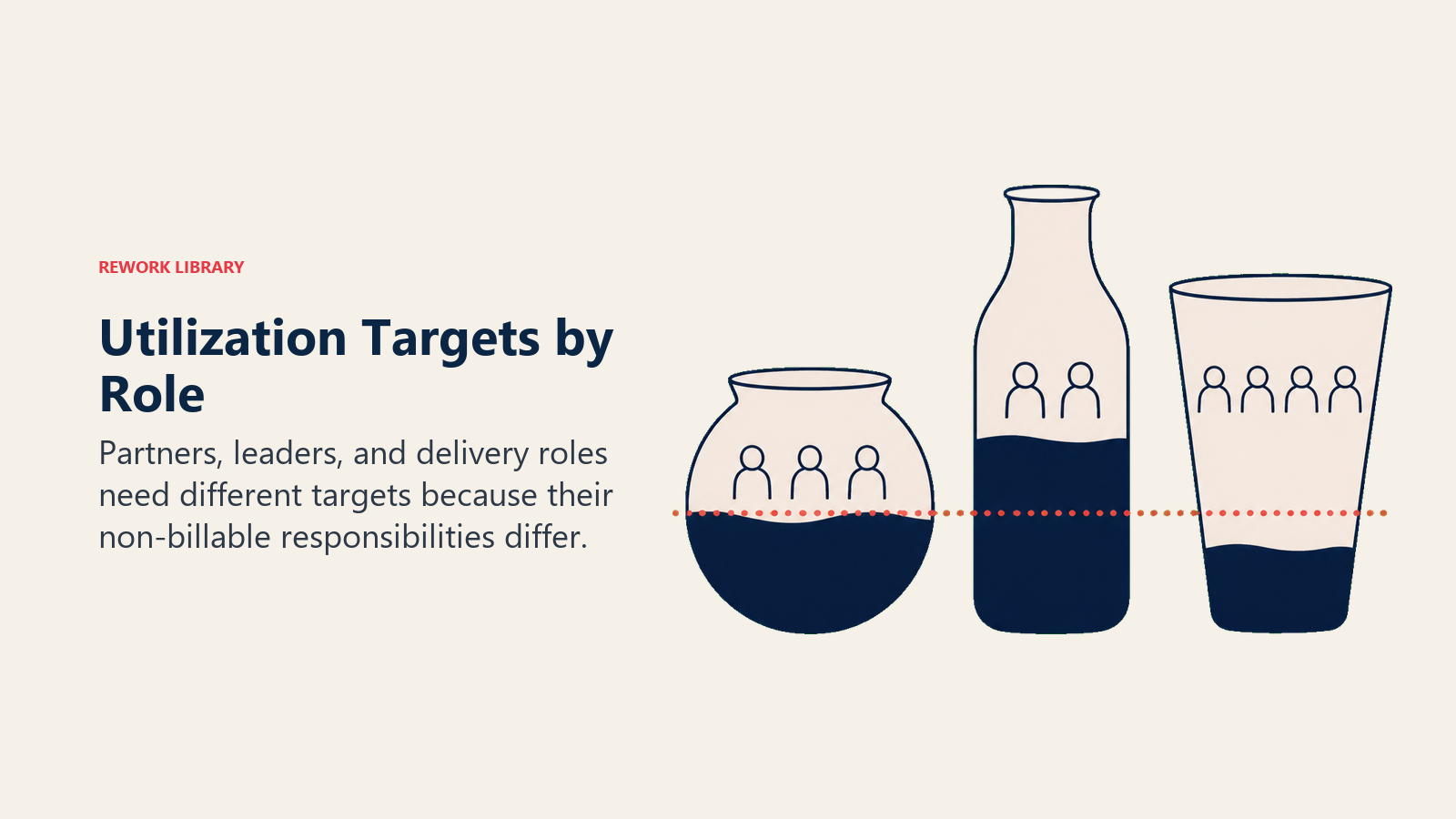
Within any firm, utilization targets should vary significantly by role and career stage. One-size-fits-all targets create dysfunction:
Partners & Principals (40-50% billable)
Partners are running the business, not just working in it. Their non-billable time includes:
- Business development and sales (20-30% of time)
- Client relationship management (10-15%)
- Firm leadership and strategy (10-15%)
- Mentoring and talent development (5-10%)
- Thought leadership and speaking (5-10%)
When partners exceed 60% utilization, the firm's growth engine stalls. They become expensive consultants rather than firm builders. This undermines your entire thought leadership strategy and business development capacity.
Senior Consultants/Directors (60-70% billable)
Senior practitioners balance delivery with client relationship building and practice development:
- Direct client delivery work (60-70%)
- Junior staff supervision (10-15%)
- Proposal development (5-10%)
- Business development support (10-15%)
- Training and skill development (5-10%)
This group is your bench strength for major client engagements while developing into future partners.
Mid-Level Staff (70-80% billable)
Mid-level professionals are productive contributors with growing client responsibilities:
- Client project delivery (70-80%)
- Peer collaboration (5-10%)
- Proposal support (5-10%)
- Professional development (5-10%)
They're past the steep learning curve but not yet carrying BD responsibilities.
Junior Staff (75-85% billable)
Junior team members focus primarily on execution with guided development:
- Client project work (75-85%)
- Training and onboarding (10-15%)
- Administrative tasks (5-10%)
High utilization here makes economic sense because you're maximizing the leverage ratio while they build skills. But going above 85% leaves insufficient time for learning and growth.
This tiered structure creates the leverage model that drives profitability. Understanding how to optimize this across your firm is explored in depth in leverage model optimization.
The 13-Week Rolling Capacity Framework
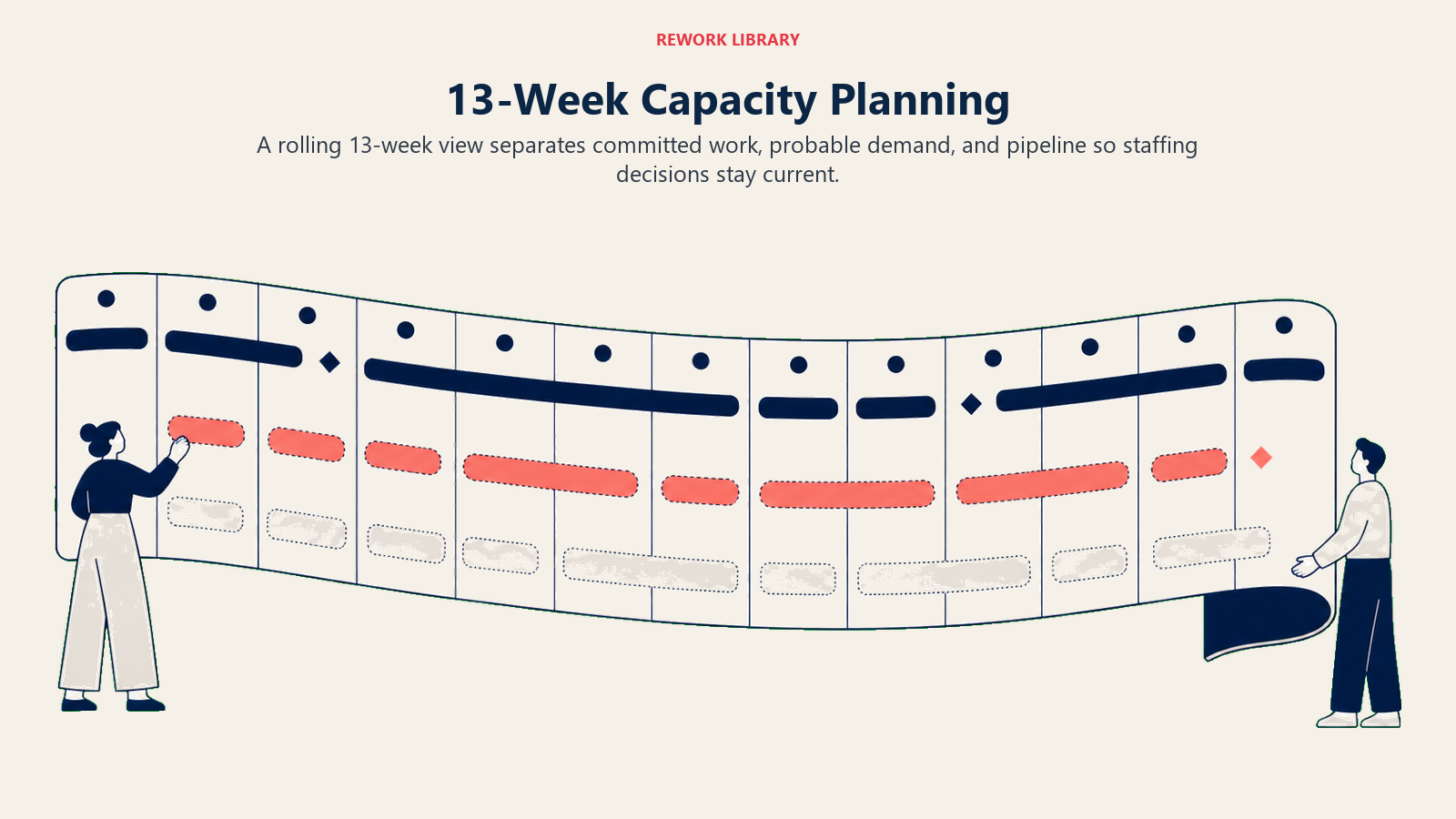
Effective capacity planning operates on a rolling 13-week horizon - long enough to be strategic but short enough to stay accurate. Here's how to build this framework:
Week 1-4: Committed Capacity
This is locked in work. Signed contracts, scheduled delivery, confirmed resource allocations. You're not forecasting here - you're executing.
Track three metrics:
- Capacity utilization: Percentage of available hours allocated to committed work
- Resource coverage: Which roles are fully booked vs available
- Margin performance: Are projects tracking to expected profitability?
If weeks 1-4 show utilization below 60%, you've got a pipeline problem. Above 90% means you're at risk of burning out your team or missing deadlines.
Week 5-8: High-Probability Pipeline
This is work in final stages - proposals submitted, contracts in legal review, verbal commitments pending signatures. Probability-weight these based on your historical close rates.
If your close rate on submitted proposals is 60%, count these opportunities at 60% of their resource requirements. This gives you realistic capacity planning rather than best-case scenarios.
Key decisions in this window:
- Do you need to accelerate hiring or contractors?
- Should you shift resources from lower-priority work?
- Are you at risk of overcommitting?
Week 9-13: Qualified Opportunities
This is earlier-stage pipeline - active discussions, scoping conversations, RFP responses in progress. Weight these at 20-30% based on your conversion rates at this stage.
This window guides medium-term decisions:
- Hiring requisitions and recruitment timelines
- Subcontractor relationships and on-boarding
- Capability development and training investments
The framework requires weekly reviews with delivery leaders and monthly planning sessions with firm leadership. As covered in staffing & resource allocation, systematic planning prevents the feast-or-famine cycles that plague many firms.
Non-Billable Investment Time Categories
Not all non-billable time is created equal. Strategic firms distinguish between necessary overhead and high-value investment activities:
Business Development (15-25% for partners)
This is where future revenue comes from:
- Client relationship building and account management
- Networking and industry participation
- Speaking engagements and conference attendance
- Strategic alliance development
Track BD hours separately and measure conversion rates. If partners are spending 20% of their time on BD but the pipeline isn't growing, you've got an effectiveness problem, not a capacity problem.
Proposal Development (5-15% depending on role)
Writing proposals, scoping projects, and developing client solutions:
- RFP responses and formal proposals
- Custom solution design
- Pricing and resource planning
- Pitch preparation and rehearsal
Measure proposal win rates and time investment per opportunity. If you're spending 40 hours on proposals with 20% win rates, your client qualification framework needs work.
Training & Development (5-10% across all levels)
Skill building and knowledge sharing:
- Internal training programs
- External certification and education
- Mentoring relationships
- Knowledge transfer sessions
Firms that cut training during slow periods pay for it in quality issues and talent attrition during busy periods.
Thought Leadership (10-20% for partners/seniors)
Content creation and expertise positioning:
- Article writing and publishing
- Webinar presentations
- Industry research
- Book authorship
This feels like overhead but compounds into inbound leads and pricing power over time. Strong service line strategy depends on established thought leadership.
Internal Operations (5-10%)
The necessary overhead:
- Team meetings and communication
- Administrative tasks
- Systems and process improvement
- Firm governance participation
Keep this category from expanding by relentlessly improving processes and eliminating low-value activities.
Resource Allocation Strategies
How you allocate people to projects determines both client satisfaction and team sustainability:
The Allocation Matrix
Build a simple matrix matching resource availability to project requirements:
Rows: Individual team members with their:
- Role and skill level
- Available hours per week
- Current allocation percentage
- Skills and certifications
Columns: Active and pipeline projects with:
- Resource requirements by role
- Project timeline and milestones
- Client priority level
- Margin targets
Update this weekly. Color-code utilization (green: 60-80%, yellow: 50-60% or 80-90%, red: below 50% or above 90%).
Strategic Overbooking
Counter-intuitive but essential: book resources to 85-90% of available hours, not 100%.
Why? Because stuff happens:
- Proposals take longer than expected
- Client emergencies arise
- People get sick or take vacation
- Projects expand mid-engagement
Firms that book to 100% capacity consistently miss deadlines, burn out staff, and deliver lower quality work. The buffer creates resilience.
Cross-Training Investment
Deliberately develop people in adjacent skill areas to increase allocation flexibility:
- Technical consultants learning client-facing skills
- Junior staff shadowing senior client interactions
- Specialists developing generalist capabilities
This investment pays off when you can shift resources across projects without scrambling for contractors or turning away work. A strong talent development program makes this flexibility possible.
Capacity Constraints & Bottlenecks
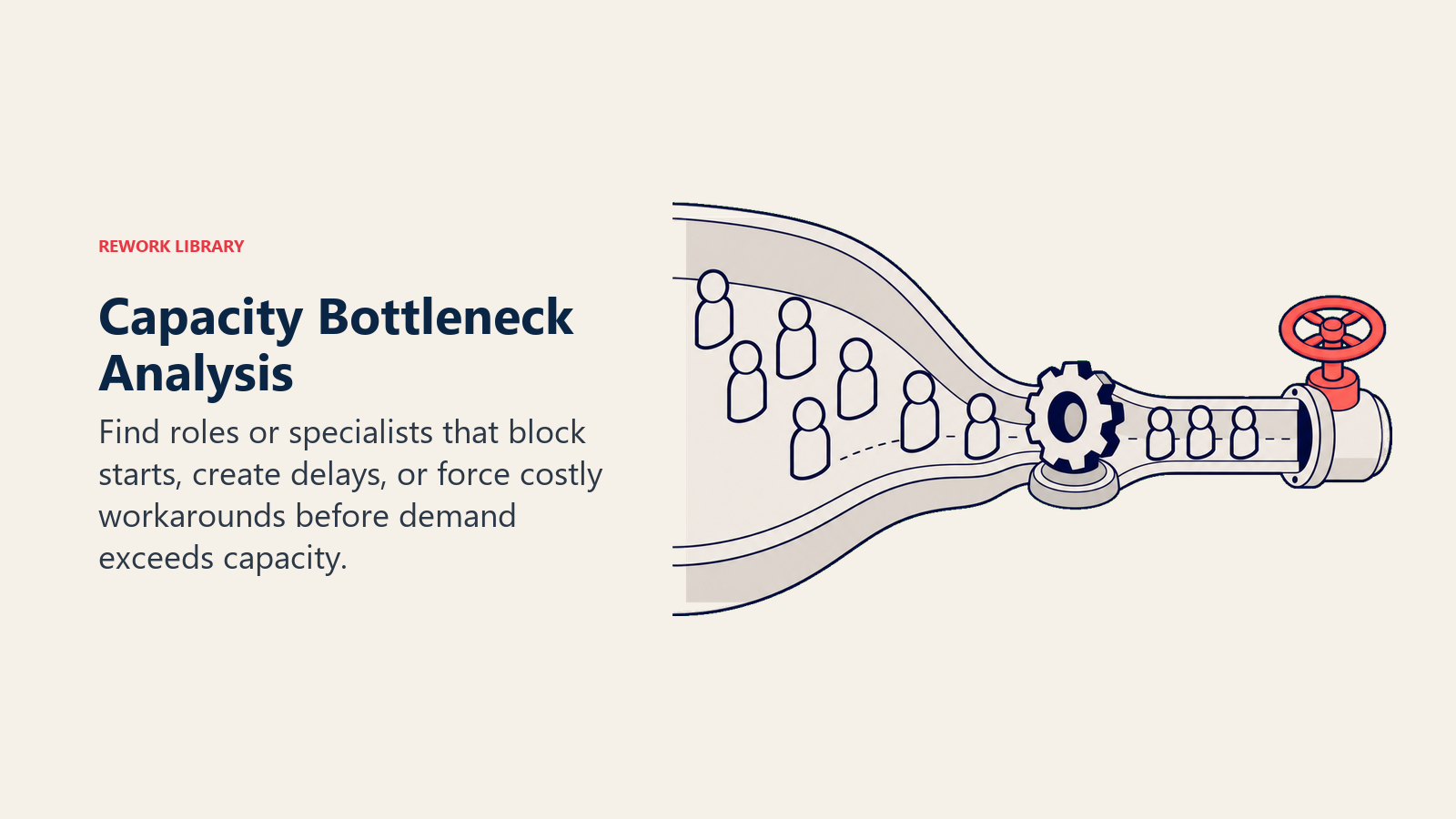
Growth exposes capacity constraints. Identifying and addressing these determines whether you scale profitably:
Identifying Bottleneck Resources
Look for roles or individuals who are:
- Consistently at 90%+ utilization
- Blocking project start dates
- Creating delivery delays
- Driving high contractor costs
Common bottlenecks:
- Senior practitioners with specialized expertise
- Client relationship owners who can't delegate
- Technical experts in niche domains
- Project managers in high-growth periods
The Hire vs. Outsource Decision
When you hit capacity constraints, you've got three options:
Option 1: Hire full-time staff
- Best when demand is sustained and predictable
- Higher upfront cost but better long-term economics
- Builds internal capability and culture
- Typical breakeven: 6-9 months of utilization at 70%+
Option 2: Engage contractors/freelancers
- Best for variable demand or specialized skills
- Higher hourly cost but no overhead or downtime
- Faster to scale up or down
- Works when demand is uncertain or project-specific
Option 3: Partner/subcontract with other firms
- Best for occasional overflow or geographic expansion
- Preserves client relationship while expanding capacity
- Revenue sharing reduces margin but eliminates overhead
- Valuable for capability gaps or market entry
The decision framework:
- If utilization of the new role would be 65%+ for 12+ months: hire
- If it's project-specific or under 6 months duration: contract
- If it's outside your core expertise or geographic market: partner
Seasonal Planning
Many professional services have predictable demand patterns:
- Accounting: Tax season peaks
- Consulting: Budget cycle planning
- Marketing: Campaign season surges
- Legal: Industry-specific cycles
Build your capacity plan around these patterns:
- Hire permanent staff for the baseline demand
- Develop contractor pools for peak periods
- Offer flexibility to retain top contractors year-round
- Use slow periods for training, BD, and thought leadership
Don't hire for peak demand and lay off during slow periods. You'll destroy your employer brand and lose talent permanently.
Utilization Tracking & Dashboards
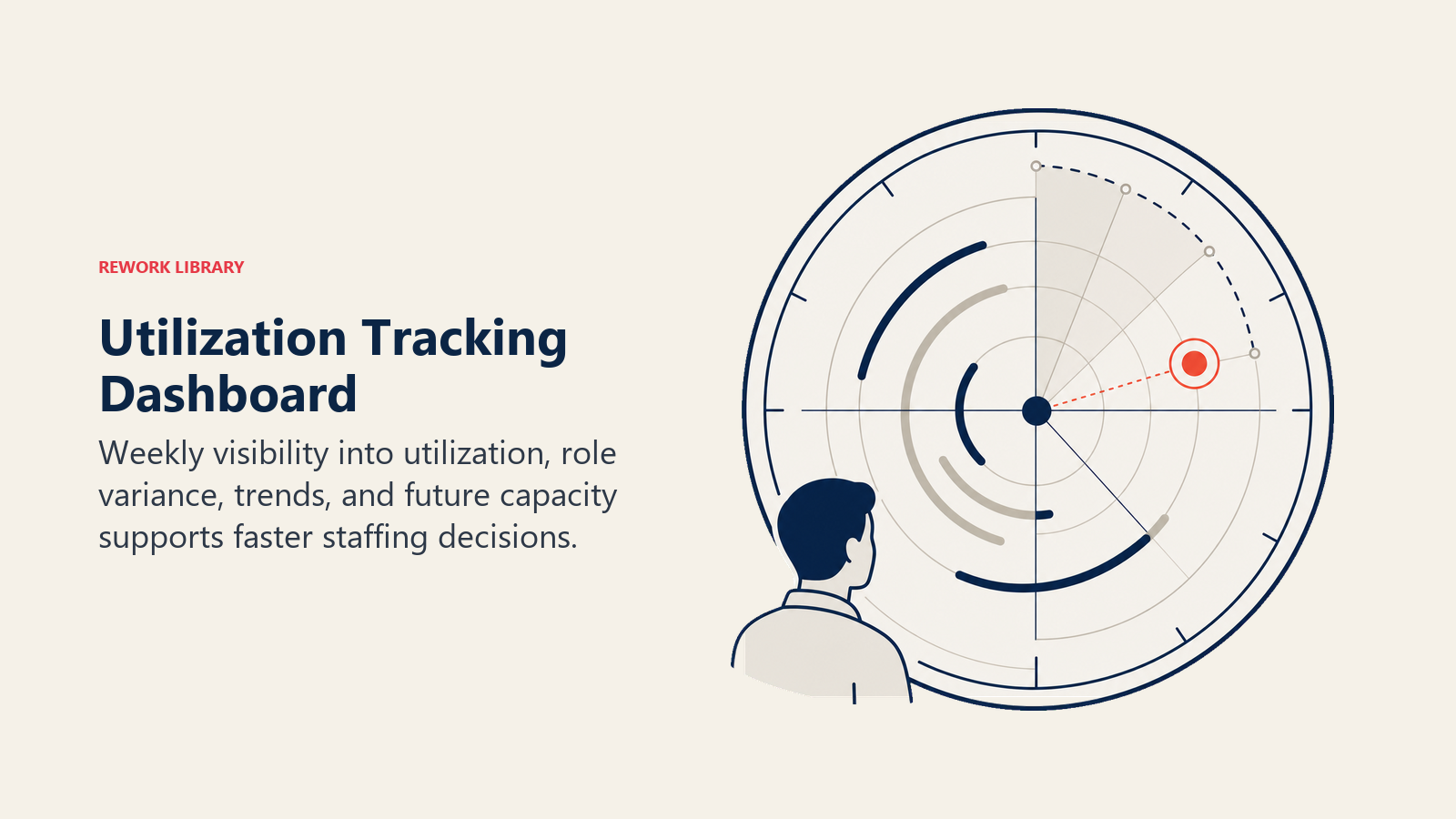
You can't manage what you don't measure. Build real-time visibility into utilization and capacity:
Weekly Dashboard Metrics
Track these numbers and review every Monday:
Overall Firm Utilization
- Current week actual billable %
- 4-week rolling average
- Trend vs. target (typically 70-75%)
Utilization by Role
- Partner/principal actual vs. target (40-50%)
- Senior/director actual vs. target (60-70%)
- Mid-level actual vs. target (70-80%)
- Junior actual vs. target (75-85%)
Capacity Status
- Committed capacity next 4 weeks
- Available capacity by role
- Pipeline-to-capacity ratio
- Bottleneck resources identified
Financial Impact
- Revenue realization vs. plan
- Margin performance by project
- Bench cost (unutilized staff cost)
Variance Analysis
When actuals differ from targets by more than 5 percentage points, investigate:
Under-utilization (below target):
- Pipeline gap - not enough sold work?
- Delivery delay - projects starting late?
- Inefficient allocation - people sitting between projects?
- Seasonal expected variance?
Over-utilization (above target):
- Scope creep on existing projects?
- Under-staffed project teams?
- Lack of investment time discipline?
- Unrealistic project schedules?
Early Warning Indicators
Build alerts for these warning signs:
Pipeline Coverage Below 1.5x Capacity If your qualified pipeline for the next 13 weeks is less than 1.5x your available capacity, accounting for typical win rates, you're at risk of utilization dropping in 8-12 weeks.
Partner Utilization Above 60% Your growth engine is being starved. Partners need to delegate delivery work and focus on business development and client relationships.
Junior Staff Below 70% Utilization You're paying for capacity you're not using. Either there's insufficient work or ineffective allocation.
Sustained Team Utilization Above 85% Your people are burning out. Quality will suffer, deadlines will slip, and attrition will spike.
Common Pitfalls to Avoid
Most professional services firms make these mistakes repeatedly:
Chasing 100% Utilization
The numbers look tempting but the consequences are brutal:
- Zero time for business development
- No capacity for proposal work
- Insufficient training and development
- High attrition from burnout
- Quality problems from rushed work
Firms that sustain 95%+ utilization are either:
- Riding a temporary surge before the crash
- Burning through people (high turnover)
- Delivering mediocre work (client churn)
- Failing to invest in growth (stagnation)
Target 70-80% firm-wide utilization and protect the investment time.
Under-Utilizing Senior Talent
Your most expensive people should be doing your most valuable work:
- Client relationship development
- Complex problem solving
- Junior staff mentoring
- Thought leadership
- Strategic firm building
When senior consultants spend 80% of their time on execution work that mid-level staff could handle, you're destroying value. The math is simple: if a partner bills at $400/hour but does work an associate could do at $150/hour, you're losing $250/hour in opportunity cost.
Build leverage ratios that push execution down and pull relationship building and strategy up.
Poor Pipeline Visibility
You can't plan capacity without knowing what's coming. Common problems:
- No systematic pipeline tracking
- Overly optimistic probability weighting
- Failure to account for sales cycle length
- Inadequate lead time for hiring
Build a real pipeline management process with:
- Defined stages and qualification criteria
- Historical close rates by stage
- Realistic time-to-close estimates
- Regular pipeline reviews with accountability
Inflexible Resource Allocation
Treating people as dedicated to specific accounts or projects reduces allocation efficiency:
- Accept that project teams should be fluid
- Develop people across multiple service lines
- Build hybrid skills in your staff
- Use the allocation matrix to optimize across all work
The firms with the highest utilization and best margins are masters at resource reallocation.
Optimization Levers You Can Pull
When utilization needs improvement, you've got multiple levers to pull:
Improve Win Rates
Increasing close rates from 40% to 50% means you convert more pipeline to booked work with the same sales effort:
- Better qualification (pursue the right opportunities)
- Stronger value propositions
- More effective proposal development processes
- Improved pricing and negotiation
A 10-percentage-point win rate improvement can increase revenue 15-20% without adding capacity.
Shorten Sales Cycles
Reducing time-to-close from 90 days to 60 days means:
- More accurate capacity forecasting
- Less pipeline needed to maintain utilization
- Faster revenue realization
- Reduced proposal costs
Focus on qualification, decision-maker access, and urgency creation.
Increase Average Project Size
Larger engagements improve utilization because:
- Less time between projects
- Better resource allocation efficiency
- Economies of scale in delivery
- Stronger client relationships
Moving from $50K to $150K average project size typically improves utilization by 5-10 percentage points.
Standardize Service Delivery
Repeatable methodologies and frameworks increase efficiency:
- Faster project setup and execution
- Better resource utilization through familiarity
- Reduced rework and quality issues
- Easier training and knowledge transfer
Firms with productized services consistently achieve 5-10 percentage points higher utilization than purely custom delivery.
Right-Size Project Teams
Over-staffing wastes capacity. Under-staffing creates quality problems and burnout:
- Define optimal team structures for each service line
- Track actual hours vs. budgeted hours by role
- Adjust staffing based on project complexity
- Use the data to improve future estimates
Most firms discover they're over-staffing project management and under-staffing specialist expertise.
Building Your Capacity Planning System
Start simple and add sophistication as you scale:
For Firms Under 20 People
Use a spreadsheet-based allocation matrix updated weekly:
- List all people with their available hours
- List all projects with resource requirements
- Match people to projects manually
- Color-code utilization levels
- Review in weekly operations meetings
This is sufficient until complexity demands automation.
For Firms 20-75 People
Implement professional services automation (PSA) software:
- Automated time tracking and utilization reporting
- Resource scheduling and allocation tools
- Pipeline integration for capacity forecasting
- Real-time dashboards and analytics
Look for tools like FinancialForce, Kimble, or Kantata (formerly Mavenlink).
For Firms 75+ People
Build a resource management practice:
- Dedicated resource manager role
- Integrated CRM-PSA-Financial systems
- Predictive analytics and capacity modeling
- Cross-office resource optimization
At this scale, capacity planning is a specialized function requiring dedicated expertise and systems.
Making It Work
Utilization and capacity planning isn't about squeezing every hour out of your people. It's about optimizing the balance between revenue generation, business development, and team sustainability.
The firms that get this right target 70-80% overall utilization while varying significantly by role. They invest non-billable time strategically in the activities that compound into future growth. They plan capacity on a rolling 13-week basis and adjust allocation weekly based on real data.
Start by measuring your current utilization accurately. Break it down by role and compare to the target ranges. Identify your bottleneck resources and capacity constraints. Build a simple allocation matrix and review it weekly.
Then protect investment time ruthlessly. Partners need 50% non-billable time to grow the firm. Senior consultants need 30% to develop client relationships and build expertise. Everyone needs development time to improve and grow.
The math is clear: a well-run firm at 75% utilization with strategic time investment will outperform and outlast a firm grinding at 95% utilization every single time.
Ready to optimize your resource allocation? Explore the frameworks for staffing & resource allocation and leverage model optimization to build sustainable growth.
Learn more:

Sales Director
On this page
- What is Utilization & Capacity Planning?
- The Mathematics of Utilization
- Industry Benchmarks by Service Type
- Target Utilization Rates by Role
- Partners & Principals (40-50% billable)
- Senior Consultants/Directors (60-70% billable)
- Mid-Level Staff (70-80% billable)
- Junior Staff (75-85% billable)
- The 13-Week Rolling Capacity Framework
- Week 1-4: Committed Capacity
- Week 5-8: High-Probability Pipeline
- Week 9-13: Qualified Opportunities
- Non-Billable Investment Time Categories
- Business Development (15-25% for partners)
- Proposal Development (5-15% depending on role)
- Training & Development (5-10% across all levels)
- Thought Leadership (10-20% for partners/seniors)
- Internal Operations (5-10%)
- Resource Allocation Strategies
- The Allocation Matrix
- Strategic Overbooking
- Cross-Training Investment
- Capacity Constraints & Bottlenecks
- Identifying Bottleneck Resources
- The Hire vs. Outsource Decision
- Seasonal Planning
- Utilization Tracking & Dashboards
- Weekly Dashboard Metrics
- Variance Analysis
- Early Warning Indicators
- Common Pitfalls to Avoid
- Chasing 100% Utilization
- Under-Utilizing Senior Talent
- Poor Pipeline Visibility
- Inflexible Resource Allocation
- Optimization Levers You Can Pull
- Improve Win Rates
- Shorten Sales Cycles
- Increase Average Project Size
- Standardize Service Delivery
- Right-Size Project Teams
- Building Your Capacity Planning System
- For Firms Under 20 People
- For Firms 20-75 People
- For Firms 75+ People
- Making It Work