Professional Services Growth Model: A Strategic Framework for Sustainable Firm Growth
Turn this article into takeaways for your work.


Each assistant summarizes the article only for you and suggests best practices for your work.
The professional services growth model is an integrated operational system for growing a firm's revenue predictably, not a single sales or marketing tactic. It rests on six pillars (expertise and positioning, business development, sales process, service delivery, client success, and operational excellence) and moves accounts through a five-stage cycle from market positioning to retention and advocacy. Firms grow when those pillars work together, not when they simply hire more talented people.
Here's the professional services paradox: you're brilliant at what you do. Your clients love your work. You have deep expertise and a track record of results. But growth? That's inconsistent, unpredictable, and exhausting.
The problem isn't your capabilities or your market. It's that most professional services firms treat growth like it's magic instead of a system. They think hiring talented consultants or lawyers or strategists will automatically generate new business. It doesn't work that way.
If you're a managing partner, practice leader, or firm executive trying to build predictable growth, you need to understand this: professional services growth isn't a business development project or a sales initiative. It's an integrated operational framework that touches every part of how you run your firm.
What is Professional Services Growth?
Professional services growth is the systematic process of attracting, winning, delivering, and expanding client relationships in a way that creates sustainable revenue increases without sacrificing profitability or burning out your team.
Notice what's not in that definition: "selling more hours" or "marketing harder." Real growth in professional services comes from building operational systems across six pillars that work together.
The Six Growth Pillars
1. Expertise & Positioning Your market reputation and how clearly you articulate what you're best at. Not what you can do, but what you're known for and why clients choose you over alternatives.
2. Business Development The relationship-building activities that create opportunities before prospects are ready to buy. This includes thought leadership strategy, professional networking, speaking, publishing. The long game.
3. Sales Process How you move from initial conversation to signed engagement. This includes client qualification, discovery, proposal development, pricing justification, and closing.
4. Service Delivery The actual execution of client work. Quality delivery isn't just about client satisfaction, it's your growth engine through referrals, case studies, and repeat business.
5. Client Success How you ensure clients achieve outcomes that justify what they paid you. This creates expansion opportunities and turns clients into advocates.
6. Operational Excellence The internal systems that enable profitable growth, utilization management, capacity planning, talent development, and knowledge management.
Most firms focus on one or two pillars and wonder why growth stalls. You need all six working together.
Why Professional Services Can't Grow Like Product Companies
Before we get to the growth model, you need to understand the unique economics that constrain service firms. Product companies can scale revenue without proportionally scaling costs. You can't.
The Time-Based Revenue Constraint
Your revenue is fundamentally tied to billable time. Whether you charge hourly or use value-based pricing, there's a ceiling on how much work your team can deliver. A software company can sell the same product to 10 customers or 10,000 without significantly increasing headcount. You can't deliver consulting work or legal services or creative strategy to 10,000 clients with the same team that serves 10.
This creates the core growth challenge: you have to add capacity (people) to grow revenue, but adding people increases costs before it generates revenue. The lag between hiring and productivity means growth is inherently risky and capital-intensive. Understanding the key professional services metrics helps you manage this risk effectively.
Utilization vs Capacity Dynamics
Professional services firms live in constant tension between utilization and capacity. High utilization (75-85% of time is billable) means good profitability but no capacity for growth activities or new client work. Low utilization means you have capacity but you're burning money on unproductive time.
The sweet spot differs by service type, consulting firms typically target 70-75%, agencies aim for 75-85%, law firms push 80-90%. But the principle is the same: you need some unbillable capacity for business development, thought leadership, and capability building. That capacity is an investment in future growth.
The Leverage Model
Most successful professional services firms operate on a leverage model: senior partners generate work and provide oversight while junior staff deliver the bulk of billable hours. This creates profit because you charge clients $300/hour for work performed by someone you pay $75/hour in compensation.
But this only works if you can consistently fill your pipeline with the right type of work. Without systematic business development, partners spend time on delivery instead of selling, which destroys the leverage model. You end up with highly paid experts doing work that should be delegated while business development suffers.
The growth challenge is building systems that protect partner time for high-value activities (selling, client relationships, thought leadership, and quality oversight) while juniors handle execution. This is where leverage model optimization becomes critical.
The Professional Services Growth Model Framework
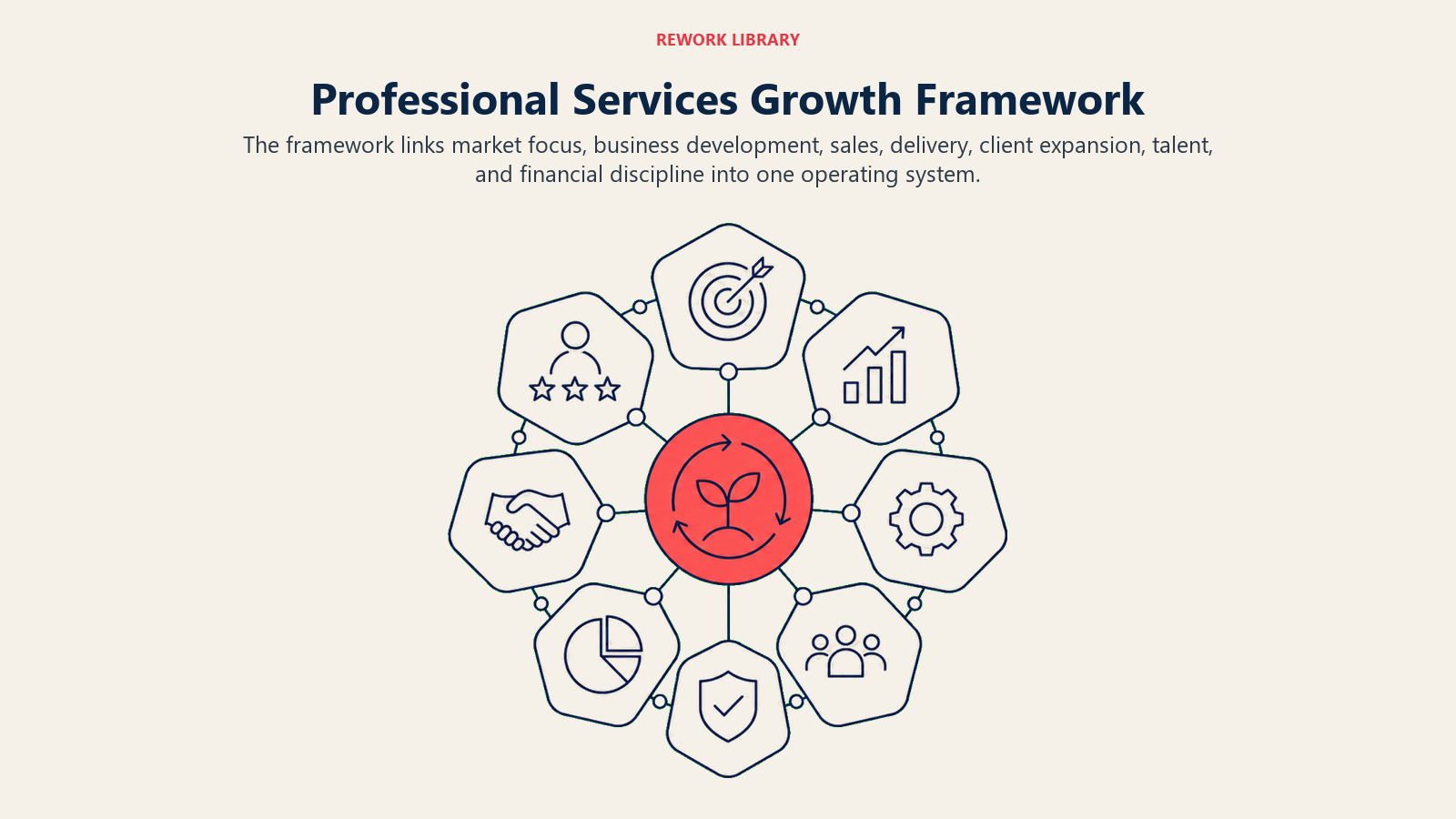
Sustainable growth follows a predictable five-stage cycle. Most firms get stuck because they optimize one stage while neglecting others.
Stage 1: Market Positioning
This is how clearly the market understands what you do, who you serve, and why you're different. Poor positioning sounds like "We're a full-service consulting firm serving middle-market companies across multiple industries." That's not positioning, that's a description of mediocrity.
Strong positioning is specific: "We help private equity firms accelerate value creation in portfolio companies through operational performance improvement." Now the market knows who you serve (PE firms), what you do (operational improvement), and when you're relevant (post-acquisition value creation).
Positioning enables everything else. Without it, your business development is scattered, your sales conversations are generic, and prospects can't explain to others why they should hire you. With it, you get inbound leads, referrals from people who understand your value, and premium pricing.
Key activities in this stage:
- Defining your ideal client profile based on where you win consistently
- Articulating your unique methodology or approach
- Building proof points through case studies and results
- Creating thought leadership that demonstrates expertise
Stage 2: Pipeline Generation
Once positioning is clear, you need systematic methods for creating opportunities. This isn't cold outreach or spray-and-pray marketing. It's deliberate relationship-building that creates conversations with qualified prospects.
Professional services buyers don't wake up and decide to hire a consultant or agency. They hire because they have a problem they can't solve, a risk they need to mitigate, or an opportunity they can't capture alone. Your pipeline generation has to intersect with those moments.
Effective pipeline generation combines:
Inbound channels: Content marketing, speaking engagements, podcasts, publishing, webinars. These position you as the expert and create awareness so prospects come to you.
Outbound relationship building: Strategic networking, industry event participation, referral partnerships. These create warm introductions and relationship-based opportunities.
Existing network activation: Staying top-of-mind with past clients, referral sources, and your professional network so they think of you when opportunities arise.
The mistake most firms make is treating pipeline generation as a marketing department's job. In professional services, your senior people are the primary pipeline generators. Marketing supports them but can't replace them.
Stage 3: Conversion Excellence
You have opportunities. Now can you close them efficiently without burning excessive time on proposals that don't convert?
This stage is about qualification, discovery, and commercial discipline. You need to know which opportunities are worth pursuing, how to structure engagements that match client needs with your capabilities, and how to price for value instead of just time.
The biggest waste in professional services is pursuit effort on opportunities you shouldn't be chasing. Bad-fit clients, unrealistic budgets, politically difficult buying processes, competitors with inside tracks, these all drain your capacity and destroy morale.
Conversion excellence requires:
Rigorous qualification: Clear criteria for what makes an opportunity worth pursuing. This includes fit, budget, decision process, timeline, and competitive landscape.
Consultative discovery: Deep understanding of client problems, desired outcomes, internal constraints, and decision criteria. You can't write winning proposals without this.
Value-based pricing: Pricing based on client outcomes and your unique value, not just hours required. This improves margins and changes the sales conversation from cost to investment. Master the pricing justification process to defend your value effectively.
Proposal discipline: Only writing detailed proposals when you have a real shot at winning. For low-probability opportunities, use lighter-weight approaches.
Track your proposal win rate by type of opportunity. If you're below 40%, you're either pursuing the wrong opportunities or your sales process needs work. Above 60% and you're probably leaving money on the table with too-low pricing.
Stage 4: Delivery & Expansion
Winning work is expensive. Converting that work into ongoing relationships and additional revenue is how you achieve profitable growth.
Service delivery isn't separate from growth, it's your most powerful growth driver. Exceptional delivery creates case studies, referrals, references, and expansion opportunities. Mediocre delivery forces you to constantly chase new logos because existing clients don't renew or expand.
The operational challenge is balancing delivery excellence with expansion conversations. Most firms staff projects for delivery efficiency, which means account leaders are buried in execution and miss expansion opportunities. You need capacity for relationship management and opportunity identification within existing accounts.
Key delivery-stage activities for growth:
- Executive sponsor check-ins to ensure client stakeholders see ongoing value
- Identifying additional needs and challenges during discovery
- Demonstrating quick wins and tangible results that build confidence
- Bringing in other capabilities through deliberate cross-sell
- Creating advocates within the client organization
One simple metric reveals whether you're doing this well: revenue per client over time. If it's flat or declining, you're just delivering projects. If it's growing 20-30% annually, you're expanding accounts systematically. Develop a formal cross-sell strategy to make this growth intentional.
Stage 5: Retention & Advocacy
The final stage converts satisfied clients into sources of future revenue through retention, repeat business, and referrals.
In professional services, your best growth comes from existing relationships. The client acquisition cost is zero, the sales cycle is short, and the close rate is high because they already trust you. Firms that maximize this stage can reduce reliance on expensive new business development.
But retention isn't passive, it requires deliberate effort:
Staying engaged between projects: Regular check-ins, sharing relevant insights, introducing them to people who can help them. This keeps you top-of-mind when new needs arise.
Creating systematic touchpoints: Quarterly business reviews, annual planning sessions, industry updates. These create structured opportunities to identify new work.
Building referral systems: Making it easy for happy clients to introduce you to their networks. This means articulating who you're looking to meet and providing introductions that create value for both parties. A systematic referral generation approach amplifies these efforts.
Measuring client health: NPS scores, satisfaction surveys, and renewal likelihood indicators. This allows you to address issues before they become exits.
The metric that matters here: client lifetime value and referral rate. If 40%+ of new business comes from existing client referrals, your retention and advocacy systems are working.
Business Development vs Sales: Why the Distinction Matters
Most professional services firms confuse business development with sales. They're different disciplines that require different approaches.
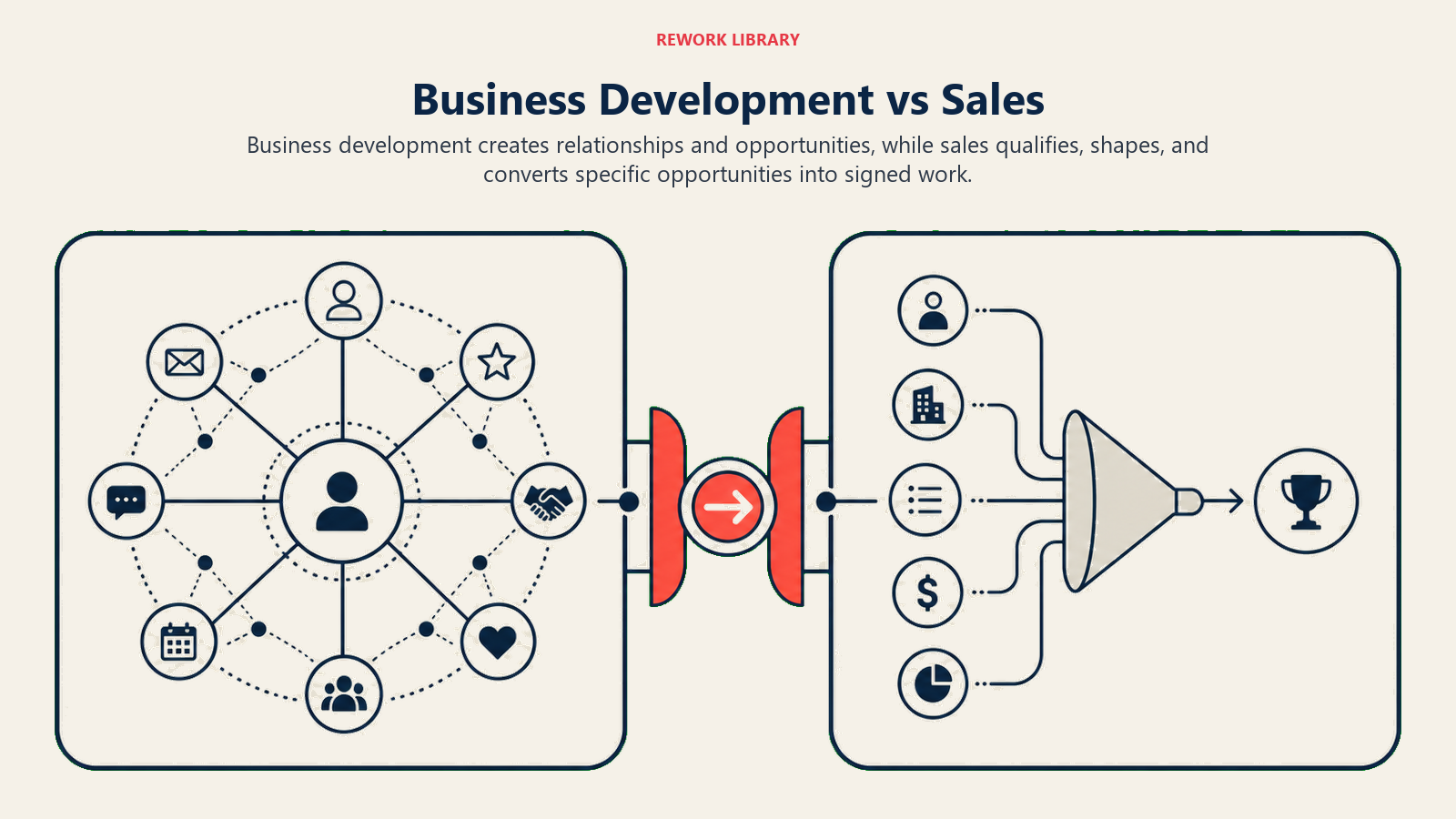
Sales is transactional and time-bound. A prospect has a need, you propose a solution, they decide to buy or not. The cycle is weeks or months. Skills required: qualifying, discovery, proposal development, negotiation, closing.
Business development is relational and continuous. You build relationships with future buyers before they have immediate needs, so when those needs arise, you're the first call. The cycle is months or years. Skills required: thought leadership, strategic networking, reputation building, industry expertise.
In product sales, you can hire a sales team and expect results in 90 days. In professional services, that doesn't work. Your senior professionals are the business development engine because clients buy expertise and relationships, not products. You can't outsource that.
The operational implication: you need to protect partner time for business development and create systems that make it efficient. This means using junior staff for research, preparation, and follow-up so partners focus on high-value relationship activities.
The Consultative Engagement Cycle
Professional services buying doesn't follow a linear funnel. It's cyclical and relationship-based. Someone becomes aware of your firm, engages with your content or attends your event, has a conversation, goes quiet for six months, resurfaces with a project, becomes a client, goes dormant, comes back with a referral.
This requires different metrics than product sales:
- Relationship strength and recency, not just pipeline value
- Engagement over time, not just conversion rates
- Share of wallet from existing clients, not just new logos
- Referral velocity from your network
Thought Leadership as a Growth Engine
In professional services, thought leadership isn't marketing fluff, it's your primary demand generation tool. When prospects can't easily evaluate your capabilities before hiring you, they look for signals of expertise. Published insights, speaking engagements, original research, and frameworks you've developed are those signals.
Firms that systematically produce thought leadership (one substantive piece per partner per quarter) see 2-3x more inbound opportunities than firms that don't. The challenge is making it operational, systems for ideation, creation, distribution, and amplification that don't depend on inspiration.
Key Growth Metrics That Actually Matter
Most professional services firms track revenue and profit margin. That's not enough to manage growth operationally. You need metrics that show whether your growth engine is healthy or breaking down.
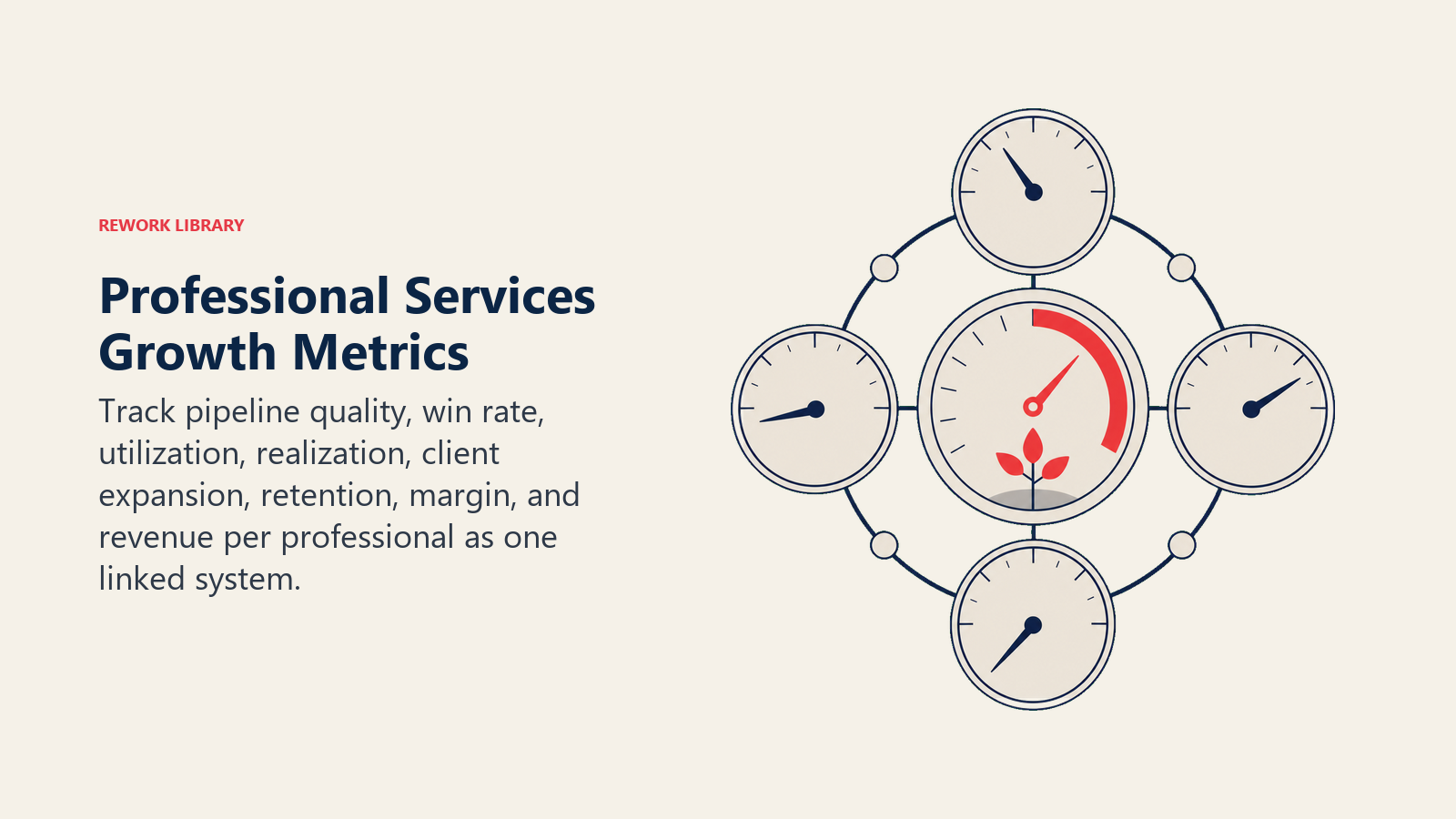
Pipeline velocity and conversion rates: How long do opportunities sit in your pipeline before converting or dying? Healthy firms move from first conversation to signed engagement in 45-90 days for most work. If you're consistently over 120 days, you're either pursuing wrong-fit opportunities or your sales process is broken.
Track conversion rate by stage: qualified opportunity to proposal, proposal to finalist, finalist to win. This shows you where you're losing deals and where to improve.
Utilization and realization rates: Utilization is the percentage of available time that's billable. Realization is the percentage of billable time you actually invoice and collect. Together they determine your effective billing rate.
High utilization (80%+) with low realization (60-70%) means you're burning time on scope creep or writing off hours. High realization (90%+) with low utilization (50%) means you're not selling enough work. The sweet spot: 70-80% utilization with 85-90% realization.
Revenue per professional: This measures productivity and leverage. Are you generating $250k, $400k, or $800k in revenue per full-time professional? Growth should increase this metric through better leverage, higher pricing, or operational efficiency.
If revenue per professional is flat while headcount grows, you're not really growing, you're just getting bigger.
Client acquisition cost and lifetime value: How much does it cost (time and money) to win a new client, and how much revenue do they generate over their relationship with you? The ratio should be at least 3:1 (LTV:CAC). If it's lower, you're spending too much on acquisition or not getting enough lifetime value.
Track these by client segment and service line. Some segments might be 10:1, others might be 1:1. That tells you where to focus growth investment.
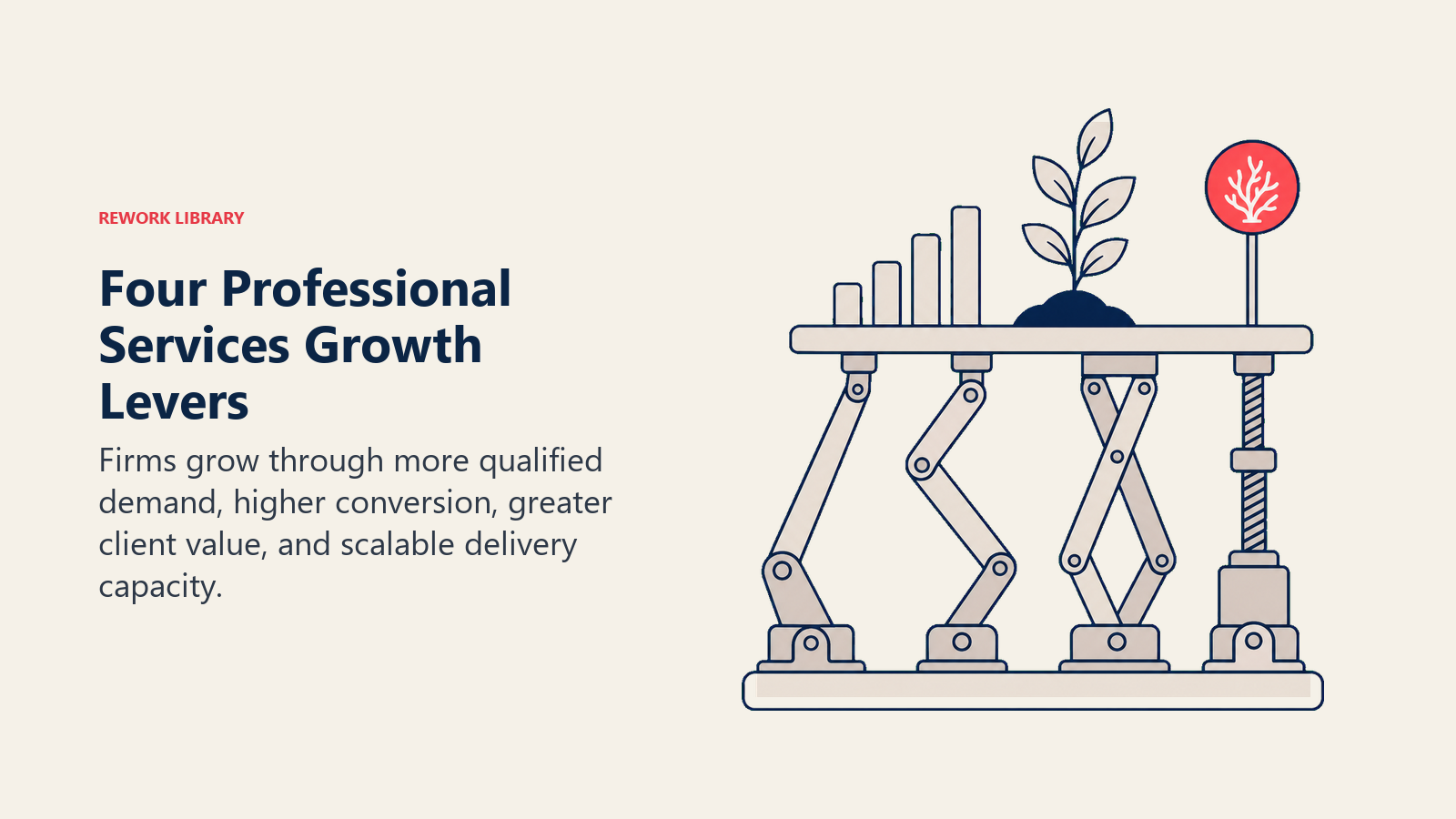
The Four Growth Levers
When you need to accelerate growth, you have four levers to pull. Most firms only use one or two.
Lever 1: Client Acquisition (New Logos)
Win more new clients. This is the most obvious lever but also the most expensive. Every new client requires education, relationship building, and trust establishment. Your close rates are lower and sales cycles are longer than with existing clients.
Use this lever when you're entering new markets, launching new services, or your existing client base is too small to drive target growth. But recognize it's the highest-cost path.
Lever 2: Wallet Share (Cross-Sell and Upsell)
Increase revenue from existing clients by expanding scope, adding services, or deepening engagement. This is the highest-ROI lever because trust and relationships already exist.
The challenge is organizational, delivery teams focused on execution often miss expansion opportunities. You need account planning, white space analysis, and cross-functional collaboration to make this work systematically.
Lever 3: Pricing Power (Value Capture)
Increase your effective billing rate by charging more for the same work. This only works if you can articulate and demonstrate unique value. Commoditized services get commoditized pricing.
Pricing power comes from positioning, expertise, results, and client outcomes. It's the most profitable growth lever because it requires no additional capacity.
Lever 4: Operational Efficiency (Margin Improvement)
Deliver the same services with less time or cost. This improves profit margin, which funds growth investments and provides buffer for price competition.
This lever involves process improvement, knowledge management, technology adoption, and junior staff development. It's the slowest lever but creates sustainable competitive advantage.
Balanced growth uses all four levers strategically based on your situation, market, and capabilities.
Industry-Specific Considerations
The core growth model applies across professional services, but execution varies by industry.
Management consulting firms sell expertise and frameworks. Their growth depends heavily on thought leadership, case study results, and partner-led business development. They typically operate on project-based work with strong leverage models (6:1 or 8:1 junior to senior ratios).
Marketing and creative agencies sell creativity and execution. Their growth comes from retainer relationships and portfolio-based selling. They face commoditization pressure and need to differentiate through specialized capabilities or results-based pricing.
Law firms sell specialized expertise and risk mitigation. Their business development cycles are very long (years) and relationship-intensive. They rely heavily on referrals and reputation. Growth comes from lateral partner hires and client relationship deepening.
Accounting firms sell compliance and advisory services. Their growth model combines recurring compliance revenue (tax, audit) that funds advisory service development. They benefit from high switching costs once relationships are established.
Each has different metrics, cycles, and growth levers, but all need the six pillars working together.
Common Growth Barriers and How to Break Through
The feast-or-famine cycle: You're either delivering work or selling it, never both at once. This happens when you lack pipeline discipline. The solution is protecting dedicated time for business development even when you're busy and maintaining minimum pipeline thresholds (3x target revenue in qualified opportunities).
Founder dependency: All growth comes through the founder or managing partner. If they're not actively selling, revenue stalls. This happens when you haven't built business development capabilities in other partners. The solution is systematic business development training and accountability for all senior professionals.
Commoditization and price pressure: Clients see you as interchangeable with competitors and buy on price. This happens when positioning is weak or service offerings are too broad. The solution is narrowing focus to areas where you have demonstrable advantage and building proof of unique value.
Talent retention challenges: You train people and they leave for competitors or start their own firms. This happens when there's no clear growth path or economic participation. The solution is creating partnership tracks, equity opportunities, and career development systems that retain high performers.
From Ad-Hoc to Systematic: Assessing Your Growth Maturity
Most professional services firms evolve through predictable stages.
Stage 1 - Opportunistic: Growth comes from personal networks and referrals. No systematic processes. Revenue is unpredictable. This works until about $2-5M in revenue.
Stage 2 - Activity-Based: You implement some systems (CRM, pipeline tracking, marketing activities) but growth is still driven by individual effort. Revenue is somewhat predictable but dependent on key people.
Stage 3 - Process-Driven: You have defined processes for business development, sales, delivery, and account management. Multiple people can execute them. Growth becomes more predictable.
Stage 4 - Optimized: You systematically measure and improve every part of the growth model. You make decisions based on data about which activities drive results. Growth is consistent and profitable.
Stage 5 - Strategic: Growth is integrated across all operations. You can predictably enter new markets, launch new services, and scale capacity because your systems support it.
Most firms operate between Stage 2 and Stage 3. Moving to Stage 4 requires treating growth as a core operational discipline, not a side activity.
Conclusion: Growth as an Integrated System
Professional services growth isn't a business development problem or a sales problem. It's a systems problem. The firms that grow sustainably do so because they build operational frameworks that connect positioning, pipeline generation, conversion, delivery, and expansion into a coherent system.
You can't delegate this to a marketing department or a sales hire. Growth in professional services requires senior professionals spending time on business development, supported by systems that make that time productive.
The choice you face as a firm leader is whether to keep treating growth as an art (inconsistent, personality-driven, unpredictable) or build it as a discipline (systematic, measurable, scalable).
Expertise alone doesn't guarantee growth. But expertise combined with operational discipline creates firms that grow profitably, serve clients exceptionally, and provide rewarding careers for your people.
That's the difference between hoping for growth and engineering it.
Deep dive into specific growth areas:

Sales Director
On this page
- What is Professional Services Growth?
- The Six Growth Pillars
- Why Professional Services Can't Grow Like Product Companies
- The Time-Based Revenue Constraint
- Utilization vs Capacity Dynamics
- The Leverage Model
- The Professional Services Growth Model Framework
- Stage 1: Market Positioning
- Stage 2: Pipeline Generation
- Stage 3: Conversion Excellence
- Stage 4: Delivery & Expansion
- Stage 5: Retention & Advocacy
- Business Development vs Sales: Why the Distinction Matters
- The Consultative Engagement Cycle
- Thought Leadership as a Growth Engine
- Key Growth Metrics That Actually Matter
- The Four Growth Levers
- Lever 1: Client Acquisition (New Logos)
- Lever 2: Wallet Share (Cross-Sell and Upsell)
- Lever 3: Pricing Power (Value Capture)
- Lever 4: Operational Efficiency (Margin Improvement)
- Industry-Specific Considerations
- Common Growth Barriers and How to Break Through
- From Ad-Hoc to Systematic: Assessing Your Growth Maturity
- Conclusion: Growth as an Integrated System